
Contact

Monitoring a just transition to a net zero and climate resilient Scotland
The Scottish Government has made successive commitments to delivering a just transition to a net zero and climate resilient Scotland. The Scottish Government and others have made progress in developing monitoring and evaluation (M&E) frameworks to consider the fairness of transition processes and outcomes. However policymakers have found that these were not ready to be implemented in practice.
On behalf of the Scottish Government, ClimateXChange commissioned a research fellow, embedded in the government’s Climate Change Analysis team, to develop a just transition M&E framework that prioritises rigour and practical use.
This research is independent and should not be considered Scottish Government policy.
The framework
The proposed framework is made up of four outcomes, each with a set of indicators – Communities and Places, People and Equity, Jobs, Skills and Economic Opportunities, Environment and Biodiversity.
There are 50 outcome indicators in total. 15 of these are identified as summary indicators intended to provide a high-level overview of progress that can be more easily communicated than the full indicator set.
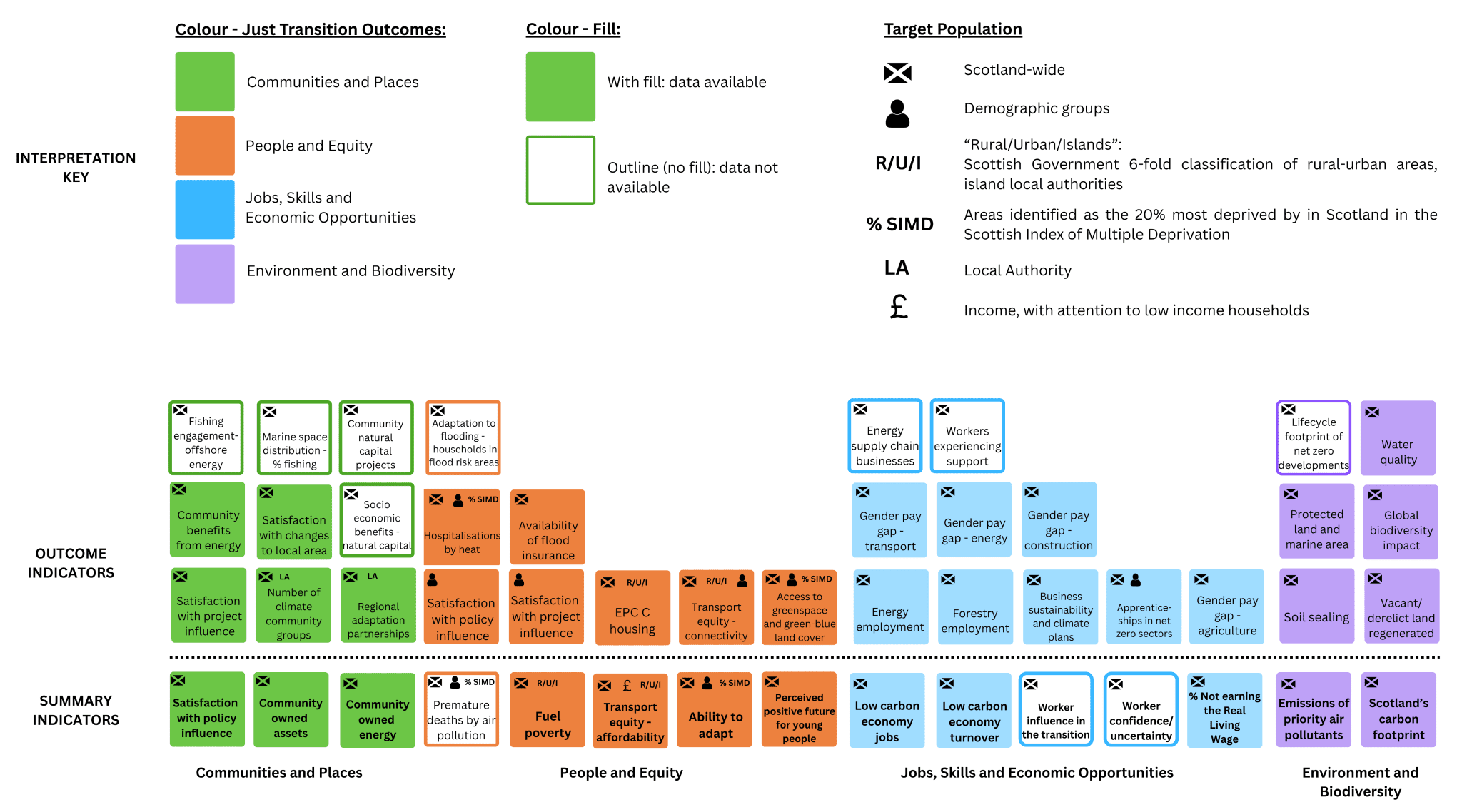
In addition to outcome indicators, this research includes 23 indicators focused on key locations, or hotspots, where the transition to a net zero and climate resilient Scotland is likely to have significant impact.
Hotspots are defined as places either experiencing significant industrial change, for example Aberdeen and Grangemouth, or hosting major net zero developments, such as Shetland and Dumfries and Galloway.
This project also examines possible anticipatory approaches for early warning identification and monitoring of hotspots, transition risks and opportunities.
The proposed framework emphasises the essential role of regular stakeholder engagement to inform all dimensions of M&E. It can be used as a tool for qualitative data collection, an approach for monitoring and indicator interpretation, a real-time tool for risk mitigation and a method for the anticipation of potential transitions.
Recommendations
The research report includes a number of recommendations to further develop the framework and just transition monitoring and evaluation. These include testing and refining through data collection, developing qualitative engagement tools, filling critical data gaps and using communications tools such as data visualisation tools to engage with external stakeholders on just transition progress.
For detailed recommendations and next steps and to learn about the development of the proposed framework, please read the report.
If you require the report in an alternative format, such as a Word document, please contact info@climatexchange.org.uk or 0131 651 4783.