

Reducing the amount of energy used in Scottish homes is an important part of transitioning to a low carbon economy. It also provides valuable opportunities to reduce household energy bills, improve indoor comfort and increase the security of Scotland’s energy supply.
In the recent Heat Policy Statement (HPS) the Scottish Government announced that it is designating energy efficiency as a National Infrastructure Priority. The cornerstone of this will be Scotland’s Energy Efficiency Programme (SEEP) which will offer support to all buildings in Scotland – domestic and non-domestic – to improve their energy efficiency rating.
This review of energy efficiency interventions includes energy efficiency regulations, schemes, support programmes, incentives and fiscal levers in other European countries, top performing American states and selected countries with relevant experience. The focus of the study is on refurbishment and new-build Building Regulations were therefore excluded.
The study was carried out by consultants Ricardo AEA between January and September 2015.
Over the last 50 years Scotland has seen a significant change in climate – to warmer and wetter weather with more extreme weather events. This poses significant risks to our infrastructure. Yet, we do not have a clear strategy for how adapting our road, rail and energy networks, or our urban and rural built environments should be financed.
We can reduce future expenditure, disruption and damage by planning and implementing actions that increase current resilience and allow us to adapt in the future. But climate change adaptation projects, especially those focussing on longer term climate change, are particularly demanding from a financing point of view in terms of quantifying or monetising the benefits of addressing future climate change.
A new report from the University of Leeds looks at how to improve access to finance mechanisms and how to maximise the contribution of adaptation actions to the local economy. The report finds that the mechanisms currently available to finance projects adapting infrastructure to climate change, like government capital grants, user charges, the public works loan board (PWLB), and grant funding, are under pressure both from cuts to public finance and challenges of accessing traditional private finance.
The report also sets out areas that need further research and where government interventions could remove barriers to finance.
ClimateXChange were involved in initiating the research and organised an event for stakeholders to discuss the finding and challenges the report sets out.

This paper examines the current position of urban tree management and the extent to which climate change resilience is being addressed.
It provides feedback from interviews with six of the seven Scottish city arboricultural and greenspace officers and their responsiveness to the need for climate change adaptation and resilience building. It offers reflections on how policy support for the arboricultural and urban forestry sector can be more effective in future.
The main findings are:
- Ageing tree populations and the current and likely future impact of pests and diseases are currently changing attitudes and operations more than climate change
- Storms and recent case law involving human injury/death are increasing the adoption of risk management principles for city trees
- Availability of resources is currently limiting resilience-building strategies, though species diversification and establishment of novel species is taking place
- Scottish cities are showing significant interest in more efficient re-use and marketing of their arboricultural arisings, for timber, firewood, biomass and horticultural uses, though the primary motivation is financial
- There is a need to develop a better collective understanding of the value of trees across local authority departments
Dr Joanne Wade, Association for the Conservation of Energy
Presentation by Dr Joanne Wade, providing a summary of recent, peer reviewed evidence about the impacts of energy efficiency programmes on household energy use. Presented at the Edinburgh Centre for Carbon Innovation on the 19th of May 2015, this presentation offers recommendations for policy action and further research priorities.
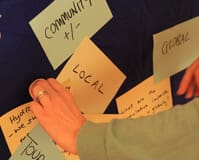
How do people feel about wind farms when they are given an opportunity to learn more about the topic and consider and discuss it as part of a group?
This unique research project, the most comprehensive of its kind and a world first, asked three groups of people (citizens’ juries) to come up with criteria for decision making about onshore wind farms in Scotland. Despite the diversity of views in the groups, all three juries managed to develop and agree a list of principles, showing that people from very different backgrounds and with varying perspectives can work together through difficult issues and come up with solutions.
Between October 2013 and February 2014 three groups of 15-20 people spent two Saturdays together listening to speakers before being asked to discuss, as a group, the question:
“There are strong views on wind farms in Scotland, with some people being strongly opposed, others being strongly in favour and a range of opinions in between. What should be the key principles for deciding about wind farm development, and why?”
Scottish Planning Policy emphasises the importance of public engagement, requiring that it should be early, meaningful and proportionate. However, to date, deliberative engagement has not been actively used to inform planning policy or decisions in Scotland. This project focussed on onshore wind farm development, and was designed to offer insight into key dynamics in citizen participation and public deliberation – rather than to inform decision-making.
The project report provides the policy and practice community with practical advice about organising and facilitating deliberative public engagement in support of decision-making. It explores how citizens’ knowledge and perspectives evolve during the process. It presents a picture of what the jurors decided matters most to them about wind farm development. It analyses whether three juries, addressing the same topic under similar conditions, generate different outcomes. And it explores the potential role of citizens’ juries in decision-making.
From the start of the juries, through hearing from expert witnesses, and discussing within the groups, we saw how the juries became a school in democracy. The participants enjoyed learning about the issue and really appreciated being asked their opinion in an atmosphere of respect for different views.
The project was overseen by a Stewarding Board comprising representatives from organisations with a range of opinions about wind farm development in Scotland. This Board discussed the jury task, project design, choice of jury locations and choice of ‘expert witnesses’.
The three jury locations where chosen to be of similar size and rural characteristics but with different exposure to wind farm developments:
- One location close to an existing wind farm (Aberfeldy)
- One with a wind farm proposed nearby (Helensburgh)
- A third with no existing or proposed wind farms (Coldstream)
There were a total of 47 jurors: 15 in Coldstream, 14 in Helensburgh and 18 in Aberfeldy. Taken together, the three juries reflected the diverse views and demographics of the Scottish population – i.e. education, gender, age and income. This meant, for example, that the juries brought together three generations to discuss the topic.
Researchers from University of Edinburgh and University of Strathclyde led the project, in collaboration with colleagues at University of West of Scotland, Queen Margaret University, Robert Gordon University and Glasgow University.
Marco Biagi ClimateXChangeTT2 from Sniffer Vimeo on Vimeo.
 This set of case studies reviews relevant national Climate Change and Energy strategies, plans and policies from elsewhere in Europe.
With a focus on heat, transport and agricultural policies, a range of countries were selected resulting in a suite of seven case studies: heat in Germany, the Netherlands and Sweden; transport in the Netherlands and Norway; and, agriculture in Denmark and France.
The research has shown that our case study countries are adopting a range of approaches to climate change policy which includes setting legally binding emissions reduction targets, implementing non-statutory targets, or simply following / committing to targets set by the EU for all member states.
Transitioning to a low carbon economy requires making important decisions about how we get energy. There are various technologies available that can be used to harness energy, each with their advantages and disadvantages; or comparative risks.
A number of energy technologies are currently contested in Scotland and in other countries. Arguments about such technologies are commonly characterised by differences in people’s perceptions of the risks associated with the technology. Conflicting information presented by various experts with differing perceptions of an issue can give the impression that little is known about the problem, even when this is not the case. Furthermore, different perceptions between experts and the wider public are often attributed to ‘information deficit’- a lack of knowledge, familiarity, and understanding of the risks associated with technologies. However, the factors influencing public concerns (such as issues of trust, empowerment and effective engagement) are often overlooked when making decisions about technologies and how they are developed. To add to the complexity, it is also not currently clear how perceived risk affects opinions on complex and contested issues.
ClimateXChange researchers at the Universities of Strathclyde and Aberdeen are exploring how risk perception varies with familiarity and expertise, and whether these factors influence opinion on the topic, using hydraulic fracturing (fracking) for shale gas in the UK as a case study.
CXC’s research seeks to explore how different groups of ‘experts’ (i.e. people with specialist knowledge about shale gas) answer questions about the potential environmental risks associated with shale gas extraction. This research uses the same questions as the University of Nottingham’s ongoing biannual survey of public attitudes towards fracking, but includes follow-on questions to investigate the rationale behind participant’s answers. This allows us to explore the participants understanding of risk and the language used to communicate risk. The research will also shed light on how opinions are affected by perceived risk.
This represents one of the first studies into how different types of expertise affects perception of risk. The work is important for policy making on complex and contested topics, where expert witnesses (typically with technical expertise) play an important role in informing decision making. The work will also inform the current debate about energy choices and developments as we move towards a low carbon energy future.
A report of the results will be published by Autumn 2015.
Useful links
This event presented recent research findings on attitudes, behaviours and governance at individual and community-levels, and considered effective policies for demand reduction and decarbonisation for Scotland and the UK.
 The half-day workshop was hosted by the UK Energy Research Centre (UKERC) in partnership with ClimateXChange, at the Edinburgh Centre for Carbon Innovation (ECCI). ClimateXChange provided support to get authoritative and leading researchers around the table to discuss with the Scottish energy policy community and invited others.
Topics covered included:
- Public Attitudes to Energy System Change
- Local and Community Governance of Energy: evidence from UK and Scottish case studies
- Household refurbishment and the Green Deal: understanding behaviours for effective policy
- Decarbonising Personal Transport: behaviours, choices and policies
- Demand Reduction, Energy Efficiency and policy effectiveness
Download the presentations using the links on the right
 Demonstration can be a powerful means to promote and encourage adaptation to climate change. On-the-ground, real-time demonstration of techniques and measures at specific locations creates a body of evidence about what works and helps to normalise adaptation actions. Demonstration facilities should ideally provide opportunities for face-to-face communication. They should actively promote dialogue between innovators of change, early adopters and the more conservative majority.
This brief looks at some of the demonstration work done in the forestry sector and the principles for good adaptation demonstrations.
In some cases, noise and shadow flicker disturbance associated with the operation of onshore wind energy developments may have negative impacts on local households. This has given rise in a small number of cases to public interest in the scope for compensation.

In order to support Scottish Government’s understanding of this issue, ClimateXChange reviewed the existing legal frameworks for environmental compensation and their potential application in compensating householders for:
• Noise and flicker disturbance associated with the operation of wind turbines; and
• Associated loss of value to privately owned property.
By reviewing existing UK and Scottish legislative frameworks, this report identifies the current legal avenues available to householders seeking compensation.
The report also reviews existing schemes in other countries to highlight potential alternative approaches to compensating householders.