

A low-carbon hydrogen deployment model for Scotland
Research complete March 2026
DOI: https://doi.org/10.7488/era/7184
1. Executive summary
Low-carbon hydrogen has been identified as a critical enabler of the transition to net zero. This is particularly the case in sectors where electrification is technically or economically constrained, such as heavy industry, shipping, aviation, and export markets. Achieving this ambition requires transparent, evidence-based analytical tools that can translate policy assumptions into credible deployment trajectories.
This report presents the findings of a research project commissioned by ClimateXChange (CXC) and the Scottish Government to develop a quantitative hydrogen deployment model for Scotland. The project responds to the need for an updated evidence base on Scotland’s hydrogen potential in light of significant policy, market, and technological developments since the 2020 Scottish Hydrogen Assessment (SHA).
As part of the project, we have created a flexible, user-configurable modelling tool. The model allows Scottish Government and Scottish Enterprise to explore how different policy, economic, infrastructure, and market conditions affect the pace and scale of hydrogen deployment across Scotland’s key sectors through to 2050. We used two illustrative deployment scenarios to test the model’s functionality and represent distinct and plausible futures for Scotland’s hydrogen sector.
The low-carbon hydrogen deployment model
The model is a scenario-based analytical tool for estimating hydrogen demand across Scotland’s key sectors through to 2050. It also estimates the supply-side infrastructure required to meet that demand. The model provides a quantitative, user-friendly framework for translating policy, economic, and technological assumptions into sector-level hydrogen demand projections and infrastructure requirements. It can be used to explore alternative deployment pathways, test key assumptions and support evidence-based decision-making.
The model itself, accompanied by a detailed user guide, was developed for use, and continued development, by Scottish Government and Scottish Enterprise analysts. This report summarises the process of its development and documents its use in testing two scenarios. The model is intended to support scenario testing and exploration of alternative futures, rather than provide a single forecast of Scotland’s hydrogen deployment trajectory. Results should therefore be interpreted as conditional on the policy, market and infrastructure assumptions specified within each scenario.
Two scenarios for hydrogen deployment in Scotland
The first scenario, ‘pragmatic scale-up’, is broadly aligned with the International Energy Agency (IEA) Stated Policies Scenario (STEPS). It reflects a world in which hydrogen grows but demand remains the binding constraint. The second, ‘industry breakthrough’, moves closer to an IEA Net Zero Emissions (NZE) trajectory. It is characterised by centralised infrastructure, high shipping and aviation targets, reliance on green hydrogen, and export development. It is a scenario in which hydrogen becomes a structural pillar of Scotland’s industrial sectors where reducing greenhouse gas emissions is particularly challenging.
Under Scenario 1, total hydrogen demand in Scotland reaches 40.2 TWh by 2050. This is underpinned by 11 GW of green and 135 MW of blue installed production capacity. Exports, (both pure hydrogen flows and derivatives such as ammonia and e-fuels), account for the majority of demand. Domestic consumption is led by shipping, aviation (including sustainable aviation fuels (SAF)), the steel sector, and the chemical industry.
Under Scenario 2, total demand reaches 70.3 TWh by 2050, served by 19.4 GW of green and 0.12 GW of blue production capacity. Exports again represent the largest single component of overall demand, with higher transport sector demand reflecting a more ambitious policy environment.
When considered alongside existing Scottish and UK hydrogen studies, both scenarios are above the most conservative projections and broadly in line with mid-range reference cases. However, they sit below the Scottish Government’s previous headline production ambitions and the most optimistic SHA scenarios.
Implications for hydrogen deployment
The model’s outputs are most sensitive to two parameters: electricity prices and the availability of export infrastructure. Electricity prices directly govern the business case for electrolytic green hydrogen production. The availability of export infrastructure acts as a hard boundary on whether Scotland can access international hydrogen demand. These findings are consistent with the broader literature and reinforce the relevance of both affordable renewable electricity and infrastructure.
We highlight several priorities for policy and investment.
- Targeted policy support to enable a competitive electricity price is essential for driving deployment and hydrogen competitiveness.
- Export infrastructure deserves early and decisive attention. Both scenarios show that exports drive the majority of Scotland’s hydrogen demand, yet export volumes are acutely sensitive to whether pipeline connections to the rest of the UK and the EU are available on time. Delays to these infrastructure routes are shown to significantly constrain overall system scale or alternatively cause sunk investments. The case for accelerating planning, consenting, and investment in inter-UK and EU cross-border hydrogen infrastructure is therefore strong.
This report and model should be treated as a first analytical layer. It focuses on demand-driven deployment under policy and infrastructure conditions and only considers electricity price conditions as a competitiveness cost-related input. No infrastructure deployment cost drives the deployment of hydrogen infrastructure in the model. Further work is recommended to evaluate the total system deployment costs of each scenario, carry out deeper sensitivity analyses, and update the model as Scotland’s hydrogen market continues to evolve.
Glossary/Abbreviations table
ATR | Autothermal Reformer |
BEIS | Department for Business, Energy & Industrial Strategy |
Blue Hydrogen | Hydrogen produced from natural gas via SMR or ATR, with CO2 |
BRIA | Business and Regulatory Impact Assessment |
CCS | Carbon Capture and Storage |
CCUS | Carbon Capture, Utilisation and Storage |
CLI | Competitiveness and Likelihood Indicator |
CO2 | Carbon dioxide – a greenhouse gas produced during combustion and industrial processes, captured in blue hydrogen production pathways. |
CPS | Current Policies Scenario |
CXC | ClimateXChange |
ToC | Theory of Change |
DESNZ | Department for Energy Security and Net Zero |
ELY | Electrolyser |
EU | European Union |
GHG | Greenhouse Gas |
Green Hydrogen | Hydrogen produced via electrolysis using renewable electricity, resulting in near-zero direct carbon emissions. |
GW | Gigawatt |
HAR | Hydrogen Allocation Round |
H2 | Molecular hydrogen — the energy carrier at the centre of this model. |
IEA | International Energy Agency |
IEA CP | International Energy Agency Current Policies |
IMO | International Maritime Organisation |
JRC | Joint Research Centre (European Commission) |
LCHA | Low Carbon Hydrogen Agreement |
MW | Megawatt – a unit of power used to express electrolyser and production capacity. |
NZE | Net Zero Emissions (by 2050) |
NZTC | Net Zero Technology Centre |
p.a. | Per annum – per year. |
rUK | Rest of United Kingdom |
SAF | Sustainable Aviation Fuel |
S-Curve/Logistic Curve | A logistic growth curve used in the model to represent technology adoption within incremental sectors, converting a CLI score into a deployment share. |
SMR | Steam Methane Reformer |
STEPS | Stated Policies Scenario |
TRL | Technology Readiness Level – a scale used to assess the maturity of a technology, applied in the model to calibrate the speed of hydrogen uptake across sectors. |
TWh | Terawatt-hour – a unit of energy used to express large-scale electricity generation or consumption. |
UK | United Kingdom |
UKG | UK Government |
VRES | Variable Renewable Energy Source |
2. Introduction
This report presents the findings of research on the development of a hydrogen deployment model to support policymaking. The research was carried out by Ramboll on behalf of ClimateXChange and the Scottish Government.
Low carbon hydrogen has been identified as a cornerstone of Scotland’s transition to net zero by 2045. This project responds to the need to update the 2020 Scottish Hydrogen Assessment in light of significant policy, market, and technological developments.
Hydrogen is increasingly recognised as a critical enabler of decarbonization across multiple sectors. It is seen as particularly important in industry, long-haul transport, and for process heat, where electrification may be less feasible.
Scotland’s Hydrogen Action Plan (Scottish Government, 2022) sets out ambitions for 5 GW of installed hydrogen production capacity by 2030 and 25 GW by 2045, with a strong emphasis on export potential to Europe. This aligns with the UKG’s ambitions of developing low carbon hydrogen capacity for use in key sectors as outlined in the Hydrogen Strategy update to the market (DESNZ, 2025). Alongside the EU’s REPowerEU initiative (EU Commission, 2026), these strategies collectively signal a growing cross-border demand for clean hydrogen. The Scottish Government’s Hydrogen Sector Export Plan (Scottish Government, 2024) highlights the importance of international competitiveness, underpinned by robust certification and emissions accounting.
3. Methodology
This research was built on three complementary workstreams:
- Literature review: gathering key data and insights to inform model building, assumptions, and scenarios. This ensured an up-to-date technical and policy basis for model development. It delivered inputs for the assumptions, and created a foundation for scenario development. The review covered Scottish and UK policy and strategy documents (including the Scottish Hydrogen Action Plan (Scottish Government, 2022), UK Hydrogen Strategy updates (UK Government, 2022-2025), Clean Power 2030 Action Plan (UK Government, 2024), and relevant low-carbon hydrogen standards and business model frameworks), Scottish technical and market studies, and international benchmarks such as IEA scenarios (including STEPS/CPS) (IEA, 2025) and other public sources. The review was used to define baseline assumptions and parameters, including technology costs, deployment timelines, policy milestones, demand drivers, and key interdependencies across the hydrogen value chain. The outcome of the review feeds into Section 4.1and provides a structured evidence base for modelling choices, scenario narratives, and stakeholder discussions.
- Deployment model development: constructing a dynamic hydrogen deployment scenario model that allows for pathway generation based on different scenario configurations. This addressed the core of the research and delivered the modelling tool that then allows for scenario analysis and exploration of deployment alternatives. Model development included: (i) defining the overall model structure and interlinked input/output sheets; (ii) generating modules and dependencies across hydrogen production, demand, infrastructure, and exports; (iii) identifying and implementing parameters and assumptions; (iv) building a dashboard for user-friendly configuration and output interpretation; and (v) testing and calibration of model functionality. The model captures key relationships such as conversion of supply targets into capacity, links between capacity and build times, infrastructure implications of policy targets, and dependencies between hydrogen production buildout and grid needs. A short description of the model is provided in Section 4, with results generated through annual trajectories to 2050.
- Scenario specification: creation of two distinct scenarios for analysis. This collected the necessary data and variations to create different pathways for hydrogen deployment (summarised in Section 3.2). The scenarios were then used in the deployment model to generate results on the future hydrogen sector in Scotland (Section 5). Scenario design was based on the literature review, related studies, and project experience. Each scenario includes (i) a narrative describing the underlying assumptions and drivers, and (ii) parameter settings for production, demand, infrastructure, exports, and policy/enablers. The two scenarios are aligned with IEA, UK Government, and Scottish Government policy ambitions and targets. These scenarios demonstrate model functionality and provide a basis for deeper sensitivity analyses on the parameters that most strongly influence hydrogen deployment outcomes.
4. Literature review and data
The scope of the study required a deep literature review to establish necessary understanding of the Scottish context and extract relevant data sources. The following sections provide the findings of the review on the Scottish energy landscape and the relevant documents used for model development. We then summarise the two scenarios that were established from the literature review. These scenarios serve as case studies for use of the deployment model.
The Scottish energy landscape
The literature review was used to establish the system context, policy boundaries, and credible deployment pathways for the Scotland hydrogen deployment model before populating detailed technical parameters. In practice, these sources informed (i) the model scope and scenario logic, (ii) the demand sectors and infrastructure pathways represented in the model, and (iii) the policy/commercial assumptions used to interpret results. This was particularly important because hydrogen deployment in Scotland is shaped not only by local resource potential, but also by UK market support frameworks, certification rules, export readiness, and wider European/international market development. The section below sets out the key documents that were used to inform the model design.
At the Scotland level, the Scottish Hydrogen Action Plan (Scottish Government, 2022) provides the primary strategic baseline for domestic and export ambition. This includes the headline production ambition (5 GW by 2030 and 25 GW by 2045) and the broader framing of hydrogen as both a decarbonisation and industrial opportunity. It was used to identify the main demand segments and deployment themes relevant to the model (industry, transport, power system integration, exports, regional clusters/hubs, and enabling infrastructure). The accompanying Business and Regulatory Impact Assessment (BRIA) (Scottish Government, 2022) provided the structure for understanding barriers and delivery risks (e.g., market immaturity, infrastructure needs, investment uncertainty and policy coordination requirements). These informed the way uncertainty is reflected in model dials and scenario ranges rather than treated as fixed outcomes.
The Scottish Government export plan (A Trading Nation: Realising Scotland’s Hydrogen Potential – A Plan for Exports) (Scottish Government, 2024) was then used to add an explicit export-system perspective. This source helped structure how the model considers Scotland’s role not only as a domestic hydrogen producer, but as a future exporter into UK and European markets. It highlighted practical enablers and constraints around export market development. These include demand assurance, certification, transport routes, ports and terminals, storage, and international coordination. These considerations were important for how infrastructure requirements and timing assumptions are framed in the model, particularly where export demand competes with or complements domestic demand growth.
A second group of sources was used to understand the UK-wide policy and commercial framework, which materially affects whether Scottish projects can progress. The UK Government’s Low Carbon Hydrogen Production Business Model (DESNZ, 2022) and the Low Carbon Hydrogen Agreement (LCHA) (BEIS, 2022) were important for understanding the commercial support architecture (e.g., long-term contractual support and price/reference-price concepts), and therefore for interpreting what kinds of projects may be financeable under different market conditions. The Hydrogen Update to the Market (DESNZ, 2025) was used as a current-state snapshot of UK policy progression and programme delivery (e.g., allocation rounds, project support progress, and updates on transport and storage business model development). This helped avoid designing scenarios around outdated assumptions and provided evidence on the pace at which the UK hydrogen market architecture is maturing.
For the power-system interface, the Hydrogen to Power consultation response (DESNZ, 2024) and the Clean Power 2030 Action Plan (UK Government, 2024) were key to understanding the emerging role of hydrogen in dispatchable, low-carbon flexible generation and system balancing. These sources frame hydrogen-to-power as a strategic, but policy-dependent, demand pathway with relevance for long-duration/seasonal balancing and firm capacity provision rather than bulk generation. This was important for defining when hydrogen-to-power demand should appear in scenarios, and how strongly it should be linked to wider electricity-system conditions and policy support. The hydrogen blending consultation document (DESNZ, 2025) was also used, but mainly as a transitional/uncertain demand pathway: it is reflected in the model as an enabler for earlier uptake rather than a core long-term demand assumption.
A third group of sources supported the representation of infrastructure and delivery pathways. The Net Zero Technology Centre (NZTC) Hydrogen Backbone Link (NZTC, 2024) report was used for understanding the strategic case and practical considerations for linking Scotland to European demand centres, including route/infrastructure development thinking and export system integration. The Joint Research Centre (JRC) assessment of hydrogen delivery options (JRC, 2021) and the academic journal article ‘An analysis of the bulk transport of green hydrogen at sea: Comparison between submarine pipeline and compressed and liquefied transport by ship’ (d’Amore-Domenech, R. et al., 2023) provided broader techno-economic context on transport vectors (e.g., pipelines vs shipping and derivative pathways) and how technology choice depends on distance, scale and delivery context. These sources did not directly set final technical parameters, but they strongly informed the infrastructure options represented in the model, i.e., trailers, pipelines and ships.
Finally, the IEA Global Hydrogen Review 2025 (IEA, 2025) and World Energy Outlook 2025 (IEA, 2025) were used as macro-level context sources. The Global Hydrogen Review was especially valuable for understanding the gap between announced project pipelines and projects reaching firm investment stages. It also helped with understanding the continued importance of established demand sectors and the central role of policy support, offtake certainty and infrastructure in unlocking deployment. The World Energy Outlook provided broader power-system and energy-security context (e.g., rising electrification, flexibility needs, grid and resilience constraints), which is relevant for interpreting hydrogen’s role in a future Scottish energy system and for ensuring the model reflects wider system interactions, rather than hydrogen in isolation.
Overall, the literature review provided the evidence base to define a policy-aware, infrastructure-aware and market-aware model structure for Scotland. It informed which dials were necessary in the model (e.g., policy support strength, export ambition, sector uptake, infrastructure rollout timing), the plausible ranges for projected system development, and the main risks and dependencies that should be reflected in scenario interpretation rather than hidden as fixed assumptions.
The representation of Scotland’s current energy system was primarily based on public data from the Scottish Energy Statistics Hub (Scottish Government, 2026), which was used to compile historical datasets on energy, heat and electricity demand. This source also informed the sectoral breakdown of fuel consumption, geographic patterns of consumption, and historical greenhouse gas emissions by type. These datasets were used to establish the baseline system conditions against which hydrogen deployment pathways were assessed.
Variable renewable energy source (VRES) capacity factors were derived from historical installed capacity and actual generation data. This enabled the model to reflect observed system performance and variability, rather than relying solely on generic capacity factor assumptions.
Most of the technical parameters used in the model were drawn from Ramboll’s internal expert knowledge, project experience, and proprietary databases developed across previous hydrogen and energy system studies. These parameters include electrolyser (ELY) efficiencies, low heating values, hydrogen storage characteristics, pipeline specifications, hydrogen tube trailer and shipping assumptions, and conversion/logistics values for hydrogen derivatives such as ammonia, e-methanol and sustainable aviation fuel (SAF). Using these internal sources ensures consistency across technologies and alignment with current engineering practice used in project development.
Scenarios
The research developed two scenarios for hydrogen in Scotland, each of which has a different underlying logic while maintaining an IEA related scope. The two following paragraphs describe the scenarios and their storyline. The scenarios are analysed using the model and results are shown in section 5.
Scenario 1 – “Pragmatic scale-up” (STEPS-aligned; hydrogen grows, but demand remains the binding constraint)
Scotland develops hydrogen in a world that broadly follows the IEA Stated Policies Scenario (STEPS) (IEA, 2025). Governments expand policies beyond what is already enacted. Barriers to new technologies are lower than in a “current policies” world, but aspirational targets are not fully met and new fuels often struggle without continued support. In this context, hydrogen activity expands, but the rate limiter is bankable demand rather than project announcements or supply potential.
Globally, hydrogen demand is still dominated by established uses (refining, chemicals such as ammonia/methanol), while new applications remain small. The IEA notes that new applications are <1% of total hydrogen demand and are heavily concentrated in a limited number of test projects. Scotland therefore prioritises near-term, contractable demand pools (industrial users, refining/chemicals, public procurement) and uses Hydrogen Allocation Rounds / business model instruments to close the cost gap. This reflects the IEA conclusion that stable, predictable demand is a key lever and that firm offtake remains limited, relative to announced project potential.
On supply, Scotland’s comparative advantage is access to low-emissions electricity. However, the “pragmatic” scenario also gives blue hydrogen a meaningful early role. This is because the cost gap for electrolytic hydrogen remains challenging and CCUS-based routes can be competitive in some regions. Accordingly, Acorn CCS progress and an acceptability window for blue hydrogen materially affect the build-out trajectory.
Hydrogen for power system firming/peaking is limited to demonstrations and niche resilience needs, consistent with STEPS’ observation that the dynamism of electricity isn’t automatically matched by strong uptake of low-emissions fuels without policy support.
Exports are a medium-term option, not the backbone: the IEA highlights that hydrogen trade remains limited today and that export-oriented projects often lack off-takers and face infrastructure constraints. Scotland therefore develops export capability cautiously, with realistic delays and selective market focus (UK first; EU later).
Scenario 2 – “Industry breakthrough” (NZE-leaning; hydrogen becomes a strategic pillar for shipping, aviation and industry)
Scotland accelerates hydrogen development in a world moving closer to an IEA Net Zero Emissions by 2050 (NZE)-type pathway (IEA, 2025). In this pathway low-emissions molecules play a larger role because electrification cannot fully decarbonise all end-uses. The use of low-emissions hydrogen and hydrogen-based fuels rise sharply (including high shares in aviation and shipping). Hydrogen-based fuels become a major decarbonisation vector for parts of transport and industry.
In scenario 2, Scotland’s policy framework is designed around the IEA’s central diagnosis that demand certainty is the key lever for investment. Support mechanisms are strengthened, long-term revenue stabilisation expands, and government orchestrates large, credible demand pools (industry clusters, ports, aviation fuel supply chains). The UK and Europe become lead markets for synthetic fuels through SAF mandates that include explicit hydrogen-based sub-targets, creating meaningful e-fuel volumes by 2030 and beyond.
Shipping demand accelerates because the regulatory environment tightens. The IEA describes how the IMO Net-Zero Framework (fuel intensity standard + GHG pricing) can incentivise low-emissions fuels, and that ports and bunkering infrastructure become pivotal early-mover nodes. Scotland leans into this by positioning key Scottish ports as hydrogen-derivatives hubs (ammonia/methanol). This aligns with the IEA’s finding that hydrogen-based fuel handling is concentrated in a limited set of ports and that infrastructure readiness can unlock early offtake.
Export development becomes a cornerstone in hydrogen sector ramp-up. While the IEA cautions that trade is limited today and export projects often lack off-takers, it also shows that trade-oriented project announcements are large and that ammonia/methanol can scale with the right contracts and terminals. Scotland therefore uses aggressive offtake aggregation and export infrastructure build-out, targeting both UK balancing and EU demand growth.
On supply, cheap renewable electricity is fully mobilised (electrolysis at scale). Blue hydrogen plays a time-limited bridging role, contingent on CCS delivery and emissions standards. This reflects the IEA view that multiple production routes can compete depending on costs and policy.
5. Hydrogen deployment model
The deployment model is at the core of this research. This section provides a summary of the purpose, the workflow and the outputs it delivers. The Annex contains a step-by-step description of the model in the form of a user guide. Detailed technical sources are marked within the model.
Purpose and design philosophy
The low-carbon hydrogen deployment model is a scenario-based analytical tool built to estimate hydrogen demand across Scotland’s key sectors through to 2050. It estimates the supply-side infrastructure required to meet that demand. The model was developed to accompany existing qualitative analysis on Scotland’s hydrogen potential. It provides a quantitative, user-friendly framework capable of translating different policy, economic, and technological assumptions into concrete, sector-level hydrogen demand projections and infrastructure requirements.
The model allows users to configure a range of external conditions, energy prices, policy ambition, infrastructure readiness, and others, and observe how sensitive hydrogen deployment is to each of those assumptions. Throughout development, the model structure and its underlying assumptions were refined in close collaboration with the project steering committee. This ensured that the tool was tailored to the specific needs of Scottish policymakers and grounded in the most relevant available evidence. This makes the model serve not just as a forecasting tool, but as a structured framework for stress-testing assumptions, identifying critical dependencies, and supporting evidence-based decision-making.
The model deliberately does not take account of deployment costs to reflect the aim of defining transition possibilities and infrastructure needs. Outputs should be seen to represent transition potential, under certain policy assumptions. The key to the outputs lies in the identification of hydrogen uptake potential per sector, given certain policies.
The model is designed primarily as a scenario exploration and policy testing tool rather than a predictive forecasting model. Its purpose is to assess how different combinations of policy, market, infrastructure and economic conditions may influence hydrogen deployment in Scotland. The outputs should therefore be interpreted as conditional scenarios based on the assumptions and calibration choices embedded within the model, rather than forecasts of future deployment
Model workflow
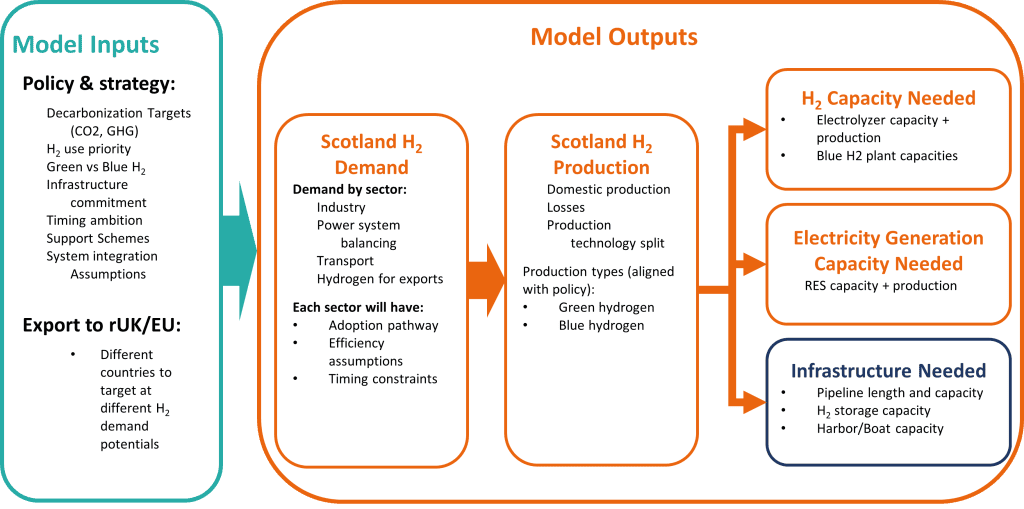
The model is organized into four interconnected modules, covering demand, production, infrastructure, and exports. Each module captures a distinct dimension of the hydrogen system, see Figure 1. These modules are linked through a common set of user-adjustable input parameters, referred to as dials. These represent the external conditions that determine whether hydrogen becomes competitive in a given sector. The dials allow for specifying Scottish factors such as electricity and gas prices, policy and funding strength, and CCUS infrastructure availability. They also address international parameters governing Scotland’s potential to supply hydrogen to the rest of the UK and the EU.
Electricity price inputs, including user-defined values for 2035, 2040, and 2050, and a score for the broader power procurement and grid environment, form the primary driver of competitiveness across the model. Alongside these, sector-specific policy levers capture the strength of support for hydrogen in individual end-use areas, including heat adoption, power generation, shipping, sustainable aviation fuel, and green ammonia production. A further set of infrastructure dials governs the availability of enabling conditions: the status of carbon capture and storage infrastructure, whether hydrogen production is assumed to be centralised or distributed across Scotland, the availability of export routes to the rest of the UK and the EU, and any assumed delays to deployment. Finally, three macroeconomic parameters (cost of labour, tax regime business impacts, and overall macroeconomic tendency), are combined with electricity price indicators into a composite Demand Development Score, which describes the growth or contraction of legacy sector energy demands over the modelling period.
Each dial setting is converted into a normalised score. These scores are combined, using literature-calibrated weightings, into a single Competitiveness and Likelihood Indicator (CLI) for each demand sector. The CLI captures, in a single value, how favourable the overall environment is for hydrogen adoption in a given sector under the chosen scenario. Each sector is assigned a specific deployment threshold: the CLI must exceed this threshold before any hydrogen uptake occurs in that sector. The presence of positive sector-specific policy support reduces the threshold, reflecting how targeted policy can unlock deployment in sectors where hydrogen would not otherwise be competitive on its own.
The CLI score is then used to determine deployment scale through sector-appropriate logic. For capital-intensive, binary sectors (such as potential hydrogen-based steel plants), the CLI triggers discrete investment decisions, reflecting the all-or-nothing nature of large industrial commitments. For more incremental sectors such as distilleries or road transport, a logistic S-curve converts the CLI into the fraction of total energy demand that switches to hydrogen. The shape and position of the curve is calibrated to reflect each sector’s technology maturity and typical investment cycle. Separate CLIs are calculated for rUK and EU export markets to capture Scotland’s relative competitiveness as a hydrogen and derivatives exporter in each of those markets.
Once sector-level hydrogen demand is established, the model builds full annual trajectories from 2026 to 2050. Deployment timing is governed by a combination of a sector start year, a construction or transition period, and any assumed delay. Together, these determine when hydrogen first enters service in each sector. Different sector types follow distinct demand calculation logics. Legacy incremental sectors project demand by applying the CLI-derived uptake share to current energy consumption, adjusted for the efficiency difference between existing fuels and hydrogen. Legacy non-incremental sectors shift demand on a plant-by-plant basis as the CLI crosses relevant thresholds. New capital-intensive industries derive demand from the number of plants triggered by the binary CLI logic multiplied by per-plant hydrogen consumption. New incremental export demands are matched against literature-derived estimates of accessible rUK and EU import markets, modulated by infrastructure availability and assumed build-out timelines. For the domestic aviation sector, an additional SAF mandate calculation runs in parallel with the general deployment logic, and the higher of the mandate-required volume and the model’s standard deployment projection is taken as the binding output.
The blue-green production is configured directly through the blue hydrogen acceptability dials. These set the relative construction share of electrolysis versus methane reforming with carbon capture, the maximum permissible share of blue hydrogen in the overall supply mix, and the years within which blue hydrogen is eligible to enter and exit the system. If Project Acorn is set to be cancelled in the infrastructure dials, the blue hydrogen share defaults to zero regardless of other inputs.
The infrastructure module then translates production volumes into physical asset requirements, pipelines, storage, and distribution. It uses spatial heuristics that account for whether production is assumed to be centralised at hydrogen hubs or dispersed across Scotland’s geography to serve distributed loads.
Outputs
The model produces a comprehensive set of time-series and summary outputs intended to directly inform infrastructure planning and policy analysis. On the demand side, these include annual hydrogen consumption by sector and production pathways from 2026 to 2050, alongside export volumes to rUK and EU markets. On the supply side, the model derives the electrolyser capacity and renewable electricity requirements associated with green hydrogen production, the SMR or ATR plant capacity and CO2 storage volumes associated with blue hydrogen. It also derives the transport and distribution infrastructure, pipelines, storage, and haulage fleet, required to connect supply to demand across Scotland’s geography. All outputs are accessible through a visual dashboard that allows scenario assumptions to be configured, and results observed in a clear and comparable way.
6. Results
The model was run under the two scenarios described in Section 5.2, generating annual hydrogen demand trajectories, production profiles, and infrastructure requirements from 2026 to 2050. The two scenarios are designed to bracket a plausible range of futures: Scenario 1, ‘pragmatic scale-up’, reflects a world of constrained but real hydrogen growth, while Scenario 2, ‘industry breakthrough’, represents an accelerated, NZE-aligned pathway in which hydrogen becomes a structural pillar of Scotland’s industrial sectors where reducing greenhouse gas emissions is particularly challenging. Both scenarios include support through aviation and shipping targets, moderate-to-low electricity prices, and pipeline export infrastructure to the rest of the UK and the EU, though the timing, scale, and ambition of these conditions differ between them. A key distinction is the role of blue hydrogen: the less ambitious scenario includes a meaningful share of methane reforming with carbon capture. This reflects the persistent cost gap for electrolysis in a pragmatic world. The more ambitious scenario converges rapidly on near-exclusively green hydrogen production.
An overview of the key results across the two scenarios is shown in Table 1[1]
Scenario 1 | Scenario 2 | ||||||
2030 | 2040 | 2050 | 2030 | 2040 | 2050 | ||
H2 domestic demand | TWh | 1.2 | 7.9 | 11.3 | 1.4 | 14.4 | 22 |
Green H2 production | TWh | 1.79 | 18.4 | 39.2 | 27.9 | 47.4 | 69.4 |
Green H2 ELY capacity | GW | 1 | 5 | 10.9 | 1 | 13 | 19.4 |
Blue H2 production | TWh | 0 | 1 | 1 | 0 | 0.9 | 0.9 |
Blue H2 SMR capacity | MW | 0 | 135 | 135 | 0 | 122 | 122 |
H2 Export rUK and EU | TWh | 0 | 4.7 | 18.7 | 0 | 21 | 30.9 |
Ammonia Exports | TWh | 0 | 1.0 | 3.1 | 0 | 1.8 | 4.9 |
Methanol for Exports | TWh | 0 | 1.2 | 1.9 | 0 | 2.3 | 3.2 |
SAF Exports | TWh | 0 | 1.3 | 2.2 | 0 | 2.3 | 3.3 |
Scenario 1 – Pragmatic scale-up
Scenario 1 is configured around a distributed deployment of electrolysers, lower overall macroeconomic growth, higher acceptability of blue hydrogen, and low-to-moderate targets for transport sectors. Export infrastructure, i.e., pipeline connections to both the rest of the UK and the EU, is built out but subject to delay, meaning international flows do not begin until 2038. No hydrogen-based heat decarbonisation is assumed.
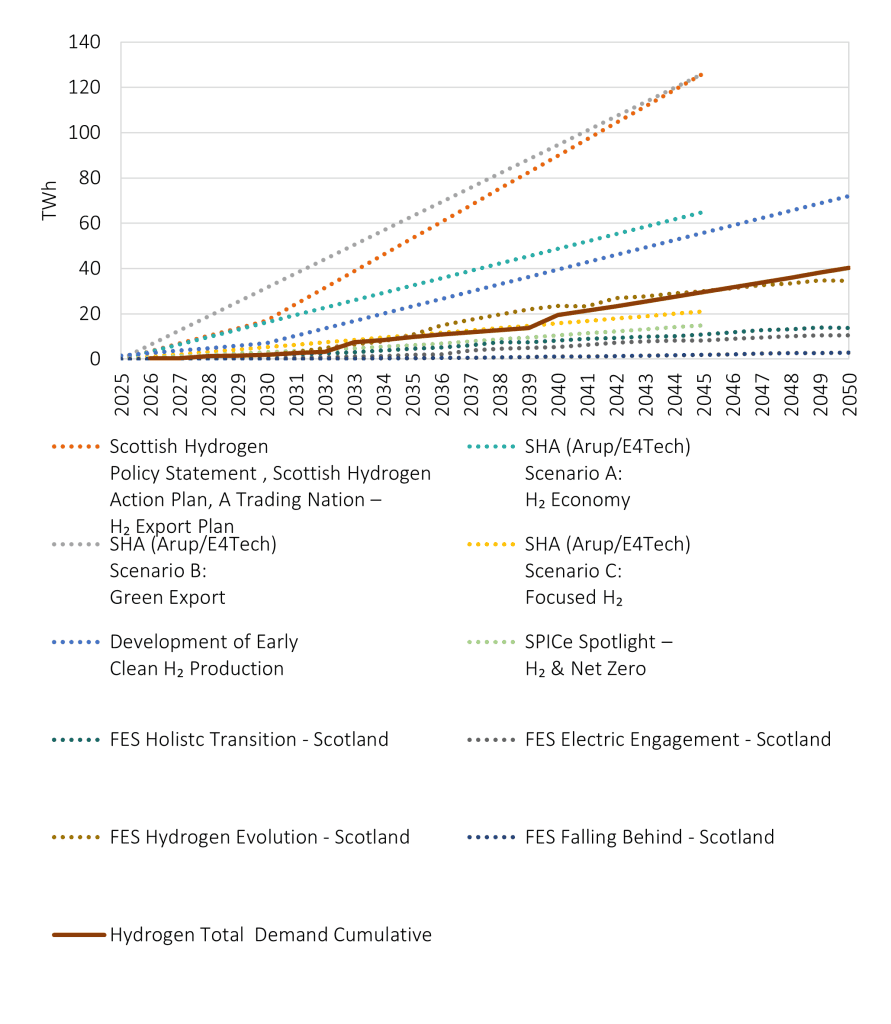
Under this configuration, total hydrogen demand in Scotland reaches 40.2 TWh by 2050, supported by 11 GW of installed green electrolyser capacity and 135 MW of blue hydrogen production. Demand is modest through the late 2020s, then accelerates between 2030 and 2040 as derivatives export production scales up. A domestic ammonia-for-fertiliser plant is triggered by policies, contributing approximately 2.6 TWh of annual demand. By 2035, cumulative annual demand reaches approximately 9.8 TWh, before growing more gradually to the 2050 endpoint. See Figure 2 for an overview of demand for Scottish hydrogen.
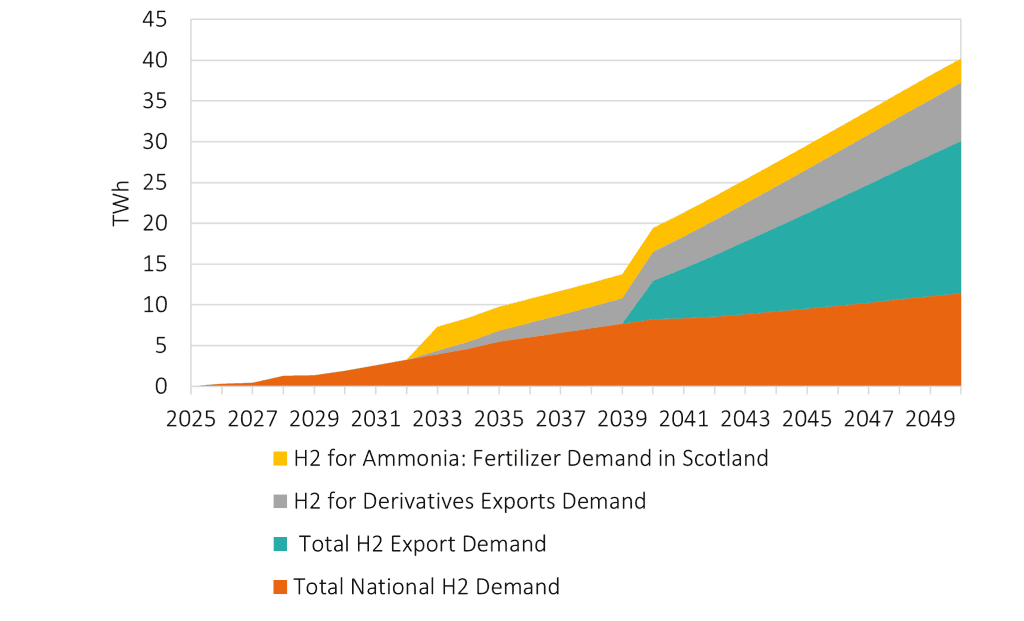
Exports account for a large share of Scenario 1 demand. Pure hydrogen exports to the rest of the UK and the EU reach approximately 18.7 TWh per year by 2050, while hydrogen derivatives exports, primarily ammonia and e-fuels for shipping and aviation markets, contribute a further 7.2 TWh. While the export pipeline infrastructure is eventually built in this scenario, the assumed delays mean that pure hydrogen exports do not commence until 2040 and derivatives exports only begin to ramp meaningfully from 2033 onward.
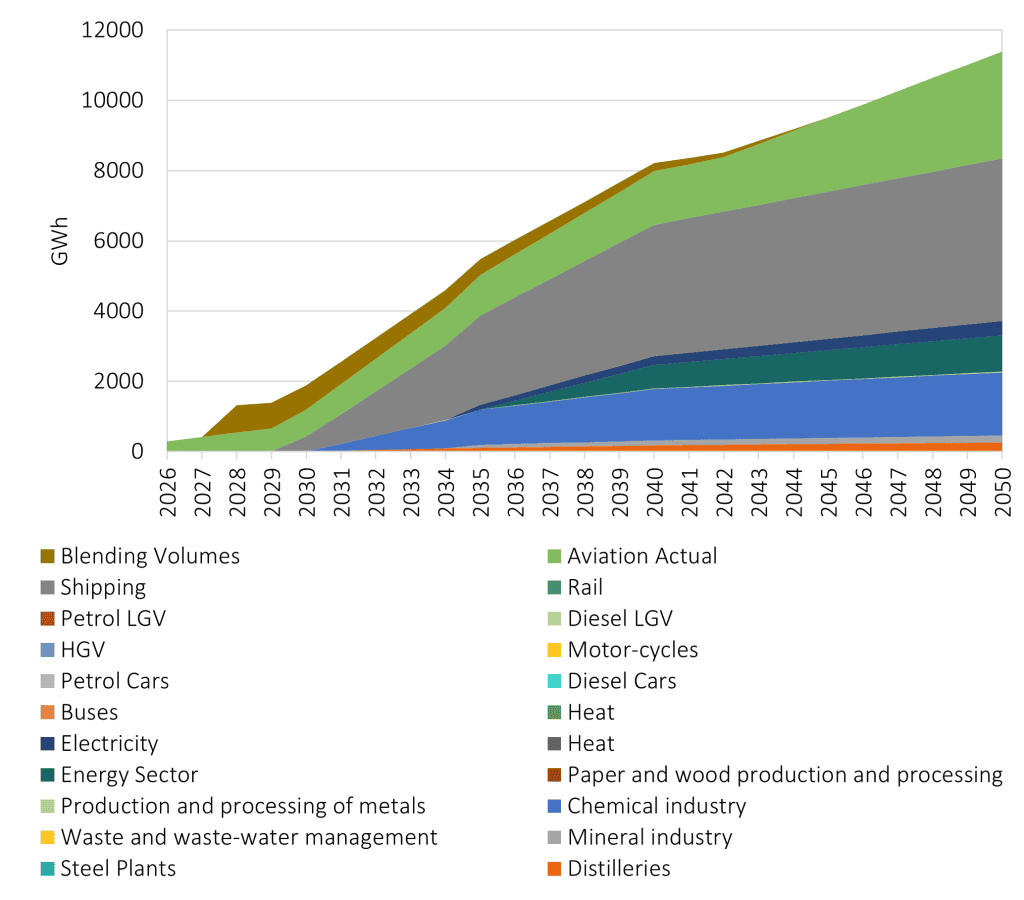
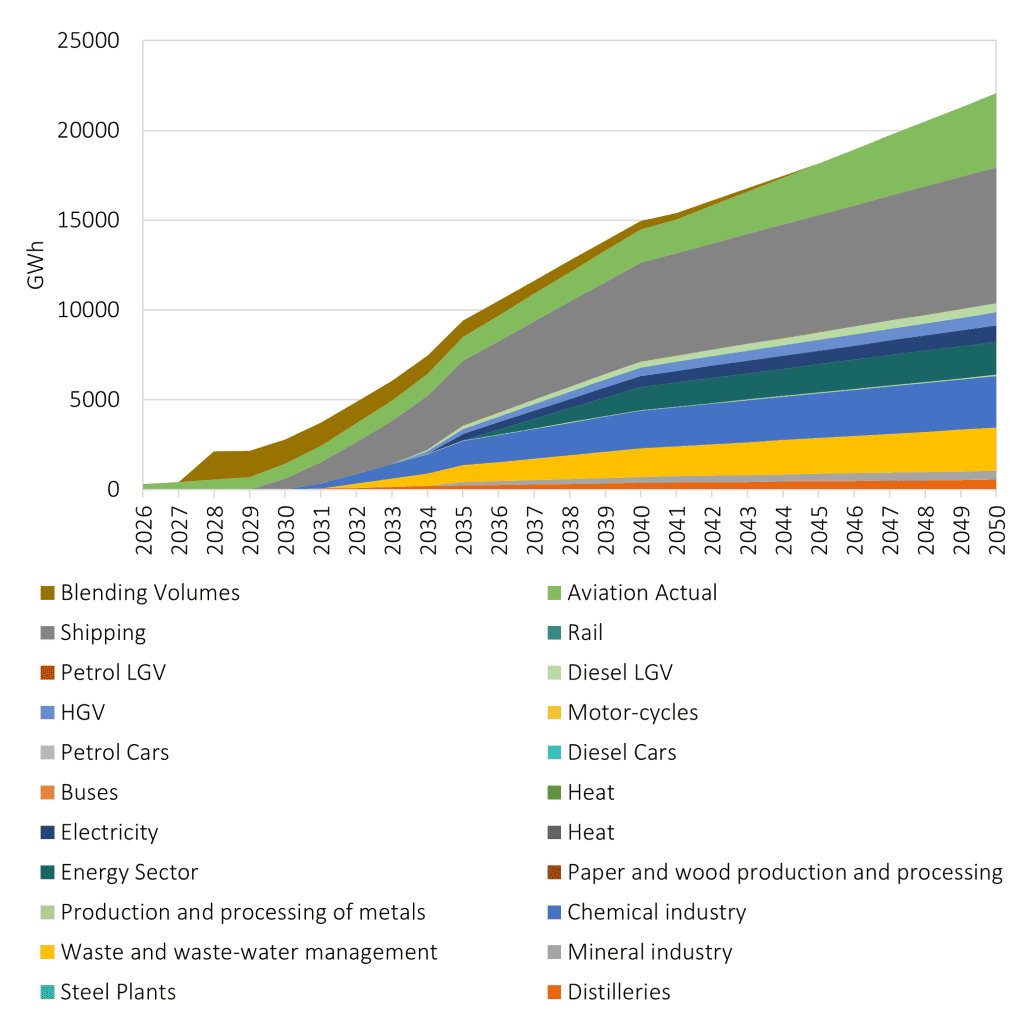
Scotland’s domestic hydrogen demand reaches approximately 11.4 TWh by 2050. Shipping is the single largest end-use sector, contributing around 4.6 TWh as Scotland’s ports and short-sea routes transition toward ammonia and methanol-based fuels. Aviation, incorporating both general sector uptake and volumes driven by the UK SAF mandate, accounts for approximately 1.5 TWh. Industrial demand is anchored by the chemical industry (approximately 1.8 TWh). The energy sector, hydrogen for power system firming and peaking, demands approximately 1 TWh, with electricity sector end-use adding a further 0.4 TWh. Road transport does not see an uptake, while distilleries and the mineral industry together account for under 0.4 TWh. Heating, light vehicle transport, rail, and paper and wood production do not register material hydrogen demand under this scenario. This is either because the CLI does not exceed sector thresholds or because the assumed policy and infrastructure conditions do not make hydrogen the least-cost decarbonisation option in these areas. Figure 3 shows domestic hydrogen demand across all sectors.
Scenario 2 – Industry breakthrough
Scenario 2 is configured around a centralised deployment of electrolysers with lower reliance on distributed small-scale infrastructure. It has high transport sector targets for both shipping and aviation, low acceptability of blue hydrogen, and more favourable electricity prices. Export infrastructure to the rest of the UK is available on time, while the EU export route is subject to delay. As in Scenario 1, no hydrogen-based heat decarbonisation is assumed. These settings reflect an accelerated policy environment in which strong regulatory support, SAF mandates with hydrogen sub-targets, tightening IMO shipping regulations, and orchestrated industrial demand clusters, enables a step-change in Scotland’s hydrogen deployment, consistent with an NZE-aligned global trajectory.
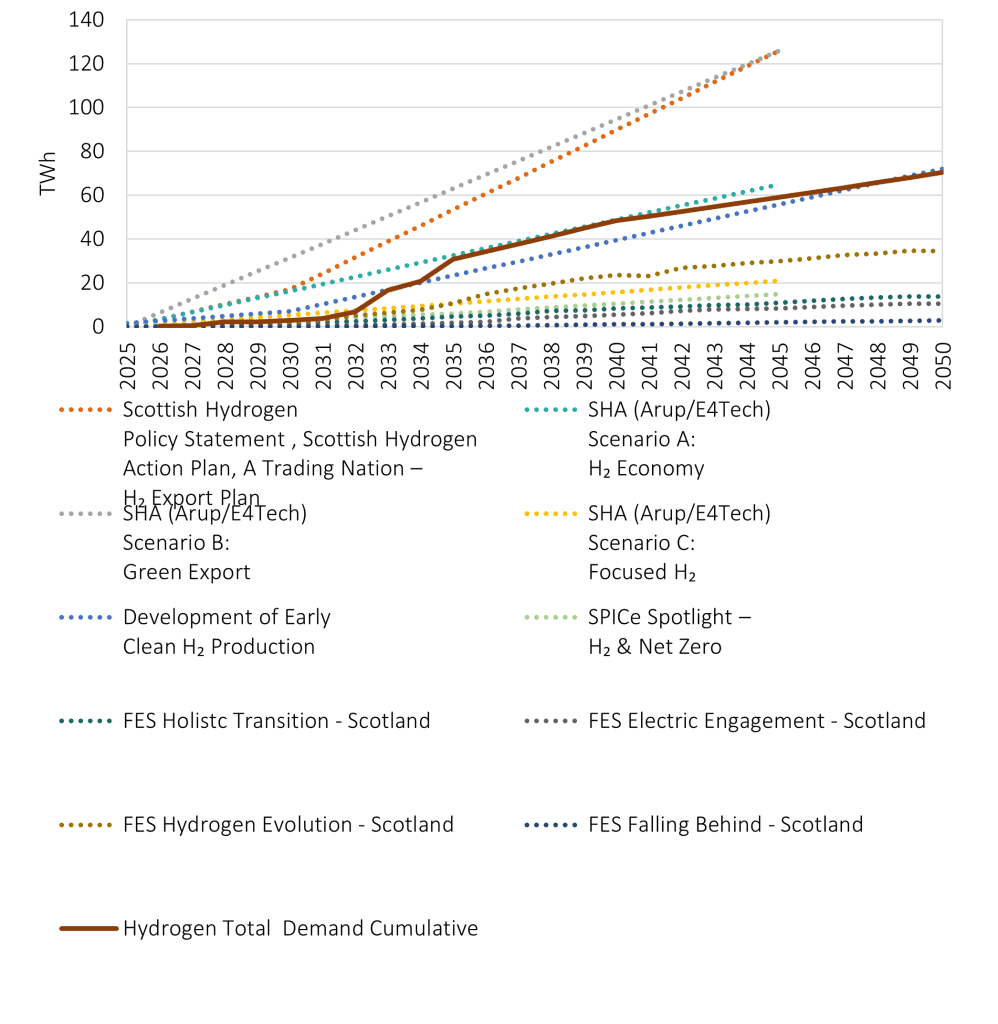
Under this configuration, total hydrogen demand reaches 70.3 TWh by 2050, supported by an almost entirely green production system totalling approximately 19.5 GW (19.4 GW of installed green electrolyser capacity and 0.12 GW of blue hydrogen). The deployment trajectory is steeper and earlier than in Scenario 1. By 2035, annual demand has already reached approximately 30.7 TWh, driven by the more rapid mobilisation of export infrastructure and the higher transport sector targets. Growth continues, albeit at a more modest pace, through to 2050. The near-complete absence of blue hydrogen in this scenario reflects both the low acceptability dial setting and the expectation that scale-up of green electrolysis, combined with stronger policy support, is sufficient to meet demand from an early stage. See Figure 4 for an overview of demand for Scottish hydrogen.
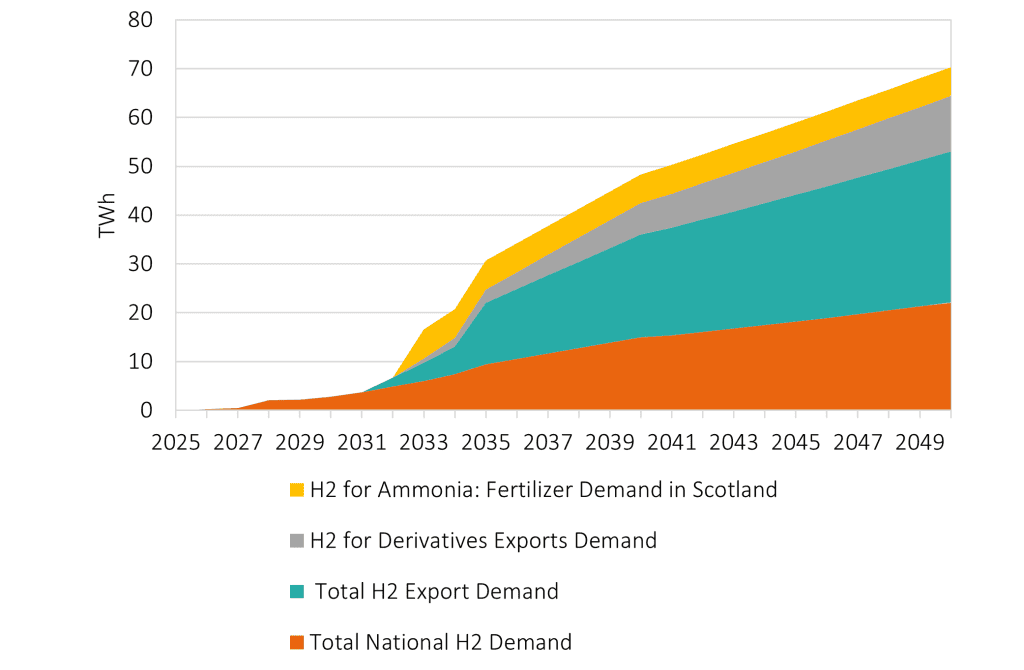
As in Scenario 1, exports dominate overall demand also in Scenario 2, with derivatives and pure hydrogen exports together accounting for the majority of the 42 TWh total. The earlier availability of the UK export pipeline (on time in this scenario) allows hydrogen trade with the rest of the UK to commence sooner. This strengthens the export revenue case and accelerates the investment rationale for large-scale electrolyser deployment. Domestic demand is driven by a higher-ambition transport sector, with shipping and aviation contributing materially more than in Scenario 1 due to the high regulatory and policy support settings. Industrial hydrogen demand, i.e., steel, chemicals, and associated sectors, follows broadly comparable trajectories to Scenario 1. This is because these sectors are anchored by binary investment decisions that are triggered once the CLI crosses the relevant threshold in both cases. The centralised infrastructure model in Scenario 2 concentrates electrolyser and storage capacity at hubs. This results in a smaller number of decentralised small-scale asset requirements compared to Scenario 1, but requires a more developed inner-Scottish pipeline and transmission system.
Comparison with previous studies
Scenario 1’s projected 40.3 TWh of demand is higher than many more conservative studies. It is well above the FES Falling Behind scenario (~2.9 TWh in 2050), FES Electric Engagement (~10.4 TWh), and the SPICe Spotlight assessment (~14.9 TWh). However, it is notably below the SHA Scenario A H2 Economy result (~65 TWh) and considerably below the Scottish Government’s headline trajectory derived from the Hydrogen Policy Statement, Hydrogen Action Plan, and Trading Nation export plan (which implies approximately 126 TWh by 2050). The result most closely resembles the FES Hydrogen Evolution scenario (~34.5 TWh), but is slightly higher due to the large export volumes that become available once infrastructure is in place. See Figure 6 for a comparison of Scenario 1 with related studies and Figure 7 for a comparison of Scenario 2.
Scenario 2, at approximately 70.3 TWh, comes much closer to the SHA Scenario A H2 Economy benchmark (~65 TWh). It represents the upper end of what a policy-supported, demand-led deployment model credibly projects without assuming full alignment with the most optimistic supply-push scenarios. Like Scenario 1, it remains below the 126 TWh implied by Scottish Government headline targets and the SHA Scenario B Green Export pathway. This underscores the fact that achieving those ambitions would require not only the strong policy and infrastructure conditions embedded in Scenario 2, but also additional demand creation, export market development, and a pace of scale-up that the model’s current calibration does not support. Both scenarios are, however, consistent with the IEA’s assessment that Scotland-scale producers in a STEPS-to-NZE world can expect to occupy the mid-range of the hydrogen deployment spectrum. This means they can be significant contributors to a decarbonising energy system, but constrained by the pace at which global demand for hydrogen and its derivatives actually materialises.
Conclusions
At the core of this research is the development of a hydrogen deployment model. The two scenarios generated by the Scotland hydrogen deployment model represent a test to model functionality as well as an outlook on future system development under IEA related assumptions. The modelling suggests substantial hydrogen deployment in Scotland under a range of future policy and market conditions. Across both scenarios, exports account for the majority of hydrogen demand by 2050, highlighting the importance of Scotland’s ability to access UK and European markets. The results also indicate that electricity prices and the availability of export infrastructure are the most important determinants of deployment, with both factors strongly influencing the scale and pace of hydrogen uptake
Scenario-related considerations
The scenarios show a moderate and a more ambitious outlook for Scotland’s hydrogen sector, spanning a range from approximately 40.2 TWh to 70.3 TWh of total hydrogen demand in 2050. Both scenarios show a period of steep growth between approximately 2030 and 2040 (as export infrastructure, derivatives production, and key industrial investments come online), followed by slower growth through the 2040s. Both scenarios estimate a level of demand in 2050 that is below what can be seen in other studies and projections.
The model’s outputs are most sensitive to two parameters: electricity prices and the availability of export infrastructure. Electricity prices are the primary determinant of the business case for green hydrogen production, directly governing both the competitiveness of electrolysis relative to fossil alternatives and the Competitiveness and Likelihood Indicator scores that drive uptake across most demand sectors. This sensitivity highlights that cheap, reliable access to renewable electricity is the foundational condition for green hydrogen business cases: electricity costs make up the largest component of electrolytic hydrogen production costs.
Export infrastructure availability acts as a hard structural boundary: if pipeline connections to the rest of the UK and the EU are not in place, international hydrogen demand, which accounts for the majority of total modelled deployment in both scenarios, cannot be incorporated regardless of how favourable other conditions are. The findings therefore reinforce the importance of timely infrastructure development alongside continued efforts to secure competitive renewable electricity.
Model development – lessons and next steps
We developed the model to describe deployment of hydrogen and hydrogen related infrastructure in Scotland. It serves as a tool for generating and testing alternative deployment scenarios. It links policy choices and market conditions to hydrogen demand and associated infrastructure requirements. The underlying logic is anchored in determining the demand for hydrogen across different sectors based on the policy landscape and support mechanisms available. Demand for hydrogen translates into the need for hydrogen infrastructure.
The main challenge of implementing policy-driven hydrogen uptake lies in meaningfully combining demand and supply-side support policies for deployment modelling. The approach we took was to work from demand estimation, based on policies. This takes limited account of supply-side-driven uptake of hydrogen. The main aim of this project was to create a user-friendly modelling tool. Within the time and resource available, the capacity for simultaneous modelling of both supply and demand side factors was limited.
The following model refinements may produce more detailed outputs:
- Electricity prices: More detailed electricity price series could improve representation of hydrogen competitiveness.
- Demand data: Improved sector-level demand data and bottom-up estimates of current energy use could enhance the quality of outputs .
- Hydrogen adoption pathways: Better evidence on technology readiness and sector-specific adoption pathways could refine uptake assumptions.
- Technology maturity and adoption: More explicit cost-based assessment of competition between technologies may improve representation of future trade-offs between blue and green hydrogen, alternative transport modes and storage options.
References
International Energy Agency (IEA) (2025) World Energy Outlook 2025. Paris: IEA.
Scottish Government (2024) A Trading Nation: Realising Scotland’s Hydrogen Potential – A Plan for Exports. Edinburgh: Scottish Government.
d’Amore-Domenech, R. et al. (2023) ‘An analysis of the bulk transport of green hydrogen at sea: Comparison between submarine pipeline and compressed and liquefied transport by ship’, Energy, 263, 125905.
Net Zero Technology Centre (NZTC) (2024) Hydrogen Backbone Link: Connecting Scotland to Europe – Report 3. Aberdeen: Net Zero Technology Centre.
Department for Energy Security and Net Zero (DESNZ) (2023) Low Carbon Hydrogen Certification Scheme: Consultation Response. London: DESNZ.
Department for Business, Energy & Industrial Strategy (BEIS) (2022) Low Carbon Hydrogen Production Business Model: Heads of Terms. London: BEIS.
Department for Energy Security and Net Zero (DESNZ) (2025) Low Carbon Hydrogen Agreement (LCHA): HAR1 Key Terms Summary and Explanatory Notes. London: DESNZ.
European Commission, Joint Research Centre (JRC) (2021) Assessment of Hydrogen Delivery Options. Luxembourg: Publications Office of the European Union.
Department for Energy Security and Net Zero (DESNZ) (2025) Hydrogen Update to the Market (July 2025). London: DESNZ.
European Commission, Joint Research Centre (JRC) (2021) Assessment of Hydrogen Delivery Options. Luxembourg: Publications Office of the European Union.
Department for Energy Security and Net Zero (DESNZ) (2025) Hydrogen Update to the Market (July 2025). London: DESNZ.
Department for Energy Security and Net Zero (DESNZ) (2024) Hydrogen to Power: Consultation Response. London: DESNZ.
Department for Energy Security and Net Zero (DESNZ) (2025) Hydrogen Blending into the GB Gas Transmission Network: Consultation Document. London: DESNZ.
Scottish Government (2022) Hydrogen Action Plan: Business and Regulatory Impact Assessment. Edinburgh: Scottish Government.
Scottish Government (2022) Scottish Hydrogen Action Plan. Edinburgh: Scottish Government.
International Energy Agency (IEA) (2025) Global Hydrogen Review 2025. Paris: IEA.
Department for Energy Security and Net Zero (DESNZ) (2024) Clean Power 2030 Action Plan (Main Report). London: DESNZ.
Scottish Government (n.d.) Scottish Energy Statistics Hub. Edinburgh: Scottish Government.
European Commission (2026) REPowerEU. European Commission.
How to cite this publication:
Mouelhi, B., Martin Nieto, C., Lüth, A., Raheli, E., Bush, R. (2026) ‘A Low Carbon Hydrogen Deployment Model for Scotland’, ClimateXChange. DOI https://doi.org/10.7488/era/7184
© The University of Edinburgh, 2026.
Prepared by Ramboll on behalf of ClimateXChange, The University of Edinburgh. All rights reserved.
While every effort is made to ensure the information in this report is accurate as at the date of the report, no legal responsibility is accepted for any errors, omissions or misleading statements. The views expressed represent those of the author(s), and do not necessarily represent those of the host institutions or funders.
This work was supported by the Rural and Environment Science and Analytical Services Division of the Scottish Government (CoE – CXC).
ClimateXChange
Edinburgh Climate Change Institute
High School Yards
Edinburgh EH1 1LZ
+44 (0) 131 651 4783
If you require the report in an alternative format such as a Word document, please contact info@climatexchange.org.uk or 0131 651 4783.
Throughout section 5, hydrogen demand is reported in four categories: (a) domestic demand is hydrogen consumed within Scotland across industrial, transport and energy sectors; (b) pure hydrogen exports is hydrogen exported directly to the rest of the UK or the EU; (c) derivative export demand is hydrogen used in Scotland to produce export products such as ammonia, methanol and SAF; (d) total hydrogen demand is the sum of domestic demand, export demand and hydrogen used for derivative production.
Unless otherwise stated, references to total hydrogen demand include all four components. ↑