

Scotland’s HDV supply chain and net zero
February 2026
Executive summary
Governments across the world are introducing policy targets to decarbonise heavy duty vehicles (HDVs). This shift presents an economic opportunity for Scottish companies. Scottish Government commissioned this research to identify the current and future economic impact of decarbonisation across three particular supply chains:
- HDV and niche vehicle manufacturing
- HDV charging infrastructure
- Hydrogen refuelling infrastructure
*HDVs are vehicles with gross vehicle weight of more than 3.5 tonnes (for example, heavy goods vehicles, buses, coaches, municipal vehicles, emergency service vehicles). Niche vehicles are those with gross weight of less than 3.5 tonnes (for example, wheelchair accessible vehicles and four by four electric vehicles).
Key findings
- Strong global policy and market forces are accelerating HDV decarbonisation
- The speed of transition varies by type of HDV and low carbon fuels are playing a role alongside zero emission options
- Scottish HDV and niche vehicle manufacturing supply chain activity is concentrated in a few companies
- The HDV charging infrastructure supply chain is mainly service based and is growing
- The HDV hydrogen refuelling infrastructure supply chain is very limited, with the main growth opportunity identified after 2035
- Market demand stimulation is vital but supply side actions are important too
Current make-up and capabilities of supply chains
HDV and niche vehicle manufacturing
- The overall supply chain includes 21 companies with locations in Scotland. We estimate there are between 3,200 and 4,000 jobs in this supply chain, with annual turnover of between £800m and £1,000m.
- The zero emission HDV and niche vehicle manufacturing supply chain is a subset of the above. We identified seven active, or recently active, companies. We estimate there are between 300 and 500 jobs in this supply chain, with an annual turnover of between £80m and £120m.
HDV charging infrastructure
- We identified 15 active companies. We estimate there are between 200 and 400 jobs in this supply chain. There was insufficient evidence to estimate the supply chain turnover.
Hydrogen refuelling infrastructure
- We identified seven active companies and estimate there are less than 100 jobs in this supply chain. There was insufficient evidence to estimate the supply chain turnover.
Supply chain strengths and opportunities
We conducted a SWOT analysis of each supply chain. The strengths and opportunities for each are summarised here.
HDV and niche vehicle manufacturing
Scotland’s main strengths are in niche manufacturing and vehicle integration, rather than mass production. Existing companies have expertise in the building of specialist vehicles, bespoke design, systems integration and aftersales support. However, the manufacturing base is small, fragmented and relies heavily on imported chassis and core systems. The most realistic opportunities for Scottish companies sit in specialist and niche applications, such as municipal and emergency vehicles.
HDV charging infrastructure
A key strength is the presence of established EV charging integrators and service providers with experience in depot-based charging, developed through the bus sector and early HDV projects. There are, however, notable gaps in the supply chain. Opportunities are driven by growing HDV electrification and policy requirements for charging infrastructure both domestically and internationally.
HDV hydrogen refuelling infrastructure
Scotland’s main strength is its practical delivery experience derived from hydrogen mobility projects, particularly for buses and municipal fleets. However, the supply chain is small and capacity constrained. There is significant reliance on a few providers and on imported core equipment. Opportunities for Scottish companies in hydrogen refuelling infrastructure are limited and use-case specific.
Future demand
For the three key supply chains discussed above, we used employment numbers as a proxy for economic growth. Our estimate for the potential change in job numbers to 2030 and 2035 is compared with current job numbers in Table 1.
Supply Chain | Current Jobs | Jobs by 2030 | Jobs by 2035 |
|---|---|---|---|
Overall HDV and niche vehicle manufacturing | 3,200 to 4,000 | 3,200 to 4,500 | 3,200 to 5,200 |
Zero emission HDV and niche vehicle manufacturing (subset of the overall HDV and niche vehicle manufacturing supply chain) | 300 to 500 | 500 to 1,000 | 1,000 to 3,000 |
HDV charging infrastructure | 300 to 400 | 400 to 700 | Uncertain – no estimate |
HDV refuelling infrastructure | Less than 100 | Uncertain – no estimate | Uncertain – no estimate |
Feedback from stakeholders also identified a small number of examples where companies in other sectors have benefited from HDVs decarbonisation, such as clean heat, onshore renewables and civil engineering
Abbreviations
AFIR | Alternative fuels infrastructure regulation |
BEV | Battery electric vehicle |
CAGR | Compound annual growth rate |
CCUS | Carbon capture, utilisation and storage |
EPC | Engineering, procurement and construction |
EV | Electric vehicle |
FTE | Full time equivalent |
HDV | Heavy duty vehicle |
HFCEV | Hydrogen fuel cell electric vehicle |
HGV | Heavy goods vehicle |
HRS | Hydrogen refuelling station |
HVO | Hydrogenated vegetable oil |
ICE | Internal Combustion Engine |
IEA | International energy agency |
OEM | Original equipment manufacture |
SME | Small to medium enterprise |
SWOT | Strengths, weaknesses, opportunities and threats |
TCO | Total cost of ownership |
TEN-T | Trans-European transport network |
ZEHID | Zero emission heavy goods vehicle & infrastructure demonstration programme |
Introduction
Governments across the world are introducing policy targets to decarbonise heavy duty vehicles (HDVs) as part of activities to reduce greenhouse gas emissions. This shift presents an economic opportunity for Scottish supply chains.
This report aims to identify the current and future economic impact of decarbonisation on key supply chains. Findings are based on desk-based evidence and conversations with 27 industry and other stakeholders. We identify active companies and their capabilities in each supply chain and analyse the strengths, weaknesses, opportunities and threats (SWOT) for each. We then estimate how policy drivers might impact demand in the coming decade. Finally, we examine how other sectors in Scotland could benefit from opportunities related to HDV decarbonisation.
This section summarises what the research was trying to achieve and how it was carried out. Further information on this can be found in Appendix A.
Research aims
The aims of this research study were to:
- Identify and assess the current make-up and capability level of
- the Scottish HDV manufacturing supply chain, including HDV manufacturing
- the Scottish HDV charging infrastructure supply chain
- the HDV hydrogen refuelling infrastructure supply chain
- Identify the strengths, weaknesses, opportunities and threats for the existing supply chains
- Identify and assess how demand for Scottish supply chain and manufacturing services may change in future, particularly in light of policy drivers and decarbonisation targets
- Identify how other sectors in Scotland (e.g. low carbon energy, heat in buildings, construction, digital) can benefit from new supply chain opportunities related to HDV decarbonisation
Scope and boundaries
The supply chains of interest are:
- HDV and niche vehicle manufacturing – manufacture of physical and/or digital products. This includes the supply chain currently active in the manufacture of fossil fuel powered vehicles as well as the subset of this that is already active in the manufacture of zero emission vehicles.
- HDV charging infrastructure – manufacture of physical and/or digital products and the delivery of services associated with design, installation, operation and maintenance.
- Hydrogen refuelling infrastructure – manufacture of physical and/or digital products and the delivery of services associated with design, installation, operation and maintenance.
The research DOES cover:
- Companies currently active in these supply chains and those with the capabilities to potentially become active in future
- Battery electric, hydrogen fuel cell and hydrogen combustion powertrains
The research DOES NOT cover:
- Hydrogen production and transportation activities
- Biofuel, biomethane or hydrogenated vegetable oil (HVO) fuelled HDV activity
- Retrofitting of the existing HDV fleet with decarbonisation technologies
Research method
The research was carried out between October 2025 and February 2026. It consisted of desk research, one-to-one consultations with 27 industry and other stakeholders from across the three supply chains and a validation workshop, attended by 13 industry and other stakeholder from ten organisations.
It is helpful to further define some of the key terms we use in this report to help clarify the scope:
- Overall HDV and niche vehicle manufacturing supply chain – this includes all companies involved in the manufacture of HDVs and niche vehicles, regardless of the technology used to power the vehicle. This supply chain therefore includes companies that are currently only involved in the manufacture of diesel powered HDVs and niche vehicles, companies that are currently only involved in battery electric powered vehicles and companies involved in a mix of several technologies. It is important that we capture this overall supply chain as companies currently active only in diesel powered vehicle manufacture will need to consider moving into zero emission powered vehicles as HDVs are decarbonised
- Zero emission HDV and niche vehicle manufacturing supply chain – this is a subset of the overall HDV and niche vehicle manufacturing supply chain. It is useful to separately identify the make-up and capabilities of this supply chain to understand the current economic contribution by companies already active in responding to the decarbonisation of HDVs
- The category of ‘niche vehicles’ includes Scottish companies involved in production of battery electric wheelchair accessible vehicles and full electric 4×4 vehicles that are under the weight threshold of 3.5 tonnes, meaning they are not classed as HDVs
- Companies identified as having the potential to become active have been identified as part of this study. These are companies that have been reviewed using desk-based, publicly available, information, such as websites. This is useful to understand the extent to which there are companies have the potential to develop goods and services relevant to one, or more, of the three supply chains being investigated. It is also useful to note that only a small proportion (less than 5%) of the companies identified as being potentially active have confirmed that they are actually interested in doing so. The others have capabilities that have been assessed as potentially relevant.
Desk research was used to identify companies active, and having the potential to become active, in the three supply chains, to build an understanding of the composition of each.
This desk research also identified estimates of employment numbers and turnover for each company. We cross-checked the lists of active companies with stakeholders and added those we had not identified during the desk research. We categorised each company’s capabilities by assigning them to different segments of the supply chains.
We used a combination of desk research and stakeholder feedback to identify the strengths, weaknesses, opportunities and threats relevant to each of the supply chains.
We used the findings of the desk research to understand the nature and timing of HDV decarbonisation and how this might impact on the number of jobs in each of the supply chains between now and 2030 and 2035. We used number of employees as the best available proxy for economic growth of the supply chains. We tested this understanding of how HDV decarbonisation would impact on the supply chains with industry and other stakeholders, both through one-to one consultations and in a group workshop.
During our discussions with stakeholders, we also identified a small number of examples of how companies from other sectors have benefited from the decarbonisation of HDVs.
A more detailed description of the research method can be found in Appendix A.
The context for HDV decarbonisation
Policies in support of HDV decarbonisation
Internationally, governments are moving to decarbonise HDVs through a mix of regulation, long-term targets and public funding. There is broad recognition that HDVs are harder to decarbonise than cars and vans. Vehicles are more expensive, infrastructure requirements are greater, and operators face tighter margins. As a result, leading countries are not relying on market forces alone. They are setting clear end dates for diesel sales, placing obligations on manufacturers and fleets, and investing directly in vehicles and infrastructure.
Many countries have now committed to 100% zero-emission HDV sales by 2040 under the Global Memorandum of Understanding on Zero-Emission Medium- and Heavy-Duty Vehicles. In the strongest cases, these commitments are backed by binding domestic regulation. The European Union has established the most comprehensive framework. Its CO₂ emission performance standards require manufacturers to achieve progressively deeper emissions reductions, reaching a 90% reduction by 2040 (EU Regulation 2019/1242). The rules apply across most truck and bus categories and are supported by mandatory monitoring and financial penalties for non-compliance. This provides long-term certainty to industry and sends a clear signal on the direction of travel.
The United Kingdom is currently consulting on a new HGV CO2 emissions regulatory framework, setting out a pathway towards the government’s intention of ending the sale of new non-ZE HGVs up to and including 26 tonnes by 2035, and all new non-ZE HGVs by 2040. (UK Government, 2026). This approach is supported by targeted public funding. The Zero Emission HGV and Infrastructure Demonstrator (ZEHID) programme is investing around £200 million to deploy zero-emission trucks and develop charging and hydrogen refuelling infrastructure. The aim is to test real-world performance, reduce cost uncertainty and inform future policy development (Innovate UK Business Connect, 2024).
In North America, regulation is combined with significant financial support. The United States has introduced strong state-level fleet requirements alongside large federal grant programmes to support vehicle purchases and infrastructure rollout (EPA, 2024). Canada has also set a 2040 sales target and is investing in charging and refuelling infrastructure to enable uptake. These measures are designed to stimulate early demand and support domestic supply chains.
China is playing a central role in global HDV decarbonisation. It has deployed large-scale subsidies and regional mandates, particularly in logistics hubs and freight corridors. This has enabled rapid deployment of zero-emission trucks and buses in targeted applications (ICCT, 2025) Although approaches vary across provinces, the overall scale of intervention is significant.
Several European countries are placing strong emphasis on infrastructure as a critical enabler. Spain is combining fleet support under Real Decreto 983/2021 with hydrogen investment programmes such as H2 Pioneros, linking transport decarbonisation with industrial and regional policy (Gobierno de España, 2021; MITECO, 2023). Norway operates competitive funding schemes that support zero-emission trucks and associated charging infrastructure, prioritising projects that deliver the greatest emissions reduction per unit of public funding (Enova, 2025). The Netherlands has adopted a similar model through its Hydrogen in Mobility subsidy scheme, which supports both hydrogen vehicles and refuelling stations (Netherlands Enterprise Agency, 2025). Ireland and Denmark are also investing in vehicle grants and infrastructure to support the transition (ZEVI, 2024; Danish Ministry of Transport, 2021).
Overall, the strongest policy frameworks combine three elements: clear long-term targets, enforceable regulatory standards and sustained public investment. The European Union, the United Kingdom, the United States, China, Norway and the Netherlands stand out in this regard. International evidence suggests that regulation alone is insufficient. Coordinated action across vehicles, infrastructure and market development is required to deliver large-scale change and to position domestic industries for emerging global opportunities.
Market trends in HDV decarbonisation
This section summarises the key market trends for the three supply chains. Understanding the market trends is important to identifying and assessing the likely nature, scale and timing of HDV decarbonisation. This will drive changes in demand for goods and services provided by the three supply chains we are investigating in this study.
A more detailed description is provided in Appendix B.
HDV and niche vehicle manufacturing
International Energy Agency (IEA, 2025) is projecting that around 20% of new global bus sales and 13% of new global heavy truck sales in 2030 will be battery electric.
The European Automobile Manufacturers Association reports that, globally, around 2.9 million HGVs and 362 thousand buses were manufactured in 2024 (ACEA, 2024). Around 20% of buses sold around the world in 2024 were zero emission, either battery electric vehicles (BEV) or hydrogen fuel cell electric vehicles (HFCEV), compared with only 3% of HGVs.
China is by far the largest national market, with Europe and North America also significant regional markets (IEA, 2025). In the EU, Germany, France, the Netherlands and Sweden account for 85% of zero emission HDV sales (Mulholland, E., et al, 2025).
In the UK, in 2024, there were 50,987 newly registered HGVs, of which 268, or 0.5%, were zero emission battery electric. In the same year, 9,919 new buses and coaches were registered in the UK, with 1,719, or 17.3%, of these being zero emission battery electric.
In Scotland, in 2024, there were 3,958 newly registered HGVs, with 12 of these, or 0.3%, being zero emission battery electric. In the same year, 663 new buses and coaches were registered, of which 74, or 11.2%, were zero emission battery electric (Department for Transport 2026 [4] and [5]).
Charging infrastructure
The International Energy Agency (IEA, 2024), expects significant growth in the stock of HDV charging devices installed, globally, estimating a twenty-fold increase by 2035.
China is the market leader in the adoption of electric buses and electric trucks and therefore is the also market leader in deployment of heavy-duty charging devices (IEA, 2024).
After China, Europe is the second largest market for electric bus and electric truck sales with the accompanying need for charger installation (IEA, 2024). The countries in Europe with the highest projected demand for battery electric truck charging infrastructure are Germany, Italy, France, Poland and Spain, collectively accounting for more than 70% of the total charging needs in the EU-27 (Basma, H and Schmidt, J. ,2025).
In the UK, it is projected that there will be a need for 400,000 truck chargers serving HGVs by 2050 (Drake, W. et al, 2023). Reports reviewed for this study found differences of opinion on the extent to which HGV charging devices would be located in the depot. One report assumed that 93% of HGV chargers would be based in depots (Drake, W. et al, 2023) whilst another stated an expectation that 77% of HGV charging would take place at depots (Energy UK, 2025).
Charging will typically take place overnight and most charging devices (97%) will be less than 100kW capacity. Public opportunity charging will require chargers with high capacity for quicker charging times. It is projected that 2,000 350kW and 1,200 1MW chargers will be required by 2050 (Drake, W. et al, 2023).
Licenced HGVs in Scotland represent 6.9% of HGVs licenced in the UK, based on Q3 2025 data (Department for Transport, 2026 [3]). It could be assumed that a similar proportion of HGV charging devices will be installed in Scotland, meaning approximately 27,600 installed by 2050 (based on UK data from Drake, W. et al, 2023). If these charging devices were installed equally over the period 2026 to 2050 then annual installations of HGV chargers would be just over 1,100 per year in Scotland. However, HGV operations in Scotland can differ materially from the UK average in ways that affect charging demand. For example, routes are often longer and less densely connected, with more variable terrain and harsher weather conditions. These factors can increase energy consumption per journey and, in turn, raise the frequency and duration of charging required per vehicle. At the same time, the spatial distribution of logistics activity in Scotland may reduce opportunities for high utilisation of individual charging sites compared to more densely populated parts of the UK. This could mean a greater number of chargers are needed to provide adequate coverage and resilience, even if utilisation rates per charger are lower. Taken together, these differences mean that Scotland’s share of charging infrastructure demand may not scale directly in line with its share of the HGV fleet.
The rate of electric heavy duty vehicle adoption will be influenced by the extent to which fleet operators use low carbon fuels, such as biomethane, HVO and biodiesel, as a means to decarbonisation their vehicles in the short term. For example, this is a strategy supported by both Logistics UK (Logistics UK, 2025) and the Road Haulage Association (Road Haulage Association, 2025), both representative bodies for the freight transport sector. If fleet owners follow this strategy in the short term, then this could delay some purchases of battery electric vehicles and reduce the associated demand for charging infrastructure.
Hydrogen refuelling infrastructure
Hydrogen refuelling stations (HRS) rollout is modest compared to charging infrastructure deployment. As of 2024, there were approximately 1,160 HRSs worldwide, mostly confined to Germany, Japan, and South Korea, compared to 4.5 million EV charging stations (Mohapatra, 2025).
The value of the global hydrogen refuelling station market was estimated at about USD 1.00 billion in 2025 and is projected to grow at a 19.8% CAGR over the period 2025 – 2033, inclusive of all applications including passenger vehicles (Grand View Research, 2026).
The EU has committed €600 million through the Alternative Fuels Infrastructure Facility to support 38 new hydrogen refuelling stations (European Commission, 2025). Member states must install one HRS every 200 km along the core of the Trans-European Transport Network (TEN-T), where minimum transport movement thresholds are exceeded. The aim is to complete these installations by 2030 with interim targets set for 2025.
In 2023, the UK had zero fuel cell HGVs in operation and only 6 HRSs. Scotland had four hydrogen refuelling stations for public use (Transport Scotland, 2022). Two of which are based in Aberdeen to support the fleet of bus and municipal hydrogen HDVs with further stations in Orkney and outside Edinburgh. The need for a minimum viable network of hydrogen refuelling stations is limiting deployment of hydrogen powered HDVs (Hydrogen UK, 2023). Cost of hydrogen fuel is also a limiting factor, according to some stakeholders. Strong near-future deployment opportunities lie in off grid refuelling applications for construction based HDVs with full HDV rollout expected to grow from 2035 onwards.
Current make-up and capabilities of supply chains
This section uses the findings of the desk-based research and feedback from stakeholders to identify and assess the current make-up and capabilities of the Scottish HDV and niche vehicle manufacturing, HDV charging infrastructure and HDV hydrogen refuelling infrastructure supply chains.
HDV and niche vehicle manufacturing
Overall HDV and niche vehicle manufacturing supply chain
The overall HDV and niche vehicle manufacturing supply chain includes 21 companies with manufacturing locations in Scotland. This includes manufacturers, and their supply chains, active in fossil fuel and zero emission HDVs and niche vehicles. Combined, we estimate these companies employ 4,402 people and generate turnover of £1,123 million. It should be noted that these figures are indicative as some of the companies reported employment and turnover includes contributions from operations located outside of Scotland. In addition, some of these companies are also involved in other markets, in addition to HDVs and niche vehicles, so the total HDV and niche vehicle employment and turnover is less than the amounts stated. We estimate that 12 of these 21 companies are exclusively active in the HDV and niche vehicle manufacturing supply chain. These 12 companies employ 3,251 people and generate annual turnover of £804 million. We estimate that the current employment range for this supply chain is between 3,200 and 4,000. We also estimate that current turnover ranges between £800m and £1,000m.
An overview of the number of companies active in each supply chain segment is shown in Table 2.
Materials | Subsystems | Systems | OEMs | Others | Niche |
|---|---|---|---|---|---|
0 | 7 | 0 | 7 | 5 | 2 |
The most economically significant segment of the overall HDV and niche vehicle manufacturing supply chain is the HDV Original Equipment Manufacturer (OEM) segment. Based on the employee numbers of the seven HDV OEMs in this segment, compared to the total 21 companies in the overall supply chain, it represents 72% of the total supply chain. The niche vehicle manufacturing segment, with two companies, is the next most significant segment of the supply chain, representing 20% of the total supply chain.
Zero emission HDV and niche vehicle manufacturing supply chain
Seven of the 21 companies active in the overall HDV and niche vehicle manufacturing supply chain are also active in the zero emission HDVs and niche vehicle manufacturing supply chain. Combined, these seven companies employ 3,005 employees and generate annual turnover of £792 million. However, our research indicates that the number of people currently employed in Scotland in the zero emission HDV and niche vehicle manufacturing supply chain is limited to several hundred. Based on stakeholder feedback and desk research, we estimate 85% to 90% of the HDV and niche vehicles manufacturing activity in Scotland uses diesel internal combustion engines and 10% to 15% being zero emission vehicles, almost all of these being buses. We also estimate, based on a combination of stakeholder feedback and desk research, that six of the seven zero emission HDV and niche vehicle manufacturing supply chain companies have a low single digit percentage of their employees engaged in zero emissions activities. We estimate that only Alexander Dennis Limited has a significant proportion of its HDV (bus) manufacture that is zero emissions. This is based on sector wide data about the proportion of new bus sales that are zero emission in the UK as we were unable to obtain data directly from the company for this study. We have used the resulting estimate, of 10% to 15% of HDV and niche vehicle manufacturing in Scotland being zero emission, to estimate associated zero emission employment to be between 300 and 500 and zero emission annual turnover to be between £80m and £120m.
An overview of the number of companies active in each supply chain segment is shown in Table 3.
Materials | Subsystems | Systems | OEMs | Others | Niche |
|---|---|---|---|---|---|
0 | 1 | 0 | 4 | 0 | 2 |
The OEM and niche vehicle manufacturing segments of the overall HDV and niche vehicle manufacturing supply chain are assessed as being the most economically significant, based on proportion of employment in those sectors. The OEM segment is the most economically significant of the zero emission HDV and niche vehicle manufacturing supply chain. The companies active in these segments are shown in Figure 1.
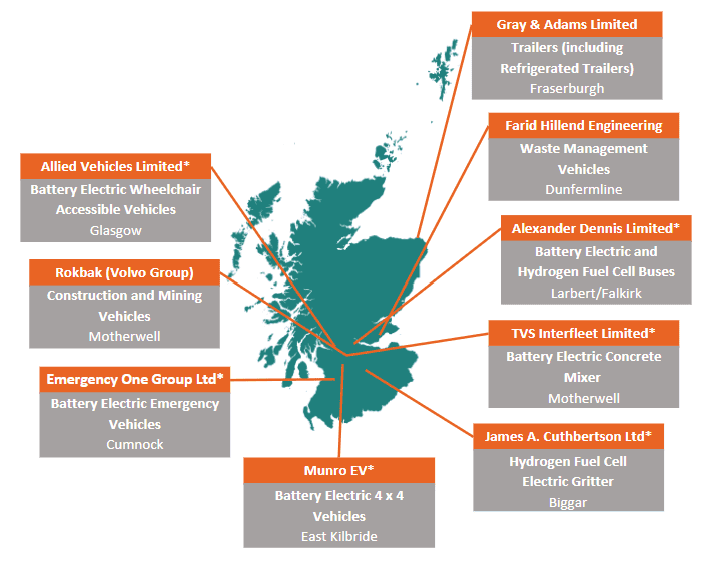
An additional company, H2 Vehicle Systems, was registered last year and is focused on emissions reduction from diesel HDVs; it is also seeking to develop hydrogen powered HGVs. There are no Scotland-based manufacturers of chassis that are used in HGVs.
There are seven companies that are active in design and manufacture of subsystems that are used in HDVs, including mechanical, hydraulic, electrical and electronic components, and five others that design and manufacture bodywork for HDVs and niche vehicles.
Companies with potential to become active
Based mainly on desk research, we have identified 102 companies as having relevant capabilities, meaning they have theoretical potential to become active in the zero emission HDV manufacturing supply chain. Of this total, 96 could provide mechanical, hydraulic, electrical and electronic system and subsystem design and manufacture. This includes, for example, sensors, control systems, power convertors and drive systems. There are also companies offering precision engineering services for the design and manufacture of parts, and others manufacture and supply materials for structural components and interior fittings.
Together, the subsystem and system capabilities in Scotland could support the further development and customisation of zero emission HDVs. Each of these companies could, potentially, work with existing OEMs to customise and optimise zero emission HDVs for specific purposes. This could include, for example:
- lightweighting, through the use of composite materials
- improving the energy efficiency of auxiliary equipment, through the design of electrical, mechanical and hydraulic subsystems
- enhanced software control of systems to optimise use and minimise energy consumption, for example through using telemetry data
However, we do not have sufficient information on whether these companies would view the zero emission HDV manufacturing supply chain as an opportunity.
Scotland’s role in the rest of the UK and international markets
Based on interviewee feedback, we have confirmed that seven of the 21 companies active in this supply chain export to markets outside the UK. Others may also export but we did not find evidence during our research to confirm this. We have also confirmed that three of the seven companies active in the zero emission HDV and niche vehicle supply chain export to markets outside the UK. Others may also export but we did not find evidence during our research to confirm this.
Role of the supply chain in other sectors
Companies that are further back in the supply chain have opportunities to sell into other net zero supply chains, including other forms of transport such as automotive, rail, and maritime.
Challenges faced
The main issue facing companies that are trying to enter the market for decarbonised HDV and niche vehicles is that customer demand is still very low. The majority of sales, particularly in the UK, are for fossil-fuel powered HDVs. Feedback from our interviews with companies and other stakeholders is that uncertainty around the deadlines for mandating zero emission HDVs is not stimulating demand compared to the situation where credible regulated deadlines were in place.
While an increasing percentage of buses are now electric, most of the OEMs supplying these vehicles are located outside of Scotland and the UK. As the majority of systems and sub-systems are integrated by the bus OEM, there is a much smaller opportunity for Scotland-based companies to become part of these supply chains.
The opportunities are greater for those supplying OEMs that design and manufacture specialised vehicles, but even here, feedback from our interviews strongly suggests that demand for zero emission vehicles will remain low due to customer concerns regarding duty cycles and opportunities to recharge or refuel the vehicle during use.
Stakeholders representing relevant industry associations whose members operate HGVs, confirmed that at present there is interest from their members regarding zero emission vehicles. There are also concerns, particularly around total cost of ownership (TCO) and the perceived increased costs of charging and hydrogen refuelling would have on their operations. There was universal concern regarding the impacts on SMEs, which represent the majority of HGV users, particularly haulage firms. Most of those interviewed believe that it is likely only larger operators, particularly those who want to be first movers, will adopt zero emission technologies prior to legislation coming into force. The only exception to this would be if the customer of the haulage firm required a reduction in scope 3 emissions (i.e., from its supply chain). In these cases, there is competition from low carbon fuels, such as biomethane or HVO as an alternative solution to zero emission vehicles. It was clear from these discussions that smaller companies, in particular, would like to see commitment from government on when legislation will come into force and assurances that the necessary charging and refuelling infrastructure will be in place, before they would commit to purchasing/operating a zero emission HDV. A lack of hydrogen refuelling infrastructure was highlighted by another stakeholder as the prime reason that they had stopped operating HFCEVs.
Companies further back in the supply chain told us that they tend to be more reactive to what customers need. They can supply into zero emission HDV manufacturing but equally could supply into OEMs that are manufacturing diesel powertrain vehicles. In many cases these companies supply a range of sectors and application areas, with automotive and HDV being just one. Overall, there are likely to be opportunities for such companies in the future, but this will be dictated by decisions made by the OEMs.
Charging infrastructure
We have identified 15 companies active in the HDV charging infrastructure supply chain with locations in Scotland. All of these companies are involved in other activities not related to HDVs. Eight of the 15 companies also have operational locations outside of Scotland. Employment and turnover data identified from desk research covers all activities in all locations of each company. It has, therefore, not been possible to use the desk-based data to reliably estimate the proportion of the total employment and turnover associated with the HDV charging infrastructure projects and carried out by staff based in Scotland.
Instead, we spoke with six of the 15 HDV charging supply chain companies and, based on these discussions, we are able to report an indicative level of current employment associated with HDV charging infrastructure work and carried out by employees based in Scotland. Companies provided information on employment related to HDV charging infrastructure activities but not turnover. This was due to a combination of the interviewees finding it easier to provide data on employment and it being less commercially sensitive than turnover data.
Based on the discussions with the six HDV charging infrastructure supply chain companies, we identified 114 employees, operating from a Scottish location that work on HDV charging infrastructure activities. It is estimated that there are between 200 and 400 employees, across all 15 supply chain companies, that are active HDV charging infrastructure projects. This estimate was tested at the validation workshop held during this study and the attending stakeholders confirmed this is a reasonable estimate. It is not possible to be more precise given the lack of data from the nine companies not interviewed as part of this study.
Based on feedback from stakeholder interviews and desk research it is reasonable to estimate that at least 90% of employment is related to the design and installation and operations and maintenance segments of the supply chain. We have not been able to reliably allocate employment numbers to a single segment of the supply chain as seven of the 12 companies active in design and installation are also active in the operation and maintenance segment. We do not have data on the activity split for the companies involved in these segments and are, therefore, unable to allocate employment numbers separately between them.
An overview of the current make-up and capability level of the Scottish HDV charging infrastructure supply chain, is shown below.
An overview of the number of companies active in each supply chain segment is shown in Table 4 (please note that the figures in Table 4 total more than the 15 companies we identified for this supply chain. This is due to some companies being active in more than one segment of the supply chain).
Materials | Parts & System Manufacture | Systems Integrator/ OEM | Design and Installation | Ownership | Operations and Maintenance |
|---|---|---|---|---|---|
0 | 1 | 0 | 12 | 4 | 7 |
The 12 companies active in the design and installation and operation and maintenance segments are show in Figure 2.
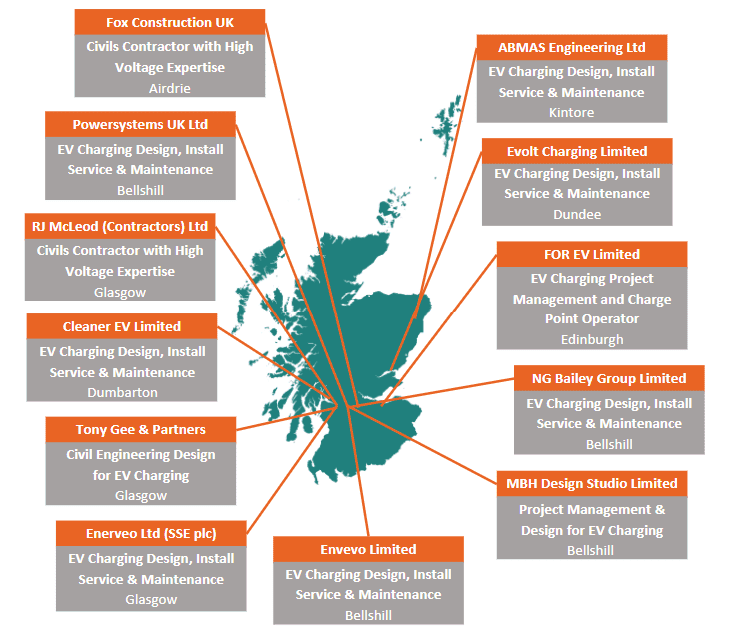
Four companies have also been identified as being owners of HDV charging infrastructure facilities: First Bus, FOR EV, Green Wheel Electric and Enerveo. The company included in the charger parts, components and systems manufacture segment has not been identified in this report due to this activity not being in the public domain.
Companies with potential to become active
We have identified 60 companies with capabilities potentially relevant to the charging infrastructure supply chain. We found no evidence that any of these were currently active in this supply chain. Our assessment of their capabilities was made based on reviewing information on their websites and most have not confirmed if they are interested in entering the supply chain.
The supply chain segment assessed as having the most potentially relevant companies was design and installation. Some of the companies identified in this segment also had capabilities that are potentially relevant to operation and maintenance. The companies were, typically, either low voltage EV charging installers, high voltage electrical contractors or civils contractors with experience in different sectors. To enter the HDV charging infrastructure market, the low voltage EV charging installers would have to develop new skills and competences to work on high voltage systems and become familiar with the installation requirements of different charging devices. Civils contractors may also require additional accreditations to work in high voltage environments. High voltage electrical contractors are likely to face the lowest barriers to entering this market of all the potential companies identified. This is due to the nature of their existing experience and skills being very similar to what is required to design and install HDV charging infrastructure.
Potential parts and systems manufacturers, for both fixed and mobile charging equipment, were identified. This covered enclosure fabrication, electronic components and devices, embedded software and cables, connectors and sockets. To enter the charging infrastructure market, these companies would have to develop supply chain relationships with manufacturers of HDV charging equipment. No manufacturers of this kind are currently located in Scotland. It is challenging to develop relationships with geographically remote customers unless there are unique attributes to the parts and systems these companies are able to supply. This could include circumstances where, for example, the potential Scottish supplier has parts or systems protected by intellectual property rights.
Six companies were identified as having the potential to manufacture fixed HDV chargers and two with the potential to manufacture mobile HDV chargers. Most of these companies are currently active in low voltage charger manufacture. It has not been confirmed if they are interested in investigating the HDV charger market.
One existing HDV charger manufacturer, located outside of Scotland, was identified as a potential inward investor for assembly activities. It has not been named due to confidentiality considerations.
Scotland’s role in the rest of the UK and international markets
We have confirmed that four of the 15 companies active in the HDV charging infrastructure supply chain export to markets outside the UK. Others may also export but we did not find evidence during our research to confirm this.
We spoke with three of these four exporting companies. In all three cases the companies described how they successfully delivered an HDV charging infrastructure design and installation project in the UK for an international customer. Having demonstrated competence in this type of project the same client then contracted with them to deliver the same type of project in overseas markets.
Two companies in the Scottish charging infrastructure supply chain described having offices in overseas companies. This includes the United Arab Emirates, which was described as having very similar electrical installation standards as the UK. Other examples of target international markets include countries in Europe such as Sweden and Germany.
Whilst there is evidence of international markets being accessible to electrical design and installation companies it is possible that opportunities for civil engineering contractors will be restricted to Scotland and the rest of the UK. This is due to reliance on capital intensive equipment that is not easy to transfer to overseas locations.
Four of the supply chain companies located in Scotland were part of a UK or international group. This means that the locations in Scotland typically service just the Scottish market or the UK market, depending on where other offices in the wider group are located. In these cases, the opportunities arising internationally will be serviced directly from other locations closer to those markets.
Role of the supply chain in other sectors
Some of the active supply chain companies identified are focused only on EV charging markets covering all sizes of vehicle, including HDVs.
Other companies have a wider target market and provide services to other sectors. For example, an electrical design and installation company servicing electrical systems works in the commercial and industrial sectors. The ability to carry out high voltage electrical projects has very wide applications, including in other sectors where decarbonisation is being driven by electrification.
Civil engineering design and installation contractors also have a wide range of application sectors for their services. Some of these may be closely connected to net zero, such as installation of district heat networks and wind farm development. Other civils work is not connected to net zero, such as expansion of the road transport network.
Challenges faced
The main challenge faced by companies in this supply chain is the current low demand from HDV operators. The main reason for this low demand is uncertainty amongst HDV operators about hard deadlines for when zero emission vehicles only will be available on the new vehicle market. All stakeholders recognise the long-term shift to decarbonised HDV fleets but, without an immediate regulatory or commercial reason to switch, there is limited incentive.
There is also uncertainty about which powertrain option to invest in amongst operators. Representative bodies, such as Logistics UK and the Road Haulage Association are lobbying for low carbon fuels to play more of a role in the short-term decarbonisation of fleets. Although these are not zero-emission solutions, they are commercially proven and an attractive option for some operators seeking to demonstrate action on greenhouse gas emission reduction to their customers. Pursuing this as a decarbonisation option in the short term could delay the adoption of zero emission HDVs and the charging and refuelling infrastructure they will require.
Other challenges
- Low operator awareness of, and skills required for, fleet decarbonisation plus limited awareness of Scottish supply chain options
- Sporadic short term grant funding for operators
- Grid capacity constraints and connection queues
- Availability of finance for fleet operators
- Physical space constraints in HDV depots
- Skills shortages in key areas, such as high voltage design engineering
- Training gaps for low voltage charger installers interested in high voltage HDV charging installation
Hydrogen refuelling infrastructure
We have identified seven companies active in the HDV hydrogen refuelling infrastructure supply chain with locations in Scotland. All of these companies are involved in other activities not related to HDVs. This means that it has not been possible to use company level employment and turnover data, identified during the desk research, to estimate the scale of HDV activity.
We spoke with two of the seven supply chain companies and a further six stakeholders with knowledge of the hydrogen economy. Based on these discussions, we estimate that the HDV hydrogen refuelling infrastructure supply chain employs fewer than 100 people in Scotland. As with the charging infrastructure supply chain, there is very limited manufacturing activity, with only two of the seven supply chain companies being active in components and systems manufacture. Most equipment used by the Scottish companies being sourced from the rest of the UK or overseas and integrated by companies in the Scottish supply chain rather than manufacturing original equipment. Based on our discussions with stakeholders, the limited number of jobs within the HDV hydrogen refuelling infrastructure supply chain are concentrated across systems integration, design, construction and installation and ownership, operation and maintenance. It has not been possible to calculate exact percentages of jobs in each of the supply chain segments as six of the seven companies are active in more than one segment and we do not know the relative split of activity between segments. Although all seven supply chain companies were approached for interview, only two participated, meaning there is insufficient data available to estimate the exact breakdown of employment by supply chain segment. There is also insufficient data available to allow us to estimate the turnover for this supply chain as those companies who did speak with us preferred to provide information about employment levels rather than turnover.
An overview of the number of companies active in each supply chain segment is shown in Table 5 (please note that the figures in Table 5 total more than the seven companies we identified for this supply chain. This is due to some companies being active in more than one segment of the supply chain).
Materials | Parts & System Manufacture | Systems Integrator/ OEM | Design, Construction & Install | Ownership, Operations and Maintenance |
|---|---|---|---|---|
0 | 2 | 4 | 5 | 4 |
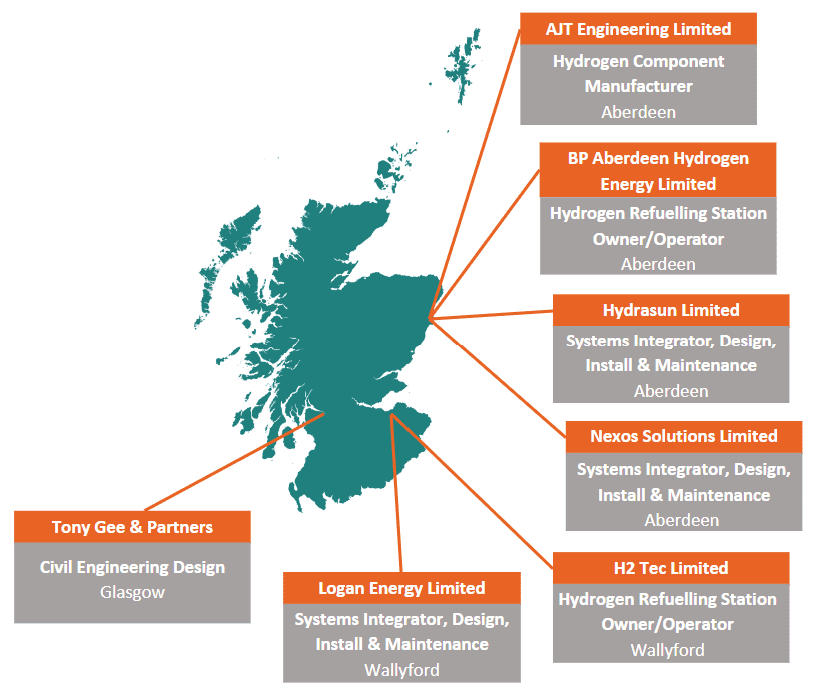
The seven companies active in the hydrogen refuelling infrastructure supply chain are show in Figure 3.
Companies with potential to become active
Our research has also identified 19 companies with the potential to become active in the hydrogen refuelling infrastructure supply chain. This assessment was made through review of their capabilities, e.g. based on information on their websites, and suggestions made by stakeholders during the consultation period that highlighted potential activity.
Most of these companies have capabilities that are potentially relevant to the component and system manufacturing segments of the supply chain. Identified companies are either already active in adjacent component supply chains or developing capabilities in hydrogen specific supply chains. The types of components include compressor and decompressor equipment, pipework, valves, metal tanks / vessels, nozzles and tubes, sensors. For example, Stewart Buchanan Gauges Ltd is designing and developing hydrogen valves, which could be relevant to the HDV hydrogen refuelling infrastructure supply chain.
The design, construction and installation companies identified mostly offer concept design, detailed design, and health and safety consultancy and support services that include hydrogen safety. It has not been confirmed whether work has been done in the hydrogen refuelling market specifically.
Scotland’s role in the rest of the UK and international markets
The UK hydrogen refuelling market is at a very early stage of development. There is limited completed or planned refuelling infrastructure. However, where it has been developed, these refuelling sites have generally been delivered by Scottish OEMs and systems integrators.
In terms of international markets, feedback from stakeholders confirms that Scotland-based systems integrators and OEMs are providing, or have provided, services and products to international markets including Europe and Asia. However, it was noted that the likelihood of entering the Chinese market is now limited due to central government financial support and rapid deployment leading to high levels of in market competition. The decline of demand in the USA market since the beginning of the current Government Administration has been damaging to what has been a core market for Scottish companies.
Role of the supply chain in other sectors
The design of the system for hydrogen refuelling infrastructure is unique to the end-use, however opportunities exist in adjacent hydrogen sectors as they develop including off-grid power generation and distribution, hydrogen storage and transport. The core hydrogen technologies and capabilities can be energy storage and refuelling applications, with stakeholder feedback identifying that there is more activity in the energy storage segment at present.
Further back in the supply chain the component manufacturers generally transition from legacy oil and gas industries and deliver components that can be used in other net zero markets including the broader hydrogen derivatives market. This could include ammonia for the decarbonisation of maritime as well as other potential applications in energy generation and storage utilising liquid or gaseous vectors and mechanical components for applications such as pumped hydro. The challenge for the supply chain is the slow progress and certainty around the development of these other net zero markets.
Challenges faced
The central challenge faced by this supply chain is a lack of clear and positive policy intent. Further, the dangers of a net zero targets easing to allow for a small amount of fossil fuel use poses a threat to the development of the hydrogen refuelling market, resulting in it becoming a marginal technology to address residual emissions rather than a primary route to decarbonisation. It was recognised through consultation with stakeholders that hydrogen (more generally) but particularly hydrogen HDVs will likely play a comparatively small but critical role in the achievement of net zero targets. The technology will likely occupy a marginal role in the achievement of the final, hard to abate reductions necessary for net zero. If policy goals shift towards allowing a small role for fossil fuels, the hydrogen economy is likely to contract.
Attracting finance to enable pilot market activity that can demonstrate commercial viability has also been identified as a key challenge.
A lack of component certification standards for hydrogen refuelling infrastructure applications was also identified as a challenge to the development of compliant components.
We note that international markets have more proactively set targets and support mechanisms for the deployment of hydrogen refuelling stations and hydrogen HDVs more broadly. One stakeholder noted that it would be helpful for the supply chain to have a clear point of contact within Transport Scotland to discuss challenges and opportunities related to hydrogen refuelling. Further challenges beyond the scope of this project include the cost of energy, the cost of producing and transporting hydrogen, and consequently, the levelised cost of hydrogen.
SWOT Analysis
Summaries of the key findings of the SWOT analysis for each supply chain are shown in Table 6: SWOT analysis – HDV and niche vehicle manufacturing supply chain, to Table 8: SWOT analysis – HDV hydrogen refuelling supply chain.
Strengths | Weaknesses |
Scotland has specialist HDV manufacturers and integrators with capability in bespoke vehicle design, integration and aftersales support | The manufacturing base is small and fragmented, with limited OEM capability |
Existing strengths in control systems, software, telematics and energy management are transferable to zero-emission HDVs | Most zero-emission HDV activity (outside buses) remains pilot-scale, with minimal demand and no measurable employment growth to date |
Manufacturers are embedded in public-sector procurement, which supports early trials and specialist applications where OEM solutions are less mature | Heavy reliance on imported chassis and systems limits value capture and exposure to external OEM decisions |
Opportunities | Threats |
UK and EU zero-emission targets have the potential to create a long-term market for compliant vehicles and systems | Strong international competition, particularly from large Chinese OEMs, limits Scotland’s competitiveness in zero-emission HDV manufacturing |
Niche and specialist vehicles (e.g. refuse, emergency and municipal) offer the most realistic entry points for Scottish manufacturers | Weak and uncertain market demand, driven by high vehicle costs and limited infrastructure, undermines investment confidence |
Growth is most likely in integration, engineering services, software and lifecycle support | Low confidence amongst some supply chain companies that 2035 and 2040 zero emission HDV policy targets will be enforced as currently stated |
Scotland’s main strengths are in niche manufacturing and vehicle integration, rather than mass production. Existing companies have expertise in the building of specialist vehicles, bespoke design, systems integration and aftersales support. Capabilities in software, control systems and energy management are largely transferable to zero-emission HDVs and align with areas where future value is expected to sit. Strong links to public-sector procurement have enabled early trials and demonstrator projects, generating learning even where commercial outcomes remain uncertain.
The analysis, however, highlights some significant weaknesses. The manufacturing base is small, fragmented and relies heavily on imported chassis and core systems. Scottish companies, therefore, have very limited influence over technology pathways or product availability, which are shaped by global OEM decisions. Zero-emission HDV production (outside buses) remains at pilot scale, with no clear evidence of employment growth to date. High vehicle costs, limited infrastructure and weak customer demand reinforce a cautious, wait-and-see approach across the supply chain.
Opportunities are largely policy-driven rather than market-led. UK and EU emissions standards and demonstrator funding create long-term demand for zero-emission vehicles, but the most realistic opportunities for Scottish companies sit in specialist and niche applications, such as municipal and emergency vehicles, and in service-led activities including integration, engineering support and digital systems.
The threats are significant. International competition, particularly from large Chinese OEMs, constrains Scotland’s ability to compete on cost or scale. Uncertain demand, high upfront costs and reliance on global supply chains increase commercial risk. Stakeholder feedback from some company and other stakeholders expressed doubt that policy targets for zero emission HDVs will be enforced as stated, and viewed this as leading to market uncertainty.
Strengths | Weaknesses |
Scotland has an established EV charging supply chain with practical experience in depot-based charging, including early HDV applications | Only one domestic manufacturer of HDV charging device components, with most value coming from services rather than equipment |
Scottish-based integrators and service providers already deliver design, grid connection, installation and operations, with growing HDV-related employment | Shortages of skilled contractors and engineers for high-power and large-scale installations may constrain delivery and scale-up |
Current Scottish capabilities align well with the expected dominance of depot charging for HDVs to 2030 | HDV charging remains early-stage and fragmented, with limited infrastructure coverage beyond pilots and bus depots |
Opportunities | Threats |
Strong growth in HDV electrification will create demand for depot charging, grid upgrades, and system operation, where Scotland already has capability | Grid capacity constraints and high connection costs risk slowing deployment, particularly for high-power sites |
Companies report clear potential for job growth in Scotland, particularly in engineering, design and operations linked to HDV charging in Scotland, UK and export markets | Policy and funding uncertainty, including short-term grant schemes and lack of clarity about regulatory deadlines, undermine market and supply-chain confidence |
EU and UK policy requirements for HDV charging corridors and depots support longer-term market demand | Skills shortages and reliance on imported hardware increase the risk that economic value and ownership shift to large international providers |
A key strength is the presence of established EV charging integrators and service providers with experience in depot-based charging, developed through the bus sector and early HDV projects. This aligns well with evidence that depot charging will dominate HDV charging to 2030. Scottish companies already provide design, grid connection, installation and operations services, and some are seeing early employment growth linked to HDV charging.
There are, however, notable gaps in the supply chain. Only one domestic manufacturer of HDV charging components was identified, providing cooling systems for HDV chargers. The Scottish supply chain relies heavily on imported equipment. Skills shortages, particularly for high-power installations, and limited training provision constrain the pace of deployment. HDV charging infrastructure remains limited, with activity concentrated in pilots and early depot projects. Uncertainty about current and future demand for HDV charging infrastructure, combined with stop-start grant funding, have reduced confidence among both fleet operators and infrastructure providers.
Opportunities are driven by growing HDV electrification and policy requirements for charging infrastructure both domestically and internationally. These create potential for job growth and positive economic impact in the installation, operations and maintenance segments of the supply chain, rather than in manufacturing.
The main threats relate to delivery risk and investment confidence. Grid capacity constraints, high connection costs and short-term funding cycles all have a negative impact on deployment. The lack of domestic manufacturing of HDV charging devices, and very limited component supply chain, limits the value retained in the Scottish supply chain.
Strengths | Weaknesses |
Scotland has practical experience in hydrogen mobility and refuelling from public-private projects in buses and municipal fleets | The supply chain is small, capacity-constrained and highly dependent on a few providers, which limits competition and resilience |
A small number of Scottish-based integrators can deliver end-to-end hydrogen refuelling projects, including design, installation and operations | Most critical refuelling equipment is imported, restricting Scottish supply chain activity to integration and maintenance |
Scotland’s extensive renewable electricity infrastructure supports the long-term potential for green hydrogen production linked to refuelling | Activity remains pilot-led and fragmented, with limited coordination between hydrogen production, vehicles and refuelling |
Opportunities | Threats |
Hydrogen refuelling is most viable in specific HDV use cases with high utilisation and centralised depots, such as buses and refuse vehicles | Weak fleet demand, high vehicle and fuel costs, and limited OEM activity in hydrogen powered HDVs undermine infrastructure utilisation and roll out |
UK and international policy frameworks and demonstrator funding support continued trials and targeted deployment | Battery-electric HDVs are scaling faster and at lower cost, restricting hydrogen to niche roles |
Scottish firms can realise economic benefits in system integration, EPC delivery and operations, and apply these capabilities in overseas markets | Policy uncertainty, high capital costs and reliance on a small international equipment market increase delivery and investment risk |
Scotland’s main strength is its practical delivery experience derived from hydrogen mobility projects, particularly for buses and municipal fleets. A small number of Scottish-based companies can deliver end-to-end refuelling projects and have developed strong safety, engineering and operational expertise. Scotland’s renewable electricity base also supports the long-term potential for green hydrogen, where refuelling is co-located with production.
The analysis, however, highlights significant weaknesses. The supply chain is small and capacity constrained. There is significant reliance on a few providers and on imported core equipment. Projects are, typically pilots or demonstrators and have been delivered on a standalone, case-by-case basis, with limited coordination between hydrogen production, refuelling infrastructure and vehicles, except for the coordinated approach of Aberdeen City Council. Failed or stalled projects have reduced confidence among public-sector sponsors and fleet operators.
Opportunities for Scottish companies in hydrogen refuelling infrastructure are limited and use-case specific. Evidence gathered during this study suggests hydrogen is most viable for HDV applications with high utilisation and predictable duty cycles where purchase agreements can be forecast, for example, buses or refuse vehicles. Policy frameworks and demonstrator funding continue to support trials and demonstrators and there is potential for Scottish companies to participate in roles such as system integration, EPC delivery and operations, rather than in equipment manufacture.
The main threats relate to low demand and sidelining of hydrogen adoption in long-term policy and strategy. High vehicle and fuel costs, limited hydrogen powered HDV manufacture and uncertain utilisation undermine the commercial case for refuelling infrastructure. The use of battery electric HDVs is scaling more quickly and at a lower cost. Ongoing policy uncertainty, high capital costs and reliance on small global equipment supply chains further increase investment and delivery risks.
Our detailed analysis of the strengths, weaknesses, opportunities and threats for each supply chain is provided in Appendix C.
Future demand changes for each supply chain
This section considers the potential change in demand of the three supply chains in Scotland as a response to the decarbonisation of HDVs. For the estimation of the current economic size of the HDV and niche vehicle manufacturing supply chain we have been able to use both turnover and employment data. Due to a lack of robust turnover data for the remaining two supply chains, from both desk research and stakeholder interviews, we have used employment estimates as a proxy for change in demand and all future economic size estimates. We recognise that using employment data has limitations in the extent that it can reflect changes in productivity. We consider 2030 and 2035 timeframes. No account has been made for any inward investment contribution to the supply chains in our estimated future economic size. Whilst we believe inward investment could be an important contributor to supply chain growth, the level of uncertainty about the scale of any such activity is too high to quantity the resulting impact. The employment projections are based on the growth of the existing supply chain companies.
We reviewed desk-based evidence to identify the nature, scale and timing of the shift to decarbonised HDVs. This provided context for how the market demand would change for the three supply chains covered in this study.
We spoke with 27 industry and other stakeholders covering all three supply chains. We combined the feedback from these stakeholders with what we found from the desk-based review. We used this to develop a view of what could happen to the number of jobs in Scotland in these supply chains from now until 2030 and then to 2035. We focused on employment numbers as a proxy for economic growth as stakeholders were more willing and able to provide data on projected employment than projected turnover.
We presented our emerging findings, about the scale of jobs growth in each of the three supply chains to 2030 and 2035, to a group of 13 industry and other stakeholders at a workshop. Some stakeholders had differing opinions on how quickly decarbonisation of HDVs will occur. Some point to parts of the HDV market where it can already be more cost effective to buy zero emission vehicles. For example, city buses and lighter heavy goods vehicles (HGVs). Others highlight the position of many HGV fleet operators that low carbon fuels, such as biomethane and hydrogenated vegetable oil (HVO), should play an important role in decarbonisation of HGVs in the short term, therefore delaying the uptake of some zero emission vehicles. However, there was broad agreement by the majority of stakeholders that the indicative scale and timing of job growth in each of the three supply chains was reasonable, given their understanding of HDV decarbonisation to 2030 and 2035.
Based on this, our estimate for the potential change in job numbers across each supply chain, to 2030 and 2035 is compared with current job numbers in Table 9.
Supply Chain | Current Jobs | Jobs by 2030 | Jobs by 2035 |
|---|---|---|---|
Overall HDV and niche vehicle manufacturing | 3,200 to 4,000 | 3,200 to 4,500 | 3,200 to 5,200 |
Zero emission HDV and niche vehicle manufacturing (subset of the overall HDV and niche vehicle manufacturing supply chain) | 300 to 500 | 500 to 1,000 | 1,000 to 3,000 |
HDV charging infrastructure | 300 to 400 | 400 to 700 | Uncertain – no estimate |
HDV refuelling infrastructure | Less than 100 | Uncertain – no estimate | Uncertain – no estimate |
HDV and niche vehicle manufacturing supply chain, including zero emissions
Based on stakeholder feedback we estimate that the size of the overall HDV and niche vehicle manufacturing supply chain is likely to remain stable or have modest growth in line with market demand for HDVs. We expect the global market demand for HGVs and buses and coaches to be less than 5% annually: 3.9% according to Grandview Research (2023) and 4.2% according to Research and Markets (2025). Within this overall supply chain, the zero emissions HDV and niche vehicle manufacturing activity is projected to move existing employment from fossil fuel vehicle manufacture to zero emission vehicle manufacture. There was some uncertainty expressed by one stakeholder about whether the pace of change would be slower than these projections suggest but the view by most stakeholders was that it was a reasonable estimate.
HDV charging infrastructure supply chain
The charging infrastructure stakeholders feedback consistently reported a significant projected increase in employment to 2030 related to HDV charging infrastructure, driven by a quickening pace of Heavy Goods Vehicle (HGV) decarbonisation. There was uncertainty about the level of jobs by 2035 due to concerns that regulatory targets to mandate new HDV sales to be net zero have not yet been established for the UK and a perceived risk that targets could subsequently be changed in future.
Hydrogen refuelling supply chain
Stakeholder feedback and desk research suggests that any significant jobs growth in hydrogen refuelling infrastructure supply chain would likely take place after 2035. One stakeholder highlighted the risk that regulatory targets could be softened to require a high level of zero emission HDV adoption rather than complete zero emission adoption. They viewed this as a risk to current investment and an issue that could significantly curtail employment growth in the supply chain in future. Stakeholder feedback and desk-based research suggests that hydrogen refuelling will play a targeted but modest role in HDV decarbonisation. This may emerge through the development of a trunk road network approach to establish a minimum viable operating model for HDV refuelling infrastructure and, therefore, hydrogen HDV operation. This approach is being followed in Europe with regulatory and fiscal support from the European Commission. An alternative could be infrastructure funded by the private sector on a case-by-case basis. Shorter-term opportunities exist in the deployment of mobile refuelling solutions, where battery electrification and recharging is not suitable, such as mining and some agricultural purposes.
Cross-check of job projection estimates made in this study
We have compared our estimates of future job numbers with those made in a previous study (Scottish Enterprise 2024). This Scottish Enterprise study provides ranges of full time equivalent (FTE) jobs related to capital investment and operation & maintenance under two scenarios. The first scenario is ‘Business as Usual’, which assumes the rate of change is slower with less appetite for change at consumer level with the Net Zero target being missed. The second scenario is ‘Strong Ambition’, which assumes high levels of deployment driven by societal change and strong policy support. Table 10 provides upper and lower job number estimates for different supply chains, calculated from data in the Scottish Enterprise report. The lower number in each cell is the estimated job numbers under the Business as Usual scenario. The second figure in each cell is the estimated job numbers under the Strong Ambition scenario. The Scottish Enterprise data for the sectors equivalent to the supply chains being investigated in this study are shown in Table 10.
Sector (SE) | Equivalent supply chain in this study | 2025 FTE range | 2030 FTE range | 2035 FTE range |
|---|---|---|---|---|
EV Buses/HGVs | Zero emission HDV manufacturing | 189 to 488 | 485 to 2,372 | 1,459 to 7,331 |
H2 Buses/HGVs | Zero emission HDV manufacturing | 29 to 58 | 48 to 134 | 82 to 284 |
EV Chargers – All | HDV charging | 87 to 235 | 330 to 888 | 789 to 1,861 |
Hydrogen Refuelling | HDV hydrogen refuelling | 30 to 105 | 52 to 238 | 105 to 536 |
We observe that the current and future employment estimates we made for the three supply chains, in this study, (shown in Table 9) are broadly compatible within the ranges of the two scenarios stated in the Scottish Enterprise (2024) report. Note that Table 10 provides job estimates for the zero emission HDV manufacturing supply chain only and not the overall HDV and niche vehicle manufacturing supply chain.
Comparison of HDV decarbonisation driven jobs growth with growth in other sectors
It is also useful to compare the current size and growth potential of the HDV related supply chains with some other sectors in the Scottish economy. This provides a context to the potential contribution of job growth from the decarbonisation of HDVs with potential job growth in other sectors. Table 11 shows current and projected employment growth from the same Scottish Enterprise study (Scottish Enterprise 2024).
Supply chain | 2025 FTE range | 2030 FTE range | 2035 FTE range |
|---|---|---|---|
Offshore Wind | 6,164 to 11,068 | 11,291 to 25,738 | 23,278 to 67,121 |
Heat Pumps | 1,089 to 6,589 | 3,516 to 14,119 | 4,647 to 13,105 |
Heat Networks | 878 to 939 | 269 to 659 | 334 to 2,107 |
Hydrogen Production | 51 to 160 | 257 to 8,039 | 151 to 6,181 |
CCUS | 665 to 1,028 | 1,383 to 2,062 | 1,348 to 1,585 |
We observe that, by 2035, the number of jobs estimated for the supply chains driven by HDV decarbonisation (those shown in Table 10) is lower than the estimated job growth in offshore wind and heat pumps but comparable to hydrogen production and higher than heat networks and CCUS.
Benefits to other sectors from HDV decarbonisation
We looked for examples of where companies in other sectors, currently outside of the three HDV supply chains might benefit from HDV decarbonisation. We did this through stakeholder interviews and desk-research.
Companies in different parts of the construction sector have skills and capabilities relevant to the civil engineering aspects of development of charging infrastructure and hydrogen refuelling infrastructure. This includes early surveying, planning and design of civil works and also civil engineering contractors to carry out groundworks in preparation for the installation of electrical infrastructure or hydrogen refuelling equipment.
Companies in the renewable energy generation sector can move downstream into the development and provision of charging stations using their expertise in planning and project management. We identified one example of this, with Greenwheel Electric Ltd in the process of planning an electric only charging station in West Dunbartonshire. Greenwheel Ltd is part of Muirhall Energy, an established onshore wind developer. This enables Greenwheel to provide a 100% renewable electric charging station offering.
Companies in the clean heat sector can use their technologies to provide systems capable of electrifying HDV truck cabins and buses, to reduce the draw on electricity from the main vehicle battery. We are aware of one company that has taken part in a pilot project to provide heat for an electric bus using their technology usually deployed in home heating. We are also aware of a company with a heat pump technology also being used to provide a cooling system for an HDV charger manufacturer. We cannot name these companies due to commercial confidentiality.
Stakeholder views on maximising economic opportunities
We asked stakeholders from each of the three supply chains to identify what could be done to maximise the economic opportunities from the decarbonisation of HDVs. A broad range of demand side and supply side suggestions were made. These are summarised in Figure 4.
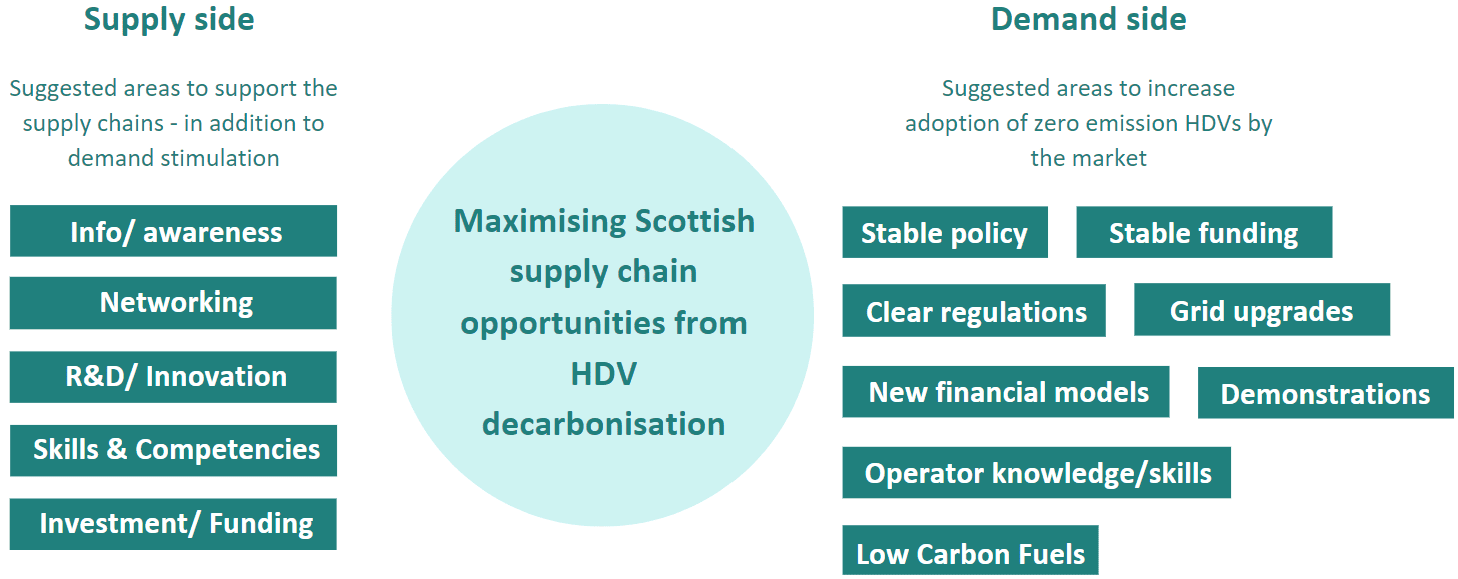
The suggestions made by interviewees, in relation to each of the three supply chains, are described in more detail in the following sections. Further details are in Appendix D.
HDV and niche vehicle manufacturing
- Increased clarity of regulation and when new HDV sales must be zero emission
- Long term, stable funding for operators to overcome total cost of ownership (TCO) issues
- Support for operators to access financial models to fund vehicle and infrastructure investment
- Improving skills provision for companies to safely work on OEM supplied BEV and HFCEV chassis when using these as a base to build customised HDVs
Charging infrastructure
- Policy and regulatory certainty for HDV operators and manufacturers
- Long term, stable funding for operators to overcome TCO issues
- Coordinated research to understand locations where grid reinforcement is required and managing future connection queues
- Support existing companies to enter the HDV charging manufacturing supply chain and attract inward investment opportunities
- Promote Scottish supply chain capabilities to Scottish operators, including networking at existing public HDV charging sites
- Invest in more in Graduate Apprenticeships to address areas of skills shortages, such as high voltage electrical design engineering
- Support low voltage charger installers to upskill if they are interested in entering the high voltage HDV charging installation market, including establishing links with charging device manufacturers
- Raise awareness of the market opportunities for civil engineering contracts and support skills development to work in high voltage environments
Hydrogen refuelling infrastructure
- Clear long-term policy confirming 100% net zero target
- Development of industry standards to support hydrogen system component development
- Promote Scottish supply chain companies to fleet operators and identify the main Government/Transport Scotland contact points for the supply chain
Conclusions
Strong global policy and market forces are accelerating HDV decarbonisation
We identified strong drivers for HDV decarbonisation, resulting in a clear direction of travel. This includes regulation and funding support from governments in major markets, including China, Europe and North America. Market drivers are also arising from companies that are increasingly demanding evidence from their supply chains that real action is being taken to reduce greenhouse gas emissions.
The speed of transition varies by type of HDV and low carbon fuels are playing a role alongside zero emission options
Many countries, including the UK, have set target dates by which sales of new diesel and petrol HDVs will be replaced by zero emission HDVs. The regulatory measures to support this are still being consulted on at a UK level. The feedback we received from stakeholders interviewed for this study highlights different views about how quickly the transition to zero emission HDVs is likely to happen.
Some stakeholders highlight examples of companies buying zero emission HDVs, without any grant funding support, due to the total cost of ownership being lower than traditional diesel alternatives. This has typically been in the bus market and lighter end of the HGV market.
Other stakeholders suggested that fleet operators are using low carbon fuels, such as biomethane and HVO in the short term for cost and proven performance reasons. Two of the main HGV fleet operator representative bodies are in favour of using low carbon fuels as a decarbonisation technology and this would likely contribute to delay in investment in battery electric and hydrogen powered HDVs.
Scottish HDV and niche vehicle manufacturing supply chain activity is concentrated in a few companies
We identified nine companies in Scotland during this study as being active in the manufacturing of HDVs or niche vehicles. Six of these are active, or have recently been active, in zero emission HDVs. An additional 12 companies are involved in the manufacturing supply chain, with only one of these having been active in zero emission manufacturing. In most of these companies, the transition to zero emission vehicles is likely to lead to safeguarding of existing jobs as diesel vehicle manufacturing is displaced. Currently the 22 active companies employ several thousand employees, with a few hundred of these being active in zero emission activities. Exporting is a key route to market for most of the companies in this supply chain. Although an additional 103 companies with Scottish locations have been identified as having potentially relevant capabilities, only three were identified as developing new products targeting this supply chain. For the remaining potential companies, there is uncertainty about whether they are either aware or interested in entering the supply chain. If they chose to do so there would be significant barriers if they did not have a clear, unique proposition.
The HDV charging infrastructure supply chain is mainly service based and is growing
We identified 15 active companies with locations in Scotland in this supply chain. We estimate that current employment is between 300 and 500 and the focus is on design, installation, ownership, operation and maintenance. Only one parts manufacturer, producing cooling systems for a large charging device manufacturer, was identified. Some companies in this supply chain are already active in European and Middle East markets, delivering HDV design and installation projects. All companies interviewed from this supply chain expect significant growth in their HDV charging business. An additional 60 companies were identified as having capabilities potentially relevant to this supply chain. Some of these are currently involved in the manufacture of charging devices for cars and light vans and it is not known whether they view HDV charging manufacture as a market development opportunity. Others are involved in installation of domestic and light commercial charging infrastructure and would need additional skills development to enter the HDV charger installation market. Again, it is not known how many of these companies view the HDV market as a realistic opportunity.
The HDV hydrogen refuelling infrastructure supply chain is very limited with the main growth opportunity identified after 2035
We identified seven companies with Scottish locations as being active in the hydrogen refuelling infrastructure supply chain. We estimate that total current employment is fewer than 100. There is limited manufacturing capability in Scotland, with most systems integrators sourcing equipment from outside of Scotland. Most of the activity in this supply chain relates to hydrogen refuelling infrastructure design, installation and operation for demonstrators. The main focus is on supporting hydrogen powered buses and public sector vehicle fleets. Discussions with stakeholders in this sector highlighted that the most significant uncertainties relate to the timing of additional hydrogen powered HDV deployment and no future employment growth estimates have been made. There was general agreement from stakeholders that significant levels of adoption would take place mid to late 2030’s but this is very dependent on HDV decarbonisation policies being ‘zero emission’ rather than ‘almost zero emission’.
Market demand stimulation is vital but supply side actions are important too
Various initiatives already exist at government and industry level to stimulate market demand for zero emission vehicles and the associated charging or hydrogen refuelling infrastructure. Key actions, which are already well understood, include clear and stable policy, consistent funding support, clear regulations and addressing grid capacity and connection constraints. Stakeholders interviewed for this study also highlighted several actions addressing specific supply side issues. These includes awareness raising and networking with fleet operators, particularly for SMEs, to highlight Scottish supply chain capabilities. The importance of addressing current and future skills shortages in electrical design and installation and training capacity to upskill low voltage EV charging installers are also examples of supply side actions required to maximise economic opportunities for the Scottish supply chains.
References
ACEA (2024) Economic and Market Report Global and EU auto industry: Full year 2024. Available at: https://www.acea.auto/publication/economic-and-market-report-global-and-eu-auto-industry-full-year-2024/ (Accessed 12 November 2025)
Basma, H and Schmidt, J. (2025) Charging Infrastructure Needs for Battery Electric Trucks in the European Union by 2030. International Council on Clean Transportation. Available at: https://theicct.org/wp-content/uploads/2025/10/ID-476-–-EU-BETs_report_final-1.pdf (Accessed 08 January 2026)
BloombergNEF (2025) Zero Emission Commercial Vehicles – Accelerating the Transition. Available at: https://assets.bbhub.io/professional/sites/24/Zero-Emission-Commercial-Vehicles-Factbook-2025.pdf (Accessed 08 January 2026)
CSIRO and GHD (2023) Hydrogen Vehicle Refueling Infrastructure: Priorities and opportunities for Australia. Available at: https://elecseed.com.au/wp-content/uploads/2023/08/Hydrogen_Vehicle_Refuelling_Infrastructure_Report.pdf (Accessed 18 November 2025)
Danish Ministry of Transport (2021) Infrastructure Plan 2035. Available at: https://www.trm.dk/politiske-aftaler/2021/aftale-om-infrastrukturplan-2035-aftale/ (Accessed 13 November 2025)
Department for Transport (DfT) and Driver and Vehicle Licensing Agency (DVLA) (2026) [1] Data Table Veh0556 – Heavy goods vehicles registered for the first time by gross vehicle weight (tonnes). Available at: https://www.gov.uk/government/statistical-data-sets/vehicle-licensing-statistics-data-tables#all-vehicles (Accessed 02 February 2026)
Department for Transport (DfT) and Driver and Vehicle Licensing Agency (DVLA) (2026) [2] Data Table Veh0601 – Licensed buses and coaches at the end of the year by body type detail. Available at: https://www.gov.uk/government/statistical-data-sets/vehicle-licensing-statistics-data-tables#all-vehicles (Accessed 02 February 2026)
Department for Transport (DfT) and Driver and Vehicle Licensing Agency (DVLA) (2026) [3] Data Table Veh1104 – Licensed Vehicles at the end of the quarter by body type and region. Available at: https://www.gov.uk/government/statistical-data-sets/vehicle-licensing-statistics-data-tables#all-vehicles (Accessed 04 February 2026)
Department for Transport (DfT) and Driver and Vehicle Licensing Agency (DVLA) (2026) [4] Data Table Veh1154 – Vehicles Registered for the first time by body type and region: Great Britain and United Kingdom. Available at: https://www.gov.uk/government/statistical-data-sets/vehicle-licensing-statistics-data-tables (Accessed 11 February 2026)
Department for Transport (DfT) and Driver and Vehicle Licensing Agency (DVLA) (2026) [5] Data Table Veh0171 – Ultra low emission vehicles (ULEVs) registered for the first time by body type and fuel type, including breakdown of generic models: Great Britain and United Kingdom. Available at: https://www.gov.uk/government/statistical-data-sets/vehicle-licensing-statistics-data-tables (Accessed 11 February 2026)
Drake, W. et al (2023) Why Great Britain’s long-distance, heavy-duty HGVs can go battery electric – and what needs done to achieve this, Element Energy/ ERM. Available at: https://www.erm.com/contentassets/553cd40a6def42b196e32e4d70e149a1/phase-two-report-use-cases-that-do-need-public-charging.pdf (Accessed 08 January 2026)
Energy UK (2025) Driving electrification in the road freight sector. Available at: https://www.energy-uk.org.uk/publications/driving-electrification-in-the-road-freight-sector/ (Accessed 02 March 2026)
Enova (2025) Support scheme for heavy-duty zero-emission vehicles. Available at: https://www.enova.no/nb/bedrift/landtransport/stottetilbud-innen-landtransport/tunge-nullutslippskjoretoy (Accessed 13 November 2025)
EPA (2024) EPA awards over $735 million for clean heavy-duty vehicles. Available at https://driveelectric.gov/news/epa-clean-heavy-duty-vehicles-awards (Accessed 13 November 2025)
European Commission (2024) Regulation (EU) 2023/1804 of the European Parliament and of the Council of 13 September 2023 on the deployment of alternative fuels infrastructure. Available at: https://eur-lex.europa.eu/legal-content/EN/TXT/?uri=CELEX%3A32023R1804 (Accessed 07 January 2026)
European Commission (2025) EU awards over €600 million to alternative fuel projects to boost zero-emission mobility. Available at: https://cinea.ec.europa.eu/news-events/news/eu-awards-over-eu600-million-alternative-fuel-projects-boost-zero-emission-mobility-2025-11-17_en (Accessed 26 November 2025)
European Commission (2025) [2] Ministerial Declaration on the Clean Transport Corridor Initiative. Available at: https://transport.ec.europa.eu/document/download/e49b6a7a-8f8a-4901-b8ba-b9f88aed8683_en?filename=CTCI-ministerial-declaration.pdf (Accessed 07 January 2026)
European Parliament news (2024) MEPs adopt stricter CO2 emissions targets for trucks and buses. Available at: https://www.europarl.europa.eu/news/en/press-room/20240408IPR20305/meps-adopt-stricter-co2-emissions-targets-for-trucks-and-buses (Accessed 28 January 2026)
Grand View Research (2023) The Global Commercial Vehicles Market Size and Outlook, 2023 – 2030. Available at: https://www.grandviewresearch.com/horizon/outlook/commercial-vehicles-market-size/global (Accessed 02 March 2026)
Grand View Research (2026) Hydrogen Fueling Station Market (2026-2033). Available at: https://www.grandviewresearch.com/industry-analysis/hydrogen-fueling-station-market-report (Accessed 28 January 2026)
Gobierno de España (2021) Real Decreto 983/2021, de 16 de noviembre. Boletín Oficial del Estado. Available at: https://www.boe.es/eli/es/rd/2021/11/16/983 (Accessed: 13 November 2025)
Herit, A., Hildebrandt, E. and Becker, H. (2024) Building Europe’s electric-truck charging infrastructure, McKinsey & Company. Available at: https://www.mckinsey.com/industries/automotive-and-assembly/our-insights/building-europes-electric-truck-charging-infrastructure (Accessed 07 January 2026)
Hydrogen Europe (2025) The need for a combined approach to zero-emission transport. Available at: https://hydrogeneurope.eu/policy-priorities/h2-mobility/ (Accessed 10 December 2025)
Hydrogen UK (2023) Hydrogen Transport Benchmarking. Available at: https://hydrogen-uk.org/wp-content/uploads/2023/03/HUK_Hydrogen-Transport-Benchmarking_online-Mar23.pdf (Accessed 14 November 2025)
Innovate UK Business Connect (2024) Zero Emission Heavy Goods Vehicles and Infrastructure Programme. Available at: https://iuk-business-connect.org.uk/programme/zero-emission-heavy-goods-vehicles-and-infrastructure/ (Accessed 13 November 2025)
International Council on Clean Transportation (ICCT) (2025) Zero-emission medium- and heavy-duty vehicle market in China: 2024 update. Available at: https://theicct.org/publication/ze-mhdv-market-china-2024-mar25/ (Accessed 14 November 2025)
International Energy Agency (IEA) (2024) Global EV Outlook 2024. Available at: https://www.iea.org/reports/global-ev-outlook-2024 (Accessed 07 January 2026)
International Energy Agency (IEA) (2025) Global EV Outlook 2025. Available at: https://www.iea.org/reports/global-ev-outlook-2025/trends-in-heavy-duty-electric-vehicles (Accessed 07 January 2026)
International Energy Agency (IEA) (2025) [2] Subsidies for FCEV program (Round 3). Available at: https://www.iea.org/policies/28065-subsidies-for-fcev-program-round-3 (Accessed 18 November 2025)
Logistics UK (2025) Powering change: building a credible plan for decarbonising road logistics. Available at https://logistics.org.uk/research-hub/reports/powering-change-building-a-credible-plan-for-decar (Accessed 07 January 2026)
Milence (2025) The Readiness of Public Charging Infrastructure for Electric Long-Haul Trucks. Available at: https://milence.com/press-release/milence-white-paper-assesses-infrastructure-readiness-and-calls-for-targeted-action-to-accelerate-the-pace (Accessed 07 January 2026)
Ministerio para la Transición Ecológica y el Reto Demográfico (MITECO) (2023) MITECO adjudica 150 millones de euros en la segunda edición de H2 Pioneros a 12 nuevos proyectos de hidrógeno renovable. Available at: https://www.miteco.gob.es/es/prensa/ultimas-noticias/2023/11/miteco-adjudica-150-millones-segunda-edicion-h2-pioneros-12-nuevos-proyectos-hidrogeno-renovable.html (Accessed 13 November 2025)
Mohapatra, A (2025) Hydrogen Powered Vehicles Face a Rough Road, S&P Global. Available at: https://www.spglobal.com/automotive-insights/en/blogs/2025/10/hydrogen-powered-vehicles-face-rough-road (Accessed 12 November 2025)
Mulholland, E. (2025) Race to Zero: European Heavy-duty Vehicle Market Development Quarterly (January – June 2025) (International Council on Clean Transportation). Available at: https://theicct.org/publication/r2z-eu-hdv-market-development-quarterly-january-june-2025-sept25/ (Accessed 12 November 2025)
Mulholland, E. et al (2025) Within reach – the 2025 CO2 targets for new heavy-duty vehicles in Europe, (International Council on Clean Transportation). Available at: https://theicct.org/publication/co2-targets-for-new-hdvs-in-europe-sept25 (Accessed 12 November 2025)
Netherlands Enterprise Agency (RVO) (2025) Hydrogen in Mobility Subsidy Scheme (SWIM). Available at: https://www.rvo.nl/subsidies-financiering/waterstof-mobiliteit (Accessed 13 November 2025)
Otto,T. et al (2024) Comparing hydrogen refueling concepts for heavy-duty vehicles. International Journal of Hydrogen Energy. Available at: https://juser.fz-juelich.de/record/1039806/files/1-s2.0-S0360319925005580-main.pdf (Accessed 18 November 2025)
Research and Markets (2025) Heavy Commercial Vehicles Market Outlook 2026 to 2034. https://www.researchandmarkets.com/report/heavy-commercial-vehicle-market (Accessed 02 March 2026)
Road Haulage Association (2025) The future of fleets – Informing the net zero transition for commercial vehicles. Available at: https://www.rha.uk.net/Campaigns/Publications (Accessed 09 February 2026)
Scottish Enterprise (2024) Economic Impact Scenarios for Scotland’s Energy Transition. Available at: https://www.scottish-enterprise.com/media/1ykbucca/the-economic-impact-of-scotlands-energy-transition.pdf (Accessed 09 February 2026)
Scottish Government (2025) Scotland’s Climate Change Plan – 2026 – 2040. Available at: https://www.gov.scot/publications/scotlands-climate-change-plan-2026-2040/pages/13/ (Accessed 02 February 2026)
Suneson, A. et al (2025) Don’t miss the bus: New strategies for European bus and coach OEMs (McKinsey & Company). Available at: https://www.mckinsey.com/features/mckinsey-center-for-future-mobility/our-insights/dont-miss-the-bus-new-strategies-for-european-bus-and-coach-oems (Accessed 12 November 2025)
Transport Scotland (2022) HGV Energy Infrastructure Opportunities and Challenges. Available at: https://www.transport.gov.scot/publication/meeting-hgv-energy-infrastructure-zero-emission-truck-taskforce-25-august-2022/hgv-energy-infrastructure-opportunities-and-challenges/ (Accessed 29 January, 2026)
UK Government (2026) Consultation on a New Heavy Goods Vehicle CO2 Emissions Regulatory Framework for the United Kingdom. Available at: https://assets.publishing.service.gov.uk/media/6983430d13622473b51ca9db/new_hgv_co2_emissions_regulatory_framework_for_UK.pdf (Accessed 02 March 2026)
Utomo, D. et al (2025) Towards Zero Emission HGV Infrastructure in Scotland: Phase 2 Report, Centre for Sustainable Road Freight at Heriot-Watt University (for Transport Scotland). Available at: https://www.csrf.ac.uk/wp-content/uploads/2025/07/Transport-Scotland-Stakeholder-Report-FINAL.pdf (Accessed 08 January 2026)
Zero Emission Vehicles Ireland (ZEVI) (2024) Zero Emission Heavy Duty Vehicle Purchase Grant Scheme. Available at: https://www.zevi.ie/supports-schemes/zero-emission-heavy-duty-vehicle-purchase-grant-scheme (Accessed 13 November 2025)
Zhu, Shirly (2025) 80% of global hydrogen refueling stations are located in just five countries, Interact Analysis. Available at: https://interactanalysis.com/insight/80-of-global-hydrogen-refueling-stations-are-located-in-just-five-countries/#:~:text=Regionally%20speaking%2C%20Asia%20Pacific%20has,site%20stations%20with%20hydrogen%20production. (Accessed 18 November 2025)
Appendices
Research method – further detail
The research method used for this study consisted of:
- Desk based research
- Development of a categorisation framework for each of the three supply chains
- Development of supply chain database structures
- Initial population of the supply chain databases
- Identification and review of relevant policy and market information
- Stakeholder engagement
- Preparation of engagement materials
- Preparation of target stakeholder lists
- Conducting stakeholder interviews
Desk based research
Development of a categorisation framework for each of the three supply chains
The first task of the desk-based research was to develop and agree a framework for the three supply chain segments being investigated:
- HDV and niche vehicle manufacturing supply chain
- HDV charging infrastructure supply chain
- HDV hydrogen refuelling infrastructure supply chain
The three supply chain structures used to categorise companies were as follows:
HDV and niche vehicle manufacturing supply chain:
- Material manufacturers
- Polymers, composites and rubbers
- Metals and alloys
- Ceramics
- Other
- Sub-systems and components manufacturers
- Electrical components and systems (wiring, cables, connectors, etc)
- Electronic components and systems (displays, sensors, processors, lighting, power electronics, etc)
- Mechanical components and systems (bearings, gears, etc)
- Hydraulic and pneumatic systems (pumps, compressors, valves, etc)
- Seals, gaskets, and tubing
- H2 storage tank
- Exterior panels and glazing
- Interior panels, enclosures and fittings
- Other
- System manufacturers
- Drivetrain
- Battery systems
- Fuel cell systems
- HV system
- Thermal management systems (for energy supply and for cabin)
- Chassis and frame (including suspension, steering, and braking)
- Embedded software systems
- Other
- System integrator/OEM
- Heavy goods vehicles
- Buses and coaches
- Agriculture / forestry vehicles (tractors, combines, harvesters, etc)
- Construction vehicles (excavators, rollers, dump trucks, etc)
- Other on-road HDVs (fire appliances, refuse trucks, tankers, etc)
- Other off-road HDVs (mining, quarrying, etc)
- Other
- Other
- Software/ digital – aftermarket (e.g. telematics)
- HDV conversion – full battery electric
- HDV conversion – hydrogen fuel cell
- HDV conversion – hydrogen ICE
- Other
- Non HDV niche vehicle manufacture
HDV charging infrastructure supply chain:
- Material manufacture
- Metals
- Polymers
- Other
- Fixed charger component and system manufacture
- Enclosures
- Cables, connectors and sockets
- Semiconductor chips
- Electronic components and devices
- Communication components and devices
- Sensors
- Displays
- Embedded software
- Other
- Fixed charger systems integrator / OEM
- Design, construction and installation
- Design and planning
- Site inspection and preparation (civil engineering)
- General site construction
- Engineering, procurement and construction (EPC)
- High voltage / grid connection
- Other
- Ownership
- Site owners
- Asset owners
- Operation and maintenance
- Charge point operators
- Maintenance services
- Other
- Mobile charger component and system manufacture
- Enclosures
- Cables, connectors and sockets
- Semiconductor chips
- Electronic components and devices
- Batteries
- Sensors
- Displays
- Embedded software (inc. battery management system BMS)
- Chassis
- Wheels/traction system
- Other
- Mobile charger systems integrator/OEM
- Mobile charger systems maintenance
HDV hydrogen refuelling infrastructure supply chain:
- Material manufacture
- Metals
- Polymers
- Other
- Components and systems manufacture
- Enclosures
- Nozzles and tubes
- Pipework
- Valves
- Compressor and decompressor equipment
- Dispensers
- Regulators / controllers
- Sensors
- Displays
- Electronic components and devices
- Embedded software
- Metal tanks / vessels
- Composite tanks / vessels
- Systems integrator / OEM
- Fixed systems
- Mobile systems
- Design, construction and installation
- Concept design engineering and consultancy
- Detailed component design
- Engineering, procurement and construction (EPC)
- Detailed site design and planning
- Health, safety and environmental consultancy
- Site inspection and preparation (civil engineering)
- Equipment installation and commissioning
- General construction
- Other
- Ownership, operation and maintenance
- Site owners / operators
- Asset owners / operators
- Maintenance services
- Other
Development of supply chain database structures
Using the above supply chain frameworks, we created MS Excel based databases to record:
- Companies either active, or with the potential to become active, in the supply chain
- Supply chain position (based on the agreed frameworks)
- Technology area (e.g. battery electric or hydrogen fuel cell electric)
- Geographical location (postcode, local authority area, economic development region)
- Number of employees and, where obvious from the activities of the company or through company interview, an estimate of the number of employees involved in the relevant supply chain
- Turnover of the company (where available) and, where obvious from the activities of the company or through company interview, an estimate of the turnover involved in the relevant supply chain – note that publicly available data on actual turnover is typically only available for larger companies
- Whether the company exports or not, where such data exists in the public domain or via company interviews. In the case of interviewed companies we also sought an approximate % breakdown of the domestic/export (outside UK) turnover related to the relevant supply chain
Initial population of the supply chain databases
We populated the supply chain databases based on our previous knowledge of companies from other studies, supplemented by additional desk research. This additional desk research included reviewing trade news sites, such as Freight Carbon Zero. We also used our subscription-based access to a proprietary database, which allowed us to generate lists of companies. We reviewed all companies identified via these methods to ensure quality control of the supply chain databases we created. This involved reviewing the online presence of all companies identified via this route using company websites, LinkedIn profiles and posts, etc.). The initial population was supplemented by feedback from the stakeholder interviews later in the study.
Identification and review of relevant policy and market information
We identified and reviewed numerous data sourced. Those used in the development of this report are included in the references section.
Stakeholder engagement
Preparation of engagement materials
We prepared a draft briefing note for the study. This contained details of the study background, scope and intended uses of the outputs. The briefing note included the information, legally required under GDPR regulations, to provide potential stakeholders with the opportunity to confirm their informed consent to participate. This included information about what personal data would be collected, how it would be processed, their right to withdraw consent and the data deletion policy.
A draft list of discussion topics was also developed to capture the information necessary to contribute, alongside the secondary research, to answering all of the study research questions.
Preparation of target stakeholder lists
We collated a list of 89 stakeholders and contacted them via email along with the briefing document. The stakeholder list had representation across all three supply chains and included companies and other stakeholders, such as support organisations and sector representative bodies.
Conducting stakeholder interviews
A total of 27 interviews were carried out over MS Teams (30% engagement rate), exceeding the planned target of 20-25.
In addition to these one-to-one interviews, we held an online validation workshop in January 2026, where initial findings were presented and discussed prior to the report being produced. This provided an opportunity to test and validate the findings. A total of 13 people, from seven companies and three support organisations/representative bodies, attended.
Market trends in HDV decarbonisation
Understanding the market trends is important to identifying and assessing the likely nature, scale and timing of HDV decarbonisation. This will drive changes in demand for goods and services provided by the three supply chains we are investigating in this study.
HDV and niche vehicle manufacturing
Globally, around 2.9 million HGVs and 362 thousand buses were manufactured in 2024 (ACEA, 2024). Asia had the largest share, accounting for around 56% of HGVs and 62% of buses, with China responsible for around 60% of HGVs and 52% of buses manufactured in Asia in 2024.
Around 20% of buses sold globally in 2024 were zero emission, either BEV or HFCEV, compared with only 3% of HGVs. However, global zero emission bus sales have remained fairly constant at between 60,000 and 70,000 per year, over the last five years, while sales of zero emission HGVs grew from around 20,000 in 2020 to 96,000 in 2024 (IEA, 2025). Asia dominates both markets, with 79.7% of zero emission bus and 83.3% of zero emission HGV global sales. Europe came second with 13.9% of zero emission bus and 12.4% of zero emission HGV global sales, followed by North America with 1.9% and 2.0% respectively. Other global regions accounted for less than 1% of sales of both vehicle types. China is by far the largest national market, accounting for 68.2% of zero emission bus and 82.2% of zero emission HGV sales in 2024. It should be noted that China was an early adopter and that around 65% of China’s current electric bus fleets were in service before 2019. Figure 5 and Figure 6 provide further detail of global sales of zero emission buses and HGVs respectively (IEA, 2025).
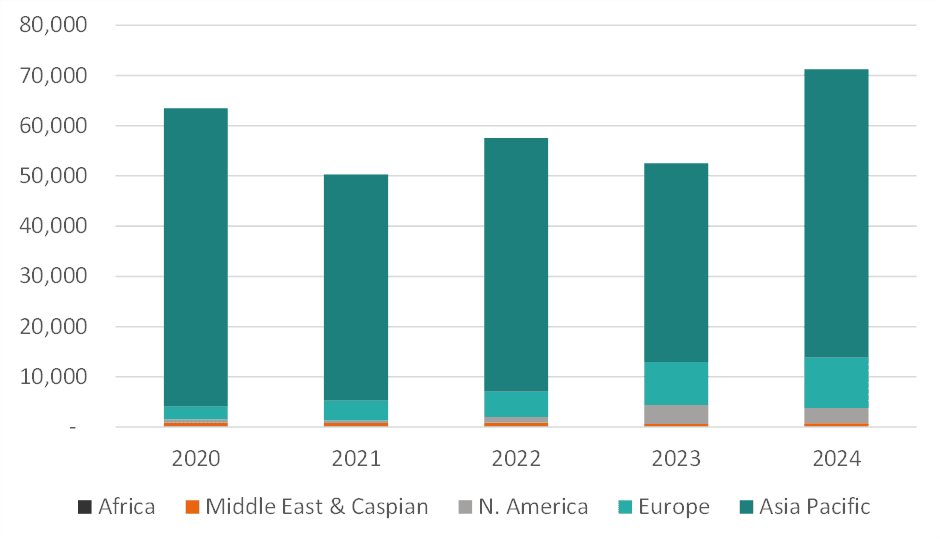
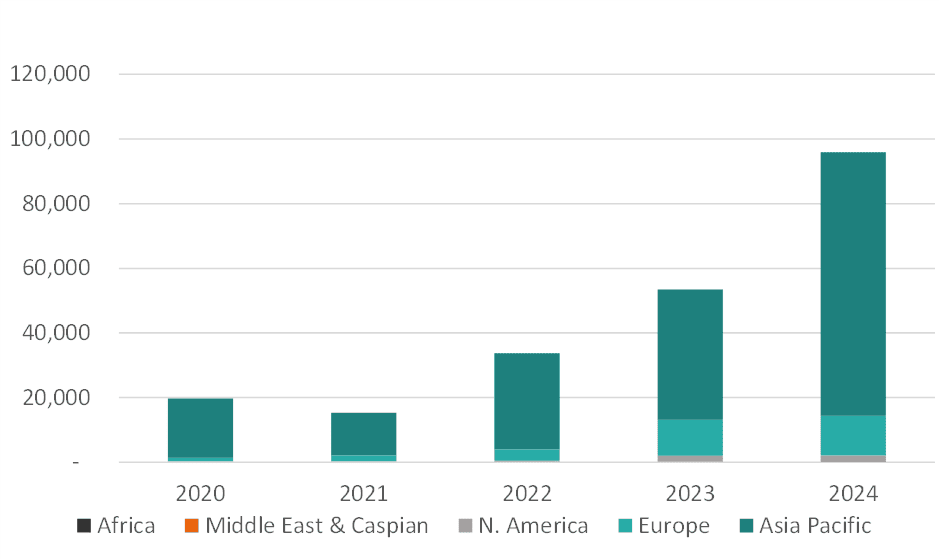
In the EU, sales for all HDVs dropped by 15% in 2025 compared with 2024, to 176,000 units (IEA, 2025). However, registration of zero emission HDVs grew by 45% over the same period to 4,100, or 1.7% of all HDV registrations. 22% of new buses were zero emission, compared with 19% of medium and light goods vehicles and only 1.4% of HGVs. In total there were more than 100 BEV and 20 hydrogen fuel cell (HFC) HDV models available in the EU in 2025 (Mulholland, E., et al, 2025). 35% of all zero emission HDV sales were in Germany, followed by France (27%), the Netherlands (15%) and Sweden (8%). However, the percentage of total sales that were zero emission vary on a national basis, with, for example, 7% of all HGV sales in Sweden being zero emission compared with only 1.8% in Germany, and 64% of all bus sales in Denmark being zero emission compared with 24% in Germany (Mulholland, E., et al, 2025). The leading zero emission OEMs in the EU are Volvo and Renault for HGVs, Ford and Mercedes for light/medium goods vehicles, and Mercedes and MAN for buses. Chinese OEMs (mainly BYD and Yutong) secured 21% of the zero-emission bus market and surveys of bus operators suggest that this could climb higher, should Chinese OEMs be able to offer ownership cost savings of 10-20% versus European OEMs (Suneson, A. et al, 2025).
In the UK, in 2024, there were 50,987 newly registered HGVs, of which 268, or 0.5%, were zero emission battery electric. In the same year, 9,919 new buses and coaches were registered in the UK, with 1,719, or 17.3%, of these being zero emission battery electric. (Department for Transport, 2026 [4] and [5]).
In Scotland, in 2024, there were 3,958 newly registered HGVs, with 12, or 0.3%, of these being zero emission battery electric. In the same year, 663 new buses and coaches were registered, of which 74, or 11.2%, were zero emission battery electric. (Department for Transport, 2026 [4] and [5]).
There are strong policies, often supported by significant investments, around the world to support the introduction of zero emission HDVs, including: in the EU a target of 100% of city bus sales as zero emission by 2035 and reduction of emissions from other HDVs by 90% by 2040 (EU Parliament news, 2024), and the UK Government’s Zero Emission HGV and Infrastructure Demonstrator (ZEHID) programme (Innovate UK, 2024) aiming to support the transition to net zero by 2050. Despite this, there are other considerations, including the US decision to repeal various electric vehicle targets, that mean that the overall projected market share of electric HDVs is now less than was projected in 2024. Nevertheless, the International Energy Agency is projecting that around 20% of new global bus sales and 13% of new global heavy truck sales in 2030 will be electric (IEA, 2025).
Charging infrastructure
The International Energy Agency (IEA, 2024), expects significant growth in the stock of HDV charging devices installed, globally, to 2030 and also to 2035. Its report looks at two future scenarios. The first is called Stated Policies, referred to as STEPS, and this is what is thought the growth will be with the existing policies that are already in place. The second scenario is called Announced Pledges Scenarios, referred to as APS, and this is what is thought the growth will be if additional policies, which have been announced but not implemented, are added to what is already in place. Figure 7 shows 1 million charging devices installed by 2023, rising to between 5.5 million and 6.6 million chargers by 2030 and between 13.8 million and 17.9 million by 2035. Most of these HDV chargers will be installed in truck and bus depots, with a small percentage (less than 1% in 2035) being opportunity chargers, which means, for example, at motorway service areas.
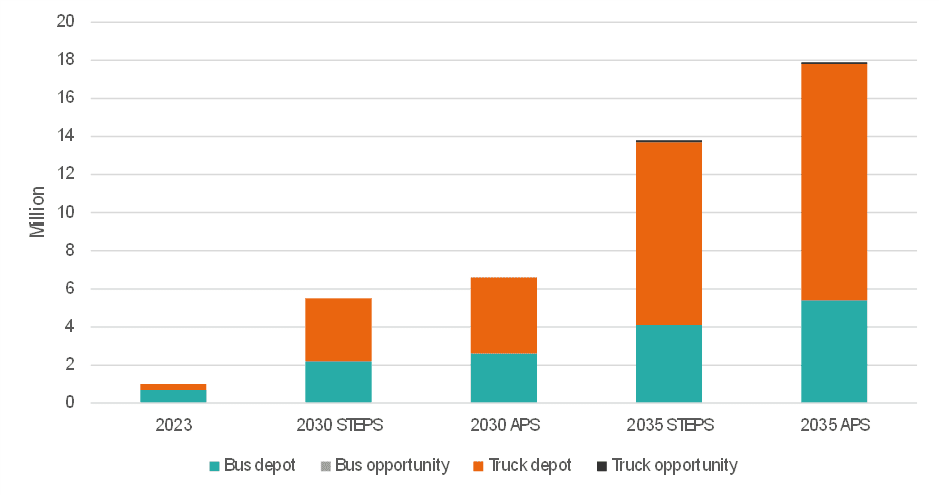
China is the market leader in the adoption of electric buses and electric trucks and therefore is also market leader in the deployment of heavy-duty charging devices (IEA, 2024). China is also leading on manufacturing heavy duty trucks that are enabled for battery swapping, which is much quicker than plug-in charging.
After China, Europe is the second largest market for electric bus and electric truck sales with the accompanying need for charger installation (IEA, 2024). The countries in Europe with the highest projected demand for battery electric truck charger infrastructure are Germany, Italy, France, Poland and Spain, collectively accounting for more than 70% of the total charging needs in the EU-27 (Basma, H and Schmidt, J. ,2025). The European Commission has introduced the Alternative Fuels Infrastructure Regulation which mandates Member States to build out publicly accessible charging infrastructure on main road networks (European Commission, 2024). HDV manufacturers are also working together to roll out fast charging infrastructure to help overcome fleet operator concerns about lack of charging availability (Milence, 2025). By 2030, Europe will require more than 300,000 public and private charge points for medium and heavy-duty trucks, compared to approximately 10,000 in 2024, at an estimated cost of €7 billion (Herit, A., Hildebrandt, E. and Becker, H., 2024).
Hydrogen refuelling infrastructure
The roll out of hydrogen refuelling stations (HRS) is modest compared to charging infrastructure deployment. As of 2024, there were approximately 1,160 HRSs worldwide, mostly confined to Germany, Japan, and South Korea, compared to 4.5 million EV charging stations (Mohapatra, 2025). The value of the global hydrogen refuelling station market was estimated about USD 1.00 billion in 2025 and is projected to grow at a 19.8% CAGR over the period 2025 – 2033, inclusive of all applications including passenger vehicles (Grand View Research, 2026). The growth in hydrogen powered mobility and related infrastructure is expected to peak in 2040 – 2050, led by HDVs as existing constraints such as limited hydrogen production, refuelling storage, and delivery technologies are addressed. Refuelling stations will likely have to deploy a range of refuelling pressures to cater for different vehicle technologies and requirements, in the early stages of deployment, whilst the market guides the dominant technology selection. At present, refuelling stations are predominantly focused on 350 bar refuelling as this is the most cost effective despite the improved efficiency of 700 bar refuelling for HDVs. A recent Hydrogen Energy Journal (Otto et.al, 2024) article found liquid hydrogen refuelling to be more cost effective than gaseous refuelling for HDVs, offering higher flow rates, lower station energy demand and simpler station design. Estimated refuelling costs were €0.16 to €0.58 per kilogram for liquid hydrogen compared with €1.02 to €3.73 per kilogram for gaseous hydrogen, with further component development and standardised protocols identified as key enablers for infrastructure deployment.
Hydrogen-powered HDVs are likely to represent a delayed or smaller share of zero-emission vehicles compared with electrification over the next decade.
As of 2025, 62% of the world’s hydrogen refuelling stations are in Asia (Zhu, 2025). China leads expansion with major hydrogen fuel cell electric vehicle (HFCEV) subsidies, highway-based HRS deployment, toll exemptions for hydrogen trucks, and provincial station incentives, targeting 50,000 fuel-cell vehicles and up to 200,000 tonnes per year of green hydrogen production by 2025 (IEA, 2025, [2]). South Korea plans 280 liquid hydrogen stations by 2030, supported by strong public – private partnerships (Zhu, 2025). India aims to deploy 1,000 hydrogen trucks and buses by 2030, though infrastructure plans are unclear. Australia and New Zealand are at earlier stages, with Australia operating 13 HRS and New Zealand 6, largely driven by local companies and pilot deployments (CSIRO and GHD, 2023). North America has experienced significant slowdown in hydrogen markets due, in part, to policy decisions of the current Administration in the USA.
In February 2025, H2 Mobility announced closure of several HRSs in German cities, shifting focus from urban light vehicle applications to larger infrastructure for commercial vehicles and buses with 350, 500, and 700 bar options (Mohapatra, 2025). The EU has committed €600 million through the Alternative Fuels Infrastructure Facility to support 38 new hydrogen refuelling stations (European Commission, 2025). Member states must install one HRS every 200 km along the TEN-T core network, with minimum levels of passing HDV transport. The aim is to complete installation by 2030 with interim targets set for 2025. Binding EU targets require a 90% reduction in HDV emissions by 2040 and zero emission for urban buses, supported by policies that ease barriers to scale-up (Hydrogen Europe, 2025). Despite this, Hydrogen Europe expects hydrogen HDVs and refuelling to lag battery electric solutions until at least 2030.
It is likely that in the UK investment in infrastructure will have to happen before hydrogen powered HDVs are adopted in significant numbers. In 2023, the UK had zero deployed heavy-duty fuel cell trucks and only 6 HRSs. As of 2022, Scotland had four hydrogen refuelling stations for public use (Transport Scotland, 2022). Two of which are based in Aberdeen to support the fleet of bus and municipal hydrogen HDVs with further stations in Orkney and outside Edinburgh. Without a minimum viable network of hydrogen refuelling stations deployment of hydrogen HDVs will be limited (Hydrogen UK, 2023). Strong near-future deployment opportunities lie in off grid refuelling applications for construction based HDVs with full HDV rollout expected to grow from 2035 onwards.
Detailed SWOT Analysis
HDV and niche vehicle manufacturing supply chain SWOT
Strengths
- Scotland has a small number of specialist HDV manufacturers and integrators (e.g. buses, emergency vehicles, refuse, gritters, temperature-controlled bodies) with application-specific knowledge rather than being involved in mass-market production
- Some companies (e.g. Emergency One, Gray & Adams, James A Cuthbertson, Farid-Hillend) have capabilities in vehicle integration, bespoke design, and aftersales support
- There is evidence of some limited export activity, mainly by Emergency One that has significant and growing international export activity in relation to its diesel vehicles. It has also exported a small number of zero-emission vehicles
- Rokbak is referenced as part of the top end of the HDV value chain in Scotland and is implicitly export-oriented through its mining and construction markets, which are typically international in nature
- There is demonstrable capability in control systems, energy management systems, telematics, and software-driven optimisation (e.g. battery management, route-aware energy optimisation). These capabilities are largely transferable to zero-emission HDVs (BEV and hydrogen), even if current market pull is weak
- Scottish manufacturers are well embedded in public-sector procurement (local authorities, emergency services), providing familiarity with regulated markets and specialist use cases where OEM solutions are less mature
- Interviewees consistently note that Scotland has experience and expertise in hydrogen technologies that could be applied to zero-emission HDVs, at a knowledge and R&D level, even if commercial delivery has been weak
- Scottish public bodies (e.g. local authorities, Transport Scotland) have been willing to act as early adopters and demonstrator partners, providing capital support and participating in trials for zero-emission HDVs and associated infrastructure. This has resulted in real-world pilots, learning exercises, and prototype deployments, even where projects have struggled to deliver sustained operational outcomes
- Scotland operates within a clear UK and international policy framework that is committed to 100% zero-emission HDV sales by 2040, supported by regulatory standards and funding programmes such as ZEHID
Weaknesses
- Scotland has only a very small number of companies with full OEM or chassis-design capability; most are, primarily, assemblers, converters or bodybuilders, rather than system owners
- Most depend on imported core systems (chassis, batteries, power electronics, fuel cells), sourced from European or even global manufacturers
- As Scottish companies rely on imported chassis and systems, strategic decisions by European, Asian, or global OEMs directly shape what Scottish manufacturers can offer. This limits Scotland’s ability to influence technology pathways (e.g. BEV vs hydrogen) and increases vulnerability to shifts in OEM priorities
- The historic component manufacturing base has largely disappeared, leaving a “hollowed-out” supply chain with limited depth
- The overall scale of HDV manufacturing in Scotland is small, with a relatively high cost base, particularly compared with European and global competitors. This means that Scotland is not considered to be internationally competitive in zero-emission HDV manufacturing
- Most HDVs produced or integrated in Scotland are diesel powered, with zero-emission vehicles representing only a very small proportion of output.
- Most manufacturers report minimal customer demand for BEV or hydrogen HDVs and adoption is seen as policy-driven rather than market-driven, leading to hesitancy and “wait-and-see” behaviour across the supply chain
- Vehicle costs (particularly BEV and hydrogen chassis) are consistently cited as prohibitive, thereby limiting demand
- Charging and hydrogen refuelling infrastructure is viewed as inadequate, unreliable, or too uncertain to support operational deployment. Hydrogen projects in particular are described as fragmented, poorly coordinated, and failing to deliver end-to-end solutions. These issues are also contributing to limited demand
- Smaller manufacturers lack the resources to invest in high-voltage training, facility upgrades, or in-house zero-emission R&D without clear demand signals
- Competition for skilled engineers (e.g. from aerospace and other sectors) can constrain company growth
- Although public support for zero-emission HDVs is acknowledged, it is perceived by a number of interviewees as fragmented and risk-averse. The projects funded to date have not translated into clear, coordinated supply-chain development
- UK-wide programmes (e.g. ZEHID) are acknowledged, but Scottish participation, in terms of manufacturing, appears limited. As a result, learning, data, and supply-chain development benefits are not strongly feeding into Scottish manufacturing capabilities
Opportunities
- Binding UK and EU CO₂ performance standards require steep emissions reductions from HDV manufacturers to 2040, creating a guaranteed long-term market for zero-emission vehicles and associated components
- To meet these targets, well over one-third of new medium and heavy-duty trucks sold in Europe will need to be zero-emission by 2030, significantly increasing demand for compliant vehicles, systems, and sub-assemblies
- UK government funding of approximately £200 million through the ZEHID programme supports vehicle deployment, infrastructure build-out, and real-world trials, creating opportunities for manufacturers and Tier 1 – 3 suppliers to participate in funded projects and supply chains
- Demonstration activity supports learning-by-doing, product validation, and early revenues for companies involved in zero-emission HDV technologies.
- Registrations of zero-emission HDVs in the EU grew by 45% between 2023 and 2024, with increasing model availability across trucks and buses, indicating accelerating market momentum that benefits manufacturers positioned in these segments
- Battery-electric HDVs are expected to dominate early adoption due to increasing range (500–700 km) and broad OEM engagement, creating opportunities across electric drivetrains, power electronics, batteries, and vehicle integration
- Niche vehicles (e.g. refuse vehicles, emergency vehicles, gritters, construction and municipal vehicles) are less well served by OEM zero-emission offerings than standard long-haul trucks. Scottish companies already active in specialist vehicle build, integration and/or conversion could participate in these segments if demand materialises
- The transition to zero-emission HDVs is expected to drive service-led revenue models (e.g. vehicle-as-a-service, battery-as-a-service), with a majority of future profits projected to come from services rather than vehicle sales, opening opportunities for supply-chain companies to move up the value chain
- There are also opportunities in energy management systems, control software, telematics, battery management, route optimisation and auxiliary load optimisation for battery electric, and to a lesser extent hydrogen, HDVs. These opportunities sit mainly at component, sub-system or service level, rather than full vehicle manufacture
- Some interviewees suggest that attracting an anchor OEM or Tier-1 supplier of scale could enable parts of the domestic supply chain to be rebuilt. This is identified as conditional and uncertain, rather than a current strength or guaranteed outcome
- Transition to BEV and hydrogen HDVs would require new skills in high-voltage systems, hydrogen safety, maintenance and infrastructure servicing. There could, therefore, be potential opportunities in training, certification and technical support services, subject to market uptake
Threats
- Global zero-emission HDV manufacturing is currently dominated by Chinese OEMs, that produced approximately 230,000 zero-emission HDVs in 2024 alone, creating strong price and scale competition for European-based supply chains
- Chinese manufacturers are gaining share in specific segments such as electric buses, with European operators considering them where cost savings of 10–20% can be achieved. This increases competitive pressure on UK and European manufacturers and suppliers
- Despite general growth the demand for HDVs, market penetration of zero emission heavy trucks remains very low (around 1–2% of new sales in the EU), creating uncertainty over near-term production volumes and making it difficult for suppliers to justify large-scale capital investment
- Adoption is uneven across countries and vehicle categories, which is resulting in demand volatility for manufacturers and their supply chains
- Some existing Scottish HDV manufacturers face commercial uncertainty, including restructuring, relocation or reduced activity. The potential loss or downsizing of OEM-level capability could further weaken the domestic supply chain and reduce critical mass
- Compliance with tightening CO₂ standards carries financial penalties for manufacturers that fail to meet targets, increasing cost pressure throughout the supply chain
- Smaller manufacturers and suppliers face higher relative risk due to the cost of retooling, certification, and technology development required to support zero-emission platforms
- Market uptake of zero-emission HDVs is strongly dependent on the parallel rollout of charging and hydrogen refuelling infrastructure, which remains incomplete and uneven, limiting demand certainty for manufacturers
- Competing technology pathways (battery-electric versus hydrogen fuel cell) create strategic risk for suppliers that must choose where to invest without clarity on long-term market dominance
- Zero-emission HDVs currently involve significantly higher upfront costs than diesel equivalents
- Many fleet operators, particularly SMEs, report low confidence in costs, technology maturity, infrastructure availability and financial models for zero-emission HDVs
- Weak or delayed demand threatens the viability of any domestic manufacturing or supply-chain investment
- Multiple stakeholders express low confidence that current 2035 and 2040 zero-emission targets will be enforced as stated
- Changes or delays to policy signals reduce incentives for manufacturers, suppliers and operators to invest in zero-emission HDVs or related infrastructure
- Several interviewees raise concerns about the survivability of small OEMs, start-ups and infrastructure providers over the next 5–10 years. This creates risk for operators and public bodies committing to vehicles or infrastructure with long asset lives
- Transition to zero-emission HDVs requires specialist skills in high-voltage and hydrogen systems. Competition from other sectors (e.g. aerospace, energy, defence) risks diverting skilled labour away from HDV manufacturing and support
- Whilst changes have been made to maximum weight limits for HDV tractor units, to allow for the extra weight of batteries, this change has not been made for trailer units. This is a threat to companies involved in refrigerated trailer manufacture that would like to use batteries to provide the refrigeration but are constrained by the weight limits
EV charging infrastructure supply chain SWOT
Strengths
- Scotland has several established EV charging systems integrators with direct experience in bus and emerging HGV depot charging, including end-to-end capability across design, planning, installation management, operations, and maintenance
- Companies such as FOR EV, Envevo, eVolt Charging (SWARCO) and Cleaner EV are already delivering high-power depot charging, with HDV activity forming a growing share of their business and employment in Scotland
- Some companies report that HDV charging already accounts for a significant proportion of Scottish jobs, with expectations of further growth to 2030
- Scottish operators and suppliers have practical experience delivering depot charging infrastructure for buses and, to a lesser extent, HDVs. Examples include electrification of bus depots (e.g. First Bus depots in Glasgow and Aberdeen) and early HDV depot installations (e.g. John G Russell, forestry and logistics sites)
- Depot charging is identified in multiple sources as the dominant charging model for HDVs to 2030, aligning Scottish experience with expected market structure
- Scotland has a number of Independent Distribution Network Operators (IDNOs) and grid-connection specialists with Scottish offices (e.g. Energy Assets, GTC, Last Mile, SSE/Optimal Power Networks) that support HDV charging delivery
- A reasonable local supply chain exists for surveys, engineering design, and project development, which are required early in HDV charging projects
- Interviewees noted positive roles played by Transport Scotland, Innovate UK and ZEHID in mapping routes, supporting demonstrations, and generating operational data for HDV charging and fleets
- Scotland is perceived as a good testbed for the development and deployments of depot-focused HDV charging due to geography, duty cycles, and fleet characteristics
- Evidence from international and UK studies shows that depot and semi-private charging will dominate HDV charging to 2030, with public en-route charging a much smaller share. Scotland’s strongest current capabilities, depot charging, fleet software, grid connections and integration services, align with this projected market structure.
- Some companies report rapid growth in Scottish employment linked to EV and HDV charging, particularly in design, engineering and operations roles.
- Experience from the bus sector has transferred into HGV charging projects, reducing early-stage delivery risk
- Scottish-based providers offer a range of commercial models, including, capital purchase, charging-as-a-service, long-term operating and maintenance contracts, asset-sharing and third-party access to depot infrastructure. The availability of multiple models reduces adoption barriers and, therefore, helps to drive market uptake
Weaknesses
- There are no HDV charging hardware OEM manufacturers based in Scotland, and limited UK manufacturing more broadly, reducing opportunities for local value capture beyond integration, installation, and services
- Much of the HDV vehicle and charger OEM ecosystem is based outside Scotland, limiting pull-through into local supply chains
- Stakeholder feedback identifies a limited number of civils contractors in Scotland with the certification, experience, and competence to deliver large-scale, high-power HDV charging installations, particularly in hazardous or fuel-station environments
- Stakeholder feedback also reports that very few Scottish contractors currently identify as being active in HDV charging installations, and HDV charging skills are not widely held
- The HDV charging market is early-stage and fragmented, with limited numbers of electric HGVs in operation; operators lacking confidence due to limited shared experience. This is limiting market demand
- Grant-driven demand has previously distorted market timing, with stop-start funding leading to delayed investment decisions
- HDV charging infrastructure in Scotland remains very limited in number, with most activity focused on small pilots, early depot installations or bus depots, rather than widespread freight or haulage coverage
- Public en-route HDV charging infrastructure is sparse, with most freight operations expected to rely on depot charging that is not yet widely available
- Depot electrification for HDVs faces space constraints, particularly where high-power chargers displace operational or parking space
- There is a lack of shared knowledge and structured education for haulage operators, many of whom are new to electrification and cautious due to previous poor experiences or lack of trusted advice
- Charging infrastructure capacity remains unevenly distributed, with weaker coverage in rural, island and remote areas
- Maintenance and uptime requirements are more difficult to meet in these locations due to distance, workforce availability and cost
- Training provision in Scotland for large-scale EV charging installations is limited, with no colleges identified as offering relevant qualifications (beyond courses focused on domestic or small commercial charging)
- Interviewees highlighted shortages of suitably trained High Voltage design engineers, electrical engineers and power engineers, creating risks to scale-up and maintenance capacity, particularly outside the Central Belt
- Grant schemes for depot and fleet charging are described as short-notice, time-limited and inconsistent, creating uncertainty and delaying investment
- First-come-first-served funding structures tend to favour large operators, limiting access for SMEs
- HDV charging infrastructure is capital intensive, with uncertain utilisation rates in the early market.
- Public charging hubs are described as a high-risk investment, particularly where uptake is uncertain or policy signals are unclear.
- Concerns were expressed about the long-term survivability of smaller charging start-ups, increasing perceived risk for fleet operators.
- Evidence points to a lack of shared planning and information between charge-point developers, site owners and HDV operators. This means that infrastructure siting decisions are not always aligned with actual freight routes or operational patterns, increasing risk of under-utilisation
Opportunities
- Global HDV charging capacity is projected to grow approximately twenty-fold by 2035, driven by increasing electrification of buses and trucks
- Under both IEA scenarios, total deployed HDV charger stock increases significantly between 2023 and 2035, with depot charging representing the dominant share of installations
- Truck depot chargers are projected to grow more rapidly than bus depot chargers to both 2030 and 2035, despite bus depot charging being more established today
- By 2030, Europe is expected to require over 300,000 public and private HDV charge points, with infrastructure investment estimated at €7 billion by 2030 and €40 billion cumulatively by 2040
- Most HDV charging infrastructure investment to 2030 is expected in private depots and semi-public hubs such as logistics and industrial sites, representing the majority of forecast capital expenditure
- Overnight depot charging is expected to grow fastest for HDVs with predictable routes and daily mileages below 200 km, including city buses and urban delivery fleets
- These market drivers and trends suggest opportunities for design, grid connection, installation, operation and maintenance services focused on fleet depots rather than public roadside charging. This will create demand for higher-power chargers (including megawatt-scale), depot upgrades and associated grid works, even if deployment remains uneven in the near term
- The European Commission Alternative Fuels Infrastructure Regulation (AFIR) creates legally binding requirements for the rollout of high-power public HDV charging along the TEN-T network between 2025 and 2030, supporting demand for compliant charging infrastructure
- The Clean Transport Corridor Initiative reinforces AFIR implementation by coordinating cross-border HDV charging deployment across major European freight corridors
- Multiple commercial models are emerging, including charging-as-a-service, OEM-led advisory models, and specialist charging point operator-led public hubs, creating opportunities across equipment supply, financing, installation, and operations
- Increasing scale and complexity of depot charging creates demand for fleet charging management software, including scheduling, power management, access control, billing and data reporting
- Increased charger utilisation rates significantly reduce levelised infrastructure costs per kWh, improving the economic case for infrastructure deployment
- Some fleet operators (e.g. bus depots) are opening depot charging infrastructure to third parties during off-peak periods. This suggests opportunities in shared-use models, site management, customer access systems and on-site operations, subject to safety and contractual constraints
- Interviews and market evidence point to likely future HDV charging at ports, logistics hubs, rail freight terminals and motorway service areas, often as stand-alone sites rather than extensions of existing fuel stations. This creates potential demand for planning, civil engineering, grid reinforcement, site development and long-term operation, though projects could be complex and capital intensive
- Expansion of EV and HDV charging will require more trained engineers and technicians for design, installation and maintenance. As there is limited current training provision there are opportunities in training delivery, certification support and maintenance services, particularly for large-scale and high-power installations
- Interviewees suggest opportunities to increase employment, with companies reporting plans to scale to 100+ HDV-related roles by 2030 (from a current baseline of 10s of jobs), particularly in design, engineering, systems integration and operations
- Some Scottish-based charging infrastructure companies report early export activity, primarily in design, project management and systems integration, often following UK customers into overseas markets
- These opportunities are service-led rather than hardware-led and remain secondary to the UK market
Threats
- Limited availability of grid connection capacity and the cost of grid upgrades are identified as key barriers, particularly for high-power and megawatt-scale charging installations
- Strengthening of substations is required at a significant proportion of identified en-route charging locations, adding cost and complexity to deployment
- Competition for grid capacity (including from data centres and other large users) is reported as a growing risk.
- Availability of finance for fleet operators to invest simultaneously in HDVs and charging
- High upfront capital requirements, particularly for public high-power charging hubs, create exposure to utilisation risk if fleet uptake is slower than projected and, therefore, potentially undermining business cases for both public and private charging sites
- Approvals for charging stations and physical space constraints at depots, logistics hubs, highway sites, and safe parking areas are cited as barriers to deployment
- Public charging sites, while fewer in number, require very high power levels, increasing complexity of siting and permitting
- Alternative solutions such as battery swapping and electric road systems are referenced as potential substitutes for wired charging in some markets, particularly outside Europe, creating uncertainty over long-term infrastructure configurations
- Megawatt chargers represent a small proportion of total charger numbers but a disproportionate share of installed power, increasing exposure to technology standardisation and cost risks
- Frequent changes, delays or short-notice grant schemes create uncertainty for investors, charging providers and fleet operators
- Lack of long-term policy clarity on vehicle phase-out dates, grant continuity and infrastructure support discourages speculative investment in charging hubs, particularly for HDVs
- There are some concerns about the long-term survivability of smaller charging providers and start-ups, particularly in a capital-intensive, low-utilisation early market
- Market exits or consolidation could leave operators dependent on a small number of large providers, increasing cost and risk
- Shortages of appropriately trained electricians, engineers and maintenance personnel threaten delivery timelines and ongoing reliability
- Limited training provision for large-scale and megawatt charging systems increases the risk of bottlenecks as deployment scales
- Charging infrastructure remains less viable in rural, island and remote areas, where grid reinforcement, maintenance response times and utilisation are more challenging
- Public-sector service-level requirements can further increase costs and delivery risk in these locations
- With no domestic charger hardware manufacturing and reliance on imported equipment, Scotland risks capturing mainly service-level value, even if deployment accelerates
- Large international charging networks and energy companies may dominate future HDV charging hubs, limiting local supply-chain participation
Hydrogen refuelling infrastructure supply chain SWOT
Strengths
- There have been a number of hydrogen mobility and refuelling projects (e.g. buses, refuse vehicles, council fleets) delivered in Scotland, particularly in Aberdeen, providing real-world operational learning and proof of concept
- Companies such as Logan Energy and Hydrasun operate as EPC-style integrators, delivering end-to-end hydrogen refuelling solutions including design, procurement, installation, commissioning and servicing, with experience across multiple projects
- Large, multi-partner initiatives such as the Th2istle Project in the north east of Scotland plan to integrate hydrogen production, mobility applications (including HDVs), and agriculture, construction and industrial uses supporting the development of local clusters of hydrogen production and use
- Hydrogen refuelling projects have benefited from European, UK and Scottish public funding, through Horizon Europe and national demonstrator programmes, enabling early market activity despite weak commercial demand
- Stakeholders highlighted Scotland’s renewable electricity base as strategically attractive for green hydrogen production, supporting the long-term viability of hydrogen production for refuelling infrastructure
- Scotland has engineering and manufacturing companies capable of producing hydrogen-compatible components, including valves, gauges and pressure-rated equipment. These companies already supply some hydrogen applications internationally, even where domestic hydrogen mobility demand is limited.
- Scottish hydrogen refuelling integrators and component suppliers are active in some international markets, particularly in Europe and Asia but generally more so in a hydrogen coordinator capacity. Activity in HDV hydrogen refuelling is limited.
Weaknesses
- Scotland has a very limited number of active hydrogen refuelling infrastructure providers, many of whom are already operating at or beyond capacity. This constrains delivery capability, limits competition, and increases costs and lead times
- The Scottish market depends heavily on a small number of companies (e.g. system integrators and EPC-style providers). When individual companies exit, pause activity, or fail to deliver, there are few alternative domestic suppliers available
- While Scotland has capable engineering companies upstream, most critical refuelling components are sourced from outside Scotland. Even project sponsors and councils reported limited visibility of Scottish supply chain participation, weakening local economic impact
- With no domestic manufacture of complete refuelling stations or core systems, Scotland risks capturing value mainly in integration, construction and maintenance, even if hydrogen refuelling deployment increases
- Project owners highlighted a shortage of hydrogen-skilled engineers and technicians in Scotland, affecting delivery, maintenance, and long-term operability of refuelling assets
- Scottish engineering companies reported an inability to commit to hydrogen product development or certification due to unclear or shifting standards (e.g. BSI), limiting their participation in refuelling infrastructure projects
- Hydrogen refuelling projects have been developed on a fragmented, project-by-project basis, with limited coordination between production, infrastructure, vehicles, and end users, increasing risk and reducing learning and knowledge transfer
- Failed or stalled hydrogen HDV refuelling projects in Scotland have reduced confidence among councils and public bodies in the domestic supply chain’s ability to deliver reliably
Opportunities
- Hydrogen refuelling is viewed as most viable for specific HDV applications where utilisation rates are high (e.g. buses, refuse vehicles, city logistics, clustered depot fleets) and where centralised refuelling can be coordinated and duty cycles are predictable
- UK government funding of approximately £200 million through the ZEHID programme supports vehicle deployment, infrastructure build-out, and real-world trials, creating opportunities for manufacturers and Tier 1-3 suppliers to participate in funded projects and supply chains
- Scottish and UK-based integrators can generate economic benefits by acting as system designers and integrators, assembling largely imported components into bespoke refuelling solutions and providing ongoing operations and maintenance services
- Refuelling infrastructure is seen as a critical enabler for downstream hydrogen applications. Successful deployment, where hydrogen refuelling is co-located with production, could unlock demand for hydrogen vehicle deployment
- Several companies active in Scotland already deliver hydrogen refuelling or storage projects internationally (Europe, Asia), suggesting that capabilities developed domestically could be applied in more advanced or faster-moving overseas markets
- International policy frameworks (e.g. EU AFIR, national hydrogen strategies) mandate hydrogen refuelling along key freight corridors and set HDV decarbonisation targets to 2040. These frameworks create long-term, externally driven opportunities for hydrogen refuelling infrastructure
Threats
- Fleet operators have, to date, only limited interest in hydrogen vehicles due to high costs, limited vehicle availability, and operational uncertainty. This is suppressing demand for refuelling infrastructure regardless of Scottish capability
- Hydrogen refuelling stations are capital intensive, with compressors and storage systems representing major cost components. These costs are particularly difficult to justify at low utilisation levels typical of early HDV deployment
- Hydrogen production costs, closely linked to electricity prices, remain high, with parity to diesel estimated at ~£9/kg. This weakens the commercial case for refuelling infrastructure and is largely outside the control of the Scottish supply chain
- Stakeholders reported delayed UK Government strategy publication, withdrawn or paused funding, and shifting UK and Scottish government priorities, leading to cancelled projects and stalled final investment decisions
- Battery-electric HDVs and charging infrastructure are cheaper, faster to deploy, and scaling rapidly. Multiple stakeholders noted that electrification now covers most HDV use cases, increasingly restricting hydrogen to niche applications
- Hydrogen HDV OEMs are limited in number, with some exiting the market or being acquired. This reduces vehicle choice, increases risk for financiers, and undermines confidence in long-term infrastructure utilisation
- Other countries (e.g. Germany, Netherlands, parts of Asia) have clearer strategies, stronger infrastructure rollouts, and better market coordination, drawing investment and supplier focus away from Scotland
- Core refuelling equipment (e.g. high-throughput compressors, dispensers, cryogenic systems) is supplied by a small number of international manufacturers. This limited supplier base is leading to long lead times and is increasing the risk of delays, cost escalation and maintenance downtime
- As hydrogen refuelling infrastructure requires specialist skills, project delivery and maintenance depend on a limited pool of experienced companies and individuals. If these companies downsize or exit the market, there are few readily available alternatives
Industry views on how to maximise the economic opportunities
HDV and niche vehicle manufacturing supply chain
The main obstacle to zero emission HDV and niche vehicle manufacturing is the lack of clarity about when legislation will come into force that mandates that sales of new HDVs must be zero emission. The uncertainty about timing and location of charging and hydrogen refuelling infrastructure is also a barrier. This is preventing the customers of the HDV manufacturing supply chain from ordering zero emission vehicles. If these obstacles can be addressed, then other considerations regarding total cost of ownership (TCO) and new financing models can also be addressed.
Discussions with OEMs indicate that additional support will be required to up- or re-skill their staff to work with both BEVs and HFCEVs. For example, one of the conversion manufacturers that was interviewed has to use the OEM that provides the chassis to power down the HGV prior to working on it (e.g. for maintenance and repair) and power up the vehicle afterwards. Delivering these skills is likely to require specialist training facilities, perhaps building on that already provided by the further education (FE) sector for zero emission private and light goods vehicles. In addition, there will need to be consideration of how training is delivered to new entrants to the workforce, who will require knowledge of conventional diesel and zero emission powertrains, during the period where both are in use.
HDV charging infrastructure supply chain
All of the charging infrastructure stakeholders interviewed highlighted the need for policy and regulatory certainty. This includes certainty around long term, stable funding to support operators with the costs of zero emission vehicles and charging infrastructure. It also includes clarity about when the HDV manufacturers will be required to place only zero emission vehicles on the new sales market.
Co-ordinated planning of future HDV depot charging needs was also highlighted as a required action. This information could be communicated to grid operators to identify where grid reinforcement work would be required and help plan for future connections demand.
Growing the Scottish HDV charging device manufacturing capability was also highlighted as an action, including parts, components and finished original equipment. This could involve pursuing both inward investment opportunities and providing innovation support to existing and new Scottish companies interested in entering this sector.
Interviewees reported that it would be beneficial to improve the awareness of the HDV charging infrastructure supply chain in Scotland amongst HDV operators. One stakeholder suggested a ‘show and tell’ type event at an existing public HDV charging site.
Actions related to developing skills and competencies were also highlighted by several stakeholders in this supply chain. More funding for Graduate Apprenticeships was highlighted as a helpful supporting action. Examples of skills in short supply included high voltage design engineers. Developing accessible high voltage charging installation training for companies currently active in low voltage EV charger installation was also highlighted as a way to increase capacity in the supply chain. This could involve improving links between charger manufacturers, colleges and private training providers. Increasing capacity in the civil engineering contractor part of the supply chain was also highlighted as important. This would include raising awareness of the business opportunity and the route to developing skills and competencies to carry out civils work in high voltage environments.
HDV hydrogen refuelling infrastructure supply chain
Consultations repeatedly identified the need for clear, long-term policy that positively enforces net zero targets including phase-out of internal combustions engine vehicles. This underpins confidence in all the included supply chains. At present, the role of hydrogen refuelling infrastructure in reducing HDV emissions is unclear due to a lack of acknowledgement in policy strategy, driving uncertainty and risk for investors and the supply chain. A clear and sequential positioning of hydrogen HDVs and refuelling infrastructure in policy will provide enough clarity for the public and/or private sector to begin project planning to develop a trunk network with hotspot and highway nodes. In the meantime, support for mobile refuelling solutions would benefit market development. This would help the supply chain to capabilities in ongoing operations and maintenance to develop skills and competences.
The development of industry standards for hydrogen components for refuelling applications would benefit the component manufacturers that underpin the supply chain and could, potentially, open other energy transition opportunities for companies that can operate to these standards.
Promoting Scottish supply chain companies to fleet operators and providing details of the key Government / Transport Scotland contact points for the hydrogen refuelling infrastructure supply chain were also identified as useful actions.
How to cite this publication:
Taylor, J., Creamer, D., Leigh, E., Morrison, M. (2026) ‘Scotland’s HDV supply chain and net zero’ ClimateXChange
© The University of Edinburgh, 2026
Prepared by Optimat Limited on behalf of ClimateXChange, The University of Edinburgh. All rights reserved.
While every effort is made to ensure the information in this report is accurate as at the date of the report, no legal responsibility is accepted for any errors, omissions or misleading statements. The views expressed represent those of the author(s), and do not necessarily represent those of the host institutions or funders.
This work was supported by the Rural and Environment Science and Analytical Services Division of the Scottish Government (CoE – CXC).
ClimateXChange
Edinburgh Climate Change Institute
High School Yards
Edinburgh EH1 1LZ
+44 (0) 131 651 4783
If you require the report in an alternative format such as a Word document, please contact info@climatexchange.org.uk or 0131 651 4783.