
Contact

Scotland’s HDV supply chain and net zero
Governments across the world are introducing policy targets to decarbonise heavy-duty vehicles (HDVs) – those with a gross vehicle weight of over 3.5 tonnes. This transition presents significant opportunities for Scottish businesses.
With this in mind, this research aims to identify the current and future economic impacts of HDV decarbonisation across three key supply chains:
- HDV and niche vehicle manufacturing
- HDV charging infrastructure
- Hydrogen refuelling infrastructure
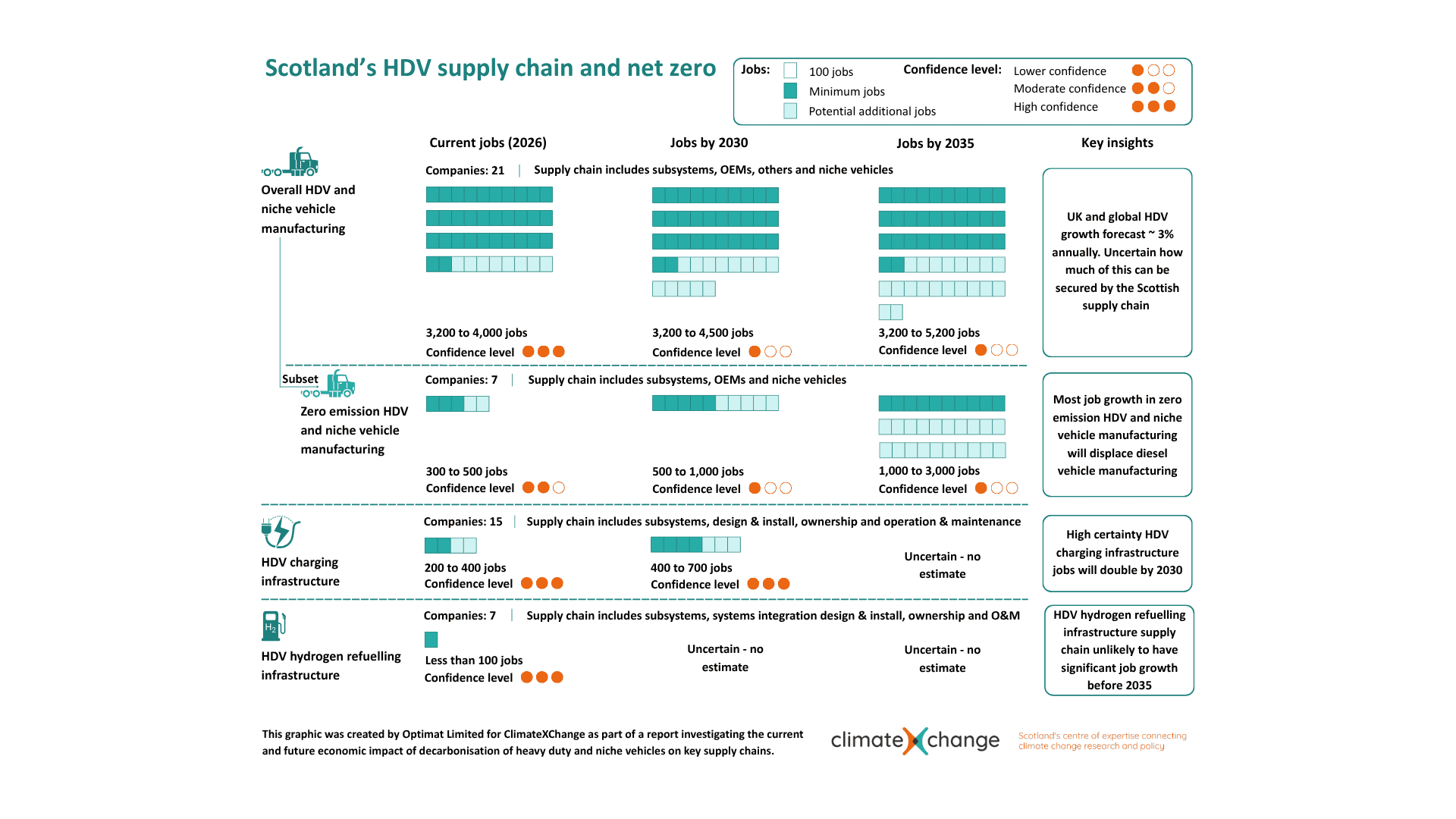
The report examines the scale, strengths, weaknesses and growth potential of the above supply chains, including how demand could evolve to 2030 and 2035. The report findings are visualised in an accompanying infographic.
Key findings
For further information, please read the full report.
- Strong global policy and market drivers are accelerating the decarbonisation of HDVs.
- The pace of transition varies across different vehicle types, with low-carbon fuels expected to play a role alongside zero-emission technologies.
- Scotland’s HDV and niche vehicle manufacturing capability is concentrated in a relatively small number of specialist companies.
- The HDV charging infrastructure supply chain is predominantly service-based and is expected to continue growing as vehicle electrification increases.
- The hydrogen refuelling infrastructure supply chain is currently small, with the greatest growth opportunities expected after 2035 and in specific use cases.
- Stimulating market demand will be essential to support supply chain growth, alongside targeted supply-side actions to strengthen Scottish capabilities and maximise economic opportunities.
If you require the report or annex in an alternative format, such as a Word document, please contact info@climatexchange.org.uk or 0131 651 4783.