

The regulatory landscape for hydrogen derivatives and products in Scotland
March 2026
DOI: https://doi.org/10.7488/era/7017
Executive summary
Aims
Scotland has set ambitious climate and hydrogen policies, including an ambition of 5 gigawatts (GW) of low‑carbon hydrogen production by 2030 rising to 25 GW by 2045. Hydrogen derivatives and associated products are expected to play a key role in enabling domestic decarbonisation. They are also expected to help position Scotland as an exporter to meet growing European demand.
Hydrogen derivatives are produced by combining hydrogen with other elements that can be more easily transported and stored. They may then be converted back into hydrogen or used directly as fuels or feedstocks. Where no further processing or conversion occurs before use, the term hydrogen product is used.
This study assesses whether the current regulatory landscape is fit‑for‑purpose to support the growth of hydrogen derivatives and products: ammonia, e‑methanol as well as synthetic aviation fuel (SAF) and wider e-fuels (fuels produced by combining hydrogen with carbon dioxide via electrolysis). Throughout this study these are referred to as hydrogen derivatives and products (HDPs).
The objective is to identify limitations and gaps within the current regulations and propose associated interventions. Drawing on an extensive regulatory review, stakeholder engagement and a criteria-based assessment, this study seeks to answer the following research questions.
- What is the regulatory landscape for ammonia, e‑methanol and SAF in Scotland?
- To what extent is the current regulatory regime fit‑for‑purpose to enable Scottish hydrogen derivative production, storage, transport and end‑use?
- What interventions are needed to create a coherent, safe and effective regulatory environment that accelerates HDPs across the value chain?
The assessment covers fuel types derived from green hydrogen and captured CO₂, and excludes bio‑derived fuels (e.g., bioethanol or biodiesel) and hydrogen production itself. The areas of hydrogen derivative value chain covered include: production in Scotland; storage; transport and use. Our assessment groups regulations by jurisdictions (both domestic and international) and impact area. Impact areas include: consenting and planning; route to market; technical standards and health, safety and environment standards (HS&E). This work follows previous ClimateXChange studies looking at HDP supply chain capabilities (Ella Yip, 2025) and the demand for HDPs (Szebasztian Csernik-Tihn, 2024).
Findings
Our study found strong existing foundations across all jurisdictions for consenting, technology standardisation and HS&E related regulations. These included existing planning, consent and environmental authorisations in Scotland, UK HSE legislations such as COMAH as well as the inclusion of HDPs in international standards under the International Maritime Organisation (IMO).
Route to market regulations, which cover hydrogen derivative related definitions, eligibility requirements and dedicated targets or mandates, were deemed least fit-for-purpose across all jurisdictions. They currently lack the clarity and cross-jurisdictional consistency to fully de-risk long-term production and market demand to maximise opportunities. They further do not provide incentives across all derivatives equally. The key limitations we identified included:
- Uneven support across derivatives
The UK policy landscape is currently skewed toward SAF, represented by the dedicated SAF mandate and revenue support mechanism. No equivalent commercial incentives exist for ammonia or e‑methanol. There is no mandate or incentive for the production of sustainable HDP maritime fuels. - Misalignment between UK and EU regulatory definitions
Definitions and requirements for Renewable Fuels of Non-Biological Origin (RFNBOs) and SAF differ, particularly around greenhouse gas (GHG) emission thresholds, and the proximity of renewable electricity sources. Scotland’s export competitiveness into the EU may be limited if producers comply only with UK requirements. - Uncertainty in the UK Emissions Trading Scheme (ETS)
Power to Liquid SAF (PtL or e-SAF) – produced specifically using CO2 and green hydrogen – is currently not zero-rated within the UK ETS, while the future expansion of the UK ETS to cover maritime sectors remains uncertain. This creates a further commercial risk for producers in terms of more limited offtake potential.
Recommendations
- Consenting and HS&E related regulations should be monitored to ensure they remain fit-for-purpose as the hydrogen derivative market expands and technology develops.
- Regarding specific technical standards and associated routes to market, we recommend supporting the progression of the IMO GHG reduction proposals for marine vessels. This encourages a further future offtake market.
The majority of assessed regulations are not explicitly designed to promote the hydrogen derivative market. Dedicated support options could be considered, in order to further strengthen the sector. Potential interventions can be taken from adjacent sectors such as (green) hydrogen. For example, the Hydrogen Storage Business Model and Hydrogen Transport Business Model currently does not include hydrogen‑derived fuels (e.g., ammonia, e‑methanol). A dedicated mechanism mirrored on these models could be established for the derivative sector. - Other proposed interventions focus on addressing regulatory discrepancies and gaps in the route to market impact area. This includes promoting the alignment between UK and EU requirements and definitions for HDPs. The EU market represents a strong opportunity for Scottish production and export potential. Securing compliance with regulatory requirements will be essential.
- We further recommend the inclusion of e-fuels / e-SAF within the UK ETS, aligning e-fuels with biomass-derived options and with the EU ETS approach. We also recommend a dedicated route to market support framework for ammonia and e-methanol. This could mirror the current support dedicated to SAF in the UK, such as specific mandates or revenue support mechanisms.
We recognise the limits of Scottish Government influence on EU and UK regulations, but our recommendations may usefully inform existing conversations and engagement opportunities to seek improvements in these routes to market.
Glossary & abbreviations
Abbreviations
ADA | Alternative Design Arrangement |
ADR | Agreement concerning the International Carriage of Dangerous Goods by Road |
AFIR | Alternative Fuels Infrastructure Regulation |
ASTM | American Society for Testing and Materials |
ATEX | ATmosphères EXplosibles (EU directives for explosive atmospheres: equipment/workplaces) |
ATJ | Alcohol-to-Jet (SAF production pathway) |
CBAM | Carbon Border Adjustment Mechanism |
CCGT | Combined Cycle Gas Turbine |
CCS | Carbon Capture and Storage |
COMAH | Control of Major Accident Hazards |
CXC | ClimateXChange |
DCO | Development Consent Order |
DESNZ | Department for Energy Security and Net Zero |
DSEAR | Dangerous Substances and Explosive Atmospheres Regulations |
EIA | Environmental Impact Assessment |
ETS | Emissions Trading Scheme |
EU | European Union |
FT | Fischer-Tropsch (chemical process used to convert syngas – a mixture of carbon monoxide and hydrogen – to liquid fuels) |
GB | Great Britain |
GHG | Greenhouse Gas (Emissions) |
HDP | Hydrogen derivatives and products |
HPBM | Hydrogen Production Business Model |
HS&E | Health, Safety and Environment |
HSE | Health and Safety Executive |
IAF | Integrated Authorisation Framework |
ICAO | International Civil Aviation Organization |
IMO | International Maritime Organisation |
LCAF | Low-carbon Aviation Fuel |
LHV | Lower Heating Value |
NOx | Nitrous Oxides |
MCA | Marine and Coastguard Agency |
MTJ | Methanol-to-Jet (SAF production pathway) |
NSIP | Nationally Significant Infrastructure Project |
PtL | Power-to-Liquid |
REACH | Registration, Evaluation, Authorisation and Restriction of Chemicals |
RED | Renewable Energy Directive |
RFNBOs | Renewable Fuel of Non-Biological Origin |
RTFO | Renewable Transport Fuel Obligations |
SAF | Sustainable Aviation Fuel |
SEPA | Scottish Environment Protection Agency |
SOLAS | International Convention for the Safety of Life at Sea |
TNUoS | Transmission Network Use of System (charges) |
UK | United Kingdom |
UK ETS | United Kingdom Emissions Trading Scheme |
VOC | Volatile Organic Compounds |
Glossary of terms and units
Introduction
The production of hydrogen derivatives and products (HDPs) forms an integral part of Scotland’s Hydrogen Action Plan (2022) and 2045 net zero targets. The Scottish Government’s aim is to establish Scotland as a key producer and exporter of hydrogen and hydrogen-derived products. This goal is underpinned by a 5GW low-carbon hydrogen production ambition by 2030, increasing to 25GW by 2045. Scottish export ambitions align with the EU’s goal of importing 10Mt of low-carbon hydrogen from outside of the EU by 2030, a significant part of which is anticipated to be in the form of HDPs.
HDPs are chemicals made by combining hydrogen with other elements so that it becomes easier to store, transport or to use as energy. The main HDPs – ammonia, e-methanol, and sustainable aviation fuel (SAF) – are studied in this report. Only HDPs from green hydrogen were considered, and not those where the hydrogen comes from bio-feedstocks. This means that in the case of SAF, only PtL SAF – also called synthetic aviation fuel or e-SAF – is included.
This study forms part of the Hydrogen Action Plan tasks of ‘building our evidence base’ and ‘identifying market access barriers’ for hydrogen and HDPs (Scottish Government, 2022). In this report, we provide an overview and analysis of the current regulatory landscape for HDPs in Scotland, the wider UK, EU and internationally. We focused on regulations applying to the whole value chain of production, storage, transport, and use. The overarching aim is to identify barriers to developing the Scottish HDPs market. This is important for three reasons: the proximity to 2030 ambitions; the need to create transition opportunities for traditional fossil fuel industries and workforce now; and the anticipated strong competition from other HDPs producers for European import targets. Many relevant route to market regulations sit at UK, EU or international level, limiting direct Scottish Government control over implementation. While the Scottish Government’s overall regulatory influence may be more limited at EU and international level, intervention options can still feed into an aligned Scottish-UK position and overall hydrogen strategy.
The research questions we aim to respond to are:
- What is the regulatory landscape for the core HDPs ammonia, e-methanol, and SAF?
- To what extent is the regulatory landscape fit-for-purpose to enable the growth of the HDPs sector in line with Scottish net zero, just transition and hydrogen ambitions?
- What interventions would be needed to create a coherent, safe, and effective framework that accelerates HDPs across all value chain areas?
To address these questions, we first conducted an extensive literature review of relevant regulations across all four jurisdictional levels. We collated applicable regulations in an extensive database and categorised them against their applicability by fuel type, value chain, and impact area.
The hydrogen derivative fuel types considered are: ammonia, e-methanol, SAF and e-fuel (e.g., e-diesel).
The value chain refers to the activities required to produce, transport, store and use HDPs. Each area has different technical process, risks and regulatory requirements. The value chain areas are: production (Scotland focus), storage, transport and use.
Impact areas refer to aspects that can influence the growth and development of a sector. These are:
- Route to Market – This impact area is used to determine the availability of offtake opportunities and customers for HDPs. Any regulations may affect how easily products can reach the customer. Overall regulatory mandates or targets can impact the size of the market available to the HDP producer, thus affecting the sector’s overall business case. Regulations may also capture market access and funding mechanisms (such as subsidies), providing revenue certainty.
- Technology development and standardisation – As technology improves, it enables a sector to do things more efficiently and/or effectively. It can further open up new markets or growth areas. Technology development has to adhere to a standard for quality. Standardisation thus creates certainty and safety for products to work reliably for the users. With international standards, these allow for products and services to be exported globally and thus accelerate global adoption in the sector.
Technical standards referenced in this study focus on standards that serve as the de facto global market‑entry requirements embedded in regulatory acceptance for certain fuels. An example of this are the American Society for Testing and Materials (ASTM) standards, which in the case of SAF, determine eligibility as aviation fuels. ISO and BSI standards, while important technical references, do not in themselves confer regulatory approval and therefore fall outside the study’s focus on regulation.
- Health, safety and environment (HS&E) – A strong HS&E framework demonstrates that a sector operates safely and responsibly which builds public trust and attracts investors. It prevents incidents which could cause shutdowns and project delays to enable a smoother long-term growth of the sector. For developers or operators, a clear, standardised HS&E framework can reduce project development uncertainty.
- Consenting – A clear and consistent consenting and planning framework can support effective and efficient project development activities. This reduces the risk of project delays and overall uncertainty for project developers and operators. A lack of clear consenting guidelines or uncertain applicability for HDPs may slow or complicate the approvals process, ultimately affecting investor confidence. This could potentially slow the growth of the sector.
We then assessed each regulation to determine suitability for and potential impact on the Scottish HDPs market, using the following criteria:
- Policy intent: To what extent the policy is designed to support development of the HDPs market
- Market impact: How it affects market outcomes in practice with respect to project viability, investment decisions or deployment pathways
- Scope and breadth of impact: How much of the market is exposed to the policy’s effects (e.g., one or multiple derivatives or value chains)
- Certainty and clarity: How clear, stable and well-understood it is and how much requires interpretation for clarity
- Degree of regulatory influence: How easily it can be influenced or changed by Scottish and/or UK Government
An overview of the assessment criteria, scoring approach and weightings is provided in Appendix A. Using the total scores, individual criteria outputs, and associated justifications for each regulation we were able to identify initial gaps, limitations and discrepancies across the regulatory landscape and jurisdictional levels. A stakeholder session was held to validate and refine our initial outputs. These combined outputs then formed the basis of our recommended intervention areas.
To help communicate this complex landscape, we also developed a visual map of all regulations across impact areas and value chain levels. This map is available separate to this report and in Appendix C.
Scope Parameters and Limitations
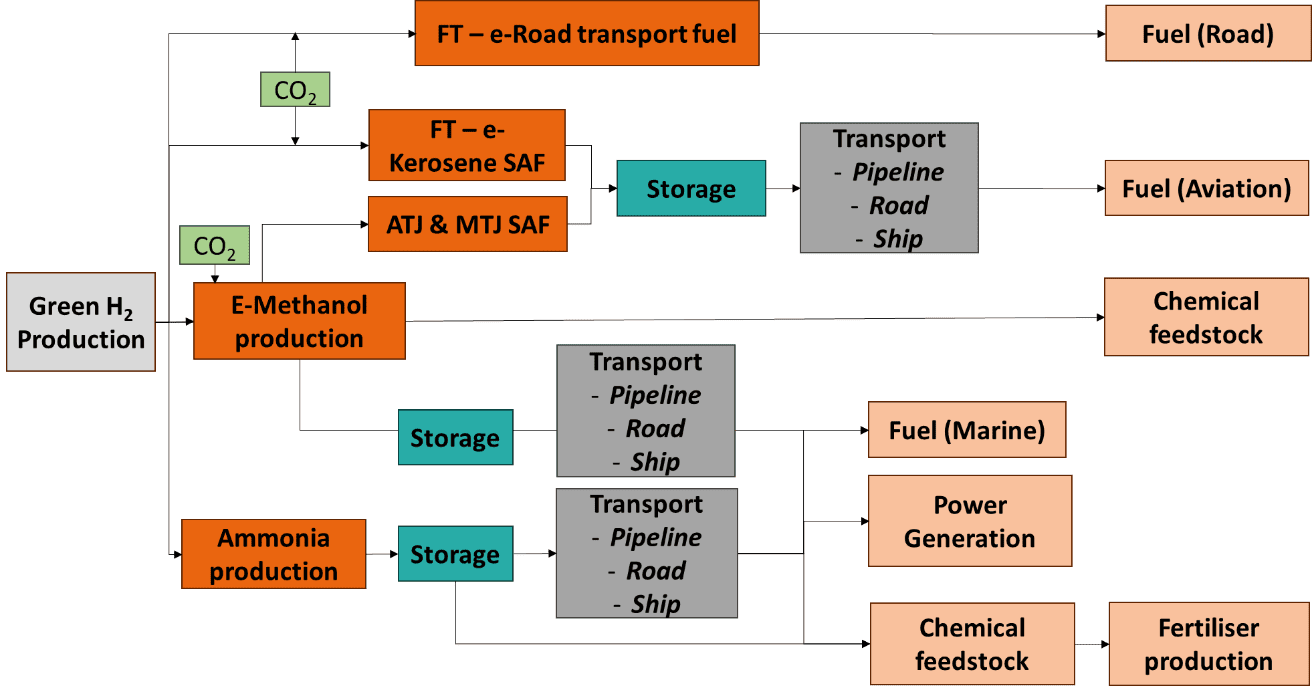
This study focused solely on regulations regarding the production, storage, transport, and use of HDPs. Only fuel types derived from green hydrogen and a carbon dioxide feedstock were covered, not fuels derived from bio-feedstocks. We also excluded the production of low-carbon hydrogen itself and associated feedstocks such as electricity from renewable energy sources. These topics have already been subject to review and reported on in existing studies[1]
Regulatory landscape for HDPs
In this section, we capture the relevant regulations for HDPs across each of the jurisdictional levels – Scotland, UK, EU and internationally. Each sub-section focuses on one geography, outlining the regulations assessed, the derivatives and value chain elements to which they apply, and their impact areas. The following sub-sections cover each jurisdictional level:
- Scotland
- UK
- European Union
- International
The overarching policy and sector strategies for each geography are laid out to provide context, and to highlight stated policy intent relating to HDPs.
Our intention in this section is to describe the regulatory landscape for ammonia, e‑methanol and SAF produced in Scotland and transported and consumed either domestically or abroad. Section 5 captures the fit-for-purpose analysis with overall assessment outputs accessible in Appendix B.
Where appropriate, the regulations have been grouped together according to impact areas in each geography. Regulations that showed greater relevance in the scoring assessment and subsequent study recommendations were outlined in additional detail for reference.
A visual regulatory map of jurisdictional levels and impact areas accompanies this report.
Scotland
Policy and sector strategy
Scotland set out an ambition of 5GW of renewable and low-carbon hydrogen production by 2030 and 25GW by 2045, in their Hydrogen Policy Statement (Scottish Government, 2020). One of the Scottish Government’s actions from this Statement was to ensure the regulatory, planning and consenting framework for renewable developments would support the scale-up of hydrogen. Hydrogen is an export ambition and HDPs are included as a form of hydrogen transport vector and commodity. Hydrogen derivative developments are subject to an overarching UK regulatory regime. This is discussed further in Section 4.2.
Scottish climate policy
Scotland’s climate policy framework is underpinned by the Climate Change (Scotland) Act (Scottish Government, 2009). This sets a legally binding target for Scotland to achieve net‑zero greenhouse gas emissions by 2045, five years earlier than the UK-wide target. The Act also requires Ministers to set and meet carbon budgets. These carbon budgets will each cover a series of 5-year periods from 2026 to 2045.
In addition, the Scottish Government published its draft Climate Change Plan 2026–2040 (Scottish Government, 2025) in November 2025. This Plan sets out how Scotland intends to meet its first three carbon budgets covering the period 2026–2040, providing a pathway aligned with independent advice from the Climate Change Committee. The draft Plan is currently undergoing public consultation.
Scotland’s draft Climate Change Plan (Scottish Government, 2025) does not address
deployment targets for HDPs such as ammonia and e-methanol. It does mention the Scottish Government’s plan to consider options for increasing SAF production and its use.
Hydrogen Action Plan
The Hydrogen Action Plan (Scottish Government, 2022) positions hydrogen and its derivatives as essential for decarbonising hard‑to‑abate sectors and supporting a just transition. The Plan outlines actions to develop Scotland’s hydrogen economy, including scaling renewable hydrogen production to support derivative fuels for domestic and export markets. It recognises the need for safe, regulated development of derivatives and highlights their potential role in early export pathways to mainland Europe. Direct actions for HDPs in the Plan are in identifying priority export markets internationally and market access barriers for derivatives.
Hydrogen export plan
Scotland published its first hydrogen sector export plan, A Trading Nation: Realising Scotland’s Hydrogen Potential – A Plan for Exports (Scottish Government, 2024) which sets out Scotland’s ambition to become a major exporter of hydrogen and HDPs to European markets, underpinned by ambitions of 5 GW of production by 2030 and 25 GW by 2045. The plan recognises Europe’s rising demand for renewable hydrogen and hydrogen products and positions Scotland as having the renewable capacity, skills and supply‑chain capability to supply derivative fuels at scale.
Scottish regulatory landscape
Scottish regulations relevant to derivatives primarily address procedures in consenting, planning and permitting of certain activities. A UK regulation on Green Freeports which impacts route to market has been included in this section as it is relevant to Scotland. Table 1 captures the assessed regulations for the development of HDPs in Scotland.
Regulation | Derivative | Value Chain Area |
|---|---|---|
The Environmental Authorisations (Scotland) Amendment Regulations 2025 | All | Production Transport |
The Town and Country Planning (Hazardous Substances) (Scotland) Regulations 2015 | All | Production Storage |
The Town and Country Planning (Environmental Impact Assessment) (Scotland) Regulations 2017 | All | Production |
Marine Works (Environmental Impact Assessment) (Scotland) Regulations 2017 | All | Storage Transport |
Finance Act 2021 with Finance (No. 2) Act 2023* – with regards to freeport tax site especially Green Freeports in Scotland | All | Production Storage Transport |
Town and Country Planning (Scotland) Act 1997 | All | Production Storage Transport |
The regulatory landscape is not hydrogen or HDPs specific but is neutral in allowing projects which adhere to the planning framework and regulated activities which require permits to proceed.
- The Environmental Authorisations (Scotland) Amendment Regulations 2025 – which amends the 2018 Regulations to create an Integrated Authorisation Framework (IAF). This framework streamlines the Scottish Environment Protection Agency (SEPA) regulation of waste, water, and industrial activities. These regulations cover activities requiring permits that must be gained separately to planning permission. This streamlined regulation is aimed at enhancing efficiency in the process for hydrogen derivative project developers in Scotland. An overall outcome or evaluation of this aim was not available at the time of writing.
- Marine Works (Environmental Impact Assessment) (Scotland) Regulations 2017 – regulations which govern EIAs for Scottish marine developments within the 12-nautical mile boundary. For hydrogen derivative projects, the water usage, waste discharge as well as infrastructure risks will be considered.
- Finance Act 2021 with Finance (No. 2) Act 2023 – the 2021 Act (UK Government, 2021) and 2023 amendments (UK Government, 2023) set the UK‑wide legal basis for Freeports, including the tax reliefs and commercial incentives available within designated Freeport tax sites. In Scotland, this framework is applied through the Green Freeports, which focus on net‑zero and just‑transition objectives, including low‑carbon fuels and energy transition projects. This makes it relevant to the hydrogen‑derivatives landscape. For example, the Forth Green Freeport identifies opportunities for alternative fuels alongside offshore wind, shipbuilding, modular manufacturing and creative industries. This emphasis on net‑zero activities provides an additional policy route and potential market access point for HDPs.
- Town and Country Planning Act 1997 – the principal consolidating statute that provides the core legal framework for regulating land development, preparing development plans, determining planning applications, and enforcing planning control in Scotland (as significantly amended by later Acts such as the Planning etc. (Scotland) Act 2006 and the Planning (Scotland) Act 2019).
UK
Policy and sector strategy
Strategy and policy on climate, transport decarbonisation, and industrial development all influence direction on HDP production and use. The most relevant UK policies and strategies are outlined below focussing on their relevance to HDPs and the scope of this project.
Climate policy
UK Government is obliged to deliver net zero emissions for the UK by 2050 by the Climate Change Act (UK Government, 2008). Legally binding carbon budgets have been set covering the period out to 2037, and the seventh carbon budget (covering 2038 to 2042) needs to be set by June this year. Additionally, the UK Government has ratified the Paris Agreement.
The Carbon Budget and Growth Delivery Plan (UK Government, 2025) lays out how the Government intends to meet its statutory carbon budgets. This focusses on the period to 2037. HDPs are listed directly as achieving emissions reduction in the following areas:
- Aviation (SAF)
- Shipping (low carbon fuels including ammonia and methanol)
- Road Transport (low carbon fuels including ammonia and methanol)
Deployment assumptions are listed for each of these sectors, but no breakdown is given. Therefore, there are no clearly stated deployment targets for the HDPs that are in the scope of this report.
Maritime Decarbonisation Strategy
The Maritime Decarbonisation Strategy (UK Government, 2025) sets out GHG emissions targets for the maritime sector. (30% reduction by 2030, 80% by 2040, 100% by 2050 relative to 2008 levels). This sets out guiding principles that include a co-ordinated approach to regulation with international bodies such as IMO. The document is clear that there are significant roles for ammonia and methanol in decarbonising the maritime sector. The strategy is focussed on achieving decarbonisation and does not include any targets for or give any direction on the need for domestic UK production of these fuels.
Jet Zero Strategy
The Jet Zero Strategy (UK Government, 2022) recognises that SAF is required to reduce emissions from the aviation sector and included the launch of a SAF mandate as a key objective. Relating to production, a KPI for five commercial scale SAF plants to be under construction was set. PtL SAF is not explicitly mentioned, and the strategy only includes general statements on funding for first of a kind commercial and demonstration advanced fuels plants.
Decarbonising transport
The Decarbonising Transport Strategy (UK Government, 2021) includes the UK Government’s strategy for decarbonising road transport. Electrification, biofuels and hydrogen are included as mechanisms to reduce emissions. This strategy introduced plans to phase out internal combustion engine vehicles in the UK, and these plans have been supported by subsequent governments. That means that while there is support for low carbon drop in fuels as an interim solution (such a biofuels), in the long term this type of fuel will be phased out in the road transport sector. There is no current strategy or policy that supports the use of HDPs in this sector.
Industrial strategy
The UK’s Modern Industrial Strategy (UK Government, 2025) has identified Clean Energy Industries as one of eight strategic sectors. The Clean Energy Industries Sector Plan (UK Government, 2025) includes hydrogen but does not specifically mention HDPs.
Hydrogen Strategy
The UK’s Hydrogen Strategy (UK Government, 2021) sets out a framework for scaling hydrogen production, transport, storage, and use, and set an ambition of 5 GW low carbon hydrogen production by 2030, later doubled to 10GW in the British Energy Security Strategy. There is no mention of HDPs in the Hydrogen Strategy. It does establish policy direction on hydrogen standards and business models that indirectly impact the derivative markets.
An update to the Hydrogen Strategy was due in late 2025 but has not been published at the time of writing this report.
UK regulatory landscape
HDPs are regulated through a combination of industrial safety legislation (e.g., COMAH), environmental consenting, and sector‑specific regimes (e.g., shipping, aviation, and industrial chemicals). As such there are multiple stakeholders split across these areas, including Department for Energy Security and Net Zero (DESNZ), Environment Agency, Health and Safety Executive, and Department of Transport. This results in a fragmented regulatory landscape which limits the strategic direction, market impact and regulation clarity for new projects.
Route to market
The considered route to market regulations within the UK are shown in the table below, highlighting which hydrogen derivative(s) they are applicable to and at what point in the value chain.
Regulation | Derivative | Value Chain Area |
|---|---|---|
Renewable Transport Fuel Obligations (RTFO) and Sustainable Aviation Fuel (SAF) Mandate Technical Guidance | All | Production (Scotland) Use |
Merchant Shipping (Carriage of Dangerous Goods and Harmful Substances) Regulations 2024 | All | Transport |
UK Emissions Trading Scheme (The Greenhouse Gas Emissions Trading Scheme Order 2020) | All | Production (Scotland) Storage |
Energy Act 2023 | Ammonia e-Methanol | Use |
The Renewable Transport Fuel Obligations Order (RFTO) 2007 | Ammonia e-Methanol | Use |
UK Carbon Border Adjustment Mechanism (CBAM) (Finance Bill 2025-26) | Ammonia | Production (Scotland) Use |
Sustainable Aviation Fuel (SAF) Mandate (Renewable Transport Fuel Obligations (Sustainable Aviation Fuel) Order 2004 | SAF | Production (Scotland) Storage |
Sustainable Aviation Fuel (Revenue Support Mechanism) Bill | SAF | Production (Scotland) |
Hydrogen Production Business Model (HPBM) | All | Production (Scotland) |
Many of these regulations do not directly promote HDPs and are driven as a result of decarbonisation targets. Regardless, they have an effect on derivatives. Regulations that will have a market impact on hydrogen derivative products are:
- Energy Act 2023 – provides the statutory framework to implement key elements of UK hydrogen policy. For HDPs, the Act helps enable investment by clarifying market arrangements and government intervention powers. The Act provides the framework for setting up business models and funding structures such as revenue support (e.g., SAF Revenue Support Mechanism, covered further below).
- UK Emissions Trading Scheme (UK ETS) – sets a carbon price on emissions only from the power generation, industry and aviation sectors, improving the relative competitiveness of low‑carbon HDPs versus fossil alternatives. This is being reviewed for expansion to maritime sector in 2026 and waste incineration in 2028. At present, PtL SAF (e-SAF) does not receive zero-rated status. Zero‑rated fuels are assumed to have zero carbon emissions when used, a designation that applies only to biomass‑based SAF.
- Renewable Transport Fuel Obligation (RTFO) – represents the central policy driver for hydrogen‑derived fuels in the relevant transport sector. This includes road vehicles and non-road transports such as non-road mobile machinery (NRMM) and the maritime sector, if the fuel used is a renewable fuel of non-biological origin (RFNBO). It creates demand for eligible RFNBOs through tradable certificates. An eligible RFNBO is required to
- Achieve a 65% GHG emission saving over the whole lifecycle relative to the fossil fuels fuel baseline of 94 gCO2eq/
- demonstrate that the renewable electricity or heat used to produce the RFNBO satisfies regionalisation rules and additionality rules. The regionalisation rule includes demonstrating that the electricity comes from the same region and electricity market where production is located. The additionality rule requires the electricity used to make RFNBO is additional, meaning produced from new, upgraded, and recommissioned production, and not diverted from existing renewable power.
Note this RFNBO definition differs from the EU definition and is further discussed in Section 5.1.1.
- RTFO and Sustainable Aviation Fuel (SAF) Mandate Technical Guidance – provides the guidance on technical requirements which are largely consistent between the RTFO and SAF Mandate, covering classification, carbon and sustainability criteria, GHG calculations and evidence requirements. This guides suppliers and allows RFTO and SAF fuels to be consistent across the UK:
- sets sustainability rules to qualify for certificates with GHG emission savings relative to fossil fuels for SAF having to be equal or above 40%, and for RFNBOs to be equal or above 65%, respectively
- provide evidence requirements, which include documentation for eligible fuel feedstock, process emissions, evidence that fuel can be tracked from source to final delivery and audits within the supply chain
- UK Carbon Border Adjustment Mechanism (CBAM) – legislation to prevent cheaper carbon intensive products being imported into the UK. Importers are charged a fee based on the carbon emissions from goods production. This will be introduced from 1 January 2027 and mainly impacts green ammonia imports (as fertilisers are included), making it more competitive. Methanol and other fuel are not covered in this legislation.
- SAF Mandate – sets a legal obligation on aviation fuel suppliers to supply a minimum proportion of SAF, increasing over time. The mandate therefore acts as a key demand‑side policy for HDPs in aviation, alongside parallel SAF revenue support mechanisms. PtL SAF obligations only start in 2028. In addition, there is currently a consultation to broaden the SAF Mandate eligibility to crop-derived SAF for flexibility.
- Sustainable Aviation Fuel (Revenue Support Mechanism) Bill – this set the regulation for the proposed revenue certainty mechanism for UK SAF production. The legislation for the revenue certainty mechanism is expected to be finalised by the end of 2026.
- Hydrogen Production Business Model (HPBM) – indirectly supports HDPs production by providing revenue support for the hydrogen used for derivatives production. However, hydrogen used to produce energy carriers for export is excluded from HPBM support.
Technology development and standardisation
Technology development and standardisation regulations for HDPs are designed to ensure that when these are used, they are produced, transported and used safely.
Regulation | Derivative | Value Chain Area |
|---|---|---|
The Alternative Fuels Infrastructure Regulations 2017 | All | Use |
Maritime and Coastguard Agency (MCA) Customer Process for Alternative Fuels – Ammonia | Ammonia | Use |
Motor Fuel (Composition and Content) Regulations and the Biofuel (Labelling) (Amendment) (NO. 2) Regulations 2021 | e-fuel (road) | Use |
There are specific regulations that set the technical, safety and operational requirements for developing and using hydrogen‑derivative technologies. Similar to ‘route to market’ related regulations, they do not actively promote the HDPs sector. However, they affect the way derivatives are deployed in the end-user market.
- The Alternative Fuels Infrastructure Regulations – regulation to ensure a common set of standards and functionality for the provision of certain alternative fuel infrastructure. These alternative fuels include electricity, hydrogen, synthetic fuels – which comprise of HDPs – supplied to vehicles or ships in a way which is consistent across the UK.
- Maritime and Coastguard Agency (MCA) Customer Process for Alternative Fuels – Ammonia – IMO have developed interim guidelines for using ammonia as fuel and these can be used by owners/operators wishing to build new vessels or convert existing vessels to run on ammonia. This guidance is used in conjunction with IMO’s International Code of Safety for Ships using Gases or other Low-flashpoint Fuels (IGF Code). The UK policies in Section 4.2.1 have not been clear on the use of ammonia as a fuel. However, this regulation indicates the MCA is preparing for this to be a possibility, which will ease its deployment as a maritime fuel.
Health, Safety and Environment
Health, Safety and Environment (HS&E) related legislation includes the Control of Major Accident Hazards (COMAH) regime and dangerous substances regulations, which govern the safe handling, storage and transport of hydrogen and HDPs.
Regulation | Derivative | Value Chain Area |
|---|---|---|
The Carriage of Dangerous Goods and Use of Transportable Pressure Equipment Regulations 2009 | All | Transport |
Control of Major Accident Hazards (COMAH) Regulations | All | Production (Scotland) Storage |
Pipeline Safety Regulations 1996 | All | Transport |
UK Registration Evaluation Authorisation and Restriction of Chemicals – The REACH etc. (Amendment) Regulations 2021 | All | Production (Scotland) Transport |
Dangerous Substances and Explosive Atmospheres Regulations 2002 (DSEAR) | All | Storage |
The Dangerous Goods in Harbour Areas Regulations 2016 | All | Storage Transport |
Table 4 lists the regulations for HS&E pertaining to HDPs. Most of these are not regarded as a barrier to deployment or constraining market activity, but to support the safe delivery of derivatives. Some of the relevant HS&E regulations for derivatives to note are:
- Control of Major Accident Hazards (COMAH) Regulations – these regulations aim to prevent and mitigate the consequences of major accidents involving dangerous substances. They apply to sites that store or handle large quantities of hazardous chemicals. The regulation is based on the mass of the particular substance so will apply to hydrogen derivative thresholds of ammonia (50 tonnes), methanol (500 tonnes), SAF (2500 tonnes). COMAH would apply to all derivatives – but not all projects as dependent on mass of substances.
- UK REACH etc. (Amendment) Regulations 2021 – applies to most chemical substances that are manufactured in or imported into England, Scotland, and Wales – and covers all HDPs. This has an associated fee and processing time for registration. The EU has its own REACH rules, which differ from UK REACH. Section 5.1.3 discusses the implications of this.
Consenting
Hydrogen derivative production facilities and infrastructure are subject to planning and permitting under UK regulations governing emissions to air, land and water, waste management and industrial installations, as shown Table 5.
Regulation | Derivative | Value Chain Area |
|---|---|---|
Pipelines Act 1962 | All | Transport |
Town and Country Planning Act 1990 | All | Production (Scotland) Storage Transport |
The Environmental Permitting (England and Wales) Regulations 2016 | All | Storage Transport |
Planning and Infrastructure Act 2025 | All | Production (Scotland) Storage |
Planning Act 2008 – Nationally Significant Infrastructure Projects (NSIPs) (includes Development Consent Order) | All | Transport |
In particular, some relevant regulations to highlight are:
- The Environmental Permitting (England and Wales) Regulations 2016 – governs the environmental permitting and protection controls framework for any industrial and waste installations and its emissions. HDPs storage and transport in England and Wales will be regulated, however this will not apply to hydrogen derivative production facilities in Scotland.
- Planning Act 2008 – Nationally Significant Infrastructure Projects (NSIPs) – NSIPs are large scale projects falling into five general categories (energy, transport, water, waste water and waste). This applies primarily to England and Wales. They include projects as diverse as electricity generating projects, reservoirs and hazardous waste facilities. HDPs would fall under Energy and energy infrastructure such as a pipeline carrying HDPs or storage of derivatives.
Cross-border projects covering Scotland and England (such as transport pipelines) will be subject to different regulatory and planning frameworks. For example, for a linear infrastructure project (e.g., cables, pipelines, rail) crossing the border, a project may need a DCO for the English portion, while the Scottish portion requires planning permission under the Town and Country Planning (Scotland) Act 1997. This would also include engaging with two different regulators handling matters – Environmental Agency and Natural Resources Wales regulating England and Wales, and Scottish Environment Protection Agency for Scotland.
European Union
Policy and sector strategy
Europe’s wider strategy and policy for HDPs is informed by the EU Hydrogen Strategy launched in 2020. HDPs are an indirect benefactor of aims to promote the overall demand for clean hydrogen and the recognition that a supportive enabling framework is required to achieve this.
The EU has several initiatives aimed at both promoting the production and use of hydrogen within the economy, with some specifically recognising the role of HDPs. Standing out are the creation of the European Hydrogen Bank and Global Europe Hydrogen Facility designed to accelerate renewable hydrogen deployment by supporting both domestic production and imports to meet 10 million tonnes by 2030. A key aim is to unlock private investment by bridging the price gap between renewable hydrogen and conventional fuels. Additional policy and regulatory frameworks are realised through the EU’s ‘Fit for 55’ Package to reach at least 55% GHG emissions reductions by 2030 compared to 1990 levels.
EU regulatory landscape
Throughout the EU landscape there is a strong focus on route to market-based regulations, with a wide application to the ‘Use’ value chain area.
Route to market
There is significant route to market enablement in the EU via hydrogen specific regulation and policy on HDPs. Standing out in particular are the definitions of what constitutes low-carbon and renewable hydrogen and the eligibility of the resulting products. The assessed regulations are shown in the table below.
Regulations | Derivative | Value Chain Area |
|---|---|---|
EU Renewable Energy Directive III (RED III) | All | All |
EU Emissions Trading Scheme | All | Use |
Fit for 55 – ReFuelEU Aviation | SAF | Use |
Regulation on employment of alternative fuels infrastructure (Regulation (EU) 2023/1804 of the European Parliament and of the Council) | All | Use |
Fit for 55 – ReFuelEU Maritime | Ammonia e-methanol | Storage Use |
EU Gas Directive (2024/1788) and its accompanying Regulation (2024/1789) | Ammonia e-methanol | Use |
EU Carbon Border Adjustment Mechanism (CBAM) | All | – |
There are three key policy instruments within the EU that take direct action in the promotion of hydrogen derivative products:
- Renewable Energy Directive III (RED III) outlines and defines the eligibility criteria particularly for hydrogen and HDPs. Hydrogen derivative criteria are defined within the description of Renewable Fuels of Non-Biological Origin (RFNBOs) as well as setting minimum mandates for use of RFNBOs across many sectors of the EU economy, including industry and transport. The European approach does not penalise international products provided they also meet the domestic eligibility criteria.There are strict eligibility criteria within RED III for RFNBOs (and the source hydrogen) via Delegated Acts:
- GHG saving must by >70% compared to fossil equivalent
- The source of power must be new renewable energy generation that is enabled by the project (alongside temporal and geographical/location constraint of the generating power asset matching hydrogen production with available renewable power generated locally)
- CO2 source restrictions must be complied with, particularly fossil fuel-based emissions. As an example, CCS from Natural Gas powered CCGT will be ineligible beyond 2036.
- RED III requires translation into law by each member state. At the time of writing this study, 25 out of 27 member states have bypassed the deadline to translate into domestic laws.
- ReFuelEU Aviation sets volume requirements for low carbon aviation fuel, SAF, to be utilised within the aviation sector. The requirements are driven by mandates on transport fuel suppliers. There are specific, time bound targets for the use of SAF and particularly synthetic or e-SAF. The latter does not take effect until 2030.
- ReFuelEU Maritime sets GHG intensity targets for ships over a 5000 gross tonnage calling at European ports. It is agnostic to fuel types or the usage of RFNBOs and does not explicitly require or promote their usage within the stated aims.
The EU definition of RFNBOs includes hydrogen itself and is not exclusive to HDPs. Therefore, any mandated use of RFNBOs throughout the economic zone does not ensure the promotion of HDPs exclusively as they will be competing directly with hydrogen itself.
Enabling policy that is indirectly supportive of low carbon HDPs includes the following:
- European Union Emissions Trading Scheme (EU ETS) which incentivises industry to utilise HDPs to avoid carbon emission penalty costs by capping the allowable volume of carbon emissions per sector of the economy. This prices carbon emissions based on supply and demand within the market and also penalises non-compliance with costs. Sectors include aviation and shipping within the capped allowances. Utilising low carbon fuels such as RFNBOs is recognised to reduce emissions intensity, offsetting exposure to carbon emissions costs
- Carbon Border Adjustment Mechanism (CBAM) which aims to protect production of low-carbon goods domestically by exposing non-domestic goods to the same level of domestic eligibility criteria with respect to GHG emissions, or face tariff penalties. This currently only applies to ammonia as a hydrogen derivative, as it is included within fertiliser as one of the five affected sector goods.
The EU ETS states that the emissions cap is agnostic to fuel choice or emissions reduction approach, therefore the adoption of RFNBOs or HDPs is not a direct policy intention. There is, however, a dedicated support mechanism for RED III eligible SAF within the scheme, which both accounts for the lower lifecycle emissions of SAF fuels (reducing the emissions liability of the airline if using SAF) and awards allowances to support price premium of SAF over conventional jet fuel. Similarly, the EU ETS recognises eligible RFNBO fuel usage as reducing the monitored and reported emissions of a stationary installation, and can effectively be used to offset emissions allowance requirements.
Other regulations that are generally supportive of HDPs within the EU include:
- Alternative Fuels Infrastructure Regulation (AFIR) which affects road infrastructure (fuelling stations), airports and ports predominantly. It requires the rollout and installation of alternative fuel supply infrastructure, such as electric charging and hydrogen refuelling. The standards and mandates are not for HDPs, although they are not explicitly excluded from the regulation.
- EU Gas Directive & Regulation (2024/1788, 2024/1789) which has been updated to include provisions for hydrogen pipelines and networks. It has recognition of HDPs ammonia and methanol as supply products relating to hydrogen terminals, particularly for the transformation of these products into hydrogen. It does not have specific provision for the transport of ammonia and methanol as energy carriers themselves (i.e., with own pipeline infrastructure network requirements).
Technology development and standardisation
Drop-in hydrogen derivative fuels or e-fuels are accommodated for within existing EU Fuel Quality Directive. This directive specifies the quality requirements for fuels for example in combustion engines, which will apply the hydrogen derivative drop-in fuels.
Regulations | Derivative | Value Chain Area |
|---|---|---|
EU Fuel Quality Directive (Directive 98/70/EC, as amended by 2009/30/EC) | e-fuels | Use |
Health, Safety and Environment (HS&E)
HDPs are accommodated within existing HS&E regulations within the EU such as EU REACH, which requires the registrations of all chemicals produced or imported into the EU above a certain quality. This is a separate registry from the UK REACH. Similarly, the ATEX regulation provide mandated equipment design requirements of pressurised and explosive substances, including HDPs.
Regulations | Derivative | Value Chain Area |
|---|---|---|
EU Registration Evaluation Authorisation and Restriction of Chemicals (REACH) (Regulation (EC) No 1907/2006) | All | Production Transport |
ATEX Directive 2014/34/EU (equipment) and 1999/92/EC (workplaces) | All | Storage Use |
Other supportive initiatives
In addition to the regulation discussed above there are other supportive instruments within the EU particularly targeting the growth of the hydrogen and hydrogen derivative sector:
- The European Hydrogen Bank is an EU-level financing instrument that, through its international pillar, supports the import of renewable hydrogen and its derivatives (such as ammonia, methanol, and e-fuels) from non-EU countries into the EU. It functions through the design of mechanisms like joint auctions and incentives to bridge price gaps, ensure sustainability standards, and help meet the EU’s 10Mt annual import target by 2030.
- H2Global is a Germany-initiated auction-based funding scheme that facilitates large-scale imports of green hydrogen and derived products from outside the EU/Germany into Europe. The derivatives included are primarily ammonia and methanol. It functions by using public funds to cover price differences between global producers’ offers and European buyers’ willingness to pay, thereby de-risking early projects.
International
Policy and sector strategy
International legislation falls within collaborative organisations that typically have remits for safety, security, and environmental protection. Efforts to progress decarbonisation are prevalent for aviation and marine sectors relating to frameworks for enabling the low carbon fuels including HDPs.
Regulatory landscape
This study reviewed regulations predominantly related to the marine and aviation environment. These are currently the dominating modes of distribution and use of HDPs internationally. The regulatory landscape internally focuses on technology development and standardisation, particular as it pertains to marine vessels.
Route to market
Within the marine sector the IMO has draft legislation targeting decarbonisation which would see a reduction in carbon emissions from combustion of fuels on large vessels over time.
Regulations | Derivative | Value Chain Area |
|---|---|---|
International Maritime Organisation (IMO) Net-Zero Framework | Ammonia e-methanol | Use |
The draft legislation has 2 main policy considerations which may indirectly influence the market of HDPs as low carbon marine fuels:
- Global Fuel Standard (GFS): Sets yearly intensity reduction targets for ship fuel, forcing gradual decarbonization.
- GHG Pricing: Imposes costs on emissions above the standard, with two tiers: a lower price for emissions between base and target, and a higher price for exceeding the target.
Technology development and standardisation
All aspects of the value chain of HDPs are applicable to existing international regulations with respect to technology development and standardisation.
Regulations | Derivative | Value Chain Area |
|---|---|---|
International Civil Aviation Organization (ICAO) Global Framework for SAF, LCAF and other Aviation Cleaner Energies | SAF | ALL |
American Society for Testing and Materials (ASTM) | ALL | Production Use |
International Code of Safety for Ships Using Gases or Other Low-Flashpoint Fuels (IGF Code) SOLAS | Ammonia e-methanol e-fuel | Transport Use |
International Code for the Construction and Equipment of Ships carrying Dangerous Chemicals in Bulk (IBC Code) | Ammonia e-methanol | Transport |
The International Code of the Construction and Equipment of Ships Carrying Liquefied Gases in Bulk (IGC Code) SOLAS | Ammonia | Transport |
International Convention for the Prevention of Pollution from Ships (MARPOL) | Ammonia e-methanol | Use |
The international regulations assessed are described below in relation to three categorisations:
- Marine vessel construction and operation.
- SAF international proliferation (as drop in fuels like eSAF will have less of an infrastructure barrier to adoption as alternative fuels in marine context).
- Fuel specifications
Marine vessel construction and operation
Non-pipeline transport of HDPs relies on the maritime sector and marine vessels. This sector adheres to internationally agreed regulation via the International Maritime Organisation (IMO). Existing IMO codes cover construction, bulk transport and design of vessels utilising HDPs as both a fuel, a refrigerant, and a hydrogen carrier (in the transportation of HDPs). There is an existing risk-based approval pathway within IMO codes for approving new ship types and fuels, via the Alternative Design Arrangement (ADA).
There is also an existing convention particularly for management of marine pollution within the IMO, the International Convention for Prevention of Pollution from Ships (MARPOL). This regulation is effective in limiting pollution from existing marine fuel types, with respect to NOx, SOx, Ozone depleting substances, Volatile Organic Compounds (VOCs), onboard incineration and fuel oil quality. No alternative fuels are included within the fuel type definitions, however, they would be expected to fit within the same rules for pollution. This is particularly relevant for utilising Ammonia as a fuel with respect to SOx emissions. It is expected that this will be managed and controlled by the inherent design of the vessel to ensure the pollution constraints are met (e.g., via the use of selective catalytic conversion technologies onboard vessels).
SAF international proliferation
Global frameworks exist particularly for the promotion of SAF within the aviation industry, via ICAO Global Framework for SAF. Promotion, support and developmental funding is provided via this organisation, of which the UK is a prominent and influential member.
International fuel specification / standards
For the widespread adoption of new fuels (e.g., SAF) standardised testing methods and specification have been created through the American Society for Testing and Materials (ASTM). This is vital for the commoditisation of alternative fuels to be used by aircraft globally. ASTM standards have been developed for all main variants of e-fuel production pathways, ensuring there is no barrier to adoption due to uncertainty of fuel specification.
Health, Safety and Environment (HS&E)
HS&E regulations are typically covered within local jurisdiction, or embedded within the technology development regulations above. It is noted that international carriage of dangerous good by road covers transport of HDPs beyond marine and aviation environments, ensuring full coverage of transport regulations.
Regulations | Derivative | Value Chain Area |
|---|---|---|
Agreement concerning the International Carriage of Dangerous Goods by Road (ADR) | ALL | Transport |
Regulatory gap analysis
Our aim in this section is to address the second and third research question of this study. We explore and discuss the gaps and limitations identified within the regulatory landscapes across and between the different jurisdictional levels, categorised by impact area. These impact areas are ‘Consenting’, ‘HS&E’, ‘Route to Market’ and ‘Technology Development / Standardisation’. To aid assessment we initially reviewed each regulation against a set of pre-determined scoring criteria to help categorise and compare before investigating regulations for gaps and limitations as a more granular level. The assessment methodology and output are shown in Appendix A and Appendix B.
Gaps and limitations
The most significant gaps relate to the Route to Market impact area. Our assessment indicated discrepancies in the treatment or definition of HDPs between jurisdictions as well as the exclusion of one or more of the three derivatives covered in this study.
We also identified wider market gaps that do not necessarily arise from the HDPs regulatory landscape. Examples are outlined separately in Section 5.1.55. While not included within our core analysis scope, they provide useful discussion points on potential actions to promote the wider growth of the derivatives market.
Route to market
Route to market regulations show clear jurisdictional discrepancies that complicate offtake opportunities. Impactful regulations were predominantly EU-led regulations, such as RED III and the EU ETS, which offer a comprehensive and clear support framework with established targets and mechanisms that would incentivise offtake and thus a route to market. Particularly supportive for Scottish HDPs production is the openness for international products under RED III and direct inclusion of derivatives under RFNBO definitions. Although these definitions were deemed comprehensive and supportive in terms of allowing international products and different production methods, market participants have also highlighted them as too restrictive in practice (WoodMackenzie, n.d.). European legislations were considered largely outside the direct influence of Scottish and UK Governments.
Key regulations such as Fit for 55 – ReFuelEU Aviation and FuelEU Maritime offer support to HDPs, but are limited by scope. ReFuelEU Aviation is only applicable to SAF and provisions for synthetic SAF are not expected to come into effect until 2030. This timeframe aligns broadly with realistically expected supply timelines. FuelEU Maritime is not explicitly designed to drive HDPs within the maritime sector. With the options of other fuels or electrification being used, the overall market impact of this regulation on HDPs was deemed to be lower.
The UK route to market landscape heavily favours SAF, with limited support for ammonia and e‑methanol. Overall, there is currently an unclear role particularly for ammonia in the UK’s energy system. The topic is expected to be covered in the next UK Government Hydrogen Strategy Update this year, with an overall greater focus and associated support mechanisms required to incentive wider production and use for this derivative type.
Specific support is only available to e-SAF as a hydrogen derivative via the Sustainable Aviation Fuel (Revenue Support Mechanism) Bill and SAF Mandate (Renewable Transport Fuel Obligations (Sustainable Aviation Fuel) Order 2004. An uncertainty within the Revenue Support Mechanism is found in plans to continue stakeholder engagement on the PtL/e-SAF obligation buy-out price at £5 per litre and the mismatch to anticipated high UK production costs. This pricing mismatch may limit uptake and reduce offtake opportunities. Similar dedicated mandates or wider commercial support frameworks currently do not exist for ammonia and e-methanol. In addition, the SAF Mandate currently does not require PtL/e-SAF to be sourced from the UK, placing local producers in competition with overseas markets.
Limitations identified within the current UK ETS system focused on PtL/e-SAF being excluded from zero-rating and users of PtL/e-SAF not being able to claim reduced emissions allowances as is possible within the EU ETS, resulting in uncertainty of application if the UK and EU ETS were to align in the future. Additional uncertainty in the UK ETS stems from the question of whether maritime sectors will be included in future, with a respective consultation planned for 2026. This makes future treatment of e‑fuels in maritime uncertain, limiting potential offtake routes.
A final limitation to highlight is the difference between UK and EU definitions and criteria for HDPs in their respective regulations. Compared to the EU ETS, the UK ETS regulation currently excludes applications in the maritime sector and has no emissions allowance for PtL/e-SAF. UK and EU definitions for SAF and RFNBOs also differ. EU requirements for RFNBOs currently exceed those of the UK, particularly with regard to the geographic correlation for renewable energy sourcing for derivative production. This currently risks reduced export potential for Scottish-produced e-methanol and ammonia if they only adhere to UK requirements.
As highlighted throughout this section, there are opportunities to reduce barriers to offtake and expand the market by seeking greater alignment between UK and EU jurisdictions. A core focus lies in aligning definitions and criteria for HDPs. Additional market engagement with Scottish producers seeking offtake options can help assess the feasibility and impact of further alignment.
Technology development & standardisation
Our analysis of technical standards identified a regulatory landscape with high degrees of certainty and clarity. Although these standards are not designed to promote derivatives, they do not currently represent barriers. Rather, they are enablers by setting the rules and guidance by which technologies and products, including for HDPs (e.g., ammonia fuelled marine engines) will need to abide.
International frameworks exist that cover the three major hydrogen derivative products. Current legislation does not create barriers to their growth, especially for transporting ammonia and methanol, which are already widely traded.
The standards for fuel testing, and promoting the wider usage of new fuels (ASTM), is available for key HDPs already, such as e-SAF (including PtL, Fischer-Tropsch variant), ammonia, methanol and drop-in motor fuels (e.g., e-diesel). With requirements for utilisation of the drop in fuels already regulated under existing legislation e.g., the UK Motor Fuel Regulations (2021).
For marine transport, the IMO IBC Code and IGC Code frameworks, enables transport of substances, such as ammonia as a hydrogen derivative, but not for its use as a fuel. However, there are existing accommodations for alternative fuels such as ammonia and methanol via the IMO IGF code Alternative Design Arrangement. The main gap is the lack of formalised standards for using HDPs outside the risk‑based ADA process. The IMO has released interim guidance for safely using ammonia as a fuel in marine vessels, which is a positive step in accommodating this hydrogen derivative within the sector.
Health, Safety and Environment
We assessed the HS&E regulatory environment as largely-fit for purpose. Regulations are characterised as agnostic to HDPs specifically, thereby not directly targeting or limiting the growth of the market as a policy intent. There is a low degree of influence of the Scottish Government to introduce amendments in European and Global regulations such as EU REACH, EU ATEX directive and the Agreement concerning the International Carriage of Dangerous Goods by Road. There are areas for efficiency and improvement, however, for instance in the current dual burden of complying with both UK and EU REACH regulations if a Scottish producer was to export to Europe.
Consenting and Development
Scotland and the UK have a supportive consenting landscape, with existing regulations already applicable to HDPs specifically. An example of this is the Town & Country Planning Hazardous Substances (Scotland) Regulations 2015. A Hazardous Substances Consent would be required for on-site storage above the thresholds of 50t for ammonia, 500t for methanol and 2,500t for jet fuel.
The Planning and Infrastructure Act 2025 sets out to accelerate the planning and delivery of critical infrastructure – including those for clean energy projects and NSIPs but HDPs are not explicitly covered. The new Environmental Delivery Plans also require clearer guidance for derivative‑specific facilities, creating uncertainty for developers. Establishing additional clarity is important to de-risk the wider value chain for HDPs produced in Scotland, ensuring barriers or complexities in transport or storage outside of Scotland do not impede local production business cases.
Attempts at improving existing regulations and permitting requirements have already been introduced. An example of this is the Environmental Authorisations (Scotland) Amendment Regulations 2025, which seeks to streamline the regulation of waste, water, and industrial activities outside of the overall planning regime. Initial stakeholder feedback has been that it is still too early to establish if the intended outcome has been achieved. We recommend continued monitoring and engagement with stakeholders on these amendments.
Additional regulatory limitations for consideration
We have identified additional market mechanisms and current challenges within the (green) hydrogen production landscape that could be applicable to HDPs. These represent a wider current limitation where a market promoting mechanism is available to hydrogen production, but not to derivatives. They are worth acknowledging when considering the future growth of the HDPs market in Scotland.
- UK power network and policy costs exemptions
An existing scheme for relief to energy intensive industries offers an exception of up to 90% of Transmission Network Use of System (TNUoS) charges. It is unclear whether electrolytic hydrogen or derivative production will qualify for these exemptions, and for how long this scheme may be active. The Climate Change Levy exemptions currently apply to electrolysis for hydrogen production, reducing the cost of power to green hydrogen producer, however, it is uncertain if further exemptions will follow for power consumed by production of HDPs. - UK hydrogen‑focused regulations do not extend to derivatives
Policies such as the Hydrogen Transport and Storage Business Models exclude hydrogen‑derived fuels (e.g., ammonia, e‑methanol), limiting support for derivative project deployment. Similar mechanisms could be considered for and targeted at the derivatives market specifically. - UK / EU hydrogen certification schemes
There is a mismatch between recognised standards for certifying low carbon hydrogen utilised within the UK and EU. The UK has a single Low Carbon Hydrogen Standard, with no further standard definition to describe HDPs utilising this hydrogen. Currently, this standard is voluntary unless receiving support via HPBM scheme. The EU, however, has a selection of third-party certification schemes (CertifHy EU RFNBO, ISCC EU, REDcert EU, TUV SUD CMS 70). The lack of a singular certification scheme may lead to additional administrative and cost burden for hydrogen derivative producers.
Intervention areas
Xodus identified the following proposed interventions and recommendations based on the gap and limitations analysis in Section 5.1. Interventions cover specific regulation areas and wider market supporting interventions outside of existing HDP regulation. We suggest that route to market interventions are the main priority, given the existing applicability and suitability of the regulatory landscape to accommodate HDPs across the other impact areas. Xodus recognise that the route to market aspects lie primarily within UK and EU jurisdictions, with more limited direct regulatory influence for the Scottish Government. The interventions thus represent overall engagement and discussion topics to promote greater alignment between jurisdictions to benefit the overall hydrogen derivative value chain.
Intervention 1: Inclusion of e-fuels / e-SAF within UK ETS
- Description: Recognise synthetic renewable fuels used by regulated industries as part of the UK ETS, similar to what the EU ETS currently does – both schemes are misaligned at present. Ptl/e-SAF is currently zero rated in the EU and not in UK. Synthetic fuels should be recognised as low or zero emissions within the emission factor available for fuels, similar to biomass implementation currently.
- Changes would remove potential additional burdens on producers to monitor and adhere to two separate ETS definitions and regimes. Inclusion of synthetic fuels within UK ETS would incentivise further offtake and thus promote market growth.
- Associated regulation: UK Emissions Trading Scheme
- Jurisdiction: UK
Intervention 2: Extend suitable hydrogen funding mechanisms to incentivise the production of hydrogen derivatives
- Description: Existing hydrogen incentivisation models recognise the production of hydrogen and hydrogen derivatives where these are not exported as energy carriers. These could be extended to include the direct subsidisation of ammonia production within the Hydrogen Production Business Model and recognise ammonia as a hydrogen storage solution within the Hydrogen Storage Business Model.
- Impacts focus on promoting deployment and offtake by improving the initial economic viability of production plants. The intervention further addresses the current focus on green hydrogen production and similar funding options for SAF.
- Associated regulation: Hydrogen Production Business Model, Hydrogen Storage Business Model
- Jurisdiction: UK
Intervention 3: Targeted end-use and route to market support for ammonia, e-methanol and other e-fuels
- Description: Implementation of instruments and regulations specific to the use of low carbon ammonia, e-methanol and other e-fuels. Support would require dedicated targets for production and consumption of ammonia and e-methanol in Scotland and the UK. A consenting perspective can aim to promote options for fast-tracking associated production plant applications. For targeted financial support an example is the Advanced Fuels Fund (AFF).
- This recommendation is closely aligned with Intervention 2 on expanding the dedicated route to market and offtake support for ammonia and e-methanol. They consider the current focus on dedicated support for SAF (e.g., through the SAF Mandate and Revenue Support Mechanism). The impact of recommendation focuses on promoting market and offtake demand, thus supporting economic viability for producers.
- Associated regulation: AFF, Hydrogen Production Business Model, similar targeted support for ammonia and e-methanol as found in the SAF Mandate
- Jurisdiction: UK
Intervention 4: Explore options to harmonise the UK and EU definition and eligibility criteria of SAF
- Description: The UK SAF Mandate definition and eligibility criteria for SAF are less restrictive than the EU counterpart. Impacts of aligning requirements focus on enhancing efficiency in offtake across multiple jurisdictions. This reduces burden on producers and supports overall viability, market development and export options from Scotland/UK to EU. It is recommended to explore options and associated impacts to harmonise requirements between the two jurisdictions. Stakeholder engagement with producers can further explore the extent of the issue on available market size.
- Associated regulation: UK SAF and ReFuelEU Aviation
- Jurisdiction: UK & EU
Intervention 5: Support progression of IMO GHG reduction proposals for marine vessels
- Description: Support the representation of UK and Scottish interests within IMO forums. Promote inclusion of hydrogen derivative applications within GHG reduction options for marine vessels in support of the Net Zero Framework. This would impact the overall potential offtake market for HDPs where they are used as a marine fuel. Strengthens a further demand market for produced derivatives.
- Associated regulation: IMO Net Zero Framework
- Jurisdiction: International
Conclusion
This study focused on assessing the regulatory landscape for HDPs in Scotland across key market impact areas and different geographical jurisdictions. We considered relevant Scottish, wider UK, EU and international regulations within the HDP and net zero policy context. Our evaluation of key impact areas covered consenting of hydrogen derivative related infrastructure, route to market regulations, technology development and standardisation as well as HS&E related requirements.
Our assessment of the regulatory landscape showed an existing fit for purpose framework particularly within the consenting, standardisation and HS&E related regulations in Scottish, UK and international jurisdictions. Existing regulations for industrial and traditional fossil-fuel based projects are already directly applicable, even where the overall policy intent is not focused explicitly on HDPs. Examples of this have included COMAH, Pipeline Safety Regulations and UK/EU REACH requirements.
Current limitations and gaps within the regulatory landscape were predominantly found to be within the route to market impact area. The UK regulatory landscape here is skewed towards more dedicated support for SAF production and use compared to e-methanol and ammonia. In addition, as there is currently not a support mechanism for the decarbonisation of marine vessels, there is opportunity for the Scottish Government to intervene and further support this.
Our analysis showed a discrepancy in requirements for HDPs in Scotland/UK compared to EU counterparts. Examples of this included the differences between UK ETS and EU ETS extent and a more stringent RFNBO definition in EU regulations overall.
We recognise that the route- to market regulations lie largely outside the Scottish Government’s direct regulatory influence. Interventions were thus proposed to guide future engagement between Scottish, UK and EU regulatory counterparts, focusing on alignment and standardisation of criteria in HDPs. We consider that improved regulatory alignment across different jurisdictions and more targeted support for all hydrogen derivative offtake will be crucial for the underlying business case of hydrogen derivative production.
Progress in these route to market areas would support the path towards more effectively realising Scotland’s ambitions of becoming a hydrogen derivative exporter. At the same time, any local demand for derivative products could be met with a reduced administrative burden or compliance risk for producers.
References
American Society for Testing and Materials (ASTM), 2026. American Society for Testing and Materials (ASTM). [Online]
Available at: https://www.icao.int/SAF/saf-conversion-processes
Ella Yip, D. N. J. W. H. M., 2025. Scotland’s capabilities in producing hydrogen products and derivatives. s.l.:ClimateXChange.
European Parliament and of the Council, 2003. European Parliament ETS DIRECTIVE 2003/87/EC OF THE EUROPEAN PARLIAMENT AND OF THE COUNCIL. [Online]
Available at: https://climate.ec.europa.eu/eu-action/carbon-markets/eu-emissions-trading-system-eu-ets_en
European Parliament, 2006. EU Registration Evaluation Authorisation and Restriction of Chemicals (REACH) (Regulation (EC) No 1907/2006). [Online]
Available at: https://eur-lex.europa.eu/legal-content/EN/TXT/?uri=CELEX:32006R1907
European Parliament, 2014. ATEX Directive 2014/34/EU (equipment) and 1999/92/EC (workplaces). [Online]
Available at: https://eur-lex.europa.eu/legal-content/EN/TXT/?uri=CELEX:32014L0034
European Parliament, 2023. EU Carbon Border Adjustment Mechanism (CBAM). [Online]
Available at: https://eur-lex.europa.eu/eli/reg/2023/956/oj/eng
European Parliament, 2023. Regulation on employment of alternative fuels infrastructure (Regulation (EU) 2023/1804 of the European Parliament and of the Council). [Online]
Available at: https://eur-lex.europa.eu/legal-content/EN/TXT/?uri=CELEX%3A32023R1804
European Parliament, 2024. EU Gas Directive (2024/1788) and its accompanying Regulation (2024/1789). [Online]
Available at: https://eur-lex.europa.eu/EN/legal-content/summary/rules-for-renewable-gas-natural-gas-and-hydrogen-in-the-internal-market.html
European Parliament, n.d. EU Fuel Quality Directive (Directive 98/70/EC), as amended by 2009/30/EC. [Online]
Available at: https://eur-lex.europa.eu/eli/dir/1998/70/oj/eng
European Parliament, n.d. Fit for 55 – ReFuelEU Maritime Regulation 2023/1805. [Online]
Available at: https://eur-lex.europa.eu/legal-content/EN/TXT/?uri=CELEX%3A32023R1805
European Parlianment, 2023. Fit for 55 – ReFuelEU Aviation. [Online]
Available at: https://transport.ec.europa.eu/transport-modes/air/environment/refueleu-aviation/faq-refueleu-aviation_en
ICAO, 2023. International Civil Aviation Organization (ICAO) Global Framework for SAF, LCAF and other Aviation Cleaner Energies. [Online]
Available at: https://www.google.com/url?sa=t&rct=j&q=&esrc=s&source=web&cd=&ved=2ahUKEwi9xOCF4b2SAxVxTkEAHd6eFiwQFnoECBwQAQ&url=https%3A%2F%2Fwww.icao.int%2Fsites%2Fdefault%2Ffiles%2Fsp-files%2Fenvironmental-protection%2FGFAAF%2FDocuments%2FICAO-Global-Framework-on-Av
IMO, 2004. International Code for the Construction and Equipment of Ships carrying Dangerous Chemicals in Bulk (IBC Code). [Online]
Available at: https://www.imo.org/en/ourwork/environment/pages/ibccode.aspx
IMO, 2005. International Convention for the Prevention of Pollution from Ships (MARPOL). [Online]
Available at: https://www.imo.org/en/about/conventions/pages/international-convention-for-the-prevention-of-pollution-from-ships-(marpol).aspx
IMO, 2017. International Code of Safety for Ships Using Gases or Other Low-Flashpoint Fuels (IGF Code) SOLAS. [Online]
Available at: https://www.google.com/url?sa=t&rct=j&q=&esrc=s&source=web&cd=&ved=2ahUKEwjq9MG-7vmRAxUlQ0EAHQzpATMQFnoECDMQAQ&url=https%3A%2F%2Fwww.itfseafarers.org%2Fsites%2Fdefault%2Ffiles%2Fnode%2Fresources%2Ffiles%2FITF%2520Guideline%2520on%2520IGF%2520Code.pdf&usg=
IMO, 2026. International Maritime Organisation (IMO) Net-Zero Framework. [Online]
Available at: https://www.imo.org/en/mediacentre/hottopics/pages/faqs-the-imo-net-zero-framework.aspx
IMO, n.d. The International Code of the Construction and Equipment of Ships Carrying Liquefied Gases in Bulk (IGC Code) SOLAS. [Online]
Available at: https://www.google.com/url?sa=t&rct=j&q=&esrc=s&source=web&cd=&ved=2ahUKEwiqt9H-3_uRAxW2VkEAHcsyKzEQFnoECB0QAQ&url=https%3A%2F%2Ftreaties.fcdo.gov.uk%2Fdata%2FLibrary2%2Fpdf%2F1998-TS0015.pdf&usg=AOvVaw1aAAZ9q9YDJOKHzwKkqNst&opi=89978449
Scottish Government, 2009. Climate Change (Scotland) Act 2009. s.l.:https://www.legislation.gov.uk/asp/2009/12/section/A1.
Scottish Government, 2015. The Town and Country Planning (Hazardous Substances) (Scotland) Regulations 2015. s.l.:https://www.legislation.gov.uk/ssi/2015/181/contents.
Scottish Government, 2017. Marine Works (Environmental Impact Assessment) (Scotland) Regulations 2017. s.l.:https://www.legislation.gov.uk/ssi/2017/115/introduction.
Scottish Government, 2017. The Town and Country Planning (Environmental Impact Assessment) (Scotland) Regulations 2017. s.l.:https://www.legislation.gov.uk/ssi/2017/102/contents.
Scottish Government, 2020. Scottish Government Hydrogen Policy Statement. s.l.:https://www.gov.scot/publications/scottish-government-hydrogen-policy-statement/.
Scottish Government, 2022. Hydrogen Action Plan. [Online]
Available at: https://www.gov.scot/publications/hydrogen-action-plan/documents/
[Accessed 3 February 2026].
Scottish Government, 2024. A Trading Nation: Realising Scotland’s Hydrogen Potential – A Plan for Exports. s.l.:https://www.gov.scot/binaries/content/documents/govscot/publications/strategy-plan/2024/11/trading-nation-realising-scotlands-hydrogen-potential-plan-exports/documents/trading-nation-realising-scotlands-hydrogen-potential-plan-exports/trading-nation-reali.
Scottish Government, 2025. Scotland’s Climate Change Plan – 2026-2040. s.l.:https://www.gov.scot/publications/scotlands-climate-change-plan-2026-2040/pages/1/.
Scottish Government, 2025. The Environmental Authorisations (Scotland) Amendment Regulations 2025. s.l.:https://www.legislation.gov.uk/sdsi/2025/9780111061473/introduction.
Szebasztian Csernik-Tihn, J. M. J. W. H. M., 2024. Review of demand for hydrogen derivatives and products. s.l.:ClimateXChange.
THE EUROPEAN PARLIAMENT AND THE COUNCIL OF THE EUROPEAN UNION, Oct 2023. Renewable Energy Directive III Directive (EU) 2018/2001. [Online]
Available at: https://eur-lex.europa.eu/legal-content/EN/TXT/?uri=CELEX%3A32023L2413&qid=1699364355105
UK Governement, 1996. Pipeline Safety Regulations 1996. s.l.:https://www.legislation.gov.uk/uksi/1996/825/contents.
UK Government, 1962. Pipe-Lines Act 1962. s.l.:https://www.legislation.gov.uk/ukpga/Eliz2/10-11/58/contents.
UK Government, 1990. Town and Country Planning Act. s.l.:https://www.legislation.gov.uk/ukpga/1990/8/contents.
UK Government, 2002. The Dangerous Substances and Explosive Atmospheres Regulations. s.l.:https://www.legislation.gov.uk/uksi/2002/2776/contents.
UK Government, 2007. Renewable Transport Fuel Obligations Order. s.l.:https://www.legislation.gov.uk/uksi/2007/3072/contents.
UK Government, 2008. Climate Change Act. s.l.:https://www.legislation.gov.uk/ukpga/2008/27/contents.
UK Government, 2008. Planning Act. s.l.:https://www.legislation.gov.uk/ukpga/2008/29/contents.
UK Government, 2009. Carriage of Dangerous Goods and Use of Transportable Pressure Equipment Regulations 2009. s.l.:https://www.legislation.gov.uk/uksi/2009/1348/contents.
UK Government, 2015. The Control of Major Accident Hazards Regulations. s.l.:https://www.legislation.gov.uk/uksi/2015/483/contents.
UK Government, 2016. The Dangerous Goods in Harbour Areas Regulations. s.l.:https://www.legislation.gov.uk/uksi/2016/721.
UK Government, 2016. The Environmental Permitting (England and Wales) Regulations. s.l.:https://www.legislation.gov.uk/uksi/2016/1154/contents.
UK Government, 2017. Alternative Fuels Infrastructure Regulations. s.l.:https://www.legislation.gov.uk/uksi/2017/897/contents/made.
UK Government, 2021. Decarbonising Transport. s.l.:https://assets.publishing.service.gov.uk/media/610d63ffe90e0706d92fa282/decarbonising-transport-a-better-greener-britain.pdf.
UK Government, 2021. Finance Act 2021. s.l.:https://www.legislation.gov.uk/ukpga/2021/26/part/4/crossheading/freeports.
UK Government, 2021. Freeports Guidance. s.l.:https://www.gov.scot/policies/cities-regions/green-ports/.
UK Government, 2021. Motor Fuel (Composition and Content) Regulations and the Biofuel (Labelling) (Amendment) (No. 2) Regulations 2021. s.l.:https://www.legislation.gov.uk/ukdsi/2021/9780348224856.
UK Government, 2021. UK Hydrogen Strategy. s.l.:https://assets.publishing.service.gov.uk/media/64c7e8bad8b1a70011b05e38/UK-Hydrogen-Strategy_web.pdf.
UK Government, 2021. UK Registration Evaluation Authorisation and Restriction of Chemicals – The REACH etc. (Amendment) Regulations 2021. s.l.:https://www.legislation.gov.uk/uksi/2021/904/made.
UK Government, 2022. Hydrogen production business model. s.l.:https://www.gov.uk/government/publications/hydrogen-production-business-model.
UK Government, 2022. Jet Zero Strategy. s.l.:https://assets.publishing.service.gov.uk/media/62e931d48fa8f5033896888a/jet-zero-strategy.pdf.
UK Government, 2023. Energy Act 2023. s.l.:https://www.legislation.gov.uk/ukpga/2023/52/contents.
UK Government, 2023. Finance (No. 2) Act 2023. s.l.:https://www.legislation.gov.uk/ukpga/2023/30/contents.
UK Government, 2024. The Merchant Shipping (Carriage of Dangerous Goods and Harmful Substances) (Amendment) Regulations. s.l.:https://www.legislation.gov.uk/uksi/2024/636.
UK Government, 2025. Carbon Budget and Growth Delivery Plan. s.l.:https://www.gov.uk/government/publications/carbon-budget-and-growth-delivery-plan.
UK Government, 2025. Clean Energy Industries Sector Plan. s.l.:https://assets.publishing.service.gov.uk/media/68587856b46781eacfd71de4/industrial_strategy_clean_energy_industries_sector_plan.pdf.
UK Government, 2025. Maritime and Coastguard Agency (MCA) Customer Process for Alternative Fuels: Ammonia. s.l.:https://www.gov.uk/government/publications/mca-customer-process-for-alternative-fuels-ammonia.
UK Government, 2025. Maritime Decarbonisation Strategy. s.l.:https://assets.publishing.service.gov.uk/media/67f4dcb3c2fea2548f4eff64/dft-maritime-decarb-strategy-25.pdf.
UK Government, 2025. Planning and Infrastructure Act. s.l.:https://www.legislation.gov.uk/ukpga/2025/34.
UK Government, 2025. Sustainable Aviation Fuel (SAF) Mandate. s.l.:https://www.gov.uk/government/collections/sustainable-aviation-fuel-saf-mandate.
UK Government, 2025. Sustainable Aviation Fuel (SAF) Revenue Certainty Mechanism Bill 2024-205. s.l.:https://commonslibrary.parliament.uk/research-briefings/cbp-10279/.
UK Government, 2025. The UK’s Modern Industrial Strategy. s.l.:https://assets.publishing.service.gov.uk/media/69256e16367485ea116a56de/industrial_strategy_policy_paper.pdf.
UK Government, 2025. UK Carbon Border Adjustment Mechanism (CBAM) (Finance Bill 2025-26). s.l.:https://www.gov.uk/government/publications/factsheet-carbon-border-adjustment-mechanism-cbam/factsheet-carbon-border-adjustment-mechanism.
UK Government, 2026. RTFO and SAF Mandate Technical Guidance. s.l.:https://assets.publishing.service.gov.uk/media/693984d733c7ace9c4a41f43/rtfo-saf-mandate-technical-guidance-26.pdf.
UK Government, 2026. UK Emissions Trading Scheme (UK ETS). s.l.:https://www.gov.uk/government/publications/uk-emissions-trading-scheme-uk-ets-policy-overview/uk-emissions-trading-scheme-uk-ets-a-policy-overview.
United Nations, 2015. Paris Agreement. s.l.:https://unfccc.int/files/essential_background/convention/application/pdf/english_paris_agreement.pdf.
United Nations, 2023. Agreement concerning the International Carriage of Dangerous Goods by Road (ADR). [Online]
Available at: https://unece.org/transport/standards/transport/dangerous-goods/adr-2023-agreement-concerning-international-carriage
WoodMackenzie, n.d. Hydrogen: 5 things to look for in 2026. [Online]
Available at: https://www.woodmac.com/news/opinion/hydrogen-2026-outlook/?utm_campaign=pandr-lenspr-g&utm_medium=email&utm_source=campaign-email&utm_content=wtw26
Appendices
Assessment methodology
This section gives a more detailed description of the methodology used to assess and score each regulation reviewed within this report across Scotland, UK, EU and international jurisdictions. The full tabulated results are shown in Appendix B.
We started with a comprehensive desk-based literature review of hydrogen derivative relevant regulations and wider jurisdiction policies. All regulations were captured in an Excel database and categorised according to the following aspects:
- Applicable derivatives: which hydrogen derivative(s) the regulation applies to (ammonia, e-methanol, SAF or combination of these)
- Applicability across value chain: which stage of the hydrogen value chain the regulation affects (production, storage, transport or use)
- Primary aspect of impact: the market growth or development factor impacted for HDPs, covering:
- Health, Safety and Environment (HS&E): affects safety requirements, risk management, or operational controls
- Consenting or Permitting: affects planning, permitting, approvals, or regulatory authorisations
- Route to Market: affects demand creation, market access, offtake, or commercialisation
- Technology development or Standardisation: affects technology requirements, standards, or technical development
- Health, Safety and Environment (HS&E): affects safety requirements, risk management, or operational controls
- Expected impact timeframe: the likely timeframe in which the regulation is expected to have most impact on the HDPs market, split into 0-2, 3-5 or 5+ years.
Where a regulation was judged to impact more than one of the impact areas listed above or could not clearly be attributed to a single category then it was given an impact area labelled as Multiple or Cross-Cutting.
Each regulation was further reviewed for specific applicability considerations and limitations in their treatment of HDPs. Findings were used to shape justifications for each assessment score. The assessment criteria, associated definitions and weightings can be seen in Table 12. A focus was to identify the overall policy intent and market impact of a regulation with regards to HDPs, as well as how clear or certain specific requirements or guidance is.
An acknowledgement of regulations only focusing on one derivative specifically – such as the SAF mandate – was reflected in the lower weighting of scope and breadth of impact. A sub-scoring was also introduced for the degree of regulatory influence – with a higher scoring accounting for direct Scottish Government influence and a 2.5 score for UK-level regulation authority.
Individual scores for each aspect of a regulation were then collated to generate a total score for the regulation’s applicability to, and support for the HDPs market. This then provided an indicator of potential areas of concern and limitations as well as regulations that offered a more supportive environment.
In a subsequent step, these scoring indicators were used to revisit regulations to identify specific gaps and discrepancies between jurisdictions. These were then used to inform potential intervention areas and recommendations.
Criteria (Weighting) | Description | High (3) | Med (2) | Low (1) |
Policy Intent (25%) | To what extent the policy is designed to support development of the HDPs market | Explicitly designed to promote or grow the HDPs market (e.g., mandates, incentives, targets) | Neutral or indirectly supportive (e.g., enabling frameworks, safeguards or oversight) | Primarily restrictive (constraining, limiting or prohibiting market activity) |
Market Impact (30%) | How it affects market outcomes in practice | Has a clear net positive effect on project viability, investment decisions, or deployment pathways | Has a neutral effect or limited / indirect influence on market | Has a net negative effect, creating material delays, costs, or barriers to deployment |
Scope and Breadth of Impact (5%) | How much of the market is exposed to the policy’s effects | Affects multiple derivatives and multiple stages of the value chain | Affects one derivative across multiple stages or multiple derivatives at one stage | Affects a single derivative and a limited part of the value chain |
Certainty and Clarity (25%) | How unclear or unstable it is | Clear, stable, and well-understood requirements | Some ambiguity or elements that require interpretation or are under development | Significant uncertainty, ambiguity, or instability that materially affects investment or planning |
Degree of Regulatory Influence (15%) | How easily it can be influenced or changed by UK regulators or government | High (3) Set at Scottish level and can be directly influenced or amended by Scottish Government Med-High (2.5) Set at UK level and can be directly influenced or amended by UK Government | Influenced by UK regulators but constrained by wider frameworks (e.g., international obligations, multi-agency coordination) | Largely determined by international standards, treaties, or external bodies, or regulatory regimes set by other nations, with limited scope for UK-level influence |
Regulatory assessment outputs
The full tabulated results are shown by jurisdiction and the primary aspect of impact. Abbreviations are used for the value chain and derivative types, as follows:
- Value chain area
- Production (P)
- Storage (S)
- Transport (T)
- Use (U)
- Derivative type:
- Ammonia (A)
- E-Methanol (M)
- SAF (S)
Scoring description
The total score shown in the rag review tables on the following pages are weighted averages across the key impact areas with a score between 1 and 3. The total score is a nuanced output, whereby a given score can be used to infer the characteristics of a given regulation, for example:
High scoring (2.5- 3) can be characterised as regulations that are a combination of the following:
- Explicitly designed policy for HDPs that will directly affect a Scotland value chain
- Clear and direct market impact e.g., through targeted support, subsidy, mandates for HDPs and products
- Applies to multiple HDPs across multiple parts of the value chain
- There is a high degree of regulatory influence due to being a regulation under either a Scottish government or UK government jurisdiction
Lower scoring (1.5-2.5) can be characterised as regulations that are a combination of the following:
- Neutral or indirectly supportive regulation for HDPs within a Scottish value chain
- Neutral or indirect effect on the HDPs market, as likely not targeting these substances specifically within the economy
- Applies to a limited number of HDPs (e.g., 1) or only a limited part of the value chain
- The Scottish government has a limited degree of regulatory influence, owing to the fact the regulation is set at beyond the jurisdiction of Scotland or the UK governments (e.g., Internationally)
Scotland full results
HS&E
No Scotland specific regulations were identified for review.
Consenting
The following regulations are all active within Scotland.
Regulation | App. der. | Value chain | Policy intent | Market impact | Scope & breadth of impact | Certainty & clarity | Degree of influence | Final score | Justification |
|---|---|---|---|---|---|---|---|---|---|
The Town and Country Planning (Hazardous Substances) (Scotland) Regulations 2015 | All | P, S | 2 | 2 | 3 | 3 | 3 | 2.45 |
|
The Town and Country Planning (Environmental Impact Assessment) (Scotland) Regulations 2017 | All | P | 2 | 2 | 3 | 3 | 3 | 2.45 |
|
Marine Works (Environmental Impact Assessment) (Scotland) Regulations 2017 | All | S, T | 2 | 2 | 3 | 3 | 3 | 2.45 |
– Regulation Intent is not to build the HDPs market demand but for to assess impact to environment in any marine developments involving HDPs e.g., a pipeline or storage by marine terminal
|
The Environmental Authorisations (Scotland) Amendment Regulations 2025 | All | P, T | 2 | 2 | 3 | 3 | 3 | 2.45 | – This regulation gives a single, simpler integrated authorisation framework for providing authorisation for activities that affect the environment. It indirectly affects the HDPs market as the production of these affect the environment. – Market Impact for ammonia have a neutral effect as the derivatives are expected to comply with regulation with no exception. |
Route to market
No Scotland specific regulations were identified for review.
Technology development & standardisation
No Scotland specific regulations were identified for review.
UK full results
HS&E
All HS&E related legislations were deemed to have an impact timeframe of 0-2 years.
Regulation | Derivative | Value chain | Policy intent | Market impact | Scope & breadth of impact | Certainty & clarity | Degree of influence | Final score | Justification |
|---|---|---|---|---|---|---|---|---|---|
The Carriage of Dangerous Goods and Use of Transportable Pressure Equipment Regulations 2009 | ALL | P, S | 2 | 2 | 3 | 3 | 2.5 | 2.375 | Policy Intent is not to build the HDPs market demand but for safety considerations in transport by rail or road. |
Control of Major Accident Hazards (COMAH) Regulations | ALL | T | 2 | 2 | 3 | 3 | 2.5 | 2.375 | Market Impact – limited influence as safety measures need to be in place for rail and road transport which serves the transport of HDPs |
Pipeline Safety Regulations 1996 | ALL | P, T | 2 | 2 | 3 | 3 | 2.5 | 2.375 | Scope and breadth of impact – regulations would apply to all HDPs |
UK Registration Evaluation Authorisation and Restriction of Chemicals – The REACH etc. (Amendment) Regulations 2021 | ALL | S, T | 2 | 2 | 3 | 3 | 2.5 | 2.375 | Policy Intent is not to build the HDPs market demand but for safety considerations. Regulation is based on the mass of the particular substance so will apply to a small amount of hydrogen storage (>5 tonnes); Derivative thresholds – Ammonia (50 tonnes), Methanol (500 tonnes), SAF (2500 tonnes). Calculation of quantity is cumulative and must consider all qualifying materials on site) |
Dangerous Substances and Explosive Atmospheres Regulations 2002 (DSEAR) | ALL | S | 2 | 2 | 2 | 3 | 2.5 | 2.325 | Market Impact – limited influence as safety measures need to be in place for project viability and as such not a barrier if project needs requirements |
The Dangerous Goods in Harbour Areas Regulations 2016 | ALL | S, T | 2 | 2 | 3 | 3 | 2 | 2.3 | Scope and breath of impact – COMAH would apply to all derivatives – but not all projects as dependent on mass of substances |
Consenting
All consenting related legislation were deemed to have immediate impact timeframes of 0-2 years.
Regulation | App. Der. | Value Chain | Policy intent | Market Impact | Scope & Breadth of Impact | Certainty & Clarity | Degree of Influence | Final Score | Justification |
Pipelines Act 1962 | A, M | T | 2 | 3 | 2 | 3 | 2.5 | 2.625 |
|
Town and Country Planning Act 1990 | ALL | P, S, T | 2 | 2 | 3 | 3 | 2.5 | 2.375 |
|
The Environmental Permitting (England and Wales) Regulations 2016 | ALL | S, T | 2 | 2 | 3 | 3 | 2.5 | 2.375 |
|
Planning and Infrastructure Act 2025 | ALL | P, S, T | 2 | 2 | 3 | 2 | 2.5 | 2.125 |
|
Planning Act 2008 – Nationally Significant Infrastructure Projects (NSIPs) (includes Development Consent Order) | ALL | T | 2 | 2 | 3 | 2 | 2.5 | 2.125 |
|
Route to market
Impact timeframes for route to market regulations cover 0-5 years, with the Renewable Transport Fuel Obligations (RTFO) and Sustainable Aviation Fuel (SAF) Mandate Technical Guidance and wider RFTO set at wider 3–5-year timeframes. The Sustainable Aviation Fuel (Revenue Support Mechanism) Bill currently has a longer impact time frame of 5+ years.
Regulation | App. Der. | Value Chain | Policy intent | Market Impact | Scope & Breadth of Impact | Certainty & Clarity | Degree of Influence | Final Score | Justification |
|---|---|---|---|---|---|---|---|---|---|
Finance Act 2021 with Finance (No. 2) Act 2023 – with regards to freeport tax site especially Green Freeports in Scotland | ALL | P, S, T | 2 | 3 | 3 | 3 | 3 | 2.75 |
|
Renewable Transport Fuel Obligations (RTFO) and Sustainable Aviation Fuel (SAF) Mandate Technical Guidance | ALL | P, U | 2 | 2 | 3 | 3 | 2.5 | 2.375 |
|
Energy Act 2023 | A, M | U | 2 | 2 | 3 | 3 | 2.5 | 2.375 |
|
Hydrogen Production Business Model | A | – | 2 | 2 | 3 | 3 | 2.5 | 2.375 |
|
Merchant Shipping (Carriage of Dangerous Goods and Harmful Substances) Regulations 2024 | ALL | T | 2 | 2 | 3 | 3 | 2.5 | 2.375 |
|
The Renewable Transport Fuel Obligations Order (RFTO) 2007 | A, M | U | 2 | 2 | 2 | 3 | 2.5 | 2.325 |
|
UK Carbon Border Adjustment Mechanism (CBAM) (Finance Bill 2025-26) | A | P, U | 2 | 3 | 1 | 2 | 2.5 | 2.325 |
|
Sustainable Aviation Fuel (Revenue Support Mechanism) Bill | S | P | 3 | 3 | 1 | 1 | 2.5 | 2.325 |
|
Sustainable Aviation Fuel (SAF) Mandate (Renewable Transport Fuel Obligations (Sustainable Aviation Fuel) Order 2004 | S | P | 2 | 2 | 1 | 3 | 2.5 | 2.275 |
|
UK Emissions Trading Scheme (The Greenhouse Gas Emissions Trading Scheme Order 2020) | ALL | P, U | 2 | 2 | 3 | 2 | 2.5 | 2.125 |
|
Technology development & standardisation
Impact timeframes for the guidance and regulations related to technology development and standardisation are focused on 0-2 year periods, with more immediate, existing impacts.
Regulation | App. Der. | Value Chain | Policy intent | Market Impact | Scope & Breadth of Impact | Certainty & Clarity | Degree of Influence | Final Score | Justification |
|---|---|---|---|---|---|---|---|---|---|
The Alternative Fuels Infrastructure Regulations 2017 | ALL | U | 2 | 3 | 3 | 3 | 2.5 | 2.675 |
|
Maritime and Coastguard Agency (MCA) Customer Process for Alternative Fuels – Ammonia | A | U | 2 | 3 | 1 | 3 | 2 | 2.5 |
|
Motor Fuel (Composition and Content) Regulations and the Biofuel (Labelling) (Amendment) (NO. 2) Regulations 2021 | E | U | 2 | 2 | 2 | 3 | 2.5 | 2.325 |
|
EU full results
HS&E
These HS&E regulations are currently active.
Regulation | App. Der. | Value Chain | Policy intent | Market Impact | Scope & Breadth of Impact | Certainty & Clarity | Degree of Influence | Final Score | Justification |
|---|---|---|---|---|---|---|---|---|---|
EU Registration Evaluation Authorisation and Restriction of Chemicals (REACH) (Regulation (EC) No 1907/2006) | All | P, T | 2 | 2 | 3 | 3 | 1 | 2.15 |
|
ATEX Directive 2014/34/EU (equipment) and 1999/92/EC (workplaces) | All | P, S | 2 | 2 | 2 | 3 | 1 | 2.1 |
|
Consenting
Not reviewed at the European block level. Consenting is specific to local jurisdiction.
Route to market
All regulations are active now and expected to impact within 0-2 years, with the exception of ReFuelEU Maritime which is expected to be long terms 5+ years.
Regulation | App. Der. | Value Chain | Policy intent | Market Impact | Scope & Breadth of Impact | Certainty & Clarity | Degree of Influence | Final Score | Justification |
|---|---|---|---|---|---|---|---|---|---|
EU Emissions Trading Scheme | All | U | 3 | 3 | 3 | 3 | 1 | 2.7 |
|
RED III Directive Implementation – Germany (Quota on GHG in Transport) | All | P, U | 3 | 3 | 3 | 3 | 1 | 2.7 |
|
Executive Order on the Reduction of Greenhouse Gases from the Transport Sector and Sustainability | All | U | 3 | 3 | 2 | 3 | 1 | 2.65 |
|
Fit for 55 – ReFuel EU Aviation | SAF | U | 3 | 3 | 1 | 3 | 1 | 2.6 |
|
Regulation on employment of alternative fuels infrastructure (Regulation (EU) 2023/1804 of the European Parliament and of the Council) | All | S, U | 2 | 2 | 3 | 3 | 1 | 2.15 |
|
Fit for 55 – FuelEU Maritime | A, M | S, U | 2 | 2 | 2 | 3 | 1 | 2.1 |
|
EU Gas Directive (2024/1788) and its accompanying Regulation (2024/1789) | A, M | U | 2 | 2 | 2 | 3 | 1 | 2.1 |
|
EU Carbon Border Adjustment Mechanism (CBAM) | A | – | 2 | 2 | 1 | 3 | 1 | 2.05 |
|
Technology Development & Standardisation
Regulation | App. Der. | Value Chain | Policy intent | Market Impact | Scope & Breadth of Impact | Certainty & Clarity | Degree of Influence | Final Score | Justification |
|---|---|---|---|---|---|---|---|---|---|
EU Fuel Quality Directive (Directive 98/70/EC, as amended by 2009/30/EC | e-fuel (e-diesel) | Use | 2 | 2 | 2 | 3 | 1 | 2.1 | Sets the required fuel quality standards that any other renewable / drop-in road fuels will need to comply with if supplying EU. |
Multiple or cross-cutting.
The expected impact timeframe for HDPs through RED III is 3-5 years.
Regulation | App. Der. | Value Chain | Policy intent | Market Impact | Scope & Breadth of Impact | Certainty & Clarity | Degree of Influence | Final Score | Justification |
|---|---|---|---|---|---|---|---|---|---|
EU Renewable Energy Directive III (RED III) | All | P, S, T, U | 3 | 3 | 3 | 3 | 1 | 2.7 | Wide overarching regulation setting mandated targets within the EU for adoption of HDPs in the form of RFNBOs. Sets out targets across industrial, transport including. There is however a risk of delay for member states transposing the Directive mandates into member states Law. The directive entered into force Nov. 2023 with a deadline for member state transposition of May 2025. But as of January 2026, only 2 out of 27 member states have fully transposed the directive into law. Policy indirectly supports global HDPs, however competition exists among hydrogen derivative producers. |
International full results
HS&E
The ADR regulation below is active now.
Regulation | App. Der. | Value Chain | Policy intent | Market Impact | Scope & Breadth of Impact | Certainty & Clarity | Degree of Influence | Final Score | Justification |
|---|---|---|---|---|---|---|---|---|---|
Agreement concerning the International Carriage of Dangerous Goods by Road (ADR) | All | T | 2 | 2 | 2 | 3 | 1 | 2.1 | Regulation to ensure safety transport of goods, including ammonia, methanol and kerosene. Existing rules in place which the HDPs already abide and must continue to abide. ” |
Consenting
Not reviewed at the international level. Consenting is specific to local jurisdiction.
Route to market
The IMO Net-Zero Framework is draft legislation with expected impact in the medium term (3-5 years).
Regulation | App. Der. | Value Chain | Policy intent | Market Impact | Scope & Breadth of Impact | Certainty & Clarity | Degree of Influence | Final Score | Justification |
|---|---|---|---|---|---|---|---|---|---|
International Maritime Organisation (IMO) Net-Zero Framework | A, M | U | 2 | 2 | 2 | 1 | 1 | 1.6 |
|
Technology development & standardisation
Below are standards / guidance, except for the ICAO Global Framework for SAF which is a Strategy / Policy initiative. All are active with an impact timeframe 0-2 years.
Regulation | App. Der. | Value Chain | Policy intent | Market Impact | Scope & Breadth of Impact | Certainty & Clarity | Degree of Influence | Final Score | Justification |
|---|---|---|---|---|---|---|---|---|---|
International Civil Aviation Organization (ICAO) Global Framework for SAF, LCAF and other Aviation Cleaner Energies | S | P, S T, U | 3 | 3 | 2 | 2 | 2 | 2.55 |
|
American Society for Testing and Materials (ASTM) | All | P, U | 2 | 3 | 1 | 3 | 1 | 2.35 |
|
International Code of Safety for Ships Using Gases or Other Low-Flashpoint Fuels (IGF Code) SOLAS | A, M | T, U | 2 | 2 | 2 | 3 | 1 | 2.1 |
|
International Code for the Construction and Equipment of Ships carrying Dangerous Chemicals in Bulk (IBC Code) | A, M | T | 2 | 2 | 1 | 3 | 1 | 2.05 |
|
The International Code of the Construction and Equipment of Ships Carrying Liquefied Gases in Bulk (IGC Code) SOLAS | A | T | 2 | 2 | 1 | 3 | 1 | 2.05 |
|
Multiple or cross-cutting.
No regulations fit within this category.
Regulatory map
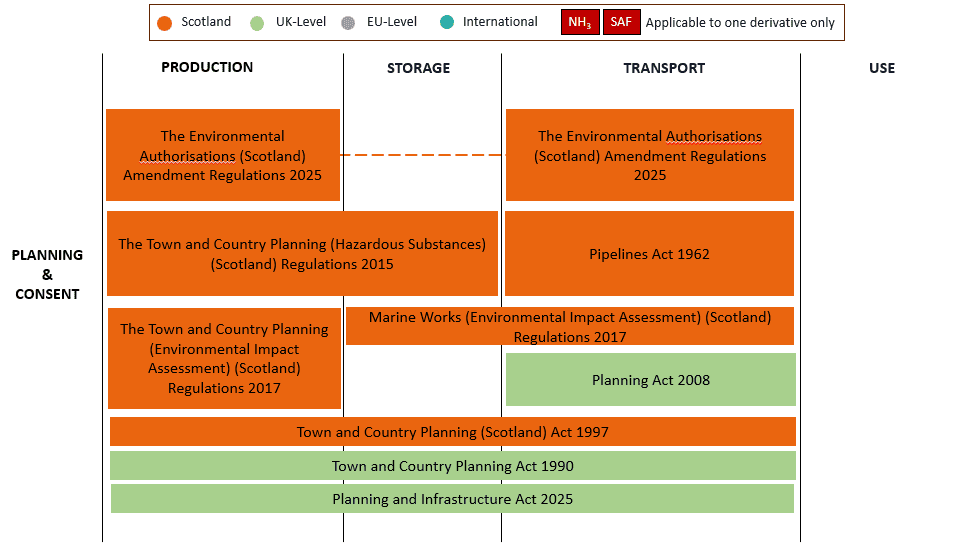
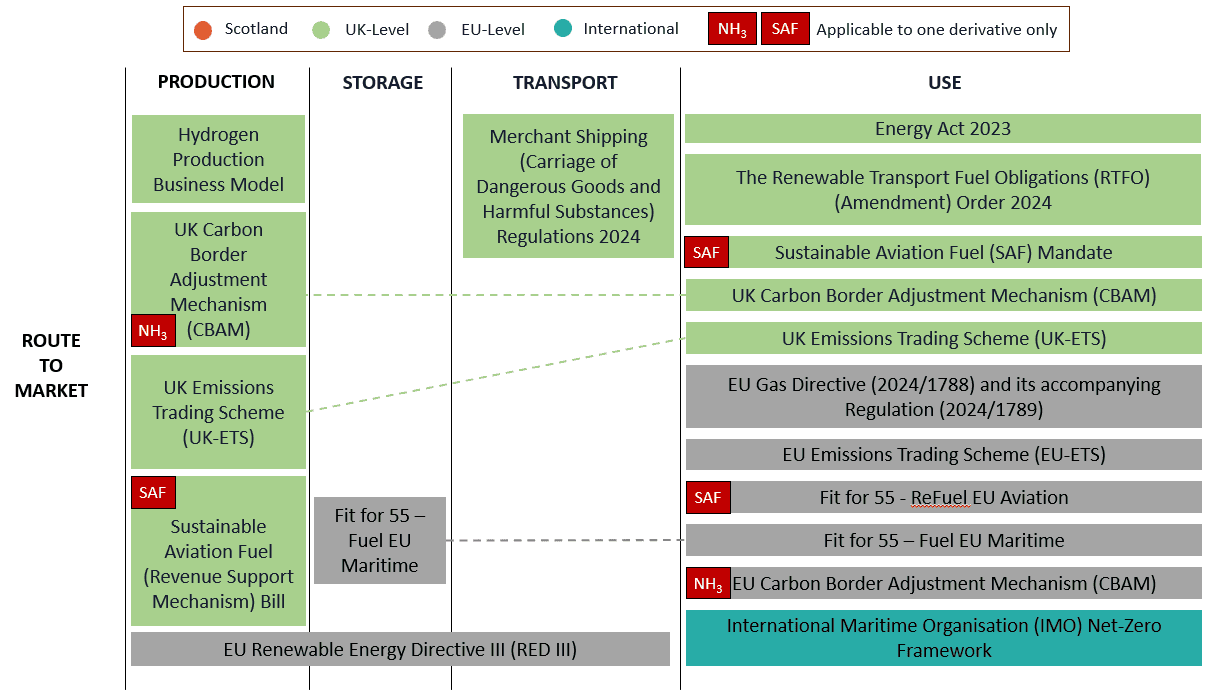
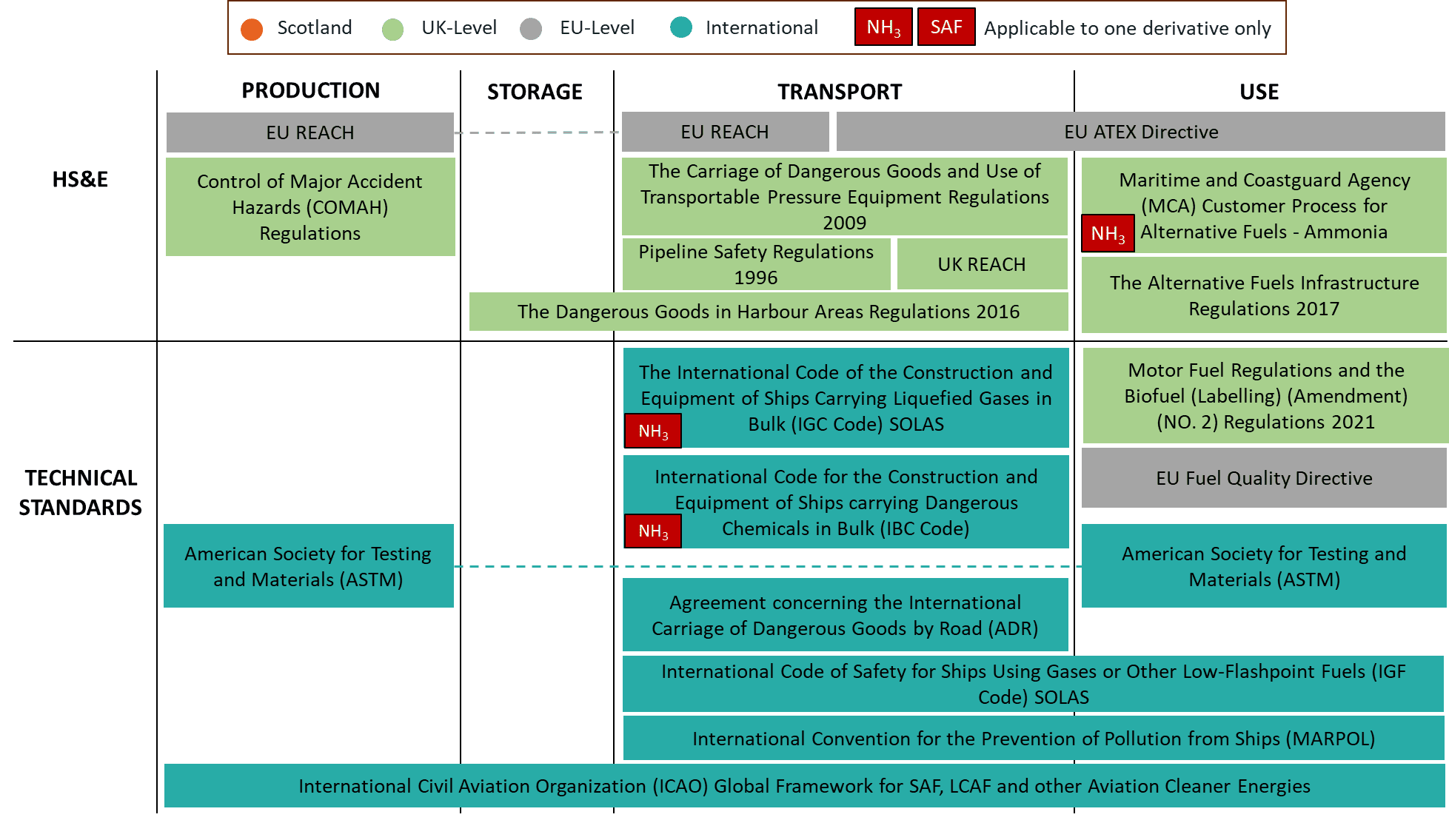
How to cite this publication:
Chan, S., Fernandes, J., McWhirr, C., Jurgens, L., (2026) ‘Regulatory Landscape for Hydrogen Derivatives and Products in Scotland’, ClimateXChange. DOI: https://doi.org/10.7488/era/7017
© The University of Edinburgh, 2026
Prepared by Xodus Group on behalf of ClimateXChange, The University of Edinburgh. All rights reserved.
While every effort is made to ensure the information in this report is accurate as at the date of the report, no legal responsibility is accepted for any errors, omissions or misleading statements. The views expressed represent those of the author(s), and do not necessarily represent those of the host institutions or funders.
This work was supported by the Rural and Environment Science and Analytical Services Division of the Scottish Government (CoE – CXC).
ClimateXChange
Edinburgh Climate Change Institute
High School Yards
Edinburgh EH1 1LZ
+44 (0) 131 651 4783
If you require the report in an alternative format such as a Word document, please contact info@climatexchange.org.uk or 0131 651 4783.
>For other reports in this series on hydrogen derivatives and products, please visit the CXC Publication Page, and see ‘Review of demand for hydrogen derivatives and products’ and ‘Scotland’s capabilities in producing hydrogen products and derivatives’. ↑