

Securing Scotland’s soils in a changing climate – policy brief
Research complete: June 2026
1. Objectives of the Soil Route Map for Scotland
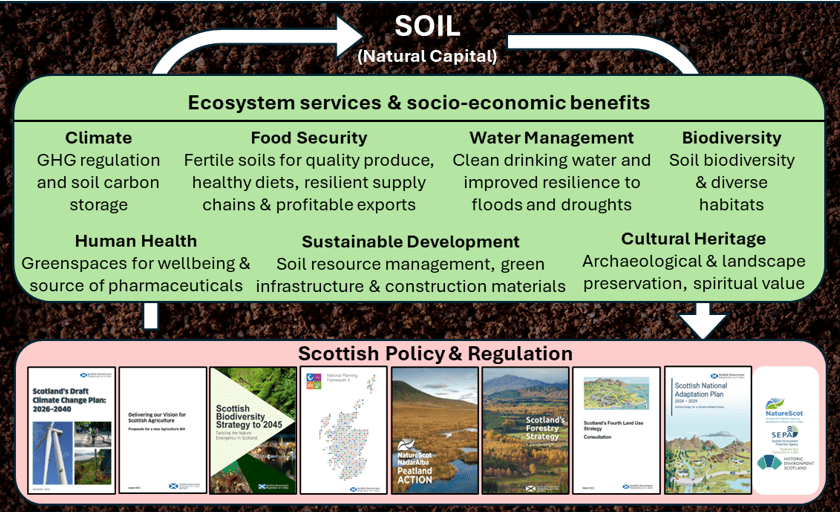
Soils underpin Scotland’s natural capital, providing vital ecosystem services (Figure 1), supporting nature-based solutions and are essential for societal wellbeing and Scotland’s economic profitability. However, unlike air, water and biodiversity (which all rely on soils) there is no soil-specific policy in Scotland to support the protection, restoration and enhancement of this vital resource. The consideration of soils is fragmented across various nature-based policies and so overarching governance is limited making the implementation of sustainable soil management strategies challenging to coordinate.
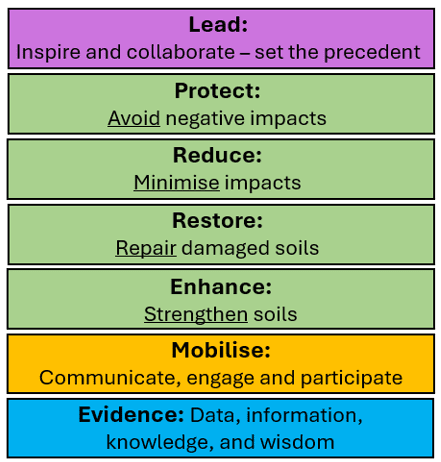
The ‘Soil Route Map for Scotland’ report was published in May 2025 and provides an initial framework and preliminary actions for delivering improved soil security across Scottish landscapes. It provided six initial, overarching objectives in response to risks to soils: Lead, Protect, Restore, Enhance, Mobilise and Evidence. The objectives and the risks to soils that they address are described more fully in Appendices A1 and A2 of the technical report accompanying this briefing. The route map also made recommendations to achieve the vision of ‘thriving soils for Scotland’s communities, economy and environment’ in Scotland’s third National Adaptation Plan.
The second phase of this work is focused on objectives 2,3 and 4: protection, restoration and enhancement (PREn). It builds upon the recommendations made for these objectives in phase one and scopes the opportunities for practical cross-sectoral actions that can contribute to soil protection, restoration and enhancement. For the PREn objectives, the soil route map recommended coordinating task groups for shared best practice and conducting place-based evidence reviews to identify actions needed.
2. Options for action
In the 2025 report, five core themes (T1-T5) were suggested to target action for specific areas of risks to soils and better inform the delivery of PREn. The themes are:
- soil sealing and management of soils in construction
- soil compaction and the physical degradation of Scottish soils
- chemical and biological soil health
- soils in the private sector
- soil monitoring and metrics
In this second phase of work, some initial overarching options (O) are provided within each theme along with an indication of readiness for initiation and key policy areas they could deliver to.
An overview of these options for action that will support the pathway to healthy soils in Scotland is set out in Table 2.
3. Implementation of options for action
It is acknowledged that there is no ‘one rule fits all’ with respect to soil PREn. However, the soil route map suggests adopting a mitigation hierarchy approach as a common principle that can be applied across sectors. In the absence of benchmarks defining ‘good’ soil health across all Scottish soils, the application of the mitigation hierarchy provides a common approach to avoid, minimise, restore and offset negative impacts on soils to achieve thriving soils for Scotland’s communities, environment and economy.
The route map explores evolving nature-based frameworks that could support further investment, education and mobilisation of sustainable soil management in Scotland. It provides an opportunity to reflect on each management decision – firstly considering whether soil impacts can be avoided and if not, reviewing options to minimise any negative consequences.
One outcome of this second phase of work is to recommend the addition of a seventh objective in the route map to healthy soils in Scotland. That is, to ‘reduce’, targeted at minimising impacts. (Figure 2).
| Objective | Recommendations | |
| LEAD | L1 | Assemble a ‘Soil Policy Team’ within Scottish Government |
| L2 | Update the Scottish Soil Framework | |
| L3 | Review the potential of statutory targets to be introduced and potential alignment with EU Soil Monitoring Law and Nature Restoration Law | |
| Protect, Restore, Enhance | PREn1 | Coordinate task groups for shared best practice |
| PREn2 | Place-based evidence reviews to identify actions needed | |
| Mobilise | M1 | Identify existing legal/regulatory avenues for implementing actions for soil protection, restoration and enhancement via implementation plans |
| M2 | Identify existing and new avenues to implement actions for soil protection, restoration and enhancement via landscape-scale implementation plans | |
| Evidence | Ev1 | Baseline soil ‘status’ across land cover types of Scotland |
| Ev2 | Identify evidence gaps and future improvement options across different land uses | |
| Ev3 | A Scottish Soil Monitoring Framework | |
| Ev4 | Evidence-led recommendations for future soil protection, restoration and enhancement | |
| AP | Actions are already in progress or could be readily initiated with some investment of resources | NM | These options would need more research and/or resources to initiate | DC | These options are likely to have a direct contribution to policy delivery | IC | These options are likely to have an indirect contribution to policy delivery |
| Where options could contribute to policy delivery | |||||||
| Option | Climate & Circularity | Biodiversity & Nature | Agriculture & Food Security | Peatland & Forestry | Water & Management | Planning & Developments | |
| T1-O1 | Develop Scotland-specific guidance to support soil protection, restoration and enhancement in Local Development Plans (LDPs) (AP) | (IC) | (IC) | (IC) | (IC) | (IC) | (DC) |
| T1-O2 | Expand guidance for identifying and protecting carbon-rich soils (AP) | (IC) | (IC) | (DC) | (IC) | (DC) | |
| T1-O3 | Develop targeted guidance for conducting Land Capability for Agriculture (LCA) assessments (AP) | (IC) | (DC) | (IC) | (DC) | ||
| T1-O4 | Review and develop guidance of soils within EIAs (AP) | (DC) | (DC) | (DC) | (DC) | (DC) | (DC) |
| T1-O5 | Review opportunities to better link the sustainable management of soils during development projects to support wider environmental net gains (NM) | (DC) | (DC) | (DC) | (DC) | (DC) | (DC) |
| T1-O6 | Develop procedures which promote the sustainable use and reuse of Scottish soils (NM) | (DC) | (IC) | (DC) | (DC) | (IC) | (DC) |
| T2-O1 | Develop cross-sector guidance on soil compaction and soil physical degradation (AP) | (DC) | (DC) | (DC) | (DC) | (DC) | (DC) |
| T2-O2 | Explore opportunities for soil compaction to be identified and alleviated through existing programmes (AP) | (DC) | (DC) | (DC) | (DC) | ||
| T2-O3 | Update guidance and tools informing the risk of Scottish soils to physical degradation and compaction (NM) | (DC) | (DC) | (DC) | (DC) | (DC) | (DC) |
| T3-O1 | Support the identification and remediation of contaminated land (NM) | (DC) | (DC) | (DC) | (IC) | ||
| T3-O2 | Review and further develop guidance to support nutrient management planning in agriculture (AP) | (DC) | (DC) | (DC) | |||
| T3-O3 | Develop research and guidance on the application or soil amendments for nutrient management (AP) | (IC) | (IC) | (DC) | (IC) | ||
| T3-O4 | Monitor progress of the Whole Farm Plan (NM) | (IC) | (IC) | (DC) | (IC) | ||
| T3-O5 | Advance research on forever chemicals and emerging contaminants in Scottish soils (NM) | (DC) | (DC) | (DC) | (DC) | ||
| T4-O1 | Continued support for peatland restoration and woodland creation (AP) | (DC) | (IC) | (DC) | (IC) | ||
| T4-O2 | Review policies for aligning a soil monitoring framework with environmental sustainability reporting standards (NM) | (DC) | (DC) | (DC) | (DC) | (DC) | |
| T4-O3 | Review policies for aligning a soil monitoring framework with nature-based frameworks (NM) | (DC) | (DC) | (DC) | (DC) | (DC) | |
| T4-O4 | Develop guidance on appropriate use and limitations of soil metrics in corporate reporting and verification (NM) | (DC) | (DC) | (DC) | (DC) | (DC) | (DC) |
| T4-O5 | Review the guidance and incentivise further mobilisation of soil protection, restoration and enhancement through the adoption of financial frameworks (NM) | (DC) | (DC) | (DC) | (DC) | (DC) | (DC) |
| T5-O1 | Review strategic objectives in the soil framework (AP) | (DC) | (DC) | (DC) | (DC) | (DC) | (DC) |
| T5-O2 | Support the design of a monitoring framework based on the integration of data sets from different sources (AP) | (DC) | (DC) | (DC) | (DC) | (DC) | (DC) |
| T5-O3 | Develop research to provide robust scientific data to support the use of novel indicators in soil monitoring (NM) | (DC) | (DC) | (DC) | (DC) | (DC) | (DC) |
| T5-O4 | Review the potential for collation and use of supplementary data (NM) | (DC) | (DC) | (DC) | (DC) | (DC) | (DC) |
| T5-O5 | Support Scotland’s Soil Website to host soil data, guidance and tools (AP) | (DC) | (DC) | (DC) | (DC) | (DC) | (DC) |
How to cite this publication:
Buckingham, S. and Baggaley, N. (2026) ‘Securing Scotland’s soils in a changing climate – policy brief’, ClimateXChange.
© The University of Edinburgh, 2026
Prepared by SLR Consulting and the James Hutton Institute on behalf of ClimateXChange, The University of Edinburgh. All rights reserved.
While every effort is made to ensure the information in this report is accurate as at the date of the report, no legal responsibility is accepted for any errors, omissions or misleading statements. The views expressed represent those of the author(s), and do not necessarily represent those of the host institutions or funders.
This work was supported by the Rural and Environment Science and Analytical Services Division of the Scottish Government (CoE – CXC).
ClimateXChange
Edinburgh Climate Change Institute
High School Yards
Edinburgh EH1 1LZ
+44 (0) 131 651 4783
If you require the report in an alternative format such as a Word document, please contact info@climatexchange.org.uk or 0131 651 4783.