

Measuring the impact of climate policy on health and health equity outcomes in Scotland
Research completed March 2026
Executive summary and recommendations
This report provides the first Scotland-wide stocktake of evidence and research expertise examining how climate mitigation and adaptation policies affect health and health equity. This report concludes that Scotland has a strong but fragmented and inconsistent evidence base that cannot yet fully support the anticipated monitoring and evaluation requirements for the Scottish National Adaptation Plan 3 (2024 – 2029) (SNAP3) and the Climate Change Plan (2026 – 2040) (CCP). It presents policy focused recommendations for action.
Purpose of this review
The aims of this rapid review were three-fold. Firstly, to summarise existing evidence on the health and health equity impacts of climate action in Scotland. Secondly, to consider how these impacts can be monitored with a clear focus on equity. Finally, to identify individuals with relevant research expertise in Scotland and engage with them to consider how best to support a more connected climate and health research community
Relevance to the policy context
Scotland’s urgent response to climate change requires mitigation and actions to adapt to a changing climate, as part of a just transition to net zero by 2045. The policy actions aimed at achieving this, set out in the SNAP3 and CCP, will impact on health directly. They will also shape the building blocks of good health in local places. This includes housing, transport, the built and natural environment, and fair work in a thriving local economy.
Where climate policy actions are designed and delivered in line with just transition principles of fairness and equity, they can protect and improve population health overall and reduce health inequalities. Where actions are poorly designed or implemented, they can lead to health harms and may widen health inequities. Addressing environmental sustainability and health equity together will support Scotland to realise its climate ambitions while contributing to the prevention-focused Population Health Framework and the wider Public Service Reform agenda.
Findings: nature of the reviewed evidence base and research landscape
Our findings on the nature of the evidence base and the characteristics of the research landscape are as follows:
- The published evidence base is diverse and highly fragmented. We used an existing typology to categorise the literature. This captured the disciplinary and methodological breadth of published literature. This stocktake shows that the depth and distribution of evidence across different categories of climate action/threat is highly variable.
- There are strengths and gaps in the evidence base: Strengths include more extensive understanding of the health and health equity impacts of climate policy in housing, nature-based solutions, agriculture and food systems, and responses to temperature and air-quality. Gaps (in a health context) include research on marine conservation, waste management, and water quality.
- A shared conceptual underpinning is urgently needed: At the stakeholder workshop, participants identified the need for shared understandings of health, health outcomes, vulnerability and equity to improve conceptual clarity. They reinforced the importance of mixed-methods, and participatory approaches to overcome the difficulties of attributing health and health equity impacts to climate actions, and a strong desire for cross and transdisciplinary collaboration.
- Health is primarily an indirect concern: From our evidence base it is striking that only a small number of studies treat health or health equity as primary outcomes. Health is often captured indirectly, framed in terms of wider determinants, or treated as contextual rather than measured.
- Metrics are varied and methodological consistency is low: Metrics vary widely from clinical health outcomes to behavioural and wellbeing indicators. Methodological consistency in relation to metrics is low, reflecting the heterogenous nature of disciplinary expertise, and the different contexts for climate action that characterise the evidence base.
- Equity is a poorly operationalised consideration: Equity is acknowledged in most publications but is inconsistently defined and poorly operationalised. Socioeconomic status is the most frequently used equity indicator, with very limited attention to protected characteristics. Few studies measured equity outcomes, and many engaged instead with theoretical or potential inequities.
- Expertise is fragmented and lacks connectivity: From the perspective of the stakeholders that we engaged in this project, the research and evidence landscape, whilst full of potential lacks visibility and is fragmented. There is a collective desire amongst researchers to be better connected and networked with policymakers and each other, in Scotland and beyond. This requires structured support to bridge the perceived gap between government research needs and academic knowledge production.
Recommendations
To generate meaningful, policy-ready evidence, it is crucial that the research landscape is supported by shared definitions, common metrics, collaboration across disciplines and sectors, practitioner involvement, and systems-based approaches. From this rapid review and stakeholder input, we make ten recommendations:
- There is a need to develop shared understanding of concepts that sit at the heart of this research-policy nexus. These include health, health outcomes, health equity, vulnerability, and resilience. There is an urgent need to clarify and then test conceptual pathways between climate actions and health/equity outcomes through systems-based models and theories of change.
- Future monitoring and evaluation frameworks could benefit from incorporating more diverse forms of measurement, that help to capture complexity and dynamic change, including process, progress, and intermediate outcome indicators.
- Efforts to develop monitoring and evaluation frameworks should consider indices of vulnerability (such as the Net Zero Vulnerability Index), or new evaluation tools that help to understand different climate vulnerabilities and steer interventions based on their context and populations to improve place-based and population-based resilience.
- There is an opportunity to strengthen the evidence base by targeted commissioning of research to address clear evidence gaps. Some of the gaps are topical e.g. marine conservation, water quality, and waste; some relate to the quality and quantity of health specific evidence that is currently insufficient for policy development and monitoring. The evidence base may also be strengthened by focusing on leverage points (such as housing) that sit at the intersection of climate policy action with multiple policy areas.
- To combat the often-superficial engagement with health and health equity in the literature, commissioning research that examines differential impacts across protected characteristics, alongside socio-economic and place-based disadvantage, would strengthen understanding of how climate policies affect different population groups and help ensure that just transition approaches address intersectional disadvantage.
- Consideration of health and health equity impacts could be incorporated into impact assessments of relevant climate policies and plans to promote the use of all possible policy levers for health.
- A coordinated, additive network aligned to existing structures (e.g. Scotland Beyond Net Zero) is needed to reduce fragmentation and low visibility within the research landscape. Such a network needs agile governance, shared tools, better data linkage, and two-way dialogue to accelerate evidence into policy and incentivise interdisciplinary collaboration. The regular publication of Scottish Government research priorities would be a key enabler.
Network building should create further links between Scotland’s community of health equity researchers and those whose focus is on the implementation of adaptation and mitigation interventions in the Scottish policy context. - Engaging with UK-wide and international research will help identify lessons and best practice for measurement. Aligning a future Scottish climate-health research-policy network with similar developments in Wales, for example, and enabling active exchange between them, would accelerate and amplify future knowledge exchange.
- Understanding of the health and health equity impacts of climate policy could be enriched by further engagement with practitioners and communities outside formal research institutions, who hold valuable applied, place-based, and lived experience insights into the pathways through which these policies affect health and health equity.
Glossary and Abbreviations
Term | Definition |
|---|---|
Adaptation | Climate change adaptation refers to actions that help reduce vulnerability to the current or expected impacts of climate change like weather extremes and hazards, sea-level rise, biodiversity loss, or food and water insecurity. |
Adaptive capacity | The ability of an individual to adjust/adapt to the threats of climate change. |
Agentic interventions | The focus here is on the amount of agency (resources, freedom, capacity) that an individual would need in order to benefit from an intervention. Highly agentic interventions include information campaigns that require a high level of personal response e.g. dietary advice campaigns. |
CCP | Climate Change Plan. |
Climate change | Climate change refers to a large-scale, long-term shift in the planet’s weather patterns and average temperatures. In the context of this report, climate change refers to these changes which have been exacerbated by human burning of fossil fuels. |
Equity | The quality of being fair, or just, particularly in ways that seek to reduce inequities (avoidable, unfair inequalities or disparities). |
Exposure | The nature and degree of climate stress (e.g. extreme heat) that an individual or group is exposed to. For example, low-lying coastal communities are more exposed to the risk of flooding than those on higher ground. |
GHG | Greenhouse gases (e.g. carbon dioxide, methane, nitrous oxide). |
Health equity | A fair opportunity for everyone to be as healthy as possible, free from avoidable structural or discriminatory barriers. |
Just transition | A just transition is both the outcome – a fairer, greener future for all – and the process that must be undertaken in partnership with those impacted by the transition to net zero. Just transition is how we get to a net zero and climate resilient economy, in a way that delivers fairness and tackles inequality and injustice. |
Mitigation | Climate change mitigation refers to actions or activities that limit emissions of greenhouse gases (GHGs) from entering the atmosphere and/or reduce their levels in the atmosphere. |
Natural capital | The goods and services provided by Earth’s terrestrial and marine ecosystems. The term is an economic metaphor for the now limited stocks of physical and biological natural resources found on the Earth. Capital refers to any stock that can yield a flow of goods in the future, even after being degraded and extracted by human activity and business. |
Nature-based solutions | Nature-based solutions (NBS) are actions to protect, sustainably manage, and restore natural and modified ecosystems that address societal challenges effectively and adaptively, simultaneously benefiting people and nature. They have the potential to make an essential contribution to reaching net-zero CO2 globally by around 2050, alongside other decarbonisation strategies. |
PHF | Population Health Framework. |
Process indicators | Measures to understand if policies are being implemented as intended. |
Progress indicators | Measures that assess meaningful change. |
Research Landscape | The research landscape encompasses both the published literature (which we have referred to as “evidence”) and the active researchers working to produce it. |
SIMD | The Scottish Index of Multiple Deprivation is a relative measure of deprivation across 6,976 small areas (called data zones). |
SNAP3 | Scottish National Adaptation Plan 3. |
UKHSA | UK Health Security Agency. |
Universalism/Proportionate universalism | Proportionate universalism describes actions or interventions that are implemented across a whole population with a scale and intensity proportionate to need. |
Upstream | Upstream activities address the economic, social and environmental conditions that shape health rather than focusing on changing individual behaviours or treating illness. |
Vulnerability | Climate change vulnerability describes how strongly people or ecosystems are likely to be affected by climate change. Vulnerability is determined by a combination of factors (exposure, sensitivity or susceptibility to harm, adaptive capacity) and can apply to different groups in different contexts. |
Introduction and overview
Aims of the project
This project was commissioned by ClimateXChange in October 2025 and has been delivered by researchers from Lucidity Services Limited and the University of Glasgow. The work comprised three elements with the following aims:
- Stocktake: describe and assess what evidence exists or is in development to measure the impacts of climate policy on health outcomes in Scotland (including any best practice examples of measurement, evaluation or indicators);
- Equity integration: consider how the impacts of climate policy on health outcomes can be monitored, particularly across different population groups and communities of place; and
- Building networks: map where this expertise exists in research institutions in Scotland and lay the foundations for a collaborative expert climate and health outcome research network in Scotland that strengthens research-policy connectivity.
Our findings are intended to inform policy development, support monitoring and evaluation, and strengthen collaboration across sectors. We hope this resource provides a useful assessment of current expertise in Scotland and an articulation of how better integrated current and future research activity could support Scotland’s climate policy ambitions.
Background and policy environment
A pressing area of policy activity in Scotland is addressing the threat of climate change. Scotland’s climate change response, in the form of large-scale societal transformation, will have a significant impact on the way we live our lives. In this report we consider how these changes, across a wide range of policy action areas, might be important for human health and wellbeing, and how we can study and measure these. A cornerstone document, the Health Effects of Climate Change in the UK: State of the evidence 2023, sets the context for the challenges we consider.
Scotland already faces significant population health challenges. These challenges will be exacerbated by the health effects of climate change through direct and indirect pathways. Directly, population health is threatened by a changing climate in several ways, including extreme weather events (particularly flooding), increased spread of infectious (including vector-borne) diseases, reduced water and food security, air pollution caused by burning fossil fuels, and impacts on the capacity of health and social care services (Dow, 2025). Climate change also poses indirect health threats through its impacts on the building blocks of good health, such as, good housing, affordable transport, high quality green space, and strong social networks and fair work for fair pay[1]. Furthermore, climate change and associated health risks will differentially impact people and places in Scotland (with vulnerability determined by levels of sensitivity, exposure, and adaptive capacity), meaning that existing health inequities could be made worse[2].
There is a pressing need to mitigate climate change as far as possible, by reducing greenhouse gas (GHG) emissions through decarbonisation and carbon sequestration actions set out in Scotland’s Climate Change Plan (2026 – 2040) (CCP), which has a target to reach net zero by 2045[3]. Some climate change, with a warming world and unstable climate, is now inevitable which has specific challenges for Scotland. As has been made clear by the UK Climate Change Committee, we need to plan for at least two degrees warming by 2050[4], and this requires significant adaptation.
Climate policy (the actions that we take to urgently decarbonise and adapt to our current and future climate) can also protect and improve population health and reduce health inequities. For example, adaptation can enable us to directly protect against some of the health harms that come from adverse weather events such as floods, storms, heatwaves, droughts, and wildfires. There is also potential for climate actions to improve health directly, for example by reducing transport or heating related air pollution that leads to respiratory and cardiovascular conditions. Investments in the building blocks of health, such as improved energy efficiency in buildings leading to warmer homes, could also positively impact physical and mental wellbeing. Other adaptation interventions, such as nature-based solutions, can create health promoting environments with mental and physical health benefits through different pathways including improved air quality, increased opportunities for physical activity, or connection with nature.
If climate actions are not targeted towards those who need them most, there is a risk that health inequities will be exacerbated. Existing health inequities are experienced along the lines of deprivation, and other structural injustices that leave particular population groups exposed to poor health, such as disadvantage according to age, ethnicity, and disability. There is a need to apply an equity lens to climate action, and target policy interventions towards the most vulnerable people and places, ensuring that any potential impacts on health, and the building blocks of health, are beneficial to the populations who have most to gain.
It is also important to avoid any possible unintended negative health consequences of climate policy, such as installing housing insulation without adequate ventilation, which can lead to damp, mould, and poorer indoor air quality. Some vulnerable groups (e.g. elderly people, or those with underlying health conditions) would be disproportionately affected by such impacts. There is a need to deliver climate policy in a way that maximises opportunities for health and health equity benefit and minimises potential harms. This includes mitigating potential unintended consequences.
Scotland is committed to a just transition ensuring that nobody is left behind as a result of the large-scale transformation required to become a resilient low-carbon economy[5]. There is an expectation that climate actions help to address existing inequalities and poverty. Interventions such as improving the energy efficiency of housing, improving active and sustainable transport, and nature-based adaptation solutions can reduce fuel poverty, reduce transport poverty, and address inequalities in access to green and blue spaces. However, if actions such as switching to healthy lower carbon diets, or the upfront costs of low carbon heating options (such as heat pumps) come with a high-cost barrier, this may exclude low-income groups who are already likely to experience poorer health. The accessibility of options for walking, wheeling and cycling may also differ between communities, and it may be harder for remote or rural populations to replace car journeys with walking or wheeling.
As laid out in Scotland’s prevention focused Population Health Framework (PHF)[6] set within the context of the wider public service reform agenda, addressing the climate emergency is not only a planetary necessity but also an opportunity to improve population health and reduce health inequities. The aim of the PHF is, by 2035, to improve Scottish life expectancy overall while reducing the gap in life expectancy between the most deprived areas and the national average, and to increase the years people live in good health (healthy life expectancy) through a prevention-focused approach. Such an approach is essential for managing increasingly limited resources sustainably. Pursuing environmental sustainability and health equity in parallel by directing resources upstream and focusing on prevention can help deliver cross-governmental policy ambitions. Climate action in multiple sectors will affect and reshape the fundamental causes of health inequalities, as well as the building blocks of good health in local communities. Climate policy must, therefore, work to proactively ensure that the benefits and costs of policy actions are fairly distributed.
Crucial to meeting this ambition is identifying ways to measure and evaluate the potential health and health equity impacts of Scottish mitigation and adaptation policies. Suitable outcome metrics and indicators that can reflect progress towards long-term health goals are needed. This is a big challenge when considering multiple policy interventions, each with complex pathways to health and health equity outcomes, with positive impacts and sometimes unintended consequences taking place over short-, medium- and long-term timeframes.
The need for a Scottish stocktake
This work is intended to support Scottish climate policy action, including the further development of the Scottish National Adaptation Plan 3 (2024 – 2029) (SNAP 3) monitoring and evaluation framework. This framework recognises key evidence gaps, particularly the need for updated indicators by 2027, when it will be reviewed. Quantified standards or targets for climate resilience in response to the UK Climate Change Committee’s forthcoming Fourth Climate Change Risk Assessment (with a specific chapter on health and wellbeing) will also need to be developed. The CCP sets an approach to monitoring emissions reduction targets and policy delivery, and embeds just transition principles, recognising the potential health and equity benefits of climate action. It has not established an approach to monitoring and evaluating health and health equity impacts of decarbonisation policies over time. There remains a gap between key policy intentions and the evidence required to assess whether climate action contributes to reducing, maintaining or exacerbating existing health inequalities. This research provides a foundation to fill this gap.
Previous reviews from outside Scotland have highlighted the limitations and challenges in this area of work. The UK Health Security Agency (UKHSA) conducted a comprehensive scoping review on potential climate change and health indicators, with a focus on England and priorities for the UKHSA (UKHSA, 2023). Some indicators are focussed on adaptation and mitigation actions, under the headings of Energy, Housing, Food, Transport, and Waste. Of the 19 indicators suggested for monitoring mitigation, no feasible data were available for 13 and the remaining 6 needed new processing of existing data. Issues with identifying and operationalising appropriate metrics represent an ongoing challenge for both researchers and policymakers.
An important aim of this project was to consider how health equity can be integrated into this evidence base, by exploring how the research considers differential impacts of adaptation and mitigation across population groups and places. This is especially important for Scotland, where long-term health inequities persist, and the gap in healthy life expectancy between the most advantaged and disadvantaged populations is approximately 26 years (26.7 years for women, 25.6 years for men)[7]. Through the CCP’s due regard for just transition principles, and the Fairer Scotland Duty, there is an existing expectation that climate action will be delivered in a way that is fair, reduces existing inequalities and poverty, and will support the wellbeing of workers and communities in Scotland, ensuring that nobody is left behind. Our mapping review takes stock of how and where equity is considered within the existing climate policy and health research, and identifies where there might be important gaps in understanding.
Overview of the methodology and report outputs
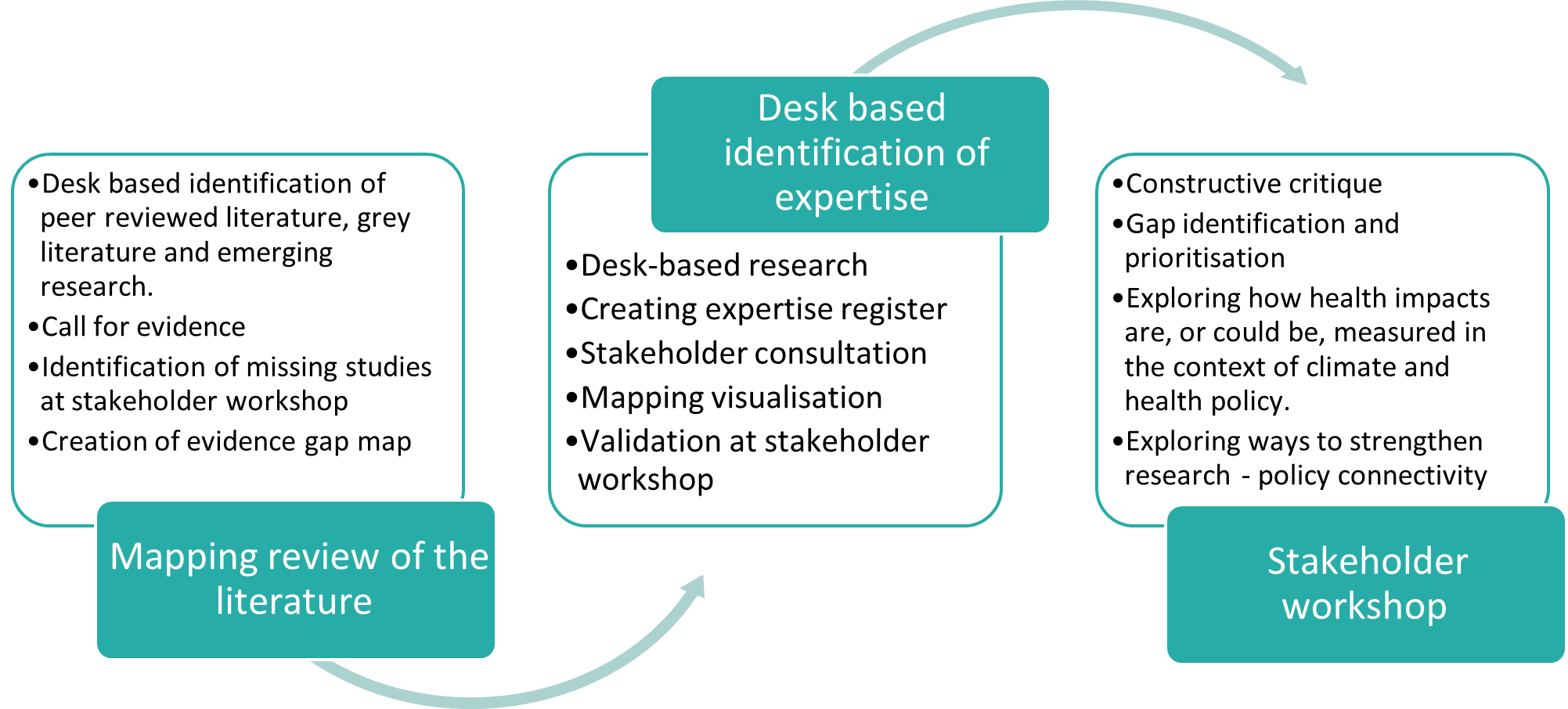
This rapid review took place between October 2025 and March 2026. It was progressed through three complementary and iterative activities: a mapping review of the literature, desk-based stakeholder mapping, and a stakeholder workshop (Figure 1). These activities were supplemented by an open call for evidence. The methods used are briefly outlined below with supporting information and methodological detail provided in the Appendices.
Mapping review of the literature
This mapping review set out to take stock of the peer-reviewed literature, non-peer-reviewed literature (often described as grey literature), and emerging or unpublished research. This review focused on studies that made an explicit connection between a specific area of climate policy action and a related health or health‑equity outcome.
We based our searches, evidence review, and expertise mapping on the climate policy action typology developed by Boyd et al., 2023, and used in the systematic review by Hjelmskog et al., 2025. The Boyd typology was developed from a reading of UK adaptation and mitigation policies which existed in 2022. It sought to identify types of actions that high income countries might carry out in response to climate breakdown and describes them against types of hazard and sector-based domains of intervention. We took the Boyd typology as a starting point and amended it to reflect post-2022 policy developments in Scotland. More detail is given in Appendix C. We used EPPI-Reviewer software to collate, code and categorise the literature.
Developing a register of expertise
Using the results of the library searches together with other publicly available information we set out to identify individuals who have published research and/or are conducting ongoing research on the health and health equity impacts of climate adaptation and mitigation policies in Scotland, and on how those impacts might be measured. Our objective was to develop a register of expertise and to visualise this interactively using online software called Polinode®. Developing the register of expertise supported the review by:
- Identifying relevant published research missed by the library search from our review of public websites.
- Identifying ongoing work and unpublished expertise from a review of webpages of researchers. This revealed ongoing grant-funded projects and supervised PhD students conducting relevant research that has not yet been published.
- Facilitating targeted invitations for the stakeholder event which was aimed at active researchers. This supported the validation and refinement of the findings from this review.
The stakeholder workshop
A stakeholder workshop was held in Glasgow on the 13th of January 2026. This brought 28 researchers, policy specialists, members of the steering group, and project team together. More detail on the design, process, and insights from the workshop is set out in Appendix D. The stakeholder workshop enabled us to:
- Explore the emerging findings from the review and identify research gaps and priorities.
- Gather perspectives on how health and health equity impacts are, or could be, measured in the context of climate and health policy.
- Characterise and discuss the current research landscape and identify opportunities to strengthen research-policy connectivity through network-based approaches.
Outputs from this review
This review is intended to act as a useful starting point for mapping Scottish examples of how the health and health equity impacts of climate policy are assessed. Four additional outputs capture these findings. These outputs are intended to help researchers and policymakers situate projects in this research landscape, and are static snapshots capturing activity accessed between October 2025 and March 2026. They are not maintained as live registries. The evidence gap map matches the data extraction table. The Polinode® map visualises the underlying register of expertise.
Output | Description |
An extracted list of key information about the peer and non-peer reviewed literature that forms the evidence base for this report. | |
The evidence gap map visualises the data extraction table and was created using EPPI-Reviewer. | |
Register of expertise | A snapshot list of active researchers in climate policy and health outcomes and their measurement. This is accessible via the Polinode map linked below. |
A visualisation of the register of expertise created using Polinode® software (publicly accessible website[8]) |
Table 1 Outputs from this review that accompany this report
Considerations associated with this review
This is a pragmatic piece of policy focussed research. Like any study, the scope of the review creates a number of considerations. The description and implications of these considerations for the insights and recommendations presented in this report are summarised in Table 2.
Consideration | Description and implications for this review |
Timescale for this review | To keep the project within the timeline, strict inclusion/exclusion criteria were adopted. The studies had to explicitly meet both the climate action and the health outcome requirements (though a very broad interpretation of health outcomes was used to include social and wider determinants of health). |
Topic breadth | This topic area is one that is both broad and diverse. This has meant that the literature review has necessarily been tightly bound in scope, and relatively high-level in its analysis. |
Geographic Scope
| This report focuses on ongoing research in Scotland rather than comprehensive evidence gaps. Other relevant publications may exist but were not included using our criteria. |
Explicit linkage requirement between climate policy action and health | By requiring studies to show a clear and explicit link between a specific climate policy action and a health or health‑equity outcome, this review may have excluded research that is highly relevant but framed differently. Many climate‑related interventions influence health through indirect or multi‑step pathways, and these impacts may not be captured if the evidence does not describe itself in these explicit terms. |
Heterogenous nature of the literature | The literature base is highly heterogeneous in format, purpose and terminology. This limits the extent to which it can be consistently captured, extracted, compared and synthesised. |
Terminology
Key terms used in this review (e.g. equity, vulnerability) can have multiple interpretations. Definitions applied in this review can be found in the Glossary.
Detailed methodology
For convenience, Table 3 indicates where detailed descriptions of our methodology can be found in the Appendices to this report.
Activity | Appendix |
Call for evidence | Appendix E |
Literature searching and mapping | Appendix E |
Development and visualisation of the register of research expertise | Appendix F |
Stakeholder workshop | Appendix D |
Taking stock of the research landscape
Summary
In this section we take stock of the evidence landscape and the researchers active within it. Through a rapid mapping review, we created a high-level overview of research that has been published either relating to Scotland directly (for example, using Scottish data, or with Scottish case studies) and/or published on this topic by authors and researchers based at Scottish institutions.
The evidence base is growing rapidly. Large interdisciplinary studies such as JUST-Systems, INHABIT, OPTIMA and GALLANT will expand the evidence base in coming years. Viewed from the perspective of the typology to classify literature used to underpin this review (which comprised categories of climate action and response), the depth and distribution of evidence identified is highly variable. Strengths include understanding the health and health equity impacts of climate policy on housing, nature-based solutions, agriculture and food systems, and responses to temperature and air-quality. Gaps include forestry, marine conservation, waste management, and water quality.
Only a small number of the studies treat health or health equity as a primary outcome. Health is often captured indirectly, framed in terms of wider determinants, or treated as contextual rather than measured. Metrics vary widely from clinical health outcomes to behavioural and wellbeing indicators. Methodological consistency in relation to metrics is low, reflecting the heterogenous nature of disciplinary expertise and different contexts for climate action that characterise the evidence base.
Scottish research expertise
We set out to identify and categorise individuals and organisations with relevant expertise[9]. These are captured in our registry of expertise, which was created from publicly available data and reflects a snapshot in time (from Oct 2025 – April 2026). The registry is appended to this report as both a log (excel file) and a visualisation which can be accessed through the publicly accessible link to the Polinode interface.
Thirteen out of Scotland’s eighteen Higher Education Institutions are represented in our register. In our searches we found no explicit links to relevant areas of expertise at the remaining five universities. There is a concentration of expertise at Scotland’s research-intensive universities with the University of Edinburgh and the University of Glasgow being the most represented institutions (41 and 26 experts identified respectively), followed by Glasgow Caledonian University (17), the University of Stirling (15) and the University of St Andrews (14).
Over 80% of experts were from Higher Education Institutions in Scotland. Expertise has been identified within a range of other organisations including independent research institutions (e.g. the James Hutton Institute (JHI)), Scottish Government bodies (e.g. Scottish Land commission), Non-Governmental Organisations (e.g. Community Land Scotland) and the third sector (e.g. Zero Waste Scotland).
Scottish research institutions and organisations hold extensive research expertise in relation to housing, nature-based solutions, health equity, agriculture and land use, temperature changes and air quality. A notable strength of the research landscape is the significant number of experts focused on evaluating the health outcomes of climate policies, alongside the presence of a substantial cohort of individuals and organisations whose research areas closely intersect with this field. This includes health equity researchers whose expertise in assessing equity dimensions of other policy areas could support the monitoring and evaluation of climate policies. Potential key gaps in Scotland’s research capability include for example forestry, which was identified as the area with least expertise in relation to measured health outcomes of climate policy.
The research projects undertaken by those listed in the register of expertise are largely self-contained. The stocktake of expertise, live research projects, and published literature illustrates a small number of cross-institutional collaborations. For example, JUST-SYSTEMS is a highly collaborative multi-institution, interdisciplinary project involving four Scottish Universities as well as several from England. It brings together academic researchers and local practitioners in support of Scotland’s just transition. Further examples of multi-institutional grant awards include GroundsWell (a multidisciplinary project to identify and implement actions to maximise health benefits from urban green/blue spaces) and the Greenspace Feasibility Study for Mental Health and Problem Substance Use project. Overall, though, less than a third of the projects identified in the mapping exercise involved more than one academic institution. Taken together our observations on the evidence base, distribution of active researchers and the limited number of multi-institutional and interdisciplinary projects, suggests that research activity is fragmented and there are opportunities for greater connectivity between researchers with common, adjacent or complementary areas of interest.
Characterising the literature
Our stocktake reveals that the evidence base is extremely diverse, and represents a wide spread of disciplines, research institutions, and methodological approaches. This is evidenced by the spread of expertise held by researchers and their primary research areas which cover all seventeen typology categories. The research landscape was identified as having a varied but complementary range of expertise. Our registry categorises researchers with both primary and secondary research areas – very few individual experts had the same set of expert knowledge.
The studies we identified show that there are many ways to analyse these health outcomes, and the evidence is very mixed in terms of how deeply the relationship between specific climate policies and tangible health outcomes is interrogated. The evidence base includes some examples of health outcome analysis for most of the categories in the climate action typology. From our analysis (see Figure 2), some types of climate policy appear to be far more extensively studied than others. In line with the number of researchers identified with expertise, the highest numbers of published papers (combined peer review and grey literature) are in the categories of Greener transport, Blue and green infrastructure, Dietary change, and Community and social resilience. Fewer published studies exist in categories such as Marine conservation, Water availability and quality, Waste, and Natural carbon sinks. The distribution of papers included in this mapping review (for categories with at least five publications) is shown in Figure 2.
The typology categorisations are helpful in showing which areas have had the largest amount of research attention in Scotland, as indicated by the volume of papers. The evidence base for health outcomes related to Greener transport is particularly well developed. It includes studies which look at the health effects of walking, wheeling and cycling, increasing public transport, and reducing high-carbon private transport. Some adaptation and mitigation actions can fall into more than one category. For example, a study on afforestation to reduce flood risk by Dittrich et al., 2019 was classified as both Forestry, and Floods and erosion. There are also examples of broader papers which deal with topics such as adaptation as a whole (Jager et al., 2015; Zamuruieva et al., 2023). This is particularly the case for grey literature publications, which are generally more high-level overview papers rather than detailed studies of specific interventions.
The degree to which health is considered within these publications is highly varied. Of the 47 peer-reviewed and 34 grey literature publications we have included, only 24 treat health and/or health equity as the primary concern of the paper. Of the remaining 57 papers, 36 treat health as a secondary concern (meaning that health impacts are considered explicitly, or even in detail, but that they are not the focus of the study) and 21 consider health or wellbeing only as a footnote. For example, Henderson et al., 2025 explore recent Scottish flood policies, which aim to prioritise equity, but make only very minor references to the health and wellbeing consequences of flooding (e.g. stress and worry) which the policies might address. To provide a fuller picture of Scottish evidence, and the current baseline, we have included the studies which consider health as only a footnote, although these papers are less useful in terms of providing examples of metrics and measurements which might be used to demonstrate impact. Identifying such studies also helped to inform identification of researchers with relevant expertise that have been included in our register.

Figure 2: Number of studies by climate action/climate threat, based on typology category
Health outcome metrics and indicators
In the snapshot of the research landscape captured by this review, we found that more than half of the experts we mapped are actively working on climate policy evaluation in relation to health outcomes. As mentioned elsewhere, this work is hugely varied and diverse in terms of methodology, and metric specificity. The mapping outputs identify a large group of researchers who could contribute to policy moving forward and support efforts to design monitoring and evaluation processes for climate policies.
Identifying appropriate metrics and indicators is a crucial part of policy monitoring. A key objective of this review was to capture examples of these from the literature. To evaluate whether Scotland’s climate policy is having the intended impact on health and health equity outcomes, we will need to track the progress of agreed, meaningful measurements of health. The large number of possible entry points into this field of research reflects the different kinds of perspectives that can be taken. This includes different interpretations of what constitutes a health outcome. We found, within our reviewed evidence base, a large range of approaches, understandings, framings, and terminologies relating to these health impacts.
Researchers are using a wide range of measurements and metrics to assess the possible health outcomes of different mitigation and adaptation actions, each of which may be able to tell us something slightly different about the likely impacts of a climate policy. These can be specific (e.g. mortality), general (e.g. wellbeing), behavioural (e.g. changing diets), or consider wider determinants (e.g. quality of public transport). See Appendix B.
The measurements can be characterised by a distinct lack of uniformity, although when considered by climate action category some trends and gaps emerge. Some typology categories provide very narrow examples of metrics, and some are much more diverse. For example, the studies on Dietary change mostly assess behaviours and attitudes (Cleland et al., 2025; Macdiarmid, 2022), whereas the two studies under Temperature change interventions both use mortality as a specific, quantifiable metric (Dwyer et al., 2022; Wan et al., 2024). Significant gaps for examples of identified metrics include the categories of Biosecurity, Marine conservation, Waste, and Water availability and quality.
As the volume of studies increased so too did the diversity of metrics. Blue and green infrastructure, and Greener transport are the categories with the largest volume of literature and the largest range of identified metrics and measurements which include:
- Clinical metrics (Tieges et al., 2020; Baker et al., 2021)
- Wellbeing metrics (Dick et al., 2020; Brennan and Ogilvie, 2025)
- Behavioural outcomes (Douglas et al., 2023; Harrington et al., 2024)
- Wider determinant measurements (Mabon et al., 2023; Lucas and Pangbourne, 2014).
Some studies also highlighted specific methodological tools or assessment frameworks to evaluate health impacts. These included: National Therapeutic Indicators (NTIs)[10]; Short Warwick-Edinburgh Mental Wellbeing Scale (Malden et al., 2025); Place Standard Tool[11] (Douglas et al., 2023); TESSA (Toolkit for Ecosystem Services Site-based Assessment) approach (MacDonald et al., 2017); and Pedestrian/Cyclist counters (Baker et al., 2021).
The literature reviewed for this stocktake includes a wide range of health metrics (often specific, quantifiable measurements), as well as examples of indicators (broader qualitative or quantitative measures that can suggest wider trends). While observable, quantifiable health metrics (such as mortality, Quality-Adjusted Life Years (QALYs) and Disability-Adjusted Life Years (DALYs), disease incidences etc.) (e.g. Baker et al., 2021), could reasonably be expected to be influenced by many kinds of climate action, they are often too broad, or too far removed from the intervention to be reliably and tangibly linked to specific policy measures.
Wider-ranging or more complex examples of measurement may be used to indicate performance, or progress, towards health impacts, in ways that tell us more than the narrower, more linear, health outcome metrics are able to. Examples we identified include resilience (e.g. to drought or flooding) (Henderson et al., 2025; Meyerricks and White, 2021), nature-connectedness (Malden et al., 2025), and heat-health relationships (Dwyer et al., 2022). It may be possible to identify further best-practice indicators in this space by looking beyond Scotland. It may also be possible to identify indicators along the causal pathways to health impacts by looking to an even wider evidence base, as policies can impact health indirectly through social and economic determinants. The evidence for the latter pathways may sit outwith the reviewed climate literature.
The development of meaningful tools and indicators to support measurement of climate policy related health outcomes is an ongoing, emerging, and growing field of research activity. Scottish researchers are making a clear contribution towards this. We identified a small number of relevant interactive resources that could be helpful for understanding the health effects of climate action. These tools often use data that is already readily available. A curated rather than exhaustive list of examples of useful tools produced from this rapidly growing area of research, are summarised in the third table in Appendix B. One example is the UK Co-Benefits Atlas. This is an interactive tool developed by researchers at the University of Edinburgh Climate Change Institute which reports on 11 social and economic co-benefits of reaching net zero in the UK. These co-benefits could be either directly or indirectly influential for health outcomes (for example: air quality improvements; excess cold/heat reduction; physical activity increase; and dietary improvements). The modelled co-benefits data are available at local authority and data zone level and can be analysed according to several demographic and socio-economic factors (such as age, housing tenure, income and employment status) to help us understand the potential equity impacts.
Insights from the stakeholder workshop
Stakeholders were invited to share their thoughts in response to the following question: “How would you expect health outcomes to be measured with regards to the impact of climate policy? Do you have any examples?”. The individual responses to this question were notably limited, with a substantial proportion (more than half) of participants providing no answer. This absence was itself considered informative, suggesting both the difficulty of specifying appropriate indicators, and a degree of uncertainty among respondents. Among the small number of substantive responses, reflections emphasised the challenges of attributing long-term health outcomes to climate policy interventions and the value of approaches such as theories of change to articulate expected pathways to impact. The group discussions highlighted the prospective value of process and progress indicators alongside outcome indicators that could support these pathway type approaches.
Participants suggested that there is a lack of well-developed conceptual frameworks or systems based models to support attribution of health outcomes from climate policy, with measurement approaches often limited, generalised or insufficiently precise to enable meaningful evaluation. Participants also noted that meaningful assessment requires indicators that operate across multiple time horizons and account for direct, indirect, upstream and downstream effects. Stakeholders highlighted that while policymakers may favour clear metrics, such as mortality or life expectancy, these are not always clearly attributable to complex, real-world interventions in the context of climate policy, reinforcing the need for a more nuanced conceptualisation.
Several participants noted the importance of using qualitative measurements to compliment ”hard numbers”, with one participant noting how qualitative measures are “actually very specific and very helpful”. Despite this, workshop participants felt that there is a challenge in policy circles to integrate qualitative data into monitoring and evaluation. Further, knowing the pathways through which policy will have impact was identified as an important process and key consideration. Overall, the conversation underscored that there appears to be limited established best practice in this space and suggested that future work may benefit from developing a more coherent framework for defining, selecting and operationalising health related indicators linked to climate action.
Looking beyond the published evidence
Ongoing and emerging research
This is a relatively new area of scholarship; 63 of the 81 papers included in our evidence review are from the past 5 years i.e. since 2020. Further relevant evidence is likely to be available to decision-makers over the next few years, both in Scotland and internationally. Although the open call for evidence yielded very few official responses (n=2), through our stakeholder mapping and engagement, we identified some additional ongoing pieces of work in Scotland that are relevant.
The desk-based review and stakeholder workshop identified several live research projects being undertaken by researchers with expertise relevant to the scope of this review (set out Appendix C). For example. there are several active grants either hosted by or affiliated with Scottish universities which are expected to produce relevant evidence in the near future. Two projects in particular – GALLANT and JUST-Systems are important sites of active knowledge production. GALLANT (Glasgow as a Living Lab Accelerating Novel Transformation)[12] has a strand of research working on indicators that will demonstrate Glasgow’s performance against the simultaneous social and ecological wellbeing requirements of the Doughnut Economics framework (Fanning and Raworth, 2025). These will include health indicators as a specific domain, but also several social and ecological dimensions that are important building blocks of good health (e.g. housing, food, social equity, income and work), and which are likely to be influenced by climate adaptation and mitigation policy.
The cross-institutional live grants identified were varied in nature. The JUST-Systems project began in 2025 and is of direct relevance to this work. Drawing on systems thinking, the project will build and facilitate partnerships with communities and stakeholders to identify new interventions in support of Scotland’s just transition. Focusing on marginalised communities across Scotland within a case-study approach, JUST-Systems will explore interventions that prioritise co-benefits in health, local infrastructure and community wealth building. Including the JUST-Systems project, we can see an increasing trend towards projects working within a systems approach, notably the Living Good Food nation lab, OPTIMA and GALLANT.
Looking beyond research that is based in or on Scotland
Whilst it is beyond the scope of this review, there is relevant published research and research activity outwith Scotland that is likely to be of interest and value to Scottish-based researchers and policymakers. For example, two large projects based at London universities are exploring similar challenges. These are the Pathfinder initiative (at London School of Hygiene and Tropical Medicine) and Policy and Implementation for Climate and Health Equity (PAICE) at University College London[13]. Forthcoming results from these projects may be particularly helpful in the case of developing best-practice metrics and indicators (see a protocol for forthcoming work from Juel et al., 2026). Another area of scholarship that is more active outside Scotland, but relevant to the Scottish context, is Health Net Gain (or Net Health Benefit). This is similar to Biodiversity Net Gain in Planning which proposes that a condition of land use decisions within spatial planning policy could be to deliver population health benefits (Stewart-Evans et al., 2024; 2025).
Leveraging expertise that exists outwith universities
The scope of this stocktake was limited to mapping research expertise within Scotland’s Higher Education Institutions and independent research organisations due to time and funding constraints. This does not reflect the full range of knowledge required to assess the health and health equity impacts of climate policy. Applied and place‑based insights held by practitioners and communities are critical to understanding delivery and real‑world impacts. These could be further interrogated through complementary approaches.
Equity as a consideration for health outcomes
Summary
More than half of the peer-reviewed and the grey literature publications included in this study acknowledge the importance of considering equity and justice in the assessment of health outcomes. However, these are inconsistently defined and poorly operationalised. Socioeconomic status is the most frequently used equity indicator, with very limited attention paid to protected characteristics. Few studies measured equity outcomes, and many engaged instead with theoretical or potential inequities. This requires focused attention in the future to support the intent of a just transition and to avoid exacerbating inequalities.
At the stakeholder workshop, participants identified the need for shared definitions of health, health outcomes, vulnerability and equity to improve conceptual clarity. They reinforced the importance of mixed-methods, and participatory approaches to overcome the difficulties of attributing health equity impacts to climate actions, and a strong desire for cross and transdisciplinary collaboration.
Indices of vulnerability (such as the Net Zero Vulnerability Index), or new evaluation tools which seek to understand how vulnerability might be turned into resilience, may offer a useful starting point for exploring the health impact of climate action on broader and more diverse population demographics.
The renowned expertise of Scottish researchers on health equity and inequalities could be more thoroughly incorporated into climate policy research in the future if the right enabling conditions (e.g. policy support, funding opportunities) were in place.
There is huge potential in Scotland to make further links, or increase challenge-led, cross-disciplinary research activity, that engages Scotland’s existing health equity expertise.
Health equity: findings from the literature review
Health equity means a fair opportunity for everyone to be as healthy as possible, free from avoidable structural or discriminatory barriers. More than half of both the peer-reviewed and the grey literature publications included in this study acknowledged the importance of considering equity and justice in their assessment of health outcomes. The way equity is integrated into this overall research landscape takes many different forms. A minority of the research we considered examined how climate actions might translate into tangible health equity impacts. Most papers refer to equity in more general terms or treat it as a context to be aware of, rather than as a pathway to be explicitly evaluated.
Multiple concepts, or dimensions, of equity are included in this evidence base. The literature shows some diversity in terms of which groups or populations are focused on. The breakdown of this is illustrated in Figure 3. The dimensions of inequity that are most considered relate to socioeconomic status (42 papers). Examples of these measures within the peer-reviewed papers include disadvantage (Ross and McCartney, 2025), income levels (Reynolds et al., 2019), and other relative measures of overall deprivation, for example analysis that is stratified according to SIMD (Brandner et al., 2022; Cleland et al., 2025; Macdiarmid et al., 2016), or considering target populations who are living in the most socioeconomically deprived postcodes (Blane and Basu, 2023). The tendency to consider mainly socioeconomic inequities is also observed in the grey literature, with more reports focussing on the impacts of policy on deprived or lower socioeconomic status groups than any other dimensions of inequity (see: Brennan and Ogilvie, 2015; Highland Adapts, 2023; Living Streets Scotland, 2022). Other dimensions of equity in the literature include: Age (17 papers); Vulnerability (17 papers); Disability (13 papers); Sex/Gender (10 papers); Ethnicity (8 papers); and Spatial dimensions such as rurality (7 papers).
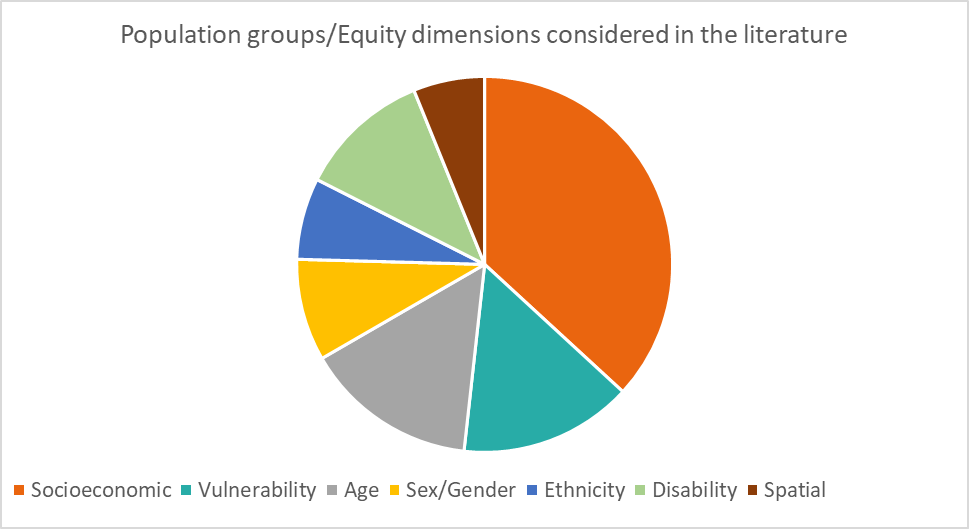
There are several examples of work that capture a broader range of socio-demographic information. This can include information about characteristics such as age, gender, ethnicity, and employment status (for example Andrews, 2022; Douglas et al., 2023; Walking Scotland, 2025; Yates and Whyte, 2019). Overall, fewer papers consider the wider range of protected characteristics, with only seven of the peer-reviewed studies examining the impacts of climate policy according to age, ethnicity, sex/gender, or disability (and the majority of these studies are simply stratifying results according to demographic data they have collected). Scottish researchers have drawn attention to the fact that some important dimensions/understandings of equity impacts for specific population groups (e.g. ethnic and racial minorities) may have been overlooked when it comes to understanding vulnerability, and differences in adaptive capacity (Meer, 2025).
Vulnerability is itself an important term within this evidence base. Different studies interpret vulnerability in various ways, demonstrating that vulnerability as a concept is not always fixed. This reflects the multitude of ways that a wide range of policy actions might be experienced by different people, including how and where the largest impacts or co-impacts are likely to be felt. The literature also varies in what individuals or communities are considered vulnerable to. For example, Jager et al. (2015) are concerned with vulnerability in general terms, to capture the threat of possible future harm to human well-being, while Dittrich et al. (2018) consider ‘vulnerable communities’ as places that are more exposed to river flooding. Vulnerability is also used to refer to the demographic characteristics associated with greater risk including low income, disability, childhood and old age (Dittrich et al., 2018; Douglas et al., 2023; Dunk et al., 2016).
Levels of vulnerability might be influenced by differences in exposure to either a particular climate hazard or policy response. Both can be influenced by underlying differences in susceptibility to harm and in adaptive capacity. For example, it is important to consider if a climate policy response to heatwaves considers the vulnerability of very old or very young people who are more susceptible to health risks during extreme temperatures (Dwyer et al., 2022).
Vulnerability can also be considered in relation to individuals facing employment transitions, where jobs may become obsolete because of decarbonisation. This includes workers in sectors such as the oil industry, who may be relatively well paid and not typically viewed as at high risk of health inequities, yet may still be vulnerable to significant disruption to this key building block of good health (Shapovalova et al., 2025). Additionally, vulnerability is influenced by the level of adaptive capacity within groups or communities their ability to adjust to a changing environment in ways that minimise harm or enable them to take advantage of opportunities that could positively affect health (Wan et al., 2024).
We found that more of the evidence base took a high-level view of health equity rather than providing a deep or explicit analysis. While some studies offer detailed analysis of very specific health outcomes such as mortality in different population groups (see Tieges et al., 2020, on the regeneration of Glasgow’s canals), others make broader observations about overall trends or risks as they related to health equity impacts (see Shipton et al., 2021, on the public health benefits of an inclusive economy). Rather than outlining detailed causal pathways, much of the literature highlighted the potential of these policies to generate benefits for health equity in general terms, without delving into the explicit mechanisms (for example, Improvement Service, 2021).
Studies most concerned with analysing health equity impacts pay attention to the manner of implementation and/or specific targeting of climate interventions to the needs of different population groups. This suggests that, in most cases, researchers are not always evaluating whether climate action itself is inherently beneficial or harmful for health equity, but rather how well it is targeted to ensure that those with the most to gain in health terms receive the greatest co-benefits or are protected from potential harms.
For example, by ensuring that policies designed to lower urban traffic and pollution do not unintentionally divert vehicles and emissions to neighbourhoods that already experience poor air quality and worse respiratory health outcomes) (Catalano and Congreve, 2025). Instead, findings from an international systematic review on health equity impacts in high-income countries suggest that positive health equity outcomes may be observed through the application of population health principles, viewed through an equity lens (Hjelmskog et al., 2025). Such principles include universalism (or proportionate universalism), prioritising upstream or structural transformation, tailored support or targeting of resources to those with most need/who have most to gain/who are most exposed to risk, and the degree of agency (including purchasing power) needed to access particular interventions.
We also observed an awareness of health equity, or often inequity, within the grey literature. However, this is rarely the topic of detailed evaluation. Instead, it was treated as important context to be aware of when considering the needs of particular communities. A report on inclusive environmental policy (Everyone’s Environment, 2025), for example, set out the needs of marginalised or disadvantaged groups, suggested that meeting these needs might help address health inequalities and systemic discrimination, but it did not take the assessment further by examining pathways or mechanisms through which these impacts might arise.
The evidence base we identified as part of this stocktake did not yet appear to fully incorporate meaningful assessment of health equity for different populations. In part, this is likely to the challenge of evidencing clear pathways from complex policy interventions to real world equity outcomes. However, we believe that it may have reflected the difficulty of defining and determining the boundaries of this very diverse and broad field of research activity. To keep the stocktake within a manageable scope, we included only evidence that clearly and explicitly incorporates climate policy as an input and a health or health equity impact as an outcome. Additional Scottish research that is not specifically about climate policy may nevertheless have important insights for those wishing to understand how policies can be designed in ways that might lead to fairer health outcomes.
Ongoing research
In terms of ongoing or emerging evidence, integrating health equity is an active area of research activity to which Scottish-based researchers are making a significant contribution. Some of the emerging work that we identified is engaging with the impact of various climate policies on particular population groups, including those with protected characteristics.
Research is forthcoming from the University of Strathclyde on the impacts of green choices (which refers to individuals’ choices, in this case relating to renewable energy, for example installing heat pumps or electric vehicle charging points) on people with protected characteristics (Calvillo and Martiskainen, 2025). Researchers at the University of Glasgow are evaluating the health effects of household energy efficiency measures (Warmer Homes Scotland and Area Based Schemes) on young children and older adults.[14] We also identified Glasgow-based PhD students researching the health impacts of the energy transition for low-income renters, and the gendered health inequities of 20-minute neighbourhoods[15]. We anticipate relevant doctoral research will emerge across other Scottish research institutions, including through active research programmes such as INHABIT[16], and could form the focus of a future call for evidence.
Outwith Scotland, this globally relevant research agenda is also being taken forward by other institutions and researchers, and evidence from elsewhere may be helpful in supporting Scotland’s health equity ambitions. See, for example, the work of programmes such as PAICE at University College London (Policy and Implementation for Climate and Health Equity)[17].
Adjacent expertise
The stocktake identified significant expertise and understanding within the Scottish research community on the causes and consequences of health inequity. However, this expertise, is not fully integrated as part of the climate policy-health research landscape. Researchers with this expertise may be well-positioned to apply an equity lens to a wide range of climate policies. Their expertise is likely to cover strong residual or contextual understandings of pathways to impact, including which population groups are most likely to be most affected by different adaptation and mitigation measures.
For example, two Glasgow universities and the Glasgow Centre for Population Health are part of a Health Determinants Research Collaboration (HDRC) tasked with reducing health inequities through policy.[18] The University of Strathclyde’s Scottish Health Equity Research Unit[19] (SHERU) produces evidence in response to key policy challenges relating to Scotland’s long-standing poor-health and health inequality outcomes. Little of SHERU’s work is explicitly related to climate action, although air pollution is a priority area (Jack, 2025). SHERU’s expertise is likely to be well matched to the challenge of evaluating health impacts of a very wide range of climate policies.
Furthermore, there is potentially a rich source of knowledge within communities and among practitioners (research, policy and the third sector) on how the impacts of climate policy are being felt, or are likely to be felt, by the different communities. This embedded understanding could be more meaningfully integrated into the wider evidence base through partnerships and collaborations with researchers and evaluation experts. Tools such as Health Impact and Health Equity Assessment Tools[20], alongside evaluation frameworks or more participatory, pragmatic and fluid methods of evaluation such as collaborative theories of change, could bring structure and meaning to a wide range of potential case studies that are ripe for research engagement.
Stakeholder insights into health equity
We discussed the topic of health equity as part of our workshop with research stakeholders. There was strong agreement among participants that a focus on equity is a crucial priority for this research agenda. There was also consensus that measuring health equity, or generating evidence that definitively attributes health equity outcomes to specific interventions, is extremely challenging. Participants highlighted the “lack of funding of health equity as an outcome of interest of itself” (University Researcher), which could be a contributing factor towards the literature that deals with health equity only at a superficial level, or as a piece of interesting context.
Groups discussed the definitions of health equity, inequality, and disparities, and showed a range of understandings that are likely influenced by the diverse cultural, educational and disciplinary backgrounds that make up this varied research landscape. Terminology and framing can vary from study-to-study, depending on the researcher’s training and perspective. Stakeholders told us that it “would be good to understand [the] difference between health equity and [the] mechanism of health inequalities” (University Researcher). We discussed the choice to use health equity as the framing for this Scottish stocktake, with an intent to capture the element of justice and fairness that is so important to a just transition and recognised that relevant insights on equity might sometimes be framed or expressed differently.
The consideration of equity as a secondary outcome makes it difficult to pinpoint specific expertise within the climate policy research space. “The breadth of climate research does make it particularly challenging to connect with different disciplines who may be interested in health and equity” (University Researcher). Navigating this complexity is seen as a challenge for individuals or small research teams with remits that are already very broad and engage with complex systems. Instead, we heard that researchers working on climate would like to incorporate this kind of evaluation through partnership or collaboration with researchers who already have relevant expertise. Participants hoped that the future research landscape would be “one where we have a good overview of current and planned research relating to climate, health and equity and where those involved in this know each other or can find each other easily” (Public Health Researcher). We also heard that stakeholders wished to see adequate funding, and better targeting of research activity, to support work that is more closely connected to the policy development process and focused on the Just Transition and vulnerable communities.
Participants highlighted that measures of health equity exist on a spectrum, and that there is a need to capture what the “ideal” versus “realistic” measures are. Ideal measures would integrate equity dimensions where possible, as well as capturing differential impacts on different populations. It was suggested that, to achieve this, multiple perspectives are needed, including on how to visualise data in ways that speak widely to different audiences with a diverse backgrounds and levels of understanding. We heard that a wide range of evidence sources could contribute to this, but that the valuable link between them would be “health equity at the centre” (Policy Stakeholder).
Suggestions were made about increasing equity within the research landscape, for example by equally valuing diverse sources of knowledge and understanding, including lived experience. Within universities, PhD and Early Career Researchers (ECRs) are recognised as having significant expertise. This is not always high profile and therefore risks being overlooked. Stakeholders demonstrated a strong appetite for a research network that would bring these different kinds of expertise together under a coherent, equity-driven framework.
Groups discussed the overarching challenge of generating evidence that articulated the causal logic and pathways linking climate policies to health equity outcomes. Challenges are to be expected when trying to evaluate complex, real-world interventions that did not necessarily have linear outcomes. Discussions highlighted that many researchers have a deep contextual understanding of how policy interacts with health equity outcomes, for example the impacts of huge employment shifts during the Covid pandemic. Drawing on this expertise, researchers can make judgements about the impact of major transitions on different population groups, including vulnerable groups. We discussed how this knowledge could be incorporated into flexible, pragmatic evaluation methods, such as collaborative or participatory Theory of Change (TOC) processes, with the potential to identify both process and outcome indicators that might signal progress towards improving health equity.
Suggestions from stakeholders included undertaking health (equity) impact assessments on climate policy, conducted by those with health equity expertise as part of interdisciplinary teams. Health equity experts could make meaningful assessments without detailed knowledge of the climate science. This kind of assessment or evaluation could potentially be linked to a “coherent overarching model of change” (University Researcher) which stakeholders suggested is needed.
Building a network to strengthen research and policy connectivity
Summary
From the perspective of the stakeholders that we engaged in this project, the research and evidence landscape whilst full of potential lacks visibility and is fragmented.
A co-ordinated and integrated research network is needed to strengthen research-policy connectivity that is additive and aligned with existing structures (for example, Scotland Beyond Net Zero). To add value, this should be underpinned by agile governance and provide shared digital tools, improved data linkage, two-way dialogue and create clear pathways for the rapid translation of evidence into policy and incentivise interdisciplinary collaboration.
While this project focused on mapping research expertise within Scotland’s Higher Education Institutions, practitioners are an essential part of the wider climate – health ecosystem. Their applied knowledge will be important for any future work and integral to networks that seek to integrate research, policy, and practice.
Characteristics of the research landscape
A core aim of the project was to map where relevant expertise exists in research institutions in Scotland and to lay the foundations for an expert climate and health network. In this section we outline how a network that strengthens research-policy connectivity could be developed, building on contributions made at the stakeholder workshop. This is set in the context of acknowledging and respecting existing research activity and networks, and reflecting the observations made by workshop attendees.
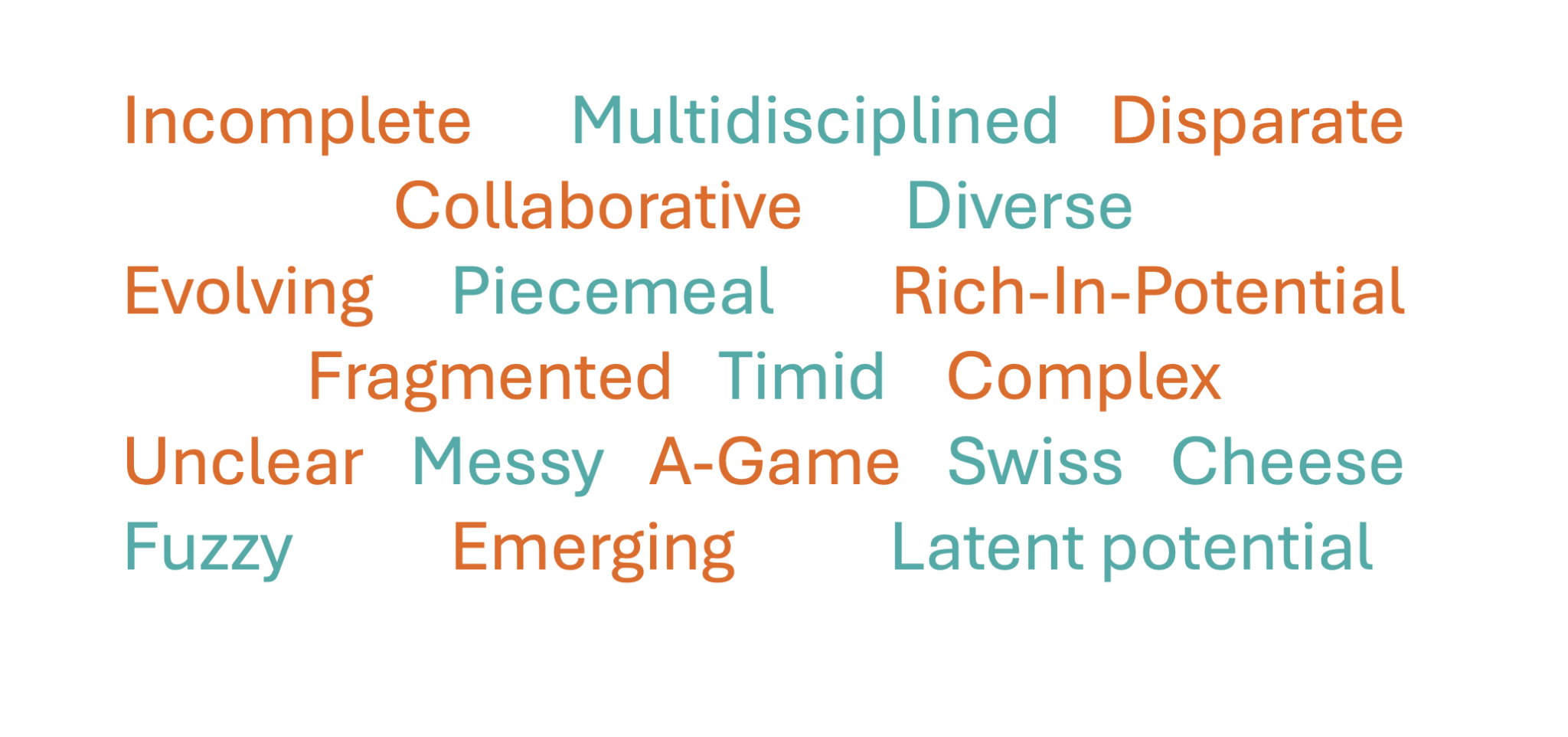
As part of a plenary discussion at the workshop, participants were invited to describe the existing research landscape at the intersection between climate policy and health outcomes in a single word or phrase (Figure 4). These responses painted a picture of a dynamic but emerging research ecosystem. One which is messy, highly varied in quality and integration, and marked by both structural challenges and significant unrealised potential.
In addition to characterising the current research landscape, the stakeholder workshop provided a valuable opportunity to explore how engaged those attending felt with Scottish Government policy making in this area (Figure 5), those working in other disciplines, and researchers working in this area from institutions outwith Scotland.
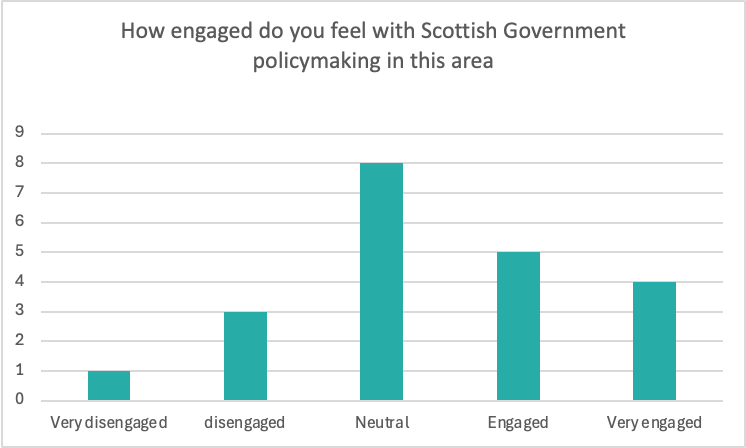
More than half the respondents felt neutral, engaged or very engaged with Scottish Government policy making in this area. Notwithstanding the perceived degree of current connectivity, those attending expressed a collective desire to be better connected and networked both with policymakers and each other, within Scotland and beyond. Discussions with senior Scottish Government researchers also underlined a gap between government research needs and academic knowledge production.
Exploring the mapping of researcher expertise with stakeholders helped to make visible the many relevant networks that could be connected and leveraged to strengthen the research landscape and policy maker-researcher-practitioner connectivity. Participants identified 24 networked projects or structures as relevant. Any future network should be cognisant of existing networks and additive in its contribution. In particular, Scotland Beyond Net Zero[21] was highlighted as a multi-institutional network-based coalition of researchers that could support future activity. It is jointly hosted by the Universities of Edinburgh and Glasgow.
Building a future network
As part of the final session of the workshop, participants were invited to consider and visualise what a future research landscape could look like. They were also invited to share their thoughts on what would help to strengthen research-policy connectivity. The attributes of this idealised future shared by participants are summarised in Table 4.
Consideration | Attributes of an idealised future research landscape |
What should be the scope and purpose of the research landscape? | Joint government – academic direction; clear theories of change or logic models; visibility of ongoing and planned research; research aligned with policy needs. |
How do we maximise its effectiveness?
| Landscape underpinned by shared definitions; consistent metrics; clarity on research gaps; interdisciplinary advice forum; accessible summaries, including policy research briefings. |
Functioning
| Connected research-policy-practice system; rapid evidence translation; agile governance; accessible knowledge; strong networks; incentivised collaboration. |
Relational aspects
| Regular two‑way engagement; multidisciplinary networks; trusted relationships; proactive communication; better data linkage; consistent researcher – policymaker interaction. |
A wide range of suggestions were made in response to the question, “What do you think would be helpful in building strong links between research and policy making in Scotland?”. Individual responses were summarised into a set of design considerations which could create an enabling environment that would enhance research-policy connectivity as follows:
- A network that fosters trust, shared purpose, and open communication;
- Regular forums that enable ongoing relationship building;
- Shared digital platforms to find people, evidence and data;
- Transparent, structured pathways for evidence into policy;
- Aligned incentives and timeframes for meaningful collaboration for researchers; and
- Greater inclusion of communities in evidence and policy processes.
Feedback from attendees at the workshop suggested that the stakeholder workshop itself should be a seed for relationship building and the formation of a network a legacy from this project. At the session we explored what those participating wanted most from a network if one were to be established. Desired attributes included:
- Enabling people to stay informed and keep abreast of developments and be better connected to relevant evidence;
- Sharing knowledge and engaging in constructive challenges;
- Connection to diverse expertise; provision of safe and supportive spaces for engagement and mentorship; and
- Access to resources, opportunities and prospective collaborations.
Conclusion and recommendations
In measuring the impact of climate policy on health and health equity outcomes, Scotland is making a substantial contribution to the rapidly expanding evidence base and international policy sphere. There are opportunities to address identified evidence gaps that could enhance policy development and evaluation tailored to Scotland’s unique context. While robust and varied, the research landscape remains fragmented and requires integration and development to effectively support the measurement requirements expected of the forthcoming CCP and to support the need for updated health indicators in 2027 to enable monitoring and evaluation of the Scottish National Adaptation Plan (SNAP3).
From the perspective of the stakeholders that we engaged in this project, the research and evidence landscape whilst full of potential lacks visibility and is fragmented. There is a collective desire amongst researchers to be better connected and networked with policymakers and each other, within Scotland and beyond. This requires structured support to bridge the perceived gap between government research needs and academic knowledge production.
To generate meaningful, policy-ready evidence, it is crucial that the research landscape is supported by shared definitions, common metrics, collaboration across disciplines and sectors, practitioner involvement, and systems-based approaches. Based on the rapid review we conducted and stakeholder input, we make ten recommendations:
- There is a need to develop shared understanding of concepts that sit at the heart of this research-policy nexus. These include health, health outcomes, health equity, vulnerability, and resilience. There is an urgent need to clarify and then test conceptual pathways between climate actions and health/equity outcomes through systems-based models and theories of change.
- Future monitoring and evaluation frameworks could benefit from incorporating more diverse forms of measurement, that help to capture complexity and dynamic change, including process, progress, and intermediate outcome indicators.
- Efforts to develop monitoring and evaluation frameworks should consider indices of vulnerability (such as the Net Zero Vulnerability Index), or new evaluation tools that help to understand different climate vulnerabilities and steer interventions based on their context and populations, to improve place-based and population-based resilience.
- There is an opportunity to strengthen the evidence base by targeted commissioning of research to address clear evidence gaps. Some of the gaps are topical e.g. marine conservation, water quality, and waste; some relate to the quality and quantity of health specific evidence that is currently insufficient for policy development and monitoring. The evidence base may also be strengthened by focusing on leverage points (such as housing) that sit at the intersection of climate policy action with multiple policy areas.
- To combat the often-superficial engagement with health and health equity in the literature, commissioning research that examines differential impacts across protected characteristics, alongside socio-economic and place-based disadvantage, would strengthen understanding of how climate policies affect different population groups and help ensure that just transition approaches address intersectional disadvantage.
- Consideration of health and health equity impacts could be incorporated into impact assessments of relevant climate policies and plans to promote the use of all possible policy levers for health.
- A coordinated, additive network aligned to existing structures (e.g. Scotland Beyond Net Zero) is needed to reduce fragmentation and low visibility within the research landscape. Such a network needs agile governance, shared tools, better data linkage, and two-way dialogue to accelerate evidence into policy and incentivise interdisciplinary collaboration. The regular publication of Scottish Government research priorities would be a key enabler.
- Network building should create further links between Scotland’s community of health equity researchers and those whose focus is on the implementation of adaptation and mitigation interventions in the Scottish policy context.
- Engaging with UK-wide and international research will help identify lessons and best practice for measurement. Aligning a future Scottish climate-health research-policy network with similar developments in Wales, for example, and enabling active exchange between them, would accelerate and amplify future knowledge exchange.
- Understanding of the health and health equity impacts of climate policy could be enriched by further engagement with practitioners and communities outside formal research institutions, who hold valuable applied, place-based, and lived experience insights into the pathways through which these policies affect health and health equity.
Publications referenced in this report
Andrews N. (2022). The Emotional Experience of Members of Scotland’s Citizens’ Assembly on Climate Change. Frontiers In Climate, 4.
Baker, G., Pillinger, R., Kelly, P., and Whyte, B. (2021). Quantifying the health and economic benefits of active commuting in Scotland. Journal of Transport and Health, 22.
Blane, D., and Basu, N. (2023). Tackling climate change and health inequalities in primary care. Family practice, 40(3), pp.498-501.
Bone, J., Cant, S., Mudd, J., Ryan, L., Doidge, M. (2020). Medium and long-term Societal Impacts of COVID-19, British Sociological Association, online.
Boyd, J., Hjelmskog, A., Elsenbroich, C., Heppenstall, A., Toney, J., and Meier, P. (2023). Climate mitigation and adaptation action in the UK and devolved nations – A typology. [Data Collection]
Brandner, M.E., Fyfe, C.L., Horgan, G.W., and Johnstone, A. M. (2022). Self-Reported Purchasing Behaviour, Sociodemographic Predictors of Plant-Based Protein Purchasing and Knowledge about Protein in Scotland and England. Nutrients, 14(21).
Brennan, J., and Ogilvie, F. (2025). Health Impact Scoping Report: Proposed Edinburgh North-South Tram Extension, NHS Lothian.
Calvillo Munoz, C., and Martiskainen, M. (2025). Understanding the barriers and impacts of green choices on people with protected characteristic. https://doi.org/10.20919/SLMN2472
Campbell, A., Humza, Y., Brannen, R., Gray, P., Hunter, G., Mutrie, N., and Murray, A. (2019). Tackling vehicle emissions and physical inactivity. Scottish Government doubles active travel budget. British journal of sports medicine, 53(8), pp.466-467.
Catalano, A., and Congreve, E. (2025). Air Pollution and Inequality in Scotland: Examining differences in pollutant concentrations across Scottish neighbourhoods. The Scottish Health Equity Research Unit (SHERU).
Cleland, E., McBey, D., Darlene, V., McCormick, B., and Macdiarmid, J. (2025). Still eating like there’s no tomorrow? A qualitative study to revisit attitudes and awareness around sustainable diets after 10 years. Appetite, 206, pp.107799.
Dick, J., Carruthers-Jones, J., Carver, S., Dobel, A., and Miller, J. (2020). How are nature-based solutions contributing to priority societal challenges surrounding human well-being in the United Kingdom: a systematic map. Environmental Evidence, 9.
Dittrich, R., Ball, T., Wreford, A., Moran, D., and Spray, C.J. (2019). A cost-benefit analysis of afforestation as a climate change adaptation measure to reduce flood risk. Journal Of Flood Risk Management, 12(4).
Dogbe, W., Huang, K., and Revoredo-Giha, C. (2025). Impacts of a minimum pricing policy on high fat, sugar and sodium (HFSS) foods: Environmental, dietary and welfare analysis. Economics and human biology, 58, pp.101514.
Douglas, M., Teuton, J., Macdonald, A., Whyte, B., and Davis A.L. (2023). Road space reallocation in Scotland: A health impact assessment. Journal of Transport and Health, 30
Dow, K. (2025). Links between Climate Change and Health in Scotland. SPICe (Scottish Parliament Information Centre).
Dunk, R.M., Satyal, P., and Bonaventura, M. (2016). A Novel Impact Assessment Methodology for Evaluating Distributional Impacts in Scottish Climate Change Adaptation Policy. Implementing Climate Change Adaptation in Cities and Communities: Integrating Strategies and Educational Approaches, (World Symposium on Climate Change Adaptation), pp.75-98.
Dwyer, I.J., Barry, S.J.E., Megiddo, I., and White, C.J. (2022). Evaluations of heat action plans for reducing the health impacts of extreme heat: methodological developments (2012-2021) and remaining challenges. International Journal of Biometeorology, 66(9), pp.1915-1927.
Everyone’s Environment (2025). Making environmental policy inclusive in Scotland. ERCS. Available at: https://www.ercs.scot/resources/everyones-environment-scotland/
Fanning, A.L. and K. Raworth. Doughnut of social and planetary boundaries monitors a world out of balance. Nature, 2025. 646(8083): p. 47–56.
Gibb, K., Sharpe, T., Morgan, C., Higney, A., Moreno-Rangel, A., Serin, B., James, W., and Hoolachan, A. (2023). Niddrie Road, Glasgow: Tenement Retrofit Evaluation. University of Strathclyde. Available at: https://housingevidence.ac.uk/wp-content/uploads/2024/02/Niddrie-Road-v4.pdf.
Haf, S., Parkhill, K., McDonald, M., and Griffiths G. (2019). Distributing power? Community energy projects’ experiences of planning, policy and incumbents in the devolved nations of Scotland and Wales. Journal Of Environmental Planning and Management, 62(6), pp.921-938.
Hamilton, I., Milner, J., Chalabi, Z., et al. (2015) Health effects of home energy efficiency interventions in England: a modelling study. BMJ Open, 2015;5:e007298.
Harrington, D.M., Bardid, F., Cory, K., Dixon, J., Dodd, S., Ferguson, N., Roberts, J.J., and Bonner, J. (2024). (Two) Wheels on the Bus: Road User Perceptions of a Bike Bus and How This Links to Addressing Global Health Challenges. Journal of physical activity and health, 21(12), pp.1382-1390.
Health and Social Care Alliance Scotland (The ALLIANCE). (2025). Draft Climate Change Plan Scrutiny 2025 Call for Views ALLIANCE Response. Available at: https://www.alliance-scotland.org.uk/blog/resources/draft-climate-change-plan-scrutiny-2025-alliance-response/
Henderson, F., Bennett, B., Dohain-Lesueur, R., and Helwig, K. (2025). ‘It’s not really their problem’: Reactive institutional community engagement and flood policy implementation. International Journal of Disaster Risk Reduction, 116.
Highland Adapts. (2023). Nature Climate Health. Available at: https://www.thinkhealththinknature.scot.nhs.uk/wp-content/uploads/2023/06/Agenda-Item-6-Climate-Nature-Health-Guidance-for-Community-Partnerships-06.06.23-1.pdf
Higney, A., and Gibb, K. (2024). Net zero retrofit of older tenement housing – The contribution of cost benefit analysis to wider evaluation of a demonstration project. Energy Policy, 191.
Hjelmskog, A., Boyd, J., Stevenson, A., Pollack, R., Elsenbroich, C., Heppenstall, A., Toney, J., Winterbottom, J., and Meier, P. (2025). The effect of climate mitigation and adaptation policies on health and health inequalities: a systematic review. The Lancet. Planetary health, 9(7), pp.101277.
Ibrahim, A., Carter, K., Brennan, J., and Bros-Williamson, J. (2026). Retrofitting Scotland’s private rented sector: Challenges and landlord attitudes. Energy Research and Social Science, Volume 133. DOI: https://doi.org/10.1016/j.erss.2026.104578
Improvement Service. (2021). Elected Member Briefing Note: Nature-based Solutions. Available at: https://www.improvementservice.org.uk/__data/assets/pdf_file/0019/26434/EM-Briefing-Nature-Based-Solutions.pdf
Jack, D. (2025). Enhancing the Evidence Base: Collaborative Research for Meaningful Impact. Scottish Health Equity Research Unit, Glasgow.
Jager, J., Rounsevell, M., Harrison, P., Omann, I., Dunford, R., Kammerlander, M., and Pataki, G. (2015). Assessing policy robustness of climate change adaptation measures across sectors and scenarios. Climatic Change, 128(3-4), pp.395-407.
Jia, Y., and Turcu, C. (2025). Climate, Health, and Urban Green Infrastructure: The Evidence Base and Implications for Urban Policy and Spatial Planning. International Journal of Environmental Research and Public Health, 22(12), 1842.
Juel, R., Whitmee, S., Green, R. et al. (2026). Integrated indicators for tracking climate mitigation and adaptation: a protocol for a rapid review with a focus on health co-benefits and trade-offs [version 1; peer review: awaiting peer review]. Wellcome Open Res, 11:30.
Kennedy, E., Vint, K., Mair, A., Wilson, I., Rose, L., Eastop, F., and Law, S. (2025). Quality prescribing strategy for respiratory conditions in Scotland: improving patient care and promoting environmental sustainability. The International Journal of Pharmacy Practice33(5), pp.534-540.
Li, S., Gilbert, L., Vanwambeke, S.O., Yu, J., Purse, B.V., and Harrison, P.A. (2019). Lyme Disease Risks in Europe under Multiple Uncertain Drivers of Change. Environmental Health Perspectives, 127(6), pp.67010.
Living Streets Scotland. (2022). Getting Scotland Walking: The Case for Action, Glasgow Centre for Population Health, Available at: https://www.gcph.co.uk/latest/publications/399-getting-scotland-walking-briefing
Lucas, K., and Pangbourne, K. (2014). Assessing the equity of carbon mitigation policies for transport in Scotland. Case Studies on Transport Policy, 2(2), pp.70-80.
Luyten, A., Winkler, M.S., Ammann, P. and Dietler, D. (2023). Health impact studies of climate change adaptation and mitigation measures – A scoping review, Journal of Climate Change and Health, vol. 9, 100186.
Mabon, L. (2023). At the margins of the international community, but inside global knowledge and policy flows? How cities in Taiwan and Scotland position themselves within intergovernmental rhetoric on nature-based solutions. Nature-Based Solutions, 4.
Macdiarmid, J.I. (2022). The food system and climate change: are plant-based diets becoming unhealthy and less environmentally sustainable? The Proceedings of the Nutrition Society, 81(2), pp.162-167.
Macdiarmid, J.I., Douglas, F., and Campbell, J. (2016). Eating like there’s no tomorrow: Public awareness of the environmental impact of food and reluctance to eat less meat as part of a sustainable diet. Appetite, 96, pp.487-493.
MacDonald M.A., de Ruyck, C., Field, R.H., Bedford, A., and Bradbury, R.B. (2020). Benefits of coastal managed realignment for society: Evidence from ecosystem service assessments in two UK regions. Estuarine Coastal and Shelf Science, 244.
Malden, S., McDougall, C.W., Ward Thompson, C., Wendelboe-Nelson, C., Ross-Perez, A., Clemens, T., Mason, S., Villegas-Diaz, R., Hoadley, A., Hunter, A., Jepson, R., and Williams, A.J. (2025). Evaluating the health and well-being effects of increasing biodiversity within multiple small parks in Edinburgh, UK: a protocol for a mixed-methods, longitudinal, pre-post natural experiment. BMJ open, 15(9), pp.e101061.
Meer, N. (2025). Social Policy and the Determinants of Vulnerability – Missing “Race” in Climate Adaptation, Social Policy and Society, pp. 1–12. doi:10.1017/S1474746425000041.
Meyerricks, S. and White, R.M. (2021). Communities on a Threshold: Climate Action and Wellbeing Potentialities in Scotland. Sustainability, 13(13).
Muirie, J. (2017). Active Travel in Glasgow: What we’ve learned so far. Glasgow Centre for Population Health. Available at: https://www.gcph.co.uk/latest/publications/331-active-travel-in-glasgow-what-we-ve-learned-so-far
Reynolds, C.J., Horgan, G.W., Whybrow, S., and Macdiarmid, J.I. (2019). Healthy and sustainable diets that meet greenhouse gas emission reduction targets and are affordable for different income groups in the UK. Public Health Nutrition, 22.
Ross, H. and McCartney, G. (2025). ‘Renoviction’ and health: an emerging research agenda. Journal of epidemiology and community health, 79(4), pp.239-241.
Shapovalova, D., Bender, K.A., Bone, J., and Potts, T. (2025). A place-based approach to measuring a just transition: Evidence from the north-east of Scotland. Energy Research and Social Science, Vol 127.
Shipton, D., Sarica, S., Craig, N., McCartney, G., Katikireddi, S.V., Roy, G., McGregor, P., and Scobie, G. (2021). Knowing the goal: an inclusive economy that can address the public health challenges of our time. Journal of epidemiology and community health, 75(11), pp.1129-1132.
Stewart-Evans, J., Koksal, C., and Chang, M. (2024). Can the implementation of net gain requirements in England’s planning system be applied to health? The Lancet Planetary Health, 8(3), e188-e196.
Stewart-Evans, J., Wilson, E., Langley, T., Hands, A., Exley, K., and Leonardi-Bee, J. (2025). Health net-outcome objectives and approaches for spatial planning and development: a scoping review. JBI Evidence Synthesis DOI: 10.11124/JBIES-25-00058.
Tieges, Z., McGregor, D., Georgiou, M., Smith, N., Saunders, J., Millar, R., Morison, G., and Chastin, S. (2020). The Impact of Regeneration and Climate Adaptations of Urban Green-Blue Assets on All-Cause Mortality: A 17-Year Longitudinal Study. International journal of environmental research and public health, 17(12).
UK Health Security Agency. (2023). Climate change and public health indicators: scoping review. UK Health Security Agency, 2023, Publishing Ref: GOV-14782.
Walking Scotland. (2025). The Power of Walking – A walking and wheeling manifesto for 2026. Available at: https://walkingscotland.org.uk/the-power-of-walking/
Wan, K., Hajat, S., Doherty, R.M., and Feng, Z. (2024). Integrating Shared Socioeconomic Pathway-informed adaptation into temperature-related mortality projections under climate change. Environmental research, 251(Pt 2), pp.118731.
Whitmee, S., et al. (2024), Pathways to a healthy net-zero future: report of the Lancet Pathfinder Commission. The Lancet. 403(10421): p. 67–110.
Yates, G. and Whyte, B. (2019) Bikes for All Evaluation, Glasgow Centre for Population Health. Available at: https://www.gcph.co.uk/latest/publications/258-bikes-for-all-widening-access-to-cycling-through-social-inclusion
Zamuruieva, I., Payne, C., Wolstenholme, R., Casey, J., Connor, B., and Cameron-Smith, A. (2023). Land Use and Climate Change Adaptation in Scotland: Insights. Adaptation Scotland. Available at: https://adaptation.scot/app/uploads/2024/09/land-use-and-climate-change-adaptation-report-digital-v2.pdf
Appendix A: Examples of live grants (March 2026)
Typology category | Lead researchers (Scotland) | Name of live grant | Affiliated institutions | Notes | |
|---|---|---|---|---|---|
Temperature Changes Cleaner Energy and reducing emissions | Prof J Pearce
Prof R Doherty
| Indoor HABItability during the Transition to NetZero Housing Hub: INHABIT (2025-2030) | Uni. of Edinburgh | “Reducing inequalities across social and ethnic groups” is a specific project theme. A range of indicators and models, which modelling produce distributions of exposures/health risk metrics, are being used (e.g., QALYs; inequalities in mortality) | |
Blue and green infrastructure Community and social resilience | Prof C W Thompson Prof R Mitchell Prof R Jepson Dr T Clemmens Dr S Malden | Groundswell: community and data-led systems transformation of urban green and blue space for population health (2021-2026) | Uni. of Edinburgh Uni. of Glasgow | Using the web resource For Equity (https://forequity.uk/) Groundswell will work with stakeholders to collect and integrate variables into administrative datasets that enable equity sensitive impact analyses. | |
Temperature Changes Cleaner Energy and reducing emissions Health outcomes | Prof R Doherty Prof D van der Horst Prof J Pierce | The health and equity impacts of climate change mitigation measures on indoor and outdoor air pollution exposure (HEICCAM) (2020-2024) | Uni. of Edinburgh | HEICCAM: an interdisciplinary research network investigating health and equity impacts of climate change mitigation measures on indoor & outdoor air pollution exposure, aiming to develop solutions for a healthy, equitable low-carbon future. | |
Buildings and infrastructure Air quality/ Temperature changes | Prof R Doherty Dr A Schurer | HEARTH: national hub on net zero, health and extreme heat (2025-2030) | HEARTH: national hub on net zero, health and extreme heat (2025-2030) | Using a mixed methods approach, HEARTH will employ climate modelling at various geographical scales (from city to individual building level), to quantify both future and present exposures of heat-vulnerable individuals. | |
Buildings and infrastructure Greener transport | Prof J Belch Dr A Geddes Prof J Chalmers | Air Quality, Low Emission Zones and Hospital Admissions in Scotland (AQMA) (2024-2028) | Uni. of Dundee | No additional information is publicly available about this project. | |
Blue and green infrastructure Community and social resilience Greener transport Buildings and infrastructure | Prof P Meir Prof J Toney Dr B Whyte | Uni. of Glasgow | Taking a whole systems approach, GALLANT utilises the Doughnut economics framework to assess sustainability of interventions, benefits & trade-offs for public health, wellbeing & economy. | ||
Biodiversity Infectious diseases | Dr B Duthie Professor N Bunnefeld Dr A Law Dr E Fuentes- Montemayor | Restoring Ecosystems to Stop the Threat Of (Re-)Emerging Infectious Diseases (2024-2027) | Uni. of Stirling | Considers the impact of ecosystem restoration on zoonotic disease spillover for population health. | |
Blue and green infrastructure Community and social resilience Health Equity | Professor T Gorely Dr H Carver Dr W Masterton | Uni. of Highlands and Islands Uni. of Stirling | This project assesses the potential of greenspace from a lived experience perspective in treating mental health and problem substance use. A Greenspace Programme Outcomes and Evaluation Guidance document has been produced. | ||
Cleaner energy and reducing emissions Buildings and infrastructure Greener transport Blue and green infrastructure Health Equity | Prof J Bone Prof T Potts Dr D Shapovalova Professor M Hannon Dr J Roberts Dr J Dickie Dr K Carter | Systems Approaches for Accelerating a Just Transition (JUST-Systems) (2025-2030) | Uni. of Aberdeen Uni. of Strathclyde Uni. of Stirling Uni. of Edinburgh | Research (WP3) is conducting “deep local engagement with stakeholders with emphasis on marginalised and unrepresented groups”. While WP2 is using energy, carbon, economic modelling (MOHRES +) + new social, built and health metrics in evaluation. | |
Community and social resilience Agriculture and Land-use | Professor M Brennan Professor L Jaacks | Uni. of Edinburgh | A focus on equity by providing bespoke data, analytical advice and support to Scottish Local Authorities & Health Boards to help with benchmarking & developing their first Local Plans. | ||
Blue and green infrastructure Community and social resilience River & coastal flooding/erosion | Prof S Mickovski Dr A Gonzalez Ollauri Prof R Emmanuel | Muir is Tir – Adapting to coastal change on Barra and Vatersay (not-started) | Glasgow Caledonian University | This project addresses the challenges of coastal change for island communities, through co-created nature-based approaches to coastal stewardship. | |
Community and social resilience Blue and green infrastructure Buildings and infrastructure Greener transport | Prof R Mitchell Prof P Meier Dr J Stokes | Uni. of Glasgow | The primary aim of OPTIMA is to produce “timely, effective, actionable evidence” on 20MNs and their health equity implications. | ||
Appendix B: Measurement table (identified metrics and measures)
Typology category | Measures used for health outcome | Type of measure e.g. specific, general, wider determinant? | Reference |
|---|---|---|---|
Biodiversity | Physical health, nutrition, longevity/life expectancy, maternal health, child health, access to health care, occurrence of diseases, mental health | Specific (wide range featured as this example is a review paper on multiple NBS) | Dick et al., 2020 |
Subjective wellbeing (measures of happiness, quality of life, satisfaction) | General | Dick et al., 2020 | |
Improved Liveability as means of increasing regular exercise/walking in the landscape | General, Behaviour | Gordon and Barron, 2012 | |
Mental wellbeing (assessed by survey) and park usage behaviours (systematic observation) | Specific (Qualitative and Quantitative) | Malden et al., 2025 | |
Increase in number of individuals and communities participating in conservation volunteering | Behaviours, Wider determinants | Highland Adapts, 2023 | |
Biosecurity | Risk of Lyme Disease (as modelled under different SSPs) | Specific | Li et al., 2019 |
Forestry | Cultural Value (of afforestation), both use-values i.e. recreational and aesthetic values and non-use values i.e. existence value | Wider determinants | Dittrich et al., 2019 |
Values (beyond carbon) of woodland e.g. “Social co-benefits” “Public access” “educational opportunities” “aesthetic value” “creating jobs” “tourism” | Wider determinants | Koronka et al., 2022 | |
Increased agricultural tourism, diversification of income streams for farmers (as well as attitudes towards afforestation/tree planting) | Wider determinants (including qualitative insights) | Mvula et al., 2025 | |
Air pollution removal by vegetation in Scotland “resulted in avoided health impacts worth £140 million annually” | Wider determinants (including economic assessment) | Lochhead / AECOM, 2025 | |
Agriculture and Land Use | Levels of vulnerability/resilience to flooding | Wider determinant | Buckingham et al., 2023 |
Improved Liveability as means of increasing regular exercise/walking in the landscape | General, Behaviour | Gordon and Barron, 2012 | |
Purchasing patterns/nutritional composition of food available/bought at farmer’s markets | Wider determinants, Behaviour/Attitudes (mostly qualitative) | Wardle et al., 2024 | |
Wellbeing, Community resilience and participation | General, Wider determinants | Zamuruieva et al., 2023 | |
Blue and Green Infrastructure | Travel behaviours/use of reallocated road space i.e. levels of walking and cycling. Changes to public transport e.g. improved bus routes/more frequent bus times | Behaviours and Wider determinants | Douglas et al., 2023 |
Mental wellbeing (assessed by survey) and park usage behaviours (systematic observation) | Specific (Qualitative and Quantitative) | Malden et al., 2025 | |
All-Cause Mortality | Specific | Tieges et al., 2020 | |
Contribution to Green Economy or Wellbeing Economy (from NBS) | Wider determinants | Mabon et al., 2023 | |
Physical health, nutrition, longevity/life expectancy, maternal health, child health, access to health care, occurrence of diseases, mental health | Specific (wide range featured as this example is a review paper on multiple NBS) | Dick et al., 2020 | |
Subjective wellbeing (measures of happiness, quality of life, satisfaction) Living Standards (range of material and economic) | General and Wider determinants | Dick et al., 2020 | |
Greenspace availability and access | General, wider determinants | Community Land Scotland, 2022 | |
Green Health Behaviours such as walking in nature, volunteering in conservation, citizen science participation, litter picking, tree planting | Behaviours, Wider determinants | Highland Adapts, 2023 | |
River and Coastal Floods and Erosion | Co-impacts of managed retreat (MR) including improved flood risk prevention (better resilience, reduced vulnerability) and spaces for recreation. Also, individual impacts on economy/business e.g. for farmers who lose productive land. | Wider determinants | MacDonald et al., 2017 |
Physical health, nutrition, longevity/life expectancy, maternal health, child health, access to health care, occurrence of diseases, mental health | Specific (wide range featured as this example is a review paper on multiple NBS) | Dick et al., 2020 | |
Subjective wellbeing (measures of happiness, quality of life, satisfaction) | General | Dick et al., 2020 | |
Mental health impact from flooding events | Specific | Miller et al, 2012 | |
Buildings and Infrastructure | QALYs from air quality improvement based on EnerPHit standards (insulation AND ventilation) in housing retrofit. Also, Social value and Value for money | Specific and General | Gibb et al., 2023 Higney and Gibb, 2024 |
Improving housing stock will improve health and wellbeing of population, with a specific equity element. | General | Just Transition Commission, 2021 | |
Housing identified as a key social determinant of health and improving the quality of homes is an important public health measure. | Wider determinants | Zero Emissions Social Housing Taskforce (ZEST), 2021 | |
Renovictions (displacement of renters as consequence of cost/challenge of retrofit measures) | Wider determinants | Ross and McCartney, 2025 | |
Levels of community empowerment, fuel poverty, housing insulations | Wider determinants | Haf et al., 2019 | |
Environments where walking is prioritised can lead to a modal shift away from car use, can reduce our carbon footprint and air pollution, and are more pleasant to be in. | Wider determinants, general | Living Streets, 2022 | |
Population health and wellbeing (with a specific equity element) | General | Just Transition Commission, 2021 | |
Cleaner Energy and Reducing Emissions (CERE) a) Phasing out and regulating fossil fuels | Risk of Lyme Disease (as modelled under different SSPs) | Specific | Li et al., 2019 |
Mortality (temperature-related mortality burdens modelled under different SSPs) | Specific | Wan et al., 2024 | |
CERE b) Invest in renewables | Levels of community empowerment, fuel poverty, housing insulations | Wider determinants | Haf et al., 2019 |
CERE c) Nuclear and Hydrogen Power | GAP- no specific example health metrics for this category identified in this body of literature | ||
CERE d) Technical Innovation | GAP- no specific example health metrics for this category identified in this body of literature | ||
CERE e) Dietary change | Consumer behaviour e.g. knowledge about plant-based food and purchasing patterns of plant-based food | Behaviour/Attitudes | Brandner et al., 2022 |
Attitudes towards sustainable diets | Behaviour/Attitudes | Cleland et al., 2025 | |
Understanding of link between food and climate, and attitudes/values towards reducing meat consumption | Behaviour/Attitudes | Macdiarmid et al., 2016 Macdiarmid, 2022 | |
GHG emissions and price data across food groups (accounting for nutrient composition) to assess Sustainable dietary change and affordability for different income groups | Wider determinants | Reynolds et al., 2019 | |
Greener Transport | Deaths avoided (from active commuting) | Specific | Baker et al., 2021 |
Levels of recreational walking | Behaviour | Campbell et al., 2018 | |
Travel behaviours/use of reallocated road space i.e. levels of walking and cycling. Changes to public transport e.g. improved bus routes/more frequent bus times | Behaviours and Wider determinants | Douglas et al., 2023 | |
User perceptions of the climate activity (i.e. using a bike bus) | Behaviour/Attitudes | Harrington et al., 2024 | |
Social and Distributional Impacts (SDIs) including: Accident reduction, improvements in air quality, changes in physical activity patterns. Also: changes to cost of transport and accessibility impacts. | Specific and Wider determinants | Lucas and Pangbourne, 2014 | |
Enhanced resilience. Increases in active travel. Improvements to public transport. | General. Behaviours. Wider determinants. | Brennan and Ogilvie (2025) | |
Increase in active travel related to BMI | Behaviours | Muirie, 2017 | |
Bicycle usage | Behaviours | Yates 2019 | |
Disease incidence(s) based on changes to travel behaviours, e.g. rates of type 2 diabetes, dementia, ischaemic heart disease, cerebrovascular disease and cancer | Specific | Dow, 2025 | |
Access to cars/public transport for disabled people | Wider determinants | ALLIANCE, 2025 | |
Increased levels of walking and cycling | Behaviour | Cleaner Air for Scotland Governance Group, 2016. | |
Levels of walking, physical activity, community cohesion | Behaviour, Wider determinants | COSLA, 2014 | |
Avoidance of long-term health conditions (e.g. heart disease, diabetes and cancer) and early death. Better sleep improved cognitive function and overall quality of life. | Specific and General | Walking Scotland, 2025 | |
Temperature Changes | Mortality (changes in heat-related deaths attributable to Heat Plans) | Specific | Dwyer et al., 2022 |
Mortality (temperature-related mortality burdens in assessing Scotland for adaptive capacity) | Specific | Wan et al., 2024 | |
Natural Carbon Sinks/Land Conservation | Improved Liveability as means of increasing regular exercise/walking in the landscape. Better air quality/cleaner water/improved soil for habitat creation and maintenance. | General, Behaviours and Wider determinants | Gordon and Barron, 2012 |
Economy, Business and Industry | Dietary consumption habits (i.e. purchase of fruits and vegetables vs. other food categories) from taxation of HFSS foods. Cost of household food basket. | Behaviours and Wider determinants | Dogbe et al., 2025 |
Population health depends upon access to a range of determinants of health, including public utilities, housing, work, income and public services. | Wider determinants | McCartney et al 2025 | |
Attributes of an Inclusive Economy including economic participation and equity | Wider determinants | Shipton et al., 2025 | |
Community and Social Resilience | Mental wellbeing (self-reported, qualitative e.g. levels of worry or hopefulness) | Specific, qualitative | Andrews, 2022 |
Improved community resilience to climate shocks will contribute to reducing adverse impacts on community members. “Building social capital in the community will help reduce social isolation and contribute to improved health and wellbeing.” | Wider determinants, qualitative, behaviours | Public Health Scotland, 2023 | |
Greening the Health Sector | Patient Care (demonstrated by improvements in National Therapeutic Indicators data, use of educational approaches, QI (Quality Improvement) methodology, and patient-focused reviews) | General | Kennedy et al., 2025 |
Doing no harm (clinicians minimising their resource use where possible to reduce global health harms from GHG emissions, balanced with providing essential care for their patients) | Wider determinants | Richie, 2023 | |
Water availability and quality | GAP – no specific example health metrics for this category identified in this body of literature | ||
Marine Conservation | GAP – no specific example health metrics for this category identified in this body of literature | ||
Waste | GAP – Waste is not the specific focus of any of our included papers, but it is a feature of some of the broader or more generalised papers (e.g. Buckingham et al., 2023; Meyerricks and White, 2021; Shipton et al., 2025) | ||
General papers potentially spanning multiple categories e.g. under ‘Adaptation’ | Vulnerability/Numbers of vulnerable people (vulnerability as threat of future harm to human well-being) | General | Jager et al., 2015 |
Tools and evaluation frameworks
We identified a small number of relevant interactive resources, which could be helpful for understanding the health effects of climate action. These tools often use data that is readily available, and examples of useful tools are summarised in the table below. These have been curated as an illustrative rather than an exhaustive list, given the rapid growth and development of this research area.
Name of Tool | Description | Scottish relevance? |
|---|---|---|
UK Co-Benefits Atlas | An interactive tool to visualise the socio-economic impacts of climate actions for reaching Net Zero across the UK. Developed by researchers at the University of Edinburgh. Link: https://ukcobenefitsatlas.net/ | Disaggregates data to Scottish datazone level. |
CO-IMPACT | An online tool to support the development of monitoring and evaluation plans for nature-based solutions, providing a selection of indicators. Developed by Glasgow City Council and Universidad da Coruña.[22] | Produced by Glasgow City Council. |
The Glasgow Doughnut | A visual representation of Glasgow’s 44 social and ecological Thriving Definitions[23], with a further objective to co-develop indicators for each of the 44 dimensions. Developed by GALLANT researchers at the University of Glasgow (ongoing project) | Uses Glasgow as a case study. Co-developed by Glasgow researchers and policymakers. |
Net Zero Vulnerability Index (NZVI) | An interactive map and tool to assess how vulnerable different regions in the UK are to economic changes as the country moves towards a net-zero economy. Developed by researchers at the University of Bristol.[24] Link: https://tcantellow.github.io/netzeroindex/index.html | Disaggregates data to local authority district (LAD) level for Scotland. |
Tree Equity Score UK | A map-based application that was created to help address disparities in urban tree distribution by identifying the areas in greatest need of people-focused investment in trees. Developed by The Woodland Trust, American Forests, and the Centre for Sustainable Healthcare. Link: https://uk.treeequityscore.org/ | Disaggregates data to Scottish datazone level. |
The (Co) Benefits Portal | A decision-support tool for policymakers to compare potential co-benefits or trade-offs of policy actions, with categories for health and other social and economic factors. Developed by University of Leeds and Priestly International Centre for Climate.[25] | Based on a global dataset, Scottish relevance on case-by-case basis. |
Appendix C: Typology overview
Overview:
The Boyd typology provided a practical and structured framework for organising this rapid review. It was selected to inform the literature search strategies and because it offers a consistent way to categorise climate mitigation and adaptation actions across sectors and hazards. However, as with any organising framework, it has limitations. Some relevant areas of scholarship such as law, finance, education, or cross‑cutting policy domains do not map neatly onto the typology’s categories. There is also some overlap between categories, and terminology does not always align with language used in practitioner or disciplinary settings. Despite these constraints, the typology enabled a coherent and systematic approach for the purposes of this study, while the limitations are important to acknowledge when interpreting the findings. This section outlines the extended typology as it was used for this study.
Typology of climate mitigation and adaptation actions
Adapted from Boyd et al (2023) Climate mitigation and adaptation action in the UK and devolved nations – A typology. [Data Collection]The full typology detail is available at: https://doi.org/10.5525/gla.researchdata.1563
Update: the typology was sense-checked by the review team (Lucidity and University of Glasgow) and steering group (CXC, Scottish Government, Public Health Scotland) for relevance to the Scottish policy context in October 2025. For pragmatic reasons and time constraints, only very minor changes and additions were made. Two new categories were added for this review (Community and Social Resilience, and Greening the Health Sector), with brief descriptions provided below.
*Note the typology is not an exhaustive list of every policy and action implemented or endorsed but instead captures the types of policy and action that might be relevant in high-income settings and provides examples. Many broad areas of climate action will fall into more than one category, or overlap (for example policy actions termed as nature-based solutions).
List of categories |
Biodiversity |
Biosecurity, Vector-borne and Communicable Disease |
Forestry |
Water Availability and Quality |
Agriculture and Land Use |
Blue and Green Infrastructure |
River and Coastal Floods and Erosion |
Buildings and Infrastructure |
Cleaner Energy and Reducing Emissions: |
Greener Transport |
Temperature Changes |
Marine Conservation |
Natural Carbon Sinks/Land Conservation |
Economy, Business and Industry |
Waste |
Community and social resilience
One of the key outcome areas of SNAP3 in Scotland is Communities and the aim is to build community resilience to climate hazards (e.g. flooding, wildfire, coastal change) though regional adaptation partnerships and support for locally-led action focused on communities vulnerable to climate impacts. Local authorities will act as leading anchor institutions for collaborative multi-sector partnerships both locally and regionally (examples include Climate Ready Clyde and Highland Adapts). Further areas of action and adaptation support include: locally-led adaptation; community resilience; new and existing buildings; culture and historic environment; and coastal communities. The Scottish Government has committed funding for a national network of climate action hubs, and Community Climate Action Plans, facilitated by Keep Scotland Beautiful, are part of a programme that supports communities to design and implement climate action plans that help them adapt to a changing climate and reach net zero. Community Wealth Building (CWB) is also a key pillar in Scotland’s ambitions to become a Wellbeing Economy and to achieve a just transition to net zero. This economic model prioritises resilience, sustainability, equality, and prosperity, for an economy that is fair, green, and inclusive. The National Planning Framework 4 (NPF4), adopted in 2023, further embedded CWB principles into National Planning Policy 25, therefore integrating CWB into Scotland’s broader policy framework. Scotland’s Community and Renewable Energy Scheme (CARES) is offering financial support for community energy generation and energy efficiency improvements, including specific funding for capacity building and development support.
Greening the health sector
Globally, the health sector (and health services) is estimated to be responsible for approximate 5% of GHG emissions (NHS Scotland’s emissions are estimated to exceed 1.7 million tonnes of CO2 equivalent annually[26]). NHS Scotland’s 2025 climate emergency and sustainability annual report outlines its commitment to reducing its environmental impact and adapting its infrastructure and services to address the risks presented by climate change. Actions include reducing emissions in vehicle fleets, medical gases, building energy, and within the supply chain (sustainable procurement). More effective and sustainable prescribing and use of inhalers, reducing waste and more effective waste management (including circular economy practices) and more sustainable construction of healthcare facilities are also part of this ambition. The National Green Theatres Programme’s (NGTP) vision is to embed sustainability into every clinical and managerial decision across NHS Scotland, to be implemented and reported through Scotland’s 22 health boards. NGTP measures may result in carbon savings through more efficient practices in energy, waste and water.
Appendix D: Stakeholder workshop
Overview and purpose
A stakeholder workshop was held in Glasgow on the 13th of January 2026. This brought together 28 researchers, policy specialists, members of the steering group, and project team to:
- Explore the emerging findings from the evidence review.
- Identify research gaps and priorities.
- Consider how health impacts are, or could be, measured in the context of climate and health policy, exploring barriers and opportunities to meaningful measurement.
- Characterise and discuss the current research landscape and opportunities to strengthen research-policy connectivity through network-based approaches.
Engaging with the emerging findings from the review
Participants engaged with the emerging findings and discussion questions from diverse disciplinary perspectives. Several participants noted the difficulty of offering fully informed reflections given the limited time available. Those attending recognised the relevance of the evidence to their own areas, while at the same time observing that both the review and workshop discussions only partially touched the specifics of their fields.
Participants were invited to consider the extent to which the evidence review had highlighted areas of research that they were involved in or were aware of and there was also discussion about whether work was highlighted that they were previously unfamiliar with. The responses suggested that while many researchers are working on health‑related impacts, they may not routinely classify their work through the climate lens of mitigation and adaptation. This aligns with reflections from the evidence review, where the distinction between mitigation, and/or adaptation focused research was often ambiguous, and connections between climate actions and health inequalities were more implicit than explicit. The discussions at the session reinforced an observation from this review that public health researchers appear more likely to integrate climate considerations into their work than climate‑focused researchers are to incorporate health outcomes.
An important function of the workshop was to try and capture gaps in the evidence and emerging findings. The discussion highlighted several areas for further consideration. These were helpful in expanding the peer review and grey literature that was screened. From the outset it was recognised by both participants and the review team that some relevant materials proposed at the stakeholder workshop sat on the margins of the inclusion criteria. Examples of potential questions/gaps suggested by those who attended the sessions, are extracted and categorised below.
Gap | Illustrative response |
|---|---|
Emergent work: Unpublished/live projects/newly funded projects | “I’ve also just submitted a funding application looking at inequality in indoor air pollution, so we’ll see how that progresses” “My project on impacts on a group with protected characteristics. I have a policy brief available and drafting a paper and book chapter” |
Framing gap: Relevant research “hidden” by language/terminology issues | “Local climate hubs. Ken Gibb – housing retrofit. David McArthur big urban dataset. See mental health part. Health impact …??
|
Potential methodological gap | “Just a reflection – to what extent is qualitative research captured?” |
Topic specific gaps: questions as to whether certain research is under-represented/omitted | “Potentially work on retrofit. Transport poverty work/ evidence. Spaces for people case studies” “I was surprised to not see as much on air quality. I am aware of work from Ruth Doherty and University of St Andrews that I could not see included” “Climate + YP does not seem to be reflected…more on health economics” |
An important aspect of the session was inviting participants to share their thoughts in response to the following question: “How would you expect health outcomes to be measured with regards to the impact of climate policy? Do you have any examples?”.
The individual responses to this question were notably limited, with a substantial proportion (more than half) of participants providing no answer. This absence was itself considered informative, suggesting both the difficulty of specifying appropriate indicators, and a degree of uncertainty among respondents. Among the small number of substantive responses, reflections emphasised the challenges of attributing long‑term health outcomes to climate policy interventions and the value of approaches such as theories of change to articulate expected pathways to impact. The table discussions highlighted the prospective value of process and progress indicators as well as outcome indicators that could support these pathway type approaches.
It was suggested that there is a lack of well‑developed conceptual frameworks or systems‑based models to support attribution of health outcomes from climate policy, with measurement approaches often limited, generalised or insufficiently precise to enable meaningful evaluation. Participants also noted that meaningful assessment requires indicators that operate across multiple time horizons and account for direct, indirect, upstream and downstream effects. The discussion further highlighted that while policymakers may favour clear metrics, such as mortality or life expectancy, these are not always feasible in the context of climate policy, reinforcing the need for a more nuanced conceptualisation. Overall, the conversation underscored that there appears to be limited established best practice in this space and suggested that future work may benefit from developing a more coherent framework for defining, selecting and operationalising health‑related indicators linked to climate action.
Opportunities to strengthen research-policy connectivity
As part of a plenary discussion participants were invited to describe the existing research landscape at the intersection between climate policy and health outcomes in a single word or phrase (see Figure 4 in main report). This language paints a picture of a dynamic but immature research ecosystem, messy, highly varied in quality and connections, and marked by both structural challenges and significant unrealised opportunity
The stakeholder workshop provided a valuable opportunity to explore how engaged those attending felt with:
- Scottish Government policy making in this area,
- Those working in other disciplines,
- Researchers working in this area from institutions outwith Scotland
Responses were variable with more than half the respondents feeling neutral, dis-engaged or very disengaged from Scottish Government policy making in this area. Notwithstanding the perceived degree of current connectivity, those attending expressed a collective desire to be better connected and networked both with policymakers and each other, both within Scotland and beyond.
Exploring the mapping of researcher expertise with stakeholders helped to make visible the existence of at least 24 relevant networks that can be connected and leveraged to enhance the research landscape and policy maker-researcher-practitioner connectivity. Future networks developed in this space should be both cognisant of existing fora and seek to be additive in their contribution. Scotland Beyond Net Zero[27] was highlighted as a multi-institutional network-based coalition of researchers that could enable future activity.
As part of the session, participants were invited to consider and visualise what a future research landscape looks like that enables the meaningful measurement of the health and health equity ambitions of Scotland’s climate policies. They were also invited to share their thoughts on what would help to strengthen research-policy connectivity. The attributes of this, and the gap between this idealised future and observations in relation to the status quo are summarised in the table that follows.
Attribute | Idealised future | Observations on status quo |
|---|---|---|
Framing and Scope (purpose and drivers of research activity) | Joint government–academic direction; clear theory of change/ logic model; visibility of ongoing/planned research; research aligned with policy needs | Hard to map existing activity; lack of systematic overview; difficulty integrating diverse projects |
Impact
| Landscape underpinned by shared definitions; consistent metrics; clarity on research gaps; interdisciplinary advice forum; accessible summaries | Evidence hard to compare; disciplinary silos; short‑termism; limited longitudinal focus |
Functioning
| Connected research-policy-practice system; rapid evidence translation; agile governance; accessible knowledge; strong networks; incentivised collaboration | Fragmented landscape; siloed working; slow data access; short‑term funding; limited connectivity; paywalls; no standing networks; limited focus on health equity |
Relational aspects
| Regular two‑way engagement; multidisciplinary networks; trusted relationships; proactive communication; better data linkage; consistent researcher–policymaker interaction | Dialogue mostly one‑way; weak connectivity; poor incentives for engagement; incomplete multi-disciplinarity |
A wealth of suggestions was made in response to the question “What do you think would be helpful in building strong links between research and policy making in Scotland?”. These have been summarised into a set of design considerations which would create an enabling environment that would enhance research-policy connectivity as follows:
- A network that fosters trust, shared purpose, and open communication
- Regular forums with ongoing relationship building
- Shared digital platforms to find people, research, and needs, building on the output from this review
- Transparent, structured pathways for evidence into policy
- Aligned incentives and timeframes for meaningful collaboration for researchers
- Greater inclusion of communities in evidence and policy processes
Feedback from attendees at the workshop suggested that the stakeholder workshop itself should act as seed for relationship building and the formation of a network as a legacy from this project. Workshop contributions articulated what those participating wanted most from a network if one were to be established. This included enabling people to stay informed and keep abreast of developments and be better connected to relevant evidence; sharing knowledge and engaging in constructive challenge; connection to diverse expertise; provision of safe and supportive spaces for engagement and mentorship; access to resources, opportunities and prospective collaborations.
Stakeholder workshop attendees
The list below details the participants who attended the researcher stakeholder event held on the 13th January in Glasgow (sorted alphabetically by surname).
First name | Surname | Organisation |
Patricia | Ayala | University of Glasgow |
John | Bone | University of Aberdeen |
Illana | Booth | University of Glasgow |
Ally | Brown | University of Strathclyde |
Christian | Calvillo | Centre for Energy Policy, University of Strathclyde |
Allison | Catalano | Fraser of Allander Institute, University of Strathclyde |
Sebastien | Chastin | Glasgow Caledonian University |
James | Cronin | Scottish Government |
Adrian | Davis | Transport Research Institute, Edinburgh Napier University |
Frederike | Garbe | Public Health Scotland |
Michelle | Gillies | Public Health Scotland |
Annika | Hjelmskog | Lucidity |
Elaine | Heslop | Lucidity |
Sarah | Lester | University of Glasgow |
Andrew | Maclaren | University of Glasgow |
Kate | McKenzie | Climate Change Legal Initiative |
Karen | Macpherson | Scottish Government |
Stephen | Malden | University of Edinburgh |
Svenja | Meyerricks | Renfrewshire Climate Action Network |
Elaine | Mulcahy | UK Health Alliance on Climate Change |
Benjamin | Murphy | Lucidity |
Rachael | Punton | Scottish Government |
Michal | Shimonovich | University of Glasgow |
Amy | Stevenson | University of Glasgow |
Christiana | Stergiou | Scottish Government |
Joanna | Teuton | Public Health Scotland |
Jaime | Toney | University of Glasgow |
Kay | White | ClimateXChange, University of Edinburgh |
Bruce | Whyte | Public Health Scotland |
Appendix E: Methodology
Overview
The evidence stocktake process consisted of three stages: the mapping review of the literature, desk-based expertise mapping and the stakeholder workshop. A call for evidence augmented this process. We viewed these activities as complementary and iterative and each was designed to inform the other. For example, our screening of both peer-reviewed and grey literature became a crucial source of information in mapping stakeholders. The stakeholder mapping formed an essential component of the workshop design (both to draw up an invitation list, and for structuring our activities and discussions). The workshop itself was an opportunity to engage and inform stakeholders, and to identify and compile important information and evidence that may have been missed, in the mapping exercises (research literature and stakeholders). More detail on our approach to these activities is set out in this appendix.
Mapping review of the literature (Peer and non-peer reviewed)
Our objectives for the mapping review were as follows:
- Develop a comprehensive search strategy to identify relevant peer-reviewed and grey literature
- Search and screen the literature according to our inclusion criteria
- Extract data from the relevant literature to capture
- Bibliographic information
- Description and category of the climate action(s)
- The recorded impact of the climate action on health and health equity
- Examples of measurement/indicators used for evaluating health outcomes
- Interpret, categorise, and summarise the data to provide a narrative overview
- Highlight trends and gaps in the evidence in line with our typology of climate actions
Inclusion criteria (PECOS)
Through discussion with our steering group, the inclusion and exclusion criteria for both peer-reviewed and grey literature were agreed as outlined in the table below.
Criteria | Definition for Inclusion | Definition for Exclusion |
|---|---|---|
Population | Scotland (including the UK if Scotland is named explicitly and/or treated separately) | Countries outside Scotland, including the UK if treated as a whole |
Exposures | Any climate mitigation or adaptation actions (responses to climate change that attempt to reduce emissions or adapt to our changing climate). | Climate change (i.e. the impact of climate change itself e.g. flooding, extreme heat WITHOUT adaptation/mitigation) |
Comparisons | Socioeconomic position (any measure including area-level deprivation and individual measures e.g., income, education), sex, ethnicity, disability, age, will be compared where possible to understand any health inequalities that may exist. | |
Outcomes | Any physical health outcome for example (e.g., mortality, morbidity, or healthy life expectancy), wellbeing or mental health outcome (e.g., quality of life or depression), or health behaviour (e.g., physical activity or diet). Include socioeconomic outcomes/building blocks of health where possible (may be phrased as co-benefits) | |
Study designs | Include empirical studies: cross-sectional or longitudinal; or theoretical papers, or commentaries and/or reports produced by agencies and organisations (i.e. grey literature). | Exclude books/discussion/letters. Exclude studies where the author(s) are based at Scottish institutions but the research is clearly outside Scotland – instead refer these to the stakeholder mapping. |
Search strategies and data extraction
Our search strategy was developed with support from an Information Scientist at the University of Glasgow library. We searched the Medline, Web of Science, and Scopus databases to identify relevant peer-reviewed literature.
Returned peer-reviewed studies were imported to EPPI-Reviewer software for abstract screening, duplicates were removed, and papers selected for full text screening were downloaded as PDFs. Downloaded studies were then screened in full by one reviewer, with any studies that were unclear discussed by at least two reviewers.
We manually searched for grey literature using key words in an internet search engine (Google) and targeted websites (initially identified through a list of organisations with membership of one or more Scottish Government Cross-Party Groups with relevance to climate change). The grey literature search was conducted using the following key words: climate adaptation; climate mitigation; just transition; net zero; health; health outcomes; health inequality/inequalities; health equity; and wellbeing. Grey literature documents were reviewed to identify activity relating to climate policy and health outcomes. Searches were specifically targeting those reports which included measurement of health outcomes. To identify any further key literature, we conducted a snowball search: 1) a review of the references and sources used in these documents; 2) citation follow-up of reviews included from the broader search above and peer reviewed literature; and 3) stakeholder engagement. The grey literature search identified key policy related documents alongside primary studies which were included (e.g. Niddrie road, Glasgow: Tenement retrofit evaluation). Included grey literature studies were then imported as PDFs into EPPI-Reviewer for coding.
Data extraction was carried out by six members of the research team and all records were checked for accuracy by a single researcher (AH). Data was extracted for: Bibliographic information (author, title, date, location, format/type of evidence); Description of climate action/policy; Categorisation of the climate action/policy (based on typology); Impact on health and health inequality outcomes; Degree of focus on health (primary, secondary, footnote); Domain(s) of health equity/inequality considered (e.g. population groups); Examples of measurement (indicators and/or evaluation frameworks) used to demonstrate the health/health equity impacts. The extraction and coding framework was iteratively refined by the wider research team. Due to time constraints, no formal quality assessment was undertaken.
Search results
The number of studies returned by our searches are shown in Figure 6.
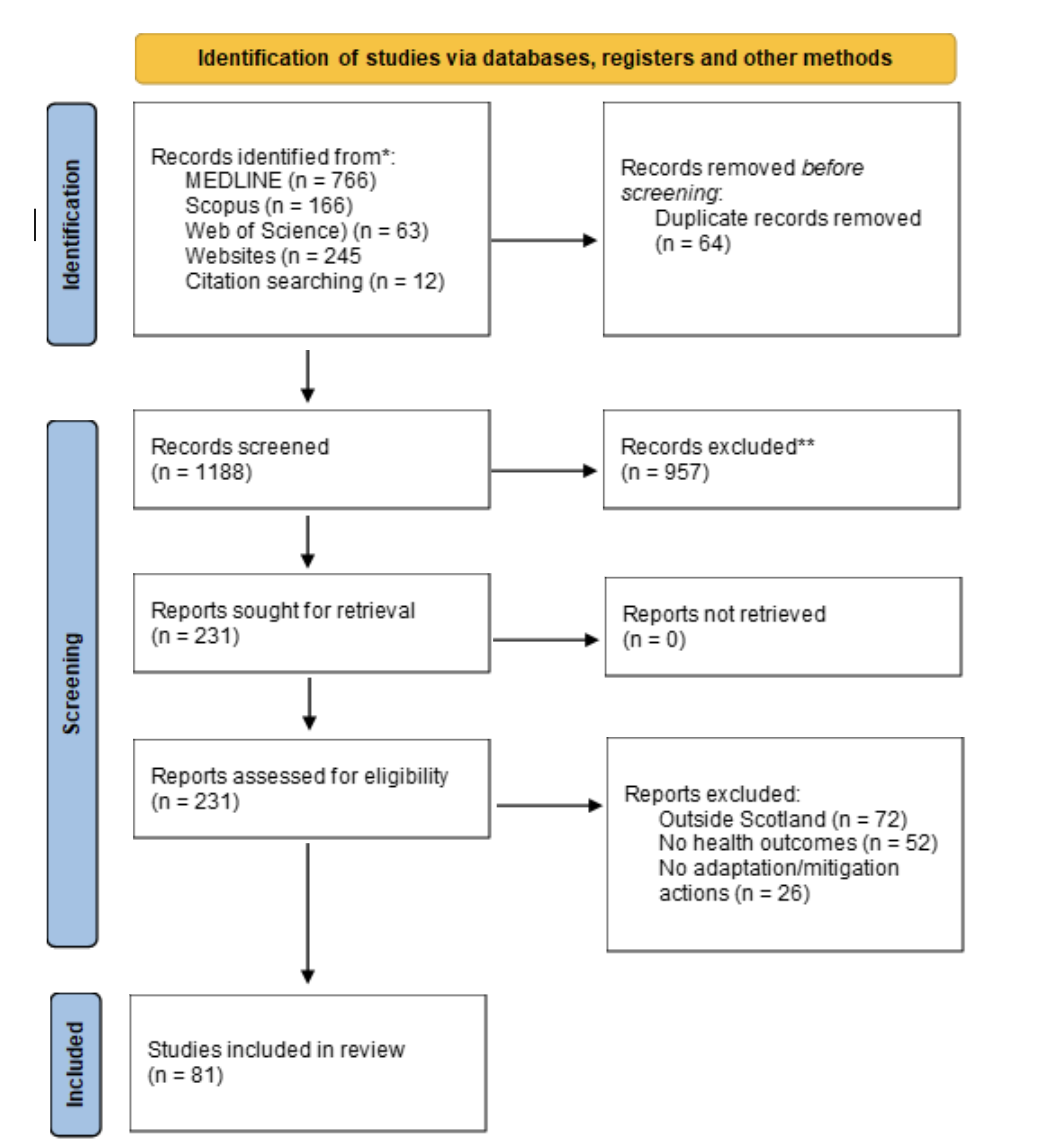
Evidence gap map
Using the finalised code sets developed in EPPI-Reviewer we produced (an) evidence gap map(s) using EPPI-mapper software. The interactive map(s) illustrate(s) the distribution of evidence according to the climate action typology and type of measurement. It facilitates quick access to topic-specific references as well as highlighting where little or no evidence was identified.
Call for Evidence
The call for evidence is reproduced below. This was shared on the CXC website, Linkedin and sent out by email.
Call for Evidence: Measuring the Impact of Climate Policy on Health and Health Equity Outcomes in Scotland
Summary
As part of a Scottish Government funded project, commissioned through ClimateXChange and delivered in collaboration by Lucidity Services limited and the University of Glasgow, we are inviting submissions of evidence, data, and case studies that demonstrate how climate change mitigation and adaptation policies in Scotland are affecting health outcomes and health equity.
This call for evidence will support Scottish Government policy development including the forthcoming CCP 2026-2040, implementation of SNAP3 2024–2029 to achieve a Just Transition towards net zero, and the health and equity goals of Scotland’s Population Health Framework.
This call for evidence runs until 16th January 2026
Call for Evidence Description
Climate change presents one of the most significant challenges to health and wellbeing in Scotland. The ways in which Scotland adapts to and mitigates climate change, through policies that reduce emissions, enhance resilience, and support a just transition, can have wide-ranging impacts on health outcomes and inequalities.
Policies that aim to reduce carbon emissions or increase climate resilience can influence the social, environmental and economic determinants of health. These impacts may be direct (e.g. through air quality improvements or energy efficiency schemes) or indirect (e.g. through changes in employment, housing, transport, or access to green space). Understanding these relationships is essential for developing climate policy that supports population health and ensures equitable health outcomes for all communities in Scotland.
This call for evidence seeks contributions that will help identify, collate and connect existing or emerging research on the effect of climate policy, and interventions, on health and health equity in Scotland, and how this is being measured/evaluated.
Background to this Call for Evidence
The Scottish National Adaptation Plan (SNAP3) 2024–2029 sets out actions to strengthen Scotland’s resilience to climate change, supported by a monitoring and evaluation framework. This framework recognises gaps in evidence and indicators to assess the health impacts of climate policy, particularly in relation to health equity. Alongside the forthcoming CCP 2026-2040 and Population Health Framework, this period represents a once-in-a-generation opportunity to maximise the health and justice potential of achieving a just transition in Scotland, through climate action that influences the building blocks of health as well as the fundamental causes of health inequalities.
Currently, there is no consolidated evidence base on how Scottish climate policies affect health and health equity. Addressing this gap will support effective climate and health policy design, monitoring, and evaluation across adaptation, mitigation, just transition, and sustainable health equity priorities.
The findings from this call will contribute to a stocktake of evidence and the development of an expert climate and health network in Scotland. This work is commissioned on behalf of ClimateXChange and directly supports Scottish Government policy making around climate change adaption, mitigation, just transition and health.
Who Should Contribute
We welcome research submissions from a wide range of stakeholders working across national (UK and Scotland), regional and local governance, NHS boards, NGO, charity and third sector, community groups, the private sector, and academia.
What we are looking for and how to respond
We are looking for evidence, data, case studies, or examples of ongoing or completed work that explore, consider or relate to how climate adaptation/mitigation actions or interventions affect health and health equity outcomes in Scotland (and how these outcomes are measured). Your research may therefore relate to the differential impacts on health, and the factors that shape our health, on different population groups in Scotland.
We are particularly interested in submissions that include:
- Measurable outcomes, indicators, or metrics
- Lessons learned from evaluation or monitoring
- Research evaluating qualitative data and/or lived experience
- Examples of partnership or cross-sector collaboration
Submissions might include (but are not limited to):
- Empirical studies or evaluations assessing the health or health equity impacts of specific climate policies (e.g. transport, housing, energy, food systems, or environmental resilience)
- Data sources, indicators, or measurement approaches used to assess the health impacts of climate policy
- Case studies or pilot projects demonstrating good practice in evaluating health outcomes from climate interventions
- Unpublished reports produced by government, local authorities, research institutions, or third-sector organisations
- Ongoing research (with early findings or plans for measuring health impacts)
- Evidence on health equity impacts, particularly how policies affect high-risk or vulnerable groups and communities of place
How to Respond
Please submit your evidence, data, or case study either by completing the online submission form [follow this link: Measuring the Impact of Climate Policy on Health and Health Equity Outcomes in Scotland – Fill out form] or directly by email to CXC1Q28@lucidityservices.limited
If you have questions about the suitability of your submission, please contact CXC1Q28@lucidityservices.limited with “Climate Policy and Health Call for Evidence” in the subject line.
The deadline for responses is 16th January 2026.
Next Steps
All submissions will be reviewed and synthesised as part of a broader evidence-gathering exercise. Findings will inform a summary report describing:
- Current evidence and data sources on the health impacts of climate policy in Scotland
- Gaps and opportunities for future monitoring and evaluation
- Best practice examples of measuring policy impacts on health and equity
- Opportunities for collaboration and the development of a Scottish Climate and Health Network
Contributors may be invited to participate in follow-up workshops or expert discussions to support this work.
Additional Information
Any personal data related to submissions will be handled in accordance with the UK GDPR and the Data Protection Act 2018. Lucidity Services Limited is registered with the Information Commissioner’s Office (ICO) under registration number ZB305267.
Appendix F: Register of expertise
The register of expertise is accessible via the Polinode map on the ClimateXChange website.
Mapping expertise (production of the register)
Experts were identified through an iterative process involving desk-based research, interviews, and consultations. The primary purpose of the mapping was to create a comprehensive database of active research expertise in climate policy and health outcomes and their measurement. The mapping of expertise had three key aims:
- To assess and map the extent of research expertise across Scotland with understanding of how climate adaptation and mitigation policies impact health and health equity.
- To generate a map of active research alongside relevant expertise on the health impacts of climate action in Scotland.
- To support the wider stock take of what evidence exists or is in development to measure the impacts of climate policy on health and the building blocks of health in Scotland.
This work began with an initial sift of publicly available information through institutional websites, staff profiles, and existing research grant sites. A jumping off point was Public Health Scotland (PHS) climate bulletins where a list of relevant climate change and health publications are given. The typology from the literature review was used to guide our search terms, and we sifted through university profile data to snowball information. After review with the steering group, our search expanded to include those working in relevant areas relating to the wider building blocks of health.
This was a non-systematic review, and expertise-stakeholders are included based on active involvement in current, or recently finished, research grants, and/or a minimum of two publications relevant to this research. Experts weren’t just confined to academic circles, and the registry includes those from independent research organisations, public and third sector and think tanks.
In attempt to filter and organise the expertise registry, a layering system has been created to arrange stakeholders and expertise in a tiered system of relevance (Figure 7). Stakeholders and expertise closest to the specific mapping aims are assigned to layer one – that is those whose work specifically involves the use of measurement of health outcomes from climate adaptation and mitigation policy. Layer two and three represent those whose work is either directly (layer 2) or indirectly (layer 3) relevant to the measurement of health outcomes from climate policy. Many of those whose work resides in layers two or three can make supporting contribution to research or policy development and may represent an opportunity to steer their work towards measurement and evaluation of health outcomes in the context of climate policy.
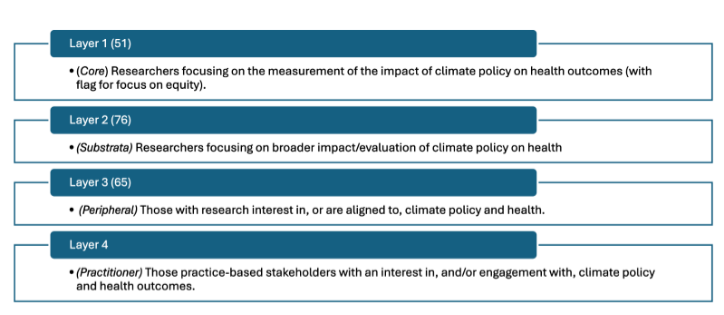
Visualising expertise (production of the Polinode® interactive map)
The visualisation of the expertise register is stored online7 through Polinode software and is publicly accessible. Polinode has enabled a visualisation of the map and gives distinct views to each layer and categorisation. The register of expertise underpins this visualisation and is a resource in its own right and is accessible from the CXC website. The stakeholder map represents a snapshot of activity at the point at which the research for this review was undertaken. At present, there are no current plans/resources to maintain it on an ongoing basis, but any future research network set up may wish to develop this further.
Appendix G: Literature overview (data extraction tables)
Peer-reviewed literature
Data and publication URLs available here: Final data extraction overview
Key: A/M (Adaptation/Mitigation)
Author, Year | Type of publication | Typology category | Climate action | A/M | Focus on health in the paper | Health outcome measure | Type of health metric | Inequality measure(s) |
|---|---|---|---|---|---|---|---|---|
Andrews (2022) | Mixed methods | Community and Social Resilience | Joining Citizens Assembly on climate change | A | Primary | Wellbeing, Emotional Experience | Wellbeing | NA |
Baker et al. (2021) | Cross-sectional | Greener Transport | Active commuting | M | Primary | Mortality/ Deaths Averted | Clinical, Behavioural | NA |
Blane (2023) | Position paper | Greening the Health Sector, Economy, Business and Industry | Sustainability in GP Practices e.g. carbon impact of prescriptions | M | Primary | Mental health, Social Wellbeing, Financial Wellbeing, Digital Inclusion, Community Engagement | Wellbeing | Socioeconomic Disadvantage |
Boyle (2024) | Case study | Agriculture and Land Use, Dietary Change | Sustainable National Food Plans e.g. Scotland’s Good Food Nation Act | M | Secondary | Dietary-related ill-health, Nutritional content of foods | Clinical, Wider Determinants | Mentions affordability |
Brandner (2022) | Cross-sectional | Dietary Change | Purchasing of and knowledge about plant-based protein | M | Secondary | Behaviours (dietary patterns) | Behavioural | Sociodemographic factors, i.e. gender, age, ethnicity, deprivation |
Buckingham (2023) | Workshop/ Position Paper/ Discussion Paper | Agriculture and Land Use, Dietary change, Waste | Reducing GHG and ammonia emissions in agriculture | M | Footnote | Co-Benefits e.g. Dietary habits, Flooding Resilience | Wider Determinants, Behavioural | NA |
Campbell (2019) | Position paper/ editorial | Greener Transport | Active travel and green public transport | M | Primary | Levels of recreational walking | Behavioural | NA |
Cleland (2025) | Qualitative | Dietary Change | Adopting sustainable diets | M | Secondary | Healthy diets, Attitudes towards dietary change | Behavioural/ Attitudes | Deprivation Spatial (Rural/Urban) |
Dick et al (2020) | Systematic map (review) | Biodiversity, Blue and Green Infrastructure, River and Coastal floods and erosion | Nature-Based Solutions (NBS) | Both | Secondary | Human Well Being (HWB) | Wellbeing | Inequalities are mentioned but mainly for the authors to highlight the evidence gap surrounding impact of NBS on equity |
Dittrich (2019) | Modelling study/ Cost Benefit Analysis | Forestry, River and Coastal floods and erosion | Afforestation to reduce flood risk | Both | Footnote | Co-Benefits e.g. recreational and aesthetic value | Wider determinants | NA |
Dogbe (2025) | Modelling study | Economy, Business and Industry, Dietary Change | Minimum pricing on HFSS foods | M | Secondary | Behaviours (purchase/ consumption habits) | Behavioural | Deprivation |
Douglas et al (2023) | Health impact assessment | Greener Transport, Blue and Green Infrastructure | Road space reallocation | M | Primary | Travel behaviours | Behavioural | Multiple sub-groups incl. Deprivation, Age, Disability, Rural vs Urban |
Dunk (2016) | Assessment toolkit | River and Coastal floods and erosion Buildings and Infrastructure Economy, Business and Industry | Adaptation (general) | A | Secondary | Co-impacts e.g. employment and skills impacts | Wider determinants | Vulnerable and hard to reach groups e.g. pensioners |
Dwyer (2022) | Review | Temperature Changes | Heat Action Plans | A | Primary | Mortality, Morbidity, Heat-Health Relationship | Clinical | Socioeconomic, Age (review paper, so reporting from other studies) |
Fronzek (2022) | Modelling study | Agriculture and Land Use | Impact Response Surfaces (IRSs) | A | Secondary | Heat-related Mortality | Clinical | NA |
Goonesekera (2022) | Review (documentary/ policy analysis) | Green and Blue Infrastructure, Temperature Changes, Rivers and coastal floods and erosion, Community and Social Resilience | Adaptation policies, including Our resilient Glasgow: A City Strategy | A | Secondary | Reviews of adaptation indicators/metrics e.g. hospitalisations[28] | Clinical | NA (but makes comment in conclusion re. need to consider equity and justice) |
Gordon (2012) | Review | Biodiversity, Agriculture and Land Use, Cleaner energy and reducing emissions, Natural carbon sinks/Land conservation | Geodiversity/ Geoconservation | Both | Secondary | Opportunities for outdoor recreation, e.g. walking and cycling, rock climbing, caving, skiing, orienteering, canoeing, sailing, camping and outdoor adventure | Wellbeing, Behavioural | NA |
Haf (2019) | Qualitative | Phasing out and regulating fossil fuels Invest in renewables Community and Social Resilience | Community energy projects | M | Footnote | Wider determinants e.g. power, autonomy, fuel poverty | Wellbeing, Wider determinants | NA |
Harrington (2024) | Observational/ ethnographic | Greener Transport Community and Social Resilience | Bike Bus | M | Primary | Wider determinants e.g. air quality. Attitudes e.g. form of protest/ activism | Wider determinants, Behavioural/ Attitudes | Income, Age, Gender, Ethnicity (Demographic information is captured, though not core to analysis) |
Henderson (2025) | Policy review | River and Coastal floods and erosion Community and Social Resilience | Flood risk management and governance | A | Footnote | Physical and Mental Wellbeing (but health is a minor focus) | Wellbeing | |
Higney and Gibb (2024) | Social cost-benefit analysis | Buildings and Infrastructure Cleaner energy and reducing emissions | Retrofit | Both | Secondary | QALYs, Air Quality, Comfort | Clinical, Wellbeing, Wider Determinants | Income |
Hjelmskog (2025) | Systematic review | All | Broad/ overview paper on 15 categories of adaptation and mitigation interventions | Both | Primary | Various, including physical health (e.g., all-cause mortality, respiratory effects, cancer, cardiovascular disease, stroke, disability-adjusted life-years); mental health and wellbeing; and health behaviours (physical activity/ dietary [such as walking and cycling, eating foods with lower greenhouse gas-emission effects | Clinical, Wellbeing, Behavioural | Variety of examples identified, focus on socioeconomic, age, and spatial differences, with fewer papers focusing on inequalities in health related to ethnicity, employment, education, sex, and disability |
Jager (2015) | Policy evaluation | Agriculture and Land Use, River and Coastal Floods and Erosion, Water Availability and Quality, Biodiversity | Clusters of adaptation actions (referred to as policy archetypes) grouped as flooding, water, food etc. | A | Secondary | Wellbeing | Wellbeing | Vulnerability |
Kennedy (2025) | Toolkit/ guidelines | Greening the Health Sector | Sustainable prescribing for respiratory conditions | M | Secondary | Patient Care | Wellbeing | NA |
Koronka (2022) | Mixed methods | Forestry, Economy, Business and Industry | Forest carbon markets | M | Footnote | Co-benefits e.g. public access, creating jobs, aesthetic value | Wider determinants | Not considered in detail but impacts on disadvantaged low-income communities are mentioned |
Li (2019) | Modelling study | Phasing out and Regulating Fossil Fuels, Biosecurity, VBD and Communicable Disease | Shared Socioeconomic Pathway (SSPs) combined with the Representative Concentration Pathways (RCPs) | M | Primary | Risk of Lyme Disease | Clinical | NA |
Lucas (2014) | Theoretical | Greener Transport | Carbon mitigation in the transport sector | M | Secondary | Accident reduction, Increases in physical activity, Air quality, Cost of transport (transport poverty) | Clinical, Behavioural, Wider determinants | Vulnerable groups, including young people; low-income households; women; disabled people; ethnic minorities |
Mabon (2023) | Documentary/ policy analysis | Biodiversity, Blue and Green Infrastructure, River and Coastal floods and erosion, Greener Transport | Nature-Based Solutions | Both | Footnote | General public health benefits | Wellbeing | Deprivation |
Macdiarmid (2016) | Qualitative | Dietary Change | Reducing meat consumption | M | Footnote | Health behaviour: attitudes toward dietary change | Behavioural | Deprivation, Rurality |
Macdiarmid (2022) | Position paper | Dietary Change | Plant-based diets | M | Primary | Nutrient profile of plant-based foods | Wider determinants | NA |
MacDonald (2020) | Impact assessment | River and Coastal floods and erosion | Coastal managed realignment | A | Footnote | Wider determinants e.g. food security, economic impacts, flood protection | Wider determinants | Not explicitly considered but mentions different groups that may be affected e.g. global vs. local in the conclusions |
Malden (2025) | Protocol (for a mixed-methods, longitudinal, pre-post natural experiment) | Biodiversity, Blue and Green Infrastructure | Increasing biodiversity in small parks | Both | Primary | Self-reported well-being, Park usage behaviours | Wellbeing, Behavioural | Deprivation |
McBey (2019) | Qualitative | Dietary Change | Reducing meat consumption | M | Secondary | Behaviour change | Behavioural | Different stages of the lifecourse (e.g. students, new parents, working age, retirees) |
McCartney (2023) | Position paper | Economy, Business and Industry | A Wellbeing Economy which achieves social justice within Planetary Boundaries | M | Footnote | Dignity, Nature, Connection, Fairness, Participation | Wellbeing, Wider determinants | Highlights existing injustices for certain groups under current economic systems (e.g. women, working classes, indigenous populations) |
McCartney et al (2025) | Evidence review | Economy, Business and Industry, Also links to: Cleaner energy and reducing emissions, Natural carbon sinks/Land conservation, Community and Social Resilience | Wellbeing Economy | M | Secondary | High level view of Determinants of health social justice, and welfare state provision | Wider determinants | Deprivation/ Disadvantage |
Meyerricks (2021) | Qualitative | Community and Social Resilience (plus multiple others e.g. Greener Transport, Invest in Renewables, Waste etc.) | Community climate action projects | Both | Secondary | Wellbeing (through work, transport, participation and green spaces for food production, biodiversity and recreation) | Wellbeing, Wider determinants | Deprivation |
Mvula (2025) | Qualitative | Forestry, Agriculture and Land Use | Agroforestry | M | Footnote | Wider determinants e.g. income streams, tourism | Wider determinants | NA |
Nneli (2023) | Modelling study | Economy, Business and Industry, Dietary Change | Taxes on HFSS foods | M | Secondary | Nutrition, Consumer Welfare, Consumption/ Purchases of different food categories | Behavioural | Income, Vulnerability |
Reynolds (2019) | Modelling study | Dietary Change | Healthy and sustainable (lower GHGE) diets | M | Secondary | Nutrient composition | Wider determinants | Income |
Richie (2023) | Theoretical paper | Greening the Health Sector | Green Informed Consent (providing patients with info on carbon impacts of medical processes) | M | Footnote | Doing no harm | Wider determinants | NA |
Ross (2025) | Position paper | Buildings and Infrastructure, Phasing out and regulating fossil fuels, Invest in renewables | Housing retrofit | Both | Primary | Renovictions | Wider determinants | Disadvantage |
Seaton (2022) | Position paper | Cleaner energy and reducing emissions, Buildings and Infrastructure, Greener Transport, Dietary change, Greening the health sector | Improving air quality (multiple actions incl. transport, heating, energy efficiency, diet, personal responsibility) | M | Secondary | Air quality, Personal Carbon Footprints | Wider determinants, Behavioural | Mentions both unequal vulnerability and unequal responsibility (most harm to those who cause the least damage) |
Shipton (2021) | Rapid review/ essay | Economy, Business and Industry | Shifting to an Inclusive Economy | M | Primary | Equitable distribution of the benefits of the economy, including (A) essential goods and services produced; (B) economic participation (e.g., income, networks); (C) assets (egg, wealth, capital); and (D) value ascribed (e.g., to female dominated sectors, the non- monetary economy) | Wellbeing, Wider determinants | Economic (refers to economic inequalities caused by structural injustices – more likely to be experienced by certain populations e.g. women, ethnic minorities, disabled people, those living in deprived neighbourhoods) Suggested metrics include income distribution or childhood well-being |
Smith (2025) | Review/ impact assessment | Cleaner energy and reducing emissions (including Dietary Change), Blue and Green infrastructure, Biodiversity, Economy, Business and Industry, Community and Social Resilience, Marine Conservation | Transitions in: energy, land and marine ecosystems, urban areas, industry and society | Both | Secondary | General human health and well-being | Wellbeing | Not specifically covered, but equitability is named as important |
Tieges (2020) | Longitudinal | Blue and Green Infrastructure | Regeneration of urban waterway (canals) | Both | Primary | All-Cause Mortality | Clinical | Deprivation |
Wan (2024) | Modelling study | Cleaner Energy and Reducing Emissions, Temperature Changes | Shared Socioeconomic Pathway scenarios combined with adaptation | Both | Primary | Mortality | Clinical | Socioeconomic adaptive capacity |
Wardle (2024) | Mixed methods Case study | Agriculture and Land Use, Dietary Change, Community and Social Resilience | Local Food Production/ Farmers markets | Both | Footnote | Nutritional value of food, Attitudes towards food | Behavioural, Wider determinants | Not part of results, but an observation is made in the discussion re affordability/ accessibility of FMs |
References included in the extracted data table
- Andrews N. (2022). The Emotional Experience of Members of Scotland’s Citizens’ Assembly on Climate Change. Frontiers in Climate, 4.
- Graham Baker, Rebecca Pillinger, Paul Kelly, and Bruce Whyte (2021). Quantifying the health and economic benefits of active commuting in Scotland. Journal of Transport and Health, 22.
- Blane David N and Basu Nayanika. (2023). Tackling climate change and health inequalities in primary care. Family Practice, 40(3), pp.498-501.
- Boyle Neil Bernard, Jenneson Victoria, Okeke-Ogbuafor Nwamaka, Morris Michelle A, Stead Selina M, Dye Louise, Halford Jason C G, Banwart Steven A. (2024). Connected Food: First Steps for an Ambitious National Food Strategy. Nutrients, 16(19).
- Brandner Magdalena M E, Fyfe Claire L, Horgan Graham W, Johnstone Alexandra M. (2022). Self-Reported Purchasing Behaviour, Sociodemographic Predictors of Plant-Based Protein Purchasing and Knowledge about Protein in Scotland and England. Nutrients, 14(21).
- Buckingham, S. et al. (2023). Greenhouse Gas and Ammonia Emission Mitigation Priorities for Uk Policy Targets. Frontiers of Agricultural Science and Engineering, 10(2), pp.268-280.
- Campbell Aileen, Yousaf Humza, Brannen Roy, Gray Paul, Hunter Graeme, Mutrie Nanette, and Murray Andrew. (2019). Tackling vehicle emissions and physical inactivity. Scottish Government doubles active travel budget. British Journal of Sports Medicine, 53(8), pp.466-467.
- Cleland E., McBey, D., Darlene, V., McCormick, B., and Macdiarmid, J. (2025). Still eating like there’s no tomorrow? A qualitative study to revisit attitudes and awareness around sustainable diets after 10 years. Appetite, 206, pp.107799.
- Dick, J., Carruthers-Jones, J., Carver, S., Dobel, A., and Miller, J. (2020). How are nature-based solutions contributing to priority societal challenges surrounding human well-being in the United Kingdom: a systematic map. Environmental Evidence, 9.
- Dittrich R, Ball T, Wreford A, Moran D, and Spray CJ. (2019). A cost-benefit analysis of afforestation as a climate change adaptation measure to reduce flood risk. Journal of Flood Risk Management, 12(4).
- Dogbe Wisdom, Huang Kaizhe, and Revoredo-Giha Cesar. (2025). Impacts of a minimum pricing policy on high fat, sugar and sodium (HFSS) foods: Environmental, dietary and welfare analysis. Economics and human biology, 58, pp.101514.
- Douglas, M., Teuton, J., Macdonald, A., Whyte, B., and Davis A.L. (2023). Road space reallocation in Scotland: A health impact assessment. Journal of Transport and Health, 30.
- Dunk, RM, Satyal P, and Bonaventura M. (2016). A Novel Impact Assessment Methodology for Evaluating Distributional Impacts in Scottish Climate Change Adaptation Policy. Implementing Climate Change Adaptation in Cities and Communities: Integrating Strategies and Educational Approaches, (World Symposium on Climate Change Adaptation), pp.75-98.
- Dwyer Ian J, Barry, Sarah J E, Megiddo Itamar, and White Christopher J. (2022). Evaluations of heat action plans for reducing the health impacts of extreme heat: methodological developments (2012-2021) and remaining challenges. International Journal of Biometeorology, 66(9), pp.1915-1927.
- Fronzek Stefan, Honda Yasushi, Ito Akihiko, Nunes Joao Pedro, Pirttioja Nina, Raisanen Jouni, Takahashi Kiyoshi; Terama Emma; Yoshikawa Minoru; Carter Timothy R. (2022). Estimating impact likelihoods from probabilistic projections of climate and socio-economic change using impact response surfaces. Climate Risk Management, 38.
- Goonesekera SM and Olazabal M. (2022). Climate adaptation indicators and metrics: State of local policy practice. Ecological Indicators, 145.
- Gordon JE and Barron HF. (2012). Valuing Geodiversity and Geoconservation: Developing a More Strategic Ecosystem Approach. Scottish Geographical Journal, 128(3-4), pp.278-297.
- Haf S, Parkhill K, McDonald M, and Griffiths G. (2019). Distributing power? Community energy projects’ experiences of planning, policy and incumbents in the devolved nations of Scotland and Wales. Journal of Environmental Planning and Management, 62(6), pp.921-938.
- Harrington Deirdre M, Bardid Farid, Cory Katherine, Dixon James, Dodd Sarah, Ferguson Neil, Roberts Jennifer J and Bonner James. (2024). (Two) Wheels on the Bus: Road User Perceptions of a Bike Bus and How This Links to Addressing Global Health Challenges. Journal of Physical Activity and Health, 21(12), pp.1382-1390.
- Henderson F, Bennett B, Dohain-Lesueur R, and Helwig K. (2025). It’s not really their problem: Reactive institutional community engagement and flood policy implementation. International Journal of Disaster Risk Reduction, 116.
- Higney, A., and Gibb, K. (2024). Net zero retrofit of older tenement housing – The contribution of cost benefit analysis to wider evaluation of a demonstration project. Energy Policy, 191.
- Hjelmskog Annika, Boyd Jennifer, Stevenson Amy, Pollack Roxana, Elsenbroich Corinna, Heppenstall Alison, Toney Jaime, Winterbottom Jo, and Meier Petra. (2025). The effect of climate mitigation and adaptation policies on health and health inequalities: a systematic review. The Lancet. Planetary health, 9(7), pp.101277.
- Jager J, Rounsevell M, Harrison P, Omann I, Dunford R, Kammerlander M, and Pataki G. (2015). Assessing policy robustness of climate change adaptation measures across sectors and scenarios. Climatic Change, 128(3-4), pp.395-407.
- Kennedy Emily, Vint Karen, Mair Alpana, Wilson Iain, Rose Lesley, Eastop Fiona, and Law Stuart. (2025). Quality prescribing strategy for respiratory conditions in Scotland: improving patient care and promoting environmental sustainability. The International Journal of Pharmacy Practice, 33(5), pp.534-540.
- Koronka J, Ovando P, and Vergunst J. (2022). Understanding values beyond carbon in the Woodland Carbon Code in Scotland. Trees Forests and People, 9.
- Li Sen, Gilbert Lucy, Vanwambeke Sophie O, Yu Jianjun, Purse Bethan V, and Harrison Paula A. (2019). Lyme Disease Risks in Europe under Multiple Uncertain Drivers of Change. Environmental Health Perspectives, 127(6), pp.67010.
- Lucas K and Pangbourne K. (2014). Assessing the equity of carbon mitigation policies for transport in Scotland. Case Studies on Transport Policy, 2(2), pp.70-80.
- Mabon, L. (2023). At the margins of the international community, but inside global knowledge and policy flows? How cities in Taiwan and Scotland position themselves within intergovernmental rhetoric on nature-based solutions. Nature-Based Solutions, 4.
- Macdiarmid Jennie I, Douglas Flora, and Campbell Jonina. (2016). Eating like there’s no tomorrow: Public awareness of the environmental impact of food and reluctance to eat less meat as part of a sustainable diet. Appetite, 96, pp.487-493.
- Macdiarmid J I. (2022). The food system and climate change: are plant-based diets becoming unhealthy and less environmentally sustainable? The Proceedings of the Nutrition Society, 81(2), pp.162-167.
- MacDonald MA, de Ruyck C, Field RH, Bedford A, and Bradbury RB. (2020). Benefits of coastal managed realignment for society: Evidence from ecosystem service assessments in two UK regions. Estuarine Coastal and Shelf Science, 244.
- Malden, S., McDougall, C.W., Ward Thompson, C., Wendelboe-Nelson, C., Ross-Perez, A., Clemens, T., Mason, S., Villegas-Diaz, R., Hoadley, A., Hunter, A., Jepson, R., and Williams, A.J. (2025). Evaluating the health and well-being effects of increasing biodiversity within multiple small parks in Edinburgh, UK: a protocol for a mixed-methods, longitudinal, pre-post natural experiment. BMJ open, 15(9), pp.e101061.
- McBey, D., Watts, D., and Johnstone, A.M. (2019). Nudging, formulating new products, and the lifecourse: A qualitative assessment of the viability of three methods for reducing Scottish meat consumption for health, ethical, and environmental reasons. Appetite, 142.
- McCartney Gerry, Hensher Martin, and Trebeck Katherine. (2023). How to measure progress towards a wellbeing economy: distinguishing genuine advances from window dressing. Public Health Research and Practice, 33(2), pp.
- Meyerricks S and White RM. (2021). Communities on a Threshold: Climate Action and Wellbeing Potentialities in Scotland. Sustainability, 13(13), pp.
- Mvula A, Prager K, and Geris J. (2025). Some love them, others hate them: Understanding farmers tree planting decisions in Scotland. People and Nature.
- Nneli, A., Revoredo-Giha, C., and Dogbe, W. (2023). Could taxes on foods high in fat, sugar and salt (HFSS) improve climate health and nutrition in Scotland? Journal of Cleaner Production, 421.
- Reynolds, C.J., Horgan, G.W., Whybrow, S., and Macdiarmid, J.I. (2019). Healthy and sustainable diets that meet greenhouse gas emission reduction targets and are affordable for different income groups in the UK. Public Health Nutrition, 22.
- Richie Cristina (2023). “Green informed consent” in the classroom, clinic, and consultation room. Medicine, health care and philosophy, 26(4), pp.507-515.
- Ross Heather and McCartney Gerry. (2025). Renoviction and health: an emerging research agenda. Journal of Epidemiology and Community Health, 79(4), pp.239-241.
- Seaton Anthony. (2022). Air pollution: What is it and what we must do. The journal of the Royal College of Physicians of Edinburgh, 52(3), pp.267-272.
- Shapovalova Daria, Bender Keith A., Bone and John, and Potts Travis. (2025). A place-based approach to measuring a just transition: Evidence from the north-east of Scotland. Energy Research and Social Science.
- Shipton Deborah, Sarica Shifa, Craig Neil, McCartney Gerry, Katikireddi Srinivasa Vittal, Roy Graeme, McGregor Peter, and Scobie Graeme. (2021). Knowing the goal: an inclusive economy that can address the public health challenges of our time. Journal of Epidemiology and Community Health, 75(11), pp.1129-1132.
- Smith Pete, Singh Pramod K, Ballal Vedant P, Cherubini Francesco, Diaz-Jose Julio, Duchkova Helena, Gupta Himangana, Hori Masakazu, Ito Akihiko, Khan Shabana, Llope Marcos, Tirado Maria Cristina, Tourinho Luara, Vale Mariana M, Xu Xiyan, Chudasama Harpalsinh, Eriksen Siri H, Mason-D’Croz Daniel, Phang Sui Chian, Srivastava Yash, van Huysen Tiff L, Ricketts Taylor, Herrero Mario, Harrison Paula A, and McElwee Pamela D. (2025). Impacts of Climate Change Interventions on Biodiversity, Water, the Food System and Human Health and Well-Being. Global Change Biology, 31(9), pp.e70444.
- Tieges Zoe, McGregor Duncan, Georgiou Michail, Smith Niamh, Saunders Josie, Millar Richard, Morison Gordon, and Chastin Sebastien. (2020). The Impact of Regeneration and Climate Adaptations of Urban Green-Blue Assets on All-Cause Mortality: A 17-Year Longitudinal Study. International Journal of Environmental Research and Public Health, 17(12).
- Wan Kai, Hajat Shakoor, Doherty Ruth M, and Feng Zhiqiang. (2024). Integrating Shared Socioeconomic Pathway-informed adaptation into temperature-related mortality projections under climate change. Environmental Research, 251(Pt 2), pp.118731.
- Wardle Jennifer, Sorathia Aslam, Smith Pete and Feliciano Diana. (2024). Environmental, social and economic perceptions of local food production: a case study of Aberdeenshire farmers’ markets. Scottish Geographical Journal, 140(1-2), pp.233-247.
Data extraction grey literature
Key: A/M (Adaptation/Mitigation)
Author/ Org, year | Type of publication | Typology category | Climate action | A/M | Focus on health in the paper | Health outcome measure | Type(s) of health metric | Inequality measure(s) |
|---|---|---|---|---|---|---|---|---|
Brennan and Ogilvie (2025) | Health impact scoping report | Greener transport, co-benefits reported for Biodiversity, Blue and green infrastructure | Proposed Edinburgh north-south tram extension | M | Primary | Obesity and related conditions, road traffic accidents, access to reliable public transport | Clinical, wider determinants | Deprivation (SIMD), low-income, vulnerable groups including women and children |
Cleaner air for Scotland (2016) | Scoping report | Agriculture and land use, buildings and infrastructure, greener transport, economy, business and industry, waste, community and social resilience | Multiple measures for improving air quality e.g., housing retrofit, decarbonising vehicles, more sustainable fertiliser use and soil/land management | Both | Secondary | Physical activity levels, obesity, physical and mental wellbeing, stress | Clinical, wellbeing, behavioural | Income. Authors state the need to avoid widening health inequalities (as can happen when high-agentic interventions are adopted by affluent groups) |
Community land Scotland (2022) | Funding evaluation | Community and social resilience, blue and green infrastructure | Community gardens / allotments, enhanced greenspace, insect-friendly planting | Both | Secondary | Wellbeing, mental health, access to sports facilities, walking | Wellbeing, wider determinants, behavioural | The paper notes the overall importance of inclusivity and diversity e.g., for people with disabilities |
COSLA healthier Scotland (2014) | Report | Greener transport | National walking strategy | M | Primary | Levels of walking, risk of disease incidence, mental and physical health improvement, expansion of social networks | Clinical, wellbeing, wider determinants, behavioural | Importance for vulnerable populations highlighted e.g., elderly and disabled people |
Dow (2025) | Briefing paper | Cleaner energy and reducing emissions (reducing fossils fuels and dietary change), water availability and quality, blue and green infrastructure, greener transport | Broad selection including urban river restoration, plant-based diets, switching to walking and cycling, and overall reducing carbon emissions (adaptation/ mitigation is the secondary focus of this paper) | Both | Primary | Disease incidence, improving health and wellbeing, air quality, financial and social co-benefits | Clinical, wellbeing, wider determinants | The paper draws attention to the need to ensure vulnerable populations benefit from these A/M actions |
Everyone’s environment (2025) | Position statement | Blue and green infrastructure; greener transport; buildings and infrastructure; cleaner energy and reducing emissions (renewables) | Green and blue spaces, transport, renewables, housing, and green jobs | Both | Footnote | Healthy environment: access to greenspace; accessible, affordable and clean transport; fair access to renewables; housing quality; accessible green jobs and skills | Wider determinants | Marginalised and disadvantaged groups i.e. By age, disability, ethnicity |
Gibb et al., (2023). | Evaluation | Buildings and infrastructure | Housing retrofit (tenement block) | Both | Secondary | QALYs, indoor air quality (measurement of carbon dioxide (CO2)), thermal comfort, cost of energy, occupant satisfaction | Clinical, wellbeing, wider determinants | Paper highlights the importance of this retrofit to those who are most vulnerable to fuel poverty/ energy poverty |
Harkins (2022), Glasgow Centre for Population Health | Evaluation | Community and social resilience, economy, business and industry, blue and green infrastructure | Wee green grants green participatory budgeting process (Glasgow) | Both | Secondary | Depth of community engagement, democratic participation | Wellbeing | Excluded or vulnerable groups e.g., disabled or easy to ignore communities |
Health and Social Care Alliance Scotland (the ALLIANCE) (2025) | Policy consultation response | Buildings and Infrastructure, Greener Transport, Economy, Business and Industry, Community and Social Resilience | Energy efficiency measures, sustainable and active transport, human rights budgeting (incl. Gender budgeting and wellbeing economy) | Both | Primary | The right to health and a healthy environment, provision of care | Wellbeing, wider determinants | The report highlights the needs of different groups i.e., by deprivation, disability, age, gender, rurality and that impacts of policies will not be felt equally or be equally accessible/ affordable |
Highland Community Planning Partnership (2024) | Report | Greening the health sector, blue and green infrastructure, biodiversity, greener transport | Improving NHS greenspaces, biodiversity, active health (café and bike workshop) | Both | Secondary | Health and wellbeing, multiple health outcomes, pro-environmental behaviours, | Wellbeing, behavioural | Socio-economic |
Highland Adapts (2023) | Guidance document | Community and social resilience, agriculture and land use, blue and green infrastructure, greener transport, | Community food growing and gardening, walking in nature, cycling, green health activities e.g., Tree planting, conservation volunteering | Both | Primary | Multiple health outcomes, physical activity, wellbeing | Wellbeing, wider determinants, behavioural | Deprivation/ socio-economic |
Improvement service (2021) | Briefing note | Green and blue infrastructure, greener transport | Nature-based solutions | Both | Secondary | Wellbeing benefits, improved air quality, exposure to flooding risk, physical activity, contact with nature | Wellbeing, wider determinants, behavioural | Disadvantaged communities |
Improvement service (2025) | Briefing paper | Cleaner energy and reducing emissions (renewables), buildings and infrastructure, greener transport, economy, business and industry, community and social resilience | The just transition to a net zero economy, housing retrofit, renewable energy projects, active travel and public transport, community and youth engagement e.g. urban greening/ conservation/ tree planting | Both | Footnote | Co-benefits e.g., warmer homes, cleaner air, green job opportunities | Wider determinants | The paper is specifically concerned with child poverty, but also highlights that climate action needs to be designed in a way that does not exacerbate existing inequities |
Just Transition Commission (2021) | Report | Cleaner energy and reducing emissions (reducing fossil fuels, increasing renewables, and dietary change), building and infrastructure, agriculture and land use, greener transport, economy, business, and industry, community and social resilience | Features of a just transition in Scotland (multiple climate actions named e.g. Energy efficiency measures in housing, sustainable food systems, free public transport, carbon border tax, participatory budgeting) | Both | Footnote | Health and wellbeing | Wellbeing | The report makes general points about the need to prioritise the most vulnerable in society |
Living streets Scotland (2022) | Briefing paper | Greener transport, blue and green infrastructure | Walking, active travel infrastructure | M | Secondary | Levels of physical activity, levels of overweight/ obesity | Clinical, behavioural | Deprivation, age (children and older people), disability |
Mitchell and Finton (2022) | Evaluation | Greening the health sector | Green health partnerships | Both | Primary | Availability of/ opportunities for green health activities, number of people participating in green health activities | Wider determinants, behavioural | Not considered at this stage of the project, but noted as important for future reports |
Mobility and access committee for Scotland | Report | Greener transport | Reducing car usage e.g. Through low emission zones (LEZs) and 20-minute neighbourhoods | M | Secondary | Air quality, mental and physical health, physical activity, community improvements e.g. Thriving businesses | Wellbeing, wider determinants, behavioural | The report points out the potential of different impacts from such policies on rural or disabled populations |
Muirie (2017), Glasgow Centre for Population Health | Report/ evidence synthesis | Greener transport | Active travel in Glasgow | M | Primary | Body mass index (BMI), levels of physical activity, air quality, social isolation, wellbeing | Clinical, wellbeing, behavioural | Groups most vulnerable to harms from air pollution e.g. By age, or pre-existing cardiac/ respiratory conditions |
NatureScot (2025) | Report/ evaluation | Greening the health sector, community and social resilience | Green health partnerships/ Scotland’s natural health service programme, including green health prescriptions e.g. Access to outdoors and sustainable nature-based interventions | Both | Primary | Number of people participating in green health activities, Number of green health referrals, Integration of green health activities into health sector planning, Overall population health and wellbeing (specific measures detailed in their evaluation framework) TOOL: evaluation framework developed with University of Glasgow researchers | Wellbeing, wider determinants, behavioural | Spatial: programme piloted in areas (both rural and urban) with health inequalities, disadvantage, and low levels of physical activity |
Public Health Scotland, Adaptation Scotland, Improvement Service (2023) | Briefing paper | Biodiversity, blue and green infrastructure, river and coastal floods and erosion, greener transport, buildings and infrastructure | Wide range of actions including: nature-based solutions e.g. To flooding, housing retrofit, accessible green transport, improved greenspace/ biodiversity | A | Secondary | Opportunities for physical activity, Social Interaction, and Contact with Nature, Community Empowerment TOOL: place standard tool (PST) with a climate lens | Wider determinants | Social and economic disadvantage |
Scottish Communities Climate Action Network (2024) | Literature review | Green and blue infrastructure, river and costal floods and erosion, temperature changes | Responses to extreme weather events, coastal adaptation including flood defences and relocation, green cover in urban areas, | A | Secondary | Heat stress, mental wellbeing, displacement, welfare of residents | Clinical, wellbeing, wider determinants | Disadvantaged communities, including imbalances of power and adaptive capacity |
Scottish Parliament cross party group on sustainable transport (2023) | Inquiry report | Greener transport, cleaner energy and reducing emissions | Zero-carbon public transport (including buses, railways, ferries) | M | Footnote | Air quality, noise pollution, job creation | Wider determinants | The report states that benefits (e.g. from improved air quality) could have largest impacts for vulnerable members of society |
Scottish Government (2025) | Report | Blue and green infrastructure, marine conservation, natural carbon sinks/ land conservation, biodiversity | Investing in Scotland’s natural capital, i.e. Geology, soil, air, water, plants and animals | Both | Secondary | General health and wellbeing benefits, air pollution removal, cost savings to the NHS, health impact savings(£) | Wellbeing, wider determinants | The report highlights the relationship between socioeconomic deprivation and poor air quality |
Scottish parliament cross party group on sustainable transport (2025) | Report from evidence sessions (including lived experiences) | Greener transport | Sustainable transport | M | Secondary | Transport poverty | Wider determinants | Poverty, age, gender, disabilities |
Walking Scotland (2025) | Manifesto | Greener transport | Walking and wheeling | M | Secondary | Avoided deaths and diseases (mortality and morbidity), improved wellbeing, air quality | Clinical, wellbeing, wider determinants | Underserved communities |
Walking Scotland (2025) | Survey | Greener transport | Walking and wheeling | M | Secondary | Benefits to physical and mental health, Wellbeing, barriers to walking and wheeling | Wellbeing, Behavioural/ attitudes | Results are stratified according to demographics and geography e.g. Deprivation, age, gender, ethnicity, rurality, disability |
Woodland Trust Scotland (2024) | Report | Forestry, biodiversity, water availability and quality, agriculture and land use, temperature changes, community and social resilience | The role of native woods and trees in Scotland | Both | Footnote | Quality of life, general health and wellbeing, tree equity rule (3-30-300) | Wellbeing, wider determinants | The report considers the extra importance of trees for urban residents. Tree equity: 3-30-300 rule |
Wray (2020) | Scoping review and survey | Greener transport | Access to bikes schemes e.g. Cycle to work | M | Footnote | Travel behaviours, accessibility/ affordability of schemes | Wider determinants, behavioural | People with disabilities/ reduced mobility |
Yates et al., (2018), Glasgow Centre for Population Health | Evaluation | Community and social resilience | Weathering change: communities becoming more resilient to current and future environmental, social and economic challenges (exacerbated by climate change) | A | Footnote | Social connections, getting around, food, keeping warm and dry, leisure and play, | Wider determinants | Age, gender, ethnicity |
Yates and Whyte (2019), Glasgow Centre for Population Health | Evaluation | Greener transport | Bikes for all (Glasgow) | M | Primary | Self-reported physical health, mental wellbeing, and fitness | Clinical | Socio-demographic characteristics captured e.g. Postcode (SIMD), gender, age, ethnicity |
Zamuruieva et al., (2023), Adaptation
| Research report including literature review and interviews | Agriculture and land use, biodiversity, forestry, waste, community and social resilience, river and coastal floods and erosion | The report looks at a wide range of areas for adaptation including biodiversity conservation, woodland planting, use of local waste products in agriculture, community flood responses | A | Footnote | General health and wellbeing, affordable housing, food and energy prices, secure employment, community connectedness and participation | Wellbeing, wider determinants | Land use is highlighted as an important area for the just transition, for vulnerable groups who are most exposed, and have least adaptative capacity, e.g. By income, ethnicity, age, ill-health, and coastal and rural populations |
Zeidler (2023), Carnegie UK | Discussion paper | Economy, business and industry | Transformation to a wellbeing economy | M | Footnote | Thriving measures fall under: Place, Personal Wellbeing, Health, Education, Economic Security, Community and Democracy Appendix has an indicator pool – (physical health examples: low birth weight, life expectancy, physical activity; mental health examples: severe mental illness, suicide risk) | Clinical, wellbeing, wider determinants, behavioural | Disability, gender and sexuality, social and economic, ethnicity, human rights |
Zero emissions social housing taskforce (ZEST), (2021) | Report | Buildings and infrastructure, cleaner energy and reducing emissions (reducing fossil fuels, support for renewables) | Decarbonisation of housing and retrofit | Both | Secondary | Wellbeing, comfort, quality of homes | Wellbeing, wider determinants | Social housing tenants |
References included in the grey literature data extraction table:
- Brennan, J., and Ogilvie, F. (2025). Health Impact Scoping Report: Proposed Edinburgh North-South Tram Extension, NHS Lothian.
- Cleaner Air for Scotland Climate Change Sub-Group. (2016). Synergies and tensions between climate change and air quality actions.
- Community Land Scotland. (2022). Owning our Future.
- COSLA Healthier Scotland. (2014). Let’s Get Scotland Walking.
- Dow K. (2025). Links between Climate Change and Health in Scotland. SPICe (Scottish Parliament Information Centre) Available at: https://digitalpublications.parliament.scot/ResearchBriefings/Report/2025/7/22/43f04848-fb71-4c5c-b568-2481bf656130
- Everyone’s Environment. (2025). Making environmental policy inclusive in Scotland. ERCS. Available at: https://www.ercs.scot/resources/everyones-environment-scotland/
- Gibb, K. et al. (2023). Niddrie Road, Glasgow: Tenement Retrofit Evaluation. Glasgow: Available at: https://housingevidence.ac.uk/wp-content/uploads/2024/02/Niddrie-Road-v4.pdf.
- Harkins, C. (2022). Evaluation of Glasgow City Council Parks and Greenspace: Wee Green Grants Participatory Budgeting Processes 2019-2020. GCPH.
- Health and Social Care Alliance Scotland (The ALLIANCE.) (2025). Draft Climate Change Plan Scrutiny 2025 Call for Views ALLIANCE Response.
- Highland Adapts. (2023). Nature Climate Health. Available at: https://www.thinkhealththinknature.scot.nhs.uk/wp-content/uploads/2023/06/Agenda-Item-6-Climate-Nature-Health-Guidance-for-Community-Partnerships-06.06.23-1.pdf
- Highland Community Planning Partnership. (2024). Highland Green Health Partnership Annual Report.
- Improvement Service. (2021). Elected Member Briefing Note: Nature-based Solutions. Available at: https://www.improvementservice.org.uk/__data/assets/pdf_file/0019/26434/EM-Briefing-Nature-Based-Solutions.pdf
- Improvement Service. (2025). Child Poverty and Climate Change.
- Just Transition Commission. (2021). Just Transition Commission: A national mission for a fairer, greener Scotland. Available at: https://www.gov.scot/publications/transition-commission-national-mission-fairer-greener-scotland/.
- Living Streets Scotland. (2022). Getting Scotland Walking: The Case for Action.
- McCartney, G. et al. (2025). Evidence review to support the development of a Wellbeing Economy strategy in Scotland. Post Growth Economics Network, pp. Available at: https://www.postgrowtheconomics.org/wp-content/uploads/2025/01/PEN-WP_2025-01.pdf.
- Mitchell, R. and Finton, B. (2022). Green Health Partnerships in Scotland – evaluation of the first three years.
- Mobility and Access Committee for Scotland. MACS Annual Report 2022-2023. Edinburgh: Transport Scotland, Available at: https://www.transport.gov.scot/publication/mobility-and-access-committee-for-scotland-annual-report-2022-2023/.
- Muirie, J. (2017). Active Travel in Glasgow: What we’ve learned so far. GCPH.
- Nature Scot. (2025). Realising the Potential of Scotland’s Natural Health Service in Practice. Available at: https://www.nature.scot/doc/realising-potential-scotlands-natural-health-service-practice.
- Public Health Scotland and Adaptation Scotland; Improvement Service. (2023). Working together to build climate-resilient, healthy and equitable places. Available at: https://adaptation.scot/app/uploads/2024/09/climate-adaptation-and-health-inequalities-briefing.pdf.
- Scottish Communities Climate Action Network. (2024). Rapid literature review of impacts of severe weather and effects of long-term climate related issues on communities. CAG Consultants.
- Scottish Parliament Cross Party Group on Sustainable Transport. (2025). Mind the Gap: Tackling Transport Inequalities in Scotland. Available at: https://transform.scot/2025/06/17/mind-the-gap-new-inquiry-reports-transport-system-excluding-majority-of-scots/.
- Scottish Government. (2025). Making the Case for Nature: Insights from Scotland’s Natural Capital Analyses.
- Scottish Parliament Cross Party Group on Sustainable Transport. (2023). Fossil-Free Future: Accelerating Scotland to Zero-Carbon Public Transport. Available at: https://transform.scot/our-work/our-projects/fossil-free-future/.
- Walking Scotland. (2025). The Power of Walking.
- Walking Scotland. (2025). Scottish Walking and Wheeling Survey 2025.
- Woodland Trust Scotland. (2024). Trees and Woods: At the heart of nature recovery in Scotland.
- Wray, E. (2020). Access to Bike Schemes in Scotland. Edinburgh
- Yates Gregor et al. (2018). Weathering Change: Community Resilience in the face of climate change. GCPH.
- Yates, Gregor and Whyte, Bruce. (2019). Bikes for All Evaluation. Glasgow: Available at: https://www.gcph.co.uk/latest/publications/258-bikes-for-all-widening-access-to-cycling-through-social-inclusion
- Zamuruieva, I., Payne, C., Wolstenholme, R., Casey, J., Connor, B., and Cameron-Smith, A. (2023). Land Use and Climate Change Adaptation in Scotland: Insights. Adaptation Scotland. Available at: https://adaptation.scot/app/uploads/2024/09/land-use-and-climate-change-adaptation-report-digital-v2.pdf
- Zeidler Liz. (2023). The Shared Ingredients for a Wellbeing Economy. Available at: https://carnegieuk.org/publication/the-shared-ingredients-for-a-wellbeing-economy/
- Zero Emissions Social Housing Taskforce (ZEST). (2021). Achieving Net Zero in Social Housing.
How to cite this publication:
Hjelmskog, A., Heslop, E., Murphy, B., Lester, S., Heslop, M., Ayala, P., Booth, I., Maclaren, A. and Ponce Hardy, V. (2026) Measuring the impact of climate policy on health and health equity outcomes in Scotland, ClimateXChange.
© The University of Edinburgh, 2026
Prepared by Ipsos UK on behalf of ClimateXChange, The University of Edinburgh. All rights reserved.
While every effort is made to ensure the information in this report is accurate as at the date of the report, no legal responsibility is accepted for any errors, omissions or misleading statements. The views expressed represent those of the author(s), and do not necessarily represent those of the host institutions or funders.
This work was supported by the Rural and Environment Science and Analytical Services Division of the Scottish Government (CoE – CXC).
ClimateXChange
Edinburgh Climate Change Institute
High School Yards
Edinburgh EH1 1LZ
+44 (0) 131 651 4783
If you require the report in an alternative format such as a Word document, please contact info@climatexchange.org.uk or 0131 651 4783.
FOOTNOTES
https://publichealthscotland.scot/population-health/environmental-health-impacts/climate-emergency/health-impacts-of-climate-change/impact-on-the-building-blocks-of-health-and-wellbeing/ ↑
https://publichealthscotland.scot/publications/working-together-to-build-climate-resilient-healthy-and-equitable-places-a-briefing-for-local-government-and-partners ↑
https://www.gov.scot/publications/scotlands-climate-change-plan-2026-2040/ ; https://www.gov.scot/policies/climate-change/ ↑
https://www.theccc.org.uk/wp-content/uploads/2025/10/CCC-letter-to-Minister-Hardy-15-October-2025.pdf ↑
https://www.gov.scot/policies/climate-change/just-transition/ ↑
https://www.gov.scot/publications/scotlands-population-health-framework/ ↑
https://www.nrscotland.gov.uk/publications/healthy-life-expectancy-2022-2024/ ↑
https://app.Polinode.com/networks/explore/6965dcd70e6646ca68b7de77/698db273c13825f5e96e87e3 ↑
For the purposes of this rapid review, we identified an expert as those with at least two relevant publications and/or are working on an active grant directly related to the project brief. Inclusion in our register was based on a desk-based review of the material which may not accurately reflect the full expertise held by individuals. ↑
https://publichealthscotland.scot/healthcare-system/system-monitoring-accountability-and-quality-of-care/prescribing-data/national-therapeutic-indicators-ntis/ ↑
Applied here as the Place Standard with a Climate Lens: https://macchub.co.uk/knowledge-base/scotland/place-standard-tool-with-a-climate-lens/ ↑
https://www.lshtm.ac.uk/research/centres-projects-groups/pathfinder-initiative ; https://www.ucl.ac.uk/bartlett/research-projects/2024/sep/policy-and-implementation-climate-health-equity-paice ↑
https://www.gla.ac.uk/pgrs/amystevenson/ ; https://www.gla.ac.uk/pgrs/annitaitto/ ↑
https://blogs.ed.ac.uk/rdoherty/phd-project-inequalities-in-outdoor-and-indoor-air-pollution-in-the-uk-and-implications-for-health-equalities-march-30th-deadline/ ↑
https://www.ucl.ac.uk/bartlett/research-projects/2024/sep/policy-and-implementation-climate-health-equity-paice ↑
https://scothealthequity.org/ ↑
https://publichealthscotland.scot/resources-and-tools/health-strategy-and-outcomes/health-impact-assessment-hia/about-health-impact-assessment/ ; https://www.gov.uk/government/publications/health-equity-assessment-tool-heat ↑
A recording of the launch session is available on YouTube https://www.youtube.com/watch?v=pcsiaBlpxxc ↑
https://www.gla.ac.uk/explore/sustainability/cop28/headline_1022188_en.html ↑
Accompanied by a peer-reviewed article and a report published by Policy Bristol. ↑
Interactive tool available online https://priestleycentre.shinyapps.io/climatecobenefitsportal/ ↑
https://www.gov.scot/publications/nhs-scotland-climate-emergency-sustainability-annual-report-2025/ ↑
- Full dataset is available for download here: https://zenodo.org/records/5705687 ↑
Photo by David Dvořáček on Unsplash