

Climate adaptation and Biodiversity Duty Reporting in Scotland
March 2026
DOI: https://doi.org/10.7488/era/7428
Executive summary
Background
Under the Nature Conservation (Scotland) Act 2004, public bodies in Scotland have a duty to further the conservation of biodiversity when carrying out their responsibilities. The Biodiversity Duty is not only about protecting biodiversity through managing specific sites, habitats and species. It also aims to increase understanding and consideration of the natural environment, including through procurement and resource use, as well as encouraging others to consider biodiversity. As part of that duty, Scottish public bodies must report every three years on the actions they have taken to further the conservation of biodiversity.
However, the current reporting process and its guidance are misaligned with Scotland’s ambitious new biodiversity vision and outcomes as well as climate adaptation objectives, as set out in the Scottish Biodiversity Strategy (SBS) to 2045 and the third Scottish National Adaptation Plan (SNAP3). As a result, the data collected under the Biodiversity Duty may be unsuitable for national monitoring. This disconnect may lead to inefficiencies and missed opportunities to track climate adaptation efforts.
Aims and objectives
The primary aim of this research was to determine what information should be collected through Biodiversity Duty reporting to better align with the monitoring needs of the SBS and SNAP3. A secondary aim was to identify potential improvements to the reporting process, including opportunities to increase efficiency, value, and engagement.
The study combined a desk-based review of the current biodiversity policy and legislative landscape in Scotland, a detailed analysis of 33 published Biodiversity Duty reports, and stakeholder engagement with public bodies and policy makers.
Findings
Our findings indicate that the Biodiversity Duty reporting process could achieve its potential more fully by addressing key opportunities to improve its clarity of purpose, feedback mechanisms, and accountability.
- The process acts as a valuable internal tool for public bodies, who reported that the process of compiling the report is helpful for raising internal awareness of the Biodiversity Duty, enhancing cross-departmental collaboration, and encouraging reflection on their progress
- There is significant confusion among public bodies and policy makers as to whether the primary goal is to monitor national progress against the SBS and SNAP3 or to simply log all actions taken. Our analysis shows the current process does not serve either purpose fully.
- Motivation and reporting compliance are low. Reporting compliance was only 55% in the 2021–23 reporting cycle. Stakeholders partly attribute this to a lack of feedback or analysis from the Scottish Government, which makes the process feel like a “tick-box” exercise with no clear value or consequences.
- Data is inconsistent and cannot be used for monitoring. The flexible guidance for Biodiversity Duty Reporting results in reports of widely varying quality, format, and length. Data provided is largely qualitative, lacks common metrics, and cannot be easily aggregated, compared, or used for national monitoring purposes.
- Published reports contain strong qualitative evidence on local biodiversity action, with particularly good coverage of species and habitats (SBS Objective 4), public engagement (SBS Objective 6), and nature-based solutions (SNAP3 Nature Connects).
- There are significant data gaps for national priorities. Reports provide limited evidence for key national priorities, including nature finance (SBS Objective 5) and sectoral actions in farming, fishing, and forestry (SBS Objective 3).
Opportunities
We identified a series of interconnected opportunities that have potential to improve the Biodiversity Duty reporting process and transform it into a more effective and valuable tool. However, consideration of any resource requirements lies outside the scope of this research:
- Clarify the core purpose of reporting. This is the foundational step. A clear definition of the primary purpose of the reporting is essential, whether for national monitoring of progress against the SBS and SNAP3, as a comprehensive log of all actions taken, or a balance of both. This decision will guide all subsequent improvements.
- Create a feedback and analysis loop. To address the primary driver of low levels of engagement with the Biodiversity Duty reporting process, a formal feedback loop could be established to provide brief, constructive feedback on submitted reports. There may also be value in aggregated analysis of all data to demonstrate the collective contribution to national goals and allow bodies to benchmark their progress.
- Streamline the process with a central portal and improved guidance. A centralised online portal for Biodiversity Duty reporting, similar to that used for the Public Bodies’ Climate Change (PBCC) reporting, could be developed for all submissions. This could provide automated deadline notifications, act as a single submission platform, and host a searchable public database of all submitted reports, guidance, and training materials.
- Introduce standardised, proportionate metrics. A core set of meaningful but achievable quantitative metrics could be incorporated to complement narrative reporting. This would enable data comparison and progress tracking against national objectives and outcomes without being overly resource intensive.
- Introduce training and strengthen support. A programme of regular training webinars, best practice examples, and a dedicated point of contact would be highly valued by public bodies.
- Communicate flexibility of timelines. The Scottish Government could proactively and clearly communicate the existing flexibility, which allows public bodies to report at any point within the three-year cycle that suits their internal workflows, to help alleviate end-of-year pressures which some public bodies have reported.
Glossary / Abbreviations table
Abbreviation | Term |
ARP | Adaptation Reporting Power |
BD reporting | Biodiversity Duty reporting |
CBD | Convention on Biological Diversity |
CCC | Climate Change Committee |
CCRA | Climate Change Risk Assessment |
CNGP | Carbon Neutral Government Programme |
CRFD | Climate-Related Financial Disclosures |
Defra | Department for Environment, Food and Rural Affairs |
EEC | European Economic Community |
EU | European Union |
GBF | Global Biodiversity Framework |
GGS | Greening Government Strategy |
HFW | Holman Fenwick Willan |
ISO | International Organization for Standardization |
MS | Member States |
OECD | Organisation for Economic Co-operation and Development |
REA | Rapid Evidence Assessment |
SBS | Scottish Biodiversity Strategy |
SNAP | Scottish National Adaptation Plan |
TCFD | Task Force on Climate-related Financial Disclosures |
TNFD | Taskforce on Nature-related Financial Disclosures |
Introduction
Under the Nature Conservation (Scotland) Act 2004, public bodies in Scotland have a duty to further the conservation of biodiversity when carrying out their responsibilities. The Biodiversity Duty is not only about protecting biodiversity through managing specific sites, habitats and species. It also aims to (NatureScot, 2023):
- Increase the level of understanding and connection between people and the living environment
- Promote consideration of all impacts on the natural world through actions and decisions, including through procurement and use of resources
- Encourage staff, partners and customers to engage with, understand and consider biodiversity.
As part of the Duty, Scottish public bodies must report every three years on the actions they have taken to further the conservation of biodiversity. ClimateXChange (CXC) commissioned Ipsos in September 2025 to carry out a review of the Biodiversity Duty reporting (BD reporting) process and its existing guidance, to help understand how it might inform key Scottish Government policy areas on biodiversity and climate change adaptation.
Our research assesses the current BD reporting guidance and explores how this might be improved to align with current Scottish Government Biodiversity and Climate Adaptation Plans and their associated monitoring and evaluation frameworks.
The need for this research
The need for this research is driven by the recognised misalignment between the current Biodiversity Duty (BD) reporting guidance and the wider policy landscape. The existing guidance was developed to support the previous Scottish Biodiversity Strategy (SBS) (2004) and the 2020 Challenge for Scotland’s Biodiversity (Scottish Government, 2013). The guidance was partially updated in 2020, and again in 2023, specifically in relation to the newly emerging Nature Network policy[1]. These ‘light touch’ revisions were not designed around the full objectives of the new Scottish Biodiversity Strategy to 2045 (SBS) (Scottish Government, 2024b) and the third Scottish National Adaptation Plan (SNAP3) (Scottish Government, 2024a).
Since the development of guidance on BD reporting, the policy landscape has significantly shifted. The Scottish Government has developed a new Biodiversity Strategy and Delivery Plan, with actions in that Plan also contributing to The Scottish National Adaptation Plan. This has created a disconnect between the existing BD guidance and the current policy landscape, resulting in several potential issues that this research was intended to explore and test:
- The data currently collected through BD reports may not be suitable for the monitoring and reporting of objectives in the SBS and SNAP3.
There is a missed opportunity to use the BD reporting process efficiently to gather data on climate change adaptation actions across the Scottish public sector. - The lack of alignment with the annual Public Bodies Climate Change Duties Reporting (PBCCD) process creates potential for inefficiency and duplication of effort.
Research aims and objectives
The primary aim of our research was to determine what information should be collected through BD reporting to align with the SBS and the SNAP3 monitoring and reporting. A secondary aim was to inform potential improvements in the reporting process itself, including identifying efficiencies.
Research objectives
- To help determine what information should be collected through BD reporting.
- To explore how the BD reporting guidance might be improved to align with current Scottish Government Biodiversity Strategy and Climate Adaptation Plans and their associated monitoring and evaluation frameworks.
To achieve the research objectives, research questions were developed to support the research objectives and can be found in the Appendix A.
Research approach and methods
We used a mixed-methods research design to provide a comprehensive review. Our approach combined desk-based research with in-depth stakeholder engagement. The research consisted of:
- Scoping interviews: we conducted five scoping interviews with key strategic stakeholders within Scottish Government and NatureScot to inform this work. These were carried out in parallel with the desk-based review and Rapid Evidence Assessment (REA).
- Desk-based review: We conducted a desk-based review of the current legislative and policy environment in Scotland. We also analysed a sample of 31 published BD reports to understand current reporting practices and their alignment with national strategies for biodiversity and climate adaptation.
- Rapid Evidence Assessment (REA): We carried out a REA. This assessment looked at similar statutory reporting duties in other countries to identify potential lessons and examples of good practice for Scotland.
- Stakeholder interviews: to gather detailed perspectives on the current process, we conducted 24 in-depth interviews. We spoke with 19 representatives from a diverse range of public bodies responsible for reporting, and with five policy makers who may use the reports.
- Synthesis and stakeholder validation: Finally, we brought all our findings together in a synthesis stage. We used a SWOC (Strengths, Weaknesses, Opportunities, Challenges) analysis to structure the evidence. We then tested and refined our initial recommendations at a stakeholder workshop to ensure they were relevant and practical.
A full, detailed description of our research methodology is available in Appendix B.
Structure of this report
The remainder of this report details the findings, conclusions and recommendations from the mixed-methods research.
Chapter 4 provides a detailed overview of the current policy and legislative landscape. It examines the alignment of BD reporting with the key strategic frameworks of the Scottish Biodiversity Strategy (SBS) and the third Scottish National Adaptation Plan (SNAP3), presenting an analysis of how existing reports contribute data to these national objectives.
Chapter 5 presents a comprehensive assessment of the BD reporting process. Drawing on extensive stakeholder engagement and a formal SWOC analysis, this chapter explores the practical effectiveness and efficiency of the current system, from reporting compliance to the impact on public bodies.
Finally, Chapter 6 synthesises findings to present a series of conclusions and opportunities for the future of BD reporting. This chapter outlines opportunities for enhancing the reporting process to better serve its purpose and meet the needs of both the Scottish Government and the public bodies responsible for reporting.
The Biodiversity Duty and the wider policy landscape
A central aim of this research was to explore what information should be collected through the reporting process to better align with Scotland’s key biodiversity and climate adaptation strategies. This chapter presents the findings from this review, assessing the alignment between the current BD reporting guidance and BD report contents and the strategic objectives and monitoring frameworks of the SBS and SNAP3.
Background
Under the Nature Conservation (Scotland) Act 2004, all public bodies must, in exercising their functions, further the conservation of biodiversity (Scottish Government, 2004). This is known as the Biodiversity Duty. The 2004 Act also requires public bodies to have regard to the Scottish Biodiversity Strategy (SBS) when discharging that duty.
Alongside the Duty, the Wildlife and Natural Environment (Scotland) Act 2011 (WANE Act 2011) requires public bodies to publish a report every three years on actions taken to comply with the Biodiversity Duty. There have been four reporting rounds to date: 2012–2014, 2015–2017, 2018–2020 and 2021–2023. While there is no statutory list of public bodies who must report, Appendix C summarises categories commonly used by Scottish Government as defined in the public bodies directory (Scottish Government, 2025b).
Separately, under Section 44 of the Climate Change (Scotland) Act 2009, relevant public bodies in Scotland have duties to reduce greenhouse gas emissions, contribute to the delivery of the Scottish National Adaptation Plan (SNAP), and act in the most sustainable way. These duties are known as the Public Bodies Climate Change Duties (PBCCD). The Climate Change (Duties of Public Bodies: Reporting Requirements) (Scotland) Order 2015 amendments require public bodies deemed to be ‘major players’ to report annually on their compliance with climate change duties. These public bodies are expected to include climate change reporting as part of their annual corporate reporting process, covering mitigation (carbon emissions reductions), adaptation and sustainability (Scottish Government, 2015). Unlike the Biodiversity Duty, the Climate Change Duties set out which public bodies they apply to. A list of relevant public bodies is provided under Schedule 1 of the 2015 Order (Scottish Government, 2015).
Timing of Biodiversity Duty reporting
The WANE Act (2011) states that ‘a public body must prepare and publish a biodiversity report within 3 years of either the base date[2] or the date on which a report was last published by the body under this subsection’ (Scottish Government, 2011). Therefore, since coming into force in 2011, BD reporting has been conducted on a three‑year cycle (2012–14, 2015–17, 2018–20, 2021–23). According to the BD reporting guidance, in the most recent 2023 round, reports were due for publication by the end of December 2023 (Scottish Government, 2023). To comply with the Biodiversity Duty, organisations must publish their report, preferably online (NatureScot, 2025).
In practice, BD reports are published at different times and in varying formats. There are no central submission routes and no structured dataset. This makes it difficult to consistently re‑use BD report content in SBS progress reporting or SNAP annual updates.
Review of existing biodiversity duty reports
To understand the extent to which publicly available BD reports were relevant to SBS Objectives or SNAP3 Outcomes, we reviewed a sample of 31 reports. The sample of biodiversity reports were selected to represent a mix of public bodies (local authorities, Executive Non-departmental Public Bodies, Executive Agencies, Non-Ministerial Office, Public Corporation, other significant bodies, parliamentary commissioners and ombudsmen) across different reporting levels (as defined by which reporting template they have used). For the local authority reports reviewed, a sample was selected that represented a range of regions, rural-urban characteristics and land area size.
We assessed whether each report showed evidence of plans or actions that relate to the SBS Delivery Plan priority actions under each objective and SNAP3 sub-objectives. We assessed presence of relevant content only and did not assess performance or outcomes. The methodology and assessment criteria can be found in Appendix B. A comprehensive list of the reviewed biodiversity reports can be found in Appendix D. A summary of the assessment of alignment with SBS Objectives and SNAP3 sub-objectives are found respectively in Table 1 and Table 2 below. The detailed mapping can be found in Appendix E and Appendix F.
Table 1: Extent to which BD reports provide relevant data to SBS Objectives[3]
SBS Objective | Extent to which the reviewed reports provided data relevant to the monitoring and reporting of each objective |
|---|---|
SBS Objective 1: Accelerate restoration and regeneration | Medium: Majority of reporting bodies reported plans or actions related to ecosystem restoration, as well as for managing Invasive non-native species (INNS). Some reporting bodies mentioned plans or actions to safeguard space for coastal habitat change, as well as nature restoration targets. Very few reporting bodies reported actions or plans to reduce herbivore impacts. |
SBS Objective 2: Protect nature on land and at sea, across and beyond protected areas | Medium: Most reporting bodies reported evidence (actions or plans) to support habitat connectivity, planning and development measures to enhance biodiversity, as well as measures to enhance biodiversity in green and blue spaces within or around urban areas. Some reporting bodies reported evidence to support the goal of 30 by 30, as well as evidence that they support the purpose and aims of National Park authorities. Very few reporting bodies reported evidence of support for National Nature Reserves (NNRs) / NNR partnerships. |
SBS Objective 3: Embed nature-positive farming, fishing and forestry | Limited: Some reporting bodies reported evidence (plans or actions) of supporting healthy soils in farming or forestry, managing woodlands, as well as plans to deliver nature restoration and biodiversity alongside climate and food production outcomes. Very few reporting bodies presented evidence relating to protecting vulnerable marine ecosystems from fisheries, minimising the impacts of aquaculture, or delivering sustainable fisheries. |
SBS Objective 4: Protect and support the recovery of vulnerable and important species and habitats | Strong: Most reporting bodies provided information that relates to contributing to the evidence base of vulnerable species. Some reporting bodies reported evidence of plans or actions for targeted conservation for Species at Risk, and for the conservation of seabirds, marine mammals, elasmobranchs or wild salmon. |
SBS Objective 5: Invest in nature | Limited: Many reports described workforce skills and organisational capacity. Few provided evidence on financing, investment flows or nature markets, which are central to this objective. |
SBS Objective 6: Take action on the indirect drivers of biodiversity loss | Strong: Most reporting bodies presented evidence of plans or actions to improve public awareness to protect and restore nature. Some reporting bodies presented evidence of embedding nature and biodiversity into the education curriculum, supporting reduced resource consumption, and mainstreaming biodiversity policy across government. |
Taken together, the reports contain strong qualitative evidence of actions and/or plans for targeted conservation of species and habitats under Objective 4. They also show strong coverage of actions and/or plans for public engagement and behaviour change under Objective 6. There is some evidence of actions and/or plans for habitat restoration and connectivity under Objectives 1 and 2. Many bodies describe actions and/or plans related to invasive non‑native species control, habitat restoration and work on and/or plans for restoration of blue‑green spaces. Fewer describe actions and/or plans related to coastal space for habitat change or the management of herbivore pressures.
Evidence is more limited for sectoral levers under Objective 3. Woodland management appears often, but there is limited existence of actions and/or plans for embedding nature positivity within agriculture, aquaculture and fisheries unless this is a core function of the reporting public body. Reports of actions and/or plans for Objective 5, investment in nature, relates mainly to workforce skills and organisational capacity. Few reports describe funding sources, investment flows or the use of nature finance and markets. Alignment to the core intent of Objective 5 is therefore partial.
This pattern reflects the levers most public bodies hold. Many have influence over their estates, planning inputs and community engagement. Fewer have direct control over agriculture, fisheries, aquaculture or external investment.
For progress monitoring of the SBS delivery plan, BD reports can help evidence actions and/or plans for nature restoration, invasive species control, blue‑green infrastructure, public engagement and woodland work. They provide less insight on finance and markets, and on sector‑specific actions in farming, aquaculture and fisheries.
We also mapped the same 31 reports to the outcomes in SNAP3. Table 2 below summarises how often report content related to each outcome.
The strongest coverage is for the SNAP3 Objective, Nature Connects. Many reports describe actions and/or plans related to nature networks, habitat connectivity, woodland work and nature‑based solutions. Several also note actions and/or plans for contributions to natural carbon stores and sinks. Coverage of actions and/or plans relevant to the Communities objective and Public Services and Infrastructure objective is strong. Reports often describe actions and/or plans related to partnerships, governance and capacity, with variable detail on assets and services.
There was moderate coverage of reported actions and/or plans relevant to the Economy, Business and Industry objective. Many public bodies reported actions to raise awareness of climate risks and some innovation projects. Fewer reported practical support to help sectors like farming, forestry, fishing and aquaculture adapt. International Action was limited, which reflects the domestic mandates of most public bodies.
This pattern is understandable. BD reporting focuses on actions in local places and assets; this aligns well with Nature Connects and with community‑level action. Adaptation in infrastructure and the economy often sits within other duties or programmes, such as PBCCD reporting. This may explain the lighter coverage here.
Table 2: Extent to which BD Reports provide data relevant to SNAP3 Outcomes[4]
SNAP3 Outcomes | Extent to which the reviewed reports provided data relevant to the monitoring and reporting of each outcome |
|---|---|
Nature Connects | Strong: Most reporting bodies reported plans or actions related to nature-based solutions and using landscape scale solutions. Many local authorities mentioned their Local Development Plans and the creation of nature networks. Many public bodies also mentioned plans or actions related to natural carbon stores and sinks. Some reporting bodies mentioned evidence of improvement to ecosystem health and marine environment. |
Communities | Medium: Most reporting bodies reported evidence of regional collaborations to support place-based adaptation actions, as well as evidence of supporting communities to take locally led adaptation action. Some reporting bodies reported evidence of improving climate resilience of new or existing buildings, preparing coastal communities for coastal erosion/sea level rise, and evidence of supporting communities to respond to emergencies in a way that builds future climate resilience. Few reporting bodies presented evidence of improving climate resilience of Scotland’s historic environment. |
Public services and infrastructure | Medium: Most reporting bodies reported evidence related to their capacity, governance, culture, skills and resources to collaborate in effective and inclusive adaptation action. Some reporting bodies reported plans or actions to ensure access to public services, as well as plans or actions to manage Scotland’s water resources. Few reporting bodies reported plans or actions to ensure the transport system is resilient to climate change and weather-related disruption. |
Economy, Business and Industry | Medium: Most reporting bodies reported plans or actions to increase business understanding of climate risks and adaptation actions. Some reporting bodies reported plans or actions to support farming, forestry, fishing and aquaculture to adapt to climate change. Some reporting bodies showed evidence of implementing innovative adaptation solutions, as well as considering climate risks and opportunities in business planning. |
International Action | Limited: Few reporting bodies presented evidence of plans or actions to support communities outside of Scotland to adapt to the impacts of climate change, nor actions to advocate for other countries outside of Scotland who are most affected by climate change. Few reporting bodies presented evidence of contributions to research and innovation on climate adaptation, loss and damage, and climate justice. |
For SNAP3 monitoring, BD reports can contribute to reporting on habitat connectivity, the extent and condition of green‑blue infrastructure, and the coverage of regional collaborations.
This analysis has limitations. The sample is purposive[5] and drawn from published reports, so it may not reflect all bodies. We recorded the presence of plans or actions, not their quality or impact. Reports vary in format and depth, which limits aggregation and comparisons. Most entries are qualitative, and there are few common quantitative metrics or baselines.
Alignment between the Climate Change Duty and BD reporting
Currently, there is limited alignment between BD reporting guidance and the Public Bodies Climate Change Duties (PBCCD) reporting requirements (Scottish Government, 2025a). PBCCD reporting has focused strongly on mitigation to date, though public bodies are also asked to report on adaptation risks, governance, actions and monitoring. The draft 2025 statutory guidance signals a strengthening of adaptation content which offers the opportunity to make explicit links between these two policy areas and emphasising that delivery of action for biodiversity can bring benefit for climate change and vice versa.[6]
Lessons from comparative statutory reporting processes elsewhere
Our review identified the existence of several comparable statutory processes elsewhere in the UK and internationally, however did not identify any examples of ‘best practice’ approaches. The review identified limited evaluative evidence on the effectiveness of public‑sector biodiversity or adaptation reporting.
While not explicitly presented as a best or good practice example, an evaluation of the Wales Biodiversity Duty provided useful lessons and recommendations that could be applicable to Scotland’s Biodiversity Reporting (Bryer et al., 2021). The Wales Biodiversity and Resilience of Ecosystem Duty requires public authorities to actively maintain and enhance biodiversity and promote the resilience of ecosystems when carrying out their functions in Wales. Authorities are expected to embed biodiversity considerations into their daily activities, policies, and planning, and to publish regular reports on their progress (Welsh Government, 2022, p. 6). The evaluation by Bryer et al (2021) examined what worked well, and key barriers and enablers to implementing the duty. Lessons from this evaluation (e.g., clearer scope, onboarding, exemplars, feedback loops)) informed our SWOC (Section 5) and opportunities (Section 6).
Assessing the current Biodiversity Duty Reporting process
We drew on our desk review and interviews with reporting organisations and policy makers to assess the BD reporting process. We used a SWOC framework to structure the evidence (see Appendix G for the full analysis). This section summarises the key findings which led to the identification of the opportunities for what information to collect through BD reporting and how to improve the guidance, so it aligns with the SBS and SNAP monitoring frameworks.
Reporting compliance
While the requirement for public bodies to report on their biodiversity actions creates a level of accountability to the Biodiversity Duty, available records suggest that around half (55%) of bodies published a BD report in 2021-23, with higher rates among Local Authorities (81%) and Executive NDPBs (62%). The highest compliance was recorded in the previous round (2018-2020), when 61% of public bodies published reports. The tables below show compliance rates across all reporting rounds and across different public body types.
Table 3: Compliance rates across all reporting rounds
Year | 2011-2014 | 2015-2017 | 2018-2020 | 2021-2023 |
Compliance rate | 44% | 46% | 61% | 55% |
Note: Source and denominator definition provided in Appendix B. Percentages rounded to the nearest whole number.
Table 4: Public body BD reporting compliance (2021-2023)
Type | Total number of public bodies that have a statutory duty to report | Reports received for 2021-23 reporting period | % Compliance |
|---|---|---|---|
Advisory NDPB | 10 | 4 | 40% |
Executive Agency | 10 | 5 | 50% |
Executive NDPB | 45 | 28 | 62% |
Health Body | 23 | 3 | 13% |
Local authority | 32 | 26 | 81% |
Non-Ministerial Office (NMO) | 10 | 7 | 70% |
Other Significant Bodies | 16 | 5 | 31% |
Parliamentary Commissioners and Ombudsmen | 7 | 4 | 57% |
Public Corporation | 4 | 3 | 75% |
Public bodies, including some that did not report in the most recent round, attributed the low compliance rate to a lack of government feedback on published reports and accountability. The absence of follow-up reduced motivation to produce high quality reports – or reports at all – thereby minimising the overall effectiveness of the Biodiversity Duty.
Lack of feedback
Public bodies highlighted that this lack of feedback was a significant driver of low compliance. Struggling to see the purpose of producing BD reports and how these contributed to national biodiversity targets, most public bodies viewed the BD reporting process as a ‘tick-box’ exercise.
“From our perspective, there is absolutely no purpose to it… It’s just no one ever gets back to us to say whether they’ve read it, we don’t know what they use it for. It doesn’t seem to be presented anywhere else.” – Executive NDPB
Most public bodies saw real value in government feedback on their published reports, particularly on their progress and areas of weakness. They believed that such feedback would help make biodiversity a corporate priority, improving both compliance rates and overall report quality.
“It would be good if they come back and said, but we think you’re weak in these areas. And then you can take that back and say, well, that’s something we can work on.” – Local Authority
They further suggested that alongside feedback, the government publishes an analysis of data from across all published BD reports to show overall progress of public organisations against national targets. This would help public bodies see their contributions and boost motivation to comply and publish quality reports.
To further strengthen compliance, public bodies suggested that the government holds organisations accountable for failing to publish reports – or for submitting low-quality ones – to create a stronger incentive to comply.
“Individual organisations don’t seem to be being held accountable for the reports. For example, if government had come back to us and said, where’s your last report? It would have strengthened the internal call for more resources to do the report.” – Executive NDPB
Resource and capacity constraints
Another identified challenge contributing to low reporting compliance is a lack of resources and capacity within organisations to draft and review BD reports. Public bodies suggested exempting small organisations with no biodiversity and/or land management remit from reporting to reduce the burden on already constrained resources. This view was well-aligned with feedback from policy makers, who felt that the scope of the Biodiversity Duty was very broad, placing an unnecessary burden on smaller organisations without a biodiversity remit.
Their suggestions to improve compliance through feedback and accountability were in line with findings from the desk review. Discussions within the Scottish Government on recent reviews and changes, noted that the Scottish Government and NatureScot should review the evidence from public bodies and, if needed, further support them to comply with BD reporting. They also noted that, to further encourage compliance, the government should write to public bodies at the start of the reporting cycle – and at regular intervals – to remind them of their BD reporting duties, and how the work they undertake on a day-to-day basis can contribute to fulfilling the Biodiversity Duty (Correspondence, 2022). This recommendation aligned with findings from the evaluation of the Welsh Biodiversity Duty, which stated that more active government involvement incentivises organisations to publish higher-quality reports (Bryer et al., 2021).
Public bodies consistently asked for clear, proportionate expectations, visible use of data and brief, constructive feedback after submission.
Guidance and process
The research has identified several strengths and weaknesses of the current BD reporting process, mostly related to the reporting guidance and the timing of the reporting cycle.
Guidance content and usability
The existing reporting guidance was developed to support the previous SBS (2004), and the partial updates in 2020 and 2023 were not built around the full objectives of the new SBS and SNAP3 (see Section 4.1). The review assessed whether BD reports contained information related to SBS and SNAP3 objectives, the presence of relevant references, plans or actions, rather than whether that information was suitable for monitoring progress towards these objectives. Policy makers stated that, as currently reported, the data cannot be easily used to monitor progress of SNAP3 or SBS. For example, the information is primarily qualitative and does not track progress against clearly defined metrics over time. Many public bodies, however, felt the guidance aligns in intent because it prompts them to describe relevant activity.
Our mapping and interviews therefore indicate medium to high alignment in terms of the presence of content linked to SBS and, to a lesser extent, SNAP3. Several bodies also undertake monitoring outside BD reporting. However, there was broad agreement that more prescriptive guidance is needed on how to report. Clearer definitions, a small set of common fields and metrics, baselines and reporting periods, and proportionate requirements by body type would help. This would streamline BD reporting against the SBS framework, reduce unnecessary narrative, and enable the information to be used to monitor progress.
The guidance provides a clear structure and was the starting point for most public bodies. Many valued the flexibility to reflect local context. However, smaller bodies and those without a strong environmental remit found the breadth challenging. Flexibility on ‘how’ to report led to inconsistency and duplication (e.g., repeated content under multiple headings).
“For a [large] agency like mine […] or someone whose whole business is delivering biodiversity, we should be expected to write a much bigger and more detailed report than a lot of small public bodies that really don’t have a strong environmental locus.” – Executive NDPB
To overcome these challenges and improve the reporting process, as well as subsequent data collection through BD reporting, interviewees asked for proportionate, tiered guidance tailored to organisational roles, with clearer minimum requirements, sector‑specific examples, and a small set of common quantitative fields (as in PBCCD) to support benchmarking and re‑use.
To improve the overall reporting process, public bodies suggested implementing a streamlined mechanism for publishing reports, such as a single website where all organisations could upload their reports and receive notifications when the reporting period begins. This aligns with feedback from policy makers who further added that uploading all reports onto a single source would help the government monitor compliance. To further streamline the process and ensure better alignment with the SBS, one policy maker suggested establishing direct communication with the individual responsible for overseeing SBS monitoring so that they can request specific data from organisations to track progress against SBS targets.
“If I was a local authority or a forestry officer or something, I’m not going to sift my way through the SBS to find out what I should or shouldn’t be doing… There needs to be tailored asks.” – Policy maker
Comparing the BD reporting and PBCCD guidance, public bodies said it was useful that the PBCCD guidance required organisations to report quantitative metrics and suggested adopting the same in future BD reporting guidance. They noted this would help to: streamline data reported across organisations; allow public bodies to track their progress, and use biodiversity reports to inform other strategies and justify funding requests, which they had found quite difficult to date, and; make it easier to compare and utilise data across reports.
Reporting cycle
Public bodies expressed mixed views about the frequency of reporting, with some valuing the current three-year cycle to show measurable change, whilst others struggled to recall activities across three years. Those struggling with the three-year period suggested having a template to continuously record their activities (see section 6.3.2 for more information). Regardless, very few public bodies suggested turning biodiversity reporting into an annual reporting cycle to make it easier to track biodiversity related activities, as doing so would significantly increase workload and add burden on resources.
There were mixed views about the timing of the report submission. Many public bodies operate as if there is a fixed deadline at the end of the calendar year, and some found this timing challenging as it competed with other end-of-year priorities and coincided with staff leave. However, it is important to note that this is a common practice rather than a statutory requirement; public bodies are free to report at any point within the three-year cycle that suits their internal workflows. The fact that this flexibility is not widely understood suggests a gap in communication.
For those operating to a December deadline, some Local Authorities and Executive NDPBs mentioned that a grace period would be beneficial to allow their reports to be ratified by committees. This feedback further highlights the need for organisations to be aware that they can set their own submission timeline within the three-year cycle to align with such internal governance processes.
“There is no grace period between the three-year period, and then there’s less than six months to write the report and to take it to committee and to do all the various other sort of things that we need to do within local authority to get it formally approved by our members.” – Local authority
Some other public bodies did not find the timing of reporting to be an issue, as their biggest competing priority with the report was day-to-day work commitments, therefore the deadline was not a factor impacting capacity.
Public bodies also suggested aligning their internal annual reports[7] with the BD report to improve the link between biodiversity and climate change activities. This was because they saw overlap between their internal annual reports – produced under internal strategies rather than national ones – on overall progress against climate change mitigation and the BD report. However, when it came to the PBCCD specifically, there was little support for producing a single, combined BD-PBCCD report. Although public bodies agreed that climate change and biodiversity were connected, they felt that combining them into one report would risk biodiversity being overshadowed by climate change mitigation. This aligned with NatureScot interviewees who had the same view.
Reporting guidance, content and alignment to SBS and SNAP3
As noted in Section 5.2, the current guidance predates the SBS to 2045 and SNAP3 (2024–2029) and is only partially aligned with their monitoring needs. Our review of 31 reports (Section 4.3; Appendix B) found medium–strong coverage of species/habitats and indirect drivers (public engagement), but less evidence for sectoral actions (agriculture, aquaculture, fisheries) and for finance/investment (SBS Objective 5). Report length, structure and metrics varied widely, which limited comparability and policy re‑use.
Due to flexible guidance, BD reports tend to be inconsistent in content, length, and quality. This has made it impossible for public bodies to benchmark their reports against those of other public bodies with similar functions. It also created challenges for policy makers who could not extract and use tangible and comparable data.
“It [the report could be] anything, from a very brief synopsis to something which you could stick on a library shelf. There’s no consistency across local authorities at all, which is a shame…you can’t even benchmark other local authorities against each other.” – Local Authority
For this reason and in addition to improving and streamlining guidance, which would help streamline report content, public bodies and policy makers suggested that the government provides additional support to organisations without internal expertise, including guidance on what actions to take in relation to contributing to and monitoring biodiversity conservation. They also recommended providing supplementary information alongside the guidance to help inexperienced organisations understand what they need to report and how. In addition to providing this information, they should also provide best practice examples to all reporting bodies. Further, some public bodies suggested holding knowledge-sharing webinars and workshops so that reporting organisations can learn best practices around taking actions, monitoring, and reporting, from one another.
“You could be running workshops to bring them [reporting organisations] together to help them understand the kind of activities that would be useful for them to report on” – Other significant body
Impacts on public bodies
Public bodies emphasised that the BD reporting process was helpful for raising awareness of biodiversity and enhancing collaboration within organisations. It created opportunities to bring the Biodiversity Duty to the attention of different parts of the organisation – including senior staff – to strengthen collaboration, and to connect staff across the organisation who had not previously engaged. Public bodies found that the process of developing the report by collecting insights from across the organisation and reviewing previous work / reports, also helped organisations reflect on their progress. Bryer et al. (2021) reported similar findings in the evaluation of the Welsh Biodiversity Duty, showing how frameworks such as the Biodiversity Duty help foster collaboration within organisations.
“[The BD reporting process] reintroduced people to the idea they had a Biodiversity Duty, what that meant, and how to talk about it in their own context.” – Local Authority
Conclusions and opportunities for the future of Biodiversity Duty reporting
Building on the findings detailed in Chapters 4 and 5, this chapter first summarises the core challenges and weaknesses identified in the current process. It then presents a series of opportunities for the Scottish Government to enhance and streamline the reporting system, to better align it with national strategic objectives and improve its effectiveness for the public bodies who report, and for the users of the reports.
Clarifying the core purpose of Biodiversity Duty reporting
It is evident from the research findings that there is significant confusion about the primary purpose of the BD reporting. As highlighted in Chapter 5, this uncertainty is felt strongly by the public bodies required to report. Many view the process as a ‘tick-box’ exercise, a perception driven by a lack of feedback from the government.
This research has shown that there are two different, and sometimes conflicting, views regarding the purpose of the reports:
- To monitor national progress: the reports are intended to be a tool to track Scotland’s collective progress against the high-level goals of the Scottish Biodiversity Strategy (SBS) and the Scottish National Adaptation Plan (SNAP3).
- To capture all biodiversity actions: the reports are intended to act as a comprehensive log of all the varied actions, big and small, that public bodies are undertaking to conserve nature, as required by the 2011 Act.
Currently, the reporting process attempts to serve both purposes but, as the findings show, it does not fully achieve either. For the first purpose – monitoring national progress – our analysis in Section 4.3 found that while reports contained some relevant information, there were significant gaps. For example, we found ‘Limited’ evidence for key areas such as ‘nature-positive farming, fishing and forestry’ (SBS Objective 3) and ‘investing in nature’ (SBS Objective 5). Furthermore, while we identified the existence of information relevant to each objective (e.g. existence of key words, etc.), it was beyond the scope of our review to assess to what extent this information or data was suitable for the monitoring of progress towards these goals/objectives.
Additionally, we found a disconnect in perception: while some public bodies felt their reporting did align with the SBS, some intended users of the reports felt that the data is unsuitable for monitoring. This unsuitability was linked to the data provided being largely qualitative, lacking common quantitative metrics, and being presented in inconsistent formats, making it impossible to aggregate or compare effectively at a national level.
For the second purpose – capturing all actions – the process also falls short. The low compliance rate of 55%, discussed in Section 5.1, means that a complete picture of all activities across the public sector is not being captured. Moreover, as reported by public bodies and policy makers, the flexibility in the guidance has led to reports of wildly inconsistent quality and format, making it impossible to compare or aggregate the information effectively.
Deciding whether the primary goal is national monitoring, a comprehensive activity log, or a balance of the two, is the essential first step. This is a foundational opportunity that would enable the other opportunities outlined below. This decision will then guide all other improvements to the guidance, reporting format, and feedback processes to ensure the system is effective and valued by all involved.
Opportunity for efficiently gathering climate adaptation evidence
A key theme of this research was to explore the potential for BD reporting to provide useful evidence on climate adaptation actions, even though this is not its primary purpose. While the PBCCD is the dedicated mechanism for monitoring progress against the Scottish National Adaptation Plan (SNAP3), there is a clear opportunity for better join-up and efficiency.
Our analysis confirms a strong, inherent overlap. BD reports are already a rich source of qualitative information on nature-based solutions and place-based actions, which align directly with the ‘Nature Connects’ outcome of SNAP3. This is an inherent strength of the BD reporting process, as it focuses on tangible actions on the ground.
However, the potential to efficiently use this information for national adaptation monitoring is currently unrealised. This is due to the procedural and content-related challenges identified throughout this report: inconsistent formats, a lack of common metrics, and misaligned reporting cycles make it difficult to systematically extract and analyse this adaptation-related content.
With minor, targeted improvements, BD reporting could become a much more efficient and valuable secondary source of climate adaptation evidence. By making small adjustments to the guidance and template, such as including a few common fields on nature-based solutions, the Scottish Government could harness this existing data stream to complement PBCCD reporting, reduce duplication of effort for public bodies, and gain a richer understanding of place-based adaptation action across Scotland. In practice, this could mean using the BD reports to directly inform the monitoring of the ‘Nature Connects’ outcome of SNAP3, for which this research found strong existing coverage. For example, standardised fields in the BD report could capture data on actions that are already being widely reported, such as habitat connectivity, the extent of green-blue infrastructure, and regional collaborations, allowing this information to be used as evidence for SNAP3 monitoring.
Enhancing training and support
Beyond clarifying the purpose, there is a significant opportunity to strengthen the support for public bodies undertaking their BD reporting. Our research found that organisations, particularly those with less environmental expertise, feel they lack the knowledge to report effectively.
Structured training for public bodies on how to report
A key opportunity exists for the Scottish Government, potentially in partnership with NatureScot, to provide regular training on the reporting process. As noted in Section 5.3, public bodies indicated a preference for webinars, and these sessions could be delivered alongside every new guidance release. To maximise their impact, training should cover the strategic context as well as the mechanics of reporting: why the reports are important, how the data is used to inform national strategy, and what constitutes best practice. Including knowledge-sharing segments where organisations can learn from one another would also be highly valuable. This would ensure a consistent message is delivered to all public bodies, reinforcing the value of their contributions.
Dedicated support and standardised continuous monitoring framework
To complement formal training, establishing a dedicated individual or team as a point of contact for queries would address the current communication gap and improve report consistency. Furthermore, to address the challenge of retrospectively gathering information, which was a concern identified in Section 5.2, the government could provide a standardised framework or digital tracking tool. This would allow public bodies to continuously record their biodiversity work, minimising information loss from staff turnover and reducing the administrative burden when the formal reporting period begins.
Tailoring guidance for all public bodies
A recurring theme from our interviews was the challenge faced by smaller public bodies or those with functions less directly related to land management. As noted in Section 5.2, the current perception of a ‘one-size-fits-all’ approach can be challenging for some public bodies, particularly those with a smaller biodiversity remit.
While different reporting templates already exist, intended to be proportionate to an organisation’s role and remit, our research found that this is not well understood by reporting bodies.
A significant opportunity lies in improving the accessibility of current templates, better signposting the existing proportionate options and developing clear, tailored guidance to accompany each level. This supplementary guidance could be specifically designed for smaller organisations or those with a limited biodiversity remit. It could include practical, relevant examples from similar bodies and, crucially, provide clear criteria for exemption where an organisation has no biodiversity-relevant functions to report on. This would reduce the burden on organisations with limited capacity and strengthen their motivation to engage by demonstrating that the reporting requirements are achievable and relevant to their scale of operations.
Integrating standardised quantitative metrics for measurable progress
Our research highlighted a major challenge for policy makers: the difficulty of extracting and comparing data from the current open-ended, narrative-style reports. This was echoed by some reporting bodies who, as noted in Section 5.2, saw value in the quantitative metrics required for PBCCD reporting. However, the workshop with stakeholders showed that there is no clear consensus on incorporating quantitative metrics into BD reporting. While some stakeholders want them, others caution against the resource burden and the risk of them becoming inaccessible for non-experts.
There is therefore an opportunity to explore the careful integration of standardised quantitative metrics into BD reporting, but this must be done in close consultation with public bodies. This could include key biodiversity metrics (e.g., area of habitat restored, length of hedgerow planted) with data fields for year-on-year comparison to demonstrate progress. To be effective, the reporting template must provide clear definitions and calculation methods for each metric to ensure consistency. This would enable the benchmarking and trend analysis that policy makers need and also empower public bodies to track their own progress and provide concrete evidence to support their biodiversity claims, strengthening their credibility. Careful consideration would be needed to identify key metrics that are within scope of activities by public bodies. Furthermore, relevant metrics will likely be different for different types of public bodies and the level of their biodiversity remit.
However, balance is needed here, and the goal should be to make reporting easier and more comparable, not necessarily more restrictive. The guidance should encourage standardised reporting where possible, while still leaving room for the qualitative storytelling that can capture context and unique contributions. The idea of ‘proportionate’ core metrics that are meaningful but achievable (e.g., percentage of land managed for nature) was strongly advocated in the workshop.
Optimising reporting timelines and processes
The practicalities of the reporting cycle itself present several opportunities for improvement to increase compliance and reduce the burden on public bodies.
Clarifying the flexibility of the reporting cycle
As discussed in Section 5.2, many public bodies perceive the reporting deadline to be at the end of the calendar year and find this timing challenging. Our research shows this is a common misconception, as public bodies are allowed to report at any point within the three-year cycle. An opportunity exists for Scottish Government to proactively and clearly communicate this existing flexibility. This would empower organisations to align their reporting submissions with their own internal workflows, such as committee schedules for local authorities. Clarifying that there is no fixed statutory deadline would alleviate the end-of-year pressure identified by stakeholders and likely improve the quality of submissions, all without requiring any legislative change.
A centralised reporting portal
A more transformative opportunity lies in the development of a centralised online portal for all BD reporting, similar to the system already in place for the PBCCD. Such a portal could provide automated deadline notifications, act as a single submission platform, and host a searchable public database of all submitted reports. This would streamline the process for reporters, provide easy access to data for users, and give the government a simple mechanism to monitor compliance and strengthen accountability. It would also serve as a single, logical location for hosting all guidance and training materials.
Establishing formal feedback and aggregate analysis of BD reports
Perhaps the most critical opportunity identified in this research is the need to address the lack of feedback, which, as noted in Section 5.1, is a primary driver of low compliance and the perception of reporting as a “tick-box” exercise. The desire for both individualised feedback and an aggregated summary report was a top priority at the stakeholder workshop. Stakeholders were keen to understand how they are performing, see where they can improve (a “critical friend”), and understand how their work contributes to the national picture. This was seen as the primary way to create motivation.
Establishing a formal feedback loop
To make the process meaningful, there is an opportunity to establish a formal feedback system. This could range from automated acknowledgements upon submission to individualised feedback reports that highlight strengths, identify areas for improvement, and point to examples of best practice. Communicating clearly how the reports will be used and by whom is essential. This would transform the process from a one-way data submission into a valuable two-way dialogue, building stronger relationships and directly addressing the lack of motivation and accountability that currently undermines the duty.
Aggregated analysis
To complement individual feedback and demonstrate the collective value of reporting, there is a powerful opportunity for the government to publish an aggregated summary of all report data within a year of submission. This analysis could highlight key trends, showcase innovative approaches, and illustrate how the actions of public bodies are contributing to the SBS Delivery Plan. This would reassure organisations that their efforts are part of a larger picture and allow them to benchmark their performance.
Furthermore, a potential middle ground approach could be adopted. This could involve universal metrics being reported on as a form of high-level, collective reporting, providing a clear and consistent overview of progress across all public bodies. To complement this, all the individual narrative reports could be made available online as additional, detailed material.
Considerations for Scottish Government
Many of these opportunities represent a shift from a passive data collection exercise to an active engagement and analysis role for Scottish Government, which would have resource implications.
Providing formal feedback (6.6), running training webinars (6.2), performing aggregated data analysis (6.6), and managing a dedicated support team (6.2) all require a substantial and sustained investment of time and resources from Scottish Government’s side. As this report has highlighted, many of the current challenges identified by stakeholders are linked to the need for more active government involvement in the process. The successful realisation of these opportunities would therefore be contingent on the availability of appropriate resources to support this more active role.
Given potential resource constraints, the Scottish Government may wish to consider a phased implementation. This would involve prioritising the opportunities that are most foundational, such as clarifying the duty’s core purpose (6.1), which this research identifies as the most critical first step. Following this, developing a centralised online portal (6.5.2) would act as a key enabler for many other desired changes, including improved guidance, feedback mechanisms, and compliance monitoring.
References
Bryer, N. et al. (2021) ‘Evaluation of implementation of the Section 6 Biodiversity Duty’.
NatureScot (2023) Guidance Note – Biodiversity Duty Explained, Nature Scot. Available at: https://www.nature.scot/doc/guidance-note-biodiversity-duty-explained (Accessed: 23 September 2025).
NatureScot (2025) Biodiversity Duty Reports | NatureScot. Available at: https://www.nature.scot/scotlands-biodiversity/scottish-biodiversity-strategy/biodiversity-duty/biodiversity-duty-reports (Accessed: 6 October 2025).
Scottish Government (2004) Nature Conservation (Scotland) Act 2004. Available at: https://www.legislation.gov.uk/asp/2004/6/section/1.
Scottish Government (2011) The Wildlife and Natural Environment (Scotland) Act. Available at: https://www.legislation.gov.uk/asp/2011/6/contents.
Scottish Government (2013) 2020 Challenge for Scotland’s Biodiversity. Available at: https://www.gov.scot/publications/2020-challenge-scotlands-biodiversity-strategy-conservation-enhancement-biodiversity-scotland/ (Accessed: 29 October 2025).
Scottish Government (2015) The Climate Change (Duties of Public Bodies: Reporting Requirements) (Scotland) Order 2015. King’s Printer for Scotland. Available at: https://www.legislation.gov.uk/ssi/2015/347/contents/made (Accessed: 6 October 2025).
Scottish Government (2023) Biodiversity duty reporting: templates. Available at: https://www.gov.scot/publications/biodiversity-duty-reporting-templates/ (Accessed: 6 October 2025).
Scottish Government (2024a) Climate change: Scottish National Adaptation Plan 2024-2029. Available at: https://www.gov.scot/publications/scottish-national-adaptation-plan-2024-2029-2/ (Accessed: 6 October 2025).
Scottish Government (2024b) Scottish Biodiversity Strategy to 2045, Scottish Government. Available at: https://www.gov.scot/publications/scottish-biodiversity-strategy-2045/ (Accessed: 6 October 2025).
Scottish Government (2025a) Climate change duties – draft statutory guidance for public bodies: consultation. Available at: https://www.gov.scot/publications/climate-change-duties-draft-statutory-guidance-public-bodies-consultation/pages/1/ (Accessed: 6 October 2025).
Scottish Government (2025b) National public bodies: directory, Gov.scot. Available at: https://www.gov.scot/publications/national-public-bodies-directory/ (Accessed: 26 February 2026).
Scottish Government (no date) Public bodies, Gov.scot. Available at: https://www.gov.scot/policies/public-bodies/ (Accessed: 26 February 2026).
Welsh Government (2022) Section 6 biodiversity and resilience of ecosystems duty: summary report 2022. Available at: https://www.gov.wales/section-6-biodiversity-and-resilience-ecosystems-duty-summary-report-2022-html (Accessed: 28 October 2025).
Appendices
- To what extent does the Biodiversity Duty Reporting and its guidance align with the monitoring and reporting objectives of the Scottish Biodiversity Strategy (SBS) and the third Scottish National Adaptation Strategy (SNAP3)? Are there opportunities to improve alignment? (Strand 1)
- To what extent is the data contained within biodiversity duty reports suitable for the monitoring and reporting of objectives in the SBS and associated Delivery Plan, and SNAP3? (Strand 1 & 3)
- To what extent does the current Biodiversity Duty Reporting align with the annual Public Bodies Climate Change Duties Reporting? Specifically, is there any overlap or duplication in the requirements? And what lessons might be learned from CCD reporting? (Strand 1 & 3)
- What good practice lessons can be learned from similar types of statutory reporting processes elsewhere in the UK/internationally? (Strand 2)
- How effective and efficient is the current Biodiversity Duty Reporting process and how can it be improved? (Strand 3)
- What are the strengths, weaknesses, opportunities and challenges of the current Biodiversity Duty Reporting process? (Strand 3 and 4)
Detailed research approach and methodology
This appendix outlines the research approach we used for this project. We designed the methodology to answer the research questions detailed in Appendix A. Our approach followed the Market Research Society’s Code of Conduct.
Overall research design
We used a mixed-methods research design. This meant we could combine broad findings from our desk research with detailed views from stakeholders. This approach gave us a more complete and reliable picture. The research had four strands:
- Strand 1: Desk-Based Evidence Review: This foundational strand involved a systematic review of the current legislative and policy landscape in Scotland, alongside a detailed review of a sample of published Biodiversity Duty reports. This strand was designed primarily to address Research Questions 1 to 3.
- Strand 2: Comparative Review and Scoping: This strand consisted of a Rapid Evidence Assessment (REA) to identify and learn from comparable reporting processes in other countries. This work aimed to address Research Question 4.
- Strand 3: In-Depth Stakeholder Engagement: To gather detailed perspectives and practical experiences, in-depth interviews were conducted with a range of public bodies and individuals who use the reports. This strand sought to provide detailed insights for Research Questions 2, 3, 4, and 6.
- Strand 4: Evidence Synthesis and Recommendation Development: The final strand involved synthesising all collected evidence through a formal Strengths, Weaknesses, Opportunities, and Challenges (SWOC) analysis and a stakeholder workshop. This synthesis process aimed to address Research Question 6.
Strands 1 and 2 were also supplemented by initial scoping interviews with key strategic stakeholders in Scotland.
Strand 1: Desk-based review of existing legislation and guidance
Strand 1.1: Desk-based review of existing legislative and policy environment in Scotland
We undertook a desk-based review of the policy and legal context for biodiversity reporting in Scotland. We gathered and reviewed the following key documents, including (full list of documents reviewed as part of Strands 1 and 2 are listed in 8.3.3:
- Legislative documents: The Climate Change (Scotland) Act 2009, the Nature Conservation (Scotland) Act 2004, and the Wildlife and Natural Environment (Scotland) Act 2011.
- Biodiversity Duty reporting guidance: All versions of the guidance covering the periods 2015-2017, 2018-2020, and 2021-2023 were reviewed.
- Core Policy and Strategy Documents: This included the Scottish Biodiversity Strategy (SBS) and its Delivery Plan, and the third Scottish National Adaptation Plan (SNAP3).
As part of this review, we conducted a systematic mapping exercise to assess the alignment of the BD reporting guidance with the objectives of the SBS and SNAP3. We used a Red-Amber-Green (RAG) rating to assess how well they were aligned. This helped us identify connections, data gaps, and misalignments between reporting outputs and the respective monitoring frameworks for biodiversity and climate adaptation.
We also carried out a comparative review of the Climate Change Duty reporting and the Biodiversity Duty reporting. Key information regarding the objectives, scope, reporting frequency, format, audience, and specific reporting requirements of each duty was extracted and summarised in an Excel grid for direct comparison.
Strand 1.2: Review of Biodiversity Duty Reports
We selected a sample of 31 recent Biodiversity Duty reports to review in detail. We carefully selected reports to include a mix of public body types (local authorities, Executive Non-departmental Public Bodies, Executive Agencies, Non-Ministerial Office, Public Corporation, other significant bodies, parliamentary commissioners and ombudsmen) and reporting levels (as defined by which reporting template they have used). For the 13 local authority reports we reviewed, we also ensured a mix of regions, rural-urban characteristics, and land area size. You can find a full list of the reports we reviewed in Appendix D.
We reviewed each report against the priority actions in the SBS Delivery Plan and the sub-outcomes in SNAP3. In our analysis, we noted if a report showed ‘evidence of actions’, ‘evidence of plans’, or ‘no evidence’ for each point.
To assess the relevance of BD reports to SBS Objectives or SNAP3 outcomes, we examined the existence of plans or actions relevant to each sub-objective. For each sub-objective, we then categorised the coverage of evidence as either “strong”, “medium” or “limited” using the criteria:
- Strong: Most sample reports reviewed (20 or more) provided evidence of plans or actions relevant to this sub-objective.
- Medium: Some of sample reports reviewed (10-20) provided evidence of plans or actions relevant to this sub-objective.
- Limited: A small number of sample reports reviewed (less than 10) provided evidence of plans or actions relevant to this sub-objective.
The detailed mapping of evidence against each sub-objective under the SBS objectives and SNAP3 outcomes is presented in Appendix E and Appendix F respectively. The overall coverage rating for each SBS objective and SNAP3 outcome (as presented in the main report) was then provided based on the assessment of sub-objectives. It reflects the average coverage rating across sub-objectives in that category.
Strand 2: Comparative review and scoping
Strand 2.1: Rapid Evidence Assessment (REA)
We conducted an REA to find and analyse similar environmental reporting from other parts of the UK, Europe, the US, Canada, Australia, and New Zealand. An REA is a quick and focused way to understand the available evidence.
We mainly used Google and Google Scholar for our search. We focused on official reporting duties for public bodies that were published after 2020. We developed a list of search terms to find these reporting processes and any associated guidance or reviews about them. Our inclusion and exclusion criteria for identifying relevant documents is presented below:
Table 5 Inclusion and exclusion criteria
Category | Inclusion | Exclusion |
Geography | Countries most comparable to a Scottish context: UK, Europe, US, Canada, Australia, New Zealand | Asia, Africa, South America, |
Reporting regime | Biodiversity reporting, climate adaptation reporting | non-environmental reporting |
Reporting bodies | Applicable to public bodies/public sector/local authorities | Applicable to private sector/private companies, not applicable to public bodies/public sector |
Reporting process | Statutory processes, mandatory processes | voluntary processes/frameworks |
Time/date | Published since 2020 | Published before 2020 |
Document types | Peer reviewed and grey literature, prioritise reviews. |
Search Terms
We used the following search terms in our literature search:
Identifying similar/comparative reporting processes
- “statutory reporting duty” AND biodiversity/nature/climate change
- “statutory reporting ” AND biodiversity/nature/climate change
- “statutory reporting requirements” AND biodiversity/nature/climate change
- “statutory reporting ” AND biodiversity/nature/climate change
- “public bodies”/”public sector” AND reporting AND biodiversity/nature/climate change
- Biodiversity/Nature reporting
- Climate change/climate adaptation reporting
Notes / additional considerations
- Add geographical scope: England/Wales/Northern Ireland/UK/Europe/Australia/US/Canada/New Zealand
Examples of search terms combined (non-exhaustive):
- “statutory reporting duty” AND “public bodies” AND biodiversity AND England OR Wales OR Northern Ireland
- “statutory reporting requirement” AND biodiversity AND “public bodies” OR “public sector” AND England OR Wales OR Northern Ireland
- “statutory reporting requirement” OR “statutory reporting duty” AND biodiversity AND “public sector” AND England OR Wales OR Northern Ireland
- “statutory reporting duty” AND “public bodies” AND biodiversity AND UK OR Europe OR Australia OR US OR Canada
- “statutory reporting requirement” AND “public bodies” OR “public sector” AND biodiversity AND UK OR Europe OR Australia OR US OR Canada
Identifying guidance for comparative processes (once identified)
- (name of process) AND reporting guidance
- (name of process) AND reporting template
Identifying evidence about effectiveness of comparative processes
- Review of statutory reporting on biodiversity
- Review of statutory reporting on nature
- Review of statutory reporting on climate change
- Review of statutory reporting on climate change adaptation
- Review of statutory reporting on state of the environment
- Same as above but for ‘evaluation of’ OR ‘assessment of’ OR ‘effectiveness of’
- ‘review of’ OR ‘evaluation of’ OR ‘assessment of’ OR ‘effectiveness of’ OR ‘progress report’ OR ‘progress update’ AND (named statutory process/duty e.g. biodiversity reporting duty)
Notes / additional considerations
- Add geographical scope: England/Wales/Northern Ireland/UK/Europe/Australia/US/Canada/New Zealand
Identifying best practice lessons
- Best practice/lessons learned/learning AND public sector/public body AND biodiversity reporting
- Best practice/lessons learned/learning AND public sector/public body AND climate change reporting
- Best practice/lessons learned/learning AND public sector/public body AND climate change adaptation reporting
Notes / additional considerations
- Add geographical scope: England/Wales/Northern Ireland/UK/Europe/Australia/US/Canada/New Zealand
Prioritisation approach
Our first search identified a long list of 146 documents. We narrowed this down to a prioritised list of 23 documents by applying the following relevance and robustness criteria:
- Type of evidence source e.g. Academic/peer reviewed (review, non-review) or grey literature (report, legislative doc, gov strategy/guidance, website, blog, etc)
- Geographic scope
- Does it cover biodiversity reporting, climate reporting or both?
- Does it cover a statutory/mandatory reporting process or a voluntary reporting process/framework?
- What reporting process(es) does the document cover?
- Description of the reporting process(es) covered e.g. objectives, scope (in terms of reporting orgs), mandatory/voluntary, regularity of reporting, summary of requirements.
- Does the evidence source present the reporting process as an example of good practice / best practice? Why?
- Does the evidence source define what a ‘good practice’ or ‘efficient’ reporting process looks like? How so?
- “What are the lessons learned that can be applied to Scotland Biodiversity Duty reporting? (e.g. what works well/less well, any recommendations).
Following this prioritisation, we then did another targeted search to identify relevant grey literature and added 21 more documents. The full list of 44 documents was then reviewed in detail.
Evidence Extraction
To assist with the analysis of this literature, we used Ipsos Facto. This is a proprietary, secure generative AI platform built by Ipsos for research purposes. It uses large language models to assist researchers with tasks like summarising and synthesising large volumes of text. In this project, it was used as a tool to help our researchers efficiently identify and extract the key information from the selected documents. All outputs from the tool were reviewed, validated, and interpreted by the human research team to ensure accuracy and relevance. We extracted information relevant to research question 2 (What good practice lessons can be learned from similar types of statutory reporting processes elsewhere in the UK/internationally?) into a coding grid in Excel.
Strand 2.2: Scoping Interviews
In parallel with the strand 1 and 2 desk-based research, we conducted five in-depth scoping interviews with key stakeholders. These interviews each lasted 45 minutes. The findings helped inform our evidence search and the design of our main interviews in Strand 3.
Full list of documents reviewed as part of the desk research (Strands 1 and 2)
- Australian climate related financial disclosure (CRFD) – update, n.d. . HFW. URL https://www.hfw.com/insights/australian-climate-related-financial-disclosure-crfd-update/ (accessed 10.29.25).
- Climate Change Committee, 2022. Understanding climate risks to UK infrastructure: Evaluation of the third round of the Adaptation Reporting Power.
- Convention of Biological Diversity, 2024. Kunming-Montreal Global Biodiversity Framework [WWW Document]. URL https://www.cbd.int/gbf (accessed 10.6.25).
- Defra, 2025. Defra’s statement on the strengthened biodiversity duty [WWW Document]. GOV.UK. URL https://www.gov.uk/government/publications/defras-biodiversity-duty-statement-2025/defras-statement-on-the-strengthened-biodiversity-duty (accessed 10.28.25).
- Henstra, D., n.d. A whole-of-government approach to climate adaptation.
- Lorilla, R.S., Kefalas, G., Bormpoudakis, D., Drakou, E.G., 2025. An overview of biodiversity data reporting by Member States under Article 17 of the Habitats Directive for the reporting period 2013-2018. https://doi.org/10.2760/1928210
- NatureScot, 2025a. Biodiversity Duty Reports | NatureScot [WWW Document]. URL https://www.nature.scot/scotlands-biodiversity/scottish-biodiversity-strategy/biodiversity-duty/biodiversity-duty-reports (accessed 10.6.25).
- NatureScot, 2025b. Biodiversity Strategy reporting | NatureScot [WWW Document]. URL https://www.nature.scot/scotlands-biodiversity/scottish-biodiversity-strategy/biodiversity-strategy-reporting (accessed 10.6.25).
- NatureScot, 2023. Guidance Note – Biodiversity Duty Explained [WWW Document]. Nat. Scot. URL https://www.nature.scot/doc/guidance-note-biodiversity-duty-explained (accessed 9.23.25).
- New Zealand Ministry for the Environment, 2021. Climate Change Response (Zero Carbon) Amendment Act 2019 [WWW Document]. Minist. Environ. URL https://environment.govt.nz/acts-and-regulations/acts/climate-change-response-amendment-act-2019/ (accessed 10.28.25).
- OECD, 2021. The United Kingdom’s pioneering Climate Change Act [WWW Document]. OECD. URL https://www.oecd.org/en/publications/ipac-policies-in-practice_22632907-en/the-united-kingdom-s-pioneering-climate-change-act_c08c3d7a-en.html (accessed 10.28.25).
- Parliament of Australia, 2024. Treasury Laws Amendment (Financial Market Infrastructure and Other Measures) Bill 2024.
- Scottish Government, 2025a. Scottish biodiversity strategy: report to Parliament 2020 to 2024.
- Scottish Government, 2025b. Public bodies climate change duties – draft statutory guidance: consultation analysis – final report [WWW Document]. URL https://www.gov.scot/publications/consultation-public-bodies-climate-change-duties-draft-statutory-guidance-analysis-responses-final-report/pages/2/ (accessed 1.2.26).
- Scottish Government, 2025c. Climate change duties – draft statutory guidance for public bodies: consultation [WWW Document]. URL https://www.gov.scot/publications/climate-change-duties-draft-statutory-guidance-public-bodies-consultation/pages/1/ (accessed 10.6.25).
- Scottish Government, 2024a. Scottish Biodiversity Strategy to 2045 [WWW Document]. Scott. Gov. URL https://www.gov.scot/publications/scottish-biodiversity-strategy-2045/ (accessed 10.6.25).
- Scottish Government, 2024b. Climate change: Scottish National Adaptation Plan 2024-2029 [WWW Document]. URL https://www.gov.scot/publications/scottish-national-adaptation-plan-2024-2029-2/ (accessed 10.6.25).
- Scottish Government, 2024c. Biodiversity: delivery plan 2024 to 2030.
- Scottish Government, 2024d. Biodiversity – meeting our “30 by 30” commitment on terrestrial and freshwater sites: consultation [WWW Document]. URL https://www.gov.scot/publications/meeting-30-30-commitment-terrestrial-freshwater-sites-consultation-legislative-proposals/pages/2/ (accessed 10.16.25).
- Scottish Government, 2024e. Climate change – Scottish National Adaptation Plan 2024-2029: monitoring and evaluation framework [WWW Document]. URL https://www.gov.scot/publications/scottish-national-adaptation-plan-2024-2029-monitoring-evaluation-framework/ (accessed 10.6.25).
- Scottish Government, 2023a. Biodiversity duty reporting: templates [WWW Document]. URL https://www.gov.scot/publications/biodiversity-duty-reporting-templates/ (accessed 10.6.25).
- Scottish Government, 2023b. Climate change duties – draft statutory guidance for public bodies: consultation [WWW Document]. URL https://www.gov.scot/publications/climate-change-duties-draft-statutory-guidance-public-bodies-consultation/pages/12/ (accessed 10.24.25).
- Scottish Government, 2015. The Climate Change (Duties of Public Bodies: Reporting Requirements) (Scotland) Order 2015 [WWW Document]. URL https://www.legislation.gov.uk/ssi/2015/347/contents/made (accessed 10.6.25).
- Scottish Government, 2013. 2020 Challenge for Scotland’s Biodiversity.
- Scottish Government, 2011. The Wildlife and Natural Environment (Scotland) Act.
- Scottish Government, 2009. Climate Change Act 2009 [WWW Document]. URL https://www.legislation.gov.uk/asp/2009/12/contents
- Scottish Government, 2004. Nature Conservation (Scotland) Act 2004.
- Scottish Government, n.d. Adaptation to climate change [WWW Document]. URL https://www.gov.scot/policies/climate-change/climate-change-adaptation/ (accessed 10.6.25).
- Stage 1 report on the Natural Environment (Scotland) Bill [WWW Document], 2025. . Scott. Parliam. Rep. URL https://digitalpublications.parliament.scot/Committees/Report/RAI/2025/9/30/c0998641-29ed-441d-b64f-59e881f12710 (accessed 10.16.25).
- The Biodiversity Duty | Department of Agriculture, Environment and Rural Affairs [WWW Document], 2016. URL https://www.daera-ni.gov.uk/publications/biodiversity-duty (accessed 10.29.25).
- Understanding climate risks to UK infrastructure: Evaluation of the third round of the Adaptation Reporting Power, n.d. . Clim. Change Comm. URL https://www.theccc.org.uk/publication/understanding-climate-risks-to-uk-infrastructure-evaluation-of-the-third-round-of-the-adaptation-reporting-power/ (accessed 10.29.25).
- Welsh Government, 2022. Section 6 biodiversity and resilience of ecosystems duty: summary report 2022 [WWW Document]. URL https://www.gov.wales/section-6-biodiversity-and-resilience-ecosystems-duty-summary-report-2022-html (accessed 10.28.25).
In-depth stakeholder engagement
Recruiting and sampling
We conducted in-depth interviews with 24 stakeholders. 19 were from public bodies that have to report, and five were from organisations that use the reports, such as staff from government departments or NatureScot.
We used a purposive sampling method. This means we worked with the project steering group to select a diverse group of people to interview. We chose organisations of different types, sizes, and locations, with different levels of reporting experience (i.e. those who had and had not reported in the most recent reporting round). We chose one-to-one interviews to create a confidential space where people could give us honest and detailed feedback.
Table 6 Interviewee sample
Criteria | Sample | |
|---|---|---|
Type of organisation | Local authority | 6 |
Executive non-departmental public bodies (Executive NDPB) | 6 | |
Public corporation | 2 | |
Health body | 2 | |
Other significant bodies | 3 | |
Executive agency | 0 | |
Reporting level | Level 1 | 13 |
Level 2 | 3 | |
Level 3 | 3 | |
Reporting history | Reported in 2021-23 and all previous cycles | 10 |
Reported in 2021-23 for the first time | 1 | |
Reported in 2021-23 and in two other previous rounds | 4 | |
Did not report in 2021-23 but have previously reported at least once | 3 | |
Never reported | 1 | |
Data collection and analysis
We drafted a semi-structured discussion guide to help guide the interviews. It covered topics such as practical experiences with the current process, views on the alignment of the Biodiversity Duty reporting with other reporting duties, and recommendations for improvement to the reporting process.
With permission from participants, we audio-recorded and transcribed all interviews. Our researchers wrote up notes from the discussions into a thematic grid in Excel. The team held analysis sessions to discuss the emerging themes. The data was systematically coded and managed within a thematic framework in Excel, allowing for rigorous analysis and the triangulation of findings with our desk-based research.
Strand 4: Evidence synthesis and recommendation development
Strengths, Weaknesses, Opportunities, Challenges (SWOC) analysis
In the final strand, we brought together all the evidence from the first three strands. The goal was to develop research recommendations for improving the Biodiversity Reporting Duty.
We organised our findings into a SWOC analysis. This gave us a clear structure:
- Strengths: Positive aspects of the current Biodiversity Reporting Duty process (e.g. existing high levels of engagement from certain sectors, clear legislative underpinning).
- Weaknesses: Internal problems and gaps in the current process (e.g. guidance that is unclear on climate adaptation, data gaps identified in reports, misalignment with SNAP3 monitoring frameworks).
- Opportunities: External factors that could be leveraged to improve the process (e.g. potential to align with the Public Bodies Climate Change Duties reporting cycle, new statutory targets from the Natural Environment Bill, best practices identified in Strand 2).
- Challenges: External challenges that could hinder the process (e.g., resource constraints within public bodies, lack of senior buy-in, potential for reporting fatigue.
The SWOC analysis is in Appendix G. It formed the basis for our initial recommendations. We then presented these findings and ideas at a Stakeholder workshop.
Stakeholder workshop
To validate the findings of the SWOC analysis and test the draft recommendations, we convened a 2.5-hour interactive online workshop with 16 key stakeholders to ensure our identified opportunities were practical and relevant. This group of stakeholders comprised the project steering group as well as some of the interviewed public bodies and intended policy makers (i.e. policy makers) from Strand 3. A summary of the workshop outputs, as well as a breakdown of the attending participants is provided in Appendix H.
The workshop session involved presenting the synthesised findings and SWOC analysis, and asking participants to review the draft recommendations, assessing their feasibility, impact, and potential consequences. This co-creation process produced a final set of refined and prioritised opportunities for the future of the Biodiversity Duty reporting, ensuring they are robust, practical, and validated by those who will use them. These opportunities are presented in Section 6 of the main report.
Limitations of this research
It is important to acknowledge the limitations inherent in the research design, which provide context for the findings and opportunities presented in this report.
- Qualitative and indicative findings: The findings from our stakeholder engagement are qualitative and indicative, not statistically representative. While we used a purposive sampling method to ensure a diverse range of public bodies were included in our 24 in-depth interviews, the views expressed are those of the individuals who participated and cannot be generalised to the entire public sector. Similarly, the analysis of 31 reports provides a snapshot of reporting practices, not a comprehensive quantitative audit of all reports submitted.
- Potential for self-selection bias: The research relied on the voluntary participation of stakeholders for interviews and workshop. It is possible that the individuals and organisations who chose to participate are more actively engaged with, or have stronger opinions on, the Biodiversity Duty than those who did not. This may result in a degree of self-selection bias, and the findings should be interpreted with this in mind.
- Scope of the Rapid Evidence Assessment: The comparative review of similar statutory reporting processes (Strand 2) was conducted as a Rapid Evidence Assessment (REA). By design, an REA is a focused and time-bound process. While it provides valuable insights and examples of good practice, it is not as exhaustive as a full systematic literature review, and it is possible that other relevant examples or evidence sources exist beyond the scope of our search.
- An evolving policy landscape: This research was conducted at a specific point in time (late 2025 and early 2026). The policy landscape for biodiversity and climate change in Scotland is dynamic. Forthcoming developments, such as the implementation of the Natural Environment Bill and the finalisation of statutory nature restoration targets, will create a new context for the Biodiversity Duty. While this report’s findings are foundational, the implementation of its opportunities will need to be adapted to this evolving landscape.
Categories of public bodies required to report under the BD reporting
The Nature Conservation (Scotland) Act 2004 does not list exactly which public bodies must comply under the Biodiversity Duty and instead states that all public bodies must comply. There are currently 133 devolved public bodies in Scotland . The full list of public bodies that fall under the following categories can be found in the public bodies directory (Scottish Government, 2025b).
- Executive agencies (e.g. Forestry and Land Scotland, Scottish Forestry and Transport Scotland).
- Non-ministerial offices (e.g. Food Standards Scotland and the Scottish Housing Regulator).
- Public corporations (e.g. Scottish Water).
- Executive non-departmental public bodies (Cairngorms National Park Authority, Loch Lomond and The Trossachs National Park Authority, NatureScot and the Water Industry Commission for Scotland).
- Advisory non-departmental public bodies (Poverty and Inequality Commission and the Scottish Law Commission).
- Health Bodies.
- Parliamentary Commissioners and Ombudsmen (Scottish Human Rights Commission, Scottish Information Commissioner and the Scottish Public Services Ombudsman).
In addition, Scottish Government and local authorities (councils) are required to submit a biodiversity report.
List of Biodiversity Duty reports reviewed
Table 7: List of biodiversity reports reviewed
Organisation name | Type of public body | Estimated reporting level |
|---|---|---|
Scottish Fuel Poverty Advisory PanelScottish Fuel Poverty Advisory Panel | Advisory NDPB | 3 |
Forestry and Land ScotlandForestry and Land ScotlandForestry and Land Scotland | Executive Agency | 1 |
Scottish Prison ServiceScottish Prison ServiceScottish Prison Service | Executive Agency | 3 |
Transport ScotlandTransport ScotlandTransport Scotland | Executive Agency | 1 |
Executive NDPB | 1 | |
Executive NDPB | 2 | |
Executive NDPB | 2 | |
Executive NDPB | 3 | |
Executive NDPB | 2 | |
Health Body | 3 | |
Local authority | 1 | |
Local authority | 11 | |
Local authority | 11 | |
Local authority | 11 | |
Local authority | 1 | |
Local authority | 1 | |
Local authority | 1 | |
Local authority | 1 | |
Local authority | 1 | |
Local authority | 1 | |
Local authority | 1 | |
Local authority | 1 | |
Local authority | 1 | |
Local authority | 1 | |
Local authority | 1 | |
Non-Ministerial Office (NMO) | 1 | |
Non-Ministerial Office (NMO) | 33 | |
Other Significant Bodies | 22 | |
Parliamentary Commissioners and Ombudsmen | 33 | |
Public Corporation | 1 | |
The Crown Estate Scotland | Public Corporation | 1 |
Mapping of BD Reporting Data to SBS Objectives
Table 8 Mapping of BD reporting data
SBS Objective | Criteria relating to each SBS Delivery Plan priority action | Number of reports that have evidence | Assessment of coverage | ||
|---|---|---|---|---|---|
None | Evidence (plans) | Evidence (actions) | |||
SBS OBJ1: | Do they have a nature restoration target? | 19 | 8 | 4 | Medium |
Accelerate restoration and regeneration | Plans or actions in regard to ecosystem restoration (i.e. landscape scale restoration)? (and SNAP3 NC2) | 6 | 1 | 24 | Strong |
Do they prevent, manage, monitor and/or remove INNS (Invasive non-native species)? | 7 | 1 | 23 | Strong | |
Any plans or actions to reduce key pressures and/or safeguard space for coastal habitat change? | 16 | 8 | 7 | Medium | |
Any plans or actions to reduce herbivore (e.g. deer and sheep) impacts? | 22 | 2 | 6 | Limited | |
Any plans or actions to address water and/or air quality?
| 6 | 2 | 23 | Strong | |
Any plans or actions to support environmentally sustainable and welfare conscious grouse moor management? | 29 | 1 | 1 | Limited | |
SBS OBJ2: Protect nature on land and at sea, across and beyond protected areas | Any plans or actions to support the goal of 30 by 30? (ensuring at least 30% of land and sea is protected and effectively managed to support nature in good health by 2030) | 16 | 8 | 7 | Medium |
Do they support the purpose and aims of National Park authorities? | 18 | 1 | 11 | Medium | |
Any plans or actions to support National Nature Reserves (NNRs) / NNR partnerships? | 21 | 4 | 6 | Medium | |
Any plans or actions to support habitat connectivity? (also SNAP NC4) | 5 | 5 | 21 | Strong | |
Any plans or actions to champion new planning and development measures for protecting and enhancing biodiversity or contribute towards NPF4? (possibly also SNAP NC3) | 6 | 5 | 19 | Strong | |
Any plans or actions to enhance biodiversity in green and blue spaces within or around urban areas? (including nature-based solutions to flooding) (also SNAP NC1) | 8 | 1 | 22 | Strong | |
SBS OBJ3: Embed nature-positive farming, fishing and forestry | Any plans or actions to support healthy soils in farming or forestry? (also SNAP NC2) | 16 | 7 | 7 | Medium |
Any framework, strategy, or plan to deliver nature restoration and biodiversity alongside climate and food production outcomes? | 19 | 8 | 3 | Medium | |
Any plans or actions that contribute to managing and restoring woodlands? (also SNAP3 NC6) | 10 | 1 | 20 | Strong | |
Any plans or activities related to protecting vulnerable marine ecosystems from fishing/fisheries? | 26 | 4 | 1 | Limited | |
Any actions to deliver sustainable fisheries, using best available scientific advice, and minimising adverse impacts on non-target species and habitats?
| 22 | 5 | 4 | Limited | |
Any plans or actions to minimise negative environmental impacts of aquaculture? | 23 | 5 | 3 | Limited | |
SBS OBJ4: Protect and support the recovery of vulnerable and important species and habitats | Any plans or actions to contribute to the evidence base on vulnerable species, including the Scottish Biodiversity List of species considered to be of principal importance for biodiversity conservation in Scotland? | 8 | 3 | 20 | Strong |
Any plans or actions for the targeted conservation of Species at Risk? | 9 | 1 | 21 | Strong | |
Any plans or actions for the conservation of seabirds, marine mammals, elasmobranchs or wild salmon? | 17 | 1 | 13 | Medium | |
SBS OBJ5: Invest in nature | Any plans or actions to support the development of nature restoration skills among Scotland’s workforce? | 4 | 0 | 27 | Strong |
SBS OBJ6: Take action on the indirect drivers of biodiversity loss |
Any plans or actions to improve public awareness and understanding of actions needed to protect and restore nature? Or to provide opportunities for people to experience and care for nature?
| 6 | 0 | 25 | Strong |
Any plans or actions for embedding nature and biodiversity into the education curriculum? | 11 | 1 | 19 | Strong | |
Any plans or actions to mainstream biodiversity policy across government? (i.e. integrating biodiversity into other gov policy areas) | 11 | 7 | 13 | Strong | |
Any plans or actions to support or encourage reduced resource consumption, reduced food waste, or a transition to plant-based diets? | 19 | 3 | 9 | Medium | |
Mapping of BD Reporting Data to SNAP3 Outcomes
Table 9 Mapping of BD reporting data (Snap3 outcomes)
SNAP3 Outcome | SNAP3 sub-outcome | Number of reports that have evidence | Assessment of coverage | ||
|---|---|---|---|---|---|
None | Evidence (plans) | Evidence (actions) | |||
SNAP3 Nature Connects | Any plans or actions to enhance biodiversity in green and blue spaces within or around urban areas? (including nature-based solutions to flooding) | 8 | 1 | 22 | Strong |
Plans or actions in regard to ecosystem restoration (i.e. landscape scale restoration)? | 6 | 1 | 24 | Strong | |
Any plans or actions to champion new planning and development measures for protecting and enhancing biodiversity or contribute towards NPF4? | 6 | 5 | 19 | Medium | |
Any plans or actions to support habitat connectivity? | 5 | 5 | 21 | Strong | |
Any plans or actions to support healthy soils in farming or forestry? | 6 | 1 | 24 | Strong | |
Any plans or actions that contribute to managing and restoring woodlands? | 10 | 1 | 20 | Strong | |
Any plans or actions in regard to evidence-informed planning and management improves ecosystem health, values
| 18 | 5 | 8 | Medium | |
SNAP3 – Communities | C1: Are they involved in any regional collaborations to support place-based adaptation action? | 9 | 3 | 19 | Strong |
C2: Any plans or actions to support communities/ individuals to take locally led adaptation action? | 6 | 2 | 23 | Strong | |
C3: Any plans or actions to support communities/ individuals to prepare, respond to, any recover from emergencies in a way that builds future climate resilience, supports emergency responders, or protects those with vulnerabilities? | 17 | 6 | 7 | Medium | |
C4: Any plans or actions to improve climate resilience of new or existing buildings? | 17 | 7 | 7 | Medium | |
C5: Any plans or actions to improve climate resilience of Scotland’s historic environment? Or using culture, heritage and creativity to support Scotland’s adaptation journey? | 24 | 3 | 4 | Limited | |
C6: plans or actions to prepare coastal communities for coastal erosion/sea level rise? | 19 | 6 | 6 | Medium | |
SNAP3 Public Services and Infrastructure | PS1: Do they have the capacity, governance, culture, skills and resources to collaborate in effective and inclusive adaptation action? | 8 | 10 | 13 | Strong |
PS2: Any plans or actions to ensure access to public services in a changing climate? Or ensure critical assets, systems and networks are resilient to the impacts of climate change? | 15 | 5 | 10 | Medium | |
PS3: Any plans or actions for managing Scotland’s water resources? | 13 | 3 | 15 | Medium | |
PS4: Any plans or actions to ensure the transport system is resilient to climate change and weather-related disruption? | 22 | 5 | 4 | Limited | |
SNAP3 Economy, Business and Industry | B1: Any plans or actions to increase business understanding (including their own organisation) of climate risks and adaptation actions? | 8 | 11 | 12 | Strong |
B2: Any plans or actions to support farming, forestry, fishing and aquaculture to adapt in a changing climate? | 11 | 4 | 15 | Medium | |
B3: Are they implementing any innovative adaptation solutions or opportunities? | 14 | 5 | 11 | Medium | |
B4: Are they considering climate risks and opportunities in business planning / business operations / supply chains? | 8 | 8 | 13 | Strong | |
SNAP3 International Action | IA1: Any plans or actions to support communities outside of Scotland to adapt to the impacts of climate change? | 28 | 2 | 1 | Limited |
IA2: Any actions to advocate for other countries / communities outside of Scotland who are most affected by climate change? | 28 | 1 | 2 | Limited | |
IA3: Are they contributing to research and innovation on climate adaptation, loss and damage and climate justice? Or facilitating knowledge sharing between global north/south? | 27 | 1 | 3 | Limited | |
Analysis of strengths, weaknesses, opportunities and challenges (SWOC)
This section presents on overview of our SWOC analysis, carried out using information from interviews with reporting organisations and policy makers, and from our desk review.
Strengths
Interviews with public bodies and intended users of Biodiversity Duty reports (i.e. policy makers) identified four key areas of strength: the BD Reporting process helped raise internal awareness of the Biodiversity Duty; the statutory nature of the framework pushed public bodies to consider their nature-positive impacts; the BD report was useful to share with external parties and customers, and; the flexibility of the reporting template allowed organisations to form their own narratives – however, it is important to note that the flexible nature of the template proved to me more of a weakness rather than a strength, for most organisations (see section 8.9.1).
The BD Reporting process raised awareness of the Biodiversity Duty
Several public bodies found that the BD reporting process helped them raise awareness about the Biodiversity Duty within their organisation and start conversations about activities around nature networks and other biodiversity elements. It also encouraged cross-departmental collaboration, helped staff connect, and raised awareness of the biodiversity actions and goals within organisations. Further, Biodiversity Officers and Leads tended to use previous BD reports to reflect on progress and plan ahead.
“[The BD] raises the profile of biodiversity and helps make sure people are actually addressing it through their organization in a strategic way across other functions.” – Local authority
These findings were in-line with the Welsh Biodiversity Duty (Bryer et al., 2021) that found a similar impact of the Welsh Biodiversity Duty on public bodies’ awareness and understanding of biodiversity. Similarly to the Scottish Biodiversity Duty, the Welsh Biodiversity Duty helped establish biodiversity as a priority on the agendas of local authorities.
Statutory Requirement for Biodiversity
Several local authorities mentioned having this [BD] statutory requirement helped them focus on planning and delivering nature-positive activities. The formal reporting process also allowed them to communicate with the public / community, reinforcing their sense of accountability.
“The strength is that the nature crisis does get some airtime and, and because it is a statutory requirement. It’s almost better to have it there than not have it there.” – Local Authority
External engagement
Some public bodies felt that the BD report was a valuable document to share with external stakeholders, partners, and customers, as it helped them explain how biodiversity action ties in with the body’s services, and allowed them to showcase their contribution to biodiversity conservation.
Flexible Reporting Template
A few interviewees noted that the current reporting template allowed their organisation to build a narrative that reflects their context and functions – this was very positively received because a template that fits all would not fit all of reporting bodies’ functions.
“I know they’re not strict about whether you use the form or whether you present it in another format as long as you actually do it. But I think the structure is actually really helpful in terms of ensuring that we’re actually reporting on everything that we should.” – Executive NDPB
However, despite this positive reaction, most public bodies and policy makers interviewed found the flexibility of the template to be challenging (see section 1.3).
Weaknesses
Interviews with public bodies and policy makers identified three key weakness of the reporting process: the template was not well-aligned with all organisations’ functions; the lack of feedback and communication from the Scottish Government; and the lack of quantitative metrics to report against.
The template was not well-aligned with all organisations’ functions
Most public body interviewees felt that the government’s template was too long and lacked context/guidance around requirements. This lack of context was particularly challenging for those who were not familiar with BD reporting – and who reported struggling to respond to some questions.
“It’s not an inviting document to put in front of someone who’s never seen it before and say, could you fill these questions in for me? Because it does, it doesn’t involve that extra bit of support to try and explain, talk people through the question.” – Local authority
Public body interviewees also noted that the template was not well aligned with their organisations’ structures or operations. This was mostly an issue for smaller organisations and for those outside the environmental sector or without landholdings, which felt the template requested a level of detail they could not provide given the limited relevance of their functions to biodiversity conservation. Interestingly, although this was raised mainly by smaller organisations, some larger bodies made the same remark, noting that the template would likely be challenging for these organisations.
“The template we were provided from with Nature Scot, wasn’t particularly good. We, we tended to ignore most of it and because it’s very hard to write a template that covers everybody’s business, but everyone’s business is very different.” – Executive NDPB
The challenge faced by organisations without land / direct relevance to biodiversity face, was also mentioned in a paper by Nia Bryer et al. (2025), who find that these types of organisations find it hard to find ways in which they can make a positive contribution to biodiversity conservation.
An interviewee from a smaller public body (>10 employees) felt their organisation had little to no impact on biodiversity and, therefore, suggested introducing a cut-off for reporting requirements so that bodies below a certain size, or with functions less relevant to biodiversity, would not be required to report. They added that this would ease pressure on already stretched resources, aligning with feedback from a policy maker who noted that some public bodies have limited or no capacity to influence biodiversity outcomes and therefore should not be required to produce a biodiversity report. As currently designed, the mandate places an unnecessary burden on smaller public bodies, which interviewees felt has contributed to lower compliance rates. These findings were in line with discussions within the Scottish Government on recent reviews and changes, that acknowledged that bodies whose core activities do not relate to nature or biodiversity might find it difficult to identify what action is required to comply with both duties.
For most, the reporting template’s flexibility was difficult to manage, resulting in inconsistent reports across local authorities and making it impossible to compare and benchmark against those of other organisations. Policy makers had a similar experience, noting that extracting and comparing data across reports was challenging. They further added that, because the template did not request quantitative data – leaving reports largely narrative – they found it hard to extract actual, tangible data (see section below).
“Our [report] is actually quite lengthy. And there are others which got a designer in, they’ve got loads of nice photos and it’s all very lovely. So, it’s everything from a very brief synopsis to something which you could stick on a library shelf. There’s no consistency across local authorities at all, which is again, a shame…you can’t even benchmark other local authorities against each other.” – Local authority
Two of the recommendations made in an evaluation of the Welsh Biodiversity Duty, and that could also apply to the Scottish Biodiversity Duty are a) ensuring that it is clear which public bodies are within scope of the Duty and b) monitoring compliance with the Duty (Audit Wales, 2025). These recommendations were in-line with the views and recommendations of public bodies interviewees.
Lack of quantitative metrics to report against
Some public bodies struggled to determine what information to provide because the template did not require quantitative metrics; interviewees often compared the biodiversity duty template with the Public Bodies Climate Change reporting duty, which they felt was more structured. The lack of quantitative metrics in the BD reporting template was particularly an issue for bodies that use their biodiversity reports to inform other strategies (e.g., investment), making it harder to explain the impact of their actions and justify funding requests. Policy makers raised the same concern, noting that reports should include quantifiable measurements/figures alongside the existing narrative.
“So we could say we’ve planted a thousand hectares of wildflower seeds…But if there was a Scottish Target that said every local Authority should plant 10,000 hectares…then we might actually have a lever to actually say we should be doing more. It’s very hard to say we should be doing more at the moment.” – Local authority
This challenge was not unique to the Scottish Biodiversity Duty – a frequently reported problem associated with reporting frameworks is the lack of standardised metrics and consistent ways to measure biodiversity interactions (Viktor Elliot et al., 2024).
Lack of feedback and communication from the Scottish Government
Multiple public bodies reported not receiving acknowledgement or feedback from the Scottish Government after publishing their biodiversity reports. As a result, they were unclear how their work contributed to national biodiversity targets and felt the process was a ‘tick‑box’ exercise. Some interviewees also noted a wider lack of understanding about why this report is necessary and what biodiversity conservation means for organisations outside the environmental sector.
“From our perspective, there is absolutely no purpose to it… It’s just no one ever gets back to us to say whether they’ve read it, we don’t know what they use it for… They want to tick the box to say that, yeah, all the public bodies have done that and that they shared that information” – Executive NDPB
The lack of feedback had an impact on accountability and compliance rates, resulting in low senior-buy which in turn led to low quality reports – or to organisations not producing a report altogether.
“Individual organisations don’t seem to be being held accountable for the reports. For example, if government had come back to us and said, where’s your last report? It would have strengthened the internal call for more resources to do the report.” – Executive NDPB
Interviewees provided comments on ways that feedback could be improved, discussed in section 8.10.1 below.
Opportunities
Interviews with public bodies and policy makers identified six key opportunities of the reporting process: feedback from the Scottish government and report data analysis; improving training and support on BD reporting; making guidance clear and more specific; adding baseline metrics to report against; reconsidering the timing of the report submission, and; the Scottish Government analysing BD report data.
Feedback from Scottish Government and report data analysis
Public bodies noted that feedback from the Scottish Government on the direction and progress of their biodiversity activities would help make biodiversity a corporate priority, and that clear feedback on areas of weakness would guide where to focus improvements. On the basis that the lack of feedback made organisations feel less accountable, they also felt that stronger accountability would prompt higher quality reports.
“It would be good if they come back and said, but we think you’re weak in these areas. And then you can take that back and say, well, that’s something we can work on.”- Local authority
In addition to feedback, some public bodies suggested for the government to provide short summaries of all reports published, to help reporting organisations understand how they collectively contribute towards Scotland’s national biodiversity goals. This could be similar to the report by Sustainable Network Scotland (SSN) for PBCCD. Having this information would help public bodies see the purpose of their reports and therefore motivate them to produce high-quality reports.
Training and support on the Biodiversity Duty Reporting
In addition to receiving feedback on published reports, some public body interviewees wanted the government to provide support to organisations lacking biodiversity expertise, including guidance on how and what to report. Some local authorities suggested introducing training webinars and workshops, showcasing best practice examples of how to fill out the template, and providing a space for public bodies to learn from each other. This could also include access to a Professional Development Programme (PDP). In addition to this, some local authorities proposed appointing a central person at Scottish Government or NatureScot that reporting organisations could contact should they require further support.
“I always feel like we’re just lacking that little bit of expertise. Is there anything that the Scottish government could provide us with in terms of being a bit more knowledgeable about what we should be doing?” – Other significant bodies
Smaller public bodies noted that attending webinars would be an additional motivation to develop and publish a BD report.
In addition to providing support to help inexperienced organisations understand what to report and how, public bodies suggested introducing a standardised framework for recording information year on year. Doing so would mean that data is saved in one place readily available for the reporting period.
“If there was a helpful framework for how you would record information across the three years. So that you come out the other end with essentially everyone’s got the same thing and it’s, it’s a, a process that’s engaged with more than one month a year, every three years.” – Local authority
Improvements to guidance to make it clearer and more specific
Overall, public bodies saw an opportunity to improve guidance to ensure streamlined data collection and consistency across reports.
The aim of the BD reports was to provide information to monitor progress against the SBS, but this has not been effectively achieved; public bodies and policy makers made the following suggestions:
- Public bodies suggested improving the reporting guidance to require information – ideally metrics – directly relevant to SBS goals, enabling the government to track progress. They added that targeted questions would help them complete the template more efficiently. This aligned with government feedback that the template should be updated to reduce information overload and increase focus on best practice, to improve alignment with the SBS.
- Public bodies suggested appointing one individual responsible for monitoring progress against SBS and its delivery Plan. This way, reporting bodies can have a direct communication with this individual, and send through relevant data, creating a better sense of contribution and streamlining of reports. In addition to this, smaller public bodies were keen to receive more guidance about which team / individual should be responsible for producing the BD report.
In addition to introducing these changes, public bodies also suggested introducing more specific or tailored guidance to smaller organisations, that is more aligned with their functions.
“There are lots and lots of small public bodies that don’t even have an environmental advisor in their organisation… At the moment, the guidance is a one size fits all thing, which doesn’t really deliver for everybody.” – Executive Agency
Adding baseline metrics to report against
Drawing on the PBCCD templates, public bodies wanted the BD reporting template to require metrics so that progress against targets is quantifiable and easier to track. Local authorities, in particular, supported this, saying it would make reporting far more effective for monitoring biodiversity than current practice. They also wanted the government to set clear targets to drive and sustain effort to meet them.
“So there’s the toss up on one hand, the flexibility that you’re given to do the report is great. But on the other hand, is it maybe leading us in the wrong direction? If we were given more direction about what we should be doing, would it be a more useful process?” – Other significant bodies
Further, drawing on the BD reporting process in England, policy makers felt that including mandatory requirements as well as optional requirements to complement the mandatory ones has worked well. This was in line with feedback from the Scottish Government, noting that including a set of mandatory questions in the template would help collecting all desirable data – including data that showcases how the SBS and SNAP3 targets are considered and integrated in the BD report.
“In England, having mandatory reporting items makes a significant difference as it provides a structured framework. This framework is the appropriate place to include information on how you are integrating with the SBS or SNAP 3.” – Policy maker
In addition, public bodies suggested making future biodiversity reporting more objective and explicitly linked to long-term resilience, climate adaptation, and ecosystem services. They believe nature resilience is key, but do not see public bodies adequately capturing how nature supports their core services or the importance of nature resilience. This came with a caveat for smaller organisations, who may not have the same data as those with a stronger environmental remit.
“What I would like to see from future biodiversity reporting, is to make it much more objective and linked with the long-term resilience, climate adaptation, ecosystem services we need from nature. We need that nature to be resilient and therefore, it would be helpful if more public bodies were asked to make that link.” – Public Corporation
Improved timings
Many public bodies suggested moving the reporting deadline away from year‑end to avoid submissions during the holidays, when fewer staff are available. Some local authorities and Executive NDPBs also asked for a grace period at the end of the three‑year cycle to allow time to draft the report and have it ratified by their committees. They were, however, keen to keep the three-year cycle. Only a few favoured moving to annual BD reporting, noting the difficulty of gathering information on activities from two or three years earlier, but most felt it would increase workload and leave too little time to observe biodiversity outcomes.
Public bodies saw value in aligning annual PBCCD reports with the three‑year BD report to improve join‑up between biodiversity and climate change activities, but did not support a single, combined report, fearing climate change would overshadow biodiversity.
Improving the reporting mechanism
Most public bodies support a more streamlined mechanism, such as a single website for uploading reports, receiving notifications when new guidance is published, and other government correspondence. A Scottish Government policy maker also noted that a centralised upload point would help the government monitor compliance. However, because legislation currently allows organisations to incorporate their Biodiversity Duty report into a wider report, monitoring compliance may still be difficult.
Challenges
Interviews with public bodies and policy makers identified two main challenges of the reporting process: lack of resources and capacity constraints; and challenges with internal data collection and coordination.
Lack of resources and capacity constraints[8]
Some public bodies faced resource constraints that affected their ability to deliver the BD report. A policy maker echoed this, noting that staff turnover between cycles made it harder to maintain contact with the right people. Capacity was further constrained by timing: the deadline coincided with the Christmas period, when organisations were understaffed, and the window between the reporting period and submission was too short to share reports with committees and incorporate feedback before publication.
“It’s fine if you’ve got a team who’ve got time on their hands, but that’s not the scenario we find ourselves in. So it is always a bit of a race to the end to try and get something produced.” – Local authority
“[Because of the 3-year cycle and timings] we never get the opportunity to take this to committee members first to say, are you happy with this before we then send it onto Scottish government?” – Local authority
While the BD report did not compete with other priorities for many, some noted that it still competed with every-day work, which needed to be prioritised. As a result of capacity constraints, not all public bodies were able give the appropriate level of attention and effort when developing their report.
Internal data collection and coordination
Some public bodies lacked centralised systems, so they struggled to gather information across their organisations. They had to follow-up with multiple colleagues, which made the process time‑consuming and complicated, and they often could not get feedback from the right people.
“The downside for us, in particular, is that it requires a lot of input from quite a wide range of people because we do so much for conservation.” – Executive NDPB
“It doesn’t really matter what questions are being asked in the duty, if the correct people aren’t feeding their information back into it.” – Local authority
To overcome this issue, public bodies suggested developing a centralised database to host all information relevant to the Biodiversity Duty. This would help faster access of data.
Outputs of the stakeholder workshop
The aim of the stakeholder workshop was to present our evidence synthesis, ensure that that it accurately reflects public bodies’ perspectives, and refine our recommendations to the Scottish Governments. The table below shows a breakdown of attendees.
Table 10 Workshop attendees
Attendees | Total number of attendees |
Executive NDPB | 3 |
Local authority | 1 |
Public Corporation | 1 |
Health body | 1 |
Other significant bodies | 2 |
Scottish Government | 7 |
NatureScot | 1 |
Total | 16 |
During the workshop we presented our SWOC analysis findings and draft recommendations. Participants were split into two breakout rooms, where the key points of discussion were:
- Determining whether findings are in line with organisations’ views and experiences, identifying any key strengths, weakness, opportunities and challenges, that had not been mentioned, and deciding which would be the most critical weaknesses to resolve.
- Determining whether recommendations adequately address critical weaknesses, identifying which recommendations would have the biggest positive impact and which would be a top priority, and proving any additional recommendations that were not mentioned.
The remainder of this section presents the findings from these discussions, split into two sections, respectively.
Validation of the SWOC analysis findings
Agreement with findings from the SWOC analysis
When asked about the extent to which findings from our SWOC analysis reflected their own experience, participants in both breakout rooms agreed that they resonated with their views. One of the findings that participants particularly resonated with, and expanded upon, was the lack of clear requirements in the template about what to report. Participants said they struggled to understand whether they are required to report on their activities or on biodiversity outcomes. Activities are easier to report, as processes are more straightforward to record compared to outcomes, that are more complex., and without in‑house ecologists, harder to gather evidence on. Participants were also unsure whether they are expected to deliver outcomes by engaging third‑party landowners and noted that clear guidance on this would be helpful. Again, in line with our findings, they said the template’s flexibility results in inconsistent reports and that organisations need clarity on what to report and how to report it.
Some participants reiterated that finding capacity to produce the report had been particularly challenging. In line with our findings, this was one of the reasons for which some organisations did not publish a report in the most recent round. They also emphasised that BD reporting was not considered a high priority and therefore had significantly less senior buy-in, compared to climate change reporting. Overall, climate change reporting was better resourced and managed than BD reporting.
Some participants were keen to add quantitative requirements in the report, but not everyone agreed on this. Those who did not support adding quantitative requirements, felt that metrics risk becoming static over time and may not accurately reflect delivery. They also noted that public bodies without in‑house expertise would struggle to collect and report quantitative data, making qualitative reporting more accessible for most organisations. Overall, and as quantitative data will likely vary across organisations, some participants said they would prefer focusing on training people on what and how to report using the current template rather than introducing new quantitative requirements.
This prompted further discussion around training. Participants noted that training could include knowledge‑sharing sessions for organisations to exchange experience and best practice (ideally from the most recent round), and to discuss and agree what type of data (qualitative or quantitative) would be most beneficial to include in their report. While this aligned with our SWOC analysis findings, participants in the workshop further added the need to consider the report’s audience; reports for senior management would be written differently compared to reports for the Scottish Government, for example. Participants agreed with our finding that most public bodies were unaware of how their reports were used by the government. They added that, although data from published BD reports is summarised, these summaries need to be more effectively integrated into policy development.
Finally, participants noted that public bodies should share feedback with the government on what support they need. They said this would also improve the relationship between public bodies and the government as well as help build capacity.
Weakness and opportunities identified in our research
When asked about additional strengths and weaknesses to consider, participants mostly reiterated aligning BD reporting with PBCCD to reduce the burden on resources, simplifying data collection, and avoiding duplication of information across reports were crucial factors to consider. However, they did not support combining climate change and biodiversity into a single report. They worried that doing so would result in climate change overshadowing biodiversity. Keeping reports separate validates the importance of biodiversity. However, there was no clear conclusion on the ideal reporting schedule.
Participants emphasised that resourcing remains a significant barrier to producing quality reports, as there are other competing priorities e.g., planning. They also emphasised that in some cases, the people writing biodiversity reports were not experts. This increased the time required and reduced the quality of the report. This would be where quantitative data could be an advantage, as it would be faster to analyse, but baring the caveats discussed earlier in the workshop.
Participants also reiterated the value of mainstreaming the SBS and SNAP3 frameworks with the BD reporting, so that data collected in the BD reports can feed into SBS and SNAP3.
Critical weaknesses to address
According to participants, the two most critical weaknesses to address were:
- Lack of feedback: this was an important issue to address so that public bodies understand how they contribute to national targets, what their overall progress is, and what their key areas of weaknesses are, and how to improve these. Participants noted that this feedback could be provided by either the government or NatureScot.
- Reporting burden on smaller organisations: as many of these organisations have low capacity and limited relevance to biodiversity, they should be exempt from publishing biodiversity reports. This would ease internal pressures and save government resources otherwise spent on monitoring compliance and chasing responses with little practical benefit. Government representatives noted that they have also suggested reconsidering which bodies would be excluded moving forward.
Critical opportunities to prioritise
According to participants, the three most critical opportunities were[9]:
- Creating a single portal for all organisations to submit their reports: this would give government and organisations access to all reports, support compliance monitoring, and provide basic analytics across reports (e.g., who is reporting on what). Government representatives added that they could generate aggregated summaries for internal and external use. They could also potentially do so using AI to reduce resources that would be otherwise needed for this task. The only caveat was that the portal would have to be designed in a way in which organisations would not struggle to upload information. Otherwise, it could end up being very time consuming.
- Create a framework for organisations to record their actions: participants welcomed a year‑on‑year framework for logging biodiversity work, as it would keep a record, track progress, and reduce the time needed to draft the report.
Validation and prioritisation of the draft recommendations
As part of the workshop, participants used Mural to vote on their top three priority recommendations by placing a star on the ones they felt should be prioritised. Figures 1.2 and 1.3 show a snapshot of the prioritisation exercise on Mural.
Figure 1 Prioritisation exercise, Mural snapshot – Group 1
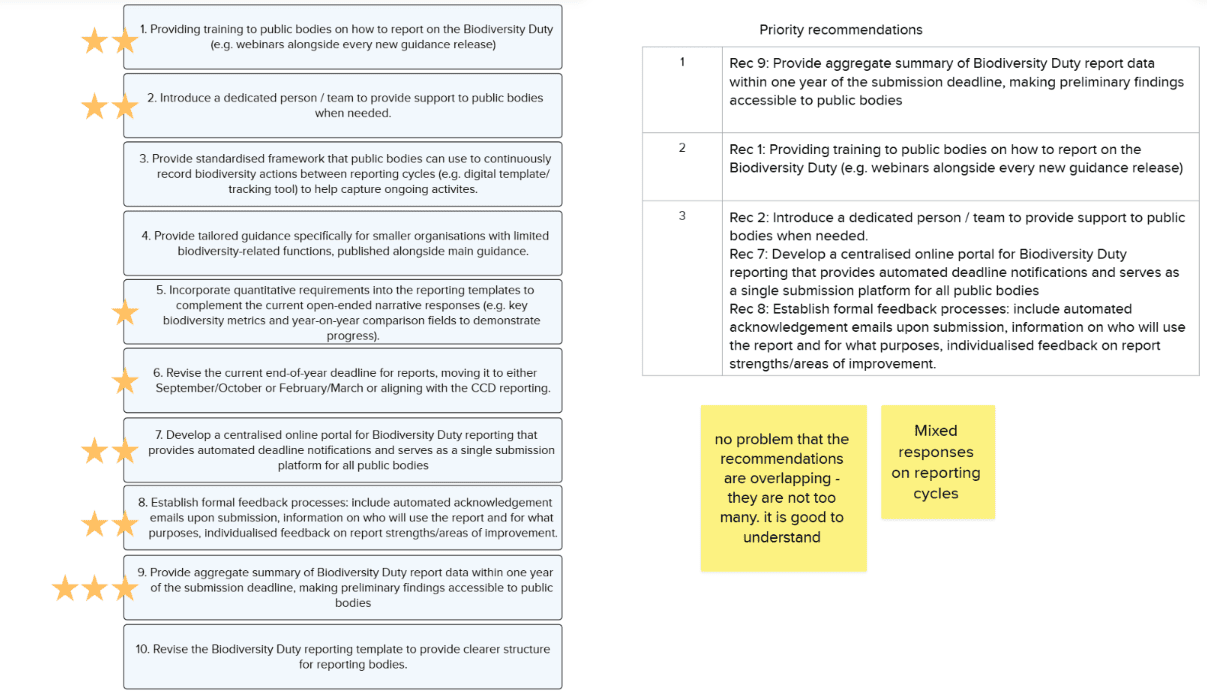
Figure 2 Prioritisation exercise, Mural snapshot – Group 2
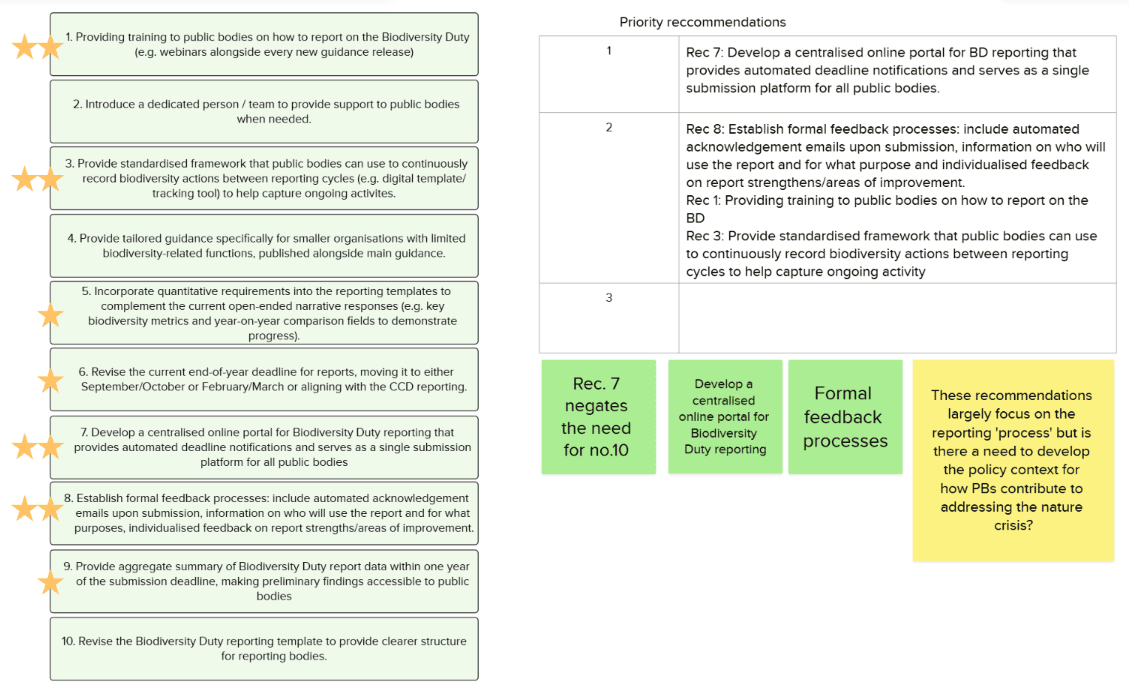
Following this prioritisation exercise, participants discussed why these recommendations should be prioritised, what changes are needed in order to make them more effective in practice, and to what extent they will help overcome the weaknesses and challenges previously discussed. Due to limited time, both breakout group discussed only two of their list of priority recommendations.
Priority recommendation 1 for group 1: Provide aggregate summary of BD report data within one year of the submission deadline, making preliminary findings accessible to public bodies.
Participants prioritised this recommendation because it would help organisations understand how they contribute to national goals and track their progress over time. It would also enable benchmarking against other public bodies. They emphasised the importance of feedback and of demonstrating that their data is used – as well as having the ability to compare their contribution to other organisations to put progress in perspective. Taken together, this would directly address the weaknesses discussed earlier in the workshop and would help organisations feel accountable as well as see visible impact.
Participants identified small changes needed to make this recommendation effective. These included introducing consequences for organisations that do not publish reports, to boost response rates; providing a checklist to help public bodies drive positive action – this would be particularly useful for organisations with gaps in delivery or poor practices; and setting clear guidance on what to report, to enable synthesis of data across reports. These changes also directly address some of the weaknesses identified, mostly around the lack of accountability.
Priority recommendation 2 for group 1: Providing training to public bodies on how to report on their fulfilment of the Biodiversity Duty.
Participants prioritised this recommendation because they believed it would help upskill staff, clarify reporting requirements, and highlight opportunities for good practice through case studies from other organisations. Training could be delivered by the government and/or existing networks like the SSN. Participants suggested asking public bodies what kind of training they need or want. This would help address weaknesses discussed earlier in the workshop, particularly around ensuring that everyone is aware of and follows best practice.
For this recommendation to be effective, participants said the government must resource and support the training. Sessions could be delivered by the government and experts, highlight gaps and opportunities in how to use biodiversity data, show how to draw on best‑practice examples, and provide a checklist of priority actions. Given that multiple organisations would attend, these sessions would also help build local connections, foster partnerships, and support joint working.
Priority recommendation 1 for group 2: Develop a centralised online portal for Biodiversity Duty reporting that provides automated deadline notifications and serves as a single submission platform for all public bodies.
Participants prioritised this recommendation so that the government and organisations have instant access to reports and records. A single portal would streamline submission and retrieval for reporting bodies and enable the government to collate data across reports and monitor compliance. If the portal replaces the template – so organisations enter information directly into defined fields – it should balance qualitative and quantitative requirements. Participants were unsure whether data would be entered manually or whether full reports would be uploaded as PDFs. If it is manual entry, they worried it could create extra work if bodies must also publish the report separately. This should be an important design consideration.
Creating this portal would help overcome weaknesses identified earlier in the workshop, particularly around response rates and monitoring of compliance. It would also make requirements clearer for reporting organisations – something which some organisations struggled with when using the existing templates.
Priority recommendation 2 for group 2: Establish formal feedback processes: Include automated acknowledgement emails upon submissions, information on who will use the report and for what purposes, individualised feedback on report strengths / areas of improvement.
Implementing this recommendation would enable tracking progress against biodiversity conservation targets, encourage compliance, and strengthen senior buy‑in. Independent reviews would enhance report credibility and provide targeted feedback to individuals and teams on how to improve. It would also support substantial learning across public bodies about what is working well and what is not in biodiversity actions. Overall, it would address a key weakness of the BD reporting – the lack of feedback – and its knock‑on effect on compliance and report quality.
Participants did not have time to discuss critical changes needed to make the recommendation effective.
How to cite this publication:
Jones, R., Ngai, R., Lee, T., Fotiadis, I., Brisley, R. (2026) Climate adaptation and the Biodiversity Duty Reporting in Scotland , ClimateXChange. https://doi.org/10.7488/era/7428
© The University of Edinburgh, 2026
Prepared by Ipsos UK on behalf of ClimateXChange, The University of Edinburgh. All rights reserved.
While every effort is made to ensure the information in this report is accurate as at the date of the report, no legal responsibility is accepted for any errors, omissions or misleading statements. The views expressed represent those of the author(s), and do not necessarily represent those of the host institutions or funders.
This work was supported by the Rural and Environment Science and Analytical Services Division of the Scottish Government (CoE – CXC).
ClimateXChange
Edinburgh Climate Change Institute
High School Yards
Edinburgh EH1 1LZ
+44 (0) 131 651 4783
If you require the report in an alternative format such as a Word document, please contact info@climatexchange.org.uk or 0131 651 4783.
More information on the Nature Network can be found here: https://www.nature.scot/doc/nature-networks-framework ↑
The base date is defined as the date on which section 36 of the Wildlife and Natural Environment (Scotland) Act 2011 (asp 6) comes into force, or where the body is established after that date, the date on which the body is established (Scottish Government, 2011). ↑
Note: ‘Strong’ indicates 20 or more of 31 reports provided evidence of plans or actions; ‘Medium’ indicates 10–19; ‘Limited’ indicates fewer than 10. See Appendix B for further details of the methodology. ↑
Note: ‘Strong’ indicates 20 or more of 31 reports provided evidence of plans or actions; ‘Medium’ indicates 10–19; ‘Limited’ indicates fewer than 10. See Appendix B for further details of the methodology. ↑
Sample was developed by intentionally selecting participants based on relevant characteristics to this research (e.g. Local Authorities, rural versus urban, organisational size, etc.). ↑
Updated guidance was published in March 2026: https://www.gov.scot/publications/public-bodies-climate-change-duties-statutory-guidance/pages/1/ ↑
Referring to internal, either mandatory or voluntary, reports, and not to national statutory reporting requirements / frameworks. ↑
As interviewees explained, in most instances there was a single individual responsible for coordinating the reporting process i.e., collecting data from colleagues, pulling information from previous reports, and writing up the biodiversity report. ↑
The first point came from Group 2; Group 1 did not have time to explore critical recommendations in depth but mentioned that creating a framework for organisations to log data throughout the years, which was one of the recommendations presented to them, would be helpful. ↑