

A scoping study of the impact of climate change on grassroots sport in Scotland
Research completed February 2026
DOI: https://doi.org/10.7488/era/6994
Executive summary
Aims
Grassroots sport plays a key role in health and wellbeing and is at the heart of many communities in Scotland. Risks from climate disruption, including increased flooding, coastal erosion, heavy rainfall and heatwaves, have the potential to impact the grassroots sport sector. This could reduce the Scottish population’s access to sport and the health and wellbeing benefits this brings, as well as make the Scottish Government’s targets for physical activity more difficult to achieve. However, the influence of grassroots sports offers a powerful vehicle for engaging new audiences on climate change issues and helping communities build resilience. To date, research into climate impacts on grassroots sport in Scotland has been limited, as has the policy response.
This report aims to help to fill this gap, by reviewing information on the current and projected climate risks to grassroots sports in Scotland and understanding the current adaptation response to these risks, as well as where further adaptation may be needed and factors that can enable this. This report also aims to understand the role that sport can play in building community resilience and how grassroots sports organisations can best be engaged to support climate action. Evidence gaps and lessons for policy are highlighted.
Key findings
Climate change impacts on grassroots sport
Extreme weather is already impacting Scottish sport, and the frequency and severity of extreme events is expected to worsen due to climate change. Some extreme events like flooding and heavy rainfall have always been an issue for the sector, but new hazards like heatwaves are emerging. Long term changes in climate will also have an impact. For example, the warming climate in Scotland is reducing the amount of snow cover available for winter sports and coastal sports assets, such as links golf courses, are being affected by sea level rise.
- Although the specific impacts of climate change vary by sport, the key risks that all sports face, particularly those played outdoors, are:
Rising costs due to factors such as increased insurance premiums, maintenance needs, damage to facilities and costs relating to contingency measures for extreme events.
Reduced participation due to factors such as greater health risks, reduced access to facilities and frustration with increased disruption and cancellation.
Assessing the scale of impact of climate change and extreme weather on grassroots sport in Scotland is difficult because there is currently very little data available to assess cancellation of sports events and other impacts. Without this data, it will also be difficult to understand future trends in participation and costs due to both climate change and other factors.
Climate disruption will not affect all places and participants equally. Increasing costs for grassroots sport could price some participants out, particularly in deprived areas of Scotland which already have higher levels of inactivity. Some rural economies that rely on visitors participating in snow sports, outdoor sports or golf may also face wider risks to livelihoods if sport participation is impacted.
Adapting grassroots sports to the future climate
Advice from the Climate Change Committee could not be clearer, at a minimum, the UK must be prepared for reaching 2°C of global warming above pre-industrial levels in the next 25 years.
Action is already being taken to protect the grassroots sector. For example, artificial pitches are allowing more sport to be played during inclement weather and some governing bodies are providing guidance to sports participants to keep them safe during extreme events. However, actions are often not explicitly recognised as adaptation and are often not designed with the future climate in mind. Some typical actions may have trade-offs, for example artificial pitches can be a significant source of microplastic pollution. There is currently very limited join up between sports policies and climate adaptation policies in Scotland.
A key barrier to adaptation action in Scottish sport is a lack of knowledge about climate impacts and the action needed to address them in the sports sector. There is generally a strong will to protect grassroots clubs for future generations and protect the environment, but a lack of knowledge about what action is most effective. A lack of clear, consistent messaging about what action needs to be taken and why may compound this problem. Partnership working with organisations who hold this knowledge can be a powerful way of overcoming this barrier and building capacity. Examples of this are highlighted by several case studies in this report.
Public engagement on climate through sport
Personal experience with extreme weather events directly influences risk perception and grassroots sports participants, particularly those playing outdoors, are having these experiences. However, in many cases, these experiences are not perceived to be linked to climate change, rather they have “always happened”.
Currently, there are very few examples of sport being used as an engagement tool for building community resilience or awareness of climate risks in Scotland. However, with the right knowledge and support, sports clubs are well placed to act as trusted messengers to build awareness of climate risk within the wider community, potentially reaching people who are less engaged with other networks delivering this information. There are numerous examples of sport being used as a tool to engage people on emissions reduction or other environmental issues and these may provide a blueprint for future engagement on climate resilience.
Lessons for policy
- Training is needed to increase knowledge and awareness of climate impacts, and where further adaptation action is needed, across all levels of the Scottish sports landscape. While some training for sports organisations is already available, uptake can be low due to resource and capacity constraints. Sportscotland currently have a centralised training platform for governing bodies of sport which could possibly be used to provide training on climate impacts and adaptation. Governing bodies can then cascade learnings to grassroots clubs through existing networks.
- Improved data collection is needed to understand the scale and trends in climate impacts on Scottish grassroots sport. A first step towards achieving this could include supporting Scottish governing bodies of sport to collect data on events they are directly involved with, and building up to more comprehensive systems, learning from organisations such as Scottish Rugby who are already collecting regular data.
- Specific inclusion of sports in national and local adaptation planning and risk assessment. Given that local authority risk assessments and adaptation plans often flow directly from national level work, explicit inclusion of sport in national level adaptation planning, such as the Scottish National Adaptation Plan, would signal a need for involvement of sports bodies in adaptation planning at the local level as well. In England, Sport England are in the process of commissioning a climate change risk assessment for the sport sector. This will provide an evidence base to support this as well as learnings that can be applied in Scotland.
- Develop the role of grassroots sports organisations in building community resilience. This could be achieved by building partnerships between community sports organisations and community climate organisations, such as climate hubs, to deliver information and action in the wider community. This could help to build knowledge of climate impacts within the sports organisations, as well as expanding the reach of climate organisations by using the sports organisations as trusted messengers in wider parts of the community. Support, such as dedicated programmes or forums, would likely be required to develop these partnerships given that many of these organisations are volunteer led and have limited capacity.
- Alignment of sports facilities funding with adaptation goals to avoid long-term, maladaptive decisions. In the short term, funding streams (such as local authority climate funding) should be identified that can support preparation for and recovery from climate risks and advertised to the grassroots sport sector, including examples of measures that could be taken. Following storms and flood events, Sport England advertise their funding to grassroots sports groups explicitly to help them recover but there has so far been no equivalent to this in Scotland. Although national circumstances differ, a similar approach of identifying how existing funding streams could be advertised to support preparation for and recovery from extreme events when needed could be explored. In the longer term, criteria for facility funding applications and other long term decision making across the sector should be reviewed to ensure climate resilience needs are formally and consistently considered so that facilities are prepared for the future climate, and potentially costly retrofits are not required.

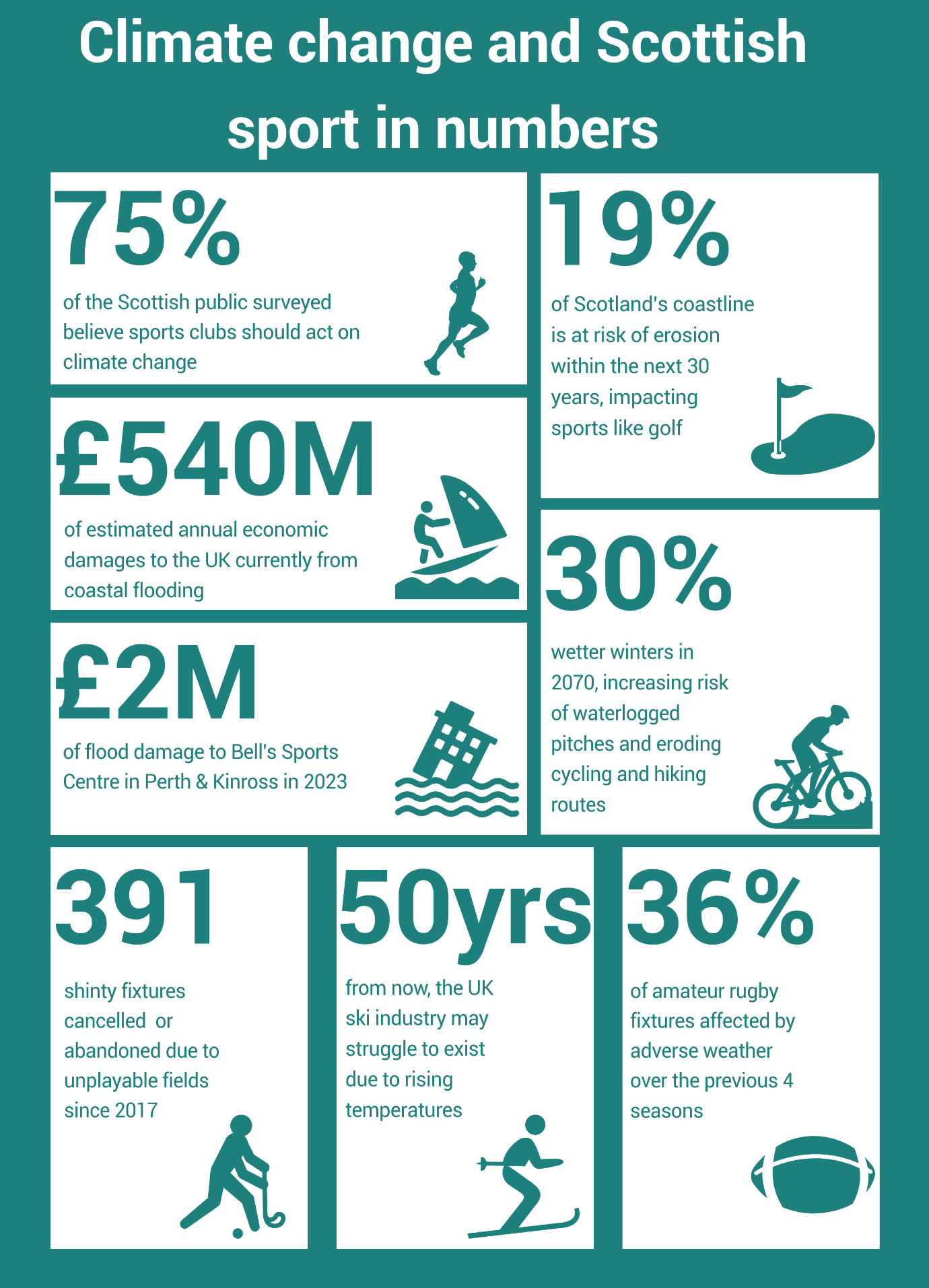
Figure 1‑1: A summary of key facts and figures relating to climate change and sport in Scotland. Further context and references for these can be found within the main body of this report.
Glossary / Abbreviations table
Definitions sourced from the Intergovernmental Panel on Climate Change glossary (Reisinger et al., 2023) and adapted for the context of this report.
Introduction
Sport is a cornerstone of Scottish culture. Scotland has over 550 golf courses (VisitScotland, 2025) and football and rugby are popular. The Scottish Highlands are one of the few places in the UK where outdoor sports on natural snow can be enjoyed and sports such as curling, shinty and the highland games are a unique part of Scotland’s heritage. However, the importance of sport goes far beyond national identity.
The benefits of sport for individuals include improved physical and mental health, social connections and development of skills including leadership and communication. Sport also contributes to the Scottish economy. In 2021, sport (defined broadly as including professional, grassroots, spectating and production of sports goods) contributed a direct impact of £3.8 bn, accounting for 2.5% of Scotland’s total gross value added (DCMS, 2024). Grassroots sport is an integral part of the national sporting landscape: fostering talent development that feeds the professional sport pipeline and the Scottish economy, promoting physical activity, improving wellbeing, and bringing communities together.
Climate change poses a threat to the continued enjoyment of and participation in grassroots sport across Scotland, and hence threatens the many benefits sport brings to people, communities and the economy. For example, in Scotland, climate change is expected to make extreme rainfall and flooding events more common, causing more disruption to sporting events and damage to facilities. Heatwaves and drought events are also likely to become more frequent and intense in the summer, resulting in further damage to facilities and risks to participants’ health and wellbeing (Duncan and McLaughlin, 2021; Adaptation Scotland and Met Office Research, 2025).
Climate change comes against a wider backdrop of challenges to sport in Scotland, including increasing costs, lack of access to high quality facilities and inequality of participation across demographics and geographies (Sported, 2023; Collins, 2024). Climate change is likely to make many of these challenges worse and grassroots sport will need to take action to prepare and build resilience, as well as to take advantage of any new opportunities, if it is to thrive in Scotland into the future. As well as building resilience for itself, the grassroots sport ecosystem is well placed to help raise wider awareness of climate impacts and how to build resilience more broadly because of its place at the heart of communities across the country.
To date, research into the climate impact on the sports sector as a whole, but particularly grassroots sport, in Scotland has been limited, as has the policy response. This report aims to help to fill this gap, by reviewing information on the current and projected climate risks to the grassroots sector in Scotland, understanding the current adaptation response to these risks, and barriers and enablers for any further adaptation that may be needed. This report also aims to start building an evidence base around the role that sport can play in building community resilience and how grassroots sports organisations can best be engaged to take climate action.
During the course of this work, a wide range of input from organisations, including Scottish Governing Bodies of sport (SGBs) and grassroots clubs, has been sought. These organisations have provided crucial input to this study and shared knowledge. It is hoped that this process and the resulting report will help to start a conversation that will build understanding of the risks and provide an opportunity for the grassroots sector to build climate resilience.
Policy context
Policies for supporting sport and encouraging physical activity are devolved to the Scottish Government within the UK. Sportscotland is the national agency for sport in Scotland and is responsible for delivering the Scottish Government’s goals for sport. Delivery of sport and physical activities also involves a wide range of other organisations, including local authorities, which provide and manage many sports facilities, and governing bodies for specific sports. The overall landscape of organisations involved in Scottish sport is complex as shown in Figure 3‑1.
Statutory duties relating to grassroots sport in Scotland are limited to requirements for local authorities to provide appropriate facilities for recreational and sports activities and guidance for sportscotland in distributing National Lottery funding (Collins, 2024). However, a range of strategies and delivery plans at the national level aim to achieve a more active Scotland and to realise the health, wellbeing and wider benefits that come with that. These include the Scottish Government’s physical activity delivery plan, A More Active Scotland, which aims to reduce physical inactivity in adults and teenagers by 15% by 2030 (Scottish Government, 2018) and ‘Sport for life’, sportscotland’s corporate strategy for meeting the vision of ‘an active Scotland where everyone benefits from sport’(sportscotland, 2025b).
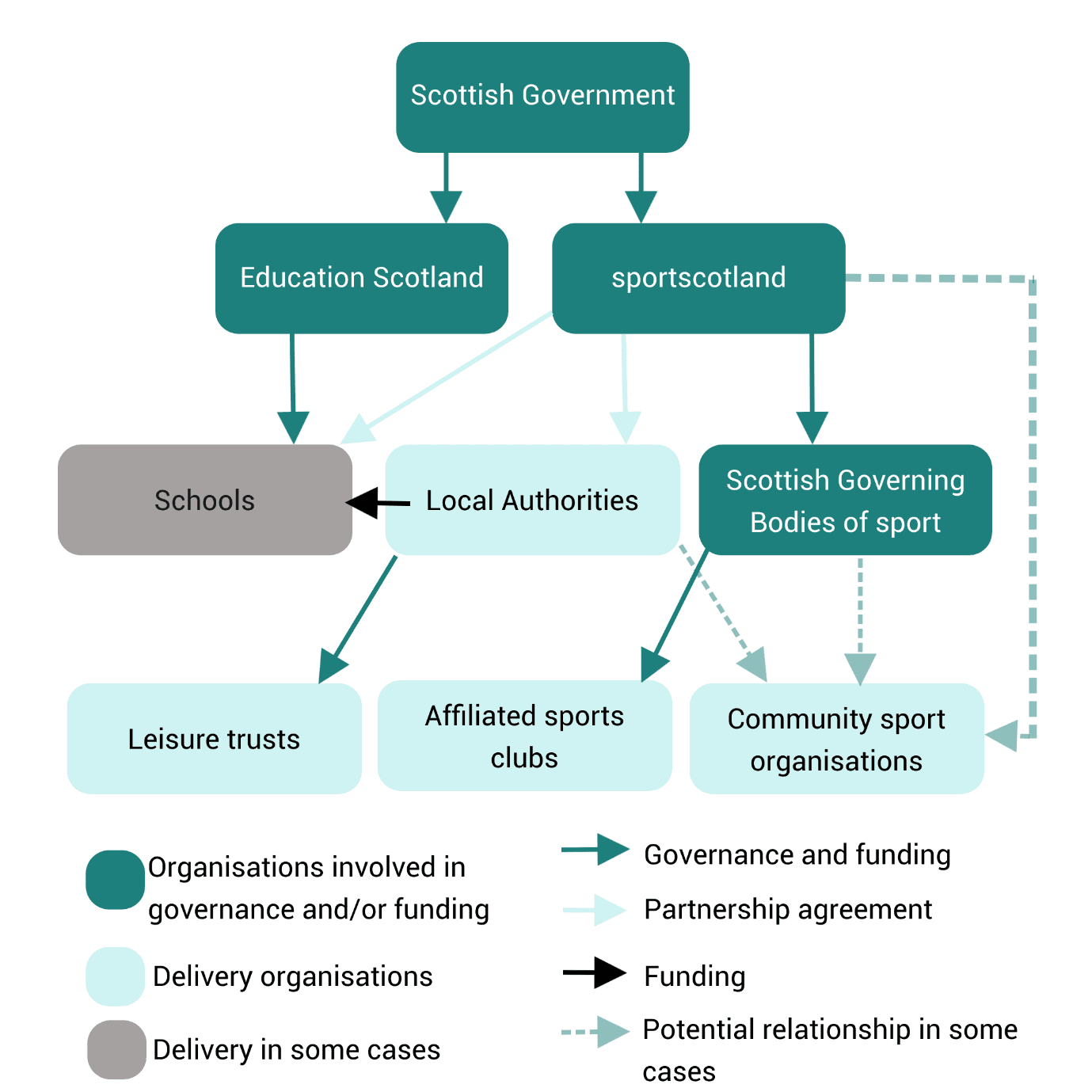
Figure 3‑1: Simplified diagram of some of the key types of organisations involved in grassroots sports governance, funding and delivery and relationships between them in Scotland. The diagram is not exhaustive and other organisations such as tertiary education providers may also be involved in grassroots sports provision. Key relationships are captured but there may be additional or different relationships operating in some circumstances. Relationships shown are those specifically relevant to sport so, for example, the relationship between Scottish Government and Local Authorities is not explicitly shown because although funding is provided to Local Authorities, this is not specifically ringfenced for sport. Diagram adapted from Collins, 2024.
There is currently limited interaction between climate adaptation policy and sports policy in Scotland. At the national level, the third Scottish National Adaptation Plan (SNAP3) sets out the actions that the Scottish Government and its partners will take to respond to the impacts of climate change (Scottish Government, 2024). The plan does not explicitly consider sports organisations as part of this response although there is a strong emphasis on the role of communities and the need for community knowledge and connection to support locally led climate change adaptation. The actions in SNAP3 aim to address the climate risks identified for Scotland in the UK’s third climate change risk assessment (CCRA3) (Betts, Haward and Pearson, 2021). The risks to sport are also not explicitly considered by this risk assessment although the impacts of relevant hazards such as heat and flooding on communities are considered more generally, as well as risks to cultural heritage and opportunities for health and wellbeing from higher temperatures (Kovats and Brisley, 2021).
Below the national level, there is no statutory requirement for local government or other community and grassroots organisations to conduct organisation or local authority (LA) level climate change risk assessments or adaptation planning in Scotland. Although LAs are required to deliver their functions in a way that supports delivery of the national adaptation plan and the National Planning Framework does acknowledge synergies between the benefits of blue and green infrastructure for both adaptation and sports activities (Scottish Government, 2023a).
However, public bodies, including sportscotland and LAs, are required to report on their compliance with their statutory climate change duties, covering emissions mitigation, adaptation and sustainability (The Climate Change (Duties of Public Bodies: Reporting Requirements) (Scotland) Order, 2015). Public bodies’ climate change reporting by sportscotland on climate risk and adaptation is currently limited (sportscotland, 2025a). Very few published examples of local authorities explicitly involving grassroots sports organisations in their climate change risk assessments or adaptation planning have been identified in this study, although this was not a focus of the work.
Methodology
The scope of climate action in this study
Sports activities contribute to greenhouse gas emissions and other environmental impacts, such as pollution from pitch infills and excess waste due to use of disposable plastics. While work to reduce these impacts is already underway in many sports organisations in Scotland, and is important and necessary, the current project focuses on the impact that climate change has on grassroots sport, rather than the impact that grassroots sport has on climate change. Impacts from climate change are already being seen. This means that, alongside continued action to reduce greenhouse gas emissions and other environmental impacts, it is important that grassroots sports organisations understand the climate risks that may affect them and how they can act to reduce these risks to their facilities, clubs, participants and the wider community. Actions taken to address these risks are often referred to as ‘adaptation’, the process of adjusting to the actual or expected climate and its effects (Calvin et al., 2023). Well-designed adaptation action can help build resilience, the ability to anticipate, cope with and recover from hazardous events (Mehryar, 2022). This will ensure that grassroots sports clubs and activities continue to thrive in Scotland long into the future.
Scope of grassroots sport in this study
The focus of the current study is on grassroots sport. There is no commonly agreed definition of grassroots sport in Scotland, although a recent briefing for the Scottish Parliament used a definition of community sport defining: “[Activities that] are low threshold and financially accessible, and organised locally, in specific – often urban – neighbourhoods. The activities are not usually high level or competitive in nature.” (Van der Veken, Lauwerier and Willems, 2020; Collins, 2024)
For the purpose of this study, we consider grassroots sport to include community-based sports and physical activity initiatives where participation is recreational and at a non-professional level. We include sports in both urban and rural settings, for both adult and child participants. We consider ‘sport’ in this study to include the broad range of recreational physical activities which have recognised governing bodies in Scotland, although not all of these are addressed explicitly in this work.
Research approach
Data collection for this study was conducted between September 2025 and December 2025 by Aether, working with a steering group including the CXC research lead and representatives from Scottish Government. The approach to this study consisted of 3 key elements: literature review, stakeholder interviews and case study analysis. The methodology was designed to provide a broad evidence base from which further research priorities and future policy actions can be informed.
The literature review aimed to provide a framework of sports, climate impacts, adaptation actions and engagement activities that would set the scope of the review and inform a protocol for stakeholder interviews. The protocol is provided in Appendix B. This protocol was used to conduct semi-structured interviews with key stakeholders, including SGBs, local authorities, leisure facility providers and grassroots clubs, to validate and expand upon the literature review. Any reference to interviewees or interviews in this report refers to information gathered from these interviews, but this has been anonymised aside from in specific cases where permission from interviewees to include information as part of specific case studies was secured. From these sources, six case studies were drawn and discussed with stakeholders to illustrate the climate impacts that have affected sport in Scotland in recent years. The case studies also illustrate how organisations have taken action and effectively responded to these. The aim of presenting these case studies is to support knowledge sharing between organisations and showcase good practice that could provide lessons for wider action elsewhere. A graphical overview of the case studies is provided in Figure 4‑1.
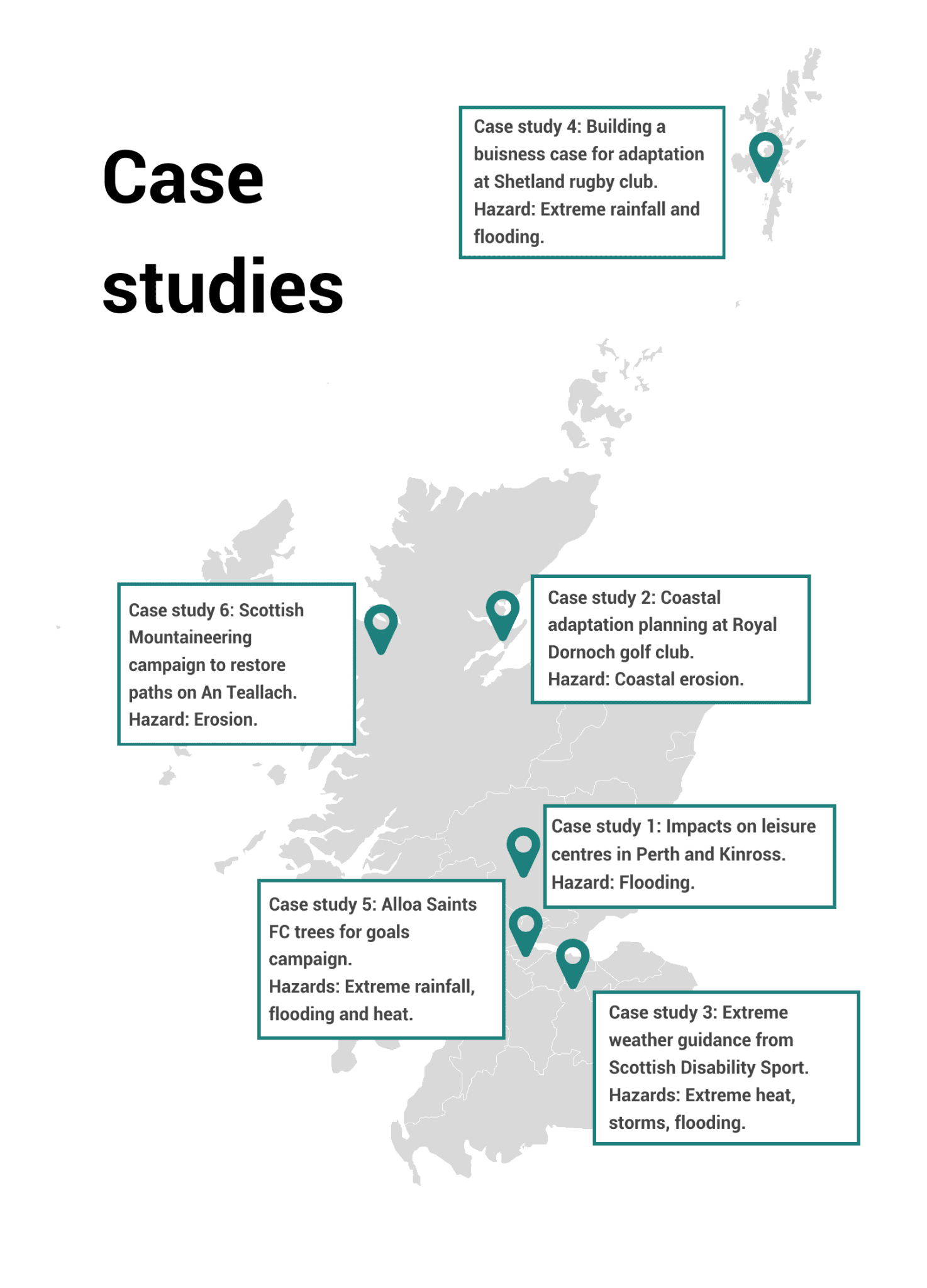
Figure 4‑1 A map summarising the locations of case studies presented in this report and the climate hazards they relate to.
Limitations of the approach
This study aims to provide a broad review of climate impacts, adaptation actions, and opportunities to engage communities on climate change via grassroots sports. It is not a comprehensive assessment of climate risk, nor a comprehensive review across the entire grassroots sport landscape in Scotland. Literature relating specifically to climate change impacts on grassroots sports in Scotland was limited. Hence, some of the evidence presented was collected in other countries or for professional sports and is assumed to apply more broadly. A summary of evidence gaps is presented in section 8.2.
The stakeholders who have input to this work via interviews do not represent the full range of sports, geographies, participants and organisations present in Scottish sport. Response rates were generally lower from grassroots organisations and local authorities than from SGBs, so they are less well represented in the information collected. There may also be some response bias towards organisations or interviewees who are already more engaged in climate issues.
Climate change impacts on grassroots sport
How will climate change affect Scotland?
As global temperatures rise, Scotland is projected to encounter warmer, wetter winters and hotter, drier summers. This will be accompanied by rising sea levels leading to more coastal erosion and flooding, as well as more frequent and intense extreme weather events (Sniffer, 2023). These extreme events include:
Extreme rainfall events that can lead to flooding, in both summer and winter,
Drought and extended dry periods in the summer,
Heatwaves in the summer,
Wildfires resulting from hotter, drier summer conditions.
2025 was the warmest year on record for the UK (Met Office, 2026a). All of the UK’s ten warmest years on record have occurred since 2002, whilst none of the ten coldest years have occurred since 1963 (Met Office, 2019). The last three years (2022-2024) have been in the UK’s top-five warmest on record and the period 2015-2024 was 10% wetter than 1961-1990 (Kendon et al., 2025). However, 1st October 2024 – 30th September 2025 was the driest hydrological year in eastern Scotland since 1976 (SEPA, 2025).
Hotter, drier summers increase the risk of wildfires with 13 wildfire warnings issued in Scotland in 2025 (the most in recent times) with a Highlands blaze described as the worst in Scotland’s history (BBC News, 2025).
These climate trends are expected to intensify over the coming decades. Met Office data suggests that the number of summer days exceeding maximum temperatures of 25°C in Glasgow could increase from 4 per year (baseline period 1981-2000) to 8-14 per year if 2°C of global warming takes place (Met Office, 2026b). The Climate Change Committee (CCC) have advised that , at a minimum, the country must be prepared for reaching 2°C of global warming in the next 25 years (Climate Change Committee, 2025).
Warmer winters will also result in reduced snow cover in the Scottish mountains. The 2024 snow patch survey of Scotland’s highest mountains recorded only 90 snow patches surviving into July – the third lowest total on record – compared with over 2,000 in 1986 (BBC News, 2024b). Long-term observations in the Cairngorms National Park show a declining trend in snow cover over recent decades, with modelling forecasting further reductions in snow cover as warming continues and accelerates (Rivington et al., 2019).
Climate change is also causing sea levels to rise, resulting in increased coastal flooding and erosion. Around Scotland, the mean sea level has risen by approximately 19.5cm from the start of the 20th century and is expected to rise by 12-18cm by 2050 and 23-54cm by 2080. This will result in 19% of Scotland’s coastline being at risk of erosion within the next 30 years (Sniffer, 2021; Adaptation Scotland and Met Office Research, 2025). Annual average economic damages from coastal flooding in the UK are currently estimated to be around £540 million (Haigh et al., 2025).
How will climate change affect grassroots sport?
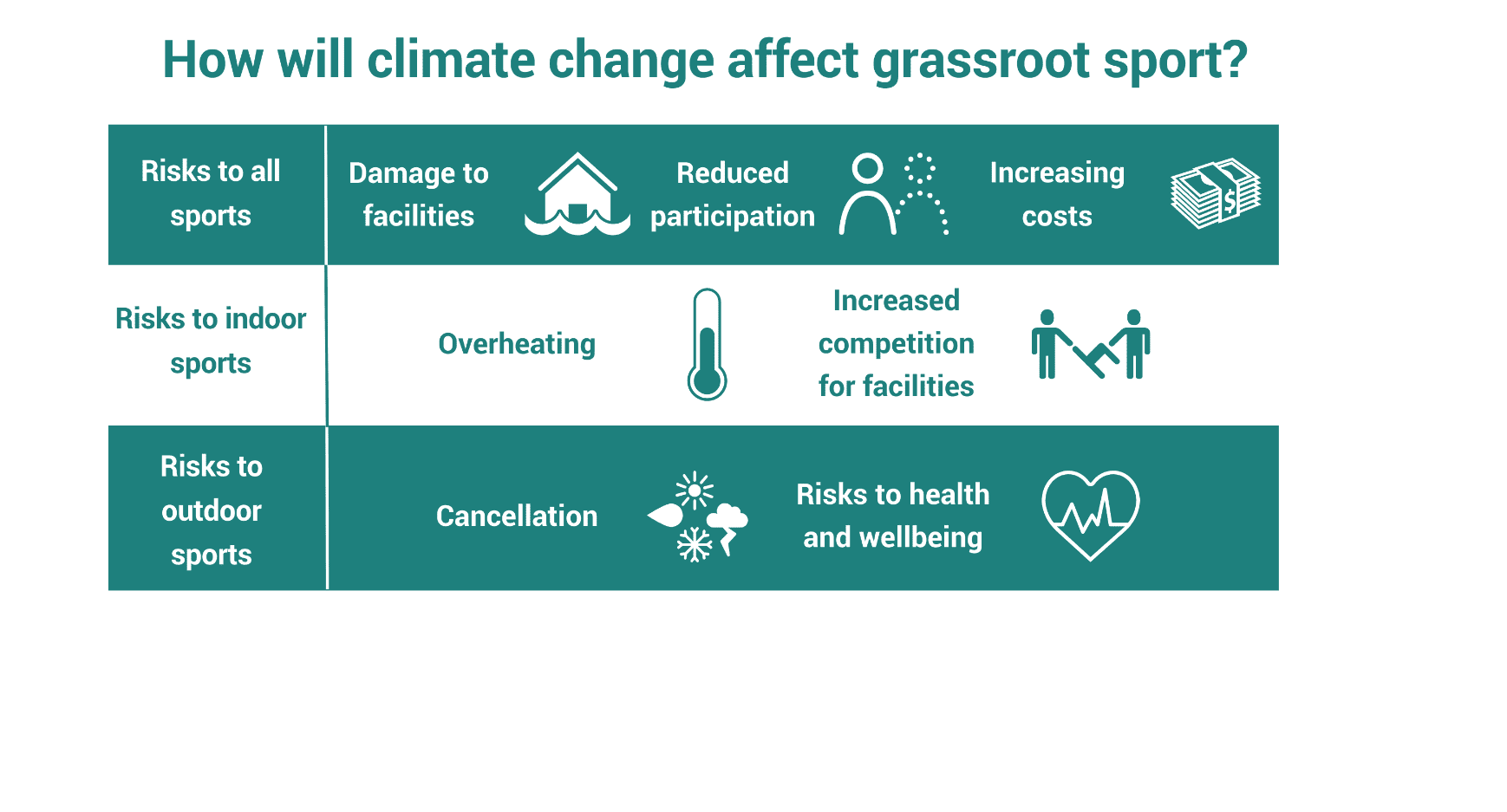
Figure 5‑1: A summary of the ways in which climate change can impact Scottish sports and how these impacts may differ between indoor and outdoor sports.
The impacts of climate change on sport, and their severity, are varied depending on location and type of sport. The severity and nature of these impacts will also depend on other trends in sport such as levels of participation amongst different groups, the level of funding available for facility maintenance and popularity of different sports. A summary of some key impacts is illustrated in Figure 5‑2. In general, for all sports, there are two key categories of negative outcomes resulting from climate change:
- Reduced participation: Sports clubs rely on regular engagement, but frequent event disruptions and cancellations due to extreme weather lead to declining involvement from players as well as coaches, referees, umpires, and other officials. Ultimately, this reduces income to clubs and weakens club viability (Department for Culture, Media & Sport (DCMS), 2025). A lack of accessible or suitable facilities, which is likely to be exacerbated by climate impacts, may also reduce participation (Orr et al., 2021; The Scottish Parliament, 2023). For some sports, increased actual or perceived health and injury risks associated with factors such as wetter or drier ground may also play a role in participation (Orr et al., 2021; Oyama et al., 2023; Department for Culture, Media & Sport (DCMS), 2025). For individuals, reducing participation in sports and physical activity is likely to have negative impacts on both physical and mental health. Physical inactivity is already estimated to cost the NHS in Scotland more than £77m per year (Meir and Scott, 2025).
- Increased costs and reduced income: Adapting and maintaining facilities able to withstand adverse weather conditions can incur financial costs to clubs and sporting bodies. For example, modelling has estimated an annual cost of £320 million to the grassroots sports sector in England alone due to the impact of adverse and extreme weather events on maintenance needs, repair costs and event cancellation. This number is likely to rise with increasing climate change impacts (Department for Culture, Media & Sport (DCMS), 2025, 2025). Interviewees for this work highlighted factors such as increased insurance costs, increased maintenance costs, and the loss of revenue due to cancelled or abandoned events as key factors influencing costs. Many also stated that contingency measures, such as renting indoor facilities at short notice during extreme weather events, have significant costs for grassroots clubs. People living in the most deprived areas of Scotland are already much less likely to participate in sport (Meir and Scott, 2025), and this inequality may be exacerbated if costs of running and participating in sport increase further (see section 5.4).
Both increased costs and reduced participation in sport pose risks to the long-term sustainability of grassroots sports clubs, which may close if they become financially unviable or do not have enough participation. This could reduce the opportunities to improve health and wellbeing through physical activity across communities in Scotland. One interviewee noted that “climate change is impacting the growth of the sport” in Scotland due to reduced access to facilities.
For certain sports and locations, such as snow sports affected by diminishing snow cover and coastal links golf courses exposed to coastal erosion, the impacts of climate change may pose an existential threat to the viability of some sports or clubs in Scotland. The following sections examine how these location-specific impacts influence participation levels and financial sustainability.
What are the specific risks to different types of sport?
Outdoor sports
In general, outdoor sports and participants are more exposed to climate hazards than indoor sports, although indoor facilities can also experience the impacts of climate change (Orr et al., 2021), as discussed in section 5.3.2 below. Figure 5-2 summarises some of the outdoor sport specific risks discussed in this section.
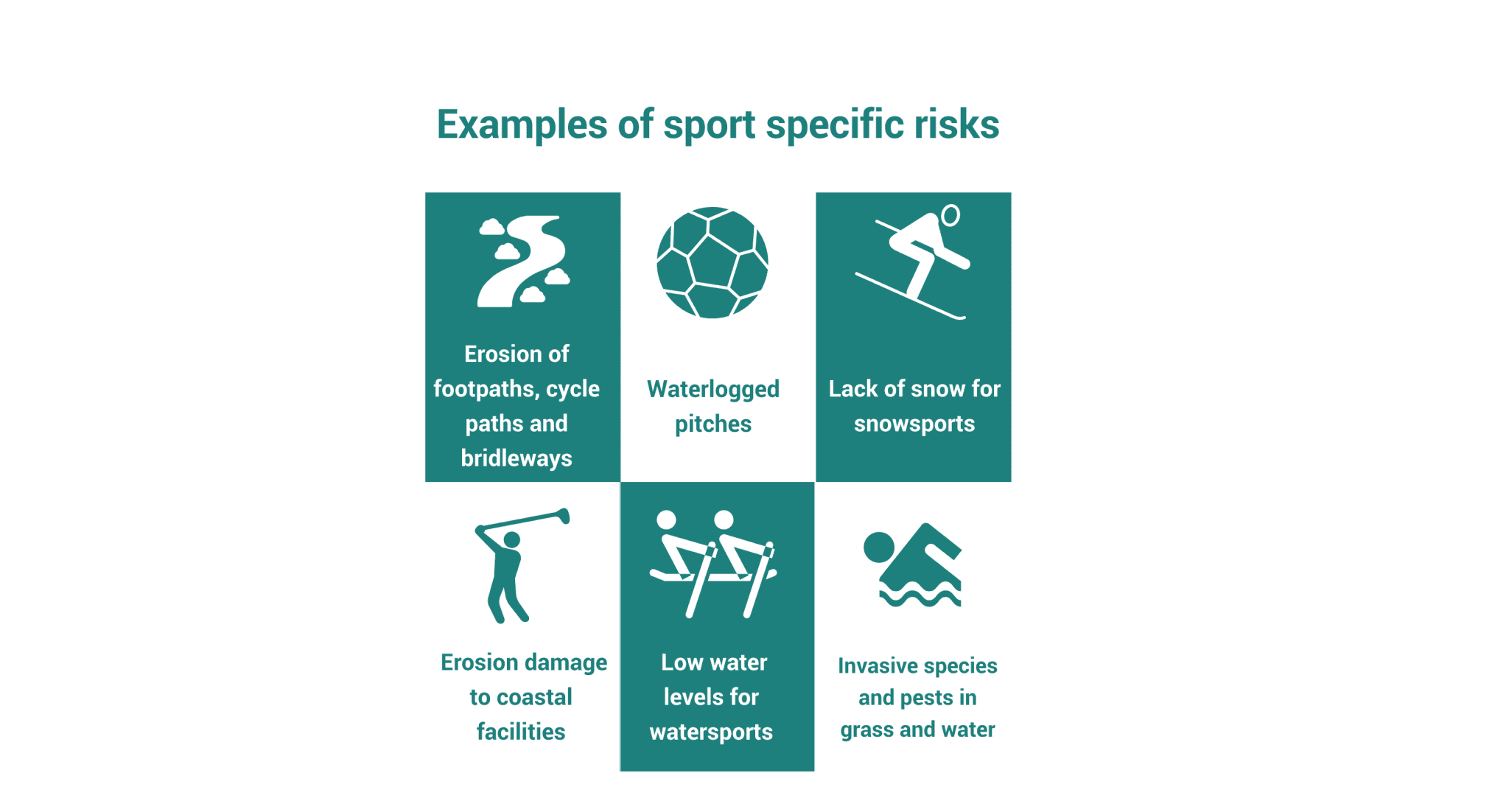
Figure 5-2: A summary of some of the specific risks to different types of outdoor sport identified in this report.
Cancellations or postponements due to extreme weather
Cancellations due to extreme rainfall episodes, flooding, cold spells and storms were consistently raised as a key issue for grassroots sport by interviewees. Many outdoor grass pitches become easily waterlogged, rendering them unusable, sometimes permanently. Other surfaces may be liable to flooding in some locations during periods of heavy rainfall (Duncan and McLaughlin, 2021; Sniffer, 2021). One interviewee noted that “pitches and training facilities can be out for days or even weeks” due to bad weather and “drainage systems seem to get more overwhelmed than they used to”. Winter rainfall is expected to increase across Scotland with climate change, but the most significant increases are expected in the west of the country (Arnell et al., 2021). Cancellations and waterlogging can be affected by a range of factors, such as maintenance and participation levels, as well as by the weather and hence long-term data collection is needed to understand the impact of climate change alongside these other factors.
Since 2017, approximately 9% of shinty (Camanachd in Scottish Gaelic) fixtures (391 matches), and the 2019 Camanachd Cup Final, were either cancelled or abandoned due to unplayable fields (Camanachd Association, email communication, December 2025). Additionally, over the previous 4 Scottish rugby seasons, 36% of scheduled fixtures were affected by adverse weather and 13% of games were cancelled (Scottish Rugby Union, email communication, November 2025). No further examples of systematic data collection on cancellation and disruption were identified through this research. Further data collection is needed to establish a baseline and allow trends in cancellations due to different factors to be better understood.
Hot, dry weather and drought episodes can also lead to cancellations as this can harden grass playing surfaces, leading to health and safety related cancelations (Bryan et al., 2020). Although this has historically been less of an issue in Scotland than wet weather and flooding, both drought risk and summer temperatures are expected to increase under future climate change. Equestrianism is also affected by dry conditions; ensuring appropriate moisture levels is essential for animal and rider welfare (Environment Agency, 2025). During periods of significant dry weather, water saving measures, such as hosepipe bans, could be imposed which could prevent irrigation of sports grounds. Although there has not been a hosepipe ban imposed in Scotland since 1995 (Davies, 2025), 1st October 2024 – 30th September 2025 was the driest hydrological year in eastern Scotland since 1976 (SEPA, 2025).
Many interviewees highlighted issues around managing postponements and rescheduling, including facility availability, participant availability, and costs. One interviewee noted that for their sport “the Scottish outdoor calendar is already shorter than the English due to wet weather, but climate change threatens to shorten it further.” Even where sports facilities are not directly affected, cancellations may also result from disruptions to transport systems required for participants to travel to facilities (see section 5.5).
Health and wellbeing impacts on sports participants
Climate change poses risks to the health and wellbeing of sports participants in a range of ways. High temperatures during summer can increase the risk of heat stress, dehydration, and cardiovascular strain (particularly among young children and older adults). Individuals with some pre-existing health conditions are also more vulnerable to these risks. Higher temperatures may also affect performance and decision making of sports participants (Winter et al., 2023; Public Health Scotland, 2025).
Interviewees generally perceived the current risk of heat to be low in Scotland, although there have been a few incidences of runners suffering from heat stroke in hill races over the last few years. In both 2019 and 2023, runners collapsed due to heat exhaustion during the Junior Home International races, resulting in two runners being hospitalised in 2019 (scottishathletics, email communication, Nov 2025). Increased awareness of heat risks, to reduce the risk of underestimating them during sports activities, will be required as heatwaves become more common and intense in Scotland in the future. Met Office data suggests that the number of summer days exceeding maximum temperatures of 25°C in Glasgow could increase from 4 per year (baseline period 1981-2000) to 8-14 per year if 2°C of global warming takes place (Met Office, 2026b).
Warmer, sunnier conditions also raise the risk of vector-borne diseases (illnesses that are transmitted to humans through living organisms such as mosquitoes or ticks), such as Lyme disease, and UV, increasing the risks of short-term sunburn and heat illnesses, and long-term skin cancer risks (Claerhout et al., 2006; Li et al., 2016; WHO, 2024). These risks may be more pronounced for sports participants spending more time outdoors, and particularly in countryside areas in the case of vector borne diseases.
Wildfire smoke also poses a significant threat to human health, primarily through respiratory effects. It can also reduce visibility, heightening the risk of accidents for sports like mountain biking (Winter et al., 2023). In 2025, a wildfire in the Highlands was described as the worst in Scotland’s history, and wildfire risk is expected to increase as summers become hotter and drier (BBC News, 2025).
Bryan et al. (2020) explored the impacts of drought on recreation and health in the UK. They identified that low water levels associated with drought could reduce accessibility and increase danger associated with inland water sports due to hazards such as rocks becoming exposed and concentration of microbes and other harmful pollutants increasing. Warm, dry weather could increase opportunities for land and coastal based sports activities. However, Bryan et al. (2020) also noted the higher risk of injury when sports grounds are hard due to drought and that warm weather can also increase the risk of heat illness outlined above. Interviewees supported these findings, suggesting that hard pitches and reduced access to water sports were likely to be issues during drought periods.
For water sports taking place inland or at sea, there are additional specific safety concerns that may be exacerbated by climate change. Coastal flooding, erosion, and storms inflict damage on sailing and boat club assets and increase safety concerns over water sports in the UK (Simpson, 2013). High water levels in rivers due to heavy rainfall can increase danger to paddle sports as water flows faster and more debris and pollutants may enter the water (Go Paddling, 2024). The growth of algal blooms in Scottish inland waters is expected to increase under climate change. Currently, algal blooms directly cost the Scottish economy at least an estimated £16.5 million annually[1] and have the potential to cause significant damage to human health if encountered through swimming and water sports (May et al., 2024). Blue-green algae has resulted in postponements and cancellations of sporting events, including the Swim Loch Tay event in 2021 (Hamilton, 2021).
Damage to sports facilities and environments
Different types of sports facility, or environments where sports take place, may be damaged by climate change impacts. In some cases, this results in increased maintenance costs or can even pose a risk to the existence of the sport. For example:
- Damage to grass pitches. Grass requires sufficient water to recover from use and wear, however, both insufficient and excessive water can be detrimental to pitch condition and increase maintenance costs. Good pitch condition is essential for creating safe, high quality, and suitable playing surfaces for sports such as tennis, hockey, rugby, and cricket, where consistent ball pace and bounce is critical (James, 2012).
- Lack of snow for snow sports. Goggins et al. (2018) suggested the UK ski industry may struggle to exist within 50 years, as a result of rising winter temperatures and a lack of snow cover. Cairngorm mountain is predicted to experience a decline in snowfall over the next 20 years, alongside an increased risk of avalanches with rapidly changing conditions (Duncan and McLaughlin, 2021; BBC News, 2024b). This reduces the frequency and reliability of conditions suitable for snow sports, potentially shortening the winter sport season and increasing injury risk.
- Erosion damage to coastal facilities. Sports clubs located on the coast may be damaged by coastal erosion and rising sea levels. Montrose Golf Club, one of Scotland’s oldest golf clubs, lost 7 meters of their course to the sea in a single year (McLaughlin, 2024). Similar impacts are discussed further in 6.1.1.1 Case study 2.
- Low water levels in inland water bodies. Inland, under drought conditions, the rivers and lochs relied on for water sports can experience significantly low water levels (Bryan et al., 2020). This can lead to higher risk of sports participants disturbing the local environment and higher health risks to participants as lower water levels can result in lower water quality (Paddle UK, 2022).
- Erosion and flooding damage to footpaths, cycle paths and bridleways. Extreme rainfall and wind, combined with rising sea levels in coastal locations, is accelerating erosion and flooding of footpaths, cycle paths, and bridleways. A resulting growth in the frequency of landslides and mudslides increases risk to user safety (Winter et al., 2023). One interviewee discussed the need for yearly route changes for one of their sports events due to path erosion.
- Invasive species and pathogens. Pathogens are organisms such as bacteria, fungi, or viruses that cause disease and invasive species are non-native organisms that cause harm in a new environment (Balloux and Van Dorp, 2017; NOAA, 2024). Escalated maintenance demands and associated costs for outdoor facilities with outbreaks of invasive species was highlighted in the interviews. Warmer, wetter conditions allow outbreaks and arrivals of non-native species, pests, and diseases in the UK, which can degrade playing surfaces, damage natural environments, and restrict access to recreational areas (Sniffer, 2021).
Indoor sports
Indoor sports can also be impacted by climate change, particularly where buildings are not well adapted. With rising temperatures, the risk of overheating in buildings is predicted to increase (Sniffer, 2021). Many indoor community sports activities (including yoga and dance) are held in old buildings, where air circulation and insulation are poor, leading to high energy costs for heating and cooling (Temple, 2024; Zhang, Li and Li, 2025). As with outdoor facilities, indoor facilities can suffer damage from storms, extreme rainfall and flooding, as illustrated by 5.3.2.1 Case study 1. During extreme weather, interviewees noted that outdoor sports often relocate indoors to avoid cancellation which drives competition, and hence prices, for renting indoor facilities (see section 5.3.1.1). One interviewee said “there is no capacity to move everyone inside at the grassroots level”.
Case study 1: Impacts on leisure centres in Perth and Kinross
Sport: indoor sports
Climate hazard: flooding
What was the challenge?
Located alongside the River Tay, Perth is prone to heavy rainfall and consequently increasingly susceptible to substantial flood events. The local council’s climate risk assessment identifies that leisure facilities lie in future flood zones, with floods posing significant risks to accessibility, finances, and insurability (Perth and Kinross Council, 2023).
In August 2020, severe flooding impacted both Bell’s Sports Centre and Perth Leisure Pool:
Bell’s Sports Centre’s overnight flooding caused damage to one sports hall and the circulation areas, which required extensive repairs and replacement of a six-court hall floor (Ogston, 2023). Following this event, the centre could no longer access insurance for surface water flooding, leaving the organisation vulnerable to future events.
Perth Leisure Pool suffered severe flooding that damaged the plant room, electrics, and filtration systems (Chalmers, 2020). The flooding caused extensive damage, disrupted services, and created long-term operational and financial pressures.
In October 2023, Bell’s Sports Centre again experienced serious flooding. There was a delay in closing nearby flood gates which may have led to property damage (BBC News, 2023; Chalmers, 2024). Water levels reached halfway up the fire exit doors, causing extensive damage to the main hall, squash courts, and a new 100-station gym (Anderson, 2024b; Perth & Kinross Council, 2024). Electrical sockets and gym equipment were damaged and repair costs reached around £2 million (Ogston, 2023).
What action was taken?
Prior to this, for less serious flood events, localised flood mitigation measures, such as deploying sandbags, identifying water entry points, and improving roof drainage and pipework had been taken and the leisure centres engaged with the council and relevant agencies to monitor weather alerts and prepare for potential flooding.
After the 2020 floods, extensive repairs were carried out at both facilities, including replacing sports hall floors and repairing filtration systems (Perth & Kinross Council, 2024). Following the 2023 flood, around 90% of activities were transferred to alternative venues.
What was the impact?
Perth Leisure Pool was closed for 14 months, with reconstruction taking 12 months and costing more than £1 million (Anderson, 2022). Although first-floor areas reopened weeks after the 2023 flood at Bell’s Sports Centre, the centre was permanently closed in August 2024 due to repair costs and ongoing operating losses (BBC News, 2024a). National and regional sporting events previously held at Bell’s have since moved to other cities in Scotland (Anderson, 2024a). The council has committed £74 million to a new leisure centre in Perth, expected within five to six years, to replace Bell’s, as well as making plans to develop the Bell’s site into an unheated, indoor sports pitch and event space.
Key lesson learned:
- The need for changing action with a changing risk profile. The leisure centres had measures to respond to flooding in place, but these were overwhelmed in 2019 and 2023. Perth and Kinross Council admitted a delay in closing the North Inch flood gates may have led to property damage from flooding in 2023, but have developed improvement plans following this incident (BBC News, 2023; Chalmers, 2024).
Which participants and places are most affected by climate risk?
Sports participants with different characteristics are affected by climate risk in different ways. For example, young children, older people and people with pre-existing health conditions are most vulnerable to health issues due to extreme heat conditions which could be exacerbated by participation in physical activity (SGSA, 2025).
As recognised in section 5.2, climate change is likely to increase costs for grassroots sports and these costs may be passed on to participants, leading to a barrier to participation, particularly for lower income households. People living in the most deprived areas of Scotland are already much less likely to participate in sport (Meir and Scott, 2025) and this inequality could increase if the costs of participation increase (Department for Culture, Media & Sport (DCMS), 2025). Furthermore, grassroots sports in more deprived areas may be more likely to lack the capacity to adapt to climate change due to pre-existing inequalities (Meir and Scott, 2025), while more deprived areas are often at higher risk of the wider negative impacts of climate change as well (Scottish Government, 2024). One interviewee noted that one club, in an area of high deprivation, was seeing increased costs due to an increasing need to hire artificial pitches to avoid waterlogging. Due to a lack of external support or funding, these costs were passed on to participants. This was affecting children playing for the club as families raised concerns about the costs of training.
Exposure to specific risks also varies across urban and rural areas. For example, rural communities may be more impacted by transport system failure limiting access to sports participation (see section 5.5), but exposure to heat risks may be higher in urban areas due to urban heat island effects (Kovats and Brisley, 2021). Some interviewees also noted some differences in regional impacts, with the west of Scotland generally facing wetter weather and more storms. Interviewees highlighted that for some rural communities, activities such as snow sports and other outdoor recreation are a key part of the rural economy and climate change could threaten livelihoods as well as access to physical activity (Scottish Government, 2023b). One interviewee highlighted that reskilling workers affected by these risks is not explicitly included in the Scottish Tourism Strategy, Just Transition Plan or SNAP3.
Animals and wildlife involved in sports are also vulnerable to climate impacts. For sports involving animals, animal welfare issues may also be exacerbated by climate change. For example, horses can also suffer from heat stress and dry, hard ground can exacerbate the risk of injury and discomfort, impacting joint and hoof health (Kang et al., 2023).
How do risks to other sectors affect sport?
Sports participants rely on wider infrastructure and supply chains to provide the services and products they need for their sports. For example, interviewees for this work stressed that “transport network resilience is just as important as the resilience of the pitches”, as many sports participants are reliant on public transport to attend sports events. CCRA3 recognises more action is needed to address climate risk to transport (CCRA3, 2021). Interviewees noted the wider disruptions and impacts caused when events are cancelled due to participants being unable to travel. This is a greater issue for the Scottish Islands where ferries to the mainland can be cancelled or delayed due to extreme weather.
Transport system failure can also impact emergency service access to sports events. One interviewee stated that one of their sport’s major annual events had to be cancelled the night before the event due to a flood warning that covered roads in the area. Emergency services informed them that they would be unable to have safe access to the event, hence putting the participants at risk and invalidating public indemnity insurance. The cost of this cancellation was approximately £40,000.
Another example of risks to other sectors impacting sport is climate impacts on supply chains increasing the price or reducing the availability of equipment. For example, during winter, hay is used to feed horses but there have been growing concerns over hay shortages across the UK following recent dry summers and unpredictable weather (Mott, 2025). Farmers and suppliers have been forced to import hay from Europe, and the demand is driving an increase in prices that affects equestrianism (Carr, 2025).
Joined up approaches to national and local climate risk assessments which include grassroots sport alongside other sectors could help address these risks. Perth and Kinross Council are one of the few local authorities who have been identified through this work as including any aspect of grassroots sport (specifically flood risk to leisure centres) in their local climate change risk and opportunity assessment (Perth and Kinross Council, 2023). The climate resilience section of their climate action plan does not explicitly address this risk but does include a range of broader flood management measures to protect the local area (Perth and Kinross Council, 2021).
What are the opportunities for grassroots sport?
Alongside the risks and negative impacts, some aspects of projected climate change may create certain conditions that could support participation in grassroot sport in Scotland. Primarily, longer summers and warmer water has the potential to increase the season length for a range of sports including golf and water sports (Simpson, 2013). This may allow clubs to schedule activities over a broader calendar window which could support improved participation. However, this in itself may bring additional risks if less experienced participants underestimate the risks associated with mountain or water sports in better weather and do not take sufficient precautions (Boyle, 2025).
It is important to note that any benefits attributed to future climate conditions do not ‘balance out’ negative impacts. Adaptation is needed to manage these negative impacts for any benefits to be realised.
Opportunities for grassroots sport to play a role in raising community awareness of climate change and building resilience for themselves as well as the wider community in the face of climate change impacts are discussed in section 7.
Adapting grassroots sport to the future climate
What can be done to reduce the risks?
Action can and is being taken to reduce the risks posed to grassroots sports by climate change in Scotland. Adaptation action to reduce the risks identified in section 5 can broadly be split into four categories:
Policies and planning,
Reducing the risks to participants in sport through education and behaviour change,
Ensuring contingency measures are in place for events and
Making improvements or changes to facilities to ensure they can cope with changes in climate and extreme events.
Examples of these actions are discussed throughout this section. As shown in Figure 6‑1, enablers such as funding, leadership and knowledge need to be in place for these measures to be implemented.
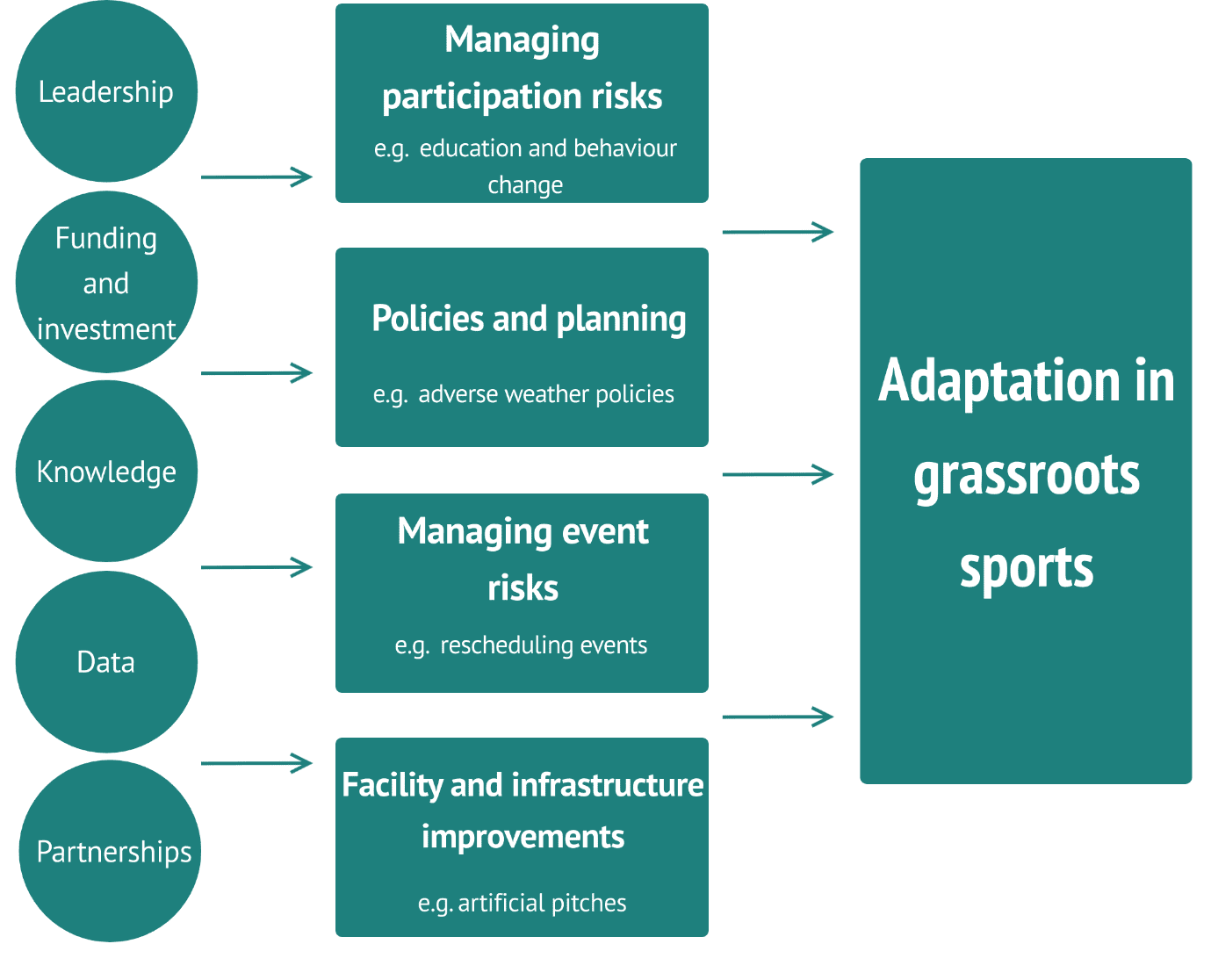
Figure 6‑1: Summary of measures that can deliver grassroots sport and the enablers that support these measures.
Policies and planning for climate change
Organisational policies and plans are a key mechanism to guide responses to adverse and extreme weather events for all sports (Orr et al., 2021; Mabon, 2022). Policies and plans may be implemented at different levels of governance, including at the club level or governing body level, and help to embed a consistent response with clear roles and responsibilities.
Examples of the kinds of policies and plans an organisation might have include:
Policies that provide guidance on how to respond to impacts from extreme weather.
Policies around event/season scheduling that may be adapted.
An adaptation plan (potentially supported by an evidence base from a climate change risk assessment) setting out resourcing and plans for the organisation’s long-term response to climate change.
Many of the adaptation responses that a policy may recommend are outlined in the following sections, but they could include providing structured guidance on when events should be cancelled, or adjusted, and clarifying when extra breaks may be required. For example, sportscotland has implemented an emergency response policy that covers major fires, floods, gale force winds, and external hazards both inside and outside facilities (sportscotland, 2023). Interviews highlighted that many sports groups in Scotland do disseminate weather risk policies and these policies are utilised in decision making. However, their use is often based on personal discretion and interpretation.
Extreme heat guidance, which should ideally involve a temperature threshold above which the policy applies, is a key policy identified in the literature for responding to health and wellbeing risks to participants during heatwaves (Orr et al., 2021; SGSA, 2025). Although the risk of extreme heat is lower risk in Scotland than in other parts of the UK, heatwaves already impact sport participant health and safety in Scotland and participants may underestimate the danger, as discussed in Section 5. The average number of heatwaves per year in Scotland is projected to be around 4 times higher in the period 2030-2060 than it was in 1981-2010, so the associated risk will increase (Arnell et al., 2021). Very few governing bodies and clubs in Scotland were found to have specific policies surrounding extreme heat, and there was a general perception amongst interviewees that heat is not a significant issue in Scotland. There are though, some examples of heat being considered in sport policies. For example, Disability Sport Scotland integrates heat as part of their inclement weather policy (see 6.1.3.1 Case study 3).
Policies may also relate to adjusting season or session timings. Interviewees also highlighted altering season timings as a possible response to a changing climate. There is some precedent for changing season timings to account for the weather. In Scotland, the children’s football season already runs from March to November to take advantage of the best weather and longer daylight hours, although for older players a traditional winter season is observed (UEFA, 2012; Scottish Youth Football Association, 2024). Scottish women’s football was also previously played in a summer season, from 2009 to 2020 when it reverted to a winter season following the COVID-19 pandemic (Reynolds, 2013; Cairney, 2020). Additionally, other sports groups have condensed the season to a shorter period of time. However, interviewees noted that this can have negative impacts, with a condensed season reducing recovery time which was anecdotally attributed to increasing injury rates.
In addition to policies that help manage current response, planning and identifying risks is important to help to prepare for future climate risks (Orr and Inoue, 2019). In general, longer term adaptation planning in response to climate change was uncommon amongst Scottish sport groups. One interviewee noted that long term climate impacts are rarely considered, as management practices tend to be localised and taken at a small scale, rather than instituted by a governing body. One exception is the Coastal Change Adaptation Planning (CCAP) discussed in 6.1.1.1 Case study 2 below.
Case study 2: Coastal change adaptation planning at Royal Dornoch golf club
Sport: Golf
Climate hazard: Coastal erosion, storm impacts, coastal flooding
What was the challenge?
Coastal erosion is posing a significant threat to Royal Dornoch’s golf courses, and many other links courses in Scotland. In 2010, erosion began to affect the club’s second course, the Struie, largely due to the shallow beach and the loss of a salt marsh, which allowed waves to erode the coastline more aggressively (Hampton, 2025). The impact of Storm Babet in 2023 further highlighted the severity of the problem, as it caused the loss of 5–10 metres of previously recovered coastline on the Championship Course. The amount of erosion was measured against stakes in the ground that had been in place for over 20 years to provide evidence of coastal change.
What action was taken?
Learning from previous erosion events along the coastline was key to informing the response. To counter the erosion in 2010, the club initially used old Christmas trees to create a barrier, later replacing them with chestnut fencing designed to break up wave energy. This approach proved effective, enabling the salt marsh to regenerate toward the sea and preventing the course from needing to be rerouted. Building on this success, Royal Dornoch continues to work with St. Andrews University, NatureScot and Dornoch Academy on saltmarsh restoration (Hampton, 2025).
Building on this experience, the club is now developing a Coastal Change Adaptation Plan (CCAP) (Hampton, 2025). The aim of this work is to analyse and model erosion patterns to anticipate how the coastline may change over the coming decades. The club’s desire to develop the CCAP was partly borne out of discussion with a club member who had expertise in the area of coastal change and hence encouraged forward planning, and this led to a broader focus on monitoring the entire coastline, not just the areas currently affected.
What was the impact?
The CCAP is expected to improve monitoring and data collection, allowing informed action to be taken. This will build up an evidence base and dataset to inform future decision making and allow proactive risk mitigation. Additionally, the club’s experience in 2010 demonstrated that the course could be protected in response to erosion without resorting to hard engineering solutions, offering a less costly approach with more co-benefits.
Key lessons learned:
1. Benefits of nature-based solutions: Supported more affordable mechanisms for reducing erosion rates, alongside supporting local biodiversity.
2. Capacity building through partnerships: Engagement and collaboration with a knowledgeable club member, and others including St. Andrews University, NatureScot, and Dornoch Academy helped to build capacity for adaptation work. Partnership working can also help with sharing good practice more widely if partners disseminate learnings through their networks, as NatureScot have in this case (Maynard, 2025). This could allow similar approaches to be used in other places.
3. Developing an evidence base: By planning for their future evidence needs through the CCAP, the club will build up data that helps them make decisions on how best to protect the club’s facilities for decades to come. Developing a detailed CCAP may not be possible for other sports groups due to capacity or financial constraints. However, alternative simple data collection methods, such as the use of stakes to measure erosion, could be readily implemented as an initial step towards improved monitoring.
Reducing the risks to participants in grassroots sport
Educating participants, providing them with appropriate information and raising awareness of actions that individuals can take is key to helping participants keep themselves safe in light of the risks posed by climate change (SGSA, 2025). Communicating extreme weather plans and educating individuals can help to establish expectations, manage health and safety risks, and improve long term participation (SGSA, 2025). For example, advice was published on the Loch Ness marathon website suggesting how runners should reduce speed in different temperatures, as well as other ways to cope with hot weather (Clyne, 2025).
Communicating risk and promoting safe behaviour amongst sports participants is not unique to the challenges posed by climate change. It already takes place in many sports, particularly for mountain sports and snow sports that are inherently higher risk. Similar channels and approaches may be used for communicating the changing risk profile that climate change brings. One instance of this is the “Think Winter” campaign which involves winter specific safety messaging delivered through a multi-organisational mountain safety group (Mountaineering Scotland, 2026). Interviewees highlighted that this campaign aims to use consistent messaging to reach those with less awareness of the weather and necessary safety precautions, such as those who are new to mountain sports and holiday makers. Assessing how well these communication mechanisms reduce participant risk is challenging, particularly given the changing risk profile, fluctuating levels of engagement in the sport over time, and improvements in emergency responses.
Weather forecasts play a key role in helping people to understand risk from weather and extreme events, particularly in water sports, mountain sports and snow sports (England Athletics, 2025; SGSA, 2025). A survey was conducted among individuals who use mountain facilities, many of which were involved in some form of mountain/snow sport, in which 98% of respondents said that use of a weather forecast was important to their decision making during mountain activities (Kelly and Smith, 2015). Evidence of using weather forecasts was identified in other outdoor sport groups during interviews, as a method of monitoring conditions to inform if sports events should go ahead. Interviewees also highlighted using weather warnings to guide safety measure implementation and cancellation if needed. One interviewee also noted the importance of early warning for flooding, saying “It is vital that flood prediction modelling is accurate to avoid unnecessary cancellation and associated costs.”
Reducing the risks to grassroots sports events
A key response in reducing the risk to events identified in the literature involves changing timings, locations or rescheduling events (Department for Culture, Media & Sport (DCMS), 2025; SGSA, 2025). A study identified that around 20% of observed adaptation mechanisms for grassroots sport in England involve altering session timings (Department for Culture, Media & Sport (DCMS), 2025). Interviewees discussed adjustments to scheduling in cases where there was expected extreme weather, as well as the potential for avoiding scheduling of events in winter/autumn due to wetter conditions. Rerouting or changing the venues of events was also discussed. Interviewees raised examples such as planning and providing pre-checked contingency routes for courses, permanently moving venues due to the impacts of wet weather on the ground, or changing course location or route. However, if rescheduling or rerouting needs to take place at short notice, it can be costly for event organisers and frustrating for event participants.
Insurance, including public liability insurance and cancellation insurance, is key to providing financial protection to events under increasing climate risks. There has been an increase in cancellation insurance premiums for events, which has been linked to rising costs and fees throughout different sectors (Joelle, 2020). Anecdotally, an interviewee noted that the cost of cancellation insurance is already high, and that they had observed a cost increase of 10-15% each year in recent years. Hence, although this insurance is effective in protecting organisations from cancellation costs, the cost of insurance is likely to become an increasing burden on clubs.
No examples of subsidies or other assistance relating to insurance or reinsurance relevant to the grassroots sports sector in Scotland were identified in this work. Further work is needed to discern the impact of increasing insurance costs on grassroot clubs and the scale of this alongside other increasing costs. Given the position of Edinburgh as a hub for the UK insurance sector and existing partnerships between the sports sector and the financial sector (such as Barclay’s sponsorship of the top four tiers of women’s football in Scotland (Freeman, 2024)), there may be opportunities for further work in Scotland on the impact of financial products on communities in relation to climate change and also opportunities for the financial sector to support engagement with sports organisations on climate change.
Case study 3: Extreme weather guidance for events from Scottish Disability Sport
Sport: outdoor sports
Climate hazard: extreme heat, wildfires, storms, flooding
What was the challenge?
Scottish Disability Sport is the national governing body for sports involving individuals of all ages and abilities with physical, sensory, or learning disabilities. Athletes with diverse and individual conditions are often particularly vulnerable to extreme weather events, which are increasing in frequency under climate change. This makes it essential for governing bodies such as Scottish Disability Sport to anticipate, manage, and mitigate these risks when organising events and competitions.
What action was taken?
Scottish Disability Sport have developed an inclement weather policy for use by event organisers and considerations relating to weather events are also included in their general wellbeing and protection policy.
The wellbeing and protection policy provides general guidance for routine checking of weather forecasts, while the inclement weather policy involves specific guidance surrounding rain, winter weather, hot weather and thunder and lightning, as well as how the guidance should be communicated when inclement weather is experienced (Scottish Disability Sport, 2026).
Communication methods have been developed for disseminating advice and decisions made from these policies. These have been effective in reaching participants to provide guidance and cancellation information. Channels have been set up to communicate any decisions and clear roles and responsibilities for individuals, and social media has been used to reach participants quickly.
The hot weather policy states that training programmes should be reviewed if projected temperatures exceed 35°C (Scottish Disability Sport, 2026). The hot weather policy also flags that at 29°C the body can no longer readily dissipate heat, noting that this is dependent on humidity, and that exceedance of 32°C is considered hot weather (Scottish Disability Sport, 2026). These thresholds are relatively high, and risks from heat can be experienced at lower temperature thresholds. Public Health Scotland has identified that the risk of heat related death to the Scottish population starts to increase at 18.2°C (Public Health Scotland, 2025). However, incorporating a defined temperature threshold at any level was not identified in other policies during this work. Thresholds or trigger points have been identified throughout the literature as a critically important response to the risks posed by extreme heat, as they provide a quantifiable point at which action should be taken (Orr et al., 2021; SGSA, 2025). Further work may be needed to identify the most appropriate thresholds for different sports and contexts.
What was the impact?
The policies have been implemented at events including annual summer camps in the Highlands. The policy prompted the organisation to respond to cold conditions by providing foil blankets and handwarmers, while in dry and warm conditions there was cancellation of BBQs to reduce fire risk, the provision of extra suncream, shaded areas, and heightened awareness of heatstroke risks. The Junior Athletics Championships, held in June, have faced highly variable conditions across years, including gale-force winds, hailstorms, torrential rain, and intense sun, requiring the implementation of the inclement weather policy to pause events when necessary. Overall, these policies have saved individuals and groups wasted journeys and have supported more efficient decision making so cancellations can be made earlier, reducing frustration from attendees which could otherwise risk engagement. Staff and volunteers also feel that these policies provide structure and a clear procedural approach. These policies therefore encouraged awareness and action in a variety of instances of inclement weather, increasing participant safety.
Key lessons learned:
1. Guidance provided for different weather events, including heat: Clear tailored policies are provided for different forms of inclement weather, with guidance on action to be taken.
2. Effective communication of actions, with clear roles and responsibilities: Clear roles are provided in the inclement weather policy, and information is disseminated to participants following action from the policy.
3. Heat policies with specific thresholds are useful for ensuring participant safety and are likely to become more necessary in Scotland in the near future as the climate changes.
Reducing the risks to facilities and places in grassroots sport
Managing grass pitches and surfaces
Managing grass pitches appropriately for field sports can reduce the risks from a changing climate. Adaptive measures can include irrigation, using drainage systems to prevent waterlogging and selecting climate resilient grass species (Bone, 2023). Although, some of these measures are likely to be prohibitively expensive for grassroots clubs, and limits may be placed on irrigation by hosepipe bans and other water scarcity measures under serious drought conditions. The Ground Manager’s Association provides comprehensive guidance for managing sports pitches during drought and, in England and Wales, runs a pitch advisory service that offers expert advice to clubs, local authorities and schools to improve the quality of their pitches in general (Grounds Management Association, 2025). Of the grassroots organisations who have taken up recommendations from the pitch advisory service, 86% have improved the quality of their pitches (Joyeux 2021).
In golf, greenkeeping has become increasingly important in addressing climate-related challenges (Reesink Turfcare, 2024) . However, interviewees identified that many clubs face capacity issues, often relying on volunteers. These capacity issues create operational challenges, with workforce shortages being a current concern for the greenkeeping profession (Dorsey, 2025; Tennant, 2025).
Shifting to artificial surfaces
In some cases, clubs have opted to replace grass pitches with artificial pitches and surfaces to avoid waterlogging in adverse weather and as a way to increase participation and prevent cancellations. For example, in cricket artificial grass surfaces are often used to mitigate the effects of the weather and allow play when conditions mean it is difficult to maintain grass (sportscotland, 2006). In general, decisions to install artificial pitches are not made with climate change in mind and are not specifically thought of as an adaptation measure by clubs. Generally decisions are driven by a desire to improve pitch quality and increase capacity. While grass pitches can only be used for a limited number of hours each week to avoid damage, artificial pitches can have up to 80 hours of use per week and hence present significant benefits for access and participation (Scottish FA, 2016; Sport England, 2025).
Third and fourth generation (3G/4G) artificial pitches are a common choice, however, these have some disadvantages:
Up front cost of installation is high, although there may be opportunities to generate revenue by renting the pitch out given higher usage is possible (Scottish FA, 2016). Opportunities to generate revenue are likely to be context dependent, for example there may be less potential in rural areas, and further research is needed to understand the impact of contextual factors.
Pitch surfaces on average need to be replaced every 10 years, although can last up to 13 years, adding to the cost and creating waste (Football Foundation, 2026).
Although artificial pitches can handle more rainfall, interviewees noted that they still have the capacity to flood and are not truly ‘all-weather’. Typically, artificial pitches are designed to provide highly efficient drainage so to reduce flood risk on the pitch (Scottish FA, 2026). A North American study identified that although synthetic turf fields can manage stormwater and provide sufficient drainage when designed correctly, damage due to flooding or improper maintenance can reduce these abilities (Procopio and Bonventre, 2022).
A Swedish study found that replacing grass fields with artificial fields can reduce biodiversity and pollution reduction benefits associated with soil processes, although the extent of this is context dependent. The study also noted that these could be offset to some degree by tree planting or green roofing in the surrounding area (Lozano and Ferguson, 2021).
Artificial pitches are more abrasive and therefore cause more grazes and friction burns than grass, although studies have found that overall injuries are no more likely on artificial turf than on grass for amateur players (Kuitunen et al., 2023).
A recent report found that artificial pitches are the main source of intentionally added microplastic pollution in the UK (Economics for the Environment Consultancy and UK Centre for Ecology & Hydrology, 2025). Following similar findings in Europe, the EU have introduced legislation phasing out the sale of products that intentionally release microplastics (Amis, 2023). Concerns were raised by interviewees regarding the environmental impact of artificial pitches due to the presence of microplastics. Sustainable infills that can provide an alternative to microplastics are being explored, with a trial of biodegradable corn infills being used as part of pitch resurfacing in Glasgow (Glasgow Life, 2025). Corn infills were also used in 6.2.5.1 Case Study 4.
Overall, artificial pitches can offer an opportunity to support higher levels of participation but may not be suitable for all local contexts and additional measures may need to be implemented to manage environmental impacts. In some cases, improved management of grass surfaces (as discussed in section 6.1.4.1) may offer a more suitable or accessible alternative.
Using artificial snow and other options for snow sports
In mountain and snow sports, artificial snow can be generated in response to reduced natural snowfall (McKenzie, 2025). The use of artificial snow is water and energy intensive and therefore costly (Loughborough University London et al., 2022; François et al., 2023; Symons, 2024). Additionally, only relatively small areas of the mountains can be covered with artificial snow and hence use of artificial snow at large scales may be unfeasible, especially with decreasing water availability expected with climate change (Loughborough University London et al., 2022).
Other adaptation strategies for snow sports providers include diversifying activities offered, such as trail running and hiking, to mitigate the risks to businesses and local economies (Hopkins and Maclean, 2014; Symons, 2024). In interviews, an alternative option discussed was increasing the provision of good quality artificial slopes in Scotland to increase the sport’s capacity. Encouraging further use of artificial slopes, and expanding these where possible could help to maintain participation (Scottish Government, 2023b). However, there are gaps in provision of artificial slopes in some areas of Scotland (Scottish Government, 2023b).
Managing footpaths, cycle paths and bridleways
Sports like running, walking and cycling often occur across large areas such as parks, pavements, roads or the countryside that are publicly maintained. Managing and maintaining routes in public open spaces to prevent erosion, or providing alternative routes after erosion has occurred, is key to maintaining access to these spaces. Options to protect footpaths from erosion include reducing gradients to slow the rate of erosion due to surface water, alongside installing additional drainage (Dolphin, 2025). One instance of providing an alternative route following erosion of a common walking route was identified in the Cairngorms where a ranger realigned a path uphill after a riverside path was damaged by 2 large floods in 2014 and 2015. The new route was safe from river erosion and flooding, meaning access could be maintained (Dolphin, 2025). Further action to protect footpaths is illustrated in 7.3.1.2 Case study 6.
Developing indoor facilities
Throughout interviews, the use of indoor facilities by outdoor sports in poor weather was highlighted as an adaptation response. Although this protects participants from risks associated with adverse weather conditions, there are a number of caveats. For example, lots of clubs moving inside simultaneously can increase the demands on facilities and drive up prices. Additionally, indoor spaces were identified to be generally more expensive, particularly when used as a last-minute response to worse weather.
Investment in facility heating and cooling to manage the impacts of extreme cold and heat, and drainage infrastructure or other flood protections to mitigate the risks form extreme precipitation and flooding may be needed to further protect indoor activities (Orr et al., 2021; Department for Culture, Media & Sport (DCMS), 2025).
From interviews, the focus on building or retrofitting facilities tended to be on improving heating rather than cooling, due to the cold weather impacts currently typical in Scotland. One instance was identified where waterproofing a basement of a sports outdoor centre, as well as the use of gabion cages for reinforcement to prevent subsidence of land around the building, had been undertaken at a site near a river where flooding is becoming more frequent.
What resources and support are needed?
As shown in Figure 6‑1, implementation of these measures is contingent on enablers being in place, details of key enablers for increasing capacity for climate adaptation action in grassroots sport are outlined with examples of where these already exist in Scotland.
Data
Improved data on weather related impacts, participation trends and cancellations can help inform adaptation decisions and make climate impacts evident to sports participants and clubs. Very limited data on climate impacts on sport in Scotland is publicly available or collated by SGBs. Many interviewees noted that they would be interested in collecting data on cancellations, however had not implemented this due to a lack of capacity. Data could help justify investment in facilities for climate adaptation (e.g. synthetic pitches) by presenting the frequency and impact of adverse weather. Many grassroots clubs use web applications (such as Spond, Pitchero and Teamer) for managing fixtures and communication and so providers of these applications may hold data that could be used to better understand cancellation and postponement in some sports.
For example: Scottish Rugby gather information on postponements and cancellations via reporting by club fixture secretaries. This is collated in their centralised, in-house data management system and tagged with the relevant reason for cancellation or postponement.
Skills and knowledge
Confidence in knowledge of climate change impacts, how to act on them, and how to communicate this, is key to implementing adaptation actions (Department for Culture, Media & Sport (DCMS), 2025). For instance, improving understanding could help clubs identify when and where funding may be needed to adapt to climate change and how to communicate this need for action. Without understanding of climate change impacts, increasingly worse weather being experienced may not be linked to a need for climate adaptation actions.
Interviewees were typically able to identify some climate change risks of relevance to them, but often missed some key risks, especially extreme heat. One interviewee asked for signposting to further resources so they could increase their knowledge. Some interviewees also showed less confidence distinguishing adaptation actions from actions to reduce greenhouse gas emissions, highlighting a knowledge gap. Interviewees also emphasised that, with many grassroots organisations being run by volunteers, capacity to undertake training or build knowledge on climate issues is often very limited.
Interviewees also mentioned that in some cases, specific skills and knowledge may be required for successful implementation of adaptation. For example, skills such as greenkeeping and farriering are needed to maintain golf courses and ensure horse welfare respectively in the face of increasing climate impacts. There are already shortages of these skills in some areas of Scotland (Murray, 2023; Tennant, 2025).
For example: Keep Scotland Beautiful provide climate emergency training to the sport sector in Scotland. Part of this is to help understanding of how Scotland’s sport sector will be impacted by climate change (Keep Scotland Beautiful, 2025). However, capacity has been a barrier to widespread uptake of this climate emergency training across Scottish sport organisations.
Funding and investment
Funding routes need to be available for climate adaptation and clearly promoted to clubs as a way to improve their facilities to decrease the risks associated with worsening weather (Department for Culture, Media & Sport (DCMS), 2025).
For example: An investment partnership established between sportscotland, Glasgow City Council and Glasgow Warriors was supported by Scottish Rugby and scottishathletics to fund a synthetic playing surface, alongside improvements to existing athletics facilities, with the aim of reducing the risk of postponement and cancellation due to poor weather conditions (Sport First, 2016). Although Glasgow Warriors are a professional rather than grassroots team and this specific case was a response to current pitch conditions rather than preparations for climate change, the multisport partnership is an approach to developing investment that could also be used elsewhere, as illustrated further in 6.2.5.1 Case study 4.
Leadership and governance
Many interviewees talked about leadership, at club, local authority and governing body level, as important to prioritise adaptation, improve capacity, support action and develop partnerships. Many clubs are reliant on volunteers or do not have any dedicated roles relating to climate change (Department for Culture, Media & Sport (DCMS), 2025).
Partnerships
Strong partnerships between clubs, local authorities and governing bodies are key to enabling adaptation action and knowledge sharing on climate change issues. Lack of facility ownership can prevent adaptation of facilities, however, strong partnerships could serve to reduce the impact of this barrier to climate adaptation (Department for Culture, Media & Sport (DCMS), 2025).
Case study 4: Building a business case for grassroots adaptation at Shetland Rugby club
Sport: Rugby
Climate hazard: Extreme precipitation and flooding
What was the challenge?
Shetland Rugby club was experiencing regular flooding issues on their grass pitch (Shetland News, 2024). Over the last decade, flooding has become more frequent on Shetland. This has caused the loss of eight weeks of training time in the past year for Shetland Rugby club. Historically, Shetland has not supported an outdoor sports season during the winter months due to adverse weather conditions and limited daylight. This has resulted in most sporting activity moving indoors, leading to increased competition and higher costs for indoor spaces. The growth of rugby has highlighted the need for a facility capable of sustaining increased usage while remaining resilient during a period in which the impacts of climate change have intensified.
What action was taken?
The Sport and Leisure department at Shetland council led a proposal for an outdoor artificial pitch to be used for both football and rugby. This proposal was prompted by consistent discussions about the flooding issues on the grass pitch, and anecdotal observations of changes in flooding over the years. Met Office data and resources from Adaptation Scotland were used to support these observations. According to this data, winters in Scotland over the last decade have been 19% wetter than the 1961-1990 average and further increases in rainfall of 8-12% are predicted between now and 2050. These statistics were used within the proposal to make the case that flooding was expected to worsen on Shetland, and hence new facilities would be required to allow grassroots sports to continue and grow.
The proposal was developed via collaboration between the Council and multiple other sporting organisations in Shetland, including Shetland Rugby and Shetland Football. A partnership was established between interested groups, and several rounds of meetings and discussions were arranged to coordinate funding. This collaboration benefited from the shared agreement on the end goal of an artificial pitch.
What was the impact?
Ultimately, funding for the project was provided by a range of sources: Shetland Islands Council, the Scottish Football Association, sportscotland, Scottish Rugby Union, Shetland Football and Shetland Rugby. The total cost was about £1.46M. The pitch uses an infill material made of biodegradable corn to avoid the negative environmental impacts of rubber infill discussed in section 6.1.4.2 (Kerr, 2025).
Shetland Council were able to coordinate an approach to support both Shetland Rugby and Football by recognising the impacts of increasingly worse weather on the grass pitch. The new pitch has the potential to increase participation by reducing cancellation rates, improving engagement through the winter and improving playing conditions. Anecdotally, feedback from players on the new pitch so far has been extremely positive. The development of the new pitch will not only enable the continued progression of rugby but will also provide opportunities for a wider range of outdoor sports to operate throughout the winter season.
Key lessons learned:
1. Understanding climate impacts on the club: The community observed that flooding issues on the pitch were increasing over time, and this was linked to freely available historic and projected climate change data.
2. Coordination and partnership approach to funding: This ensured that the proposal for the artificial pitch met the needs of sporting organisations and groups across Shetland. The council took a leadership role which facilitated coordination of the different sporting organisations on Shetland, and several rounds of meetings supported development and coordination of the multiple funding sources.
Public engagement on climate through sport
What are the perceptions of climate risk and adaptation within grassroots sports?
Perceptions of climate risk
In a Keep Scotland Beautiful study, it was found that more than 75% of people in Scotland believe sports clubs and sport governing bodies should work to reduce emissions and climate change impacts. More than half agreed that sports clubs (58%), sport governing bodies (60%) and sports players (50%) should use their platform to encourage climate action (Keep Scotland Beautiful, 2023). However, only 39% of respondents to a survey of youth participants in Scottish grassroots sports, said their group’s activities were impacted by climate change in the past six months (Sported, 2024). This suggests that whilst there is a general awareness of climate change amongst sports fans, people may not be attributing their lived experience to impacts of climate change.
It is recognised that personal experience with extreme weather events directly influences risk perception (Van der Linden, 2014). For many outdoor sports, interviewees cited personal experiences of climate impacts disrupting their sports when talking about climate risks. However, interviewees also commented that, in Scotland, impacts from extreme weather events are an accepted day to day reality of participating in grassroots sports. Whilst extreme weather events are increasing in severity and frequency, one interviewee noted impacts such as event cancellations and waterlogged pitches “have always happened”. As such, some interviewees did not perceive significantly increased risks from the changing climate. Interviewees also noted that damage to infrastructure and equipment during extreme weather events was often attributed to a long-term lack of maintenance rather than climate change.
As discussed in section 6.2.1, data collection relating to climate risk is very limited for grassroots sports. Therefore, perceptions are largely anecdotal and based on lived experience. Overall, perceptions around the level of risk varied by type of hazard. Interviewees frequently cited the impact of flooding on sporting activities and event delivery as a key risk. The impact of extreme heat and drought was cited much less frequently overall, and only in instances where hot dry weather had recently led to event postponement or cancellation.
Perceptions and understanding of adaptation
When talking about taking action on climate impacts, the majority of interviewees referred to ‘sustainability’ rather than climate adaptation. Sustainability was interpreted holistically, in an environmental sense but also including financial sustainability and ensuring sport’s and club’s longevity. Developing a sustainability policy addressing these issues was generally viewed as something a club ought to do. However, the usual focus of sustainability action currently is on reducing carbon footprint, with little acknowledgment of climate risk. Where adaptation action has been undertaken, such as through introduction of artificial pitches or extreme weather policies, it was often not explicitly recognised as such.
Interviewees generally noted that there is willingness to take action to manage climate risk and adapt, but a lack of knowledge around effective measures and capacity to implement these. Even at the elite level, athlete activists have reported uncertainty around ‘correct’ climate actions and messaging to share with sporting audiences (Knowles, Scott and Rutty, 2023). Interviewees also noted a lack of clarity around the roles and responsibilities of clubs and other sporting bodies in terms of delivering adaptation action. This uncertainty directly affects their ability to provide clear, simple messaging to participants around climate adaptation and create buy-in for action. One club was cautious to provide messaging around climate impacts, in case information changed in the future. As acknowledged in section 6.2, this lack of knowledge also means organisations are less confident on how to use funding to deliver measures that will help adapt to climate impacts. Discussions about climate change must include an acknowledgement of people’s capacity for response in order to avoid being disempowering and patronising (Orr and Inoue, 2019).
At the global level, the United Nations Framework Convention on Climate Change (UNFCCC) has responded to the increasing perception of climate risks in sport, establishing a Sports for Climate Action Framework (United Nations Climate Change, 2022). The framework aims to align sports with a 1.5°C climate-safe future and help sports adapt to the impacts of climate change through partnerships and collaboration, as well as to leverage the platform of sports to engage communities, fans and global audiences on climate action. It should be noted that the CCC have advised that , at a minimum, the UK must be prepared for reaching 2°C of global warming in the next 25 years, rather than preparing for a 1.5°C future (Climate Change Committee, 2025). Commonwealth Games Scotland and Snowsport Scotland are signatories of the Sports for Climate Action Framework, as well as a number of UK and Great Britain wide sports organisations. The framework provides guidance on actions signatories should take and also provides training on climate risk, mitigation and adaptation. This study did not assess level of engagement with the Sports for Climate Action Framework, so the influence of these resources on sporting organisations’ perceptions and understanding of adaptation, is unknown.
How can sports communities be effectively engaged on climate change?
Hooks for engaging with sporting communities
Sport is core to many people’s lives and has a uniting power to bring people together (European Climate Pact, 2024). This means sport can be used as a hook to engage communities on climate issues, raise awareness and influence behaviours. A number of specific hooks for engagement with sports audiences have been identified and are summarised in Figure 7‑1:
- Sporting identity: Many sports participants consider sport to be a core part of their personal identity, identifying themselves as ‘hikers’, ‘footballers’ or ‘skiers’. Hence, personalising communication to appeal to these groups, may help to galvanise support for adaptation action and pitch engagement in terms of what is most important and actionable for individuals and clubs. Previous work has found that behaviour is effectively influenced when messages align with individual values and worldviews of the target audience (Bolderdijk et al., 2013).
- Concern for future generations: A number of interviewees noted that many sports participants are passionate about introducing their children to the sport they love. In some cases, families may even move to a specific area to improve access to their sport. A study in North America noted that legacy is an important driver for engagement. Not being able to pass on a sport to future generations, in particular younger family members can mean participating in sports feels less meaningful for current participants if there is a perceived likelihood that the activity may only be available to this generation (Protect Our Winters, 2020). Interviewees reported that more generally, grassroots sports may use messaging relating to ‘protecting the club’ to motivate people to take action to ensure that their clubs, which may have existed for many generations already, will also be around for future generations to enjoy and to continue their legacy.
- Focus on practical implications including disruption and cost: In the interviews, messages around impacts on access, maintenance, health and safety and cost were viewed as key for mobilising action for both sporting participants and sporting organisations, particularly where these impacts are already being felt. Messaging around addressing rising costs due to climate change was a particularly compelling hook, as increasing costs of maintenance and repairs are being passed on to players through membership or event fees, raising the point of entry. Previous work in England has acknowledged that there is a risk of grassroots sports becoming “increasingly elitist” as rising costs due to climate change reduce accessibility (Department for Culture, Media & Sport (DCMS), 2025). Sporting clubs and organisations are facing significant wider challenges around the availability of facilities and spaces, as well as the costs of running, owning, and maintaining such venues (Sported, 2024). Hence, action on climate risk may not be seen as a priority. Several organisations noted messages which focus on cost savings, and direct benefits for participants, are key.
- Appreciation of the environment: In some cases, particularly for sports taking place in more rural areas or in the Scottish mountains, interviewees identified pride in the Scottish environment and a general appreciation and care for the environment to be a motivating factor.
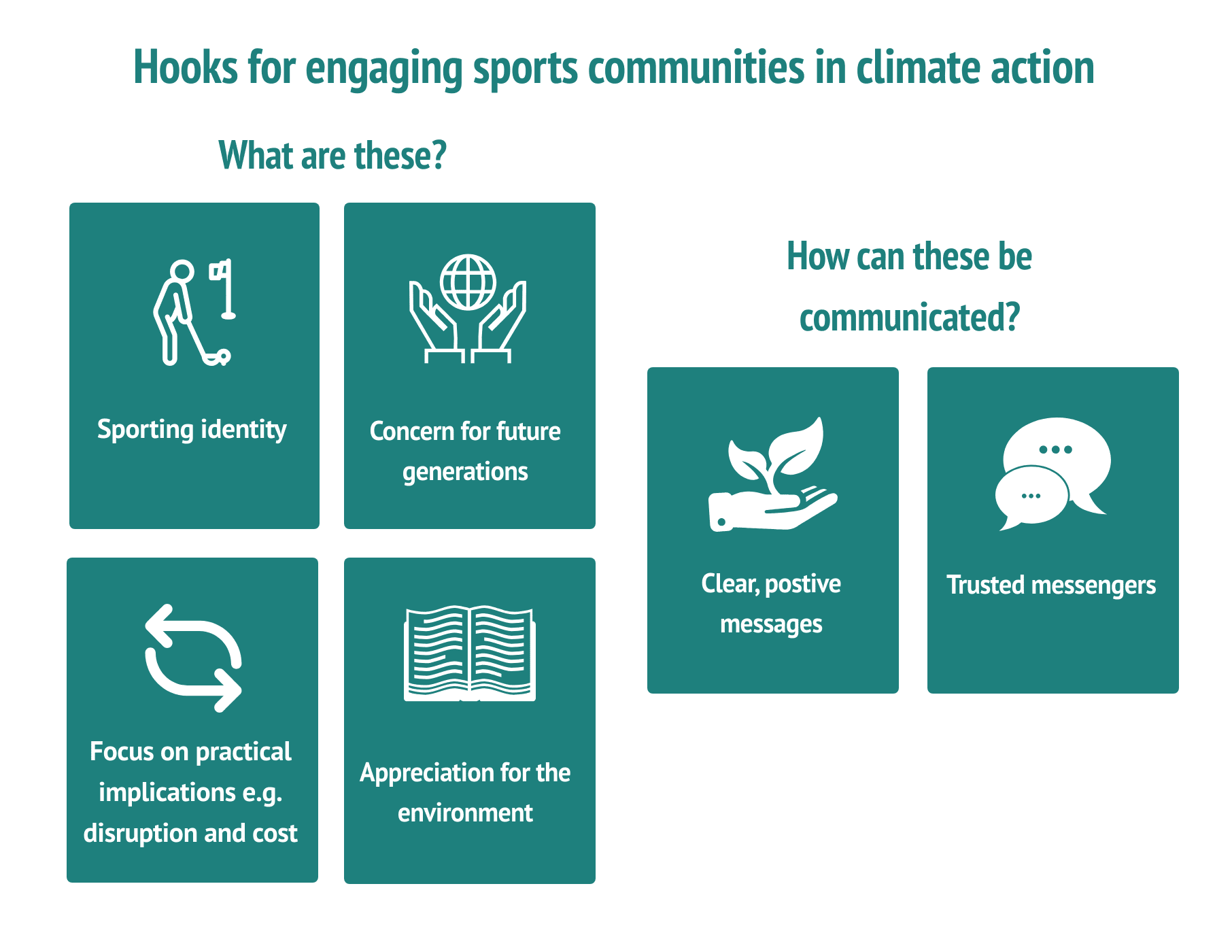
Figure 7‑1: Summary of hooks identified for engaging sports communities on climate issues.
Trusted messengers
The role of the trusted messenger is vital for engagement. A trusted messenger is an individual or organisation that has influence and credibility within a community, be that sporting or geographic. They foster genuine connections, and use their shared experiences, interests, values and deep community bonds, to inspire action (Purpose, 2025). Individuals who take on leadership roles within sporting communities, such as elite athletes or coaches and captains at grassroots level, build trust around climate messaging and legitimise action, as well as being able to reach wider audiences (Sport Positive, UN Sports for Climate Action and CAST, 2024). Interviewees noted that “role models are vital” and trusted messengers can share powerful, personal stories about the climate impacts they are seeing, how the impacts are affecting them, and inspire change. The global Adapt2Win campaign is an example of where professional athletes are using their platform as role models and trusted messengers and emphasising impacts on sport to call for climate adaptation action (Adapt2win, 2025). England football player Beth Mead is part of this campaign and has highlighted her experience of extreme heatwaves leading to cancellations of professional level football matches (Mead, 2025).
Trusted messengers from sports organisations can also support engagement with members of the community who are engaged with sports organisations, but not with other groups that typically share messaging around climate change. One interviewee stated that broad environmental NGOs have less impact in sports communities as they are less aligned with the values of the people involved. A study in North America supported this view, finding that traditional environmental and climate change messaging often fails to resonate with the outdoor sports community (Protect Our Winters, 2020). Another interviewee mentioned that a club member with expertise in climate change acted as a trusted messenger in their sports club when speaking with other members and hence helped to build support and acceptance for adaptation measures. This led to partnerships between the club and local schools to raise awareness of the adaptation measures in the wider community. Another interviewee mentioned that organisations like Local Authorities may not have a good understanding of some parts of the community’s interests, whereas local sports clubs often do and hence can tailor their messaging.
Clear, positive messaging
Providing clear, positive messages that emphasise opportunities for action is important for engagement (Football for Future and Common Goal, 2025). One interviewee highlighted that the use of positive messaging during an in-person energy efficiency event, fostered community engagement for climate action. The event, hosted in partnership with Home Energy Scotland, raised awareness of energy efficiency measures grassroots sports participants can take, and tailored messages around tackling fuel poverty. Advice was focused around making climate action practical and solution-oriented, recognising the community’s limited time and budget. It was noted in an interview, when it comes to sharing climate messages the “more normal the wording, the better”. Another interviewee highlighted lessons from government messaging during the COVID-19 pandemic, noting that the coherent, simple messaging with clear actions for individuals attached, and a clear purpose, was easy to communicate to the sports community.
Engagement is effective when an understanding of climate impacts is coupled with the reality of everyday lives, and an understanding of what climate change means in practice for places (Climate Outreach, 2023). People are most interested in what they can do to make a difference, and this is best communicated through relatable, personal actions (Protect Our Winters, 2020). Applying this approach to engage with grassroots clubs around climate adaptation measures, could unlock opportunities for climate resilience to become embedded within communities. An example of where this has been used effectively for community engagement through sport is illustrated in 7.2.2.3 Case study 5.
Case study 5: Alloa Saints Youth FC trees for goals
Sport: Football
Climate hazard: Extreme precipitation, flooding and heat
What was the challenge?
Alloa Saints Youth Football Club has been experiencing the effects of climate change. Heavier, more frequent rainfall is leading to waterlogged grass pitches and increased seasonal flooding. Artificial pitches are becoming increasingly expensive to hire for training and matches, so training costs for young players are increasing. This affects participation rates, especially against the backdrop of generally increased cost of living. Parts of Alloa are within the most deprived 5% of areas in Scotland (Scottish Government, 2020).
What was done?
The Forth Climate Forest approached Alloa Saints Youth Football Club with the opportunity to take up the ‘Trees for Goals’ initiative. For every goal scored, one tree was planted by the club, from the beginning of the 2024 season until National Tree Week (ending 1st December 2024). This initiative was a partnership between Forth Valley Climate Action Hub, The Conservation Volunteers Scotland and Forth Climate Forest (Youth Football Scotland, 2024).
The aim of the project was to teach young players that community sports can have a real impact on tackling climate change and biodiversity loss. Planting trees can be an effective measure for climate adaptation, providing shading and flood protection. The Trees for Goals initiative supports the Forth Climate Forest’s goal, to plant 16 million trees in Clackmannanshire, Falkirk and Stirling within the next decade (University of Stirling, 2024).
What was the impact?
Through the scheme, 1,200 trees have been planted in Sauchie Meadow, an area which was previously empty field land. Forth Climate Forest identified locations where planting more trees would create benefit for people and wildlife (University of Stirling, 2024). Linking tree planting as a long-term solution to climate impacts the community is already experiencing helped to raise awareness.
Key lessons learned:
1. Use of simple and positive messaging: ‘For every goal, one tree is planted’ is an effective mission statement which creates buy-in for the community. A 6-year old player commented “that’s a tree” when they scored a goal.
2. Partnership working: Working with an existing campaign enabled Alloa Saints FC to focus on engagement and participation rather than establishing mechanisms for delivery or funding, as well as benefit from the knowledge and expertise of wider organisations.
3. Physical act of tree planting: Taking tangible action allows people to feel positive about contributing to solutions. To maximise these benefits, planning and coordination is needed to ensure timing and communication of activities is tailored to the community’s needs.
How is sport being used for engagement?
Sport is a powerful vehicle for driving positive change as it transcends cultures, borders and generations (International Olympic Committee and United Nations Climate Change, 2019). Sport has a history of empowering local communities to become agents of change (Football for Future and Common Goal, 2025), notably shifting social norms around food poverty and gender equality and connecting sectors (UNFCCC Sports for Climate Action, 2025).
The majority of examples of sport being used for engagement on climate change identified through this work are related to reducing emissions and climate mitigation, with relatively few examples of sport being used as a tool to raise awareness of climate risk and adaptation. This likely reflects the wider climate action landscape in the UK, where mitigation action has historically had a higher profile than adaptation. As discussed in section 7.1.2, a lack of knowledge is currently a barrier to clubs and governing bodies driving adaptation action and engagement within communities themselves. Specifically, examples of climate impacts on grassroots sports clubs leading to action and awareness amongst the wider community have not been identified. Examples of initiatives that supported sports participants to engage in adaptation related action are illustrated in Section 7.3.1.1 Case study 5 and Section 7.3.1.2 Case study 6.
Although the following examples of sport being used for climate change engagement are primarily focused on reducing emissions, pollution or litter, they illustrate the breadth of initiatives underway in Scotland and similar approaches could be used to support engagement on risk and adaptation in future.
Surfers against Sewage are a charity involved in raising awareness around climate change and pollution. They are active throughout Scotland. They are supported by a range of sports including swimming, kayaking and surfing, and often run events to raise awareness for issues affecting their sports (Goldblatt, 2025).
Protect Our Winters UK, based in Edinburgh, brings together winter and outdoor sports participants to protect cold environments. They take a systemic focus and seek to educate, advocate and collaborate for climate action, connecting with sporting organisations to widen support. They connect lived experiences of climate impacts with potential future climate risks, and highlight the need to consider these at the national consultation level (Protect Our Winters, 2020).
The Scottish Football Association have partnered with Zero Waste Scotland to provide a guide on how Scottish football clubs can become more environmentally sustainable. They reach out to clubs to encourage them to think about sustainability and climate change, promote stories, as well as funding resources. Ayr United delivered education in schools on climate change through their academy (Mabon, 2022)
The Pledgeball initiative involves fans making a climate related pledge linked to their club via the Pledgeball website. Pledges include things like walking or cycling for short journeys or eating more vegetarian meals. Pledgeball shows fans how they can take action themselves, makes fans actions visible to each other, raises the awareness of the impact of collective action, and links fans’ existing values as supporters of their club to climate change (Allan, 2025).
Case study 6: It’s up to us – Scottish mountaineering campaign to restore paths
Sport: Mountaineering, hiking
Climate hazard: Extreme precipitation, flooding and snowmelt leading to footpath erosion
What was the challenge?
High rainfall and flooding events are increasing in frequency and severity, due to climate change. Footpath erosion of mountain paths in Scotland is worsening due to this extreme weather and the cumulative effect of increased levels of participation in hillwalking. Many of Scotland’s mountain paths have become badly eroded and are in desperate need of repair for the safety of users and the integrity of the fragile mountain habitat. The upland path network provides access to Scotland’s mountains and so underpins the hill tourism industry. The majority of visits to upland areas involve the use of a path. With most European funding no longer available post-Brexit and no UK government funding, most mountain paths are at risk of not receiving the essential maintenance required to keep them fit for purpose (Outdoor Access Trust for Scotland, 2025).
What action was taken?
The Outdoor Access Trust for Scotland and Mountaineering Scotland created the ‘It’s Up to Us’ campaign in 2023. The three-year partnership aims to raise £300,000 to repair the badly eroded hill path from Dundonnell on An Teallach, one of Scotland’s most iconic mountains in the Northwest Highlands (Outdoor Access Trust for Scotland, 2025).
The campaign seeks to raise awareness of the need for investment in repair, maintenance and restoration of mountain paths that are being affected by increasing extreme weather events. The messages in the campaign have been particularly effective, as they leverage national pride for Scottish mountain environments, appeal to ‘hill-goers’, and emphasise values of stewardship and nature as a right for all. Mountain paths are depicted to be integral to physical and mental wellbeing and connection with nature and Scotland’s wild places. The campaign raises the profile of challenges facing land managers in Scotland in finding funding for path repair and maintenance on privately owned land. The simple, direct message ‘it’s up to us’ acts as a compelling call to action; without financial support from hill-goers and further investment by government, the paths are at significant risk. Engaging with stakeholders and Government, the campaign also aims to develop a framework for a long term, sustainable fund for maintenance of upland paths.
What was the impact?
Contributions from the general public so far have totalled approximately £47,000 which is significantly more than was raised for the previous Mend our Mountains campaign in 2018. An additional £7,700 has come from clubs, £17,000 from corporate donations, as well as £33,000 from other major donors, including Cotswolds Outdoors as a lead sponsor. As of December 2025, the campaign is almost at the funding target of £300,000. The campaign has also incorporated several volunteer days and a team of volunteers forming for other joint initiatives for path maintenance.
Key lessons learned:
1. Engaging with wider stakeholders increases impact, including the Scottish Government, stakeholder agencies and organisations, outdoor businesses, and all path users.
2. Investing in social media and communications strategy upfront to reach a wider audience and potentially inspire action beyond the locality of the Scottish mountains.
Developing a funding microsite and campaign video and updating social media regularly with new videos and content, has generated online interest. Use of magazines, TV and newspapers have effectively generated sustained public engagement in the campaign. Focusing on platforms the sports community uses, was particularly effective.
Conclusions
Overview of key findings
Climate change is already impacting grassroots sport in Scotland and many of these impacts are expected to worsen in the coming decades. Different sports are impacted in different ways and to different degrees, but for all sports considered, it is expected that climate change impacts could reduce participation in sport and physical activities and increase costs. Increased cancellations and postponements, risks to health and wellbeing and transport disruption, may contribute to reduced participation whilst factors such as increased maintenance and repair need as well as insurance price increases contribute to higher costs. These impacts will not be distributed evenly, with sport potentially becoming more inaccessible to deprived areas which already experience lower levels of physical activity. Although climate change poses substantial challenges for sport, warmer, drier summers may allow longer participation windows for some outdoor activities if the risks are managed.
Adaptation actions can be taken to reduce the risks from climate change as well as harness the opportunities. These include educating participants to change their behaviour in extreme weather, adapting facilities to maintain high quality playing surfaces under flood and drought conditions, and putting severe weather policies in place. Currently, actions that may be effective in adapting grassroots sport to climate change are rarely explicitly planned with the future climate in mind and may be implemented for other reasons or to deal with current weather impacts. The key barrier to more strategic approaches across the grassroots sports sector is knowledge, and the capacity to build this, with more guidance needed on future climate risk and effective adaptation actions. Improved knowledge and skills across the sector would support more systematic monitoring of climate impacts, leadership by SGBs on adaptation, and more effective investment in building resilience.
Given the key role of grassroots sport within communities, improved knowledge and understanding of adaptation would also allow leadership by sports organisations on building resilience within communities. Currently, there is limited join up between community adaptation and sports organisations in Scotland. Sports participants are experiencing some of the risks climate change poses via extreme weather but do not always link these experiences to climate change, as there is some perception that they have always occurred. In general, the sports community has the will to act on these risks but may not know how to do so or have capacity to do so. By using athletes, coaches and sports clubs as trusted messengers to deliver clear, positive messages, grassroots sports could play a role in empowering communities to build resilience, particularly as sports clubs may have reach into areas of the community who may be less engaged with climate change messaging more generally. There are numerous examples of sport being used as a tool to engage people on emissions reduction or other environmental issues and these may provide a blueprint for future engagement on resilience.
Evidence gaps
Data relating to climate impacts on sport in Scotland and action being taken to adapt and respond to these is not systematically collected or readily available. This means it is difficult to understand the scale of the impacts and how this is changing over time, as well as monitoring where additional adaptation measures might be needed. There are some examples of individual clubs developing data collection at the local level but limited examples at larger scales. Although it is not usually possible to attribute cancellations directly to climate change, data provides a baseline from which future trends in cancellations can be understood and acted upon. Further exploration of data owned by fixture management apps could provide valuable insights into the scale of weather and climate impacts on cancellation and postponement.
There is limited evidence available on the specific adaptation options available for sport in Scotland, and their effectiveness under different circumstances. In many cases, actions currently being taken, such as building new artificial pitches or providing extreme weather guidance, are not explicitly recognised as playing a role in adapting to the future climate. Evaluating the efficacy of actions is difficult because there are often many factors affecting outcomes. This makes it difficult for organisations to understand what actions they can and should take to prepare for the future climate, the scale at which these actions should be taken and to build business cases to finance these actions. There are also currently limited mechanisms available to share learning and examples of good practice to support the scaling up of successful actions.
Most engagement between sports organisations and climate issues relates to reducing emissions rather than adapting to the impacts of climate change. This means that less evidence is available regarding the role of sports organisations and the climate impacts they experience in building community resilience or supporting community understanding of climate risk and what works well for achieving this, although relevant lessons can be applied from engagement with wider sustainability initiatives.
The limitations of this study outlined in section 4.4 mean that there may also be sport specific risks or adaptation measures that have been missed by this study due to a lack of literature or stakeholder engagement.
Lessons for policy
Based on this work, a number of lessons for policy around grassroots sport and adaptation in Scotland have been identified. These are listed below with the first two recommendations being the highest priority to build capacity for taking on the other recommendations.
- Training is needed to increase knowledge and awareness of climate impacts, and where further adaptation action is needed, across all levels of the Scottish sports landscape. While some training for sports organisations is already available, uptake can be low due to resource and capacity constraints. Sportscotland currently have a centralised training platform for SGBs which could possibly be used to provide training on climate impacts and adaptation. SGBs can then cascade learnings to grassroots clubs through existing networks.
- Improved data collection is needed to understand the scale and trends in climate impacts on Scottish grassroots sport. A first step towards achieving this could include supporting SGBs to collect data on events they are directly involved with, and building up to more comprehensive systems, learning from organisations such as Scottish Rugby who are already collecting regular data.
- Specific inclusion of sports in national and local adaptation planning and risk assessment. Given that local authority risk assessments and adaptation plans often flow directly from national level work, explicit inclusion of sport in national level adaptation planning, such as the Scottish National Adaptation Plan, would signal a need for involvement of sports bodies in adaptation planning at the local level as well. In England, Sport England are in the process of commissioning a climate change risk assessment for the sport sector. This will provide an evidence base to support this as well as learnings that can be applied in Scotland.
- Develop the role of grassroots sports organisations in building community resilience. This could be achieved by building partnerships between community sports organisations and community climate organisations, such as climate hubs, to deliver information and action in the wider community. This could help to build knowledge of climate impacts within the sports organisations, as well as expanding the reach of climate organisations by using the sports organisations as trusted messengers in wider parts of the community. Support, such as dedicated programmes or forums, would likely be required to develop these partnerships given that many of these organisations are volunteer led and have limited capacity.
- Alignment of sports facilities funding with adaptation goals to avoid long-term, maladaptive decisions. In the short term, funding streams (such as local authority climate funding) should be identified that can support preparation for and recovery from climate risks and advertised to the grassroots sport sector, including examples of measures that could be taken. Following storms and flood events, Sport England advertise their funding to grassroots sports groups explicitly to help them recover but there has so far been no equivalent to this in Scotland. Although national circumstances differ, a similar approach of identifying how existing funding streams could be advertised to support preparation for and recovery from extreme events when needed could be explored. In the longer term, criteria for facility funding applications and other long term decision making across the sector should be reviewed to ensure climate resilience needs are formally and consistently considered so that facilities are prepared for the future climate, and potentially costly retrofits are not required.
References
Adapt2win (2025) Adapt2Win: A Global Call for Climate Adaptation Action. Available at: https://adapt2win.org (Accessed: 11 February 2026).
Adaptation Scotland and Met Office Research (2025) Climate change trends and projections. Available at: https://adaptation.scot/scotland-and-climate-change/climate-change-trends-and-projections/ (Accessed: 28 October 2025).
Amis, C. (2023) ‘Landmark Decision – Intentionally-added microplastic restrictions are to be adopted by the EU Fidra’, Fidra, 22 May. Available at: https://www.fidra.org.uk/pitch-in/intentionally-added-microplastics-restriction/ (Accessed: 22 December 2025).
Anderson, K. (2022) ‘£85 million proposal to replace Perth Leisure Pool could make quite a splash at council meeting’, Daily Record, 18 February. Available at: https://www.dailyrecord.co.uk/news/local-news/85-million-proposal-replace-perth-26264277 (Accessed: 8 January 2026).
Anderson, K. (2024a) ‘Councillor wants to see national sports competitions brought back to Perth’, Daily Record, November. Available at: https://www.dailyrecord.co.uk/news/local-news/councillor-wants-see-national-sports-34161672 (Accessed: 2 January 2026).
Anderson, K. (2024b) ‘Leisure facilities to be removed from Bell’s Sports Centre by August 31’, Daily Record, 17 May. Available at: https://www.dailyrecord.co.uk/news/local-news/leisure-facilities-removed-bells-sports-32829519 (Accessed: 8 January 2026).
Arnell, N.W. et al. (2021) ‘Indicators of climate risk in the UK at different levels of warming’, Environmental Research Communications, 3(9), p. 095005. Available at: https://doi.org/10.1088/2515-7620/ac24c0.
Balloux, F. and Van Dorp, L. (2017) ‘Q&A: What are pathogens, and what have they done to and for us?’, BMC Biology, 15(1), p. 91. Available at: https://doi.org/10.1186/s12915-017-0433-z.
BBC News (2023) ‘Flood gate closure delay may have led to Perth property damage’, BBC News, 22 November. Available at: http://bbc.co.uk/news/uk-scotland-tayside-central-67450336 (Accessed: 10 February 2026).
BBC News (2024a) ‘Closure confirmed for Bell’s Sports Centre in Perth’, BBC News, 16 May. Available at: https://www.bbc.co.uk/news/articles/cw4d4q1pjzxo (Accessed: 8 January 2026).
BBC News (2024b) ‘Reduced mountain snow patches point to climate change’, BBC News, 2 July. Available at: https://www.bbc.com/news/articles/c29dx3nyer2o (Accessed: 30 September 2025).
BBC News (2025) ‘First September warning of extreme wildfires for five years’, BBC News, September. Available at: https://www.bbc.co.uk/news/articles/cx2re2172y4o#:~:text=The%20alert%20is%20the%2013th,and%20urged%20%22extreme%20caution%22. (Accessed: 23 December 2025).
Betts, R.A., Haward, A.B. and Pearson, K.V. (2021) Introduction. In: The Third UK Climate Change Risk Assessment Technical Report. London: Prepared for the Climate Change Committee. Available at: https://www.ukclimaterisk.org/publications/technical-report-ccra3-ia/ (Accessed: 17 December 2025).
Bolderdijk, J.W. et al. (2013) ‘Values Determine the (In)Effectiveness of Informational Interventions in Promoting Pro-Environmental Behavior’, PLoS ONE, 8(12). Available at: https://journals.plos.org/plosone/article?id=10.1371/journal.pone.0083911 (Accessed: 12 November 2025).
Bone, A.T. (2023) How Might Climate Change Affect Different Sports Pitches? Available at: https://www.atbone.co.uk/news/how-might-climate-change-affect-different-sports-pitches/ (Accessed: 14 October 2025).
Boyle, J. (2025) ‘Mountain rescue teams warn of increase in accidents all year round’, The Sunday Post, 24 August. Available at: https://www.sundaypost.com/fp/huge-rise-in-rescues-as-global-warming-makes-mountains-seem-more-inviting/ (Accessed: 9 January 2026).
Bryan, K. et al. (2020) ‘The health and well-being effects of drought: assessing multi-stakeholder perspectives through narratives from the UK’, Climatic Change, 163(4), pp. 2073–2095. Available at: https://doi.org/10.1007/s10584-020-02916-x.
Cairney, J. (2020) ‘SWPL set for expansion as league scraps relegation for this season’, The Herald, 12 October. Available at: https://www.heraldscotland.com/sport/18788760.swpl-set-expansion-league-scraps-relegation-season/ (Accessed: 11 February 2026).
Calvin, K. et al. (2023) IPCC, 2023: Climate Change 2023: Synthesis Report. Contribution of Working Groups I, II and III to the Sixth Assessment Report of the Intergovernmental Panel on Climate Change [Core Writing Team, H. Lee and J. Romero (eds.)]. IPCC, Geneva, Switzerland. First. Intergovernmental Panel on Climate Change (IPCC). Available at: https://doi.org/10.59327/IPCC/AR6-9789291691647.
Carr, B. (2025) ‘Horse sanctuary struggling with soaring hay prices’, BBC News, 9 December. Available at: https://www.bbc.co.uk/news/articles/cx2dxw2gp30o (Accessed: 2 January 2026).
CCRA3 (2021) ‘Transport Briefing’. UK Climate Risk. Available at: https://www.ukclimaterisk.org/wp-content/uploads/2021/06/CCRA3-Briefing-Transport.pdf.
Chalmers, R. (2020) ‘BREAKING NEWS: Flood-damaged Perth Leisure Pool to remain closed for 12 months’, Daily Record, 16 October. Available at: https://www.dailyrecord.co.uk/news/local-news/breaking-news-flood-damaged-perth-22856227 (Accessed: 8 January 2026).
Chalmers, R. (2024) ‘“More robust” flood scheme is pledged for Perth following review’, Daily Record, 2 February. Available at: https://www.dailyrecord.co.uk/news/local-news/more-robust-flood-scheme-pledged-32024416 (Accessed: 11 February 2026).
Claerhout, S. et al. (2006) ‘Pathways involved in sunburn cell formation: deregulation in skin cancer’, Photochemical & Photobiological Sciences, 5(2), pp. 199–207. Available at: https://doi.org/10.1039/b504970a.
Climate Change Committee (2025) ‘CCC letter to Minister Hardy – advice on the UK’s adaptation objectives’. Available at: https://www.theccc.org.uk/publication/letter-ccc-letter-to-minister-hardy-advice-on-the-uks-adaptation-objectives/ (Accessed: 11 February 2026).
Climate Outreach (2023) ‘Talking climate at the grassroots: what works and what’s tough’, Talking climate at the grassroots: what works and what’s tough. Available at: https://climateoutreach.org/talking-climate-grassroots/ (Accessed: 1 August 2026).
Clyne, F. (2025) Loch Ness Marathon – Running in the Heat. Available at: https://www.lochnessmarathon.com/training-zone/training-tip-6/ (Accessed: 4 November 2025).
Collins, D. (2024) ‘Sport in Scotland: An Overview of Legislation, Governance, Policy and Funding’, SPICe Briefing [Preprint]. Available at: https://bprcdn.parliament.scot/published/2024/5/3/80d33c81-8d78-48b9-a5e7-193dc8169b9d/SB%2024-22.pdf (Accessed: 17 December 2025).
Davies, D. (2025) ‘Why no hosepipe bans in Scotland?’, SPICe Spotlight, 9 April. Available at: https://spice-spotlight.scot/2025/09/04/why-are-there-no-hosepipe-bans-in-scotland/ (Accessed: 14 January 2026).
DCMS (2024) Sport Satellite Account for the UK 2024: Key findings. Available at: https://www.gov.uk/government/publications/sport-satellite-account-for-the-uk-2024-research-into-a-new-measure-for-estimating-the-value-of-sport/sport-satellite-account-for-the-uk-2024-key-findings (Accessed: 9 December 2025).
Department for Culture, Media & Sport (DCMS) (2025) Exploring the financial implications of climate change on grassroots sport. Available at: https://www.gov.uk/government/publications/exploring-the-financial-implications-of-climate-change-on-grassroots-sport/exploring-the-financial-implications-of-climate-change-on-grassroots-sport (Accessed: 26 September 2025).
Dolphin, B. (2025) Navigating the climate crisis. Available at: https://www.ramblers.org.uk/navigating-climate-crisis (Accessed: 30 October 2025).
Dorsey, K. (2025) ‘Battling staff shortages in golf’s “invisible” profession’, The Herald, 12 September. Available at: https://www.heraldscotland.com/news/25460447.bigga-tackles-shortages-golfs-invisible-profession/ (Accessed: 7 January 2026).
Duncan, T. and McLaughlin, C. (2021) ‘COP26: How is climate change affecting Scottish sport?’, BBC Sport, 2 November. Available at: https://www.bbc.com/sport/scotland/59078464 (Accessed: 26 September 2025).
Economics for the Environment Consultancy and UK Centre for Ecology & Hydrology (2025) Option appraisal for intentionally added microplastics. Defra. Available at: https://sciencesearch.defra.gov.uk/ProjectDetails?ProjectId=21802 (Accessed: 22 December 2025).
England Athletics (2025) Recommendations for running events in hot weather. Available at: https://www.englandathletics.org/news/recommendations-for-running-events-in-hot-weather/ (Accessed: 14 October 2025).
Environment Agency (2025) Drought prospects for spring 2026. Available at: https://www.gov.uk/government/publications/drought-prospects-for-spring-2026 (Accessed: 22 December 2025).
European Climate Pact (2024) ‘Sport – a key player in climate action?’, Sport – a key player in climate action? Available at: https://climate-pact.europa.eu/articles-and-events/pact-articles/sport-key-player-climate-action-2024-07-26_en (Accessed: 12 November 2025).
Football for Future and Common Goal (2025) Fields of Change. Available at: https://online.flippingbook.com/view/671377101/66-67/ (Accessed: 1 August 2026).
Football Foundation (2026) 3G Pitch Replacement. Available at: https://footballfoundation.org.uk/support-article/3g/pitch/replacement (Accessed: 6 January 2026).
François, H. et al. (2023) ‘Climate change exacerbates snow-water-energy challenges for European ski tourism’, Nature Climate Change, 13(9), pp. 935–942. Available at: https://doi.org/10.1038/s41558-023-01759-5.
Freeman, T. (2024) ‘Barclays becomes new title sponsor for Scottish Women’s Football national leagues’, Scottish Women’s Football, 1 August. Available at: https://scotwomensfootball.com/latest-news/barclays-becomes-new-title-sponsor-for-scottish-womens-football-national-leagues/ (Accessed: 11 February 2026).
Glasgow Life (2025) ‘Glasgow Life Sport football pitches to receive £850,000 refresh’, Glasgow Life, 5 February. Available at: https://www.glasgowlife.org.uk/news/glasgow-life-sport-football-pitches-to-receive-850-000-refresh (Accessed: 9 February 2026).
Go Paddling (2024) ‘What Rising River Levels Means for Paddlers’, Go Paddling, 13 February. Available at: https://gopaddling.info/blog/tips-and-advice/what-rising-river-levels-means-for-paddlers/ (Accessed: 11 February 2026).
Goggins, D. et al. (2018) Game changer I: How climate change is impacting sports in the UK. 1. Available at: https://static1.squarespace.com/static/58b40fe1be65940cc4889d33/t/5a79bac853450a7495861454/1517927115822/Game+Changer.pdf (Accessed: 1 December 2025).
Goldblatt, D. (2025) Sports’ response to the climate crisis. Available at: https://www.playthegame.org/themes/sport-and-climate-change/sports-response-to-the-climate-crisis/ (Accessed: 30 September 2025).
Grounds Management Association (2025) Managing Sports Pitches During Drought. Available at: https://www.thegma.org.uk/news/managing-sports-pitches-during-drought/ (Accessed: 14 January 2026).
Haigh, I.D. et al. (2025) ‘Climate change impacts on coastal flooding, relevant to the coastal and marine environment around the UK and Ireland’, MCCIP Science Review 2025, p. 24pp. Available at: https://doi.org/10.14465/2025.reu02.cfl.
Hamilton, L. (2021) ‘Toxic algae forces cancellation of Loch Tay swim event’, 5 September. Available at: https://www.thecourier.co.uk/fp/news/perth-kinross/2509244/toxic-algae-forces-cancellation-of-loch-tay-swim-event/ (Accessed: 22 December 2025).
Hampton, N. (2025) Mapping out coastal changes to manage risk. Available at: https://royaldornoch.com/2025/07/24/mapping-out-coastal-changes-to-manage-risk/ (Accessed: 6 January 2026).
Hopkins, D. and Maclean, K. (2014) ‘Climate change perceptions and responses in Scotland’s ski industry’, Tourism Geographies, 16(3), pp. 400–414. Available at: https://doi.org/10.1080/14616688.2013.823457.
Intergovernmental Panel on Climate Change (IPCC) (ed.) (2023) ‘Climate Change Information for Regional Impact and for Risk Assessment’, in Climate Change 2021 – The Physical Science Basis: Working Group I Contribution to the Sixth Assessment Report of the Intergovernmental Panel on Climate Change. Cambridge: Cambridge University Press, pp. 1767–1926. Available at: https://doi.org/10.1017/9781009157896.014.
International Olympic Committee and United Nations Climate Change (2019) Sports for Climate Action: Sustainability Essentials. Available at: https://stillmed.olympics.com/media/Document%20Library/OlympicOrg/IOC/What-We-Do/celebrate-olympic-games/Sustainability/sustainability-essentials/SUSTAINABILITY-ESSENTIALS-ISSUE-2.pdf (Accessed: 8 January 2026).
James, I. (2012) Managing sports surfaces in drought conditions. Cranfield University: Centre for Sports Surface Technology. Available at: https://sportengland-production-files.s3.eu-west-2.amazonaws.com/s3fs-public/drought-report.pdf?VersionId=.pE53SWN8onQN5mzdH_wtjuy6ec0MRyM (Accessed: 22 December 2025).
Joelle, S. (2020) ‘Are Event Cancellation premiums on the rise?’, Insure Our Event, 27 January. Available at: https://insureourevent.co.uk/event-premiums-on-the-rise/ (Accessed: 6 January 2026).
Joyeux, D. (2021) ‘Pitch Perfect Engineering’, Ingenia, December, pp. 18–23.
Kang, H. et al. (2023) ‘Heat stress in horses: a literature review’, International Journal of Biometeorology, 67(6), pp. 957–973. Available at: https://doi.org/10.1007/s00484-023-02467-7.
Keep Scotland Beautiful (2023) Scots support sports clubs implementing environmental measures. Available at: https://www.keepscotlandbeautiful.org/news/2023/nov/scots-support-sports-clubs-implementing-environmental-measures/ (Accessed: 28 October 2025).
Keep Scotland Beautiful (2025) Sport | Climate Training | Keep Scotland Beautiful. Available at: https://www.keepscotlandbeautiful.org/climate-emergency-training/accredited-training/sector-based/sport/ (Accessed: 26 October 2025).
Kelly, N. and Smith, S. (2015) Mountain Weather Service: Research and Appraisal Full Report: Sep 2015. sportscotland. Available at: https://sportscotland.org.uk/media/ojcauhnh/mountain-weather-service-research-and-appraisal-final-full-report-nov-2015.pdf (Accessed: 2 December 2025).
Kendon, M. et al. (2025) ‘State of the UK Climate in 2024’, International Journal of Climatology, 45(S1), p. e70010. Available at: https://doi.org/10.1002/joc.70010.
Kerr, B. (2025) ‘New “North Loch Park” synthetic pitch to formally open on Friday’, Shetland Islands Council, 12 October. Available at: https://www.shetland.gov.uk/news/article/3871/new-north-loch-park-synthetic-pitch-to-formally-open-on-friday- (Accessed: 12 February 2026).
Knowles, N., Scott, D. and Rutty, M. (2023) ‘Climate change versus winter sports; can athlete climate activism change the score?’, International Review for the Sociology of Sport, 59(3). Available at: https://journals.sagepub.com/doi/full/10.1177/10126902231209226 (Accessed: 12 November 2025).
Kovats, S. and Brisley, R. (2021) Health, Communities and the Built Environment. Available at: https://www.ukclimaterisk.org/publications/technical-report-ccra3-ia/chapter-5/ (Accessed: 5 December 2025).
Kuitunen, I. et al. (2023) ‘Incidence of football injuries sustained on artificial turf compared to grass and other playing surfaces: a systematic review and meta-analysis’, eClinicalMedicine, 59, p. 101956. Available at: https://doi.org/10.1016/j.eclinm.2023.101956.
Li, S. et al. (2016) ‘Modelling the seasonality of Lyme disease risk and the potential impacts of a warming climate within the heterogeneous landscapes of Scotland’, Journal of The Royal Society Interface, 13(116), p. 20160140. Available at: https://doi.org/10.1098/rsif.2016.0140.
Loughborough University London et al. (2022) Slippery slopes: How climate change is threatening the Winter Olympics. Available at: https://library.olympics.com/Default/doc/SYRACUSE/1568540/slippery-slopes-how-climate-change-is-threatening-the-winter-olympics-madeleine-orr-et-al?_lg=en-GB (Accessed: 2 December 2025).
Lozano, J.E. and Ferguson, S. (2021) Ecosystem services for compensation of artificial turf systems. Research Institute of Industrial Economics. Available at: https://www.ifn.se/media/sq0b0gti/2021-ferguson-lozano-ecosystem-services-for-compensation-of-artificial-turf-systems.pdf (Accessed: 10 February 2026).
Mabon, L. (2022) ‘Football and climate change: what do we know, and what is needed for an evidence-informed response?’, Climate Policy, 23(3). Available at: https://www.tandfonline.com/doi/abs/10.1080/14693062.2022.2147895 (Accessed: 30 September 2025).
May, L. et al. (2024) Mitigating Climate Change Impacts on the Water Quality of Scottish Standing Waters. UK Centre for Ecology & Hydrology. Available at: https://www.researchgate.net/publication/379144715_Mitigating_Climate_Change_Impacts_on_the_Water_Quality_of_Scottish_Standing_Waters (Accessed: 22 December 2025).
Maynard, C. (2025) ‘Green Shores: Scotland’s longest running coastal restoration project’, Scotland’s Nature, 10 July. Available at: https://scotlandsnature.wordpress.com/2025/07/10/green-shores-scotlands-longest-running-coastal-restoration-project/ (Accessed: 11 February 2026).
McKenzie, S. (2025) ‘Glencoe Mountain ski resort to keep making snow until May’, BBC News, 3 April. Available at: https://www.bbc.co.uk/news/articles/cpq7d2rypn2o (Accessed: 22 December 2025).
McLaughlin, C. (2024) ‘The golf courses disappearing into the sea’, BBC News, 3 April. Available at: https://www.bbc.co.uk/news/articles/cqljjg1zq31o (Accessed: 22 December 2025).
Mead, B. (2025) ‘Beth Mead: ‘If we don’t adapt to climate change, football becomes a privilege, not a right‘’, The Guardian, 19 November. Available at: https://www.theguardian.com/football/2025/nov/19/beth-mead-climate-change-football (Accessed: 10 February 2026).
Mehryar, S. (2022) ‘What is the difference between climate change adaptation and resilience?’, Grantham Research Institute on climate change and the environment, 9 December. Available at: https://www.lse.ac.uk/granthaminstitute/explainers/what-is-the-difference-between-climate-change-adaptation-and-resilience/ (Accessed: 9 January 2026).
Meir, D. and Scott, D. (2025) Getting the inactive active: Barriers to physical activity and their potential policy solutions. The Scottish Parliament. Available at: https://bprcdn.parliament.scot/published/2025/1/10/c1a1038a-6254-45be-b329-edba530b47e1/SB%2025-03.pdf (Accessed: 5 January 2025).
Met Office (2019) Top ten UK’s hottest years all since 2002. Available at: https://www.metoffice.gov.uk/about-us/news-and-media/media-centre/weather-and-climate-news/2019/state-of-the-uk-climate-2018 (Accessed: 1 December 2007).
Met Office (2026a) ‘2025 is double-record breaker: UK’s warmest and sunniest year on record’, Met Office, 1 February. Available at: https://www.metoffice.gov.uk/about-us/news-and-media/media-centre/weather-and-climate-news/2026/2025-is-double-record-breaker-uks-warmest-and-sunniest-year-on-record (Accessed: 11 February 2026).
Met Office (2026b) Climate Report for Glasgow City. Local Authority Climate Explorer. Met Office. Available at: https://www.reports.esriuk.com/view-report/b8eb3cee8f764147a2cfcd69cf36238f/S12000049 (Accessed: 11 February 2026).
Mott, M. (2025) ‘Animal charities warn of “panic” over hay shortage’, BBC News, 8 October. Available at: https://www.bbc.co.uk/news/articles/c1476e4ky64o (Accessed: 2 January 2026).
Mountaineering Scotland (2023) It’s Up to Us – Saving Scotland’s Mountain Paths. Available at: https://www.mountaineering.scot/its-up-to-us-path-campaign (Accessed: 12 November 2025).
Mountaineering Scotland (2026) ThinkWINTER | Mountaineering Scotland. Available at: https://www.mountaineering.scot/safety-and-skills/thinkwinter (Accessed: 6 January 2026).
Murray, B. (2023) ‘Concerns shortage of farriers in certain regions will hit horse welfare’, Horse & Hound, September. Available at: https://www.horseandhound.co.uk/news/concerns-shortage-of-farriers-in-certain-regions-will-hit-horse-welfare-837799 (Accessed: 2 January 2026).
NOAA (2024) What is an invasive species? Available at: https://oceanservice.noaa.gov/facts/invasive.html (Accessed: 9 February 2026).
Ogston, G. (2023) ‘Bell’s Sport Centre flood damage repairs could reach £2m’, BBC News, 22 November. Available at: https://www.bbc.co.uk/news/uk-scotland-67496241 (Accessed: 9 January 2026).
Orr, M. et al. (2021) ‘Impacts of climate change on organized sport: A scoping review’. Available at: https://doi.org/10.1002/wcc.760.
Orr, M. and Inoue, Y. (2019) ‘Sport versus climate: Introducing the climate vulnerability of sport organizations framework’, Sport Management Review, 22(4), pp. 452–463. Available at: https://doi.org/10.1016/j.smr.2018.09.007.
Outdoor Access Trust for Scotland (2025) ‘It’s Up to Us…to step up and save our mountain paths’, It’s Up to Us…to step up and save our mountain paths. Available at: https://www.outdooraccesstrustforscotland.org.uk/its-up-to-us-to-step-up-and-save-our-mountain-paths/ (Accessed: 12 November 2025).
Oyama, T. et al. (2023) ‘Validation of upper thermal thresholds for outdoor sports using thermal physiology modelling’, Temperature: Multidisciplinary Biomedical Journal, 11(1), pp. 92–106. Available at: https://doi.org/10.1080/23328940.2023.2210477.
Paddle UK (2022) ‘Paddling in Low Water Levels’, Go Paddling, 16 August. Available at: https://gopaddling.info/blog/tips-and-advice/paddling-in-low-water-levels/ (Accessed: 14 January 2026).
Perth & Kinross Council (2024) BELL’S SPORTS CENTRE. 24/151. Strategic Lead – Economy, Development & Planning, Perth & Kinross Council. Available at: https://shorturl.at/Bl4Zr (Accessed: 8 January 2026).
Perth and Kinross Council (2021) Climate Resilience. Perth and Kinross council. Available at: https://www.pkclimateaction.co.uk/climate-resilience (Accessed: 11 February 2026).
Perth and Kinross Council (2023) Climate Change Risk and Opportunity Assessment. 4. Available at: https://www.pkclimateaction.co.uk/files/PKC_CCROA_2024_V2-1.pdf (Accessed: 19 December 2025).
Procopio, N. and Bonventre, J. (2022) ‘Synthetic Turf Impacts on Storm Water and Flood Resilience, and Potential for Heat Island and Heat-stress Effects’. Available at: https://dep.nj.gov/wp-content/uploads/dsr/synthetic-turf-memorandum-june2022.pdf (Accessed: 10 February 2026).
Protect Our Winters (2020) Motivating Lifestyle Driven Advocacy. Available at: https://protectourwinters.org/wp-content/uploads/2020/06/POW_NeimandReport_v11.pdf (Accessed: 1 August 2026).
Public Health Scotland (2025) Heat impacts on health in Scotland: Deaths 2005-2024. Available at: https://publichealthscotland.scot/media/35610/20251017-health-impacts-from-heat-in-scotland_final.pdf (Accessed: 2 December 2025).
Purpose (2025) ‘The Power of Trusted Messengers: Beyond Traditional Influence’, The Power of Trusted Messengers: Beyond Traditional Influence. Available at: https://www.purpose.com/the-power-of-trusted-messengers-beyond-traditional-influence/ (Accessed: 1 July 2025).
Reesink Turfcare (2024) Acclimatising to our changing climate: How is climate change impacting turf management strategies? Available at: https://www.reesinkturfcare.co.uk/insider-knowledge/acclimatising-to-our-changing-climate-how-is-climate-change-impacting-turf-management-strategies/ (Accessed: 7 January 2026).
Reisinger, A. et al. (2023) ‘Annex I: Glossary’, in Climate Change 2023: Synthesis Report. Contribution of Working Groups I, II and III to the Sixth Assessment Report of the Intergovernmental Panel on Climate Change. Geneva, Switzerland: Intergovernmental Panel on Climate Change, pp. 119–130. Available at: https://www.ipcc.ch/report/ar6/syr/annexes-and-index/.
Reynolds, T. (2013) ‘Scottish football season: Should it be moved to the summer?’, BBC Sport, 2 May. Available at: https://www.bbc.co.uk/sport/scotland/22337539 (Accessed: 11 February 2026).
Rivington, M. et al. (2019) ‘Snow Cover and Climate Change in the Cairngorms National Park: Summary Assessment’. Available at: https://cairngorms.co.uk/uploads/documents/cxc-snow-cover-and-climate-change-in-the-cairngorms-national-park_1-Published.pdf (Accessed: 27 October 2025).
Scottish Disability Sport (2026) ‘Policies & Procedures -’. Available at: https://scottishdisabilitysport.com/policies-procedures/ (Accessed: 11 December 2025).
Scottish FA (2016) Watt gives expert view on pitch debate. Available at: https://www.scottishfa.co.uk/news/watt-gives-expert-view-on-pitch-debate/ (Accessed: 22 December 2025).
Scottish Government (2018) A More Active Scotland: Scotland’s Physical Activity Delivery Plan. Available at: https://www.gov.scot/binaries/content/documents/govscot/publications/strategy-plan/2018/07/active-scotland-delivery-plan/documents/00537494-pdf/00537494-pdf/govscot%253Adocument/00537494.pdf.
Scottish Government (2020) ‘Scottish Index of Multiple Deprivation 2020’. Available at: https://www.gov.scot/collections/scottish-index-of-multiple-deprivation-2020/ (Accessed: 23 December 2025).
Scottish Government (2023a) National Planning Framework 4. Available at: https://www.gov.scot/publications/national-planning-framework-4/ (Accessed: 14 January 2026).
Scottish Government (2023b) Snowsports sector 2022 – economic, social, and cultural impact: research. Available at: https://www.gov.scot/publications/economic-social-cultural-impact-scotlands-snowsports-sector-2022/pages/2/ (Accessed: 6 January 2026).
Scottish Government (2024) Scottish National Adaptation Plan. Available at: https://www.gov.scot/publications/scottish-national-adaptation-plan-2024-2029-2/pages/3/ (Accessed: 15 October 2025).
Scottish Youth Football Association (2024) Supplementary and playing rules 2024-2025. 15. Scottish Youth Football Association. Available at: https://www.seryfa-online.info/sites/default/files/Form%20Downloads/Supplementary%20Playing%20Rules%202024-2025.pdf (Accessed: 11 February 2026).
Scottish FA (2026) ‘Stadia 3G construction installation guidelines’. Available at: https://www.scottishfa.co.uk/media/2367/stadia-3g-construction-installation-guidelines.pdf (Accessed: 9 February 2026).
SEPA (2025) Autumn water situation report 2025. Available at: https://beta.sepa.scot/water-scarcity/water-scarcity-seasonal-reports/autumn-water-situation-report-2025/ (Accessed: 22 December 2025).
SGSA (2025) ‘Planning for extreme heat at sports grounds’, SGSA. Available at: https://sgsa.org.uk/document/planning-for-extreme-heat-at-sports-grounds/ (Accessed: 30 September 2025).
Shetland News (2024) ‘New 3G pitch could “lift the ceiling” for rugby and football in Shetland’, Shetland News, 13 December. Available at: https://www.shetnews.co.uk/2024/12/13/new-pitch-lift-ceiling-rugby/ (Accessed: 7 January 2026).
Simpson, M. (2013) ‘Impacts of climate change on tourism (and marine recreation)’, MCCIP Science Review 2013, p. 13 pages. Available at: https://doi.org/10.14465/2013.ARC29.271-283.
Sniffer (2021) Evidence for the third UK Climate Change Risk Assessment (CCRA3) Summary for Scotland. Available at: https://www.ukclimaterisk.org/publications/summary-forscotland-ccra3-ia/ (Accessed: 2 November 2025).
Sport First (2016) Scotstoun Stadium Development on Track. Available at: https://sportfirst.sportscotland.org.uk/articles-archive/green-shoots-all-over-again/index.html (Accessed: 23 October 2025).
Sport Positive, UN Sports for Climate Action and CAST (2024) What’s Stopping Us? Applying psychology to accelerate climate action in sport. Available at: https://www.sportpositive.org/wp-content/uploads/2024/11/Whats-stopping-us-Applying-psychology-to-accelerate-climate-action-in-sport_FINAL.pdf (Accessed: 12 November 2025).
Sported (2024) Issues facing grassroots sport and the communities and young people it serves. Sported UK. Available at: https://sported.org.uk/wp-content/uploads/2025/10/Winter-2024-Pulse-Scotland.pdf (Accessed: 12 November 2025).
Sported, C. (2023) ‘Cost of living pressures putting grassroots sport at risk – Sported’, 11 May. Available at: https://hub.sported.org.uk/cost-of-living-pressures-putting-grassroots-sport-at-risk/ (Accessed: 27 November 2025).
Sport England (2025) Position statement on 3G pitches. Available at: https://www.sportengland.org/how-we-can-help/facilities-and-planning/planning-for-sport/position-statement-on-3g-pitches (Accessed: 6 January 2026).
sportscotland (2006) National Audit of Scotland’s Sports Facilities Summary Report. Available at: https://sportscotland.org.uk/media/1eafzgtq/golf_facilities_final_report-1.pdf (Accessed: 2 December 2025).
sportscotland (2023) Emergency Response Policy. sportscotland. Available at: https://sportscotland.org.uk/media/vq1ngblq/emergency-response-policy.pdf (Accessed: 2 December 2025).
sportscotland (2025a) Reports – Sportscotland. Available at: https://sustainablescotlandnetwork.org/reports/sportscotland (Accessed: 17 December 2025).
sportscotland (2025b) Sport For Life. Available at: https://sportscotland.org.uk/about-us/sport-for-life (Accessed: 18 December 2025).
Symons, A. (2024) Can artificial snow help Europe’s ski resorts survive climate change?, euronews. Available at: http://www.euronews.com/green/2024/04/03/snowball-effect-is-artificial-snow-a-long-term-solution-for-ski-resorts-in-a-warming-world (Accessed: 24 October 2025).
Temple, N. (2024) ‘New research shows community buildings falling behind in energy efficiency race’, Social Investment Business, September. Available at: https://www.sibgroup.org.uk/new-research-shows-community-buildings-falling-behind-in-energy-efficiency-race/ (Accessed: 8 January 2026).
Tennant, B. (2025) ‘Addressing the skills shortage in greenkeeping and grounds management’, Pitchcare, 29 July. Available at: https://www.pitchcare.com/blogs/news/addressing-the-skills-shortage-in-greenkeeping-and-grounds-management-1 (Accessed: 7 January 2026).
The Climate Change (Duties of Public Bodies: Reporting Requirements) (Scotland) Order (2015) The Climate Change (Duties of Public Bodies: Reporting Requirements) (Scotland) Order 2015. Statute Law Database. Available at: https://www.legislation.gov.uk/ssi/2015/347/contents (Accessed: 17 December 2025).
The Scottish Parliament (2023) Female participation in sport and physical activity. 7. The Scottish Parliamentary Corporate Body. Available at: https://digitalpublications.parliament.scot/Committees/Report/HSCS/2023/10/9/44f3cbcf-b4f5-429b-822d-93fdd1e60353-1 (Accessed: 24 October 2025).
UEFA (2012) Small is beautiful for Scottish player development. Available at: https://www.uefa.com/news-media/news/01ef-0f86237adb6a-4f3f0043d25a-1000–small-is-beautiful-for-scottish-player-development/ (Accessed: 11 February 2026).
UNFCCC Sports for Climate Action (2025) Sport industry invites governments to team up and harness the power of sport to take climate action to the next level, p. 7. Available at: https://unfccc.int/documents/651331 (Accessed: 1 August 2026).
United Nations Climate Change (2022) Sports for Climate Action Framework. 2. United Nations. Available at: https://unfccc.int/sites/default/files/resource/Sports_for_Climate_Action_Declaration_and_Framework.pdf (Accessed: 1 June 2026).
University of Stirling (2024) Forth Climate Forest annual review 2024. Available at: https://www.stir.ac.uk/about/scotlands-international-environment-centre/forth-climate-forest/annual-review-2024/ (Accessed: 12 November 2025).
Van der Linden, S. (2014) ‘On the relationship between personal experience, affect and risk perception: The case of climate change’, European Journal of Social Psychology, 44(5), pp. 430–440.
Van der Veken, K., Lauwerier, E. and Willems, S.J. (2020) ‘How community sport programs may improve the health of vulnerable population groups: a program theory’, International Journal for Equity in Health, 19(1), p. 74. Available at: https://doi.org/10.1186/s12939-020-01177-5.
VisitScotland (2025) Scottish Golf & the Best Golf Courses in Scotland. Available at: https://www.visitscotland.com/things-to-do/outdoor-activities/golf (Accessed: 9 December 2025).
WHO (2024) Vector-borne diseases. Available at: https://www.who.int/news-room/fact-sheets/detail/vector-borne-diseases (Accessed: 9 February 2025).
Winter, D. et al. (2023) Downhill from here: How Climate Change threatens cycling as we know it. Available at: https://drive.google.com/file/d/1neIbFM8yxElveFvnXY91H8id5Ke6-p_o/view (Accessed: 2 December 2025).
Youth Football Scotland (2024) ‘Alloa Saints score for the environment with “Trees for Goals” initiative’. Available at: https://www.youthfootballscotland.co.uk/alloa-saints-score-for-the-environment-with-trees-for-goals-initiative/ (Accessed: 12 November 2025).
Zhang, W., Li, L. and Li, Y. (2025) ‘Natural Ventilation and Energy Consumption Research for Dry Sports Halls Within National Fitness Centers in Cold Regions—Case Study of Qingdao’, Buildings, 15(5), p. 734. Available at: https://doi.org/10.3390/buildings15050734.
Appendices
Initially, a framework was developed, categorising sports and climate hazards into broad groups and identifying wider factors influencing climate risk to ensure broad coverage of relevant issues when searching through the literature. Sports were categorised based on the environment in which the sport occurs as this affects the climate hazards it is exposed to. Climate hazards were categorised by grouping IPCC climate impact drivers for Europe (Intergovernmental Panel on Climate Change (IPCC), 2023) into broader categories that were relevant to Scotland and this project. Hazards included were: extreme heat, long-term trends in precipitation and temperature, flooding, drought, wind and storms, snow and mountain conditions, sea level rise and coastal erosion, wildfire and air pollution.
This work aims to provide information that is relevant to a wide range of sports and hence, to facilitate knowledge sharing and identify common issues and solutions between different activities, sports were grouped into seven typologies when considering impacts and adaptation measures:
- Field sports – Sports typically played on grass, including football, rugby, golf and cricket.
- Outdoor court sports – Sports played outdoors but typically on a court or other specialist surface or facility, including tennis, netball, some equestrian activities and some athletics activities.
- Water sports – Outdoor sports played on water, such as open water swimming, sailing, canoeing and paddle boarding.
- Coastal sports – Sports with facilities or infrastructure based along the coastline, including links golf courses, surfing and windsurfing.
- Mountain and winter sports – Sports such as climbing and hillwalking that take place on mountainous terrain and snow sports such as skiing and snowboarding.
- Open space sports – Sports and activities such as running, walking and cycling that can take place in the wider environment and do not require specific facilities.
- Indoor sports – Sports such as pool swimming, badminton, basketball and gymnastics which typically take place indoors.
These typologies are broadly based on the environments in which sports are played as these environments strongly determine the climate risks that participants and facilities in each sport are exposed to. Typically, sports within each type will experience similar impacts of climate change and hence can share learnings and knowledge about how to manage these. The full range of organisations who have supported this work, who cover a range of sports across the categories above, are listed in Appendix D.
Alongside this we also included additional considerations such as factors affecting exposure to climate hazards (such as location or geography), factors affecting vulnerability (such as demographics) and cascading risks (such as transport failure impacting access to sports).
The key questions posed by CXC and the Scottish Government for this work were:
How are grassroots sporting organisations in Scotland currently experiencing climate change and what are the likely future impacts according to the latest projections?
How can grassroots sports best adapt and thrive in Scotland in a changing climate and what type of resources and support do they need to do so? What good practice already exists?
What opportunities are there for public engagement on climate change as it relates to sport and how can this be integrated into how sports organisations respond to climate impacts?
What opportunities does climate change and its related impact on grassroots sports offer as a vehicle for public engagement and communication on climate change?
Using the framework outlined above, we disaggregated these into more specific questions relating to climate hazards, adaptation and engagement to guide searches of the literature.
We searched the academic and grey literature, initially focusing on literature from the last five years, as well as sports organisation websites and news articles, using a combination of key terms to address each question as well as snowballing from existing key references. Literature from this search was supplemented by recommendations of further literature from stakeholders during the interview phase of the work. This allowed for identification of a broad range of findings across climate risks and adaptation actions relevant to sport. These were then narrowed down to identify any UK and Scotland specific information and examples where possible, although as noted in section 4.4, these were limited.
The search approach means that the literature reviewed may not be comprehensive, is potentially biased towards studies cited in other recent work and keyword searches may not have picked up some sources, particularly where different sports or disciplines use different or specific language. The initial literature review was heavily supplemented with grey literature, media articles and publications from SGBs as signposted by the stakeholder interviews. Hence, the literature presented in this report may be biased towards the sports represented by interviewees.
An interview protocol was prepared to cover the main research questions for the project. The interviews followed a semi-structured format and were tailored to each interviewee’s knowledge base and expertise. In some cases, impacts and adaptation measures identified as most important for each sport via the literature review were asked about explicitly. An overview of the interview protocol is shown below.
Key question | Optional follow up questions |
Intro What facilities and activities do your organisation oversee at the grassroots level? |
|
Impacts How does weather and climate affect your sport(s) at grassroots level? Can you give some examples? Have you seen any changes in these impacts over time, how might you expect them to change in the future?
|
|
Adaptation What measures are your organisation taking to address and prepare for these kinds of weather and climate events and changes? What are the barriers to taking these measures? What is needed to make them happen? |
|
Engagement Is your organisation involved in public/community engagement activities around climate change or other social or environmental issues? |
|
We would like to thank the following organisations for providing input to this work:
Aberdeen Grammar RFC
Alloa Saints FC
Camanachd Association
Dundee City Council
Durty Events
Horse Scotland
Keep Scotland Beautiful
Live Active
Mountaineering Scotland
Parkrun
Protect our winters
Royal Dornoch golf club
RYA Scotland
scottishathletics
Scottish Disability Sport
Scottish Football Association
Scottish Golf
Scottish Rugby Union
Shetland Rugby
Snowsport Scotland
Sport England
sportscotland
Tennis Scotland
University of Edinburgh
Verture
How to cite this publication:
Wright, S, Clements, L, Sidhu, N, Chalmers-Arnold, I, Riggall, J. (2026) ‘A scoping study on the impact of climate change on grassroots sport in Scotland’, ClimateXChange. DOI https://doi.org/10.7488/era/6994
© The University of Edinburgh, 2026
Prepared by Aether on behalf of ClimateXChange, The University of Edinburgh. All rights reserved.
While every effort is made to ensure the information in this report is accurate as at the date of the report, no legal responsibility is accepted for any errors, omissions or misleading statements. The views expressed represent those of the author(s), and do not necessarily represent those of the host institutions or funders.
This work was supported by the Rural and Environment Science and Analytical Services Division of the Scottish Government (CoE – CXC).
ClimateXChange
Edinburgh Climate Change Institute
High School Yards
Edinburgh EH1 1LZ
+44 (0) 131 651 4783
Reflecting increased water treatment costs, and reductions in tourism and property values. ↑