
Work completed: December 2023
DOI: http://dx.doi.org/10.7488/era/3666
This research was carried out in 2022/23 and was based on the market conditions at that time. Policy related to and emphasis on electricity networks has changed significantly since this research was conducted and therefore not all aspects of the report reflect the current landscape.
Executive summary
Solar panels can help decarbonise Scotland’s energy supply and there are plans to reduce barriers to enable greater deployment in Scotland. The Scottish Government recently consulted on the potential for a solar ambition and a Solar Vision is in development.
The solar industry has been calling for a 4-6 GW solar photovoltaic (PV) ambition by 2030, to put Scotland in line with the UK target of 70 GW by 2035. This can be broken down as 2.5 GW rooftop solar (1.5 GW domestic and 1 GW commercial), with the remaining capacity made up of large-scale grounded mounted solar.
Our work investigates the benefits and impacts of deploying 2.5 GW of rooftop solar PV installation onto the electricity network in Scotland by 2030. The distribution network operators are forecasting lower levels of solar PV uptake in their future energy scenarios.
We consider the benefits, high-level estimate of reinforcement investments needed to accommodate it and the potential impact on consumer bills. We also consider wider costs to the transmission network.
Benefits and opportunities
The rise of electricity generation connected to a distribution network, known as embedded generation, offers new opportunities to the distribution network for managing the future growth of demand. Potential network benefits include:
- Reduction in electricity infrastructure investments due to generation meeting demand
- Reduced line losses from transmitting electricity across the transmission network due to more demand being met by onsite generation.
- Supporting demand in other areas by selling excess power
Financial benefits for consumers adopting solar PV arise from lower electricity bills. Benefits could be increased if demand could be shifted to times of excess generation. Stakeholders from the distribution networks considered that increased solar PV deployment would provide greatest opportunities for commercial consumers whose peak demand during the day would be most likely to match peak solar generation.
We also found that the co-location of commercial or domestic scale battery storage alongside solar PV would provide the greatest economic opportunities by extending the duration throughout the day when demand is met by on-site generation. This could also reduce network impacts by delaying the need for network upgrades.
Impacts and costs
We estimate that 27% (209) primary substations in Scotland might become overloaded with an increased deployment of rooftop solar. The impact is additional to that from other low-carbon technologies (e.g. wind, ground mounted solar, battery storage) as forecast by Distribution Network Operators. The majority (84%) of these substations are located in Scottish Power Energy Networks region, with 16% in Scottish & Southern Electricity Networks region.
Our high-level estimates of total costs for all forecasted network interventions are:
- Scottish Power Energy Networks (SPEN): £130 million worth of work to upgrade high-voltage substations and low-voltage networks and £120 million to upgrade transmission infrastructure.
- Scottish & Southern Electricity Networks (SSEN): £20 million worth of work to upgrade high-voltage substations and low-voltage networks, and £30 million to upgrade transmission infrastructure.
These are based on network reinforcement costs for a mix of areas representative of Scotland and key information on network location and capacity, and magnitude of solar PV in the area, with the results scaled up to represent all of Scotland. The cost of traditional network reinforcement involves replacing substations and overloaded equipment with that of a higher capacity rated equipment.
The distribution costs will be paid by all consumers in Scotland through their energy bills. The estimated average annual increase in domestic consumer energy bills is £0.53 in the SSEN area and £1.81 in the SPEN area. The estimated average annual increase in non-domestic consumer energy bills is £7.17 in SSEN’s area and £24.46 in SPEN’s area.
Alternative ways to release additional capacity from existing assets that could reduce costs include:
- Flexibility services, which contracts consumers/aggregators to generate power or shift load at times of congestion to support constraint management.
- Reconfiguring networks to release capacity from feeders that are close to operational limits.
- Smart solutions and approaches to release capacity, for instance low-voltage monitoring for better informed design and operation, dynamic variable ratings to factor in seasonality and electronic control of power flows.
These have the potential of decreasing or delaying the need for reinforcement but will not entirely negate this need.
Overall, it is difficult to quantify whether the benefits outweigh the impacts on the grid and on consumer bills, but steps can be taken to reduce the potential impacts and enable greater benefits to be realised. Examples include investing in on-site battery storage and continued deployment of network flexibility and innovation solutions.
Recommendations
- Network interventions are triggered because Distribution Network Operators are required to use a conservative assumption that less generation will be consumed onsite with more exported to the network. This could be an area to explore.
- Incentivising the requirement to have domestic and non-domestic battery storage in conjunction with solar PV to absorb any excess solar, thus preventing exports, may reduce the scale of network interventions needed. Battery storage can provide greater network flexibility by charging and discharging as required.
- A co-ordinated approach is needed between key stakeholders including the Distribution Network Operators, transmission operators, local authorities and the solar industry to ensure that a significant increase in solar PV can be accommodated. Improved evidence of large quantities of solar being proposed is needed to allow the network operators to plan accordingly and justify their decisions to Ofgem.
Glossary of terms
|
AC |
Alternating current |
|
ANM |
Active network management |
|
BSPs |
Bulk supply points |
|
DC |
Direct current |
|
DFES |
Distribution future energy scenarios |
|
FIT |
Feed in Tariff |
|
DGCG |
The distributed generation connection guides |
|
DNOs |
Distribution network operators |
|
DUoS |
Distribution Use of System |
|
EHV |
Extra high voltage |
|
EREC |
Engineering recommendation |
|
EV |
Electric vehicle |
|
GSPs |
Grid supply points |
|
GW |
Giga watt |
|
GB |
Great Britain |
|
G98 |
Distributed Generation Connection Guides: G98 |
|
G99 |
Distributed Generation Connection Guides: G99 |
|
HV |
High voltage |
|
kW |
kilo Watt |
|
LCTs |
Low-carbon technologies |
|
LV |
Low voltage |
|
MW |
Mega watt |
|
Ofgem |
Office of Gas and Electricity Markets |
|
PS |
Primary substation |
|
PV |
Photovoltaic |
|
RIIO-ED2 |
RIIO’ stands for ‘Revenue = Innovation + Incentives + Outputs’ and ‘ED’ stands for Electricity Distribution |
|
SEG |
Smart export guarantee |
|
SPEN |
Scottish Power Electricity Network |
|
SPT |
Scottish Power Transmission |
|
SS |
Secondary substation |
|
SSEN |
Scottish & Southern Electricity Networks |
|
SSET |
Scottish & Southern Electricity Transmission |
|
T&D |
Transmission and distribution |
|
TOs |
Transmission operators |
|
UoS |
Use of System |
Introduction
Background
Scotland has made significant progress in decarbonising its energy sector through the growth of renewable electricity generation technology. The Scottish Government has a statutory target legislated in the Climate Change (Scotland) Act 2019 to reach net zero emissions by 2045. This will require further decarbonisation across the entire energy sector in Scotland. The draft Energy Strategy and Just Transition Plan and the Climate Change Monitoring report set out targets for the transformation of Scotland’s energy sector from 2030 and beyond. There is an ambition to deliver at least 20 GW of additional low-cost renewable capacity by 2030, and for at least the equivalent of 50% of Scotland’s energy across heat, transport, and electricity demand to come from renewable sources.
Over recent years, domestic, non-domestic and commercial buildings have been encouraged to become more energy efficient and reduce electricity consumption from the grid. As well as the use of energy efficiency measures, there has been an increase in the adoption of low carbon technologies (LCT), such as rooftop solar PV. Schemes such as Feed in Tariff (FIT) and Smart Export Guarantee (SEG) have further contributed to the rise in solar PV installations. The SEG scheme provides a payment to renewable energy generators for every kilowatt-hour (kWh) of energy that is exported to the grid via a p/kWh tariff agreement.
The Scottish Government recently consulted on the potential for a solar ambition. The solar industry has been calling for a 4-6 GW solar photovoltaic (PV) ambition by 2030, which would align Scotland with the UK Governments target for solar [1]. This can be broken down into the following:
- 1.5 GW domestic rooftop solar
- 1 GW commercial rooftop solar
- Remaining capacity made up of large-scale grounded mounted solar
This level of solar ambition will require additional electricity network capacity, with cost implications in the form of necessary distribution and transmission network interventions. The distribution network costs will, in part, be passed onto electricity consumers across Scotland while transmission costs are levied on consumers at GB level. If distribution network intervention costs are higher in specific network regions, then consumers who sit in this region will pay more towards distribution costs through their energy bills than those in other network regions.
Aims and approach
This report focuses on 2.5 GW of rooftop solar PV installations, spread across domestic and non-domestic premises, and provides an assessment into the impacts on the electricity network and the resulting costs and benefits of greater solar PV deployment in Scotland.
The level of investment needed to accommodate the additional solar installations and potential impact on consumers energy bills is estimated using credible assumptions but is not definitive. The assessment also considers wider costs to the transmission network. Our work was informed through desktop research, stakeholder engagement and analysis using data obtained from DNOs and reports in the public domain.
Electricity network overview
The electrical infrastructure in Scotland is made of two key parts: the transmission network and the distribution network. The transmission network includes the 400 kV, 275 kV and 132 kV network and operated by Transmission Owners (TOs), and the distribution network which includes lower voltage networks and is operated by the Distribution Network Operators (DNOs).
The transmission and distribution networks in Scotland are operated by the following organisations (see Figure 1):
- Scottish Power Energy Networks (SPEN), made up of 2 key parts:
- Scottish Power (SP) Distribution are the DNO of the distribution network in Central & Southern Scotland
- SP Transmission are the TO for Central & Southern Scotland
- Scottish & Southern Electricity Networks (SSEN), made up of 2 key parts:
- SSEN Distribution, who are the DNO for the North of Scotland
- SSEN Transmission are the TO for the North of Scotland
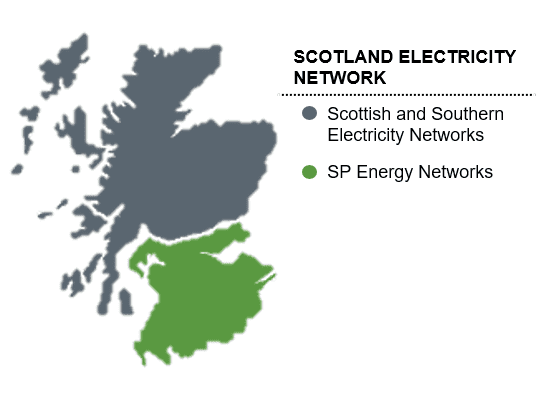
Figure 1 Electricity network operator map for Scotland
At the distribution level, there are four types of electrical substations used to distribute electrical power from the transmission network to consumers:
- Grid Supply Points (GSPs): Provide the connection between the transmission system and the distribution network. GSPs step the voltage down from the transmission network voltage of either 400 kV, 275 kV or 132 kV to the highest distribution network voltage known as the sub-transmission network or EHV network.
- Bulk Supply Points (BSPs): Step the incoming 132 kV voltage down to 33 kV, which is then distributed to different primary substations in the region. Some very large industrial and commercial loads may be directly fed at this level.
- Primary Substations: Take the incoming 33 kV feeder and steps the voltage down to 11 kV which directly supplies some larger commercial loads, as well as the secondary substations.
- Secondary Substations: Take the incoming 11 kV feeder and steps the voltage down to Low Voltage (LV), which will typically supply residential areas.
Solar PV connection types
All solar PV installations (and other generation types) connecting to the distribution network must comply with the Distribution Code and either Engineering Recommendation (EREC) G98 or G99 as applicable [2] [3]. The Distributed Generation Connection Guides (DGCG) outline the steps to be carried out to obtain a connection agreement and gain approval to connect solar PV assets to the network [4].
The DGCG considers both EREC G98 and EREC G99:
- G98 for small-scale installations: This is applicable for small-scale installations with a total capacity of no more than 16 amps per phase connected at low voltage (230 V). This equates to a maximum peak power of 3.68 kW single phase or 11.04 kW three-phase. An example of a G98 application is domestic rooftop solar PV.
- G99 for large-scale installations: This is applicable for installations with a total installed capacity greater than 16 amps per phase connected at either low voltage (Type A only) or high voltage levels. G99 includes four types:
- Type A: From 0.8 MW to < 1 MW
- Type B: From 1 MW to < 10 MW
- Type C: From 10 MW to < 50 MW
- Type D: greater than or equal to 50 MW
Depending on available roof space, a commercial rooftop solar installation may fall into the G99 Type A category. Larger G99 types are likely to be ground-mounted.
Project findings
Potential opportunities for distribution networks from increased solar PV deployment
Distribution network equipment has traditionally been sized to supply the peak load, which is the maximum demand that an area is expected to draw from the wider electricity network. This is to ensure that consumers do not pay for network infrastructure that is not used, known as stranded assets. The electrification of heat and transport through the introduction of heat pumps and electric vehicle charging points will add to the peak demand, potentially resulting in greater network constraints and triggering necessary interventions as a result. There are new ways to manage the impacts, including using the techniques described in Section 4.3.3. The rise of embedded connected generation will offer new opportunities to the distribution network when it comes to managing the future growth of demand.
Benefits include the following:
- Reduction in electricity infrastructure: Connecting distributed generation close to the point of use (e.g., rooftop solar PV behind the meter) could result in a reduced need for distribution infrastructure as the demand is being offset by generation. Increased distributed generation can reduce the average load on network assets and can defer the immediate need for asset replacement and when replacement is required. For example, charging of EVs could be timed to match the generation profile of the solar, reducing the need to supply power from elsewhere in the grid. However, the scale of 2.5 GW of additional solar will need to be investigated further to understand this opportunity in more detail.
- Reduced line losses: Generation can supply loads within the distribution network, reducing the distance between where supply and demand are located, which reduces energy losses.
- Supporting demand in other areas: Generators can sell excess power that cannot be consumed locally to the network to support other demand users. This can have the benefit of reducing network demand during periods of high demand, thus enabling more capacity to be made available for supporting more connections in wider network.
Leveraging these benefits requires active support for flexibility technologies and accounting for these benefits in network design.
Due to its inherent nature, solar PV generates in a finite window which is not generally at times of peak demand. This makes solar less directly beneficial than other renewable energy technologies that have some part of their energy generation window overlapping with the peak demand window. Engagement with DNO stakeholders resulted in the following conclusions on solar opportunities to the network:
- A greater deployment of solar PV in the future will provide only small opportunities to reduce peak demand on the wider network. This is because solar generation is greatest in the summer on sunny days, and the demand peaks in the winter evenings when solar generation is usually at its lowest.
- Domestic consumers who deploy rooftop solar PV are unlikely to present opportunities to the network as it is unlikely that generation will coincide with peak domestic demand.
- There may be greater opportunities to the network from commercial consumers whose demand will peak during the day with a greater chance of matching the peak in solar PV generation. This would especially be the case for commercial buildings with flexible demand, or who provide EV charging points to their employees.
However, it is the view of the stakeholders that co-locating domestic and commercial scale battery storage within the premise along with solar PV can provide greater economic opportunities. It will enable greater benefits to the distribution network to be realised as it will allow consumers to offset their peak demand and extend the duration during which electricity stored from solar PV can meet their own energy requirements [5]. This could provide a valuable flexibility service to the network and delay the need for expensive network upgrades, which can reduce network costs and consumers’ energy bills. Overall, battery storage should be encouraged alongside solar to enable greater opportunities for both the network and technology to be realised going forward.
Potential benefits to consumers from increased solar PV deployment in Scotland
Connecting solar consumers
For an individual connecting solar consumer, the main benefits of installing solar PV include a reduction in electricity costs and direct access to zero carbon renewable electricity.
The Carbon Trust publishes information online to advise businesses on the potential of renewable energy and to assess whether using renewable technologies is a viable option for a business [6]. According to the Carbon Trust, typical small-scale installations are around 15 to 25 square metres, with a 3 kW system comprising of around 15 panels taking up an area of 20 square meters and can generate roughly 2,500 kWh per annum [7]. Maintenance costs are low and estimated payback time varies significantly and will depend on the circumstances of each site. Some domestic installations report a payback period of just 4 years, reduced from previous years due to higher electricity prices in the UK [8].
The potential benefit to individual connecting solar consumers will be on a case-by-case basis and depends on how much solar can be generated and the times of day the consumer is at home to maximise the benefits. For example, an average assumption for domestic solar panels is that 30% of generation is consumed at home and 70% is exported when the owners are out at work from 9-5pm [9]. If the consumer is at home during the day, then self-consumption will increase, while a commercial building is likely to use over 80% onsite. In summer, this offset might be significant, though this will be lower in winter when generation will be lower, and demand is often higher. Installing solar PV can bring financial incentives where a payment can be received from a supplier for a proportion of solar that is sold directly to the grid through securing Smart Export Guarantees [10].
Stakeholders agreed that installing energy storage alongside solar PV can be used to extend the duration when power from solar can offset consumer demand, enabling further reduction in energy bills. Using energy storage can provide benefits by storing the excess solar energy that cannot be consumed at the time of generation, which reduces the level of exports onto the distribution network. This could help to reduce the need for network interventions if the design methods adopted by the DNOs allow for this.
All consumers across Scotland
The scale of solar PV installations in a 2.5 GW ambition will trigger network interventions because the DNOs are required to make conservative assumptions that less generation will be consumed onsite with more exported onto the network. This will have an impact on all consumers electricity bills in Scotland (not only those consumers with solar PV); however, consumers with solar installations will be less impacted compared to consumers without solar installations. Adopting flexibility measures such as domestic and commercial scale battery storage to absorb and reduce the excess solar generation exporting onto the grid will reduce network interventions, and thus reduce overall consumer costs. This should be encouraged alongside the installation of solar PV to maximise the potential of the technology and extend the duration at which demand can be met by on-site generation.
Potential for distribution connected solar PV deployment in Scotland’s energy network
DNO forecasts of rooftop solar PV connections
The decarbonisation of a wide range of economic sectors, including the electrification of transport and heating, is expected to result in high adoption of low-carbon technologies (such as heat pumps and EV chargers) on the electricity distribution grid. As a result, greater network capacity will be required to facilitate supplying these additional loads, and the network load profiles will become less predictable. This could raise new operational and management challenges to the DNOs. In order to plan in advance of future network pinch points, the DNOs carry out studies to identify where network intervention is required between now and 2050 to enable informed investment priority decisions to be made.
As part of their licence, DNOs are responsible for facilitating and creating the network infrastructure to meet electricity demand. To accomplish this, the DNOs forecast and understand consumers changing electricity needs under varying levels of consumer ambition, government policy support, economic growth, and technological development. The DNOs present these results in form of their DFES data, which provide a breakdown of different demand and generation technologies across each scenario up to 2050 and is updated every year after the DNOs have revised their modelling data. Both SP Distribution [11] and SSEN Distributions latest DFES data was assessed as part of this project. SSEN Distribution DFES results is not published in the public domain, this information was obtained directly.
Using the latest DFES data on Scotland’s energy network, the Figure 2 shows both SP Distribution and SSEN Distributions forecasts of new small-scale solar installation until 2030 using 2020 as the baseline.
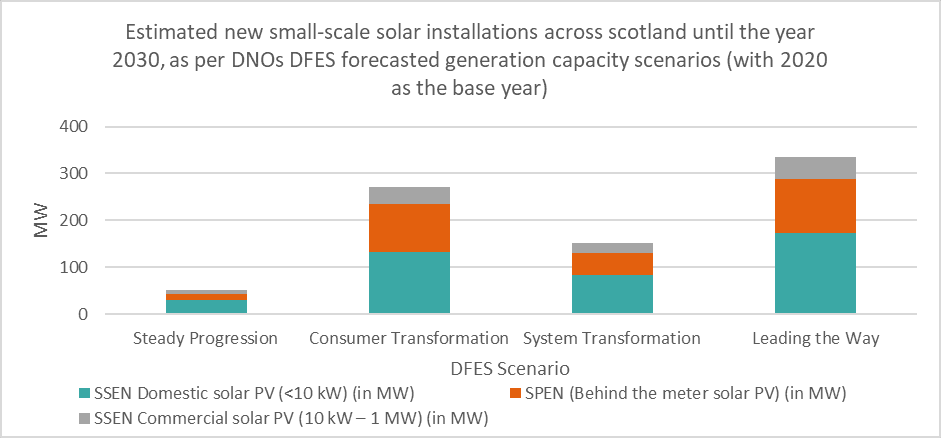
Figure 2: Estimated new solar rooftop installations across Scotland in 2030 (2020 base year) Source: DFES forecasted generation capacity scenarios
Figure 2 shows that projected small-scale solar PV uptake in 2030 is significantly less than the 2.5 GW number suggested by the solar industry. Even the scenario with the highest projected numbers (Leading the Way) forecasts only 13% (c.325 MW) of the 2.5 GW solar industry ambition. This indicates that the evidence collected by DNOs from stakeholder meetings with Local Authorities (LA) and generation developers is for a lower level of solar deployment.
Accommodating a significant number of small-scale solar installations
From our engagement with DNO stakeholders, we understand that individual small-scale (G98) applications are of less concern due to their small export capacity; however, a large cluster within a specific network area will pose greater network challenges. The impact will be location dependent as network topology and capacity will vary. In some cases, depending on the makeup of the LV feeder, the cross-sectional area of the cable, the number of consumers supplied on that feeder and the size of the houses, there may be no problems connecting a significant amount of PV in an area. However, in other cases, network reinforcement may be required with the addition of even a modest amount of PV generation.
DNO stakeholders informed us that major network interventions needed to accommodate a significant amount of G98 applications are designed based on ‘worst case’ principles, where minimum consumer demand and maximum generation output are witnessed on the DNOs network. This approach has been used by DNOs over many years to establish if the network can still operate safely and reliably when there is an excess of generation exports due to low consumer site demand.
Network impact assessments allow the DNO to understand the impacts as a result of accommodating more generation connections. Areas of investigation for the DNOs include:
- Thermal overload
- Voltage rises
- Increased harmonic and fault level contributions
If EREC standards of compliance are not meet through utilisation of the existing network, network interventions are required, and the scale of the work needed is proportional to the resulting network impact.
Larger rooftop solar PV installations (G99 connections) require approval from the DNO before connection is granted. In contrast, G98 connections are ‘fit and inform’, where the connection can proceed without DNO approval. The connections are managed by the DNOs on a first come first serve basis by placing G99 applicants into a managed queue. A network impact assessment is carried out and any reinforcement costs incurred by the DNO are included in the final connection offer. The timescales for accommodating G99 solar PV connections (mainly commercial buildings) depends on the scale of the upgrades needed; however, DNOs are licenced by Ofgem and are obligated to make a final connection offer within the set timescales.
Innovative methods of accommodating new connections
Historically, the connection agreements for generators and load connected at low voltage allowed import or export of the full rated power with no restriction to time or duration. Connections and the network had to be reinforced to allow this. This would involve replacing cables, overhead wires, transformers, and switchgears. Broadly speaking, the more reinforcement works needed at high voltage levels results in greater the reinforcement costs.
However, in recent years DNOs have introduced new methods that enable smarter use of the network equipment and reduce the amount of traditional reinforcement that is needed to accommodate the significant uptake of generation.
The type of interventions used by DNOs include:
- Network flexibility though flexible connection agreements: Flexible connection agreements allow the DNO to manage the load and generation connected to the network to some extent, providing a lever to alleviate overload on equipment or voltage issues. Examples include requiring the generation or load to operate differently if there is an outage of equipment on the network, at certain times during the year, or in response to signals from the DNO. This means that less reinforcement is needed to connect the new load or generation, potentially reducing the cost and time to connection. This does mean though that some developments would not be able to export power at certain times if they signed up to flexible connection agreement.
- Network reconfiguration: This involves using remote controlled switches (mostly manual switching is done at LV level) to reconfigure the network and shift generation output from network equipment that is heavily loaded to another area of the network that is lightly loaded. This helps to release capacity on the network, reduce network constraints and avoid network upgrade investment.
- Other innovative solutions: Both SP Distribution and SSEN Distribution are actively deploying new smart network management tools to manage the network more efficiently to allow a transition away from traditional ways of operating. For example, collection of network data to make more informed decisions on network operation or control systems to manage the network better during peak operation periods which will help reduce network constraints and maintain voltage tolerance limits.
It is important to note that innovative solutions will not alleviate all traditional reinforcement requirements. If the options above fail to provide the necessary network capacity needed to accommodate more generation then infrastructure will need to be upgraded.
Connecting a significant volume of rooftop solar generation
A significant rise in solar PV connections could be accommodated in an efficient manner if the DNOs and policymakers work in collaboration to understand the policy signals, increase data transparency, understand the role different parties need to play and investment required to make this happen in a timely manner.
In order to maintain a smooth transition to greater solar PV uptake, improved intelligence is needed, particularly at LA level, to understand where solar PV is likely to be located. More local information could provide more accurate data to update DNO modelling tools. This will give the DNOs a better picture of where networks will likely require intervention and inform their investment priority decisions ahead of time. This will also provide evidence to justify DNO decisions to Ofgem.
DNOs have an obligation to provide an option to connect, but the timescales for making connections will vary depending on how much network intervention is needed. The cost of providing such interventions is, in part (depending on the particular situation) borne by the developer seeking the ability to export. The scale of investment needed in specific locations could affect connection timescales.
Innovative approaches should continue to be used where possible to reduce the cost and time to connect. This will minimise the barriers to develop new renewable generation projects while maintaining a secure and reliable power supply. Innovative approaches are also a more efficient and cost-effective approach to asset management.
Impacts of increased solar PV deployment on electricity networks
Potential network challenges of increased rooftop PV
The changing nature of the electricity distribution network as a result of dynamic power flows and increased unpredictability in load profile behaviour requires a transition away from traditional ways of operating. For example, electricity networks in Scotland are traditionally managed to meet the maximum demand throughout the day and year by sizing assets accordingly. However, the rise of generation at distribution level creates new challenges, such as demand reduction, increased thermal constraints, reverse power flows, greater voltage constraints, greater fault level contributions and harmonic contributions. These are detailed in Section 7.1.
The impacts depend greatly on the size, design and local network condition of each individual connection. Additional PV generation would also be connected within the context of other LCTs such as heat pumps, batteries, electric vehicles, wind and larger solar generation. It is difficult to predict the specific challenges and impacts which will be experienced with accuracy.
DNO stakeholders informed us that they are most concerned about voltage rises which must be maintained within the correct limits. This will be a big challenge in summer when there is excess generation flowing in the opposite direction onto the network, which increases network voltages. The exact scale is unknown and even a small deviation from voltage limits can damage network infrastructure and appliances because all electrical equipment is designed to handle voltages within specified tolerances.
Estimated scale of network impact
We conducted an analysis to determine how many primary substations are likely to require intervention in 2030 as a result of greater solar PV deployment in Scotland. The analysis used 1.5 GW domestic rooftop solar and 1 GW commercial rooftop solar by 2030, information provided by the DNOs and data from the DNOs DFES. The DFES provides generation forecasts up to 2050, including the distribution of that forecast across primary transformers. It was assumed that the additional solar generation was spread across the network in accordance with the forecasted distribution pattern. The uplifted generation forecast numbers for rooftop solar PV were then used to understand where substations were likely to be overloaded and may require interventions in 2030 by using the DNO headroom report on capacity availability [12] [13]. The methodology behind the analysis is discussed further in the Appendix Section 7.2.
The projected percentage of primary substations that may require intervention in 2030 due to the 2.5 GW solar rooftop are shown in Table 1.
Table 1: Primary substations that may require interventions by network area (Source: DFES data)
|
Scottish Power Energy Networks |
Scottish & Southern Electricity Networks |
Total | |
|
Number of substations that may require intervention in 2030 due to greater rooftop solar PV deployment |
176 |
33 |
209 |
|
Total number of primary substations (down to 11 kV level) |
385 |
384 |
769 |
|
% of primary substations that may require intervention |
46% |
9% |
27% |
We found that 46% of total primary substation equipment in SP Distribution and approximately 9% of total primary substation in SSEN Distribution could be overloaded as a result of increased solar PV generation. This represents 176 primaries out of 385 in SP Distribution’s area and 33 out of 384 in SSEN Distributions area. The analysis can be broken down further into low, medium and highly constrained sites:
Table 2: Extent of site constraints for overloaded sites
|
Lightly constrained (less than 10% overloaded) |
98% of sites |
|
Moderately constrained (10-20% overloaded) |
approximately 1% of sites |
|
Highly constrained (more than 20% overloaded) |
approximately 1% of sites |
The majority of these network interventions are projected to take place in SPENs distribution network area, which is likely to be linked to the fact that it is located in busier urban areas, whereas SSEN Distribution area is more rural.
We carried out a high-level analysis to estimate the cost of interventions for upgrading distribution network infrastructure to accommodate the 2.5GW solar rooftop in 2030. The estimated cost of reinforcement provided by DNOs for selected study areas was scaled up to estimate the reinforcement cost for the entire network.
The methodology used to estimate this cost is described in Section 7.3.
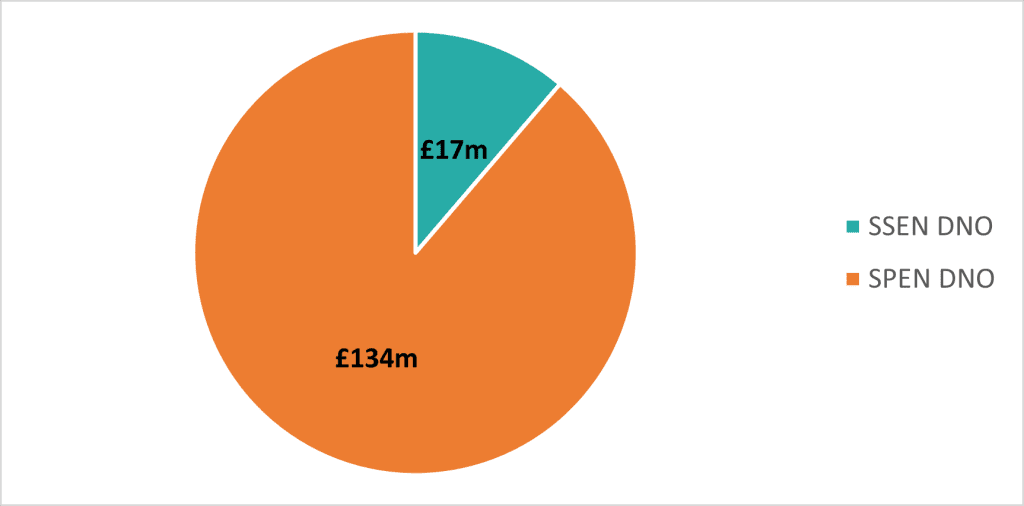
Figure 3: Estimated cost of interventions in 2030 in both SPEN and SSENs distribution boundaries (£ millions)
It can be seen that the cost of intervention is higher in the SP Distribution area (£134m compared to £17m in SSEN Distribution area). This can be attributed to a greater number of interventions being forecast as required in the SP Distribution area.
Impacts on consumers’ bills and potential mitigations
Rules for connection charges and Use of System charges
The DNOs are licenced by the energy regulator, Ofgem, who sets rules regarding the amount of revenue DNOs can recover from consumers, this includes connection charges.
Connection charges for rooftop solar covers the cost of replacing or upgrading equipment to facilitate new generation connections. The DNO determines the extent of network reinforcement required, and the subsequent cost, by studying the impact of the additional generation on the network.
G98 connections, which are likely to include all domestic-scale and smaller commercial rooftops, do not incur connection charge. Larger generation installations under G99 may trigger an upfront connection charge depending on the capacity of the local network. Multiple generation installations in close proximity installed by the same party, for example a housing association fitting solar panels across many properties in one area, may also result in a connection charge.
For all cases, additional costs not covered by the connection charge are recovered through Use of System (UoS) charges. UoS charges are charged to all consumers through their electricity bills. The DNOs are required to calculate these UoS charges annually utilising the Common Distribution Charging Methodology (CDCM) [14]. Each DNO is required to publish their statement of charges in advance of application [15]. These statements provide detail of how the charges are determined for demand or generation customers, and these are further split by domestic and non-domestic categories. The charging statements also contain worked examples of how any reinforcement costs are calculated.
There are a number of steps used to calculate the Distribution Use of System (DUoS) charges which will be impacted by increased solar PV installation. For example, for each category of demand users the DNO estimates the following load characteristics:
- A load factor, defined as the average load of a user group over the year, relative to the maximum load level of that user group; and
- A coincidence factor, defined as the expectation value of the load of a user group at the time of system simultaneous maximum load, relative to the maximum load level of that user group.
In determining the load characteristics of each category of demand user, the DNO will analyse meter and profiling data for the most recent 3 year period for use in the calculation of charges. Load factors and coincidence factors are calculated individually for each of the 3 years and a simple arithmetic average is then used in tariff setting. Large scale PV deployment would impact these calculations but without detailed data it is not possible to accurately determine what the resultant potential impact might be.
The DNO determines a set of different distribution time bands, based on the underlying demand profiles and associated costs – these could be expected to change given large scale PV deployment in some areas. These time bands can only be revised annually on 1 April. It is likely that the large-scale rollout of solar PV for domestic customers will reduce their consumption during daylight hours (co-incident with system peak times) thus leading to a lower DUoS cost over those periods.
The DNO also forecasts the volume chargeable to each tariff component under each tariff for the charging year, which are separately determined for the Domestic Aggregated and Non-Domestic Aggregated tariffs. These volumes would be impacted by PV deployment relating to the two different categories, thus impacting the relevant tariffs differently.
The Significant Code review undertaken by Ofgem “Network Access and Forward-Looking Charges” [16] came into effect from 1 April 2023. This resulted in a reduction in the contribution to network reinforcement made by G99 connections. This improves the business model for many generators, who would otherwise have had to pay larger upfront costs. A summary of the previous and new rules for connection charging is provided below with some key terms.
- Onsite works: This is works needed onsite to accommodate the installation and includes facilitating a connection to the distribution network.
- Reinforcement works: This involves replacing equipment on the existing network to accommodate new connections. This usually involves replacing cables, transformers and switchgears etc.
- Connecting solar consumers: This refers to domestic and commercial entities who have rooftop solar installations. A G98 installation is typically relevant to connecting consumers who are domestic, while G99 is more relevant to connecting consumers who are commercial entities.
Table 3: The new Ofgem Significant Code Review rules for recovering network upgrade costs from generation connections that trigger the need for reinforcement (Source: Ofgem [16])
|
Onsite works |
Reinforcement at connection voltage |
Reinforcement at one voltage level above the connection voltage | |
|
G98 single installation Likely to include all domestic and smaller commercial properties |
Unlikely to be needed, as the property should already be connected to the grid |
Fully funded by the DNO via UoS charges |
Fully funded by the DNO via UoS charges |
|
Multiple G98 or G99 installations |
Connecting solar consumers pay 100%. Bigger installation would likely trigger the needed more bigger fuses onsite. |
Connecting solar consumers pay a proportion of the reinforcement costs (likely to be a small fee or nothing) |
Old arrangement Connecting solar consumer pays a proportion of the reinforcement costs |
|
New arrangement Fully funded by the DNO via UoS charges, up to a High Cost Cap |
Potential impact on consumer bills
Large-scale solar PV adoption will impact the DUoS calculations for consumers. In order to assess the cost impact of the large scale roll out of rooftop solar on all consumer bills (not only consumers with solar installations) we assumed that all network interventions required to accommodate 2.5 GW of solar would be socialised. This is a simplified assumption that provides an estimate of the maximum impact UoS charges has as a result of the modelled interventions. A more accurate assessment would require more data regarding locations of commercial and domestic properties and the scale of solar to be adopted at the premises. This is because larger commercial buildings adopting solar PV will likely make a direct contribution to network intervention costs, thus reducing the UoS spread across all remaining consumers.
According to Scottish Government energy data, non-domestic consumers account for 60% of Scotland’s total electricity consumption. As a result, non-domestic consumers will pay more towards DUoS directly due to their higher energy consumption [17]. We applied a non-domestic to domestic electricity consumption ratio of 60:40 in both DNO licence areas in Scotland. This allocated 60% of the intervention costs in each DNO area to non-domestic, with the remaining 40% of the costs going to domestic consumers.
We then spread the costs using the ratio of number of non-domestic to domestic premises to obtain an indication of the increase in non-domestic and domestic energy bills which could be realised following large-scale solar deployment. SSEN provided this split, where out of total consumers in their licenced area that have electricity meters, 90% are non-domestic premises while 10% are domestic. The Department of Energy Security and Net Zero (DESNZ) has published information on GB electricity meters, and a similar ratio was observed [18]. SPEN did not provide the split in their region, so we have assumed the same ratio will apply.
Table 4 shows the annual impact of socialising the reinforcement investment required at distribution level to accommodate 2.5 GW rooftop solar. Costs per consumer bill split between domestic and non-domestic consumers in Scotland irrespective if they have solar or not have been estimated. Section 7.4 explains the methodology used to calculate this estimate.
Table 4: Annual impact of socialising the reinforcement cost at distribution level on consumers in Scotland (£/year/customer bill)
|
DNO |
Estimated annual impact per domestic customer bill (£) for reinforcement costs in 2030 |
Estimated annual impact per non-domestic customer bill (£) for reinforcement costs in 2030 |
|
SSEN |
£0.53 per year for 45 years |
£7.17 per year for 45 years |
|
SPEN |
£1.81 per year for 45 years |
£24.46 per year for 45 years |
Non-domestic consumers will pay a bigger contribution towards reinforcements triggered by solar PV uptake due to their higher energy consumptions, while domestic consumers pay less towards DUoS. These costs are based on assumptions applied due to lack of available data during the research and should therefore be treated as indicators of what the additional costs over and above baseline energy bills could be but they are not definitive.
The DNOs did not validate or confirm the methodology we used to derive these numbers. These provide a highest cost estimate due to the assumption that all Scottish consumers will pay 100% of reinforcement costs through their electricity bills. However, it is likely that some commercial solar connecting consumers will pay a proportion of the reinforcement costs they triggered upfront directly. This would reduce the impact on all consumer bills but is unlikely to have a large impact. It was not possible to separate the reinforcement cost triggered by commercial consumers due to data limitations.
Potential impacts on the transmission network
A proposed ambition 2.5 GW of small-scale rooftop solar PV by 2030 is likely to trigger the need for network reinforcement across the transmission network in Scotland and the rest of GB. The exact nature and scale of the upgrades required is difficult to predict as there is uncertainty as to where the clusters of solar will be located and the nature of impacts are locationally dependent. Different areas of the transmission network have varying levels of headroom and different amounts of generation could be accepted before voltage and fault levels are triggered.
The nature of transmission network impacts and the intervention design works needed to accommodate future connections (including solar PV and other generation technologies) are determined from the Security and Quality of Supply Standard (SQSS) [19]. This sets the criteria for electricity transmission network planning.
- Network Assessment Approach: The TOs take a deterministic snapshot methodology approach to reduce the risk of transmission assets being overloaded and generators being constrained on their respective networks. In this deterministic methodology, the TOs study the summer minimum demand against the maximum generation output on a given local area network for the assessment of any new generation connecting.
- The results of network impact assessments: The TOs assess thermal, voltage and fault level constraints on the network and conclude if greater solar PV embedded in the distribution network could trigger non-compliance with grid code procedures if reverse power was realised.
The timelines to resolve transmission constraint issues can be significant and are longer than the timescales needed for distribution upgrades.
A high-level analysis was carried out to estimate the transmission network costs incurred by the TOs to upgrade the network. Figure 4 shows the estimated cost on the transmission network in Scotland is over £150 million with £122 million (81%) of this in the SPEN transmission network and £30 million (19%) in the SSEN transmission network.
Section 7.3 explains the methodology used to estimate these costs in more detail. In brief, the estimated cost of reinforcement provided by TOs for our selected study areas was scaled up to estimate the reinforcement cost for the entire network. SPEN transmission reinforcement costs were estimated using cost of reinforcement shared by SSEN transmission for the study area.
There will also be an incremental impact on the transmission network in England which will trigger additional transmission costs due to greater transmission capacity required to accommodate greater solar exports. These have not been considered in this study and the numbers provided below are for transmission assets that are located only in Scotland.
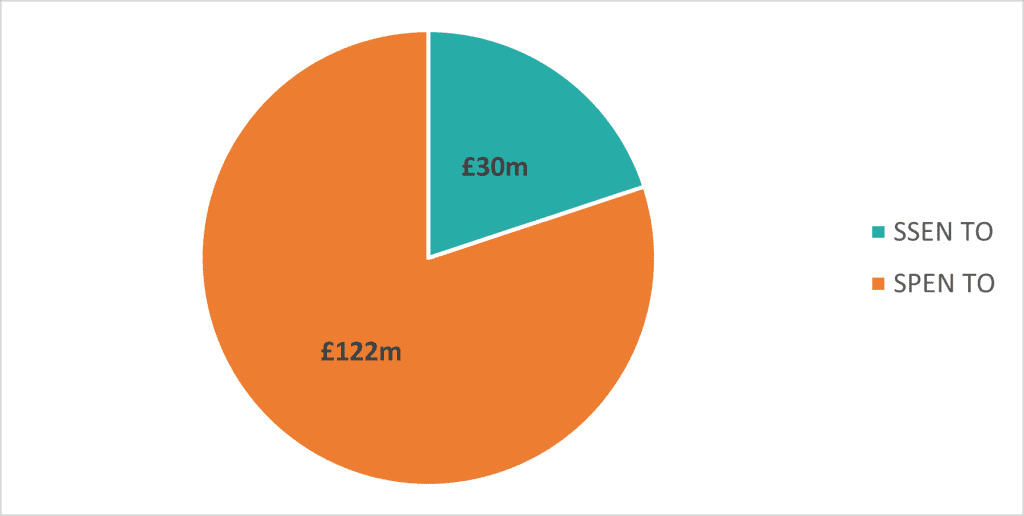
Figure 4: Estimated cost of interventions in 2030 in both SP and SSENs transmission boundaries (£ millions)
The investments made by the TO will be recovered through the price control mechanism with the cost being socialised across all GB energy consumers. Our estimated costs are provided to give insight into the scale of the challenge to reinforce the transmission network but are not definitive. Further, more detailed analysis would be required to reliably quantify the estimated costs associated with interventions in the transmission network.
Conclusions
We assessed the likely benefits and impacts of a proposed ambition for an additional 2.5 GW solar PV at distribution level in Scotland by 2030. In conclusion:
- An additional 2.5 GW solar ambition would enable progress towards net zero targets. The Scottish Government has set a target to reach net zero carbon emission by 2045 and increased rooftop solar could contribute to the ambition to deliver at least 20 GW of additional low-cost renewable capacity by 2030.
- Individual financial benefits are based on the reduction in electricity bills for consumers adopting solar PV. Benefits could be increased if demand could be shifted to times of excess generation.
- Network benefits could be realised by pairing solar PV with battery storage as this will improve flexibility. Solar PV is an intermittent energy source and unlikely to reduce peak demand significantly.
- DNOs would be obliged to make a firm or flexible connection offer to facilitate the extra solar PV in a cost-effective manner. Advance visibility of where large quantities or clusters of rooftop solar PV connections would be located would help DNOs understand the scale of intervention needed and in what timescale it can be delivered.
- We estimate that 30% of primary transformers will require intervention to accommodate a 2.5 GW solar ambition. Most of these will be lightly constrained sites that are less than 10% overloaded. The impact is highly uncertain and depends on specific location of large quantities of solar PV and the status of the local electricity network.
- The cost of this impact is uncertain; we estimate £150m in the distribution networks, and over £150m in transmission networks. These are based on highest-cost assumptions that traditional methods are used for capacity release eg that overloaded equipment is replaced with higher rated equipment.
- The required intervention will be largely paid for by consumers. The network intervention costs associated with implementing the additional rooftop PV will be socialised to all consumers through electricity bills. A proportion of larger installations may be payable through connection charges by the connecting consumer.
- The estimated average annual increase in energy bills for domestic consumers is £0.53 and £1.81 in SSEN and SPEN areas respectively. The average annual increase in non-domestic consumers energy bills is estimated at £7.17 in SSENs area and £24.46 in SPENs area. These are indicators based on assumptions but are not definitive, and the approach has not been validated or confirmed by the DNOs.
- Adopting flexibility measures such as domestic and commercial scale battery storage will reduce the excess solar generation exporting onto the grid. This will reduce network interventions and thus reduce consumer costs. This should be encouraged alongside the installation of solar PV to maximise the potential of the technology and extend the duration at which demand can be met by on-site generation.
- Network interventions are triggered in part because DNOs are required to use the conservative assumption that less generation will be consumed onsite with more exported onto the network.
- Incentivising the requirement to have domestic and non-domestic battery storage in conjunction with solar PV to absorb any excess solar, thus preventing exports, may reduce the scale of network interventions needed. Battery storage can provide greater network flexibility by charging and discharging as required.
- Network operators are developing innovative ways of managing networks which could reduce the costs. Solutions including flexibility, reconfiguring the network, improved network visibility and active network approaches are increasingly being used. These approaches could also speed up the time taken to offer new connections. While these approaches could decrease the need for reinforcement, they are unlikely to entirely mitigate the need to be consistent with relevant technical requirements.
- A co-ordinated approach is needed between key stakeholders including the DNOs, TOs, LAs and the solar industry to ensure that a significant increase in solar PV can be accommodated. Improved evidence of large quantities of solar being proposed is needed to allow the DNOs to plan accordingly and justify their decisions to Ofgem.
- Overall, it is difficult to quantity whether the benefits outweigh the impacts on the grid and on consumer bills, but steps can be taken to reduce the impact and enable greater benefits to be realised. Examples include investing in on-site battery storage and continued deployment of network flexibility and innovation solutions.
References
|
[1] |
Solar Energy UK, “‘Significant appetite’ for more solar power, says Scotland’s new energy plan,” January 2023. [Online]. Available: https://solarenergyuk.org/news/significant-appetite-for-more-solar-power-says-scotlands-new-energy-plan/. |
|
[2] |
Energy Network Association, “G98 Distributed Generation Connection Guide,” 2022. [Online]. Available: https://www.energynetworks.org/search-results?sitesearch=G98&id=113. |
|
[3] |
Energy Networks Association, “G99 Connecting Type,” [Online]. Available: https://www.energynetworks.org/search-results?sitesearch=G99&id=113. |
|
[4] |
Energy Networks Association, “The Distribution Code of Licensed Distribution Network Operators of Great Britain: DG Connection Guides,” 2021 Revision. [Online]. Available: https://dcode.org.uk/current-areas-of-work/dg-connection-guides.html. |
|
[5] |
E.On Energy, “Solar battery storage,” [Online]. Available: https://www.eonenergy.com/solar-battery-storage.html. |
|
[6] |
Carbon Trust, “Renewable energy guide,” Jan 2018. [Online]. Available: https://www.carbontrust.com/our-work-and-impact/guides-reports-and-tools/renewable-energy-guide. |
|
[7] |
Carbon Trust, “Renewable Energy Sources,” [Online]. Available: https://ctprodstorageaccountp.blob.core.windows.net/prod-drupal-files/documents/resource/public/Renewable-energy-guide.pdf. |
|
[8] |
All Seasons Energy, “Solar panel payback period is now 4 years,” 31 August 2022. [Online]. Available: https://allseasonsenergy.co.uk/news-and-blogs/solar-panel-payback-period-4-years/. |
|
[9] |
Spirit Energy, “Solar PV Knowledge Bank: Solar PV Export Tariffs,” 2023. [Online]. Available: https://www.spiritenergy.co.uk/kb-solar-pv-export-tariff. |
|
[10] |
Ecosphere renewables, “Benefits of solar PV,” [Online]. Available: https://www.theecosphere.co.uk/our-services/solar-pv/benefits-of-solar-pv/. |
|
[11] |
Scottish Power Energy Networks, “Distribution Future Energy Scenarios,” 2022. [Online]. Available: https://www.spenergynetworks.co.uk/pages/distribution_future_energy_scenarios.aspx. |
|
[12] |
Scottish Power Energy Networks, “Network Development Plan,” 2022. [Online]. Available: https://www.spenergynetworks.co.uk/pages/network_development_plan.aspx. |
|
[13] |
Scottish and Southern Electricity Networks, “Network Capacity Information,” 2022. [Online]. Available: https://www.ssen.co.uk/our-services/network-capacity-information/. |
|
[14] |
DCUSA, “Section 16: Common Distribution Charging Methodology,” 2022. [Online]. Available: https://dcusa-viewer-staging.electralink.co.uk/dcusa-document/117/423464. |
|
[15] |
Scottish and Southern Electricity Networks, “Scottish Hydro Electric Power Distribution charging statements,” [Online]. Available: https://www.ssen.co.uk/about-ssen/library/charging-statements-and-information/scottish-hydro-electric-power-distribution/. |
|
[16] |
Ofgem, “Access and Forward-Looking Charges Significant Code Review: Decision and Direction,” 3 May 2022. [Online]. Available: https://www.ofgem.gov.uk/publications/access-and-forward-looking-charges-significant-code-review-decision-and-direction. |
|
[17] |
Scottish Government, “Energy Statistics for Scotland – Q3 2022,” December 2022. [Online]. Available: https://www.gov.scot/publications/energy-statistics-for-scotland-q3-2022/pages/energy-consumption/#:~:text=This%20document%20is%20part%20of%20a%20collection&text=Consumption%20of%20electricity%20between%202021,with%20decreased%20in%20both%20sectors.. |
|
[18] |
Department for Energy Security and Net Zero, “Smart Meter Statistics in Great Britain: Quarterly Report to end June 2023: data tables,” August 2023. [Online]. Available: https://www.gov.uk/government/statistics/smart-meters-in-great-britain-quarterly-update-june-2023. |
|
[19] |
National Grid ESO, “Security and Quality of Supply Standard (SQSS),” [Online]. Available: https://www.nationalgrideso.com/industry-information/codes/security-and-quality-supply-standard-sqss. |
|
[20] |
“Distribution Future Energy Scenarios 2022: Results and methodology report – North of Scotland licence area,” April 2023. [Online]. Available: https://www.ssen.co.uk/globalassets/about-us/dso/smart-and-local-benefits/ssen-dfes-2022-north-of-scotland-report.pdf. |
Appendices
Network challenges
Demand Reduction through the use of onsite generation will change the daily domestic and commercial load profiles and make them more unpredictable and more difficult to plan the network. Network operators strive to balance demand and generation in order to maintain grid stability and reliability. An increase in solar PV connections will lead to greater network challenges around grid stability. As distributed generation grows it will remove a significant portion of demand from the network during certain time periods, while higher up in the grid, greater numbers of renewable energy plants (offshore and onshore wind) will be connected leading to greater network imbalance. This will exacerbate the situation and pose additional challenges to grid operation. The National Grid may seek to reduce the imbalance by asking large-scale wind operators to reduce energy output or switch off which leads to constraint payments being made. The deployment of greater network demand through large-scale battery storage and hydrogen production is being actively encouraged to reduce the network imbalances.
Examples of network challenges are as follows:
Increased thermal constraints, where significant generated power is fed into the network, for example if there are clusters of PV generation in one area, and there is a mismatch between onsite solar generation and demand on a sunny day. This can overload equipment causing them to heat up beyond their rated temperatures, causing damage or aging. This will be common in summer where there is mismatch between solar generation and onsite demand.
Reverse power flows, where power is fed into the network from generation resulting in power flowing in the opposite direction than designed. Some substations with new equipment will be able to handle greater reverse power flows, however, older equipment or that with a particular design may have less or no reverse power capability and may require maintenance or replacement.
Greater voltage constraints, where voltage rises due to the reduction in load or the increase in generation across an area of network. All networks are designed to operate at voltages within acceptable tolerances and DNOs have a frequent task to maintain voltages within the correct limits. If voltages go outside their limits, this poses risk to asset health which could be damaged as a result. Greater solar connections runs the risk of exceeding voltage limits as laid out in the DNO licences. Voltage constraints are the biggest concern to the DNOs as they have the biggest impact.
Greater fault level contributions, where the solar PV installations contribute towards greater network fault currents, which are triggered due to disturbances on the network. Faults on the network can cause inrushes of current which can damage critical infrastructure. The network and its protection equipment must be designed to accommodate the fault level for a short time in order to keep equipment and people safe. PV generation contributes to fault level (large inrush of current when there is a fault on the network), and so connection designs must accommodate it. If the fault level rating of equipment is exceeded the DNO will replace the assets. As a result, a significant cluster of generation will increase fault level contributions right up to transmission level.
Harmonic contribution, where PV generation creates distortions in the Alternating Current (AC) signal resulting in a reduction in power quality being delivered to consumers and some consumer equipment might flicker or not operate properly. PV generation contributes to harmonic issues as a result of the inverter equipment, but this contribution is limited by regulation.
Methodology for estimating proportion of interventions needed
The DNOs forecast and understand consumers changing electricity needs under varying levels of consumer ambition, government policy support, economic growth, and technological development. The DNOs create forecasts for multiple scenarios through their DFES data (Leading the Way, Consumer Transformation, System Transformation, Steady Progression) [11] [20]. DFES data from both SPEN and SSEN using the Consumer Transformation Scenario was used in our analysis. This scenario assumes greater consumer engagement, which leads to greater deployment of low-carbon technologies, such as solar PV, to offset network demand. We consider that this assumption would be consistent with increased solar deployment.
Primary substations which are likely to require intervention in 2030 were determined by spreading the 2.5 GW of solar PV across all primary substation assets in Scotland. We used the DNOs modelling assumptions to determine where they believe the high clusters of future solar installations will be located and spread the extra the 2.5 GW using the same pattern of distribution. The detailed approach is described below:
- We used DNOs DFES modelling tools to determine how much rooftop solar PV is estimated between now and 2030 across all primary substation assets. This was clear from SPEN modelling, but SSEN did not provide a degree of granularity and we estimated as the solar PV numbers.
- The DNOs own estimates of rooftop solar PV were removed from the analysis to leave an indication into forecast individual large-scale solar PV (ground-mounted). This was to avoid including the 2.5 GW over and above the DNOs rooftop solar PV forecast as this would duplicate the number of households that has solar PV.
- We calculated the proportion of rooftop solar to total solar using DFES data. The DFES data only provided total rooftop solar numbers across each year rather than across each individual substation per year which reduces the level of granularity. However, the combined solar PV numbers (rooftop + ground mounted) was provided for each substation across every year. We expressed the total rooftop solar PV numbers to the combined solar PV numbers in 2030 as a percentage. This allowed us to estimate the proportion ratio of rooftop solar in 2030, which was then used to separate the rooftop component from the overall total solar PV numbers across all primary substation data. This provided an estimate of rooftop solar PV across each primary substation.
- 2.5 GW of solar capacity was then spread in a similar proportion to the original DNO forecast of rooftop solar across all primary substations to provide an uplifted forecast. For example, if the DNO was estimating that 2 MW of rooftop solar PV would be located in an area in Glasgow, we estimated that 15 MW would be realised in that area in 2030 using the following calculation:
- Uplifted forecast = (2MW / total forecasted rooftop solar PV in 2030 from DNOs modelling tools) * 2.5GW
- The proportion of primary substations that will require interventions was estimated by subtracting the uplifted forecast from the DNOs published headroom report figures.
Methodology for estimating cost of intervention
We used four study areas in order to assess the cost of interventions needed. The study areas covered four categories:
- Rural
- Domestic properties in urban areas
- Mixed domestic & commercial in urban areas
- Commercial properties in urban areas
A primary substation was selected for each study area that was close to being overloaded by using the DNOs published heat map data.
Table 5 Study areas used to assess cost of intervention
|
Rural |
Domestic properties in urban areas |
Mixed domestic & commercial in urban areas |
Commercial properties in urban areas | |
|
DNO |
SSEN Distribution |
SP Distribution |
SP Distribution |
SP Distribution |
|
Location |
Aberdeenshire |
Larbert, Falkirk |
Livingston |
Edinburgh |
|
Primary Substation |
FYVIE |
LARBERT |
DEANS |
KINGS BUILDINGS |
|
Primary S/S generation capacity |
Red (heavily constrained) |
Amber (approaching operational limits) |
Amber (approaching operational limits) |
Amber (approaching operational limits) |
|
GSP |
KINTORE |
Bonnybridge |
DRUMCROSS |
KAIMES |
|
GSP generation capacity |
Red (heavily constrained) |
Red (heavily constrained) |
Red (heavily constrained) |
Red (heavily constrained) |
|
Headroom after adding in 2.5 GW target (MW) |
-2.95 |
-4.74 |
-1.51 |
-3.50 |
|
Uplifted forecast (MW) |
4.51 |
5.47 |
1.73 |
4.03 |
The study areas were submitted to both the DNOs and TOs to gain high level estimates of the type of interventions deployed and the cost of interventions.
Due to time constraints, the DNOs and TOs could not commit to undertaking a detailed analysis, which involves undertaking detailed power flow analysis. The results provided are estimates of interventions from previous assessments carried out by the DNOs. The results of the DNOs and TOs analysis are detailed below.
Table 6 Cost of interventions and assumptions provided by the DNOs for each study area
|
Study area type |
DNO |
Cost of interventions |
Assumptions |
|
Rural |
SSEN Distribution |
£844k for replacing primary substation |
Replacing a 33/11 kV primary substation. The rules used to estimate costs in other parts of the network are for every £1 spent reinforcing the primary network, SSEN will spend:
|
|
Domestic Properties in Urban areas |
SP Distribution |
£0.5m – £1.25m |
This takes into account all reinforcement work from primary down to LV level. |
|
Mixed domestic & commercial properties in urban areas |
SP Distribution |
£0.1m – £0.25m |
This takes into account all reinforcement work from primary down to LV level. |
|
Commercial properties in urban areas |
SP Distribution |
£0.5m – £1.0m |
This takes into account all reinforcement work from primary down to LV level. |
The estimated cost of reinforcement provided by DNOs for the selected study areas was scaled up to estimate the reinforcement cost for the entire network. The headroom capacity numbers across all primary substations that may require intervention was used to scale up the costs.
The results of the investigation with the TOs are provided in Table 7.
Table 7 Cost of interventions and assumptions provided by TO for study area
|
Study area type |
TO |
Cost of interventions |
Assumptions |
|
Rural |
SSEN Transmission |
£5 to £6 million |
|
SPEN transmission reinforcement costs were estimated using the cost of reinforcement shared by SSEN transmission for the study area.
Methodology for estimating the impact on consumer bills
The steps below explain the methodology to estimate the impact of socialised costs on consumer bills split between domestic and non-domestic.
- Allocated 60% of the estimated interventions costs directly to non-domestic consumers with the remaining 40% going to domestic through the DUoS mechanism, which allocates socialised costs to the higher energy consumer. 60% of Scotland’s total electricity consumptions comes from non-domestic.
- Socialised costs were treated as standard network capex and so were added to the DNOs Regulatory Asset Base (RAB).
- The total socialised cost to be recovered through deprecation over a period of 45 years (assumption shared by SSEN DNO).
- The DNOs regulated rate of return was applied to the investment.
- SSENs split of non-domestic and domestic consumers in their licences area (90:10) was provided for the investigation. SPEN did not provide a similar split; however, it is assumed that the same ratio split applies.
- Using the total costs allocated to non-domestic and domestic based on their energy consumptions, and using the quantity of customers split between domestic and non-domestic, an annual impact per customer split between domestic and non-domestic could be obtained.
The numbers are reflective of 2030 prices as this is when 2.5 GW could be realised. The year 2030 was used in isolation throughout this analysis rather than assessing the impact each year up to 2030 as we could not be sure how much solar would be added each year. It was therefore assumed that the grid would see 2.5GW in 2030.
Stakeholder engagement findings
This section presents areas of discussion in a series of stakeholder engagement meetings with DNOs and TOs. The meetings aimed to understand the following:
- The potential for greater solar PV deployment in Scotland and how existing distribution and transmission networks will accommodate them in additional to other generation technologies
- The impacts on the networks as a result of greater solar PV connections and the resulting interventions deployed by the network operators to manage the increase in connection requests
- Establish the intervention assumptions and resulting cost to deploy these interventions when solar PV connections trigger the need when capacity headroom is no longer available
- Explore the opportunities that solar PV can bring to future distribution network
- Explore gathering data on the cost of interventions to support with the analysis
SSEN Transmission
A meeting was held between Ricardo and SSEN Transmission on 20 February 2023 to establish the implications on the North of Scotland transmission network because of greater solar PV connections and how this would be accommodated. A summary of the meeting with the questions relevant for the discussion are summarised below.
Area of discussion: The process that transmission networks use to accommodate a significant increase in PV connections across Scotland’s energy network
The meeting focused on the following topics:
- SSEN TOs view of the 2.5 GW solar PV target by 2030.
- How transmission network impacts are assessed, and the rules adopted for network reinforcement designs.
- The ability of the transmission network to accommodate 100% reverse power flow and identify what needs to happen to accommodate this in the future.
- Establish the impacts on the network from greater generation connections that are off most concern to the transmission network.
- What type of interventions are being deployed to mitigate the impact on consumers.
SSEN DNO
Two meetings were held between Ricardo and SSEN Distribution on 24 January and 10 February 2023 to establish the implications on the North of Scotland distribution network because of greater solar PV connections and how this would be accommodated. A summary of the meeting with the questions relevant for the discussion are summarised below.
Area of discussion: How will existing networks will accommodate a significant increase in solar PV connections across Scotland’s energy network?
Areas explored:
- How are G98 (‘fit and inform’) connections accommodated? How can this be done at a large-scale?
- How are G99 (large-scale) connections accommodated, and how can they be accommodated at large-scale?
- What is the timeframe for a G99 application to be granted approval by SSEN? How is this impacted by a large proportion of consumers requesting connections to the same part of the network?
- What type of interventions are being considered? Any smart grid solutions?
- Do you think it will be technically feasible to accommodate 2.5GW of additional small-scale rooftop solar across Scotland’s energy network by 2030?
SPEN DNO
A meeting was held between Ricardo and SPEN Distribution on 15 February 2023 to establish the implications on the Central and Southern distribution network in Scotland because of greater solar PV connections and how this would be accommodated.
Area of discussion: How will existing networks accommodate a significant increase in solar PV installations between now and 2030?
Areas explored:
- How are G98 (‘fit and inform’) connections accommodated? How can this be done at a large-scale?
- How are G99 (large-scale) connections accommodated, and how can they be accommodated at large-scale?
- What is the timeframe for a G99 application to be granted approval by SPEN? How is this impacted by a large proportion of consumers requesting connections to the same part of the network?
- What type of interventions are being considered? Any smart grid solutions?
- Do you think it will be technically feasible to accommodate 2.5GW of additional small-scale rooftop solar across Scotland’s energy network by 2030?
Solar Energy Scotland
A meeting was held between Ricardo and Solar Energy Scotland (SES) on 28 July 2023 to discuss the solar industry view on the solar ambition, benefits of solar and areas of concern for how new connections are currently assessed by DNOs.
© The University of Edinburgh, 2024
Prepared by Ricardo Energy & Environment on behalf of ClimateXChange, The University of Edinburgh. All rights reserved.
While every effort is made to ensure the information in this report is accurate, no legal responsibility is accepted for any errors, omissions or misleading statements. The views expressed represent those of the author(s), and do not necessarily represent those of the host institutions or funders.
Research completed: January 2024
DOI: http://dx.doi.org/10.7488/era/4033
Executive summary
This study reviewed the use of fiscal levers to reduce greenhouse gas (GHG) emissions across the world. These levers include taxes, levies, duties or charges applied by governments on major sources of emissions.
It focused mainly on direct carbon taxes which are applied to specific goods – typically fuels – based on the amount or intensity of greenhouse gases they produce. It also considered indirect taxes, which place a price on other forms of pollution, such as air or water, but often target GHGs as well. Grants and subsidies are not in scope.
The study examined whether these levers have been effective in decreasing GHG emissions, the revenue that has been raised, and how governments have used that revenue. It looked at six international case studies in more detail. It also examined relevant fiscal levers currently applied in the UK and Scotland, and the possible implications for Scotland of adopting any new lever, based on the case studies. This study does not make policy recommendations, nor does it consider the costs and benefits if they were adopted.
Findings
The study focused mainly on the use of direct carbon taxes both nationally and sub-nationally (in specific regions or provinces within a country) around the world. Key findings are:
- The use of carbon taxes is increasingly common. There are 37 direct carbon taxes in 27 jurisdictions globally, most of them in Europe. Several jurisdictions outside Europe have adopted taxes and more are considering them. About 6% of global GHG emissions are taxed by carbon taxes and this share has increased over the past 15 years. Sub-national carbon taxes have also been applied by Canada and Mexico.
- Taxes differ in terms of GHG coverage and carbon price: We identified three broad categories:
- ‘High ambition’ instruments with both a relatively high price and coverage of GHGs;
- A mixed level of ambition, with either high prices and low coverage; or a high share but low prices;
- Relatively low prices and coverage.
- The balance of evidence suggests carbon taxes have reduced GHG emissions where adopted, but the data is limited, uncertain and rarely quantifies carbon leakage – when businesses transfer production to other countries with laxer emission constraints. Other regulatory measures are likely to be required alongside them to meet wider climate policy goals. There is limited detailed evidence on how affected businesses and households adjust behaviour in response to taxes.
- Carbon taxes have generated government revenue; between several billion dollars in Sweden to tens of million in Iceland. The potential for revenue generation depends on the prevailing carbon price and coverage of the tax, as well as the size of the economy, its carbon intensity and energy mix. They have been relatively straightforward and inexpensive to administer for governments. Some direct carbon taxes have been used to raise revenues for specific purposes. These have typically been channelled towards green technology and specific rebates or tax cuts for affected groups, including low-income households.
- Implementation has been politically challenging. Carbon taxes have been repealed in Australia, delayed in New Zealand and a planned acceleration of the carbon price was suspended in France. A legal challenge was brought in Mexico over whether the regional government had legal authority to implement a proposed tax.
Current fiscal levers in the UK and Scotland
Fiscal levers that target or address GHG emissions focus on energy and energy intensive industries, transportation and resource use. Examples include Fuel Duty, the Climate Change Levy, the Renewable Energy Obligation and the UK Emission Trading System, as well as Air Passenger Duty and vehicle excise duty. A devolved tax, the Air Departure Tax (Scotland) Act 2017, is being progressed, but needs to address the Highland and Islands exemption and safeguard connectivity. The Scottish Landfill Tax applies to waste disposed to landfill.
The introduction of new national devolved taxes can only be delivered by agreement of the Scottish and UK Parliaments or through a change to the devolution settlement. Four of the six case studies have similarities to UK levies, which would need amending, but two would be entirely new. We consider how elements of the case studies could be applied in Scotland but make no recommendations on whether this would be advisable.
Principles for implementation
Any financial lever would be designed based on the six principles in Scotland’s Framework for Tax: proportionality, efficiency, certainty, convenience, engagement and effectiveness. As such, the precise design of any lever would need to be subject to careful consideration and clear communication in terms of its scope, phase-in, price (including future price escalation), sectors and activities on which it is levied and any relevant exemptions. Distributional effects would have to be carefully considered, including if and how revenue should be reallocated, to whom and under what conditions.
Successful fiscal levers have been based on transparent design, regular monitoring and communication of revenues, costs and benefits, with rapid adjustments if unexpected adverse effects occur. They have formed part of wider fiscal reforms, with a clear strategic objective. Any potential options would be required to undergo extensive further consultation and robust impact assessment to fully understand the costs and benefits.
Glossary
|
1tCO2e |
One tonne CO2 equivalent. A metric that allows like for like comparison of carbon intensity |
|
Abatement technologies |
A technological mechanism or process that has the potential to reduce emissions or pollution |
|
Bonus Malus |
Latin for “good-bad”, used to describe an arrangement – or fiscal lever in this case – which alternatively rewards (bonus) and penalises (malus) specific purchasing behaviour. |
|
Carbon leakage |
A potential situation whereby carbon emissions were displaced, in whole or in part, from one jurisdiction to another, as a result of business production relocation in response to specific policies, for example. |
|
CBAM |
Carbon border adjustment mechanism. A fiscal lever which applies a carbo price to certain products imported into a jurisdiction |
|
CCC |
The Climate Change Committee. A statutory body established to advise the UK government and devolved administrations on emission targets, progress made in reducing GHG emissions and preparing for and adapting to the impacts of climate change. |
|
Counterfactual scenario |
Estimates or analysis of what would have occurred without the policy being adopted. It is used widely used in public policy analysis. |
|
Earmarking or hypothecation (of revenues) |
Commitments – whether set out in legislation, policy documents or via political statements – on specific uses of revenue from taxation (for example on tax rebates for low-income groups, of investment in green technologies) |
|
Ex-ante |
Translates from Latin as “before the event”. It refers to evidence based on prediction or forecast. |
|
Ex-post |
Translates from Latin as “after the fact”. It refers to evidence based on what actually occurred. |
|
ETS |
Emission trading scheme or emission trading system |
|
Fiscal levers |
An intervention or policy used by governments to affect financial revenue generated via taxes, duties, levies, charges (or fees). In this study the scope of the term excludes grants and subsidies. |
|
GHG |
Greenhouse gases, i.e., gases present in the earth’s atmosphere that trap heat. Examples include carbon dioxide (CO2), methane and industrial fluorinated gases hydro fluorocarbons (HFC, perfluorocarbons (PFC). |
|
IPCC |
Intergovernmental Panel on Climate Change. The United Nations expert body for assessing the science related to climate change. |
|
Negative externalities |
Where the social costs of a market transaction are greater than the private costs (for example air passengers may not pay the full costs of the damage from the carbon emission associated with their flight). |
|
Price elasticity of demand and supply |
An economic concept concerned with if, and to what extent, demand or supply of a good or service changes when its price does. It is calculated by observing changes in quantity of a good or service demanded (supplied), divided by the change in its price. Inelastic in this context means that demand (supply) does not change when prices do. |
|
Progressive and regressive taxation |
Terms which refer to the effects of specific taxes based on a person’s or a household’s income. Progressive refers to taxes which increase as a person’s income increases, for example income tax. Regressive taxes are applied uniformly, irrespective of income. The tax would then take a larger share of income from lower earners than from higher. For example, VAT is applied uniformly. |
Introduction
Scotland has a legally binding target to reach “net zero” by 2045, as well as annual climate targets. “Net zero” means reducing carbon emissions to almost zero, with any remaining emissions absorbed by nature (such as via forests) or by technologies (such as carbon capture and storage). Rapid transformation across Scotland’s economy and society is required to meet this goal and the Climate Change Plan sets out a pathway and policies to deliver the targets. The Scottish Government has also committed to a just transition, which endeavours to make rapid decarbonisation beneficial and positive for society. There is currently a gap in our evidence base on the potential role for fiscal levers to deliver reductions in greenhouse gas emissions. For the purposes of this study, we define fiscal levers as taxes, levies, duties, or charges. The use of subsidies, grants and loans are not in scope of this work.
We summarise the results of a targeted evidence review on the international use of fiscal levers seeking to reduce GHG emissions, which have either been considered or adopted by national or sub-national governments. We examine the evidence for how well certain fiscal levers have worked internationally, both in terms of reducing emissions of GHGs and in raising government revenue. We analyse six case studies in detail. After reviewing existing fiscal levers in Scotland, we also assess the potential implications for Scotland.
This report should not be interpreted to mean the Scottish Government intends to adopt the examples analysed in this report, nor any fiscal lever. The purpose is to provide an evidence base for the Scottish Government in their consideration of policy action as part of a strategic approach to climate change mitigation.
Overview of methodology
We conducted a targeted literature review of the global use of fiscal levers currently in place – or being considered – that seek to reduce GHG emissions, either directly or indirectly. We then selected six case study examples that were judged to be relevant to Scotland for further exploration. We conducted semi-structured interviews with academics and technical specialists and with experts in the case study jurisdictions to obtain greater insights. We also conducted a high-level review of existing environmental fiscal levers in the UK (including energy, transport and pollution or resources taxes), focusing the analysis on those that deliver reductions in GHG emissions. This was to help understand whether the six case study examples could be implemented by the Scottish Government under current devolved competencies, or whether their adoption would require joint action with the UK Government. More detail on the methodology we used is in Appendix A.
This approach has limitations. The project was undertaken over a short period, between July and October 2023. As such, the report presents selected results of a targeted search of a large secondary literature supplemented by the interviews referred to above, and it has not been possible to examine all issues in detail. No economic modelling has been undertaken on the potential scope or effects of the levers identified.
The use of fiscal levers for GHG emission reductions
Given the size of the literature and the complexity of the issues involved, we have simplified the review into a smaller number of lever typologies and identified lessons learned via successes and challenges encountered. The information in this chapter is drawn from secondary literature and a small number of targeted interviews with subject matter experts.
We have defined fiscal levers as a tax, duty, levy or charge. Typically enacted by a national or sub-national government, they seek to induce changes in behaviour of companies and consumers via changes in the prices of goods and services. This is sometimes referred to as ‘carbon pricing’, which means levers which apply a price to GHG emissions with the intention of reducing them. Carbon pricing can provide an effective and cost-efficient approach to reducing GHG emissions in multiple economic sectors. They do so by incentivising changes in behaviour, via changes in prices, on both the supply side (i.e., amongst the suppliers of goods and services to invest in new abatement technologies or more efficient processes or products) as well as the demand side (i.e., among consumers in their purchasing choices). They also have the potential to raise government revenue.
Economists often refer to GHGs (and other forms of pollution) as negative externalities. This is a type of market failure where the social costs (in this case the damages caused by climate change to current and future generations) are greater than the private costs from specific transactions (i.e., one only pays for the fuel, not the harm from emissions when filling a tank of petrol). A carbon price is a way of correcting the market failure by ensuring those wider costs are captured or ‘internalised’ in transactions (Coyle, 2020).
The scope of this study does not extend to any assessment of the use of grants and subsidies, including so called “environmentally harmful subsidies” (World Bank, 2023a). These have been considered in Scotland in separate work (Blackburn, 2022).
Typologies of fiscal levers
We developed a list of typologies of fiscal levers to enable their effectiveness to be assessed. We have taken a simple approach to aid clarity, and therefore define five broad types of fiscal lever for this study. These are broadly in line with the categories used by the World Bank (2023b). The types of lever are:
Direct taxation schemes
These are taxes which provide a direct price signal and have the explicit aim to reduce GHG emissions, often referred to in the literature as ‘carbon taxes’. They are levied on emissions, for example £ per tonne of CO2 equivalent (tCO₂e), or on £ on emissions per litre of fuel. Costs incurred increase in direct proportion to emissions, but costs may be reduced or avoided by changes to production processes or purchasing decisions, where feasible. In practice all such direct taxes are applied only to certain sectors or economic activities, with various exemptions. Given that the focus of the work are levers to reduce GHG emissions, we have focused our research on direct taxes, where the link to GHG reduction is clearest.
Indirect taxation schemes
These are taxes which provide an indirect price signal and may have multiple aims, which include addressing GHGs as well as other forms of pollution, such as air or water pollution. The tax may be applied on a range of activities but are not directly proportionate to embodied GHGs.As such there is a much wider range of such taxes in operation.We summarise such schemes at a high-level.
Carbon credit schemes
These are systems where tradable carbon credits (again typically representing 1tCO2e) can be generated via voluntary emission reduction activities. Such activities are varied and can include emission avoidance as well as removal, for example tree planting, or carbon capture and storage activities. These credits can be sold (either by businesses achieving the credits or the organisation that administers the scheme). Demand for such credits (and hence value) are generated via the requirements of other carbon pricing or climate change mitigation policies. These are discussed further below, but our research indicates they offer limited potential for revenue raising by a host government, so are not prioritised in this study.
Emission Trading Scheme (ETS)
A Government places a limit on the mass of GHG emissions from the affected entity (usually businesses within a defined economic sector, or undertaking specific economic activities, e.g. agriculture, or aviation) defined in the legislation. Emissions units or allowances, typically representing one tonne of CO2 equivalent (1tCO2e), are typically auctioned to businesses. These can be traded to enable them to emit GHGs, within a given period. The price from the auction and/or a traded second market represents the price of carbon. There are two main types of ETS:
- Cap and trade ETS: Governments set a cap on total GHG emissions from one or more economic sectors (or specific entities). They then sell allowances, typically in auctions, or distribute them for free (or a combination of both) up to the level of the cap. The cap (or the number of free allowances) may be progressively reduced. The European Union (EU) and UK ETSs are examples.
- Rate based ETS: Here the total emissions are not fixed, but entities are allocated a performance benchmark (typically based on the emission intensity of their output). This then serves as a limit on net emissions. Emission allowances can be earned where entities’ emissions are lower than the benchmark and these can then be traded with those who exceed it. The China national ETS system is an example.
The UK ETS replaced the UK’s participation in the EU ETS on 1 January 2021. The UK ETS applies in England, Scotland, Wales and Northern Ireland, whose governments comprise the UK ETS Authority. In Scotland, the Scottish Environment Protection Agency (SEPA) administer the scheme (UK Gov, 2023a). The UK ETS was originally based on the EU ETS but has since diverged in structure and operation. Given that Scotland currently has an ETS system, further research on such schemes have not been prioritised in the current research. However, in some jurisdictions, national governments have applied domestic ETS to additional sectors not covered by, for the example, the EU scheme. We refer to these as ‘national ETS’. These are included in the research as they could potentially be applied in Scotland.
Carbon border adjustment mechanism (CBAM)
These are policy mechanisms which impose a carbon price at the border on embodied emissions in specific goods imported from elsewhere. These seek to ensure a level playing field between the carbon price imposed via domestic legislation (such as via an ETS) and goods produced outside that jurisdiction as well as mitigate the risk of carbon leakage (i.e., displacement of carbon intensive activities outside of regulated jurisdiction) which may lead to a lower level of emission reduction overall.
The EU CBAM entered a transitional phase in October 2023. This is aligned with the phase-out of the allocation of free allowances under the EU ETS. The first reporting period ends on the 31st January 2024 (European Commission, 2023).
The UK Government is considering a range of further potential policy measures to mitigate the risk of carbon leakage in future. One such policy being considered is a UK CBAM. A consultation on these options was conducted jointly by HM Treasury and the Department of Energy Security and Net Zero between the 30th March and 22nd June 2023. The UK Government is currently considering these responses (UK Gov, 2023b). As such, this review does not focus on CBAM measures in other jurisdictions.
Direct taxation schemes
We used data from the World Bank carbon pricing dashboard (World Bank 2023c) to provide an overview of the characteristics of direct carbon pricing instruments as of March 2023. This dashboard identifies a total of 73 such instruments implemented in 39 national jurisdictions across the world. Together, these cover 11.6 gigatonnes CO2e (GtCO2e) of emissions (23% of global GHG emissions). Of these, 37 instruments are direct carbon tax instruments, the remainder are ETS instruments. These carbon taxes have been implemented in 27 national jurisdictions and they cover 2.7 GtCO2e about 5.6% of global GHG emissions. Several trends are evident from these data.
The vast majority of direct carbon tax instruments in operation are in high-income countries, particularly Europe. In terms of timescales for adoption the earliest adopters of national carbon tax instruments in the 1990s are in Northern Europe (Finland, Sweden, Norway, Denmark) but also Poland. The 2000s saw modest further adoption, with only Estonia, Latvia, Switzerland, Ireland and Iceland adopting national carbon tax instruments by 2010. Thereafter, several further European and Non-European countries adopted instruments (the UK Carbon Price Support and carbon taxes in France, Portugal, Spain, Ukraine, Japan and Mexico). These were followed relatively quickly by carbon taxes in Argentina, Chile, Colombia, then Canada, Singapore and South Africa.
In several jurisdictions, carbon taxes have been applied alongside national (or supranational) ETS instruments. These include several in EU Member States (including the UK at the time), as well as Mexico and Canada.
There are only two jurisdictions where sub-national carbon taxes are in operation. There are a total of five in Canada: British Columbia (BC) which was the first subnational carbon tax anywhere in the world; Northwest Territories; Newfoundland and Labrador; New Brunswick and Prince Edward Island. Mexico has several such instruments, the Zacatecas carbon tax, and instruments in Queretaro and Yucatan, for example. In both cases, these are applied alongside a national carbon pricing mechanism; the Canadian federal fuel charge and the Mexican carbon tax, respectively. As would be the case in Scotland, they are also applied alongside an ETS instrument (the Canadian Federal Output based Pricing System (OBPS) and the Mexican pilot ETS, respectively.
Recently, several further jurisdictions are considering instruments. These include the New Zealand agricultural carbon tax, and taxes in Indonesia and three African states: Botswana, Senegal and Morocco. Manitoba in Canada, Mexico (Jalisco), Catalonia and Hawaii are considering new subnational instruments.
Figure 3.1 provides a visual overview of carbon taxes that are either implemented (in operation), scheduled for implementation (adopted in legislation with an official start date) or under consideration (the relevant government has announced its intention to work toward an initiative). Those that are implemented or scheduled are in blue; those under consideration – four subnational taxes and five national – are in yellow.
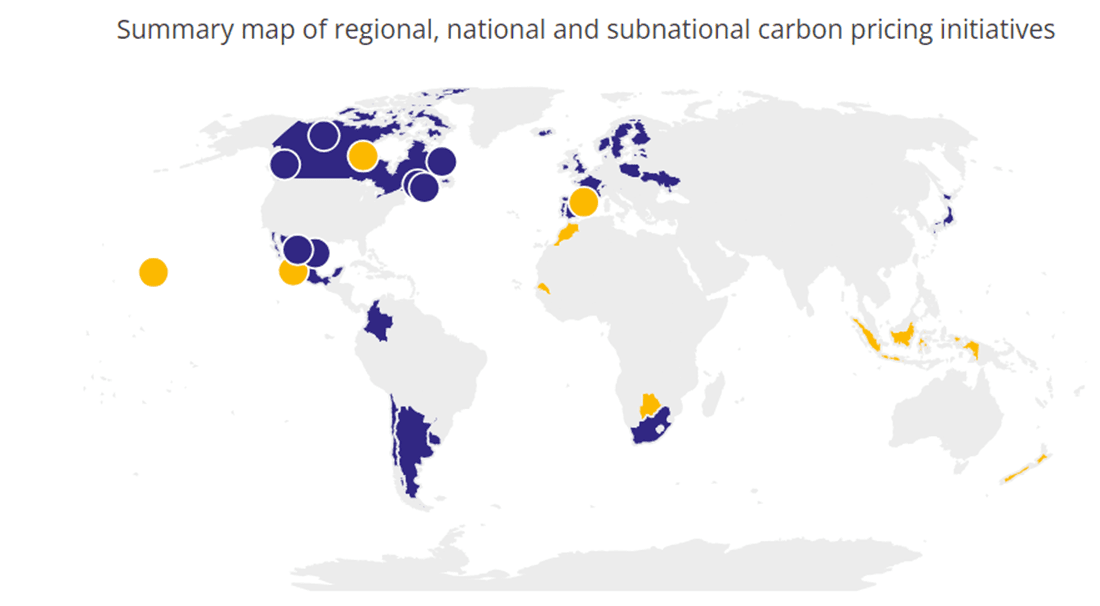
Figure 8.1 (Appendix C) provides time series data on the share of global GHGs covered in the various carbon tax instruments between 1990 and 2023. This provides an indication of the overall significance of their use globally. Note, due to data limitations the share of emissions shown in the figure from 2015 onwards is based on 2015 global emissions data. Several trends are evident, based on these data:
- As of March 2023, carbon tax instruments covered 5.4% of global GHG emissions. This was slightly down from a peak in 2019 of 5.7%. This is likely to reflect reductions in GHG emissions associated with mandatory lockdowns during the Covid-19 pandemic, alongside some emission reductions in at least some jurisdictions.
- Increases in coverage are evident in the last 15 years, arising from the introduction of new instruments in 2011 (Ukraine), 2012 (Japan), 2014 (France and Mexico), and 2019 (South Africa).
- Over the same period however, total global GHG emissions increased by around 50%, from about 31 million kilotonnes of CO₂e (ktCO₂e) in 1990 to over 46 million in 2020 (latest data). Whilst there are some uncertainties in the data, the overall rate of increase in global GHG does appear to have slowed after 2013 (World Bank 2023d).[1]
In terms of overall ambition for the carbon tax instrument, Figure 8.2 (Appendix C) presents data from March 2023 which compares the carbon price (in US Dollars per tCO₂e) with the share of GHG emissions that are covered by the relevant tax. The figure also shows ETSs for comparison. These data highlight that existing instruments vary in both price and coverage. Overall, we can identify three broad groupings based on the overall level of ambition of existing instruments:
- High ambition: those with relatively high carbon prices and relatively broad coverage as a proportion of total GHG emissions in that jurisdiction. The carbon taxes in Liechtenstein, Sweden, Switzerland, Norway and Finland are such examples.
- Mixed ambition: this is a larger group with some trade-offs apparent between share or price. For example, Uruguay’s carbon tax, levied on gasoline, provides the highest carbon price but only covers a small share (less than 20% of relevant GHGs). Conversely, Singapore and Japan have wider coverage but a lower price. Others have middling coverage and price, for example France, Canada’s federal fuel charge, Iceland, Denmark and Portugal.
- Low ambition: a smaller group with relatively low prices and coverage. For example, Poland, Estonia, Argentina, Chile and Colombia.
Indirect taxation schemes
The World Bank (2023) defines indirect carbon pricing as other policies which might change the price of products associated with GHG emissions, but they do so in ways not directly proportional to the emissions associated with those products. So these levers do not tax carbon or tax at a rate proportionate to carbon content. Rather, they tax carbon intensive activities or services (or focus on other forms of pollution, such as air pollution, which also has the benefit of producing GHG reductions alongside), hence indirectly create a carbon price signal and encouraging the reduction of GHG emissions. Indirect taxation schemes are therefore very broad. As such, the World Bank (2023c) note that indirect carbon pricing policies are far more common and wide-ranging than direct pricing. This diversity and the weaker causal link with reductions in GHG emissions present a challenge for assessing their effectiveness in this study. As a result, we have given them a lower priority than direct taxation schemes for the purposes of the evidence review.
Examples of indirect taxes exist across many different sectors. They include landfill taxes, such as those in place in Bulgaria (EEA 2022a) and Austria (IEEP, 2016a) or ‘pay as you throw’, schemes for example in Lithuania (EEA 2022b). Pay as you throw schemes are designed to incentivise citizens to separate their waste at source and charge a fee for the collection of residual waste from households.
France has a ‘General Tax on polluting activities’ which applies to companies which are engaged in the storage, thermal treatment or transfer of non-hazardous and hazardous waste (French Ministry of Finance 2023). Latvia employs a National Resources Tax (Latvian Ministry of Finance, 2020), which applies to the extraction of natural resources, environmental pollution, disposal and use of hazardous goods as well as the packaging used in business activities.
In the field of air quality, levers include the Bonus Malus Scheme in France (see Section 8.9 for further detail), air pollution load charge in Hungary, which applies to emissions of nitrogen oxides, sulphur dioxides and non-toxic dust (IEEP 2016b) and a tax on emissions of SO2 and NO2 in Galicia, Spain (Xunta de Galacia, nd). Other levers include an incentive fee on volatile organic compounds as is in place in Switzerland, and a Pesticide Tax (Sweden and Denmark).
Finland also employs a tax on peat use for energy. However, this represents a unique situation as peat is in fact subsidised in comparison to the tax rates of other fuels, and peat makes up a significant part of Finland’s energy mix.
Carbon credit schemes
We have used data from the World Bank carbon pricing dashboard (World Bank 2023c) to provide an overview of carbon credit schemes, their use, prominence in global trading, and role in international climate agreements.
Carbon credits are units that represent emission reduction activities that include either avoiding the carbon being produced (e.g., capturing methane from landfills), or removing carbon from atmosphere (e.g., sequestering carbon through planting trees or directly capturing carbon from the air and storing it). One credit is typically equivalent to one metric tonne of a carbon dioxide equivalent (tCO₂e) reduced or removed.
Carbon credit schemes create opportunities for investors and corporations to trade carbon credits. The carbon credit market has grown significantly since the concept was establish alongside the 1997 Kyoto Protocol. It experienced a further surge in interest following the Paris Agreement of 2015, more than doubling in size over five years (Dyck, 2022), though the sector grew less between 2021 and 2022, reflecting challenging economic conditions and criticism of the integrity of some schemes (World Bank 2023c). Carbon credits are supplied via regional, sub-national and national governments (such as the California Compliance Offset Program), at international scale through international treaties (such as the Kyoto Protocol and the Paris Agreement), and independently, via non-governmental entities (such as Gold Standard). The largest share of carbon credits is issued via independent non-governmental mechanisms, which had driven much of the overall growth seen between 2018 and 202.1 Figure 8.3 in Appendix C provides more detail.
The biggest driver for demand on carbon credits is companies purchasing credits, usually from independent suppliers, to compensate for emissions-heavy activities, either voluntarily or in response to regulation. However, carbon credits can be controversial because it is not always clear that carbon has in fact been saved or stored, and there are concerns with the ways in which schemes are set up, managed and promoted. The carbon credit market is currently evolving to respond to these concerns (Donaho, 2023).
Effectiveness of fiscal levers
We interpret effectiveness as the extent to which the policy has achieved its desired objectives and reached the affected group(s) (Scot Gov, 2018), compared to the starting (or baseline) position (i.e. has the instrument led to decreases in GHG emissions in the sector or activities targeted). We have also considered the extent to which impacts can be attributed to the policy in question, compared to other factors. We focus on the available secondary evidence and on direct tax examples. We have sought evidence on policy objectives of interest to the Scottish Government; namely the extent to which the instruments have resulted in GHG emission reductions, preferably where these have been quantified and attributed to the tax, and the extent to which they have generated revenues for the host government. Where possible, we consider whether the policy has brought about behaviour change in response to the tax. We have also considered data on the revenues that the tax has created, as well as how that revenue has been used by the host government. Other unintended impacts are noted, where evidence allows.
Before we consider data from specific instruments, a key broader conclusion is that several sources do not consider that existing carbon tax instruments are sufficient to address climate change goals. The Intergovernmental Panel on Climate Change (IPCC) estimated that to meet global GHG reduction requirements the average G20 economy needs to reduce its GHG emissions by over 10% every year (Green, 2021). The sources above suggests that the price and scope of existing instruments are not sufficient to deliver this kind of reduction.
Evidence on effectiveness – GHG emissions and behaviour change
In analysing the literature, we looked for secondary evidence on the overall effectiveness of different fiscal levers. Our assessment was limited by two key factors. First, it is not always possible to attribute GHG reductions to one policy instrument, compared to the various other factors influencing GHG emissions and all such estimates are subject to uncertainty. Possible other factors include rates of overall economic growth, growth within sectors, economic structure (i.e., size of emission intensive sectors and trends within these), imports and exports, as well as economic shocks such as recessions, the Covid-19 pandemic, and the Russian invasion of Ukraine. Similarly, there are several policies that may affect GHG emissions, so it can be difficult to ascribe GHG reduction to one climate-related policy over another. Second, there is a time lag between policy implementation and observed changes which, in this case, limits the available evidence.
Overall, the balance of evidence suggests that the fiscal levers reviewed have reduced GHG emissions in the relevant jurisdictions, but the precise reduction is unclear. A 2021 review (Green, 2021) collated available quantitative ex post evidence on GHG emissions reductions attributed to either ETSs or carbon taxes.[2] Key findings are below (note further detail is provided in Table 8.1 in Appendix C, which contains discussion on the findings of several specific studies, including quantitative GHG emission reduction estimates).
- Although carbon pricing has dominated many political discussions of climate change, only 37 studies assess the actual effects of the policy on emission reductions. Of these, the vast majority are focused on European examples. In turn, most of these examples focus on ETSs, rather than carbon taxes, per se. Similarly, there are few studies which compare either carbon taxes or ETSs to other climate change mitigation policies to establish the relative effectiveness and efficiency of policy measure or packages.
- Most studies suggest that the aggregate reductions from carbon pricing (note this refers to both ETSs and carbon taxes) on emissions are generally limited. The overall reductions observed were on average up to 2% per year (again this refers to both ETSs and carbon taxes). However, there is considerable variation in the GHG reductions seen between sectors.
- In general, the review concluded that the existing evidence suggested carbon taxes may have performed better than ETSs in producing emission reductions. Note this conclusion should be interpreted with caution; it may reflect the prevailing carbon price, rather than the mechanism itself and much of the evidence on emission reductions from ETSs discussed in the review focussed on the EU ETS. Some of the studies on which this conclusion is drawn are based on the pilot phase of the EU ETS, which involved free allocations to several sectors, a higher emissions cap and a relatively low carbon price. Future evidence should be monitored to examine whether that conclusion remains valid.
- However, there is more evidence that other regulatory instruments beyond either ETSs or carbon pricing probably have a greater effect than either measure acting alone. A 2020 study concluded that “the real work of emission control is done through regulatory instruments” (Cullenward and Victor, cited in Green 2021). A 2018 review provides some evidence that nations which are part of the EU ETS and are without a carbon tax experienced emission reduction in those sectors not covered by the ETS at a slightly faster rate than those that applied a domestic carbon tax, alongside the EU ETS (Haites, 2018, cited in Green 2021). There are clearly several factors at play.
- Experience to date indicates that in comparison with ETSs, establishing and administering carbon taxes in the host government are comparatively straightforward and inexpensive.
We have identified limited evidence on the behavioural effects of the taxes. Two studies (Tvinnereim and Mehling 2018, Rosenbloom et al 2020, cited in Green, 2021) consider this. They conclude that there is little evidence that the taxes directly result in wider decarbonisation. The studies suggest a more common response is to mitigate the flow of emissions, via fuel switching or efficiency improvements, rather than more significant changes in manufacturing process or technologies. This may be a product of the nature of the instrument, the activities on which the taxes are targeted or current relatively low prices. It may also reflect a lack of coordination of wider climate mitigation policy, which as we have seen above, is likely to be necessary to sustain wider emission reductions.
Evidence on effectiveness – Revenue generation and ‘hypothecation or earmarking’
We reviewed evidence on both the revenue generated by carbon taxes as well as how these revenues have been used. The available data reflects different time periods and there are some methodological inconsistencies. Two overall conclusions are apparent. First, that carbon taxes have generated substantial income for the host government. Second, that a key characteristic of carbon taxes in operation to date is that a substantial proportion of that revenue is often allocated (or ‘earmarked’ or ‘hypothecated’) for specific purposes. Occasionally this hypothecation is explicit in the legislation, hence legally binding, while in other cases this allocation is via a political commitment, hence potentially subject to change with associated changes in Government.
A 2016 review (Carl and Fedor, 2016) of 56 national or subnational instruments found revenues from carbon pricing (i.e., taxes and ETSs) amounted to $28.3 billion in 2013. Of this, well over $20 billion was raised from carbon taxes.[3] Of this only a small proportion of this revenue overall (about 15% was allocated to ‘green spending’. The review concluded that it was much more common for carbon tax revenues to be reallocated in the form of tax cuts and rebates and this accounted for about 44% of revenues at the time. About 28% were not allocated for a specific purpose, referred to as ‘unconstrained’. The same review indicates indirect taxes are often not reallocated for specific purposes (Carl and Fedor, 2016). Analysis of specific carbon tax instruments were also included, with results shown in Table 8.2 in Appendix C. These data indicate that taxes accounted for revenues between $30 million per year (Iceland) to $1 billion or more (Denmark, British Columbia and Norway). Sweden’s is by far the largest at $3.5 billion and it also has the largest per capita cost and share of GDP. These data indicate – at the time – that the most ambitious schemes constitute well under 1% of GDP. Further quantitative data is set out in Table 8.2 in Appendix C.
More recent data show that by 2022 (World Bank 2023), revenues from carbon pricing had increased significantly to $95 billion, of which carbon taxes generated 31% (just under $30 billion).[4] Although revenues from carbon taxes had increased, this had been driven by rising revenues from ETSs. The overall tax revenue is not just a by-product of prices, but of the share of GHG emission covered, exemptions, the carbon intensity of sectors, and carbon leakage. For example, South Africa’s carbon tax covers nearly 10 times more emissions than Colombia’s and at a higher rate but was delivering a similar amount of revenues (World Bank 2023).
For comparison, a more recent study based on 40 countries also examined the level and use of revenue (OECD, 2019). This source examines whether the revenue reallocations were legally binding (i.e., set out in the relevant legislative act) or based on a political commitment (i.e., via ministerial or policy statement). The review also provides further detail on precisely how the revenues have been used. These full data are produced in Table 8.3 in Appendix C.
Again, the data show that a consistent feature of carbon taxes is the extent to which the revenues are used for specific purposes; around two thirds of total revenues have some form of hypothecation or constraint. They have been particularly directed toward reducing the taxation burden in other spheres, such as associated with employment or in provision of direct financial relief or subsidy to specific groups. Moreover, the review found that introduction of carbon taxes has frequently been part of broader tax reforms and that it has been more common for carbon tax revenue to be allocated based on political, rather than legal commitments. The authors indicate that the tax reform potential of carbon taxes (i.e., reducing the tax liabilities from labour and capital) may form part of the motivation for adoption, alongside the climate mitigation potential in at least some jurisdictions (OECD, (2019).
Lessons learned
We reviewed evidence on where carbon taxes have been effective, as well as where setbacks have occurred and why. We highlight data gaps and conclude with recommendations identified in the literature on how a hypothetical UK carbon tax might be applied.
Are carbon taxes regressive?
A small number of studies have explicitly reviewed the evidence on distributional effects from carbon taxes (i.e., to whom the costs are incurred, with a particular focus on different impacts based on income) and whether carbon pricing results in generally progressive or regressive effects. For example, Ohlendorf et al (2018) provide a meta-review, but the information identified has generally focussed on low and middle-income countries and shown different results. The review notes that literature reviews have shown mostly regressive impacts in developed countries, but that this is not necessarily the case in developing countries. More progressive outcomes were observed for reforms that remove fossil fuel subsidies as well as some transportation policy. Overall, the review is inconclusive and provides limited lessons for Scotland. The tax itself is likely to be regressive, where additional costs incurred via carbon taxes are passed through supply chains to end users or consumers. Without the revenue recycling/rebate measures described above this may disproportionately affect those on the lowest incomes (Ohlendorf et al 2018, LSE, 2019). The UK Government Net Zero Review examines household exposure to the costs associated with the net zero transition. The review concludes that forecasting household costs in detail is not possible, but costs may fall on households via a number of routes. These include via Government decisions on tax and expenditure, via businesses and reflected in prices, wages and consumer choices (HM Treasury, 2021).
What has worked in the application of carbon taxes?
Overall, we found several examples where carbon taxes have been applied, maintained, contributed to emission reduction and generated revenue for the host government, whilst maintaining popular support. However, in every case, the design of the tax has considered the unique context in each jurisdiction.
A significant element of revenue recycling is a characteristic of most instruments adopted to date. An OECD review notes it has been possible, “in most circumstances”, to strike a balance between using the revenue in ways that are socially useful and that contribute to public support for carbon pricing. Such revenue recycling should not be seen as a panacea for public support, however. Introducing carbon pricing instruments generally is seen as more challenging when general public confidence in government is low (note this is not defined and is clearly relative). Such lack of confidence further limits the options for revenue use, by reducing the space for more significant tax reforms and increasing the political appeal for lump sum transfers of revenue (OECD, 2019).
Others have seen the degree of hypothecation of revenues as a way of ensuring ‘lock in’ of the front-end prices and increasing the overall longevity and stability of the instrument. For instance, by ensuring the back-end uses of the proceeds are visible, it is harder to change prices or exempt certain sectors for reasons of political expediency (Carl and Fedor, 2016).
A further balance must be struck between rigid hypothecation of the revenues, which may constrain flexibility, and the benefits of clearly communicating what revenues are being generated and how they are to be used. This communication is considered to be key for creating public support and any policy should be developed in conjunction with stakeholders and be subject to a detailed cost-benefit analysis (OECD, 2019).
Sweden’s carbon tax, for example, may be seen as an exception to this. Some analysis suggests that it has been subject to so many changes that the ultimate effect of the carbon tax is not clearly distinct from effects of other measures e.g., value added tax, excise duties, etc. (Carl and Fedor, 2016). However, what is clear from the Swedish example is that the tax was part of a wider reform which itself had a clear objective (Section 8.6). This may explain at least some of the public support, even with a relatively high carbon price.
The justification made at the time for the introduction of carbon taxes vary and are not confined to emission reduction objectives. For example, reducing taxation in other areas, such as on labour (British Columbia, Sweden) as well as using them for wider fiscal recovery after financial crisis (Ireland, Iceland). Other rationale includes the relative simplicity and stability relative to ETS instruments (Carl and Fedor, 2016).
In the past, carbon taxes have provided a degree of price predictability and of revenue certainty for the host government. For instance, the British Columbia government has been able to predict revenues at least a year ahead within a 5% margin for error (Carl and Fedor, 2016). This would seem to be a feature of the design of the tax (i.e., the sectors at which it is targeted and the overall share of GHG affected).
Gradual introduction of the tax was seen as a positive feature (for example British Columbia), avoiding a sudden increase in the cost base for affected sectors and mitigating unintended consequences. However, they are also seen as visible, tangible and “politically immediate” ways of demonstrating progress toward climate mitigation (Carl and Fedor, 2016, LSE, 2019).
What lessons have been observed in the application of carbon taxes?
It is equally important to draw lessons on where they have not worked or have encountered problems. Reflecting on implementation, we find that existing carbon taxes are generally not sufficient, either in price or scope, to meet existing climate policy goals.
Carbon taxes have also been politically difficult to implement. They have proved controversial in many jurisdictions, including several with similarities to Scotland. Green (2021) suggests this opposition comes from two sources. The first source is the emitting industries themselves. Second, some evidence is presented by Green (2022) that the public tend to prefer other policies to carbon pricing. Use of dividends (i.e., rebates) may mitigate this risk, but only as part of a wider climate change mitigation package of policy.
The review has identified several jurisdictions where significant setbacks have been observed. The clearest case is in Australia where an existing carbon tax policy was cancelled. The tax generated what were at the time the largest overall revenues and per capita costs in the world. This was despite having a carbon price ($30 per tonne as of 2016) which was comparable with other jurisdictions. The revenues were a product of the relative carbon intensity of the country’s – largely coal fired – energy generation infrastructure. Repealing the tax became a key element of the opposition party’s ultimately successful political campaign (Carl and Fedor, 2016).
Mexico is the first Latin American country which has introduced sub-national carbon taxes. Durango is the most recent State to enact one, in January 2023 and others are considering implementing them. Baja California (a Mexican State) introduced a carbon tax as of 2022 as a part of broader fiscal reforms. The tax was levied on emissions from gasoline and diesels. A legal challenge was subsequently brought in Baja California, by the Mexican Federal Government and a group of regulated entities. This argued that under the Mexican Constitution, only the federal government could implement a tax on fuels. The Mexican Supreme Court ruled in favour of the Federal Government (World Bank 2023c).
In France a planned acceleration of the carbon price increase was suspended in 2018. At that point the price was around $50 per tonne. This was in response to a public backlash on the perceived unfairness of the tax, which was introduced at the same time as broader reforms which were perceived as benefiting the wealthy (IMF, 2019). The wider backlash was epitomised by the ‘gilets jaunes’ or ‘yellow vests’ protests about fuel prices.
There are other examples where the instruments have been adjusted, paused, amended or the price escalator has been delayed or otherwise changed. For example, British Columbia and particularly New Zealand, where a proposed ‘fart tax’ was cancelled and an agricultural tax has been delayed (see Section 3.7.4).
A specific challenge is that the UK – and by implication, Scotland – has one of the most complex tax systems in the world. Some experts have consistently criticised a lack of an overall coherent tax strategy for the UK, particularly considering the implications of demographic changes for future taxation targeted at the economically active working age population (Johnson, 2023).
What are the data gaps?
Our review and the interviews have generated limited specific detail on impacts within affected sectors, as well as details on the behavioural response of those sectors. This reflects methodological challenges as well as time lags between policy action and observed effects. It has also identified limited quantitative information on carbon leakage. The emission reduction estimates are likely to be somewhat overstated, given that this has not been quantified.
Recommendations for the UK in the literature
A 2019 policy brief from the Grantham Institute reviewed the global evidence and provided a series of explicit recommendations for the UK if it were to implement a carbon tax (LSE, 2019). The recommendations were:
- The tax rate should be high enough to be consistent with net zero policy objectives. This implied a starting rate somewhere around £40 per tonne (as of 2020) (note this also depends on the scope of the tax, which is not specified in detail in the paper, but would need to be applied “in most sectors”). It should complement and be carefully designed alongside other climate change mitigation policies.
- Credibility requires clear rules, a design that is not susceptible to political pressure and visibility on how the trajectory of prices or scope may change over time (i.e., annually, based on factors like investment cycles or emission performance).
- The price should start low and rise over time. This doesn’t only allow affected industries time to respond but allows evidence on effectiveness and any unintended effects to be observed in practice.
- The use of the proceeds should be carefully and regularly explained alongside information on the economic, social and environmental costs and benefits (via a published, independent cost-benefit analysis, for example).
Case studies
To gain further depth on specific international examples of fiscal levers, we assessed six case studies in further detail. Their selection was based on six predetermined criteria (see Section 8.1.2 in Appendix A on the methodology for the overall study for more detail). An overview of the selected case studies, and the accompanying rationale for their selection against these criteria is in Table 3.1, below. Each criterion has been assigned a red [R], amber [A] or green [G] (RAG) rating. This is based on a judgement of the researchers on the overall similarities between the case study jurisdiction and the Scottish context. For comparison, the Scottish population was some 5.4 million (in 2022), whilst GDP per capita was $42,362 (in 2021).[5] Given Scotland’s devolved powers to create taxes with consent of UK Parliament, we include examples where instruments have been applied sub-nationally (for example Canada, Wallonia). There are cases which include rural and island communities or significant renewable energy generation potential (for example New Zealand). Scotland’s ambition is for Net Zero by 2045 and 75% reduction in emission by 2030, so we have selected jurisdictions with similarly ambitious targets (for example Sweden and Austria).
We discuss key features and potential lessons for Scotland in Sections 3.7.1 to 3.7.4 below the table. Full details of the case studies are in Appendix D.
|
British Columbia |
Sweden |
Austria |
New Zealand |
France |
Wallonia | |
|---|---|---|---|---|---|---|
|
Overview of instrument |
Direct carbon tax, applied to fuels based on their CO2 content |
Direct carbon tax, applied to fuels based on a CO2 price per tonne |
National ETS scheme which augments the EU ETS and applies to sectors excluded from it |
Agricultural tax, applying a farm-level levy on GHG emissions |
Bonus Malus scheme with fees on purchase of new emission intensive vehicles and rebates for electric vehicles |
Indirect tax on environmental impacts from farming, focussed on water resources |
|
Population and GDP per capita |
5 million (2021) and $59,962 [G] |
10.5 million (2022) and $65,157 (2021) [A] |
9 million (2022) and $59,991 (2021) [A] |
5.1 million (2022) and $47,982 (2021) [G] |
68 million (2022) $55,064 (2022) [A] |
3.6 million (2022) and €31,568 (2021) [A] |
|
Administrative and legal arrangements/ competencies |
Sub-national tax, with separate federal tax system [G] |
National level tax, alongside EU ETS [A] |
National ETS designed around EU ETS [G] |
A proposed national-level tax [A] |
National level indirect tax [A] |
Indirect tax at sub-national level [G] |
|
Shared challenges |
Significant renewable energy use (largely hydropower), rural communities [G] |
Rapidly growing renewable energy potential, Rural and Island communities [G] |
Rapidly growing renewable energy potential, rural communities [A] |
Significant renewable energy potential, Peatland[G] |
Increasing renewable energy potential, rural communities [G] |
Increasing renewable energy use [G] |
|
Climate ambition |
Net Zero by 2050 [A] |
Net Zero by 2045 [G] |
Net Zero by 2040 [G] |
Net Zero by 2050 [A] |
Net Zero by 2050 [A] |
80-95% reduction in emissions by 2050 [A] |
|
Data and Evidence |
Good level of evidence [G] |
Good level of evidence [G] |
No ex-post evidence, but detail on design/expected impacts [G] |
Implementation lessons only [R] |
Good level of evidence [G] |
Good detail on lever design, limited evidence on effectiveness [A] |
|
Diversity of Approaches |
Sub-national direct carbon tax [G] |
Longstanding and highest priced direct carbon tax [G] |
National level ETS [G] |
Novel concept [G] |
Indirect tax, administered nationally [G] |
Indirect tax, administered at sub-nationally [G] |
Impact on GHG emissions
The available evidence linking each fiscal lever with GHG emission reduction varies significantly. The case studies include two direct taxes – both of which are applied to various fuels based on their CO2 content – in Sweden and British Columbia (BC), Canada. These levers have been in place for a relatively long period, so have generally good ex-post evidence available. Bernard and Kichian (2019) have calculated that the British Columbia carbon tax, once reaching the rate of $30/ton of CO2, achieved an estimated 1.13-million-ton reduction in CO2 emissions. This equates to an average annual reduction of 1.3% relative to British Columbia’s 2008 diesel emissions and 0.2% relative to all BC CO2 emissions in 2008. However, they do not think it is a viable strategy for achieving net zero goals in isolation. With regards to the Swedish carbon tax, a review of ex-post analyses of carbon taxes by Green (2021) reveals different results around Sweden’s emission reductions. For example, research by Andersson (2019) found an average emission reduction of 6.3% per year between 1990 and 2005, Fernando (2019) found an annual average reduction of 17.2% and research by Shmelev and Speck (2018) found no effect on emissions. A study conducted by Jonsson, Ydstedt, & Asen (2022) state that GHG emissions have declined by 27% between 1990 and 2018. This highlights various methodological differences in conducting these ex-post analyses, and the difficulty in establishing the baseline of what emissions reductions would have occurred even in the absence of the lever.
The Austrian national ETS (nETS) – which extends the EU ETS, of which Austria is a part, to other sectors – is still in a phased implementation stage and will establish a set price which increases each year, reaching a market phase in 2026. Ex-ante modelling conducted by the Austrian government expects the scheme to reduce GHG emissions 800,000 tonnes by 2025. The proposed tax on agricultural emissions in New Zealand has not yet been finalised.
The evidence suggests the French Bonus Malus scheme – which incentivises uptake of low emission vehicles with a combination of fees and rebates – has been effective in shifting vehicle sales toward more environmentally friendly vehicles. Even though progress has slowed in recent years, average emissions have reduced significantly from 149 gCO2/km in 2010 to 111 gCO2/km in 2017. The relationship between the agricultural tax in Wallonia – which is applied at a farm level on the effects on water resources from livestock and land cultivation – and GHG emissions is much less clear.
Revenue generation and use
Data availability on revenue generated by these schemes varies. In all cases, a key element has been that revenues are either directly recycled back to citizens or are offset in other parts of the budget. This has occurred via direct payments/rebates to households or implementing other tax cuts alongside the lever.
The British Columbia carbon tax was designed to be revenue neutral and so was implemented alongside a wider scheme of tax cuts, and is now part of the Canadian Federal approach, which gives direct payments back to households. In 2019, SEK 22.2 billion was generated via the Swedish carbon tax, which is approximately 1% of Sweden’s total tax revenue. The carbon tax revenue goes into the overall government budget, and is not hypothecated, thus it is unclear where the revenue generated is distributed (Jonsson, Ydstedt, & Asen, 2022). The Austrian nETS was implemented as part of a wider policy package. Although revenue for the emissions allowances goes directly into the main budget and there is no hypothecation, ‘climate bonus’ payments are given directly back to households. Revenue in 2022 was approximately €800 million and the government have reallocated around €1 billion.
Since 2014, the Bonus Malus scheme has generated surplus revenue for the French general budget. For 2018, the malus was set at a level that covered the costs of the bonus payments (EUR 261 million) and the additional bonus for scrapped vehicles (EUR 127 million). The agricultural tax in Wallonia generates an annual revenue of around €1.2 million, however, it is unclear how this is subsequently used.
Behaviour change
There is some evidence on how the case study examples influence behaviour change. The carbon tax in British Columbia has been shown to have had a role in decreasing consumer demand for fossil fuels and natural gas (Pretis, 2022). Additional studies from Xiang and Lawley (2018) and Antweiler and Gulati (2016) also draw correlations between the implementation of the tax and a decrease in fuel demand.
The carbon tax in Sweden has shown to be effective in shifting market investment into low-carbon technology, specifically in renewable energy sources such as hydro and wind (Hildingsson and Knaggård, 2022). Levying the carbon tax at different rates on fuels has also resulted in behaviour changes in companies. Between 1993 and 1997, the higher tax rate on fuels used within domestic heating systems compared to fuels used within industry resulted in industries selling their by-products to domestic heating companies, while continuing to burn fossil fuels themselves (Johansson, 2000).
One interviewee suggested that the Austrian nETS, whilst in its fixed price stage, is not expected to generate a strong enough price signal to result in a clear and significant change in behaviour. However, other parts of the policy package have been designed to specifically change behaviour (such as subsidies for changing heating systems in households). The Bonus Malus scheme has had a clear impact on shifting vehicle sales in France towards less CO2 intensive vehicles. However, the scheme may have a rebound effect, as the lower fuel expenditure for consumers due to more efficient vehicles may lead to an increase in vehicle use and thus in fuel consumed (and thus on emissions). There is no evidence regarding the behavioural effects of the agricultural tax in Wallonia.
Unexpected challenges
In British Columbia, the tax was initially designed without exemptions and applied universally. However, after competitiveness concerns were raised, the government introduced a one-time exemption worth $7.6 million in 2012, followed by an ongoing exemption in 2013 to greenhouse growers and an exemption for gasoline and diesel used in agriculture in 2014.
When implementing their nETS, the Austrian government experienced challenges designing the scheme around the existing EU ETS. To ensure that emissions were not double counted, exemptions from the national ETS were given to installations already regulated under the EU ETS. This proved a challenging exercise for the Austrian government.
Challenges have been observed for the proposed agricultural tax in New Zealand. Whilst these are political in nature, they have presented challenges for the implementing government. The original proposal for a split-gas, farm-level levy was revoked after a consultation highlighted public concerns about the impact on the cost and potential implications on availability of produce. A series of media outlets reported tensions between the agricultural sector in New Zealand and the government. Farmers expressed concerns regarding both the profitability and competitiveness of their business, with some expecting to have to reduce their herd size (Pannett, 2023). After revoking the original planned tax, the NZ government are now implementing mandatory monitoring and reporting of emissions from agriculture, to eventually transition into pricing of emissions.
Overview of fiscal levers in the UK
We investigated existing UK environmental fiscal levers, including taxes in the energy intensive industries, the power generation, transport, and pollution and resource sectors in Appendix B. We focused analysis on those that deliver reductions in GHG emissions. These include:
- Fiscal levers specifically targeted to reduce GHG emissions.
- Fiscal levers specifically targeted to address environmental impacts and affecting GHG emissions.
These were classified using the typologies developed in Section 3.1. Fiscal levers that do not contribute to reducing GHG emissions have not been considered. A complete list of environmental taxes in the UK (at time of writing) is in Section 8.1.4.
Existing fiscal levers which target or address GHG emissions focus on energy and energy intensive industries, transportation (road and air transport) and resource use. Examples include Fuel Duty, the Climate Change Levy (CCL), the Renewables Obligation (RO), the UK ETS, the UK Air Passenger Duty (APD), and the Vehicle Excise Duty (VED).
Under the current devolution settlement, most tax powers remain reserved to the UK Government and Parliament. However, any existing national tax can potentially be devolved to the Scottish Parliament. New national taxes can be created through a mechanism allowing the UK Parliament, with the consent of the Scottish Parliament, to grant powers for new national devolved taxes to be created in Scotland (Scottish Parliament, 2021).
Overview of fiscal levers in Scotland and implications of the case studies
Devolution is the statutory delegation of powers from the central government of a sovereign state to govern at a subnational level. It is a form of administrative decentralisation. Devolved territories have the power to make legislation relevant to the area, thus granting them higher levels of autonomy. In the UK, devolution is the term used to describe the process of transferring power from the centre (Westminster) to the nations and regions of the United Kingdom (Torrance, 2022). Devolution provides Scotland, Wales and Northern Ireland with forms of self-government within the UK. In the case of Scotland, this includes the transfer of legislative powers to the Scottish Parliament and the granting of powers to the Scottish Government. While the UK Parliament still legislates for Scotland, it does not do so for devolved matters without the consent of the Scottish Parliament.
The devolution process has led to calls for the Scottish Parliament to be given more responsibility over revenue raised and spent in Scotland. There are existing devolved environmental taxes under the Scottish Government’s remit that contribute to reducing GHG emissions. We have also considered implications of the case studies from a legal and regulatory perspective. No assessment is made of the potential costs and benefits of adoption nor of the practical challenges associated with them.
Legal and regulatory fiscal system in Scotland
The legislative framework for devolution to Scotland was originally set out in the Scotland Act 1998. The Scotland Act 1998 established the Scottish Parliament and set out the matters on which the Scottish Parliament cannot legislate and make laws, known as general and specific reservations. Everything not listed as a reserved matter is assumed to be devolved. Reserved taxation matters include VAT rates, Fuel Duty, and Corporation Tax. The Scottish Parliament currently has devolved responsibilities in relation to five taxes (Scottish Government (2021), as follows:
- Scottish Income Tax, which is partially devolved. It is collected and administered by HMRC on behalf of the Scottish Government.
- Land and Buildings Transaction Tax, a tax paid in relation to land and property transactions in Scotland, and Scottish Landfill Tax, a tax on the disposal of waste to landfill, are fully devolved national taxes and are managed and collected by Revenue Scotland.
- The Scottish Parliament also has powers over local taxes for local expenditure. Currently, the two main local taxes are Council Tax and Non-Domestic Rates (also known as business rates), which are collected by local authorities. Note that a review of local taxes is not covered in this study.
In addition, powers in relation to two further taxes have been devolved to the Scottish Parliament, but these have not yet been implemented and the relevant reserved taxes therefore continue to apply. These taxes are Air Departure Tax, a tax on all eligible passengers flying from Scottish airports, which will replace Air Passenger Duty when introduced, and a devolved tax on the commercial exploitation of crushed rock, gravel, or sand, which will replace the Aggregates Levy when introduced.
The Scottish Parliament has the power to create new local taxes (i.e. local taxes to fund local authority expenditure). There is also a mechanism allowing the UK Parliament, with the consent of the Scottish Parliament, to devolve powers for new national devolved taxes to be created in Scotland. This is unlikely to be a swift process and would likely depend on the complexity of the new national tax and negotiation over devolution of the requisite powers.
The UK Internal Market Act 2020 (IMA) seeks to prevent internal trade barriers among the four countries of the United Kingdom. Schedule 1, paragraph 11 of the IMA specifically exempts taxes (Legislation.gov.uk, 2020a). However, new regulatory acts considered to create additional administrative burdens which may affect intra UK trade may be challenged under the IMA.
Devolved fiscal levers to deliver reductions in GHG emissions in Scotland
The Commission on Scottish Devolution (also referred to as the Calman Commission), established in 2007, identified some taxes (including the Landfill Tax and the Air Passenger Duty) where devolved powers could be applied. Following this, the Scotland Act 2012 devolved powers for a Landfill Tax to the Scottish Parliament to cover landfills and transactions taking place in Scotland, which led to the Landfill Tax (Scotland) Act 2014. At the time of writing, this is the only fully devolved fiscal lever delivering reductions in GHG emissions that currently applies in Scotland.[6] Although the Scotland Act 2016 included the power to introduce a devolved tax on the carriage of passengers by air from airports in Scotland (i.e. to replace the present, UK-wide Air Passenger Duty). The Air Departure Tax (Scotland) Act 2017 was passed by the Scottish Parliament 2017, however the introduction of the tax has been deferred due to state aid (and now subsidy control) issues. The Scotland Act 2016 Act also made provisions for the creation of a devolved tax on extraction of aggregates, which is currently being legislated for in the Scottish Parliament, although this does not specifically look to reduce greenhouse gas emissions.
Indirect Taxation Schemes
The Scottish Landfill Tax (SLfT) replaced the UK Landfill Tax in Scotland from 1 April 2015 under the Landfill Tax (Scotland) Act 2012. The SLfT is part of Scotland’s Zero Waste Scheme and aims to encourage the prevention, reuse and recycling of waste in the country. It is administered by Revenue Scotland with support from the Scottish Environment Protection Agency (SEPA). SLfT is a tax on the disposal of waste to an authorised or non-authorised landfill in Scotland. The taxation of disposals to unauthorised sites (that is illegal dumping) is a key difference between SLfT and UK Landfill tax.
The Scottish Government is responsible for setting the rates of the tax as part of the annual Scottish Budget and determining which waste is subject to it. The tax is paid on the disposal or unauthorised disposal of waste to landfill and is calculated based on the weight and type of the waste material. A standard rate of £102.10 per tonne is applied, while a lower rate of £3.25 per tonne is paid on less polluting (referred to as ‘inert’)[7] materials. Tax revenues have decreased from £149 million in 2015-2016 to £125 million in 2021-2022. The SLfT has been a major part of the success in driving change in Scotland’s waste performance (Revenue Scotland, 2021).
Air Departure Tax (ADT). The Scotland Act 2016 included the power to introduce a devolved tax on the carriage of passengers by air from airports in Scotland. This allows Scotland to design a replacement for APD. The Air Departure Tax (Scotland) Act 2017 made provision for such a tax, which will be managed and collected by Revenue Scotland. However, the tax has not yet been introduced and UK APD continues to apply.
The Scottish ADT will tax flights departing from an airport in Scotland (this includes airports in the Highlands and Islands regions). As with the UK APD, the amount of tax payable depends on the destination of the passenger and the characteristics of the aircraft (take-off weight,[8] flight distance seat pitch and seating capacity). Depending on the aircraft, the passenger will pay either the standard, premium or special rate.[9] Certain flights and passengers are exempt from ADT. Exemptions apply to flights operated under a public service obligation, which may include many flights to/from small islands, although the Air Departure Tax (Scotland) Act 2017 making provision for such a tax does not mention any exemptions for passengers on flights leaving from airports in the Scottish Highlands and Islands. There are also exemptions for emergency medical service flights, military, training or research flights. Passenger exemptions apply to persons that are working during the flight, such as flight crew, cabin attendants, persons undertaking repair, maintenance, safety or security work, persons not carried for reward, such as Civil Aviation Authority flight operations inspectors, or children under the age of 16 (FCC Aviation, 2023).
ADT was originally expected to come into force on 1 April 2018. However, on April 2019 the Scottish Government deferred the introduction of ADT beyond April 2020 until issues have been resolved regarding the tax exemption for flights departing from airports in the Highlands and Islands regions. The devolution process is, thus, on hold. In the meantime, UK APD (and the rates and bands that currently exist) and the current Highlands and Islands exemption continues to apply.
Implications of the case studies for Scotland
We assessed whether the six case study examples (Section 3.7) could hypothetically be implemented by the Scottish Government under current devolved competencies. We also provide a high-level explanation of practical issues (e.g., target of the lever and groups affected). No assessment is made of the costs and benefits of adoption.
While the balance of evidence suggests that similar taxes have reduced GHG emissions where they have been applied elsewhere, the net effect on GHG emissions in the host jurisdiction is uncertain. Challenges in implementation have also been observed and there is limited detailed evidence on behavioural effects. These issues will need to be further investigated before any such tax could be considered for Scotland. If the Scottish Government were to consider exploring any of the examples we have looked at, it would be necessary to undertake thorough policy scoping, analysis and consultation, in addition to the agreement of both the UK and Scottish Parliaments. The Scottish Government could also consider these points in the context of its wider discussions with the UK Government on the direction of climate and fiscal policies as part of a collaborative approach.
Direct Carbon Tax
The UK CCL (which is in practice similar to direct carbon taxes in place in several countries or regions, including Sweden and British Columbia) could be devolved to the Scottish Parliament through an agreement between the Scottish and UK governments and parliaments on the transfer of powers.
A new Scottish carbon tax could then in theory replace the UK CCL in Scotland. This could be broadly similar to the UK CCL, although the Scottish Government could also make its own decisions on issues such as scope and rates to better align it with Scotland’s socioeconomic conditions and emissions reduction targets. Were the Scottish Government to consider such a measure, it would require significant exploration of options and detailed analysis to ensure it achieved these objectives, including consultation and engagement with stakeholders.
Emissions Trading System
The UK ETS is jointly operated by the Scottish Government, UK Government, Welsh Government and Northern Ireland Executive through the UK ETS Authority. It relies primarily on legislation that is devolved (the Climate Change Act), although parts of the ETS relating to auction processes are based on legislation that is more often considered reserved and, thus, relies on UK parliament.
A new ‘Scotland ETS’ could hypothetically replace the UK ETS. This would require prior consent of the UK Parliament, Welsh Parliament, and Northern Ireland Assembly to have effect, as well as the agreement of the Scottish Parliament. The agreement of the Scottish Parliament could be sought through new specific legislation (either primary or secondary). Thus, an Act of the Scottish Parliament to make provision about the functioning of the ETS in Scotland would be required. This could in theory cover additional sectors not covered by the UK ETS, similar to the Austrian nETS operating alongside the EU ETS. However, any such proposal would require comprehensive policy scoping and consultation, in addition to the need for agreement from each legislative body, as detailed above.
Bonus Malus Scheme for Vehicles
The UK VED (similar to the bonus malus scheme explained in Appendix D) paid by businesses and households could in theory be devolved to the Scottish Parliament. Thus the new Scotland VED would replace the UK VED through an agreement between the Scottish and UK governments and parliaments on the transfer of powers.
This could potentially allow for innovation, as differences are in principle permitted, as happened with landfill tax (the SLfT applies on the disposal of waste to both authorised and non-authorised landfills, whereas the UK landfill tax only applies to disposals to authorised sites). It could therefore be feasible to create bonuses to incentivise buyers to purchase low or zero emission vehicles (along the lines of the Bonus-Malus in France), which UK VED does not currently offer. However, this would require detailed policy scoping and consultation to ensure any potential measure operates fairly and effectively, as well as having the consent of both the UK and Scottish Parliaments.
Tax on agricultural emissions
Under Section 80B of the Scotland Act 1998 (as amended), a new tax on agricultural emissions similar to the tax on agricultural emissions proposed in New Zealand (for further details, see Appendix D) could in theory be created in Scotland as the UK Parliament can, with the consent of the Scottish Parliament, devolve powers for new national devolved taxes to be created in Scotland.
This tax might operate by putting a price on agricultural GHG emissions, for example, and could include farmers and growers who operate on Scottish territory, depending on their GHG emissions. The lessons learned from the example in New Zealand clearly demonstrate that consideration of any such measures would require rigorous policy design, consultation and close collaboration with stakeholders in the sector. Whilst new taxes can be effective in changing behaviours and reducing GHG emissions, there is an important and challenging balance to strike between protecting jobs and the viability of industries such as agriculture whilst also meeting net zero targets.
Conclusions
Of the various policies to mitigate the effects of climate change, the use of fiscal levers (taxes, levies, duties or charges) to reduce GHG emissions has gained increased attention and wider adoption by policymakers around the world. Different types of fiscal levers include emission trading schemes; carbon credit schemes; carbon border adjustment mechanisms; and carbon taxes. We focused on direct carbon taxes. Subsidies, grants and loans by the UK or Scottish Governments were not in scope.
International review of fiscal levers for GHG emissions
Use of carbon taxes is increasingly common. 37 direct carbon taxes are in operation in 27 jurisdictions globally. The majority are applied in high-income countries, particularly Europe. Scandinavian countries were among the earliest adopters. Many of these taxes have been applied alongside an ETS. There has been less use outside Europe to date. However, several jurisdictions are currently considering them.
Sub-national carbon taxes have been applied successfully: Of particular relevance to Scotland, two jurisdictions have applied carbon taxes sub-nationally: Canada, which has five, and Mexico, which currently has two with further instruments planned.
Existing instruments differ in terms of GHG coverage and carbon price: about 6% of global GHG emissions are taxed by carbon taxes. This share has increased significantly over the past 15 years. Existing instruments differ in scope, price and coverage. For example, Sweden has a ‘high ambition’ instrument and was one of the earliest adopters with the highest carbon tax globally. Other instruments have a mixed level of ambition e.g. high prices and low share (Uruguay) or high share but low prices (Singapore). Relatively low prices and shares include some Eastern European and South American states.
The balance of evidence suggests carbon taxes have reduced GHG emissions, with caveats. Despite the extensive literature on the merits of carbon taxation, actual data on their impact on GHG emissions is limited. Any assessment of impact is methodologically challenging, particularly in attributing GHG reductions to the specific tax. Effects of carbon leakage are rarely quantified, so estimates may overstate reductions in GHG emissions when taking a global view. Despite these challenges, the evidence indicates that carbon taxes have generally reduced GHG emissions in the relevant sector or jurisdiction. There is some limited evidence that carbon taxes perform better than ETSs in terms of GHG reduction, but both are likely to need additional regulatory measures to deliver the scale of decarbonisation necessary. The extent of reductions attributed to the taxes to date are not considered sufficient to meet broader climate goals.
Evidence on behavioural effects within affected sectors is more limited. The available evidence indicates that fuel switching or efficiency improvements may be more common responses than significant changes to manufacturing processes or technologies. Analysis of the Swedish carbon tax suggests some decreased demand for petrol was offset by increases for diesel but it was considered to have supported a shift in investment toward low-carbon technologies. It is not clear if responses were a result of the design of the tax or a reflection of prevailing prices and/or coverage.
Carbon taxes have generated government revenue but their magnitude depends on the design of the tax. The data contain some methodological and reporting inconsistencies, but 2013 information suggested revenues differed between some $3.5 billion (Sweden) and tens of million (Iceland). Data from 2019 show similar orders of magnitude, but the values for specific jurisdictions differ. The share of GDP represented by the taxes were all under 1% of national GDP at that time. By 2022 carbon tax revenues were upwards of $30 billion globally. Overall, revenues reflect the carbon price, as well as factors including the size of the economy, the coverage of the tax, exemptions, the carbon intensity of the jurisdiction and energy mix. The available evidence suggests that direct carbon taxes are relatively straightforward and inexpensive to administer for the host government.
Direct carbon taxes have involved extensive allocations of revenues for specific purposes. Many of the instruments for which data are available contained extensive allocations, as a percentage of revenue. These were often legally binding or via political commitment. Specific allocations include for green spending and particularly on specific rebates or tax cuts to affected groups, including low-income households and some businesses. British Columbia’s carbon tax was designed to be revenue neutral. In Sweden and Iceland, revenues are unconstrained and used to finance general government expenditure.
Implementation has been politically challenging. Australia is the only jurisdiction identified where an existing carbon tax was repealed. Repealing the tax became a central element of a successful opposition election campaign. Similarly, a planned acceleration of the carbon price was suspended in France as a result of widespread civil unrest, citing the perceived unfairness of the tax, having been introduced alongside tax cuts for the wealthy. A successful legal challenge was brought in Mexico over whether the regional government had legal authority to implement a subnational tax.
Potential implications for Scotland
Our high-level review of existing fiscal levers in the UK identified several existing taxes in the energy, transport and resource sectors which specifically target or address GHG emissions.
The Scotland Act 2012 (Section 80B) provides the Scottish Parliament with the power to devolve any existing national tax of any description to Scotland and create new national taxes such as on activities currently not taxed under the UK tax code. Any changes to existing taxes or the introduction of new taxes will require the agreement of the Scottish Parliament and the prior consent of the UK Parliament to have effect. Several of the case studies contain elements that are in practice similar to existing UK levies, but which would need amending if they were to be considered for Scotland.
Any new carbon tax could hypothetically be applied in Scotland, potentially as part of a devolved Scottish Climate Change levy. Similarly, a new ‘Scotland ETS’ could hypothetically replace the UK ETS, with adjustments in scope to incorporate additional sectors. This would require prior consent of the UK Parliament, Welsh Parliament and Northern Ireland Assembly, as well as the agreement of the Scottish Parliament. A devolved VED could theoretically replace the UK VED in Scotland. New national taxes could also be created in Scotland, requiring consent of both the UK and Scottish Parliaments. In each case, new Scottish legislation would be required.
Principles for implementation
This review has highlighted several fiscal levers used in other countries to reduce GHG emissions. Should any of these be explored further, Scotland’s Framework for Tax sets out the principles and strategic objectives that underpin the Scottish approach to taxation and any new measures (Scottish Government, 2021). These principles are:
- Proportionality: Taxes should be levied in proportion to taxpayers’ ability to pay and a fair system should reflect relative income or wealth of the taxpayer.
- Efficiency: Prospects for revenue should be balanced against the potential for unintended behavioural responses.
- Certainty: So that businesses and individuals can plan and invest with confidence, taxpayers must know what is to be paid, by whom and when.
- Convenience: Taxes should be collected in a way that maximises convenience for taxpayers. Policy should be simple, clear and straightforward and opportunities to streamline the tax system taken.
- Engagement: To ensure accountability and maintain trust, governments should consult as widely as possible on tax design.
- Effectiveness: Taxes should raise the expected revenues and achieve their intended aims. Opportunities for tax avoidance should be minimised.
As such, the effectiveness of any fiscal lever depends on the precise design of the lever and should be subject to careful consideration and clear communication in terms of its scope, phase-in, price (including future price escalation), sectors and activities on which it is levied and any relevant exemptions. Distributional effects should be carefully considered, including if and how revenue should be reallocated, to whom and under what conditions. challenges in implementation have been observed. Successful fiscal lever examples have been based on transparent design, regular monitoring and communication of revenues, costs and benefits, with rapid adjustments if unexpected adverse effects occur. Successful examples have also formed part of wider fiscal reforms, with a clear strategic objective.
Any potential instrument should be subject to detailed economic modelling, including testing different price rates and trajectories, an assessment of the risk of carbon leakage (with or without a UK CBAM), economic competitiveness and innovation effects, distributional effects (and potential mitigation via revenue reallocation), and any impacts on small and medium sizes businesses. This should be published in a robust Regulatory Impact Assessment to provide a comprehensive evaluation of any prospective measures, and ensure they adhere to the principles of the Framework for Tax while achieving GHG reductions through behavioural change.
References
Andersson, J. J. (2019). Carbon Taxes and CO2 Emissions: Sweden as a Case Study. American Economic Journal Policy.
Anon (2021). “Restoring peat wetlands – our climate change secret weapon”. Forest & Bird. Available at: https://www.forestandbird.org.nz/resources/restoring-peat-wetlands-our-climate-change-secret-weapon
Beck, M., Rivers, N., Wigle, R., & Yonezawa, H. (2015). Carbon tax and revenue recycling: Impacts on households in British Columbia. Resource and Energy Economics, 41, 40-69.
Bernard, J. and Kichian, M. (2019). The long and short run effects of British Columbia’s carbon tax on diesel demand. Energy Policy, 131, 380-389.
Blackburn, C (2022). Environmental Fiscal Measures for Scotland: learning from case studies and research to create a potential strategic approach. SPICe Briefing, The Scottish Parliament.
Business Waste. (2023). A guide to the UK landfill tax. Available at https://www.businesswaste.co.uk/a-guide-to-the-uk-landfill-tax/
Carattini, S., Carvalho, M. and Fankhauser, S., 2018. Overcoming public resistance to carbon taxes. Wiley Interdisciplinary Reviews: Climate Change, 9(5), p.e531.
Carl, J and Fedor, D (2016). Tracking global carbon revenues: a survey of carbon taxes versus cap and trade in the real world. Energy Policy, 96 (2016) 50-77.
CCC, (2023). Progress in reducing UK emissions 2023 Report to Parliament https://www.theccc.org.uk/wp-content/uploads/2023/06/Progress-in-reducing-UK-emissions-2023-Report-to-Parliament-1.pdf
Civil Service (2022). Devolution: Factsheet
Coopens, L. et al. (2022). Achieving -55% GHG emissions in 2030 in Wallonia, Belgium: Insights from the TIMES-Wal energy system model. Energy Policy 164, 112871. DOI: 10.1016/j.enpol.2022.112871
Corlett, E. (2022). “Nineteen years after the ‘fart tax’, New Zealand’s farmers are fighting emissions”. The Guardian. Available at: https://www.theguardian.com/world/2022/nov/12/19-years-after-the-fart-tax-new-zealands-farmers-are-fighting-emissions
Coyle, D, (2020). Markets, State and People. Economics for Public Policy. Princeton University Press.
Craymer, L. (2023). “New Zealand Farmers Set for Right-Wing protest vote over Climate Change Policies”. Reuters. Available from: https://www.reuters.com/world/asia-pacific/new-zealand-farmers-set-right-wing-protest-vote-over-climate-change-policies-2023-09-27/.
DairyNZ and B+LNZ (n.d.). “Agriculture Emissions Pricing System”. Available at: https://beeflambnz.com/knowledge-hub/PDF/agriculture-emissions-pricing-system-blnz-dairynz-summary-recommendations
European Commission (2023). Carbon Border Adjustment Mechanism. Available at: https://taxation-customs.ec.europa.eu/carbon-border-adjustment-mechanism_en
European Commision (2022). Environmental Implementation Review 2022. Country Report – Belgium. Available at: https://eur-lex.europa.eu/legal-content/EN/TXT/?uri=comnat%3ASWD_2022_0261_FIN
European Environment Agency (2022a) Early warning assessment related to the 2025 targets for municipal waste and packaging waste: Bulgaria. Available at: https://www.eea.europa.eu/publications/many-eu-member-states/bulgaria/view
European Environment Agency (2022b) Early warning assessment related to the 2025 targets for municipal waste and packaging waste: Lithuania. Available at: https://www.eea.europa.eu/publications/many-eu-member-states/lithuania/view
Eurostat (2023) Share of energy from renewable sources. Energy statistics – quantities, annual data. Available from: https://ec.europa.eu/eurostat/databrowser/view/nrg_ind_ren__custom_7813071/default/table?lang=en
FCC Aviation. (2023). Scottish Air Departure Tax. https://www.fccaviation.com/regulation/united-kingdom/scottish-air-departure-tax
Fernando S 2019 The environmental effectiveness of carbon taxes: a case study of the nordic experience The 1st Int. Research Conf. on Carbon Pricing 14-14 February (New Delhi, India: World Bank) pp 349–68
French Ministry of Finance (2023) General tax on polluting activities. Available at: https://entreprendre.service-public.fr/vosdroits/F23497
Government of Canada (2023a). “Economic Overview”. Canada.ca. Accessible at: https://www.canada.ca/en/pacific-economic-development/corporate/economic-overview.html
Green, J.F., 2021. Does carbon pricing reduce emissions? A review of ex-post analyses. Environmental Research Letters, 16(4), p.043004.
Government of Canada (2023b). Census profile, 2021 census of Population profile Table . Profile table, Census Profile, 2021 Census of Population – British Columbia [Province]. https://www12.statcan.gc.ca/census-recensement/2021/dp-pd/prof/details/page.cfm?Lang=E&DGUIDlist=2021A000259&GENDERlist=1%2C2%2C3&STATISTIClist=1&HEADERlist=0
Government Offices of Sweden (2021). Sweden’s Carbon Tax. Available at: https://government.se/government-policy/swedens-carbon-tax/swedens-carbon-tax/ (Accessed: 10 October 2023).
Harrison, K. (2013), “The Political Economy of British Columbia’s Carbon Tax”, OECD Environment Working Papers, No. 63, OECD Publishing, Paris, https://doi.org/10.1787/5k3z04gkkhkg-en
Harrison, K. (2019). “Lessons from British Columbia’s carbon tax”. Policy options politiques. Available at: https://policyoptions.irpp.org/magazines/july-2019/lessons-from-british-columbias-carbon-tax/ (Accessed: 02 October 2023).
Hildingsson, R. and Knaggård, Å. (2022). The Swedish carbon tax: A resilient success. In C. de la Porte, G. B. Eydal, J. Kauko, D. Nohrstedt, P. ‘t Hart, & B. S. Tranøy (Eds.), Successful Public Policy in the Nordic Countries: Cases, Lessons, Challenges (pp. 239–262). Oxford University Press. https://doi.org/10.1093/oso/9780192856296.003.0012
HM Treasury (2021) Net Zero Review. Analysis exploring the key issues. Available at: https://assets.publishing.service.gov.uk/media/616eb3568fa8f52979b6ca3e/NZR_-_Final_Report_-_Published_version.pdf
Institute for European Environmental Policy (IEEP) (2016a) Landfill Tax, Incineration Tax and Landfill Ban in Austria. Available at: https://ieep.eu/wp-content/uploads/2022/12/AT-Landfill-Tax-final.pdf
Institute for European Environmental Policy (IEEP) (2016b) Air pollution load charge in Hungary. Available at: https://ieep.eu/wp-content/uploads/2022/12/HU-Air-Pollution-Charge-final-1-1.pdf
International Carbon Action Partnership (ICAP), (2022), Emissions Trading Worldwide: Status Report 2022. Berlin: International Carbon Action Partnership. Available at: https://icapcarbonaction.com/system/files/document/220408_icap_report_rz_web.pdf
International Carbon Action Partnership (ICAP), (2023), Austrian National Emissions Trading System. Available at: https://icapcarbonaction.com/en/ets/austrian-national-emissions-trading-system
International Energy Agency (2023) Austria. Available at: https://www.iea.org/countries/austria
International Monetary Fund (2019). Fiscal Monitor: How to mitigate climate change, October 2019 https://www.imf.org/en/Publications/FM/Issues/2019/09/12/fiscal-monitor-october-2019
IPCC, 2023: Sections. In: Climate Change 2023: Synthesis Report. Contribution of Working Groups I, II and III to the Sixth Assessment Report of the Intergovernmental Panel on Climate Change [Core Writing Team, H. Lee and J. Romero (eds.)]. IPCC, Geneva, Switzerland, pp. 35-115, doi: 10.59327/IPCC/AR6-9789291691647
Johansson, A. (2021). European Investment Bank. Available at: https://www.eib.org/en/press/all/2021-386-76-of-swedish-people-in-favour-of-stricter-government-measures-imposing-behavioural-changes-to-address-the-climate-emergency
Johansson, B. (2000) ‘Economic Instruments in Practice 1: Carbon Tax in Sweden’, Swedish Environmental Protection Agency.
Johnson, 2023. Follow the money. How much does Britain Cost? Paul Johnson. Abacus. February 2023
Jonsson, S., Ydstedt, A., & Asen, E. (2020). Looking Back on 30 Years of Carbon Taxes in Sweden. Tax Foundation Fiscal Fact.
Latvian Ministry of Finance (2020) Natural Resources Tax. Available at: https://www.fm.gov.lv/en/natural-resources-tax?utm_source=https%3A%2F%2Fwww.bing.com%2F
Legislaiotn.gov.uk, (1998). The Scotland Act 1998 (as amended in 2012). https://www.legislation.gov.uk/ukpga/1998/46/section/80B
Legislation.gov.uk, (2020) The Greenhouse Gas Emissions Trading Scheme Order 2020 https://www.legislation.gov.uk/uksi/2020/1265/schedule/1/made
Legislation.gov.uk, (2020a) United Kingdom Internal Market Act 2020https://www.legislation.gov.uk/ukpga/2020/27/schedule/1/paragraph/11/enactedLow Carbon Contracts Company. (2023). Contracts for Difference (CfD). Available at https://www.lowcarboncontracts.uk/our-schemes/contracts-for-difference/#:~:text=The%20Contracts%20for%20Difference%20scheme,least%20cost%20to%20the%20consumer
Ministry for the Environment and Ministry for Primary Industries (2022). “Pricing agricultural emissions: Consultation document”. Wellington: Ministry for the Environment. Available at: https://environment.govt.nz/assets/publications/Pricing-agricultural-emissions-consultation-document.pdf
Ministry for Primary Industries, New Zealand Government (2022). “Situation and Outlook for Primary Industries”. Ministry for Primary Industries. Available at: https://www.mpi.govt.nz/dmsdocument/54517-Situation-and-Outlook-for-Primary-Industries-SOPI-December-2022
Monschauer, Y., & Kotin-Förster, S. (2018). Bonus Malus Vehicle Incentive System in France. Federal Ministry for the Environment, Nature Conservation and Nuclear Safety (Germany) and the European Climate Initiative (EUKI). Available at: https://www.euki.de/wp-content/uploads/2018/09/fact-sheet-bonus-malus-vehicle-incentive-system-fr.pdf
Murray, B., & Rivers, N. (2015). British Columbia’s revenue-neutral carbon tax: A review of the latest “grand experiment” in environmental policy. Energy Policy, 86, 674-683.
National Audit Office (2021) Environmental tax measures. Available at https://www.nao.org.uk/wp-content/uploads/2021/02/Environmental-Tax-Measures.pdf
National Farmers Union Scotland (2023). “Farming facts”. National Farmers Union, Scotland. Available at: https://www.nfus.org.uk/farming-facts.aspx#:~:text=Some%2080%25%20of%20Scotland’s%20land,billion%20food%20and%20drink%20exports.
New Zealand Government (2022a). “Towards a productive, sustainable and inclusive economy”. Ministry for the Environment. Available at: https://environment.govt.nz/assets/publications/Aotearoa-New-Zealands-first-emissions-reduction-plan.pdf
New Zealand Government (2022b). “Pricing agricultural emissions”. Ministry for Environment and Ministry for Primary Industries. Available at: https://environment.govt.nz/assets/publications/Pricing-agricultural-emissions-summary-of-the-consultation.pdf
New Zealand Government (2022c). “He Waka Eke Noa, Milestone update and six-month progress report. October 2021-March 2022”. Available at: https://hewakaekenoa.nz/wp-content/uploads/2022/03/He-Waka-Eke-Noa_Six-Month-Progress-Report_March-2022.pdf
New Zealand Government (2023). “Progress update on agricultural greenhouse gas emissions pricing”. Ministry for the Environment. Available at: https://environment.govt.nz/assets/publications/Proactive-release-ag-emissions-Cab-paper.pdf
OECD (2019). The Use of revenues from Carbon Pricing. Centre for Tax Policy and Administration Environment Directorate, Joint Meeting of Tax and Environmental Experts
OECD (2023a), Gross domestic product (GDP) (indicator). OECD Data. Available at: https://data.oecd.org/gdp/gross-domestic-product-gdp.htm#indicator-chart
OECD (2023b), Population (indicator). OECD Data. Available at: https://data.oecd.org/pop/population.htm
Office for Budget Responsibility. (2023). Fuel duties. Available at https://obr.uk/forecasts-in-depth/tax-by-tax-spend-by-spend/fuel-duties/
Office for Budget Responsibility. (2023). Vehicle excise duty. Available at https://obr.uk/forecasts-in-depth/tax-by-tax-spend-by-spend/vehicle-excise-duty/
Office for National Statistics (2023). Environmental taxes dataset. Available at https://www.ons.gov.uk/economy/environmentalaccounts/datasets/ukenvironmentalaccountsenvironmentaltaxes
OFGEM. (2023). Renewables Obligation (RO). Available at https://www.ofgem.gov.uk/environmental-and-social-schemes/renewables-obligation-ro/suppliers
Ohlendorf et al (2018). Ohlendorf, N; Jakob, M: Minx, J; Schroder, C, Steckel, S 2018 Distributional Impacts of Climate Mitigation Policies – a Meta-Analysis. Discussion Paper. Deutsches Institut für Wirtschaftsforschung (DIW Berlin).
OMAAT. (2023). Understanding the UK Air Passenger Duty (APD). Available at https://onemileatatime.com/guides/uk-air-passenger-duty/
Pannett, R. (2023). “How New Zealand plans to tackle climate change: Taxing cow burps”. The Washington Post. Available at: https://www.washingtonpost.com/climate-solutions/interactive/2023/new-zealand-cows-burps-methane-tax/
Parliament Österreich (2022) Ecological Tax Reform Act 2022 Part 1. Available at: https://www.parlament.gv.at/gegenstand/XXVII/I/1293
Portail de Wallonne (2023). “Paying tax on the discharge of domestic and industrial waste water and on environmental loads generated by farming endeavours”. Available at: https://www.wallonie.be/en/demarches/paying-tax-discharge-domestic-and-industrial-waste-water-and-environmental-loads-generated-farming-endeavours
Pretis, F. (2022). Does a carbon tax reduce CO2 emissions? Evidence from British Columbia. Environmental and Resource Economics, 83(1), 115-144.
Revenue Scotland. (2021). Annual Summary of Trends in the Devolved Taxes 2021-22. Available at https://revenue.scot/news-publications/publications/statistics/annual-summary-trends-devolved-taxes-2021-22
Scottish Government (2021). Framework for Tax, 2021. Available at: https://www.gov.scot/publications/framework-tax-2021/pages/3/
Scottish Government (2021b). AFTER BREXIT: The UK Internal Market Act & Devolution. Available at https://www.gov.scot/binaries/content/documents/govscot/publications/strategy-plan/2021/03/brexit-uk-internal-market-bill-scotlands-future/documents/brexit-uk-internal-market-act-devolution/brexit-uk-internal-market-act-devolution/govscot%3Adocument/brexit-uk-internal-market-act-devolution.pdf
Scottish Government (2022). Policy, Climate Change. The UK emissions trading scheme https://www.gov.scot/policies/climate-change/emissions-trading-scheme/
Scottish Government (2023a). GDP Quarterly National Accounts, Scotland. National Statistics. Available at: https://www.gov.scot/binaries/content/documents/govscot/publications/statistics/2023/02/gdp-quarterly-national-accounts-2022-q3/documents/quarterly-national-accounts-2022-q3-full-publication/quarterly-national-accounts-2022-q3-full-publication/govscot%3Adocument/GDP%2BQNAS%2B-%2B2022%2BQ3%2B-%2BPublication.pdf
Scottish Government (2023b). Share of renewable electricity in gross final consumption. Scottish Energy Statistics Hub. Available at: https://scotland.shinyapps.io/Energy/?Section=RenLowCarbon&Subsection=RenElec&Chart=RenElecTarget
Scottish Government (2023c). “Scotland’s census 2022 – rounded population estimates”. Scotland’s Census. https://www.scotlandscensus.gov.uk/2022-results/scotland-s-census-2022-rounded-population-estimates/
Scottish Government, (2020). Update to the Climate Change Plan 2018-2032. Securing a Green Recovery on a Path to Net Zero, the Scottish Government, December 2020. Update to the Climate Change Plan 2018 – 2032: Securing a Green Recovery on a Path to Net Zero (www.gov.scot)
Scottish Renewables (2023) Statistics – Energy Consumption by sector. Available at: https://www.scottishrenewables.com/our-industry/statistics
SEFE Energy. (2023). What is the Climate Change Levy (CCL)? Available at https://www.sefe-energy.co.uk/help-and-support/bills-payments/what-is-the-climate-change-levy-ccl/#:~:text=The%20Climate%20Change%20Levy%20is,to%20reduce%20their%20overall%20emissions
Shmelev S E and Speck S U 2018 Green fiscal reform in Sweden: econometric assessment of the carbon and energy taxation scheme Renew. Sustain. Energy Rev. 90 969–81
Shmelev, S.E. and Speck, S.U., 2018. Green fiscal reform in Sweden: econometric assessment of the carbon and energy taxation scheme. Renewable and Sustainable Energy Reviews, 90, pp.969-981.
Sumner, J., Bird L., & Smith, H. (2009). Carbon Taxes: A review of Experience and Policy Design Considerations. National Renewable Energy Laboratory.
Torrance, D. (2022) Introduction to devolution in the United Kingdom, Commons Library Research Briefing, 25 January 2022
UK Government (2023b). Guidance. Participating in the UK ETS. Update 4th September 2023. Department for Business, Energy and Industrial Strategy and Department for Energy Security and Net Zero. https://www.gov.uk/government/publications/participating-in-the-uk-ets/participating-in-the-uk-ets
UK Government (2023c). Participating in the UK ETS. Available at https://www.gov.uk/government/publications/participating-in-the-uk-ets/participating-in-the-uk-ets#overview
UK Government (2023d). CRC Energy Efficiency Scheme. Available at https://www.gov.uk/government/collections/crc-energy-efficiency-scheme
UK Government, (2023a). Closed Consultation. Addressing carbon leakage risk to support decarbonisation HM Treasury, Department of Energy Security and Net Zero https://www.gov.uk/government/consultations/addressing-carbon-leakage-risk-to-support-decarbonisation
United Nations. (2012) “Case Study: Addressing Competitiveness in introducing ETR United Kingdom’s climate change levy”, in Low Carbon Green Growth Roadmap for Asia and the Pacific, Bangkok. Available at https://www.unescap.org/sites/default/files/48.%20CS-United-Kingdom-climate-change-levy.pdf
World Bank (2023a). Damania, Richard; Balseca, Esteban; de Fontaubert, Charlotte; Gill, Joshua; Kim, Kichan; Rentschler, Jun; Russ, Jason; Zaveri, Esha. 2023. Detox Development: Repurposing Environmentally Harmful Subsidies. Washington, DC : World Bank. http://hdl.handle.net/10986/39423 License: CC BY 3.0 IGO
World Bank (2023b). State and Trends of Carbon Pricing 2023. © http://hdl.handle.net/10986/39796 License: CC BY 3.0 IGO. https://openknowledge.worldbank.org/handle/10986/39796
World Bank (2023c) Carbon Pricing Dashboard https://carbonpricingdashboard.worldbank.org/map_data
World Bank (2023d) World Bank databank. World development Indicators https://databank.worldbank.org/source/world-development-indicators/Series/EN.ATM.GHGT.KT.CE
Xunta De Galacia (nd) Tax guide. Available at: https://www.atriga.gal/es/tributos-da-comunidade-autonoma/contaminacion-atmosferica/guia-do-imposto-sobre-a-contaminacion-atmosferica
Appendices
Appendix A. Methodology
This section provides a more detailed overview of the methodology we used.
Literature review
First, we conducted a targeted literature review on fiscal levers used to reduce greenhouse gas emissions. We focussed on academic and grey literature sources using agreed search terms. These were: ‘fiscal levers’, ‘tax’, ‘levy’, ‘duties’, ‘charges’, ‘carbon tax’, ‘environmental tax’ ‘carbon pricing’, ‘carbon credits’ ‘greenhouse gas emissions’, ‘Net Zero’, ‘climate change’, ‘fiscal measures’, ‘environmental behaviours’, ‘behaviour change’, ‘dis/incentive’, ‘rural” & “island’, ‘revenues’, and ‘devolved’. We used Boolean operators e.g., AND/OR etc to create relevant search strings from these key words and to refine the search results. We used additional terms including ‘effectiveness of’, ‘review of’, ‘evaluation of’, ‘impact assessment of’ and ‘meta-review of’ to identify additional evidence for specific schemes once they had been identified.
We searched databases including PubMed, Web of Science All Databases and Scopus to identify relevant academic literature sources. We also looked for legislation as well as publications from national Governments, supranational organisations such as the European Commission or OECD as well as non-governmental organisations. The grey literature was identified via Google searches and searches of relevant government/organisation websites.
As we identified sources, we screened them using executive summaries or abstracts to ascertain their relevance and quality. If we decided the source was relevant and of sufficient quality, we logged them in a data source register, which was a live Excel document (stored on the project SharePoint site) that was available to all team members. We recorded the source details (title, author, year, source) and information on the contents of the publication, such as the type(s) of lever it discusses, geographical scope, relevance for GHG emissions as well as an indication of the methodological rigour, accuracy and robustness of the source. This ensured that we clearly documented the evidence, and that we could share resources efficiently across the project team. As part of this exercise, 36 sources were logged, informing the beginning of the more in-depth research undertaken for each individual case study.
As we logged the sources in the register, we undertook a secondary screening exercise of the lever examples – where specific examples were discussed – categorising them into an initial list of typologies. This also identified a ‘longlist’ of potential case studies of specific lever examples for more detailed analysis.
Case study selection
We shortlisted six case studies to be analysed in greater detail, from a long list of 12. The case study selection process was twofold. First, initial assessment during literature review stage of the project. While logging the data in the live excel sheet, we conducted a high-level assessment of the relevance of the identified fiscal levers to the Scottish context. Each case study was assigned a RAG rating based on an assessment against six criteria agreed with CxC and the Scottish Government. These criteria were:
- Population, economic structure and GDP: Countries/regions that with comparable population, GDP/GDP per capita and economic structure (i.e., size of manufacturing sectors, predominance of service sectors) were prioritised. This may include certain EU Member States, for example.
- Administrative and legal arrangements and competencies: Countries/regions with similar administrative arrangements (i.e., devolved competencies or instruments applied sub-nationally) were prioritised. Examples may include U.S. States, Australian territories or Belgian Regions.
- Shared challenges: Countries/regions with similar characteristics to Scotland, such as extensive peatland, rural/island communities or extensive renewable energy resources may provide valuable insight. This may include Ireland, Canada, Estonia, Sweden, Finland and Germany, for example.
- Climate ambition: Countries/regions with similar levels of ambition in terms of climate change mitigation should be prioritised. For example, those with net zero targets set out in national legislation.
- Diversity of approaches: Different levers and typologies should be covered in the case studies to allow for a comprehensive analysis.
- Data and evidence: Sufficient data and evidence on the lever and its effectiveness must be available to support case study analysis.
We then used this RAG rating to select the most relevant case studies, which were presented to the project steering group for agreement. The project steering group selected the final six case studies for the project. These case studies are contained in Appendix C.
Semi-structured interviews
To supplement the literature review, we conducted 7 semi-structured interviews of c.45 minutes via MS teams. In two cases, the interviewees requested to respond in writing. Two rounds of interviews were conducted.
We conducted the first round of interviews with experts who could offer an international perspective on the use of fiscal levers for greenhouse gas emission reductions. The purpose of these interviews was to gain expert input on the global picture, to ensure that sound case study options had been selected and to ensure that the project team was aware of all available evidence. We held interviews with Stefano Carattini, an academic specialising in carbon taxation worldwide, Ian Parry an expert from the IMF and Professor Lorraine Whitmarsh, an academic specialising in behavioural change in the face of environmental legislation and carbon taxation.
The second round of interviews aimed to gain more targeted information about specific case studies in the relevant jurisdictions. We aimed to obtain evidence on the effectiveness of the fiscal levers and fill in any data gaps that had persisted after the literature review. These interviews included civil servants working on the policy in the relevant governments where these could be identified, as well as academics with the required expertise working in the relevant countries. We were able to arrange interviews with experts from four out of the six case studies analysed in this study. Experts in British Columbia, Austria, Wallonia and Sweden were consulted. Difficulties related to recent elections, and the early nature of the implementation of the tax in New Zealand meant that no civil servants were available to contribute to our study in this jurisdiction. In France, the expert we contacted rejected our interview request, based on the time which had elapsed since the individual was involved with that instrument. We were satisfied with the amount of information publicly available regarding the Bonus Malus scheme, however.
We provided each interviewee with an interview guide in advance of the interview. The guide included a letter of introduction on the project and a short project briefing note, an interview consent form, detailing how the information would be used and stored (in accordance with GDPR). We requested that each interviewee signed and returned the form in advance of the interview. We recorded the interviews, subject to interviewee consent, and stored their data securely. The recordings were used to create meeting notes which were agreed by both the interviewee and the interviewer.
Fiscal levers in the UK and Scotland
We first identified existing environmental fiscal levers in the UK (including taxes in the energy, transport and pollution/resource sectors). The main source of information was the Office of National Statistics (ONS). The UK environmental taxes annual bulletin from the ONS shows the value and composition of UK environmental taxes, by type of tax and economic activity. These levers were:
- Environmental taxes in the energy sector include the following: Tax on Hydrocarbon oil; Climate Change Levy; Fossil Fuel Levy; Gas Levy; Hydro-Benefit; Renewable Energy Obligations; Contracts for Difference;) UK Emissions Trading Scheme; Carbon Reduction Commitment
- Environmental taxes in the transport sector include the following: Air Passenger Duty; Rail Franchise Premia; Vehicle Registration Tax; Northern Ireland Driver Vehicle Agency; Fuel Duty; Vehicle Excise Duty (VED) paid by businesses; VED paid by households; Boat Licenses; Air Travel Operators Tax; Dartford Toll
- Pollution Resources taxes include the following: Landfill Tax; Fishing Licenses; Aggregates Levy; Plastic Packaging Tax.
As the focus of our assignment is on fiscal levers to deliver reductions in GHG emissions, we focused our analysis on those that deliver reductions in GHG emissions. These include:
- Fiscal levers specifically targeted to address environmental impacts and affecting GHG emissions.
- Fiscal levers specifically targeted to reduce GHG emissions.
The Rail Franchise Premia (premium paid by train companies to UK government to provide specified train services), the Boat Licenses (annual charge required by owners of boats who use or keep their boats on inland waterways in the UK), the Air Travel Operators Tax (an insurance scheme ran by the UK Civil Aviation Authority), the Dartford Toll (toll for motorists to use the Dartford Crossing), the Fishing Licenses (required to fish for certain species of fish in various locations across the UK), the Aggregates Levy (a tax on sand, gravel or rock that has been dug from the ground, dredged from the sea or imported into the UK), and the Plastic Packaging Tax (on finished plastic packaging components containing less than 30% recycled plastic) have not been considered in our analysis. These taxes do not contribute to reducing GHG emissions, either directly or indirectly. The Contracts for Difference and the Vehicle Registration Tax have not been considered either. The Contracts for Difference offers generators a contract with a known strike price for renewable electricity sold and, thus, it is considered a subsidy and not a tax. The Vehicle Registration Tax is a tax on vehicle registration in the UK.
For taxes covered in our assessment (Tax on Hydrocarbon oil (Fuel Duty); Climate Change Levy[10]; Gas Levy; Hydro-Benefit; Renewable Energy Obligations; UK Emissions Trading Scheme[11]; Carbon Reduction Commitment; Air Passenger Duty; VED paid by businesses; VED paid by households and the Landfill Tax), we conducted a literature review of several academic and grey literature sources that reported information. This related to the following issues: objective of the tax, revenue generated, year of introduction, what is taxed and how tax is collected. This provided a good background overview.
Within the UK, the devolution process has led to calls for the Scottish Parliament to be given more responsibility over revenue raised and spent in Scotland. Following the review of existing UK taxes, the next step has been to look at the environmental taxes under the Scottish Government’s remit that contribute to reducing GHG emissions.
The devolution process was examined. This includes Section 80B of the Scotland Act 1998 (as amended), which devolves powers to add new national taxes in Scotland with the agreement of the Scottish Parliament. It also includes the Calman Commission, which supported the principle of devolution and identified some taxes (Stamp Duty Land Tax, Landfill Tax, the Aggregates Levy and Air Passenger Duty, and elements of Income Tax) where devolved powers could be applied. We reviewed the current legal framework and identified existing environmental fiscal levers in Scotland with an impact on GHG emissions where this devolution process has been applied. This only includes the Scottish Landfill Tax, which was devolved to the Scottish Parliament following the Scotland Act 2012 and replaced Landfill Tax on transactions taking place in Scotland. The Air Departure Tax (Scotland) has also been reviewed following the Scotland Act 2016. According to this Act, Air Passenger Duty is due to be fully devolved to Scotland and to be replaced by Air Departure Tax. However, this devolution process is currently on hold until a solution can be identified that protects Highland and Island connectivity and complies with UK subsidy controls.
For the devolved taxes (this includes the Scottish Landfill Tax and the (Scottish) Air Departure Tax, even though the latter is still on hold) we conducted a literature review of academic and grey literature sources that reported information related to the following issues: objective of the tax, revenue generated, year of introduction, what is taxed and how tax is collected. A brief description of the levy/tax is presented, including, depending on the availability of official data, the rates applied, the taxable event, the taxable person and other additional considerations.
Finally, we examined whether the six case study examples could be implemented by the Scottish Government under current devolved competencies, or whether their adoption would require joint action by the UK Government. This was carried out with reference to two key legislative acts. First, the Scotland Act 1998 that established the Scottish Parliament and gave it the power to legislate on certain matters, including certain elements of taxation. Second, Scotland Act 2012 (which amends the Scotland Act 1998) and gives the Scottish Parliament the power to (a) create new taxes in Scotland (such as on activities currently not taxed under the UK tax code) and (b) devolve any tax of any description with the prior consent of the UK Parliament (in addition to fully devolve the power to raise taxes on waste disposal to landfill).
Appendix B. Fiscal levers to deliver reductions in GHG in the UK
Direct taxation schemes
Tax on Hydrocarbon oil (or Fuel Duty)
Fuel Duty is charged on the purchase of petrol, diesel and a variety of other fuels. It is levied per unit of fuel purchased and is included in the price paid for petrol, diesel and other fuels used in vehicles or for heating. The rate depends on the type of fuel, as follows (Office for Budget Responsibility, 2023):
- The headline rate on standard petrol, diesel, biodiesel and bioethanol is 52.95 pence per litre.
- The rate on liquefied petroleum gas is 28.88 pence per kilogram.
- The rate on natural gas used as fuel in vehicles is 22.57 pence per kilogram.
- The rate on fuel oil burned in a furnace or used for heating is 9.78 pence per litre.
In 2022, Fuel Duty revenue was £24.8 billion. It is the largest environmental tax, comprising 52.5% of environmental taxes and 70.2% of energy taxes in 2022 (Office for National Statistics 2023). Data for Scotland is not reported.
Climate Change Levy (CCL)
This levy was introduced by the UK Government in April 2001. It is an environmental tax charged on the energy used by businesses to encourage them to become more energy efficient, while helping to reduce their overall emissions. By 2022, the tax generated revenues of more than £2 billion in the UK (Office for National Statistics, 2023). Data for Scotland indicates that the share collected in Scotland was between 8 and 9% from 2001 to 2019. Revenues collected in Scotland reached £158 million in 2018-2019.
Specifically, the tax applies to four groups of energy products: electricity; coal and lignite products; liquid petroleum (LPG); and natural gas when supplied by a gas utility. The CCL is paid via two rates: the main levy rate (for energy suppliers) and the carbon price support rate (for electricity producers). The CCL must be declared (via submission of a Climate Change Levy return to HMRC) and paid every three months, although small businesses can apply to make annual returns instead of quarterly returns.
Main levy rate
The main levy rate is applied to companies in the industrial, public services, commercial and agricultural sectors, and according to their consumption of electricity, gas and solid fuels (e.g., coal, coke, lignite or petroleum coke). Energy suppliers are responsible for charging the correct levy to their customers (SEFE Energy, 2023).
The levy rate varies for each category of taxable commodity, according to energy content: kilowatt-hours (kWh) for gas and electricity; and kilograms for all other taxable commodities. The rates do not apply to domestic consumers and charities for non-business use. There are also reduced rates for energy consumers that hold a climate change agreement (United Nations, 2012). Climate change agreements (CCA) are voluntary agreements made between UK industry and the relevant Environment Agency to reduce energy use and CO₂ emissions. CCAs are available for a wide range of industry sectors from major energy-intensive processes such as chemicals and paper to supermarkets and agricultural businesses such as intensive pig and poultry farming.
Carbon price support rate
Carbon price support rates apply to owners of electricity generating stations and operators of combined heat and power stations. They become liable for the carbon price support rate when (a) gas passes through the meter at the registration station and or (b) LPG, coal and other solid fossil fuels are delivered through the entrance gate at the generation station. Electricity generators are responsible for measuring, declaring and paying the correct carbon price support rate.
Renewable Energy Obligations
The Renewables Obligations (RO) were introduced in April 2002 in Great Britain, and in 2005 in Northern Ireland, with the aim of increasing the use of renewable energy to help reduce GHG emissions. Revenue from the tax has increased since its introduction, reaching £6.6 billion in 2022 (Office for National Statistics, 2023). Disaggregated data for Scotland is not reported.
This scheme requires electricity suppliers to generate a certain proportion of electricity from renewable sources. It imposes an annual obligation to present to the Office of Gas and Electricity Markets (OFGEM) a specified number of Renewables Obligation Certificates (ROCs) per megawatt hour (MWh) of electricity supplied to their customers during each obligation period. Suppliers can therefore comply with their obligation in two ways: buying and then redeeming ROCs or paying a buy-out price to OFGEM. The energy must be generated in the UK to qualify for ROCs and the eligible renewable sources include landfill gas, sewage gas, hydro (20MW or less), onshore wind, offshore wind, biomass (agricultural and forestry residues), energy crops, wave power and photovoltaics.
The government sets the RO obligation each year based on predictions of the amount of electricity that will be generated in the UK and the number of ROCs that OFGEM will issue to eligible renewable generators. This obligation level is published at least six months before the start of each obligation period, which runs from April 1 through March 31 (Office of Gas and Electricity Markets, 2023).
Carbon Reduction Commitment (CRC)
The CRC was introduced in 2010 to improve energy efficiency and reduce carbon dioxide emissions in private and public sector organisations that are high energy users, although it was closed in 2019. In the years that the tax was in force, the revenue collected ranged from £0.2 billion to £0.7 billion (Office for National Statistics, 2023).
Organisations that met the qualification criteria were required to participate and purchase allowances for every tonne of carbon emitted. For example, the scheme included supermarkets, water companies, banks, local authorities and all central government departments. Participating organisations were required to monitor their energy use and report annually on their energy supply. The Environment Agency’s reporting system then applied emission factors to calculate participants’ CO₂ emissions based on this information. Participants were then required to purchase and surrender allowances for their emissions (UK Government, 2023d).
Emission trading schemes
UK ETS
The UK ETS was established on 1 January 2021. It replaced the EU ETS following the UK’s exit from the EU. The scheme revenue was £4.3 billion in 2022 (Office for National Statistics, 2023).
The UK ETS covers energy-intensive industries, power generation and aviation. For aviation, the routes covered by this scheme include UK domestic flights, flights between UK and Gibraltar, flights between Great Britain and Switzerland, and flights departing the UK to European Economic Area states, conducted by all aircraft operators, regardless of nationality. For installations, the UK ETS applies to regulated activities that result in GHG emissions (except installations whose primary purpose is the incineration of hazardous or municipal waste). Activities in scope are listed in Schedule One (aviation) and Schedule Two (installations) of the in the Greenhouse Gas Emissions Trading Scheme Order 2020 (Legislation.gov.uk, 2020). The scope of the scheme is set to expand to include more high-emitting areas. It will be applicable to large maritime vessels of 5,000 gross tonnage and above from 2026. From 2028, it will also include waste incineration and energy generated from waste.
Installations with combustion activity below 35MW rated thermal capacity (small emitters), installations with emissions of less than 2.500t CO₂e per year (ultra-small emitters) and operators that provide services to hospitals can opt out of the UK ETS. Instead of having to obtain allowances and thus having allowance surrender obligations, these installations will be subject to emissions targets. However, they will be required to monitor their emissions and notify the regulator if they exceed the threshold.
Free allocation of allowances to eligible installation operators and aircraft operators is maintained to reduce the risk of carbon leakage for UK businesses (UK Government, 2023c). The maximum number of free allowances was set at around 58 million in 2021 (approximately 37% of the 2021 cap) and will decline by 1.6 million allowances per year (ICAP, 2022). Eligible installations must submit a verified Activity Level Report. If the data in the Activity Level Report shows an increase or decrease in activity of 15% or more from historical activity levels, their free allocation will be recalculated. Specific data for Scotland has not been reported.
Free allocations will be made available for operators of eligible installations who applied for a free allocation of allowances for the 2021 to 2025 allocation period and for new entrants to the UK ETS. The free allocation will also apply to the allocation period 2026 to 2030, although free allocations are intended to reduce over time. From 2026, flight operators and aviation businesses will need to buy allowances for every tonne of carbon they emit.
Indirect taxation schemes
Air Passenger Duty (APD)
UK APD is a tax levied on airlines based on the number of passengers carried when departing from a UK airport. It was introduced in 1994 to raise funds for the government and to regulate larger aircraft, but over the years it has become an important environmental tax. The amount of APD is based on the distance travelled and the class of service. There are four different pricing bands. Pricing as of April 2023[12] is:
- For domestic flights (only within England, Scotland, Wales and Northern Ireland), the APD is £6.50 in economy, and £13 in a premium cabin.
- For international flights of up to 2,000 miles (short haul), the APD is £13 in economy, and £26 in a premium cabin.
- For international flights of 2,001 to 5,500 miles (long haul), the APD is £87 in economy, and £191 in a premium cabin.
- For international flights of more than 5,500 miles (ultra long haul), the APD is £91 in economy, and £200 in a premium cabin.
This tax does not apply to flights to the UK, as it is a departure tax only, nor to children under the age of 16 (OMAAT, 2023). Passengers carried on flights leaving from airports in the Scottish Highlands and Islands region are exempt, but passengers on flights from other areas of the UK to airports in Scotland are not. As with other environmental taxes, the government’s revenue from the APD has increased over time. Although it declined between 2020 and 2021 due to restrictions placed on air travel during the COVID-19 pandemic, it reached £2.9 billion in 2022 (Office for National Statistics, 2023). According to HM Revenue & Customs, UK APD collections from Scotland have been over 9% since 1999 and over 10% since 2018, amounting to over £380 million in 2022.
Vehicle Excise Duty (VED)
This is paid by businesses and households as a tax levied on vehicles using public roads in the UK. It is payable annually by owners of most types of vehicles, collected by the Driver and Vehicle Licensing Agency. The amount of VED depends on the year of registration of the vehicle: before or after 1 April 2017, or before 1 March 2001. Further changes will come into effect in April 2025, affecting new and existing electric vehicles.
For cars registered before 1 March 2001 the excise duty is based on engine size. Vehicles with an engine size < 1549 cc pay £180 (single annual payment), while vehicles with an engine size > 1549 cc pay £295 (single annual payment). For vehicles registered between 1 March 2001 and 31 March 2017 a standard rate between £0 (up to 100 g/CO₂/km, which includes hybrid vehicles) and £630 (Over 255 g/CO₂/km) is charged based on theoretical CO₂ emission rates per kilometre. The standard rate is only paid in the year the vehicle is first registered.
For vehicles registered from April 2017 onwards, VED are paid every year. First-year VED payments are based on theoretical CO₂ emission rates per kilometre and are in the range between £0 (up to 0 g/CO₂/km, which does not include hybrid vehicles) and £2000 (Over 255 g/CO₂/km). Drivers of Ultra Low Emission Vehicles (ULEVs) are particularly incentivised as they pay zero VED. Drivers of relatively fuel-efficient petrol or diesel cars (up to 10g/km CO₂) pay up to £10 for the year of initial registration (depending on the car’s official CO₂ emissions), while drivers of less fuel-efficient cars pay up to a maximum of £2,000. For the second year and beyond, most drivers pay a fixed flat rate of £140 regardless of their vehicle’s CO₂ emissions (except for zero-emission cars which pay zero). Apart from the payment period, the biggest changes from April 2017 are that hybrid vehicles are no longer rated at £0 and that cars with a retail price above £40,000 will pay a £310 supplement for years 2 to 6. The reformed VED system retains and strengthens the CO₂-based first year rates to incentivise uptake of the very cleanest cars whilst moving to a flat standard rate.
Electric vehicles (EVs) are currently exempt and drivers of EVs pay no VED. However, from 2025 EVs first registered on or after 1 April 2017 will be liable to pay the lower rate in the first year and the standard rate from the second year of registration onwards. This also applies to zero emission vans and motorcycles (Office for Budget Responsibility, 2023).
Landfill tax
The landfill tax was introduced in the UK in October 1996 to encourage recycling and increase the use of reusable materials. Since its introduction, the amount of waste sent to landfill has fallen by 60%. The tax applies to all waste disposed at a licensed landfill site unless the waste is exempt. It is charged by weight and there are two charge rates: a lower rate for ‘inactive waste’, such as rocks or soil, currently £3.25 per tonne, and a standard rate for all other waste, currently £102.10 per tonne. Rates are updated by the UK Government annually and come into effect on 1 April each year.
The landfill tax is paid by the operators or owners of landfill sites, who often pass on the costs to waste producers such as companies or local authority. Households are not required to pay landfill tax directly as local councils and authorities are responsible for the disposal of household waste. However, the cost may be further passed on to households that end up paying it indirectly via their council tax bill.
In 2022, the UK government raised £0.8 billion from the landfill tax (Office for National Statistics, 2023). The revenue is used for a variety of purposes, including supporting environmental projects and programs (Business Waste, 2023). According to HM Revenue & Customs, Scotland’s share of the total collected by the UK Landfill Tax was 13% in 2014-2015 (the tax was devolved to Scotland in 2015), amounting to a collection of £0.15 billion.
Appendix C. Supplementary data
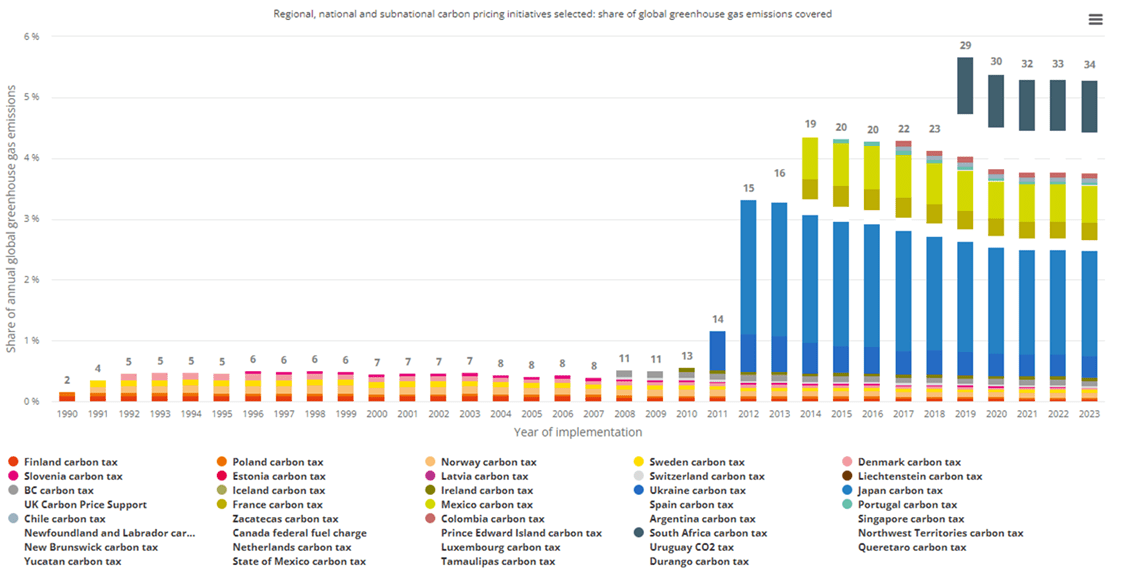 Figure 8.1: Share of GHG emissions covered, as of March 2023 (World Bank 2023c)
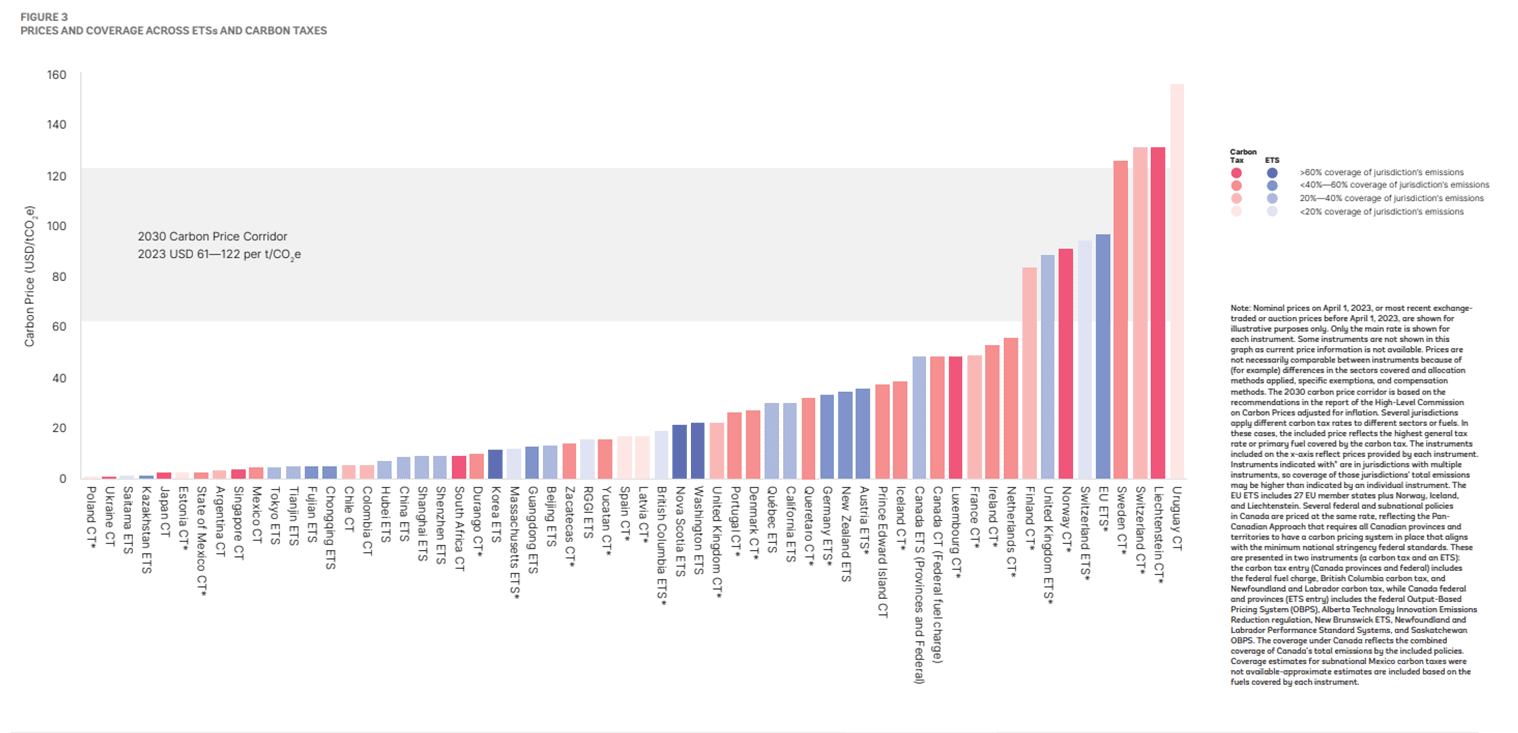
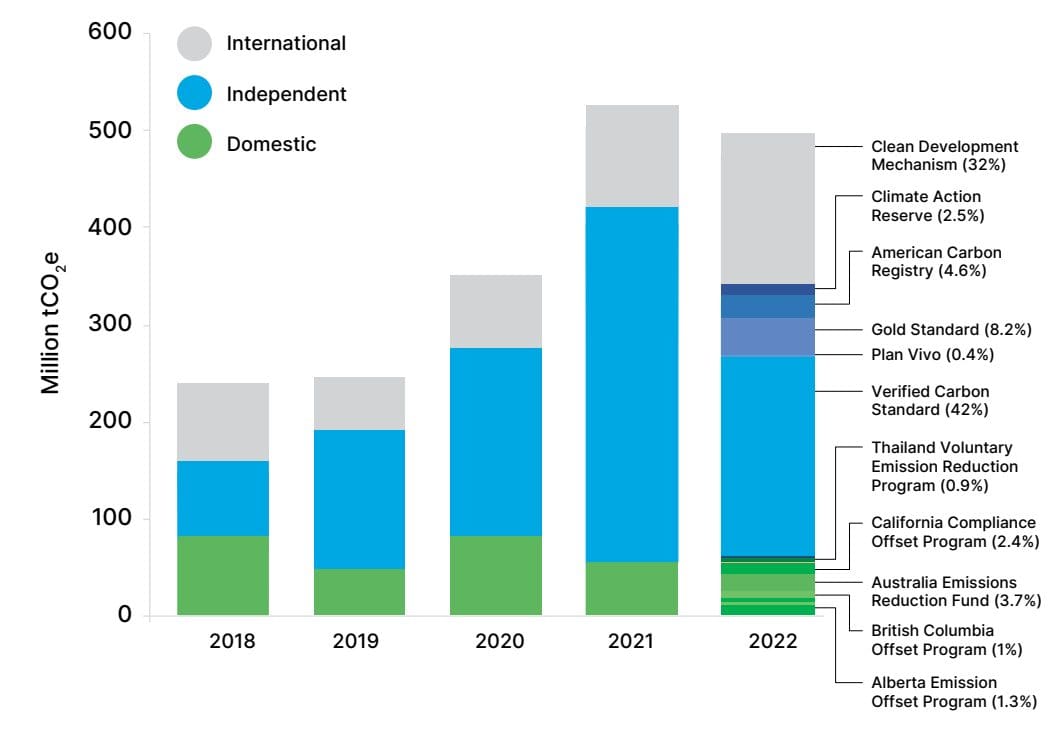 Figure 8.3: An overview of global carbon credit issuance (World Bank 2023c)
|
Instrument |
Quantified GHG emission reductions |
Notes |
|---|---|---|
|
“Carbon taxes in European nations” |
Reduction in GHG emissions “by up to 6.5% over several years”. |
Evidence taken from a 2018 review, drawing on data up to the end of 2015 from 35 carbon taxes (cited in Green 2021). The instruments and period are not specified further. |
|
Carbon tax in British Columbia |
Reductions over 2008 – 2014 (with some variation in dates among studies) range between 5% and 15% below a counterfactual reference level, or around 2% per year. Note it is not clear in the source if this figure relates to total emissions in the jurisdiction or in affected sectors; it is assumed to be the latter. A 2015 study noted it reduced CO2 emissions from gasoline consumption by more than 2.4 million tonnes in the first four years of operation. And a 2020 study over the period 1990-2014 noted the tax had reduced transport sector emissions by 5%. |
Evidence based on a meta-review of various (number not given) of studies on the BC tax. Note this estimate does not include a quantitative estimate of carbon leakage associated with the tax to other jurisdictions. The net reduction is therefore highly likely to be less (cited in Green, 2021). |
|
UK carbon price support (UKCPS) |
A 2019 study concludes the UKCPS reduced emissions in the power sector between 41% and 49% over 4 years (2013–17). Another that it reduced emissions “overall” by 6.2% (2013-2016(2.1% per year)), based on a price of €18 per ton. |
All three studies are cited in Green, 2021. It is not always clear if these studies referred to reductions within the sectors affected by the instrument or overall aggregate reduction. Again, it is assumed to be the former. As above, the treatment of carbon leakage is not specified, hence the emission reduction estimates may be overstated. |
|
UK Climate Change Levy (CCL) |
A third study noted the CCL reduced emissions amongst power plants paying the full levy rate by “between 8.4% and 22.6% compared to plants paying the reduced rate”. The study refers to between 2000 and 2004. | |
|
Sweden Carbon Tax |
Overall, the findings differ. A 2019 study estimated emission reductions of 6.3% in an average year, between 1990 and 2005. Other studies identify emission reductions only in certain sectors (district heating emissions, in a 1998 study and emissions from petrol in a 2018 study). |
The review notes “Nordic taxes tend to do better on emission reductions, although the wide variation in fundings make it hard to conclude this definitively”. The source is not clear on the precise period in question for each statistic, but the overall period assessed was 1960-2010. Other studies suggest the tax had “little or no effect on emissions”. This is an important finding, given the relatively high carbon price in Sweden as well as the length it has been in operation. Note: No estimates have been identified for Liechtenstein and Switzerland, the other jurisdictions with the highest carbon prices. |
|
Finland, Netherlands, Norway, Sweden. |
A 2011 study identified no effect on per capita growth rate of emissions between 1990 and 2008 in any jurisdiction, except Finland (which saw a reduction of 1.7%). |
The study applied a “difference in difference” analysis (a type of economic modelling approach). The time period this refers to is not clear. |
|
Sweden, Norway, Denmark, and Finland. |
A 2019 study identifies annual reductions in Sweden of 17.2% and 19.4% in Norway, but “no statistically significant effects in Denmark or Finland, over the period 1990-2004. |
Based on a synthetic control study (a statistical approach which compares effects based on case studies). Results considered “an outlier” in the Green 2021 review. |
|
Norway |
A 1997 study identifies a reduction of between 3% to 4% between 1991 and 1993 (1-1.3% per year). |
Based on a hypothetical counterfactual scenario. |
|
Denmark, Ireland, Finland, Sweden and Slovenia |
An increase in price of €1 per ton in CO2 tax results in an annual 11.58 kg per capita decrease in emissions. |
Based on panel data. |
|
France |
Carbon tax reduced emissions in manufacturing sectors by between 1% and 5% between 2014 and 2018. |
A 2019 study, using a counterfactual based on historical data. |
|
“Tipping points” |
A 2018 study, based on analysis between 1995 and 2013 suggests that CO2 taxes reduce emission if they surpass 2.2% of GDP. |
Based on economic modelling based on panel data. |
|
Germany, Denmark, Netherlands, UK, Slovenia, Finland and Sweden. |
Average reduction of 3.1% compared to a historical baseline (for 6 of the 7 countries). |
Based on historical data for the baseline and a counterfactual using country specific data. The “7th country” is not specified. |
|
Instrument |
Annual revenue (million) |
Per capita revenue |
Share of GDP |
Earmarking/hypothecation |
|---|---|---|---|---|
|
Sweden carbon dioxide tax |
$3,680 |
$381 |
0.67% |
General funds (50%) and revenue recycling (50%) |
|
Norway carbon dioxide tax |
$1,580 |
$307 |
0.31% |
Green spending (30%); general funding (40%) revenue recycling (30%) |
|
British Columbia carbon tax shift |
$1,100 |
$239 |
0.49% |
Revenue recycling (102%) |
|
Denmark carbon tax act (2010) |
$1,000 |
$177 |
0.29% |
Green spending (8%); general funding (47%) revenue recycling (45%) |
|
Switzerland carbon dioxide levy |
$875 |
$107 |
0.13% |
Green spending (33%); revenue recycling (67%) |
|
Mexico special tax on production and services (2014) |
$870 |
$7 |
0.06% |
General funding (100%) |
|
Finland carbon dioxide tax |
$800 |
$146 |
0.29% |
General funding (50%); revenue recycling (50%) |
|
Ireland [1} |
$510 |
$111 |
0.03% |
Green spending (13%); general funds (88%) |
|
Japan tax for climate mitigation (2012) |
$490 |
$4 |
0.01% |
Green spending (100%) |
|
France [2] |
$452 |
$7 |
0.02% |
Green spending (100%) |
|
Iceland [3] |
$30 |
$92 |
0.22% |
General funds (100%) |
Notes:
- natural gas carbon tax, mineral oil tax and solid fuel carbon tax, data from 2012
- domestic consumption tax on energy products (carbon dioxide), data for 2014 and reflects a partial year
- Carbon tax on carbon of fossil fuel origin
|
Instrument |
Annual revenue (EUR Million) |
Earmarking/ hypothecation commitment |
Notes on revenue use |
|---|---|---|---|
|
Canada (Alberta and BC) |
1,520 |
Legally binding |
Overall spending measures exceed revenues, via tax cuts, rebates and direct compensation. Revenues are distributed to households – targeted to low-income households – as well as business (including small businesses). Since 2018 a “clean growth incentive programme has been supported which focuses on research on fugitive emissions in the oil and gas sector and on slash burning. |
|
Chile |
233 (2018) |
None |
Unconstrained (used for general funds). Tax introduced in 2014 as part of a broader reform, to help fund educational reform policy. |
|
Denmark |
480 |
Political commitment |
No data. |
|
Finland |
1,402 |
All revenues distributed as tax cuts or rebates. | |
|
France |
3,800 |
79% legally binding, remainder unconstrained |
The legally hypothecated 79% is distributed via tax cuts and rebates. Up to 2016 this funded a tax credit for business. Since 2017 revenues are allocated to a dedicated “energy transition account” which compensates affected industries of a proportion of the costs associated with use of renewable energy sources. |
|
Iceland |
26 |
None |
Revenues are unconstrained. |
|
Ireland |
434 |
12% legally binding, reminder via political commitment |
The majority of revenues are distributed via tax cuts and rebates, including reductions in payroll taxes. A small proportion is allocated to energy efficiency measures, particularly household retrofits to help households at risk of fuel poverty and to provide support for rural public transport. |
|
Japan |
No data |
100% legally binding. |
Revenue data is not publicly available but used for energy efficiency and renewable energy support programmes. |
|
Norway |
1,246 |
44% legally binding, reminder via political commitment |
Revenues are distributed via tax cuts and rebates. A proportion of the revenue flows to the Government Pension fund, the returns from which (expected to equate to the real rate of return (3%)) are then allocated to general government funds. |
|
Portugal |
134 |
11% legally binding |
Reallocated to tax cuts and rebates particularly income tax reductions for households with larger families. A proportion of the revenue are allocated to green and environmental spending, including infrastructure for electric vehicles, public transport, conversation and climate change mitigation policy. |
|
Slovenia |
132 |
All revenues are unconstrained |
From 2005 to 2008 some revenues were used to finance carbon reduction projects and environmental subsidies for industries. |
|
Sweden |
2,549 |
Introduced in the early 1990s as part of a broader fiscal reform package. The revenues were used to finance labour tax reductions as well as fund Sweden’s 1996 application to the EU. Revenues from 2016 flow directly to central government budget. | |
|
Switzerland |
985 |
100% of revenues legally binding |
One third of revenues fund energy efficiency in buildings, including geothermal heating as well as a technology fund. The remainder fund social security contributions for businesses as well as subsidies on health care premiums. |
Appendix D. Case studies
For all case studies, RAG rating for similarities to Scotland denoted red [R], amber [A] and green [G].
Case study 1
Lever type: Direct Carbon TaxJurisdiction: British Columbia, Canada
|
Population and GDP |
[G] |
Like Scotland, Canada is a high-income country, it comprises ten provinces and three territories. The British Columbia (BC) economy is similar in size to Scotland’s. For comparison, BC’s GDP was $265.8 billion (around £154 billion)[13] in 2020; Scotland’s was £148 billion. GDP per Capita in BC is $59,962 (Government of Canada, 2023a); in Scotland it was $42,632 in 2021 (Scottish Government, 2023a)[14] BC’s population is also comparable; BC’s population was 5 million in 2021 (Government of Canada, 2023b), compared to 5.4 million in Scotland in 2022 (Scottish Government, 2023c). | |
|
Administrative and legal arrangement/ competencies |
[G] |
The carbon tax in BC was designed, applied, enforced, and administered at province level. This makes it of particular interest to Scotland, given devolution. Since its implementation however, it was frozen and then re-introduced when the Federal carbon tax was implemented at national scale by the Canadian Government. This tax is administered by the Canadian Ministry of Finance. The Ministry of Environment and Climate Change is responsible for the inventory and allocating funding. | |
|
Shared challenges |
[A] |
Canada relies heavily on fossil fuel consumption for both domestic use and net exports of carbon-intensive manufactured goods and fossil fuels. It is also among some of the most intensive emitters of CO2 in the OECD, with per capita emissions for 2010 being recording at 15.5 tonnes per capita of CO₂. This compares to 9.6 tonnes per capita of CO₂ the OECD average and 7.6 tonnes per capita in the UK in the same year (OECD, 2023).[15] BC sources a very high proportion (93% of its electricity in 2008) from renewable energy, specifically hydropower (Harrison, 2013). | |
|
Climate ambition |
[A] |
Canada is committed to achieving Net Zero by 2050. Scotland has committed to reducing emissions by 75% by 2030 and achieving Net Zero by 2045. | |
|
Data and evidence |
[G] |
There is significant information available. | |
|
Diversity of approaches |
[G] |
The approach taken in BC is a direct carbon tax that is administered at sub-national level. It is the only sub-national direct carbon tax selected as a case study. | |
|
Lever design | |||
|
The BC Government introduced the first carbon tax in North America in 2008 (Pretis, 2022). It was introduced at a time when other North American governments were embracing cap and trade over taxation (Harrison, 2013). It is a direct carbon tax applied to fuels based on their CO₂ content, covering all liquid transportation fuels such as gasoline and diesel, as well as natural gas or coal used to power electric plants. The tax is applicable to 70-75% of the province’s GHG emissions, with the remainder of GHG emissions coming from non-combustion CO2 in industrial processes, methane emissions, from natural gas extraction and transmission, nitrous oxide emissions from agriculture and CO₂ emissions from forestry (Murray and Rivers, 2015, p.676). The rate of the tax at implementation was $10 CAD per tonne emitted. Initially, this was set to rise by $5 CAD per year until it reached $30 CAD per tonne in 2012. The tax increase was frozen however in 2012 by the British Columbia Government. In 2018, a change in government and the implementation of a federal carbon tax in Canada resulted in the BC carbon tax being unfrozen and the price increased. However, the legislation surrounding the tax was altered to no longer require revenue neutrality. We understand, following a stakeholder interview, that the British Columbian Government have mirrored the rates set by the federal government at national scale by following the federal government’s schedule for carbon tax increases[16]. The British Columbian government initially committed to the tax being revenue neutral. It operated as a tax shift wherein carbon tax revenues were countered by cuts in other taxes (such as business taxes, personal income tax, low-income tax credits and direct grants to rural households) or direct transfers to households. Between the tax’s implementation in 2008 and 2015, the tax generated C$6.1 billion (Murray and Rivers, 2015). Since 2018, the revenue generated is now allocated centrally by the federal government. The revenues are then redistributed through dedicated tax rebates for low-income households or for public purposes, including climate action.[17] The administration of the tax is via the Ministry of Finance. The Ministry of Environment and Climate Change is responsible for the inventory and fund allocation.[18] When introduced, the tax did not include exemptions for particular sectors, it was applied universally. Concerns were raised, however, by greenhouse plant/vegetable growers (Seed your future, 2023)[19] regarding the competitiveness of their operations in comparison with California and Mexico. This led the Government in BC to introduce a one-time exemption (worth $7.6 million) from the Carbon tax in 2012, an ongoing 80% exemption from the carbon tax for greenhouse growers from 2013, and an exemption for gasoline and diesel used in agriculture from 2014. | |||
|
Lever effectiveness | |||
|
Public perception of the carbon tax in BC, almost 15 years on from its implementation, is seen as generally positive. The tax is considered a success in terms of its role in promoting behavioural change and decreasing consumer demand for fossil fuels and natural gas (Pretis, 2022). The Pretis paper outlines a series of studies, including Xiang and Lawley (2018) and Antweiler and Gulati (2016) that drew correlations between the implementation of the tax and a decrease in fuel demand. Furthermore, evidence shows that the tax has had a low per capita cost, aiding further public acceptance. Bernard and Kichian (2019) assess the extent to which the tax reduces British Columbia’s CO2 emissions. They state that once reaching the rate of $30/ton of CO2, it achieved an estimated 1.13-million-ton reduction in CO2 emissions, amounting to an average annual reduction of 1.3% relative to BC 2008 diesel emissions and to 0.2% relative to all BC CO2 emissions in 2008. Bernard and Kichian (2019) argue however, that whilst the tax can be considered politically successful, the reductions seen are not significant enough for it to be considered a viable strategy, in isolation, for the Canadian government to meet its carbon-related commitments. Pretis (2022) conducted a study on the effectiveness of the tax at reducing aggregate CO₂ emissions in order to determine economy-wide CO2 emission reductions. It was concluded that there is a lack of statistically significant proof of economy-wide effectiveness. The carbon tax was considered too low to result in rapid cross-sectoral changes. Pretis (2022) did outline that the tax has had significant impact on emissions from transport as BC relies heavily on individual motor vehicles due to the long driving distances and limited public transport. It also showed little impact on emissions from electricity production. This is explained by the high reliance on hydropower for electricity generation. The revenue-neutral commitment made by the government upon implementation of the carbon tax has been criticised by some analysts for not fully compensating low-income households for the additional burden due to higher energy prices (Beck et al., 2014). Beck et al. (2014) argues however, that criticisms such as that are unfounded, stating that the government have made every effort to ensure that the policy is equitable. It is important to note however, that this study was published before the revenue-neutrality element of the tax was changed, no later assessments of the equitability of the tax were found. | |||
|
Key lessons learned | |||
|
Pretis (2022) argues that the BC carbon tax is a good example for the introduction of carbon taxes in comparable jurisdictions. It confirms that carbon tax policies with high public support and acceptance are possible. It is also a positive example for how a carbon tax, with targeted sectoral exemptions, can reduce aggregate emissions. Pretis (2022) notes however, that the predominant role that hydropower plays in BC electricity generation potentially limits its applicability where reliance on fossil fuels is higher. Moreover, Harrison (2013) argued that the introduction of a carbon tax in BC resulted from a “perfect storm” of factors that enabled its implementation. These factors included the prominence of the hydropower, an increase in public concern for climate change, a government with the trust of the business community and a political leader (at province level) with the ability and determination to implement his ambitions. It is important to consider therefore, that whilst it worked in the context of BC, other nations considering the implementation of a carbon tax with a similar ethos, will still need a combination of factors related to political, economic and social context which ultimately determine its success. But several elements of the BC context are applicable to Scotland. First, there are lessons to be learnt from the progression of the tax, transitioning from sub-national instrument to later alignment with federal standards. It is an example of how sub-national taxation can be successful at reducing GHG emissions at sectoral level. It also shows that subnational carbon taxation can generate significant revenue for Governments to spend as they deem fit. As in Scotland there is high reliance on private vehicle use in BC, given low population density, extent of rural areas and low reliability of public transport connections in rural areas. Bernard and Kichian (2019) also noted that whilst the carbon tax in BC is generally publicly accepted, it has not been shown to have influenced significant reductions in overall emissions of CO2. They conclude therefore that it should not be considered a viable sole strategy for the Canadian government to meet its carbon-related commitments. | |||
Case study 2
Lever type: Direct Carbon TaxJurisdiction: Sweden
|
Context | ||
|
Population and GDP |
[A] |
Like Scotland, Sweden is a high-income country. Sweden has a larger economy and double the population. For example, GDP per Capita in Sweden was $65,157 in 2021 and in Scotland was $42,362 (Scottish Government, 2023a).[20] Sweden’s GDP was $683 billion in 2021 compared to Scotland’s £148 billion. Sweden has a population of 10.5 million (2022), approximately double that of Scotland (5.4 million in the same year (Scottish Government, 2023c)). |
|
Administrative and legal arrangement/ competencies |
[A] |
Sweden provides an example of a nationally administered carbon tax. The carbon tax is levied on transport fuels and is designed to work alongside Sweden’s energy tax and the EU ETS. Sweden’s energy tax is levied on diesel, coal, oil, and electricity used for heating purposes. This could give valuable lessons for Scotland in terms of designing a similar carbon tax to function alongside the UK ETS and the UK climate change levy. |
|
Shared challenges |
[G] |
Both Sweden and Scotland are increasing their renewable energy potential, in 2021 around 60% of Sweden’s energy production came from renewable sources compared to Scotland at around 57% (Swedish Institute, 2022) (BBC, 2021). In addition, both Sweden and Scotland have rural and rural-island communities which create a unique set of challenges and opportunities in delivering equitable national climate action. |
|
Climate ambition |
[G] |
Sweden is legally bound to achieving Net Zero by 2045. They are on track with this target and have managed to meet one of their renewable energy targets already. Scotland has similarly committed to achieving Net Zero by 2045 and reducing emissions by 75% by 2030. |
|
Data and evidence |
[G] |
There is significant information available for this case study as the carbon tax was implemented in the early 1990s, however there are contesting views on the effectiveness of the tax in reducing greenhouse gas. |
|
Diversity of approaches |
[G] |
This is an example of a direct carbon tax, administered at national level. The tax is one of the oldest and currently the highest priced carbon tax in the world. |
|
Lever Design | ||
|
Due to growing environmental concerns and building on Sweden’s history of levying taxes on energy products, the government introduced their first carbon tax in 1991 (Andersson, 2019). The carbon tax was levied on gas oil, heavy fuel oil, coal, natural gas, petrol, gas oil, heavy fuel oil, coal and natural gas (Johansson, 2000). To ensure Sweden’s existing energy tax – levied on diesel, coal, oil, and electricity for heating purposes – would work alongside the newly introduced carbon tax, fuels used for power generation were exempt from the carbon tax (Johansson, 2000). As such the fuels targeted by the carbon tax were mainly used within the transport sector, which in the early 1990s was Sweden’s largest emitting sector. In 1991, the carbon tax was introduced at a price of US$30 per tonne of CO₂ however tax rates were lowered by 50% for the agricultural and industrial sector to avoid carbon leakage and ensure international competitiveness. Furthermore, full exemptions were made for fuels used within electricity production as these were covered by Sweden’s energy tax (Jonsson, Ydstedt, & Asen, 2022). The Carbon tax introduction in 1991, was part of a wider tax reform by the Swedish Government, referred to as the “green tax switch”. Here, environmental taxes were increased while taxes such as marginal income tax, corporate tax and the capital income tax were lowered. The revenue generated by the carbon tax was 26 billion SEK in 2004 (Government Offices of Sweden, 2021). More recently, the carbon tax covers the direct (Scope 1) CO₂ emissions from all fossil fuels except peat, with 90% of the tax revenue coming from gasoline and motor diesel alone (Andersson, 2019) (World Bank, 2023b). As there are still numerous fuel exemptions from the tax, for example those used for commercial aviation and maritime, only around 40% of Sweden’s greenhouse gas emissions are covered by the tax. Some of the exempted industries are covered by the EU ETS (European Union Emission Trading Scheme) however levies within this scheme currently price carbon lower than the carbon tax (Jonsson, Ydstedt, & Asen, 2022). Note limited data was identified regarding the administration and enforcement of the tax. | ||
|
Lever effectiveness | ||
|
Public perception of the tax is generally positive, and Sweden is acknowledged as a pioneer in environmental governance at an at an international level (Hildingsson and Knaggård, 2022). The tax is considered to be a success as Sweden has been able to reduce its greenhouse gas emissions while maintaining a growing GDP (Government Offices of Sweden, 2021). Published research has attempted to quantify the effectiveness of the tax in reducing greenhouse gas emissions. Research by Sumner, Bird & Smith (2009) evaluates the carbon tax by comparing its implementation period to national greenhouse gas reduction trends. The results state that emissions were reduced by approximately 15% from 1990 to 1996, by 9% from 1990 to 2006 and decreased by 40% from the mid-1970s to 2008. There is some methodological disagreement on what reduction can be attributed to the carbon tax, in isolation. A review of ex-post analyses of carbon taxes by Green (2021) reveals contesting results around Sweden’s emission reductions. For example, research by Andersson (2019) found an average emission reduction of 6.3% per year between 1990 and 2005, Fernando (2019) found an annual average reduction of 17.2% and research by Shmelev and Speck (2018) found no effect on emissions. A study conducted by Jonsson, Ydstedt, & Asen (2022) state that GHG emissions have declined by 27% between 1990 and 2018. In terms of revenue generated by the tax, by 1994 the carbon tax generated 7 billion SEK. From 1994 revenue rapidly increased to 26 billion SEK in 2004 (Government Offices of Sweden, 2021). During this time the carbon tax rate increased from 23 EUR/tonne CO₂ to 84 EUR/tonne CO₂. Fluctuations in revenue generated by the tax have been caused by an increasing tax rate and decreasing tax base (greenhouse gas emissions overall are declining). From 2004, the revenue generated stabilised until 2010 and since then it has gradually declined over the last decade (Jonsson, Ydstedt, & Asen, 2022). In 2019, SEK 22.2 billion was generated which is approximately 1% of Sweden’s total tax revenue. The carbon tax revenue goes into the overall government budget, and is not hypothecated, thus it is unclear where revenue generated is distributed (Jonsson, Ydstedt, & Asen, 2022). The carbon tax has shown to be effective in shifting market investment into low-carbon technology, specifically in renewable energy sources such as hydro and wind (Hildingsson and Knaggård, 2022). In 2019, 59% of Sweden’s energy mix was generated by renewable energy sources (Hildingsson and Knaggård, 2022). Levying the carbon tax at different rates on fuels has also resulted in behaviour changes in companies. Between 1993 and 1997, the higher tax rate on fuels used within domestic heating systems compared to fuels used within industry resulted in industries selling their byproducts to domestic heating companies, while continuing to burn fossil fuels themselves (Johansson, 2000). Our understanding, following a stakeholder interview, is that the carbon tax increased the price of gasoline and diesel for consumers at the fuel pump and in response there was a substitution away from gasoline toward diesel. This interviewee referred to data showing road sector fuel consumption of gasoline decreasing while diesel consumption increased after the carbon tax was implemented. | ||
|
Key lessons learned | ||
|
Sweden’s experience with the world’s longest standing carbon tax makes it a valuable case study for Scotland. Sweden’s carbon tax is described as a ‘resilient success’ by the policy assessment called the “PPPE framework” (programmatic, process, political and endurance) and the tax has formed the backbone of environmental policy in Sweden to date (Hildingsson and Knaggård, 2022). The tax has been continuously redesigned over the past 30 years by the Swedish Government to reflect Sweden’s political, social, and economic situation. For example, the tax rate has incrementally increased over the last 30 years and the tax rate has been lowered by 50% on fossil fuels used by industry. These measures have ensured Sweden’s international competitiveness in energy exports have not been negatively impacted by the tax (Hildingsson and Knaggård, 2022). Sweden’s carbon tax was introduced at a time in which the country was undergoing a wider fiscal reform referred to as the ‘green tax shift’ where energy and CO2 taxes were introduced while labour taxes were reduced. Research by Shmelev and Speck (2018) suggests that in isolation the carbon tax would have been insufficient at reducing emissions and emission reductions were only achieved by a collective effort of the carbon tax, energy tax and investment into low carbon technology such as nuclear and hydro power. As evidence suggests, a carbon tax alone may not be effective enough in reducing Scotland’s emissions. Research by Carattini, Carvalho and Fankhauser (2018) reveals that the public’s support in increasing the Swedish carbon tax was strengthened by findings which demonstrated the effectiveness of the tax in reducing national emissions. Therefore, Scotland would need to consider the benefits of public awareness and information sources in incentivising support around any potential future carbon tax, should it be considered. Tax revenue recycling can be implemented to reduce potential distributional effects of carbon taxes. Thus, Scotland could explore revenue recycling options if it were to consider implementing a carbon tax to reduce any distributional effects such as income inequality. | ||
Case study 3
Lever type: National ETS (nETS)Jurisdiction: Austria
|
Context | ||
|
Population and GDP |
[A] |
Austria is a high-income country, however, there are differences in GDP. Austria’s was 537 billion USD in 2021, whereas Scotland was 181 billion in 2021). In per capita terms, this equates to $59,991 per capita for Austria in 2021 in comparison to Scotland’s $42,361 in the same year.[21].Austria also has almost double the population of Scotland – 9 million vs 5.4 million in 2022 (OECD, 2023a; OECD 2023b; Scottish Government, 2023a). |
|
Administrative and legal arrangement/ competencies |
[G] |
The Austrian nETS is administered at national level. However, it has been specifically designed to fit around and complement the EU ETS, a supranational cap and trade system. This could give valuable lessons for Scotland in terms of designing a similar scheme around the UK ETS. |
|
Shared challenges |
[A] |
Both Austria and Scotland are rapidly growing their renewable energy potential, although their situations are not necessarily comparable – Scotland had a target of 100% renewable electricity generation by 2020, however, the equivalent of 85% of gross energy consumption was from renewable sources in 2021. (Scottish Government, 2023b). Austria aims to reach 100% renewable electricity generation by 2030, and in 2021 Austria’s electricity mix was 71% renewable energy (Eurostat, 2023). Austria’s renewable energy is largely supplied by hydropower as a result of the many rivers and high rainfall, whereas Scotland’s is largely driven by onshore and offshore wind (Scottish Renewables, 2023). Austria has no island communities but does contain large rural population which could provide useful insights and comparators, in particular for the transport sector covered by the nETS. |
|
Climate ambition |
[G] |
The Austrian government has pledged to achieve Net Zero by 2040, however this has not been enshrined into national legislation and the IEA state that achieving this would require Austria to substantially enhance decarbonisation efforts across all energy sectors (IEA, 2023). Despite this, they have demonstrated climate ambition by implementing a novel fiscal lever to reduce GHG emissions in non-EU ETS sectors. Although Germany also has a nETS in place, neither have been in place long enough to generate significant evidence on effectiveness. |
|
Data and evidence |
[G] |
A lot of information is available on the lever design; however, the scheme is still in its initial implementation phase. An overall cap on emissions and trading of allowances, which will create a “market” price, will be initiated in 2026. Therefore, no ex-post evidence is available on effectiveness of the lever in practice as it has not yet reached the final stage of implementation. |
|
Diversity of approaches |
[G] |
This is the only national level ETS considered as a case study. Germany also operates a similar national level ETS but these are novel approaches. |
|
Lever design | ||
Austria launched its nETS as part of the Ecological Tax Reform Act on 1 October 2022 (Parliament Österreich, 2022). The reforms included many other pricing instruments, so was implemented as part of a wider policy package. The scheme was initially intended to be in place from 1 July 2022, but was postponed as part of an energy relief package intended to relieve cost of living pressures from increased energy prices resulting from the war in Ukraine. The nETS was designed to complement and exist alongside the EU ETS. It covers CO2 emissions from fossil fuels including transport fuels (petrol and diesel), fuel and heating oil, natural gas/liquified gas, coal and kerosene used in sectors which are not regulated under the EU ETS. The sectors in scope are small, non-EU ETS industry, transport, buildings, waste and agriculture. No data has been identified which set out the differences between the EU ETS and nETS in terms of GHG coverage. Designing the nETS to fit around the EU ETS, namely ensuring that EU ETS installations are not exposed to double counting, was one of the biggest challenges the Austrian government experienced when implementing this lever.[22] The ETS has a fixed price, which is designed to steadily increase from 2022-2025, before transitioning to a market price after that, which will operate as a standard cap and trade scheme. The scheme was designed to increase as a fixed price in this way to ensure there is security for market participants to plan ahead. The pricing scheme is as follows, for allowance which covers one tonne of CO₂e:
For comparison, the price under the EU ETS in September 2023 was ~85 EUR per tonne. Therefore, the price under the nETS is much lower than under the EU ETS, however, at the end of the transitional phase it will be closer. However, by nature of the market phase it is uncertain what the price will be after the fixed allowance prices cease. Phased implementation In the early phase of the scheme (2022-2023), there is a fixed price and a simplified procedure for registration and reporting – registered entities (the company/person liable for paying the tax) are not required to conduct monitoring and reporting at this stage, and the National Emissions Trading Information System is being established. Emission allowances do not need to be formally purchased or surrenders, so the scheme is more like a tax, although companies are preparing for full implementation. In the transitional phase (2024-2025), allowances will start being issued and surrendered and obligatory monitoring and reporting will be phased in. This will include independent verification of emission allowances. In 2026, an overall cap on emissions will be in place and allowances will shift to a market price. The scheme will eventually align with the EU ETS 2, which from 2027 will eventually price emissions in the same sectors at European level. Compliance, MRV and Enforcement (ICAP, 2023) The Austrian Federal Ministry for Finance (BMF) and its excess duty administration is responsible for the implementation of the scheme in Austria, which has eased administration burdens for implementing the scheme due to similarities with existing excise duties, although the process of surrendering allowances is new and has been a learning process (other departments handle this for EU ETS).[23] The compliance period runs per calendar year, and registered entities must submit an emissions report at the end of June for the previous year’s emissions, and then have until the end of July in the following year to surrender allowances to cover the reported emissions. Emissions reporting must be independently verified and be based on a pre-approved monitoring plan. Exemptions are in place for installations subject to the EU ETS to avoid double burdens, negligible cases (emitting less than one tonne CO₂e) or exemptions under energy taxes. Entities must pay an increased certificate price (at two times the fixed emissions price) for each tonne of CO₂e for which no allowance has been surrendered. Once the market phase has been reached, entities must pay an increased certificate price of EUR 125 per tonne CO2e. Fines can be issued for other instances of non-compliance, apart from those exempted outlined above. The Austrian Federal Ministry for Finance (BMF) is the authority responsible for establishing the regulatory framework of the nETS, and the Office for National Emissions Allowance Trading at the Austria Customs Office is the implementing authority, responsible for receiving emissions reports. Revenue The nETS was implemented as part of a wider policy package. Although revenue for the emissions allowances goes directly into the main budget and there is no hypothecation, ‘climate bonus’ payments are given directly back to households. This is paid as a set price per person, which means that relatively poorer households (who typically live a less carbon intensive lifestyle, hence pay less of the costs) gain relatively more back than richer households. Currently, in the fixed price phase, more money is given back to households and companies in ‘climate bonus’ payments than is received by the Austrian government in revenue. Revenue in 2022 was approximately €800 million and the government have provided rebates of around €1 billion.[24] | ||
|
Lever effectiveness | ||
|
There are no ex-post studies or evaluations available as the lever has not yet reached its full implementation stage. Emissions data for 2022 (although implementation only started in October 2022) will be available in due course. However, 2022 was an unusual year as energy prices were very high, affecting behaviour. The CO2 price was still relatively low in 2022 – a carbon price of €30 leads to no more than €0.08 per litre of diesel or gasoline). Therefore, the Austrian government do not think that this will be representative of a typical year. Ex ante modelling studies conducted by the Austrian government showed that the scheme was expected to reduce CO2 emissions from the sectors affected of around 800,000 tonnes by 2025.[25] During the fixed price scheme the price signal is not expected to result in a clear and significant change in behaviour, however, other parts of the policy package are designed to specifically change behaviour (such as subsidies for changing heating systems in households). | ||
|
Key lessons learned | ||
|
The case of the nETS in Austria could yield important lessons for any potential similar system in Scotland. The Austrian scheme is specifically designed to be complementary to the existing EU ETS and covers emissions from non-EU ETS sectors. A similar scheme in Scotland could be designed to complement and exist alongside the UK ETS, which currently has the same coverage as the EU ETS. This would be crucial to ensure there is no double counting, and this was a key area highlighted by interviewees. The sectors covered by the Austrian nETS are small industry, transport, agriculture and buildings, which are not covered by the EU ETS. Many effects of the scheme are yet to be realised as the scheme is still under phased implementation. This phased implementation has been crucial to give businesses certainty about the future. However, from experience, the Austrian government suggest that a period of mandatory monitoring and reporting, without implementing a carbon charge, would be a useful place to start.[26] | ||
Case study 4
Lever type: Proposed tax on agricultural emissionsJurisdiction: New Zealand
|
Context | ||
|
Population and GDP |
[G] |
Like Scotland, New Zealand is a high-income country. New Zealand’s economy is larger than Scotland ($231.7 billion in 2020, compared to £148 billion and GDP per capita is slightly higher ($47,982 in NZ and $42,362 in Scotland in 2021 (Scottish Government, 2023a))[27]. New Zealand is of comparable size to Scotland in terms of population (NZ 5.1 million in 2022 (OECD, 2023b) compared to 5.4 million in Scotland (Scottish Government, 2023c)). |
|
Administrative and legal arrangement/ competencies |
[A] |
The proposed tax on agricultural emissions in New Zealand would apply at a national level. |
|
Shared challenges |
[G] |
The agricultural sector plays a key role in New Zealand’s economy, being a net exporter of farm commodities. In 2020, the crop and livestock exported was worth $25 billion (Ministry for Primary Industries, New Zealand Government, 2022). Similarly, approximately 80% of Scotland’s land mass is currently being under agricultural production (National Farmers Union Scotland, 2023). Like Scotland, New Zealand has a high potential for transitioning its energy sector towards renewable sources. This is due to the high potential of its wind, solar and hydro energy sectors (Anon, 2021). |
|
Climate ambition |
[A] |
New Zealand is committed to achieving Net Zero by 2050. Scotland has committed to more ambitious targets of achieving a 75% reduction in its CO₂ emissions by 2030 and Net Zero by 2045. |
|
Data and evidence |
[R] |
There is limited evidence available on the tax and its exact design is still uncertain as the original design was revoked and is yet to be applied. However, it is the first tax which explicitly focusses on agricultural emissions. Lessons may be learned in terms of design, political acceptance and implementation. |
|
Diversity of approaches |
[G] |
Despite the exact format of the tax remaining uncertain, it is a novel concept that could provide valuable insight for Scotland. |
|
Lever design | ||
|
A government announcement in December 2020 declared a climate emergency that “demands a sufficiently ambitious, urgent, and coordinated response across government to meet the scale and complexity of the challenge”. Following this, an emissions reduction plan for the Agricultural sector was announced in May 2022. The aim was to meet emissions reduction targets set in New Zealand’s Nationally Determined Contribution under the Paris Agreement, and the domestic emission reduction targets laid out in the Climate Change Response Act 2002 (CCRA). Targets were set at both national and at sectoral scale. Particular attention was paid to the agricultural sector given it accounts for half of New Zealand’s total greenhouse gas emissions (New Zealand Government, 2023). Almost 20 years ago, the New Zealand government announced a ‘fart tax’, which taxed GHG emissions deriving from livestock and agricultural sources. The announcement resulted in protest amongst the farming community. The Government then retracted the proposal, demonstrating the strong political influence the agricultural industry holds (Pannett, 2023). More recently, in 2022, the government founded a partnership with the Māori government and primary industry. The partnership was known as the He Waka Eke Noa – the Primary Sector Climate Action Partnership. It proposed a ‘farm-level levy’ that would require farms to calculate their emissions and pay for them. The emissions pricing was set to use a split-gas approach by applying unique levy rates to long-lived gases, i.e., carbon dioxide and nitrous oxide. Note this would be alongside an ETS also introduced in New Zealand. In response to the proposal for a farm-level levy, the Government launched a consultation to gain feedback from a series of stakeholders on options to price agricultural emissions (New Zealand Government, 2022b). The results of the consultation highlighted public concerns for the impact of the levy on the cost and availability of agricultural produce to consumers as farmers, growers and the wider agricultural sector adjust to internalising the new cost on emissions (Ministry for the Environment and Ministry for Primary Industries, 2022). A series of media outlets, including the Washington Post, have reported on tensions between the agricultural sector in New Zealand and the government. Farmers expressed concerns regarding both the profitability and competitiveness of their business, with some expecting to have to reduce their herd size (Pannett, 2023). The concerns of the agricultural sector have been attributed to the government altering their proposal. A new, temporarily less-stringent proposal was made that shifted the Government’s focus from farm-level taxation towards tightening monitoring and permitting requirements. Instead of outlining farm-level emission pricing, this shifted the focus – at least in the short term – toward a phased approach to mandatory monitoring and reporting requirements, to be implemented by 2025. The proposal delays the implementation of a farm-level levy therefore, until 2027. This new proposed legislation has been better received by the agricultural sector, although some have suggested the involvement of farming lobby groups in the development process (Corlett, 2022). The first stage of the revised proposal outlines a standardised approach to measuring and reporting of on-farm emissions which would eventually transition into the mandatory reporting of all farm-related emissions. The second area involved the recognition and reward of scientifically valid forms of on-farm sequestration (New Zealand Government, 2023). The policy would require that all producers in the agricultural sector collate emission reports by the end of 2022 and develop a farm plan to be implemented by 2025 (New Zealand Government, 2022a). These requirements seek to ensure farmers are aware of their own on-farm emissions and can provide the government with detail on their practices and technologies, providing it with further detail into how best to reduce emissions borne from agricultural sources and how emission levels vary between farms (New Zealand Government, 2023). It is proposed that the mandatory requirements for reporting and monitoring would apply to Inland Revenue registered farms. The proposal also outlines financial incentives for farmers to use technologies recommended by the Government that reduce sheep and cow burps. It also commits to reinvest the revenue generated from the tax into the sector (Craymer, 2022). | ||
|
Lever effectiveness | ||
|
The lever is yet to be implemented; therefore, assessments of effectiveness or behavioural impacts are not available. The tax is thought to offer potential to reduce New Zealand’s emissions due to the contribution of the agriculture sector to New Zealand’s total GHG emissions (Craymer, 2022). The agricultural sector accounts for nearly half of New Zealand’s total GHG emissions, the majority of which are emissions of methane. These emissions are not covered in New Zealand’s ETS (Craymer, 2022). | ||
|
Key lessons learned | ||
|
The New Zealand Government’s transition from a policy which placed direct pricing on emissions at farm-level towards one that implemented monitoring and reporting requirements demonstrates the importance of introducing change in a staggered, cooperative manner. Whilst the initial proposal from 2002 was widely contested, the involvement of farming groups in the development of the policy has enabled the Government to implement measures that are a step towards the pricing mechanism they have committed to in 2027 (Corlett, 2022). The New Zealand case has demonstrated the importance of stakeholder engagement in the successful implementation of contentious policies. One of our interviewees Professor Lorraine Whitmarsh who specialises in behavioural change and public policy acceptance, highlighted the importance of stakeholder engagement in policy development to gain public acceptance more generally. She noted the Scottish Government had made progress in implementing these methods in its policymaking process. | ||
Case study 5
Lever type: Indirect tax (Bonus Malus scheme)
Jurisdiction: France
|
Context | ||
|
Population and GDP |
[A] |
France is a high-income country. According to WorId Bank estimates, it is the world’s seventh largest economy by nominal GDP. If this is calculated per inhabitant, France is 19th. GDP per capita was 55,064 US dollars in 2022,[28] higher than Scotland (42,362 US dollars in 2021 (Scottish Government, 2023a))[29]. The 2022 population of France was 68 million, based on OECD data. This is much larger than Scotland (5.4 million (Scottish Government, 2023c)). |
|
Administrative and legal arrangement/ competencies |
[A] |
The scheme is administered at national level. |
|
Shared challenges |
[G] |
To achieve its 2050 carbon neutrality objective, France has committed to reducing the use of fossil fuels in energy production (almost two-thirds of the French heating and cooling systems are powered by fossil fuels) while increasing the use of renewable energy. In addition to accelerated phase-out of coal, the government will ban the sale of petrol and diesel vehicles from 2040 onwards. French diesel taxes are also increasing to further incentivise diesel drivers to switch to petrol, hybrid, or electric cars (Monschauer et al. 2018). Note, a carbon tax is also in place in France (not the focus of the current case study). The country’s carbon tax is among the highest in the world and was scheduled to increase steeply in the coming years. It covers the transport, industry and buildings sectors. |
|
Climate ambition |
[A] |
In 2019, France passed the Law on Energy and Climate to introduce the objective of carbon neutrality by 2050 as part of its commitment to the 2015 Paris Agreement. The National Low-Carbon Strategy was updated in 2020 to reflect this objective. |
|
Data and evidence |
[G] |
A significant amount of information is available for the case study. |
|
Diversity of approaches |
[A] |
An “indirect” taxation instrument, administered at national level. |
|
Lever design | ||
|
The Bonus Malus system is one of the main instruments of climate policy in the French transport sector. It was introduced on January 1, 2008, by the Finance Law as amended for 2007 and Decree No. 2007-1873. This system combines fees and rebates for the purchase of new vehicles: vehicles purchased or leased whose emissions exceed certain limits pay a fee, whilst vehicles that do not exceed these limits are entitled to a bonus or rebate. Revenues from emission-intensive vehicle fees are used to finance these bonus payments for low-emission vehicles to incentivise car purchasing decisions. Since its inception in 2008, the French government has adjusted the system several times. Since 2017, only electric and hybrid vehicles have been eligible for bonuses. Since 2018, the fee must be paid for vehicles with CO₂ emissions equal to or greater than 120 g/km. For that threshold, the fee started at €50, but the fee function increases considerably (EUR 1,050 for 140 g/km and EUR 4050 for 160 g/km). For vehicles with CO₂ emissions equal to or above 185 g/km, car buyers must pay EUR 10,500. In parallel, vehicles specially equipped to run on E85 super ethanol can benefit from a 40% reduction in carbon dioxide emission levels if their CO₂ emissions are less than 250 g/km. In addition to the existing tax (’malus’), a ’super malus’ targeting luxury cars was introduced in January 2018. Car buyers must pay EUR 500 per “fiscal horsepower” for powerful vehicles with more than 35 fiscal horsepower and the tax is capped at EUR 8,000[30]. On the ’bonus ’ side, since January 2018, the bonus of up to EUR 6,000 (27% of the acquisition cost) is only granted for electric vehicles emitting less than 20 gCO₂/km. Vehicles with emissions between 20 and 120 gCO₂/km are not affected by the Bonus Malus System, i.e. hybrid vehicles with emissions between 20 and 60 gCO₂/km are no longer eligible for a EUR 1,000 bonus payment. The bonus is granted directly to the buyer by means of an application form or is deducted from the price of the vehicle, when agreements are in place with dealers. At the same time, an additional bonus of EUR 1,000 (EUR 2,000 for non-taxable households) is granted when an old diesel or gasoline vehicle is scrapped and a used electric vehicle or a vehicle with a more efficient internal combustion engine is purchased (CEDEF, 2018). In the case of new electric and plug-in hybrid vehicles, the bonus is EUR 2,500. Two and three-wheeled vehicles, as well as electric quads, are eligible for a 20% or 27% subsidy of their acquisition cost (EUR 100 or EUR 900 maximum), depending on their power. In addition, non-taxable households can receive a subsidy of 20% of the cost when purchasing electrically assisted bicycles. | ||
|
Lever effectiveness | ||
|
In terms of GHG emissions effectiveness, the scheme has successfully contributed to reducing average passenger car emissions since its implementation. The scheme has been very effective in shifting vehicle sales towards more environmentally friendly vehicles, thereby removing old vehicles from French roads (according to plans, the scrappage bonus is likely to remove around 100,000 old vehicles) and lowering average emissions. Though progress has slowed in recent years, average emissions have reduced significantly from 149 gCO₂/km in 2010 to 111 gCO₂/km in 2017. The current European target for emissions levels of new cars sold is set at 95 gCO₂/km by 2024. For 2025 onwards, the EU feet-wide CO₂ emission targets are defined as a percentage reduction from a 2021 starting point.
By promoting electric vehicles, the Bonus Malus scheme also contributes to improve local air quality in urban areas. Although it seems clear that the scheme has proven to be effective in reducing GHG emissions in France and local air conditions, the impact of this measure on GHG emissions is difficult to isolate. The scheme may have a rebound effect, as the lower fuel expenditure for consumers due to more efficient vehicles may lead to an increase in vehicle use and thus in petrol/diesel consumed (and thus on emissions). Based on projections of average annual vehicle kilometres and the number of new registrations, the French Ministry of Ecology estimates that measures to improve the performance of new passenger vehicles, including for example a CO₂ label for passenger cars, could lead to GHG emission savings of 5.4 million tonnes CO₂e (MtCO₂e) in 2020, 8.0 MtCO₂e in 2025 and 9.8 MtCO₂e in 2030. Compared to emissions from private cars, which in 2015 were around 66 MtCO₂e, the impact of the scheme could be substantial considering that the Bonus Malus system is likely to be the dominant driver of reductions. However, these figures also imply that additional measures would be necessary to significantly reduce emissions from the transport sector in the future. In terms of revenues generated, since 2014 the Bonus Malus scheme has generated surplus revenue for the French general budget. For 2018, the malus was set at a level that cover the costs of the bonus payments (EUR 261 million) and the additional bonus for scrapped vehicles (EUR 127 million). Note all data in this section taken from Monschauer, Y & Kotin-Förster, S 2018. | ||
|
Key lessons learned | ||
|
An important lesson was that incentives for new registrations were initially underestimated, leading to an overall increase in car sales and high costs for the bonuses paid at the beginning of the scheme. For example, during the first three years of implementation, the French state lost EUR 300 million (on average) per year because car manufacturers took advantage of the large steps between bonus payment categories in previous years. The instrument has been continuously adapted to meet efficiency and effectiveness criteria. It is also difficult to forecast the evolution of supply and demand. However, the establishment of a modelling function as a basis for malus rates has made it easier to predict the market reaction as a function of vehicle purchase cost elasticity. Consumers do not always understand how the system works and how it relates to air quality measures for passenger cars. Combining the Bonus Malus system with air quality criteria also remains a challenge, as the system is designed to be technologically neutral and it does not explicitly differentiate between petrol and diesel vehicles. Although diesel cars benefit slightly more from the system due to their lower average GHG emissions, they cause more particulate emissions than petrol cars. One success factor is the support of the French car industry, which has welcomed the bonus payments and acknowledges that they are financed by the malus charges. | ||
Case study 6
Lever type: Indirect tax (Environmental impacts of farming)Jurisdiction: Wallonia, Belgium
|
Context | ||||||||||||||||||||||||||||||||||||||||||||||||||||||||||||||||||
|
Population and GDP |
[A] |
Wallonia is a high-income region. According to the National Bank of Belgium, in 2021, the region’s GDP per capita was EUR 31,568, somewhat lower than Scotland (42,362 US dollars (Scottish Government, 2023a).[31] The 2022 population of Wallonia was 3.6 million, based on Iweps (Institute Walloon of L’évaluation, De La Prospective Et De La Statistique) data. This is slightly lower than in Scotland (5.4 million in 2022 (Scottish Government, 2023c)). | ||||||||||||||||||||||||||||||||||||||||||||||||||||||||||||||||
|
Administrative and legal arrangement/ competencies |
[G] |
Administered at sub-national level | ||||||||||||||||||||||||||||||||||||||||||||||||||||||||||||||||
|
Shared challenges |
[G] |
Wallonia is committed to transitioning towards a low carbon and environmentally friendly economy. It is also committed to increasing the use of renewable energy. For example, the region has decided to use Sustainable Capital Markets as a means of financing green projects and has created a Sustainability Bond Framework. One aim of the Bond is to help the region achieve its objectives in energy efficiency and low carbon buildings, sustainable mobility, resources/land use, and affordable housing. For the period 2019-2024, Wallonia has established an investment plan (in French PWI – Plan Wallon d’Investissement), which involves an investment budget of more than €5 billion to channel investments in social and environmental assets in several pillar sectors. The region has also established low emission zones to limit the most polluting vehicles and improve air quality. However, Wallonia must respond to several energy-related challenges, such as the planned closure of nuclear power plants and an ageing and energy inefficient residential building stock (Coppens et al., 2022). About 80% of Scotland`s total land area is under agricultural production, it is useful to focus a case study on this sector. | ||||||||||||||||||||||||||||||||||||||||||||||||||||||||||||||||
|
Climate ambition |
[A] |
The Walloon Region has made an ambitious commitment to reduce its GHG emissions by up to 55% by 2030 and by 80% to 95% by 2050 (compared to 1990). Moreover, on 4 February 2021, Wallonia adopted its first strategy for the Circular Economy, which shows ambitions for 2025, such as: (i) 50% of relevant public procurement contracts will integrate circular economy principles or circular criteria; (ii) 75% of public information and communications technology (ICT) contracts will be circular and ethical; (iii) All public demolition/deconstruction contracts and subsidised contracts will include a materials inventory and selective deconstruction; and (iv) Reuse materials will be used in all public works contracts and progressively in works subsidised by the Walloon Region (European Commission, 2022). | ||||||||||||||||||||||||||||||||||||||||||||||||||||||||||||||||
|
Data and evidence |
[R] |
There is limited data beyond the number of people affected and the annual revenue. However, there is detailed information on the coefficients applied by type of animal and crop. | ||||||||||||||||||||||||||||||||||||||||||||||||||||||||||||||||
|
Diversity of approaches |
[G] |
Indirect tax, administered at sub-national level | ||||||||||||||||||||||||||||||||||||||||||||||||||||||||||||||||
|
Lever design | ||||||||||||||||||||||||||||||||||||||||||||||||||||||||||||||||||
|
In Wallonia, agriculture represents about 40% of the total surface water abstractions. The main pressures on water resources are non-point source pollutions by nutrients and pesticides. Key pollutants from the agricultural sector are nutrients and pesticides as well as sediments from erosion. With the decrees of 12 December 2014 and 23 June 2016, the regional Parliament adopted measures aimed at financing water policy by optimising mechanisms for recovering the costs of services linked to water use, including costs for the environment and water resources, in application of Directive 2000/60/EC of the European Parliament and of the Council of 23 October 2000 establishing a framework for Community action in the field of water policy. Thus, the tax on environmental impacts from farming, in force since 2015, is intended to address the environmental costs associated with the impact of agricultural activities on water resources, in particular livestock manure and the use of fertilizers and phytosanitary on crops. In particular, the tax is based on the environmental charge, a tax base that considers not only the retained livestock, the “livestock” environmental charge, but also cultivation activities, the “land” environmental charge. Through the spreading of nitrogenous fertilisers and the use of plant protection products, these activities have a significant impact on water resources. The tax on environmental charges generated by farms in the Walloon Region is one of the key incentives in Wallonia’s environmental policy. The aim of the tax is to meet the requirements of the Water Framework Directive 2000/60 of 23 October 2000, the ultimate objective of which is to achieve good ecological and chemical status of all Community waters. As such, it is not directly related with GHG although it is useful as it encourages farmers to use water more efficiently.
Principles: This system is based on the environmental load generated by the farm and it takes into account: (i) retained livestock or environmental loads generated by run-off from livestock manure storage infrastructures on the farm reaching groundwater or surface water, as well as pollution due to effluent storage infrastructures that do not allow storage for at least 6 months; and (ii) cultivation activities that generate, through the application of nitrogen fertilisers and the use of plant protection products, damage to aquatic resources. Farmers concerned: Farmers who meet at least one of the following three conditions are subject to the tax: (1) Keep live more than three head of livestock stock with an environmental load of more than three units (this unit is not defined in the literature identified, but is assumed to relate to/the same as head of cattle); (2) Have an area of crops, other than grassland, of at least half hectare; and (3) Hold an area of grassland of at least 30 hectares. Calculation of environmental load (taxation formula): N = 2 + N1 + N2 where N is the number of environmental load units, N1 is the “livestock” environmental charge. The load is determined by summing the products resulting from multiplying the number of animals in each category by its nitrogen coefficient (shown in the table below). This coefficient reflects the value of annual nitrogen production per type of animal. N2 is the “land” environmental load. The charge is determined by summing the products resulting from multiplying the areas under crops and grassland by the following coefficients: – 1) crop coefficient: 0.3 – 2) organic farming coefficient: 0.15 – 3) “Grassland” coefficient: 0.06 – 4) “Organic grassland” coefficient: 0.03 These coefficients reflect the average nitrogen residue in the soil, the average use of pesticides and the erosive potential of crops and meadows. The Government may assimilate certain agricultural practices that preserve the quality and condition of groundwater and surface water to organic crops within the meaning of the coefficients. N2 = area per category x coefficient for the corresponding category.
Tax exemptions or reductions: The tax includes two exemptions: (1) “Livestock” environmental charge (N1): is zero when the farm holds a certificate of compliance for livestock effluent storage facilities or when this certificate is in the process of being used; and (2) “Land” environmental charge (N2): the first thirty hectares of a farm are exempt from the tax. This exemption is calculated by multiplying the farm’s average “land” environmental load unit by 30. The average “land” environmental charge unit for the farm is obtained by dividing the “land” environmental charge (N2) by the total surface area of the farm. Applicable rate: The basic rate of the tax per environmental load unit linked to the farm is set at €10 from 1 January 2015. This basic rate will be indexed based on the consumer price index in force six weeks before the indexation date. Taxation data: The data integrated into SIGEC (detailed agricultural data filled by each farmer for the purpose of compliance with EU Common Agricultural Policy) as part of the Wallonia Agriculture Code are used to establish the tax on environmental charges. Source for information in this section: Portail de wallonne, 2023; Interview. | ||||||||||||||||||||||||||||||||||||||||||||||||||||||||||||||||||
|
Lever effectiveness | ||||||||||||||||||||||||||||||||||||||||||||||||||||||||||||||||||
|
The tax concerns some 13,500 taxpayers and generates annual revenue of around €1.2 million. The view from an interviewee indicates the tax may not be as effective as it could be, as the rate of taxation is low and the polluting nature of certain types of crops is not considered in the tax calculation formula. Only the state of cultivation or grassland and whether it is organic are currently considered in the formula for determining the amount of tax. | ||||||||||||||||||||||||||||||||||||||||||||||||||||||||||||||||||
|
Key lessons learned | ||||||||||||||||||||||||||||||||||||||||||||||||||||||||||||||||||
|
This instrument is simple to apply and generate revenues. It sends a signal to the market that an increasingly scarce resource such as water needs to be better managed, otherwise a tax will have to be paid. This tax is applied in what is a key sector for Scotland and covers a large part of its territory, so it could feasibly have a significant effect. Moreover, it could potentially be applied without major legal/administrative complications. | ||||||||||||||||||||||||||||||||||||||||||||||||||||||||||||||||||
© The University of Edinburgh, 2024
Prepared by Logika Group and Metroeconomica on behalf of ClimateXChange, The University of Edinburgh. All rights reserved.
While every effort is made to ensure the information in this report is accurate, no legal responsibility is accepted for any errors, omissions or misleading statements. The views expressed represent those of the author(s), and do not necessarily represent those of the host institutions or funders.
Official data indicate that between 2013 and 2020, the increase was less than 1%, but 2020 emissions were affected by the restrictions associated with the COVID-19 pandemic. A more accurate comparison of underlying trends may be between 2013 and 2018, where global GHG emission increased by just under 5%. ↑
Note the evidence in this paper was drawn from peer reviewed academic research and grey literature published since 2000. The review focussed on emission reduction evidence, it did not consider the balance of costs and benefits, technological innovation or issues associated with equity, for example. It excluded national evaluation reports, reflecting the diversity in methodological approaches and a potential lack of independence in these sources. The latter critique is questionable, as third parties often conduct them. Our secondary review has also not identified such evaluations, which is an acknowledged limitation of the review. ↑
Defined as levies applied downstream to the emission of carbon dioxide and other GHGs or upstream to the sale of carbon intensive fuels. ↑
Note the two figures are not directly comparable, the 2016 review is based on a selection rather than an overall estimate of total revenues. Moreover, the two studies appear to use different definitions of “carbon taxes” and for example do not appear to treat e.g., fuel/excise taxes in the same way. ↑
£30,793 in 2021, converted to US dollars for consistency in jurisdictions, using the average exchange rate for 2021 of 1.3757. Source: https://www.exchangerates.org.uk/GBP-USD-spot-exchange-rates-history-2021.html ↑
i.e., it is managed, and revenues are collected by Revenue Scotland. In this context, partially devolved, is where instruments are managed and revenues collected by HMRC on behalf of the Scottish Government. ↑
Defined by the European Environment Agency as wastes that do not undergo any significant physical, chemical, or biological transformations when deposited in a landfill. ↑
The maximum mass at which the aircraft is certified for take-off due to structural or other limits ↑
The special rate applies to business jets with a take-off distance weight (MTOW) of more than 20 tons and a maximum seating capacity of less than 19 passengers. The Scottish standard rate applies if the aircraft does not qualify for the special rate and the seat pitch does not exceed 1,016 meters. Otherwise, passengers will be charged the premium rate. ↑
Prior to the introduction of the Climate Change Levy, a Fossil Fuel Levy introduced in 1990 existed. The tax was paid by suppliers of electricity from non-renewable energy sources and ended following the introduction of the Climate Change Levy. ↑
The United Kingdom Emissions Trading Scheme replaced the European Union Emissions Trading Scheme in 2021 following the UK’s exit from the EU. ↑
Up to 31 March 2023, there were 2 destination rate bands ↑
Based on the 2020 annual average exchange rate of CAD 1.7202 to 1 GBP. https://www.exchangerates.org.uk/GBP-CAD-spot-exchange-rates-history-2020.html ↑
£30,793 in 2021, converted to US dollars for consistency in jurisdictions, using the average exchange rate for 2021 of 1.3757. Source: https://www.exchangerates.org.uk/GBP-USD-spot-exchange-rates-history-2021.html ↑
Air and climate – Air and GHG emissions – OECD Data ↑
Information obtained during the case study expert interview phase of the stakeholder consultation ↑
Information obtained during the case study expert interview phase of the stakeholder consultation ↑
Information obtained during the case study expert interview phase of the stakeholder consultation ↑
https://www.seedyourfuture.org/greenhousegrower#:~:text=A%20greenhouse%20grower%20specializes%20in%20growing%20plants%20in%20a%20greenhouse%20environment ↑
£30,793 in 2021, converted to US dollars for consistency in jurisdictions, using the average exchange rate for 2021 of 1.3757. Source: https://www.exchangerates.org.uk/GBP-USD-spot-exchange-rates-history-2021.html ↑
£30,793 in 2021, converted to US dollars for consistency in jurisdictions, using the average exchange rate for 2021 of 1.3757. Source: https://www.exchangerates.org.uk/GBP-USD-spot-exchange-rates-history-2021.html ↑
Information obtained during the case study expert interview phase of the stakeholder consultation ↑
Information obtained during the case study expert interview phase of the stakeholder consultation ↑
Information obtained during the case study expert interview phase of the stakeholder consultation ↑
Information obtained during the case study expert interview phase of the stakeholder consultation ↑
Information obtained during the case study expert interview phase of the stakeholder consultation ↑
£30,793 in 2021, converted to US dollars for consistency in jurisdictions, using the average exchange rate for 2021 of 1.3757. Source: https://www.exchangerates.org.uk/GBP-USD-spot-exchange-rates-history-2021.html ↑
Provisional data ↑
£30,793 in 2021, converted to US dollars for consistency in jurisdictions, using the average exchange rate for 2021 of 1.3757. Source: https://www.exchangerates.org.uk/GBP-USD-spot-exchange-rates-history-2021.html ↑
Fiscal horsepower is a unit indicating the tax burden on a vehicle. In the past it was related to engine power, hence this measure is also referred to as “fiscal power”. In Spain, for example, it is usually obtained from the engine capacity. In France, the calculation is different: since July 1998 (Article 62 of Law n°98-546 of 2 July 1998), the fiscal power depends on the standardised CO₂ emission value in g/km and the maximum engine power in kW. ↑
£30,793 in 2021, converted to US dollars for consistency in jurisdictions, using the average exchange rate for 2021 of 1.3757. Source: https://www.exchangerates.org.uk/GBP-USD-spot-exchange-rates-history-2021.html ↑
Research completed March 2024
DOI: http://dx.doi.org/10.7488/era/5316
Executive summary
Background
The Scottish Government’s Climate Change Plan Update (CCPu) sets out an ambition for the agriculture sector to reduce emissions by 31% from 2019 levels by 2032, and a commitment to “work with the agriculture and science sectors regarding the feasibility and development of a SMART target for reducing Scotland’s emissions from nitrogen (N) fertiliser.”
The agricultural sector is dependent on N inputs, both organic and inorganic. The inefficient use of these inputs creates N wastage, impacting air and water quality and the climate. The global nature of the issue provides an opportunity for Scottish agriculture to learn from other countries on how to improve Nitrogen Use Efficiency (NUE), i.e. taking action to reduce agricultural N losses while maintaining and supporting the sector in terms of income and yield.
This report explores the potential for setting a NUE target for agriculture in Scotland. It examines N flows found in Scottish agriculture as shown in the Scottish Nitrogen Balance Sheet (SNBS), providing a clear analysis of the opportunities and barriers.
Key findings
Whilst there is theoretical potential for setting a NUE target for Scotland, there are practical obstacles that policy makers would need to overcome for the target to be implemented.
This research argues sector specific NUE values are not currently feasible due to the calculation set-up in the SNBS and the assumption that production will remain stable, with only inputs decreasing.
- We suggest that the SNBS calculations need refinement to attribute flows of N to the different measures and sectors. In the current version of the SNBS, the NUE calculations do not align directly with what happens in practice because there are overlaps and movements of N flows between the different agricultural sectors.
- These are not easily viewed in isolation and not necessarily attributed to the correct sector. For example, mitigation measures around manure management will, in practice, be mainly implemented by the livestock sector but will, in the current calculations, be attributed to the arable sector because they are linked to reduced emissions from spreading of organic matter to soils.
Opportunities
- The SNBS would offer an effective data source for setting and monitoring progress towards a single nationwide NUE target that covers all sectors.
- Many mitigation measures with known impacts on reducing N waste and improving N use are already in use in Scotland. Measures with the greatest potential improvement on NUE are
- nitrification inhibitors
- improving livestock nutrition, and
- improving livestock health.
- Note – that the improvement reflects implementing the relevant measure individually and does not consider any combination effects or interactions with other measures.
- The lowering of N-related emissions through reaching a NUE target will positively contribute to other emission reduction targets and the potential for an increase in farm business profitability.
Barriers
- Since a sector specific NUE target is currently not feasible, the remaining option is a single nationwide target.
- However, the arable, horticultural and livestock sectors would need to implement distinct mitigation measures, start from differing baselines, and will react inconsistently to implemented changes. This is partially due to the current limitations in the SNBS, but also due to the much lower baseline of current NUE values, setting a nationwide NUE target might cause the livestock sector to feel unfairly targeted.
- Some mitigation measures require significant capital expenditure to implement.
- The concept of NUE is complex and clear communication is required to ensure that targets and measures are clearly understandable and achievable to generate support from the farming sector.
- We examined different scenarios to model a potential target. The table below shows an achievable target and one that is more ambitious. The 2045 (Ambitious) scenario is based on transformational change across the sector.
|
Potentially achievable NUE estimates (%) | |||||
|
2021 (Current) |
2030 |
2040 |
2045 |
2045 (Ambitious) | |
|
Whole agriculture |
27.2 |
33.7 |
35.7 |
38.2 |
40.9 |
- No country currently uses a standalone NUE target. Several countries have set N-related targets, some of which include information on NUE. Notably, the Colombo Declaration represents the first time that governments are collaborating on a global N management target on N waste.
Conclusions and recommendations
While this research identified opportunities for setting a NUE target for Scottish agriculture, more work is needed to fully understand the following elements:
- differential flows for each sector
- make appropriate changes to the SNBS
- ensure that the role of legumes in emissions reduction is fully integrated and
- carefully plan communication to achieve support from the farming sector.
A NUE target is not currently the most appropriate option for Scotland. This is partially due to the methodology in the current SNBS.
Recommendations
- Explore the potential for a more granular breakdown, and accurate representation of N flows in the SNBS. This may be difficult but would significantly help both monitoring and setting of a SMART NUE target.
- Creating a NUE target requires considering several criteria including mitigation measures, current uptake, applicability, expected future uptake, timescales, and sector breakdown. It is important to understand that other agricultural practices may impact N flows, as will changes in the size of agricultural sectors, and achieving these targets in practice will require supporting instruments to encourage the uptake of these measures. This research recommends that:
- N waste be considered as a target instead of a NUE target and that a SMART analysis is carried out to explore a N waste target further. Opportunities for setting a N waste reduction target include:
- It is an easier concept to communicate to the farming community.
- It values any N as a resource until it is lost as waste, creating options for greater collaboration between the arable, horticulture and livestock sectors. Any potential bias towards a sector will be avoided.
- A N waste target would achieve reductions in national NUE thereby achieving the same objectives without the current issues around NUE targets.
- Experience of the United Nations Environment Assembly and the Green Deal’s Farm to Fork targets has shown more potential in successfully reducing N pollution when focusing on reducing N waste over NUE targets as a policy option.
- If a decision is made to set a NUE target, the underlying assumptions should first be updated based on latest available evidence, for example using the updated Up to date Farm Census data. would strengthen any underlying assumptions and may directly influence the potential for the mitigation measures, particularly relating to slurry and manure management.
- The SNBS be improved by assigning distinct N flows to N waste and N re-use. A SMART target analysis for N waste will be beneficial to set a challenging and realistic target.
Glossary / Abbreviations table
Table 1: Glossary/ abbreviations table
|
Term/acronym |
Definition |
|
CCPu |
Climate Change Plan Update |
|
CO2 |
Carbon Dioxide |
|
EUNEP |
European Union Nitrogen Experts Panel |
|
GHG |
Greenhouse gas |
|
INMS |
International Nitrogen Management System |
|
kt N / yr |
kilo tonnes of nitrogen per year |
|
MtCO2e |
Million tonnes of carbon dioxide equivalent |
|
N |
Nitrogen |
|
N2 |
Di-nitrogen |
|
NH3 |
Ammonia |
|
NH4+ |
Ammonium |
|
NO3– |
Nitrate |
|
N2O |
Nitrous Oxide |
|
NUE |
Nitrogen Use Efficiency |
|
NVZ |
Nitrate Vulnerable Zones |
|
PESTLE |
Political, Economic, Social, Technical, Legal, Environmental |
|
REA |
Rapid Evidence Assessment |
|
SNBS |
Scottish Nitrogen Balance Sheet |
|
SWOT |
Strengths, Weaknesses, Opportunities, Threats |
|
UNEP |
United Nations Environment Program |
Introduction
Nitrogen and its relevance to agriculture
 Crops require nitrogen (N) to maximise growth. Most crops take up N from the soil in the form of nitrate (NO3-). NO3– in soils come from three major sources, the application of organic livestock manures, the application of inorganic N fertilisers and nitrogen fixing plants such as legumes. During harvest and through grazing, N is removed from the system. N can also be lost from soil through NO3– leaching and through emissions of ammonia (NH3) and nitrous oxide (N2O). The N cycle (Figure 1) shows how different forms of N flow through the agricultural system.
An excess of N can both directly and indirectly lead to soil, water and air quality deterioration which is detrimental to human and ecosystem health (e.g., affecting respiratory systems and reducing oxygen in water). According to the IPCC AR5 Synthesis Report, N2O has a global warming potential (GWP) 273 times that of carbon dioxide (CO2) over a 100-year timescale. In Scotland N2O is responsible for a quarter of the agriculture sector’s total GHG emissions.
More detail can be found in Appendix A on the process of leaching, the effects of eutrophication and how N2O and NH3 are emitted from agricultural sources and in Appendix B on the chemical processes of N conversion.
Nitrogen Use Efficiency
Nitrogen use efficiency (NUE) describes the ratio between total N input (e.g., fertiliser) and total N output (e.g., harvested product) expressed as a percentage (%). Figure 2 presents a visual example of NUE.
Figure 2. NUE diagram. Source: Udvardi et al., 2021
NUE gives an indication of the efficiency of crop utilisation of N. Generally, the higher the percentage NUE the better as this means less loss of N to air and water and indicates the crop is efficient in the uptake of N. However, pushing the ratio too high (for example over 90% in a cereal crop) can indicate ‘soil nutrient mining’ leaving not enough available N to maintain healthy crop growth and soil ecosystems (Sanchez, 2002). When NUE is too low (less than 50% in cereal crops), a large amount of N is likely being lost to the water and air. An ideal NUE would therefore be between 50% and 90%. NUE efficiency is also greatly impacted by climatic conditions, with changes in microbial activity in drought and frozen soils, along with increased risk of denitrification or leaching when soils are waterlogged.
NUE values are therefore both indicators of resource efficiency and markers for improvement. Key factors influencing NUE include crop type and rotation, soil pH and texture, climate, ammonia, leaching, biological utilisation of N and N management amongst others. As such, an absolute NUE reference value cannot be universally applied and will need to be understood and optimised for specific systems.
Nitrogen and NUE targets in other countries
Introduction
A Rapid Evidence Assessment (REA) seeking evidence relating to the setting and use of nitrogen and NUE targets was undertaken and identified peer-reviewed academic literature as well as government policies and websites. The review also identified grey literature sources such as farming and industry press reports. This search included, but was not limited to, targets for NUE, N emissions and N fertiliser use. The methodology can be found in Appendix C. The review focussed on identifying:
- Relevant scientific research on NUE target setting (4.2)
- Countries with N-related target/s, including types, values and timeframes (4.3)
- Relevance to Scottish agriculture, agricultural sectors and N flows (4.4).
Research on NUE target setting
This section includes information found through the REA on global NUE trends and relevant scientific research on the possibility of setting a NUE target including the necessary considerations (e.g., differences in farming sectors). 95 sources of literature were reviewed through the REA, 38 of which were from the UK, 32 from European countries and the remaining from other countries from around the world. Search strings used to gather this data can be found in Appendix C.
The NUE trend in the UK shows an increase from 1961 to 2014 (Lassaletta, L et al., 2014) which is likely a response to both regulation and market forces (for example the Nitrates Directive and changes in farm incomes). A full list of country-specific changes (%) in NUE values from 1961 to 2014 can be found in Appendix D. Following on from these observations, the research discussed below highlights the requirements and considerations for setting a NUE target.
Studies such as Quemada et al., 2020 collected farm-level data from 1240 farms across Europe and through statistical analysis, present NUE targets for different agricultural systems (e.g., 23% for a pig farm and 61% for an arable farm) which demonstrates the possibility of setting farm-level NUE targets. However, the study also highlights the importance of how differences in farming sectors will impact target setting.
A study conducted by Antille et al., 2021 states that there is no universal method for the calculation and reporting of NUE across all agricultural sectors. Furthermore, research projects which provide recommendations for NUE targets also suggest that such targets could be dependent on the agricultural system and its management, as well taking the ‘4R nutrient stewardship’ approach (right fertilizer type, right amount, right placement and right time) (Waqas et al., 2023). These approaches are country and region specific, dependent on climate, farmer knowledge, technological advancement and availability.
The EU Nitrogen Experts Panel (EUNEP) (initiated by an industry-based organisation ‘Fertilizers Europe’) recommends a maximum NUE of 90% (Duncombe, 2021), with an ‘ideal range’ of 50% to 90%. This range has been set to reflect that a NUE value below 50% is likely to result in N lost to the environment, while a value above 90% could result in soil N mining. Further detail is given in section 3.2. Whilst it is important to note that values will vary according to context (soil, climate, crop etc), the identification of this ‘ideal range’ by the EUNEP helps us to understand the opportunity and potential for setting a NUE target.
The research has highlighted that whilst it is possible to set NUE targets, there are a number of variables which impact upon setting a NUE target. These variables include the differences in farming sectors, differences in farming management, a lack of universal calculation and reporting of NUE, country / region specificity and climate.
N targets by country – types and policy context
There are currently no standalone country level NUE targets. Several countries, however, have set N targets through various means, some of which include information or actions on NUE. The review of approaches and literature can be summarised as having three main reasons/drivers for introducing N targets, these are all focused on responding to environment and climate impacts of N emissions:
- To lower GHG emissions
- To improve water quality
- To improve air quality
The underlying impact of N-related targets all seek to reduce N waste[1], however, the two primary mechanisms differ in their points of measurement. Some targets are set to reduce N emissions whilst others are set to improved water or air quality. Table 2 gives an overview of existing initiatives across the world and their main N target with relation to agriculture. Many are relatively vague and reflect the difficulty in setting firm policy across regions or countries. No set value was found for the targets in table 2 that do not include a percentage or numeric change. These initiatives or legislation are described in further detail below.
Table 2. Overview of existing initiatives on N targets.
|
Initiatives and country |
N target |
|---|---|
|
Colombo Declaration 2019, United Nations Environment Programme |
Halve N waste by 2030 |
|
Climate Change Response (Zero Carbon) Amendment Act 2019, New Zealand |
Reduce N2O emissions to net zero by 2050 |
|
Nitrates Directive 1991, EU |
Reduce NO3 losses from agricultural sources |
|
National Emissions reduction Commitments Directive 2016, EU |
Reduce NH3 emissions from agriculture |
|
Farm to Fork Strategy 2020, EU |
Reduce nutrient losses by at least 50% |
|
Harmony rules, Denmark |
Limit N inputs to land from livestock manure |
|
Climate Action Plan 2021, Ireland |
Improve NUE |
|
Green transition of the agricultural sector 2021, Denmark |
Reduction of N emissions by 10,800 tonnes by 2027 |
|
French Climate and Resilience Law 2021, France |
Reduction of N2O emissions by 15% of 2015 levels and NH3 emissions by 13% of 2005 levels by 2030 |
|
National Emissions Ceilings Regulations 2018, UK |
Reduction commitments for NH3 of 16% by 2030 relative to 2005 levels |
|
Wales, UK |
Reduction of agricultural GHG emissions by 28% by 2030 compared to 1990 |
International action
The UN Environment Program (UNEP) previously considered ‘an aspirational goal for a 20% relative improvement in full-chain NUE by 2020’ (Sutton et al., 2014). However, Sutton et al., (2021) found that this could lead to an unfair distribution of effort whereby everyone had to increase their NUE by a relative amount. If this was the case a farm currently operating with high efficiency, e.g., 60% NUE, would have to increase by 12% to reach this 20% target. Whereas a farm operating with low efficiency e.g., 10% NUE, would have to increase by 2% to reach the same 20% target.
To overcome this unfair distribution, a target to halve N waste was seen as a more equitable approach as less waste means less action is needed. For example, to reduce N waste by 50%, a farm with higher N waste e.g., 100t N/yr would have to reduce by 50 t N/yr and a farm with less N waste e.g., 10 t N/yr would have to reduce by 5t N/yr. Therefore, the largest effort needed is placed on farms with higher N waste (low NUE) as opposed to farms already operating with high efficiency (high NUE).
Alongside the support from the UNEP and the technical support of the International Nitrogen Management System (INMS), the Colombo Declaration represents the first-time that governments are collaborating on an ambitious, quantitative, and global N management target by seeking to cut N waste by 50% across the world.
Outside Europe
New Zealand’s Climate Change Response (Zero Carbon) Amendment Act 2019 includes a target to reduce N2O emissions to net zero by 2050. Canada (which has set a target to reduce fertiliser emissions by 30% by 2030) applies a region-specific approach due to the vast expanse of the country having variable meteorological conditions.
The European Union
The Nitrates Directive (1991) aims to protect water quality across Europe by preventing nitrate losses from agricultural sources through the promotion of good farming practices and includes limitations on N application from manures. Nitrate Vulnerable Zones (NVZs) are areas where the water bodies, such as lakes or rivers, are considered ‘at risk’ because there they have more than 50 mg/l of NO3– or are eutrophic. Farmers in these areas must comply with rules set out in the Member States’s action programmes to reduce the risk and the Managing Authorities need to report on NO3– concentrations in ground and surface waters. The Directive does not focus on N emissions other than NO3–. While the Nitrates Directive has driven a reduction in nutrient application over the last 30 years, targets have failed to improve NUE in many areas with reported high levels of N surplus (N remaining beyond plant and soil requirements) found in the Netherlands, Belgium, north-west Germany, Luxembourg and Brittany in France.
The National Emissions reduction Commitment (NEC) Directive (2016) is the current primary European regulation requiring actions to improve air quality and sets targets for reduction in the emissions of key air pollutants. This is important in an agricultural context due to the inclusion of setting reduction targets for NH3. Target reductions are specific to each Member State and vary significantly with the target NH3 reduction for 2030 ranging from 1% for Estonia and 32% for Hungary.
The European Green Deal (2019) is the EU’s holistic plan to achieve net zero GHG emissions across the EU, while improving biodiversity and human health. The Farm to Fork strategy (2020) includes targets to reduce the use of N fertilisers and losses of N to the environment to support improvements in air and water quality and to reduce emissions of GHGs. The strategy sets a target to reduce nutrient losses by at least 50%, while ensuring that there is no deterioration in soil fertility. The European Commission expect this to reduce the use of fertilisers by at least 20% by 2030.
Considering the European wide scope of the directives and strategies to reduce N pollution, our study findings were surprising in that examples of nationwide NUE targets are limited. Whilst no country has a standalone NUE target, some countries such as Ireland and Denmark have incorporated NUE as an ‘action’ as part of a programme or another target (e.g., GHG target).
The Danish example relates to the historic, 1980 ‘Good Agricultural Practice Program’ where increasing NUE was part of a suite of actions to reduce N use. This program was unsuccessful in limiting emission effects and as such ‘harmony rules’ were introduced, which, along with other measures, increased the Danish national NUE to an average of 40%. The Danish harmony rules prescribe the minimum area that a livestock farm must have for spreading livestock manure from their livestock production, thus limiting N inputs to land from livestock manure (Sommer and Knudsen., 2021).
Ireland’s Climate Action Plan 2021 put forward a suite of actions to deliver their GHG target that includes N. Action 359 details the implementation of ‘a suite of measures to improve NUE’. Teagasc, who is leading this action, sees that there is room for improvement across Irish dairy farms with an industry target of 35% NUE “set for farmers to achieve in the coming years” – an improvement of 10% from the current NUE of 25%.
Also in 2021, Denmark introduced the ‘Green transition of Danish agriculture’ which has set an agricultural target to reduce GHG emissions by 55-60% by 2030, including a reduction of N emissions by 10,800 tonnes by 2027. The specific impacts on the aquatic environment are further covered through their Action Plan on the Aquatic Environment III which has targets to reduce N leaching.
France, through the French Climate and Resilience Law 2021, have set targets for reduction of N2O emissions by 15% of 2015 levels and NH3 emissions by 13% of 2005 levels by 2030 (Hawley., 2022). This law includes measures to reduce the use of mineral N fertilisers.
The United Kingdom
In the UK, there are N relevant targets at both UK-wide and devolved levels. Nitrate vulnerable zones (NVZ), designated as part of the Nitrates Directive (1991), aim to reduce nitrate water pollution by encouraging good farming practice. Areas where the concentration of nitrate in water exceed 50 mg/l in ground and/or surface waters have been designated as NVZs. There are at least 70 NVZs in England and Wales, covering 55% of agricultural land in England and 2.3% of Wales. Five areas of Scotland (Lower Nithsdale, Lothian and Borders, Strathmore and Fife (including Finavon), Moray, Aberdeenshire / Banff and Buchan, and Stranraer Lowlands) have been designated as NVZs.
The National Emissions Ceilings Regulations (NECR) (2018) commits the UK to reduce NH3 of 8% by 2020 and 16% by 2030, both relative to 2005 levels. The 2020 target was not met, but there has been a 12% reduction since 2005[2]. The NECR also contains reduction targets for nitrogen oxides (NOx), of 55% by 2020 (which was met) and 73% by 2030 but agriculture is a less important source.
Wales have set a target of reducing its total agriculture specific GHG emissions by 28% by 2030 compared to 1990. There are currently no UK-wide agriculture specific GHG emissions reduction targets, however, there is a UK-wide target of net zero by 2050, and agriculture will play an important role in achieving this target. For example, Defra has implemented new regulations on the use of urea fertilisers from 2023, which means that only urease-inhibitor treated or protected urea fertilisers may be used throughout the year, while untreated/unprotected urea fertilisers may only to be used from 15th January to 31st March each year. This regulation is expected to deliver an 11kt reduction in ammonia emissions by 2024/2025.
Why set a NUE target in Scotland?
It is important to consider the size and balance of the different Scottish agricultural sectors to understand the NUE potential of each sector. This section provides detail on the different forms of N found in Scottish agriculture, their impact on flows of N and how they can be targeted to improve NUE. A list of mitigation measures to improve NUE can be found in Appendix E and the impacts of these measures on NUE in Scotland are discussed in section 6.2.
The most recent Scottish GHG Statistics (2021) states that 2MtCO2e of N2O was emitted from the agricultural sector, which is a quarter of Scotland’s agriculture sector’s total GHG emissions and 2/3rds of total N2O emissions. N2O is emitted from soils after the application of N-fertilisers and manures (Brown, 2021). In addition, 90% of Scotland’s total NH3 emissions are attributed to the agricultural sector. Tackling the emissions of these pollutants will directly contribute to the following Scottish Government policies and ambitions:
- The Nitrates Directive is the basis of Scotland’s five NVZs under the Nitrate Vulnerable Zones (Scotland) Regulations 2008[3],
- the Scottish Government’s Biodiversity strategy to 2045: tackling the nature emergency, has the ambition of “restored and regenerated biodiversity across the country by 2045”,
- the Scottish Government’s Cleaner Air for Scotland 2 delivery plan
- the Pollution Prevention and Control (Scotland) Regulations 2012,
- target 7 of the Kunming-Montreal Global Biodiversity Framework to ‘reduce excess nutrients lost to the environment by at least half including through more efficient nutrient cycling and use’. The UK is a signatory to this framework and Scotland signed the associated Edinburgh Declaration,
- National GHG targets set by the Climate Change (Emissions Reduction Targets) (Scotland) Act 2019
- the CCPu sets out an ambition for the Scottish agriculture sector to reduce emissions by 31% from 2019 levels by 2032, and a commitment to “work with the agriculture and science sectors regarding the feasibility and development of a SMART target for reducing Scotland’s emissions from nitrogen (N) fertiliser.”
Understanding N flows in Scotland
In recognition of the potential for reducing N to reduce total GHG emissions, the Climate Change (Emissions Reduction Targets) (Scotland) Act 2019 set requirements for Scottish Ministers to create a Scottish Nitrogen Balance Sheet (SNBS) from 2022 (Figure 3). The N flows in the SNBS combine data across all sectors of the economy and environment forming an evidence base to support the optimal use of N across all economic sectors to achieve optimal economic and environmental outcomes. While the SNBS was published in 2022, the data within it relates to 2019. Scotland is currently the only country to have planned to regularly update a cross-economy and cross-environment N balance sheet.
Figure 3. Scottish Nitrogen Balance Sheet (baseline data (mainly 2019)). Source: 3. Results from the initial version of the Scottish Nitrogen Balance Sheet – Establishing a Scottish Nitrogen Balance Sheet – gov.scot (www.gov.scot)
The annual SNBS report to the Scottish Parliament presents an assessment of:
- progress towards implementing proposals and policies relevant to improving NUE in Scotland,
- any future opportunities for improving NUE in Scotland, and
- how NUE is expected to contribute to the achievement of future emissions reduction targets (as per section 98 of the Climate Change (Emissions Reduction Targets) (Scotland) Act 2019)
In 2022, the SNBS report published NUE values for agriculture as a whole sector (27%) with more granular figures of 65% for crop production NUE and 10% for livestock feed conversion. This valuable baseline shows NUE’s potential for improvement which can reduce emissions from all forms of N to support improvements in air and water quality with positive implications to both human (Pozzer et al., 2017) and biodiversity health (Houlton et al., 2019). While the SNBS is a valuable baseline for improving N management it is important to note the specificities of its set-up particularly on how different quantities of N are attributed to different sectors and how this relates to what happens in practice (more detail on this can be found in Section 6.5).
Research has found that the global arable NUE is 35%. When we do not consider all the variables which impact NUE and NUE target setting, as discussed in sections 3.2 and 4.2, the Scottish arable NUE of 65% appears to compare well to international data, however, some EU countries have arable NUEs of up to 77%, showing there may be room for improvement. The 2022 SNBS report states total N losses from agriculture to the environment amount to 30.2 kt N/yr as air pollutants (NH3, nitrogen dioxide (NO2) and N2O) and 104 kt N/yr from runoff and leaching from agricultural soils.
Targeting different forms of N
 Figure 4 Scottish agricultural sectors (Scottish Agricultural Census June 2021)
The different N inputs and outputs of Scottish agriculture are described below (also see Figure 3). Most of Scotland’s 5.64 million ha of agricultural area is best suited to livestock farming with a significant proportion occupied by cattle and sheep in Less Favoured Areas (LFAs) (55% or 3,159,137 ha) followed by crops and grass (1,885,701 ha), shown in Figure 4. Non-LFA cattle and sheep (107,712 ha) and specialist dairy (106,935 ha) are large sources of N in manure. More intensive sectors such as pigs and poultry do not have a direct correlation between NUE and land area, however they are significant sources of manures and contribute to N inputs. These areas are used to track N flows from the SNBS against sectors of particular potential in section 4.4.2. Note that forestry and aquaculture are out of scope of this project but will have impacts on Scottish N flows.
NUE varies between different Scottish farm types as the biological utilisation of N influences the potential NUE. The SNBS shows that livestock farms currently have a lower NUE (10%) than arable farms (65%). This is partly due to the relative inefficiency in the conversion of ingested N in feed converting to stable N within livestock products (milk and meat).
N Inputs
Fertiliser as the N input
The SNBS details that one of the largest flows of N in Scotland (143.8 kt N/y) is the use of inorganic fertiliser on arable crops and grass, with 62.1kt of this inorganic N applied to crops per year and 81.7kt going to grass [4]. The British Survey of Fertiliser practice states that in 2022, 63 kg N/ha were applied on average to all crops and grass in Scotland.
There is little information on N use in Scottish horticulture and permanent crops. Nonetheless, N fertiliser recommendations for vegetables, minority arable crops, bulbs, soft fruit and rhubarb crops exist. The high value of many of these crops and the technological advances taking place in this sector facilitate a higher degree of precision in management (e.g., GPS use for N application, leaf N monitoring, fertiliser application within irrigation water etc), which allows a better understanding of N flows in these systems. Targeted N applications could lead to reductions in inputs and waste thereby improving overall NUE for these crops. However, to date there are no recommended NUE levels for these specialist crops, thus more research is needed to understand the impact of reduced N applications on crop health and yield.
The evidence relating to the N requirements for the majority of crop and grass areas in Scotland is well described within the technical notes, and recommendations for NUE targets could build upon the evidence supporting these recommendations. Like specialist crops, improvements in fertiliser practices and technology can support improvements in N applications which will help matching of N inputs to crop requirements with greater precision and thus improves NUE.
Livestock Feed intake as the N input
The optimum levels for dietary crude protein are often exceeded to ensure that N intake does not limit either growth or welfare. This excess of N supply in the diet results in surplus N being excreted through manure and urine leading to N losses. Cattle cannot efficiently convert dietary N (efficiency ranging between 22-33%) and therefore, on average, 75% of consumed N is wasted, mainly through excretion. Matching N supply in feed with livestock requirements is part of ‘precision livestock feeding’ which can increase farm profitability, reduce emission intensity of methane (Rooke et al., 2016) and reduce N intake and excretion. Reductions to NH3 and N2O emissions from livestock sources due to precision feeding vary widely. However, studies have found that a reduction in crude protein of 2% leads to a 24% reduction in NH3 emissions in broilers, and a 1% crude protein reduction in pig feed results in a 10% reduction in NH3 emissions (Santonja, 2017).
The SNBS found one of the largest N flows is N excreted by livestock (142.9 kt N/y). The control of N levels added to soil from livestock directly impacts the input part of the livestock NUE calculation. A NUE target aimed at the livestock sector may be most impactful as it currently has the lowest NUE (10%) whilst also covering the largest amount of agricultural land (combined total of 3.3 million ha) meaning even a small, targeted improvement in NUE for livestock could have a significant impact on the overall N budget.
N Outputs
Ammonia as the output
NH3 from agricultural sources produces particulate matter which can impact human health, causing diseases such as cardiovascular and respiratory disease. In addition, NH3 emissions can result in the long-range transport of N compounds and this N deposition can cause acidification and eutrophication. Scottish agriculture accounts for 90% of total NH3 emissions, which have decreased by 12% over the last 30 years. NH3 is tied specifically to the (housed) livestock sector, with most emissions (35% of NH3 emissions) coming from cattle manure management. Livestock housing and storage of manure is responsible for 10.5kt N/y in the form of NH3 emissions, therefore improvements targeted at this sector would directly improve NUE. Examples of mitigation measures which can be introduced to lower the NH3 emissions in this sector are detailed in Table 3 under section 6.2.1 and include slurry store covers and slurry acidification.
Use of urea based inorganic fertilisers can lead to significant losses of NH3. High temperatures and winds at the time of fertiliser application or very dry conditions can lead to high levels of NH3 volatilisation (the conversion of NH4+ to NH3 gas) with a significant proportion of the N being lost and unavailable to the plants. A useful mitigation measure is the use of urease inhibitors with urea fertilisers to reduce these emissions.
Nitrate leaching as the output
Excessive leaching of N from agricultural activity can lead to water pollution and eutrophication which can then result in the loss of aquatic biodiversity and GHG emissions. The SNBS shows N run-off and leaching from crops and arable land as 45.5 kt N/yr and from grass as 58.5 kt N/yr. This N is lost as NO3–, which is readily mobile in soil water or runoff. Any N that is lost from the soil is no longer available to plants thereby lowering the potential NUE and increasing agricultural pollution.
According to Adaptation Scotland, Scotland is predicted to experience an increase in rainfall, with intense, heavy rainfall events increasing in both winter and summer. This has the potential to increase N leaching as soil moisture controls both crop N uptake and N leaching (McKay Fletcher et al., 2022). In addition, Scotland’s topography affects the rate of run-off as steep slopes promote surface run-off. When considering Scotland’s topography and the predicted change in rainfall, the potential for leaching will increase and continue to negatively affect water quality. Those areas currently most at risk are classified as NVZs.
Nitrous oxide emissions as the output
N2O is a GHG that accumulates in the atmosphere and directly contributes to climate change. The SNBS shows 5.9kt N2O per year is emitted from the agriculture sector. This includes 0.9kt from livestock (including manure management), 3.8kt from soil management (including mineral fertiliser use), and 1.2kt of indirect emissions (from N deposition and NO3– leaching). N2O is produced in the process of denitrification, where denitrifying bacteria under conditions where oxygen is limited (for example waterlogged soils) use the NO3– available in soil. By using the NO3–in soil, these bacteria reduce the NO3– available by plants potentially negatively impacting yield. In conditions where NO3– is available in excess denitrification can reduce NO3– losses through leaching. However, since N2O is produced in the process, negative impacts on climate are the result. Total elimination of N2O emissions from agriculture is not possible; however, some mitigation is possible through improvements in soil conditions and avoidance of N fertiliser application under wet conditions (Munch and Velthof, 2007).
Crop and livestock outputs
Crop and livestock products are the useful outputs of N from agriculture. In Scotland these account for 54.5kt N per year. This value includes livestock products, including meat, milk, eggs, and wool, and harvested crops used for food for human consumption (but excludes crops for animal feed or fodder). Useful crop outputs also include seed, feed and straw, but these are retained in the agricultural system and so are not final outputs.
Cereals, explicitly for alcohol production, accounts for the largest useful output flow in Scotland at 20.5kt N, followed by livestock products at 19.6kt N and crop product for human consumption at 12.2kt N (all values per year).
Optimising the quantity of N recovered in these outputs i.e. the N is taken up by the plant or animal and used to increase growth, relative to the quantity of inputs (feed and fertiliser) is key to reducing N waste and improving NUE. Managing the quantity of N application to meet crop and livestock requirements alongside the soil conditions will improve the overall NUE.
Viability of a SMART Target for NUE in Scotland
This section looks at the viability of setting a NUE target for Scotland and provides a summary of the risks and benefits of setting a Specific, Measurable, Achievable, Relevant, and Time-Bound (SMART) NUE target in Scotland and presents how a range of influences can support or hinder the achievement of a NUE target. Information on N targets in other countries was considered and analysed for their applicability to Scotland. Since no other country has a standalone NUE target, we had to rely on information on other N targets for our analysis and transfer these finding to a NUE target for Scotland. The methodology can be found in Appendix F.
Analysis Tools
SWOT analysis
Strengths, weaknesses, opportunities, and threats (SWOT) of setting N-related targets were analysed based on the information gathered on N targets in other countries. We also included analysis of GHG and climate related targets where relevant to increase the body of information. This information was then used to assess applicability of setting a NUE target for Scottish agriculture with the limitation that the analysis was based on N, GHG and climate related, rather than NUE specific targets. The SWOT analysis shows a range of influences which can support or hinder the achievement of a NUE target. The full SWOT analysis can be found in Appendix F.
PESTLE analysis
Setting NUE and other N targets are subject to a range of enablers and barriers. Therefore, a political, economic, social, technical, legal, and environmental (PESTLE) analysis was undertaken to assess the feasibility of setting a NUE target for Scottish agriculture, again, with the limitation that the analysis was based on N, GHG and climate related rather than NUE specific targets. The PESTLE assessment took place following the SWOT analysis to ensure the findings from the SWOT were assessed and, if relevant, included into the PESTLE categories. The full PESTLE analysis can be found in Appendix F.
Discussion
Supporting a SMART NUE target
The SNBS is reviewed and updated annually and provides a source of data for measuring and monitoring the changes in NUE and thus the progression of a NUE target. In addition, all mitigation measures identified in section 6.2 and analysed for their effect on Scottish agriculture NUE are captured by the SNBS. The use of the SNBS enables a measurable target. This was identified as a strength and technical enabler in the analysis of setting a NUE target.
Another strength and technical enabler identified through the analysis includes the mitigation measures required to achieve a NUE target. N-related mitigation measures are well understood, and many are relatively low cost and already practiced in Scottish agriculture (e.g., use of catch and cover crops) which makes reduction in N losses achievable. Furthermore, measures continue to be developed through additional research e.g. in Canada to understand the emission reduction potential, costs and benefits of different measures at farm level.
Section 6.4 recommends years 2030, 2040 and 2045 as deadlines which would ensure a NUE target is time-bound. These years align with other emission targets set in Scottish Government which may affect agriculture and therefore complement a new, potential NUE target. Including three timed steps into a binding target would also help measure the progression of the NUE target whilst also encouraging the delivery of high reductions.
A NUE target would be relevant in meeting statutory emission reduction targets. Introducing a NUE target would lower N-related emissions and would therefore contribute to other emissions reduction targets, for example the CCPu which aims to reduce agricultural GHG emissions by 31% from 2019 levels by 2032. Similarly, a NUE target would be relevant to several other environmental issues as the implementation and success of a NUE target would have multiple benefits for example, improvements to water quality, air quality (Sutton et al., 2014), human health and biodiversity (Houlton et al., 2019).
The SWOT and PESTLE analysis identified influences needed to support a specific and achievable NUE target by detailing opportunities which could assist with the implementation of such a target. Regulatory instruments include BAT/mitigation measures and fertiliser use limits, economic instruments include taxes and subsidies, and communicative instruments include extension services and awareness (Oenema et al., 2011).
Other positive influences include an increase in farm profitability following the implementation of mitigation measures such as precision livestock feeding and matching N supply to demand) which was found as a strength and economic enabler through the analysis. Moreover, through the introduction of a NUE target, there would be an opportunity to involve advisors and consultants which may also lead to the implementation of better advice and practice regarding N use in Scottish agriculture.
Hindering a SMART NUE target
All analysis was based on N targets rather than NUE targets due to the lack of any NUE specific targets in other countries. Therefore, clear evidence on NUE targets is lacking and the analysis of a NUE target for Scotland is based on assumptions through transferring information from N-related targets to NUE.
To achieve any potential NUE targets a range of new techniques, technologies and systems would be required. These are referred to as mitigation measures. There is already a good body of evidence and supporting examples of the implementation of mitigations. These have been identified as a strength and enabler as some examples such as variable rate N application (precision farming) can save farmers money on inputs by only purchasing and applying N as needed. Others, however, require significant capital expenditure with upfront investment of time and money required to implement some of the mitigation measures (for example, low emission slurry application equipment). This has also been identified as a weakness and economic barrier which may be experienced by Scottish farmers. This could directly impact upon the achievability of a NUE target. Similarly, several barriers to uptake of mitigation measures were identified as a threat through the SWOT analysis. Barriers include lack of awareness and knowledge of why and how to improve N use, and farmer’s personal beliefs, both of which may lead to Scottish farm managers finding it difficult to quantify the benefits to their business and understand the relevance of a NUE target. These barriers would generally hinder the achievability of a NUE target.
In trying to make a NUE target relevant in terms of meeting statutory emission reduction targets, there is a risk when reducing N-related emissions, through mitigation measures, that pollution-swapping takes place. An example of this is the decrease in NH3 emissions and an increase in N2O emissions (due to nitrification/denitrification processes) when using slurry injection (a type of low emission slurry application) compared to surface application. Pollution-swapping as an unintended consequence of some mitigation measures was identified as a threat and environmental barrier in introducing a NUE target.
Farmers’ perception of a national NUE target for Scotland may limit target achievability. Scottish farmers may not understand how their practices impact NUE and how introducing on-farm mitigation measures may impact on a general NUE target for Scottish agriculture. For example, questions may arise on how many and at what frequency the relevant mitigation measures need to be introduced by each farmer to achieve this overarching target. To overcome this, some farmers may respond more positively to several more specific targets, for example a reduction of fertiliser input (by a certain amount and by a certain date). Alternatively, ensuring a NUE target is accompanied with very specific and relevant action points on how this NUE target would be achieved so that farmers have a clear understanding on what is expected of them and their farming system to contribute to a national NUE target.
The time taken to create and process the appropriate legislation for a NUE target can be uncertain and longwinded. This process has the potential to directly impact the time-bound element of a SMART NUE target.
In the Netherlands, an ambitious target led to civil unrest where more than 10,000 Dutch farmers have been protesting following government plans to reduce N emissions. Similarly, when targets or limits are seen to be a barrier to economic performance, implementation of new regulation can become challenging, as is seen in the case of revising the approach towards Nutrient Neutrality in England. The use of a SMART target is therefore critical to avoid the implementation of a policy which is neither appropriate nor achievable.
In the main, these examples relate to current exceedances of regulations under the Habitats or Nitrates directives, follow a long period of previous actions and constraints on the farming sector and relate to farming systems which are very different to those present within Scotland. In addition, these regulations are not focused on NUE but rather on the achievement of environmental targets and so do not consider the productive potential of the sector. Notwithstanding these differences, these risks do indicate the importance of well formulated targets, based on sound scientific understanding and with a clear plan for consultation and implementation on their achievement and delivery.
The political and legal barriers identified include the potential for pushback on mitigation measures which are seen to reduce productive output and a concern that Scottish farmers may not comply with regulatory requirements. This could directly impact upon the achievability of a NUE target.
Development of a NUE target for Scotland
Assessment using the Scottish Nitrogen Balance Sheet
The SNBS has been used as a baseline to assess how practices that influence N pools or flows may impact the agricultural NUE value. This dataset contains values for key sectors, pools (stores of N within parts of the N cycle e.g. in manure, in soils or in livestock/crops), and flows of N (movement of N into different pools as the N form changes or is taken up by plant or animals). These flows include inputs to the system (e.g. fertilisers, animal feed), useful outputs (e.g. meat, cereals), and waste (e.g. NO3– leaching, NH3 emissions). Each of these flows have a value in kt N/yr assigned. The NUE is improved by either increasing the output flow values or reducing input and waste flow values. This can be modelled by estimating the impact of a mitigation measure (e.g. improved nutrient planning or reduced protein livestock feed) and applying these values to the relevant N flow in the SNBS (for improved nutrient planning this would be reduced inputs of fertiliser and reduced N emissions to atmosphere). This produces estimates for N flows that can then be summarised in NUE calculations as currently setup in the SNBS, resulting in estimates of improved NUE values (see Appendix E for a detailed methodology and all assumptions).
Mitigation measures
The effect of mitigation measures on Scottish agriculture’s NUE
This section presents and discusses the effects of 18 different mitigation measures on the current NUE of Scottish agriculture.
The table below presents modelled estimates for the NUE of Scottish agriculture, by individual measure and at each future projected target year. The values reflect implementing the relevant measure individually and compared to the current whole-agriculture NUE of 27.2% (i.e. preventing soil compaction may improve total NUE by 0.1% by 2030). The results show the impact for the relevant measure in isolation and do not reflect any combination effects for interactions with other measures. Further detail on the assumptions and methodology can be found in Appendix E. The 2030, 2040 and 2045 scenarios are based on minimal change, continuing recent trends of recent changes in uptake, but including greater increases where there is precedent to, e.g. low emissions spreading techniques all increasing to 95% by 2030 as this will be required under the New General Binding Rules on Silage and Slurry. However, the 2045 Ambitious scenario is based on a transformational change across the sector where there is greater effort to improve NUE to meet a legally binding target. Therefore, the improved NUE in the 2045 and 2045 (Ambitious) scenarios may be viewed as the range where a target may be set, where the lower bound of the range (2045 scenario) is more achievable, while the higher bound (2045 (Ambitious) scenario) would require more effort across stakeholders to be achieved but is a better value.
Table 3 List of mitigation measures and their effect on Scottish agriculture NUE (%) compared to the current whole agriculture NUE of 27.2%. The two 2045 scenarios can be viewed as an ideal range for NUE; where the lower bound (2045 scenario) reflects changes to agriculture planned to come in (current and upcoming legislation, expert judgement on technological developments etc.); while the upper bound (2045 ambitious scenario) reflects the possibility for a greater push from industry and government to improve NUE (financial incentives, increased awareness of N management, etc.).
|
Measure |
2030 |
2040 |
2045 |
2045 (Ambitious) |
|
Avoid excess N |
31.23% (-3.02%) |
31.90% (-3.48%) |
31.90% (-3.48%) |
33/41% (-5.59%) |
|
VRNT |
27.66% (-0.43%) |
27.96% (-0.72%) |
28.41% (-1.16%) |
30.40% (-3.02%) |
|
Urease Inhibitors |
27.57% (-0.35%) |
28.08% (-0.86%) |
28.35% (-1.12%) |
28.70% (-1.47%) |
|
Improving nutrition |
27.26% (-0.03%) |
27.30% (-0.07%) |
28.27% (-1.04%) |
28.26% (-1.03%) |
|
Novel crops |
27.44% (-0.22%) |
27.52% (-0.29%) |
27.77% (-0.55%) |
27.81% (-0.58%) |
|
Low emission spreading |
27.62% (-0.39%) |
27.62% (-0.39%) |
27.62% (-0.39%) |
27.62% (-0.39%) |
|
Rapid incorporation |
27.26% (-0.09%) |
27.31% (-0.09%) |
27.34% (-0.11%) |
27.47% (-0.24%) |
|
Low emission housing |
27.24% (-0.02%) |
27.27% (-0.04%) |
27.28% (-0.06%) |
27.43% (-0.20%) |
|
Improving livestock health |
27.64% (-0.42%) |
28.02% (-0.80%) |
27.32% (-0.09%) |
27.43% (-0.20%) |
|
Slurry cover |
27.25% (-0.02%) |
27.28% (-0.05%) |
27.03% (-0.07%) |
27.33% (-0.10%) |
|
Optimal soil pH |
27.25% (-0.02%) |
27.29% (-0.06%) |
27.30% (-0.07%) |
27.30% (-0.07%) |
|
Nitrification inhibitor |
27.23% (-0.01%) |
27.24% (-0.02%) |
27.25% (-0.02%) |
27.25% (-0.03%) |
|
Improving GI + genomic tools |
27.23% (0.00%) |
27.23% (-0.01%) |
27.23% (-0.01%) |
27.25% (-0.03%) |
|
Slurry acidification |
27.23% (0.00%) |
27.24% (-0.01%) |
27.24% (-0.01%) |
27.25% (-0.02%) |
|
Preventing soil compaction |
27.23% (-0.01%) |
27.24% (-0.01%) |
27.24% (-0.02%) |
27.24% (-0.02%) |
|
Use of catch and cover crops |
27.27% (-0.05%) |
27.34% (-0.11%) |
27.37% (-0.15%) |
27.38% (-0.18%) |
|
Legume-grass mixtures |
– |
– |
– |
– |
|
Grain legumes in crop rotations |
– |
– |
– |
– |
There are potential interactions/overlaps between several of these measures. Where this occurs, measures cannot be applied on the same unit (area of land/head of livestock) at the same time as they are mutually exclusive. We have avoided double counting these effects by resolving the total maximum applicability across overlapping measures i.e. the combination of measures cannot exceed the total land available to apply the measure to.
The key outcomes are:
- The measures with the greatest potential improvement on NUE are nitrification inhibitors, improving livestock nutrition, and improving livestock health.
- Nitrification inhibitors are more effective at improving NUE than urease inhibitors as they can be applied to a greater proportion of fertiliser products used in Scotland (both NO3– and urea-based products, while urease inhibitor can only be applied to urea-based products).
- Improving livestock nutrition will improve NUE by reducing the overall quantity of N being fed to livestock while maintaining liveweight yield.
Measures that are based on the use of legume crops were not included in the modelling of the new NUE values, as the reduced requirement for inorganic fertiliser input will be offset by increased biological fixation of N from the atmosphere. Both flows are included in the N input values when calculating NUE in the SNBS. Therefore, the total N inputs levels will stay constant, as will the outputs, and so there is no impact on NUE. However, there are benefits of legume crops beyond an improvement to NUE, which should be considered, namely the effects of reduced requirement for inorganic fertiliser inputs (lower GHG emissions), improved soil health and soil function, and reduced costs. This is likely to be economically beneficial to the farmer, as soil health benefits the local ecosystem and improves resilience, reduced fertiliser use avoids emissions from manufacture and transportation of inorganic fertiliser; all of which are benefits from moving to a circular economy.
Potential N savings through implementation
The table below summarises the potential savings of N inputs of mineral fertiliser in both absolute values in kt N yr-1, and relative to the quantity in the current SNBS as a %. The values presented here include fertiliser use savings due to legume-based measures (legume-grass mixtures, and legumes in crop rotations). The effect of these measures is not included in calculations of NUE due to the assumption that the saved fertiliser N application will be replaced by increased N deposition from the atmosphere.
Table 4 Absolute values of N inputs of mineral fertiliser saved in kt N per year and as % of the quantity in the current SNBS when all modelled measures are included. The two 2045 scenarios can be viewed as an ideal range for NUE; where the lower bound (2045 scenario) reflects changes to agriculture planned to come in (current and upcoming legislation, expert judgement on technological developments etc.); while the upper bound (2045 ambitious scenario) reflects the possibility for a greater push from industry and government to improve NUE (financial incentives, increased awareness of N management, etc.).
|
Year |
2021 (kt N yr-1) |
Savings (kt N yr-1) |
Savings (%) |
Savings (kt CO2e yr-1) |
|
2030 |
143.78 |
36.36 |
25.29 |
160.09 |
|
2040 |
143.78 |
44.16 |
32.12 |
213.41 |
|
2045 |
143.78 |
53.14 |
37.96 |
248.56 |
|
2045 (Ambitious) |
143.78 |
78.22 |
-54.40 |
361.15 |
Recommended criteria for target(s) setting for Scotland
When modelling the NUE improvements and the establishment of potential targets, the key criteria for consideration are listed below.
Mitigation measures
The measures/farming practices that have been included for modelling are the result of literature searches and expert judgement. Measures that impact N flows in agricultural systems, and the relevant data, were extracted from literature. These were then reviewed to ensure applicability to Scotland, and any other measures that were identified by experts as being important were also researched.
Current uptake
The current uptake provides a basis from which to estimate what future uptake may be possible and the likely rate of additional implementation. It also supports the calculation of a baseline or counterfactual against which change can be measured. These values come from the same sources which have provided the NUE impact values (see Appendix E for detail on current uptake for each measure).
Applicability
The applicability values refer to the portion of a SNBS N flow that a measure’s impact value can apply to. Expected future uptake
The expected future uptake values are estimates based on expert judgment and consultation within the project team. The values for each measure can be found in Appendix E and are additional to the current uptake levels. These values increase over time to reflect increasing commitment to NUE improvements. The two 2045 scenarios can be viewed as an ideal range for NUE; where the lower bound (2045 scenario) reflects changes to agriculture planned to come in (current and upcoming legislation, expert judgement on technological developments etc.); while the upper bound (2045 ambitious scenario) reflects the possibility for a greater push from industry and government to improve NUE (financial incentives, increased awareness of N management, etc.). The expected future uptake ranges from 1% to 100% depending on the measure and scenario. For example, soil compaction was only expected to increase by 2% even in the 2045 (Ambitious) scenario as it was assumed that where soil compaction is occurring most farmers will already be taking steps to improve it. While low emission spreading techniques increased to 95% by 2030 to reflect the New General Binding Rules on Silage and Slurry. A full example is provided in Appendix G.
Timescales
We modelled potential NUE targets for Scottish agriculture for 2030, 2040, and 2045. These were chosen to align with Scotland’s Climate Change Act 2019 with a target date of 2045 for reaching net zero GHG emissions.
One NUE target for Scottish agriculture or per sector?
Currently, the arable sector is more N efficient than the livestock sector (65% and 10% respectively). This difference is due to inherent qualities of livestock systems with animals unable to process N as protein as efficiently as plants uptake N. The current NUE should, however, be seen as a baseline, and the scale of improvements from this should be the focus rather than an absolute target applicable to all sectors and systems. The majority of measures included in the modelling of NUE improvements target the soil N pools (arable and grass land), therefore separate targets for each sector are advisable.
Analysis of recommendations
The table below presents the estimated NUE values in 2030, 2040, and 2045 based on increased uptake of on-farm measures. As well as an additional value for the year 2045 where increased ambition has been included in the projected uptake values.
Table 5. Potentially achievable NUE estimates in 2030, 2040 and 2054 based on increased uptake of on-farm measures. The two 2045 scenarios can be viewed as an ideal range for NUE; where the lower bound (2045 scenario) reflects changes to agriculture planned to come in (current and upcoming legislation, expert judgement on technological developments etc.); while the upper bound (2045 ambitious scenario) reflects the possibility for a greater push from industry and government to improve NUE (financial incentives, increased awareness of N management, etc.).
|
Potentially achievable NUE estimates (%) | |||||
|
2021 (Current) |
2030 |
2040 |
2045 |
2045 (Ambitious) | |
|
Whole agriculture |
27.2 |
33.7 |
35.7 |
38.2 |
40.9 |
The NUE values that are modelled in this study are based on the selected measures, and the achievement of these NUE targets rely on their implementation. Other agricultural practices may impact N flows, as will changes in the size of agricultural sectors.
Similarly, the NUE values that have been calculated are based on the levels of implementation that have been included in the modelling. Achieving these targets in practice will require supporting instruments to encourage the uptake of these measures. As stated in Section 6.2.1, the NUE values in the above table for 2030 and 2040 reflect assumptions on uptake based on minimal change and not a transformational change to the sector (such as the setting of a target). Therefore, these values should not be viewed as potential targets for these years, but as indicators of the feasibility of improvements to NUE in Scottish agriculture.
Sector specific NUE values are not currently feasible due to the calculation set-up in the current SNBS (which flows are considered as inputs/outputs for arable and livestock), and the assumption made in the modelling that production will not increase and only inputs will decrease. This set-up leads to results that make it seem that the arable sector is mining N, which is not the case. Improvements to the set-up of calculations to overcome this barrier are outlined in Section 6.5 below.
Guidance for future implementation
In the current version of the SNBS, the NUE calculations do not align directly with what happens in practice in the different agricultural sectors because there are overlaps and movements of N flows between the different agricultural sectors that are not easily viewed in isolation. For example, in practice, improvements to NUE due to implementation of manure management measures will largely be implemented by the livestock sector. However, given the current set-up of the calculations in the SNBS, N flows related to manure management may not be attributed to the livestock sector NUE values as they will reduce emissions from spreading of organic matter to soils, which would be reported in the arable sector calculation. This would make it more difficult to use the SNBS to set and measure sectoral targets. Therefore, accurately monitoring the changes in NUE and attributing these changes to the correct sector would be important if considering sectoral targets. Accurately representing N flows in the SNBS to the relevant sector may be difficult, due to, for example, data availability, different ways data is collected across mitigation measures and sectors and difficulties in correctly separating overlaps and movements of N flows between the different agricultural sectors, however, could significantly help the feasibility of achieving and monitoring NUE targets.
When reflecting the potential impacts of mitigation measures on the values in the SNBS, certain hurdles resulting from the disaggregation of flows make it more difficult and possibly less accurate. More details of these hurdles, and how they were overcome, can be found in Appendix E, but a key example here is the use of slurry acidification on livestock slurry. In the SNBS there is one flow of N from manure management to atmosphere which includes all manure storage types and all livestock types. However, the implementation potential and mitigation impact potential will vary between storage and livestock types. This required an assumption to be made on the breakdown of this manure management N flow so that the appropriate uptake levels and impact values can be applied to the correct portion of the total N value (in this instance the Scottish Agricultural Census was used). This can be considered a sound approach to reflect the mitigation measures in the current SNBS, however going forward, to improve the ease and accuracy with which targets can be projected and improvements can be measured, a more granular breakdown on the N flows in the agricultural sector in the SNBS are required.
Conclusions
A NUE target for Scotland
The rationale behind setting a NUE target for Scotland is to reduce the impacts of N wastages to the environment to lower GHG emissions and improve water and air quality. NUE values can be used as indicators for N resource use efficiency and as markers for improvement. Scotland is in the unique position to use and regularly update a cross-economy and cross-environment N Balance Sheet (SNBS). The SNBS provides a valuable baseline in the current performance of Scottish agriculture and provides a tool to tackle all forms of N pollution.
However, setting a NUE target is not without challenges and nowhere in the world has yet set a NUE target. NUE values are impacted by various factors (soil type, climate, crop type, livestock type, etc). Whilst research shows that the ideal range for NUE is between 50-90%, it is crucial to understand the different forms of N inputs and outputs and to allocate these correctly to the different farming sectors.
As no other country has yet set a standalone NUE target, we had to solely rely on other N-related targets for our evidence base. Our analysis of the viability of setting a NUE target for Scotland is therefore based on assumptions through transferring information from N-related targets to NUE.
The SWOT and PESTLE analysis carried out in this study highlighted several factors which can influence the success of a SMART NUE target for Scottish agriculture. Importantly, the use of the SNBS would make the target measurable and the fact that many N-related mitigation measures are well understood and already practiced in Scottish agriculture would make the target achievable. However, some mitigation measures require significant capital expenditure, such as slurry management equipment, or increased ongoing investment, such as nitrification inhibitors, or a change in focus, such as better-balanced protein in livestock feed. These changes would need support from the farming sector. Using NVZ regulations as an example, a small study conducted in 2016 (Macgregor and Warren 2016) showed that some farmers regarded the NVZ regulations as “burdensome and costly”. To avoid similar responses to setting NUE targets, farmers would need to be able to quantify the benefits to their business and understand the relevance of a NUE target for climate and the environment. It is therefore important to accompany NUE targets with specific actions points expected by farming businesses. Providing funding to farmers to help implement mitigation measures and share knowledge on the impact to their businesses, the climate, water quality, air quality and biodiversity is likely to aid faster and easier uptake of these measures.
Looking at initiatives worldwide, we know that N use can be targeted in many different forms (fertiliser use, livestock diet, reduction of N waste, reduction of emission of air pollutants, etc.) and alongside the proven mitigation measures discussed above, it is clear that improvements to NUE are achievable.
Modelling NUE improvements using the SNBS
In this study, the SNBS has been used to model NUE improvements by estimating the impact of a mitigation measure and applying these values to the relevant N flow in the SNBS. It is important to note that these results show the impact for the relevant measure in isolation so do not reflect any combination effects for interactions with other measures. In the arable sector, the mitigation measures with the greatest potential to improve NUE are the use of variable rate N application (precision farming) and the use of nitrification inhibitors potentially increasing NUE to 28.8% and 29.7%, respectively, by 2045. In the livestock sector, improving nutrition and improving livestock health (NUE of 31.7% and 29.4% respectively by 2045) have the greatest potential. Overall, the modelling suggests that total NUE of Scottish agriculture could be increased to 38.2-40.9% by 2045, depending on the level of implementation of mitigation measures.
Sector specific NUE values are not presently feasible due to the calculation set-up in the SNBS and the assumptions that production will remain stable, with only inputs decreasing. In the current version of the SNBS, the NUE calculations do not align directly with what happens in practice in the different agricultural sectors because there are overlaps and movements of N flows between the different agricultural sectors that are not easily viewed in isolation and not necessarily attributed to the correct sector. For example, mitigation measures around manure management will, in practice, be mainly implemented by the livestock sector but will, in the current calculations, be attributed to the arable sector because they are linked to reduced emissions from spreading of organic matter to soils.
The feasibility of a NUE target for Scotland
This research indicates that a NUE target for Scotland is not currently feasible. We see potential for such a target in the future but recommend to first consider several points for improvement.
- The SNBS. Improvements to the calculations and attributions of flows of N to the different measures and sectors are required. The modelling for this report depends on assumptions and figures from another CXC report (Eory, et al., 2023). We recommend updating this data with real on farm data to better inform assumptions that follow from it.
- The sectors. Currently, the arable sector is more N efficient than the livestock sector (65% and 10% respectively). Sector specific targets would be helpful due to differences in current NUE, N inputs and N wastages but this is presently not possible due to the current limitations in the SNBS.
- The mitigation measures. More data on the impacts of mitigation measures under Scottish conditions would increase the accuracy of modelling achievable aims. Since NUE values are both indicators of resource efficiency and markers for improvement, it is possible to focus on mitigation measures with the most potential to improve NUE values.
- Farmers. It is highly important to ensure that targets and measures are clearly understandable and achievable for farmers to create support from the farming sector.
A potential target figure?
If a NUE target was set, this could be in line with the modelled potential NUE estimates of 38.2-40.9% by 2045, depending on mitigation measure implementation. To achieve greater improvement, a combined push from industry and government (financial incentives, increased awareness of N management, etc.) is required. This additional push is reflected in our ‘Ambitious scenario’.
However, based on our research findings, the barriers identified to implementing an achievable and successful NUE target and the need for farmer and industry support to achieve changes in practices and expectations, we conclude that focusing on reducing N waste is likely to have more success than NUE targets as a policy option. Experience from the United Nations Environment Assembly’s discussions on N and the Green Deal’s Farm to Fork targets, has shown more success in including the reduction of N pollution in policy when focusing on N waste over NUE targets. NUE can instead be used as a technical tool to mark improvements, with the SNBS key to setting a baseline and providing a visualisation of the combined impacts of implemented mitigations measures over time. We therefore recommend setting a target for N waste.
An alternative – a N waste target?
Opportunities for setting a N waste reduction target include:
- It is an easier concept to communicate to the farming community and other N producing sectors.
- It gives the opportunity to value any N as a resource until it is lost as waste, creating options for greater collaboration between the arable, horticulture and livestock sectors. Any potential bias towards a sector will be avoided.
- Each individual farmer and land manager would be encouraged to reduce N waste for the economic and environmentally beneficial outcomes. The positive messages around a N waste target would be likely to create support from the farming sector.
- Achievements towards an N waste target would achieve reductions in national NUE thereby achieving the same objectives without the current issues around NUE targets.
Following the Colombo Declaration of 50% reduction of N waste and the Green Deal target of reducing nutrient waste by 2030, a reduction of 50% of N waste in Scottish agriculture would align with other examples. However, we recommend further research to determine a realistic N waste target for Scotland.
Research gaps for setting a N waste target
In the SNBS, N flows would need to be properly assigned to N waste and N re-use. Legumes would need to be included in the SNBS because N waste is likely to be lower than N input. A SMART target analysis for N waste would be beneficial to set a challenging and realistic target. It would be helpful to closer investigate the relationship between N waste and NUE targets if a NUE target is the long-term aim.
References
Antille, D. L., Moody, P. W. 2021. Nitrogen use efficiency calculators for the Australian cotton, grain, sugar, dairy and horticulture industries. Environmental and sustainability indicators, ELSEVIER.
Adaptation Scotland 2021 Climate Projections for Scotland Summary. https://www.adaptationscotland.org.uk/application/files/1316/3956/5418/LOW_RES_4656_Climate_Projections_report_SINGLE_PAGE_DEC21.pdf
Barnes, A., Bevan, K., Moxey, A., Grierson, S. and Toma, L., 2022. Greenhouse gas emissions from Scottish farming: an exploratory analysis of the Scottish Farm Business Survey and Agrecalc. Scotland’s Rural College.
Brown, P., Cardenas, L., Choudrie, S., Del Vento, S., Karagianni, E., MacCarthy, J., Mullen, J., Passant, N., Richmond, B., Smith, H., Thistlethwaite, G., Thomson, A., Turtle, L. & Wakeling, D. (2021) UK Greenhouse Gas Inventory, 1990 to 2019. Ricardo Energy & Environment, Department for Business, Energy & Industrial Strategy, London quoted in Climate Exchange, 2023, Scenarios for emissions reduction targets in Scottish agriculture.
Duncombe, J. (2021). Index suggests that half of nitrogen applied to crops is lost, Eos, 102. https://doi.org/10.1029/2021EO162300.
Emmerling, C., Krein, A. and Junk, J., 2020. Meta-analysis of strategies to reduce NH3 emissions from slurries in European agriculture and consequences for greenhouse gas emissions. Agronomy, 10(11), p.1633. https://www.mdpi.com/867332
Eory, V., Topp, K., Rees, B., Jones, S., Waxenberg, K., Barnes, A., Smith, P., MacLeod, M. and Wall, E., 2023. A scenario-based approach to emissions reduction targets in Scottish agriculture. Scotland’s Rural College. http://dx.doi.org/10.7488/era/3048
Eory, V., MacLeod, M., Topp, C.F.E., Rees, R.M., Webb, J., McVittie, A., Wall, E., Borthwick, F., Watson, C.A., Waterhouse, A. and Wiltshire, J., 2015. Review and update the UK agriculture MACC to assess the abatement potential for the 5th carbon budget period and to 2050: Final report submitted for the project contract “Provision of services to review and update the UK agriculture MACC and to assess abatement potential for the 5th carbon budget period and to 2050”.
EU Nitrogen Expert Panel (2015) Nitrogen Use Efficiency (NUE) – an indicator for the utilization of nitrogen in agriculture and food systems. Wageningen University, Alterra, PO Box 47, NL-6700 Wageningen, Netherlands.
Germán Giner Santonja, Konstantinos Georgitzikis, Bianca Maria Scalet, Paolo Montobbio, Serge Roudier, Luis Delgado Sancho; Best Available Techniques (BAT) Reference Document for the Intensive Rearing of Poultry or Pigs; EUR 28674 EN; doi:10.2760/020485
Hawley, J., 2022. A comprehensive approach to Nitrogen in the UK.
Hellsten, S., Dalgaard, T., Rankinen, K., Tørseth, K., Bakken, L., Bechmann, M., Kulmala, A., Moldan, F., Olofsson, S., Piil, K. and Pira, K., 2019. Abating N in Nordic agriculture-Policy, measures and way forward. Journal of Environmental Management, 236, pp.674-686.
Houlton, B.Z., Almaraz, M., Aneja, V., Austin, A.T., Bai, E., Cassman, K.G., Compton, J.E., Davidson, E.A., Erisman, J.W., Galloway, J.N. and Gu, B., 2019. A world of cobenefits: solving the global nitrogen challenge. Earth’s future, 7(8), pp.865-872.
Jenkins, B., Avis, K., Willcocks, J., Martin, G., Wiltshire, J. and Peters, E., 2023. Adapting Scottish agriculture to a changing climate-assessing options for action. Ricardo Energy & Environment.
Lassaletta, L., Billen, G., Grizzetti, B., Anglade, J., Garnier, J. 2014. 50 year trends in nitrogen use efficiency of world cropping systems: the relationship between yield and nitrogen input to cropland. Environ. Re. Lett.9. 111005.
Macgregor, C.J. and Warren, C.R., 2016. Evaluating the impacts of nitrate vulnerable zones on the environment and farmers’ practices: a Scottish case study. Scottish Geographical Journal, 132(1), pp.1-20.
McKay Fletcher, D., Ruiz, S., Williams, K., Petroselli, C., Walker, N., Chadwick, D., Jones, D.L. and Roose, T., 2022. Projected Increases in Precipitation Are Expected To Reduce Nitrogen Use Efficiency and Alter Optimal Fertilization Timings in Agriculture in the South East of England. ACS Es&t Engineering, 2(8), pp.1414-1424.
Munch, J.C. and Velthof, G.L., 2007. Denitrification and agriculture. In Biology of the nitrogen cycle (pp. 331-341). Elsevier.
Oenema, O., Bleeker, A., Braathen, N.A., Budňakova, M., Bull, K., Čermak, P., Geupel, M., Hicks, K., Hoft, R., Kozlova, N. and Leip, A., 2011. Nitrogen in current European policies. In The European nitrogen assessment (pp. 62-81).
Pozzer, A., Tsimpidi, A.P., Karydis, V.A., De Meij, A. and Lelieveld, J., 2017. Impact of agricultural emission reductions on fine-particulate matter and public health. Atmospheric Chemistry and Physics, 17(20), pp.12813-12826
Quemada, M., Lassaletta, L., Jensen, L. S., Godinot, O., Brentrup, F., Buckley, C., Foray, S., Hvid, S. K., Oenema, J., Richards, K. G., Oenema, O. 2020. Exploring nitrogen indicators of farm performance among farm types across several European case studies. ELSEVIER. Agricultural Systems, Vol 177. https://doi.org/10.1016/j.agsy.2019.102689
Rooke, J.A., Miller, G.A., Flockhart, J.F., McDowell, M.M. and MacLeod, M., 2016. Nutritional strategies to reduce enteric methane emissions.
Sanchez PA. 2002 Soil fertility and hunger in Africa. Science 295, 2019-20.
Sommer, S.G. and Knudsen, L., 2021. Impact of Danish livestock and manure management regulations on nitrogen pollution, crop production, and economy. Frontiers in Sustainability, 2, p.65823
Sutton, M.A., Howard, C.M., Kanter, D.R., Lassaletta, L., Móring, A., Raghuram, N., Read, N., 2021. The nitrogen decade: mobilizing global action on nitrogen to 2030 and beyond. Elsevier. One Earth Volume 4, Issue 1, p10-14. https://doi.org/10.1016/j.oneear.2020.12.016
Sutton, M.A., Skiba, U.M., Van Grinsven, H.J., Oenema, O., Watson, C.J., Williams, J., Hellums, D.T., Maas, R., Gyldenkaerne, S., Pathak, H. and Winiwarter, W., 2014. Green economy thinking and the control of nitrous oxide emissions. Environmental Development, 9, pp.76-85.
Udvardi, M., Below, F.E., Castellano, M.J., Eagle, A.J., Giller, K.E., Ladha, J.K., Liu, X., Maaz, T.M., Nova-Franco, B., Raghuram, N. and Robertson, G.P., 2021. A research road map for responsible use of agricultural nitrogen. Frontiers in Sustainable Food Systems, 5, p.660155
United Nations Environment Programme, Global Partnership on Nutrient Management, & International Nitrogen Initiative (2013). Our Nutrient World: The Challenge to Produce More Food and Energy with Less Pollution. https://wedocs.unep.org/20.500.11822/10747.
Van Grinsven, H. J. H., ten Berge, H. F. M., Dalgaard, T., Fraters, B., Durand, P., Hart, A., Hofman, G., Jaconsen, B. H., Lalor, S. T. J., Lesschen, J. P., Osterburg, B., Richards, K. G., Techen, A. K., Vertes, F., Webb, J., Willems, W. J. 2012. Management, regulation and environmental impacts of nitrogen fertilization in northwestern Europe under Nitrates Directive; a benchmark study. Article, Vol. 9. Issue 12. 5143-5160.
Waqas, M., Hawkesford, M.J., Geilfus, C.M. 2023. Feeding the world sustainably: efficient nitrogen use. Trends in Plant Science. Volume 28, Issue 5. Pages 505-508. https://doi.org/10.1016/j.tplants.2023.02.010.
Appendix / Appendices
Appendix A: Nitrogen and its relevance to agriculture
Leaching and the effects on eutrophication
Leaching is the loss of N (as nitrate) as water drains through the soil moving nitrate away from the root zone. Both organic forms of N (such as slurry and manures) and inorganic fertilisers are liable to leaching. When nitrate is leached from soils, it can enter watercourses contributing to environmental problems such as eutrophication. Eutrophication is an accumulation of nutrients in watercourses causing excessive plant and algal growth resulting in reduced water quality and impacts upon fish, invertebrates and plant diversity. The extent of leaching is determined by factors such as soil type, crop cover, land management methods, geological characteristics and meteorological conditions prior to, during and following the application of the nutrients.
How NH3 is emitted from agricultural sources
Loss of ammonia which is a significant air pollutant impacting upon both human health and biodiversity (respiratory harms and nutrient enrichment of sensitive habitats) is common from agricultural systems. Ammonia is lost through volatilisation of ammonium (NH4+).
How N2O is emitted from agricultural sources
Nitrous oxide is emitted in the process of denitrification, a bacterial process in waterlogged soils that converts nitrate to nitrous oxide and N2 (for more explanation regarding the chemical processes involved please see Annex F). N2O is a potent greenhouse gas and forms a significant contribution to agriculture’s impact on climate warming.
Appendix B: Chemical processes of Nitrogen
Appendix C: Rapid evidence assessment methodology
The Rapid Evidence Assessment (REA) methodology used for this project aligns with NERC methodology and comprised of the following steps.
- Define the search strategy protocol, identify key search words or terms, define inclusion/exclusion criteria. A list of key words, terms and search strings were created and reviewed by the project steering group to direct the REA review to the most relevant sources.
- Searching for evidence and recording findings. Literature was searched using Google Scholar, utilising our accounts with Science Direct and Research Gate to access restricted PDF’s where required. When searching through Government websites (to find policy initiatives and associated targets), the search engine Google was used. Searches were divided into academic literature and government websites (including farming press and industry). A unique search reference was assigned for each individual search, and the date, search string used, total number of results found, and the total number of relevant papers found were recorded. Examples of search strings include:
- “Nitrogen” “target” “Europe”
- NH3 target agriculture
- Nitrate leaching target
- Emission reduction target Denmark
All results were recorded in an excel spreadsheet with information extracted on the following:
- Country
- Target
- Target timeframe
- Benefits and risks/challenges of proposed target
- Mitigation measures (introduced, planned and proposed/suggested)
A RAG (red, amber, green) rating was also assigned for each source, based on the following criteria:
|
Description |
Rating |
|
Quality | |
|
Peer reviewed journal, sound data sources and methodology |
Green |
|
Government funded research reports, sound data sources and methodology |
Green |
|
International Nitrogen Management System (INMS) |
Green |
|
Research funded by NGOs (e.g. AHDB), sound data sources and methodology |
Amber |
|
Work is unreliable because of unreliable data sources, or limited sources, or because the method is not robust |
Red |
|
Information from websites, blogs etc., of unknown quality |
Red |
|
Relevance | |
|
Timeframe: within last 10 years |
Green |
|
Timeframe: within last 20 years |
Amber |
|
Timeframe: older than 20 years |
Red |
- Screening. Sources of evidence were then screened initially by title and then accepted papers were screened again using the summary or abstract. Literature was screened for information on the following inclusion criteria:
- Nitrogen target (including but not limited to target for NUE or nitrogen emissions, or nitrogen fertiliser use, or nitrogen deposition)
- Benefits and risks of introducing a target
- Mitigation methods that improve NUE, or decrease nitrogen inputs
- Extract and appraise the evidence. The screening provided an organised list of papers which enabled evidence to be extracted directly from the literature into the report. Literature extracted also guided the internal workshop and supported information included in the SWOT and PESTLE tables.
How was the evidence found used. Evidence gathered from the REA was used to identify the different types of N targets used in other countries and provided a discussion following examples of the relevance of these targets to Scottish agriculture (section 4). The evidence was also used to identify the benefits and risks of setting a NUE target for Scotland and assisted the SWOT and PESTLE analysis (section 5) and to inform criteria and underpin recommendations for setting an appropriate target/s for Scotland.
Appendix D: Country-specific changes (%) in NUE values from 1961 to 2014
Table 6: Country-specific changes (%) in NUE values from 1961 to 2014 (Our World in Data)
|
Country or region |
Year |
Relative change (%) | |
|---|---|---|---|
|
1961 (%) |
2014 (%) | ||
|
Denmark |
39.68 |
74.29 |
87 |
|
Finland |
34.51 |
57.08 |
65 |
|
France |
37.89 |
73.87 |
95 |
|
Germany |
37.71 |
62.62 |
97 |
|
Greece |
65.22 |
50.25 |
11 |
|
Hungary |
45.26 |
92.95 |
105 |
|
Iceland |
0.38 |
0.21 |
43 |
|
India |
43.73 |
34.34 |
21 |
|
Indonesia |
48.2 |
80.38 |
67 |
|
Ireland |
77.02 |
86.9 |
13 |
|
Italy |
47.85 |
52.64 |
10 |
|
Japan |
37.36 |
27.87 |
25 |
|
Latvia |
58.75 |
61.41 |
5 |
|
Luxembourg |
49.71 |
18.29 |
63 |
|
Malaysia |
42.81 |
262.09 |
512 |
|
Mexico |
75.78 |
45.74 |
40 |
|
Netherlands |
18.15 |
37.1 |
104 |
|
New Zealand |
10.26 |
5.23 |
49 |
|
North Korea |
49.68 |
41.85 |
16 |
|
Norway |
20.08 |
20.35 |
1 |
|
Poland |
48.16 |
45.27 |
6 |
|
Portugal |
33.39 |
19.2 |
42 |
|
Romania |
40.8 |
107.17 |
163 |
|
Russia |
64.37 |
125.2 |
95 |
|
Sweden |
43.15 |
53.01 |
23 |
|
Switzerland |
50.53 |
36.66 |
27 |
|
UK |
28.36 |
66.69 |
135 |
|
USA |
71.9 |
71.61 |
0 |


info@climatexchange.org.uk
+44(0)131 651 4783
@climatexchange_
www.climatexchange.org.uk

© Published by Institution, 202X on behalf of ClimateXChange. All rights reserved.
While every effort is made to ensure the information in this report is accurate, no legal responsibility is accepted for any errors, omissions or misleading statements. The views expressed represent those of the author(s), and do not necessarily represent those of the host institutions or funders.
Appendix E: Analysis & recommendation development Methodology
- Data collection
Relevant measures were collated from results of the REA. The impact factors for these measures on N flows was extracted into an excel file.
- Data extraction
All relevant data points were extracted from the papers into an Excel spreadsheet manually.
- Data appraisal
A RAG rating was applied to all data sources based on the quality of the data (including publishing date, assumptions made, applicability etc.). Where data was considered to be very poor quality, alternative sources to fill or improve this data point were sourced.
- Mapping
Relevant mitigation measures were mapped on to the SNBS according to what nitrogen flows they impacted. This allowed for accurate modelling of the change in nitrogen flow, and subsequently nitrogen use efficiency, if the measures are implemented at the estimated uptake rates in the given years.
- Calculations
Once the impact values had been mapped on to relevant N flows, they were evaluated to ensure that the theory behind these values relate and can therefore be applied to the values in the SNBS. This involved ensuring that each measure had a relative impact value as percentage, and that the baseline is applicable to that in the SNBS.
Applicability: the portion of the relevant flow in the SNBS that the measure/impact value applies to e.g. emissions from livestock are grouped in one flow in the SNBS, and so a measure/impact value relevant to only dairy animals can only be applied to a portion of the N flow value. There were several sources used to determine this granularity of application. For livestock sectors the Scottish agricultural census data was used. The total livestock number in heads was divided by the total number of livestock from all sectors and reported as a percentage. Fertiliser use was determined from data within the Agricultural SMT produced by ADAS.
Some measures that include N fixation may not improve NUE but will reduce mineral N inputs.
Current uptake: An estimation of the portion of the relevant N flow that is subject to the impact of the measures. This is subtracted from the overall applicability as the impact is already considered in the current NUE values. In this way double counting of impacts is avoided.
Maximum future impact: Calculated as applicability minus current uptake, multiplied by the impact value. This calculates the impact the measure may have if implemented on all remaining applicable units. The value is then multiplied by the projected future uptake value in each of the time points to produce an estimate for the impact that could be expected.
- Quality Assessment
All data inputs, calculations, and outputs of this task were reviewed internally by the sector experts to ensure robustness and validity. Where possible the results were also compared to peer reviewed literature to ensure that they were consistent with the current scientific understanding.
- Assumptions around SNBS
There is no flow that relates to N from soil into grass, so impacts on this could not be quantified in the SNBS.
Crop residue N is recycled within the system. Therefore, this flow is not considered in the NUE calculations in the SNBS, and so any impacts to crop residue N due to implementation of measures will not be reflected in an improvement to NUE. To compensate for this, improvements to crop residue N was modelled as a reduction in N inputs from fertilisers.
There is around 30kt N unaccounted for through livestock flows. This is perhaps accounted for in what is considered in the report as ‘stocks’ – i.e. an amount of N in living livestock at any one time.
Appendix F: Description of measures and assumptions
In the following tables, where the source is given as “other CXC paper” this is referring to the paper Eory, V., et al. (2023) and “MACC Update” refers to the paper Eory V., et al. (2015).
- Preventing soil compaction
Approximately 20% of arable land in Scotland is susceptible to soil compaction and is therefore eligible to have compaction prevention applied. This measure is expected to increase yields and crop residue N, and so is assumed to reduce mineral N requirements.
|
Paper |
CXC |
CXC |
CXC |
CXC |
CXC |
CXC |
|
Sector |
Arable |
Grassland |
Arable |
Grassland |
Arable |
Grassland |
|
N Effect |
Crop Residue N |
Crop Residue N |
Yield |
Yield |
N2O Emission Factor |
N2O Emission Factor |
|
Value |
2% |
1% |
2% |
1% |
-6% |
-6% |
|
Applicability |
20.00% |
20.00% |
20.00% |
20.00% |
20.00% |
20.00% |
|
Current Uptake |
0% |
0% |
0% |
0% |
0% |
0% |
|
Maximum Future Impact |
2.00% |
1.00% |
2.00% |
1.00% |
-6.00% |
-6.00% |
|
Uptake 2030 |
1% |
1% |
1% |
1% |
1% |
1% |
|
Uptake 2040 |
2% |
2% |
2% |
2% |
2% |
2% |
|
uptake 2045 |
2% |
2% |
2% |
2% |
2% |
2% |
|
2030 |
-0.01% |
-0.01% |
-0.01% |
-0.01% |
-0.04% |
-0.04% |
|
2040 |
-0.03% |
-0.02% |
-0.03% |
-0.02% |
-0.10% |
-0.10% |
|
2045 |
-0.04% |
-0.02% |
-0.04% |
-0.02% |
-0.13% |
-0.13% |
- Optimal soil pH
This measure involves applying lime to soils to ensure that soil pH is in the optimal range for N availability. This means that when applying N fertilisers there will be less excess N as it will be more bioavailable and taken up by crops. This has been found to increase crop residue N and yield, both by 6%, while reducing the emission of N2O by 3%, in arable and grassland. It has previously been assumed that approximately 9% of arable land and 22% grassland are applicable to have pH optimised.
|
Paper |
CXC |
CXC |
CXC |
CXC |
CXC |
CXC |
|
Sector |
Arable |
Grassland |
Arable |
Grassland |
Arable |
Grassland |
|
Nitrogen Effect |
Crop Residue N |
Crop Residue N |
Yield |
Yield |
N2O Emission Factor |
N2O Emission Factor |
|
Value |
6% |
6% |
6% |
6% |
-3% |
-3% |
|
Applicability |
9.00% |
22.00% |
9.00% |
22.00% |
9.00% |
22.00% |
|
Current Uptake |
0% |
0% |
0% |
0% |
0% |
0% |
|
Maximum Impact in Future |
-0.56% |
-1.37% |
0.56% |
1.37% |
-0.27% |
-0.66% |
|
2030 |
-0.17% |
-0.41% |
0.17% |
0.41% |
-0.08% |
-0.20% |
|
2040 |
-0.22% |
-0.55% |
0.22% |
0.55% |
-0.11% |
-0.26% |
|
2045 |
-0.42% |
-1.03% |
0.42% |
1.03% |
-0.20% |
-0.50% |
|
Uptake 2030 |
30% |
30% |
30% |
30% |
30% |
30% |
|
Uptake 2040 |
40% |
40% |
40% |
40% |
40% |
40% |
|
uptake 2045 |
75% |
75% |
75% |
75% |
75% |
75% |
- Use of catch/cover crops
Catch/cover crops are non-productive plants cultivated between catch crops with the effect of taking up excess N that was left in soil, having not been taken up by the preceding cash crop. This reduces the amount of N (in the form of NO3– ) that is lost in leaching by 45%. The applicability of this measure to crops has previously been set to 34%.
|
Paper |
MACC Update |
|
Sector | |
|
Nitrogen Effect |
Frac_Leach |
|
Value |
-45% |
|
Applicability |
34.00% |
|
Current Uptake |
30.00% |
|
Maximum Future Impact |
-10.71% |
|
2030 |
-0.75% |
|
2040 |
-1.82% |
|
2045 |
-2.36% |
|
Uptake 2030 |
7% |
|
Uptake 2040 |
17% |
|
uptake 2045 |
22% |
- Variable rate nitrogen application
Variable rate nitrogen application (VRNT) is where a digital map or real-time sensors supports a decision tool that calculates the N needs of the plants, transfers the information to a controller, which adjusts the spreading rate (Barnes et al. 2017). This measure is applicable to all land that receives fertiliser. 2-22% of farms use precision farming technologies and 16% used variable rate application, though only 11% use yield mapping (25% cereal farms, 18% other crop farms, 5% pig/poultry and dairy farms, 2% grazing livestock farms, 11% mixed farms). This measure can increase yield, reduce fertiliser use rates, and increase crop residue N. As with all measures yield is kept constant with current levels, and crop residue N is considered through a decrease in N fertilisation. Therefore, this measure is modelled as a decrease to N inputs through three mechanisms.
|
Paper |
CXC |
CXC |
CXC |
CXC |
CXC |
CXC |
|
Sector |
Crop |
Grassland |
Crop |
Grassland |
Crop |
Grassland |
|
Nitrogen Effect |
N fertilisation rate |
N fertilisation rate |
Crop yield |
Crop yield |
Crop residue N |
Crop residue N |
|
Value |
-5% |
-5% |
-3% |
-3% |
-3% |
-3% |
|
Applicability |
100.00% |
100.00% |
100.00% |
100.00% |
100.00% |
100.00% |
|
Current Uptake |
21.50% |
2.00% |
21.50% |
2.00% |
21.50% |
2.00% |
|
Maximum Impact in Future |
-3.93% |
-4.90% |
-2.36% |
-2.94% |
-2.36% |
-2.94% |
|
2030 |
-0.27% |
-0.34% |
-0.16% |
-0.21% |
-0.16% |
-0.21% |
|
2040 |
-0.67% |
-0.83% |
-0.40% |
-0.50% |
-0.40% |
-0.50% |
|
2045 |
-0.86% |
-1.08% |
-0.52% |
-0.65% |
-0.52% |
-0.65% |
|
Uptake 2030 |
7% |
7% |
7% |
7% |
7% |
7% |
|
Uptake 2040 |
17% |
17% |
17% |
17% |
17% |
17% |
|
uptake 2045 |
22% |
22% |
22% |
22% |
22% |
22% |
- Urease Inhibitors
Urease inhibitors slow down the hydrolysis of urea to ammonia when urea-based fertilisers are applied to soils, reducing ammonia emissions and increasing the N available to plants.
|
Paper |
CXC |
CXC |
CXC |
|
Sector |
Crop |
Crop |
Crop |
|
Nitrogen Effect |
N2O Emission Factor |
N leaching |
N fertilisation rate |
|
Value |
-27% |
-13% |
-17% |
|
Applicability |
8.40% |
8.40% |
8.40% |
|
Current Uptake |
0.00% |
0.00% |
0.00% |
|
Maximum Impact in Future |
-2.27% |
-1.10% |
-1.41% |
|
2030 |
-0.56% |
-0.27% |
-0.35% |
|
2040 |
-1.35% |
-0.65% |
-0.84% |
|
2045 |
-1.75% |
-0.85% |
-1.09% |
|
Uptake 2030 |
25% |
25% |
25% |
|
Uptake 2040 |
60% |
60% |
60% |
|
uptake 2045 |
77% |
77% |
77% |
- Nitrification Inhibitor
|
Paper |
CXC |
CXC |
|
Sector |
Crop |
Crop |
|
Nitrogen Effect |
N2O Emission Factor |
N2O Emission Factor |
|
Value |
-60% |
-30% |
|
Applicability |
7.50% |
36.50% |
|
Current Uptake |
0.00% |
0.00% |
|
Maximum Impact in Future |
-4.50% |
-10.95% |
|
2030 |
-0.53% |
-1.28% |
|
2040 |
-1.27% |
-3.10% |
|
2045 |
-1.65% |
-4.02% |
|
Uptake 2030 |
12% |
12% |
|
Uptake 2040 |
28% |
28% |
|
uptake 2045 |
37% |
37% |
- Improved Nutrition
Improving the nutrition of livestock can involve matching N in feed to the needs of the animal, improving the availability of N in the feed to animal, improving the digestibility of the feed so that more N is utilised by the animal and converted to liveweight. This can reduce N inputs and/or reduce N losses while keeping useful N outputs constant, and so increases NUE. From previous modelling of this measure in Scotland it was found that the N content of feed could be reduced by 2% in beef, poultry, and dairy, while excreted N could be reduced by 5% in pigs and 2% in sheep. The applicability of this measure for each livestock type is based on the proportion of total livestock units of each livestock type based off the Scottish Agricultural Census. The current uptake is based off data from previous reports modelling this measure in Scotland.
|
Paper |
CXC |
MACC (2020) |
MACC (2020) |
MACC (2020) |
CXC |
|
Sector |
Beef |
Pigs |
Poultry |
Dairy |
Sheep |
|
Nitrogen Effect |
Feed |
N Excreted |
Feed |
Feed |
N excreted |
|
Value |
2% |
5% |
2% |
2% |
-2% |
|
Applicability |
42.46% |
11.50% |
10.35% |
10.84% |
23.03% |
|
Current Uptake |
20.00% |
80.00% |
80.00% |
80.00% |
20.00% |
|
Maximum Impact in Future |
0.68% |
0.12% |
0.04% |
0.04% |
-0.37% |
|
2030 |
0.08% |
0.01% |
0.00% |
0.01% |
-0.04% |
|
2040 |
0.19% |
0.03% |
0.01% |
0.01% |
-0.10% |
|
2045 |
0.25% |
0.04% |
0.02% |
0.02% |
-0.14% |
|
Uptake 2030 |
12% |
12% |
12% |
12% |
12% |
|
Uptake 2040 |
28% |
28% |
28% |
28% |
28% |
|
uptake 2045 |
37% |
37% |
37% |
37% |
37% |
- Improved health
This measure includes eliminating issues including worms, liver fluke, and lameness, increasing the productivity/efficiency of the animals. While in theory 100% of the herd could have improved health (the stance taken in CXC A scenario), an 80% applicability value was chosen, following the assumption in CXC marginal abatement. This will produce a slightly more conservative estimate of the impact on NUE, to allow for not all diseases/health issues that contribute to lower productivity being treatable/eradicated, and a portion of the herd that may already be achieving higher health. Previous studies focusing on improving livestock health to mitigate nutrient loss, greenhouse gas loss etc. focused on the mechanism of increased productivity. Therefore, as we are keeping yields constant in this model the increased productivity is factored in as a reduction in feed inputs.
|
Paper |
CXC |
CXC |
CXC |
|
Sector |
Dairy |
Beef |
Sheep |
|
Nitrogen Effect |
Milk Yield |
Liveweight |
Liveweight |
|
Value |
6% |
6% |
10% |
|
Applicability |
41.63% |
24.05% |
8.21% |
|
Current Uptake |
0.00% |
0.00% |
0.00% |
|
Maximum Future Impact |
2.66% |
1.53% |
0.86% |
|
2030 |
0.80% |
0.46% |
0.26% |
|
2040 |
1.50% |
0.87% |
0.49% |
|
2045 |
1.95% |
1.13% |
0.63% |
|
Uptake 2030 |
30% |
30% |
30% |
|
Uptake 2040 |
57% |
57% |
57% |
|
uptake 2045 |
73% |
73% |
73% |
- Livestock Genetics
Livestock genetics techniques can be used with various goals including increasing productivity, climate resilience, or reducing emissions. For improving NUE of livestock systems the key goal is increasing efficiency i.e. increasing the utilisation of N and yield of livestock products, compared to the feed N intake levels. The uptake of using better genetic material is only around 20-25% in the dairy herd, and still lower in the beef herd (Defra 2018). The outcomes of this measure will depend on the breeding tools used and the breeding goal chosen. Three more specific measures have been gathered from the literature, and their potential impact on NUE has been modelled. These are:
- Increased uptake of the current approach in the dairy herd,
- Using the current breeding goals but enhancing the selection process by using genomic tools, in dairy and beef,
- New breeding goals to include lower GHG emissions, using genomic tools.
In 2018 usage of improved genetic material was reported as 20-25% in the dairy herd, and less in the beef herd. However, several previous projects modelling similar measures set the current uptake at 0% of both dairy and beef herds.
|
Paper |
CXC |
CXC |
CXC |
|
Sector |
Dairy |
Dairy |
Beef |
|
Nitrogen Effect |
Milk yield |
Milk protein |
Liveweight |
|
Value |
1% |
1% |
0% |
|
Applicability |
10.84% |
10.84% |
42.46% |
|
Current Uptake |
60.00% |
60.00% |
25.00% |
|
Maximum Future Impact |
0.04% |
0.04% |
0.08% |
|
Uptake 2030 |
15% |
15% |
5% |
|
Uptake 2040 |
25% |
25% |
10% |
|
uptake 2045 |
35% |
35% |
20% |
|
2030 |
0.00% |
0.00% |
0.00% |
|
2040 |
0.00% |
0.00% |
0.00% |
|
2045 |
-0.01% |
-0.01% |
-0.03% |
- Slurry acidification
Livestock excreta is susceptible to N volatilization, leading to losses to the atmosphere using storage, and leaching during spreading. Acidification of slurry can immobilize the N and reduce these losses. The impact of acidification is largely measured and reported in reductions to emissions, however, as the emissions values are not considered in the NUE calculations this has to be transformed to an impact on inputs. Higher N in slurry will increase yields/maintain yields with lower inputs. Therefore, in this model we include the impact of slurry acidification as a reduced input of N to land receiving fertiliser.
|
Paper |
CXC |
CXC |
CXC |
MACC Update |
MACC Update |
MACC Update |
|
Sector |
Dairy |
Beef |
Pigs |
Dairy |
Beef |
Pigs |
|
Nitrogen Effect |
NH3 Volatilisation |
NH3 Volatilisation |
NH3 Volatilisation |
N2O Emission |
N2O Emission |
N2O Emission |
|
Value |
-75% |
-75% |
-75% |
-23% |
-23% |
-23% |
|
Applicability |
2.28% |
0.85% |
2.19% |
2.28% |
0.85% |
2.19% |
|
Current Uptake |
0.00% |
0.00% |
0.00% | |||
|
Maximum Future Impact |
-1.71% |
-0.64% |
-1.64% |
-0.52% |
-0.20% |
-0.50% |
|
Uptake 2030 |
7% |
7% |
7% |
7% |
7% |
7% |
|
Uptake 2040 |
17% |
17% |
17% |
17% |
17% |
17% |
|
uptake 2045 |
22% |
22% |
22% |
22% |
22% |
22% |
|
2030 |
-0.12% |
-0.04% |
-0.11% |
-0.04% |
-0.01% |
-0.04% |
|
2040 |
-0.29% |
-0.11% |
-0.28% |
-0.09% |
-0.03% |
-0.09% |
|
2045 |
-0.38% |
-0.14% |
-0.36% |
-0.12% |
-0.04% |
-0.11% |
- Slurry store cover
Based on an impermeable slurry cover. Impact and uptake values taken from previous CXC paper. The flow in the SNBS does not distinguish between NH3 emissions from housing and spreading and N2O emissions from animal husbandry in general. The portion of each of these gaseous emissions was then extrapolated from the SMT. An impermeable cover is applicable to 100% of slurry tanks and lagoons as there is no available uptake data.
|
Paper |
CXC |
CXC |
CXC |
CXC |
CXC |
CXC |
|
Sector |
Dairy |
Dairy |
Beef |
Beef |
Pigs |
Pigs |
|
Nitrogen Effect |
NH3 Volatilisation |
N2O Emission |
NH3 Volatilisation |
N2O Emission |
NH3 Volatilisation |
N2O Emission |
|
Value |
-80% |
-100% |
-80% |
-100% |
-80% |
-100% |
|
Applicability |
6.25% |
2.71% |
0.85% |
0.85% |
4.26% |
4.26% |
|
Current Uptake |
0.00% |
0.00% |
0.00% |
0.00% |
24.00% |
24.00% |
|
Maximum Future Impact |
-5.00% |
-2.71% |
-0.68% |
-0.85% |
-2.59% |
-3.23% |
|
Uptake 2030 |
18% |
18% |
18% |
18% |
18% |
18% |
|
Uptake 2040 |
43% |
43% |
43% |
43% |
43% |
43% |
|
uptake 2045 |
55% |
55% |
55% |
55% |
55% |
55% |
|
2030 |
-0.88% |
-0.47% |
-0.12% |
-0.15% |
-0.45% |
-0.57% |
|
2040 |
-2.13% |
-1.15% |
-0.29% |
-0.36% |
-1.10% |
-1.37% |
|
2045 |
-2.75% |
-1.49% |
-0.37% |
-0.47% |
-1.42% |
-1.78% |
- Low Emission Housing
Acid air scrubbers can remove nitrogen from air, reducing NH3 emissions, which can then be applied to soils as N fertiliser, and essentially recovering more N in useful outputs by reducing waste N in emissions. Approximately 90% of recovered N can be reinput into the soil. The removal efficiency depends on the specific machinery used and approximately 90% can be expected for acid air scrubbers.
|
Paper |
Comparing environmental impact of air scrubbers for ammonia abatement at pig houses: A life cycle assessment (sciencedirectassets.com) |
Comparing environmental impact of air scrubbers for ammonia abatement at pig houses: A life cycle assessment (sciencedirectassets.com) |
|
Sector |
Pigs |
Poultry |
|
Nitrogen Effect |
Recovering emissions |
Recovering emissions |
|
Value |
-81% |
-81% |
|
Applicability |
12% |
10% |
|
Current Uptake | ||
|
Maximum Impact in Future |
-9.32% |
-8.38% |
|
Uptake 2030 |
7% |
7% |
|
Uptake 2040 |
17% |
17% |
|
uptake 2045 |
22% |
22% |
|
2030 |
-0.65% |
-0.59% |
|
2040 |
-1.58% |
-1.42% |
|
2045 |
-2.05% |
-1.84% |
- Novel Crops
Novel crops (crops with improved NUE) is designed to reflect the impact of growing new cultivars of crops that can maintain (or improve yields) with a lower requirement for N inputs as fertiliser. Previous
|
Paper |
MACC Update |
|
Sector |
Arable |
|
Nitrogen Effect |
N fertilisation rate |
|
Value |
-9% |
|
Applicability |
70.00% |
|
Current Uptake |
0.00% |
|
Maximum Impact in Future |
-6.30% |
|
2030 |
-13.23% |
|
2040 |
-2.52% |
|
2045 |
-4.73% |
|
Uptake 2030 |
30% |
|
Uptake 2040 |
40% |
|
uptake 2045 |
75% |
- Rapid Incorporation
|
Paper |
SMT |
|
Sector | |
|
Nitrogen Effect |
NH3 Volatilisation |
|
Value |
-41% |
|
Applicability |
100% |
|
Current Uptake |
26% |
|
Maximum Impact in Future |
-30.34% |
|
Uptake 2030 |
12% |
|
Uptake 2040 |
28% |
|
uptake 2045 |
37% |
|
2030 |
-9.10% |
|
2040 |
-8.60% |
|
2045 |
-11.12% |
- General Assumptions:
- Take the total inputs and subtract the total loss to atmosphere as NH3 and loss to run off and leaching
- Maybe assume that N2 and NOx stay constant, NH3 and N2O, estimate the losses and subtract from inputs
- Ignore crop residue N, check how this impacts flow
- Increased N fixation will lead to reduced mineral fertiliser inputs, balance out
- Reduced losses (N2O, NH3, leaching) will reduce inputs in equal amounts (may need to apply a percentage to this, as farmers may only reduce inputs by 80%, may have to look into the literature)
- Maintain yield (useful outputs), and so any change to output will be modelled as a change to inputs. This is based on the principle that there will be economic drivers at play that will mean on a Scotland wide scale production levels will be maintained, and so if there is a yield increase/decrease on one farm this will be balanced out by the converse on a different farm. Any yield increase/decrease will be felt as the converse in inputs – feed, fertiliser etc. will be reduced in line with the estimated increase of milk, liveweight, crop, etc.
- All legume measures will not impact NUE as any saving in N fertilisation will be balanced by increased biological fixation.
- Assumed that legumes are included once in every five years. Therefore, a fertiliser saving is felt in two of every five years and so impacts 40% of the mineral fertiliser input to crops flow (one year (20%) will be saved from the legume cycle, and one year (20%) from the subsequent crop year due to residual soil N).
- Within the SNBS, nitrogen flows to or from livestock pools were given as a single value for all livestock, rather than by type. However, the measures relating to livestock were species-specific (e.g. slurry acidification in dairy slurry and pig slurry). To compensate for this the number of heads of each livestock type (from the Scottish agricultural census) was converted to livestock units, and then the proportion of total livestock amount of each type was calculated and applied to the relevant measures.
- A single flow value is provided in the SNBS for all mineral fertiliser to crops and all mineral fertilisers to grass, however several of the measures only impact a certain type of fertiliser or may have a different impact depending on the type of fertiliser.
Appendix G: SWOT and PESTLE Analysis
The risks and benefits to Scotland from determining a NUE target were determined through giving consideration to numerous avenues of information and data. Evidence gathered following the completion of Task 1 (evidence review) focusing upon risks and benefits of setting NUE targets in other countries were collated and analysed. This was followed by an internal workshop, led by key experts within the agricultural field, to determine the applicability of the information to Scotland, during which time additional risks and benefits were identified. Following the internal Workshop, a more detailed study of the aspirations and trends in agricultural practices set by the Scottish Government was undertaken. The SWOT (strengths, weaknesses, opportunities, threats) and PESTLE (political, economic, sociological, technological, legal and environmental) tables were populated to better understand the complexities of the information gathered by Ricardo, with the analysis tools providing a summary of the risks and benefits of setting a NUE target in Scotland and demonstrating how a range of influences can support or hinder the achievement of a NUE target. The points presented in both the SWOT and PESTLE analysis have varying degrees of severity therefore a judgment on overall supporting and hindering influences cannot be made on the number of points alone.
SWOT
Strengths, weaknesses, opportunities, and threats (SWOT) of setting N-related targets were analysed based on the information gathered on N targets in other countries. We also included analysis of GHG and climate related targets where relevant to increase the body of information. This information was then used to assess applicability of setting a NUE target for Scottish agriculture with the limitation that the analysis was based on N, GHG and climate related rather than NUE specific targets. The SWOT analysis shows a range of influences which can support or hinder the achievement of a NUE target.
|
Strengths of a NUE target |
Weaknesses of a NUE target | |
|---|---|---|
|
Internal |
|
|
|
O Opportunities presented by having a NUE target |
Threats presented by having a NUE target | |
|
External |
|
Threats to achieving a NUE target
|
PESTLE
Setting NUE and other N targets are subject to a range of enablers and barriers. Therefore, a political, economic, social, technical, legal, and environmental (PESTLE) analysis was undertaken to assess the feasibility of setting a NUE target for Scottish agriculture, again, with the limitation that the analysis was based on N, GHG and climate related rather than NUE specific targets. The PESTLE assessment took place following the SWOT analysis to ensure the findings from the SWOT were assessed and, if relevant, included into the PESTLE categories.
|
Enablers |
Barriers | |
|
Political |
|
|
|
Economic |
|
|
|
Social |
|
|
|
Technical |
|
|
|
Legal |
|
|
|
Environmental |
|
|
Appendix H: Worked example
To aid in understanding the approach taken to calculate the impact of each measure on the NUE worked example, for slurry acidification has been presented below.
Slurry acidification can reduce the NH3 volatilisation at the storage stage by 75% for dairy, beef and pigs. It will also reduce N2O at the spreading stage by 23%. This measure cannot be applied on all managed livestock manure, and can be applied only where slurry is stored in tanks. Approximately, 41%, 4%, and 38% of dairy, beef, and pig excreta is on a slurry system, respectively, and approximately 50% is in slurry tanks rather than lagoons, for each livestock type. Therefore, this measure can be applied to approximately, 21%, 2%, and 19% of all dairy, beef, and pig excreta.
The relevant flows with the SNBS for these two impact values are N2O emissions from animal husbandry (including manure management), with a value of 0.92 kt N yr-1, and NH3 from housing and storage of manure, with a value of 10.5 kt N yr-1.
These flow values represent the absolute quantity of N transferring from the excreta pool to the atmosphere, for all livestock and storage types. Of total livestock units in Scotland, approximately 42% are beef, 11% are dairy, and 12% are pigs.
The uptake levels of this measure in 2030 is estimated to be 7%.
The current uptake is assumed to 0%.
The applicability of this measure on dairy is:
Portion of livestock that are dairy animals * portion of dairy excreta suitable for acidification
0.11 * 0.21
= 0.0228
Therefore, the impact of slurry acidification on the dairy sector is:
Applicability * (1-Current Uptake) * Impact Value * 2030 Uptake
0.0228 * (1-0.00) * -0.75 * 0.07
= -0.12%
Apply this to the absolute value for dairy from the SNBS:
10.5 * 0.0012
= 0.0126 kt N yr-1
This calculation is carried out for all three livestock types, and for the N2O value. The total N saved is 0.03 kt N yr-1, which is subtracted from the quantity of mineral fertiliser applied to soils:
143.78 – 0.03
= 143.74 kt N yr-1
The NUE is recalculated taking into account the new mineral fertiliser quantity:
(Inputs / Outputs) * 100
(200.08 / 54.48) * 100
= 27.23%
© The University of Edinburgh, 2024
Prepared by Ricardo PLC on behalf of ClimateXChange, The University of Edinburgh. All rights reserved.
While every effort is made to ensure the information in this report is accurate, no legal responsibility is accepted for any errors, omissions or misleading statements. The views expressed represent those of the author(s), and do not necessarily represent those of the host institutions or funders.
ClimateXChange
Edinburgh Climate Change Institute
High School Yards
Edinburgh EH1 1LZ
+44 (0) 131 651 4783
N waste is reactive nitrogen (Nr) that is not used in the nitrogen cycle. Higher N waste reduces NUE. ↑
The 2021 total is an adjusted total to consider compliance, meaning the contribution of emissions from non-manure digestate spreading is removed ↑
A NVZ designation limits the total amount of N (from livestock manure) that can be applied to agricultural land in that area. Scottish NVZ designation is reviewed every four years and nitrate concentrations in surface and ground water are measured by The Scottish Environment Protection Agency (SEPA). ↑
N fertilisers are used most commonly in the forms of ammonium nitrate and to a lesser extent urea both as a solid prill (pellet) which is spread using a broadcast spreader. ↑
Research completed October 2023
DOI: http://dx.doi.org/10.7488/era/5005
Executive summary
Introduction
Land use transformation (and related reductions in greenhouse gas emissions) will be necessary to achieve Scotland’s ambitions to reach net zero emissions by 2045 as well as biodiversity and climate change targets. A variety of support systems for land use transformation, such as financial support and advice, are already in place. This study aims to understand how and why land managers engage, or not, with these support systems. This helps inform how policy could be best deployed to accelerate the process of change.
Influences on land manager decision making
We found substantial evidence for land manager behaviour and decision making that influences engagement with support systems. Their decisions are determined by a range of interacting internal and external factors, primarily related to financial, practical and cultural influences, which can be enabling or restricting, such as:
- personal values and knowledge
- perceived loss of control
- social norms/pressures
- trust in sources of information and advice e.g. land agents
- administrative burdens/transaction costs
- financial incentives
- awareness and understanding
- clarity of the benefits of change.
Restrictive barriers are compounded by context specific factors that vary across individual businesses, such as tenure, business scale and biophysical constraints.
Findings
Overall, the public sector grant-giving support network is logical to use. Most schemes are accessed through the Rural Payments and Inspections Division (RPID) portal. Other schemes are straightforward with regard to procedures. The RPID portal only requires one set of login credentials to access a wide range of support systems. Support systems under this umbrella are easy to access and do not require additional login credentials.
The administrative burden associated with applying to schemes, i.e. form filling, is a barrier to engagement. Procedural support (i.e. form filling by an adviser) is widely available from both public and private advisory sources but requires additional resource to procure. This is distinct from practical support, such as site-specific implementation advice, which was frequently mentioned by stakeholders as key to facilitating the uptake of environmental management practices and yet less readily available.
Land managers often decide whether to engage with support and advice based on confidence in its source. For example, farmers are more likely to trust advisers or organisations that have a background in practical farming over those from a consulting or academic background.
Land managers in Scotland primarily access public funding support. Some access private finance to supplement their income or achieve specific goals. Those accessing private finance generally do it to avoid the conditionality of public funding support and retain operational control over the management of their land. Combining Agri-Environment Schemes and e.g. the Peatland Code is perceived as overly cumbersome, with interactions between schemes, different application dates and the need to demonstrate additionality proving complex.
The breadth of support sources is confusing for some land managers. Better alignment, or at least signposting between sources, would be helpful. Ideally this needs to be via people as well as (rather than just) an online portal. This will enable land managers to choose the correct support more readily, according to their own circumstances.
Applicants would prefer administrative simplicity and greater flexibility. Therefore, efforts to streamline application and monitoring processes, reduce information burdens, widen application windows and vary contract lengths, are justifiable.
Administrative touch points and contractual constraints are only one influence on land manager behaviour. Improved accessibility and flexibility will not, by themselves, increase overall engagement with land use change. Other measures will also be needed such as attractive payment rates, sufficient technical advice and training, and management flexibility. Further research from workshops with potential support recipients, ideally out of peak summer work season, would help understand how future engagement can be maximised.
Abbreviations table
|
AECS |
Agri-Environment Climate Scheme |
|
ARE |
Agriculture and Rural Economy Directorate |
|
BPS |
Basic Payment Scheme |
|
ENFOR |
Environment and Forestry Directorate |
|
FAS |
Farm Advisory Service |
|
FGS |
Forestry Grant Scheme |
|
JHI |
The James Hutton Institute |
|
MLDT |
Modern Limited Duration Tenancy |
|
NFUS |
National Farmers’ Union Scotland |
|
NGO |
Non-Governmental Organisation |
|
LDT |
Limited Duration Tenancy |
|
LFA |
Less Favourable Area |
|
LFASS |
Less Favourable Area Support Scheme |
|
PCC |
Peatland Carbon Code |
|
QMS |
Quality Meat Scotland |
|
RPID |
Rural Payments and Inspections Division |
|
RSABI |
Rural Payments and Services |
|
RSPB |
Royal Society for the Protection of Birds |
|
WT |
Woodland Trust |
|
SAF |
Single Application Form |
|
SAOS |
Scottish Agricultural Organisation Society |
|
SCF |
Scottish Crofting Federation |
|
SEPA |
Scottish Environment Protection Agency |
|
SLE |
Scottish Land and Estates |
|
SLDT |
Short Limited Duration Tenancy |
|
SOPA |
Scottish Organic Producers’ Association |
|
SRUC |
Scotland’s Rural and Agricultural College |
|
SUSSS |
Scottish Upland Sheep Support Scheme |
|
SSBSS |
Scottish Suckler Beef Support Scheme |
|
STFA |
Scottish Tennant Farmers’ Association |
|
WCC |
Woodland Carbon Code |
Introduction
Rural land use in Scotland directly supports the national economy, rural communities, and local businesses. Sustainable land use holds a key role delivering Scotland’s biodiversity goals and response to climate change. Agriculture is the second largest source of greenhouse gas emissions in Scotland, behind the transport sector, with emissions largely coming from livestock and soils.[1] In order to achieve biodiversity recovery and climate mitigation and adaptation, agricultural transformation is required to reduce emissions, and capture carbon in vegetation and soils. A continued, long-term expansion and integration of regenerative agriculture, afforestation and peatland restoration will be necessary and is currently underway as part of the plan to achieve Scotland’s net zero targets.
This research was undertaken to gain a better understanding of the key influences that have a bearing on land manager decision making, including their motivations, what they want to achieve for their operation and their appetite for change.
The aims of the project were to map current support services across different land use sectors to inform our understanding of a land manager’s ability to make decisions and access funding and advice for different land uses. One of the key influences on land manager decision making is their awareness and engagement with support systems. “Support systems”, for the purpose of this report, refers to all sources of support that a land manager in Scotland could access to aid their management of their operation. This includes the following sources:
- Public funding support (e.g. Agri-Environment Climate Scheme (AECS))
- Private funding support (e.g. Woodland Carbon Code (WCC))
- Procedural and practical support from advisors, both public and private (e.g. Farm Advisory Service (FAS))
- Informal networks (Family, friends, and peers)
We looked at availability and links between existing and relevant land use information systems, support services, and current incentives for land use transformation which are directly related to achieving Net Zero and/or nature restoration.
Through stakeholder interviews and other evidence, we established where, when and how different rural land managers interact with the systems and services; we then collated the evidence for issues and barriers to access them. The results are presented using SWOT and PESTLES analysis, conclusions, and visualisations.
When we defined “land manager” we focussed our research on managers of agricultural land, including moorland, peatland and forestry, whether that be farmers, crofters, large estates or organisations such as NGOs.
Understanding land manager behaviour in relation to their awareness of, and drivers of actions that support (or not) environmental outcomes is complex. Decisions and outcomes in this area are a result of multiple interactions between agronomic, cultural, social and psychological factors, all of which sit within the national, regional and specific site context (Mills et al, 2016). Therefore, understanding land manager engagement with current support systems will prove equally complex.
To further our understanding, we carried out an evidence review of the literature. This informed the design of typical land manger archetypes to facilitate the analysis of how specific sectors in Scotland are engaging and accessing support systems. Please see Table 6 in Appendix B for the longlist of archetypes. The long list was used to gather further data, through stakeholder interviews, from both support providers and receivers, across the spectrum of land manager sectors in Scotland. Twenty-five stakeholder interviews were conducted, with participants ranging from support recipients such as crofters and farmers, to support providers and academics. Views from the agriculture, forestry and peatland sectors were captured. Attitudes relating to land managers’ ability and willingness to engage with support systems as well as what determines the level of engagement with these systems were explored. This included the types of support available, their pros and cons, as well as whether they were felt to be accessible, credible and available.
Reflecting its relative prominence within public expenditure and land-based businesses in rural areas, agriculture dominates much of published literature on land-use support. This evidence was supplemented by feedback from stakeholder interviewees, including individuals representing other sectors. The final step was to map the experience of six chosen, prioritised, archetypes in more detail. These are presented in section 6.2.
Full details of our methodology can be found in Appendix A-D.
This study included:
- Carrying out a rapid literature review. (methodology in Appendix D)
- Identifying and mapping the most prominent existing and relevant land use information systems, support services and the current incentives for land use transformation directly related to achieving Net Zero and/or nature restoration. (Appendix A)
- Developing typologies for land managers who might engage with these systems. (Appendix B)
- Agreeing a discussion guide (see Appendix C) for semi-structured interviews.
- Identifying a list of target candidate interviewees who were chosen to represent recipients of support, providers of information and advice, and academic experts. (Appendix C)
- Analysis of where, when, and how land managers interact with the systems and services.
- Presentation of evidence for issues and barriers to access these systems and services from the stakeholder interviews.
Introduction to land manager decision making
The literature is consistent in reporting that land manager decision making, regarding the use and management of their land, and therefore support system engagement, is influenced by both internal and external factors which combine to create individual circumstances. (Buamgart-Getz et al. 2012; Mills et al. 2016; Barnes et al. 2021; Conti et al. 2021; Thompson et al. 2021a).
These factors affect a land manager’s willingness and ability to adopt environmental management practices. The importance of this is underlined by the fact that climate is the most important element of agricultural productivity in many instances (Scottish Government, 2012). Therefore, once bio-physical conditions (an external factor in itself) have determined what management measures are suitable for a land manager, the wider range of internal/external factors will influence engagement with specific support systems offering funding, information, advice, and training. Table 1 below displays the different internal and external factors that influence land manager decision making, as identified by Thompson et al. (2021a).
Table 1 – Internal and external factors influencing land manager decision making – (adapted from Thompson et al. (2021a)).
|
Factor |
Description | |
|
Internal |
Risk perception |
Extent to which a land manager is open to changing practices. |
|
Values |
Extent to which a land manager has a positive view of environmental measures. | |
|
Knowledge |
Extent to which a land manager understands how to implement environmental measures and how these compare to other potential land uses such as recreation, housing, renewables etc. | |
|
Socio demographic, age and location |
Specific land manager characteristics, including sociodemographic background, education, age and location. | |
|
External |
Funding, cost and policy indicators |
Access to funding (e.g. subsidies, private investment), cost of changing practices and perception/stability of the policy environment. |
|
Land characteristics |
Key characteristics, such as farm size, tenure, type (arable, mixed, dairy etc.), biophysical condition, whether there is currently active land management. | |
|
Support system accessibility |
Complexity and accessibility of support systems, i.e. how complicated support systems are perceived. | |
|
Knowledge availability, sharing, and awareness |
Land manager knowledge of alternative practices and preference of farmer on method of engaging with wider network and support systems (verbal, formal etc.) | |
|
Cultural |
Networks and connectivity, social norms (what is perceived to be right and wrong) and influence of peer group. |
The way these factors affect and interplay with land manager willingness – and their ability to adopt environmental practices – are shown in Figure 1 (after Mills et al. (2016)). For example, a land manager with limited resources, reliant on informal networks of support, with a strong anti-change personal attitude is unlikely to engage with environmental practices and support systems. Another land manager with higher access to finance, human and social capital, more formalised support networks and a positive outlook on environmental practices would be more likely to engage.
Figure 1 – Factors influencing land manager engagement, willingness and ability to adopt (from Mills et al. 2016).
These examples are clearly extreme ends of the spectrum. Landowners will all have a unique set of factors that influence their decision making when it comes to adopting environmental practices and engaging with specific support systems. It is for this reason that understanding and predicting land manager environmental behaviour and engagement with support systems is complex.
It is important to note that most of the literature on the subject of land manager engagement/motivations with support systems focuses on farmers. For example, (Sutherland et al. 2011) who state “research into actor influences on land use change (attitudes, motivations and objectives held by individuals and groups) has traditionally focused on single sectors, particularly farming. Neither is the range of landholding entities addressed, as emphasis is typically on private owners.”
Some studies (Ambrose-Oji, 2019; Tyllianakis et al. 2023) have explored wider land manager engagement with support systems in detail, however the focus in the academic literature remains centred on farmers. The reasons behind this focus are not currently clear, but it may be due to the large engagement of the agricultural industry with support systems, particularly financial support.
We have attempted to fill this gap in the literature through targeted stakeholder interviews with individuals representing land managers outside, as well as within, the agricultural industry.
Our evidence review has suggested that engagement with current support systems is primarily influenced by certain personal values and knowledge, perceived loss of control, excessive administrative burdens/transaction costs, a lack of credible financial incentives, a lack of awareness, understanding and clarity of the benefits of certain support schemes and social norms/pressures. These barriers are then further compounded by context specific factors that vary across individual businesses, such as tenure, business scale and biophysical constraints.
Land manager engagement with support systems is discussed in more detail in Section 6
Review of support systems
The next stage of this study attempted to identify the current land use support systems that land managers are engaging with in Scotland. This allowed us to map current support services across sectors in Scotland. Once we established the variety of support systems, we could begin to understand how land managers are interacting and engaging with these systems, whilst identifying key barriers and opportunities that could be used to inform future policy support.
We achieved this by firstly identifying a range of typical land manager archetypes in Scotland, followed by a review of all visible support systems identified through academic and grey literature review.
More detail on the types of support available is given in Appendix A Support in terms of funding is available from Government and the Private sector. Advice and information can be sought from direct Government sources plus third-party sources funded by Government (e.g. the Farm Advisory Service) but also independent third-party provision. Third sector, charities and Non-Governmental Organisations also provide landowners with advice and funding to undertake measures that align with their objectives.
Initial land use support system mapping
The infographic on the following page (Figure 2) displays a high-level mapping overview of the current land use support systems in Scotland and the extent to which land managers are engaging with each. Most land managers engage with government agency support and funding, with agricultural land managers doing this to a greater extent. This is mostly limited to schemes such as BPS and LFASS as these offer large rewards for less administrative actions compared to other schemes, such as AECS. Other land managers are more likely to be engaging with corporate buyers and private sector sources of support, such as emerging natural capital opportunities.
Figure 2 demonstrates clearly that the land manager support network in Scotland is a complex entity, with different land managers drawing from a wide range of support sources. Whilst it has not been possible to quantify the exact support flows between support providers and support receivers, we have provided an indication of the overall network and flow of support in Scottish Agriculture, helping us map current land manager engagement with support systems.
Figure 2 – Land use support system providers in Scotland. Source: Adapted from Sutherland et al. (2023)
Stakeholder views on engagement with support systems
It was recognised from the outset that the results of the evidence review must be calibrated against the lived experience of key stakeholders. We were able to conduct 25 interviews, and had scheduled to supplement this with additional workshops, but it proved very difficult to gain substantive input from planned workshops due to the timing overlap with the peak summer workload alongside harvesting.
We have captured the results of the stakeholder feedback below. This should be read alongside the review of the literature which is presented in section 7. Whilst there are significant similarities between the evidence from the literature review and stakeholder perceptions from the interviews, we recognise that this evidence would be usefully supplemented by a more in-depth form of action research with a wider stakeholder group, in particular potential support recipients, which would help to deliver more substantive results.
Factors influencing land managers’ decisions.
Stakeholder interviewees identified many factors influencing the ability and willingness of land managers to change management practices and/or land use patterns. Although varying in terms of emphasis and specific examples offered, there was a high degree of agreement across stakeholders (and consistency with the literature) regarding the main categories of (interacting) influences, which can be summarized as follows:
Confidence and understanding
Land management involves a range of tasks requiring both practical skills (e.g. handling livestock and machinery) but also organizational (e.g. resource allocation) and strategic (e.g. business planning). Changing land management practices and/or land use patterns requires expanding this skill set. However, not all land managers currently have the necessary skills, leading to many having a low understanding of how to change and low confidence in abilities to change successfully. Conflicting messages about the definitions, relative merits and compatibility of different practices (e.g. afforestation, regenerative agriculture) cause significant confusion, reinforcing an underlying wariness of changing unnecessarily.
Indeed, stakeholders were concerned that basic awareness amongst many land managers of requirements for change under both future agricultural policy, but also private supply-chain pressures, is still very low. Clearer and more consistent messaging from government and industry leaders would help, particularly if it was accompanied by more detail on practical support measures, including funding levels, the provision of information, advice and training, and any implications for future eligibility for land-related tax breaks and other public funding sources.
Resource constraints
Although any given parcel of land can be used for a variety of purposes, its underlying natural capital and biophysical characteristics (e.g. climate, topography, soils) exert a significant influence over its inherent suitability for different uses. Consequently, land managers do not all face the same land use possibilities to deliver particular ecosystem services. The Less Favoured Area (LFA) designation recognizes this in agricultural production terms but variation in suitability to deliver other ecosystem services is also recognized through various environmental designations (and indeed spatial targeting of agri-environment measures).
Farm type provides a convenient, albeit crude, indicator of likely flexibility in agricultural land use, with many hill and upland livestock farms being particularly constrained. The JHI Agricultural Land Capability Map (and equally the forestry suitability map) offers a more refined indication, but greater use of maps to categorise potential to deliver wider, environmental services would be helpful. For example, High Nature Value (HNV) farming.
Beyond biophysical constraints, farm businesses are also constrained by the availability and quality of other resources – in particular, working capital, equipment and labour. Stakeholders stressed that many farm businesses operate on very slim margins and are risk averse, limiting the scope for experimentation and investment in new management practices or forms of land use. Financial support can help to overcome this, as can support scheme contracts’ length and flexibility. However, labour scarcity and the relentless nature of farming often leave little spare time to devote to engaging with the process of change.
Geographical remoteness and/or poor communications connectivity can add further challenges. So can small scale – smaller businesses with fewer resources (especially labour) typically lack both the economies of scale and flexibility available to larger businesses to accommodate/experiment with change. This limits their ability to be creative and do something different. Some larger businesses have recruited in-house expertise and/or they directly commission academic and other consultants, particularly in relation to emerging nature-based solutions and rewilding exercises.
Transaction costs
The transaction costs of seeking information, advice, training, and external funding to implement change can be significant. To make it easy for all applicants, sources of information, advice, training and funding should be easy to locate. Administrative processes for applications, monitoring and reporting should be simple and accessible, including in their choice of language and terminology.
Stakeholders acknowledged that accountability for public expenditure necessarily requires a degree of bureaucratic oversight. However, they expressed concern that the complexity of some funding schemes[2] was a deterrent to some applicants, including those with little spare time and/or an unfamiliarity with administrative processes. This phenomenon was described as ‘form anxiety’. The difficulties of coordinating across multiple sources of information, advice and training were recognized, and it was suggested that clearer signposting and the use of one-stop-shops would be welcome.
Smaller businesses lacking the staff and/or finance to hire specialist advisors may be particularly affected by transaction costs, facing a proportionately greater burden than larger businesses. For example, there is often a fixed cost element to application processes regardless of the level of funding sought and having to seek information directly rather than being able to delegate to staff can have a high opportunity cost.
Tenure
Farm tenure exerts a direct influence over land managers’ ability to undertake change, particularly between different land uses. Specifically, whilst owner-occupiers have the freedom to choose how they manage their land, tenants are constrained by the terms of their lease. The degree of restriction varies across different types (e.g. length) of tenancy, with crofting tenure adding some further complexities, particularly in relation to common grazing.
In most cases, agricultural tenancies restrict the range of land use activities permitted. For example, afforestation and non-agricultural enterprises are typically precluded from leases by default (although may be agreed via negotiation). Moreover, non-agriculturally productive parcels of land (e.g. pre-existing woodland, riparian habitats) are often excluded from the area covered by a lease. Consequently, the ability of many tenants to implement and benefit from land use change is currently constrained.
However, some stakeholders believed that the issues around tenure constraints had become better understood in recent years and were hopeful that the forthcoming Agriculture Bill would address many of them.
Motivations and norms
Beyond the practical constraints suggested above that influence a land manager’s ability to change, willingness to change is also affected by various factors. In particular, by an individual land manager’s attitude towards and motivation for land management and by cultural norms held by family, friends and peer groups.
Land managers need to perceive how change fits with business viability and continuity. Some land managers (e.g. rewilding estates, NGOs) may be motivated to undertake change primarily by seeking environmental improvements. Others may be more motivated by the traditional farming values centred around food production, and they be more fundamentally opposed to activities perceived as incompatible with growing or rearing consumable produce. The latter is particularly relevant to debates around afforestation and (to a lesser extent) peatland restoration.
Many land managers are starting from a mainstream farming perspective, although not all are; other groups are perhaps more open to change such as community groups, foresters and horticultural producers. Stakeholders suggested that variation in willingness to change was likely to be significant across the full population of land managers and would complicate any targeting of encouragement to change.
Stakeholders also noted that willingness to change could ultimately be influenced by financial pressures, whether via public finding or market signals, but that sustainable change would require cultural shifts – winning hearts and minds. This implies a need for clear industry leadership backed-up by the provision of information, advice and training plus (probably) encouragement for generational renewal. Negative perceptions of bureaucracy and of support payments simply flowing to advisers (a ‘consultants charter’) are widespread.
Types and sources of support
Stakeholders identified different types of support for land managers, distinguishing funding from other forms of support.[3]
Funding
Funding was further divided into public and private, although the emphasis was very much upon public funding. Public funding for land management is dominated by agricultural support, notably decoupled area payments plus limited voluntary coupled support. Significant funding is also available for forestry and peatland restoration, plus wider agri-environmental schemes, innovation funds and various capital grant schemes. Public funding is also available to land-based businesses from other sources, such as the Enterprise Networks (see Table 2 for listing).
Stakeholders regarded public funding as essential to achieving management and land use change; in particular to offer financial incentives (or at least reduce disincentives) to make change worthwhile and to encourage any necessary capital investments. However, it was noted that inflation continues to erode the real terms value of public funding, decreasing the leverage that it has over management decisions.
Private funding for changing land management is also available. For example, there are high-profile cases of new and large landowners essentially self-funding and/or harnessing emerging environmental funding mechanisms. The latter include the Woodland Carbon Code and the Peatland Code.
However, the accessibility of such mechanisms to all land managers (e.g. tenants, common grazing, smaller holdings, community owners) is imperfect. Moreover, considerable uncertainty exists over the future value of carbon credits, and the possibility of claims over them by downstream supply-chain partners. Consequently, notwithstanding Scottish Government aspirations to increase private funding, stakeholders expressed some scepticism about the potential of private funding to replace public funding.
Non-funding support
Stakeholders also sub-divided non-funding support, into procedural support to help land managers navigate bureaucratic processes (e.g. advice on how to complete application forms, enrol in training programmes) and support to help with actual activities on-the-ground (e.g. training in new management practices). Both were regarded as necessary, but the degree of procedural support required relates back to concerns about transaction costs.
Procedural support tends to either take the form of information and general advice provided by the source of any funding, or the form of professional assistance to comply with application and reporting processes. For example, public funding is accompanied by online (and sometimes print) public guidance material plus online, phone and (sometimes) face-to-face advice on (e.g.) eligibility criteria, payment rates and evidence requirements. Private sources (e.g. land agents, consultants) often mirror this, but also offer further hands-on assistance to gather necessary data and complete paperwork plus more bespoke advice for individual land managers.
Practical support is similarly available in different forms from a variety of sources. Indeed, stakeholders emphasized the huge variety of forms and sources (see Table 2 for listing). For example, information is available via print and social media from public (e.g. Scottish Government, NatureScot, SEPA, Universities), private (e.g., levy bodies, consultants, input suppliers) and third-sector (e.g. NGOs) providers and advice can be offered one-to-one or one-to-many[4] either online or face-to-face. Moreover, face-to-face may involve a simple meeting or a site visit or demonstration. Vocational training (e.g. via Lantra or colleges) tends to involve face-to-face events, but online training can suit some strategic and planning type skills development. Stakeholders suggested that the breadth of support sources was confusing for some land managers and better alignment or at least signposting between sources would be helpful, although signposting ideally needs to be via people as well as (rather than just) an online portal, for land managers to define the correct source of support for their own individual circumstances.
Importantly, stakeholders also stressed the role of informal sources of information and advice. For example, family and friends plus unrelated business professionals (e.g. accountants, vets). Peer group networks (local but also international) of like-minded people can also be important – indeed some stakeholders identified these as particularly relevant for emerging practices such regenerative agriculture and agro-forestry which some stakeholders regarded as not well-served by more formal support mechanisms. Peer networking can be encouraged through trained facilitators and funding.
Availability, accessibility and relevance
Uptake of information, advice and training requires land managers to trust the source and to see the relevance of what is being offered. This poses a demand-side challenge in persuading land managers of the need for change and relates back to points made above regarding the need for clear, consistent messaging from government and industry leaders to set the tone – particularly in relation to strategic business skills and new technical skills.
However, it also poses supply-side challenges in terms of the availability and accessibility of information, advice and training. Government only has leverage of this through either direct provision itself, or funding of third parties to provide support. Stakeholders noted that availability was already patchy geographically and in terms of specialist topics. Moreover, they were not confident that public funding levels would be sufficient to cover all future requirements – implying a need to prioritise particular topics or groups of land managers, and/or to rely more upon online and one-to-many methods (despite experiential, hands-on learning being viewed as more effective).
Citing diminishing returns and the 80/20 rule[5], some questioned the merits of trying to accommodate all ‘hard to reach’ groups (e.g. smaller producers, new entrants, women, the very young, those with poor mental health). However, the Women in Agriculture initiative was cited as a good example of targeting.
Furthermore, even if future funding was sufficient, stakeholders were not confident that sufficient appropriate advisors would be available in the short-term. Trust depends on perceived credibility and, rightly or wrongly, in many cases this requires advisors to have agricultural backgrounds – yet the types of management and land use changes required extend beyond agriculture. This implies a need to upskill existing advisors but also to recruit advisors from different backgrounds – either to work in teams or (hopefully) to be accepted as credible by land managers.
Stakeholders offered a variety of solutions to this problem, including allowing the Farm Advisory Service (FAS) to evolve in terms of its modes of operation and topic overage but also to sub-contract other independent and/or specialist advisers (including existing land managers) as appropriate. Deployment of RPID staff to offer advice as well as conducting inspections was also suggested, reminiscent of previous policy eras and also, to some extent, emulating more recent practice in forestry and catchment management.
The use of facilitators rather than advisors was supported by some stakeholders, reflecting (possibly) easier recruitment (technical expertise is less essential than people skills) and perceived advantages of facilitated experiential learning rather than expert instruction.
It was also suggested that advisors should be included more formally in policy design and monitoring processes since they are well placed to offer insights into how ideas will be received and implemented on-the-ground. It was noted that total formal advisory capacity includes those working for input (e.g. seed, feed, fertiliser) suppliers as well as those aligned with FAS or working independently.[6]
Table 2 – Cited examples of support
|
Category |
Funding (for investment, working capital and income support) |
Info/advice/training (via print & social media, online, telephone, face-to-face, demonstrations, one-to-one, one-to-many etc). |
|
Private, independent |
Loans. Equity partners. Crowdfunding. Impact bonds. Carbon markets. |
SAC Consulting, ADAS, Land Agents. Forest Carbon. Scottish Agronomy. Smaller independent consultancies (e.g., 5 AGM, ScotFWAG). Vets. Accountants. Contractors. Ringlink Scotland. |
|
Private, tied |
Input suppliers and marts (credit lines). Downstream buyers (credit lines, grants). |
Feed/Fertiliser/Seed/Machinery suppliers. Banks. Downstream supply-chain. |
|
Public, national |
Ag and forestry support/grants. Research grants. Peatland Action grants. |
Scottish Government. SEPA. Forestry & Land Scotland. FAS. Scottish Land Fund. |
|
Public, local |
RPID Area Offices; RLUPs; National Parks. | |
|
Research body |
Grants. |
SRUC, JHI, Mordun, Universities EPI-Agri |
|
NGO |
Woodland Trust grants. |
RSPB, Wildlife Trusts, Soil Association. Lantra. |
|
Land manager organization, formal |
QMS. AHDB. SAOS. Confor. RICS. STFA. NFUS. SLE. SCF. NBA. NSA. DMG. Monitor Farms. | |
|
Land manager organization, informal |
Peer-to-peer. Innovative Farmers. Pasture for Life. Nature Friendly Farming Network. | |
|
Neighbours/personal network |
Business partners. |
Neighbours. Business partners. |
|
Family |
Friends and family. Non-farming income. |
Inter-generational. |
|
Generic business support |
Loans. |
Enterprise Networks, Business Gateway. Local Authorities. Banks |
Land manager experiences of support systems
As part of this research project, we attempted to identify and map all existing and relevant land use information systems, support services and the current incentives for land use transformation directly related to achieving Net Zero and/or nature restoration. An outline of all the support schemes identified can be found in Appendix A. We then collected additional information on a sub-set of current support systems administered by the Scottish Government, to explore specific touch points for land managers. To frame this exercise, we firstly mapped the main agencies within the Scottish government that are responsible for the relevant land manager support systems (Figure 3).
Figure 3 underlines that multiple agencies are responsible for providing and administrating support to land managers in Scotland. This has the effect of increasing administrative burdens for land managers if systems across agencies are not in sync in terms of data collection and system operation.
Figure 3 – Agencies responsible for land manager support in Scottish Government
Insights from the literature
We can gain significant insight from published grey literature about where, when, and how land managers interact with support systems and services. There are three highly relevant published pieces of work. The first is the RPID customer satisfaction survey (RPID, 2021), where RPID customers gave their views on the application process and how it could be improved. 2147 customers filled in this survey, providing a robust sample size to gather insights from. The second piece of work is the NatureScot Research Report 1254 (NatureScot, 2021), where biodiversity outcomes were evaluated. This included a quick survey of applicants’ views on the application process. The third piece of work is ‘Doing Better Initiative to Reduce Red Tape for Farmers & Rural Land Managers’ (SRUC, 2014) where regulations (or their implementation) that impinge on business decisions were identified and solutions were put forward to address these.
Administrative burdens
The general literature review (reported in Section 7) and Stakeholder views (reported in Section 5) revealed that the administrative burden and ‘form anxiety’ associated with support schemes can significantly affect land manager engagement with support systems.
We can relate this to the RPID survey responses, in particular the question ‘Applications made to other schemes in the last twelve months’. Interestingly, 77% of RPID customers stated that they did not make another application to another non-SAF (Outside BPS, LFASS, AECS, FGS) scheme in the last 12 months.
Groups who had not made another scheme application are compared below:
- More owners (80%) than tenants (74%) and business partners (70%);
- More other businesses (84%) and farms (79%) than crofts (73%);
- More older (84%) than younger (66%) customers; and
- More customers that completed their SAF with support (81%) than those that completed it on their own (74%).
This would suggest that for the majority of RPID customers, the main support systems they are engaging with fall within the bracket of the SAF administrative process. It appears that many land managers are only engaging with SAF and not applying for schemes outwith this (e.g. AECS, Peatland Action etc.). Although it is difficult to draw conclusions from this question alone, the supporting evidence from this report would suggest that the administrative burdens are a considerable factor in preventing land managers from engaging with other support systems outside their SAF application.
For instance, the RPID survey found that a substantial number of RPID customers felt that application processes were too complicated, or the application forms were too long or complicated. When asked what customers’ main reasons for dissatisfaction with information from RPID, the main two reasons given were:
- The application process is too complicated (53%)
- Application forms are too long/complicated (52%)
Furthermore, in the 2013 RPID customer satisfaction survey, the most common reason for dissatisfaction with information from RPID was ‘not enough information being available’ (29%). This suggests that the administrative burden involved with applying for rural funding schemes has become a more significant influence on farmer decisions in the period between 2013-2021.
The challenges of administrative burdens are further reinforced when customers were asked about the ‘aspects of RPID’s performance customers would like to see improved’ where the most popular answer was ‘application forms are easy to complete’ (42%). One respondent was quoted:
“Website and all forms etc. need to be rewritten and simplified. They need to be clear and concise and user friendly. Use words not acronyms. Use far fewer words.”
We find further evidence to support this in SRUC (2014) where a list of recommendations is provided to the Scottish Government on how to reduce red tape burdens placed on farmers and land managers. Recommendation 5 states that an IT system should be developed that reduces the form filling burden for farmers and land managers – reducing administration costs. This recommendation also suggests that a full review of data requests from farmers and land managers is undertaken to ensure that duplication is minimised.
Despite this point being raised in 2014, the findings from the RPID survey suggest that from 2013 to 2021 administrative burdens on land managers applying for government support schemes have increased.
Support required to access funding
There is also substantial evidence that suggests that many land managers in Scotland require support to submit applications to financial support systems. Evidence for this is provided by the RPID survey, where the following three points were cited as the reasons why customers needed some support with their Single Application Form submission:
- Personal (e.g., first time completing form, learning disability) – 43%
- Mistakes (e.g., want to avoid mistakes) – 41%
- Forms (e.g., difficulty accessing forms, take too long to complete) – 34%
This would suggest that many land managers find the current administrative processes involved with submitting applications to support systems a significant barrier to engagement and require support to ensure that they can access these. The response to this question suggests that the current complexity is leading landowners to obtain procedural support to complete their applications.
Of those that are using procedural support to complete applications, SRUC agents are the most common support agents being used (48% of cases). Interestingly, other business (not farmers) used commercial agents to support applications 51% of the time.
Land manager support system mapping
This section presents three infographics (drawn from RPID survey data and our findings from the previous sections of this study) representing the typical land manager pathways to access agricultural support systems in Scotland. Each infographic is broken down into four main sections (from left to right). The first section, motivations, highlights the broad overarching motivations that a land manager is looking to achieve within their business objectives. This includes motivations such as ‘business support’ and ‘woodland establishment’. The following section highlights the agency touchpoints that a land manager will engage with if they decide to follow one or multiple of the previous motivations. This includes both the agency (such as RPID) and the specific scheme that relates to that motivation (such as the Forestry Grant Scheme for Woodland establishment). The third section shows the administrative actions that are associated with engaging with each different support scheme, including information such as what IT system is used (e.g. RPID portal) and if support is generally needed by a third party. The final section details what kind of login credentials are needed for each administrative action and if these are shared or unique for each scheme.
Figure 4 represents all the pathways open to land managers, providing an overview of the support system landscape. Figure 5 highlights the pathways that a typical farming land manager could take. Figure 6 highlights the pathway that a non-farming land manager, such as an estate, could take. The following sub-sections draw out some of the key findings and help understand where, when and how land managers interact with support systems and services.
Figure 4 – land manager support system map
This figure presents an overview of all the motivations, touchpoints and administrative actions that a land manager could undertake if they were to take certain pathways. Key points from this infographic include:
- It appears that land managers only need to have one login credential to access all support services via RPID (Rural Payments and Inspections Division) in Scotland. This is the RPID portal login, where land managers can access the SAF, AECS application, SSBSS & SUSSS form and FGS application. For those schemes not under the umbrella of the RPID portal (Peatland Action), online submissions are required that do not require login credentials (FAS applications still require RPID Business Reference Number however). This would suggest that login credentials do not pose a significant barrier to land manager engagement with support systems.
- Regarding touch points, RPID is the agency that land managers are most likely to be engaging with for funding. This is because the most popular support schemes (BPS, LFASS, AECS etc.) are administrated through this agency. Other support schemes that are not administrated by RPID, such as the Forestry Grant Scheme, are still accessed through the RPID portal. FAS and Peatland Action support schemes are accessed outwith the RPID portal, but require relatively simple administrative inputs to complete.
- Overall, the RPID public sector support system network is administratively logical from a high-level perspective. The majority of schemes are accessed through the RPID portal, and those that are not are procedurally straightforward in terms of required steps. However, the level of detailed information needed by certain schemes makes accessing a wide range of these extremely challenging for some land managers in Scotland (recalling from section 5 that land managers differ widely with respect to skills and confidence to tackle administrative processes and implement management changes). For example, AECS applications are considered very complex due to the level of information that needs to be provided along with the lengthy application form/process. Furthermore, Forestry Grant Scheme applications require a level of detail that is beyond most typical land managers’ (farmers etc.) knowledge, leading to a reliance on external specialists to complete applications.
- On the whole, this would suggest that the complexities in land manager support systems, including the level of detail needed for specific applications are reducing engagement with systems that could encourage improved environmental management practices. This does not take into account private schemes, such as the Woodland Carbon Code, which would only add to this complexity.
- All other things being equal, administrative simplicity is preferable to complexity and (for applicants) greater flexibility is preferred. Hence efforts to, for example, streamline application and monitoring processes, reduce information burdens, widen application windows and vary contract lengths, are justifiable. However, accountability for public expenditure requires a degree of bureaucracy to ensure that funds are disbursed and used as intended, and simplicity and flexibility for applicants may impose additional complexity for administrators. Consequently, there are trade-offs, and the scope for improvements in process design alone will typically be limited.
- This implies that other steps need to be taken to improve accessibility, including the provision of additional procedural information and advice – which necessarily incurs additional public administrative costs, raising familiar questions regarding the appropriate degree of such assistance and whether it should be universal or targeted at specific groups.
- Moreover, administrative touch-points and contractual constraints are only one influence on land manager behaviour, implying that improved accessibility and flexibility will not by itself increase overall engagement with land use change. Other measures will also be needed. For example, attractive payment rates, sufficient technical advice and training, and support for capital investments.
Figure 5 – farmer decision pathway map
This figure presents an indicative pathway through the support systems that would be taken by a land manager (farmer) who does not have any specific environmental goals (woodland establishment, peatland restoration) but would like to improve the efficiency of their operation and reduce their overall impact on the environment. It is important to stress that this pathway is indicative, and it is not intended to represent all farmers in all locations. In reality, as explained in the literature review in section 7 later, all land managers will have a unique set of motivations, barriers and opportunities regarding land management practices that will affect their engagement with support systems. The findings from this infographic are summarised below:
- The majority of farming land managers will be engaging with support systems that are accessed through the SAF process (BPS etc.) as these are familiar and provide a high level of financial support for a relatively small administrative and practical input.
- Land managers of this type could also be engaging with AECS. This provides the land manager with an opportunity to improve the economic performance of their operations, whilst also benefitting the environment. Land managers will often choose options that require the smallest practical/administrative inputs compared to financial returns. Many land managers will require support from a third party to complete their AECS application due to the complexity of information required.
- Many land managers of this type will rely on FAS and other agents, along with informal networks, to provide procedural support to their applications to support systems. This is because farming land managers are often time-poor due to their focus on practical activities on farm, relying on others to assist with the administrative processes of applying to support schemes.
Figure 6 – Non-farmer decision pathway map
This figure presents an indicative pathway through the support systems that would be taken by a land manager (non-farming) who is looking to diversify the use of their land, improving economic and environmental performance simultaneously. Again, it is important to stress that this pathway is indicative, and it is not intended to represent all non-farming land managers in all locations. In reality, as explained in the literature review, all land managers will have a unique set of motivations, barriers and opportunities regarding land management practices that will affect their engagement with support systems. The findings from this infographic are presented below:
- Non-farming land managers are much more likely to engage with a wider range of support systems outwith those administered by RPID. This may be due to a mixture of different beliefs, fewer/different constraints on time and resources and more desire to diversify income streams to ensure financial resilience.
- These land managers still often rely on external specialists to assist with certain elements of the application process, such as external forestry consults when applying for the Forest Grant Scheme.
 Figure 4. Land manager support system map
 Figure 4. Land manager support system map
Figure 5 – farmer decision pathway map (N.B. this is indicative and not intended to represent all farmers in all locations.)
 Figure 5 – farmer decision pathway map (N.B. this is indicative and not intended to represent all farmers in all locations.)
Figure 6 – Non-farmer decision pathway map (N.B. this is indicative and not intended to represent all non-farming land managers in all locations.
Land manager attitudes – a review of the literature
Factors affecting engagement with support schemes
The literature review highlighted that internal factors such as attitudes, beliefs and personal values can have a significant impact on engagement with support systems.
Values and knowledge
It was recognised as far back as the 1970’s (Gasson 1973) that farmers do not always make financially rational decisions and that a range of social and intrinsic factors may also be prioritised; risk perception, values and knowledge are particularly influential in business decision making.
Land managers, in particular farmers, generally have a strong sense of self and are often influenced by their intrinsic values. This theme can be explored when looking at land manager attitudes towards planting trees on their land. Historic literature suggests that land managers have a resistance to creating woodland and forests, due to traditional values surrounding the belief that measurable productivity and growth are their traditional core purpose. Burton et al. (2008) explores the importance of the ‘good farmer’ identity, where social status and personal validation is derived by the evidence of delivering a skilled role on landscapes, i.e. livestock farming. Burton (2004) concludes that planting woodland and forest (afforestation), as well as engagement with other non-farming activities, represents both a loss in productive output and a symbolic loss of the opportunity to demonstrate farming skill and knowledge.
Farmers often resist afforestation on this basis, with agriculture and forestry historically being viewed as competitors for land rather than complementary land management practices that could be adopted as a sustainable approach to single proprietary unit diversification (Nicholls, 1969; Hopkins et al. 2017). Therefore, as many farmers perceive themselves to be farmers only, they are unwilling to change their practices due to inherent values that are tied to their current activity. This trend is likely to be seen across most landowners, not just restricted to afforestation, who will possess their own objectives, values and knowledge. For example, Moxey et al. (2021) note that the willingness to participate in peatland restoration schemes is highly variable, and that cultural ties shape attitudes towards restoration activities.
On the other hand, some land managers have intrinsic values that prioritise attempting to balance the need for a productive enterprise and protecting/enhancing the environment. Mills et al., (2017) found that it was common to hear that farmers were attempting to find a balance between production and environmental management, which were not always seen as conflicting needs.
This is reflected by the well documented finding that farmers (and land managers as a whole) are often willing to adopt environmental measures if they are perceived to increase the efficiency of on farm activities and therefore prove cost effective (Feliciano et al. 2014). For example, Farsted et al. (2022) noted that climate mitigation measures are mainly perceived as, treated as, and appreciated for offering farm-beneficial functions other than climate change mitigation by Norwegian farmers. This is also reflected in the Farm Practices Survey (2022) where 44% of farmers thought that reducing emissions would improve farm profitability and that the main motivation for farmers to take action to reduce GHGs on farm was that it was considered good business practice (84%).
Unsurprisingly, those land managers that are personally concerned/motivated to address climate change are more likely to be undertaking environmental management measures on their land. Those who are less engaged are likewise less likely to be undertaking environmental management practices.
Ease of transition, control and risk perception
An important aspect of land manager engagement with support systems is the perceived degree of control afforded by the available schemes and the ease of operational transition.
Academic literature in this area has focused on exploring the barriers that prevent uptake of Agri-Environment Schemes (AES), specifically focusing on schemes that restrict land manager’s ability to control and own the final product that is being delivered. For example, Lampkin et al. (2021) suggest that a top-down prescriptive approach of some AESs has failed to engage farmers in a way that would give them ownership of the delivery of environmental goods. This view is supported by Daxini et al. (2019) who found that the intention to follow a Nutrient Management Plan is primarily driven by perceived behavioural control.
Thompson et al. (2021) further suggest that farmers are more likely to participate in AESs if they retain some control over implementation, which requires flexible terms and regular monitoring. Therefore, it appears an important element of how land managers engage with current support systems involves analysing the degree to which each support system will affect operational control.
Another key internal factor that will influence land manager engagement with support systems is risk perception. Multiple sources suggest that the clarity and certainty of the final objective of any support scheme is important to its uptake and success. Analysis from the James Hutton Institute (Rajagopalan and Kuhfuss, 2017) suggested that the uptake of the Agri-Environment Climate Scheme (AECS) was restricted by the lack of flexibility in options, along with the uncertainty on the environmental outcome due to the influence of external factors outside of the land managers’ control (climate, pests etc.)
Kuhfuss et al. (2018) also suggest the success of AES may vary depending on the clarity of the objectives and perceived challenges in achieving them. For example, afforestation is a relatively easy concept to understand and is generally low risk, however peatland restoration is much more difficult conceptually and is seen as a higher risk option. Indeed, peatland restoration may seem to be of high risk because UK peatlands are at the southern limit in the northern hemisphere and therefore at risk due to anticipated climatic changes.
The tolerance of land manager to the inherent risks that are involved with engaging with support schemes that require alterations in management practices is an important factor in determining uptake.
Socio-demographic, age and education
The traditional view within the literature is that older land managers are less willing to change land management practices and that younger and more educated farmers are more willing to adopt new practices and engage with environmental support schemes. Sutherland et al. 2016; Mills et al. 2016; Brown, 2019)
This is often supported by evidence that younger people have a higher degree of environmental concern, risk tolerance and openness to new practices (Dessart et al. 2019). Therefore, younger land managers may be more able to engage with support systems and understand the requirements and trade-offs involved. Benni et al. (2022) reported that the age and education of farmers was not found to affect time requirements to fill in administrative burdens. This suggests that the transaction costs associated with support systems does not interplay with age and education levels of applicants.
When analysing the factors behind farmers’ adoption of ecological practices, Thompson et al. (2023) found that socio-economic factors were insignificant more often than they were significant. Despite these findings, Tyllianakis and Martin-Ortega (2021) argue that the evidence base suggests that wealthier land managers stand to gain more than less wealthy land managers in enrolling in AESs. The impact of socio-economic and demographic factors on land manager engagement is therefore likely to vary considerably across different sectors and organisational structures.
Engagement and trust of official advice vs. informal networks
Due to the rise of information available (mainly through the expansion of digital services), answers can be found to many real-world and agricultural issues and questions online. Rust et al. (2021) suggest that farmers have previously often relied on in-person advice from traditional ‘experts’, such as agricultural advisors, to inform farm management practices. Sutherland et al. (2013) stress the importance of the perceived credibility of sources of advice. This view is supported by Daxini et al. (2019) who found that trust in technical sources of information (e.g. advisor and discussion group) is found to be a more influential determinant of farmers’ attitude, subjective norm and perceived behavioural control than trust in social information sources (e.g. family and the media).
Nonetheless, Birner et al. (2006) and Sutherland et al. (2022, 2023) highlight the breadth of sources of information, advice and training utilised by land managers, encompassing family and friends, peer groups, accountants, vets, input suppliers, private consultants, NGOs and public sector bodies, accessed in different modes including via print and social media, online, one-to-one meetings, group meetings and events/demonstrations.
This is discussed further by Rust et al. (2021), who suggest that farmers are now changing their information sources due to the rise of online sources of knowledge and advice, foregoing traditional ‘expert’ advice in preference for peer-generated information. They found that farmers regularly use online sources to access soil information and often changed practices based on information from social media. Results from their survey suggested that farmers placed more trust in other farmers and peer networks rather than traditional ‘experts’, particularly those from academic and government institutions, who they believed were not empathetic with the farmers’ needs.
This could be further compounded by many farmers deciding not to engage with advisory services at all. Dunne et al. (2019) found that almost one-third of farmers in Ireland were not using extension services and a further third had contracts with private sector and public sector advisors.
Research from the James Hutton Institute (Hopkins et al. 2020) also found that new entrants to farming are less likely to engage with subsidies and support systems than existing farmers in the sector. In particular, new entrants did not think that the ‘official’ Farm Advisory Service (FAS) and the Scottish Government were helpful when starting their enterprise. This finding is mirrored by Labarthe et al. (2022), who suggest that new entrants to agriculture are often disconnected from knowledge structures, as they often operate businesses that are not typically addressed by advisory services. Other ‘hard to reach’ or less engaged groups can include women farmers and those suffering from poor mental health (Hurley et al. 2022).
Understanding how land managers engage with knowledge networks and their trust of these networks is an important factor in determining their experience of support systems. By improving farmers’ awareness, it is expected that changes in behaviour would be reflected in the adoption of improved management practices. However, Okumah et al. (2021) argue that the limited research in this area so far has shown that the link between awareness and adoption exists. This link is indirect and is mediated and moderated by other factors. Nevertheless, on balance, it seems that hypothetically, with all factors being equal, more awareness is better than less awareness.
Summary
The willingness of land managers to engage with forms of support for changing management practices and land use patterns is influenced by a number of internal factors. These include the compatibility of change with land managers’ self-identify of what it means to be a land manager, particularly a farmer – something that is ingrained and often inter-generational, making it difficult to alter in the short-term. Similarly, inflexible management prescriptions are at odds with cherished decision-making autonomy and change can be perceived as incurring higher than acceptable levels of risk, although attitudes can be softened if prescriptions align with personal or business objectives.
Weak confidence and understanding regarding the purpose and practicalities of change reinforce business-as-usual, with a lack of trust in the credibility and relevance of available sources of information, advice and training further constraining engagement. Such internal factors vary across individual land managers, but there is some evidence that greater openness to change may be associated with (younger) age and (greater) education but also that some groups, including women, new entrants with no prior experience and people suffering from poor mental health, may be further disconnected from support systems.
External factors influencing land manager engagement with support schemes
Alongside the internal factors identified above, there are significant external factors that influence land manager behaviours, including the physical, environmental, business structure, financial, knowledge availability, social norms and time factors on land management.
Funding, costs and policy indicators
As with any business operation, the need to generate revenue to ensure the survival of the business is a high priority for any land manager. The majority of land managers, especially tenants, seek to make a profit from their land. Therefore, financial considerations are paramount to the landowners’ decision-making process, underlining the importance of support schemes and their potential to influence change.
Previous research has indicated that given the unpredictability of agricultural and land-based activities, only when economic conditions were stable could land managers focus on other activities – including environmental considerations (Scottish Government, 2012). Measures that do not guarantee financial benefits – e.g., that may have a negative impact on production or come at a cost to the farmer – are unlikely to be adopted in the absence of other tangible benefits.
In the latest Farm Practices Survey (2022), 32% of farmers who were already taking actions to reduce GHG emissions stated that environmental measures were too expensive to implement. This may explain why Ruto and Garrod (2009) found payment rates to be a key driver and Pineiro et al. (2021) conclude that interventions that lead to short term financial benefits have higher adoption rates than those that concentrate on delivering ecological service provision. This view is supported by Mills et al. (2016) who state that current financial incentives and regulatory approaches have had a degree of success in encouraging environmental practices, but these are ultimately transient drivers that have not led to long-term sustainability.
Within this, policy uncertainty may further hinder the uptake of environmental land management practices. Kuhfuss et al. (2018) describe these uncertainties as:
- differences in sources in funding (public vs private)
- eligibility rules
- financial uncertainty of prices in the carbon markets and
- potential emerging markets that may provide better results.
This is further compounded by whether a payment by results or an activity model is used. Moxey at al. (2021) reinforce this point by suggesting that peatland restoration work is hindered by the perceived ineligibility for agricultural support payments, tax breaks and concerns over future support arrangement and carbon market fluctuations.
Bio-physical constraints, tenure and structure
Environmental constraints often limit which environmental measures can be implemented on a spatial scale. Location, climate and environmental quality are key determinants of which support schemes are viable for a land manager’s piece of land as they affect what is implementable practically in local conditions in relation to opportunities. An example of this is the large amount of peatland and moorland that provides potential for peat bog restoration management practices: in these locations woodland planting should be discouraged (Lampkin et al. 2021). Paulus et al. (2022) provide further evidence to support this point by suggesting that environmental management practices are more likely to be implemented on sites with unfavourable agricultural conditions.
Two more important factors are the size of the enterprise and the tenure of the land. Regarding tenure, a meta-analysis of 46 studies (Baumgart-Getz et al. 2012) looking at the adoption of best-management practices found secure tenure to be a positive indicator of adoption, and the findings are likely to apply to climate friendly measures as well. This suggests that land managers who either own their land or are on secure tenancies with a good relationship with their landlord are more likely to adopt environmental measures due to the long-term security that their tenure status affords them.
Multiple sources within the literature also suggest that larger enterprises may be more willing and able to engage with support systems, particularly those with environmental outcomes (Mills et al. 2013; Paulus et al. 2022). Smaller enterprises are likely to have fewer opportunities to take elements out of production and fewer resources to apply without impacting their net income.
Ease of access to support
A key determinant of engagement with support systems is the perceived and actual accessibility of these schemes.
If a scheme is considered to be straightforward and easy to apply for, there is likely to be high engagement. The opposite is true of a scheme that is considered complex and time consuming. For example, for land managers the administrative load (transaction costs) and time commitment is often the determining factor on whether to participate or not. A common criticism of AESs is that they often carry high transaction costs, especially in comparison to more traditional support schemes (Kuhfuss et al. 2018).
Lampkin et al. (2021) suggest that schemes have become increasingly complex, partially in response to regulatory, audit and compliance issues. The administrative burden can also vary across enterprise type, with Benni et al. (2022) finding that dairy producers face substantially higher transaction costs than arable producers. Furthermore, once schemes are in place, the ongoing maintenance requirement for many AES (reporting etc.) can prove a further barrier to uptake (MacKay & Prager, 2021).
The Peatland Code can be used to understand some of the accessibility issues found in the Scottish agricultural sector. Moxey et al. (2021) suggest that the administrative burden associated with applying for joint funding via AESs and via the Peatland Code is perceived as overly complex, with interactions between them further increasing this. The study notes that the issue of interacting schemes occurs when having to demonstrate additionality, aligning funding cycles between different sources and coordinating across multiple land managers and investors.
Novo et al. (2021) also found that challenges in understanding the application process and funding mechanism were a barrier mentioned by interviewees in their study regarding the peatland carbon code.
Therefore, the perceived and actual transaction costs associated with support systems are a barrier to uptake. When looking to address this, Westway et al. (2023) caution that simplicity is important to encourage uptake, however oversimplification of schemes can lead to unintended consequences and needs to be balanced against public accountability for expenditure.
Knowledge availability, sharing and awareness
Engagement with support schemes and uptake of specific on farm measures is frequently linked with the knowledge and understanding of the individual land manager (Toma et al. 2018).
A lack of knowledge and understanding has been frequently cited as a key barrier to new management practices. This is further enhanced when new technological and informational processes are needed for alternative practices and if the costs/benefits are not clear or easy to judge. This finding is supported by results from the Farm Practitioner Survey (2022), where the most reported reason for not taking action was being unsure on what to do due to too many conflicting views (44%). These informational barriers are important as 30% responded that a lack of information was another key reason for not taking action.
This sentiment is echoed by two specific examples in Scotland. Firstly, Moxey et al. (2021) found that the awareness of the need for and benefits of peatland restoration is generally not well known amongst land managers, along with the voluntary market of the Peatland Code. Secondly, Lozada & Karley (2022) suggest that more evidence and greater awareness are needed amongst land managers about the financial and social outcomes of agroecological practices to facilitate uptake.
There is also evidence that land managers have a difference in ability to adopt new practices due to a variance in resources. Larger scale land management operations may have more resources and the ability to bring in consultants and agents for any new opportunities and land management practices. This is in comparison to smaller scale land managers who may not be able to approach new opportunities in the same manner due to (e.g.) a lack of time and cash plus higher overhead and transaction costs and less scope to cope with risk.
As an example, it has been suggested that small scale agroecological farmers might disproportionately suffer from a lack of access to incentives, despite delivering to environmental policy targets, or see incentive schemes as contrary to their farming ethos (Lozada & Karley 2022). This involves access to specialist advisors, where more profitable enterprises will be able to access specific advice on a more frequent basis compared to less profitable enterprises.
Social norms
As seen in section 4.2 above, farmers do not always make rational economic decisions and are influenced by societal goals and norms (Mills et al. 2017), the influence of a land manager’s peer group is likely to determine the extent to which they engage with specific support systems and management practices. This is observed in multiple studies (Kuhfuss et al. 2016: Cullen et al. 2020; Cusworth, 2020) where peer behaviour has been deemed to influence land manager uptake of environmental practices to a varying degree through framing of what it means to be a ‘good farmer’.
Howley et al. (2021) suggest that social norms can be harnessed to encourage pro-environmental behaviours in land managers. The researchers found that providing farmers with an opportunity to demonstrate their “green credentials” to their peer group can encourage conservation practices.
Summary
The ability of land managers to engage with changing management practices and land use patterns is influenced by a number of external factors. At a practical level, biophysical characteristics, and the area of land available will determine the suitability of alternative practices and land uses, but also the scope for experimentation and risk management. Equally, tenancy restrictions may impose legal constraints on freedom to change.
As businesses, the financial consequences of making changes matters. Funding needs to cover actual cash costs but also opportunity costs (time, income forgone) and transaction costs. The latter arise from application and reporting processes, both for funding and/or non-funding support, and can be disproportionately burdensome for smaller land managers. Separately, access to support can vary in terms of eligibility but also the availability of information, advice and training. Importantly, internal factors such as social norms and peer group pressure strongly influence land managers’ self-identity. This affects their perception of whether different management practices and land use patterns are compatible with their own values.
Discussion guide
The findings from the literature review suggested that we should focus on three main themes when we were drilling into the details with key stakeholders:
- identify the main determinants of ability and willingness to change land use and land management practices, to give us a clearer understanding of the key factors that influence land manager decision making, including their motivations, what they want to achieve for their business or organisation, and their appetite to change.
- focus on the existing support systems that land managers are engaging with and their experiences of doing so. This allowed us to identify and map all existing and relevant land use information systems, support services and the current incentives for land use transformation directly related to achieving Net Zero and/or nature restoration and understand some of the key barriers/opportunities regarding land manager engagement with these systems.
- explore how land managers are accessing these support systems, which allowed us to explore where, when and how the land managers interact with the systems and services.
The interview methodology and more detail on the interview questions can be found in Appendix C, and the findings are summarised above in section 5.
SWOT & PESTLE analysis
This section provides the details of a SWOT and PESTLE analysis on the current land manager support systems in Scotland and were informed by the literature review and stakeholder engagement exercises.
8.1 SWOT analysis
|
Strengths |
Weaknesses |
|
|
|
Opportunities |
|
|
|
8.2 PESTLE analysis
|
Political |
|
|
Economic |
|
|
Social |
|
|
Technological |
|
|
Legal |
|
|
Environmental |
|
Conclusions
Our research has reinforced existing findings in the literature surrounding land manager behaviour and decision making. Reflecting its relative prominence within public expenditure and land-based businesses in rural areas, agriculture dominates much of published literature on land use support and this was supplemented by stakeholder interviews, including with individuals representing other sectors.
The key message is that land manager engagement with support systems is determined by a range of interacting internal and external factors. These relate to financial, practical and cultural influences on both willingness and ability to engage. This is supported by the following conclusions:
- The administrative systems associated with land use support in Scotland are perceived as logical from a high-level perspective. Most interactions with the system are through the RPID portal, which only requires one set of login credentials to access a wide range of support systems. Those support systems not under this umbrella are easy to access.
- However, the administrative burden associated with applying to these schemes, i.e. form filling, is the main barrier to engagement. Some land managers have more resources available to absorb this administrative burden, such as large estates, investment owners and rewilding estates. If several schemes are appropriate this burden will increase.
- Procedural support (i.e. form filling by an advisor on behalf of a land manager) is widely available from both public (FAS, SAC) and private advisory sources. However, this is distinct from practical support, such as site-specific implementation advice, which was frequently mentioned by stakeholders as key to facilitating the uptake of environmental management practices, and yet less readily available, and can depend on location.
- We found that land managers often decide whether to engage with support and advice based on the credence of its source. For example, farmers are more likely to trust advisers/organisations that have a background in practical farming over those from a consulting/academic background.
- Another key determinant of engagement with support systems was the level of control associated with outcomes/management practices. Stakeholders mentioned that the perceived prescriptive nature of AECS and forestry related grants would prevent land managers from choosing to access these support services.
- Land managers in Scotland primarily access public funding support, with some accessing private finance to supplement their income or achieve specific goals. For those accessing private finance, this is generally done to avoid the conditionality of public funding support and retain operational control over the management of their land.
- A lack of knowledge and understanding has been frequently cited as a key barrier to new management practices. This is further enhanced when new technological and informational processes are needed for alternative practices and if the costs/benefits are not clear or easy to judge.
Going forwards, administrative simplicity is preferable to complexity and (for applicants) greater flexibility is preferred. Therefore, efforts to streamline application and monitoring processes, reduce information burdens, widen application windows and vary contract lengths, are justifiable. However, accountability for public expenditure requires a degree of bureaucracy to ensure that funds are disbursed and used as intended, and simplicity and flexibility for applicants may impose additional complexity for administrators. Consequently, there are trade-offs, and the scope for improvements in process design alone will typically be limited.
As our literature findings highlight, administrative touch points and contractual constraints are only one influence on land manager behaviour. This implies that improved accessibility and flexibility will not by itself increase overall engagement with land use change. Other measures will also be needed such as attractive payment rates, sufficient technical advice, training and management flexibility.
References
Abdul-Salam, Y., Ovando, P., and Roberts, D. (2022) ‘Understanding the economic barriers to the adoption of agroforestry: A Real Options analysis’, Journal of Environmental Management, 302. https://doi.org/10.1016/j.jenvman.2021.113955
Ambrose-Oji, B. (2019) Characterising land managers to support woodland creation efforts in Scotland. Available at: wcscotland_review_of_typologies_and_segmentation_march2019.v2_f96crvh.pdf (forestresearch.gov.uk)
Ashton, L. and Bradshaw, B. (2023) ‘Enabling conditions for scaling natural climate solutions in Canada’s agriculture sector’, Nature-Based Solutions, pp.100071.
Barnes, AP; Thompson, B; Toma, L. (2022) ‘Finding the ecological farmer: a farmer typology to understand ecological practices within Europe’, Current Research in Environmental Sustainability, 4, pp. 100125, https://doi.org/10.1016/j.crsust.2022.100125.
Baumgart-Getz, A., Prokopy, L.S. and Floress, K. (2012) ‘Why farmers adopt best management practice in the United States: A meta-analysis of the adoption literature’ ,Journal of Environmental Management, 96(1), pp.17-25.
Benni, N.E., Ritzel., Heitkamper, K., Umstatter, C., Zorn, A. and Mack, G. (2022) ‘The cost of farmers’ administrative burdens due to cross-compliance obligations’, Journal of Environmental Planning and Management, 65 (5), pp. 930-952.
Birner, R., Davis, K., Pender, J., Nkonya, E., Anandajayasekeram, P., Ekboir, J.M., Mbabu, A.N., Spielman, D.J., Horna, D., Benin, S. and Kisamba-Mugerwa, W. (2006) From” best practice” to” best fit”: a framework for designing and analyzing pluralistic agricultural advisory services (No. 4). International Food Policy Research Institute (IFPRI).
Boufous, S., Hudson, D. and Carpio, C. (2023) ‘Farmers’ willingness to adopt sustainable agricultural practices: A meta-analysis’, PLOS Sustainability and Transformation, 2(1), pp.e0000037.
Bowditch, E. A. D., McMorran, R., and Smith, M. A. (2023) ‘Right connection, right insight engaging private estate managers on woodland expansion issues in times of uncertainty’, Land Use Policy, 124. https://doi.org/10.1016/j.landusepol.2022.106437
Braito, M., Leonhardt, H., Penker, M., Schauppenlehner-Kloyber, E., Thaler, G. and Flint, C.G. (2020) ‘The plurality of farmers’ views on soil management calls for a policy mix’, Land Use Policy, 99, pp.104876.
Broadmeadow, S., Nisbet, T., Palmer, R., Webb, L., Short, C., Chivers, C.A., Hammond, J., Lukac, M., Miller, A., Gantlett, R. and Clark, J. (2023) ‘Incorporating technical and farmer knowledge to improve land use and management for natural flood management in lowland catchments’, Land Use Policy, 128, pp.106596.
Brown, C., Kovacs, E.K., Zinngrebe, Y., Albizua, A., Galanaki, A., Grammatikopoulou and Villamayor-Tomas, S. (2019) Understanding farmer uptake of measures that support biodiversity and ecosystem services in the Common Agricultural Policy (CAP): An EKLIPSE Expert Working Group Report. Wallingford: Centre for Ecology & Hydrology.
Brown, I. (2020) ‘Challenges in delivering climate change policy through land use targets for afforestation and peatland restoration’, Environmental Science and Policy, 107, pp. 36–45. https://doi.org/10.1016/j.envsci.2020.02.013
Burton, J.F. (2004) ‘Seeing Through the ‘ Good Farmer’s’ Eyes: Towards Developing an Understanding of the Social Symbolic Value of ‘Productivist’ Behaviour’, Sociologia Ruralis, 44 (2), pp. 195-215.
Burton, J.F., Kuczera, C. and Schwarz, G. (2008) ‘Exploring Farmers’ Cultural Resistance to Voluntary Agri-Environment Schemes’, Sociologia Ruralis, 48, pp. 16-37.
Burton, R.J. and Farstad, M. (2020) ‘Cultural lock‐in and mitigating greenhouse gas emissions: The case of dairy/beef farmers in Norway’, Sociologia Ruralis, 60(1), pp.20-39.
Burton, V., Metzger, M.J., Brown, C. and Moseley, D. (2019) ‘Green Gold to Wild Woodlands; understanding stakeholder visions for woodland expansion in Scotland’, Landscape Ecology, 34, pp. 1693–1713. https://doi.org/10.1007/s10980-018-0674-4
Carmen, E., Waylen, K., Marshall, K. and Ellis, R. (2023) Appraising Key Stakeholders and Institutions Relevant to Catchment-based Nature-based Solutions (NbS) in Scotland. Available at: https://www.hutton.ac.uk/sites/default/files/files/23_03_28_D2-2_M4A_Stakeholder_Inst_analysis.pdf
Conti, C., Zanello, G. and Hall, A. (2021) ‘Why are agri-food systems resistant to new directions of change? A systematic review’, Global Food Security, 31, pp.100576.
Creamer, E. (2015) ‘The double-edged sword of grant funding: a study of community-led climate change initiatives in remote rural Scotland’, Local Environment, 20 (9), pp. 981-999.
Cullen, P., Ryan, M., O’Donoghue, C., Hynes, S., Ó hUallacháin, D. and Sheridan, H. (2020) ‘Impact of farmer self-identity and attitudes on participation in agri-environment schemes’, Land Use Policy, 95, pp. 104660.
Cusworth, G. (2020) ‘Falling short of being the ‘good farmer’: Losses of social and cultural capital incurred through environmental mismanagement, and the long-term impacts agri-environment scheme participation’, Journal of Rural Studies, 75, pp. 164-173.
Daxini, A., Ryan, M., O’Donoghue, C. and Barnes, A.P. (2019) ‘Understanding farmers’ intentions to follow a nutrient management plan using the theory of planned behaviour’, Land Use Policy, 85, pp.428-437.
Dde Boon, A., Sandström, C. and Rose, D.C. (2022) ‘Perceived legitimacy of agricultural transitions and implications for governance. Lessons learned from England’s post-Brexit agricultural transition’, Land Use Policy, 116, pp.106067.
Department for Environment, Food & Rural Affairs. (2022) National Statistics – Farm Practices Survey February 2022. Available at: Farm practices survey February 2022 – greenhouse gas mitigation practices – GOV.UK (www.gov.uk)
Dessart, F.J., Barreiro-Hurlé, J. and Van Bavel, R. (2019) ‘Behavioural factors affecting the adoption of sustainable farming practices: a policy-oriented review’, European Review of Agricultural Economics, 46(3), pp.417-471.
Dunne, A., Markey, A. and Kinsella, J. (2019) ‘Examining the reach of public and private agricultural advisory services and farmers’ perceptions of their quality: the case of county Laois in Ireland’, The Journal of Agricultural Education and Extension, 25(5), pp.401-414.
El Benni, N., Ritzel, C., Heitkämper, K., Umstätter, C., Zorn, A. and Mack, G. (2022) ‘The cost of farmers’ administrative burdens due to cross-compliance obligations’, Journal of Environmental Planning and Management, 65(5), pp.930-952.
Ensor, J. and de Bruin, A. (2022) ‘The role of learning in farmer-led innovation’, Agricultural Systems, 197, pp.103356.
Farstad, M., Melås, A.M. and Klerkx, L. (2022) ‘Climate considerations aside: What really matters for farmers in their implementation of climate mitigation measures’, Journal of Rural Studies, 96, pp.259-269.
Feliciano, D., Hunter, C., Slee, B. and Smith, P. (2014) ‘Climate change mitigation options in the rural land use sector: Stakeholders’ perspectives on barriers, enablers and the role of policy in North East Scotland’, Environmental Science & Policy, 44, pp.26-38.
Garforth, C., Angell, B., Archer, J. and Green, K. (2003) ‘Improving farmers’ access to advice on land management: lessons from case studies in developed countries’, Agricultural Research and Extension Network Paper, 125.
Gasson, R. (1973) ‘Goals and Value of Farmers. Journal of Agricultural Economics’, 24 (3), pp. 521-542.
Glenk, K., Thomson, SG., Burns, J., Liebe, U., and Potts, J. M. (2022) Perceived legitimacy of agricultural support and priorities for a future support scheme in Scotland. SRUC.
Hill, B. and Bradley, D. (2023) ‘Goals and values of farmers revisited: Gasson fifty years on’, Journal of Agricultural Economics, 75, pp. 108-113.
Hill, I. and Mole, K. (2022) State of the Art Review Supporting rural businesses NICRE SOTA Review No 4: July 2022. Available at: (PDF) State of the Art Review Supporting rural businesses (researchgate.net).
Hopkins, J., Sutherland, L-A., Ehlers, M-H., Matthews, K., Barnes, AP., & Toma, L. (2017) ‘Scottish farmers’ intentions to afforest land in the context of farm diversification’, Forest Policy and Economics, 78, pp. 122 – 132. https://doi.org/10.1016/j.forpol.2017.01.014.
Hopkins, J., Sutherland, L.-A., Calo, A., Barlagne, C., Wardell-Johnson, D., Barnes, A., Thomson, S., Mcmillan, J., and Spencer, M. (2020) New entrants: their potential contribution to farming in Scotland by 2023. Available at: Research_Note_New_Entrants_final_RD242_published.pdf (hutton.ac.uk)
Howley, P. and Ocean, N. (2021) ‘Doing more with less: leveraging social norms and status concerns in encouraging conservation farm practices’, Land Economics, 97(2), pp.372-387.
Howley, P. and Ocean, N. (2022) ‘Can nudging only get you so far? Testing for nudge combination effects’, European Review of Agricultural Economics, 49(5), pp.1086-1112.
Hurley, P., Lyon, J., Hall, J., Little, R., Tsouvalis, J., White, V. and Rose, D.C. (2022) ‘Co‐designing the environmental land management scheme in England: the why, who and how of engaging ‘harder to reach’ stakeholders’, People and Nature, 4(3), pp. 744-757.
Ingram, J., Chiswella, H., Mills, J., Debruyne, L., Cooreman, H., Koutsouris, A., Pappa, E. and Marchand, F. (2018) ‘Enabling learning in demonstration farms: A literature review’, International Journal of Agricultural Extension, 6(3), pp.29-42.
Ingram, J., Mills, J., Black, J.E., Chivers, C.A., Aznar-Sánchez, J.A., Elsen, A., Frac, M., López-Felices, B., Mayer-Gruner, P., Skaalsveen, K. and Stolte, J. (2022) ‘Do Agricultural Advisory Services in Europe Have the Capacity to Support the Transition to Healthy Soils?’, Land, 11(5), p.599.
Interreg. (n.d.). What Scottish stakeholders think of the Agri-environment Climate Scheme and how it could be improved. Available at: https://northsearegion.eu/media/15256/scottish-aes-policy-report-what-scottish-key-stakeholders-think-of-the-scottish-agri-environment-scheme-and-how-it-could-be-improved.pdf (Accessed on 12/05/2024).
Irwin, R., Short, I., Mohammadrezaei, M. and Dhubháin, Á.N. (2023) ‘Increasing tree cover on Irish dairy and drystock farms: The main attitudes, influential bodies and barriers that affect agroforestry uptake’, Environmental Science & Policy, 146, pp.76-89.
King, P., Martin-Ortega, J., Armstrong, J., Ferré, M. and Bark, R.H. (2023) ‘Mainstreaming nature-based solutions: What role do Communities of Practice play in delivering a paradigm shift?’, Environmental Science & Policy, 144, pp.53-63
Klerkx, L., De Grip, K. and Leeuwis, C. (2006) ‘Hands off but strings attached: the contradictions of policy-induced demand-driven agricultural extension’, Agriculture and Human Values, 23, pp.189-204.
Klerkx, L. and Proctor, A. (2013) ‘Beyond fragmentation and disconnect: Networks for knowledge exchange in the English land management advisory system’, Land use policy, 30(1), pp.13-24.
Klerkx, L. (2020) ‘Advisory services and transformation, plurality and disruption of agriculture and food systems: towards a new research agenda for agricultural education and extension studies’, Journal of Agricultural Education and Extension, 26(2), pp.131-140.
Knierim, A., Boenning, K., Caggiano, M., Cristóvão, A., Dirimanova, V., Koehnen, T., Labarthe, P. and Prager, K. (2015) ‘The AKIS concept and its relevance in selected EU member states’, Outlook on Agriculture, 44(1), pp.29-36.
Knook, J., Eory, V., Brander, M. and Moran, D. (2020) ‘The evaluation of a participatory extension programme focused on climate friendly farming’, Journal of Rural Studies, 76, pp.40-48.
Kreft, C., Finger, R. and Huber, R. (2023) ‘Action‐versus results‐based policy designs for agricultural climate change mitigation’, Applied Economic Perspectives and Policy. https://doi.org/10.1002/aepp.13376.
Kuhfuss, L., R. Preget, S. Thoyer, N. Hanley, and P. Le Coent. (2016) ‘Nudges, social norms and permanence in agri-environmental schemes’, Land Economics, 92(4), pp. 641–655.
Kuhfuss, L., Rivington, M., and Roberts, M. (2018) The “Payment for Ecosystem Services” approach-relevance to climate change Defining “Payments for Ecosystem Services.”. Available at:The ‘Payment for Ecosystem Services’ approach – relevance to climate change (climatexchange.org.uk).
Lebarthe, P., Sutherland, L.A., Laurent, C., Nguyen, G., Tisenkopfs, T., Triboulet, P., Bechtet, N., Bulten, E., Elzen, B., Madureira, L. and Noble, C. (2022) ‘Who are Advisory Services Leaving Out? A Critical Reflection on ‘Hard to Reach’Farmers’, EuroChoices, 21(1), pp.50-55.
Lampkin, N., Shrestha, S., Sellars, A., Baldock, D., Smith, J., Mullender, S., Keenleyside, C., Pearce, B. and Watson, C. (2021) Preparing the Evidence Base for Post-Brexit agriculture in Scotland – case studies on alternative payments. Available at: Preparing the Evidence Base for Post-Brexit agriculture in Scotland – case studies on alternative payments — SRUC, Scotland’s Rural College.
Lawrence, A., and Dandy, N. (2014) ‘Private landowners’ approaches to planting and managing forests in the UK: What’s the evidence?’, Land Use Policy, 36, pp.351–360. https://doi.org/10.1016/j.landusepol.2013.09.002
Lawrence, A., Deuffic, P., Hujala, T., Nichiforel, L., Feliciano, D., Jodlowski, K., Lind, T., Marchal, D., Talkkari, A., Teder, M. and Vilkriste, L. (2020) ‘Extension, advice and knowledge systems for private forestry: Understanding diversity and change across Europe’, Land Use Policy, 94, pp.104522.
Lawrence, A., Deuffic, P., Hujala, T., Nichiforel, L., Feliciano, D., Jodlowski, K., Lind, T., Marchal, D., Talkkari, A., Teder, M. and Vilkriste, L. (2020) ‘Extension, advice and knowledge systems for private forestry: Understanding diversity and change across Europe’, Land Use Policy, 94, pp.104522.
Leloup, H., Bulten, E., Elzen, B., Prazan, J. and Zarokosta, E. (2022) ‘Socio‐Technical Scenarios as a Tool to Improve Farm Advisory Services’, EuroChoices, 21(1), pp.32-39.
Lozada, L. M., and Karley, A. (2022) The adoption of agroecological principles in Scottish farming and their contribution towards agricultural sustainability and resilience. Available at: SEFARI-FFCC Agroecology in Scotland March 2022.pdf.
MacKay, R. and Prager, K. (2021) ‘The dilemma of upland footpaths–understanding private landowner engagement in the provision of a public good’, Scottish Geographical Journal, 137(1–4), pp.131–157. https://doi.org/10.1080/14702541.2021.1994150
Mahon, M., Farrell, M. and McDonagh, J. (2010) ‘Power, positionality and the view from within: agricultural advisers’ role in implementing participatory extension programmes in the Republic of Ireland’, Sociologia Ruralis, 50(2), pp.104-120.
Mills, J., Gaskell, P., Reed, M., Short, C.J., Ingram, J., Boatman, N., Jones, N., Conyers, S., Carey, P., Winter, M., and Lobley, M. (2013) Farmer attitudes and evaluation of outcomes to on-farm environmental management. Report to Defra. Project Report. CCRI, Gloucester.
Mills, J., Gaskell, P., Ingram, J., Dwyer, J., Reed, M. and Short, C. (2016) Engaging farmers in environmental management through a better understanding of behaviour. Agriculture and Human Value. Available at: Engaging farmers in environmental management through a better understanding of behaviour (robyorke.co.uk)
Mills, J., Chiswell, H., Gaskell, P., Courtney, P., Brockett, B., Cusworth, G. and Lobley, M. (2021) ‘Developing farm-level social indicators for agri-environment schemes: a focus on the agents of change’, Sustainability, 13(14), pp.7820.
Moxey, A. P., McCracken, DI., and Thomson, S. (2021) Environmental conditionality on direct payments to land managers. Available at: https://pure.sruc.ac.uk/en/publications/environmental-conditionality-on-direct-payments-to-land-managers
Moxey, A., Smyth, M.A., Taylor, E. and Williams, A.P. (2021) ‘Barriers and opportunities facing the UK Peatland Code: A case-study of blended green finance’, Land Use Policy, 108, pp.105594.
Mustin, K., Newey, S. and Slee, B. (2017) ‘Towards the construction of a typology of management models of shooting opportunities in Scotland’, Scottish Geographical Journal, 133(3-4), pp.214-232.
Nicholls, D.C. (1969) ‘The Use of Land for Forestry within the Proprietary land unit’, Forestry Commission Bulletin No. 39.
Novo, P., Sposato, M., Maynard, C. and Genk, K. (2021) Understanding the experiences of peatland restoration in Scotland. Available at: https://era.ed.ac.uk/handle/1842/37697
Ocean, N. and Howley, P. (2021) ‘Using choice framing to improve the design of agricultural subsidy schemes’, Land Economics, 97(4), pp.933-950.
Okumah, M., Chapman, P.J., Martin-Ortega, J. and Novo, P. (2018) ‘Mitigating agricultural diffuse pollution: Uncovering the evidence base of the awareness–behaviour–water quality pathway’, Water, 11(1), p.29.
Okumah, M., Martin-Ortega, J. and Novo, P. (2018) ‘Effects of awareness on farmers’ compliance with diffuse pollution mitigation measures: A conditional process modelling’, Land Use Policy, 76, pp.36-45.
Okumah, M., Martin-Ortega, J., Chapman, P.J., Lyon, c. and Novo, P. (2019) Behavioural impacts of Northern Ireland’s Funded Soil Sampling and Training Schemes 2017-2019. Available at: http://wp.lancs.ac.uk/rephokus/
Okumah, M., Martin-Ortega, J., Novo, P. and J. Chapman, P. (2020) ‘Revisiting the determinants of pro-environmental behaviour to inform land management policy: A meta-analytic structural equation model application’, Land, 9(5), pp.135.
Okumah, M., Chapman, P.J., Martin-Ortega, J., Novo, P., Ferre, M., Jones, S., Pearson, P. and Froggatt, T. (2021) ‘Do awareness-focussed approaches to mitigating diffuse pollution work? A case study using behavioural and water quality evidence’, Journal of Environmental Management, 287, pp.112242.
Okumah, M., Martin-Ortega, J., Chapman, P.J., Novo, P., Cassidy, R., Lyon, C., Higgins, A. and Doody, D. (2021) ‘The role of experiential learning in the adoption of best land management practices’, Land Use Policy, 105, pp.105397.
Paulus, A., Hagemann, N., Baaken, M.C., Roilo, S., Alarcón-Segura, V., Cord, A.F., Beckmann, M. (2022) ‘Landscape context and farm characteristics are key to farmers’ adoption of agri-environmental schemes’, Land Use Policy, Volume 121, pp.106320. https://doi.org/10.1016/j.landusepol.2022.106320.
Piñeiro, V., Arias, J., Elverdin, P., Ibáñez, A., Morales Opazo, C.,Prager, S. and Torero, M. (2021) Achieving sustainable agricultural practices. From incentives to adoption and outcomes. Washington: International Food Policy Research Institute (IFPRI).
Prager, K. (2022) ‘Implementing policy interventions to support farmer cooperation for environmental benefits’, Land Use Policy, 119, pp.106182.
Quinn, B., McKitterick, L., Tregear, A. and McAdam, R. (2021) ‘Trust in the programme: An exploration of trust dynamics within rural group-based support programmes’, Journal of Rural Studies, 88, pp.326-336.
Rajagopalan, D., and L. Kuhfuss. (2017) Agri-Environmental Concerns and the Potential for Catchment-Scale Cooperation near Five Case-Study Research Farms in Scotland: an overview of the initial scoping exercise. The James Hutton Institute.
Reissig, L., Stoinescu, A. and Mack, G. (2022) ‘Why farmers perceive the use of e-government services as an administrative burden: A conceptual framework on influencing factors’, Journal of Rural Studies, 89, pp.387-396.
Ritzel, C., Mack, G., Portmann, M., Heitkämper, K. and El Benni, N. (2020) ‘Empirical evidence on factors influencing farmers’ administrative burden: A structural equation modelling approach’, Plos one, 15(10), pp.e0241075.
Rust, N.A., Stankovics, P., Jarvis, R.M., Morris-Trainor, Z., de Vries, J.R., Ingram, J., Mills, J., Glikman, J.A., Parkinson, J., Toth, Z. and Hansda, R. (2021) ‘Have farmers had enough of experts?’, Environmental Management, 69, pp.31-44.
Ruto, E. and Garrod, G. (2009) ‘Investigating farmers’ preferences for the design of agri-environment schemes: a choice experiment approach’, Journal of Environmental Planning and Management, 52(5), pp.631-647.
Schaub, S., Ghazoul, J., Huber, R., Zhang, W., Sander, A., Rees, C., Banerjee, S. and Finger, R. (2023) ‘The role of behavioural factors and opportunity costs in farmers’ participation in voluntary agri‐environmental schemes: A systematic review’, Journal of Agricultural Economics, 74(3), pp.617-660.
Schulte, I., Eggers, J., Nielsen, J.Ø. and Fuss, S. (2022) ‘What influences the implementation of natural climate solutions? A systematic map and review of the evidence’, Environmental Research Letters, 17(1), pp.013002.
Scottish Government. (2012). Agriculture and Climate Change: Evidence on Influencing Farmers Behaviours. Available at: Agriculture and Climate Change: Evidence on Influencing Farmer Behaviours – Research Findings – gov.scot (www.gov.scot).
Scottish Government. (2021). Scottish Government Rural Payments and Inspections Division (RPID) Customer Satisfaction Survey 2021 Scottish Government Rural Payments and Inspections Division (RPID) Customer Satisfaction Survey 2021. Available at: Rural Payments and Inspections Division (RPID): customer satisfaction survey 2021 – gov.scot (www.gov.scot).
Slee, B. (2014) WEAG recommendation No 10: Increasing the integration of farming and forestry in Scotland: a summary of recent research. Available at: WEAG recommendation No 10: Increasing the integration of farming and forestry in Scotland: a summary of recent research (climatexchange.org.uk).
Sligo, F.X. and Massey, C. (2007) ‘Risk, trust and knowledge networks in farmers’ learning’, Journal of Rural Studies, 23(2), pp.170-182.
Sutherland, L.A., Mills, J., Ingram, J., Burton, R.J., Dwyer, J. and Blackstock, K. (2013) ‘Considering the source: Commercialisation and trust in agri-environmental information and advisory services in England’, Journal of Environmental Management, 118, pp.96-105
Sutherland, L-A., Toma, L., Barnes, A. P., Matthews, K. B., and Hopkins, J. (2016) ‘Agri-environmental diversification: Linking environmental, forestry and renewable energy engagement on Scottish farms’, Journal of Rural Studies, 47, pp.10–20. https://doi.org/10.1016/j.jrurstud.2016.07.011
Sutherland, L-A., Barlagne, C. and Barnes, A.P. (2019) ‘Beyond ‘hobby farming’: towards a typology of non-commercial farming’, Agriculture and Human Values, 36, pp. 475-493.
Sutherland, L.-A., Macleod, K., Koronka, J., Kuhfuss, L., & Blackstock, K. (2021) Attitudes and drivers of behaviours of landowners/land managers towards Land use change associated with Climate Change Plan targets. Available at: PAWSA-Land-Manager-Behaviours-in-relation-to-the-environment-and-climate-change-24-June-2021.pdf (hutton.ac.uk).
Sutherland, L.A. and Labarthe, P. (2022) ‘Introducing ‘microAKIS’: a farmer-centric approach to understanding the contribution of advice to agricultural innovation’, The Journal of Agricultural Education and Extension, 28(5), pp.525-547.
Sutherland, L.A., Madureira, L., Elzen, B., Noble, C., Bechtet, N., Townsend, L., Zarokosta, E. and Triboulet, P. (2022) ‘What Can We Learn from Droppers and Non‐adopters About the Role of Advice in Agricultural Innovation?’, EuroChoices, 21(1), pp.40-49.
Sutherland, L-A., Adamsone-Fiskovica, A., Elzen, B., Koutsouris, A., Laurent, C., Straete, E.P. and Labarthe, P. (2023) ‘Advancing AKIS with assemblage thinking’, Journal of Rural Studies, 97, pp. 57-69.
Thomas, E., Riley, M. and Spees, J. (2020) ‘Knowledge flows: Farmers’ social relations and knowledge sharing practices in ‘Catchment Sensitive Farming’, Land use policy, 90, pp.104254.
Thompson, B., Morrison, R., Stephen, K., Eory, V., Ferreira, J., Vigors, B., Degiovanni, H. B., Barnes, A., and Toma, L. (2021a) Behaviour change and attitudes in the Scottish agricultural sector-a rapid evidence assessment. Available at: Behaviour change and attitudes in the Scottish agricultural sector – a rapid evidence assessment (ed.ac.uk).
Thompson, B., Leduc, G., Manevska‐Tasevska, G., Toma, L. and Hansson, H. (2023) ‘Farmers’ adoption of ecological practices: A systematic literature map’, Journal of Agricultural Economics, 75, pp. 84-107.
Thomson, SG., Moxey, A. P., and Hall, J. (2021b) The Transition to Future (Conditional) Agricultural Support – NFU Scotland’s Approach. Available at: 0521 NFUS Proposals For Future (Conditional) Support.pdf.
Toma, L., Barnes, A. P., Sutherland, L. A., Thomson, S., Burnett, F., and Mathews, K. (2018) ‘Impact of information transfer on farmers’ uptake of innovative crop technologies: a structural equation model applied to survey data’, Journal of Technology Transfer, 43(4), pp. 864-881.
Turner, J.A., Horita, A., Fielke, S., Klerkx, L., Blackett, P., Bewsell, D., Small, B. and Boyce, W.M. (2020) ‘Revealing power dynamics and staging conflicts in agricultural system transitions: case studies of innovation platforms in New Zealand’, Journal of Rural Studies, 76, pp.152-162.
Tyllianakis, E. and Martin-Ortega, J. (2021) ‘Agri-environmental schemes for biodiversity and environmental protection: How we are not yet “hitting the right keys”’, Land Use Policy, 109, pp.105620.
Tyllianakis, E., Martin-Ortega, J., Ziv, G., Chapman, P.J., Holden, J., Cardwell, M. and Fyfe, D. (2023) ‘A window into land managers’ preferences for new forms of agri-environmental schemes: Evidence from a post-Brexit analysis’, Land Use Policy, 129, pp.106627.
Vrain, E. (2015) Factors influencing farmer uptake of water pollution mitigation measures: The role of farm advice (Doctoral dissertation, University of East Anglia). Available at: (PDF) Factors influencing farmer uptake of water pollution mitigation measures: The role of farm advice. (researchgate.net)
Westaway, S., Grange, I., Smith, J. and Smith, L. (2023) ‘Meeting tree planting targets on the UK’s path to net-zero: A review of lessons learnt from 100 years of land use policies’, Land Use Policy, 125, pp.106502.
Wood, B.A., Blair, H.T., Gray, D.I., Kemp, P.D., Kenyon, P.R., Morris, S.T. and Sewell, A.M. (2014) ‘Agricultural science in the wild: A social network analysis of farmer knowledge exchange’, PloS one, 9(8), pp.e105203.
Yang, W. and Knook, J. (2021) ‘Spatial evaluation of the impact of a climate change participatory extension programme on the uptake of soil management practices’, Australian Journal of Agricultural and Resource Economics, 65(3), pp.539-565.
Yang, W. and Wang, L. (2022) ‘Impact of farmer group participation on the adoption of sustainable farming practices—spatial analysis of New Zealand dairy farmers’, Farmer’s Oranizations and Sustainable Development, 94(3), pp. 707-717.
Appendices
Appendix A – Support system overview
As part of the desk-based research element of this report, we attempted to discover as many of the existing official support systems available to land managers in Scotland as possible. This included visiting Scottish Government resources, such as the Rural Payments and Services website[7], along with an internet trawl through other resources – such as NatureScot’s summary of the Agri-Environment and Climate Scheme[8]. We used this information to compile Table 5 below, giving a summary of all the available sources of support and an indication, where possible, of how land managers are engaging with this support system.
To help understand how land managers are engaging with support systems, we identified and defined the key support system providers. These are outlined below:
Government – publicly funded support systems. These can come in the form of general funding support schemes (such as BPS) or more targeted schemes with environmental objectives (AECS). Government funding also underpins other forms of support, such as the Farm Advisory Service. Generic, rather than agricultural-specific business funding is also available from local and central government, but is generally regarded as less relevant to land managers.
Private sector – Land managers routinely access private sector funding in the form of overdrafts and loans offered by banks, plus calling upon personal networks (friends and family). Other sources of short-term credit include auction markets and input suppliers. More novel funding sources such as crowdfunding and impact bonds have emerged in recent years, as have voluntary carbon markets e.g. the Woodland Carbon Code and the Peatland Code.
Knowledge networks and advisory services – Land managers draw on a range of informational support when making decisions. This includes direct government sources plus third-party sources funded by government (e.g. the Farm Advisory Service) but also independent third-party provision. The latter includes advisory services tied to input suppliers as well as independent consultants but also, importantly, less formal reliance upon friends and family plus peer-to-peer networks.
Third sector, charities and NGOS – Certain groups with defined goals, such as nature protection and restoration, also provide landowners with advice and funding to undertake measures that align with their objectives. These groups are often landowners themselves.
Table 5: Support scheme overview
|
Scheme |
Primary[9] Type of support |
Description |
Project providers |
Support providers |
Land manager experience of support system |
|---|---|---|---|---|---|
|
Decoupled area payments: Basic Payment Scheme/Greening/LFASS (also National Reserve) |
Financial |
The Basic Payment Scheme (BPS) acts as a safety net for farmers and crofters by supplementing their main business income. Greening is a top-up to the BPS. The National Reserve helps new and young farmers who do not automatically qualify for BPS entitlements. LFASS (Less Favoured Area Support Scheme) is a separate decoupled area payment, but covers most farm businesses, particularly beef and sheep farms. Payment rates per ha vary according to geography. |
Croft, Grazing, Mixed farm, Arable, Dairy, Pig & Poultry, Soft fruit, Estate (multi), Community ownership |
Government agencies |
Many land managers, particularly farmers, rely on basic annual payments to ensure profitability in their enterprises. For example, even with support payments, only 60% of dairy farms were profitable in 2018.[10] Those in the crofting and grazing industry have relied on support on the basis of what businesses ‘have’ or ‘had’ rather than what they ‘do’.[11] LFASS calculation methods have resulted in many businesses with historically managed higher livestock numbers getting overcompensated whilst other units that have since grown are not receiving full support payment levels to reflect their higher production and activity levels. |
|
Voluntary Coupled Support (VCS): Suckler Beef Support Scheme (SBSF)/Scottish Upland Sheep Support Scheme (SUSSS) |
Financial |
The SBSF and SUSSS are supplementary payments per selected animal, available to suckler beef and sheep farms in selected areas. |
Suckler beef and sheep farms |
Government agencies |
An attempt to target support payments at particularly vulnerable types of farming receiving low decoupled support. |
|
Woodland Carbon Code |
Financial |
The Woodland Carbon Code (WCC) is the UK’s voluntary carbon standard for woodland creation projects. It provides reassurance about the carbon savings that woodland projects may realistically achieve. |
Estate (multi) Estate (sporting) Estate (conservation) Charity organisation Estate (investment) Commercial forestry Community ownership |
Corporate buyers Government agencies |
Preliminary results of the analysis of Project Design Documents suggest that carbon is only one consideration amongst other factors. This is demonstrated by differences in planting and management decisions, which affect the type and uses of the woodland created. This is corroborated by interviews with developers and landowners, who expressed a wide range of interests and intentions behind woodland creation.[12] |
|
Peatland Carbon Code |
Financial |
The Peatland Code is a voluntary certification standard for UK peatland projects wishing to market the climate benefits of restoration. It provides assurances to carbon market buyers that the projects they are investing in are credible and deliverable. |
Estate (multi) Estate (sporting) Estate (conservation) Charity organisation Estate (investment) Commercial forestry Community ownership |
Corporate buyers Government agencies |
The Peatland Code itself is largely unknown amongst land managers and restoration practitioners. As a comparator, awareness of the Woodland Carbon Code is notably greater, as is its uptake. |
|
Peatland Action |
Financial |
The main source of public funding for peatland restoration, covering a proportion of upfront capital. |
Estate (multi) Estate (sporting) Estate (conservation) Charity organisation Estate (investment) Commercial forestry Community ownership |
Government agencies |
Proactive raising of awareness by NatureScot and iterative changes to payment rates and terms and conditions have achieved relatively high uptake rates, but the pace needs to quicken further if ambitious restoration targets are to be met. |
|
Agri-Environment Climate Scheme |
Financial |
The Agri-Environment Climate Scheme (AECS) promotes land management practices which protect and enhance Scotland’s natural heritage, improve water quality, manage flood risk and mitigate and adapt to climate change. About £30-40 million is awarded annually to land managers. |
All |
Government agencies |
Over 3,200 farmers, crofters and land managers have AECS contracts out of the regular 18,000 CAP claimants. The AECS covers 1,16 million hectares of agricultural land under management contracts representing about 20% of agricultural land. Comments on the application process include: “Guidance is awful even for someone who has much experience in this area such as an agent/manager like myself. It is difficult to find all the information on the internet and too bureaucratic. Guidance can change. Before, there was a booklet to guide you through everything, but now it is on the internet and can change with little knowledge of changes that may have happened to various measures/payments etc.” “It’s a 5-year scheme so there can be problems when planning, as it is difficult to change options and areas during the scheme, which is sometimes important in arable rotations to get the best from the land”. “Not difficult for an adviser, but it would be a lot of problems for a farmer, on his own, to do” |
|
Forestry Grant Scheme |
Financial |
The Forestry Grant Scheme supports 1) the creation of new woodland and 2) the sustainable management of existing woodlands. There are eight categories under which support can be applied for; agroforestry, woodland creation, forest infrastructure, woodland improvement grant, sustainable management of forests, tree health, harvesting and processing and forestry co-operation. |
Estate (multi) Estate (sporting) Estate (conservation) Charity organisation Estate (investment) Commercial forestry Community ownership All farming archetypes |
Government agencies |
Some farmers are put off engaging with this support system due to inherent views that planting trees is not what a typical ‘good farmer’ would do – representing a lack of skill that may reduce their standing amongst peers. Some farmer archetypes also do not engage with this support system as it is outwith the administrative system that they normally engage with. The MacKinnon Report[13] attempted to identify the key administrative barriers in current support schemes and propose solutions to remove some of the burden on scheme applicants. This may have led to a streamlined application process to this support scheme. |
|
Sustainable Agriculture Capital Grant Scheme |
Financial |
The Sustainable Agriculture Capital Grant Scheme (SACGS) provides support to businesses so that they can invest in equipment to reduce harmful ammonia emissions and reduce adverse impacts on water quality resulting from the storage and spreading of livestock slurry and digestate. |
Grazing Mixed farm Dairy Pig & Poultry Arable Estate (multi) |
Government agencies |
There is little evidence on how land managers are engaging with this support system. |
|
Scottish Land Fund |
Financial |
The Scottish Land Fund is a programme which supports community organisations across Scotland to own land, buildings, and other assets. |
Public Community ownership |
Charity Government agencies |
A recent evaluation report of the Scottish Land Fund[14] found that 92% of applicants rated the overall process involved in the fund as either good or very good. The report concluded that the “fund is highly valued and seen as a vital tool for community groups who wish to transform land and buildings in their local areas.” On this evidence, it would appear that land managers are positively engaging with this support system. |
|
Preparing for Sustainable Farming |
Knowledge |
This scheme helps farmers and crofters to further their understanding of how farming and food production can be even more economically and environmentally sustainable. Scottish farmers can claim funding for carbon audits, soil sampling and analysis and animal health and welfare interventions. |
Croft, Grazing, Mixed farm, Arable, Dairy, Pig & Poultry, Soft fruit, Estate (multi), |
Government agencies |
There is little evidence on how land managers are engaging with this support system. |
|
Knowledge Transfer and Innovation Fund |
Knowledge |
The scheme has two aims: 1) to promote skills development and knowledge transfer in the primary agricultural sector and 2) deliver innovation on-the-ground improvements in agricultural competitiveness, resource efficiency, environmental performance and sustainability. |
Croft, Grazing, Mixed farm, Arable, Dairy, Pig & Poultry, Soft fruit, Estate (multi) |
Government agencies |
The Farm Advisory Service[15] have published multiple reports summarising the activities undertaken as part of the Knowledge Transfer and Innovation Fund. For example, the project ‘Agroforestry in Action’ highlighted that their agroforestry advice videos have had over 8,000 views at the time of writing in 2021. |
|
Nature Restoration Fund |
Financial |
The Nature Restoration Fund (NRF) is a competitive fund launched in July 2021, which specifically encourages applicants with projects that restore wildlife and habitats on land and sea and address the twin crises of biodiversity loss and climate change. |
Estate (multi) Estate (sporting) Estate (conservation) Charity organisation Estate (investment) Community ownership |
Government agencies |
We found little evidence on how land managers are engaging with this support system other than a published list of successful projects. |
|
The Water Environment Fund |
Financial |
The Water Environment Fund is targeted on projects which will derive the greatest benefit to Scotland’s rivers and neighbouring communities. |
All |
Government agencies |
We found little evidence on how land managers are engaging with this support system. |
|
Advisory Services (FAS) |
Knowledge |
The Farm Advisory Service (FAS) offers a range of advisory services to Scottish farmers, such as livestock and soil management, water management, specialist advice and integrated land management plans (ILMPs). FAS is part of the Scottish Rural Development Programme (SRDP) which is funded by the Scottish Government, providing information and resources aimed at increasing the profitability and sustainability of farms and crofts. |
Croft, Grazing, Mixed farm, Arable, Dairy, Pig & Poultry, Soft fruit, Estate (multi) |
Government agencies |
A recent evaluation of the FAS service concluded that “Overall, there is clear evidence that the FAS One to Many service has delivered a wide-ranging programme which, insofar as we have data, appears to be well-regarded by those who use it.” Highlighted points include those below: Delivering over 800 events over a range of geographical locations, with consistently high feedback. As many as 15,656 people attended these events between 2016/17 and 2019/20. Provision of a small farm and crofter subscription service, providing subsidised advice to 2, 188 crofters and 287 small farms in 2019/20. Providing technical information, including a Farm Management Handbook. Between January 2020 and August 2020, 108,674 technical documents were downloaded. It would therefore appear that land managers, in particular farmers, in Scotland are engaging heavily with this support service. |
|
Farmer Clusters |
Knowledge |
Farmer Clusters are groups of farmers and land managers that come together under the guidance of a ‘facilitator’ or advisor to work cohesively in their locality. The approaches can differ, with sources of funding varying across Britain. Currently, only two Farm Clusters are registered in Scotland. |
Croft, Grazing, Mixed farm, Arable, Dairy, Pig & Poultry, Soft fruit, Estate (multi), |
Charity |
We found little evidence on how land managers are engaging with this support system. |
|
Monitor farms/forests |
Knowledge |
Monitor farms are managed by Quality Meat Scotland and AHDB Cereals and Oilseeds as a form of demonstration farm for new practices and innovative technologies. Improving carbon performance is one of the key themes of this. |
Croft, Grazing, Mixed farm, Arable, Dairy, Pig & Poultry, Soft fruit, Estate (multi), |
Government agencies |
A previous report from 2014 highlighted that monitor farms have been successful in practical and effective knowledge exchange and delivered a positive impact on farm practices and performance. More recent evaluation of engagement with this support system is not available. |
|
Carbon positive |
Knowledge |
Managed by SAOS as a platform for collating farm data on natural capital and carbon footprints |
Croft, Grazing, Mixed farm, Arable, Dairy, Pig & Poultry, Soft fruit, Estate (multi), |
Private sector |
We found little evidence on how land managers are engaging with this support system. |
|
Croft Woodlands and Crofting MOREwoods |
Knowledge |
The Woodland Trust’s “Croft Woodlands” advisory team offers crofters, smallholders and common grazing committees free advice on tree planting as well as training, educational resources, assistance with grant applications and funding for tree planting. |
Croft, Grazing, Mixed farm, Estate (multi), |
Private sector Charity Government agencies |
From 2015 to 2020, this support scheme supported the planting of over a million trees in the Crofting Counties and helped bring over 1000ha of woodland into sustainable management. |
|
The Facility for Investment ready Nature in Scotland |
Finance |
Through the Facility for Investment Ready Nature in Scotland (FIRNS), grants of up to £240,000 will be offered to organisations and partnerships to help develop a viable business case and financial model, to attract investment in projects that can restore and improve the natural environment. |
All |
Government Agencies |
We found little evidence on how land managers are engaging with this support system. |
|
Facility for Investment Ready Nature Scotland Grant Scheme |
Finance |
The FIRNS is a joint initiative between NatureScot, the Esmée Fairbairn Foundation and the National Lottery Heritage Fund Supporting the development of environmental projects in Scotland that: -align with the Scottish Government’s Interim Principles for Responsible Investment in Natural Capital -aim to value and monetise ecosystem services derived from the restoration of natural capital assets, in a model that will attract and repay investment or support an investment model that can be scaled up and duplicated elsewhere. |
Charity organisation Community organisation Local Government |
Government Agencies |
Seven projects have been selected to be funded by FIRNS. |
|
Private agricultural consultancies |
Knowledge |
Private consultancies offer a range of management and consultancy services to rural land managers, providing support and guidance. This usually focuses on commercial development of the business and can include advice on estate management, planning, building consultancy, renewables and tax and funding advice. |
Estate (multi) Estate (sporting) Estate (investment) Commercial forestry Community ownership All farming archetypes |
Private sector |
We found that all archetypes are engaging with private agricultural consultancies to some extent. Some are using these services to offer procedural support, such as help completing application forms etc. whereas others are using more specialised services, e.g. forestry. |
Appendix B – Archetype methodology
Archetype identification
The first priority was to define a baseline list of Scottish land manager archetypes[16] in discussion with the project steering group.
Archetypes are a useful tool when trying to simplify the heterogeneity of land managers in Scotland and provide context to the following sections of analysis. The simplified archetypes were then used to underpin the mapping elements of this study. Firstly, archetypes were used to provide a high-level overview of how different land managers are engaging with support systems in Scotland. Secondly, the archetypes were used to identify potential climate change mitigation project providers in Table 6 below. Thirdly, archetypes were discussed with participants at the stakeholder workshop to explore the extent to which each archetype is interacting with support systems in the manner to which is expected based on stakeholder interviews and our literature review.
The following archetypes have been informed by Mills et al. (2017) (see Figure 1) where three main factors are defined that influence a land manager’s willingness and ability to undertake environmental management.
These are listed below:
- Willingness to adopt – willingness of land managers to undertake environmental land management practices and the intrinsic factors (e.g., motivations, beliefs, social norms) affecting land managers environmental behaviours.
- Farmer Engagement – where land managers enter into dialogue, discussion and collective problem framing with those who hold environmental knowledge and expertise.
- Ability to adopt – farm characteristics (e.g., tenancy, scale, skills and capital constraints), that influence land manager’s decision making in relation to environmental management and their ability to adopt new practices.
Mills et al. (2017) found that land managers tend to exhibit different sub-optimal positions within this conceptual framework. These positions are found below:
- Willing and engaged only – willingness to undertake environmental management activities on their land, but this has not translated into behaviour because the manager does not have the ability to do so.
- Able and engaged only – undertaking environmental management and has engaged with advice, but lacks sustained motivation to maximise environmental benefits.
- Willing and able only – actively undertaking environmental management, but has not engaged with any advice which means that land is not delivering its full environmental potential.
- Disengaged – not engaged with any environmental management, either because they were not willing, they do not have capacity, or they dislike outside interference or are concerned with loss of control or management flexibility.
Some characteristics are more readily observable than others. For example, farm type, size and tenure status are recorded routinely, levels of financial, human and social capital or personal attitudes less so. Nevertheless, it is possible to construct example archetypes that can be used to explore how different configurations may affect land use decisions.[17] The Table on the following page is an attempt to illustrate a broad range of potential land manager archetypes in Scotland. This has been arranged primarily based on activity, as this is the most observable difference between land manager types. We have provided a hypothesis of the likely size, tenure and engagement along with a brief description of key characteristics and indication of location. Words in bold indicate that this characteristic applies to the archetype.
In further developing these archetypes, we hypothesized additional influences on ability and willingness to change land management/use:
- Tenure restrictions (particularly short-term leases and crofting tenure, notably common grazing) constrain automatic freedom to change (and reap rewards);
- Small scale incurs proportionally higher transaction (e.g., application) costs, although transaction costs also deter larger land managers. Small scale also constrains availability of labour/capital/land to make changes.
- Availability of advisers (particularly for non-traditional topics) perceived as credible and relevant is limited, especially/ in remoter areas.
- General lack of policy certainty also deters change.
- Biophysical conditions constrain land use options.
- Financial circumstances constrain ability to change – but also affect relative importance (leverage) of public funds e.g., market revenues and/or non-land income may matter more, making some land managers less responsive to policy (i.e., opportunity cost vary) even if public funding is generous.
- All of the previous influences are mediated through cultural identities, social norms and personal motivations – willingness to change will vary within any given category of activity, size, tenure, region, biophysical circumstances and financial circumstances.
Archetype table
Table 6 – Archetypes
|
Activity |
Size |
Tenure |
Description |
Region |
Priority* |
|---|---|---|---|---|---|
|
Crofting |
Small Medium Large |
Crofting Tenant Crofting Owner |
Traditional small-scale sheep and suckler cow producers in highlands and islands LFA area with a small area of arable crops grown for livestock feed on the croft with the livestock grazing on the common grazing (which is shared with multiple crofters in the township). There are around 20,000 crofts in Scotland. |
Highlands & Islands North East South East South West All |
YES |
|
Grazing (mixed beef and sheep) |
Small Medium Large |
Tenant (LDT/SLDT/MLDT) Tenant (grazing) Tenant (secure) Owner |
Single or multiple farms managed solely for beef and sheep purposes. Typically, they possess the lowest earnings of any farm types which may limit ability to adopt environmental measures. |
Highlands & Islands North East South East South West All | |
|
Mixed Farm |
Small Medium Large |
Tenant (LDT/SLDT/MLDT) Tenant (grazing) Tenant (secure) Owner |
Single or multiple farms managed (either all owned or mixture between tenanted and seasonal lets) across Scotland, enterprises vary, from specialist pig, dairy, arable, beef and sheep units to soft fruit and veg growing. Can vary in size/output/profitability. |
Highlands & Islands North East South East South West All |
YES |
|
Arable |
Small Medium Large |
Tenant (LDT/SLDT/MLDT) Tenant (grazing) Tenant (secure) Owner |
Single or multiple farms managed solely for arable purposes. Concentrated in the South East/North East and generally make lower profits than other activities such as specialist horticulture and dairy. Around 10% of Scotland’s total agricultural area in 2019 was arable land. |
Highlands & Islands North East South East South West All | |
|
Dairy |
Small Medium Large |
Tenant (LDT/SLDT/MLDT) Tenant (grazing) Tenant (secure) Owner |
Single or multiple farms managed solely for dairy purposes. Generally the most profitable type of enterprise in Scotland which may increase their ability to adopt environmental practices. Often possess a large environmental impact. In 2021 dairy cows numbered 174,200 in Scotland. |
Highlands & Islands North East South East South West All |
YES |
|
Intensive pig & poultry |
Small Medium Large |
Tenant (LDT/SLDT/MLDT) Tenant (grazing) Tenant (secure) Owner |
Single or multiple farms managed solely for pig & poultry purposes. As of 2020 there were 14.4 million poultry and 337 thousand pigs. |
Highlands & Islands North East South East South West All | |
|
Soft fruit |
Small Medium Large |
Tenant (LDT/SLDT/MLDT) Tenant (grazing) Tenant (secure) Owner |
Single or multiple farms managed solely for soft fruit purposes. In 2020 the estimated total area of soft fruit was 2,200 hectares. |
Highlands & Islands North East South East South West All | |
|
Estate (Multi farm/croft) |
Small Medium Large |
Tenant (LDT/SLDT/MLDT) Tenant (grazing) Tenant (secure) Owner |
Similar to a farm owner, may employ a factor or a land agent to have day to day responsibility for the land management interests and overseeing the entire estate incl. tenants, will likely have other land based income such as renewables, forestry, holiday/residential lets, sporting etc. |
Highlands & Islands North East South East South West All | |
|
Estate (Sporting) |
Small Medium Large |
Tenant (LDT/SLDT/MLDT) Tenant (grazing) Tenant (secure) Owner |
Estate that is managed solely for sporting purposes. Willingness to adopt is constrained by the desire to keep sporting estate, e.g. deer and grouse, in its current state. However, environmental management is often a priority for these land managers. |
Highlands & Islands North East South East South West All |
YES |
|
Estate (Conservation) |
Small Medium Large |
Tenant (LDT/SLDT/MLDT) Tenant (grazing) Tenant (secure) Owner |
Purchased for environmental ethical reasons, usually removed from agricultural production and returned to nature through rewilding (tree planting, peatland restoration). Pro-environmental goals of land management increase willingness to adopt however unlikely to engage with wider advice. |
Highlands & Islands North East South East South West All | |
|
Charity organisation |
Small Medium Large |
Tenant (LDT/SLDT/MLDT) Tenant (grazing) Tenant (secure) Owner |
Purchased and managed for environmental reasons, may carryout limited agricultural activity using livestock to graze habitats. Main activity is nature restoration/conservation. Reliance on charitable funding could constrain the ability to adopt. |
Highlands & Islands North East South East South West All |
YES |
|
Public ownership |
Small Medium Large |
Tenant (LDT/SLDT/MLDT) Tenant (grazing) Tenant (secure) Owner |
Land owned and managed by public bodies (including Local Authorities). Examples of this could be the MoD, who own 64,900 hectares in Scotland. Normally managed with a primary function in mind, such as training zones. |
Highlands & Islands North East South East South West All | |
|
Estate (Investment) |
Small Medium Large |
Tenant (LDT/SLDT/MLDT) Tenant (grazing) Tenant (secure) Owner |
Land managed with investment priorities, either through natural capital (carbon offsetting) or commercial production of timber. Often used to offset internal carbon emissions of large corporations (such as Aviva) and therefore disengaged with wider support systems. |
Highlands & Islands North East South East South West All |
YES |
*Priority – this column indicates that this archetype was identified as a priority for this research project by the steering group.
Appendix C – Interview methodology
Interview methodology for land use support
A Discussion Guide (see below) for semi-structured interviews was developed and a list of target candidate interviewees was also drawn-up and agreed. Candidate interviewees were chosen to represent recipients of support, providers of information and advice, and academic experts.
Semi-structured interviews were arranged in advance by email and conducted mostly by video conferencing with some conducted by mobile phone. Interviews lasted 25 to 85 minutes and occurred between 17th June and 3rd August 2023. Overall, 25 interviews were conducted with 28 interviewees (plus one by email only). The list of interviewees is shown in the table below.
Written notes were taken during interviews, and subsequently converted into reflective summaries immediately afterwards to capture key insights. The use of formal thematic coding and software analysis was not deployed and, to protect commercial confidentialities, no quotes have been attributed to individual interviewees.
Table 7 – Interviewee’s organisation
|
Interviewee’s organisation |
Principally representing |
|
Confor |
Support recipients |
|
Scottish Tenant Farmers Association |
Support recipients |
|
Community Land Scotland |
Support recipients |
|
NFUS |
Support recipients |
|
Rewilding Scotland (email only) |
Support recipients |
|
SCF |
Support recipients |
|
Milk Suppliers Association |
Support recipients |
|
Institute of Auctioneers & Appraisers in Scotland |
Support recipients |
|
Scottish Land and Estates |
Support recipients |
|
Pasture for Life |
Support recipients |
|
RSPB Scotland |
Support provider |
|
Lantra |
Support provider |
|
Scottish Agricultural Organisation Society |
Support provider |
|
South of Scotland Enterprise |
Support provider |
|
Independent Forestry Consultant |
Support provider |
|
Forest Carbon |
Support provider |
|
Peatland Code |
Support provider |
|
SAC Consulting |
Support provider |
|
ScotFWAG |
Support provider |
|
Soil Association |
Support provider |
|
Agricultural Industries Confederation |
Support provider |
|
Future Ark and FLS non-exec Director |
Support provider |
|
University of Leeds |
Academic expert |
|
University of Gloucestershire |
Academic expert |
|
University of Aberdeen |
Academic expert |
|
Royal Agricultural University |
Academic expert |
|
James Hutton Institute |
Academic expert |
As with all efforts to canvass opinion from industry stakeholders, the approach taken was limited by the resources and time available to conduct interviews – further interviews might have produced additional insights. Moreover, it is possible that the profile of interviewees or selective answering of questions by them could bias reported findings. However, there was a high degree of consistency across interviews (and with the literature) in terms of the issues identified, implying that participation was in good faith.
Discussion guide
- What factors influence land managers’ ability to adopt new management practices and/or land uses?
- What factors influence land managers’ willingness to adopt new management practices and/or land uses?
- What types of support are required? What determines engagement with them?
- What sources of support are available? Any pros and cons for different sources?
- What mode of (non-funding) support are available? Any pros and cons for different modes?
- What affects the availability, accessibility and credibility of (non-funding) support?
Appendix D – Literature review methodology
We undertook a focused literature review to identify existing policy and research relating to existing support systems in the agricultural industry in Scotland. In order to conduct a robust, rapid evidence review, key search terms were agreed with the steering group. Search terms were applied to both academic search functions and generic search providers. This ensured a wide range of academic and grey literature was captured. Search terms can be found below in Table 8.
Table 8 – Search terms
|
Theme |
Search term |
|
Support systems |
Land manager; support systems, access to funding, grants, loans, barriers to funding, barriers to finance, incentives (Scotland, UK) Low-carbon farming; support systems, access to funding, grants, loans, barriers to funding, barriers to finance, incentives (Scotland, UK) Financing land support measures (Scotland, UK) Land use change support systems (Scotland, UK) Green finance and agriculture (Scotland, UK) Private finance and agriculture (Scotland, UK) Government support of; rural economy, rural environmental objectives, agricultural environmental objectives (Scotland, UK) Additional terms for specific support systems: Forestry grant scheme, woodland grants, woodland carbon code, peatland code, conservation funding, peatland advisory services, Peatland Action, Nature restoration fund (Scotland, UK) |
|
Land manager decision making and motivations |
Path dependence in Scottish Agriculture. Land manager; decision making, motivations, motivations in seeking change, land use change, access to knowledge, access to skills, knowledge sharing, advice, training, information gathering, barriers to change, sunk costs and stranded assets (Scotland, UK) Agricultural; decision making, motivations, motivations in seeking change, land use change, access to knowledge, access to skills, knowledge sharing, advice, training, information gathering, barriers to change, sunk costs and stranded assets. (Scotland, UK) Land manager; diversification activities. (Scotland, UK) Agricultural; diversification activities. (Scotland, UK) Land manager; experience of support systems, engagement with support systems, experience of funding, experience with subsidies, experience of applications, experience with support systems. (Scotland, UK) Agricultural; experience of support systems, engagement with support systems, experience of funding, experience with subsidies, experience of applications, experience with support systems. (Scotland, UK) |
Key
Words in bold are the truncated search term, with the phrases following added onto the stem to broaden the use of the stem word. Where (Scotland, UK) is indicated, these terms will be added to the end of each search term in that group.
© The University of Edinburgh, 2024
Prepared by LUC on behalf of ClimateXChange, The University of Edinburgh. All rights reserved.
While every effort is made to ensure the information in this report is accurate, no legal responsibility is accepted for any errors, omissions or misleading statements. The views expressed represent those of the author(s), and do not necessarily represent those of the host institutions or funders.
Scottish Greenhouse Gas Statistics 2021. Accessed 15/02/2024 ↑
The level of detail offered by stakeholders regarding specific public funding schemes varied, but most suggested that agri-environmental type schemes were more complex to enrol in. ↑
Although in practice there may be some overlap since funding may be made available to facilitate interaction with other forms of support. For example, grants to attend training sessions. ↑
i.e. one advisor to one land manager or one advisor to many land managers ↑
The Pareto principle (also known as the 80/20 rule) states that roughly 80% of outcomes come from 20% of input effort. ↑
For example, the AIC estimates that its members deploy c.125 staff in Scotland under Feed Adviser Register (FAR) system, which compares with c.140 FBBASS accredited advisers. ↑
https://www.ruralpayments.org/ ↑
https://www.nature.scot/doc/scotlands-agri-environment-and-climate-scheme-summary ↑
Financial support is normally accompanied by at least the provision of information but sometimes also more interactive advice. ↑
https://www.webarchive.org.uk/wayback/archive/20220804182342/https://www.gov.scot/publications/dairy-sector-climate-change-group-report-2/documents/ ↑
https://www.gov.scot/binaries/content/documents/govscot/publications/independent-report/2021/06/blueprint-sustainable-integrated-farming-crofting-activity-hills-uplands-scotland/documents/hill-upland-crofting-group/hill-upland-crofting-group/govscot%3Adocument/hill-upland-crofting-group.pdf ↑
https://www.hutton.ac.uk/sites/default/files/files/WCC%20Poster%20Website.pdf ↑
https://www.gov.scot/binaries/content/documents/govscot/publications/corporate-report/2016/12/mackinnon-report/documents/analysis-current-arrangements-consideration-approval-forestry-planting-proposals-pdf/analysis-current-arrangements-consideration-approval-forestry-planting-proposals-pdf/govscot%3Adocument/Analysis%2Bof%2Bcurrent%2Barrangements%2Bfor%2Bthe%2Bconsideration%2Band%2Bapproval%2Bof%2Bforestry%2Bplanting%2Bproposals.pdf ↑
https://www.gov.scot/binaries/content/documents/govscot/publications/research-and-analysis/2021/03/scottish-land-fund-evaluation/documents/scottish-land-fund-evaluation/scottish-land-fund-evaluation/govscot%3Adocument/scottish-land-fund-evaluation.pdf ↑
https://www.fas.scot/publication-type/ktif-reports/ ↑
a very typical example of a certain person or thing. ↑
e.g.: Mustin, K., Newey, S. and Slee, B., 2017. Towards the construction of a typology of management models of shooting opportunities in Scotland. Scottish Geographical Journal, 133(3-4), pp.214-232.; Sutherland, L-A., Barlagne, C. and Barnes, A.P. 2019 Beyond ‘hobby farming’: towards a typology of non-commercial farming; Barnes, AP; Thompson, B; Toma, L. 2022 Finding the ecological farmer: a farmer typology to understand ecological practices within Europe. ↑
Completed in September 2024
DOI: http://dx.doi.org/10.7488/era/5006
Executive summary
Purpose
Collaborative landscape management is the enhancement of ecosystems via combined efforts of multiple farmers and land managers across a landscape. It has potential to help meet Scottish Government targets associated with addressing biodiversity loss and climate change.
This research, commissioned by Scottish Government, investigated a variety of models and experiences of collaboration to explore how support for collaborative landscape management in Scotland could be provided. This can help inform how such support may be incorporated in the Agricultural Reform Programme and other relevant policy areas.
Key findings
Overall, stakeholders were keen to see that we build on what exists already, rather than reinventing the wheel.
Relevant examples of collaboration in Scotland:
- Facility for Investment Ready Nature in Scotland (FIRNS)
- Deer Management Groups
- Tweed Forum
- Working for Waders (led by the RSPB)
- Findhorn Watershed Initiative
The English farmer cluster model is also considered successful in bringing farmers together and initiating and planning for collaborative activities. This is beginning to be replicated in Scotland, for instance in Strathmore, Moray, Lunan Burn and West Loch Ness, mainly supported by the Game and Wildlife Conservation Trust.
International examples:
- Landscape Enterprise Networks (efforts are underway to develop LENs in Leven and elsewhere in Scotland).
- The FASB initiative in Brazil
- The Cevennes National Park in France
- The EU Interreg Partridge project
Success factors, required support and opportunities
Informed by the main success factors in these examples, as well as their own knowledge and experience, stakeholders identified the following support needs:
- Facilitation to bring groups together and enable planning, preparation for and implementation of collaborative landscape management approaches. This includes long-term funding and training for facilitators. This could be provided through a mechanism akin to the Countryside Stewardship Facilitation Fund delivered in England by DEFRA, or expanding the Farm Advisory Service.
- Long-term funding dedicated to incentivising and supporting implementation of collaborative activities. This could include investing in existing collaborative structures, such as farmer clusters, Regional Land Use Partnerships, Landscape Enterprise Networks and Deer Management Groups. Greater accessibility and flexibility of funding are needed to encourage engagement in collaborative landscape management.
- Encouraging private sector investment to incentivise engagement in collaborative landscape management and enable greater flexibility for context-specific, bespoke projects. This could be encouraged by increasing the scale of FIRNS and completing development of NatureScot’s Landscape Scale Natural Capital Tool. The Scottish Government could also actively broker direct connections between farmers and private-sector organisations.
- Training, conferences and knowledge sharing to foster a culture of collaboration.
- Monitoring, evaluation and communication about the benefits of collaborative landscape management approaches. For example, through building on data such as NatureScot’s Ecological Surveys and Natural Capital Tool, as well as community science approaches.
- Coordinated support for collaboration, both across government policies and between government and other stakeholders. Collaboration may be incentivised by increasing support points in the Agri-Environment Climate Scheme and Nature Restoration Fund.
Gaps and opportunities for future research and innovation
We have found tensions between stakeholders’ preferences for greater incentives and the importance of regulation, as well as between simplicity and flexibility of support mechanisms. Private sector involvement may incentivise flexible collaboration. However, approaches that ensure private-sector-led nature restoration initiatives remain responsible and accountable, whilst making favourable returns on investment, need to be explored.
Glossary / Abbreviations table
|
Collaborative landscape management |
Enhancement of ecosystems via the combined efforts of multiple farmers and land managers across a landscape (Westerink et al., 2017). |
|
AECS |
Agri-environment climate scheme |
|
Biodiversity |
The variability among living organisms from all sources including terrestrial, marine and other aquatic ecosystems and the ecological complexes of which they are a part (Intergovernmental Science-Policy Platform on Biodiversity and Ecosystem Services). |
|
CSFF |
Countryside Stewardship Facilitation Fund |
|
DMGs |
Deer Management Groups |
|
ECAF |
Environmental Cooperation Action Fund |
|
Facilitation |
Activities provided by an individual or organisation to run meetings, foster relationships, discussions, planning and learning. May also include coordination of administrative tasks for groups of collaborators (Leach and Sabatier, 2003). |
|
FAS |
Farm Advisory Service |
|
FIRNS |
Facility for Investment Ready Nature in Scotland |
|
GWCT |
Game and Wildlife Conservation Trust |
|
LENS |
Landscape Enterprise Networks |
|
LEAF |
Linking Environment and Farming |
|
Natural capital |
Defined by NatureScot as: A term for the habitats and ecosystems that provide social, environmental and economic benefits to humans. |
|
NGOs |
Non-governmental organisations |
|
NRF |
Nature Restoration Fund |
|
RLUPs |
Regional Land Use Partnerships |
|
RSPB |
Royal Society for the Protection of Birds |
|
SAOS |
Scottish Agricultural Organisation Society |
|
SAC |
The Scottish Agriculture Consultants |
Acknowledgements
The authors would like to thank all the stakeholders who participated in this study, Antonia Boyce for review and project management support, and Alhassan Ibrahim for review.
Introduction
Context
It is widely acknowledged that transformative change is needed to address biodiversity loss and climate change at pace and at scale. The Scottish Government has therefore set ambitious targets to meet ‘Net Zero’ by 2045 and proposed nature restoration targets for the same period, for inclusion in a Natural Environment Bill. Meeting these targets will require collaboration across the boundaries of individual farms and land holdings, to match land management to the scale of habitats, catchments, and landscapes.
Defining collaborative landscape management
Various definitions of collaborative landscape management exist. For the purpose of this report, we use the definition: enhancement of ecosystems via the combined efforts of multiple farmers and land managers across a landscape (Westerink et al., 2017). Academic literature indicates such approaches can enable positive outcomes for nature and climate change (Kuhfuss et al., 2019), increasing information flows and learning (Prager and Creaney, 2017), as well as reducing the likelihood of conflicting or duplicate efforts by neighbours (Westerink et al., 2017). In so doing, they may offer better value for public money.
However, it cannot be assumed that farmers and land managers are able and willing to collaborate across a landscape. Collaboration requires time and effort. Support mechanisms such as agri-environment schemes have historically been directed at the level of individual farms, rather than at the landscape scale. Scottish Government are therefore keen to understand more about how to create a supportive policy environment for collaborative land management practices.
Existing research on collaboration between farmers indicates that it often depends on long-term relationships and knowledge-sharing, supported by facilitators (Kuhfuss et al., 2019). Where farmer groups already exist, their facilitators are known to be a key influence on farmers’ learning (Prager and Creaney, 2017). The importance of facilitators is also true for other types of landscape-scale collaborations (Waylen et al., 2023). This is especially relevant as other types of landscape-scale partnerships also exist in Scotland, such as Rural Land Use Partnerships (RLUPs), Deer Management Groups (DMGs), and voluntary catchment management partnerships. Ongoing research on collaborative management interventions (JHI-D4-1[1]), in the Scottish Government’s Strategic Research Programme also emphasises the importance of peer-to-peer learning and building on social capital.
There are therefore a variety of models and experiences of collaboration, from which lessons may be drawn. To enable collaborative landscape management for conservation and climate change outcomes, it is therefore important to identify what existing networks and institutions can be built on and how. This will help to establish what approach(es) for supporting collaborative landscape management will be most worthwhile, and feasible, to include in the future agricultural support framework and other policy developments. To assist in understanding how collaborative landscape management can best be supported, the Scottish Government commissioned this CXC study, in which we built on key concepts and insights from the academic literature and explored this issue with key expert stakeholders in Scotland.
Aim
This study engaged with agricultural and conservation stakeholders (including farmers, land managers, conservationists, and academic experts), in Scotland. We explored their expert opinions regarding how collaborative landscape management can be supported to deliver positive outcomes for climate and nature in Scotland. Specifically, we addressed the following research questions:
- What examples of effective support for collaborative landscape scale activities may be identified and what lessons may be learned from them?
- What should support measures look like, to enable farmers and land-managers to engage in collaborative landscape management? What are their relative advantages and disadvantages? How might they enrich and elaborate on existing approaches?
- What are the barriers and opportunities for uptake of collaborative landscape management?
- What benefits can collaborative approaches achieve, and how may they be monitored and evaluated?
The research involved stakeholder engagement through an online survey and in-person workshop, both conducted in June 2024. The methodology is explained in Appendix A.
Stakeholders’ experiences of collaborative landscape management
Stakeholders were keen to emphasise the importance of building on what exists already, rather than ‘reinventing the wheel’. This section therefore identifies existing examples of collaborative landscape management and draws lessons from them in terms of what is working well and what is challenging.
Examples of success
Stakeholders identified a range of examples of collaborative landscape approaches that they perceived as successful, within Scotland, across the UK, and internationally. Existing examples in Scotland included the following:
- The Facility for Investment Ready Nature in Scotland (FIRNS), delivered by NatureScot in collaboration with the Scottish Government. FIRNS is currently supporting 29 projects to improve their readiness to attract private sector investment. FIRNS is also stimulating flows of information and relationship-building via its ‘Community of Practice’ forum.
- The Deer Management Groups are helping to pool information about landscape-scale biodiversity and are encouraging collaboration by bringing people together to work on a common issue (deer management). Groups are entirely different in composition but all work at landscape scale. Initially, this was primarily to manage a single resource (deer), but over the last ten years there has been a shift towards landscape planning in the public interest, including peatland restoration, woodlands and communities. These collaborative mechanisms have been well established but are currently facing a lack of funding for continuation of this work.
- The Tweed Forum are carrying out a great amount of work around river management through building trust among different stakeholders, to engage them in landscape-scale nature restoration. They have successfully improved water quality at the catchment scale, via a collaborative approach.
- The Working for Waders initiative in Strathspey is an example of an environmental NGO funded landscape scale project. It involves a range of different stakeholders, including farmers and the Royal Society for the Protection of Birds (RSPB), to protect and restore habitat for waders in Scotland.
- The ‘Findhorn Watershed Initiative’ have achieved success in winning Just Transition funding to support building partnerships among different stakeholders for collaborative landscape management approaches. This funding allows for not just the restoration work but also building social capital and socio-economic aspects.
- The Dee Invasive Non-Native Species Project (DINNs) has a lot of farmers working collaboratively and has good examples of large-scale projects that have achieved funding with relative ease. They were described as ‘doing what they say on the tin’ within their work, one example being bringing people together to collaborate on the removal of Himalayan Balsam (an invasive plant species) in their landscape.
- The Cairngorms Nature Index (CNI), built on an example from The Norwegian Institute for Nature Research (NINA), collects data around health of habitats, species and ecosystems and attempts to put it into a standardised format that people can draw on. This has potential to inform clusters in the areas, however this link is not currently there.
The main example from England, which stakeholders spoke highly of, was farmer clusters:
- Farmer clusters are showing success in bringing farmers together and initiating and planning for collaborative activities. This is especially the case where they receive support from the Countryside Stewardship Facilitation Fund (CSFF) delivered by DEFRA. The CSFF supports the time and resources needed for facilitators to arrange meetings, create opportunities for information sharing and conduct administrative tasks. Specific examples that participants mentioned, included the North East Cotswold Farmer Cluster and the Selborne Landscape Partnership.
A wide range of international examples of collaborative landscape management were cited. The full list is included in Appendix B. Some key examples included:
- Landscape Enterprise Networks are helping to build networks of farmers and land managers in multiple countries.
- The FASB initiative in Brazil is supporting local-level nature restoration initiatives by creating collaborative working groups, facilitating peer-to-peer learning, and supporting existing local-level initiatives.
- The Cevennes National Park in France is achieving strong engagement from landowners, by working hand-in-hand with them.
- The EU Interreg Partridge project was considered successful in ensuring consistency for managing species across landscapes.
- The Netherlands is generally considered to have a strong culture of collaboration among farmers. Indeed, collaboration is compulsory for some types of agricultural support.
What is working well?
We draw the following lessons from the above examples of success, regarding what is working well in supporting collaborative landscape management.
Facilitation
The examples of success emphasise the importance of providing a forum for groups of farmers, land managers and other stakeholders to come together in the first place, share ideas, plan and build trusting relationships. One survey respondent emphasised the importance of leadership and building trust: “…a note about how important it is to have trusted people in the area you’re working in, well respected. Leadership and trust is important.” Farmer clusters have been particularly successful in England for encouraging local collaboration between landowners. The perceived success of these English farmer clusters was largely attributed to the fact they can benefit from the CSFF, which supports the time and resources needed for facilitators to arrange meetings, create opportunities for information sharing and conduct administrative tasks. This can help bring farmers and land managers together, in the first place, to agree objectives and plan for long-term and evolving goals/projects to maintain engagement within the group.
Bespoke projects
Bringing groups of farmers and land managers together around a specific, common issue can be particularly effective, as this helps provide a clear reason and motivation for why collaborative landscape management is needed. If different farmers and land managers are able to relate with each other around challenges that they are facing, this can encourage strong relationships between them. The Tweed Forum was raised, by both conservation organisations and farmers, as an example of positive work being carried out around river management. It has focused on bringing local land managers and farmers together to tackle issues such as water quality and run-off. Their approach centres on strong leadership and trust building. Similarly, the Riverwoods project was mentioned as a successful network working towards creation of riverbank woodlands and healthy river systems across Scotland. The Deer Management Groups described themselves as a particular example of a bespoke arrangement, in that they bring people together to work on the specific issue of deer management. “… we represent 50 deer management groups which cover something like 3 million hectares of the uplands, the groups are entirely different in composition but all of them working at landscape scale, initially to manage a resource, which was deer”. Other examples that focused on management of a particular issue included management of beavers, management of habitats for partridge in the EU Interreg project, and removal of Himalayan Balsam in the Dee catchment. A farmer representative used these examples to argue that one-size-fits-all approaches are not always appropriate. He thus emphasised the importance of tailoring collaborative landscape management to specific contexts.
Forums for sharing and learning
Forums for sharing knowledge and experience were considered factors for success in several of the examples above. Such forums can help communicate the benefits of collaborative landscape management, as well as enable learning that could help others to achieve these benefits elsewhere. The FIRNS ‘Community of Practice’ was considered a useful forum by many stakeholders. This focuses on ensuring farmers, land managers and other stakeholders are informed and able to engage in, and see benefits from, environmental markets and private investment in natural capital. For instance, a representative from Bioregioning Tayside suggested that the “community of practice model has been very effective across Scotland and a smaller ‘sister’ fund to FIRNS would be helpful”. A Leven LENS representative stressed that whilst the term ‘communities of practice’ has become a slight buzzword, communities of practice are really important for building channels of communication. Examples of other successful forums included ‘study tours’ (in which farmers visit others in another location to share knowledge and learning), the CSFF conference in England, and the Farm Advisory Service (FAS), which helps farmers to stay informed of new initiatives as they come onstream.
Integrated support
Involving various stakeholder groups in supporting collaborative landscape management was also a factor in the success of the examples above. This includes involving stakeholders beyond just government and the agriculture sector. For instance, LENS are bringing private and public-sector organisations together to broker negotiations, and eventually transactions for organising the buying and selling of nature-based solutions. The Working with Waders project is achieving success in Strathspey, through funding from non-governmental organisations (NGOs) and collaboration between NGOs and farmers. Projects like this show that NGOs are willing to collaborate on and fund projects, and that involving a wide range of stakeholders can generally increase capacity for collaborative landscape management in Scotland.
What is challenging?
The catalogue of successful examples of collaborative landscape management signifies that there is a breadth of positive collaboration taking place, which may be learned from and built upon. However, stakeholders also highlighted significant challenges faced for promoting collaborative landscape management approaches, which are explained as follows.
Inadequate facilitation and limited culture of collaboration
Stakeholders perceived poor facilitation and poor communication as preventative to collaboration. For long-term collaboration to work, stakeholders considered the choice of facilitator and engagement methods as key, suggesting consultations cannot be the only engagement method moving forwards. Collaborative projects benefit from a trustworthy, engaging, non-biased and pragmatic facilitator, who regularly stays in touch with participants and is willing to adapt their facilitation method based on the group’s needs. In the workshop, stakeholders perceived that support for facilitation is currently limited, which limits the availability of skilled facilitators to effectively support collaborations.
Stakeholders acknowledged that there is not generally a culture of collaboration between different farmers and land managers, or between the different government and non-governmental sectors involved in supporting collaborative landscape management, due to a historical culture of competition. The current competitive culture results in situations where new approaches, data and technologies are being copyrighted for individual financial gain, rather than shared and used collaboratively with other farmers and landowners for common benefit. Stakeholders in the survey, suggested this can result in hesitancy to engage and trust in new processes, as well as lose out on the benefits of collaboration between different sectors and organisations. For example, the projects listed in Section 5.1 show that NGOs are willing to work with farmers to fund and support collaborative projects. However, they do not currently benefit from agricultural support, which could widen their impact.
Unsuitable funding mechanisms
Our findings revealed a perception, among stakeholders, that current agricultural support is not suitable for supporting collaborative landscape management. Stakeholders consider existing agricultural support, particularly Agri-Environment Climate Scheme (AECS) and Nature Restoration Fund payments, as complicated, restrictive and competitive. This was considered a challenge for engaging in any kind of positive management for biodiversity and the climate, including collaborative approaches. According to stakeholders, the process of acquiring funding has a tendency to be extremely complex and time consuming, with ineffective mechanisms for distributing or releasing funds in a timely manner. Stakeholders also indicated that there is a lack of legal and legislative knowledge amongst farmers and landowners, and this is limiting their ability to apply for funding. Applications for funding, therefore, require a huge amount of effort and monetary investment. Indeed, the costs of initiating collaborations and preparing applications for grants and incentives, were considered significant challenges for engaging in collaborative landscape management. For example, a representative from the Deer Management Groups cited the financial burden of simply preparing an application as a major disincentive for farmers to engage in collaborative landscape management.
Stakeholders considered the competitive nature of funding to exacerbate this, as there are significant costs involved in starting-up and applying for funding, but limited chance of success. Farmer representatives, in particular, agreed that when funding is competitive many farmers simply will not bother applying, as the high cost of applications, combined with the high risk of failure, simply makes it not worthwhile. Multiple stakeholders agreed this structure puts smaller farmers and land managers at a disadvantage and favours large landowners, who have sufficient time and resources for making applications and absorbing fines that could occur through mistakes.
Stakeholders also perceived that, with the exception of getting extra points for collaborative projects in AECS, there is currently a lack of funding designed specifically to support collaboration. Stakeholders expressed concerns that existing grant funding is short term in nature (e.g. for AECS is only a 5-year agreement), which does not lend itself to building collaborations or implementing long term changes at a landscape scale. Additionally, AECS funding is points-based, meaning farmers are in competition with each other to meet the points threshold. This was considered a disincentive to engaging in collaboration.
Existing mechanisms for supporting collaboration were also considered too restrictive, in terms of the types of landscape management options that could be funded. Stakeholders emphasised that a one-size-fits-all approach will never work, and policy support for collaborative landscape management must take this into account. A farmer representative highlighted the geographic differences across landscapes and catchments. He emphasised that even the top of a hill and the bottom of the hill can be very different, and different landowners will have different needs. This is true not just of the physical landscape but also in farming techniques, revenue, or funding streams. As one survey response stated: “Single outcome objectives can limit participation and success”.
Siloed and top-down governance
Stakeholders raised further challenges, related to the approach taken by government, that they thought were hindering support for collaborative landscape management. In the workshop, although farmer representatives stated that the Government has been very imaginative, and that successes should not be forgotten, they also highlighted shortcomings in the Government’s approach. Stakeholders expressed a sentiment that the Government have not listened to them enough, despite continually providing feedback. They perceived this top-down approach from government as perpetuating power imbalances that favour some views about land use and management, over others, and do not offer any real help for farmers.
There was also a feeling that current policy exists in a siloed system in which agriculture, forestry and biodiversity policy do not interact. This can result in complexity and contested interests between different siloes and thus reduce political will and ability to act in support of collaborative landscape management. Some stakeholders, such as a representative from Scottish Environment LINK in the workshop, thought that existing initiatives were “very messy at the government level”. He argued that there are too many different targets and proposed initiatives, which, at the level of implementation at the landscape scale: “no one knows how it is supposed to fit together”. Some agricultural stakeholders also suggested that policies such as the Wildlife Bill and the Land Reform Agenda actually discourage collaboration, because they encourage fragmentation of land ownership.
Limited evidence for the benefits of collaborative landscape management
Stakeholders highlighted that there is limited awareness of successful examples of collaborative landscape management projects and their impacts. They considered this a barrier to promoting favourable attitudes and motivations for collaborative landscape management approaches. It is not always possible to imagine something you have never seen, and positive examples are needed for farmers and land managers to understand the potential benefits of collaborative landscape management. For example, a representative from Bioregioning Tayside felt that a lack of awareness around existing solutions has led to a lack of comprehension around how land could be managed to help deal with extreme weather events. Some stakeholders also highlighted successful landscape collaboration projects along the River Spey and the River Dee, but stressed that their impacts are limited by a lack of communication and knowledge-sharing amongst one another.
Stakeholders’ needs and aspirations for collaborative landscape management
Stakeholders were forthcoming in suggesting the types of support that they thought would enable and enhance collaborative landscape management. This section discusses the types of support that were suggested, as well as potential opportunities that could be taken.
What types of support are needed?
Stakeholders suggested a range of support mechanisms that they thought would help to deliver positive outcomes for climate and nature in Scotland
Support for facilitation of collaboration
Stakeholders considered facilitation as essential for organising collaborative landscape management approaches. This was considered important by stakeholders from across the range of perspectives represented in both the workshop and the survey. When asked how important facilitation of collaboration was for collaborative landscape management, 17 of 20 survey respondents agreed it was essential, with the remaining 3 suggesting it was somewhat important, as shown in Figure 1.
Facilitators can help, practically, to bring farmers and land managers together, from across a landscape, and help them to form groups that engage in collaborative activities together. In the survey responses, farmers, in particular, emphasised the importance of facilitators engaging with individuals, not just in a group setting, providing opportunities for social interaction, and establishing the conditions under which groups of farmers would be willing to collaborate. Others emphasised the importance of facilitators for building trust and long-term relationships, and who listen to and understand local needs and aspirations. For instance, a representative of a conservation NGO, stated: “To enable the group to come together and get underway, there needs to be a person who is good at bringing the group together and keeping them together.”
Facilitators were considered useful for helping groups of farmers and land managers set clear goals and expectations, incorporating different individual goals and expectations. This was emphasised by another representative of a conservation NGO in the survey: “There needs to be clear objectives and purpose established from the start, so everyone is clear as to why they are collaborating and what outcomes are expected. There should be a clear project plan with clear timelines”. In the workshop, it was suggested that encouraging facilitators to develop formally constituted agreements with groups they work with, can help encourage those groups to take risks associated with collaboration.
Stakeholders also thought that facilitators can help build the capacity of groups to ‘get things done’. This includes helping farmers and land managers to collect data for assessing biodiversity on their land, and then preparing maps and models of collaborative projects and their intended effects. It also includes supporting applications for funding to support collaborative landscape management projects, by conveying information and guidance about funding schemes, and then ensuring applications are prepared correctly, and in a professional format (which one existing farmer cluster facilitator stressed as highly important when groups are first starting up).
Stakeholders recognised that effective facilitation requires skilled individuals and appropriate investment in their training, time and resources. Facilitators need a wide-ranging set of skills, including: project management, mapping, monitoring and evaluation, diplomacy to manage competing interests, awareness of funding schemes, experience of funding applications, a combined understanding of both agricultural economics and biodiversity, and an ability to draw information from across relevant sectors. Stakeholders therefore stressed that facilitators themselves need to be supported, through training, and funding to pay for their time, skills and training.
In the survey, we asked stakeholders how long they thought support for facilitation of collaborative landscape management projects should last. As shown in Figure 2, the highest proportion of respondents thought support for facilitation should last 2-5 years (n=7), and the second highest proportion thought support should last 5-10 years (n=5). This emphasises the value of long-term support for facilitation.
Funding to incentivise and implement collaborative activities
Perhaps unsurprisingly stakeholders, across the board, considered financial incentives and funding for implementation as imperative for supporting farmers and land managers to engage in collaborative landscape management activities. As noted in Section 5.3, stakeholders considered existing agricultural support schemes, such as Agri-Environment Climate Schemes (AECS) and Nature Restoration Fund (NRF) as currently unsuited for supporting collaboration. There was therefore a strong push for ‘holistic’ funding for landscape-scale collaboration that would cover support for the full range of different aspects involved in collaborative landscape management. This included:
- Start-up funding to help form groups in the first place.
- Capital funding to help groups acquire resources, such as machinery, and other materials needed to implement a collaborative project.
- Revenue funding for ongoing land management.
- Funding for tasks such as mapping and surveying biodiversity.
- Funding for administrative tasks such as writing and formatting applications.
- Funding for monitoring, evaluation and knowledge sharing.
- Funding for communications and publicity.
Farmers, especially, stressed financial incentives as the single most important support measure for encouraging collaborative landscape management. However, they suggested that it is essential for funding to align with farmers’ interests, rather than simply being lucrative. In the workshop, one cluster farmer stated, strongly: “the motivation to do the best for the environment is there, but the support is not coming. The government need to up their game and provide incentives. Farmers will go along, as long as they are paid, but we need help to do that”.
All stakeholders did recognise, however, that such holistic funding for collaborative landscape management would be expensive, and thus thought it would be challenging for public sector funding alone to provide this. In both the survey and the workshop, stakeholders showed interest in private sector investment as an alternative, or additional, source of funding for supporting collaborative landscape management. One advantage of this, that stakeholders identified, is that many businesses already have environmental targets and are ready and willing to invest in efforts to improve biodiversity and climate change outcomes. This may be for financial benefits (through nature finance), or to improve their reputation. Representatives from the Deer Management Groups and LENS explained that they are already working successfully with investment from private businesses, whilst several stakeholders cited FIRNS as an initiative that could help to build opportunities for private sector investment. One stakeholder, from Bioregioning Tayside, suggested that the government could encourage access to private sector funding by facilitating direct connections between groups of farmers and corporations with an interest in investing in them (such as large supermarkets). Another stakeholder, from a land agency cautioned about over-reliance on the private sector, noting that private sector investment is profit-driven and can make nature a marketable commodity.
The survey asked respondents to rank the importance of support for implementation of a collaborative landscape management project, shown in Figure 3. The highest proportion thought support should last 5-10 years (n=7) and the second highest proportion thought it should last for 2-5 years (n=6). This indicates the importance of medium-to-long-term support for collaborative landscape management projects to be successful.
Education and advocacy
Whilst there was universal agreement on the importance of financial incentives, in the workshop, several stakeholders noted the importance of creating longer-term changes in attitudes and behaviour. Some stakeholders suggested that farmers, land managers, and others whose businesses depend on land and agriculture, need to understand the potential benefits of collaborative approaches to nature restoration for their business models. For example, crop production benefits from the presence of pollinating insects, so there is an inherent benefit to crop farmers managing land to protect those insects at the landscape scale. One stakeholder even questioned whether farmers and land managers should receive payment in instances where biodiversity is good for their businesses. However, there was some disagreement with this, especially from farmers, who argued that they already have the knowledge and motivation for nature restoration, they just need the funding.
Increasing flows of knowledge, information and learning about the benefits of biodiversity emerged as an important incentive, in addition to funding. This was considered a potential opportunity to encourage longer-term changes in attitudes and motivations that would promote management of land for positive nature restoration and climate change outcomes. Such changes could reduce dependence on financial incentives for collaborative landscape management. This emphasises the importance of increasing the visibility of successful collaborative projects, including through communication between projects and increasing opportunities for advocacy and information sharing.
Collaborative culture
In the workshop, several stakeholders suggested ways in which a collaborative culture may be encouraged in Scotland. A farmer representative pointed to the French agricultural support system as a positive example of a collaboration being encouraged. There was also some discussion around the idea that collaboration could be made compulsory to ensure it happens. A farmer representative asserted that this could be necessary, because in cases where voluntary schemes for collaboration have ended, collaborative action has stopped, or even been reversed. Such a compulsory approach is taken in the Netherlands, where there is a long history of group/cluster development, apparently with some success. However, for a compulsory approach to be successful in Scotland, stakeholders thought there would be a need for major group development across farmers and land managers. The idea of a compulsory approach was also criticised by a land agent, who thought it would be politically undesirable to implement and enforce. A representative from Scottish Land and Estates suggested a culture of collaboration could be created through a compromise of points-based awards for collaboration within Tier 2 agricultural support payments and then making collaboration compulsory in Tier 3 support. This was contested by a conservation NGO, as points for collaboration already exist in AECS and the NRF. Nonetheless, these points systems could be increased in scale, to incentivise collaborative activities.
Simplicity and flexibility.
As explained in Section 5.3, there was a strong sentiment, across all of the participating stakeholders, that current support measures, such as AECS, are too complicated to effectively support collaborative landscape management. There is therefore huge demand for simplified application processes. As shown in Figure 4, 17 survey respondents considered the accessibility of application processes to be essential, whilst the remaining 3 considered it somewhat important.
Stakeholders also wanted to see greater flexibility, in terms of the types of landscape management options for biodiversity restoration that farmers can access support for. Stakeholders highlighted a need for different types of collaboration in different landscapes for different purposes, and a need for bespoke funding, information and facilitation to be tailored to different contexts. For example, one representative from Bioregioning Tayside called for measures that “allow for agency and different interpretations, depending on context.” Similarly, one member of a farmer cluster suggested a need for different measures, and different governance structures, for collaboration in different regions, citing an example from France, in which different regions are supported in different ways. Another cluster farmer contended that flexibility is needed within specific landscapes, not just across different regions, and suggested that support measures could be tailored to specific habitats. Specific options that stakeholders wanted to see funding for included: planting trees, using grasslands to sequester carbon, mixed livestock and forest farming, reducing fertiliser use, and adoption of hydrogen as a fuel.
There were also calls for flexibility in terms of allowing for the fact that mistakes might be made during the implementation of collaborative landscape management approaches. Farmers were keen not to be punished too harshly for this and thought greater lenience would help reduce the risk of them engaging in collaborative landscape management. This was considered especially important for encouraging smaller farmers and land managers to engage in nature restoration. Stakeholders from Scottish Agricultural Organisation Society (SAOS) and Bioregioning Tayside thought the government needed to ‘let go’ of its risk aversion and accept that not all projects will work.
These calls for simplicity and flexibility must, obviously, be measured against a need for regulation and accountability, to ensure that collaborative landscape management is done effectively and makes best use of public funds. This was acknowledged by stakeholders, to some extent, though there was a strong push to favour flexibility and incentives over regulation. There is also a potential tension between demands for flexibility and demands for simplicity. The greater the variety of options that are offered, the greater the complexity of support required.
Integrated approach
Stakeholders indicated a need for clear and joined-up support and advice from Scottish Government. In the survey, 16 out of 20 survey respondents felt that navigating complex and contested interests and priorities was essential, the remaining 4 felt it was somewhat important, as shown in Figure 5, below.
Taking an integrated approach to designing and implementing support, as well as governance of collaborative landscape management was considered a solution that could help navigate this complexity and contestation, as well as balance flexibility with accountability and simplicity. Stakeholders strongly suggested that for policies to successfully support collaborative landscape management, they must be joined-up and ensure they complement each other. To aid this, stakeholders wanted to see greater integration of different sectors, policies and government departments, as well as regular and meaningful engagement with stakeholders, to listen to their needs. For example, non-governmental organisations, such as the RPSB, LENs, Bioregioning Tayside and the Deer Management Groups, who are already doing collaborative work with farmers and land managers at a landscape scale, stated they would benefit from increased collaboration with the government and agricultural sector. Such a collaborative approach was perceived, by stakeholders, as advantageous, because working across sectors could help to improve simplicity and efficiency of support for collaborative land management, as well as build on existing efforts to increase the scale of collaborative landscape management. However, there could be a danger that involvement of other sectors could diminish support for agriculture. Some stakeholders were therefore careful to ensure that agricultural funding stays ringfenced.
Monitoring, evaluation and knowledge-sharing
Stakeholders also emphasised the importance of support for monitoring and evaluation of collaborative landscape management approaches. In particular, they thought this should involve support for understanding and mapping the biodiversity that exists in a landscape, and then assessing the impacts of collaborative projects on this biodiversity, over time. Stakeholders suggested a range of approaches for understanding the success or efficacy of collaborative landscape management projects. This included more informal opportunities for learning and sharing knowledge, as well as more structured approaches to formal monitoring and evaluation. In terms of learning and sharing knowledge, ‘study tours’ (where groups of farmers visit farmers in another location to learn from each other), and forums such as conferences and the FIRNS ‘community of practice’, were considered important for encouraging reflection and learning about collaborative landscape management. Stakeholders suggested several potential benefits of such opportunities for learning and sharing knowledge. In the workshop, one land agent thought they could help farmers and land managers understand what work is needed to manage landscapes for nature restoration in their local areas, and understanding how collaborations may be set up. A cluster farmer thought they could be used for sharing how business and funding decisions and agreements are made.
In terms of more formal, or structured, monitoring and evaluation, the importance of setting ‘baselines’ and maps of the biodiversity that exists in a landscape, at the start of a project, were considered essential by a range of stakeholders in both the survey and the workshop. For instance, a survey respondent from a conservation NGO stated that monitoring and evaluation should be conducted: “on a project scale by establishing the baseline and then how the project has moved beyond this”. In other words, farmers and land managers should establish what biodiversity exists in a landscape at the outset of a project, and then assess the success of the project according to whether and by how much biodiversity improves during the implementation of the project. This was reflected by similar suggestions across the survey and the workshop, with stakeholders indicating a need for farmers to be assisted in producing such baselines and associated maps. However, a GWCT representative in the workshop contended that such baselines of biodiversity need to be conducted at the level of individual farms, before they can be done at the landscape scale.
As is often the case when discussing approaches for monitoring and evaluation, there was tension between assessing standardised indicators of biodiversity and exploring more contextual, qualitative experiences. In the survey, several respondents, across different perspectives, called for monitoring and evaluation in relation to general standards of biodiversity, such as standardised ‘measurement, recording and verification’ frameworks. In contrast, other survey respondents emphasised the importance of context-specific monitoring and evaluation that takes specific, landscape-scale objectives into account and includes qualitative data regarding people’s relationships with the landscape and the biodiversity within it. One farmer specifically objected to ‘simplified biodiversity metrics.’ A respondent from a conservation NGO suggested that monitoring and evaluation should include recreational and cultural elements, as well as those related to biodiversity and climate outcomes. This was reflected by the strong sentiment in the workshop around the importance of flexibility and context-specific approaches. Striking a balance between standardised and context-specific approaches to monitoring and evaluation therefore remains a challenge.
Opportunities for supporting collaboration
Further to the needs for support, outlined above, stakeholders suggested several opportunities for improving support for collaborative landscape management. Again, stakeholders were keen to emphasise the importance of building on existing efforts, rather than ‘reinventing the wheel’.
Existing structures for enabling collaboration
Stakeholders suggested several existing initiatives that could be invested in to help consolidate and encourage uptake of collaborative landscape management approaches. Farmer clusters, which were considered a successful example of collaborative landscape management approaches, are beginning to be developed in Scotland. Thus far, these have largely been supported by the Game and Wildlife Conservation Trust, and exist in Strathmore, Moray, Lunan Burn, and West Loch Ness. Efforts are also underway to develop LENs in Leven and elsewhere. Stakeholders also suggested that the Regional Land Use Partnerships and Deer Management Groups already have structures in place for encouraging collaboration, and these could be built upon. Several stakeholders suggested that investment in these existing structures for networking and collaboration should be increased, particularly the Regional Land Use Partnerships (RLUPs) and FIRNS Community of Practice. Funds such as the Just Transition Fund may also be used to support building partnerships, as in the given example of the Findhorn Watershed Initiative.
Funding and training for facilitators
For supporting facilitation, specifically, stakeholders advocated for the English Countryside Stewardship Facilitation Fund’ (CSFF) to be adopted in Scotland. Some also highlighted that some support for facilitation was included in the Environmental Cooperation Action Fund (ECAF), although this closed in 2017, without having issued any funding. Some stakeholders suggested something similar could be incorporated into Scottish Government’s Tier 1 and Tier 2 agricultural support mechanisms. In terms of providing training to create a cadre of skilled facilitators, the Farm Advisory Service (FAS) were considered well-placed to contribute to this. Their services already include communicating and explaining new support schemes as they come online. It was suggested this could be expanded to provide opportunities for learning and training for facilitators, as well as delivering proactive facilitation of collaborative projects.
Incentives and funding for implementation
Stakeholders were keen for funding and financial incentives to support collaborative landscape management approaches. In terms of financial incentives for farmers to engage in collaborative activities, stakeholders considered the current incorporation of points for collaborative projects within Agri-environment Climate Scheme (AECS) payments as a positive, and suggested that the availability of points for collaboration should be expanded. Similarly, several stakeholders suggested including a collaborative element in the Nature Restoration Fund. Incentivising collaborative landscape management within the Basic Payment Scheme was also considered an opportunity.
Private sector investment
Many stakeholders, particularly those representing agri-environment NGOs, acknowledged that providing holistic financial support for collaborative landscape management would be expensive. It may not be possible for such support to be entirely provided by the public sector. Stakeholders were therefore keen to see greater private sector investment to support incentivisation and implementation of collaborative landscape management activities. Conservation NGOs highlighted that current ‘rewilding’ initiatives are already funded mostly through private business, including foreign investors. Exploring similar opportunities to support collaborative landscape management could therefore offer a solution to increasing financial incentives for this.
Various stakeholders highlighted opportunities to incentivise private companies to support collaborative landscape management. Some thought food companies could partner with or invest in collaborative groups of farmers, particularly local businesses operating within the same landscape. This was also thought to result in shorter supply chains, which could further complement biodiversity and climate goals. Others thought larger businesses (such as large supermarkets or chain restaurants) could be encouraged to build reputational capital in Scotland at a large scale, by investing in biodiversity and climate outcomes. Stakeholders highlighted that most businesses now have environmental targets and have an interest in contributing to positive outcomes for nature and climate. However, they still need a push from Government to take the initiative. Some stakeholders thought the role of Scottish Government could be to facilitate direct connections between farmer groups and private sector funders, whilst others suggested mandating companies to conduct ‘nature impact disclosures’ could push them to invest in nature restoration.
Existing initiatives that encourage private sector investment in natural capital were also considered useful for stimulating private sector investment. In particular, stakeholders spoke positively about the Facility for Investment Ready Nature in Scotland (FIRNS), and saw increasing the investment and scale of this as an opportunity for supporting collaborative landscape management. A ‘Landscape Scale Natural Capital Tool’, is also being developed by NatureScot, to assess and value natural capital assets across a landscape. There was a strong appetite, particularly among those representing farmer clusters, for further development of this, in partnership with private companies who have nature restoration goals. Some agricultural stakeholders also highlighted the opportunity for new forms of land tenancy, in which natural capital gets integrated into the value of a farm. They thought this could incentivise groups of farmers to collaborate, to increase the value of natural capital across a landscape.
Advocacy and education
Increasing advocacy, education and information flows was considered a useful approach for highlighting the benefits of collaborative landscape management for nature and climate, as well as businesses that depend on the land for productivity. Several stakeholders suggested that building on the existing approach taken by the FAS could be an opportunity to promote this. The FAS already help to communicate and explain information about new initiatives, as they come onstream. Stakeholders therefore considered them well-placed to facilitate communication and sharing of information about successful examples of collaborative landscape management projects, as well as improving understanding of the benefits of managing landscapes for positive nature and climate outcomes. Other suggested opportunities to increase knowledge and information flows about collaborative landscape management included: advocacy campaigns and training, conferences, ‘study tours’, and ‘place-based apprenticeships’ to increase awareness of environmental challenges for young farmers.
Some agricultural representatives also proposed that the farming media, and events, such as the Royal Highland Show, could do more to communicate the benefits of collaborative landscape management and provide recognition of successful collaborations. Printed, online or, podcast media, particularly those that farmers are actively listening to, represent an opportunity to highlight the need for collaborative landscape management. The wider group was in agreement and a representative from Scottish Land and Estates suggested their ‘Helping it Happen’ awards could incorporate a collaboration category to reward and promote collaborative approaches.
Creating a culture of collaboration
The opportunities presented above emphasise the importance and potential benefits of building on existing initiatives. Stakeholders were keen for a culture of collaboration to be created, in which all stakeholders are involved. Several stakeholders commended this engagement, as a useful step in taking stock of existing collaborations and involving stakeholders in planning support for collaborative landscape management. They were therefore keen for further such engagements. Some stakeholders, such as LENs and the Strathmore Farmer Cluster thought that accreditation of collaborative groups as ‘trusted operators’ would help consolidate their positions and encourage further collaboration. Stakeholders thought that greater integration across policies, as well as across sectors would help encourage collaboration. However, stakeholders acknowledged this is complex and agreed that agricultural support must remain ringfenced.
Monitoring and evaluation
Stakeholders also suggested several existing initiatives that could be built on to assist monitoring and evaluation of collaborative landscape management approaches. Farmer cluster groups were again highlighted as examples of best practice, in this case for developing standards and creating opportunities for data collection. For example, the Strathmore Cluster are currently using hand-held mapping systems for mapping key species. Deer Management Groups were also raised as an existing structure that could help to lead, pool and disseminate data. Similarly, Bioregioning Tayside are using ‘community science’, to involve local communities in monitoring biodiversity in their local area. Stakeholders thought such approaches could be useful for monitoring the effects of collaborative landscape management on biodiversity.
Increasing ‘open access’ to data, mapping and modelling also has the potential to help land managers and communities understand why change is needed. The Landscape Scale Natural Capital Tool, being developed by NatureScot was considered a useful initiative to support access to data. This is taking a holistic approach to recording different elements of a landscape, and their condition, such as soil types, or water quality. This tool could prove useful for understanding and mapping what is needed for positive outcomes for nature and climate, and could be used by collaborative groups to plan and set goals. Open access to such data could also allow groups to feel some ownership over it. However, stakeholders did raise the question of how and by whom data collection and mapping should be paid for. Some emphasised the fact that this too needs to be funded and facilitated.
Other useful data sources that stakeholders suggested, included ecological surveys and apps being rolled out by NatureScot, as part of the Agricultural Reform Programme, and the Linking Environment And Farming (LEAF) Sustainable Farming Review or data platforms like Omnia (a digital information tool for supporting farm management). One participant indicated that mobile apps for recording biodiversity, are being developed for biodiversity credit schemes. Several stakeholders also indicated that bringing in independent reviewers, such as universities and expert ecologists, could help to support monitoring and evaluation.
Conclusions
In this section, we draw conclusions in relation to what is currently working well, what is needed and what opportunities may be built upon for supporting collaborative landscape management. We also highlight some gaps and opportunities for further research and innovation. The conclusions are based on the input from stakeholders in this study. They are particularly relevant to the Scottish Government’s Agricultural Reform Programme but may also be relevant to other groups with resources and capacity to support collaborative landscape management.
What is working well?
It is important to build on existing initiatives and avoid reinventing the wheel. Successful collaborations in Scotland provide examples for how to bring people together and build relationships across landscapes and could thus be supported to build on their existing work. Stakeholders also consider that the English farmer cluster model works well. This is beginning to be replicated in Scotland. The main factors supporting these examples’ success were support for facilitation, bespoke projects that bring people together to work on an issue of common interest, forums for sharing knowledge and experience, and an integrated approach to supporting collaboration.
What support is needed?
Although the examples of success are encouraging, stakeholders thought that collaborative landscape management is currently hindered by limited support for facilitation, scarcity of suitable incentives and funding for implementation, poorly integrated approaches to support, and limited evidence of successful collaborations. Overall, Scotland was considered to lack a collaborative culture among farmers and land managers.
Facilitators are required to bring groups together and enable planning, preparing for and implementation of collaborative landscape management approaches. Support for facilitators is therefore required in the form of training, to develop their skillsets, as well as funding to pay for their time and skills.
Stakeholders also require incentives and long-term funding for development and implementation of collaborative landscape management activities. Encouraging private sector investment could act as an incentive, as well as supplementing public sector funding for implementation of collaborative activities. Balancing accessibility and flexibility of funding, with quality control and regulation, is a challenge, but stakeholders strongly thought that greater accessibility and flexibility are needed to encourage engagement in collaborative landscape management. Support for bespoke projects, perhaps utilising private sector funding, or tailored support for different landscapes and regions could help resolve this.
Education and advocacy are considered necessary to change attitudes and highlight the benefits of collaborative landscape management. This would be aided by support for monitoring and evaluation that demonstrates the effects of collaborative approaches. A culture of collaboration may also be fostered through an integrated approach to supporting collaborative landscape management. Stakeholders are keen for integrated policies within government, as well as involvement of actors beyond those directly involved in government and the agriculture sector.
What opportunities exist?
Existing examples of collaborative structures, such as farmer clusters, Regional Land Use Partnerships, Landscape Enterprise Networks and Deer Management Groups may be used as foundations for future collaborative landscape management approaches. Investing in them could thus help to consolidate and enhance uptake of collaborative landscape management approaches.
Funding for facilitation may be supported by adapting the English Countryside Stewardship Facilitation Fund for Scotland. The approach of the Farm Advisory Service could be elaborated to include training a cadre of skilled facilitators for collaboration.
Incentives for collaboration may be built into the Agri-Environment Climate Scheme and the Nature Restoration Fund, through increasing the points available for collaborative approaches in these schemes. Opportunities exist to increase private sector investment in collaborative landscape management, including increasing the scale of the Facility for Investment Ready Natural Capital in Scotland (FIRNS), and completing development of NatureScot’s Landscape Scale Natural Capital Tool. The Scottish Government could also play a useful role by actively facilitating connections between farmers and private-sector organisations, such as local businesses and larger scale supermarkets and chain restaurants.
Building on existing initiatives and networks could also help foster a culture of collaboration. This could include increasing opportunities for training, conferences and knowledge sharing, as well as communicating the benefits of collaborative landscape management approaches. There is growing access to data, including NatureScot’s Ecological Surveys and their developing Landscape Scale Natural Capital Tool, as well as other sources and types of knowledge, including participatory approaches like Bioregioning Tayside’s community science. These could help improve understanding of the effects of collaborative approaches, whilst promotion of collaborative landscape management approaches via the Farm Advisory Service, farming media and agricultural events could help raise awareness.
Gaps and opportunities for future research and innovation
The results of this project identified several tensions. Stakeholders appeared to prefer encouragement for collaboration via increasing incentives, but there was acknowledgement of the importance of regulation. They also requested both simplicity and flexibility to support context-specific, bespoke projects, but simplicity and flexibility are not always easily enabled together.
Private sector investment may help to increase incentives and provide some of this flexibility, but it will require caution to ensure standards continue to be met. Exploring and testing mechanisms for involving the private sector in a way that ensures responsible and accountable nature restoration, whilst making favourable returns on investment is an important opportunity for research and innovation.
Stakeholders also highlighted the importance of integration across government policies and between government and other stakeholders. However, questions about how such forms of integration may be achieved and who should be responsible for coordinating them, remain unresolved. Further research and innovation on the topic of integration is therefore important.
Although this study identified and engaged with a range of stakeholders and initiatives, the timescale for this project required tight targeting. Further engagement and a more in-depth appraisal would be beneficial. In particular, the 2024 UK General Election hindered engagement with UK Government stakeholders involved in collaborative landscape management approaches. Further engagement with the Farm Advisory Service could also be useful. It may also be enlightening to conduct a more in-depth appraisal of international examples of support for collaborative landscape management.
References
HODGE, I. 2024. The potential for local environmental governance: A case study of Natural Cambridgeshire. Journal for Nature Conservation, 79, 126631.
KUHFUSS, L., BEGG, G., FLANIGAN, S., HAWES, C. & PIRAS, S. 2019. Should agri-environmental schemes aim at coordinat-ing farmers’ pro-environmental practices? A review of the literature.
LEACH, W. & SABATIER, P. 2003. Facilitators, coordinators, and outcomes. Promise and Performance Of Environmental Conflict Resolution. RFF Press.
PRAGER, K. 2015. Agri-environmental collaboratives as bridging organisations in landscape management. Journal of Environmental Management, 161, 375-384.
PRAGER, K. 2022. Implementing policy interventions to support farmer cooperation for environmental benefits. Land Use Policy, 119, 106182.
PRAGER, K. & CREANEY, R. 2017. Achieving on-farm practice change through facilitated group learning: Evaluating the effectiveness of monitor farms and discussion groups. Journal of Rural Studies, 56, 1-11.
RILEY, M., SANGSTER, H., SMITH, H., CHIVERRELL, R. & BOYLE, J. 2018. Will farmers work together for conservation? The potential limits of farmers’ cooperation in agri-environment measures. Land Use Policy, 70, 635-646.
RUNHAAR, H. & POLMAN, N. 2018. Partnering for nature conservation: NGO-farmer collaboration for meadow bird protection in the Netherlands. Land Use Policy, 73, 11-19.
WAYLEN, K. A., BLACKSTOCK, K. L., MARSHALL, K. & JUAREZ-BOURKE, A. 2023. Navigating or adding to complexity? Exploring the role of catchment partnerships in collaborative governance. Sustainability Science, 18, 2533-2548.
WESTERINK, J., JONGENEEL, R., POLMAN, N., PRAGER, K., FRANKS, J., DUPRAZ, P. & METTEPENNINGEN, E. 2017. Collaborative governance arrangements to deliver spatially coordinated agri-environmental management. Land Use Policy, 69, 176-192.
Appendices
Appendix A. Methodology
We began by identifying a conceptual framework of factors likely to enable collaborative landscape management. We then invited people with knowledge and interest in agriculture, land management and conservation in Scotland to share their perspectives in a stakeholder engagement in June 2024. This involved two activities: 1) a consultation, via an online survey; and 2) a stakeholder workshop, held in person, in Perth on 25th June 2024. Each of these invited a range of stakeholders to respond to discussion questions, structured around a conceptual framework based on existing research about factors that support collaborative landscape management. Each engagement approach engaged 20 stakeholders. The survey was anonymous, so it is difficult to say precisely how many stakeholders contributed overall, but based on the organisations represented in each activity, we estimate around 30 stakeholders contributed overall. This yielded expert insights regarding lessons learned from experience of existing support for collaboration, as well as aspirations, needs, and interests of those involved in promoting and delivering collaborative landscape management. Below we first describe the conceptual framework, and then summarise the two stakeholder engagement activities, and how the resulting data were analysed.
Conceptual framework
A growing number of studies exist that identify and suggest factors that can contribute to supporting collaborative landscape management. These elements are brought together by Westerink et al. (2017), into a framework which suggests that to support collaborative landscape management, it is important to consider the following characteristics:
- Coordinating the collective effort of landholders across a landscape, and ensuring their efforts complement each other.
- Promoting the involvement of both governmental and non-governmental actors in processes of decision making around landscape management
- Enabling monitoring and learning from the effects of landscape management approaches
A range of specific factors have been suggested by various authors to help in enabling these characteristics (Hodge, 2024, Prager, 2015, Prager, 2022, Riley et al., 2018, Runhaar and Polman, 2018) These include:
- Building on existing relationships and collaborative activities.
- Skilled facilitation.
- Ensuring sufficient time, funding and resources are available, especially for facilitation.
- Setting clear and realistic expectations.
- Balancing top-down governance and bottom-up initiative.
- Navigating complex and contested interests and priorities.
- Learning, monitoring and knowledge exchange.
- User-friendly procedures for accessing incentives.
In this research, we used the above characteristics and specific factors to structure the questions for response in the consultation and discussion in the workshop, whilst remaining open-minded to responses emerging from beyond this framework.
Online consultation survey
The survey, administered online via Qualtrics, consisted of a mixture of open-ended and multiple-choice questions, which were structured around the factors that the conceptual framework identifies as important to consider for supporting collaborative landscape management. The open-ended questions asked stakeholders for their views on: supportive factors for collaborative landscape management; barriers to collaboration; the ideal roles of government and non-government actors; and understanding the impacts of collaborative activities. The multiple-choice questions asked stakeholders to rate how important they thought various factors would be in supporting collaborative landscape management, as well as how long they thought support should last for. The full list of questions is available in Appendix B.
In-person workshop
The workshop, held in-person at the Perth Subud Centre on 25th June 2024, brought together a group of 20 stakeholders to deliberate what was needed to support collaborative landscape management in a Scottish context. To provide a backdrop for the workshop discussions, the workshop began with a brief presentation by an academic expert on lessons for thinking about collaborative landscape management from elsewhere, followed by presentation of initial results from the online survey. Stakeholders were then asked to discuss the following set of four questions, based on the conceptual framework, in small groups, and list their responses:
- What is currently working well in terms of support for collaborative landscape management (drawing on examples from within Scotland and elsewhere)?
- What barriers exist for collaborative landscape management (drawing on examples from within Scotland and elsewhere)?
- In general, what types of support are needed to enable collaborative landscape management?
- How can learning and knowledge exchange about collaborative landscape management be supported?
The small group activity was followed by a full group session, in which stakeholders were asked to consider and discuss the question of how support for collaborative landscape management in Scotland could be done better, and then finally to note down suggested next steps. The full programme for the workshop is available in Appendix C
Recruitment of stakeholders
To recruit stakeholders for both the survey and workshop, we capitalised, initially, on contacts held by the research team with farmer clusters and non-governmental organisations working on biodiversity restoration and climate outcomes. We then expanded the selection through these networks, as well as via recommendations from Scottish Government partners. All of the stakeholders were invited to participate in both the survey and the workshop, though not all were able to participate in both. This resulted in a group of stakeholders who represented a range of different perspectives, including: farmers, farmer cluster facilitators, land agents, landowners, academic experts, and non-governmental organisations working in agriculture, land management and conservation. We also invited organisations involved in administering the Farm Advisory Service, but did not receive a response. Overall, 20 stakeholders participated in the survey and 20 (not all the same people) attended the workshop. These are listed in Table 1, below.
|
Sector represented |
Organisations |
|
Farmer clusters |
West Loch Ness Farm Cluster; Lunan Burn Wildlife Cluster; Strathmore Wildlife Cluster; Buchan Farm Cluster; Moray Farm Cluster |
|
Agri-environment NGOs |
Bioregioning Tayside; Linking Environment and Farming; South of Scotland Enterprise; ScotFWAG; Scottish Agricultural Organisation Society; Scottish Environment LINK; Leven Landscape Enterprise Networks |
|
Conservation NGOs |
SEDA Land; GWCT; RSPB Scotland; Forth Rivers Trust; Deer Management Groups |
|
Landowners/estates |
Crown Estate Scotland; Scottish Land and Estates |
|
Land agents |
Sylvestris |
|
Academic institutions |
The James Hutton Institute; University of Aberdeen |
|
Environmental agencies |
NatureScot |
|
Other |
Individual Consultant |
Overall, this stakeholder engagement included representation from a range of stakeholders involved in agriculture, conservation and land management. Existing farmer clusters, in particular, were well-represented, as were agri-environment and conservation NGOs. However, the tight targeting for this project meant that it was not possible for all possible stakeholders to be included. Perspectives from providers of farmer advisories could have been better represented, as could land agencies and the private sector. A UK Government General Election also hampered efforts to include perspectives from UK Government agencies involved in collaborative landscape management. The focus of the study on agriculture also meant that perspectives associated with other land uses, such as forestry and recreation, were not represented. The findings therefore strongly reflect farming and conservation perspectives and, whilst this is relevant to the agricultural reform programme, further studies may be enriched through inclusion of a wider range of perspectives.
Analysis
By design, both the survey and the workshop produced mainly qualitative data, regarding stakeholders’ views on what was needed to support collaborative landscape management. The data was collated by the research team into sets of summary notes, which we read through, carefully, and identified themes across the stakeholders’ responses. For rigour, we compared themes from the survey against those from the workshop, and from both activities against the proposed supportive factors for collaborative landscape management, identified in the conceptual framework. We also compared the themes across different groups of stakeholders, to explore if there was agreement/disagreement or difference between different sectors.
Limitations
We are confident that this methodology enabled us to invite and explore expert insights across a range of agricultural and conservation perspectives, including from actors already involved in collaborative landscape management activities. The combination of an asynchronous online survey with an in-person workshop helped ensure that the study benefited from both anonymous input from individuals, in their own time, and without their responses being influenced by others, as well as in-depth knowledge exchange and deliberation in the workshop. Nonetheless, as with any workshop, it is possible that the discussions, and thus the data, were influenced by the most vocal participants and the general biases of those present, whilst the survey had limited opportunities to yield in-depth responses. We have therefore made efforts to present the results in a balanced way and highlighted areas of disagreement and uncertainty. Both activities were limited by the amount of time available for the study, and a richer picture may have been painted with more time for in-depth inquiry.
Appendix B. Examples of landscape scale collaboration from outside of Scotland that were suggested by survey respondents
|
Name |
Location |
Link |
|
EU Interreg PARTRIDGE project |
North Western Europe | |
|
Fiji 4 Returns Framework |
Fiji | |
|
Landscape Enterprise Networks |
Established in England, Italy, Poland and Hungary, and being developed in Scotland | |
|
Norway Nature Index |
Norway (and being trialled in Cairngorms) | |
|
Heart of Borneo Initiative |
Indonesia, Malaysia, Brunei | |
|
North East Cotswold farmer cluster |
England |
Home | The North East Cotswold Farmer Cluster | England (cotswoldfarmers.org) |
|
Selborne Landscape Partnership |
England | |
|
The Australian National Landcare Programme |
Australia | |
|
The Sustainable Farming Incentive |
UK | |
|
The Cevennes National Park |
France |
Cévennes National Park | Cévennes Tourism (cevennes-tourisme.fr) |
|
FASB Initiative |
Brazil | |
|
Dutch Farmer Collectives |
Netherlands |
Appendix C. Online consultation survey questions
Online Consultation: How can landscape scale collaboration be supported to help deliver nature restoration, climate change mitigation and adaptation?
Introduction – *Watch short, recorded presentation* – embed in Qualtrics.
Thank you for taking the time to contribute your insights to this study on how landscape scale collaboration can be supported to deliver nature restoration, and climate change mitigation and adaptation.
This short survey will ask you to respond to a series of questions regarding the factors you think are important for supporting landscape scale collaboration. The questions build on the framework outlined in the presentation, in particular:
- how you think collaborative landscape management should be facilitated,
- how you think government and non-governmental actors should support collaborative landscape management,
- what would help support learning in collaborative landscape management,
- and what conditions and resources are needed for all of this.
The survey consists of a mixture of open-ended questions and sliding scales and should take around 10-15 minutes to complete. You will be asked to name the organisation you represent, but this will not be linked with your responses in the findings or outputs from this study, to ensure you are not identifiable (please refer to the information sheet and consent form for further details).
1) Do you consent to take part in this survey? (You do not have to answer all questions and you may withdraw at any point).
Yes/No (Conditional question – Yes needed to advance).
3) For which organisation do you work?:
Free Text
4) What measures (e.g. administrative, funding, logistical, etc) are required to support land managers to undertake collaborative landscape-scale management to benefit biodiversity and climate mitigation?
Free text
5) What should be the role of a) governmental and b) non-governmental actors in decision-making around collaborative landscape management?
a) governmental actors
Free text
b) non-governmental actors
Free text
6) How can the impact of collaborative landscape-scale activities be monitored and evaluated?
Free text
7) To what extent do you agree that the following are important factors in enabling landscape-scale collaboration to benefit nature restoration and mitigate climate change?:
Building on existing relationships and collaborative activities between landholders.
Essential
Somewhat important
Neutral
Not important
Unnecessary
Not sure
Facilitation of collaboration (e.g. having an advisor who helps convene, plan for and enable collaborative activities).
Essential
Somewhat important
Neutral
Not important
Unnecessary
Not sure
Availability of sufficient time, funding and resources for the planning and implementation of collaborative activities.
Essential
Somewhat important
Neutral
Not important
Unnecessary
Not sure
Developing clear and realistic plans for collaborative activities.
Essential
Somewhat important
Neutral
Not important
Unnecessary
Not sure
Balancing top-down governance and bottom-up initiatives.
Essential
Somewhat important
Neutral
Not important
Unnecessary
Not sure
Navigating complex and competing interests.
Essential
Somewhat important
Neutral
Not important
Unnecessary
Not sure
Support for monitoring and evaluating the effects of collaborative landscape-scale activities.
Essential
Somewhat important
Neutral
Not important
Unnecessary
Not sure
Ensuring application processes for accessing incentives are accessible and user-friendly.
Essential
Somewhat important
Neutral
Not important
Unnecessary
Not sure
8) Are there any other factors you think are important for supporting landscape-scale collaboration? If so, please elaborate.
Free text
9) Are there any factors that tend to constrain or hinder landscape collaboration? If so, please elaborate.
Free text
10) For how long do you think support for facilitation of collaborative landscape activities should last (from the point at which any particular collaboration commences)?
Less than 1 year
1-2 years
2-5 years
5-10 years
Longer than 10 years
Indefinitely
11) For how long do you think support for implementation of collaborative landscape activities should last (from the point at which implementation of a particular activity commences)?
Less than 1 year
1-2 years
2-5 years
5-10 years
Longer than 10 years
Indefinitely
12) Are there any lessons from your experiences or knowledge of collaborative landscape management you would like to share?
Free text
13) Are you aware of any examples of landscape scale collaboration in other countries that could be useful for Scotland to learn from? If so, please mention them here.
Free text
14) Any additional comments.
Free text
*End survey.*
Appendix D. Workshop activities
Landscape-scale collaboration to benefit biodiversity and climate change outcomes – stakeholder engagement – Stakeholder workshop 25/06/2024 Subud Centre, Perth
Aim: To explore stakeholder perspectives and encourage dialogue regarding what is needed to encourage landscape-scale collaboration in the Scottish context.
Welcome and introductions (11:00 – 11:15)
- A brief welcome from the project team.
- Housekeeping stuff – include mention that we will be audio recording and taking notes.
- Expectation that we want to hear from everyone, and everyone’s views are welcome and ought to be respected, including where there are disagreements.
- Run through the agenda.
- An overview from Scottish Government, explaining why we are all here today and Scottish Government’s interest in exploring the possibilities around developing some form of future Landscape Scale Collaboration mechanism within an agri-environment context.
- Brief introductions – name, organisation/sector representing, plus icebreaker question (e.g. favourite vegetable).
Session 1 – Setting the scene (11:15 – 11:50)
Aim: to set the scene with regards to understanding of ‘collaborative landscape management’ for agricultural land and holdings.
To do that, we will hear short talks from:
i) Expert on landscape collaboration approaches, about current understanding in research on landscape-scale collaboration;
ii) initial results from the online consultation survey.
Each presentation will be around 10 minutes, plus 15 minutes for questions at the end of the session.
Session 2 – Share ideas about what is needed to support landscape-scale collaboration in Scotland (11:50 – 13:00)
Aim: to facilitate discussion regarding what participants think is needed to support landscape-scale collaboration in a Scottish context.
This will involve a ‘Carousel’-style activity, whereby stakeholder participants will be split into small groups, rotating around four ‘stations’, each featuring a different discussion question. Proposed questions are:
- What is currently working well in terms of support for collaborative landscape management (drawing on examples from within Scotland and elsewhere)?
- What barriers exist for collaborative landscape management (drawing on examples from within Scotland and elsewhere)?
- In general, what types of support are needed to enable collaborative landscape management?
- How can learning and knowledge exchange about collaborative landscape management be supported?
Participants will be asked to write their group’s responses on pieces of flipchart paper at each station. These will be stuck up around the room for participants to read during the lunch break.
45 minutes – 10-minute explanation – then diminishing amounts of time at subsequent stations (15 mins – 10 mins – 5 mins – 3 mins) 15-minute buffer for overrunning.
Lunch 13:00 – 13:45: Good food & networking.
Session 3 – Plenary discussion (13:45 – 15:00).
Aim: clarify what is needed to support landscape-scale collaboration in Scotland.
This will start with a summary of points brought up during Session 2. Participants will have had time to look at all of the responses that have come up on the flipcharts for the carousel activity. Lead facilitator (SP) will give a brief summary of these as well.
We will then do a ‘think-pair-share’ activity, whereby each participant writes down their thoughts on a sticky note, then compares with the person next to them, and then we ask participants to share with the room. This will be framed around the question:
- how could support for collaborative landscape management in Scotland be done better?
Facilitation note: Encourage participants to be specific about what needs to change, and who can do what, and even, optionally, when.
Then, finally, we will move into more of an open, plenary discussion around opportunities, actions and potential next steps for supporting collaborative landscape management in Scotland.
Facilitation note: Make sure to check and acknowledge differences and disagreements, if not already aired – explore why they might be coming up.
75 minutes – 10-minute review of previous session – 5-minute explanation of next task – 10 minutes for ‘think-pair-share’ question (5 min ‘think’, 5 min ‘pair’) – 50 minutes for general discussion. Then 15 minutes for closing comments.
Finish by around 15:15 – buffer of 15 minutes for closing and leaving.
© The University of Edinburgh, 2024
Prepared by The James Hutton Institute on behalf of ClimateXChange, The University of Edinburgh. All rights reserved.
While every effort is made to ensure the information in this report is accurate, no legal responsibility is accepted for any errors, omissions or misleading statements. The views expressed represent those of the author(s), and do not necessarily represent those of the host institutions or funders.
This refers to the RESAS Strategic Research Programme ‘People and Nature’ project (JHI-D4-1), which aims to examine the indirect drivers of biodiversity loss – social values and behaviours. https://sefari.scot/research/projects/people-and-nature ↑
Research completed August 2024
DOI: http://dx.doi.org/10.7488/era/4836
Executive summary
Aims
This report presents indicators for monitoring the four domestic outcomes of the third Scottish National Adaptation Plan (SNAP3). These outcomes are summarised as:
- Nature Connects
- Communities
- Public Services and Infrastructure
- Economy, Business and Industry
It establishes a baseline prior to the implementation of SNAP3 for monitoring and determining progress at the end of the Plan’s five-year period.
The report addresses the challenges of developing indicators for a national adaptation plan by adopting an approach that balances robustness and practicality, considering available resources and data. We have developed a set of indicators for each outcome, assessing their relevance and feasibility for monitoring, through desk-based review and stakeholder engagement. The assessment has been grounded in the practical reality of what data is available rather than theoretically ideal indicators.
Findings
The indicators proposed for each of SNAP3’s outcomes are listed below. For each indicator, there was sufficient data available to allow for a pre-SNAP3 baseline to be established and then reported against after a five-year period.
- Nature Connects – outcome indicators
- Habitat Connectivity Index
- Proportion of surface water bodies classified in high and good condition
- Proportion of Scotland’s protected sites in favourable condition
- Proportion of soft shorelines affected by coastal erosion
- Extent of green-blue land cover in urban areas
- Proportion of adults who live within a five-minute walk of their nearest green or blue space
These six indicators cover elements of ecological connectivity, ecosystem health, and nature-based solutions (NbS) for climate adaptation. A marine ecosystem indicator could not be included due to insufficient data availability.
- Communities – outcome indicators
- Level of community awareness around climate change
- Level of community climate action
- Progress of actions in local flood risk management plans
- Level of community wellbeing
The four indicators cover elements of community resilience, wellbeing, and climate action. It was particularly challenging to capture the complexity of health and equity in relation to climate adaptation with only a few high-level indicators. The onus was placed on monitoring levels of community action in creating resilient, healthy, and equitable places.
- Public Services and Infrastructure – outcome indicators
- Level of collaboration across public services
- Level of adaptation actions across public services
The two indicators monitor collaboration and adaptation action among public bodies. While these indicators provide high-level insights into public sector collaboration and adaptation efforts, they do not measure the effectiveness or inclusiveness of these actions, which would require numerous sector-specific indicators that would be onerous to monitor.
- Economy, Business and Industry – outcome indicators
- Proportion of businesses monitoring climate-related risks
- Proportion of businesses taking action to adapt to the effects of climate change
- Number of green jobs
- Uptake of grants for agriculture storage reservoirs and off-season storage lagoons
The five indicators cover elements of business preparedness, adaptation actions, and economic opportunities related to climate change. These indicators provide an overview of Scotland’s economic adaptation to climate change. However, they do not cover investment in climate adaptation initiatives or economic resilience to climate-related hazards, as there were insufficient available data.
Recommendations
Key recommendations for the outcome indicators following this project include:
- Consistent application of indicators. The indicator set for SNAP3 should be finalised as soon as possible and consistently applied to enable meaningful and coherent monitoring over the Plan’s five-year period. Any changes made to individual indicators or the data that underpin them may compromise the ability to track progress consistently relative to the baseline.
- Maintain continuity, quality and availability of data required by each indicator. It is vital to maintain the allocation of resources to the collection, maintenance and accessibility of datasets used by the indicators across all relevant Scottish Government departments.
- Maintain flexibility regarding potential for additional indicators. New indicators may be added in the immediate term if relevant data becomes available, as may be anticipated regarding, for example an ecosystem functions indicator for Nature Connects or a green finance indicator for Economy, Business, and Industry. While the suite of indicators addresses the needs for monitoring the outcomes of SNAP3, it may be viewed as a foundation to build upon regarding monitoring of SNAP4.
- Establish a working group to sustain the functioning of the indicators. The working group could comprise key stakeholders and data providers who could meet annually to review the functioning of the indicators and address any issues regarding their deployment, e.g., continuity and availability of data and its quality.
The findings of this report may also be of interest to anyone interested in monitoring and evaluation of climate adaptation planning more generally.
Glossary / Abbreviations table
BICS | Business Insights and Conditions Survey |
CCAH | Community Climate Action Hubs |
LPP | Local Place Plans |
|
MEL | Monitoring, Evaluation and Learning |
|
NAP | National Adaptation Plan |
|
NbS | Nature-based solutions |
|
ONS | Office of National Statistics |
|
SEPA | Scottish Environment Protection Agency |
|
SHeS | Scottish Health Survey |
|
SHS | Scottish Household Survey |
|
SNAP3 | 3rd Scottish National Adaptation Plan |
|
SSN | Sustainable Scotland Network |
|
WEMWBS | Warwick-Edinburgh Mental Wellbeing Scale |
Introduction
Aims of this report
The third Scottish National Adaptation Plan (SNAP3)[1] will be published in Autumn 2024 and Scottish Ministers have agreed that there is a need to improve monitoring of its outputs and outcomes, as compared with the way previous adaptation plans in Scotland have been monitored. The central aim for monitoring, evaluation and learning (MEL) of SNAP3 is to ensure that the indicators are as robust and relevant as possible for monitoring its specific outcomes, while remaining practical and accessible to implement in terms of resources and data available. We have sought to strike this balance between robustness and feasibility in the outcome indicators presented in this report.
The structure of SNAP3 is based around five long term outcomes and 23 objectives that set out adaptation priorities for the Scottish Government between 2024-2029. These five outcomes are (with abbreviations used hereinafter in brackets):
- “Nature connects across our lands, settlements, coasts, and seas” (Nature Connects)
- “Communities are creating climate-resilient, healthy, and equitable places” (Communities)
- “Public services are collaborating in effective and inclusive adaptation action” (Public Services and Infrastructure)
- “Economies and industries are adapting and realising opportunities in Scotland’s Just Transition” (Economy, Business and Industry)
- “Scotland’s international role supports climate justice and enhanced global action on climate adaptation” (International Action)
The indicators developed here address the first four outcomes, which are focused on Scotland’s resilience at the national level. Through a process of desk-based research and engagement with the Scottish Government’s departments and relevant organisations, we have developed a suite of indicators to monitor progress of these outcomes. Each indicator was assessed using criteria to determine its inclusion. The criteria addressed the indicator’s conceptual relevance and practical implications, including availability of baseline data. Our development of indicators for the four outcomes of SNAP3 took place concurrently with work undertaken by the Scottish Government to develop a suite of indicators for the 23 objectives that sit beneath the outcomes.
This report takes the following structure: first, Section 1.2 provides a brief overview of MEL in national adaptation contexts. Section 2 outlines the process undertaken to develop the outcome indicators. Section 3 provides information for each indicator and is structured by each outcome. Baseline data is presented in the Section 4. Section 5 concludes with a discussion and recommendations for next steps. Annexes provide further details on methodology and technical information.
Context
A key takeaway from the COP28 in December 2023 was the importance of monitoring, evaluation, and learning (MEL) to understand and report on the effectiveness of the design and implementation of national adaptation planning processes (Beauchamp & Józefiak, 2023). Due to the iterative nature of climate adaptation, MEL is essential to periodically understand the effectiveness of adaptation plans effectiveness and improve their design accordingly (GEF, 2016). Furthermore, national MEL systems are of importance for fulfilling national reporting commitments, such as the Enhanced Transparency Framework under the Paris Agreement (UNDP, 2022).
Developing indicators of climate adaptation is challenging, conceptually and practically, due to the complex, multi-sectoral and context-specific nature of climate impacts that need to be addressed (UNFCC, 2022). Challenges include: the length of time it can take to implement adaptation actions due to their scope and scale; the length of time for adaptation actions to mature and deliver measurable outcomes; and the need for monitoring to be sustained, which poses practical issues regarding maintenance of a consistent methodology using comparable data and associated long-term funding and policy cycles.
No standard metrics exist to capture adaptation nor an off-the-shelf indicator framework to apply to a country’s context (New et al., 2022). Nevertheless, there are numerous efforts to structure MEL of climate adaptation in the form of checklists and toolkits. Examples include: the BASE Evaluation Criteria for Climate Adaptation, which offers a checklist for evaluation focused on outcomes and processes; and the ‘Toolkit for MEL for National Adaptation Plan (NAP) Processes’ for developing countries (Beauchamp et al., 2024).
The Global Goal on Adaptation (GGA) framework adopted at COP28 (known as the UAE Framework for Global Climate Resilience) represents a concerted effort at a global level to establish universal targets to guide countries’ adaptation pathways. However, identifying a set of indicators to monitor progress remains a fundamental challenge (Gabbatiss & Lempriere, M, 2024). This is exemplified by the wide-ranging list of potential indicators found in the recent UAE – Belém work programme that synthesises countries’ submissions to the United Nations Framework Convention on Climate Change (UNFCCC) (UNFCCC, 2024).
In Scotland, the approach to climate adaptation M&E monitoring and evaluation has been robustly developed through the previous Scottish Climate Change Adaptation Programmes (SCCAPs). The Climate Change Committee (CCC) has provided significant recommendations on enhancing the M&E framework within Scotland. A key recommendation from the CCC has been to establish clear, measurable outcomes and associated indicators that can effectively capture the progress and impact of adaptation initiatives (CCC, 2022). Recognising the benefits of this approach, the Scottish Government has adopted an outcomes-focused approach for its Adaptation Plan. The importance of aligning national adaptation indicators with local contexts, ensuring that the indicators are relevant and actionable for Scotland’s unique environmental, social, and economic conditions has been highlighted in previous ClimateXChange research (Moss, A., 2019). he work presented in this project builds upon this background of previous MEL work.
Developing the suite of indicators
To develop the suite of indicators for monitoring the four outcomes of SNAP3, we followed a five-step approach, as illustrated in Figure 1 and described below.
The first step was a desk-based, data-mapping process. This involved reviewing draft SNAP3, the previous adaptation national plans, the published relevant Scottish policies and some international guidelines on MEL to identify possible indicators. The second step involved developing criteria to rank the indicators and facilitate their selection. At the third and fourth steps, this first longlist of indicators was presented and discussed with several stakeholders, during both one-to-one interviews and four workshops organised on each of the four SNAP3 outcome areas. This dynamic process enabled us to refine and amend the longlist of indicators, clearly identify gaps and limitations, and provide some recommendations. The final step of the process was the presentation of the indicator framework containing 12 outcome indicators.
Figure 1: The five-step approach to develop the suite of indicators
Figure 2:: visualisation of the indicator development process
Desk-based research
The first stage of developing indicators involved data mapping through review of:
- Sectoral policies listed in the draft SNAP3 and their implementation plans, where published, to search for relevant existing indicators and associated datasets (See Annex 1).
- Relevant existing indicators and associated datasets used by previous Scottish adaptation plans (CCC, 2023; Moss, A., 2019,) and unpublished meeting notes from a stakeholder workshop led by CXC in May 2023 entitled ‘Monitoring and evaluation of Scotland’s Climate Change Adaptation Programme 2024-2029’.
- A selection of international guidelines and frameworks on national climate change adaptation monitoring and evaluation (EPA, 2017; FAO, 2017; Mäkinen et al., 2018; OECD, 2015; UNFCCC, 2023; UNFCCC, 2024) to learn from others’ approaches to the identification of outcome indicators and to identify if they used any adaptation outcome indicators that might be modified for use regarding SNAP3.
The four outcomes cover a wide range of different elements. Therefore, we used an approach based around theory of change (ToC) to identify those core elements that the indicators for each outcome should cover. This approach complemented the ToC work undertaken by Scottish Government as part of the draft SNAP3. We identified core elements through interpretation and analysis of each outcome section in the draft SNAP3. The core elements identified were:
- Nature Connects: Ecological connectivity (terrestrial, marine, and coastal); ecosystem health (terrestrial, marine, and coastal); and connection to nature.
- Communities: Community action; community resilience; health and equity.
- Public Services: Public sector collaboration; public sector adaptation action; effectiveness of public sector action; and inclusiveness of public sector action.
- Economy, Business, and Industry: Business preparedness and action; and economic adaptation.
This approach provided a broad structure and scope for the development of a longlist of potential indicators. The latter emerged from this desk-based research (See Annex 2). The longlist was refined by applying the indicator criteria (see Section 2.2 below) and amended based on the inputs gathered during the stakeholder engagement.
Indicator criteria
The indicator criteria (see Table 1) built upon established indicator criteria, such as SMART (Specific, Measurable, Achievable, Relevant and Time-Bound) (Biden, 2022) and RACER (Relevant, Accepted, Credible, Easy and Robust) (Peter & Peter, 2009), while refining elements to the specific context (e.g. adaptation relevance). Indicator ranking “low” for any criterion were excluded.
Table 1: Criteria for selecting outcome indicator for SNAP3
| Criterion | Description | Low | Moderate | High |
|---|---|---|---|---|
|
Adaptation relevance |
The indicator should relate to key elements of climate adaptation, including vulnerability, risk, exposure, and adaptive capacity. |
Minimal to no relevance to key climate adaptation elements. |
Some relevance to key climate adaptation elements. |
Clear relevance to key climate adaptation elements. |
|
Representativeness |
The indicator represents a core element of the outcome area within the adaptation plan that it fits under. |
Indicator only represents a small element of the outcome area. |
Indicator somewhat represents the key characteristics of the outcome area. |
Indicator represents well the key characteristics of the outcome area. |
|
Understanding |
The indicator should be easily understandable by a wide range of stakeholders, including non-experts, to ensure effective communication. |
Technical expertise required to fully understand indicator. |
Some technical expertise required but broadly understandable to non-expert audiences. |
Indicator is clearly understandable to a wide audience. |
|
Data availability |
Data for the indicator is readily available and accessible for use by wide range of stakeholders |
No data available or heavily restricted access to necessary data. |
Data exists but requires resources and expertise to fully access. |
Data fully and freely available. |
|
Sensitivity |
The indicator is sensitive enough to detect changes over five-year period. |
Changes in indicator not detectable over the required time-period. |
Indicator data is somewhat sensitive enough to detect changes over the required time-period. |
Indicator data is sensitive enough to detect changes over the required time-period. |
|
Baseline |
It should be possible to set clear, quantifiable baseline for the indicator to track progress. |
Data not available to establish a baseline. |
Baseline data is possible but requires resources to obtain. |
Baseline data is easily accessible. |
|
Practicality |
Indicator should be cost-effective to use and have low resource requirements for data collection and analysis. |
Prohibitively expensive and/or impractical to use indicator data. |
Some expenses and resources required to use indicator data. |
Cost-effective and low-resource to use indicator data. |
Stakeholder engagement
With support from the Scottish Government’s steering group, and drawing upon our desk-based research, we identified relevant stakeholders that could help validate and refine indicators within each outcome area. Stakeholders were considered from various backgrounds relevant to outcome areas, who could offer insights into data availability and gaps, as well as practicality of indicators.
We conducted one-to-one interviews with experts who could offer insights into data availability and gaps to discuss specific areas of the SNAP3 and four stakeholder workshops were organised; one for each outcome area[2]. We also gathered 66 participants over four workshops, from more than 25 different organisations, detailed in Annex 3. They were invited based on their expertise in fields relevant to each outcome area discussed and their knowledge of climate adaptation. The participants received the longlist of indicators before the workshop and were asked: (a) whether the indicators proposed covered well the targeted outcome area and (b) if there were any aspects missing.
The overall aim of stakeholder engagement was to engage with relevant teams across the Scottish Government on existing monitoring work to date, review existing available datasets, and amend the longlist of quantitative indicators developed by Ricardo. Experts confirmed, advised against, or suggested indicators that would best reflect the outcome areas. The workshops helped identify limitations of the selected indicators, as well as highlighting suggested outcomes that should not be included (for example, due to lack of data availability).
Outcome indicators
This section presents the proposed outcome indicators for SNAP3. Figure 2 visually presents the proposed outcome indicators, with each indicator categorised under the relevant outcome area. An overview is provided for each outcome before detailing each indicator. This information includes the indicator title, description, data holder, unit and rationale for inclusion. Detailed information for how the indicator criteria was applied to each indicator is provided in Annex 4.
Figure 2: Proposed outcome indicators for SNAP3
Nature connects across our lands, settlements, coasts, and seas
Overview
The outcome Nature Connects places emphasis on nature’s role in climate adaptation. It emphasises connectivity across landscapes, settlements, coasts, and seas to bolster ecosystem resilience. Key actions include developing nature networks in every local authority area, managing invasive species, and enhancing natural carbon stores like peatlands and forests. Taking a holistic approach aims to improve Scotland’s climate resilience while delivering co-benefits for biodiversity, flood mitigation and human wellbeing. Figure 3 illustrates the SNAP3’s pathway from objectives to outcome and impact for the Nature Connects outcome.[3]
Considerations for indicator selection
Following the desk-based review and stakeholder engagement, several considerations emerged regarding indicator selection for the Nature Connects outcome:
- The importance of acknowledging that connectivity indicators do not necessarily reflect habitat quality or overall ecosystem resilience. Hence, ideally, there would be a focus on ecosystem functions and processes. However, while indicators focused on ecosystem functions are currently under development by Nature Scot, they will not be operational in time for use in monitoring SNAP3.
- Despite the high-level nature of indicators, there is a need to reflect Scotland’s diverse environment. Freshwater environments were highlighted as both a useful proxy for the extent of ecological connectivity and with a comprehensive and accessible dataset.
- Urban green infrastructure is an important aspect of this outcome and the indicators should capture the extent of accessibility to nature and green spaces.
- Species indicators are not sufficiently sensitive to show a significant trend over SNAP3’s five years. Changes in species abundance and distribution due to climate change are often gradual. Species’ adaptation, whether through genetic changes, changes in behaviour, or moves to new areas, often require longer than five years to be observable. Over a shorter period, it can be difficult to distinguish between short-term fluctuations and longer-term changes driven by climate change. While five-year studies can provide valuable snapshots and early indicators, longer timeframes are typically needed to confidently assess significant trends in species abundance and distribution related to climate adaptation. Therefore, indicators like “terrestrial species’ abundance” developed by Nature Scot were deemed inappropriate for inclusion.
- As outlined in SNAP3, marine ecosystems will make a vital contribution to Scotland’s adaptation to climate change. However, there is very limited data available to measure marine habitat connectivity. Furthermore, there is difficulty capturing adaptation of the marine environment in a single, general indicator. For example, NatureScot’s marine species’ abundance indicator focuses upon the average abundance of 14 species of breeding seabird. Such an indicator was not considered to be suitably representative of marine ecosystems and, therefore, not selected.
- Not all the natural habitat types are captured in this framework. Specific indicators were considered but not selected. For example, the baseline for the Woodland Ecological Condition indicator was too old and the indicator would not cover the 2024-2029 period.
Nature Connects – proposed indicators
When setting out to develop a list of indicators for the Nature Connects outcome, it was important to cover ecological connectivity between habitats across land and sea, ecosystem health, and the implementation of NbS for climate adaptation. To a large extent, the six indicators chosen for this outcome efficiently achieve this coverage by using established indicators and available data held for various Scottish Government agencies.
The proposed indicators are:
- Habitat Connectivity Index
- Proportion of surface water bodies classified in high and good condition
- Proportion of Scotland’s protected sites in favourable condition
- Proportion of soft shorelines affected by coastal erosion
- Extent of green-blue land cover in urban areas
- Proportion of adults who live within a five-minute walk of their nearest green or blue space.
Immediately below we present the baseline information foreach of the six indicators proposed to monitor the Nature Connects outcome. For each indicator, we provide the baseline value, a description of the baseline, the recent trend and desired trend for each indicator to provide context. More information on baseline data is available in Annex 5. This is followed by a further detailed summary of each indicator and the rationale for their inclusion.
Nature Connects – baseline
Habitat Connectivity Index
- Description: In 2020, the total Equivalent Connected Area (Probability of Connectivity) (ECA (PC) value for Scotland was 35,570 ha for semi-grassland (2.9%), 5,655 ha for woodland (1.4%) and 214,277 ha for heathland (8.3%).
- Recent trends: None.
- Desired trend: Increase
- Baseline
- Semi-grassland: 2.9%
- Woodland: 1.4%
- Healthland: 8.3%
Proportion of surface water bodies classified in good and better condition
- Description: In 2022, 445 (13.7%) surface water bodies were in better condition and 1664 (51.2%) surface water bodies were in good condition.
- Recent trends: This percentage has remained broadly stable in recent years, rising slightly from 61.8% in 2014.
- Baseline: 64.9%
- Desired trend: Increase
Proportion of Scotland’s protected sites in favourable condition
- Description: In March 2024, the proportion of natural features in favourable condition on protected sites was 75.6%.
- Recent trends: The trend between 2023 and 2024 is relatively stable, slightly decreasing by 0.9%. However, the proportion of features in favourable condition has decreased by 4.8 percentage points since 2016 when it peaked at 80.4%.
- Baseline: 75.6%
- Desired trend: Increase
Proportion of soft shorelines affected by coastal erosion
- Description: In 2021, 46% of the soft coast is affected by coastal erosion. The average rate of erosion is 0.43 m/year.
- Recent trends: In 2017, 38% of the soft coast was affected by coastal erosion, representing an 8% increase in eight years. Note, the proportion of shorelines experiencing coastal erosion, and the rate of erosion, increases under all climate change emissions scenarios.
- Baseline: 46%
- Desired trend: Decrease
Extent of green-blue land cover in urban areas
- Description: The total area of urban greenspace in Scotland as defined by Ordnance Survey is 3,167 km².
- Recent trends: April 2024 represents the only OS MasterMap Greenspace data currently available from the Ordnance Survey.
- Baseline: 3,166km2
- Desired trend: Increase
Proportion of adults who live within a 5-minute walk of their nearest green or blue space
- Description: In 2022, 70% of adults reported living within a 5-minute walk of their nearest green or blue space.
- Recent trends: This percentage has remained broadly stable since 2013, where it was 68%. There has been a slight, steady increase from 2017 from 65% to 70%.
- Baseline: 70%
- Desired trend: Increase
Nature Connects – indicator summaries
ECOSYSTEM HEALTH AND CONNECTIVITY
Habitat Connectivity Index
|
Indicator |
Habitat Connectivity Index |
|
Description |
This habitat connectivity indicator measures ‘functional connectivity’. This refers to how well species can move from one habitat patch to another. This indicator shows the functional connectivity of three habitats (Woodland; Heathland; Grassland;). |
|
Data holder |
Nature Scot |
|
Unit |
% of total habitat area per catchment |
The Habitat Connectivity Index was selected to represent the functional health of natural ecosystems in Scotland. Habitat networks enable species to follow their shifting climate envelope and move to new habitats, ensuring their survival and the continuity of ecosystem services. Connectivity is crucial for promoting the survival, migration, and adaptation potential of species populations in response to climate change. By assessing functional connectivity, this indicator provides valuable insights into ecosystem resilience, highlighting areas where habitat fragmentation might increase the risk and exposure of species to climate-related impacts. Enhancing habitat connectivity directly supports the adaptive capacity of species by facilitating movement and gene flow, thereby reducing vulnerability, and supporting biodiversity conservation (Haddad et al., 2015). It reflects the interconnectedness of ecosystems and underscores the importance of maintaining and improving habitat connectivity to mitigate climate risks and enhance the adaptive capacity of natural systems (Krosby et. al., 2010).
Proportion of surface water bodies classified in good or better condition
|
Indicator |
Proportion of surface water bodies classified in high or good condition |
|
Description |
This indicator shows the proportion of surface water body with an overall status classified either “good” or “high”. SEPA monitors the environment to assess the condition of water quality, water resources, physical condition, fish migration and the impact of invasive non-native species. If any single aspect of a water body is classified as below good, that water body’s overall condition is reported as below good. |
|
Data holder |
Scottish Environment Protection Agency (SEPA) |
|
Unit |
% |
We chose ‘proportion of surface water bodies classified in high or good condition’ as a proxy for climate change adaptation because it reflects the health and quality of water ecosystems. Healthy water bodies are more resilient to climate change impacts such as altered precipitation patterns, increased temperatures, and pollution. By maintaining high and good conditions, these water bodies can better support biodiversity and delivery of ecosystem services that fulfil human needs, particularly regarding climate adaptation (Palmer et al., 2009).
Proportion of Scotland’s protected sites in favourable condition
|
Indicator |
Proportion of Scotland’s protected sites in favourable condition |
|
Description |
This indicator shows the efforts to improve the condition of natural features in protected sites as they will ensure terrestrial habitats are in good ecological health in Scotland. This indicator relates to the quality of natural habitats. |
|
Data holder |
Nature Scot |
|
Unit |
% |
We chose ‘proportion of Scotland’s protected sites in favourable condition’ as a proxy to reflect the health and resilience of Scottish ecosystems. Healthy and well-managed protected sites are better able to withstand and adapt to the impacts of climate change, such as shifting species distributions and extreme weather events (Watson et al., 2014). This indicator shows how effectively Scotland is preserving biodiversity and ecosystem services, which are crucial for climate resilience. It is important to look at the proportion of sites in favourable condition by habitat type. Indeed, habitats such as native woodland, which are vulnerable to overgrazing and invasive non-native species, have a lower percentage (56.8%) of sites in favourable condition than the other types of habitats (average of 73.4%).
Proportion of soft shorelines affected by coastal erosion
|
Indicator |
Proportion of soft shorelines affected by coastal erosion |
|
Description |
This indicator shows the proportion of shorelines experiencing coastal erosion in Scotland. |
|
Data holder |
Ordnance Survey |
|
Unit |
% |
Scotland’s coastline is estimated to be 18,743 km in length along the high-water line. This indicator was chosen as coastal erosion affects society’s assets such as infrastructure and cultural heritage, and contributes to more frequent coastal flooding. Coastal erosion is exacerbated by climate change. Implementing adaptation strategies to protect Scotland’s coasts is crucial to protect the biodiversity of coastal ecosystems. It also ensures the safety and resilience of coastal communities against climate impacts, as well as the resilience of regional and national infrastructure (McGranahan et al., 2007).
URBAN GREEN INFRASTRUCTURE
Extent of green-blue land cover in urban areas
|
Indicator |
Extent of green-blue land cover in urban areas |
|
Description |
This indicator shows the accessible and non-accessible greenspaces (woodland open semi-natural areas, inland water, beach or foreshore, manmade surface, multi-surface) in urban areas in Scotland. |
|
Data holder |
Ordnance Survey |
|
Unit |
% |
This indicator is chosen as a proxy for integration of nature into urban settlements. Green infrastructures within towns and cities are NbS designed to reduce the urban heat island effect, improve resilience to flooding and provide an opportunity for people to enjoy and benefit from nature. Compared to technology-based solutions to climate challenges, NbS like green-blue land cover in urban areas are often more cost-effective and longer lasting. They also have multiple co-benefits, such as reducing net emissions, providing habitats for biodiversity, enhancing human health and well-being (Demuzere et al., 2014; Gill et al., 2007).
Proportion of adults who live within a five-minute walk of their nearest green or blue space
|
Indicator |
Proportion of adults who live within a five-minute walk of their nearest green or blue space. |
|
Description |
This indicator measures the proportion of adults who live within a five-minute walk of their nearest green or blue space. |
|
Data holder |
Scottish Household Survey |
|
Unit |
% |
This indicator is chosen as a proxy to reflect the extent communities have access to natural spaces. Easy access to green and blue spaces enhances community resilience in the face of climate stressors by promoting well-being (e.g. air quality improvement, mental and physical health, etc.) (Maas et al., 2006). Access to green and blue spaces helps mitigate the urban heat island effect, providing cooler areas that can reduce heat-related health risks during extreme weather events. Lastly, green and blue spaces contribute to biodiversity and water management, supporting ecosystems that buffer against climate impacts such as flooding (Demuzere et al., 2014).
Communities are creating climate-resilient, healthy and equitable places
Overview
This outcome focuses on empowering communities to create climate-resilient, healthy and equitable places. It adopts a place-based approach, acknowledging that climate impacts vary by local context. Key initiatives include establishing Climate Action Hubs, developing collaborative planning partnerships and providing capacity-building support. This community-centred approach seeks to ensure adaptation efforts are inclusive, address local needs and build societal resilience to climate impacts. Figure 4 presents the SNAP3’s pathway from objectives to outcome and impact for the Communities outcome.[4]
Considerations for indicator selection
Following the desk-based review and stakeholder engagement, several considerations emerged regarding indicator selection for the Communities outcome:
- Data on exposure to climate-related hazards provides information on the places where efforts need to be intensified to limit inequalities, for example, if hazard data is coupled with data on deprivation or social vulnerability (Sayers, PB., et al., 2021). We explored one indicator related to the exposure of vulnerable populations to climate-related hazards. This indicator sought to understand inequality in how communities are impacted by climate hazards. There are limitations to such an indicator focusing on exposure to flood, heat, drought, or wildfire, as it does not consider the resilience of the population exposed. While exposure is unlikely to change in the short to medium term, measures to reduce the vulnerability of those most exposed to risks will be key to increasing their resilience. It is, therefore, important data but less suitable as an indicator measuring increased community resilience for the purposes of this work. The overall conclusion was that the indicators for the Communities outcome should focus more on actions being taken by communities that are indicative of resilience.
- Flooding and the action taken to adapt to this hazard was a focus for consideration due to its significance as a climate-related hazard for Scotland. Example indicators include the ‘proportion of flood resilience action undertaken’ or ‘uptake of property flood protection measures in deprived areas’, or ‘responses to surveys on adaptation action’. Indicators around property flood protection measures and insurance were considered. However, although schemes such as “Build back better” exist, there were insufficient national data available to include this indicator.
- A combination of two indicators, ‘progress of actions in local flood risk management plans’ and ‘percentage of the population declaring that they understand what actions they should take to help tackle climate change’ were selected as proxies to capture community action in climate adaptation.
- Collaboration at community level was often mentioned as essential when it comes to adaptation to ensure the salience, credibility and legitimacy of actions and common understanding, ownership, and a desire to implement. The level of community climate collaboration is captured through monitoring the Community Climate Action Hubs (CCAH) and Local Place Plans.
- Health is embedded in all the areas of SNAP3. This makes it difficult to have a general indicator linking health to climate-related hazards and issues, such as heatwaves, cold, flooding, vector-borne diseases, and food systems. This could only be captured by a fuller set of indicators focusing on health and well-being. A dataset measuring climate morbidity in Scotland could be relevant as a future outcome indicator for SNAP4 should suitable data become available. For this indicator set, a focus on wellbeing is taken using national data on the Warwick-Edinburgh Mental Wellbeing Scale (WEMWBS).
Communities – proposed indicators
When setting out to develop a list of indicators for the Communities outcome, we aimed to cover aspects of community resilience, health, and equity. Of the four indicators selected for this outcome, three indicators reflected the community resilience aspect (level of community awareness; level of community climate action; and progress of actions in local flood risk management plans). There was a particular challenge in capturing the complexity of health and equity in relation to climate adaptation with only a few high-level indicators in this framework. Instead of health, a focus on community wellbeing was taken with the use of national data on the Warwick-Edinburgh Mental Wellbeing Scale (WEMWBS). With elements of health and equity not explicitly covered, we have instead put onus on using established indicators and available data to monitor levels of community action in creating resilient, healthy, and equitable places. Monitoring this level of community action, be it in increased community awareness, the growth of Community Climate Action Hubs (CCAH) and Local Place Plans (LPP) or in specific community actions around flood management, provides important insight on how communities are adapting to climate change.
The proposed indicators are:
- Level of community awareness around climate change
- Level of community climate action
- Progress of actions in local flood risk management plans
- Level of community wellbeing.
Below we present the baseline information for each of the four indicators proposed to monitor the Communities outcome. For each indicator, we provide the baseline value, a description of the baseline, the recent trend and desired trend for each indicator to provide context. More information on baseline data is available in Annex 5. This is followed by a further detailed summary of each indicator and the rationale for their inclusion.
Communities – baseline
Proportion of adults viewing climate change as an immediate and urgent problem
- Description: In 2022, 74% of adults viewing climate change as an immediate and urgent problem.
- Recent trends: The Scottish population concerned about climate change representing an immediate and urgent problem has risen every year since 2013, where 46% held this view. In 2017, 61% held this view.
- Baseline: 74%
- Desired trend: Increase
Proportion of the population declaring that they understand what actions they should take to help tackle climate change
- Description: In 2022, 80% of adults agreed that they understood what actions they should take to help tackle climate change.
- Recent trends: In 2018, 74% of adults stated they understood what actions they should take to help tackle climate change.
- Baseline: 80%
- Desired trend: Increase
Number of Community Climate Action Hubs
- Description: In 2024, 20 hubs across Scotland support community-led climate action, covering 81% of the Scottish council areas.
- Recent trends: The first two hubs launched in September 2021 and the network has now expanded, consisting of the 20 hubs.
- Baseline: 81%
- Desired trend: Increase
Number of Local Place Plans
- Description: In 2024, no local place plans have been adopted.
- Recent trends: Many councils have recently invited communities to prepare Local Place Plans so that they can play a proactive role in defining the future of their places.
- Baseline: 0
- Desired trend: Increase
Progress of actions in local flood risk management plans
- Description: In 2019, 90% of the actions to avoid an increase in flood risk were complete. By 2021, 100% of the actions were expected to be complete. In 2019, 84% of the actions to reduce flood risk were complete. By 2021, 96% of the actions were expected to be complete.
- Recent trends: progress was assessed for cycle 1 (2015-2021).
- Baseline: 90% (completed actions to avoid an increase in flood risk), 84% (completed actions to reduce flood risk)
- Desired trend: Increase
Level of community wellbeing
- Description: In 2022, the mean WEMWBS score for all adults was 47.0
- Recent trends: The mean WEMWBS score for all adults remained stable between 2008 and 2019, between 49.4 and 50.0. Since 2019, it has decreased to 48.6 in 2021 and now 47.0 in 2022.
- Baseline: 47.0
- Desired trend: Increase
Communities – indicator summaries
Community awareness around climate change
|
Indicator |
Level of community awareness around climate change |
|
Description |
This indicator is measured by the following:
|
|
Data set holder |
Scottish Household Survey |
|
Unit |
% |
This indicator is chosen as it combines the knowledge of what is required to tackle climate change with the perception of urgency in addressing climate change. This combination is a critical aspect of community resilience. A well-informed community that recognises the urgency of climate action is more likely to engage in adaptive behaviours (Marshall et al., 2013; Shi et al., 2016). This indicator provides insights into the adaptive capacity of communities and their readiness to implement adaptation measures.
Community action on climate change
|
Indicator |
Level of community climate action |
|
Description |
This indicator covers the number of Community Climate Action Hubs (CCAH) and Local Place Plans in Scotland. Community Climate Action Hubs are centers that support local initiatives focused on climate resilience, providing resources, education, and networking opportunities to empower communities in addressing climate challenges. This indicator will look at the percentage across all Scotland’s regions that have at least one CCAH. Local Place Plans are community-led plans that detail the aspirations and priorities of residents for the development and improvement of their areas, ensuring that local voices are integrated into the broader planning process. |
|
Data set holder |
Scottish Government |
|
Unit |
CCAH – % / LPP – Number |
This indicator was selected as the number of Community Climate Action Hubs in Scotland indicates strong community resilience. This is done through fostering local engagement, resource distribution, capacity building, innovation, network-building, and policy advocacy for climate adaptation (Agrawal, 2008). Local Place Plans act as a good proxy for community-led collaboration and action. The data is available and how the hubs and plans relate to action is understandable to wider audiences.
Community flood resilience
|
Indicator |
Progress of actions in local flood risk management plans |
|
Description |
This indicator measures the progress of actions to reduce or avoid flooding set in the Flood Management Plans. |
|
Data set holder |
The 14 lead local authorities in charge of local Flood Risk Management Plans |
|
Unit |
% of actions completed |
This indicator focuses on actions of local authorities to build community flood resilience. It emphasises the importance of communities playing an active role in reducing the impact of climate change effects, in this case increased flooding (McEwen et al., 2014). This aspect is a key part of communities creating climate-resilient, healthy, and equitable places. These flood risk management plans are part of Scotland’s route map for reducing the effects of flooding on communities. This is key to Scotland’s health, wellbeing and economic success, with an estimated 284,000 homes, businesses and services identified as at risk of flooding.
Community wellbeing
|
Indicator |
Level of community wellbeing |
|
Description |
This indicator measures adults (aged 16+) average score on the Warwick-Edinburgh Mental Wellbeing Scale (WEMWBS). The WEMWBS scale comprises 14 positively worded statements designed to assess positive affect, satisfying interpersonal relationships and positive functioning. |
|
Data set holder |
Scottish Health Survey |
|
Unit |
Mean score on WEMWBS scale |
This indicator captures the extent of wellbeing within communities. Evidence shows that experience of the effects of climate change, for example a flooding event, and the capacity to adapt or react to it has a direct impact on mental health (Berry et al., 2018; Palinkas & Wong, 2020). Therefore, it is representative of communities and their health in relation to adaptation.
Public services are collaborating in effective and inclusive adaptation action
Overview
This outcome addresses the need for public services to collaborate effectively on adaptation. It aims to enhance governance, culture, skills and resources within public services to enable effective adaptation. Key actions include strengthening the Public Sector Climate Adaptation Network, modernising water industry adaptation and embedding adaptation across transport networks. This approach seeks to ensure continued delivery of essential services and infrastructure resilience amidst climate change. Figure 5 presents the SNAP3’s pathway from objectives to outcome and impact for Public Services.[5]
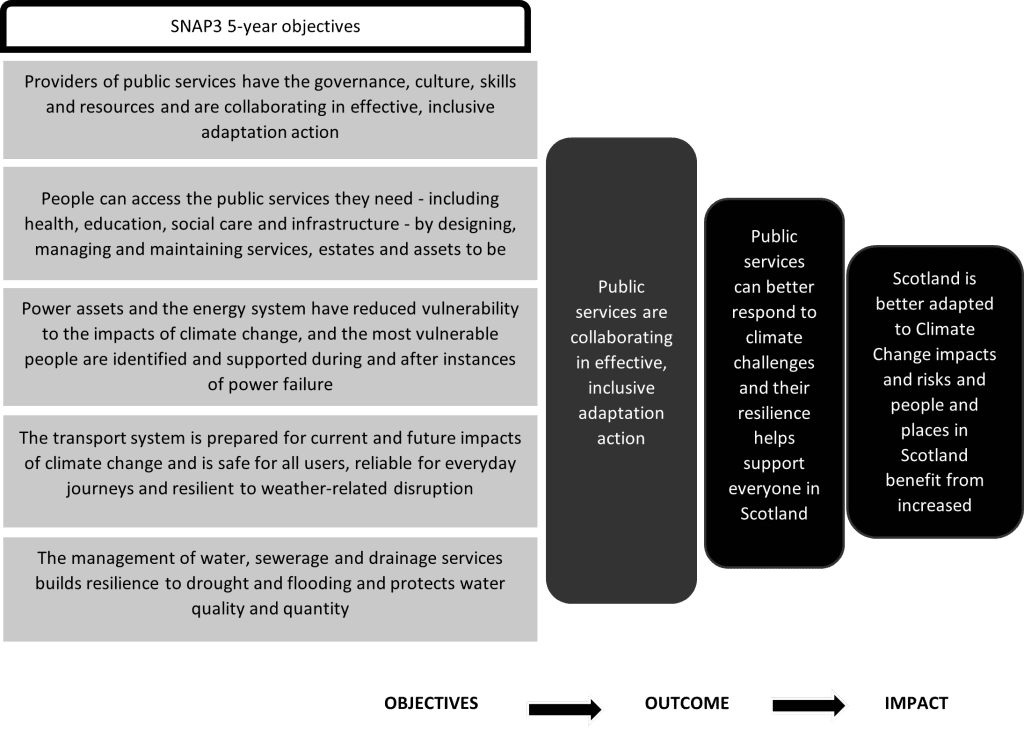
Considerations for indicator selection
Following the desk-based review and stakeholder engagement, several considerations emerged regarding indicator selection for the Public Services outcome:
- We determined that focusing on specific sectoral indicators related to the adaptation of critical infrastructure would result in numerous indicators. This would go against a core aim of our work to develop a concise and clear set of indicators. As discussed, the Scottish Government’s work developing indicators at an objective level has taken place alongside development of the outcome indicators presented in this report. Specific sectoral indicators have been determined at the objective level rather than being included in the high-level outcome indicators developed through this work.
- We explored the possibility of an indicator around participation levels at a recently established infrastructure adaptation forum. However, the objectives and the ambitions of this forum are still at an early stage and it was not possible to determine a baseline, so it was not included here.
- Collaboration is an important aspect of this outcome. The extent of collaboration of public service bodies is captured through the Sustainable Scotland Network annual report. The quality of collaboration is equally as important to capture. However, there is currently insufficient data available to incorporate this element within the outcome indicators.
Public services – proposed indicators
When setting out to develop a list of indicators for the Public Services outcome, we aimed to cover the extent of collaboration between public services, as well as the extent of effective and inclusive adaptation. These indicators use data available to capture high-level insights on the extent of public sector collaboration and adaptation actions that public bodies are taking. These indicators do not cover the extent to which these actions are effective or inclusive. Ultimately, this can only be captured at a sector-specific level, as no generalised metric for effectiveness or inclusiveness of public services and infrastructure exists. It was not possible to go to the level of sector-specific indicators for public services and infrastructure as this would result in numerous indicators.
The proposed indicators are:
- Level of collaboration across public services
- Level of adaptation actions across public services.
Below we present the baseline information for each of the two indicators proposed to monitor the Public Services outcome. For each indicator, we provide the baseline value, a description of the baseline, the recent trend and desired trend for each indicator to provide context. More information on baseline data is available in Annex 5. The is followed by a further detailed summary of each indicator and the rationale for their inclusion.
Public services – baseline
This section presents baseline information. For each indicator, we provide the baseline value, a description of the baseline, the desired trend for each indicator and recent trends for each baseline to provide context.
Number of public bodies members in the Public Sector Climate Adaptation Network
- Description: In 2024, the Public Sector Climate Adaptation Network counted 50 members.
- Recent trends: the Public Sector Climate Adaptation Network was launched in 2019 with 40 major organisations. 10 additional 10 organisations joined the Network in October 2023.
- Baseline: 50
- Desired trend: Increase
Number of public bodies citing the Work in partnership & collaborations as a priority for the year ahead in relation to climate change adaptation
- Description: In 2022-2023, 53.2% of the 188 listed public bodies (100 public bodies) submitting an annual compliance report cite “Work in Partnerships & Collaborations” in their top five priorities for the year ahead in relation to climate change adaptation.
- Recent trends: In 2021/22, 36.2% of public bodies declared that they prioritized “Work in Partnerships & Collaborations”.
- Baseline: 53.2%
- Desired trend: Increase
Level of risk assessment across the public sector
- Description: 70.2% of the public bodies submitting an annual compliance report have completed some form of risk assessment during or prior to the 2022/23 reporting period. 43.6% of bodies have carried out a limited risk assessment. 20.7% of bodies have carried out a comprehensive risk assessment. 5.8% have completed an advanced risk assessment, involving stakeholders and considering a range of climate or socioeconomic scenarios.
- Recent trends: In 2021/22 reporting, 66.0% of public bodies submitted some form of adaptation risk assessment.
- Baseline:
- Limited risk assessment: 43.6%
- Comprehensive risk assessment: 20.7%
- Advanced risk assessment: 5.8%
- Desired trend: Increase
Level of adaptation action taken across the public sector
- Description: 71.8% of all listed public bodies submitting an annual compliance report have taken adaptation action during or prior to the 2022/23 reporting period. 44% of bodies have taken some action, 21% of all bodies are taking good action. 6% of bodies are taking advanced action.
- Recent trends: In 2021/22 reporting, 67.0% of public bodies reported taking some form of action on adaptation.
- Baseline:
- Some actions taken: 44%
- Good action taken: 21%
- Advanced action taken: 6%
- Desired trend: Increase
Public Services – indicator summaries
Level of collaboration across public services
|
Indicator |
Level of collaboration across public services |
|
Description |
This indicator is a combination of:
and
|
|
Data set holder |
Adaptation Scotland and Sustainable Scotland Network on behalf of Scottish Government |
|
Unit |
This indicator is selected as a proxy to demonstrate the level of collaborative effort between different public bodies on shared outcomes and priorities. Collaboration is vital to tackling the complex challenges involved in strengthening climate resilience. Effective collaboration can enhance adaptive capacity, reduce vulnerability, and ensure a cohesive response to climate change (Runhaar et al., 2018).
Level of adaptation actions across public services
|
Indicator |
Level of adaptation actions across public services |
|
Description |
This indicator is measured by the following:
This indicator is a combination of two pieces of information reported by 188 public bodies according to Section 44 of the Climate Change (Scotland) Act 2009. The level of risk assessment (none, limited, comprehensive, advanced) and of adaptation action (none, some, good, advanced) taken across the public sector are assessed. The Sustainable Scotland Network manages the annual reporting process and analyses the returns on behalf of the Scottish Government. |
|
Data set holder |
Sustainable Scotland Network on behalf of the Scottish Government |
|
Unit |
% |
This indicator captures the level of climate adaptation actions undertaken by public bodies. The public sector must assess and address climate risks through adaptation planning and action to ensure the quality of its services to the population in a changing climate (Runhaar et al., 2018). By monitoring the level of risk assessment and adaptation actions, this indicator provides insights into the preparedness and resilience of public services.
Economies and industries are adapting and realising opportunities in Scotland’s Just Transition.
Overview
This outcome focuses on adapting the economy and industries to realise opportunities in Scotland’s Just Transition. It aims to support businesses in understanding and responding to climate risks, whilst fostering innovation in adaptation solutions. Key actions include increasing business awareness of climate risks, supporting adaptation in sectors like farming and forestry, and promoting Scotland as an innovation hub for adaptation solutions. This approach seeks to ensure Scotland’s economy remains competitive and resilient whilst capitalising on emerging opportunities. Figure 6 presents SNAP3’s pathway from objectives to outcome and impact for Economy, Business and Industry.[6]
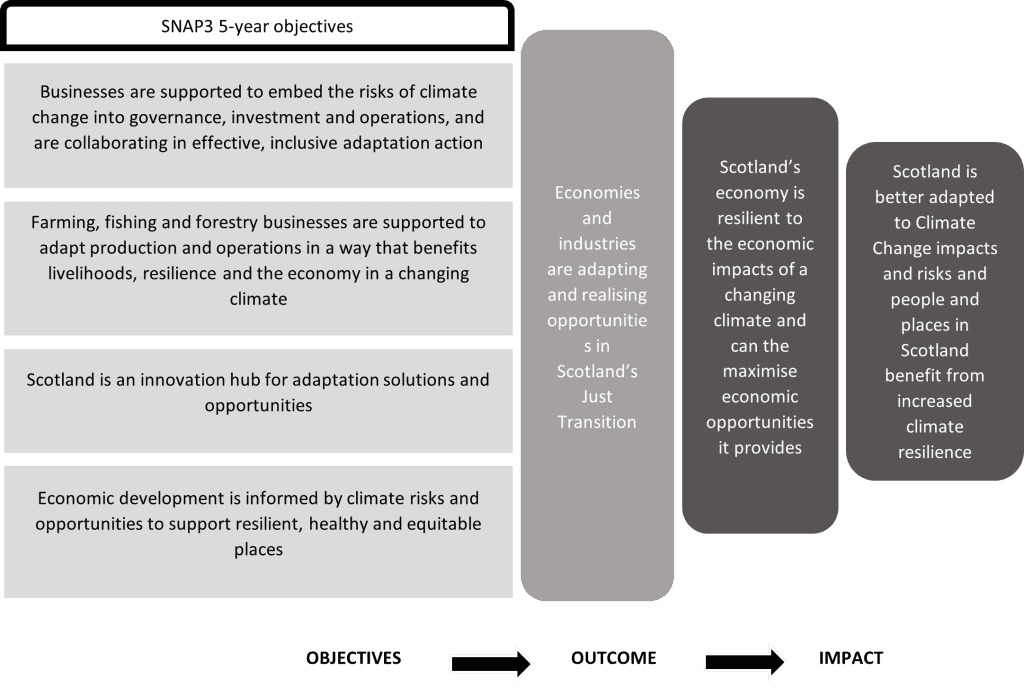
Considerations for indicator selection
Following the desk-based review and stakeholder engagement, several considerations emerged regarding indicator selection for the Economy, Business and Industry outcome:
- Investments in climate resilience, with a specific taxonomy for adaptation-related investment, was considered a potential indicator. Such a taxonomy would prove a useful indicator for how the economy is adapting to climate change. However, while initiatives are emerging, this has not been fully implemented at national level yet. It is something to consider for inclusion in the next SNAP.
- The direct economic loss associated with climate-related hazards, such as flooding was considered. Some stakeholders felt that many businesses could be reluctant to invest in resilient infrastructure because its benefits are not easily quantified. Capturing direct loss associated with climate-related hazards helps industries understand the value of investments in adaptation. Nevertheless, no viable dataset currently exists for such an indicator in the Scottish context.
- An indicator on green jobs is included in the indicator set. However, it does not capture the development of adaptation skills needed by existing Scottish businesses to address the challenges of climate change. Training employees to increase adaptation knowledge and skills specific to the needs of individuals or businesses is an important aspect that is not captured as no viable dataset currently exists.
- Sustainable practice in the agriculture sector is the focus of one indicator, given it accounts for 69% of Scotland’s total land use. Another area of the economy initially considered was the forestry sector. An indicator “percentage of certified woodland area in Scotland” was considered. However, considering that certification mostly applies to woodlands used for timber production and not woodlands more generally, the coverage of this indicator was considered too limited.
- The proportion of agricultural land categorised as High Nature Value (HNV) Farming has initially been chosen as a proxy of adaptation to climate change in agriculture in Scotland. High Nature Value (HNV) Farming is an indicator used to identify agricultural systems that support high levels of biodiversity through low-intensity, traditional farming practices. HNV farms are more likely to be resilient to climate variability and extreme weather events. However, this indicator was not selected because the latest baseline is from 2013 and has not been updated since then. Should new data become available this indicator could be reviewed in the future.
- Capturing innovation in Scotland’s economy was considered as an important aspect of this outcome. However, given the broad scope, complexity and subjectivity around what constitutes innovation, it is a difficult aspect to capture in a single quantitative indicator and is, therefore, not included.
Economy, Business and Industry – proposed indicators
It is important that the indicators cover the preparedness and adaptation of businesses and industries and the extent into which they take advantage of economic opportunities linked to climate change. The five indicators selected cover business preparedness and action using data periodically recorded by the Business Insights and Conditions Survey. The use of Office of National Statistics (ONS) data on green jobs provides an indicator for the transition towards a climate-smart economy and workforce skills development for the green economy. Another indicator focused specifically on adaptation action in the agricultural sector, which is a significant part of the Scottish economy. Taken together, this set of indicators uses available data to provide a broad indication of whether Scotland’s economy is adapting to climate change. Nevertheless, there are some key aspects that are not covered. These include levels of investment in climate adaptation initiatives and economic resilience (e.g., economic loss related to climate-related hazards) as well as the level of innovation from businesses in responding to climate risks.
The proposed indicators are:
- Proportion of businesses monitoring climate-related risks
- Proportion of businesses taking action to adapt to the effects of climate change
- Number of green jobs
- Uptake of grants for agriculture storage reservoirs and off-season storage lagoons.
Below we present the baseline information for each of the five indicators proposed to monitor the Economy, Business and Industry outcome. For each indicator, we provide the baseline value, a description of the baseline, the recent trend and desired trend for each indicator to provide context. More information on baseline data is available in Annex 5. This is followed by a further detailed summary of each indicator and the rationale for their inclusion.
Economy, Business and Industry – baseline
Proportion of businesses monitoring climate related risks
- Description: In 2023, 15.6% of Scotland businesses have assessed risks for supply chain disruption and distribution, 6.2% for increased flooding and 4.4% for temperature increase.
- Recent trends: August 2023 was the first time the question related to businesses monitoring climate related risks was asked.
- Baseline:
- Supply chain disruption: 15.6%
- Increased flooding: 6.2%
- Temperature increase 4.4%
- Desired trend: Increase
Proportion of businesses taking action to adapt to the effects of climate change
- Description: In 2023, 26.5% of Scotland businesses have taken action to adapt supply chain disruption and distribution, 11.5% to adapt to increased flooding and 4.4% to adapt to temperature increase.
- Recent trends: August 2023 was the first time the question related to businesses taking adaptation action was asked.
- Baseline:
- Supply chain disruption: 25.6%
- Increased flooding: 11.5%
- Temperature increase 5.7%
- Desired trend: Increase
Number of green jobs
- Description: In 2022, Scotland employment in green jobs in 2022 was estimated at 46,200 full-time equivalents (FTEs).
- Recent trends: This number has increased yearly since 2015 (32,800 FTE), except between 2021 and 2022.
- Baseline: 46,200
- Desired trend: Increase
Uptake of grants for agriculture irrigation lagoons
- Description: In 2024, 5 AECS applications for irrigation lagoons were successful. 14 applications were submitted.
- Recent trends: the number of applications submitted and successful are usually between 0 and 2 per year.
- Baseline: 5
- Desired trend: Increase
Economy, Business and Industry – indicator summaries
Business awareness of climate adaptation
|
Indicator |
Proportion of businesses monitoring climate related risks |
|
Description |
This indicator is a survey question from the Business Insights and Conditions Survey. |
|
Data holder |
Office for National Statistics |
|
Unit |
% |
This indicator captures the level of knowledge and awareness of climate-related risks by businesses. Ensuring businesses across Scotland are aware of the risks that climate change may pose to their operations, premises, staff, and supply chains is a crucial component of a climate resilient economy (Linnenluecke et al., 2013; Surminski, 2013).
Business preparedness in climate adaptation
|
Indicator |
Proportion of businesses taking action to adapt to the effects of climate change |
|
Description |
This indicator is a survey question from the Business Insights and Conditions Survey. |
|
Data holder |
Office for National Statistics |
|
Unit |
% |
This indicator captures businesses’ capacity to respond to the risks posed by climate change. Ensuring businesses across Scotland have a plan to face the risks climate change may pose to their operations, premises, staff and supply chains will be crucial to building a more climate resilient economy (Linnenluecke et al., 2013; Surminski, 2013).
Green jobs in the Scottish economy
|
Indicator |
Total Scotland employment in green jobs |
|
Description |
This indicator looks at green jobs, as defined as “employment in an activity that contributes to protecting or restoring the environment, including those that mitigate or adapt to climate change”; they can be estimated using industry, occupation, and firm approaches. This indicator follows an industry-based approach which includes all jobs in a green industry or sector and provides our headline estimate of employment in green jobs. |
|
Data holder |
Office for National Statistics |
|
Unit |
Number |
This indicator monitors the adaptation opportunity in Scotland’s Just Transition as it directly tracks employment in environmentally sustainable sectors. This indicator reflects the economic growth and industry shift towards sustainable practices, essential for climate adaptation and effective Just Transition (Martinez-Fernandez et al., 2010).
Agriculture water-use efficiency
|
Indicator |
Uptake of grants for agriculture irrigation lagoons |
|
Description |
This indicator follows the number of applied and approved agricultural projects (AECS) to improve water-use efficiency by collecting and storing water in an irrigation lagoon. |
|
Data set holder |
Scottish Government |
|
Unit |
Number of applications and approved grants |
This indicator represents proxy of adaptation by the agricultural sector. Improving water storage efficiency through irrigation lagoons is a strategic adaptation measure that addresses several challenges posed by climate change: it helps mitigate the variability of rainfall patterns and allow farmers to store water during periods of excess rainfall to ensure a steady water supply for crops. It will also contribute to reduce the stress on Scotland’s water resources and reduce flood risk at times by capturing and storing excess rainfall runoff (Schmitt et. al., 2022).
Discussion
Conclusions
Climate adaptation is complex and multifaceted, spanning across sectors and scales. Therefore, MEL of climate adaptation will always be challenging. Nevertheless, monitoring the extent to which an adaptation plan’s outcomes are achieved is essential to understand the effectiveness of its associated activities and policies. Ultimately, efforts to monitor adaptation plans, such as SNAP3, must navigate this complexity, seeking a balance of indicators that is relevant, robust, and practical to implement. We have sought to achieve this balance by taking a systematic approach to the selection of indicators through desk-based review and extensive engagement with stakeholder groups across Scottish governmental departments and associated organisations. The assessment has been grounded in the practical reality of what data is available rather than theoretically ideal indicators.
In relation to the relevance and robustness of indicators, we have developed outcome indicators that efficiently capture most of the core elements of four of SNAP3’s outcomes.
For the Nature Connects outcome, the indicators proposed cover ecological connectivity, ecological health, and urban-nature connection. Taken together, these indicators will provide useful insights on progress in securing the resilience of Scotland’s natural ecosystems to climate change. Lack of an indicator specifically for marine ecosystems, due to inadequate available data, is a key, is a key limitation.
For the Communities outcome, capturing health and equity in high-level, generalised indicators was challenging due to the complexity of these issues. Therefore, the proposed indicators focus on monitoring community action of relevance to climate adaptation.
For the Public Services outcome, the proposed indicators focus upon collaboration and adaptation actions at a high-level. It was impractical to address the effectiveness of actions, as the number of different sectors associated with this outcome would result in numerous indicators.
For the Economy, Business, and Industry outcome, the indicators proposed cover areas of business preparedness and action, the extent of the transition to green economy, and the extent to which an important sector of the economy (agriculture) is undertaking climate adaptation. While acknowledging that the level of investment in climate adaptation initiatives and economic losses resulting from climate-related hazards is not addressed, these indicators will still provide useful insights about the delivery of this outcome.
Regarding practical implementation, the proposed indicators redeploy established indicators that, crucially, are based on accessible data. Most are publicly reported, although some require correspondence with the relevant Scottish Government data holder. The proposed indicators allow for a baseline to be established at the start of SNAP3 and then reported against after a five-year period. There is variation on the extent of historic data available across the indicators; there; there is more extensive data on previous trends for some than others. Importantly, we believe the relevance of proposed indicators is clear and they are straightforward to apply. As such, they can be used at the end of the five-year period by those who have not been closely involved in their development.
The stakeholder engagement process was critical in the development of the outcome indicators. A wide range of relevant stakeholders across Scotland engaged in one-to-one calls, workshops or written feedback to provide insights both conceptually on what indicators might capture SNAP3 outcomes and practically on what data are available. This engagement provided sector- and topic-specific knowledge, as well as offering validation of the final proposed set of indicators. Several themes emerged from this process of engagement. First, there was an inherent tension between what is ideal and what is possible. Discussions sometimes veered more towards enthusiasm about theoretically ideal indicators that monitor outcomes rather than being grounded in the practical reality of what data is available. While this certainly did not negate the importance of discussing ideal indicators, it was important to ensure, insofar as possible, that an onus on what is practically possible influenced the discussion.
Second, often data limitations lay at the heart of challenges regarding identification of suitable indicators. The limitations took different forms: no data existed (e.g., economic loss from climate-related hazards); it was insufficiently captured (e.g., marine species’ abundance); or it was not easy to access or publicly available (e.g., data on Build Back Better grants). It is not uncommon for data limitations to be a significant obstacle to developing indicators for climate adaptation (Vallejo, 2017).
Third, the SNAP3 outcomes are structured in a clearly defined way, which was beneficial for developing the set of proposed indicators, these outcomes overlap in ways that should be acknowledged. One example relates to the Communities outcome and the Public Services outcome, as collaboration is of significance for both community resilience and for effective public services. Hence, community actors and public service actors cannot be clearly distinguished from each other. Another example is the emphasis of Nature Connects outcome on access to green space and associated health benefits that overlaps with the community health and wellbeing aspects of the Communities outcome. Such overlaps are not inherently problematic but did point to the need for the net to be cast as wide as possible when considering stakeholder engagement for when identifying indicators.
Recommendations
Several recommendations and next steps emerge from this work. It is important to finalise the outcome indicators for SNAP3 as soon as possible, as applying these indicators consistently will be crucial to enable meaningful comparisons against the baseline. Any changes made to individual indicators or the data that underpin them may compromise the ability to track progress consistently relative to the baseline. Furthermore, it is important to maintain continuity, quality and availability of data required by each indicator. It is vital to maintain the allocation of resources to the collection, maintenance and accessibility of datasets used by the indicators across all relevant Scottish Government departments.
Whilst the indicators represent a complete and operational indicator set, there should be a flexibility regarding potential for additional indicators. New indicators may be added in the immediate term if relevant data becomes available. For example, an ecosystem functions indicator for Nature Connects or a green finance investment indicator for Economy, Business, and Industry are anticipated in the near future. While the suite of indicators addresses the needs for monitoring the outcomes of SNAP3, it may be viewed as a foundation to build upon regarding monitoring of SNAP4.
Lastly, we recommend establishing a working group to sustain the functioning of the indicators. The working group could comprise key stakeholders and data providers who could meet annually to review the functioning of the indicators and address any issues regarding their deployment, e.g., continuity and availability of data and its quality. Furthermore, this working group would build on the strong interest evident across a wide range of stakeholders to engage in the topic of climate adaption MEL.
References
Agrawal, A. (2008). The role of local institutions in adaptation to climate change. In Social Dimensions of Climate Change: Equity and Vulnerability in a Warming World (pp. 173-198). World Bank.
Beauchamp, E. & Józefiak, I., 2023. Breaking the Glass Ceiling at COP 28: Four key elements to ensure a successful global goal on adaptation. International Institute for Sustainable Development. Available at: https://www.iisd.org/publications/report/global-goal-on-adaptation-monitoring-evaluation-learning-framework-cop-28 [Accessed 16 July 2024].
Beauchamp, E., Leiter, T., Pringle, P., Brooks, N., Masud, S., and Guerdat, P., 2024. Toolkit for Monitoring, Evaluation, and Learning for National Adaptation Plan Processes. NAP Global Network. Available at: https://www.adaptation-undp.org/sites/default/files/resources/internal_brief_transparency-mrv-me-april202249_adjusted_doc_revised.pdf [Accessed 16 July 2024].
Berry, H. L., Waite, T. D., Dear, K. B., Capon, A. G., & Murray, V. (2018). The case for systems thinking about climate change and mental health. Nature Climate Change, 8(4), 282-290.
Biden, A., 2022. 5 Smart Indicators in Monitoring and Evaluation. tools4dev. Available at: https://tools4dev.org/blog/smart-indicators-in-monitoring-and-evaluation/ [Accessed 16 July 2024].
Climate Change Committee (CCC), 2022, Is Scotland Ready? 2022 Report to Scottish Parliament. Available at: https://www.theccc.org.uk/publication/asc-writes-to-scottish-government-about-outcomes-based-approach-for-the-sccap/
Climate Change Committee, 32023. Adapting to climate change – Progress in Scotland. Climate Change Committee. Available at: https://www.theccc.org.uk/publication/adapting-to-climate-change-progress-in-scotland/ [Accessed 16 July 2024].
Demuzere, M., Orru, K., Heidrich, O., Olazabal, E., Geneletti, D., Orru, H., Bhave, A.G., Mittal, N., Feliu, E. & Faehnle, M. (2014) Mitigating and adapting to climate change: multi-functional and multi-scale assessment of green urban infrastructure, Journal of Environmental Management, 146, pp. 107–115.
Food and Agriculture Organization of the United Nations (FAO), 2017. Tracking adaptation in agricultural sectors. FAO. Available at: https://www.fao.org/policy-support/tools-and-publications/resources-details/en/c/1193260/ [Accessed 16 July 2024].
Global Environmental Facility (GEF), 2016. Monitoring and Evaluation of Climate Change Adaptation. Global Environment Facility. Available at: https://www.thegef.org/sites/default/files/council-meeting-documents/EN_GEF.STAP_.C.51.Inf_.03_M%26E_of_CCA.pdf [Accessed 16 July 2024].
Gabbatiss, J. & Lempriere, M., 2024. Bonn climate talks: Key outcomes from the June 2024 UN climate conference. Carbon Brief. Available at: https://www.carbonbrief.org/bonn-climate-talks-key-outcomes-from-the-june-2024-un-climate-conference/ [Accessed 16 July 2024].
Gill, S. E., Handley, J. F., Ennos, A. R., & Pauleit, S. (2007). Adapting cities for climate change: the role of the green infrastructure. Built Environment, 33(1), 115-133.
Haddad, N.M., Brudvig, L.A., Clobert, J., Davies, K.F., Gonzalez, A., Holt, R.D., Lovejoy, T.E., Sexton, J.O., Austin, M.P., Collins, C.D., Cook, W.M., Damschen, E.I., Ewers, R.M., Foster, B.L., Jenkins, C.N., King, A.J., Laurance, W.F., Levey, D.J., Margules, C.R., Melbourne, B.A., Nicholls, A.O., Orrock, J.L., Song, D.X. & Townshend, J.R. (2015) Habitat fragmentation and its lasting impact on Earth’s ecosystems, Science Advances, 1(2), e1500052
Krosby, M., Tewksbury, J., Haddad, N. M., & Hoekstra, J. (2010). Ecological connectivity for a changing climate. Conservation Biology, 24(6), 1686-1689.
Linnenluecke, M.K., Griffiths, A. & Winn, M.I. (2013) Firm and industry adaptation to climate change: a review of climate adaptation studies in the business and management field, Wiley Interdisciplinary Reviews: Climate Change, 4(5), pp. 397–416.
Maas, J., Verheij, R.A., Groenewegen, P.P., de Vries, S. & Spreeuwenberg, P. (2006) Green space, urbanity, and health: how strong is the relation?, Journal of Epidemiology & Community Health, vol. 60, no. 7, pp. 587–592.
Mäkinen, K., Prutsch, A., Karali, E., Leitner, M., Völler, S., Lyytimäki, J., Pringle, P., and Vanneuville, W., 2018. Indicators for adaptation to climate change at national level – Lessons from emerging practice in Europe. European Topic Centre on Climate Change impacts, Vulnerability and Adaptation (ETC/CCA) Technical paper 2018/3. DOI: 10.25424/CMCC/CLIMATE_CHANGE_ADAPTATION_INDICATORS_2018.
Marshall, N. A., Park, S. E., Howden, S. M., Dowd, A. B., & Jakku, E. S. (2013). Climate change awareness is associated with enhanced adaptive capacity. Agricultural Systems, 117, 30-34.
Martinez-Fernandez, C., Hinojosa, C. & Miranda, G. (2010) Green jobs and skills: The local labour market implications of addressing climate change, OECD Local Economic and Employment Development (LEED) Working Papers, 2010/02, OECD Publishing, Paris.
McEwen, L., Jones, O. & Robertson, I. (2014), ‘A glorious time?’ Some reflections on flooding in the Somerset Levels, The Geographical Journal, 180(4), pp. 326-337.
McGranahan, G., Balk, D., & Anderson, B. (2007). The rising tide: assessing the risks of climate change and human settlements in low elevation coastal zones. Environment and Urbanization, 19(1), 17-37.
Moss, A., 2019. A monitoring and evaluation framework for the second SCCAP. ClimateXChange. Available at: https://www.climatexchange.org.uk/publications/a-monitoring-and-evaluation-framework-for-the-second-sccap/ [Accessed 16 July 2024].
New, M., Reckien, D., Viner, D., Adler, C., Cheong, S.-M., Conde, C., Constable, A., Coughlan de Perez, E., Lammel, A., Mechler, R., Orlove, B., and Solecki, W., 2022. Decision-Making Options for Managing Risk. In: Pörtner, H.-O., Roberts, D.C., Tignor, M., Poloczanska, E.S., Mintenbeck, K., Alegría, A., Craig, M., Langsdorf, S., Löschke, S., Möller, V., Okem, A., and Rama, B. (eds.) Climate Change 2022: Impacts, Adaptation and Vulnerability. Contribution of Working Group II to the Sixth Assessment Report of the Intergovernmental Panel on Climate Change. Cambridge University Press, Cambridge, UK and New York, NY, USA, pp. 2539–2654, doi:10.1017/9781009325844.026.
Organisation for Economic Co-operation and Development (OECD), 2015. National Climate Change Adaptation: Emerging Practices in Monitoring and Evaluation. OECD Publishing, Paris. Available at: http://dx.doi.org/10.1787/9789264229679-en [Accessed 16 July 2024].
Peter, S., & Peter, F., 2009. Evaluation of Indicators for EU Policy Objectives. Ecologic Institute. Available at: https://www.ecologic.eu/sites/default/files/publication/2016/1901-research_note-d2-1-evaluation-of_indicators-for-eu-policy-objectives-2009.pdf [Accessed 16 July 2024].
Palinkas, L. A., & Wong, M. (2020). Global climate change and mental health. Current Opinion in Psychology, 32, 12-16
Palmer, M. A., Lettenmaier, D. P., Poff, N. L., Postel, S. L., Richter, B., & Warner, R. (2009). Climate change and river ecosystems: protection and adaptation options. Environmental Management, 44(6), 1053-1068.
Runhaar, H., Wilk, B., Persson, Å., Uittenbroek, C., & Wamsler, C. (2018). Mainstreaming climate adaptation: taking stock about ‘what works’ from empirical research worldwide. Regional Environmental Change, 18, 1201-1210.
Sayers, PB., Lindley. S, Carr, S and Figueroa-Alfaro, R. W, 2021. The impacts of climate change on population groups in Scotland. Research undertaken by Sayers and Partners in association with the University of Manchester for ClimateXChange.
Schmitt, R.J. P., Rosa, L., Daily, G. (2022), ‘Global expansion of sustainable irrigation limited by water storage’, Proceedings of the National Academy of Sciences, 119 (47), https://doi.org/10.1073/pnas.2214291119.
Shi, J., Visschers, V.H.M., Siegrist, M. & Arvai, J. (2016) Knowledge as a driver of public perceptions about climate change reassessed, Nature Climate Change, 6, pp. 759–762.
Surminski, S. (2013) Private-sector adaptation to climate risk, Nature Climate Change, 3(11), pp. 943–945.
United Nations Development Programme (UNDP), 2022. Transparency, MRV, and M&E. United Nations Development Programme. Available at: https://www.adaptation-undp.org/sites/default/files/resources/internal_brief_transparency-mrv-me-april202249_adjusted_doc_revised.pdf [Accessed 16 July 2024].
United Nations Framework Convention on Climate Change (UNFCCC), 2024. Synthesis of submissions on the UAE – Belém work programme on indicators, Advance Unedited Version. UNFCCC. Available at: https://unfccc.int/documents/638384 [Accessed 16 July 2024].
United Nations Framework Convention on Climate Change (UNFCCC), 2023. Draft technical paper on monitoring and evaluation of adaptation at the national and subnational level (AC22). UNFCCC. Available at: https://unfccc.int/sites/default/files/resource/ac22_7c_monitoring_evaluation.pdf [Accessed 16 July 2024].
United States Environmental Protection Agency (EPA), 2017, . Development of a Climate Resilience Screening Index (CRSI): An Assessment of Resilience to Acute Meteorological Events and Selected Natural Hazards. EPA. Available at: https://cfpub.epa.gov/si/si_public_record_report.cfm?dirEntryId=335758 [Accessed 16 July 2024].
Vallejo, L. (2015). Insights from national adaptation monitoring and evaluation systems. In Mullan, M., Kingsmill, N., Agrawala, S. & Kramer, A.M. (eds) National Adaptation Planning: Lessons from OECD Countries. Springer, Cham. Available at: https://www.oecd.org/en/publications/2017/06/insights-from-national-adaptation-monitoring-and-evaluation-systems_d2e677fe.html [Accessed 16 July 2024].
Watson, J. E. M., Dudley, N., Segan, D. B., & Hockings, M. (2014). The performance and potential of protected areas. Nature, 515, 67-73.
Annexes
Annex 1 – Policies reviewed
The following policies were reviewed for sectorial indicators that could be relevant for the SNAP3 outcome indicators.
Scottish policies listed in the draft SNAP3 for the outcome area “Nature connects across our lands, settlements, coasts and seas”:
|
|
Scottish policies listed in the draft SNAP3 for the outcome area “Communities creating climate-resilient, healthy and equitable places”:
Scottish policies listed in the draft SNAP3 for the outcome area “Public services are collaborating in effective, inclusive adaptation action”:
Scottish policies listed in the draft SNAP3 for the outcome area “Economies and industries are adapting and realising opportunities in Scotland’s Just Transition”:
Annex 2 – Initial longlist of indicators
The initial longlist of indicators is listed below. This longlist was shared with stakeholders and revised through engagement as described in section 2.
Initial longlist of indicators for the outcome area “Nature connects across our lands, settlements, coasts and seas”:
|
|
|
|
|
|
|
|
|
|
|
|
Initial longlist of indicators for the outcome area “Communities creating climate-resilient, healthy and equitable places”:
|
|
|
|
|
|
|
|
|
|
|
Initial longlist of indicators for the outcome area “Public services are collaborating in effective, inclusive adaptation action”:
|
|
|
|
|
|
|
|
|
|
|
|
|
|
Initial longlist of indicators for the outcome area “Economies and industries are adapting and realising opportunities in Scotland’s Just Transition”:
|
|
|
|
|
|
|
|
|
|
Annex 3 – Workshop participation
The following organisations participated in the workshops.
Organisations represented in the workshop “Nature connects across our lands, settlements, coasts and seas”:
- Centre of Expertise for Waters
- Edinburgh Council
- Forestry and Land
- Glasgow City Council
- Highlands and Islands Airports
- James Hutton Institute
- Marine Directorate of Scottish Government
- National Centre for Resilience
- Nature Scot
- Public Health Scotland
- SEPA
- Scottish Government
- Scottish Water
- Sniffer
Organisations represented in the workshop “Communities creating climate-resilient, healthy and equitable places”:
- FloodRe
- Glasgow City Council
- National Centre for Resilience
- National Resilience Scotland
- Nature Scot
- Public Health Scotland
- Scottish Dynamic Coast
- Scottish Flood Forum
- Scottish Government
- Scottish Land Commission
- Scottish Waters
- Sniffer
- Strathclyde University
Organisations represented in the workshop “Public services are collaborating in effective, inclusive adaptation action”:
- Climate Change Committee
- Glasgow City Council
- MET Office
- Nature Scot
- Network Rail
- Public Health Scotland
- SEPA
- Scottish Flood Forum
- Scottish Government
- Scottish Water
- Sniffer
- Transport Scotland
- University of Strathclyde
Organisations represented in the workshop “Economies and industries are adapting and realising opportunities in Scotland’s Just Transition”:
- Climate Change Committee
- Forestry and Land Scotland
- Glasgow City Council
- Marine Directorate of Scottish Government
- Scottish Government
- SEPA
- Scottish Water
- Sniffer
Annex 4 – Indicator criteria
OUTCOME: Nature connects across our lands, settlements, coasts, and seas
ECOSYSTEM HEALTH AND CONNECTIVITY
Habitat Connectivity Index
|
Criterion |
Rating |
Assessment |
|
Adaptation Relevance |
Green |
This indicator addresses habitat connectivity and quality, which are important aspect for assessing the vulnerability of ecosystems to climate change. By evaluating how well species can move and adapt to changing conditions, the indicator provides valuable insights into the adaptive capacity of habitats. |
|
Representativeness |
Amber |
The indicator covers four key types of habitats: Woodland, Heathland, Grassland, and Fen/Marsh/Swamp – habitats that are representative of the broader landscape and crucial for maintaining ecological functions and services. However, the indicator does not cover freshwater, marine and coastal environments, and therefore has some limitations in its representativeness of indicating ecological health and connectivity. |
|
Data Availability |
Amber |
Data is collected by NatureScot. Data for CSGN area is publicly available on NatureScot’s website. However, data for the whole Scotland is provided directly by NatureScot and is not published online. |
|
Sensitivity |
Amber |
Updating this indicator every five years is considered a sensible frequency to observe meaningful changes in habitat connectivity. There may be a lag in reporting years, with data being published on average 2 years after. The up-to-date data may therefore not be available immediately at the end of the Plan. |
|
Understanding |
Green |
This indicator on habitat connectivity can be widely understood by a broad range of stakeholders in relation to improved ecological health and associated resilience. |
|
Baseline |
Green |
The indicator was last updated in 2022 for semi-natural grassland, heathland, and semi-natural woodland. Baseline maps are available on the Nature Scot website, providing a reference point for measuring changes over time. These baselines are crucial for assessing the progress and effectiveness of adaptation measures. The metric uses to calculate the habitat connectivity it is the Equivalent Connected Area (Probability of Connectivity), the ECA (PC). |
|
Practicality |
Green |
The data is publicly available and detailed by catchment area, making it practical for use in planning and decision-making processes. This accessibility ensures that stakeholders can utilize the information to enhance habitat connectivity and support climate adaptation strategies. The practical application of this data supports localized adaptation efforts and helps to mitigate the impacts of climate change on biodiversity and ecosystem services. |
Proportion of surface water bodies classified in good or better condition
|
Criterion |
Rating |
Assessment |
|
Adaptation relevance |
Green |
This indicator is relevant for climate adaptation as it addresses the quality and health of water ecosystems, which are critical for reducing vulnerability and enhancing adaptive capacity. By tracking the proportion of water bodies in good or high condition, this indicator provides insights into the resilience of water ecosystems and their capacity to adapt to changing climatic conditions. |
|
Representativeness |
Amber |
The indicator is broadly effective for monitoring ecological health as it encompasses key aspects of ecosystem quality. Although it has limitations due to its primary focus on surface water bodies, it can be used as a useful proxy for the status of broader ecological and biodiversity conditions. |
|
Data availability |
Green |
Full GIS data for this indicator is available on the SEPA website, ensuring that data is current and reliable. The data is updated every year by SEPA. |
|
Sensitivity |
Green |
Changes in water quality and ecosystem health can be noted over a five-year timescale interventions. |
|
Understanding |
Green |
This indicator on water quality can be widely understood by a broad range of stakeholders in relation to improved ecological health and associated resilience. |
|
Baseline |
Green |
The indicator is publicly available on SEPA’s website has an established baseline from 2007 to 2022. |
|
Practicality |
Green |
Statistical and mapping data for this indicator is already being collected and publicly accessible, making it practical to monitor as an indicator. |
Proportion of Scotland’s protected sites in favourable condition
|
Criterion |
Rating |
Assessment |
|---|---|---|
|
Adaptation relevance |
Green |
Protected sites play a role in improving the adaptive capacity of vulnerable species by providing safe havens with the functional network that species can migrate from or too. This indicator is relevant for climate adaptation as it directly relates to the resilience of ecosystems and their ability to adapt to changing environmental conditions. |
|
Representativeness |
Amber |
While the indicator is a useful proxy for ecological health and connectivity, its limitation should be noted. The indicator does not include offshore marine sites and features in Scotland beyond 12 nautical miles, and primarily focuses on protected sites and not all natural sites, which may limit its representativeness of the broader ecological health and connectivity. |
|
Data availability |
Green | |
|
Sensitivity |
Amber |
The indicator has shown longer-term changes, though it may not reflect notable changes within shorter periods, such as from 2023 to 2024. While a five-year timescale may be too short to observe long-term trends, the indicator is suitable to detect significant changes over longer periods. |
|
Understanding |
Green |
This indicator on condition of protected sites can be widely understood by a broad range of stakeholders in relation to improved ecological health and associated resilience. |
|
Baseline |
Green |
The indicator has an established baseline from 2005 to 2024, with historical data available for comparison. |
|
Practicality |
Green |
Statistical and mapping data for this indicator is already being collected and publicly accessible, making it practical to monitor as an indicator. |
Proportion of soft shorelines affected by coastal erosion
|
Criterion |
Rating |
Assessment |
|
Adaptation relevance |
Green |
Monitoring the extent of coastal erosion is relevant to climate adaptation as it reflects the efficacy of implemented adaptation measures in enhancing coastal resilience. |
|
Representativeness |
Green |
This indicator represents the coastal component of the Nature Connects outcome of the SNAP3. |
|
Data availability |
Amber |
Data is publicly available, however, it is not specifically stated how long the programme hosting the data is running for. |
|
Sensitivity |
Green |
Changes in this indicator are sufficient sensitive to the time-period of SNAP3. |
|
Understanding |
Green |
The connection between the extent of coastal erosion as a proxy for coastal adaptation to climate change is generally recognised. |
|
Baseline |
Green |
Baseline data available from 2017 and 2021. |
|
Practicality |
Green |
The indicator is publicly available on the Center of Expertise for Waters (CREW) website. It has been developed under the Dynamic Coast project. |
URBAN GREEN INFRASTRUCTURE
Extent of green-blue land cover in urban areas
|
Criterion |
Rating |
Assessment |
|---|---|---|
|
Adaptation relevance |
Green |
Green-blue land cover in urban areas reflects the extent of natural spaces in cities that provide crucial ecosystem services. It is relevant for climate adaptation as it captures how well cities are prepared to adapt to the challenges posed by climate change, making urban environments more sustainable and liveable. |
|
Representativeness |
Amber |
This indicator offers a good coverage of Scotland, with urban areas defined as those with a population more than 500. It covers public and private greenspaces, including woodland, open semi-natural, inland water, beach or foreshore, and manmade surface. It also distinguishes the different functions of greenspaces, such as public park or garden, school grounds, private garden, allotments, playing fields, etc. However, it does not cover the tree canopy over hard surfacing or green roofs, which are also relevant in terms of adaptation. |
|
Data availability |
Amber |
This dataset “OS MasterMap Greenspace Layer” is updated every 6 months by Ordnance Survey, but requires a licence to access it. |
|
Sensitivity |
Green |
Land use modification in urban areas can be noted over a five-year timescale. |
|
Understanding |
Green |
This indicator on green-blue land cover in urban areas can be widely understood by a broad range of stakeholders in relation to the extent of natural spaces in cities associated with resilience. |
|
Baseline |
Green |
This dataset “OS MasterMap Greenspace Layer” can be purchased on the Ordnance Survey website |
|
Practicality |
Amber |
Data is available in ESRI Shapefile, GML 3.2.1, GeoPackage and Vector Tiles format. The GIS map has to be purchased and analysed to be transformed to actual percentage. |
Proportion of adults who live within a five-minute walk of their nearest green or blue space
|
Criterion |
Rating |
Assessment |
|---|---|---|
|
Adaptation relevance |
Amber |
The indicator captures the distance to the nearest public or open space, but does not reflect the level of accessibility, the perception of safety people have toward the green and blue spaces nor the frequency of access. |
|
Representativeness |
Green |
The figures for this indicator come from the Scottish Household Survey (SHS). It covers the whole Scottish territory and includes people resident in Scotland aged 16 and over. The SHS sample has been designed to allow annual publication of results at Scotland level and for local authorities. To meet these requirements, the target sample size for Scotland was 10,450 household interviews with a minimum local authority target of 250. |
|
Data availability |
Green |
The data is published annually in the Scottish Household Survey Annual Report. |
|
Sensitivity |
Amber |
Changes in the proportion of adults who live within a five-minute walk of their local green or blue space can be noted over a five-year timescale. There is a lag in reporting years up to a maximum of one year (e.g. 2024 fieldwork ending in January 2025 with publication of results later in 2025) The up-to-date data will therefore not be available immediately at the end of the Plan. |
|
Understanding |
Green |
This indicator can be widely understood by a broad range of stakeholders. |
|
Baseline |
Green |
The figures for this indicator come from the Scottish Household Survey (SHS) which is a National Statistics product produced by the Scottish Government. This indicator is also part of the National Performance Framework. |
|
Practicality |
Green |
Statistical data for this indicator is already being collected and publicly accessible, making it practical to monitor as an indicator. |
OUTCOME: Communities are creating climate-resilient, healthy and equitable places.
Community awareness around climate change
|
Criterion |
Rating |
Assessment |
|
Adaptation relevance |
Amber |
This indicator is relevant for climate adaptation as it improves community adaptive capacity through knowledge enhancement. By understanding what actions are necessary to tackle climate change and recognizing the urgency of these actions, communities can better prepare for and respond to climate impacts. This knowledge reduces vulnerability and increases resilience. However, the question asked does not specifically address the impacts of climate change, the criteria is therefore orange. |
|
Representativeness |
Green |
The survey provides useful snapshot on the awareness and knowledge of communities around climate change. The SHS sample has been designed to allow annual publication of results at Scotland level and for local authorities. To meet these requirements, the target sample size for Scotland was 10,450 household interviews with a minimum local authority target of 250. |
|
Data availability |
Green |
The Scottish Household Survey climate awareness and action questions are asked biennially on odd years. The results are publicly available. |
|
Sensitivity |
Amber |
This indicator is sensitive to changes for the purposes of SNAP3 monitoring, as observed the marked changes that occurred in public perception and knowledge between 2019-2022. There is a lag in reporting years up to a maximum of one year (e.g. 2024 fieldwork ending in January 2025 with publication of results later in 2025)The up-to-date data will therefore not be available immediately at the end of the Plan. |
|
Understanding |
Green |
There is a clear connection on how understanding climate actions and the urgency of these actions relate to progress in climate adaptation. |
|
Baseline |
Green |
The baseline data for this indicator is available since 2019, providing a reference point for measuring changes in community awareness and perception over time. |
|
Practicality |
Amber |
The Scottish Household Survey has been collecting data since 1999, making it a practical, cost-effective, and well-established method for gathering information. |
Community action on climate change
|
Criterion |
Rating |
Assessment |
|
Adaptation relevance |
Green |
Community climate action hubs will improve knowledge of communities and enhances the preparedness of communities. |
|
Representativeness |
Amber |
This indicator does not capture the quality of action and may therefore not be fully representative of the effectiveness of climate actions. While it shows the presence of CCAHs and LPPs, it does not measure the depth or impact of the actions taken through these hubs/plans. |
|
Data availability |
Green |
Data is held by the Scottish Government, and is publicly accessible on the Scottish Government website: Community climate action hubs: contact details – gov.scot (www.gov.scot) . |
|
Sensitivity |
Amber |
This indicator is sensitive to changes for the purposes of SNAP3 monitoring, as observed by marked changes that between 2019-2022. |
|
Understanding |
Green |
It is easy to see the connection between the existence and maintenance of CCAHs and LLPs as metrics for climate action, although it might not be clear what specific actions arise from these. |
|
Baseline |
Amber |
20 CCAHs as of June 2024 (81% of the council areas covered). |
|
Practicality |
Amber |
Information on LPPs is not located in one centralised place, so requires time and resource to obtain. |
Community flood resilience
|
Criterion |
Rating |
Assessment |
|
Adaptation relevance |
Green |
This indicator is relevant to climate adaptation progress as it indicates the implementation effectiveness of strategies to mitigate flood risks and enhance community resilience. |
|
Representativeness |
Green |
Flooding is considered a significant climate hazard, as outlined in the SNAP3, therefore an indicator that captures action for this is representative of climate-resilient communities. |
|
Data availability |
Green |
Updated data on progress will be publicly available in 2025 and 2028. Data will be published by the 14 lead local authorities in charge of local Flood Risk Management Plans, and information will be centralised by SEPA. |
|
Sensitivity |
Green |
Changes in this indicator are sufficiently sensitive to the time-period of SNAP3 monitoring. However, reports are not published annually so the up-to-date data will therefore not be available immediately at the end of the Plan. |
|
Understanding |
Green |
The extent that actions are taking place to manage the impacts of flooding are clear to understand for a wide audience. |
|
Baseline |
Amber |
Actions to reduce or avoid flood are collated by the 14 lead local authorities in charge of Local Flood management Plans in their Flood Management Plan assessment report. The latest report was published in 2021, and the next one is expected in December 2025. |
|
Practicality |
Green |
Data is easy to obtain and easy to use to understand progress. |
Community wellbeing
|
Criterion |
Rating |
Assessment |
|
Adaptation relevance |
Amber |
Not directly related to climate change adaptation, but the experience of the effects of climate change, for example a flooding event, and the capacity to adapt or react to it has a direct impact on mental health. This indicator highlights the intersection between mental wellbeing and climate resilience, showing how adaptive capacity influences community health. |
|
Representativeness |
Amber |
Wellbeing metrics are useful indicators of community health, however, health and its impacts from climate change are wide-ranging in scope. Therefore, there is ultimately limitations that must be acknowledged with this indicator when representing overall community health. |
|
Data availability |
Green |
Data is publicly available from Scottish Government. |
|
Sensitivity |
Amber |
Whilst minor changes have been observed since 2006, this does not necessarily point to a lack of sensitivity in relation to the information this indicator provides. There is a lag in reporting years, with data being published on average one year later. The up-to-date data will therefore not be available immediately at the end of the Plan. |
|
Understanding |
Amber |
Whilst the concept of mental wellbeing and its importance as a metric of community resilience is easy to understand, how this indicator relates to climate adaptation is not clear. |
|
Baseline |
Green |
The baseline data from 2022 shows a mean score of 47.0 on the WEMWBS scale. |
|
Practicality |
Green |
Data has been monitored since 2006, the established data collection processes ensure that this indicator can be consistently and reliably monitored. |
OUTCOME: Public services are collaborating in effective and inclusive adaptation action
Level of collaboration across public services
|
Criterion |
Rating |
Assessment |
|---|---|---|
|
Adaptation relevance |
Green |
Collaboration is vital component of climate adaptation planning. Effective collaboration can enhance adaptive capacity, reduce vulnerability, and ensure a cohesive, equitable response to climate change. |
|
Representativeness |
Amber |
While this indicator shows the level of participation and collaboration, it does not capture the quality or depth of progress in terms of collaboration. It measures quantity rather than the effectiveness of the collaborative actions being taken. |
|
Data availability |
Green |
Data on the participation of public bodies in the Public Climate Adaptation Network is publicly available from Adaptation Scotland and the Sustainable Scotland Network. |
|
Sensitivity |
Amber |
While the indicator data is sensitive enough for the purposes of SNAP3 monitoring, the number of public bodies participating to the Public Climate Adaptation Network is not expected to rise significantly because Adaptation Scotland’s strategy is to integrate few members at a time to insure their good and lasting integration into the network. For the Public bodies climate change duties reporting, there is a lag in reporting years, with data being published on average 1 year after. The up-to-date data will therefore not be available immediately at the end of the Plan. |
|
Understanding |
Green |
This indicator is widely understood with the importance of collaboration in climate adaptation is broadly recognised and easily communicated. |
|
Baseline |
Green |
The baseline data is from 2024 for the Public Climate Adaptation Network and from 2022/23 for the SSN report. |
|
Practicality |
Green |
Data is easy to obtain and utilise to monitor progress over the SNAP3 monitoring period. |
Level of adaptation actions across public services
|
Criterion |
Rating |
Assessment |
|
Adaptation relevance |
Green |
This indicator is highly relevant to adaptation, providing information on levels of risk assessments undertaken by public sector and the extent that adaptation action is taking place. |
|
Representativeness |
Green |
The indicator is representative insights on the extent public services are engaging in adaptation action. However, it only captures the level of risk assessment and action of public bodies subject to mandatory reporting. |
|
Data availability |
Green |
Data is collected annually, providing a regular update on the level of adaptation action across public services. Data is publicly available. |
|
Sensitivity |
Amber |
Changes in collaboration will likely be observed over a five-year time period. There is a lag in reporting years, with data being published on average 1 year after. The up-to-date data will therefore not be available immediately at the end of the Plan. |
|
Understanding |
Amber |
This indicator requires some understanding of SSN’s analytical framework (and subjective nature of assessment) but the concept of risk assessment is widely understood. |
|
Baseline |
Green |
The baseline for this indicator is established from data collected in 22022-3. |
|
Practicality |
Green |
Data is easy to obtain and utilise to monitor progress over the SNAP3 monitoring period. |
OUTCOME: Economies and industries are adapting and realising opportunities in Scotland’s Just Transition.
Business awareness of climate adaptation
|
Criterion |
Rating |
Assessment |
|
Adaptation relevance |
Green |
Business action in relation to adaptation can make them more resilient and prepared for climate hazards, thereby reducing vulnerability. |
|
Representativeness |
Amber |
This indicator represents well the business adaptation component of the Economy, Business and Industry outcome area. It should be noted that it represents businesses with 10 or more employees. |
|
Data availability |
Green |
Data is publicly available and reported on annually. |
|
Sensitivity |
Amber |
Notable changes in the number of business monitoring climate risks is observable in the five-year period. This question was asked in August 2023. There exists potential for it to be asked soon after the end of the plan and therefore no lag in reporting. |
|
Understanding |
Green |
There is a clear connection between the extent in which businesses are monitoring climate risks and how this relates to adapting economy, business and industry. |
|
Baseline |
Green |
Baseline data available from August 2023. |
|
Practicality |
Green |
Data is being captured by BICS already, and practical to use. |
Business preparedness in climate adaptation
|
Criterion |
Rating |
Assessment | |
|---|---|---|---|
|
Adaptation relevance |
Green |
Business action in relation to adaptation can make them more resilient and prepared for climate hazards, thereby reducing vulnerability. | |
|
Representativeness |
Amber |
This indicator represents well the business adaptation component of the Economy, Business and Industry outcome area. It should be noted that it represents businesses with 10 or more employees. | |
|
Data availability |
Green |
Data is publicly available and reported on annually. | |
|
Sensitivity |
Amber |
Notable changes in the number of business monitoring climate risks is observable in the five-year period. This question was asked in August 2023. There exists potential for it to be asked soon after the end of the plan and therefore no lag in reporting. | |
|
Understanding |
Green |
There is a clear connection between the extent in which businesses are monitoring climate risks and how this relates to adapting economy, business and industry. | |
|
Baseline |
Green |
Baseline data available from August 2023. | |
|
Practicality |
Green |
Data is being captured by BICS already, and practical to use. |
Green jobs in the Scottish economy
|
Criterion |
Rating |
Assessment |
|
Adaptation relevance |
Amber |
The green jobs definition signifies its relevance to adaptation. However, important to realise limitations around green jobs, for example – adaptation considered as thinking embedded into all businesses, and not just new jobs created. |
|
Representativeness |
Amber |
In its focus on employment/skills in relation to climate adaptation, this indicator represents well the business adaptation component of the Economy, Business and Industry outcome area. |
|
Data availability |
Green |
Data is publicly available and captured annually. It should be noted that this data is currently categorised as ‘official statistics in development’. This means the data is potentially subject to revision. However, as stated by the Office of National Statistics, this data, even when in development, is considered sufficient quality to be used.[7] |
|
Sensitivity |
Amber |
Changes in this indicator are sufficiently sensitive to the time-period of SNAP3 monitoring. There is a lag in reporting years, with data being published on average 2 years after (e.g. 2022 data was published in March 2024). The up-to-date data will therefore not be available immediately at the end of the Plan. |
|
Understanding |
Amber |
The connection between a ‘green job’ and its relevance to climate adaptation is potentially unclear, therefore terminology and definitions used must be clearly stated. |
|
Baseline |
Green |
Baseline data available between 2015-2022. |
|
Practicality |
Green |
Statistical data for this indicator is already being collected and publicly accessible, making it practical to monitor as an indicator. |
SUSTAINABLE PRACTICE IN THE AGRICULTURE SECTOR
Agriculture water-use efficiency
|
Criterion |
Rating |
Assessment |
|---|---|---|
|
Adaptation relevance |
Green |
Improve water use efficiency in agriculture increases the resilience of farms against several effects of climate change. |
|
Representativeness |
Amber |
The east of Scotland is more concerned by drought risk than the west of the country. Moreover, irrigation lagoons are large-scale projects, but other ways to increase water-use efficiency can also be implemented on farms and will not be captured by this indicator. |
|
Data availability |
Amber |
Data is captured annually by Scottish governmentGovernment but is not publicly available. |
|
Sensitivity |
Green |
Changes in this indicator are sufficiently sensitive to the time-period of SNAP3 monitoring. |
|
Understanding |
Green |
There is a clear connection between water use efficiency and adaptation in the agricultural sector. |
|
Baseline |
Green |
Data has been collated annually since 2015. |
|
Practicality |
Amber |
This information is not publicly available. |
Annex 5 – Baseline information for each indicator
|
Indicator |
Year |
Baseline |
Data source |
|
Nature Connects Nature connects across our lands, settlements, coasts, and seas | |||
|
Habitat Connectivity Index |
2020 |
Equivalent Connected Area (Probability of Connectivity) (ECA (PC)) values from 2020 are available for Scotland for semi-grassland, woodlands and heathland. The data used was the 2020 EUNIS Level 2 landcover map produced by Space Intelligence. To get an overall ECA (PC) value from the local authorities data, each value needs to be squared, the totals summed and then the square root taken. The total Equivalent Connected Area (Probability of Connectivity) (ECA (PC) value for Scotland was 35,570 ha for semi-grassland (2.9%), 5,655 ha for woodland (1.4%) and 214,277 ha for heathland (8.3%). The overall national percentage figure is always going to be lower for each habitat than the individual local authority figures. This is because in a larger area you have more individual habitat patches which results in a lower connectivity measurement. |
For CSGN data visualisation: Habitat Connectivity Indicator – CSGN (arcgis.com) The data for whole Scotland was provided directly by NatureScot. |
|
Proportion of surface water bodies classified in good or better condition |
2022 |
445 (13.7%) surface water bodies in high condition, 1664 surface water bodies in good condition (51.2%) on a total of 3 249 surface water bodies monitored. | |
|
Proportion of Scotland’s Protected Sites in Favourable Condition |
2024 |
65.1% of natural features in favourable condition ‘Site condition monitoring assessment). If we include the sites where monitoring has detected signs of recovery, but favourable condition has not been reached (6.1%) and the sites with positive management is in place that is expected to improve the condition of the site (4.4%), the overall number reaches 75.6%. For woodlands (the least favourable habitat type), the proportion of sites in favourable condition is 56.8%. |
The Proportion of Scotland’s Protected Sites in Favourable Condition 2024 | NatureScot |
|
Proportion of soft shorelines affected by coastal erosion |
2021 |
46% of the soft coast is affected by coastal erosion. The average rate of erosion is 0.43 m/year. | |
|
Extent of green-blue landcover in urban areas |
2024 |
As of April 2024, the total area of urban greenspace in Scotland, as defined by Ordnance Survey, is 3,166 km². | |
|
Proportion of adults who live within a 5-minute walk of their nearest green or blue space |
2022 |
70% of adults reported living within a 5-minute walk of their nearest green or blue space. |
Supporting documents – Scottish Household Survey 2022: Key Findings – gov.scot (www.gov.scot) |
|
Communities creating climate-resilient, healthy and equitable places | |||
|
Proportion of adults viewing climate change as an immediate and urgent problem |
2022 |
74% of adults viewing climate change as an immediate and urgent problem. “Adult” refers to those aged 16 and over. | |
|
Proportion of the population declaring that they understand what actions they should take to help tackle climate change |
2022 |
80% of adults agreed that they understood what actions they should take to help tackle climate change. “Adult” refers to those aged 16 and over. | |
|
Number of Community Climate Action Hubs |
2024 |
There are currently 20 hubs across Scotland supporting community-led climate action. It covers 81% of the Scottish council areas (26 council areas covered by the 20 hubs). | |
|
Number of Local Place Plans |
2024 |
No local place plans have been adopted yet. Many councils have recently invited communities to prepare Local Place Plans so that they can play a proactive role in defining the future of their places. |
This information has not been centralised and published in one place by the Scottish government. |
|
Progress of actions in local flood risk management plans |
2019/21 |
90% of the actions set out in the strategies to avoid an increase in flood risk are green. 10% of the actions are amber. By 2021, 100% of the actions are expected to be complete. 84% of the actions described in the strategies to reduce flood risk are green, 12% of the actions are amber and 4% are red. With 96% of the actions completed or underway by 2021, the actions developed to meet the reduce objectives will mostly be achieved. | |
|
Mental wellbeing score (WEMWBS) |
2022 |
In 2022, the mean WEMWBS score for all adults was 47.0. |
Scottish Health Survey 2022 Main Report Volume 1 (www.gov.scot) |
|
Public services are collaborating in effective, inclusive adaptation | |||
|
Number of public bodies members in the Public Sector Climate Adaptation Network |
2024 |
50 organisations are currently members of the Public Sector Climate Adaptation Network. |
Adaptation Scotland :: Public Sector Climate Adaptation Network |
|
Number of public bodies citing the Work in partnership & collaborations as a priority s for the year ahead in relation to climate change adaptation |
2022/23 |
53.2% of the 188 listed public bodies (100 public bodies) submitting an annual compliance report cite “Work in Partnerships & Collaborations” in their top 5 priorities for the year ahead in relation to climate change adaptation. |
Public Bodies Climate Change Reporting – Analysis Report 2022/23 (sustainablescotlandnetwork.org) |
|
Level of risk assessment across the public sector |
2022/23 |
70.2% of all listed public bodies submitting an annual compliance report have completed some form of risk assessment during or prior to the 2022/23 reporting period. 43.6% of bodies have carried out a limited assessment which does not provide an in-depth risk assessment addressing a range of climate hazards or risks. 20.7% of bodies have carried out a comprehensive risk assessment. 5.8% have completed an advanced risk assessment involving stakeholders and considering a range of climate or socioeconomic scenarios. |
Public Bodies Climate Change Reporting – Analysis Report 2022/23 (sustainablescotlandnetwork.org) |
|
Level of adaptation action taken across the public sector |
2022/23 |
71.8% of all listed public bodies submitting an annual compliance report have taken adaptation action during or prior to the 2022/23 reporting period. 44% of bodies have taken some action where a range of actions or policies exist but it is unclear how the actions are contributing to addressing specific climate risks or hazards. 21% of all bodies are taking good action, meaning the bodies are taking action to reduce specific risks and/or taking significant sector-specific adaptation actions. 6% of bodies are taking advanced action where a comprehensive set of actions are in place to address specific climate risks and plans are in place to measure progress against the management of these risks. |
Public Bodies Climate Change Reporting – Analysis Report 2022/23 (sustainablescotlandnetwork.org) |
|
Economies and industries are adapting and realising opportunities in Scotland’s Just Transition | |||
|
Proportion of businesses monitoring climate related risks (flooding, temperature increase, supply chain disruptions) |
2023 |
15.6% of Scotland businesses have assessed risks for supply chain disruption and distribution. 6.2% of Scotland businesses have assessed risks for increased flooding. 4.4% of Scotland businesses have assessed risks for temperature increase. 60.6% of Scotland businesses have not assessed any risks related to climate change. The scope of “businesses” taken into account by this survey are businesses which have not permanently stopped trading, with 10+ employees and with a presence in Scotland (n=1,061). |
Climate Change – BICS weighted Scotland estimates: data to wave 88 – gov.scot (www.gov.scot) |
|
Proportion of businesses taking action to adapt to the effects of climate change |
2023 |
26.5% of Scotland businesses declare they have already taken action to adapt to supply chain disruption and distribution. 11.5% of Scotland businesses declare they have already taken action to adapt to increased flooding. 5.7% of Scotland businesses declare they have already taken action to adapt to temperature increase. 21.2% of Scotland businesses have not assessed any risks related to climate change. 18.1% of businesses reported that they do not expect to be impacted by these climate change effects. The scope of “businesses” taken into account by this survey are businesses which have not permanently stopped trading, with 10+ employees and with a presence in Scotland (n=521). |
Climate Change – BICS weighted Scotland estimates: data to wave 88 – gov.scot (www.gov.scot) |
|
Number of green jobs |
2022 |
Using the industry approach, Scotland employment in green jobs in 2022 was estimated at 46,200 full-time equivalents (FTEs). |
Experimental estimates of green jobs, UK: 2015 to 2022 – Office for National Statistics (ons.gov.uk) |
|
Uptake of grants for agriculture storage reservoirs/ off season storage lagoons |
2024 |
5 AECS applications for irrigation lagoons were successful in 2024. 14 applications were submitted. |
Scottish government – unpublished data |
© The University of Edinburgh, 2024
Prepared by Ricardo on behalf of ClimateXChange, The University of Edinburgh. All rights reserved.
While every effort is made to ensure the information in this report is accurate, no legal responsibility is accepted for any errors, omissions or misleading statements. The views expressed represent those of the author(s), and do not necessarily represent those of the host institutions or funders.
ClimateXChange
Edinburgh Climate Change Institute
High School Yards
Edinburgh EH1 1LZ
+44 (0) 131 651 4783
If you require the report in an alternative format such as a Word document, please contact info@climatexchange.org.uk or 0131 651 4783.
https://www.gov.scot/isbn/9781836017264 ↑
Meeting notes from the four workshops are provided as supplementary materials to this report. ↑
Note: the objectives used here are taken from the draft SNAP3. The wording in the final SNAP3 differs slightly. ↑
Note: the objectives used here are taken from the draft SNAP3. The wording in the final SNAP differs slightly. ↑
Note: the objectives used here are taken from the draft SNAP3. The wording in the final SNAP differs slightly. ↑
Note: the objectives used here are taken from the draft SNAP3. The wording in the final SNAP differs slightly. ↑
See Office of National Statistics – https://www.ons.gov.uk/economy/environmentalaccounts/bulletins/experimentalestimatesofgreenjobsuk/2024#measuring-the-data ↑
Research completed in February 2024
DOI: http://dx.doi.org/10.7488/era/4864
Executive summary
Only around 11% of occupied homes in Scotland have renewable or low-emission heating systems, with the majority still relying on high-emission sources like gas and oil. To meet Scotland’s net zero greenhouse gas emissions target by 2045, over 2 million homes will need to transition to clean heating systems.
Heat pumps and electric resistive heating are the main clean heating options available today and they are likely to work well in most homes. This project investigates the feasibility of clean heating, especially heat pumps, in challenging home types in Scotland, in terms of practicality and cost effectiveness.
We reviewed academic research, industry literature and case studies, and conducted a combination of surveys and semi-structured interviews with industry experts. We identified the advantages, disadvantages, contradictory evidence and research gaps surrounding the application of clean heating technology in Scotland.
We reviewed previous studies and identified the following challenging dwelling types: older properties from before 1919, rural properties, small properties, and flats and tenements.
Findings
Overall, while there are challenges to implementing heat pumps across different property types, innovative solutions and careful planning can facilitate their adoption and contribute to decarbonising heating systems in Scotland. We found:
- Older properties: Buildings constructed before 1919, often characterised by solid walls and potentially holding protected status, may pose challenges for both insulation upgrades and heat pump installations due to planning constraints and preservation concerns. Whilst it is common to prioritise improving energy efficiency prior to the installation of heat pumps, recent studies have concluded that heat pumps can operate effectively when installed into dwellings that have not undergone energy efficiency upgrades. It is also important to note that while increasing energy efficiency stands as a crucial objective, the structural integrity and overall condition of the building need consideration. It is important to ensure a building is in good condition before installing new heating systems, in particular, repairing structural issues, water ingress and damage. Consequently, any new heating technologies will be more effective and contribute to the building’s overall energy performance.
- Rural properties: Rural areas can present unique challenges due to grid capacity limitations and vulnerability to power cuts. However, heat pump adoption rates are already highest in off-grid regions due to cost savings compared to existing off gas network fuel sources. Evidence shows that heat pumps can operate well in cold climates, with studies evidencing effective performance compared to gas boilers, even at extremely low temperatures. No significant barriers to heat pump adoption have been identified. Heat pumps with additional corrosion protection are available for coastal areas. However, a lack of local contractors, increased servicing costs and higher costs for energy efficiency improvements pose challenges in remote areas, particularly the Scottish islands.
- Small properties: Space constraints, such as limited room for hot water storage and radiator upgrades, present challenges for heat pump installations. No evidence of a quantitative threshold to define ‘small’ was identified. Innovative solutions like compact heat batteries or external hot water storage may offer alternatives.
- Flats and tenements: In addition to the challenges presented above, flats and tenements face difficulties due to constraints on external locations for air source fans, as well as coordinating changes with neighbours and building owners, due to differing tenancy arrangements. Case studies highlight the importance of careful planning and resident input in determining suitable locations. These are similar to the challenges to basic repairs and maintenance of blocks of flats and tenements and to fabric improvements, such as insulation. Fifth generation heat networks, with individual indoor heat pumps supplied by communal ground sources may provide a potential solution.
Recommendations
- Establish evidence for the suitability of air-to-air heating and, if found to be appropriate, provide policy support for certification and installation in homes where it is more cost effective than water-based space heating.
- Policymakers should monitor developments in thermoelectric heat pumps, which may provide radical space savings.
- Explore whether there is a role for hybrid heat pumps in certain circumstances, for hot water only.
Glossary
|
Air to air. A type of heat pump that sources heat from external air and distributes it internally by recirculating air through heat exchangers | |
|
Air-to-water (A2W) |
Air to water. A type of heat pump that sources heat from external air and distributes it internally using water in pipes and radiators or underfloor heating |
|
ASHP |
Air source heat pump |
|
Clean heating |
Defined by the Scottish Government as a system capable of providing heat without producing any greenhouse gas emissions at point of use (Scottish Government, 2023a) |
|
EPC |
Energy Performance Certificate |
|
Flats and tenements |
Any building that contains multiple dwellings. This includes, four-in-a-blocks, low rise blocks, high rise blocks and tenements. |
|
GSHP |
Ground source heat pump |
|
PV |
Solar photovoltaic panels |
|
Working fluid |
The fluid that is compressed and expanded in heat pumps to transfer heat. Also called the refrigerant. |
|
ZDEH |
Zero direct emissions heating (Also called ‘clean heating’ for short, throughout this document) |
Introduction
Of the 2.5 million occupied homes in Scotland, only around 11% currently have renewable or very low emission heating systems with the majority still reliant on high-emission energy sources like gas and oil (Scottish Government, 2021b). To meet net zero greenhouse gas emissions targets, over 2 million homes will have to transition to clean heating by 2045 (Scottish Government, 2021a). Clean heating systems have been defined within the consultation on a Heat in Buildings Bill by the Scottish government as:
“Systems – such as heat pumps and heat networks – that don’t produce any greenhouse gas emissions at the point of use” (Scottish Government, 2023b). Bioenergy is not included in this definition due to emissions at the point of use so were not included in this work.
As described, several technologies already exist, each at different stages of adoption. Electric heating was commonplace in homes throughout the 1960s and beyond, resulting in significant improvements over time to make them more efficient and streamline their design. Alternative technologies, such as heat pumps, which also first became commercially available in the 1960’s, are less mainstream in Scotland, but are expected to play a significant role in the decarbonisation of heat in Scotland. The Climate Change Committee has described them as a ‘low regrets’ option (CCC, 2020) and they feature prominently in Scotland’s Heat in Buildings Strategy (Scottish Government, 2021a).
While electricity provided from the grid is currently a mix of renewable and non-renewable energy, it is expected that as renewable power generation such as wind and solar power increases, the emissions associated with electricity will continue to reduce, rendering it an extremely low carbon energy option. To capitalise on this, it will be required that heat in homes provided by gas, oil, and other high emitting energy sources be phased out and replaced by electricity.
The Scottish Government’s Hydrogen Action Plan States “We do not consider that hydrogen will play a central role in the overall decarbonisation of domestic heat and therefore cannot afford to delay action to decarbonise homes this decade through other available technologies. The potential for hydrogen to play a role in heating buildings depends upon strategic decisions by the UK Government that will be made over the coming years and the Scottish Government will continue to urge the UK Government to accelerate decision-making on the role of hydrogen in the gas grid”.
Consequently, this report predominantly focusses on heating systems which utilise electricity as an energy source, specifically heat pumps and their applications. However, it should be recognised that heat networks and each of the clean heating technologies described may play a crucial role in addressing challenging dwelling types.
In this report, we investigate the feasibility, in terms of practical application and cost-effectiveness, of applying clean heating technologies in challenging dwelling types.
Additionally, we explore alternative clean heating options, considering their potential application to the archetypes and examine scenarios where hybrid fossil fuel heating systems may offer a transitional solution, particularly in contexts where the full adoption of renewable technologies poses challenges.
This research focussed on the following building types that we have considered upon review of previous studies as reflecting broadly those that are considered as difficult to decarbonise with clean heating:
- Older properties, especially those built before 1919
- Rural properties
- Small properties
- Flats and tenements of different forms
This project does not consider clean heating challenges that are relevant to all building types, such as skills shortages and capital costs. However, we acknowledge additional challenges such as temporary disruption to households who may need to decant. Particularly when households are without hot water while install work is on-going. This is more acute in winter when losing heating and hot water for a period of time is most impactful to households. This may be perceived as a barrier to adoption, however no evidence was found to corroborate this within this research. Presented below are the results of the evidence review. The research identifies gaps in the available evidence which may inform future research priorities. We also identify where there are best case examples relevant to Scotland.
The evidence reviewed was a combination of grey literature, published research, academic papers, case studies and industry expert feedback through interviews and a survey. For in-situ evidence of how heat pumps are likely to perform in Scotland, we reviewed both large-scale heat pump field trials and small-scale monitoring studies. Whilst, the scope of the research was for both domestic and non-domestic buildings, the majority of identified evidence relates to domestic settings.
Method
A Rapid Evidence Assessment (REA) is a systematic and streamlined approach to reviewing existing literature and evidence on a specific topic within a limited timeframe. This method is often employed when there is a need for quick insights and when a traditional comprehensive systematic review may take too long. The full method for the REA can be found in Appendix 10.1.
Using the keyword searches in relevant databases, 147 sources were identified. The results were screened according to the protocol. Each of the screened sources which were analysed further can be found in the references section of this work. The purpose of the deeper dive was to investigate what evidence was available that heat pumps are a practical, technically feasible and cost-effective clean heating option for hard-to-treat archetypes in Scotland. To enhance the literature review, surveys and interviews were carried out with industry professionals. These interactions aimed to determine whether the research gaps identified in existing literature were mirrored in industry and to explore any opportunities or strategies that the industry has developed to address the identified challenges. The survey and interview questions can be found in Appendices 10.2 and 10.3, respectively.
We received 16 survey responses from:
- Six retrofit advisory/consultancies
- Four registered social landlords
- Five architects/Designers
- One utility company
We conducted 10 structured interviews with:
Clean heating technologies
This section outlines the main technologies for heating free of emissions at the point of use. Various clean heating technologies are available, adaptable to specific building and occupant needs. Each technology presents unique opportunities and applications, catering to diverse requirements.
Direct electric
Direct electric, or electric resistive heating generates heat by passing electricity through a resistive element, in the same way a kettle works. Examples of direct electric heating are storage heaters, panel heaters, electric boilers, infrared heating, and electric underfloor heating. Direct electric heating is 100% efficient, delivering one unit of energy as heat for every unit of electricity consumed.
Direct electric heating has a low capital cost.
A significant barrier in the uptake of electric heating is the unit cost, which remains expensive when compared with gas (Nesta, 2023a, 2023b). To overcome this, there is the opportunity for UK Government to review the distribution of taxes by reducing the tax on electricity and increasing the tax on high emitting energy sources (Ahmad, 2023; Rosenow, 2022; Sevindik, 2023). This may encourage the uptake of heat pumps and also aid in the renewable energy transition.
Heat pumps
Heat pumps operate by transferring heat from one medium to another. Heat pumps are used in fridges, freezers and air conditioning, as well as in heating systems. Air-source heat pumps use the outside air, while ground-source heat pumps will use water preheated by the ground as the source medium. As the source medium passes through a heat exchanger inside the unit, it causes a refrigerant enclosed in a loop to evaporate into a gas. This gas is compressed, raising its temperature. It then passes through a second heat exchanger, transferring its heat to the inside air, or to water that circulates to radiators, underfloor heating, and to heat up water tanks and so on. The refrigerant, now in a liquid state, then passes through an expansion valve, reducing its pressure and temperature, completing the cycle.
Domestic heat pumps may source heat renewably from the air, ground or water sources such as rivers, lochs, and the sea. They may also use waste heat from industrial sources such as data centres and factories.
The most common form of domestic heat pump in Scotland sources heat from the outdoor air and delivers it through water-filled radiators. Heat is delivered to living spaces through conventional wall-mounted radiators or underfloor heating. This is commonly referred to as an air-source heat pump (ASHP), or air-to-water heat pump (A2W).
‘Air to air’ (A2A) heat pumps are common in commercial applications such as shops and are also installed in domestic settings. Heat is delivered to living spaces by blowing recirculated air over a heat exchanger. During warmer seasons, A2A heat pumps can also be used for cooling, extracting heat from indoor air and releasing it outside. This operates independently of piping and radiators, and one unit will generally service a single room/space.
Ground source heat pumps collect heat from boreholes up to 200 metres deep or from shallow coil collectors buried over large areas. They can achieve higher operating efficiencies because ground temperatures, which sit consistently between 5°C and 10°C, are warmer than air temperatures in the depths of winter. However, these operating efficiencies can be negated by the higher capital costs, especially in buildings with lower heat demands. The primary influence on heat pump efficiency is the difference in temperature between the source (the outside air temperature for ASHP’s), and that of the flow to the indoor emitters. The narrower the gap, the higher the efficiency. In other words, with radiators operating at lower temperatures, e.g., 45°C instead of 65°C, energy use and operating costs will be noticeably lower. Average in situ efficiencies of around 270-300% are reported (HeatpumpMonitor.org, n.d.)
To maintain comfortable room temperatures with this cost-efficient operation, new higher-output radiators and larger pipework may be required. Replacing pipework, if required, is likely to be particularly disruptive. Upgrades to radiators may also be required for condensing boilers to operate in energy efficiency condensing mode. Condensing boilers were mandated in 2005 as a carbon abatement strategy, but Building Standards were never adapted to enforce the changes to the radiators and controls required to achieve the energy efficiency savings. Consequently, boilers often operate significantly below manufacturers efficiency claims. Instead, the upgrades to radiators required for improved efficiency are now being enforced with the transition to heat pumps through the MCS Certification standard for publicly funded installations.
Heat networks
Heat networks distribute heat, and sometimes cooling, from a central origin to multiple properties. Several clean heat network technology options are currently available, for example, communal networks, which serve a single building, and district heating which covers a wider area. Fourth generation heat networks distribute heat in insulated pipes using water at around 65°C (Lund et al., 2021). Fifth generation district heating and cooling (5GDHC) distributes very low temperature heat, between 10°C and 20°C, from sources including boreholes, mine water and industrial waste heat. Individual heat pumps in each property transfer the heat to the home at high temperature or, in summer, transfer heat from the home to the network for cooling.
This variety of options means that individual building owners, as well as local authorities, may drive heat network adoption. This report will include consideration of communal, fifth generation networks as a clean heat option for some property types.
Heat networks are central to the Scottish Government’s Heat in Buildings Strategy with a capacity target of 2.6TWh of output by 2027 and 6TWh by 2030 (Scottish Government, 2021b). Currently heat networks supply 1.18TWh of heat in Scotland to 30,000 homes and 3,000 non-domestic properties (Scottish Government, 2022a). To operate effectively, be economically sustainable, and offer cost-effective solutions, heat networks must be strategically situated. This involves locating them in areas with ample heat demand and density to ensure optimal functionality.
Challenges for clean heating
The following section outlines the findings of this work in determining the suitability of clean heating technologies for challenging dwelling types. The primary findings are generated via the literature review, which are corroborated by the relevant findings in the semi-structured interviews, as highlighted. As discussed in Section 5, there are several low or zero carbon heating technologies available. The purpose of this work is to identify strategies that are both cost effective and practical to apply in the identified challenging dwelling types. Where heat pumps are not determined suitable, alternative technologies have been outlined.
Older properties
In the context of this report, older properties denote traditionally constructed buildings erected prior to 1919 (HES, n.d.). These structures are typically characterised by solid wall construction and may also be designated as protected buildings. This section applies to both houses and tenements.
Heritage and planning
Almost all properties built in Scotland before 1919 have solid walls and often have attractive facades in natural materials, principally sandstone and granite. Pre-1919 properties make up 19% of the Scottish housing stock (Scottish Government, 2023c). Regarding insulation improvements, older properties are often described as ‘hard to treat’ (HES, 2016), because readily available and cost-effective treatments such as cavity wall insulation are not suitable. Furthermore, heritage and planning constraints may prevent some measures such as external wall insulation or increase the cost of others, such as heritage-compliant double glazing.
Obstacles to implementing heat pump technology in older buildings have been identified in building regulations and planning consents, as in the example of a retrofit of a Glasgow tenement block, which was neither listed nor in a conservation area (K. Gibb et al., 2023). This four-story sandstone block, comprising eight small flats and built in 1895, is representative of a large proportion of tenements across Scotland. However, there are important qualifications about the transferability of findings from this project. This was an empty property wholly under the control of a social landlord aiming to fill a retrofitted empty property with social tenants. Planning officers raised concerns with designers on several fronts, such as the installation of external wall insulation, PV panels on the roof, and attaching air source heat pumps to the rear wall. Consequently, new gas boilers were installed in the top floor flats.
The challenges with planning consent outlined above were echoed in the industry survey and interviews. Interviews with installers and housing professionals identified challenges around gaining approval from local authorities and planning officers to proposed changes to increase energy efficiency and green technologies in existing homes, as well as a lack of consistency between different regions which make it difficult to develop repeatable solutions.
Fabric efficiency
Some sources asserted that building fabric efficiency is important for heat pumps to work effectively. However, the rationale for this assertion was often not explained, such as in Carroll et al. (2020). The innovation charity Nesta also made this assertion 2021 (Nesta, 2021), but reversed it 2024 stating:
“It is often claimed that homes need to be well insulated to have a heat pump, but this is largely untrue” (Nesta, 2024).
A WWF report focussed on decarbonisation pathways for Scotland’s housing stock stated that “it is technically possible to install heat pumps in solid wall properties without insulating the solid walls”. However, without insulation upgrades, the heating system upgrade can be more expensive due to the need for larger radiators, pipework and heat pump (Leveque, 2023).
Different household needs in the context of fuel poverty refer to the unique challenges fuel-poor households face in heating their homes due to financial constraints and inefficient systems. These challenges necessitate tailored solutions, like specialised heat pump installations, to ensure energy is used effectively and affordably. Addressing these needs is crucial for reducing overall heat demand, aligning with energy efficiency and sustainability efforts (London Economics, 2023; NEA, 2023a). Where literature describes inefficiencies in heat pump installations without solid wall insulation, this is sometimes referring to the total cost of ownership rather than the pure energy efficiency of the heat pump. For example, the WWF technical report on Scottish housing stock pathways considered capital costs of insulation and heating upgrades (excluding public subsidies), as well as the operating cost over 15 years. It found that the total cost of ownership of a heat pump in a solid walled detached house would be 8% lower over 15 years if solid wall insulation was included in the investment (Palmer and Terry, 2023a).
Total heat required to be delivered from the heating system can increase with heat pumps operating with radiators at lower temperatures, as compared with gas boilers. This is due to the reduced responsiveness of low temperature heating, resulting in the need to maintain temperatures within a narrower range. Essentially a right sized heating system heats up a building more slowly than an oversized boiler. For these reasons, households almost always need to change their heating schedule in order to achieve the same comfort as before (Terry and Galvin, 2023). Modelling found that this is especially important in homes with high thermal mass, such as brick internal walls or solid external walls without insulation on the interior face. Such homes may require up to 20% more heat be delivered from a heat pump, compared with turning off a gas boiler during periods of non-occupancy, such as in households that commute to work. The authors propose that an estimate of increased heating demand would be a useful measure of heat pump readiness, and that the parameters required to assess this should be provided on energy performance certificates.
The long-established ‘fabric first’ approach to energy upgrades prioritises reducing heating demand with insulation and draught proofing before installing clean heating. While the enhancement of energy efficiency stands as a crucial objective, the structural integrity and overall condition of the building necessitate simultaneous consideration. The advantage of this sequence, as opposed to the reverse order, has been to avoid some pipework and radiator upgrades and to reduce the size and cost of the required clean heat sources. However, there is an increasing recognition that, given fabric insulation levels do not influence operational energy efficiency, and depending on individual household needs, decarbonisation may be prioritised ahead of demand reduction to meet emissions targets (Nesta, 2024).
In much of the housing stock potentially no invasive demand reduction is required to meet emissions targets. Instead, the focus should be on electricity pricing and workforce education to enable good installation standards (Eyre et al., 2023). The UK Government’s Review of Electricity Market Arrangements (BEIS, 2022) is considering changes that would significantly reduce the cost of operating heat pumps, such as decoupling electricity pricing from volatile wholesale gas prices.
Rural properties
Within this work, rural refers to properties located off the gas grid which rely on alternative heat sources such as oil boilers to heat their homes.
Many off gas grid properties use electric resistive heating, which is a clean heating technology, but which partially accounts for higher rates of fuel poverty in rural areas (Scottish Government, 2023c) due to the higher unit cost of electricity compared to gas which leads to higher running costs. Therefore, more energy efficient heat pumps are a potential solution for fuel poverty in off gas grid areas.
Rural dwellings face a unique set of challenges compared to those found in urban settings.
Electricity network
The electricity network is vulnerable to extreme weather. In 2021, 40,000 households were left without power for three days in northern England and north east Scotland following Storm Arwen (OFGEM, 2023). This review did not find evidence establishing whether electric heating is more vulnerable in off gas grid area than on-gas areas. It should be noted that all types of heating – other than solid fuel burners require an electrical supply including gas, oil and biomass boilers.
Grid capacity is expected to be a potential constraint to the electrification of heat in all areas. The grid constraint is alleviated, and infrastructure investments can be postponed, if demand is reduced with insulation and if heat pump efficiency is improved, for example through the use of ground source heat (DELTA, 2018). Off gas grid housing often has the advantage of being built at low density, providing greater opportunity for the use of ground source heat pumps. However, ground source heat pump has a higher capital investment, and consideration should be given to share ground source networks also known as fifth generation heat networks.
Another strategy for reducing or postponing the need for network infrastructure investments is demand levelling. Time of use tariffs, the Demand Flexibility Service and the falling cost of domestic batteries provide incentives for consumer behaviour changes and automated smart demand response systems which can shift some electrical loads out of peak demand periods. Off gas grid areas have the same opportunity to benefit from these incentives as on gas areas.
Cold climates
Concerns have been raised about heat pump efficiency in cold climates (Simons, 2023). Field studies, however, demonstrate that with proper design, heat pumps maintain efficiency even at temperatures as low as -10°C, and can still be effective in conditions down to -30°C. (D. Gibb et al., 2023). It is crucial to understand that the effectiveness of heat pumps is not determined by the type of building or its insulation level. Efficiency is consistent across different environments and for buildings requiring more heat, due to size or less insulation, a larger heat pump can be employed to meet the demand effectively. This adaptability ensures heat pumps can provide efficient heating solutions in a wide range of settings and climates. This finding is applicable to all areas of Scotland but can be particularly relevant to rural areas which can face more severe winters and lower temperatures.
Evidence of adoption
Although challenges are present for rural homes, nevertheless the highest rates of heat pump installation are found in off gas grid areas (Nesta, 2023c). Analysis of the MCS installation database showed the UK’s highest adoption rates are in the Highlands & Islands, rural Wales and Cornwall. This is likely because significant operating cost savings are achieved with heat pumps, compared with oil and direct electric heating due to the high efficiencies of heat pumps (see Section 5.2).
Islands and Coastal areas
Research into clean heating for new housing in island communities found no consumer barriers or region-specific capital barriers to heat pump adoption (ClimateXChange, 2022). Additional anti-corrosion treatments are included in coastal locations. However, a lack of local specialist contractors was considered a constraint on installation rates and increased servicing costs were incurred due to mainland contractor travel costs.
Small properties
This section considers barriers to heat pump adoption related to indoor space, including both houses and flats. There is no formal definition of ‘small properties’ and categorisation differs in the literature so we have used a broad definition to include properties that are identified as having space limitations since this is what limits the uptake of heating technologies that require more space than existing systems.
Hot water storage
In Scotland, 80% of dwellings currently have boilers and most of these are combi type, producing hot water on demand. Homes with combi boilers do not have space committed to hot water storage. Unlike a combination (‘combi’) gas or oil boiler, heat pumps and direct electric systems generally do not supply instant hot water. Therefore, it is necessary to have a system in place for storing energy to meet the occupant’s hot water demand. The system usually takes the form of a hot water cylinder, the volume of which is driven by the size of the property and number of occupants. This calls for an evaluation of alternative hot water storage systems and a general evaluation of consumer barriers in terms hot water storage.
There is also the opportunity to think more broadly in terms of energy storage and review the viability of communal hot water storage externally.
Finding space for a hot water cylinder is one of the most significant consumer barriers in all homes and is particularly acute in small properties (Nesta, 2021; Palmer and Terry, 2023a; Scottish Government, 2022b).
In an analysis of the Scottish Building stock, homes with less than 18m2 of floor area per habitable room were assumed to be unsuitable for individual heat pump adoption due to the requirement for a hot water cylinder (Element Energy, 2020). This threshold, which equates to 90 m2 for a dwelling with 3 bedrooms and two reception rooms, was not explained. Since the average floor area of Scottish homes is 97m2 (Scottish Government, 2023c) this threshold, if significant, takes in a large proportion of the housing stock.
One technical solution for small properties is compact phase change material heat batteries, such as those produced by Sunamp. These contain a material which is melted when heated by a heat pump, solar thermal panels or internal resistive element. It heats water instantly when a tap is opened, eventually solidifying as it cools. Heat batteries can be up to four times smaller than equivalent hot water cylinders.
Another solution is to locate hot water storage outside. This strategy was trialled in seven small houses by National Energy Action (NEA, 2023b). In this system a compact heat battery is located outside in an insulated enclosure adjacent to the heat pump.
Electrical batteries in conjunction with instant hot water taps and electrical showers may be a feasible solution where hot water demand is relatively low. Lithium-ion batteries can have roughly double the energy density of water storage, so could be effective in space-constrained cases (Energy Saving Trust, 2017). The cost of lithium-ion batteries has reduced dramatically in recent years (BloombergNEF, 2023) new battery technologies such as flow batteries are now emerging in domestic applications (PV magazine, 2023).
An interim solution, highlighted in interviews with housing officers, is to enable decarbonisation of space heating would be to allow the retention of combis for hot water production only. Thus, a heat pump would cover 100% of the space heating requirement. Over time, households may find space for hot water storage, potentially incentivised by the high unit cost of hot water or further technical solutions may emerge.
Radiators
In most UK homes, radiators are currently undersized to meet industry convention comfort standards with efficient gas boiler operation (BEIS, 2021). Consequently, either boilers must heat radiators to higher temperatures or rooms are cold.
In order to meet comfort standards and achieve high operating efficiencies with heat pumps, heating water temperature is typically needs to be lower with a heat pump than with gas or oil boilers. This means larger radiators and changes to pipework are often part of a heat pump installation (BEIS, 2021; Nesta, 2021; Zhuang et al., 2023).
In some cases, dependent upon ease of access, replacing undersized radiators could be fairly trivial, (Leveque, 2023), however in some, space constraints such as the wish to preserve space for bookshelves, may present a consumer barrier (Nesta, 2021; Wade, 2020).
Designing the heating system to operate at a higher temperature can mitigate the need for radiator upgrades. The capital savings may balance out operational cost increases over the life of the system (Palmer and Terry, 2023). Nonetheless, with the availability of modern heat pumps, designers can specify operating temperatures similar to the outgoing heating system which could mitigate the need for radiator upgrades.
Cost effectiveness
In small properties with low heat demands the capital costs of an air-to-water heat pump may not be economic. Alternative technologies can be considered.
Air-to-air heat (A2A) pumps have significantly lower capital costs than air-to-water and may be an attractive solution where there is no existing water-based system (Lowes, 2023). They therefore provide an option for addressing fuel poverty in homes with existing direct electric systems.
A further benefit of A2A heat pumps is that they can also provide cooling from the same capital investment in homes that are at risk of overheating in summer (Khosravi et al., 2023). Air to air systems account for a large part of Europe’s lead over the UK in heat pump installation rates, although much of this is for heating in Southern Europe (Nesta, 2023d).
Infrared is proposed by manufacturers as a clean heat solution with low capital cost. Its use in industrial settings such as warehouses with high ceilings is well established (Anwar Jahid et al., 2022; Cao et al., 2023; Kylili et al., 2014). However, there is lack of evidence on energy efficiency benefits over simple resistive heating (Brown et al., 2016) with studies focussing on high ceilings (Roth et al., 2007). Other studies have identified discomfort concerns due to asymmetric temperatures (Corsten, 2021). By reducing the overall heat demand of a building and targeting only certain areas, while you may use less energy, overall, the building will be colder than if you maintained a constant air temperature. As a result, damp and mould could become more prevalent. In general, only things which are hit by the IR radiation will get hot although some heat will be emitted by the things which get hot and heat up the surroundings (Lowes Richard, 2022).
Where heat pumps remain impractical for small properties storage heaters are the most cost-effective option available today. In modelling of total cost of ownership, storage heaters are the optimal clean heating solution in some situations (Palmer and Terry, 2023a).
Flats and tenements
Flats and tenements are defined here as any building that contains multiple dwellings. This includes, four-in-a-blocks, low rise blocks, high rise blocks and tenements.
In the 2011 Census, it was found that 36% of the Scottish population lived in flats, making up the highest percentage among dwelling types (NRS, 2011). Around a third of tenement flats were built prior to 1919, another third between 1919-1982, and the final third after 1982. Many tenement flats are in a state of critical disrepair, particularly those built before 1919 (Built Environment Forum Scotland, 2019). The Scottish Parliamentary Working Group on Tenement Maintenance has been meeting since March 2018 with the purpose of establishing solutions to aid, assist and compel owners of tenement properties to maintain their buildings. Recommendations include establishing periodic inspections and maintenance sinking funds. This is important for energy efficiency and clean heating to be implemented in flats. (Scotland, n.d.)
Location of heat pump
Typically, air-source heat pumps are installed externally, such as in garden areas, driveways, or other outdoor spaces around the building. Unlike houses, flats and tenements often lack private gardens. Literature cited the lack of external space as a challenge when looking to install heat pumps (Nesta, 2021; Scottish Government, 2022b; Southside Housing Association, 2020).
The Scottish Government undertook a case study on the Dunbeg Phase 3 project in Oban which installed air source heat pumps into 74 flats (Scottish Government, 2022b). A primary finding highlighted the importance of considering a suitable external location for heat pumps specifically, relating to shared gardens. This challenge has not been expanded upon in the Dunbeg case study as it is likely a planning constraint similar to that experienced during the retrofit of a tenement block in Glasgow (K. Gibb et al., 2023). In this case, the aspiration was to utilise heat pumps that were attached to the external wall. However, planning officers determined that heat pumps could only be installed if they were located in the back communal garden on the ground and were fenced off. Consequently, gas boilers were installed in the top two floors.
Southside Housing Association trialled the installation of air source heat pumps to a selection of flats (Southside Housing Association, 2020). The installation work was informed by surveys and feedback from the residents. At the outset, the drying area within each floor of the flats was selected as the location for the heat pump. However, further consultation with residents determined that the preference was for the heat pumps to be installed on the individual flat balconies. This strategy presented some challenges in the beginning, such as difficulty pumping condensate water back to the main drain and heat loss through the external pipework. As a pilot project, the lessons learned should be applied to future projects, having successfully demonstrated alternative locations for flats with limited external space.
Air source heat pumps offer a versatile heating solution for multi-storey buildings. Ground-mounted units are ideal for efficiently heating ground-level and first-floor flats, using tailored circulation systems to distribute heat effectively. For higher floors, split system configurations are beneficial, allowing refrigerant lines to run vertically with greater ease and efficiency than insulated water lines, though this setup requires additional indoor equipment. Additionally, in buildings where rooftop access is available, heat pumps can be strategically installed on roofs or in loft spaces, providing effective heating coverage from the base to the top of the building.
Another option for flats is the adoption of either shared external heat pump units, such as at Hillpark in Glasgow (Star Renewable Energy, n.d.). Such systems have been demonstrated as being more cost effective than individual units whilst also consuming less space (Palmer and Terry, 2023). Agreement between different owners and tenants can be difficult to attain, especially where there are multiple owners and tenure types.
Options exist that enable an air source heat pump to be located fully within the building. Exhaust air heat pumps form part of the ventilation system and draw heat from exhausted stale air. Further heat is drawn directly from outside. They are most readily suited to energy efficient buildings (Energy Saving Trust, n.d.).
Individual room air to air heat pumps could provide further low capital, easy installation options. These systems are gaining popularity in some settings with existing ducted air systems, for example in flats in the United States (Gradient) and in UK hotel rooms (Powrmatic).
Clean hot water heating could be provided independently on the hot water system by using hot water heat pumps which either using excess internal heat or ventilation exhaust air or outdoor heat to generate hot water.
Shared ground source heat networks, also known as fifth generation heat networks, provide a clean heating solution that does not need equipment to be located above ground outdoors. Ground temperature heat drawn from boreholes is shared across homes through a network. Individual water to water heat pumps inside each property supply heat to space and to hot water storage.
In common with the challenges of addressing communal maintenance, the main remaining barrier to heat pump adoption in flats is the challenge of gaining agreement to, and coordinating works, between all owners of the building. These are similar to the challenges to basic repairs and maintenance blocks of flats and to fabric improvements such as insulation. An expert Short Life Working Group presented recommendations for addressing these barriers in 2023 (Scottish Government, 2023a). These centred on whole building approaches and further amendments to the Tenements Act.
Future Developments
This review has found that with careful consideration, clean heating technologies are available to suit challenging dwelling types, though there are factors to consider including running cost, space constraints and need for communal agreement. There remains the opportunity to address barriers and support delivery through further technical and policy development as well as sharing best practice by gathering more evidence from pilots on key aspects such as managing costs, disruption levels and post occupancy evaluations.
Application of existing technologies
This review has reported on a variety of technologies in different forms of application. It shows that there is no panacea, or one-size-fits-all solution for clean heating. Further consideration is required to support the finding that appropriate technologies are available for challenging dwelling types. These recommendations are provided as a cumulation of findings from the literature review, industry interviews and the report authors experience.
As described in section 6, air-to-air heat pumps may provide a cost-effective means of providing low-cost clean heat in small dwellings. However, there is only weak evidence for the energy efficiency of such systems. For related reasons, there is no certification standard to support publicly funded air-to-air installations. Policy makers should consider commissioning field or laboratory studies to clarify the effectiveness of air-to-air heat pumps.
The role of cascade heat pump systems such as exhaust air heat pump and hot water heat pumps should be considered further. These systems use both outdoor air and internal air to provide heating and hot water at different temperature levels. Further research is required to determine appropriate applications and the required skills and policy support.
There is also the opportunity to think more broadly in terms of energy storage and review the viability of communal hot water storage externally, this would be particularly well suited to flats and tenements or small homes in rural areas which may have limited internal area.
Fifth generation heat networks
Besides wide-area fourth generation heat networks, which operate at around 65°C, this report has covered other heat network configurations including communal air source heat pumps for flats. However, the potential for shared ambient loop networks, also known as fifth generation heating and cooling networks, to serve Scottish challenging dwelling types is not well reported in the independent literature. Further research in this area is merited.
Improving installed heat pump performance
As described in the context of older buildings in section 6, with some households and buildings it may be appropriate to decarbonise without any new insulation measures. However, while it’s possible to install any heating system at any time, it’s advised to first enhance the building’s fabric. Rather, it is more important to focus on design and installation standards to maximise in situ efficiency (Eyre et al, 2023).
Workforce education should be directed towards better system design. This concerns the right-sizing of heat pumps, radiators and pipework. This enables heat pumps to operate in their high efficiency ‘sweet spot’ for more of the heating season. This can often reduce capital costs and avoid unnecessary radiator and pipework upgrades.
Furthermore, a better understanding is needed about whether demand reduction and energy-saving measures can enable or speed up the deployment of technologies such as heat pumps, for example, by reducing the size and cost of equipment required, smoothing out peaks in electrical demand, and reducing operating costs.
Emerging technology
Domestic heat pumps use the vapour compression cycle. An alternative heat pump technology, the Peltier Effect is used in thermoelectric heat pumps. In these devices voltage applied to a semiconductor device creates a temperature difference between the two sides of the device, supporting thermal energy collection from renewable sources (Tritt, 2002). Thermoelectric heat pumps, known for their application in industries and portable devices like camping fridges, offer unique benefits for challenging building environments, especially smaller spaces such as flats or compact homes. Their key advantages include a lack of working fluid, eliminating concerns over global warming potential, absence of moving parts which ensures durability and minimal maintenance, and a compact size that allows for flexible installation options. Unlike traditional systems, thermoelectric units do not necessarily require external components, making them an ideal choice for locations where external installations are impractical. This makes thermoelectric heat pumps a versatile and eco-friendly option for urban living spaces where space constraints and building regulations might limit the use of conventional heating systems.
Developments in industry indicate that thermoelectric heat pumps may be suited to heating dwellings. TE Conversion, based in Glasgow, discussed with the author how they expect to test prototypes operationally in domestic settings in 2024.
Emerging technology once recognised as a ‘mature’ technology, service and maintenance costs are not anticipated to be any higher than for fossil fuel (or biomass) equipment as the intervention period should be longer. Annual service costs whether for gas boilers or heat pumps are likely to be comparable.
Conclusions
We conducted a review of existing literature and evidence to assess the feasibility of heat pumps as a clean heating option for building types considered difficult to decarbonise. We found that with careful consideration and effective design, clean heating technology can be applied to all types of challenging dwellings.
However, a key caveat of this report is the need to evaluate the cost-effectiveness of implementing clean heating technology in varied circumstances. Without a comprehensive cost analysis of comparable solutions, it is difficult to determine their economic viability. Therefore, future research should prioritise conducting whole-life cycle cost analyses of different heat pump applications and scenarios, ideally based on industry data wherever available.
The appendices include four key literature pieces that may complement the findings of this report, offering a comprehensive understanding of the challenges and opportunities associated with challenging dwelling types and clean heating technologies.
Recommendations
Based on the findings of the report, the authors recommend the Scottish Government explore the following:
- Conduct in-depth case studies, evaluations and surveys on the application of clean heating technology in challenging dwelling types to extract valuable socio-technical lessons learned and develop repeatable solutions.
- Future studies that facilitate consistent appraisal and comparison in heat pump evaluations.
- Investigate zero carbon back-up options for areas with vulnerable above ground distribution networks.
- Consider the recommendations of the Working Group on Tenements – mandatory owners associations, periodic inspections and maintenance sinking funds. This is important for energy efficiency and clean heating to be implemented in flats.
- Investigate alternatives to hot water storage in flats and small properties and a general evaluation of consumer barriers in terms of hot water storage systems. For example, Community Energy Storage systems.
- Establishing evidence for the energy efficiency of air-to-air heating and, if found to be appropriate, providing policy support for certification and installation in homes where it is more cost effective than water-based space heating.
In addition, the research team identified several financial and regulatory barriers for Scottish Government to consider:
- Monitoring developments in thermoelectric heat pumps, which may provide radical space savings.
- MCS certification for air-to-air heat pumps or support for communal ambient loops with individual water-to-water heat pumps for flats.
- Hybrid heat pumps where fossil fuels are used only for hot water.
- Resolving inconsistency in planning guidance for heritage buildings and conservation areas.
References
Ahmad, S., 2023. Motivations and Barriers Associated with Adopting Domestic Heat Pumps in the UK.
Anwar Jahid, M., Wang, J., Zhang, E., Duan, Q., Feng, Y., 2022. Energy savings potential of reversible photothermal windows with near infrared-selective plasmonic nanofilms. Energy Convers Manag 263, 115705.
BEIS, 2021. Domestic heat distribution systems: Evidence gathering.
BEIS, 2022. UK launches biggest electricity market reform in a generation [WWW Document]. URL https://www.gov.uk/government/news/uk-launches-biggest-electricity-market-reform-in-a-generation (accessed 2.16.24).
BloombergNEF, 2023. Lithium-Ion Battery Pack Prices Hit Record Low of $139/kWh.
Brown, K.J., Farrelly, R., O’Shaughnessy, S.M., Robinson, A.J., 2016. Energy efficiency of electrical infrared heating elements. Appl Energy 162, 581–588.
Built Environment Forum Scotland, 2019. Facts & Figures [WWW Document]. URL https://www.befs.org.uk/scotlands-historic-environment/facts-figures/ (accessed 3.27.24).
Cao, X., Li, N., Li, Y., Che, L., Yu, B., Liu, H., 2023. A review of photovoltaic/thermal (PV/T) technology applied in building environment control. Energy and Built Environment.
Carroll, P., Chesser, M., Lyons, P., 2020. Air Source Heat Pumps field studies: A systematic literature review. Renewable and Sustainable Energy Reviews.
CCC, 2020. Reducing emissions in Scotland Progress Report to Parliament.
ClimateXchange, 2022. Zero emissions heating in new buildings across Scottish Islands.
Corsten, A., 2021. A comparative performance assessment of infrared heating panels and conventional heating solutions in Dutch residential buildings.
DELTA, 2018. Technical feasibility of electric heating in rural off-gas grid dwellings.
Element Energy, 2020. Technical feasibility of Low Carbon Heating in Domestic Buildings.
Energy Saving Trust, 2017. A guide to energy storage.
Energy saving trust, n.d. Exhaust air heat pumps [WWW Document].
Eyre, N., Fawcett, T., Topouzi, M., Killip, G., Oreszczyn, T., Jenkinson, K., Rosenow, J., 2023. Fabric first: is it still the right approach? Buildings and Cities 4, 965–972.
Gibb, D., Rosenow, J., Lowes, R., Hewitt, N., 2023. Coming in from the cold: Heat pump efficiency at low temperatures. Joule 7.
Gibb, K., Sharpe, T., Morgan, C., Higney, A., Moreno-Rangel, A., Serin, B., White, J., Hoolachan, A., 2023. Niddrie Road, Glasgow: Tenement Retrofit Evaluation.
HeatpumpMonitor.org, n.d. HeatpumpMonitor.org. An open source initiative to share and compare heat pump performance data. [WWW Document]. URL https://heatpumpmonitor.org/ (accessed 2.8.24).
HES, 2016. Climate change adaptation for traditional buildings.
HES, n.d. Traditional buildings [Online] Available at: https://www.historicenvironment.scot/advice-and-support/your-property/owning-a-traditional-property/traditional-buildings/
Khosravi, F., Lowes, R., Ugalde-Loo, C.E., 2023. Cooling is hotting up in the UK. Energy Policy 174, 113456.
Kylili, A., Fokaides, P.A., Christou, P., Kalogirou, S.A., 2014. Infrared thermography (IRT) applications for building diagnostics: A review. Appl Energy 134, 531–549.
Leveque, F., 2023. Affordable warmth. Next steps for clean heat in Scotland.
London Economics, 2023. Understanding the challenges faced by fuel poor households.
Lowes, R., 2023. Blowing hot and cold: Reflecting the potential value of air-to-air heat pumps in UK energy policy.
Lowes, R., 2022. Infrared heating: don’t get excited.
Lund, H., Østergaard, P.A., Nielsen, T.B., Werner, S., Thorsen, J.E., Gudmundsson, O., Arabkoohsar, A., Mathiesen, B.V., 2021. Perspectives on fourth and fifth generation district heating. Energy 227.
NEA, 2023a. Making heat pumps work for fuel-poor households [WWW Document].
NEA, 2023b. Making heat cheaper, smarter and greener.
Nesta, 2021. How to Heat Scotland’s Homes.
Nesta, 2023a. The electricity-to-gas price ratio explained – how a ‘green ratio’ would make bills cheaper and greener [WWW Document]. URL https://www.nesta.org.uk/blog/the-electricity-to-gas-price-ratio-explained-how-a-green-ratio-would-make-bills-cheaper-and-greener/ (accessed 2.16.24).
Nesta, 2023b. How the UK compares to the rest of Europe on heat pump uptake [WWW Document]. URL https://www.nesta.org.uk/report/how-the-uk-compares-to-the-rest-of-europe-on-heat-pump-uptake/electricity-gas-and-other-fuel-prices-across-europe/#:~:text=Between%202011%20and%202021%2C%20in,times%20more%20expensive%20than%20gas. (accessed 2.16.24).
Nesta, 2023c. Do heat pumps work in rural areas? [WWW Document]. URL https://www.nesta.org.uk/blog/do-heat-pumps-work-in-rural-areas/#:~:text=The%20truth%20is%20that%20rural,to%20invest%20in%20heat%20pumps. (accessed 2.7.24).
Nesta, 2023d. How the UK compares to the rest of Europe on heat pump uptake.
Nesta, 2024. Insulation impact: how much do UK houses really need.
NRS, 2011. Scotland’s Census 2011.
Palmer, J., Terry, N., 2023a. Faster deployment of heat pumps in Scotland: Settling the figures.
Palmer, J., Terry, N., 2023b. Faster deployment of heat pumps in Scotland: Settling the figures.
PV magazine, 2023. German manufacturer unveils 10kWh residential redox flow battery.
Rosenow, J., 2022. Analysis: Running costs of heat pumps versus gas boilers.
Roth, K., Dieckmann, J., Brodrick, J., 2007. Emerging technologies: Infrared radiant heaters 49, 72–73.
Scottish Government, 2021a. Heat in buildings strategy: Achieving net zero emissions in Scotland’s buildings.
Scottish Government, 2021b. Heat in buildings strategy: Achieving net zero emissions in Scotland’s buildings.
Scottish Government, 2022a. Heat Networks Delivery Plan.
Scottish Government, 2022b. Case Study: Zero Direct Emissions Heat in New Build Affordable Homes.
Scottish Government, 2023a. Tenements Short Life Working Group – energy efficiency and zero emissions heating: final report.
Scottish Government, 2023b. Delivering Net Zero for Scotland’s Buildings. Changing the way we heat our homes and buildings. A Consultation on proposals for a Heat in Buildings Bill.
Scottish Government, 2023c. Scottish House Condition Survey: 2021 Key Findings.
Sevindik, S., 2023. Modelling Scenarios for Low Carbon Heating Technologies in the Domestic Sector Towards a Circular Economy.
Simons, P., 2023. Cold hard facts about the efficiency of heat pumps. The Times.
Southside Housing Association, 2020. 30 Invergyle: Drive Phase 1 – Performance study & review.
Star Renewable Energy, n.d. UK’s largest residential air -source heat pump halves the cost of energy for flats in hillpark.
Terry, N., Galvin, R., 2023. How do heat demand and energy consumption change when households transition from gas boilers to heat pumps in the UK. Energy Build 292.
Tritt, T.M., 2002. Thermoelectric Materials: Principles, Structure, Properties, and Applications. Encyclopedia of Materials: Science and Technology 1–11.
Wade, F., 2020. Routinised heating system installation: the immutability of home heating. Energy Effic 13, 971–989.
Zhuang, C., Choudhary, R., Mavrogianni, A., 2023. Uncertainty-based optimal energy retrofit methodology for building heat electrification with enhanced energy flexibility and climate adaptability. Appl Energy 341.
Appendix
Methodology
A Rapid Evidence Assessment (REA) is a methodology which enables a researcher(s) to undertake a systematic review of existing literature related to a specific research question and provides a method to search and critically appraise relevant literature. To further complement this, a deeper analysis of the gaps identified in the literature review was undertaken through a combination of surveys and semi-structured interviews with industry experts.
A rapid evidence assessment is split up into seven key stages:
- Protocol development
- Evidence search
- Search screening
- Evidence extraction
- Critical assessment of evidence
- Synthesis of results
- Communication of findings
Each of these stages and their methods have been discussed in more detail below.
Protocol development
The purpose of the protocol development is to develop a search strategy and formally detail the methodology. Developing a protocol distinguishes Rapid Evidence Assessments (REA’s) reviews with less structure. This ensures that the evidence review (ER) process is rigorous and transparent. It also facilitates communication among the User, Steering Group, and Review Team, laying out how the review will be carried out. The Review Team bears the responsibility for developing the review protocol, active input and approval from the User and Steering Group are essential components of the review process.
Background
Approximately 20% of Scotland’s total greenhouse gas emissions originate from homes and workplaces. In pursuit of climate objectives, the Scottish Government has established targets, aiming to transition over one million homes to clean heating systems by 2030, with the broader goal of achieving clean heating for all homes by 2045. Over one third of Scotland’s housing stock comprises tenement properties, characterised by factors such as accessibility issues, space limitations, ownership complexities, and structural challenges, which can pose difficulties in installing clean heating technology. Although several clean heat technologies exist, heat pumps are expected to play a significant role in the decarbonisation of heat in Scotland. The purpose of this work is to assess whether heat pumps represent a practical, technically viable, and cost-effective clean heating option for various dwelling types, including flats, tenements, and other hard-to-treat archetypes.
Primary question
What evidence is there that heat pumps are a practical, technically feasible and cost-effective clean heating option for Scottish flats, tenements, and other hard-to-treat archetypes?
Population: Flats, tenements, and other hard-to-treat buildings in climates like Scotland’s.
Impact: Clean heating technologies
Comparator: Existing fossil fuel heating system
Outcome: Practical, technically feasible, cost effective
Secondary question
What evidence is there that dwelling types may be suited to other ZDEH technology such as direct electric heating. Which dwellings are suited to non-ZDEH hybrid heating systems?
|
Scope of the work | ||
|
Boundaries |
Geography |
Scotland (and other countries with similar economies and policy drivers i.e., wider UK and Europe where applicable) |
|
Date |
Since 2010 We agreed that research carried out within the last 5 years would be the most relevant in terms of technology adoption and the regulatory/ policy framework with what is in place presently. We viewed research carried out in the last 5-10 years to be less relevant but may still be applicable and therefore has been included in this work. Research older than 10 years is anticipated to be the least relevant, using older technologies than available now, and adhering to different standards and policies that are currently in place. | |
|
Outcome |
Immediate cost/ benefit to occupants and building owner in terms of technical feasibility, practicality, user acceptance, capital cost and operating cost. | |
|
Keyword search | |
|
Population |
dwellings; homes; houses; hard to treat; flats; apartments; traditional; solid wall; heritage; small |
|
Intervention |
low carbon heat; heat pump; zero carbon heat; renewable heat |
|
Comparator |
(we are comparing vs business as usual) |
|
Outcome |
economics; costs; comfort; consumer; skills; supply chain |
|
Other |
case study; evaluation |
|
Search locations | |
|
Peer-reviewed literature |
Engineering, policy, and social science databases |
|
Grey literature |
Engineering, policy, and social science databases for conference proceedings and non-peer reviewed academic publications Search engines |
|
Unpublished data |
Members of Heat Source; professional contacts of review team; contacts of Steering Team. |
|
Secondary review |
Semi structured interviews with industry experts to further complement the findings of the literature review. |
Evidence search
The search strategy outlined above was utilised to carry out the evidence search. Boolean Operators, including words like AND, OR, NOT, or AND NOT allow the combination or exclusion of keywords, leading to more precise and productive results. This streamlined approach is designed to save time and effort by eliminating irrelevant hits that would otherwise need to be reviewed before being discarded.
Google searches are restricted to searching 32 words at a time; therefore 3 keyword searches were undertaken. As such the core searches performed across the three key databases can be seen in the table below. These were duplicated in each of the chosen search engines, Google, Google Scholar and Edinburgh Napier University academic library.
The keyword searches are outlined below:
|
Boolean operator | ||||||||||
|
AND | ||||||||||
|
Either (OR) |
dwellings |
hard to treat |
low carbon heat |
economics |
case study | |||||
|
homes |
flats |
heat pump |
costs |
evaluation | ||||||
|
houses |
apartments |
zero carbon heat |
comfort |
| ||||||
|
|
traditional |
renewable heat |
consumer |
| ||||||
|
|
solid wall |
zero emissions heat |
skills |
| ||||||
|
|
small |
|
supply chain |
| ||||||
|
|
traditional |
|
| |||||||
|
Search 1 |
Search 2 |
Search 3 | ||||||||
Search results were then exported to an excel file. Duplicate results between the three searches were removed.
Search screening
Search result screening ensures that only the most relevant results are taken forward to the evidence extraction phase. Inclusion and exclusion criteria, in this case RAG analysis, was utilised was then used to carry out this initial screening.
Table 2: boundary conditions
|
Category |
Thresholds |
Score |
|
Year |
2018 onwards |
Green |
|
2013-2018 |
Amber | |
|
Pre 2013 |
Red | |
|
Source |
Peer Reviewed publication OR Book |
Green |
|
Independent Research (not peer reviewed) OR Government Policy |
Amber | |
|
Industry grey literature |
Red | |
|
Location |
Scotland or UK |
Green |
|
Europe |
Amber | |
|
Rest of World |
Red | |
|
Restrictions |
Relevant to all 3 |
Green |
|
Relevant to 2 |
Amber | |
|
Relevant to 0 or 1 |
Red |
Evidence extraction
- Key observation/particular area of interest
- Evidence overview
- Key data
Once the initial search screening had been completed, we analysed the searches for further information to determine their alignment with clean heating in Scotland for challenging dwelling types. The following information was extracted or each piece of evidence:
Critical assessment
The critical assessment is the part of the REA which is used to determine the robustness and relevancy of the information that has been extracted in the preceding stages.
Assessing relevancy
The initial step in the critical assessment involves assessing the relevancy of evidence in connection to clean heating in hard-to-treat archetypes. The following has been considered:
- The appropriateness of the method employed in the evidence to clean heating in Scotland for hard-to-treat property types.
- The relevance of the evidence to hard-to-treat archetypes in Scotland.
- The relevance of the intervention under scrutiny.
- The relevance of the measured outcome.
Synthesis of results
This stage involves the systematic analysis and integration of findings from the gathered evidence to draw conclusions or make recommendations. This stage typically follows the data extraction phase and precedes the final reporting or dissemination of findings.
Communication of findings
The final step in the REA communicates the findings in a report and provides appropriate recommendations and conclusions.
Industry survey questions
The survey was conducted through Survey Monkey specifically targeting the HeatSource network, a collaborative low carbon heat knowledge hub, hosted by BE-ST on behalf of Scottish Enterprise. The survey was distributed to 311 people with a return rate of 16. The return of 5% although low provided some insights. The low return in part could be due to the timing, the survey was distributed in December.
Survey questions
- Provide your view on the suitability of electric heating for challenging property types based on your experience. If unsuitable, please provide the reasons why. As far as possible provide values or data to support your views.
- For which challenging property types have you considered, assessed, designed or installed clean heating systems? Select all which apply.
- Multi-storey flats
- Tenements (any age)
- Old/heritage properties pre-1919
- Four in a block
- Off gas grid properties
- Small properties of less than 80m2
- None of the above (please specify other)
- What experience do you have or have considered in retrofitting any of the following technologies?
- Instant electric heating systems, for example, electric boilers, CPSU, infrared, panel heaters
- Off peak direct electric, for example storage heaters
- Air source heat pumps
- Ground source heat pumps
- Other (please specify)
- None of the above
- Thinking about the heating projects you have been involved in, what was your desired outcome/ motivation for action? You can define this further in the space provided.
- Achieve a reduction in operating costs
- Achieve parity operating cost
- Reduction in fuel poverty
- Achieve reduction in carbon emissions
- Improving occupant thermal comfort
- Achieve a reduction in cost savings for periodic replacement
- Where possible provide supporting figures/data. (for example, reduce carbon emissions associated with a property by x%, increase thermal comfort for tenants) Define your desired outcome, ideally with numbers. Please specify below.
- Thinking about projects you have been involved in where clean heating systems were considered, did they go ahead?
- Yes
- No
- Did you achieve your desired outcomes? Where possible, provide figures or data citing actual versus target for outcomes.
- Yes – why?
- No – why?
- If you have abandoned attempts to install a clean heating system, why was this?
- Capital cost
- Expected operating cost
- Installation barriers
- Occupant/user barriers – e.g., concerns with heat pump controls
- Lack of supply chain
- Lack of occupier engagement/support
- Lack of funding
- Other
- Please use the space below to elaborate on the reasons and context for the decision to not proceed with a planned installation.
- If you are an installer, what is important to successful outcomes in clean heating installations in challenging property types?
- In your opinion, what additional evidence is needed to increase confidence in deploying clean heating in challenging property types?
- In your opinion what are the key barriers to increasing deployment of clean heating in challenging property types?
Semi-structured interviews
Interviewees were identified by the project report authors as key industry experts with experience of clean heating technology. In total ten interviews were conducted with installers, architects, and housing professionals. The interviews were an addition to the literature review process to help draw out key findings in areas such as barriers to adoption and potential solutions to deliver clean heating technology at scale.
Sample questions altered slightly dependent on background and job role.
1. What is your experience of retrofitting zero direct emissions heating systems?
2. What barriers do you perceive with difficult to treat archetypes?
3. What did your previous research reveal to you about ZDEH systems?
4. What is your opinion on alternative solutions (using a table of options)
5. Why do you think retrofitting ZDEH systems in difficult to treat homes is not being done at scale?
6. What are the key things you need to see to enable difficult to treat properties being retrofitted?
Case examples
Using our sources protocol and deeper dive the four sources below were identified as most insightful in terms of the research question. Although it must be stressed all four still have gaps in findings.
|
Title of source | ||||
|
Faster deployment of heat pumps in Scotland: Settling the figures | ||||
|
Year |
Type of research |
Country/Climate zone |
Contains hard to treat and clean heat research evidence |
Author/ For |
|
2023 |
Modelling |
Scotland |
Yes |
Cambridge Architectural Research/ WWF |
|
Note | ||||
|
The study emphasises integrating heat pumps with energy efficiency measures to reduce emissions in Scottish homes, focusing on the cost, energy efficiency needs, and impact on energy bills and fuel poverty. It leverages the ScotCODE model for dynamic, cost-effective strategies in low-carbon heating deployment. | ||||
|
Key observations/Implications | ||||
|
Evidence of technically feasibility (or not) | ||||
|
Title of source | ||||
|
Affordable warmth next steps for clean heat in Scotland | ||||
|
Year |
Type of research |
Country/Climate zone |
Contains hard to treat and clean heat research evidence |
Author/ For |
|
2023 |
Mixed |
Scotland |
Yes |
Fabrice Leveque/ |
|
Note | ||||
|
It shows that energy efficiency, electric heat pumps and heat networks can help cut energy bills and lower carbon emissions. With energy prices likely to remain elevated, these solutions are our best strategy to minimise fuel poverty and tackle climate change | ||||
|
Key observations/Implications | ||||
|
Evidence of technically feasibility (or not) Evidence of cost-effectiveness (or not) Evidence of other ZDEH tech Evidence of non-ZDEH tech | ||||
|
Title of source | ||||
|
How to Heat Scotland’s Homes An analysis of the suitability of properties types in Scotland for ground and air source heat pumps. | ||||
|
Year |
Type of research |
Country/Climate zone |
Contains hard to treat and clean heat research evidence |
Author/ For |
|
2021 |
Mixed |
Scotland |
Yes |
Energy Systems Catapult/Nesta Scotland |
|
Note | ||||
|
Narrative summary of barriers. Quantitative assessment of Scottish housing stock. Some view on flats for heat pumps ‘difficult’. ” It was found that installing a heat pump into a pre-1914 flat without retrofit measures would leave the house below acceptable comfort levels for more than 22% of the time during the coldest periods of the year. | ||||
|
Key observations/Implications | ||||
|
Evidence of technically feasibility (or not) | ||||
|
Title of source | ||||
|
Niddrie Road, Glasgow: Tenement Retrofit Evaluation | ||||
|
Year |
Type of research |
Country/Climate zone |
Contains hard to treat and clean heat research evidence |
Author/ For |
|
2023 |
Case Study |
Scotland |
Yes |
UK Collaborative Centre for Housing Evidence/ Scotland Funding Council |
|
Note | ||||
|
Evaluating the deep ‘green’ retrofit of a traditional, pre-1919, sandstone tenement in Niddrie Road, Glasgow. A partnership consisting of Southside Housing Association, Glasgow City Council, John Gilbert Architects and CCG Construction to deliver an Enerphit level retrofit. The report contains an evaluation and its wider lessons for retrofitting tenements and older building stock. | ||||
|
Key observations/Implications | ||||
|
Evidence of technically feasibility (or not) “ASHPs were constructed into the ground and first floor with gas boilers in the upper two floors. s. This was a direct result of the planning decisions – the hot water piping could only reach the first two floors from the back yard with sufficient heat distribution retained to meet the manufacturing warranty” Planning guidance initially ruled out external wall insulation (EWI) at the rear and partial gable end of the block. It also later argued that residential air source heat pumps could not be used if attached to the rear of the building at windows. It also ruled out photo-voltaic panels on the roof, and it did not approve proposed wider gutters. Tenement planning policy is critical to aligning the fabric first needs of the retrofit (air -tight insulation combining external wall insulation and internal wall insulation as well as mechanical ventilation with heat recovery and other specific components) alongside renewables to deliver low energy. Niddrie road is a standard sandstone tenement. Even so, planning permission for the retrofit was complex and challenging Evidence of cost-effectiveness (or not) “The decision to commit to an EnerPHit approach was made possible because the association had control of a complete (and empty) tenement block or close. On the other hand, this means that the approach and the standard are not suitable for most situations where ownership patterns are more fragmented.” “Like many other older tenements, 107 Niddrie Road had been poorly maintained and suffered from a wide range of long-term problems such as failing finishes and decayed floor structure which significantly impacted on time and costs” Evidence of other ZDEH tech When the space heating demand is reduced by as much as it is at Niddrie Road, then the biggest component of most peoples’ fuel bills are hot water costs. Wastewater heat recovery systems can reduce costs (and carbon emissions) of hot water can be reduced by around 40% | ||||
© Published by BE-ST, 2024 on behalf of ClimateXChange. All rights reserved.
While every effort is made to ensure the information in this report is accurate, no legal responsibility is accepted for any errors, omissions or misleading statements. The views expressed represent those of the author(s), and do not necessarily represent those of the host institutions or funders.
info@climatexchange.org.uk
+44(0)131 651 4783
@climatexchange_
www.climatexchange.org.uk
May 2024
DOI: http://dx.doi.org/10.7488/era/4854
Executive summary
Project aims
The Scottish Government’s Heat in Buildings (HiB) Strategy commits all Scottish homes to be net zero by 2045. However, in line with the commitment to a Just Transition, the Government recognises that personal circumstances may, in some cases, make it more challenging for people to meet the requirements of the proposed Heat in Buildings Standard. Personal circumstances include vulnerability criteria related to the occupiers of the dwelling, such as disability, age, or low-income.
This study reviewed how regulations, both in the UK and internationally, have accounted for personal circumstances. Provision made for vulnerable groups for these circumstances included exemptions, extensions or abeyances, support mechanisms such as financial support, amendments or alterations to the standard.
This research will support the Scottish Government’s development of the proposed standard, through considering personal circumstances in domestic buildings, specifically focusing on owner occupied homes and the private rented sector.
We also investigated the impact of including personal circumstances in the regulation. The review has covered relevant low-carbon heating, domestic energy efficiency, housing and transport regulations. Flexibility is often provided within operational regimes without it being explicitly specified within the legislation, and this flexibility was not captured by this study. We also highlight new emerging policy areas to support consideration of how similar regulations could work in Scotland.
Summary of key findings
The study identified 18 international examples of personal circumstances being included in regulations. Six stakeholders from consumer organisations, professional housing sector, government departments and policy groups were interviewed to provide insight on regulations identified through the study. Our key findings are:
- There is limited evidence of including personal circumstances in regulations.
- The most common personal circumstances identified relate to those with a low income. Several regulations across Europe and Canada offer additional financial support for low-income households to undertake energy efficiency renovations or to upgrade to clean heating systems.
- Similar examples from the Netherlands, Switzerland and the USA exempt properties from upgrading to a clean heating system if the cost of doing so is prohibitive or if the lifetime savings were too low.
- Germany allows exemptions for clean heating regulation for owner-occupiers over 80 years of age, if they live in a building of up to six flats.
- Most stakeholders were aware of funding or support for low-income households, but several noted they had not considered including other personal circumstances within regulations.
- A proposal in Flanders aims to introduce a decision tree for personal circumstances, which includes significant life events to excuse residents for not meeting the standard. If implemented, this could allow application for a time extension to meet energy efficiency and clean heat standards in properties based on specific personal circumstances such as divorce or death in the family.
- Stakeholders were concerned that including personal circumstances in the proposed HiB Standard would risk people losing out on the benefits of the energy transition such as reducing energy costs, greater energy efficiency and warmer homes.
- There were concerns regarding a lack of clarity on how including personal circumstances would work in practice and the potential for an additional administrative burden on both residents and those administering schemes.
- Further examples of personal circumstances within regulation include Low Emission Zones across the UK, which provide exemptions for vehicles owned by those with a disability. However, drawing direct parallels to energy efficiency and clean heating regulations is challenging due to the specifics of how the regulation works.
Recommendations and value to a policy audience
Should the Scottish Government decide to implement new regulations that include personal circumstances, the key recommendations are:
- More thorough consideration of the potential benefits and risks associated with including personal circumstances – The benefits have largely been assumed but they require further investigation. The impact of including personal circumstances requires further consideration to understand which groups are most likely to benefit. Additionally, the needs of different vulnerable groups require greater clarity to ensure that the introduction of any flexibilities best meet these needs. This includes owner-occupiers, tenants in the private rented sector and communities connecting to heat networks to determine the likely positive impact. The risks of losing out on the benefits of the transition should also be considered.
- Consider additional support and flexibility – In addition to providing financial support to cover the cost of the measure, consider providing further support or alternative accommodation for low-income households during disruptive works.
- Ongoing monitoring of policy and regulation developments in similar countries, particularly in Flanders.
Glossary
|
Clean heat |
A heating system with zero direct emissions, e.g. an air-source heat pump |
|
EE |
Energy efficiency |
|
EPC |
Energy Performance Certificate |
|
HiB |
Heat in Buildings |
|
HiB Standard/the standard |
A proposal for a Heat in Buildings Standard comprising a minimum energy efficiency standard and a prohibition on polluting heating systems recently consulted on by the Scottish Government. |
|
Personal Circumstances |
Multiple, different vulnerability criteria such as those with disabilities, elderly, low-income, etc; related to the occupiers of the dwelling |
Introduction
This report provides findings from review of a wide range of international regulations that include provision for personal circumstances. Some personal circumstances are legally protected characteristics such as age, disability and pregnancy. However, the definition of personal circumstances is broad and can include wide ranging factors such as income level, health conditions (including disabilities), ownership status of property, location (which can affect outside temperatures), household composition and different cultural practices. These characteristics could affect the ability of different groups to comply with regulations.
The aim of the review is to inform the Scottish Government’s decision-making on future regulations regarding decarbonising residential buildings in Scotland and what types of provisions could be made to take into account personal circumstances. The review covers a variety of regulations that make provision for personal circumstances within different countries and regions that are considered to have relevance for the Scottish Government.
Policy context
The Heat in Buildings (HiB) Strategy commits all of Scotland’s buildings, including residential, to net zero by 2045 (Scottish Government, 2021). A proposal for the HiB Standard (“the standard” for the purposes of this report), comprising a minimum energy efficiency standard and a prohibition on polluting heating systems, was recently consulted on by the Scottish Government (Scottish Government, 2023).
The consultation proposed a prohibition on polluting heating systems from 2045, thereby requiring all homes to switch to a clean heating system. A clean heating system is defined as one with zero direct emissions at the point of use. The Scottish Government’s consultation proposed that private landlords must meet the minimum energy efficiency standard by 2028 and owner occupiers by 2033. Owner occupiers that install a clean heating system will not be mandated to improve their energy efficiency, however it is preferable, for the reasons outlined below.
The benefits of improving the EE performance of homes, particularly regarding the insulation levels and the resulting improved thermal performance are well established. Residents are likely to experience improved comfort and lower bills. EE schemes have a long history in Scotland and the UK, with significant numbers of properties now having good levels of insulation. However, some properties are still behind, with over 37% of private sector homes in Scotland having minimal levels of loft insulation and 47% no form of wall insulation (Scottish Government, 2024).
Clean heating is essential to meet decarbonisation targets and for homes with an improved thermal performance (through meeting EE standards) the expectation is that residents will not experience higher bills following a change to their heating system. The consultation on a HiB Bill also proposed two early action triggers for upgrading a heating system ahead of 2045; these are after the purchase of a property (with a grace period of 2 to 5 years), and when a heat network becomes available (Scottish Government, 2023).
The Scottish Government recognises that there are numerous reasons why properties remain poorly insulated, including technical, cost, practical and personal circumstances. EE retrofit measures and clean heating system installations are sometimes associated with disruption in the home which can be a major barrier for residents. For example, a heat pump installation will typically take 2-4 days to complete (LCP Delta, 2022) and can be disruptive to residents. The associated disruption is the main barrier to upgrading to a heat pump (LCP Delta, Energy Systems Catapult, Oxford Computer Consultants, 2022). This disruption could potentially have a greater impact on those in vulnerable situations.
There is recognition that personal circumstances could make it more challenging for some people to meet the proposed standard due to real or perceived barriers. Personal circumstances are relevant for both energy efficiency (EE) and clean heating requirements.
To ensure fairness, the Scottish Government has proposed (in its consultation on a Heat in Buildings Bill) that the Bill (Scottish Government, 2023) will:
- Ahead of 2045, exempt those who can’t, or perhaps should not have to, meet the HiB Standard.
- Provide extra time for those who need it to meet the standard or require that people comply with a modified version of the standard which considers their building’s characteristics or unique circumstances.
- Make it simple for people to appeal where they believe the requirements are incorrect or unfair.
The new bill has been central to a consultation process which closed in March 2024 (Scottish Government, 2023)
Research aims and scope
This project sought to identify examples of regulation which incorporated personal circumstances from a broad range of international regulations, including energy efficiency and low carbon, housing and transport policies. Regulations were reviewed to determine how suitable alterations, extensions or exemptions have been included to accommodate personal circumstances in different types of regulation. This includes what measures have been used or proposed to provide support (such as financial, deadline extensions) to assist with full or partial compliance with the regulations. This will inform Scottish Government decision-making around future proposals, including if and how to incorporate personal circumstances into new retrofit policy.
Overview of methodology
The key focus of this project was to identify regulatory examples, both within the UK and internationally, that include personal circumstances as a basis for extensions, abeyances or exemptions. We anticipated the number of examples specific to heat and energy efficiency regulations would be low. Our approach therefore drew from a broad base that included other sectors. This approach ensured we cast a wide net to identify a diverse range of types of personal circumstances and different ways these have been accounted for in regulations. To ensure all relevant examples were identified, our approach included a comprehensive evidence search and multi-method approach:
- A desk-based study: We reviewed data from internal reports and databases, including a previous international review for ClimateXChange on heat and energy efficiency policy (LCP Delta, 2023). Additionally, we searched publicly available policy databases and conducted tailored internet searches to identify academic, policy and other research sources.
- Consulted with in-house expert colleagues: this supported our research and ensured we focused our searches in areas that were likely to provide value.
- An online call for evidence: This was posted to LinkedIn via our company page which has over 10,000 followers to encourage stakeholders to share relevant regulatory examples.
- Interviews with external stakeholders: We completed interviews with six external stakeholders to discuss how regulatory examples had been implemented and the impact of including personal circumstances. Stakeholders were from a broad range of sectors and countries including the UK, Europe and Canada. These are summarised in the table below.
Table 1: Interviewees by sector and country
|
Interviewee no. |
Interviewee sector |
Country |
|
1 |
Independent consumer organisation |
Belgium |
|
2 |
Professional housing sector body |
UK |
|
3 |
Government department (energy/decarbonisation) |
Canada |
|
4 |
Policy NGO |
UK |
|
5 |
Policy network organisation |
Belgium |
|
6 |
Policy and PA consultancy |
Italy |
In our research, personal circumstances refer to a variety of individual or household factors that may affect the ability to comply with or benefit from such regulations. Depending on the personal circumstance, they can be transient by their nature or permanent. Specifically, we considered the following aspects of personal circumstances:
- Income level: Financial status is crucial as it affects an individual’s or family’s ability to invest in energy-efficient technologies or renovations. Lower-income households may require subsidies or financial incentives to afford necessary upgrades. Low-income households may also struggle to deal with disruptive works in the house, particularly if they need to find alternative housing during the work.
- Health conditions and disability: Health issues, especially those related to respiratory problems or illnesses exacerbated by cold or damp conditions, can make certain regulations more urgent or necessary for specific individuals. They can also make it particularly difficult to deal with disruptive works in the house.
- Property type: The type of property one lives in (e.g., detached house, flat, listed building, etc) can influence the feasibility of certain energy-efficient solutions or decarbonisation methods. A separate piece of research investigated building characteristics that may require exemptions is ongoing at the time of writing.
- Ownership status: Whether a person owns or rents their home significantly impacts an individual’s ability to make substantial changes to their property, such as upgrading heating systems. Renters often lack the ability to implement these improvements, as landlords retain the final decision-making power. Landlords might impose modifications that do not align with tenants’ preferences or fail to consider their personal circumstances adequately. Additionally, tenants may face the risk of eviction if they push for changes that landlords find inconvenient. Thus, protecting the interests of tenants becomes crucial, ensuring that energy efficiency improvements and clean heat installations do not result in undue cost or disruption for them.
- Location: Geographic location affects climate-related needs; for example, homes in colder regions might prioritise heating efficiency more than homes in milder climates. The reliability of the heating system is also crucial in colder regions. Additionally, rural or urban settings can influence access to certain technologies or energy sources and logistics.
- Household composition: The size of the household and the presence of vulnerable individuals (such as children, elderly, or disabled members) can affect energy needs.
- Cultural practices: Cultural or lifestyle factors might affect energy consumption patterns and openness to certain technologies or changes.
The project team built an Excel database to log all relevant regulations identified through the project and to include key information for each one. The database was a valuable resource when completing the analysis of findings for the project. Relevant criteria collected for each regulation included the enforcing authority to determine the eligibility and type of personal circumstance within the regulation, as well as the method of support available – such as extension, financial support, etc, and redress options (if relevant). The full list of database criteria is available in the appendix.
Research limitations
We acknowledge that the number of regulatory examples that include personal circumstances we have identified is limited. The researchers have endeavoured to identify regulatory examples to the extent that is possible. However, we acknowledge the limitation of finding all relevant regulations given the breadth of the project and the fast-developing nature of the heat and energy efficiency policy space.
We have not conducted full research into the reasons why governments have not included personal circumstances within regulations but suggest the following potential reasons for limited examples:
- Not considered viable: Inclusion of personal circumstances may have been considered, but the government determined that doing so was not feasible. This could either be due to the potential to limit effectiveness of the regulation or challenges associated with how including personal circumstance would work in practice. There may be an assumption that appropriate flexibility will be offered within the overall regime, without it being explicit in the overarching legislation.
- Low priority: Countries may have considered including personal circumstances at some stage during regulation design but deemed this a low priority resulting in no further action.
- Oversight: Countries may have neglected to consider the significance of personal circumstances within key regulation and the potential benefit of including them.
As the research focused on identifying regulations, the research on the type of personal circumstances that affect people’s ability to meet a regulation is limited. Additionally, we have not researched in detail how government intervention could best help different people meet the regulations as this is beyond the scope.
A further limitation of the research is the focus on regulation. There is a possibility that some countries are open to considering exemptions or extensions in practice on a case-by-case basis. This would require residents to reach out to the enforcing authority or body to request some flexibility on the regulation that considers their personal situation. The interview data suggests this possibility, but this was not investigated in detail in this report. It is also possible that Government funding is provided to people in vulnerable circumstances that is not linked directly with regulation; this was also not covered within the scope of the research.
Key findings: Personal circumstances in energy efficiency and clean heat regulations
We undertook a comprehensive review of heat, energy efficiency and other home decarbonisation-related regulations to identify the most relevant examples of regulations including flexibility in enforcement for personal circumstances. Through desk-based research, we identified 18 existing regulations relevant to this study that consider personal circumstances.
We conducted six interviews for this project. Most interviewees were not aware of examples of regulations that include provision for personal circumstances and responses to the idea ranged from neutral to negative. One interviewee who works for a professional housing sector body confirmed that within the housing sector, regulation usually involves meeting a minimum standard with funding available for those who cannot do this themselves. There are no exemptions from electrical and gas safety standards, so the interviewee questioned why decarbonisation measures should be treated any differently as the regulation is in part intended to benefit the resident. Discussions regarding personal circumstances within regulations focused on low-income residents struggling to meet standards due to lack of finance; most interviewees were familiar with such regulation. Most interviewees agreed the solution to this would be provision of additional funding and confirmed that they were only aware of such examples. This tallied with our findings from the desk-based research.
To facilitate the analysis, we have grouped our findings into two categories based on the personal circumstance considered. Our first category considers income levels and highlights eight policies providing additional support to lower-income households, using different methods. Our second category considers the high cost of the work mandated by the policy / regulation and highlights three examples of policies supporting owner-occupiers with the costs incurred for energy efficiency improvements or replacing their heating system with the mandated clean and renewable technology. A third section focuses on other exemptions and considerations, in which we highlight three other policies. In our analysis, we have merged two policies (implemented in France) together as they effectively work together and left out other policies identified which related to legal requirements and were thus out of scope. At the end of this section, we provide a detailed summary and analysis of the six interviews we conducted for this project. Interviewees came from different sectors to ensure a wide range of views.
Income level
Overview
Out of the 18 regulations identified which considered personal circumstances, nine considered income level. More particularly, the regulations had a specific provision for low-income households. These regulations, covered in more detail below, focus on the renovation of existing residential buildings to increase their energy efficiency, and on the replacement of inefficient or high-carbon heating systems for hot water and space heating. These regulations were identified in Europe for the most part (France (3), Italy, the Netherlands, the UK and Poland) as well as in Canada. They include minimum standards setting out how renovation should be conducted and which appliances to install, as well as other regulations encouraging the uptake of energy efficiency measures.
In our research, we identified two distinct phases—initial and advanced— in the evolution of regulatory approaches aimed at promoting energy efficiency and reducing environmental impact. The initial phase is characterised by non-binding, voluntary measures designed to encourage the adoption of clean heat technologies. This phase relies heavily on incentives such as grants, subsidies, or tax rebates to motivate owner-occupiers to implement energy-efficient solutions without the pressure of legal mandates. Most of the regulations highlighted in this section are part of governments’ first step in driving the transformation of buildings on the way to decarbonisation and net zero objectives. In contrast, the advanced phase introduces legally binding regulations that include minimum standards setting out how renovation should be conducted and which appliances to install, as well as other regulations encouraging the uptake of energy efficiency measures. The Scottish Government is specifically interested in the regulations falling in the advanced phase, as funding (initial phase) has already been implemented in Scotland. Two of the regulations highlighted fit into this advanced phase as they include minimum standards, which could show a potential path for the evolution of existing or future clean heat measures. Minimum standards create a legal requirement for specific appliances or energy efficiency measures to be installed, which is then enforced by local planning authorities. The City of Vancouver’s Zoning and Development by-law (City of Vancouver, 2022) mandated the installation of zero emissions heating systems in all new low-rise residential buildings in 2022 and will extend this mandate to all new and replacement heating system installations in 2025. The second example is Poland’s Clean Air 2.0 (Ministry of Climate and Environment, 2022) in which Polish regions have implemented emissions standards for heating appliances in all new and existing single-family homes.
Policymakers across these six countries recognise the urgency in renovating their housing stock and turning them into clean, efficient and comfortable homes. However, they are also aware of the cost implications of these updates and retrofits. As a result, they have developed support schemes and policies to incentivise and help all households to undertake these works, with specific, additional support for low-income households. The definition of a low-income household depends on local economic conditions and is country specific. However, the support provided to low-income households has commonalities across the regulations identified:
- Grants and subsidies: the regulation offers a free contribution to owner-occupiers who undertake an energy efficiency renovation in their home. The contribution usually only covers a share of the total cost of the renovation and is capped up to a certain amount. As an example, the French PrimeRénov’ (Republique Francaise, 2024) is an incentive to help owner-occupiers replace their heating system; in addition to other incentives, it can cover up to 90% of eligible expenses for very modest households, 75% for low-income households, 60% for intermediary households and 40% for high-income households. Eligible expenses include a large-scale renovation of a home leading to an improvement of at least two EPC labels, a specific renovation of the heating system or insulation, or the renovation of a multiple occupancy building.
- Low-interest loans: the regulation offers access to a low-interest loan for owner-occupiers to undertake the renovation and / or retrofit. Depending on countries, the loan can cover part or the total of the renovation work. The Dutch Energy Saving Loan provides a 0% rate on the total cost of the renovation for owner-occupiers with an aggregate income below €60,000. (Nationaal Warmtefonds, 2024).
In our review, we did not identify examples of regulations providing exemptions or abeyances related to income levels. Similarly, redress options weren’t mentioned on the websites reviewed.
Analysis of effectiveness and success
All nine regulations accounting for income level as a personal circumstance proved effective in incentivising owner-occupiers to install energy efficiency measures. Across the countries identified, at least thousands of households had applied for the support schemes. These schemes are available to most households but provide additional support for low-income households. In France, the PrimeRénov’ has received over 1.7 million applications, distributed over €1.7 billion in grants between 2020 and 2023 (Carole-Anne Cornet, 2024). In the Netherlands, over €1.2 billion were provided as part of the Energy Savings Loans, resulting in the renovation of over 90,000 homes across the country (Nationaal Warmtefonds, 2024). One notable measure is the Italian Superbonus which was the only measure providing support up to 110% of the cost of the renovation for owner-occupiers. Whilst the initial objective of the regulation – incentivising owner-occupiers to undertake energy efficiency renovations – has been achieved, the policy had been much more popular than expected, as the take-up of incentives had hit €219 billion by the end of 2023, as opposed to the budgeted €35 billion (Balmer & Fonte, 2024).
Understanding the effectiveness of providing additional support when considering income level as a personal circumstance is more challenging, as governments don’t report such detailed information. Table 2 provides detailed uptake and spending information for all measures identified, when information was available.
Table 2: Income level-related measures and impact
|
Country |
Name |
Support available |
Impact and awareness |
|
France |
CEE |
Additional financial support up to €15,500 for low-income households for replacing their heating system with low-carbon options. |
In 2020, 1.3 million applications were approved for support. (Ministere de la Transition Ecologique, 2024) |
|
France |
Ma PrimeRenov’ |
All subsidies apply to energy efficiency and heating improvements and are claimed directly by the contractor / installer. At time of paying, the amount of the subsidy is taken off the bill by the contractor. |
Between 2020 and beginning of 2023, 1.7 million applicants with over 1 million renovation work undertaken, with €1.7B distributed. (Carole-Anne Cornet, 2024). |
|
France |
Heating Boost |
|
Between 2019 and 2022, 1.12 million heating systems were replaced thanks to the subsidies and 2.1 million insulation work completed, with grants totaling €4.8B. (Ministere de la Transition Ecologique, 2024) |
|
Italy |
Superbonus |
Subsidies and tax deduction covering between 60-110% of the expenses incurred, increasing based on the number of people in the household. These incentives can be applied to thermal insultation work, the replacement of a heating system or structural improvements. |
By August 2023, 425,350 energy efficiency projects had applied for the tax deduction through the Superbonus scheme. (Statista, 2023) |
|
England |
Sustainable Warmth |
Maximum of £10,000 grant for low-income households installing a heat pump or hybrid heating system. |
Under Sustainable Warmth (LAD Phase 3 and HUG Phase 1), almost 5,200 households have been upgraded up to December 2022. (Department for Energy Security and Net Zero, 2023) |
|
Netherlands |
Warmth Funds |
Interest rate of 0% on the Energy Savings Loan provided for owner-occupiers with aggregate income below €60,000. |
By December 2023, the Dutch Heat Fund had granted over €1.2B in Energy Savings Loans, resulting in the financing of more than 208,000 energy-saving measures for over 90,000 homes. (Nationaal Warmtefonds, 2024) |
|
British Columbia, Canada |
Zoning and Development By-law |
Additional support for low-income households mentioned but not implemented yet. Includes exemptions from building code and planning requirements following energy efficiency work. |
No data published |
|
Poland |
Clean Air 2.0 |
Most households can get a grant up to €5,000 when replacing their heating system to a low-emissions system. Low-income households can claim up to €7,000. |
By early 2022, over 384,000 applications had been submitted, totaling PLN 6.45B of co-financing (GBP 1.2B). (Ministry of Climate and Environment, 2022) |
High cost of work in the home
Overview
Out of the 18 regulations identified which considered personal circumstances, three specifically considered the high cost of work in the home, as a combination of property type and location personal circumstances. These regulations mandate the ban of fossil-fuelled heating systems and their replacement by clean or hybrid heating systems. These regulations were identified in the Netherlands, Switzerland and the United States of America (USA). For this exemption, these regulations consider the cost of replacing a fossil-fuelled heating system with a clean / hybrid one and the lifetime cost of running the clean / hybrid heating system. In the cases where the combined estimated installation and running costs of the clean / hybrid heating system are higher, owner-occupiers are exempt from the ban. The regulations in place do not mention a duration for this exemption. Denver City Council has implemented such a regulation banning the installation of natural gas furnaces and water heaters in new commercial and multi-occupancy buildings as part of its new building codes (Weiser, 2023). Additionally, they have earmarked $30 million in incentives to help building owners and homeowners install heat pumps instead.
Analysis of effectiveness and success
There is no published information available online on the effectiveness and / or success of these regulations. These regulations are rather recent, published in 2021 in Switzerland, 2023 in the USA and 2024 in the Netherlands. The Dutch regulation, which mandates a hybrid heat pump as the standard for residential heating, will be implemented from 2026. (Dutch Ministry of the Interior and Kingdom Relations, 2023)
Table 3: Measures considering high cost of work in the home
|
Country |
Name |
Exemption |
Impact and awareness |
|
Netherlands |
Hybrid heat pump standard |
Homes where installing a hybrid heating system would require too costly adjustments to the home affecting the payback period are exempt from the standard. (Dutch Ministry of the Interior and Kingdom Relations, 2023) |
No data published |
|
Switzerland |
Energy Act |
Climate-neutral heating system is mandatory only if it is technically possible and if the costs over the entire lifetime are no more than 5% higher than a new oil or gas heating system. |
No data published |
|
USA |
Building Code |
None mentioned but ban on natural gas furnaces is to be implemented in 2027. |
No data published |
Other exemptions: alternative clean heating considerations, location, age of residents and household composition
Overview
Our research uncovered two examples of regulations where an exemption was granted if an alternative clean heating system was already being implemented. This approach effectively ties compliance obligations to geographic location, making them dependent on local infrastructure rather than individual choice. As a result, whether a homeowner needs to adhere to these mandates becomes a matter of personal circumstance dictated by their residence’s location, which is typically a fixed factor unless the homeowner decides to move. This geographic-based exemption recognises the contributions of existing local initiatives and reduces redundancy in regulatory compliance.
These examples are both in the Netherlands, where gas-fired heating appliances were banned from all newbuild construction in 2018 and all replacement heating systems will need to meet a specific level of efficiency as per the standard for heating appliances implemented from 2026. The standard for heating appliances is a de facto ban on gas-fired heating appliances with the only alternative being hybrid systems and heat pumps. The Dutch Government grants exemptions to the construction of a new build development when green gas is used in the local and existing gas infrastructure, and if there is no alternative heating system available. From 2026, the Dutch Government plans to grant exemptions to the heating appliance efficiency standard only when homes are connected, or plan to be connected in the near future, to another alternative to natural gas, such as a heat network, to avoid duplication of costs.
Our research also uncovered a unique example of a regulation in Germany mandating all new heating system installations to be at least 65% renewable, effectively mandating hybrid systems or heat pumps. In addition to subsidies and wide-ranging transition periods applying to the whole population, this regulation includes an exemption for owner-occupiers aged 80 or older occupying a building of up to six properties, for new installations or replacement. There is no published explanation of the reasoning behind this exemption, however we understand it is meant to avoid any unnecessary stress and disruption on elderly people.
Analysis of effectiveness and success
The Dutch efficiency standard will be implemented from 2026 and thus can’t be assessed yet. However, we believe that the Dutch public is aware of this regulation as it attracted significant attention in the press and general media when it was voted on. Similarly, whilst the German building act is one of the most advanced clean heating legislations in Europe, there isn’t enough time to measure its impact since it was implemented in January 2024. The Dutch Gas Act has been implemented since 2018 and is estimated to support 1.5 million existing homes to change their heat source by 2030 (Cole, 2021).
Table 4: Other exemptions
|
Country |
Name |
Exemption |
Impact and awareness |
|
Netherlands |
Gaswet (Gas Act) |
Alternatives – includes exemptions when there is no alternative available, or when green gas is used in existing gas infrastructure. |
No data published. |
|
Netherlands |
Standard for heating appliances from 2026 (De facto ban of gas boilers) |
Alternatives – includes exemptions when homes are connected to another alternative to natural gas in the short term (heat network). |
No data published. |
|
Germany |
Gebaudesenergie-gesetz (Building Energy Act) |
Age – includes exemptions for owner-occupiers over 80 years of age who occupy a building with up to six flats. This exemption also applies to the replacement of storey heating systems for flat owners over 80 years. |
No data published. |
Interview findings
The following sections provide an overview of the responses and comments from interviewees. Where similar responses have been made, information has been grouped together thematically where appropriate.
Country specific examples
Flanders are looking to introduce a decision tree of personal circumstances
One interviewee shared a proposed policy change that relates to the Energieprestatie legislation in Flanders (Propriétés Im mobilières (PIM), 2022). This regulation mandates that for all property sales from 2023 onwards, properties with an EPC of E or F must be renovated to a level D or better within five years of purchase. Failure to do so will result in a fine. However, the Flemish energy minister recently announced that people struggling to comply due to personal circumstances would not necessarily face a fine. The proposed solution is a decision tree that could include personal circumstances such as divorces, a death in the family or financial difficulties to determine whether it is reasonable that an owner occupier has not met the standard (Baert, 2024). The decision tree announcement has not yet been followed up by an official change to the regulation. Therefore, currently the requirement to meet the regulatory requirement applies to everyone.
The interviewee was asked to comment on potential parameters for the decision tree; they stressed that all comments are highly speculative. It is likely that the decision tree will be for an extension rather than exemption to the standard, such as allowing the owner occupier an additional five years. The government recognises the importance of homes all meeting the standard so it is unlikely that many people will be granted an extension. It is not yet clear how the Flemish government will define valid personal circumstances but losing a job is unlikely to qualify as there is funding available for those on low incomes. However, a terminal illness diagnosis or the death of a partner could potentially be considered valid.
British Columbia is not actively looking to include personal circumstances but do include other exemptions
British Columbia has some significant differences in terms of policy and housing heating systems. Exemptions only apply in cases where the physical house cannot accommodate the change, such as lack of floor space. The interviewee also stated that in emergency situations, such as a heating system breakdown, the government will not insist that the homeowner upgrades the system. In Vancouver, there is a regulation that mandates upgrades to low-carbon hot water heating systems. This regulation was described as ‘soft’ with minimal levels of enforcement for the first five years; the regulation comes into effect from 2024 (City of Vancouver, 2024). The expectation is that this will be tightened and more stringently enforced in the future, but the current focus is on early adopters. The interviewee recognised the potential benefit of including personal circumstances, particularly to allow extensions in emergency situations or for right to repair. However, there was also a concern that this would increase the administrative burden.
Additional findings from the interviews
Challenges getting people to make changes in their homes
Several interviewees commented on the challenge in getting both owner occupiers and landlords to make changes to their properties. One interviewee commented that smoke alarms are now obligatory in all properties in Scotland, but compliance has been challenging despite this being affordable and less invasive than some decarbonisation measures. There was an acknowledgement that some people will struggle to meet the standard and that this was valid, for example for elderly or disabled people, as associated disruption would be harder for these groups. Likely reasons for lack of engagement relate to a lack of trust and in some cases, insufficient funding or access to finance. It is vital that these barriers are addressed as a priority where possible, before introducing regulation that allows exemptions or extensions.
Concerns raised regarding including personal circumstances in regulation
Including personal circumstances could risk some residents being ‘left behind’ and missing out on the benefits of the energy transition due to decarbonisation measures not being completed. This could be due to a lack of financial support (or lack of awareness that this is available), lack of understanding of the benefits (such as a warmer home) or due to some stakeholders, such as landlords, using personal circumstances as a loophole to avoid undertaking work. This point was raised in several interviews. Several stakeholders stated that the priority should be engaging and supporting people to meet the decarbonisation standards as it will benefit them overall. In circumstances where the cost of doing the work is prohibitive more funding should be made available. One interviewee commented that if a person on a low income cannot stay in their home during the retrofit work, then the funding should also cover the cost of them temporarily staying somewhere else.
Personal circumstances may be a valid reason for not meeting the standard, but regulation is not necessarily the right tool
Several interviewees noted that vulnerable people, particularly elderly and disabled people, are often already known to social services and there is potential to rely on their assessment of someone’s personal circumstances as they are on the front line. In some countries, people are sometimes exempted from meeting energy efficiency regulation informally. In cases where someone has a terminal illness then a decision can be made on the ground not to enforce. The focus should be on making delivery work in practice and not just meeting the regulation. One interviewee commented that personal circumstances do not always fall under precise criteria, for example having no social support from friends or family may make someone more vulnerable but regulation will usually not include such criteria. Some retrofit programmes have not sufficiently considered how to work with socially diverse groups, which creates issues for delivery. Addressing this problem would support better delivery of regulations on the ground and lead to better overall outcomes, instead of focusing on top-down regulation.
Unclear how including personal circumstances would work in practice
There is a risk that including personal circumstances in regulations will be overly bureaucratic. There would need to be clarity on how people apply for exemption or extension and how personal circumstances are monitored to determine if they are still relevant. Personal circumstances can change quickly, so the regulations need to be able to respond dynamically in a way that is not restrictive. There is still a risk that things will become confusing and difficult to manage. There are already challenges with the current data levels on standards within the domestic sector that need to be improved to ensure an accurate picture on compliance. Improving the quality of the data would be necessary to manage any exemptions or extensions under personal circumstances. Additionally, there needs to be clarity on how to handle situations such as mixed tenancy blocks of flats where there may be different personal circumstances in each dwelling.
If personal circumstances are to be included in regulation this should be minimal
Three interviews highlighted that if personal circumstances were to be included, it should be cautiously. One stated that there could be a place for extensions but highlighted that there are still concerns related to managing this in practice. Another interviewee stated that any exemptions should be kept to a minimum as there was concern that this could be deliberately used to stop change. There is a risk that those with personal circumstances are assumed to be unable to act, which is not necessarily correct. Most people will be able to act and those that cannot, due to financial issues should be provided with support. Several interviewees stated that this should include appropriate levels of finance, including through banks and mortgages so people can make the necessary improvements to meet the standard.
Key findings: Personal circumstances in other decarbonisation regulations
In an effort to identify as many examples as possible of decarbonisation regulations including flexibility for personal circumstances, we widened the scope of our research to transport and housing-related decarbonisation regulations. A few cities across the UK have implemented is at the forefront of decarbonising individual transport in measures to reduce the number of polluting cars in city centres. The regulation sets a standard for vehicle emissions, and drivers need to pay a fee if their vehicle doesn’t meet the standard. London’s Ultra Low Emission Zone (ULEZ) has been extended in 2023 to cover all of London’s boroughs. (Transport for London, 2023) It provides exemptions for vehicles for disabled people, because they might not be able to use alternative transportation options. ULEZ regulation also provides for a fee reimbursement for National Health Service (NHS) patients driving to a point of care. The second example is a similar and more recent regulation in Edinburgh, which offers a few more exemptions for specific types of vehicles, including vehicles for people with disabilities as well as historic vehicles, showman’s vehicles, emergency and military vehicles. (Edinburgh Council, 2024)
Whilst these regulations provide examples of decarbonisation regulations including blanket exemptions, it is challenging to draw specific learnings for heating and energy efficiency decarbonisation, particularly as the exemptions included are tied to vehicle types.
Table 5: Personal circumstances in other decarbonisation regulation
|
Country |
Name |
Exemptions |
|
Edinburgh, Scotland |
Low Emission Zone |
The following vehicles / drivers are exempt: – vehicles for people with disabilities, including Blue Badge holders. – historic vehicles – showman’s vehicles – emergency vehicles – military vehicles |
|
London, England |
Ultra Low Emission Zone |
The following vehicles / drivers are exempt: – vehicles for disabled people. – NHS patient reimbursement. |
Conclusions
Key findings for regulation development
Income level
Most of the regulations identified in our research focused on addressing the impact of the energy transition on low-income households. Policymakers seem to be aware of the high costs of the transition and provide financial support under different forms, including grants, subsidies or low interest loans and tax deduction. The financial support is usually tied to specific energy efficiency objectives in the home, or the installation of a specific heating technology. Low-income households can get access to more funding to cover the incurred costs, up to 110% in Italy.
No financial support is provided to deal with the disruption resulting from the replacement of the heating system. The interviews identified this as an important gap in policy, as vulnerable people, particularly those with ongoing health conditions will likely need additional support, during work that is particularly disruptive.
High cost of work in the home
A few of the regulations identified in our research provided exemptions to owner-occupiers where the cost of installing a clean heating system was significantly higher than the cost of installing a fossil-fuelled heating system. Whilst these regulations consider the installation cost as well as the lifetime cost of the appliance, it remains challenging to assess the lifetime cost of a new appliance and without careful implementation and enforcement, there is a risk that this type of regulation could be exploited to justify the continued use of fossil-fuelled heating systems.
Other exemptions: alternative clean heating and age
A few of the regulations identified in our research provided exemptions from clean heat standards where homes had access to alternative clean heating technologies (e.g. heat networks) or when green gas is used in the gas network. Our research also found an example which exempted owner-occupiers over 80 years of age from replacing their heating system with a system that is at least 65% renewable, to avoid significant disruption.
Stakeholder opinions on the inclusion of personal circumstances
The interviewees primarily consisted of those who had never considered including personal circumstances within regulations or who were sceptical about how this would be beneficial. There were also questions raised regarding how effective this would be in helping vulnerable groups while balancing the needs of the energy transition. This included a lack of clarity regarding who the introduction of personal circumstances was intended to support and additional concerns regarding the process becoming overly bureaucratic. One interviewee noted that the potential disruption associated with installing decarbonisation upgrades could potentially be alleviated by providing temporary accommodation for vulnerable residents during the works.
Overall conclusion
Our overall research concluded that there are limited examples of regulations that include exemptions, extensions or abeyances based on personal circumstances. Our recommendation to the Scottish Government is that blanket exemptions are not suitable for this policy area as it risks excluding some members of society from the benefits of the energy transition. We found a limited number of regulatory examples that consider personal circumstances. This could be a suitable amendment to the regulation provided there is clarity on how exemptions would be managed over time and that does not become overly bureaucratic for residents.
We recommend that the Scottish Government continues to monitor the situation in Flanders, as new policy announcements may provide greater clarity on the proposed decision tree. We also recommend further consideration is given to the suggestion by one interviewee, to provide alternative accommodation for those on a low-income during upgrade works to their homes, which can be highly disruptive.
Priorities for further research activity
We have found that the Scottish Government appears to be considering the impact of upgrading residential home on vulnerable groups more than other countries. This is an important consideration to ensure the energy transition is fair and does not negatively affect vulnerable groups. However, should the Scottish Government seek to include personal circumstances within energy efficiency and clean heat regulations we recommend further research. This includes investigating more precisely which vulnerable groups are most likely to benefit from an exemption, extension or abeyance through stakeholder engagement. Additionally, greater clarity is required regarding what the needs of different vulnerable groups are to determine how the inclusion of personal circumstances within regulations would potentially benefit them. Finally, there is a need to identify the potential risks and possible negative unintended consequences associated with including personal circumstances before any policy amendments are made.
The introduction of personal circumstances has the potential to provide different levels of benefit for different groups that may struggle to meet the HiB Standard. There was significant discussion during the project, with interviewees, the Scottish Government and the project delivery team regarding who is most likely to benefit from the inclusion of personal circumstances in regulation. However, this was not the key focus of the research, so any conclusions regarding who is most likely to benefit is highly speculative. We have outlined our assumptions below, but these would require further research to be conclusive.
The three groups that could benefit from the inclusion of personal circumstances relate to the proposed trigger points for action from Scottish Government. These are outlined below:
- New owner-occupied properties: One of the proposed trigger points to meet the standard is the point of sale of a property. The benefit of including personal circumstances is likely to be low for this group, as they have already encountered disruption when moving. The current proposal is to allow a grace period of 2-5 years for this trigger point; therefore, additional disruption associated with meeting the standard would likely be well tolerated. One interviewee commented that when some vulnerable people, particularly older people, move to a new property, they often move to sheltered or social housing rather than into a privately owned home. This would reduce the benefit of including personal circumstances as such housing is covered by separate legislation.
- Tenants in the private rented sector: Another proposal is for landlords to meet the standard, regardless of the circumstances of their tenants. The potential benefit of including personal circumstances of tenants could be high, as vulnerable people in this group have less agency than those in owner-occupied properties. However, there is also a risk that by including personal circumstances, landlords may see this as a loophole to avoid making improvements on their property that would benefit their tenants. The uncertainty regarding the levels of disruption and potential unintended consequences for tenants would benefit from further research.
- Opportunity to connect to a heat network: A final proposed trigger point is a new district heat network. Residents would not be obligated to connect but would be expected to adopt an alternative clean heating solution instead if they do not. The benefit of including personal circumstances for this group could also be high, as any community or neighbourhood that connects to a heat network is likely to be composed of a range of residents, including vulnerable people.
References
Baert, D. (2024, February 16). Those who are unable to comply with their obligation to renovate do not necessarily have to fear fines. Retrieved from VRT News: https://www.vrt.be/vrtnws/nl/2024/02/16/wie-renovatieplicht-niet-kan-nakomen-hoeft-niet-noodzakelijk-ee/
Balmer, C., & Fonte, G. (2024, April 9). Explainer: Why Italy’s Superbonus blew a hole in state accounts. Reuters, p. Published online. Retrieved from https://www.reuters.com/world/europe/why-italys-superbonus-blew-hole-state-accounts-2024-04-09/
Carole-Anne Cornet. (2024, Mars 22). MaPrimeRenov’: montants, conditions 2024, travaux … Tout savoir. Retrieved from MoneyVox: https://www.moneyvox.fr/immobilier/maprimerenov.php
City of Vancouver. (2022, January). Zoning amendments to support the Climate Emergency Response. Retrieved from City of Vancouver: https://vancouver.ca/green-vancouver/zoning-amendments-to-support-climate-emergency.aspx
City of Vancouver. (2024, April). Domestic hot water: improving the efficiency hot water heaters at home. Retrieved from https://syc.vancouver.ca/projects/hot-water-at-home/improving-hot-water-heaters-efficiency-at-home-english.pdf
Cole, L. (2021, October 27). How the Netherlands is turning its back on natural gas. Retrieved from BBC: https://www.bbc.com/future/article/20211025-netherlands-the-end-of-europes-largest-gas-field
Department for Energy Security and Net Zero. (2023, March 30). Household Energy Efficiency, Statistical Realease, Great Britian, Data to December 2022. Retrieved from GOV.UK: https://assets.publishing.service.gov.uk/media/64230bbd3d885d000cdadd20/HEE_Stats_Detailed_Release_-_Mar_23.pdf
Dutch Ministry of the Interior and Kingdom Relations. (2023, May 01). Heat pump the norm from 2026: good for the climate and energy bills. Retrieved from Government of the Netherlands: https://www.rijksoverheid.nl/onderwerpen/energie-thuis/nieuws/2023/05/01/warmtepomp-de-norm-vanaf-2026-goed-voor-klimaat-en-de-energierekening
Dutch Ministry of the Interior and Kingdom Relations. (2023). Heat pump to heat many homes and other buildings from 2026. Retrieved from Government of the Netherlands: https://www.rijksoverheid.nl/onderwerpen/energie-thuis/warmtepomp
Edinburgh Council. (2024). Low Emission Zones (LEZ) exemptions. Retrieved from The City of Edinburgh Council: https://www.edinburgh.gov.uk/low-emission-zone/lez-exemptions#:~:text=Low%20Emission%20Zones%20%28LEZ%29%20exemptions%201%20Blue%20Badge,4%20Emergency%20vehicles%20…%205%20Military%20vehicles%20
Energy Systems Catapult (ESC). (2024, May). Electrification of Heat – Home Surveys and Install Report. Retrieved from https://es.catapult.org.uk/report/electrification-of-heat-home-surveys-and-install-report/
LCP Delta. (2023, June). International heat and energy efficiency policy review. Retrieved from https://www.climatexchange.org.uk/projects/international-heat-and-energy-efficiency-policy-review/
Lips, M., & Frei, E. (2021, December 6). Zurich voters approve new rules for effective climate protection in building sector. Retrieved from International Law Office: https://pestalozzilaw.com/media/publications/documents/ILO_Switzerland_Environment_Climate_Change_December_2021.PDF#:~:text=climate-neutral%20heating%20system%20is%20mandatory%20only%20if%20it,than%20a%20new%20oil%20or%20gas%20heating%20system.
Ministere de la Transition Ecologique. (2024, April 10). 5 EME PERIODE DES CEE, 2022-2025: Rapport annuel. Retrieved from Dispositif des Certificats d’économies d’énergie: https://www.ecologie.gouv.fr/dispositif-des-certificats-deconomies-denergie
Ministry of Climate and Environment. (2022, January 24). New part of the „Clean Air” programme – support of up to PLN 69 thousand. Retrieved from GOV.PL: https://www.gov.pl/web/climate/new-part-of-the-clean-air-programme–support-of-up-to-pln-69-thousand
Nationaal Warmtefonds. (2024). About the National Heat Fund. Retrieved from Nationaal Warmtefonds: https://www.warmtefonds.nl/over-ons
Nationaal Warmtefonds. (2024). Warmtefonds. Retrieved April 22, 2024, from https://www.warmtefonds.nl/
Propriétés Im mobilières (PIM). (2022, October). “Energieprestatie” (EPB): Flanders imposes work on buyers from 1 January 2023. Retrieved from https://www.pim.be/energieprestatie-epb-la-flandre-impose-des-travaux-aux-acheteurs-a-compter-du-1er-janvier-2023/
Republique Francaise. (2024). France Rénov’ : le bon réflexe pour rénover son logement. Retrieved April 22, 2024, from France Rénov’: https://france-renov.gouv.fr/
Scottish Government. (2021, October). Heat in Buildings Strategy – achieving net zero emissions in Scotland’s buildings. Retrieved from https://www.gov.scot/publications/heat-buildings-strategy-achieving-net-zero-emissions-scotlands-buildings/
Scottish Government. (2023, November). Delivering Net Zero for Scotland’s Buildings – Changing the way we heat our homes and buildings. A consultation on progress for a Heat in Buildings Bill. Retrieved from https://www.gov.scot/binaries/content/documents/govscot/publications/consultation-paper/2023/11/delivering-net-zero-scotlands-buildings-consultation-proposals-heat-buildings-bill/documents/delivering-net-zero-scotlands-buildings-consultation-proposals-hea
Scottish Government. (2024, February). Scottish House Condition Survey: 2022 Key Findings. Retrieved from https://www.gov.scot/publications/scottish-house-condition-survey-2022-key-findings/pages/2-energy-efficiency/
Statista. (2023, October). Cumulative number of energy efficiency projects applying for the superbonus in Italy from August 2021 to August 2023. Retrieved from Statista: https://www.statista.com/statistics/1417675/number-of-superbonus-energy-efficiency-projects-in-italy/#:~:text=By%20August%202023%2C%20the%20cumulative%20number%20of%20energy,superbonus%20program%20since%20its%20creation%20in%20July%202020.
Transport for London. (2023). Discounts and exemptions. Retrieved from Transport for London – Ultra Low Emission Zone: https://tfl.gov.uk/modes/driving/ultra-low-emission-zone/discounts-and-exemptions
Weiser, S. (2023, February 27). Denver imposes natural gas ban on heating, cooling equipment in commercial buildings, multi-family housing. Retrieved from The Denver Gazette: https://denvergazette.com/news/business/denver-imposes-natural-gas-ban-on-heating-cooling-equipment-in-commercial-buildings-multi-family-housing/article_e8a5352c-b6f1-11ed-b6f5-2bbe6c6ff924.html
Appendix
The full list of criteria collected for each regulation and included in database:
- Country / Region where the policy is in force
- Type of regulation such as a national strategy, subsidy, standard, tax, etc
- Level of governance: municipal, regional or national
- Implementing body within relevant country
- Topic area: energy efficiency, clean heat or both of these or transport
- Name of regulation/policy
- Date first introduced
- Regulation objective
- Regulation description
- Personal circumstances provision in the regulation
- Support available – Financial
- Support available – abeyances or exemptions
- Redress options available
- Criteria used for assessment
- Link to the regulation
- Link to relevant case study (if available)
© The University of Edinburgh, 2024
Prepared by LCP Delta on behalf of ClimateXChange, The University of Edinburgh. All rights reserved.
While every effort is made to ensure the information in this report is accurate, no legal responsibility is accepted for any errors, omissions or misleading statements. The views expressed represent those of the author(s), and do not necessarily represent those of the host institutions or funders.
February 2024
DOI: http://dx.doi.org/10.7488/era/4856
Executive summary
The 2023/2024 consultation on the Heat in Buildings (HiB) Bill proposed standards covering heating and energy efficiency that all existing buildings will be required to meet. This report explores the data sources that could be used in future to develop a digital compliance monitoring system for those standards. The standards require:
- In all buildings, including non-domestic premises: non-polluting heating from 2045.
- In owner occupied homes: a minimum energy efficiency standard by the end of 2033.
- In privately rented homes: a minimum energy efficiency standard by the end of 2028.
- Those purchasing a property to comply with the prohibition on polluting heating within a specified amount of time following completion of the sale.
- Providing local authorities and the Scottish Ministers with powers to require buildings within a Heat Network Zone to end their use of polluting heating systems by a certain date and with a minimum notice period.
Compliance with the standards can be met through:
- The presence of a clean heating system, including connection to a heat network.
- Meeting the energy efficiency standard through either installing a list of measures or meeting a fabric energy efficiency rating of 120kWh/m2/year or less.
Compliance with the standard creates a need to check on the progress of Scotland’s buildings. This may require a dedicated system. Through desk-based investigation and stakeholder interviews, we identified public and private repositories of information regarding buildings, which could be used to carry out compliance monitoring for domestic and non-domestic properties.
Findings
We found no digital dataset (or database comprising various datasets) that combines data relevant to the HiB Standard that is highly accurate and with full coverage of all buildings in Scotland. For instance, only 55% of Scottish domestic dwellings have an assessed EPC created following a domestic energy assessment, as opposed to a prediction based on similar nearby properties. As a result, no existing dataset could readily be used for compliance monitoring.
Ultimately, reliable digital compliance monitoring can only be achieved with a high degree of accuracy of the data being inserted and coverage across the whole built environment in Scotland. Our findings include observations around the role of data governance, property identification, professionals and professional indemnity insurance, data consistency, archetype approaches, and data sharing.
Conclusions
We suggest that an optimal digital solution in terms of coverage and accuracy could be achieved in the near term by combining data from different sources and enriching it with new data. We identify below which datasets are relevant to various aspects of the Standard. This review is on the basis that current update points for EPCs remain the same and that the process is able to adapt and update sufficiently quickly to the new clean heating systems coming onto the market.
|
Aspect of compliance |
Data source |
Gap analysis |
|
Heat network zone presence |
|
|
|
Clean heating system |
|
|
|
Various energy efficiency measures applied to building fabric or services controls |
|
|
|
Fabric based heating demand of 120kWh/m2/year or less |
|
|
Table 1 Existing datasets that could be used to measure compliance
Considering the above, the following options may be considered by the Scottish Government for the establishment of a compliance and monitoring tool. Each option has advantages and drawbacks as well as a set of actions required to enable successful implementation.
Option 1: Use existing data sources in their current locations
- Option 1a: Homeowner reporting into existing locations – 3 to 6 months to develop
- Homeowners are required to self-report into these locations and upload evidence. Government looks individually at these data sources.
- The responsibility to demonstrate compliance rests with the homeowner, who must generate, gather and upload the relevant information to the data sources to demonstrate compliance to the government.
- Option 1b: Professional reporting into existing locations (status quo)
- Government looks individually at these data sources, which can only be updated by professionals.
- The responsibility to demonstrate compliance rests with the homeowner, who must pay for generating, gathering and uploading the relevant information to the data sources to demonstrate compliance to the government.
Option 2: Professional reporting from linked databases – 3 to 6 months to develop
- Data sources listed above remain in their current locations.
- Government looks at a single portal, which in turn looks at existing sources that can only be updated by professionals.
- The responsibility to assess compliance rests with the government and the responsibility to demonstrate compliance rests with homeowners or their professional consultants. The government creates a means of collating the data on a per-property basis via a new portal.
Option 3: Professional reporting into a new central database – 12 to 18 months to develop
- Data is moved from existing data sources to a new government-managed platform.
- Government manages a combined dataset that can only be updated by professionals.
- The responsibility to assess compliance rests with the government, and the responsibility to demonstrate compliance rests with homeowners or their professional consultants. The government creates a means of collating the data on a per property basis on this new platform.
Opportunities
We highlight an opportunity for Scotland to develop a comprehensive central database looking at many aspects related to buildings and property, including building materials, fabric condition, and energy use. While this is out of scope of this project, such a database could bring many benefits, such as increased building safety, simpler conveyancing, smoother statutory consent processes, fewer vacant homes, improved building condition, and more resilient property value. The EU and various member states are legislating on the introduction of property logbooks (also called “green building passports”) to constitute such datasets from the ground up, starting at property level. The list of database tools provided by the private sector in our study is testament to the market’s confidence in their potential to positively impact comfort, affordability, and the environment through the provision of digital logbooks.
Glossary of terms and abbreviations
|
DEA |
Domestic Energy Assessors |
|
EPC |
Energy Performance Certificate |
|
EPC Data |
The information gathered by a Domestic energy Assessor during a survey which is entered into RdSAP to produce an EPC. |
|
EST |
Energy Savings Trust |
|
HiBS |
Heat in Building Strategy October 2021. |
|
HiB Bill |
Proposals for a Bill by the Scottish Government – the consultation has now closed. |
|
HA |
Home Analytics. A database relating only to domestic properties founded on EPC Data and augmented using assumptions and algorithms. Core or foundational to several other databases reviewed. |
|
LHEES |
Local Heat and Energy Efficiency Strategy |
|
MCS |
The Microgeneration Certification Scheme Service (MSC) creates and maintains standards that allow for the certification of products, installers and their installations where those products produce electricity and heat from renewable sources. |
|
MPRN |
Meter Point Reference Number. This is the number that is used to identify the gas service at each property, meaning there is a unique MPRN for every single gas service in every building. |
|
PAS2035 |
A UK Government standard for domestic retrofit. It sets out the management and coordination of the process, rather than the technical standards required. |
|
PII |
Professional Indemnity Insurance |
|
Professional |
A consultant with recognised training, qualifications, PII, and code of ethics giving them an obligation to protect the public. |
|
QA |
Quality Assurance. The maintenance of a desired level of quality in a service or product, especially by means of attention to every stage of the process of delivery or production. |
|
RdSAP |
Reduced Data Standard Assessment Procedure. Software which models the energy efficiency of domestic premises. A simplified version of SAP. |
|
RICS |
Royal Institute of Chartered Surveyors. |
|
RLBA |
The Residential Logbook Association (RLBA) is the DLUCH supported trade association and self-regulatory body for companies providing digital logbooks for the residential property market. |
|
SG |
Scottish Government |
|
SAP |
Standard Assessment Procedure. A software tool for modelling the energy performance of buildings. |
|
UPRN |
Unique Property Reference Number. |
Background and context
Introduction
Following the Scottish Government’s Climate Change (Emissions Reduction Targets) (Scotland) Act 2019, new strategies and policies have been published to provide a framework for reducing the emissions from our homes and buildings. One such key document is the ‘Heat in Buildings Strategy’, which aims to support the decarbonisation and retrofitting of existing buildings. Further to the Strategy, a consultation ran between November 2023 and March 2024 with proposals for a Heat in Buildings (HiB) Bill, designed to provide new regulations for the improvement of energy efficiency and transition to clean heating systems in homes and buildings in Scotland. At local authority level, Local Heat and Energy Efficiency Strategies (LHEES) and Delivery Plans have been published to identify opportunities and target funding for decarbonised heat at local council level.
The Scottish Government wishes to explore a digital system to monitor compliance of existing buildings with the upcoming Heat in Buildings Standard to be established by the proposed Bill. This paper reviews existing digital data sources that the Scottish Government could draw on in developing a future monitoring regime.
Data in property and construction
The real estate industry started to adopt digital technology, such as spreadsheets and accounting software, throughout the 1980s as personal computing became more common (Reed, 2021). At the same time, it became possible to model building performance using computers, leading the Building Research Establishment (BRE) to develop the Standard Assessment Procedure for the Energy Rating of Dwellings (SAP), based on the BRE Domestic Energy Model (BREDEM) and published by BRE and the Department of the Environment in 1992. It has now been adopted by the UK Government and Scottish Government as the official methodology for calculating the energy performance of dwellings (Scottish Government, 2023).
This approach was drawn into international environmental legislation through the European Union’s Energy Performance of Buildings Directive (EPBD), first enacted in 2002, and updated in 2010, 2012, 2018 and 2024. This Directive called for standard assessment procedures to analyse the energy performance of buildings, standard data inputs and outputs, and a means of communicating the findings of this process to the public through what became Energy Performance Certificates (EPCs). EPCs use building energy models to communicate modelled energy efficiency in buildings, from bands A (highest energy efficiency) to band G (lowest energy efficiency). Given the varying definitions of ‘energy efficiency’, these bands have changed over the years.
Heat in Buildings (HiB) Strategy (2021)
The HiB Strategy, published by the Scottish Government in October 2021 “provides an update to the 2018 Energy Efficient Scotland Route Map and the 2015 Heat Policy Statement, and brings together [Scottish Government’s] ambitions on energy efficiency and heat decarbonisation into a single framework.” It calls for all owner-occupied homes to reach EPC C by 2033 and all private rented homes by 2028, although it acknowledges that the more difficult homes in mixed tenure or mixed ownership blocks, and non-domestic premises, may take until 2045 to achieve it. Public Buildings should have zero emission heating sources as soon as possible, with a backstop of 2038.
The Strategy further acknowledges challenges around these targets, suggesting that “where it is not technically feasible or cost-effective to achieve the equivalent to EPC C rating, (…) a minimum level of fabric energy performance through improvement to walls, roof, floor and windows, as recommended in the EPC, would apply.”
Heat in Buildings Bill consultation
In December 2023 the Scottish Government published a consultation (Scottish Government, 2023) on the proposed Heat in Buildings Bill.
The consultation included the following proposals:
- Prohibit the use of polluting heating systems after 2045 across all buildings.
- Require those purchasing a home or business premises to end their use of polluting heating systems within a fixed period following completion of the sale.
- Require homeowners to make sure that their homes meet a reasonable minimum energy efficiency standard by 2033 only where no clean heating system has been installed.
- Require private landlords to meet this minimum energy efficiency standard by 2028 regardless of whether a clean heating system has been installed.
- Require property owners to connect to a Heat Network when it comes available, or change to another form of clean-heating of their choice
We consider the elements below, present in the consultation, to be of particular relevance to the data requirements for a compliance system.
Section 2 states:
“We propose to set a minimum energy efficiency standard that can be met by installing a straightforward list of measures. This list of measures would be developed to prioritise those that could have the most impact for homes with the lowest amount of cost and disruption. Any homeowner who had installed these measures – or as many of them as are feasible for the type of home they live in – would be considered to have reached a good level of energy efficiency and meet the new standard.
We think this list could be:
- loft insulation
- cavity wall insulation
- draught-proofing
- heating controls
- 80 mm hot water cylinder insulation
- suspended floor insulation”
“Alongside this straightforward list of measures, we propose an alternative option of meeting the standard based on the result of an EPC assessment. We have recently consulted on the addition of a new fabric efficiency metric to EPCs, which could be used to show that a property meets a good level of energy efficiency.”
“Owner occupied homes that have ended their use of polluting heating by 2033 will not be required to meet the minimum energy efficiency standard.”
“Private rented properties would still be required to meet the minimum energy efficiency standard, however, even if a clean heating system had already been installed.”
“We are not proposing to set a minimum energy efficiency standard for non-domestic buildings.”
“While we are also not proposing to apply this Heat in Buildings Standard to the social rented sector, the sector will still be on the same pathway.”
Section 4 states:
“We are proposing that any buildings within a Heat Network Zone will not need to meet the Heat in Buildings Standard following a property purchase.”
Section 5 states:
“This consultation has described five points in time at which we may be asked to meet the Heat in Buildings Standard:
- at the end of a grace period which follows the completion of a property purchase;
- following notice from a local authority to a building owner in a Heat Network Zone that they are required to end their use of polluting heating;
- at the end of 2028, private landlords will need to have met the minimum energy efficiency standard;
- at the end of 2033, owner occupiers will need to have met the minimum energy efficiency standard; and
- at the end of 2045, all building owners will need to have ended their use of polluting heating.”
A definition of HiB Standard compliance
We used a definition of HiB Standard compliance against which to compare existing digital datasets, databases, and tools.
- Presence of a clean heating system i.e., a heating system which does not emit CO2 at point of use.
- This includes connection to a Heat Network.
- Being in a heat network zone means that the property does not need to meet the Heat in Buildings Standard following a property purchase.
- Installing a list of measures (alterations to the building) or meeting a fabric-based heating demand of 120kWh/m2/year or less (as modelled by approved software).
The opportunity for Scotland
Scotland’s differentiated legislative, regulatory and policy regime affords it the opportunity to determine its own approach with regards to energy and heat in buildings, though with certain limitations around control over the gas grid or product standards. Furthermore, the Scottish building stock is different to the wider U.K. stock, calling for a specific approach. More people live in flats (National Records of Scotland, 2023), (Office for National Statistics, 2023), construction is of a lower quality generally (BRE Trust, 2020), it has a larger social housing sector (Serin, et al., 2018), and the climate is more challenging. Furthermore, traditional tenements, post-war non-traditional construction, and the greater prevalence of timber kit construction in the late 20th century (PBC Today, 2022) are all unique features of the Scottish building stock.
The gap between the current state of Scottish housing and the expectations set by the HiB Bill will stimulate economic activity. This positions retrofit as a key area of potential growth in the labour market.
Mapping the current situation
Buildings
The HiB Strategy (Scottish Government, 2021) and Scottish House Condition Survey (Scottish Government) contain statistics about the built environment and the people and communities living in them.
- The total domestic building stock in Scotland comprises around 2.7m homes.
- Following their introduction in 2009, as of 2023 around 1.5 million domestic EPCs currently exist (55% of the building stock).
- Following their introduction in 2009, as of 2023 around 49,000 non-domestic EPCs currently exist (25% of the building stock).
- In 2022-2023 there were 101,055 residential property sales in Scotland (Registers of Scotland, 2023), leading to as many updates to the EPC register.
Building data holders
We drew up a list of organisations known to be maintaining databases associated with the built environment. Other organisations were added upon suggestion by interviewees.
All organisations were contacted via email with a letter of introduction from the Scottish Government about the research study. A series of standard questions were posed, which are listed in Appendix A.
The array of different datasets and tools for buildings and energy data included within this study can be categorised as follows:
- Public databases – owned, funded or managed on behalf of the government.
- Public data analysis tools – owned, funded or managed on behalf of the government.
- Private datasets and analysis tools – owned and funded by third parties.
A summary of all databases contacted as part of this study is provided in Annex A. The following tables summarise the findings. Where “-” is used, there was no comment given in the interview relating to this category.
Public databases only
|
Organisation |
Name/Title |
Geography |
Coverage |
HiB compliance data (EPC data and/or presence of measures) |
Contains data about energy? |
Data ownership |
|
Registers of Scotland |
Sasine Register |
Scotland |
Domestic |
NO |
NO |
Registers of Scotland |
|
Energy Saving Trust |
EPC Register |
Scotland |
Domestic Non-domestic |
YES |
YES |
Scot Govt |
|
National Records of Scotland |
Valuation Database |
Scotland |
Domestic |
NO |
NO |
National Records of Scotland |
|
Scottish Government |
Scottish House Condition Survey |
Scotland |
Domestic |
YES |
YES |
Scot Govt |
|
Registers of Scotland |
Scotlis |
Scotland |
Domestic Non-domestic |
NO |
NO |
Registers of Scotland |
|
BE-ST |
Scottish Construction Industry Data Dashboard |
Scotland |
Industry |
NO |
NO |
Public |
|
Scottish Government |
Improvement Service |
Scotland |
Domestic Non-domestic |
YES |
YES |
Scot Govt; Local Authorities |
Table 2 Summary of information in public databases
Detailed commentary on each is in Appendix B.
Public databases with data analysis tool
|
Organisation |
Name/Title |
Geography |
Coverage |
HiB compliance data (EPC data and/or measures) |
Contains data about energy? |
Data ownership |
|
Scottish Government |
Scotland Heat Map |
Scotland |
Domestic Non-domestic |
YES |
YES |
Scot Govt |
|
Scottish Energy Officers Network |
Public Sector Benchmarking |
Scotland |
Public Buildings |
NO |
YES |
Scot Govt |
|
Energy Savings Trust |
Home Analytics |
Scotland |
Domestic |
YES |
YES |
Scot Govt |
|
Energy Savings Trust |
Non-Domestic Analytics |
Scotland |
Non-domestic |
YES |
YES |
Scot Govt |
|
IRT Surveys |
DREam |
U.K. |
Domestic |
YES |
YES |
Local Authorities |
|
National Grid ESO |
National Grid ESO |
U.K. |
All |
NO |
YES |
National Grid |
|
DESNZ |
National Household Model |
U.K. |
Domestic |
NO |
YES |
UK Govt |
Table 3 Summary of information in public databases with data analysis tools
Detailed commentary on each is in Appendix C.
Private database or data analysis tool
|
Organisation |
Name/Title |
Geography |
Coverage |
HiB compliance data (EPC data and/or measures) |
Contains data about energy? |
Data ownership |
|
Kuppa |
Kuppa |
U.K. |
Domestic |
YES |
– |
– |
|
Zoopla |
Zoopla |
U.K. |
Domestic |
YES |
– |
– |
|
RoomAgree Ltd |
Shedyt |
England |
Domestic |
– |
YES |
Developer |
|
The National Deeds Depository |
The Property Logbook Company |
U.K. |
Domestic |
NO |
YES |
Homeowner |
|
Shepherds |
Single Survey |
Scotland |
Domestic |
YES |
NO |
Surveyor |
|
PropEco |
PropEco |
U.K. |
Domestic |
YES |
YES |
Mixed |
|
Chimni |
Chimni |
U.K. |
Domestic |
YES |
YES |
Homeowner |
|
Kamma Data |
Kamma Data |
U.K. |
Domestic |
– |
YES |
Mixed |
|
Novoville |
Shared Works |
U.K. |
Domestic |
YES |
YES |
Mixed |
|
Kestrix |
Kestrix |
U.K. |
Domestic |
NO |
YES |
Developer |
|
Trustmark |
PAS2035 Data Warehouse |
U.K. |
Domestic |
YES |
YES |
Trustmark |
|
Parity Projects |
Portfolio / Pathway |
U.K. |
Domestic |
YES |
YES |
Developer |
Table 4 Summary of private databases or data analysis tools
Detailed commentary on each is in Appendix D.
Information required for HiB monitoring
The compliance criteria noted in section 3.5 are cross-referenced below with the datasets and tools reviewed in Table 5.
We haven’t distinguished between data which is assumed, predicted, observed, or modelled. See Section 5 below for commentary on this distinction. The databases are primarily split into two categories:
- Those which contain EPC data (beyond the EPC band).
- This includes data about all elements of the building.
- EPC data is the basis of “Home Analytics”
- Home Analytics is itself the basis of several other databases (see Appendices B, C and D for details)
- Those that don’t contain EPC data beyond the EPC band.
The only public data set with data of a higher quality on the individual building elements than the EPC data is the Scottish House Condition Survey (SHCS). The SHCS data is based on a small sample set of the housing stock and then extrapolated over the whole stock to generate the associated report. This level of quality and accuracy is also present in “Single Survey” data, which is present for a much larger percentage of the stock, though this is held privately at present.
One of the few databases which provide centralised and accessible information about Heat Network Zones is the Scotland Heat Map, providing that Local Authority LHEES data has been uploaded to it.
|
Organisation |
Name/title |
EPC band |
EPC data |
Heat network zone |
Roof insulation |
Floor insulation |
Windows |
Air leakage |
Controls |
Hot water generation |
Clean heating system |
|
Registers of Scotland |
Sasine Register |
NO |
NO |
NO |
NO |
NO |
NO |
NO |
NO |
NO |
NO |
|
Energy Saving Trust |
EPC Register |
YES |
YES |
NO |
YES |
YES |
YES |
NO |
NO |
YES |
YES |
|
National Records of Scotland |
Valuation Database |
NO |
NO |
NO |
NO |
NO |
NO |
NO |
NO |
NO |
NO |
|
Scottish Government |
Scottish House Condition Survey |
NO |
NO |
NO |
YES |
YES |
YES |
NO |
YES |
YES |
YES |
|
Registers of Scotland |
Scotlis |
NO |
NO |
NO |
NO |
NO |
NO |
NO |
NO |
NO |
NO |
|
Scottish Government |
Improvement Service |
NO |
NO |
NO |
NO |
NO |
NO |
NO |
NO |
NO |
NO |
|
Scottish Energy Officers Network |
Public Sector Benchmarking |
NO |
? |
NO |
NO |
NO |
NO |
NO |
NO |
NO |
NO |
|
Energy Savings Trust |
Home Analytics |
YES |
YES |
NO |
YES |
YES |
YES |
YES |
YES |
YES |
YES |
|
Energy Savings Trust |
Non-Domestic Analytics |
YES |
YES |
NO |
YES |
YES |
YES |
YES |
YES |
YES |
YES |
|
IRT Surveys |
DREam |
YES |
YES |
NO |
YES |
YES |
YES |
YES |
YES |
YES |
YES |
|
National Grid ESO |
National Grid ESO |
NO |
NO |
NO |
NO |
NO |
NO |
NO |
NO |
NO |
NO |
|
Scottish Government |
Scotland Heat Map |
NO |
NO |
YES |
NO |
NO |
NO |
NO |
NO |
NO |
NO |
|
DESNZ |
National Household Model |
YES |
NO |
NO |
NO |
NO |
NO |
NO |
NO |
NO |
NO |
|
Trustmark |
PAS2035 Data Warehouse |
YES |
YES |
NO |
YES |
YES |
YES |
YES |
YES |
YES |
YES |
Table 5 Databases cross-referenced with HiB compliance criteria
Data sharing and transferability
Data is held by various organisations in a mix of structured and unstructured databases. Some of them are publicly or privately accessible via APIs. Some of them require the export of data in usual formats (CSV or XLS). Some of them do not have any built-in connections, but this could be created on demand. More problematic is the lack of a common framework for what the data means, different ownership of data, the lack of data sharing agreements, and the rights that individuals and organisations have to make it available to others.
While SAP (upon which the EPCs are based) provides a useful definition and structure for each element it looks at, enabling comparisons across buildings, this is not an exhaustive way of looking at and analysing buildings. These gaps, and the lack of a common standard, are quickly filled by other assessment methods created by trade bodies or organisations for their own purposes, which results in a fragmented, hardly interoperable, and ultimately unactionable data universe. For instance, while SAP determines floor area in a certain way, Royal Institution of Chartered Surveyors (RICS) determines it differently. While RICS or RIAS leave it up to Chartered Professionals to prioritise fabric interventions, SAP provides a proscriptive way. While PAS2035 provides a specific list of possible interventions, these are not used across the board in all retrofit assessment software available.
In short, there is no commonly agreed way of fully describing the characteristics, condition, and work required of all buildings. Work is underway in the private sector to address some of these gaps and differences. For instance, we are aware that a study group within the National Retrofit Hub is working on creating a data scheme suitable for domestic properties. Such a scheme could then be adopted by Residential Logbook Association (RLBA) members to standardise the way in which data is recorded and presented in their platforms. This work could further be integrated into the emerging Property Data Trust Framework being developed by the Open Property Data Association in order to standardise access to various data points. As a whole, this work could provide a standard for the description of buildings, increase interoperability of platforms and databases, and pave the way for faster rollout of retrofit measures. There is also currently a small project being funded by BE-ST to investigate the opportunity of a national buildings ‘domestic’ database.
Before data can truly be transferable, however, other issues need to be considered as part of this work. These include data ownership and data sharing consent mechanisms. For instance, some of the data which a homeowner could make use of in order to plan retrofit, such as Home Analytics, belongs to the Scottish Government, is held by the Energy Saving Trust and can only be accessed by request from local authorities or registered social landlords, but not homeowners. This creates a barrier to access information which ultimately relates to the property in the ownership of the person trying to access it. Similarly, Trustmark logs information covering all past government-funded interventions, but this information isn’t readily accessible to the homeowners. Access to this would allow homeowners to have precise and up to date information of their property’s heat and energy installations, and the potential for further work. For consumer access to such information to be possible, such as through the medium of a property logbook (also called “green building passport”), a trusted means of verifying the identity of the person requesting the data needs to be agreed upon by all parties.
Particular attention should be paid to the data ownership and sharing provisions of data held by third-parties on behalf of the government. The study team recognises the commercial incentives that organisations holding data on behalf of the government have to restrict, and in some cases charge for, access to data which is in public (government) ownership. A review of the government’s data sharing agreements with third-party organisations holding data on its behalf could be conducted to ensure that:
- publicly-owned data can be made available to appropriate persons and organisations (such as the householder or their consultants);
- publicly-owned data is not privatised;
- only modelled data derived from third party organisations’ own investment and Intellectual Property can be commercialised.
Summary of existing energy & building data landscape
Our review showed that there is no single existing source of data which could readily be used as a compliance and monitoring tool for the Scottish Government for the aspects of building construction and performance set out in the HiB Bill consultation. The existing data landscape described above is patchy in its coverage, with even the most comprehensive data set (Domestic EPCs) covering just over 50% of the stock to which it applies[1]. Some databases, such as EPCs, have the potential to contribute an important proportion of the data required. However, they suffer from issues which preclude their wholesale adoption for the purpose of compliance and monitoring.
Furthermore, while the structure of EPC data is consistent, there are variations in the structure, unit of measurement and phraseology of the other data points gathered, held, and processed in other databases which could all be complimentary if this issue were resolved.
Two of the databases listed above – the Scotland Heat Map and the National Grid – bring together complementary datasets to provide a more holistic picture of the decarbonisation potential of building heat sources, but it is hard to use them for HiB compliance as they present data for groups of buildings, rather than individual buildings.
In conclusion, any solution for the monitoring and tracking of the HiB compliance will have to draw on several datasets and be enriched with additional data to close gaps where modelled/assumed data is currently relied upon.
Observations
The following section contains our more detailed observations of the datasets outlined in summary above in more detail with commentary arranged by topic.
Indexing
Accessing information about a given property across multiple databases would require searching indexed data according to a single unique identifier for the property.
There are several ways in which properties in the UK have been identified. These include Property Title numbers, Unique Property Reference Numbers (UPRN), Meter Point Reference Numbers (MPRN), and Postal Addresses. Unfortunately, these aren’t immediately usable: Property Titles can relate to more than one dwelling, UPRNs aren’t present for every building in the UK, MPRNs can relate to multiple properties at once, and Postal Addresses have multiple formats. A breakdown of the strengths and drawbacks of various identifiers is in Appendix E.
Heat network zones
The HiB Bill consultation refers to the Local Heat and Energy Efficiency Strategies (LHEES) published by each Local Authority. Each LHEES identifies potential Heat Network Zones, areas where a heat network appears to be viable. LHEES are to be updated every 5 years. The second round of LHEES will take into account designated heat network zones. Some LHEES data on Heat Network Zones is being uploaded to the Scottish Heat Map. The Scottish Government will update the Heat Map data and Local Authorities will report any inaccuracies/ ad hoc updates, making use of the Heat Map’s GIS framework to make them interactive and usable.
Given the high priority the HiB Bill consultation gives Heat Network Zones, knowing whether a property is in a Zone or not is a key piece of information for compliance monitoring. Having all LHEES potential heat network zone data and designated Heat Network Zone data digitised and accessible would provide a key plank of the SG monitoring and compliance framework. Potential zone data isn’t vital for compliance – but could help to communicate where zones might soon be.
EPCs, RdSAP, Home Analytics
Domestic buildings must have an Energy Performance Certificate (EPC) created on construction, sale, or lease (or marketing thereof). An EPC must be created through an approved modelling methodology called SAP, or RdSAP in its simplified version. The certificate must be lodged on a public register, which in Scotland is administered on behalf of the Scottish Government by the Energy Saving Trust (EST).
The base data that is collected and used for creating EPCs (EPC data) is collated and owned by the Scottish Government. This data is then enriched with socio-economic and spatial indicators, such as Local Authority Ward, topographical information, Scottish Index of Multiple Deprivation, and other indicators to create a data set called “Home Analytics” (HA). Predictive modelling is then used to:
- Close the gaps: of the 2.7m homes in Scotland, only around 1.5m of them have EPCs. To get a Scotland-wide picture, HA predicts EPCs using the EPCs of nearby properties.
- Identify decarbonisation opportunities. By looking at several other simple datasets (e.g., orientation, typology, nearby land) it can suggest measures which might be viable for each property (such as the installation of a wind turbine, or solar panels).
Where data has been assumed, or predicted based on an algorithm, confidence ratings applied to show that these data points were not produced via observation by an energy assessor. 100% confidence is given to original information, and lower ratings for derivative or modelled information. Home Analytics is available to public sector organisations and their subcontractors for specific projects.
Due in part to difficulties in accessing the Home Analytics dataset, many of the organisations we spoke to have constructed their own database based on the public EPC register, augmented by combining with various other data sources to generate more informed conclusions about either the country-wide picture, or smaller zones of stock.
Non-domestic analytics
Non-domestic buildings also must have an EPC on construction, sale or lease, or marketing thereof. SBEM or an approved Dynamic Simulation Model (DSM) can be used to produce the EPCs. In the same way as domestic EPCs, the input and output data is owned by the Scottish Government and is managed by EST. Our research did not extend into the non-domestic analytics database. However, from discussion with interviewees the study team were informed that the non-domestic analytics database contains less observed data, and more modelling than HA (due to bigger variance in non-domestic buildings).
Public Buildings Standards
Having spoken to several key managers within the public building portfolios sector, we found that the energy performance data held by the public sector about their buildings is variable and incomplete.
Scottish Futures Trust (an executive non-departmental public body of the Scottish Government, established to improve public infrastructure investment) are now onto the second revision of their Net Zero Public Buildings Standard, which “helps public bodies define objectives for their new or retrofit construction project in pursuit of a credible path to net zero operational energy”.
As noted above, HiB notes the target for public buildings is to have clean heating systems first and foremost, with achieving a broader level of energy efficiency a further implicit means of improving the efficiency of said heating system. Given this, the target for this stock may be purely to decarbonise heating systems.
PAS2035 and Trustmark
PAS2035 is the UK Government specification for the retrofit of domestic buildings. It establishes a complete process, creates new roles and responsibilities, and brings in checks and balances which aim to avoid the pitfalls of previous Government-funded home energy efficiency investments. It is currently mandated where the “ECO” funding stream is used for projects, and some public sector bodies in England and Wales mandate it for works funded by other streams. From the study team’s experience, standard PAS2035 practice relies heavily on EPCs as the tool to determine the energy efficiency of buildings before and after any work.
Trustmark is the organisation tasked with applying quality assurance (QA) to the PAS2035 process. A key element of this quality assurance is that installation data should be uploaded to a Trustmark-managed ‘data warehouse’ at the end of a PAS2035-compliant project. This data comprises the wider QA documentation generated, such as “before and after” EPCs, photographs, reports, drawings, and specifications.
The Scottish Government, and the wider construction industry in Scotland, have been debating the role of PAS2035 in retrofit activity for several years. As of the date of this study, there appears to be a mixed response to increasing use of the PAS2035 standard for retrofit work, in part due to the higher cost implications. This may be discounting the benefits of record-keeping and post-installation data lodging aspects which PAS2035 brings.
Trustmark notes that the data is considered publicly owned, and consequently private commercial organisations cannot easily access it, despite ongoing explorations into how to expose more of it. They also note that the vast majority of what is held relates to properties in England, given the small number of PAS2035 projects carried out in Scotland. Trustmark reported that only around 600,000 properties (2% of UK 27 million existing homes) have data lodged in the ‘data warehouse’.
Microgeneration Certification Scheme (MCS)
The MCS is a quality assurance scheme for small renewable energy, heat pump and Photovoltaic (PV) cell installations. It was created to improve the quality of work carried out by having a defined list of approved installers, and a methodology to track such installations. It was implemented by the UK Government from 2011 onwards. MCS requires registration of installers, standard methods of generating specifications and quotes, and guarantees for equipment installed and after-sales care. The documentation of each system installed is lodged with MCS and held centrally.
Lead vs lag
Many databases comprise data for buildings which can be described as “historic” or “stale” (i.e., not recent). We refer to them as ‘lag’ data. Others use this historic data as inputs into models which suggest what measures individual buildings, groups of buildings, whole estates, or the national stock could benefit from. This second type of data is considered ‘lead’ data.
For the purposes of tracking compliance, the lag data sources are more useful because though they might be stale, they are not predicted, which implies a lower confidence. But this raises the question of the point at which the lag data gets updated. These data update points are described as “update points” below.
Property Logbooks / Building Passports
Two of the organisations we spoke to provide property logbooks (sometimes referred to as “building passports”). These software applications are emerging digital tools which provide a comprehensive digital record of the building’s past. Some of them comment on fabric condition, occupancy patterns, and provide a ‘roadmap’ for work to be undertaken to the building into the future. The advent of these digitised data repositories and improvement plans is something the focus of this paper (accessing and synthesising building databases) could leverage.
Two-way connections between building logbooks produced by private companies and nationwide databases, such as Home Analytics and Scotland’s Heat Map, could create a joined up, dynamic and holistic data environment about buildings, and have positive impacts extending beyond the current aims of the Heat in Buildings Bill.
The provision of property logbooks is now mandatory in France for newbuilds and retrofitted properties (Today’s Conveyancer, 2023). A European research project (DemoBLog) is contributing to the evidence that a holistic and digital approach to building data can accelerate reduced environmental impact of buildings (European Commission, 2023).
A Scottish equivalent is the recommendations of the Scottish Parliamentary Working Group on Tenement Maintenance and their proposal for five-yearly inspection reports. These documents would include Building Passport-level information on the mutual parts of tenements and be mandated by statute. To be useful in the context of HiB compliance, they would have to then be digitised and accessible.
Modelled vs measured
Measured or observed data comprises data captured in-situ and reported directly without processing. However, we found that very few properties have had an in-situ performance measurement, and that sample sizes would be too small to extrapolate to the whole stock, or even to archetypes. While this data can be relied upon to measure compliance, this data is incomplete (more measurements should be made) or stale/lag (which can be addressed by update points described below).
Where it hasn’t been possible to measure data in situ, chiefly due to the cost of surveying, tools have sought to model (or predict) data based on a variety of criteria, such as similar typologies nearby and assumed occupant behaviours. As noted above, this is a core component of Home Analytics, but it is also used in some of the private sector databases.
This distinction becomes complex as EPCs use observed data as an input, and then use software to model energy usage and fabric based heating demand, making them a hybrid of both.
Compliance monitoring relying on modelled/predicted data may lead to disputed findings where the approved modelling is shown to conflict with real-world observed measurements. For instance, should an RdSAP-based EPC state that fabric based heat demand is over 120kw/sqm/year, but measured heat demand proves to be lower, would the property be deemed to be in compliance? This is an important matter for an upcoming Bill to make clear, with consequences for a digital compliance monitoring system.
Update points
As noted above, EPCs are required by regulations:
- When a domestic or non-domestic building is built, sold, or leased (when advertised for such).
- As a condition of receiving funding, such as grants for energy improvement works (Home Energy Scotland, Business Energy Scotland, or Local Energy Scotland), or ECO (which requires PAS2035).
These update points allow for the refresh of data, which, over a period of months trickles all the way through to various datasets, including Home Analytics, and others. Having more update points, such as at any intervention listed in the Standard, would help measure compliance using existing datasets.
Several key triggers are noted in the HiB Bill consultation, including one focussing on the property’s purchase. The chances of the HIB trigger points, and the trigger points for updating the other databases, aligning in a reasonable time frame should be considered. For instance, if an EPC is updated on purchase to show that the building is not on a clean heating system, and then one is installed without an obligation to have a new EPC created, and then the Scottish Government checks for compliance, the record would show that the building does not comply.
Confidence and risk
Variation in data quality and the widespread use of modelling to produce apparently complete datasets has led to lack of trust from practitioners, who like to rely on their own measurements prior to providing retrofit advice. This has been a primary driver behind the UK and Scottish Government’s recent work to ‘improve’ or ‘enhance’ areas such as the process and content of EPCs (Scottish Government, 2023). Concern over data quality is not unique to the construction and property sectors. A challenge for the Scottish Government is how any existing data source can be used to check for compliance if the data is of potential uncertain provenance and fidelity.
The traditional construction and property sectors used a structure of insurances, professional qualifications, and codes of ethics to provide a quality assurance system for work with buildings. Where advice and design is concerned, this system relies on professional indemnity insurance backed up with chartered professionals such as architects, surveyors and engineers. These structures are notably absent from the energy efficiency and retrofit sector, which contributes to a lower level of trust in the sector by the public.
There is some quality assurance built into some of the datasets the study team reviewed. For example, Trustmark, via the Scheme Providers, carries out sampling of EPCs to check for compliance against the standard process for producing EPCs. Some private operators align and utilise British Standards quality assurance or data management certifications.
Energy focus
A significant number of the datasets reviewed are focused on energy (kWh/sq.m/year), rather than building fabric, or connection to a heat network zone. The reasons for this are varied, though perhaps linked to the prevalence of EPC bands as a primary focus in recent years. EPC data includes building fabric information, which can be used for HiB Standard monitoring and compliance, though this is not present where just the EPC band itself is used in a given database. From this we observe that the EPC data is more useful for monitoring and compliance than just the EPC band itself.
The future of EPCs
An obvious challenge to basing a compliance scheme on EPC data modelling is the ongoing initiatives in the public sector that could result in changes to the methodology and outputs of the EPC over the next few years. The Scottish Government refer to their ambition to improve the EPC in the HiB Bill consultation and recently consulted on a range of options. In parallel, the UK Government is looking to replace SAP with the Home Energy Model (HEM).
Self-certification
In researching compliance against the Heat in Buildings Standard we considered the potential approaches involving either self-declaration (relying solely on the building owner/occupant), or the role of existing compliance and check mechanisms.
Below we have outlined examples of self-certification compliance approaches:
The census: it is mandatory for everyone to complete the census. There are fines for not doing so, or for giving false information. There is not, as far as we’re aware, a process for checking the validity of information given by respondents to the census. However, there is no gain or loss to the person completing the census for the information they provide, and so there is no particular pressure to report any given way.
Building Standards: Building Standards (the control over building regulation consent in Scotland) requires drawings to be submitted showing how the proposed works meet the building regulations. A Building Warrant is issued, enabling the works to be built legally by the local authority when they deem the proposals meet the Building Regulations. At the end of the works, the client or their representative issues a Completion Certificate, self-certifying that the works meet the drawings consented as part of the warrant. The Local Authority does spot-checks on the works to confirm that this is the case, and, if satisfied, will issue an Acceptance of Completion Certificate.
SER: the Structural Engineers Register is a limited company appointed by the Scottish Government’s Building Standards Division to administer a scheme for Certification of Design (Building Structures). This is one of only two areas where self-certification is allowed. The scheme requires structural engineering firms and individual engineers to maintain registration with SER though qualifications and audits of their work. This allows them to sign off the structural design of buildings and avoid review by the local authority. The oversight of the scheme is stringent and the structural calculation assessments are checked by a separate engineer. For Section 6 of the Building Regulations (Energy), there is an online submission procedure administered by RIAS.
EPCs: Domestic Energy Assessors (DEAs) undergo a 3-day training course, submit photo evidence of their inspections, and are checked on a percentage of their assessments. They carry Professional Indemnity Insurance (PII), they have a code of practice administered through Trustmark, and are required to carry out Continual Professional Development (CPD). Their obligation is to run the RdSAP process correctly, but they are not responsible for the result of the EPC, or for the recommendations given by the EPC (which are generated by algorithm).
MOTs: In the case of motor vehicles, cars must have an MOT annually and hold a certificate stating they meet the checklist of performance indicators. Qualified test centres check this, for which there is a nominal charge. Any factors not in compliance are notified to the vehicle owner/user. Using a car which has failed to pass a MOT certificate means it is illegal to drive the vehicle.
Competent person: A “competent person” is required to carry out processes mandated by organisations like RICS, and this level of qualification is set out in the relevant professional standard. BS7913 sets best practices for work with historic buildings and establishes the role of a “competent person” and what qualifies a person as such. In both cases, funders or clients of work to which this competence relates require this standard to be met to enable them to fund the work.
Self-reporting
Self-reporting may be suitable for reporting compliance with the clean heating system mandate, with checks being carried out at purchase (such as the Building Warrant used for new build, or for existing buildings where the assessment is included within the pre-sale survey of the building). If a statement has been made that a clean heating source is present, but this is found not to be the case on sale by the Home Report Surveyor, then the sale value is likely to be affected and may fall foul of the Sale of Goods Act (1979).
Self-reporting is however more complex for the energy efficiency standard, as the definition of something seemingly simple, such as the loft-roll being compliant, varies from standard to standard. Questions arise, such as whether it is evenly installed, pushed into corners, whether there is a vapour control layer under it, whether it is dressed around the cold-water storage tank, etc. A further challenge is that not everyone is able to access the loft, or sufficiently computer-literate to use the digital systems. It is our recommendation that some form of survey by an assessor with some level of training and consumer protection could undertake this work.
The energy efficiency metric (kW/m2) is more complex still, as it requires training in how to use a dedicated piece of software, and how to reliably enter data to get consistent results. Again, we propose that a competent assessor is best placed to carry out this work
Finally, homeowners must seek advice on what alterations to make to a property to make it compliant. At present, the RdSAP EPC is very clear that the recommendations are suggestions, and not “advice” to be followed without further checks. This distinction frequently escapes the public, which could lead to widespread failure of retrofit to deliver reliable improvement. However, this is where an ‘archetypes approach’ for retrofit guidance could assist homeowners and property managers.
An advantage is that self-reporting can lead to wide societal engagement, and more education and agency over the task at hand.
The challenge with self-reporting is to incentivise individuals to do it and to make the process easy to comply with. The quality of self-reporting will vary. Like the census process, the questions being asked and the possible answers need to be precisely determined (such as using multiple choice answers). There is a risk of false reporting to gain advantage unless there is some policing/checking if the answers given will lead to any gain or loss.
Consultant reporting
The challenge with consultant reporting is that there are significant differences behind the designation of ‘consultant’, with training ranging from 3 days to 7 years. Some consultants have legally protected status, codes of ethics and some have a code of practice. Some carry PII, some don’t. PII only insures the advice given for a certain area of competence. For instance, a structural engineer’s PII will not pay out if the advice was given on non-structural matters. Both the PII and the confirmed area of competence are therefore important. Without PII and a defined area of competence, there is no consumer protection for the advice given by the consultant.
There are differentiations between different specialisms. We suggest it would be useful to conduct further research assessing how HiB Standard compliance could be conducted by different disciplines and roles, their areas of competence required, and requirements for PII.
Reporting should show confidence rating linked to the qualifications/ability/consumer protection of the person making the statement. Red/Amber/Green ratings are used by some, others (Home Analytics for example) used percentages.
Options to consider
This study suggests three main options that may be considered by the Scottish Government for the establishment of a digital compliance and monitoring tool.
Option 1: Use existing data sources in their current locations
Data sources remain in their current locations, with two options:
- Option 1a. Homeowners are required to self-report into these locations and upload evidence.
- Option 1b. Professional reporting into existing locations (status quo).
For both options, the responsibility to demonstrate compliance rests with the homeowner with either self-reporting or professionals reporting.
Advantages
- Requires little investment from the government.
Drawbacks
- Would likely be difficult for homeowners due to the complexities of the Standard and the need to look for information in various places.
- It may be long-winded for owners who are not familiar with digital technology.
- Reduced consistency if homeowner reporting, rather than a professional with PII.
Requirements
- Create “how-to” guides to help homeowners understand where they can gather the information.
- Ensure that the appropriate data sharing mechanisms and identity verification mechanisms are in place so that information can be queried from data holders by homeowners.
- Ensure that non-digital means of accessing the information are available.
- Identify opportunities for market to engage; district heating providers to broker connections between public/commercial anchor load buildings and homes in heat zones, clean heat system providers provide support apps/websites, surveyors promote building assessment services.
Option 2: Professional reporting from linked databases
Data remains in its current locations. Government looks at a single portal, which in turn looks at existing sources. The responsibility to assess compliance could rest with the government or homeowners, but the government must first create a means of collating the relevant information on a per property basis.
Advantages
- Saves homeowners’ time.
- Gives the government a more comprehensive picture of any property in the country.
- Makes property data more actionable and consistent in reporting
- Public facing online data input platforms already exist, with confidence ratings, allowing self-monitoring at the front end. Back-end data logging to be linked by unique identifier.
- Consumer protection and consistency of data due to presence of PII.
Drawbacks
- Requires more technical investment from the government
- Medium risk to privacy infringements
Requirements
- Create or generalise the use a unique identifier per property
- Create more data update points
- Create or use an existing data nomenclature and phraseology
- Review and update existing data sharing agreements with relevant data holders
- Create APIs to enable data transfer
- Create a public facing ‘check if your building is compliant’ government portal such as Check vehicle tax
Option 3: Professional reporting into a new central database
Data is moved from existing data sources to a new government-managed platform. The responsibility to assess compliance could rest with the government or the homeowners, but the government must first gather all relevant information on all properties in a new data holding structure.
Advantages
- Saves homeowners’ time
- Gives the government a complete picture of every property in the country
- Makes property data more actionable and enhances consistency of reporting.
- Provides country-level insights on all property and energy needs
- Enables more modelling and place-based answers to decarbonisation needs.
- Consumer protection and consistency of data due to presence of PII
Drawbacks
- Requires significant government investment
- Could be construed as government overreach
- Existing data custodians could offer pushback
- Might slow down innovation if human resources are not devoted to exploiting data
- Higher risk to privacy infringements.
Requirements
- Create or generalise the use of an unique identifier per property
- Create a public facing ‘check if your building is compliant’ government portal such as Check vehicle tax
- Create more data update points
- Create or use an existing data nomenclature and phraseology
- Create technical infrastructure required to hold data
- Terminate existing data sharing agreements with relevant data holders and organise data handover
- Either create APIs to enable data transfer between existing data custodians and the government, or change the data lodging mechanisms to feed in directly into the government data lake
- Create a frontend dashboard to query information from all databases at once
- Identify opportunities to exploit data strategically.
Further Key Considerations
The following points should be considered alongside the options set out above.
Data governance
The industry suffers from a lack of commonly agreed standards and procedures which would allow data to flow between organisations and databases. While there exists virtually no technical difficulty in moving data across platforms, the legal basis for this, the format of the data, and the necessary safeguards in terms of data ownership, are absent.
This lack of such a data governance framework is a significant hurdle to the emergence of the retrofit industry, and ultimately, the decarbonisation agenda. To fill the gap, private sector actors have been forming associations and trade bodies, to formulate answers to these issues, such as the Open Property Data Association or Residential Logbooks Association. Our view based on our research and experience is that for real progress to be made, governments will need to take ownership of the data governance issue and standardisation of process and reporting structure, participate in industry work, and eventually endorse the outcomes of this work, as was done when the UK Government endorsed the SAP methodology for assessing buildings.
In general, providing that the ownership of a given property can be proven (such as through the Property Data Trust Framework), publicly-owned information about a property should be available free of charge to that property’s owner, and their consultants.
Identifying and indexing
There is currently no comprehensive way to identify every structure considered a separate building in Scotland. Several possibilities exist. UPRN would be a good way forward for domestic properties compliance, but less so for non-domestic buildings. A separate piece of work is required to find a way to identify and index all buildings to which the Standard and associated monitoring and compliance checking will apply.
Archetype approaches
An exercise to analyse how archetype approaches and interventions could support a compliance methodology may be useful, considering the high number of house and apartment types within an archetype construction (e.g., tenements, timber frame, no fines). Studies and reports have cited archetypes approaches [ (ZEST Taskforce, 2021), (Smith, 2021), (Bros-Williamson & Smith, 2024)] to retrofit, and archetype-specific list of measures to be applied to demonstrate compliance aligned to a specific EPC band.
Common Scheme Standardisation / nomenclature
A significant piece of work would be required to ensure that, once a building identifier has been produced, the data attached to this identifier is labelled according to a nomenclature shared across the industry. The work required would involve:
- Determining a common format in which input data pertinent to retrofit objectives can be collected to enable interoperability, transfer and actionability regardless of provenance and destination.
- Determining a common format for output data reflecting the resulting programme of works.
- Encouraging any relevant organisation to adopt the standard, starting with property logbook providers.
- Working with governments to publicise the scheme and insert it within the Property Data Trust Framework.
Data access and data sharing
Building data is the fundamental building block on which national retrofit efforts are planned and delivered. Without easy access to publicly-owned information about their property, homeowners may delay their investigations and home improvements. Without free access to publicly-owned information about their property, homeowners could be made to finance organisations that have no ownership of this data. The study team believes that a strict distinction should be made between publicly-owned and privately-owned data, and that the former be made readily available to appropriate persons.
Beyond operational energy
The primary emphasis of the HiB Bill consultation centres on promoting clean heating systems, such as heat networks or individual building systems powered by clean electricity, and on fabric improvements. The focus on building fabric does not include comment on the condition of the building, which is a factor of fabric performance. Factoring condition into the HiB Standard, on top of monitoring and compliance, could provide an opportunity to address the condition of the nation’s building stock as part of the retrofit agenda. We suggest that broadening the approach to compliance and monitoring to encompass building condition could offer an opportunity for synergistic improvement to fabric and energy and underpin a future legacy of a pan-Scotland built environment approach.
Appendices
Question List/Appendix A
|
Data Field |
Description of question |
|
Organisation |
name of the organisation interviewed. |
|
Name |
the name of the database or initiative. |
|
Status |
the status of the conversation with the organisation, whether they have been contacted, interviewed, |
|
Organisation ownership |
public or private, or a mix. |
|
Geography |
Geography covered by the data |
|
Description |
Description of the database |
|
Energy coverage |
whether the database includes energy data. |
|
Content |
a brief description of the content of the database. |
|
Data ownership |
who owns the data in the database. |
|
Access control |
who controls access to the database. |
|
Coverage |
what facets of the building the database covers. |
|
Gaps |
what gaps are acknowledged to be present in the data, from the perspective of its use as a HiBs compliance tool. |
|
Connections |
how the data can be exported/imported. |
|
Use |
the use of the data. |
|
Users |
the organisations, individuals or sectors who currently use the data. |
|
Cost |
the charging model, if any, for accessing the data. |
|
Contact name |
the name of the person responsible for the data. |
|
Contact details |
Contact details for the person responsible for the data. |
|
Link |
for any online interface or website for the database. |
Table 6 Areas of discussion with database owners
Detailed commentary to section 4.3/Appendix B
Sasine Register. Not spoken to. Information in the study is from publicly available data on what the register does.
EPC Register. The EPC register is a database of all EPCs created for domestic and non-domestic buildings in Scotland. It is managed by the Energy Savings Trust.
Valuation Database. Not spoken to. Information in the study is from publicly available data on what the Database does.
Scottish House Condition Survey. This is a subset of the Scottish Household Survey who survey 10,000 households a year, asking a huge range of demographic questions (age, disabilities, activities, etc.). They then re-survey 3,000 dwellings with a physical inspector (assessor, architect), who do a full physical survey, recording everything about the house in terms of energy efficiency (fuel, central heating, insulation, age and efficiency of boiler) and things like disrepair. The selection of buildings is intentionally representative of the wider housing stock.
Scotlis. The land register can be used to find property prices, view boundaries on a map, check if land or property is on the land register, and identify who owns the property. Not spoken to. Information in the study is from publicly available data on what the register does.
PAS2035 Data Warehouse. Trustmark hosts retrofit lodgement data (PAS2035) for buildings that have been retrofitted under government funded retrofit schemes. This includes information about the retrofit work done. Each home is lodged individually. Trustmark’s key role is quality assurance, so they test a sample of these installations using a risk-based approach for desktop and on-site audit using the information uploaded to the data warehouse.
Detailed commentary to section 4.4/Appendix C
Scotland Heat Map. It is a GIS tool, a collection of datasets, that primarily Local Authorities use to check for demand for heat, to help introduce policies to reduce CO2 from heat production. Are areas suitable for heat networks. It is one of the core datasets in LHEES. At the moment some Local Authority LHEES are being uploaded to it. It’s about bringing data together in a spatial way. The main metric is heat demand metrics generated from a range of sources. Based on UPRN, they have a strong relationship with the Ordnance Survey. Uses a layered approach, footprint on an OS map, and applying energy benchmarks. Different sources of subjective reliability. Indicative tool bringing together data generated for other purposes, have to make some gross assumptions based on not much information. It answers the question: does this area look promising for heat networks?
Improvement Service. This is a data sharing portal. It helps Local Authorities make data useable, standardised, and actionable. Their first big project was to put some order to the property address dataset.
Public Sector Benchmarking. They have performed energy benchmarking analysis for Scottish Public Sector assets. It shows data for a “typical” building of that type to compare against “best practice”. Public sector building managers can then compare their building to that. The point of this document was always to do comparisons. Highland Council have taken this data and analysed the whole estate and made the data public but that is yet to happen elsewhere.
Home Analytics. It’s an address level database with information on all properties in Scotland ranging from building characteristics to heating systems based on the RdSAP input and output data from domestic EPCs. It contains more or less half of all buildings as survey data and uses algorithms to create assumed EPCs for those which don’t exist. It is indexed by UPRN (which is produced by Ordnance Survey). Installations which require a new EPC due to funding rules will lead to this data ending up in Home Analytics, which is uploaded/updated every 6 months.
Non-Domestic Analytics. The EST team who run this were not spoken to, so the data in our report is based on publicly available information about non-domestic analytics. Like Home Analytics but for non-domestic buildings. It contains everything Home Analytics does, except there is less modelling behind it. Fewer non-domestic properties have an EPC, so there are more unknowns. Big exception is access.
DREam. Home analytics data augmented with IR survey results and asset management data provided by a private company IRT. The dataset remains the property of the Local Authority or RSL commissioning the study.
National Grid ESO. This tool cross-compares other datasets to provide long term energy forecasting for domestic and non-domestic demands, and potential opportunities as the nation decarbonises.
National Household Model. Not interviewed.
Detailed commentary to section 4.5/Appendix D
Kuppa. A modelling tool for options appraisal: “Kuppa gives you a holistic view of a home’s energy performance, now, and how it could be in the future.”
Zoopla. Not interviewed.
National Buildings Database. Emergency services and safety data, edging into climate resilience currently under development by Edinburgh University and others.
Shedyt. Shedyt is a digital homeowner manual which exists to simplify property management for occupiers in collaboration with a marketplace of real estate experts, starting with residential property developers. It’s a tech company first and foremost, offering a marketplace. They match property developers to the people who sell to them. When a newbuild goes up, everything is specced up: the aim is to not throw this away. Long term ambition being to help the occupier down the line. Up to now, the data wasn’t captured for the benefit of the homeowner, but only themselves & legislation. The idea is to offer one place to manage your home idea.
The Property Logbook Company. Their business came from the legal side of use cases. In 2003 the land registry went from analogue to electronic titles. All the analogue documents become irrelevant when things went digital. Going digital has actually slowed down conveyancing. PLC suggested making “the big warehouse” digital to overcome that – for the lawyer, it provided the certainty that a document existed. It’s a digital interpretation of a very analogue process. PLC built B2B business which the consumer accessed whenever they bought and sold properties. The homeowner has access to the system. When they put new windows in, for example, they can upload the document to evidence this
Single Survey. The single survey is a condition survey presented in a legislatively mandated format, standardised for all homes transacted in Scotland. The data gathering and report production is by proprietary software created by the individual providers. Quest (owned by Landmark) have a database. OneSurvey, in Scotland, is controlled by Allied Surveyors. MovMachine in Edinburgh (ESPC) is used as CRM. SurvPoint is used by Shepherds is also used as CRM and Project Management platform. Quest is £12/use. The data is owned by the surveying firm. Information gathered is given to Rightmove, Zoopla etc. this information could’ve been collated centrally, but RICS didn’t proceed with the idea. The richer data is in the Surveyor’s notes, but that’s difficult to access. It could be possible to strip out the condition codes from the online databases. Postal address is key identifier.
PropEco. Futureproofing home with advanced data and analytics
Chimni. A property logbook company. Secure digital record of all transactions (conveyancing), maintenance, DIY and certifications (such as connectivity with EPC register), Trustmark supporting retrofit. They provide an additional group of APIs which allows a homeowner to access the info that sits in the Trustmark Data Warehouse. Their aim is building API certifications with as many places as possible.
Kamma Data. Originally a geospatial map company. The first thing they do is attach UPRN to addresses. Their end product is data. They note that property data is poor quality, with no proper framework and thus inconsistent. They’ve built a machine learning module which helps match properties together and build a profile for property. They have a retrofit automation tool which takes pricing data and data from the national grid to make recommendations, making it an optimisation engine.
Novoville Shared Works. A property logbook/building passport looking at people, property and its constituent elements. Structured around RICS, RIBA and GFI frameworks for data and cross-compatible with RdSAP data structures, Shared Works can connect to thermal modelling engines such as Scene to provide retrofit optioneering to build a plan which is then audited by a construction professional such as an architect or surveyor. The Shared Works Building Passport can be looked at alongside other to form buying communities and so create community groups and cost efficiencies.
Kestrix. Similar to IRT’s DREam but coming at it from different direction. Kestrix’s premise is scalability of IR to the building energy efficiency market, and once scaled to work towards accuracy. The lack of accurate actionable data is the challenge they’re trying to solve. Their tool captures vision and thermal imagery to build 3D models. Their goal is to get to U Values from IR. They aim to create a more accurate than EPC building physics model to leverage and make retrofit recommendations for portfolio. The imagery is aerial, oblique shot from drones, thermal imagery shot at night, private mode right now, project based. They outsource the drone work. They are a software company.
Property Identifier Commentary/Appendix E
UPRNs
Of all the above, the Unique Property Reference Numbers (UPRNs) appear as the best way of identifying private residential buildings. This is because they are already used in many of the datasets reviewed, they are unique, and supported by the Ordnance Survey.
For those working with non-domestic buildings where different buildings may all reside on one campus, UPRNs were deemed insufficient by some of the interviewees since several buildings will share one UPRN yet may be very different.
Property Title Numbers
When HM Land Registry register a property, they give it a unique reference called a title number and prepare both a register and, in most cases, a title plan. Like the UPRN, this is connected to the legal property, and so would be the same for individual structures all on the same legal title and therefore present shortcomings when dealing with some non-domestic buildings.
MPRN
MPRNs act as unique identifiers for the gas meter in each building. However, with the ongoing decarbonisation of homes and considering the 16% of the Scottish housing stock not connected to the gas grid, the use of MPRNs related to gas would not provide adequate coverage and might over time become a redundant identifier.
MPAN
A meter point access number (MPAN) is used for electric meters in buildings. As with MPRNs, these identifiers are not suitable, as some buildings have several meters, and some meters serve more than one building.
VOA
In December 2023 the Dept for Net Zero and Energy Security established a research project to develop a National Buildings Database (commencing with non-domestic buildings). One of the potential identifier codes for each building that may be used is the Valuation Office Agency (VOA) registration for each building. The Property Details dataset was introduced in the 1970s and was originally known as the Dwelling House Coding guide. Its original purpose was to provide a simple system for understanding the main features and attributes of a property. VOA datasets do not contain information about individuals or households. The information VOA collects and holds about domestic properties supports statutory functions for valuation and maintenance of Council Tax lists under the Local Government Finance Act 1992. It’s the statutory requirement of VOA to maintain accurate valuation lists for Council Tax. However, VOA only collects data needed to place an accurate band on the property.
As council tax is operated separately in Scotland and given the separate laws and regulations for Scotland’s property, it may be useful to determine if there is a Scottish equivalent identifying code which could be utilised as part of the monitoring and tracking of HiBs.
Outside of Britain
Unique Building Identifier (UBID) is an initiative by the US Department of Energy (DOE) to establish a system for generating and maintaining unique ID’s for all buildings across the planet. The UBID algorithm generates a unique ID based on the geo-spatial location and form of a building footprint. A unique building ID will provide a universal indexing mechanism for the collection, linking and aggregation of building-centric data from disparate sources (see: GitHub – Open city model data for the United States).
References
BRE Trust, 2020. The Housing Stock of the United Kingdom. [Online]
Available at: https://www.gov.scot/publications/delivering-net-zero-scotlands-buildings-consultation-proposals-heat-buildings-bill/pages/1/
Bros-Williamson, J. & Smith, S., 2024. Applying a retrofit and low-carbon technology archetype approach to buildings in Scotland, Edinburgh: University of Edinburgh.
European Commission, 2023. Demo-BLog – Development and Demonstration of Digital Building Logbooks. [Online]
Available at: https://build-up.ec.europa.eu/en/resources-and-tools/links/demo-blog-development-and-demonstration-digital-building-logbooks
National Records of Scotland, 2023. Housing. [Online]
Available at: https://www.gov.scot/publications/delivering-net-zero-scotlands-buildings-consultation-proposals-heat-buildings-bill/pages/1/
Office for National Statistics, 2023. Housing, England and Wales: Census 2021. [Online]
Available at: https://www.gov.scot/publications/delivering-net-zero-scotlands-buildings-consultation-proposals-heat-buildings-bill/pages/1/
PBC Today, 2022. Timber frame homes UK market to rise by £70m. [Online]
Available at: https://www.pbctoday.co.uk/news/mmc-news/timber-frame-homes- uk/107522/#:~:text=In%20Scotland%20timber%20frame%20homes,%2C%20rising%20by%20almost%2060%25
Reed, R., 2021. Property Development. Abingdon: Routledge.
Registers of Scotland, 2023. Property market report 2022-23. [Online]
Available at: https://www.ros.gov.uk/data-and-statistics/property-market-report-2022-23#:~:text=In%202022%2D23%3A,when%20compared%20with%202021%2D22
Scottish Government, 2021. Heat in Buildings Strategy – achieving net zero emissions in Scotland’s buildings. [Online]
Available at: https://www.gov.scot/publications/heat-buildings-strategy-achieving-net-zero-emissions-scotlands-buildings/
Scottish Government, 2023. Building standards approved energy assessment software: guidance. [Online]
Available at: https://www.gov.scot/publications/building-standards-approved-energy-assessment-software-guidance/
Scottish Government, 2023. Delivering net zero for Scotland’s buildings – Heat in Buildings Bill consultation. [Online]
Available at: https://www.gov.scot/publications/delivering-net-zero-scotlands-buildings-consultation-proposals-heat-buildings-bill/pages/1/
Scottish Government, 2023. Energy Performance Certificate (EPC) reform: consultation. [Online]
Available at: https://www.gov.scot/publications/energy-performance-certificate-epc-reform-consultation/pages/2/
Scottish Government, nd. Scottish House Condition Survey: Collection. [Online]
Available at: https://www.gov.scot/collections/scottish-house-condition-survey/
Serin, B., Kintrea, K. & Gibb, K., 2018. Social housing in Scotland. [Online]
Available at: https://housingevidence.ac.uk/wp-content/uploads/2024/03/R2018_SHPWG_Scotland.pdf
Smith, S., 2021. Developing Net Zero Technical Solutions for Scotland’s Future Mass Retrofit Housing Programme, Edinburgh: Scottish Government.
Today’s Conveyancer, 2023. Property logbooks made compulsory in France. [Online]
Available at: https://todaysconveyancer.co.uk/property-logbooks-made-compulsory-france/
ZEST Taskforce, 2021. Achieving net zero in social housing: The Zero Emissions Social Housing Taskforce Report. [Online]
Available at: https://www.gov.scot/binaries/content/documents/govscot/publications/independent-report/2021/08/achieving-net-zero-social-housing-zero-emissions-social-housing-taskforce-report/documents/zero-emissions-social-housing-taskforce-report/zero-emissions-social
© The University of Edinburgh, 2024
Prepared by EALA Impacts CIC, Novoville and University of Edinburgh on behalf of ClimateXChange, The University of Edinburgh. All rights reserved.
While every effort is made to ensure the information in this report is accurate, no legal responsibility is accepted for any errors, omissions or misleading statements. The views expressed represent those of the author(s), and do not necessarily represent those of the host institutions or funders.
- https://epbd-ca.eu/wp-content/uploads/2021/07/Implementation-of-the-EPBD-in-the-United-Kingdom-%E2%80%93-Scotland-%E2%80%93-2020.pdf ↑
Research completed in August 2024
DOI: http://dx.doi.org/10.7488/era/4792
Executive Summary
Background
The UK Climate Change Committee states that adjustments to dietary patterns are necessary to meet greenhouse gas (GHG) reduction targets for Scotland. Food-based dietary guidelines (FBDGs) have a policy role to play in supporting such adjustments.
Drawing on international evidence including three case studies, this report presents findings on whether and how greenhouse gas emission criteria could be included in Scottish FBDGs.
Main findings
- Out of 33 jurisdictions reviewed, only seven have FBDGs with extensive climate focus. However, this number is increasing over time.
- Emissions-focused FBGDs advise reducing meat, in particular ruminant meat; moderating dairy; increasing vegetables, fruits and plant proteins; sourcing sustainably; avoiding highly processed foods and reducing food waste.
- FBDGs for Flanders, the Netherlands and Sweden offer good examples of how dietary linkages between human and planetary health can be explained with clear recommendations for food consumers.
- Development of climate-focused FBDGs suits a ‘science first’ approach, involving cross-disciplinary expert panels and reviews. Stakeholder inputs are restricted to the final steps of messaging and implementation.
- Policy implementation for climate-friendly diets requires coordinated effort and strategic packages of measures, to tackle the food system holistically.
- In Flanders, the Netherlands and Sweden, policy coordination has been lacking. Measures to date are largely limited to information campaigns and voluntary actions in public catering.
- More recently, Flanders and the Netherlands have launched more integrative food strategies. They are starting to combine policy measures across the food chain to encourage more sustainable diets.
Implications for Scotland:
- Adopting climate-focused FBDGs would require time and effort, but would be a generally low-regret action, aligning with dietary goals and the net zero agenda.
- Some micronutrient deficiency risks are possible for certain population groups, depending on which foods are substituted. Other potential risks include displacement of GHG emissions from import/export activities.
- To address such issues, a coordinated cross-departmental policy approach would be needed, deploying a mix of supply-side and demand-side measures.
- In particular, households at risk of micronutrient deficiencies due to constrained access to healthy foods would need targeted support, including improvements to their food environments.
Glossary / Abbreviations table
BMI | Body Mass Index: a weight to height ratio used to indicate whether an individual is underweight, normal weight, overweight or obese. |
CAP | Common Agricultural Policy: the overarching framework for supporting agricultural production across the EU. |
CCC | Climate Change Committee: the statutory advisory body to the UK government and Devolved Administrations in relation to climate mitigation and adaptation. |
Demand-side | Used to describe policy measures seeking to influence the demand for (in this case) different foods. For example, raising or lowering consumer prices through taxation or subsidies. |
Eatwell Guide | A policy tool used to define government recommendations on eating healthily and achieving a balanced diet within the UK. |
Eco-labelled | Voluntary certification of products to indicate their environmental impact. |
FBDG | Food Based Dietary Guidelines offer advice on foods, food groups and dietary patterns to provide the required nutrients to the general public to promote overall health and prevent chronic diseases. Some now also include environmental considerations. |
Food Environment | The physical, economic, political and socio-cultural contexts in which people engage with the food system to make their decisions about acquiring, preparing and consuming food. Can significantly affect consumers’ access to different foods. |
GHG | Greenhouse Gases: gases in the atmosphere that contribute to climate change. Notably carbon dioxide and methane. |
HFSS | Food and drink high in fat, sugar or salt. |
Micronutrient decencies | A lack of certain dietary elements required in low concentrations. For example, various vitamins and minerals. |
NNR | Nordic Nutritional Requirements: these constitute the scientific basis for national dietary guidelines and nutrient recommendations across the Nordic and Baltic countries. |
Nutrient dense | Nutrient-dense foods contain relatively high levels of vitamins, minerals, complex carbohydrates, lean protein, and healthy fats for a given weight of food. |
Protein Strategy | A stated EU-wide and domestic approach to encourage greater production and consumption of plant proteins. |
Science first | The approach adopted in some countries for developing FBDG, basing recommendations on scientific evidence first before only later considering stakeholder views on implementation. |
Scottish Dietary Goals | The Scottish Dietary Goals describe the diet that will improve the health of people in Scotland by reducing the number of people who are overweight and obese, and the number of people getting diet related diseases. |
Supply-side | Used to describe policy measures seeking to influence the supply of (in this case) different foods. For example, production subsidies or regulatory controls. |
UPF | Ultra Processed Foods. Food items at the extreme end of the NOVA food classification system, characterised by a very high degree of processing and often including artificial ingredients. |
Introduction
Background
The food system is a significant emitter of greenhouse gases (GHGs), accounting for up to 30% of emissions globally and at least 20% within Scotland.[1] As other sectors of the economy (e.g. energy) decarbonise, food’s share of total emissions will increase over time. Mitigation of this can be (and is being) attempted through changes to the production methods of the foods that currently comprise our diets (e.g. via improved plant and animal health and reductions in chemical inputs).
Yet meeting GHG emission targets will also require changes to diets themselves, towards those featuring greater proportions of climate-friendly foods. Dietary shifts for climate reasons must also, of course, promote human health, a dual imperative that is captured in concepts such as the Planetary Health Diet.[2]
Scottish Government commitments to a sustainable, healthy food system and associated emission reductions are expressed in the Programme for Government 2023/24 and underpinned by, for example, the Good Food Nation (Scotland) Act 2022, the Climate Change (Scotland) Act 2009 (and subsequent amendments) and Climate Change Plan Updates.[3] In the Scottish Dietary Goals, the aim to reduce red and red processed meat intake to no more than 70g/day, due to the links with colorectal cancer, is also broadly consistent with the UK Climate Change Committee’s recommendation of a 20% reduction in meat by 2030 to reduce emissions.[4]
The current UK Food Based Dietary Guidance (FBDG) is the Eatwell Guide[5]. Studies indicate that a diet following the Eatwell Guide generates lower emissions than the current UK diet[6]. However, diets based on many FBDGs globally, including the Eatwell Guide, exceed emissions targets for 1.5 degrees global warming[7]. Hence this report was commissioned to gather international evidence on more climate-focused FBDGs, and explore how they may potentially apply in Scotland.
The specific project objectives were to:
(i) explore dietary guidelines and recommendations in other jurisdictions;
(ii) explore the extent to which these have a climate focus;
(iii) identify what policies, strategies and actions have been taken to encourage progress to the guidelines;
(iv) discuss what could potentially apply in Scotland, drawing on Scottish data and evidence, and
(v) explore impacts on different groups in Scotland, e.g. gender, age, social class, vulnerable groups.
The findings are relevant to the UK Climate Change Committee’s statement that meeting Scottish emission reduction targets will require changes to dietary patterns. The findings are also relevant to future revisions of the Scottish Dietary Goals.
Project Methods
The project was undertaken in five steps, from October 2023 to March 2024. The steps are shown in Figure 1.1 and described below.
Step 1: Guided by the Steering Group, and with reference to published studies, we selected the FBDGs of 33 international jurisdictions for inclusion in the study. The set comprised mainly European and anglophone jurisdictions.
Step 2: Using FAO resources and online documentation, we accessed the FBDGs in all 33 jurisdictions, and reviewed each one for reference to climate. We allocated each FBDG to one of three categories, according to the extent of climate focus: from ‘red’ (little to no reference to climate) to ‘green’ (extensive climate focus).
Step 3: Following discussion with the Steering Group, we selected three example ‘green’ FBDGs to examine in more detail. These were Flanders, the Netherlands and Sweden. In each case, we identified the main advice and how it is linked to climate. We also studied the development process for the FBDGs. Lastly, we reviewed key policies, strategies and actions taken to implement the FBDGs. The main data sources were online materials and grey literature. These were supported by semi-structured interviews with officials involved in the development of the guidance in each jurisdiction (see Appendix A).
Step 4: We compared the insights from the 3 jurisdictions with the current situation in Scotland, drawing from official data sources and recent studies. We then reflected on what could potentially apply in Scotland, in terms of more climate-focused FBDGs and supporting policies. These reflections drew from published studies and official statistics, and were also informed by semi-structured interviews with a range of Scottish stakeholder groups. Guided by the Steering Group, these groups were: ASSIST FM; the British Dietetics Association; Food and Drink Federation Scotland; National Farmers Union Scotland; Nesta; Soil Association Scotland.
Step 5: We explored the impacts of more climate-focused FBDGs on different sub-groups in Scotland. The key data sources were official dietary statistics and recent studies of potential impacts of climate focused diets in Scotland.
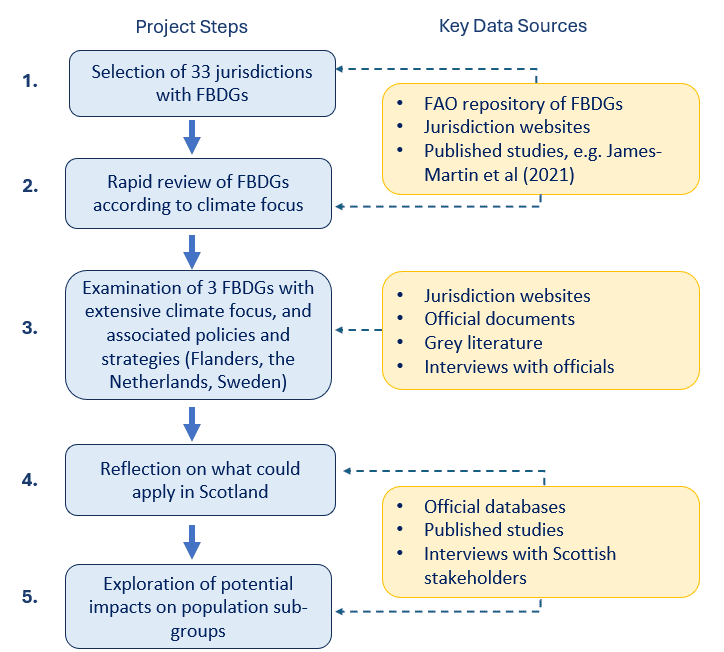
International review of FBDGs
Review of FBDGs in other jurisdictions, with reference to climate criteria
Appendix B provides a tabulated summary of information for all 33 FBDGs included in the review, on a country by country basis. Appendix C summarises the intakes for key food groups (all meat, red/processed meat, dairy, fruit and vegetables) as stated in the FBDGs for 22 of the 33 jurisdictions.
Of the 33 FBDGs studied, we found the majority (19) contained no or extremely limited reference to climate impact. Six contained moderate reference, while seven contained extensive reference (Table 2.1). It is worth noting that although the majority of countries have yet to explicitly include reference to climate in their FBDGs, or are still at the development phase, the number is increasing over time. For example, all the entries in the Extensive column have emerged in the past decade.
No reference, or very limited reference | Moderate reference | Extensive reference | |
Australia Austria Brazil Canada Croatia Cyprus Greece Hungary Iceland Ireland | Latvia Malta New Zealand Norway Portugal Romania Slovenia Switzerland UK USA | Belgium (national) Chile Estonia France Italy Poland | Denmark Finland Belgium (Flanders) Germany Netherlands Spain Sweden |
Jurisdictions in the red column: these have FBDGs which make no reference to climate impact, or only very limited reference, in either background or consumer-facing documents. ‘Limited reference’ denotes guidance which mentions sustainability, but only in an isolated way, and without any explanation or context. For example, the FBDGs of Austria and the UK (Eatwell Guide) both recommend choosing ‘sustainably sourced’ fish, by looking for MSC or similar labelling. However, this is the only reference to sustainability in the documents (i.e. no other food group has a similar recommendation), and there is no explanatory connection to the underlying sustainability issue with fishing.
Jurisdictions in the amber column: these FBDGs – in either consumer-facing or background documents – make more reference to climate than those in the red column. However, those references appear either in a circumscribed way, disconnected from the main guidance, or are individually brief or superficial within the body of the main guidance. An example of ‘circumscribed reference’ is the national guidance for Belgium. In the background document, there is a short stand-alone chapter dedicated to sustainability and climate, which explains the relevance to dietary issues. However, the contents are not connected to other chapters, and sustainability is not referred to in the consumer-facing guidance. An example of ‘superficial reference’ is the guidance for France. There are three individual references to climate and the environment in the consumer-facing guidance, however each one is very brief, without explanation of the underlying issues.
Jurisdictions in the green column: these FBDGs – in either the consumer-facing and/or background documents – make extensive reference to climate impact. The most advanced of these have climate impact as an integral component of the guidance, rather than an added feature, or set of ideas in development. Features that the ‘green’ FBDGs have in common include (i) introductory sections which make a clear connection between human health and planetary health, (ii) frequent references to climate impact throughout sections and applied to different food groups, (iii) effort (some more than others) to explain the reasons behind the climate-related guidance, and how consumers may navigate complexities and trade-offs between health and climate impacts.
Content of FBDGs with extensive climate focus
Overview of content
The jurisdictions found to have the most extensive reference to climate impact in their FBDGs were Denmark, Flanders, the Netherlands, Sweden and Finland. Germany and Spain are also included in this group, although their coverage is less extensive and integrated than the others[8].
These FBDGs make a clear link between human health and planetary health, by pointing out that what we eat affects not only our own well-being but also the environment. In terms of over-arching consumption advice, these FBDGs recommend:
- eating less meat and animal products;
- eating more plants, plant proteins and wholegrains;
- choosing nutrient dense foods over nutrient poor;
- drinking tap water;
- not overeating;
- avoiding waste.
The following sections describe what these climate-focused FBDGs advise, by food group. Advice from the Eatwell Guide is also referenced, for comparison.
Advice relating to meat
All seven FBDGs advise reducing meat consumption, due to the high GHG emissions from meat production, in particular ruminant meat. Table 2.2 shows the maximum recommended intake levels for meat in the seven FBDGs, and the Eatwell Guide. Germany specifies the lowest maximum weekly intake for all meat (240g), while Finland and the Netherlands specify the highest (500g). The Eatwell Guide does not specify a maximum level for all meat. The Netherlands specifies the lowest maximum intake for red/processed meat (300g) while Sweden specifies the highest (500g). The Eatwell Guide specifies the second highest maximum intake for red/processed meat at 490g.
All Meat (max g/wk) | Red/Processed (max g/wk) | |
Denmark | 350 | ns |
Finland | 500 | ns |
Flanders | ns | 330 |
Germany | 300 | 60 |
Netherlands | 500 | 300 |
Spain | 375 | ns |
Sweden | ns | 500 |
Eatwell Guide | ns | 490 |
ns: not specified. Germany: ‘all meat’ includes beef. Red/processed is processed only.
Examples of qualitative advice on meat in these FBDGs:
- When choosing meat, select more sustainably produced options, e.g. organic or agroecological, following a ‘’less but better” approach (The Netherlands, Sweden).
- Diets based on small amounts of meat can support the positive effects of grazing livestock on landscape and biodiversity (The Netherlands, Sweden)
- Meat-free days per week are specifically recommended by Denmark, Finland (1) Flanders (up to 4), Netherlands (up to 6), Spain (up to 7) and Sweden (up to 3).
The Eatwell Guide advises eating less red and processed meat. It gives no advice on production systems, nor on meat-free days.
Advice relating to dairy
The seven climate-focused FBDGs advise moderation in dairy product consumption, due to the GHG emissions associated with dairy farming. Table 2.3 shows the recommended daily intake levels for selected dairy products in these FBDGs. For milk/yoghurt, Denmark and Germany recommend c.250ml, while most others recommend a range extending to 500ml at the upper boundary. For hard cheese, the lowest recommended intake is 20g (Denmark) and the highest maximum is 60g (Spain). Four out of the six FBDGs do not specify a set intake level for cheese, although Germany offers guidance on how to allocate a total dairy amount between different product types. The Eatwell Guide does not specify intake levels for any dairy products.
Milk, yoghurt (ml/d) | Hard Cheese (g/d) | |
Denmark | 250 | 20 |
Finland | ns | ns |
Flanders | 250-500 | ns |
Germany | 250 | ns |
Netherlands | 300-450 | 40 |
Spain | 250-500 | 40-60 |
Sweden | 200-300 | ns |
Eatwell Guide | ns | ns |
Examples of qualitative advice for dairy consumption in these FBDGs:
- Take enough dairy to avoid chronic diseases and get enough nutrients, but not more than that, because dairy products come from cows, which have a high environmental impact (The Netherlands).
- Eating moderate amounts of dairy can support the positive effects of grazing livestock on landscape and biodiversity (Sweden).
- Where possible, choose eco-labels like organic for the more sustainably produced options (Sweden).
- Eat fewer processed dairy products, to get the nutritional benefits without the added climate burden from extra processing stages (Finland).
The Eatwell Guide advises eating ‘some’ milk and dairy food (or dairy alternatives). It gives no advice on production systems or levels of processing.
Advice relating to vegetables, fruit and plant proteins
All seven FBDGs give very clear recommendations to eat more vegetables, fruits and plant proteins for climate reasons. Table 2.4 shows the specified daily intake levels for these foods. For vegetables and fruit, recommended intakes range from 450g (Netherlands) to 690g (Spain). By comparison, the Eatwell Guide recommends the lowest minimum intake: at least 400g. In terms of legumes, only Denmark, Germany and Spain specify minimum intakes, from 100g (Denmark) to 200g (Spain) per week. For nuts, all jurisdictions except Sweden recommend intakes, from 15g to 30g per day. The Eatwell Guide does not recommend intake levels for legumes or nuts.
Examples of qualitative advice for vegetables, fruits and plant proteins in these FBDGs:
- Eat vegetables and fruit in season, for lower carbon footprint (Flanders, Sweden).
- Choose field grown rather than glasshouse grown (Flanders, Sweden), although glasshouses powered with renewable energy can have similar footprints (Finland).
- Locally grown is not necessarily lower carbon (Flanders).
- Choose ecolabelled and organic to reduce climate impact (Sweden).
- Legumes are nitrogen-fixing, which saves use of nitrogen fertilizer (Finland).
The Eatwell Guide does not advise on production methods or seasonality in this group.
Vegetables and Fruit (min g/d) | Legumes (min g/wk) | Nuts (g/d) | |
Denmark | 600 | 100 | 30 |
Finland | 500 | ns | 30 |
Flanders | 550 | ns | 15-25 |
Germany | 550 | 125 | 30 |
Netherlands | 450 | ns | 25 |
Spain | 690 | 200 | 20-30 |
Sweden | 500 | ns | ns |
Eatwell Guide | 400 | ns | ns |
Advice relating to cereals, grains, fats and oils
All climate-focused FBDGs highlight that, in general, grains and cereals have relatively low carbon footprints. Recommended intakes range from 75g (Denmark) to 90g (Sweden) wholegrain foods per day. Rice is identified as a grain with a higher carbon footprint (Denmark, Sweden, Finland), hence, advice is to swap rice for other grains or potatoes.
In terms of fats and oils, plant-based oils are recommended over butter and spreads due to their lower carbon impact (Denmark, Finland, Sweden). Within plant oils, rapeseed oil is presented as a particularly sustainable option, with a low carbon footprint (Sweden).
The Eatwell Guide does not advise about types of grains or fats from a climate perspective. This means that rice is recommended equally alongside pasta and potatoes. It recommends oils from plant sources, such as rapeseed and olive oil, as these are unsaturated fats. The outcome is that the same oils are recommended by Eatwell and the climate-focused FBDGs.
Advice relating to high fat, salt and sugar (HFSS) foods [9]
The seven FBDGs, advise to consume as few foods as possible from this category. This benefits the environment because (i) many foods in this category are ultra-processed (UPF), containing ingredients/processes which are carbon intensive, and (ii) they are nutrient poor. As all food production has an environmental impact, it is best to consume foods that are nutrient dense, to make the environmental impact ‘count’. All the FBDGs recommend tap water as the lowest carbon impact beverage, and that bottled drinks, including bottled water, should be avoided for the sake of the planet.
For HFSS foods, the Eatwell Guide’s recommendations are to avoid or eat in small amounts. The outcome is therefore the same as climate-focused FBDGs. For beverages, unlike the climate-focused FBDGs, the Eatwell Guide does not distinguish between bottled and tap water, and includes milk and diet/sugar-free drinks as recommended drinks.
Advice relating to sustainability
All climate-focused FBDGs contain the strong common messages of (i) only eat as much as you need and (ii) avoid food waste. The latter is advised as important for the planet because every food item wasted has an environmental impact that could have been avoided. The Eatwell Guide advises to eat only as much food as you need. It does not include any advice about food waste.
Summary of similarities and differences between climate-focused FBDGs and the Eatwell Guide
Advice within climate-focused FBDGs which is in common with the Eatwell Guide:
- Limit intake of red and processed meat (although 5 out of 6 FBDGs set maximum intakes lower than the Eatwell Guide)
- Eat plenty of vegetables and fruit (although all 6 FBDGs recommend minimum intake levels higher than the Eatwell Guide)
- Choose vegetable oils, e.g. rapeseed or olive oil, over animal fats
- HFSS foods are non-essential to diet so only eat in small amounts
- Only eat as much as you need
Advice within climate-focused FBDGs, which is different from the Eatwell Guide:
- Eat less meat and animal products, while increasing intake of plants and plant proteins (includes advocating meat-free days)
- Moderate dairy intake
- Choose seasonal, field grown vegetables and fruits
- Choose foods from more sustainable production methods, e.g. organic
- Choose potatoes, pasta or other grains over rice
- Favour unprocessed or lightly processed foods, and avoid UPFs
- The only recommended drinks are tap water, tea and coffee
- Avoid food waste
Sub-national variation
Of the seven FBDGs reviewed in this section, several come from jurisdictions with a degree of sub-national devolution, with regional powers able to adopt different approaches to certain policy areas. However, although guidance may be presented with regional badging, most often we found the substantive content of FBDGs is the same in different parts of a given country. The Flanders region of Belgium was the only clear example of sub-national variation in FBDGs found by this study. Yet policies to encourage uptake of nationally uniform FBDG do vary regionally in some jurisdictions. For example, across Dutch and Swedish municipalities and Australian States and Canadian Provinces.[10]
Case study: Flanders
This chapter provides an overview of the FBDGs in Flanders, how they were developed, and policy implementations to date. Appendix E provides more details.
FBDGs in Flanders: the Flanders Food Triangle
In Flanders, the FBDGs are captured in a 24-page consumer-facing document “Eating According to the Food Triangle: Good for Yourself and the Planet” (2021). It was developed by the Flemish Institute of Healthy Living (“Gezond Leven”), in cooperation with the Department of the Environment of the Flemish Government. The context of the guidance emphasises that the environmental impact of our food is currently greater than what our planet can bear, so dietary change is needed.
In terms of content, the Food Triangle (Figure 3.1) is offered as the basis for a healthy and environmentally responsible diet. It advises eating more vegetables, fruits, wholegrains and plant proteins, while eating less meat, butter and cheese. Discretionary foods (high in fat, salt and sugar) are separated from the triangle as non-essential to the diet, to be eaten ‘as little as possible’. This category includes processed meat. The guidance also recommends up to three or four days per week of meat-free meals. It provides links to support materials developed by Gezond Leven, including recipes for vegetarian meals and a seasonal buying guide for fruit and vegetables.

How the FBDGs were developed
A ‘science first’ approach was taken to develop the guidance. First, Gezond Leven and the Department of the Environment commissioned a review of scientific literature on the health and environmental impacts of dietary choices. Next, they convened a cross-disciplinary academic expert panel to help analyse the evidence and determine the core content of the final guidance. After this, public-facing messaging was designed and tested amongst citizens, with the support of experts in behaviour and communication. Only after the guidance was finalized were stakeholders consulted. Importantly, these consultations related only to the coordination and implementation of the guidance: they did not influence or change its substance.
Policies, strategies and actions related to the FBDGs
Various policy documents in Flanders have content aligned with the goals of the FBDGs, although they do not refer specifically to the guidance. For example, the ‘Strategic Plan: Flanders Lives Healthier in 2025’ and the ‘The Flemish Climate Policy Plan’ both refer to the need for changes to food consumption habits in the jurisdiction, for reasons of health and climate impact.
Recent strategies have also been launched with the aim to encourage more holistic, systems-based action on food than has been achieved historically. (In the past, policies for food have reflected departmental silos in government.) For example, the 2022 Flemish Food Strategy (“Go4Food”[11]) sets out 11 ‘Food Deal’ themes, around which cross-cutting actions are encouraged to coalesce. Funding is intended for these, albeit not specified in the document.
Another cross-cutting example is the ‘Flemish Protein Strategy 2021-2030’. This aims to increase the ratio of plant protein consumption vs animal protein consumption in Flanders to 60:40. Using CAP funding for domestic plant protein production as a catalyst, the strategy supports collaborations between food supply chain actors, research institutes and NGOs.
In practice, the Protein Strategy has led to increased domestic production of plant protein crops, research/innovation in processing, and promotion of plant proteins by food retailers. Overall, it represents an effort to fund coherent cross-sectoral work on sustainable food, by leveraging EU funding and private sector investment. CAP funding has similarly been used to encourage greater organic food production, albeit to a lesser degree than plant protein production.
Actions specifically to promote climate-friendly diets have been more limited in scope and scale. They have been largely focused on public communications campaigns and work with public catering (Table 3.1).
Policy type | What activities? |
Public information campaigns | Gezond Leven has produced various materials and resources for use by public and professionals, including videos, recipe cards, seasonal buying guides, etc. It has also entered into partnership with food retailers to promote increased consumption of plant proteins. |
Labelling | No introduction of new product labelling for climate impact. |
Regulation | No introduction of new demand-side regulations for climate impact of food. On supply side, targets have been set for levels of sustainable soya used in animal feeds. |
Taxes and Subsidies | The Belgian Government introduced a sugar tax in 2015. However no demand side taxes or subsidies on foods have been implemented for climate reasons. On the supply side, funding is available for plant protein production under the Protein Strategy. |
Public Procurement and Catering | Gezond Leven works with frontline staff in public catering, supporting them to change menus and practices for health and sustainability. All activity is voluntary, there are no mandatory changes. |
Evaluations of effects of FBDGs and/or policies
The Flanders Government conducts a National Food Survey on a 10-year cycle, with the next round due in 2024. This will be the first opportunity to gauge any changes in public dietary habits from the latest FBDGs. In the meantime, a recent small-scale survey on protein consumption showed trends in the desired direction (increases in plant consumption, decreases in meat consumption), but only to a very small extent. More formal evaluations of policy effectiveness are needed.
Case study: The Netherlands
This chapter provides an overview of the FBDGs in the Netherlands, how they were developed, and policy implementations to date. Appendix F provides more details.
FBDGs in the Netherlands: The Wheel of Five and Seven Steps to Sustainability
In the Netherlands, climate-focused dietary guidance is captured in the “Eating more sustainably: fact sheet” (2022), which accompanies the main “Wheel of Five” dietary model. The factsheet is a 10-page document targeted at professionals/policymakers. It sets out the case for environmentally sustainable diets, and explains how the Dutch diet should change to be in line with science-based planetary health recommendations.
The factsheet states that shifting from the current diet to the Wheel of Five is good for health and climate, but it also gives more specific advice about the most sustainable options to choose (Figure 4.1). The 7 ways are: (i) eat less meat (opt more often for pulses, nuts or eggs); (ii) waste as little as possible (buy and cook what you need); (iii) eat recommended amounts (moderate your snacks and sweets); (iv) drink mostly tap water; (v) eat enough dairy and cheese (but within bounds); (vi) buy seasonally (and check product origins); (vii) choose premium sustainability labels.

How FBDGs were developed
Two agencies led the development of the Dutch FBDGs. These were the National Institute for Public Health and the Environment (NIPHE), a research centre which collects and analyses scientific evidence and conducts data modelling, and the Netherlands Nutrition Centre (NNC), a body which translates the science into practical FBDGs for consumers and health professionals. Both are independent bodies, funded solely by the Ministries of Health and Agriculture.
In 2015, the NIPHE reviewed the scientific evidence on health and climate impacts of diets, with input from academic subject experts. NIPHE used this intelligence to model dietary guidelines as close as possible to the existing Dutch diet, while meeting parameters of health, climate impact, feasibility and impact on different target groups.
The NNC used the modelled solutions to draft the public facing dietary guidance, including the graphics. A transparent consultation process followed with experts, to check for any errors/omissions in the science, and also with health professionals, to advise on practical implementation.
The food industry was specifically not involved in the consultation. Only after the final guidance was completed were meetings held with industry representatives. This approach was taken to maintain both the real and perceived independence of the NIPHE and NNC. In total, the development process took several years.
Policies, strategies and actions related to the FBDGs
Policies relevant to food in the Netherlands appear to reflect the traditional priorities of host ministries, with relatively little integration of health and climate goals. For example, the 2018 ‘National Prevention Agreement: Towards a Healthier Netherlands’ makes no reference to climate or sustainability, while the 2019 ‘Climate Agreement’ contains only one brief reference to the need for change in food consumption habits. The 2015 ‘National Food Policy’ includes goals to increase consumption of fruits and vegetables, but these are justified for health not climate reasons.
However, the Dutch National Protein Strategy is more integrative. As in Flanders, CAP funding has been used to encourage plant protein production at farm level. This is being combined with further funding under economy-wide ‘green growth’ schemes, from both public and private sources, to encourage market growth along the supply chain.
Actions specifically to encourage take-up of the FBDGs are led by the NNC. They are centred on public communication tools and work with public caterers. In addition, one Dutch municipality (Haarlem city) is imposing a ban on outdoor advertising of meat. Table 4.1 provides more details.
What activities? | |
Public information campaigns | The NNC has launched two apps, to help consumers make healthier, more sustainable food choices. One of these, “Mijn Eetmeter”, allows users to record their eating habits and get tailored advice to improve their diet. This app has >2 million downloads and good ratings on GooglePlay and Apple Store. |
Labelling | No new labelling regime introduced, instead the NNC advises consumers on a set of the most reliable existing labels/certification schemes for making sustainable product choices. |
Regulation | At municipal level, the city of Haarlem will implement a ban on outdoor advertising of meat products in 2024. Climate impact is part of the motivation for the ban. There are no similar restrictions at national level. |
Taxes and Subsidies | There are no demand-side taxes or subsidies on foods for climate reasons (a sugar tax was introduced in 2023). In 2018 the Dutch Government stated an intention to remove VAT from fruit and vegetables. However, this was not implemented due to concerns about feasibility and effectiveness. On the supply side, funding is available for plant protein production and processing under the Protein Strategy. |
Public Procurement and Catering | The NNC works with public caterers to support and encourage them to develop more sustainable menus and practices. However, there are no mandatory measures imposed for climate impact. |
Evaluations of effects of the FBDGs and/or policies
The NNC undertakes consumer research and also administers the Dutch National Food Survey. Their data indicate that awareness of the Wheel of Five dietary model in the Dutch population is 71%, and trend analysis from the Dutch National Food Survey indicates small increases in fruit and vegetable consumption, and small decreases in meat consumption between 2007 and 2021. The changes are small, but in the right direction. However, policy effectiveness has not been evaluated formally.
Case Study: Sweden
This chapter provides an overview of the FBDGs in Sweden, how they were developed, and policy implementations to date. Appendix G provides more details.
FBDGs in Sweden: “Eat greener, not too much, and be active”
In Sweden, the FBDGs are captured in the 28-page consumer-facing document “Find your way to eat greener, not too much, and be active” (2015). It was developed by the Swedish National Food Agency (SNFA), in cooperation with the Swedish Public Health Agency, Board of Agriculture and Environmental Protection Agency. In terms of context, the guidance makes the argument for a holistic approach to eating, and for considering the environmental impact of food choices.
Advice is structured around 3 sections: 1. things to eat/do more of; 2. things to switch; and 3. things to eat less of (Figure 5.1). For each named food group (vegetables and fruits; seafood; wholegrains; healthy fats; low fat dairy products; red and processed meat; salt; sugar), there is a dedicated page which explains the advice in more detail, including the link to environmental impacts. These pages also offer specific ingredient and recipe suggestions to help make the change.

How FBDGs were developed
The Swedish National Food Agency is an independent, government-funded body, which administers public diet and health activities. It is one of 25 government agencies with special responsibility for achieving the government’s environmental objectives.
The FBDGs development process was science led, although stakeholder input happened earlier in the process than in Flanders and the Netherlands. From 2008-13, the Swedish Food Agency commissioned a series of reports on the environmental impacts of different foods, alongside evidence on the health effects of diet gathered from Nordic Nutrition Recommendations (NNR)[12]. The joint evidence was reviewed, with experts from the Swedish Public Health Agency, Board of Agriculture and Environmental Protection Agency. The review was supported by a stakeholder panel.
In 2014, a public consultation took place, including participants from industry, consumer and patient organisations, and public health professionals. Then the guidance was drafted and tested with consumers. The guidance was published in 2016/17. The whole process from initial discussions to publication took almost 10 years.
Since the development of this guidance, the latest revision of the Nordic Nutrition Recommendations (NNR), in 2023, has been published. It includes explicit reference to climate impact. It therefore provides a very high standard, scientifically informed evidence base on climate-friendly diets.
Policies, strategies and actions related to the FBDGs
In Sweden, the policy landscape for sustainable diets appears fragmented. For example, the 2016 “National Food Strategy for Sweden”, and subsequent 2019 “Action Plan”, focus almost exclusively on agricultural production. Meanwhile, the 2016 “Strategy for Sustainable Consumption” contains only a brief reference to food. The 2018 “Climate Framework Policy”, which sets out the Swedish Government’s net zero targets for the whole economy, also makes no reference to food consumption or dietary change.
In 2021, the Swedish Government tasked the Swedish Food Agency and Public Health Agency to propose areas of action needed for a more sustainable food system in Sweden, and indicators to measure progress[13]. The work was based on consultations with authorities, industry and civil society. The report, published 2024, emphasizes the need for joined-up policies to tackle health and climate problems. However, given recent shifts in politics in Sweden and hardening resistance from industry stakeholders to food system change, it may be challenging for officials to take forward many of the recommended Actions in the report.
Actions specifically to encourage take-up of the FBDGs are led by the Swedish Food Agency. To date, they have focused on public communications activities and work with public caterers, in particular schools. Table 5.1 provides more details.
Policy Type | What Activities? |
Public information campaigns | The Swedish Food Agency provides online information and manages a citizen panel to discuss healthy and sustainable eating. The Consumer Agency promotes food waste reduction within a circular economy. |
Labelling | No new product labelling introduced for climate-friendly food. Consumers are encouraged to refer to ‘Keyhole’ symbol (Swedish labelling scheme for healthy foods) and organic labels. |
Regulation | No regulatory changes applied. |
Taxes and Subsidies | No direct taxes or subsidies on the demand side to encourage shift to climate friendly diets. On supply side, there has been direct government investment in organic farming, to increase domestic land area under organic production. |
Public Procurement and Catering | Post-launch of FBDGs, the Swedish Food Agency undertook engagement work in school catering, this included encouragement of vegetarian days (voluntary). In 2020, “A New Recipe for School Meals” was launched, a collaboration between the National Food Agency and Vinnova, the Government research and innovation agency. The latter funded 4 municipalities to trial different projects, including measurement of waste and selling leftover meals[14]. |
Evaluations of effects of the FBDGs and/or policies
No formal evaluations have been conducted of the effect of the FBDGs on dietary habits. However, consumption trend data show that meat consumption peaked in 2016 and has subsequently declined whilst the proportion of Swedish meat within total meat consumed has increased. This suggests there has been some response to the “eat less but better” messaging, with ‘better’ meaning ‘Swedish’.
Implications for the potential development and implementation of climate-friendly FBDGs in Scotland
Having assessed climate-friendly FBGDs in other jurisdictions, and explored their development and policy implementation in Flanders, the Netherlands and Sweden, this chapter considers the possible implications for Scotland. Throughout this chapter, the FBDGs of Flanders, the Netherlands and Sweden are used as climate-focused comparators.
Dietary profile of Scotland compared with jurisdictions having climate-focused FBDGs
Studies show repeatedly that the diet of the average Scottish adult is unhealthy. It comprises higher than recommended intakes of calories, fat, sugar and salt, and lower intakes of fibre and fruit and vegetables[15]. These are associated with a range of chronic health problems, including diabetes, cardiovascular disease (CVD), hypertension and certain cancers.
In addition, average diets for some groups of Scottish consumers are deficient in micronutrients such as selenium and iodine. These deficiencies are also associated with a range of health problems, including fatigue, mental impairments and weakened immune systems. However, intake rates of red and processed meats are within the Scottish Dietary Goals maximum recommended for almost three quarters of the population[16].
Belgium (2014) | Netherlands (2021) | Sweden (2010/11) | Scotland (2021) | |
Fruit | 115 | 134 | 128 | 134 |
Vegetables | 155 | 174 | 176 | 131 |
Meat | 104 | 92 | 110 | 80 |
Dairy | 202 | 329 | 245 | 230 |
18 <= BMI <25 | 49% | 50% | 49% | 32% (42%)* |
25 <= BMI <30 | 35% | 35% | 35% | 36% (35%)* |
BMI >= 30 | 14% | 13% | 14% | 31% (20%)* |
Population | 6.8m | 18.0m | 10.6m | 5.4m |
* Scottish-specific BMI figures with UK figures in brackets from same Eurostat source as other countries. Comparisons are indicative given differences in survey methods, definitions and timings. See also Appendices B and C.
Table 6.1 above shows intakes for different food groups in Scotland, compared with Flanders, the Netherlands and Sweden. Notwithstanding caveats regarding precise comparability, the figures suggest that Scottish fruit consumption is relatively high compared to the other jurisdictions, while meat and vegetable intakes are relatively low. Dairy consumption appears similar to Sweden but lower than the Netherlands. Body Mass Index (BMI) scores, as indicators of broader diet-related health, are also similar for the proportion of the population overweight, but Scotland (and the UK) have markedly higher obesity rates.
Potential impacts on the Scottish population from take-up of climate-focused FBDGs
Potential Revisions to Eatwell Guide | Potential Risk to Population Health | |
Meat |
| Low, depending on substitution scenario |
Dairy |
| Deficiency risks for iron and iodine, depending on substitution scenario |
Vegetables, fruits and plant proteins |
| Low |
Cereals and grains |
| Low |
HFSS foods |
| Low |
Beverages |
| Low |
Other |
| Low |
Table 6.2. Examples of likely revisions needed to Eatwell Guide to align with more climate-focused FBDGs, and potential risks to Scottish population
The key features of climate-focused FBDGs were discussed in Chapter 2, summarizing similarities and differences between climate-focused guidance and the Eatwell Guide. Table 6.2 lists possible revisions for guidance in Scotland, to align with more climate-focused FBDGs. It also indicates the potential risks of negative impacts on the Scottish population, should the revised guidance be taken up. The potential risks for meat, dairy and sustainable sourcing advice are further discussed below. Potential risks for population sub-groups are discussed in section 6.3.
Potential impacts of revised meat intake advice
For greater climate focus, revisions to the Eatwell guidance would likely specify a lower maximum intake for red/processed meat, a new maximum intake for all meat, and strengthened messaging on reducing meat generally in the diet.
Comrie et al (2024) modelled the effects on micronutrient intake and of chronic disease risks from a 20% reduction in meat intake in Scotland, i.e. to levels consistent with the recommendations of UK Climate Change Committee (CCC).
They found that a 16% reduction could be achieved by encouraging the 28% highest red/processed meat eaters to limit their intake, of those meats alone, to the current Eatwell/SDGs maximum of 70g per day. To achieve the CCC’s 20% reduction target, the average intake of red/processed meat would need to reduce to 60g per day. This would impact the highest 32% of current red/processed meat consumers.
If meat intakes are substituted with alternative protein sources, e.g. fish, dairy or eggs, both scenarios above represent low risk options in terms of nutritional impacts. They would also bring health benefits associated with lowering red and red processed meat intakes. However, if meat intakes are substituted with refined grains or HFSS foods, then there are risks of diets becoming less rather than more healthy[18]. Therefore, revised dietary guidance needs to include advice about healthy and accessible substitutions for meat. Other policies need to make those substitutions affordable and accessible.
Non-GHG related environmental impacts are also possible from reduction in meat intakes, depending on which foods people switch to. Increases in demand for fish could exacerbate marine pollution/ecosystem problems. Also, switching from red ruminant meat (beef, lamb) to non-ruminant meat may lead to increases in intensive pig and poultry systems. Whilst these systems are more carbon efficient, they can increase air and water pollution problems[19]. To address these risks, a holistic perspective on environmental impact is needed during the scientific evidence gathering phase of the FBDG revisions. Other policies need to address environmental impacts of fish, pig and poultry systems.
Potential impacts of revised dairy intake advice
For greater climate focus, revisions to dietary guidance would likely set new advice to moderate dairy intake[20].
Comrie et al (2024) modelled the nutritional and chronic disease impacts of reducing dairy intake across the population by 20%, alongside meat reduction. They find that unless substituting with eggs, there are deficiency risks in the general population for iron and iodine. They highlight that as dairy is consumed in greater quantities across the population than meat, there is more reliance on it for micronutrients. Dairy is also a source of protection against Type 2 diabetes. Therefore, some nutritional and disease risks are possible, at the population level, from moderation of dairy intake.
In principle, nutritional and disease risks could be addressed with plant-based substitutes. However, these could require considerable changes to current dietary habits for many, and substitutes may have cost and accessibility issues. These have implications for the structure of the food environment. New advice on such changes would be needed, as the current guidance gives limited explanation. The new advice would need to address the composition of processed plant-based meat and dairy substitutes, in terms of fat, salt and sugar, and potentially , the use of fortification to supply key micronutrients. As is the case with existing meat and dairy products, at present, there is high variability between products and brands in the market, in terms of composition.
Potential impacts of advice on sustainable sourcing
For greater climate focus, revisions to the Eatwell guidance would likely introduce new advice on sustainable sourcing, for example choosing organic or agroecological products. These products are typically more expensive than conventional alternatives. In periods of generally squeezed incomes and high food price inflation, this advice may be unobtainable for many. Careful messaging would be needed within the guidance to address risks of frustration/alienation. At the same time, policy measures are needed to make sustainably sourced food more affordable and accessible[21].
Potential impacts on sub-groups of Scottish population from take-up of climate-focused FBDGs
With reference the likely changes to Eatwell guidance presented in Table 6.2, potential impacts are as follows:
Advice to reduce meat intake and moderate dairy intake
The modelling work conducted by Comrie et al (2024), on the impacts of reducing meat and dairy intakes across the population by 20%, also considered sub-groups. Depending on the substitution scenario, the authors found risks of some micronutrient deficiencies. These included selenium and zinc intakes for women and calcium intakes for young adults. Revised guidance on meat and dairy intakes would therefore need to include careful messaging and tailored advice for sub-groups, such as these, who may be at greater risk of micronutrient deficiencies. These problems may be exacerbated for women and young adults in lower income groups, who may find it more difficult to afford or access suitable meat alternatives, such as fish, eggs or plant proteins. Ability and capacity to cook meals using alternatives may also disproportionately affect these groups.
Advice to increase vegetable, fruit and plant protein intakes
Some population sub-groups may find it more difficult than others to access the range of vegetables, fruits and plant proteins recommended by revised guidance. As a result, they could face nutritional and disease risks, disproportionate to the wider population. These sub-groups could include lower-income consumers, who may struggle to afford more expensive items and/or cook the recommended foods. They could also include people in rural areas, or in urban food deserts/swamps, who face more limited ranges of foods and food retail options.
Advice to choose sustainably sourced foods
Citizens in lower income groups may be disproportionately unable to follow this advice. This could be particularly alienating. Careful messaging would be needed within the guidance. Programmes and initiatives are also needed to make sustainably sourced food more accessible and affordable.
Advice to favour potatoes, pasta and other grains over rice
This advice could disproportionately impact sub-groups whose diets rely more heavily on rice than the wider population. Tailored messaging would be needed, as well as advice on how to make the most climate-friendly choices for rice.
Advice to avoid UPFs and avoid food waste
Reducing consumption of processed and ultra-processed foods (UPFs) requires access to alternatives and a capacity for more labour and/or energy intensive food preparation. Hence consumers with restricted access due to income and/or food environment constraints and/or lacking the necessary time or facilities for food preparation (e.g. kitchen equipment) will be less likely to be able to avoid processed and UPFs. For similar reasons, consumers with limited or no access to appliances such as fridges and freezers may find it more difficult to follow advice to avoid food waste.
Policies, strategies and actions to implement climate-focused diets
Policy coordination for climate-focused diets
Policies to encourage take-up of climate-focused diets should make sustainable choices the easiest choices for consumers. This means tackling the food environment in a holistic way, using strategic packages of policy measures and instruments[22]. This requires collaboration and co-ownership between multiple government departments[23].
The case studies of Flanders, the Netherlands and Sweden reveal problems with coordination and coherent policy implementation on climate-friendly diets, to date. Siloed thinking has been evident, reinforced by resource allocations tied to narrow departmental remits rather than cross-cutting goals.
More recent food strategies aim to encourage more holistic, systems-based action on food and diets (e.g. the Flemish Food Strategy). However, implementation is at an early stage, and formal evaluations of their effectiveness have yet to be conducted.
Policy measures and actions for climate-focused diets.
Table 7.1 gives examples of specific policy measures for climate-focused diets that may feature in holistic packages. It also shows whether any of these measures have been applied in Flanders, the Netherlands or Sweden.
On both the demand and supply sides of the food system there are fiscal and regulatory measures. Also on the demand side are public information provision, labelling and public catering. The supply side also includes influencing voluntary industry action. In Flanders, the Netherlands and Sweden, public information campaigns and public catering dominate on the demand side, while fiscal measures and influencing industry dominate on the supply side. The pros and cons of these measures are discussed below, with implications for Scotland.
Policy Measure | Examples | At least one example applied in Flanders, Netherlands, Sweden? | |
Demand Side | Public information provision | Climate-friendly dietary guidance and information via websites, brochures, social media, digital technologies, face-to-face. | Yes (F, N, S). |
Labelling | Certifications for organic/agroecological production; carbon labels. | No new climate labels developed. | |
Fiscal Measures | ‘Cash first’ programmes for lower income groups; taxes on higher carbon foods; VAT reductions on lower carbon foods. | No food taxes or subsidies for climate reasons. | |
Regulation | Advertising restrictions on higher carbon foods; food waste restrictions. | One city-level ban on outdoor advertising of meat (N). | |
Public catering provision | Climate-friendly public food procurement standards; lower carbon menu design; carbon literacy training for catering staff. | Yes, voluntary actions for climate (F, N, S) | |
Supply Side | Influencing industry actions | Voluntary industry actions to reformulate products, give shelf space to plant proteins | Yes (F, N) |
Regulation | Climate-friendly domestic food production standards; climate-friendly standards for imported foods; mandatory carbon measurement and reporting. | Yes (F, N, S) | |
Fiscal measures | Subsidies for climate-friendly farming; funding for climate-friendly research and innovation. | Yes (F, N, S) |
Public information provision
This is a popular measure to encourage climate-friendly consumption. All three case study jurisdictions have applied it. Public information campaigns are relatively quick and inexpensive to implement, and the range of options now includes digital tools that offer interactivity (e.g. the Mijn Eetmeter diet tracking app in the Netherlands[24]).
However, there is little evidence that information alone can shift dietary habits. Population heterogeneity is significant, and people engage with or avoid information for multiple reasons[25]. Nevertheless, public information has a role to play in packages of policy measures. It may help to address low awareness of diet and sustainability issues in the population. Also, public information can signal the government’s priorities and direction of travel to citizens, industry and public bodies. This can be a way to show leadership to stakeholders[26].
Implications for Scotland:
Develop public information campaigns or messaging for climate-friendly diets as part of strategic policy packages, rather than stand-alone actions. Consider the multiple audiences for information on climate-friendly diets, and explore the potential for campaigns to signal clearly the policy agenda to a range of stakeholders.
Labelling
In theory, labelling schemes for climate-friendly foods can have an ‘industry pull’ effect. As producers change their practices in order to get certified, this brings widespread improvements[27]. However, evidence for the capacity of labels to change consumer behaviour is mixed at best[28]. Consumers already face multiple labelling schemes which compete for their attention. Also, environmental impact labels for food products are beset with technical challenges. For example, standardised, reliable metrics for carbon scores are lacking. In addition, labels which only show carbon values are ignoring other important environmental impacts.
For these reasons, climate-friendly labelling is uncommon[29]. None of the case study jurisdictions have sought to develop climate labels. Instead, they recommend existing certification schemes that are already familiar to consumers, as ways to identify more sustainable options. These include organic labels.
Implications for Scotland:
The development of any new carbon-specific labelling is unlikely to be worthwhile. Following the examples of the Netherlands and Sweden, it would be more feasible to focus on existing certification schemes (e.g. organic, meat quality assurance schemes), and explore ways to strengthen their climate relevance.
Fiscal measures and regulation (demand side)
Demand side regulation has been used actively in the food sector for public health reasons. Examples include restrictions on advertising unhealthy foods to children, and on the use of trans fats in food manufacturing. Fiscal measures (e.g. subsidies, taxes) have also been implemented for health reasons, for example, the Soft Drinks Industry Levy. Both types of measure are associated with stronger behaviour change outcomes than information or labelling. They are also associated with driving positive changes in industry practices, including reformulation of products[30].
However, these measures are less commonly applied explicitly in relation to climate-friendly diets, as they can have unintended consequences and evidence on effectiveness is mixed[31]. A risk of taxing high carbon foods like meat, for example, is that some consumers switch to foods of lower nutritional value, such as HFSS foods. As lower income households are already more likely to purchase such foods, such taxes risk exacerbating health inequalities. Furthermore, taxes on domestic high carbon foods may lead to carbon ‘leakage’ through import/export substitution effects, with no net reduction in global climate impact.
Implications for Scotland:
Taxes on foods for climate reasons may lead, unintentionally, to regressive outcomes. To address risks of exacerbating health inequalities, taxes should be partnered with policies to make healthier substitutes affordable and accessible to lower income groups. To address risks of GHG leakages, domestic carbon taxes should be partnered with appropriate trade policies.
Importantly however, not all tax/subsidy powers reside with the Scottish Government. Even those that do are subject to UK-wide agreement under the Internal Market Act 2020 and/or the Subsidy Control Act 2022.[32] Hence not all fiscal policy options are necessarily feasible within Scotland.
Public catering provision
Public catering is frequently presented as a policy area with the potential for direct behaviour change towards more climate-friendly diets[33]. There are two main ways this can happen. First, procurement standards and criteria can be revised to be more climate-focused. Criteria can relate to food and non-food purchases, facilities and equipment. Second, catering service practices can be revised to reduce climate impact. This can include, for example, recipe and menu design, and food waste reduction.
Flanders, the Netherlands and Sweden have all taken climate-related public catering actions, including introduction of meat-free days in school menus. To date, these actions have largely been voluntary for their sectors.
Implications for Scotland:
In the Scottish public sector, food procurement and catering provision are governed by separate standards. Often, they are also managed by different teams and processes, which presents challenges to coherent decision-making on climate impact.
To make public food procurement more climate friendly, a higher minimum weighting could be applied to climate criteria in contract awards. Suppliers could be asked to provide more carbon information, or be part of certification schemes. However, such demands may disproportionately impact small suppliers or first-time bidders. This would conflict with wider goals to encourage greater diversity in public procurement. Measures to reduce this risk may include supporting suppliers to meet more exacting climate requirements. Procurement officers could also be offered additional sustainability training.
Catering provision standards vary according to sector. In schools, statutory standards for food are based on nutritional not climate goals[34]. These standards could be revisited to explore ways to make them more climate-friendly. This would increase their consistency with local authority obligations to measure and reduce the carbon footprints of their services[35]. Extension of the Food For Life programme to all local authorities (currently voluntary) could also be a route to more climate focus.
In practice, school catering managers are increasingly taking voluntary climate actions, e.g. food waste reduction and meat-free days. Measures are needed to better support these actions, e.g. by strengthening public information on sustainable diets, and offering training and support for climate-friendly catering to service teams.
Influencing voluntary industry actions
Governments have well-established engagement with industry to encourage voluntary actions for public health reasons. Actions are now being encouraged to promote more climate-friendly food choices, for example, by reformulating products or changing microenvironments in-store to shape choice architecture[36]. Such approaches can be attractive to government since they avoid the time and effort needed to design and implement formal regulatory controls or taxes. However, industry actors may withdraw if market circumstances alter or industry leadership changes. Hence, voluntary agreements need to be monitored. They are often encouraged through the threat of imposing non-voluntary arrangements (e.g. regulation, fiscal measures) if engagement levels drop[37].
Both Flanders and the Netherlands are currently encouraging voluntary industry agreements related to sustainable diets. Under their Protein Strategies, they are encouraging domestic processors and retailers to increase activity in plant proteins. They have done this by presenting direct investments in domestic plant protein, derived from CAP Green Deal funding, as a market growth opportunity (see below). This is an example of more holistic policymaking, with coherence across supply and demand side measures.
Implications for Scotland:
Persuading industry partners to voluntarily adjust their practices requires either a perceived threat of future regulatory controls/fiscal distinctives from non-adjustment, or perceived benefits from doing so. Achieving either requires repeated engagement with industry stakeholders to establish mutual understanding of objectives, constraints and feasible options. Scottish industry stakeholders are already routinely involved in agricultural and food policy discussions, but voluntary actions by different stakeholders often progress at different rates. This can lead to poorly coordinated outcomes.[38]
Regulation and fiscal measures (supply side)
Various regulatory controls are applied to agricultural production across the EU, and some of these relate explicitly to mitigating GHG emissions. For example, farmers’ support funding requires adherence to Good Agricultural and Environmental Condition (GAEC) criteria. EU-level efforts also seek to regulate food imports on the basis of their GHG emissions. However, the link between all regulatory measures and domestic dietary guidance is often implicit at best.
Similarly, fiscal support for domestic agricultural production is also deployed under the EU-wide CAP. Much of this takes the form of decoupled payments not tied explicitly to the production of any particular (or indeed any) food product. However, some support is targeted explicitly at specific sectors, such as organic production and plant protein production. For the latter, further public funding from other sources has been deployed for R&D activities and to leverage private funding along the supply chain. This has been the case in Flanders and Netherlands’ Protein Strategies.
Implications for Scotland:
Agricultural production is already subject to various regulatory controls. Revision to agricultural funding support is likely to introduce new requirements related to GHG emissions. This will include obligations to monitor and report emissions[39]. Such improvements to the climate impact of Scottish agricultural production can be connected to advice within FBDGs, to choose more sustainably sourced foods.
Regulatory controls on imported food items fall outwith Scottish Government devolved powers.
Supply-side fiscal measures are already deployed within Scotland, most notably with respect to holders of agricultural land but also through investment and training grants for other parts of the supply-chain and funding for a range of research institutions. The majority of funding through such measures is not currently linked strongly to climate-related dietary change. However, as in some other countries, there may be scope to do so. This will require greater cross-departmental working and reprioritization of current budgets. Such issues feature in current parliamentary scrutiny of the Agricultural and Rural Communities Bill, including in relation to Good Food Nation ambitions.[40]
The scope for deploying new tax measures is more limited given constraints on devolved powers.
Conclusions
Listed by project objectives, the key findings are summarised here.
Dietary guidelines and recommendations in other jurisdictions
Out of 33 jurisdictions studied, only seven have FBDGs with extensive climate focus.
The main differences between health-focused and climate-focused guidance are that the latter recommends greater meat reduction, in particular ruminant meat, moderating dairy intake, choosing sustainably sourced foods, avoiding highly processed foods and avoiding food waste.
In three jurisdictions with climate-focused FBDGs (Flanders, the Netherlands, Sweden), the guidance was developed via a ‘science first’ approach, using expert panels and reviews. Stakeholder inputs were restricted to the final steps of messaging and implementation, to preserve the independence of the guidance.
Policies, strategies and actions taken to encourage progress to the guidelines
Policy implementation for climate-focused guidance requires coordination across government departments and budgets, and strategic packages of policy measures. These are needed to tackle food environments holistically, to make climate-friendly choices affordable and accessible.
Policy implementation of FBDGs in the three jurisdictions has lacked coordination, and measures have been largely limited to public information campaigns and encouragement of voluntary actions in public catering (e.g. menu adjustments).
Potential applications in Scotland and impacts on different groups
Adoption of climate-focused FBDGs would be a generally low-regret action, consistent with the direction of travel for policies relating to climate and health.
Some micronutrient deficiency risks are possible for certain population groups, depending on which foods are substituted. These include women, young adults, and lower income households. Other risks include import/export carbon leakage.
To address such issues, a coordinated cross-departmental policy approach would be needed, deploying a mix of supply-side and demand-side measures.
References and other supporting literature
Abrahamse, W., 2020. How to effectively encourage sustainable food choices: a mini-review of available evidence. Frontiers in psychology, 11, p.589674.
Aguirre-Sánchez, L., Teschner, R., Lalchandani, N.K., El Maohub, Y. and Suggs, L.S., 2023. Climate change mitigation potential in dietary guidelines: A global review. Sustainable Production and Consumption.
Ahrens, W., Brenner, H., Flechtner-Mors, M., Harrington, J.M., Hebestreit, A., Kamphuis, C.B., Kelly, L., Laxy, M., Luszczynska, A., Mazzocchi, M. and Murrin, C., 2022. Dietary behaviour and physical activity policies in Europe: learnings from the Policy Evaluation Network (PEN). European journal of public health, 32(Supplement_4), pp.iv114-iv125.
Ammann, J., Arbenz, A., Mack, G., Nemecek, T. and El Benni, N., 2023. A review on policy instruments for sustainable food consumption. Sustainable Production and Consumption.
Andretta, I., Hickmann, F.M., Remus, A., Franceschi, C.H., Mariani, A.B., Orso, C., Kipper, M., Létourneau-Montminy, M.P. and Pomar, C., 2021. Environmental impacts of pig and poultry production: insights from a systematic review. Frontiers in Veterinary Science, 8, p.750733.
Angelsen, A., Starke, A.D. and Trattner, C., 2023. Healthiness and environmental impact of dinner recipes vary widely across developed countries. Nature Food, pp.1-9.
Astbury, C.C., Aguirre, E., Cullerton, K., Monsivais, P. and Penney, T.L., 2021. How supportive is the global food supply of food-based dietary guidelines? A descriptive time series analysis of food supply alignment from 1961 to 2013. SSM-Population Health, 15, p.100866.
Bailey, R. and Harper, D.R., 2015. Reviewing interventions for healthy and sustainable diets. Chatham House, The Royal Institute of International Affairs.
Barton, K.L., Wrieden, W.L., Sherriff, A., Armstrong, J. and Anderson, A.S., 2015. Trends in socio-economic inequalities in the Scottish diet: 2001–2009. Public health nutrition, 18(16), pp.2970-2980.
Barton, K.L., Masson, L.F. and Wrieden, W.L., 2018. Estimation of food and nutrient intakes from food purchase data in Scotland, 2001-2015: report to Food Standards Scotland.
Barton, K.L., Ronald, C. and Savage, A., 2022. Estimation of food and nutrient intakes from food purchase data in Scotland between 2001 and 2018. Report to Food Standards Scotland
BDA 2020. Eating patterns for health and environmental sustainability: A Reference Guide for Dietitians. British Association of Dietitians.
Bechthold, A., Boeing, H., Tetens, I., Schwingshackl, L. and Nöthlings, U., 2018. Perspective: food-based dietary guidelines in Europe—scientific concepts, current status, and perspectives. Advances in nutrition, 9(5), pp.544-560.
Benton, T.G. and Bailey, R., 2019. The paradox of productivity: agricultural productivity promotes food system inefficiency. Global Sustainability, 2, p.e6.
Bergman, K., Lövestam, E., Nowicka, P. and Eli, K., 2020. ‘A holistic approach’: incorporating sustainability into biopedagogies of healthy eating in Sweden’s dietary guidelines. Sociology of Health & Illness, 42(8), pp.1785-1800.
Binns, C.W., Lee, M.K., Maycock, B., Torheim, L.E., Nanishi, K. and Duong, D.T.T., 2021. Climate change, food supply, and dietary guidelines. Annual review of public health, 42, pp.233-255.
Blomhoff, R., Anderson, R., Arnesen, A. et al. 2023. Nordic Nutrition recommendations 2023. Copenhagen: Nordic Council of Ministers.
Brennan, M., 2023. Food Systems Transformation in Scotland—The Journey to, Vision of, and Challenges Facing the New Good Food Nation (Scotland) Act. Sustainability, 15(19), p.14579.
Brink, E., van Rossum, C., Postma-Smeets, A., Stafleu, A., Wolvers, D., van Dooren, C., Toxopeus, I., Buurma-Rethans, E., Geurts, M. and Ocké, M., 2019. Development of healthy and sustainable food-based dietary guidelines for the Netherlands. Public health nutrition, 22(13), pp.2419-2435.
Burke, D.T., Hynds, P. and Priyadarshini, A., 2023. Quantifying farm-to-fork greenhouse gas emissions for five dietary patterns across Europe and North America: A pooled analysis from 2009 to 2020. Resources, Environment and Sustainability, p.100108.
Caleffi, S., Hawkes, C. and Walton, S., 2023. 45 actions to orient food systems towards environmental sustainability: co-benefits and trade-offs. London, UK: Centre for Food Policy
Cámara, M., Giner, R.M., González-Fandos, E., López-García, E., Mañes, J., Portillo, M.P., Rafecas, M., Domínguez, L. and Martínez, J.A., 2021. Food-based dietary guidelines around the world: A comparative analysis to update AESAN scientific committee dietary recommendations. Nutrients, 13(9), p.3131.
Cara, K.C., Goldman, D.M., Kollman, B.K., Amato, S.S., Tull, M.D. and Karlsen, M.C., 2023. Commonalities among dietary recommendations from 2010-2021 clinical practice guidelines: A meta-epidemiological study from the American College of Lifestyle Medicine. Advances in Nutrition.
Cobiac, L.J. and Scarborough, P., 2019. Modelling the health co-benefits of sustainable diets in the UK, France, Finland, Italy and Sweden. European journal of clinical nutrition, 73(4), pp.624-633.
Comerford, K.B., Miller, G.D., Boileau, A.C., Masiello Schuette, S.N., Giddens, J.C. and Brown, K.A., 2021. Global review of dairy recommendations in food-based dietary guidelines. Frontiers in nutrition, 8, p.671999.
Comrie, F., Jaacks, l., Kennedy, J., Mcdonald, A., McNeill, G., Runions, R., Stewart, C., Vonderschmidt, A. (2024). Approaches to modelling impact of reduction in meat and dairy intakes on micronutrient intakes and disease risk. CXC, University of Edinburgh, Food Standards Scotland.
Crippa et al., 2021. Food systems are responsible for a third of global anthropogenic GHG emissions. Nature Food, 2(3), pp.198-209.
Cullum, A., 2024. Developing food-based dietary recommendations in the UK. Proceedings of the Nutrition Society, 83(1), pp.55-61.
Darmon N, Drewnowski A. Contribution of food prices and diet cost to socioeconomic disparities in diet quality and health: a systematic review and analysis. Nutr Rev. 2015;73:643–660.
Dawkins, E., André, K., Leander, E., Axelsson, K. and Gerger Swartling, Å., 2023. Policy for sustainable consumptionan assessment of Swedish municipalities. Frontiers in Sustainability, 4, p.1265733.
Djojosoeparto, S.K., Kamphuis, C.B., Vandevijvere, S., Murrin, C., Stanley, I., Romaniuk, P., Harrington, J.M., Poelman, M.P. and PEN Consortium, 2022. Strength of EU-level food environment policies and priority recommendations to create healthy food environments. European Journal of Public Health, 32(3), pp.504-511.
Djojosoeparto, S.K., Kamphuis, C., Vandevijvere, S. and Poelman, M.P., 2022. How can national government policies improve food environments in the Netherlands? International Journal of Public Health, 67, p.1604115.
Drewnowski, A., 2020. Impact of nutrition interventions and dietary nutrient density on productivity in the workplace. Nutrition reviews, 78(3), pp.215-224.
EC. 2023. Health Promotion and Disease Prevention Knowledge Gateway. European Commission https://knowledge4policy.ec.europa.eu/health-promotion-knowledge-gateway/food-based-dietary-guidelines-europe-source-documents-food_en
EC. 2023. Food-Based Dietary Guidelines in Europe. European Commission. https://knowledge4policy.ec.europa.eu/health-promotion-knowledge-gateway/topic/food-based-dietary-guidelines-europe_en
Eluwa, T.F., Eluwa, G.I., Iorwa, A., Daini, B.O., Abdullahi, K., Balogun, M., Yaya, S., Ahinkorah, B.O. and Lawal, A., 2023. Impact of unconditional cash transfers on household livelihood outcomes in Nigeria. Journal of Social Policy, pp.1-16.
FAO 2023 Food-based dietary guidelines. https://www.fao.org/nutrition/education/food-based-dietary-guidelines/regions/countries/en/
Fischer, C.G. and Garnett, T., 2016. Plates, pyramids, and planets: developments in national healthy and sustainable dietary guidelines: a state of play assessment. Food and Agriculture Organization of the United Nations.
Food Standards Scotland 2020. The Scottish Diet – It needs to change, 2020 update. Food Standards Scotland.
Galli, A., Antonelli, M., Wambersie, L., Bach-Faig, A., Bartolini, F., Caro, D., Iha, K., Lin, D., Mancini, M.S., Sonnino, R. and Vanham, D., 2023. EU-27 ecological footprint was primarily driven by food consumption and exceeded regional biocapacity from 2004 to 2014. Nature Food, 4(9), pp.810-822.
Garnett, T., Mathewson, S., Angelides, P. and Borthwick, F., 2015. Policies and actions to shift eating patterns: what works. Foresight, 515(7528), pp.518-522.
Gladding, T.L., Rolph, C.A., Gwyther, C.L., Kinnersley, R., Walsh, K. and Tyrrel, S., 2020. Concentration and composition of bioaerosol emissions from intensive farms: pig and poultry livestock. Journal of environmental management, 272, p.111052.
Godin, L. and Sahakian, M., 2018. Cutting through conflicting prescriptions: How guidelines inform “healthy and sustainable” diets in Switzerland. Appetite, 130, pp.123-133.
Gržinić, G., Piotrowicz-Cieślak, A., Klimkowicz-Pawlas, A., Górny, R.L., Ławniczek-Wałczyk, A., Piechowicz, L., Olkowska, E., Potrykus, M., Tankiewicz, M., Krupka, M. and Siebielec, G., 2023. Intensive poultry farming: A review of the impact on the environment and human health. Science of the Total Environment, 858, p.160014
Hansen, K.L., Golubovic, S., Eriksen, C.U., Jørgensen, T. and Toft, U., 2022. Effectiveness of food environment policies in improving population diets: a review of systematic reviews. European Journal of Clinical Nutrition, 76(5), pp.637-646.
Harrington, J., Kenny, T. and O’Mahony, L. 2023. Building ‘sustainability’ into national healthy eating guidelines. Review of international practice and practical implications for policy. Safefood report.
Henchion, M., Moloney, A.P., Hyland, J., Zimmermann, J. and McCarthy, S., 2021. Trends for meat, milk and egg consumption for the next decades and the role played by livestock systems in the global production of proteins. Animal, 15, p.100287.
Hendrie, G.A., Lyle, G., Mauch, C.E., Haddad, J. and Golley, R.K., 2021. Understanding the variation within a dietary guideline index score to identify the priority food group targets for improving diet quality across population subgroups. International journal of environmental research and public health, 18(2), p.378.
Herforth, A., Arimond, M., Álvarez-Sánchez, C., Coates, J., Christianson, K. and Muehlhoff, E., 2019. A global review of food-based dietary guidelines. Advances in Nutrition, 10(4), pp.590-605.
Hoek, A.C., Malekpour, S., Raven, R., Court, E. and Byrne, E., 2021. Towards environmentally sustainable food systems: decision-making factors in sustainable food production and consumption. Sustainable Production and Consumption, 26, pp.610-626.
Jaacks, L., Frank, S., Vonderschmidt, A., Stewart, C., Runions, R., Kennedy, J., McNeill, G., Alexander, P. (2024). Understanding the climate impact of food consumed in Scotland. CXC report.
James-Martin, G., Baird, D.L., Hendrie, G.A., Bogard, J., Anastasiou, K., Brooker, P.G., Wiggins, B., Williams, G., Herrero, M., Lawrence, M. and Lee, A.J., 2022. Environmental sustainability in national food-based dietary guidelines: a global review. The Lancet Planetary Health, 6(12), pp.e977-e986.
Jennings, R., Henderson, A.D., Phelps, A., Janda, K.M. and van den Berg, A.E., 2023. Five US Dietary Patterns and Their Relationship to Land Use, Water Use, and Greenhouse Gas Emissions: Implications for Future Food Security. Nutrients, 15(1), p.215.
Kirwan, L.B., Walton, J., Flynn, A., Nugent, A.P., Kearney, J., Holden, N.M. and McNulty, B.A., 2023. Assessment of the Environmental Impact of Food Consumption in Ireland—Informing a Transition to Sustainable Diets. Nutrients, 15(4), p.981.
Kovacs, B., Miller, L., Heller, M.C. and Rose, D., 2021. The carbon footprint of dietary guidelines around the world: a seven country modeling study. Nutrition journal, 20, pp.1-10.
Kwasny, T., Dobernig, K. and Riefler, P., 2022. Towards reduced meat consumption: A systematic literature review of intervention effectiveness, 2001–2019. Appetite, 168, p.105739.
Laine, J.E., Huybrechts, I., Gunter, M.J., Ferrari, P., Weiderpass, E., Tsilidis, K., Aune, D., Schulze, M.B., Bergmann, M., Temme, E.H. and Boer, J.M., 2021. Co-benefits from sustainable dietary shifts for population and environmental health: an assessment from a large European cohort study. The Lancet Planetary Health, 5(11), pp.e786-e796.
Lassen, A.D., Christensen, L.M. and Trolle, E., 2020. Development of a Danish adapted healthy plant-based diet based on the EAT-Lancet reference diet. Nutrients, 12(3), p.738.
Leme, A.C.B., Hou, S., Fisberg, R.M., Fisberg, M. and Haines, J., 2021. Adherence to food-based dietary guidelines: a systemic review of high-income and low-and middle-income countries. Nutrients, 13(3), p.1038.
Lindström, H., Lundberg, S. and Marklund, P.O., 2020. How Green Public Procurement can drive conversion of farmland: An empirical analysis of an organic food policy. Ecological Economics, 172, p.106622.
Lobos, M.F., L’Abbé, M., Ng, S.H., Phulkerd, S., Ramirez‐Zea, M. and Rebello, S.A., 2019. An 11‐country study to benchmark the implementation of recommended nutrition policies by national governments using the Healthy Food Environment Policy Index, 2015‐2018. Obesity Reviews, 20, pp.57-66.
Macura, B., Ran, Y., Persson, U.M., Abu Hatab, A., Jonell, M., Lindahl, T. and Röös, E., 2022. What evidence exists on the effects of public policy interventions for achieving environmentally sustainable food consumption? A systematic map protocol. Environmental Evidence, 11(1), pp.1-9.
Martini, D., Tucci, M., Bradfield, J., Di Giorgio, A., Marino, M., Del Bo’, C., Porrini, M. and Riso, P., 2021. Principles of sustainable healthy diets in worldwide dietary guidelines: efforts so far and future perspectives. Nutrients, 13(6), p.1827.
Matthews, A., Candel, J., Mûelenaere, N.D. and Scheelbeek, P., 2023. The political economy of food system transformation in the European Union. In Resnick, D. and Swinnen, J., 2023. Political Economy of Food System Transformation. The Political Economy of Food System Transformation, Routledge.
Mazac, R., Renwick, K., Seed, B. and Black, J.L., 2021. An approach for integrating and analyzing sustainability in food-based dietary guidelines. Frontiers in sustainable food systems, 5, p.544072.
Milner, J., Green, R., Dangour, A.D., Haines, A., Chalabi, Z., Spadaro, J., Markandya, A. and Wilkinson, P., 2015. Health effects of adopting low greenhouse gas emission diets in the UK. BMJ open, 5(4), p.e007364.
OECD. 2021. Making Better Policies for Food Systems. OECD.
Pineda, E., Poelman, M.P., Aaspõllu, A., Bica, M., Bouzas, C., Carrano, E., De Miguel-Etayo, P., Djojosoeparto, S., Blenkuš, M.G., Graca, P. and Geffert, K., 2022. Policy implementation and priorities to create healthy food environments using the Healthy Food Environment Policy Index (Food-EPI): A pooled level analysis across eleven European countries. The Lancet Regional Health–Europe, 23.
Purnell, J.Q., Gernes, R., Stein, R., Sherraden, M.S. and Knoblock-Hahn, A., 2014. A systematic review of financial incentives for dietary behavior change. Journal of the Academy of Nutrition and Dietetics, 114(7), pp.1023-1035.
Reay, D. et al. 2020. From farm to fork: growing a Scottish food system that doesn’t cost the planet. Frontiers in Sustainable Food Systems, 4, p.72.
Reisch, L.A., Sunstein, C.R., Andor, M.A., Doebbe, F.C., Meier, J. and Haddaway, N.R., 2021. Mitigating climate change via food consumption and food waste: A systematic map of behavioral interventions. Journal of Cleaner Production, 279, p.123717.
Reisch, L.A., 2021. Shaping healthy and sustainable food systems with behavioural food policy. European Review of Agricultural Economics, 48(4), pp.665-693.
Romaniuk, P., Kaczmarek, K., Brukało, K., Grochowska-Niedworok, E., Łobczowska, K., Banik, A., Luszczynska, A., Poelman, M., Harrington, J.M., Vandevijvere, S. and Pen Consortium, 2022. The healthy food environment policy index in Poland: implementation gaps and actions for improvement. Foods, 11(11), p.1648.
Röös, E., Bajželj, B., Smith, P., Patel, M., Little, D. and Garnett, T., 2017. Greedy or needy? Land use and climate impacts of food in 2050 under different livestock futures. Global Environmental Change, 47, pp.1-12.
Röös, E., Larsson, J., Sahlin, K., Jonell, M., Lindahl, T., André, E., Säll, NS., Harring, N. and Persson, M. 2021. Policy Options for Sustainable Food Consumption – Review and Recommendations for Sweden. Mistra Sustainable Consumption report 1:10.
Rossi, L., Ferrari, M. and Ghiselli, A., 2023. The Alignment of Recommendations of Dietary Guidelines with Sustainability Aspects: Lessons Learned from Italy’s Example and Proposals for Future Development. Nutrients, 15(3), p.542.
Scheelbeek, P., Green, R., Papier, K., Knuppel, A., Alae-Carew, C., Balkwill, A., Key, T.J., Beral, V. and Dangour, A.D., 2020. Health impacts and environmental footprints of diets that meet the Eatwell Guide recommendations: analyses of multiple UK studies. BMJ open, 10(8), p.e037554
Schwingshackl, L., Watzl, B. and Meerpohl, J.J., 2020. The healthiness and sustainability of food based dietary guidelines. bmj, 370.
Scott, C., Sutherland, J. and Taylor, A., 2018. Affordability of the UK’s Eatwell Guide. The Food Foundation, p.17.
Sinclair, M., Combet, E., Davis, T. and Papies, E.K., 2023. Sustainability in food-based dietary guidelines: a review of recommendations around meat and dairy consumption and their visual representation. University of Glasgow preprint.
Some, S., Roy, J., Chatterjee, J.S. and Butt, M.H., 2022. Low demand mitigation options for achieving Sustainable Development Goals: Role of reduced food waste and sustainable dietary choice. Journal of Cleaner Production, 369, p.133432.
Speck, M., Wagner, L., Buchborn, F., Steinmeier, F., Friedrich, S. and Langen, N., 2022. How public catering accelerates sustainability: a German case study. Sustainability Science, 17(6), pp.2287-2299.
Springmann, M., Spajic, L., Clark, M.A., Poore, J., Herforth, A., Webb, P., Rayner, M. and Scarborough, P., 2020. The healthiness and sustainability of national and global food based dietary guidelines: modelling study. bmj, 370.
Stewart, C., McNeill, G., Runions, R., Comrie, F., McDonald, A. and Jaacks, P.L.M., 2023. Meat and milk product consumption in Scottish adults: Insights from a national survey. Available at SSRN 4628199.
Stoll-Kleemann, S. and Schmidt, U.J., 2017. Reducing meat consumption in developed and transition countries to counter climate change and biodiversity loss: a review of influence factors. Regional Environmental Change, 17, pp.1261-1277.
Strid, A., Hallström, E., Hjorth, T., Johansson, I., Lindahl, B., Sonesson, U., Winkvist, A. and Huseinovic, E., 2019. Climate impact from diet in relation to background and sociodemographic characteristics in the Västerbotten Intervention Programme. Public health nutrition, 22(17), pp.3288-3297
Tetens, I., Birt, C.A., Brink, E., Bodenbach, S., Bugel, S., De Henauw, S., Grønlund, T., Julia, C., Konde, Å.B., Kromhout, D. and Lehmann, U., 2020. Food-based dietary guidelines–development of a conceptual framework for future Food-Based Dietary Guidelines in Europe: report of a Federation of European Nutrition Societies Task-Force Workshop in Copenhagen, 12–13 March 2018. British Journal of Nutrition, 124(12), pp.1338-1344.
The Carnon Trust. 2016. The eatwell guide: A more sustainable diet.
Tucci, M., Martini, D., Marino, M., Del Bo’, C., Vinelli, V., Biscotti, P., Parisi, C., De Amicis, R., Battezzati, A., Bertoli, S. and Porrini, M., 2022. The Environmental Impact of an Italian-Mediterranean Dietary Pattern Based on the EAT-Lancet Reference Diet (EAT-IT). Foods, 11(21), p.3352.
van Dooren, C., Marinussen, M., Blonk, H., Aiking, H. and Vellinga, P., 2014. Exploring dietary guidelines based on ecological and nutritional values: a comparison of six dietary patterns. Food Policy, 44, pp.36-46.
von Philipsborn, P., Geffert, K., Klinger, C., Hebestreit, A., Stratil, J., Rehfuess, E.A. and PEN Consortium, 2022. Nutrition policies in Germany: a systematic assessment with the Food Environment Policy Index. Public Health Nutrition, 25(6), pp.1691-1700.
Vermeir, I., Weijters, B., De Houwer, J., Geuens, M., Slabbinck, H., Spruyt, A., Van Kerckhove, A., Van Lippevelde, W., De Steur, H. and Verbeke, W., 2020. Environmentally sustainable food consumption: A review and research agenda from a goal-directed perspective. Frontiers in psychology, 11, p.520238.
Whybrow, S., Hollis, J.L. and Macdiarmid, J.I., 2018. Social deprivation is associated with poorer adherence to healthy eating dietary goals: analysis of household food purchases. Journal of Public Health, 40(1), pp.e8-e15.
Wijesinha-Bettoni, R., Khosravi, A., Ramos, A.I., Sherman, J., Hernandez-Garbanzo, Y., Molina, V., Vargas, M. and Hachem, F., 2021. A snapshot of food-based dietary guidelines implementation in selected countries. Global Food Security, 29, p.100533.
Wood, A., Moberg, E., Curi-Quinto, K., Van Rysselberge, P. and Röös, E., 2023. From “good for people” to “good for people and planet”–Placing health and environment on equal footing when developing food-based dietary guidelines. Food Policy, 117, p.102444.
Wrieden, W., Halligan, J., Goffe, L., Barton, K. and Leinonen, I., 2019. Sustainable diets in the UK—developing a systematic framework to assess the environmental impact, cost and nutritional quality of household food purchases. Sustainability, 11(18), p.4974.
Yin, J., Hua, J., Zhang, X., Tuyishimire, A. and Yang, D., 2023. Healthy Eating for All? The Challenge of Adhering to Dietary Guidelines for Low-Income Groups in China. Nutrients, 15(12), p.2704.
Yoong, S.L., Turon, H., Wong, C.K., Bayles, L., Finch, M., Barnes, C., Doherty, E. and Wolfenden, L., 2023. An audit of the dissemination strategies and plan included in international food-based dietary guidelines. Public health nutrition, 26(11), pp.2586-2594.
Appendices
Appendix A: Interviewees and discussion guide
Flanders:
Senior professional from Flanders Institute of Healthy Living (Gezonden Leven)
Senior professional from Flanders Department of the Environment and Spatial Planning
Netherlands:
Senior professional from the Netherlands Nutrition Centre (Voedingscentrum)
Sweden:
Senior academic from the Swedish University of Agricultural Sciences
Scotland:
Representative from NESTA
Representative from NFUS
Representative from the British Dietetic Association
Senior academic, University of Edinburgh
Representative from the Soil Association
Two representatives from ASSIST FM
Representative from the Food and Drink Federation Scotland
Other:
Team of academics from the London School of Hygiene and Tropical Medicine (undertaking similar research on behalf of Defra)
Discussion Guide
Aims of Interview
The Scottish Government currently provides dietary guidance via the EatWell Guide, which promotes better health and nutritional outcomes. Scottish Government is exploring how to align the guidance with its climate objectives, to encourage diets that are both healthy and climate-friendly. The purpose of these discussions is to gather views on what climate-friendly dietary guidelines could look like in Scotland, what actions would be most effective to encourage their uptake, and what barriers, problems or unintended consequences Scottish Government should be aware of, from your perspective as a representative of [name of stakeholder group].
1.Explain privacy notice and confirm consent to undertake the interview [2 mins]
2. Opener [5 mins]
- From the perspective of your organisation/profession, what does a climate-friendly diet mean to you?
- What key features, or guidelines, would you expect in a climate-friendly diet?
- If interviewees are familiar with the EatWell Guide, could also ask how climate-friendly they think it currently is, and what they would change/revise, to make it more climate-friendly.
3. Discussion of climate friendly dietary guidance, using prompt material [10 or 15 mins, depending on interviewee’s expertise]
In advance, we will share the attached montage of dietary guidelines assembled from climate-focused FBDGs, i.e. Flanders, Netherlands, Sweden:
On the slide are examples of climate-friendly dietary guidance, from other countries. Please tell me:
- What is your impression of these dietary guidelines?
- To what extent could they apply in Scotland?
- In particular, what is your view about the advice to:
- Reduce meat consumption, especially red meat (including specifying maximum intake per week)?
- Moderate dairy consumption?
- From your perspective, what difference does the addition of climate-focused guidance make to nutritional outcomes? Does it create any tensions? Will consumers be more or less receptive?
- What problems or unintended consequences might come from guidance such as this in Scotland?
- Which groups may particularly benefit, and which groups may be negatively impacted?
- (If time – If ScotGov decided to develop climate-friendly dietary guidelines, what would your advice be about which stakeholders should be involved in the development process?
- Who should lead the process?
4. Discussion of how to encourage take-up of dietary guidance, using prompt material [10 or 15 mins, depending on interviewee’s expertise]
In advance, we will share the attached montage of policy instruments from other jurisdictions, designed to encourage climate-friendly diets.
On the slide are examples of policy actions in other countries to encourage take-up of climate-friendly diets. Please tell me:
- What is your impression of these policy actions?
- To what extent could they apply in Scotland?
- In particular, what is your view of:
- Carbon labelling of food
- Subsidising fruit and vegetables to targeted groups
- Changing public catering standards to encourage more meat-free menus
- Acting on the food environment
5. Wrap up
- Do you have any questions you would like to ask?
- Confirm how information will be used
- Thank participant and end interview
Appendix B: FBDG information for selected countries
Dietary Guideline information for selected countries, citing official documentation and showing degree to which guidance is linked to environmental impact. Recommendations included where linked explicitly to environment/climate[41]
All weblinks accessed during December 2023.
Austria
Document type | Publishing organisation | Document name (publication date) and weblink source | Document length (pages) | Comments |
Consumer | Austrian Agency for Health and Food Safety | Austrian Food Pyramid (2010)* https://www.fao.org/3/as659o/as659o.pdf also The Austrian Food Pyramid – AGES | 12 (pdf) | Only ref to environment is sustainable fish. Recommends low meat consumption, and seasonal, regional and organic food, but not for environmental reasons. No dietary recommendations are linked explicitly to environment or climate. |
Background | None found[42] | None found | N/A | N/A |
Degree to which document links guidance to environmental impact: Extensive and frequent Partial Occasional or none
Which document? | What Advice? | Why Do This? | How Do This? | Quantification? |
Consumer. | Consume sustainably sourced fish. | “In the spirit of sustainability” | “In the spirit of sustainability, when buying fish, look for certifications from MSC, ASC or organic” | “At least 300g fish per week” |
* New Austrian Food Pyramids (plural) are due to be published in the autumn of 2024, https://www.sozialministerium.at/Themen/Gesundheit/Ern%C3%A4hrung/%C3%96sterreichische-Ern%C3%A4hrungsempfehlungen-NEU.html
Australia
Document type | Publishing organisation | Document name (publication date) and weblink source | Document length (pages) | Comments |
Consumer | National Health and Medical Research Council | Eat for Health. Australian Dietary Guidelines Summary (2013) | 2 (pdf) | No mention of climate or environment. No dietary recommendations are linked explicitly to environment or climate. |
Background | National Health and Medical Research Council | Eat for Health. Australian Dietary Guidelines (2013) https://www.eatforhealth.gov.au/sites/default/files/2022-09/n55_australian_dietary_guidelines.pdf | 226 (pdf) | Briefly mentions climate and emissions, although cited examples do not relate to primary production. No dietary recommendations are linked explicitly to environment or climate. |
Degree to which document links guidance to environmental impact: Extensive and frequent Partial Occasional or none
Which Document? | What Advice? | Why Do This? | How Do This? | Quantification? |
N/A | N/A | N/A | N/A | N/A |
NB. National level guidelines apply everywhere but supporting policy measures vary across sub-national jurisdictions across Australia.
Belgium (country-wide)
Document type | Publishing organisation | Document name (publication date) and weblink source | Document length (pages) | Comments |
Consumer | Superior Health Council FPS Public Health, Walloon Agency for Quality Life (AVIQ) for the French version, Gezond Leven and Vlaanderen is zorg for the Flemish version. | FBDG: Eat and gain life-years? Doable! (2019) https://www.youtube.com/watch?v=_GcH7x7unQY The Food Tree (2019) https://www.karott.be/karott-epi-alimentaire/ and https://www.foodinaction.com/nl/voedingstak-pijlers-beter-eten/ (in Dutch and French, machine translated to English via Google Translate and DeepL) | 2.14 minutes (video) 6 (pdf) | Dietary recommendations are not linked explicitly to environment and climate. |
Background | Superior Health Council | Dietary Guidelines for the Belgian Adult Population (2019) https://www.health.belgium.be/sites/default/files/uploads/fields/fpshealth_theme_file/20191011_shc-9284_fbdg_vweb.pdf | 91 (pdf) | Sustainability issues are noted and endorsed as relevant, but not in an integrated way. Dietary recommendations are not linked explicitly to environment and climate. |
Degree to which document links guidance to environmental impact: Extensive and frequent Partial Occasional or none
Which document? | What Advice? | Why Do This? | How Do This? | Quantification? |
N/A | N/A | N/A | N/A | N/A |
NB. Guidance expected to be updated after 2023 see https://www.health.belgium.be/en/advisory-report-9284-fbdg-2019
Belgium (Flanders)
Document type | Publishing organisation | Document name (publication date) and weblink source | Document length (pages) | Comments |
Consumer | Departement Omgeving (Department of Environment) | Eating According to the Food Triangle: Good for Yourself and the Planet (2021) | 24 (pdf) | Dietary recommendations are linked explicitly to environment and climate. |
Background | Vlaams Instituut Gezond Leven (Flemish Institute for Healthy Living) | Rationale for a substantive food and health vision (2017); Food & Environmentally Responsible Consumption (2021) Achtergronddocument-Voeding-en-gezondheid.pdf (gezondleven.be) (in Dutch, machine translated to English via Google Translate and DeepL) Background-food-and-environment-EN.pdf (gezondleven.be) and www.gezondleven.be/voedingsdriehoek . | 30 (pdf) 133 (pdf) | Dietary recommendations are linked explicitly to environment and climate. |
Degree to which document links guidance to environmental impact: Extensive and frequent Partial Occasional or none
Which document? | What Advice? | Why Do This? | How Do This? | Quantification? |
Consumer. NB. Guidelines for Flanders are distinct from those issued by Wallonia, and indeed to those issued by the Superior Health Council for all adult Belgians. | Eat more plant-based food than animal-based food. Eat seasonal fruit and veg. Drink mostly tap water. Moderate fish consumption. Opt for less processed plant-based meat and dairy substitutes. | “Plant-based generally has lower environmental impact. Legumes very low impact compared to meat. Not only are seasonal fruits and veg at their best, but their environmental impact is also more limited. Did you know that buying local is not always better for the environment? They can have a higher environment impact if they are grown in heated greenhouses.” “Given that no packaging and transport is required, tap water has a lower environment impact. Fish can have a significant environmental impact.” | “Make a week menu and plan one veggie day to begin with. Increase number of veggie days step by step. Website and app for tasty and healthy recipes and a decision-tree to help choice. Better to opt for less processed variants like tofu, tempeh and seitan and use the Nutri-Score to make better choices. For dairy substitutes, soy drinks enriched with calcium and vitamins has nutritional value comparable to milk. Drinks based on nuts, oats or rice have lower protein content.” | “Start with one meat-free day per week and build from there. Eat handful of unsalted nuts every day.” “If opt for meat, have one meat meal per day and have a small portion… size of your palm.” “It is recommended to eat (oily) fish once or twice per week.” |
Brazil
Document type | Publishing organisation | Document name (publication date) and weblink source | Document length (pages) | Comments |
Consumer | Ministry of Health | Food Guide for the Brazilian population (2018) https://www.gov.br/saude/pt-br/assuntos/saude-brasil/publicacoes-para-promocao-a-saude/guiadebolso2018.pdf/@@download/file (in Portuguese, machine translated by Google Translate and DeepL). | 49 (pdf) | Environmental sustainability is mentioned briefly, but no dietary recommendations are linked explicitly to environment and climate. |
Background | Ministry of Health University of São Paulo | Dietary Guidelines for the Brazilian Population (2015) https://bvsms.saude.gov.br/bvs/publicacoes/dietary_guidelines_brazilian_population.pdf Food and health: the scientific basis of the food guide for the Brazilian population (2019) https://www.livrosabertos.sibi.usp.br/portaldelivrosUSP/catalog/view/339/298/1248 | 152 (pdf) 133 (pdf) | Environmental sustainability is acknowledged as important but no dietary recommendations are linked explicitly to environment and climate. |
Degree to which document links guidance to environmental impact: Extensive and frequent Partial Occasional or none
Which document? | What Advice? | Why Do This? | How Do This? | Quantification? |
N/A | N/A | N/A | N/A | N/A |
Canada
Document type | Publishing organisation | Document name (publication date) and weblink source | Document length (pages) | Comments |
Consumer | Health Canada | Canada’s Food Guide (2019) https://food-guide.canada.ca/sites/default/files/artifact-pdf/HEPs-Guide-nw-en.pdf see also https://food-guide.canada.ca/en/ | 2 (pdf) | Does recommend choosing protein that comes from plants more often and notes lower environmental impact, but no dietary recommendations are linked explicitly to environment or climate |
Background | Health Canada | Canada’s Dietary Guidelines for Health professionals and Policy makers (2018/19) https://food-guide.canada.ca/sites/default/files/artifact-pdf/CDG-EN-2018.pdf see also https://www.canada.ca/en/health-canada/services/food-nutrition/healthy-eating-strategy.html | 62 (pdf) | Background document briefly notes emissions from food waste. No dietary recommendations are linked explicitly to environment or climate |
Degree to which document links guidance to environmental impact: Extensive and frequent Partial Occasional or none
Which document? | What Advice? | Why Do This? | How Do This? | Quantification? |
N/A | N/A | N/A | N/A | N/A |
NB. National level guidelines apply everywhere but supporting policy measures vary across sub-national jurisdictions across Canada.
Chile
Document type | Publishing organisation | Document name (publication date) and weblink source | Document length (pages) | Comments |
Consumer | Ministry of Health | Food Guides for Chile (2022) https://www.minsal.cl/wp-content/uploads/2023/08/Guias-alimentarias-version-corregida-MINSAL.pdf (in Spanish, machine translated into English by Google Translate, DeepL unable to do so) | 12 (pdf) | No mention of climate or environment beyond reducing food packaging and waste. No dietary recommendations are linked explicitly to environment or climate |
Background | Ministry of Health | Dietary Guidelines for Chile (2022) https://www.minsal.cl/wp-content/uploads/2022/12/guias_alimentarias_2022_2ed.pdf (in Spanish, machine translated into English by Google Translate and DeepL) Updating Of Food-Based Dietary Guidelines Food-Based Dietary Guidelines (Fbg) For The Chilean Population”. Conceptual Development Framework Reports 1 & 2 (2022) https://www.minsal.cl/wp-content/uploads/2022/12/02.11.2022-PRODUCTO-1.pdf https://www.minsal.cl/wp-content/uploads/2022/12/02.112022-PRODUCTO-2.pdf (in Spanish, machine translated into English by Google Translate and DeepL) | 108 (pdf) 686 (pdf) 236 (pdf) | Sustainable, environment and climate are mentioned frequently, but no dietary recommendations are linked explicitly to environment or climate |
Degree to which document links guidance to environmental impact: Extensive and frequent Partial Occasional or none
Which document? | What Advice? | Why Do This? | How Do This? | Quantification? |
N/A | N/A | N/A | N/A | N/A |
Croatia
Document type | Publishing organisation | Document name (publication date) and weblink source | Document length (pages) | Comments |
Consumer | Croatian Institute for Public Health | Healthy living. Do you also eat healthy? (2018) https://www.hzjz.hr/wp-content/uploads/2020/03/Hrana-LETAK.pdf (in Croatian, machine translated into English by Google Translate and DeepL) | 2 (pdf) | No mention of climate or environment. No dietary recommendations are linked explicitly to environment or climate |
Background | Croatian Institute for Public Health | Recommendations for the spring and summer nutrition (2018) https://zivjetizdravo.eu/wp-content/uploads/2020/03/Brosura-PROLJECE_LJETO-.pdf and Recommendations for the autumn and winter nutrition, 2018 https://zivjetizdravo.eu/wp-content/uploads/2020/03/Brosura-JESEN_ZIMA-LowRes.pdf (in Croatian, machine translated into English by Google Translate and DeepL) | 2 x 28 (pdf) | No mention of climate or environment. No dietary recommendations are linked explicitly to environment or climate |
Degree to which document links guidance to environmental impact: Extensive and frequent Partial Occasional or none
Which document? | What Advice? | Why Do This? | How Do This? | Quantification? |
N/A | N/A | N/A | N/A | N/A |
Cyprus
Document type | Publishing organisation | Document name (publication date) and weblink source | Document length (pages) | Comments |
Consumer | Ministry of Health | National Nutrition and Exercise Guidelines leaflet (2011) (in Greek, machine translated into English by Google Translate, DeepL unable to do so) | 2 (pdf) | No mention of climate or environment. No dietary recommendations are linked explicitly to environment or climate |
Background | Ministry of Health | National Nutrition and Exercise Guidelines (2011) Layout 1 (moh.gov.cy) (in Greek, machine translated into English by Google Translate, DeepL unable to do so) | 16 (pdf) | No mention of climate or environment. No dietary recommendations are linked explicitly to environment or climate |
Degree to which document links guidance to environmental impact: Extensive and frequent Partial Occasional or none
Which document? | What Advice? | Why Do This? | How Do This? | Quantification? |
N/A | N/A | N/A | N/A | N/A |
NB. National level guidelines apply everywhere but supporting policy measures vary across sub-national jurisdictions across Canada.
Denmark
Document type | Publishing organisation | Document name (publication date) and weblink source | Document length (pages) | Comments |
Consumer | Ministry of Food, Agriculture and Fisheries | The Official Dietary Guidelines – Good for Health and Climate (2021) https://foedevarestyrelsen.dk/publikationer/2021/de-officielle-kostraad-godt-for-sundhed-og-klima-pjece (in Danish, machine translated into English by Google Translate and DeepL). Website also includes other materials. | 23 (pdf) | Frequent mention of climate/ environment. Recommendations are linked explicitly to environment or climate |
Background | National Food Institute Department of Risk Assessment and Nutrition | Nordic Nutrition Recommendations 2023 Integrating Environmental Aspects (2023) https://pub.norden.org/nord2023-003/ Advice on sustainable healthy eating. Professional basis for a supplement to the Official Dietary Guidelines (2020) https://www.food.dtu.dk/english/-/media/institutter/foedevareinstituttet/publikationer/pub-2020/rapport-raad-om-baeredygtig-kost.pdf (in Danish, machine translated into English by Google Translate and DeepL). | c.20 (web) 116 (pdf) | Explicit reference to Planetary Boundaries, SDGs, environment, climate change and EAT-Lancet etc. Recommendations are linked explicitly to environment or climate |
Degree to which document links guidance to environmental impact: Extensive and frequent Partial Occasional or none
Which document? | What Advice? | Why Do This? | How Do This? | Quantification? |
Consumer | “Eat more fruit and veg.” “Limit the use of butter”. “Eat less meat.” | Fruit and veg “…are among the foods with the lowest carbon footprint.” “A high intake of dairy products contributes to increased climate impact. “Cutting down on meat is also good for the climate. This applies to all types of mea, especially beef and lamb…. Poultry, pork and eggs have a significantly lower impact on the climate than beef and lamb.” | “Introduce meat-free days and use less meat in your meals. “Replace meat with vegetables, legumes or wholegrains.” “Choose vegetable oils and low-fat dairy products.” “Eat foods with wholegrains.” | “Around 350g or meat per week is sufficient.” “Around 250ml milk product per day, 20g cheese per day” “30g nuts per day, 1-2 tablespoons seeds per day” “75g wholegrains per day” “600g per day fruit and veg” plus “100g per day legumes” |
Estonia
Document type | Publishing organisation | Document name (publication date) and weblink source | Document length (pages) | Comments |
Consumer | National Institute for Health Development | The Food Pyramid(2017) tai_toidupuramiid_plakat_est_420x594mm_bleed_5mm_FIX (in Estonian, machine translated to English via Google Translate) | 1 (pdf) | No mention of environment or climate No dietary recommendations are linked explicitly to environment or climate |
Background | National Institute for Health Development | Estonian Diet and Exercise Recommendations (2017) https://intra.tai.ee/images/prints/documents/149019033869_eesti%20toitumis-%20ja%20liikumissoovitused.pdf (in Estonian, machine translated to English via Google Translate) | 338 (pdf) | Section on sustainable consumption and notes climate and environmental impacts. No dietary recommendations are linked explicitly to environment or climate |
Degree to which document links guidance to environmental impact: Extensive and frequent Partial Occasional or none
Which document? | What Advice? | Why Do This? | How Do This? | Quantification? |
N/A | N/A | N/A | N/A | N/A |
Finland
Document type | Publishing organisation | Document name (publication date) and weblink source | Document length (pages) | Comments |
Consumer | Finnish Food Authority
| Nutrition and Food Recommendations (2020) | c.30 (web) | Dietary recommendations are linked explicitly to environment and climate. |
Background | State Nutrition Advisory Board | Health from food. Finnish Nutrition Recommendations 2014 (2018) https://www.ruokavirasto.fi/globalassets/teemat/terveytta-edistava-ruokavalio/kuluttaja-ja-ammattilaismateriaali/julkaisut/ravitsemussuositukset_2014_fi_web_versio_5.pdf (in Finnish, machine translated to English via Google Translate) | 59 (pdf) | Dietary recommendations are linked explicitly to environment and climate. |
Degree to which document links guidance to environmental impact: Extensive and frequent Partial Occasional or none
Which document? | What Advice? | Why Do This? | How Do This? | Quantification? |
Consumer. | “More fruit and berries, vegetables, leguminous plants, whole and nuts and seeds.” “Less red meat and meat products” “We should favour domestic plants of the crop season, i.e. local and seasonal food.” | “A higher proportion of vegetables, root plants, potatoes, berries and fruit as well as cereal products in the diet reduces the load on the climate and eutrophication.” | “The more colourful your food is, the better! Eat some of your vegetables uncooked. Oil-based dressings add juiciness and flavour to salads and grated vegetables. Eating berries and fruit whole is better than juicing them.” “…it is advisable to select poultry meat rather than red meat.” | “Eat at least five handfuls of vegetables, berries and fruit a day.” “No more than 500 g of red meat and meat products a week (cooked weight).” |
France
Document type | Publishing organisation | Document name (publication date) and weblink source | Document length (pages) | Comments |
Consumer | Santé publique France | 50 Tips to Eat Better and Move More (2017) https://www.mangerbouger.fr/content/show/1501/file/Brochure_50_petites_astuces.pdf (in French, machine translated using Google Translate and DeepL) | 32 (pdf) | Document makes limited reference to the env, and only for meat and bottled water consumption. Other guidance, such as eating more veg, consuming organic, is made without linking to env outcomes. Eating to benefit the env is presented as choosing local and seasonal products. |
Background | ANSES French Agency for Food, Environmental, and Occupational Health & Safety Santé publique France | Updating of the PNNS guidelines: revision of the food-based dietary guidelines ANSES opinion Collective expert report (2016) https://www.anses.fr/en/system/files/NUT2012SA0103Ra-1EN.pdf Recommendations Concerning Diet, Physical Activity and Sedentary Behaviour for Adults (2019, Updated 2023) https://www.santepubliquefrance.fr/content/download/515446/3807453?version=1 | 282 (pdf) | Document gives explanation of the process by which the revised guidelines were arrived at, and justification/evidence for the decisions. It does not refer to the environment – it is entirely health-based. |
Degree to which document links guidance to environmental impact: Extensive and frequent Partial Occasional or none
Which document? | What Advice? | Why Do This? | How Do This? | Quantification? |
Consumer. | “Good eating also means taking into account the environment by showing preference for foods from local producers and foods in season.” “Eat less meat, eat more pulses.” | “Of all foods, it’s meat which has the biggest climate impact. Pulses are the heroes of sustainable agriculture, as they naturally enrich the soil without need for fertilisers, and use little water.” | Various meal suggestions for including more pulses. No actual direction on swapping meat with pulses | “Maximum of 500g per week of meat, of which maximum 150g processed meat. Eat minimum 2 portions of pulses per week.” |
Germany
Document type | Publishing organisation | Document name (publication date) and weblink source | Document length (pages) | Comments |
Consumer | German Society for Nutrition (DGE) | DGE Nutrition Circle (2024) https://www.dge.de/gesunde-ernaehrung/gut-essen-und-trinken/dge-ernaehrungskreis/ but also Eat and drink well – the DGE recommendations (2024) Eat and drink well – the DGE recommendations | DGE and FAQ (2024) https://www.dge.de/gesunde-ernaehrung/faq/lebensmittelbezogene-ernaehrungsempfehlungen-dge/#c6508 | 1+ (web) 1+ (web) 1+ (web) | Explicit reference to environment impacts, albeit not explained in great detail |
Background | German Environment Agency German Federal Ministry for Food and Agriculture German Society for Nutrition (DGE) | Towards healthy and sustainable diets in Germany An analysis of the environmental effects and policy implications of dietary change in Germany (2023) https://www.umweltbundesamt.de/sites/default/files/medien/11740/publikationen/2023-05-10_texte_67-2023_towards_healthy_1.pdf Key Issues Paper: Towards the Federal Government’s Food Strategy (2022) https://www.bmel.de/SharedDocs/Downloads/DE/_Ernaehrung/ernaehrungsstrategie-eckpunktepapier.html (in German, machine translated to English using Google Translate and DeepL) Scientific basis of food-related dietary recommendations for Germany (2024) https://www.ernaehrungs-umschau.de/fileadmin/Ernaehrungs-Umschau/pdfs/pdf_2024/03_24/EU03_2024_M158_M166_Online.pdf (machine translated via DeepL) | 11 (pdf) 10 (pdf) 9 (pdf) | Environmental impacts of dietary choices acknowledged explicitly. |
Degree to which document links guidance to environmental impact: Extensive and frequent Partial Occasional or none
Which document? | What Advice? | Why Do This? | How Do This? | Quantification? |
Consumer | Take advantage of the variety of foods and eat a varied diet. Choose predominantly plant-based foods. | Predominantly plant-based diet have less impact on the environment and the climate. In the production of plant-based foods, the consumption of resources and the emission of harmful greenhouse gases is lower than in the production of animal-based foods | Incorporate vegetables and fruits into every meal, either raw or gently prepared, so that many nutrients are preserved. The more colorful, the better. For meat and sausage, choose the low-fat variants. | At least 550g of fruit and vegetables daily. No more than 500g of milk and dairy products daily. A weekly amount of meat and sausage of no more than 300g. |
Greece
Document type | Publishing organisation | Document name (publication date) and weblink source | Document length (pages) | Comments |
Consumer | Ministry of Health | National Nutrition Guide for Greek Adults (2014) http://www.diatrofikoiodigoi.gr/files/PDF/ADULTS.pdf (in Greek, machine translated to English via Google Translate) Also http://www.diatrofikoiodigoi.gr/?page=summary-adults (English summary) | 132 (pdf) 16 (web) | Pollution from food transport is mentioned. No dietary recommendations are linked explicitly to environment or climate. |
Background | Ministry of Health | National Nutrition Guide for Greek Adults – Scientific Documentation (2014) | 250 (pdf) | Briefly notes climate and environmental impacts of animal production and benefits of plant based Mediterranean diet, but no dietary recommendations are linked explicitly to environment or climate. |
Degree to which document links guidance to environmental impact: Extensive and frequent Partial Occasional or none
Which document? | What Advice? | Why Do This? | How Do This? | Quantification? |
N/A | N/A | N/A | N/A | N/A |
Hungary
Document type | Publishing organisation | Document name (publication date) and weblink source | Document length (pages) | Comments |
Consumer | National Association of Hungarian Dietitians (endorsed by Food Science Scientific Committee of the Hungarian Academy of Sciences) | OKOSTÁNYÉR® – SmartPlate, new Hungarian Dietary Recommendations (2016, renewed in 2021) http://mdosz.hu/uj-taplalkozasi-ajanlasok-okos-tanyer/ (Hungarian, machine translated into English using Google Translate and DeepL) and https://www.okostanyer.hu/wp-content/uploads/2021/11/2021_OKOSTANYER_ANGOL_felnott_A4.pdf (in English). Other web resources (2018 – 2021) at https://www.okostanyer.hu/ (some in English) | 1+ (web) 3 (pdf) | Renewed version mentions more plant-based foods and restricting meat. No dietary recommendations are linked explicitly to environment or climate. |
Background | None found | None found | N/A | N/A |
Degree to which document links guidance to environmental impact: Extensive and frequent Partial Occasional or none
Which document? | What Advice? | Why Do This? | How Do This? | Quantification? |
N/A | N/A | N/A | N/A | N/A |
Iceland
Document type | Publishing organisation | Document name (publication date) and weblink source | Document length (pages) | Comments |
Consumer | Directorate of Health | Dietary Recommendations for Adults and Children from the Age of Two (2017) https://island.is/en/nutrition-recommendations/radleggingar_spurningar_svor see also Radleggingar_mataraedi_vef_utgafa_2021.pdf (ctfassets.net) and diskamodel- skola (ctfassets.net) (both in Icelandic, machine translated to English using Google Translate and DeepL) | 28 (pdf) | Based on Nordic Nutrition Recommendations from 2013. No mention of environment or climate. No dietary recommendations are linked explicitly to environment or climate. |
Background | Directorate of Health | Basis for dietary recommendations (2016) Grundvollur_radlegginga_um_mataraedi_og_radlagdir_dagskammtar.pdf (ctfassets.net) (in Icelandic, machine translated to English using Google Translate) | 25 (pdf) | Based on Nordic Nutrition Recommendations from 2013. Passing reference to environment and climate. No dietary recommendations are linked explicitly to environment or climate |
Degree to which document links guidance to environmental impact: Extensive and frequent Partial Occasional or none
Which document? | What Advice? | Why Do This? | How Do This? | Quantification? |
N/A | N/A | N/A | N/A | N/A |
Ireland
Document type | Publishing organisation | Document name (publication date) and weblink source | Document length (pages) | Comments |
Consumer | Health Service Executive | The Healthy Food Pyramid (2016) https://www.hse.ie/eng/about/who/healthwellbeing/our-priority-programmes/heal/food-pyramid-images/food-pyramid-simple-version.pdf and Healthy Food for Life. The Food Pyramid guide to every day food choices for adults, teenagers and children aged five and over (2016) https://assets.gov.ie/7649/3049964a47cb405fa20ea8d96bf50c91.pdf | 1 (pdf) 7 (pdf) | No mention of environment or climate No dietary recommendations are linked explicitly to environment or climate |
Background | Health Service Executive | Healthy Food for Life Food Pyramid Questions and Answer (2016) Healthy Food for Life Revised healthy eating guidelines and Food Pyramid rationale (2016) https://www.hse.ie/eng/about/who/healthwellbeing/our-priority-programmes/heal/food-pyramid-images/foodforlifefoodpyramidrationale2016.pdf | 4 (pdf) 8 (pdf) | No mention of environment or climate No dietary recommendations are linked explicitly to environment or climate |
Degree to which document links guidance to environmental impact: Extensive and frequent Partial Occasional or none
Which document? | What Advice? | Why Do This? | How Do This? | Quantification? |
N/A | N/A | N/A | N/A | N/A |
Italy
Document type | Publishing organisation | Document name (publication date) and weblink source | Document length (pages) | Comments |
Consumer | CREA Food and Nutrition Research Center | Guidelines for Healthy Eating (2019) https://sapermangiare.mobi/483/linee-guida.html (in Italian, machine translated to English using Google Translate and DeepL), with links through to sections of Background document (oddly ignoring meat) Sustainable Diets https://sapermangiare.mobi/N3567/diete-sostenibili.html (in Italian, machine translated to English using Google Translate and DeepL) | 13 (web + vidoes)) 1 (web) | Sustainable consumption discussed, but dietary recommendations are not linked explicitly to environment or climate, and env criteria are secondary to health and cultural criteria |
Background | CREA Food and Nutrition Research Center | Healthy Eating Guidelines Revision 2018 (2019) https://www.crea.gov.it/en/web/alimenti-e-nutrizione/-/linee-guida-per-una-sana-alimentazione-2018 (in Italian, machine translated to English using Google Translate and DeepL) | 231 (pdf) | Section on sustainable consumption and notes climate and environmental impacts, but dietary recommendations are not linked explicitly to environment or climate |
Degree to which document links guidance to environmental impact: Extensive and frequent Partial Occasional or none
Which document? | What Advice? | Why Do This? | How Do This? | Quantification? |
N/A | N/A | N/A | N/A | N/A |
Latvia
Document type | Publishing organisation | Document name (publication date) and weblink source | Document length (pages) | Comments |
Consumer | Ministry of Health | Eat healthily using the plate principle (2020) https://esparveselibu.lv/sites/default/files/2020-09/Skivja-princips-infografika.pdf (in Latvian, machine translated to English using Google Translate and DeepL) | 1 (pdf) | No mention of climate or environment. No dietary recommendations are linked explicitly to environment or climate. |
Background | Ministry of Health | Dietary Guidelines for Adults (2020) https://esparveselibu.lv/sites/default/files/inline-files/VM_Uztura_ieteik_pieaug.pdf (in Latvian, machine translated to English using Google Translate and DeepL) | 13 (pdf) | Guidelines influenced by the WHO recommendations and Nordic Nutrition. No mention of climate or environment. No dietary recommendations are linked explicitly to environment or climate. |
Degree to which document links guidance to environmental impact: Extensive and frequent Partial Occasional or none
Which document? | What Advice? | Why Do This? | How Do This? | Quantification? |
N/A | N/A | N/A | N/A | N/A |
Malta
Document type | Publishing organisation | Document name (publication date) and weblink source | Document length (pages) | Comments |
Consumer | Ministry for Health | Dietary guidelines for Maltese adults. Healthy eating the Mediterranean way! (2015) https://hpdp.gov.mt/sites/default/files/2023-07/healthy_eating_the_mediterranean_way_en.pdf Dietary Guidelines for Maltese Children the Mediterranean Way! (2018) | 16 (pdf) 16 (pdf) | No mention of climate or environment. No dietary recommendations are linked explicitly to environment or climate. |
Background | N/A | None found (but strategy is published as https://health.gov.mt/wp-content/uploads/2023/04/Food_and_Nutrition_Policy_and_Action_Plan_for_Malta_2015-2020_EN.pdf) | N/A | FAO cites “Dietary guidelines for Maltese adults: information for professionals” but links are broken |
Degree to which document links guidance to environmental impact: Extensive and frequent Partial Occasional or none
Which document? | What Advice? | Why Do This? | How Do This? | Quantification? |
N/A | N/A | N/A | N/A | N/A |
Netherlands
Document type | Publishing organisation | Document name (publication date) and weblink source | Document length (pages) | Comments |
Consumer | Netherlands Nutrition Centre Netherlands Nutrition Centre | The Wheel of five (2020) https://www.voedingscentrum.nl/Assets/Uploads/voedingscentrum/Documents/Service/English/Wheel-of-five.pdf How do you eat healthy and sustainably? Sustainable eating in 7 steps (2020) https://www.voedingscentrum.nl/nl/duurzaam-eten/duurzaam-eten-in-7-stappen.aspx https://www.voedingscentrum.nl/nl/gezond-eten-met-de-schijf-van-vijf/hoe-eet-je-gezond-en-duurzaam.aspx (in Dutch, machine translated to English using Google Translate, DeepL unable to do so) | 5 (pdf) 1 (web) 1 (web) | Mentions sustainability but no meaningful link to recommendations Dietary recommendations are linked explicitly to environment or climate. |
Background | Netherlands Nutrition Centre | Eating More Sustainably: Fact Sheet for professionals (2022) | 8 (pdf) | Dietary recommendations are linked explicitly to environment or climate. |
Degree to which document links guidance to environmental impact: Extensive and frequent Partial Occasional or none
Which document? | What Advice? | Why Do This? | How Do This? | Quantification? |
Background | ”..eat less meat, and what meat you do eat, make it more sustainably produced meat” “within each food category, eat the most sustainably produced or lowest envtl impact option” “eat enough dairy and cheese, but within boundaries”. “navigate trade-offs between sustainability impacts of animal production systems” | “The current Dutch diet is not sustainable.” “The food we eat has a major impact on the environment” “Generally speaking, the greatest environmental benefit can be achieved by: eating less meat and more sources of plant-based proteins, such as pulses and nuts; wasting less food; only eating what you need”. “…meat is responsible for easily the largest proportion of GHG emissions” | “A diet based on the Wheel of Five can be food for your health as well as beneficial in terms of sustainability.” “Opt more often for pulses, nuts or eggs”. “Select certified products from the list approved by Milieu Centraal” “Consume fewer products that are not on the Wheel of Five” “Buy and cook what you need”, “eat recommended amounts” “…sometimes compromises are necessary… | “If you eat 400g of meat a week rather than the recommended maximum of 500g, this would result in a reduction in GHG emissions of 9% for men and 10% for women”. Also “If you stop eating meat and replace it with pulses, nuts and eggs, this would result in a reduction in GHG emissions of 35% for men and 37% for women” |
New Zealand
Document type | Publishing organisation | Document name (publication date) and weblink source | Document length (pages) | Comments |
Consumer | Ministry of Health | Eating and Activity Guidelines for New Zealand Adults: Summary of Guidelines Statements and Key Related Information (2021) | 6 (pdf) | No mention of climate or environment. No dietary recommendations are linked explicitly to environment or climate |
Background | Ministry of Health | Eating and Activity Guidelines for New Zealand Adults (2020) https://www.health.govt.nz/system/files/documents/publications/eating-activity-guidelines-new-zealand-adults-updated-2020-oct22.pdf | 164 (pdf) | Mentions environmental impacts and emissions but no dietary recommendations are linked explicitly to environment or climate. |
Degree to which document links guidance to environmental impact: Extensive and frequent Partial Occasional or none
Which document? | What Advice? | Why Do This? | How Do This? | Quantification? |
N/A | N/A | N/A | N/A | N/A |
Norway
Document type | Publishing organisation | Document name (publication date) and weblink source | Document length (pages) | Comments |
Consumer | Norwegian Directorate of Health | Norwegian Dietary Guidelines (c.2014) | 28 (pdf) | No mention of climate or environment. No dietary recommendations are linked explicitly to environment or climate |
Background | National Council for Nutrition, Directorate of Health | Dietary advice to promote public health and prevent chronic illnesses: methodology and scientific knowledge base (2011). Not found online, only in printed form https://www.fagbokforlaget.no/Kostr%C3%A5d-for-%C3%A5-fremme-folkehelsen-og-forebygge-kroniske-sykdommer/I9788245022995 | 353 (physical) | N/A |
Degree to which document links guidance to environmental impact: Extensive and frequent Partial Occasional or none
Which document? | What Advice? | Why Do This? | How Do This? | Quantification? |
N/A | N/A | N/A | N/A | N/A |
NB New Nordic Nutrition Recommendations (2023) https://www.norden.org/en/publication/nordic-nutrition-recommendations-2023 explicitly address sustainability issues and may indicate likely revision to expected update of dietary guidelines
Poland
Document type | Publishing organisation | Document name (publication date) and weblink source | Document length (pages) | Comments |
Consumer | Ministry of Health National Institute of Public Health | Eating and Activity Guidelines for New Zealand Adults: Summary of Guidelines Statements and Key Related Information (2021) Talerz i zalecenia 3 strony www (pzh.gov.pl) (in Polish, machine translated to English using Google Translate and DeepL) | 3 (pdf) | Environment mentioned only once, in relation to recommendation for meat and meat products |
Background | None found | N/A | N/A | N/A |
Degree to which document links guidance to environmental impact: Extensive and frequent Partial Occasional or none
Which document? | What Advice? | Why Do This? | How Do This? | Quantification? |
Consumer | Substitute meat with plant-based protein products, i.e. pulses (beans, chickpeas, soybeans, peas, lentils, broad beans) and nuts, as well as fish and eggs. | For health and the environment | Step 1 – Enter one day a week without meat. Step 2 – Swap processed meats and red meat for poultry, fish, pulses and eggs. Step 3 – Substitute meat with plant-based protein products, i.e. pulses (beans, chickpeas, soybeans, peas, lentils, broad beans) and nuts, as well as fish and eggs. | Do not eat more than 500 grams of red meat and processed meat (cold cuts, sausages) per week. Swap processed meats and red meat for poultry, fish, pulses and eggs. |
Portugal
Document type | Publishing organisation | Document name (publication date) and weblink source | Document length (pages) | Comments |
Consumer | Portuguese Health Directorate; Portuguese Consumer’s Directorate | The New Food Wheel. Guide to daily food choices. (2016) (in Portugese, machine translated to English using Google Translate and DeepL) The Mediterranean Food Wheel. Culture, tradition and Balance.(2020) https://alimentacaosaudavel.dgs.pt/roda-dos-alimentos/ (in Portugese, machine translated to English using Google Translate and DeepL) | 5 (pdf) 1 (web) | Two sets of guidelines exist in parallel. Environment and climate are not mentioned in either. No dietary recommendations are linked explicitly to environment or climate. |
Background | University of Porto | The Portuguese mediterranean diet wheel: development considerations (2022) | 7 (pdf) | Environment mentioned in passing. No dietary recommendations are linked explicitly to environment or climate. |
Degree to which document links guidance to environmental impact: Extensive and frequent Partial Occasional or none
Which document? | What Advice? | Why Do This? | How Do This? | Quantification? |
N/A | N/A | N/A | N/A | N/A |
Romania
Document type | Publishing organisation | Document name (publication date) and weblink source | Document length (pages) | Comments |
Consumer | Ministry of Health | The Food Pyramid (2006) https://www.ms.ro/documente/5%20recomandari%20nutritionale_8319_6030.pdf (in Romanian, machine translated to English using Google Translate and DeepL) | 1 (pdf) | Environment and climate are not mentioned. No dietary recommendations are linked explicitly to environment or climate. |
Background | Romanian Nutrition Society | Guide to Healthy Eating (2006) https://www.spitalsmeeni.ro/docs/ghiduri/ghid_alimentatie_populatie.pdf and https://www.fao.org/3/as693ro/as693ro.pdf (in Romanian, machine translated to English using Google Translate and DeepL) | 48 (Word) 173 (pdf) | Environment and climate are not mentioned. No dietary recommendations are linked explicitly to environment or climate. |
Degree to which document links guidance to environmental impact: Extensive and frequent Partial Occasional or none
Which document? | What Advice? | Why Do This? | How Do This? | Quantification? |
N/A | N/A | N/A | N/A | N/A |
Spain
Document type | Publishing organisation | Document name (publication date) and weblink source | Document length (pages) | Comments |
Consumer | Spanish Agency for Food Safety and Nutrition | Sustainable Dietary and Physical Activity Recommendations (2022) https://www.aesan.gob.es/AECOSAN/docs/documentos/nutricion/RECOMENDACIONES_DIETETICAS_EN.pdf | 19 (pdf) | Recommendations are linked explicitly to environment or climate |
Background | Spanish Agency for Food Safety and Nutrition | Report of the Scientific Committee of the Spanish Agency for Food Safety and Nutrition (AESAN) on sustainable dietary and physical activity recommendations for the Spanish population (2022) https://www.aesan.gob.es/AECOSAN/docs/documentos/seguridad_alimentaria/evaluacion_riesgos/informes_cc_ingles/RRDD_SOSTENIBLES_INGLES.pdf | 55 (pd) | Explicit reference to Planetary Boundaries, SDGs, environment, climate change and EAT-Lancet etc. Recommendations are linked explicitly to environment or climate |
Degree to which document links guidance to environmental impact: Extensive and frequent Partial Occasional or none
Which document? | What Advice? | Why Do This? | How Do This? | Quantification? |
Consumer | “Consume a minimum of 5 [fruit and veg] servings per day…3-6[cereals] servings a day….. a maximum of 3 [dairy]servings a day”. “0 to a maximum of 3 servings of meat per week” “At least 3 [fish] servings per week” “Consume a maximum of 4 medium-sized eggs a week” “Consume at least 4 [legume] servings a week” | “The environmental impact of cereals…vegetables and fruits is low…legumes have little environmental impact.” “The environmental impact of meat is greater than that of other types of food” “…high environmental impact of dairy products…” | Prefer buying fresh seasonal, local, and minimally processed products. Choose products from farms where animal husbandry meets the highest standards of animal welfare and eat all parts of the animal (including fatty cuts and offals), to avoid waste. Prioritising the consumption of white meat of poultry and rabbit | Fruit & veg: 120g – 200g per portion Cereals: 40g -80g per portion Legumes: 50g – 60g per portion Fish: 120g – 150g per portion Eggs: 53g – 63g per portion Dairy: <250g per portion Meat: 100g – 125g per portion |
Slovenia
Document type | Publishing organisation | Document name (publication date) and weblink source | Document length (pages) | Comments |
Consumer | National Institute for Public Health | 12 Steps Towards Health Eating. Dietary recommendation (2018) https://nijz.si/wp-content/uploads/2022/07/12_korakov_plakat_0.pdf (in Slovenian, machine translated to English using Google Translate and DeepL) | 1 (pdf) | Meat free days and plant-based food mentioned. No dietary recommendations are linked explicitly to environment or climate. |
Background | None found | None found | N/A | N/A. However, a Strategic Council for Health & Nutrition was appointed in 2023 and endorses a shift to the Eat Lancet approach – implying it is not currently deployed https://www.gov.si/zbirke/delovna-telesa/strateski-svet-za-prehrano/ |
Degree to which document links guidance to environmental impact: Extensive and frequent Partial Occasional or none
Which document? | What Advice? | Why Do This? | How Do This? | Quantification? |
N/A | N/A | N/A | N/A | N/A |
Sweden
Document type | Publishing organisation | Document name (publication date) and weblink source | Document length (pages) | Comments |
Consumer | Swedish Food Agency | The Swedish Dietary Guidelines. Find your way to eat greener, not too much and be active (2015) | 28 (pdf) | Frequent mention of climate/ environment. Dietary recommendations are linked explicitly to environment or climate. |
Background | Swedish Food Agency | The Swedish Dietary Guidelines – risk benefit and management report (2015) | 79 (pdf) | Frequent mention of climate/ environment. Dietary recommendations are linked explicitly to environment or climate. |
Degree to which document links guidance to environmental impact: Extensive and frequent Partial Occasional or none
Which document? | What Advice? | Why Do This? | How Do This? | Quantification? |
Consumer | “eat more.. fruit and veg…seafood, healthy fats… low fat dairy” “., switch to wholegrain, eat less meat”. “Choose more sustainably produced foods” | “what you eat isn’t just important to your own personal well-being: it’s important to the envt as well… one quarter of the climate impact of Swedish households comes from the food we eat – or throw away. That’s why we’ve devised this advice on how you can eat sustainably – to the benefit of both your health and the envt. So that you don’t have to choose.” | “Ecolabels such as ‘organic’ help you choose foods produced with the envt in mind.” “Focus more on vegetarian foods and eggs, and sometimes fish or poultry. Or eat meat a little more often, but in small quantities.” “If you cut back on meat, you’ll have enough money for meat produced sustainably, with attention paid to the welfare of the animals. Choose ecolabelled meats such as free range, organic or certified eco-friendly.” | Fruit & veg: 500g per day (does not include potatoes) Fish: 2-3 times p/w (with caveats for oily fish from polluted waters Wholegrain 70g per day women, 90g per day men Red meat and processed meat; 500g per week Dairy: 2-3 decilitres of milk or fermented milk per day, to ensure you get enough calcium |
Switzerland
Document type | Publishing organisation | Document name (publication date) and weblink source | Document length (pages) | Comments |
Consumer | Swiss Society for Nutrition | The Swiss Food Pyramid (2016) | 5 (pdf) | Environment and sustainable diets mentioned. No dietary recommendations are linked explicitly to environment or climate. |
Background | Federal Department of Home Affairs. See also Federal Office of Food Safety and Veterinary Affairs; Federal Commission for Nutrition | Eating Well and Staying Healthy Swiss Nutrition Policy 2017–2024 (2017) https://www.blv.admin.ch/dam/blv/en/dokumente/lebensmittel-und-ernaehrung/ernaehrung/schweizer-ernaehrungsstrategie-2017-2024.PDF.download.PDF/Ernaehrungsstrategie_Brosch_EN.PDF also Nutrition Strategy Action Plan (2017) https://www.plandactionnutrition.ch/ NB Reappraisal of the scientific evidence linking consumption of foods from specific food groups to NCDs (2020) https://www.blv.admin.ch/blv/en/home/das-blv/organisation/kommissionen/eek/pyramide-neubewertung-lebensmittelkonsum-ncd.html | N/A | No mention of environment or climate. No dietary recommendations are linked explicitly to environment or climate. |
Degree to which document links guidance to environmental impact: Extensive and frequent Partial Occasional or none
Which document? | What Advice? | Why Do This? | How Do This? | Quantification? |
N/A | N/A | N/A | N/A | N/A |
UK (England, Northern Ireland, Scotland and Wales)
Document type | Publishing organisation | Document name (publication date) and weblink source | Document length (pages) | Comments |
Consumer | Public Health England in association with the Welsh Government, Food Standards Scotland and the Food Standards Agency in Northern Ireland | The Eat Well Guide (2016) https://assets.publishing.service.gov.uk/media/5a75564fed915d6faf2b2375/Eatwell_guide_colour.pdf (mirrored identically on official websites in Northern Ireland, Scotland and Wales) The Eatwell Guide. Helping you eat a healthy, balanced diet (2019) https://www.food.gov.uk/sites/default/files/media/document/eatwell-guide-master-digital%20Final.pdf (mirrored almost identically on official websites in Northern Ireland, Scotland and Wales) | 1 (pdf) 12 (pdf) | No mention of environment or climate, sustainable mentioned briefly. No dietary recommendations are linked explicitly to environment or climate. |
Background | As above As above | From Plate to Guide: What, why and how for the eatwell model (2016) https://assets.publishing.service.gov.uk/media/5a7f73f7e5274a2e8ab4c461/eatwell_model_guide_report.pdf The Eatwell Guide: a More Sustainable Diet. Methodology and Results Summary (2016) https://www.foodstandards.gov.scot/downloads/ The_Eatwell_Guide_a_more_sustainable_diet.pdf | 37 (pdf) 12 (pdf) | Lack of a sustainability criteria acknowledged (and no dietary recommendations are linked explicitly to environment or climate) but points to ex post estimation by Carbon Trust of positive environmental gains relative to current average diet |
Degree to which document links guidance to environmental impact: Extensive and frequent Partial Occasional or none
Which document? | What Advice? | Why Do This? | How Do This? | Quantification? |
N/A | N/A | N/A | N/A | N/A |
USA
Document type | Publishing organisation | Document name (publication date) and weblink source | Document length (pages) | Comments |
Consumer | United States Department of Agriculture | MyPlate (2020) https://myplate-prod.azureedge.us/sites/default/files/2021-01/DGA_2020-2025_StartSimple_withMyPlate_English_color.pdf but see also broader web resources | 4 (pdf) c.30+ (web) | No mention of environment or climate. No dietary recommendations are linked explicitly to environment or climate. |
Background | United States Department of Agriculture | Dietary Guidelines for Americans 2020 – 2025 (2020) | 164 (pdf) | No mention of environment or climate. No dietary recommendations are linked explicitly to environment or climate. |
Degree to which document links guidance to environmental impact: Extensive and frequent Partial Occasional or none
Which document? | What Advice? | Why Do This? | How Do This? | Quantification? |
N/A | N/A | N/A | N/A | N/A |
NB. Federal MyPlate guidance appears to apply across all individual States. Some (e.g. California) have State-badged material that is otherwise identical to Federal guidance. However, Alaska and Hawaii (plus Pacific Island dependencies) appear to also refer to the Secretariat of the Pacific Community and The Pacific Food Guide. The latter was sponsored by the United States Department of Agriculture to account for regional differences in culture and dietary challenges, but makes no mention of environmental or climate impacts of dietary choices: http://manoa.hawaii.edu/ctahr/pacificfoodguide/index.php/about-the-guide/. In response to academic criticism of the Federal guidance, Harvard University publishes the ‘Healthy Eating Plate’ as an alternative to MyPlate, https://www.health.harvard.edu/staying-healthy/healthy-eating-plate
Appendix C: Recommended intakes for key food groups, in FBDGs for 22 jurisdictions
All meat (g/wk) | Red/processed Meat (g/wk) | Dairy (ml/day) | Fruit and vegetables (g/d) | |
Austria | 399-450g | 600 | 650 | |
Australia | – | 455 | 625 | 675 |
Belgium Flanders | – | 500 | 250-500 | 550 |
Denmark | 350 | – | >250 | 600 |
Finland | 500 | – | -500 | |
France | – | 500 | – | – |
Germany | 300 | 60 | 250 | 550 |
Greece | 450 | 150 | 500 | 690 |
Hungary | – | 350-500 | 500 | 600 |
Iceland | – | 500 | 500 | 500 |
Italy | 300 | 100 | 375 | 800 |
Latvia | – | 500 | – | 500 |
Malta | 480 | 180 | 500 | 400 |
Netherlands | 500 | 300 | 300-450 | 450 |
New Zealand | – | 500 | – | – |
Norway | – | 500 | – | 500 |
Poland | – | 500 | – | 400 |
Portugal | 595 | – | 500 | 820 |
Spain | 375 | – | 500 | 690 |
Sweden | – | 500 | 200-500 | 500 |
Switzerland | – | – | 450-600 | 600 |
Source: derived from references listed in Appendix B
Appendix D: Summary dietary patterns, recommended intakes and population characteristics for Flanders, Netherlands, Sweden and Scotland
Belgium (2014) | Netherlands (2021) | Sweden (2010/11) | Scotland (2021) | |
Fruit | 115 | 134 | 128 | 134 |
Vegetables | 155 | 174 | 176 | 131 |
Meat | 104 | 92 | 110 | 80 |
Dairy | 202 | 329 | 245 | 230 |
18 <= BMI <25 | 49% | 50% | 49% | 32% (42%)* |
25 <= BMI <30 | 35% | 35% | 35% | 36% (35%)* |
BMI >= 30 | 14% | 13% | 14% | 31% (20%)* |
Population | 6.8m | 18.0m | 10.6m | 5.4m |
* Scottish-specific BMI figures with UK figures in brackets from same Eurostat source as other countries. Comparisons are indicative given differences in survey methods, definitions and vintage.
Dietary statistics sources:
Belgium.
Scientific Institute for Public health 2016 Food Consumption Survey 2014-2015 https://www.sciensano.be/en/biblio/enquete-de-consommation-alimentaire-2014-2015-resume-des-resultats
Healthy Belgium 2020 Nutritional habits https://www.healthybelgium.be/en/health-status/determinants-of-health/nutritional-habits
STATBEL 2023. Structure of the Population.
https://statbel.fgov.be/en/themes/population/structure-population
Statistics Flanders 2023. Gross domestic product per capita
https://www.vlaanderen.be/en/statistics-flanders/macro-economy/gross-domestic-product-per-capita
For a Healthy Belgium 2020. Weight status.
https://www.healthybelgium.be/en/health-status/determinants-of-health/weight-status#references
Netherlands.
National Institute for Public Health and the Environment: Ministry of Health, Welfare and Sport. 2022. The diet of the Dutch Results of the Dutch National Food Consumption Survey 2019-2021 on food consumption and evaluation with dietary guidelines. https://www.rivm.nl/bibliotheek/rapporten/2022-0190.pdf
National Institute for Public Health and the Environment: Ministry of Health, Welfare and Sport. 2023. Dutch National Food Consumption Survey 2019-2021: Consumption https://statline.rivm.nl/#/RIVM/nl/dataset/50110NED/table?ts=1706353152036
Statistics Netherlands 2023. Regional key figures; National Accounts https://www.cbs.nl/en-gb/figures/detail/84432ENG
Statistics Netherlands 2023. Population Counter https://www.cbs.nl/en-gb/visualisations/dashboard-population/population-counter
Sweden
Swedish National Food Agency 2012 National food – adults 2010-11. Food and nutrient intakes among adults in Swedenhttps://snd.gu.se/en/catalogue/dataset/ext0093-1
Swedish Board of Agriculture. 2023. Food consumption and nutrient content. Data up to and including 2019 https://jordbruksverket.se/om-jordbruksverket/jordbruksverkets-officiella-statistik/jordbruksverkets-statistikrapporter/statistik/2020-12-09-livsmedelskonsumtion-och-naringsinnehall.–uppgifter-till-och-med-2019
Official statistics of Sweden 2023. Population statistics https://www.scb.se/en/finding-statistics/statistics-by-subject-area/population/population-composition/population-statistics/
Statistics Sweden 2023. Sweden’s GDP per capita ranks seventh in Europe
Scotland
Barton, K. and Ronald, C. 2023. Estimation of Food and Nutrient Intakes from Food Purchase Data in Scotland 2001-2018 https://www.foodstandards.gov.scot/downloads/FSS_-_Monitoring_Dietary_Intakes_-_Living_Costs_and_Food_Survey_-_LCFS_-_2001_to_2018_-_Report_for_Publication_-_FINAL_-_PDF_Version_for_Publication_on_Website_-_01_February_2022.pdf
Stewart, C., McNeill, G., Runions, R., Comrie, F., McDonald, A. and Jaacks, P.L.M., 2023. Meat and milk product consumption in Scottish adults: Insights from a national survey. Available at SSRN 4628199. https://deliverypdf.ssrn.com/delivery.php?ID=857005071031031000088070115122121000008032020031003054085010011001034115108111087086083066097092081020103030015004125120065026076016072087060115025026001021037011068002087078095090086003011000052053046070037015000090031072029087122085104109065002075126019112074019089127120092112074085122005&EXT=pdf&INDEX=TRUE
Scotland’s Census 2023. Scotland’s Census 2022 – Rounded population estimates.
https://www.scotlandscensus.gov.uk/2022-results/scotland-s-census-2022-rounded-population-estimates
Obesity statistic sources:
Eurostat Body mass index (BMI) by sex, age and country of citizenship https://ec.europa.eu/eurostat/databrowser/view/hlth_ehis_bm1c/default/table?lang=en&category=hlth.hlth_det.hlth_bmi
NCD-RISC NATIONAL ADULT BODY-MASS INDEX https://www.ncdrisc.org/data-downloads-adiposity.html
Scottish Government 2022. Scottish Health Survey 2021 https://www.gov.scot/collections/scottish-health-survey/#2022
Appendix E: Dietary guidance development and selected food policies and strategies in Flanders
Governance of the Flanders region
Flanders is a region of Belgium. At 483 km2, it comprises less than half the land mass of Belgium, but with more than 6 million inhabitants it represents 57% of the population. Authority for many aspects of health and environmental policy are devolved to regional governments in Belgium, including Flanders, whilst fiscal policy, defence, etc are governed centrally.
FBDGs in Flanders: the Flanders Food Triangle
In Flanders, the FBDGs are captured in a 24-page consumer-facing document “Eating According to the Food Triangle: Good for Yourself and the Planet” (2021). It was developed by the Flemish Institute of Healthy Living (“Gezond Leven”), in cooperation with the Department of the Environment of the Flemish Government. The stated aims of the document are to draw from the latest science and expert advice, in order to provide concrete, achievable consumer recommendations for diets that can improve human health and that of the planet.
The context of the guidance emphasises that the environmental impact of our food is currently greater than what our planet can bear, so dietary change is needed. A graph (Figure 13.1) ranks foods according to their environmental impact, such that citizens are advised to eat more of the foods at the top (legumes, tofu, wheat and rye, potatoes, root vegetables and nuts), and less of the foods at the bottom (lamb, beef, pork, cheese and milk). It also emphasises that consumer choices and habits are strongly influenced by the food environment. Consequently, it argues a multi-stakeholder effort is needed to make healthy, climate-friendly diet choices the most obvious and appealing options for consumers.

In terms of content, the Food Triangle is offered as the basis for a healthy and environmentally responsible diet. It is underpinned by 3 principles: (i) eat proportionately more plant-based food than animal-based food (due to the former generally having lower environmental impact than the latter); (ii) eat and drink as few nutrient poor foods as possible (because every food production step adds an environmental burden, hence our foods need to ‘count’ more); (iii) avoid food waste and moderate your consumption (because every food item that is wasted is an environmental impact that could have been avoided).
The guidance offers specific advice for each of the food groups in the Triangle, which includes quantified amounts for each category, with continued reference/justification to environmental impact. Discretionary foods (foods high in fat, salt and sugar) are separated from the triangle as non-essential to the diet, and this category also includes processed meat.
The Flanders FBDGs emphasises gradual change, not radical shifts: “balance is key: take care of yourself and the planet, but don’t forget to enjoy yourself.” It also recommends up to three or four days per week of meat-free meals. Links are offered to relevant support materials, developed by Gezond Leven, such as recipes for vegetarian meals and a seasonal buying guide for fruit and vegetables.
The guidance offers detailed and nuanced advice about the environmental impacts of different types of production system, and of transportation. For example, it cautions against assumptions that locally sourced food is automatically lower carbon. The guidance also advises on processed meat substitutes, for example, by recommending substitutes like tofu and tempeh, which are less processed than alternatives. It also gives specific advice about nutritional contents to look for in milk and dairy substitutes.
How the FBDGs were developed
Gezond Leven was the lead partner developing the guidance. It is an independent agency working under contract to the Flanders Government, responsible for public health promotion. The other key partner was the Department of the Environment and Spatial Development. The steps of the development process are depicted in Figure 13.2, and can be summarised as follows. The process began with a commissioned review of the scientific literature on the health and environmental impacts of dietary choices. Next, a cross-disciplinary expert panel of academics was convened, to help analyse the evidence and determine the core content of the final guidance, including the visual model. This step also involved development of the underpinning reasoning for the guidance, based on a strong scientific foundation. After this, public-facing messaging was designed and tested amongst citizens. Only after the guidance was finalized were stakeholders consulted on matters related to coordination and implementation of the guidance. Stakeholders did not influence or change the substance of the guidance.

The primacy of science in the development process, and the exclusion of stakeholders from the core development, was a deliberate decision by Gezond Leven. It was based on its first experience of designing climate-focused guidance in 2017, where stakeholders were included in the development process, and less time was spent establishing the scientific underpinning. Gezond Leven received criticisms from stakeholders and the media that the ensuing guidance was biased and lacking in scientific evidence. This led to the ‘science first’ approach for the 2021 guidance.
A co-benefit of developing a solid science base for the current guidance has been the creation of a background document, which explains clearly the reasoning for the integration of climate aspects. This helps Gezond Leven, and the Department of the Environment, to keep the momentum in policy actions which might otherwise be delayed or distracted, with regressive ‘why are we doing this?’ questions.
Policies, strategies and actions related to the FBDGs
The Flemish FBDGs, ‘Eating according to the food triangle: good for yourself and the planet’[43] do not exist in isolation but sit alongside several other food and/or climate-related government strategies and policies.
For example, the ‘Strategic Plan: Fleming Lives Healthier in 2025’ was published in 2018. This acknowledges multiple influences upon human health but makes explicit reference to nutrition and food and the importance of enabling healthy choices, plus monitoring dietary patterns. Similarly, the ‘The Flemish Climate Policy Plan’ commits to reducing agricultural emissions and acknowledges the role of diets and local production patterns in achieving this but notes the challenge of doing so against a backdrop of rising agricultural emissions.[44] Reducing food waste is also addressed in the ‘Action Plan Circular Food Loss and Biomass (Residual) Flows 2021-2025’.[45]
More particularly, the 2019-2024 Flemish Coalition Agreement included a commitment to create a strong food policy. This led to the Department of Agriculture and Fisheries publishing ‘Go4Food: A Flanders Food Strategy for Tomorrow’ in 2020 (subsequently updated).[46]
The Food Strategy explicitly recognises the importance of a healthy and environmentally responsible diet but highlights the need for an inclusive system-wide approach considering the interests of different groups of food consumers and producers. Moreover, the Strategy is acknowledged to exist alongside international (e.g. EU), national (i.e. Belgian) and municipal (e.g. city authorities) food strategies.

As shown in Figure 13.3 above, Go4Food presents four strategic pillars linked to 19 strategic objectives. The objectives include explicit reference to healthy and sustainable diets (SO1, SO2) and environmental sustainability (SO6 and SO7), plus more specific topics such as a circular economy (SO5), minimising food waste (SO8) and more sustainable protein production and consumption (SO9). In turn, these are linked to 11 ‘Food Deal’ ambitions, around which cross-cutting actions are encouraged to coalesce, supported by funding (albeit not yet specified).
The Strategy does not itself describe detailed policy measures but does list various possible policy. For example, public communications, education and training, research and development, voluntary agreements with private supply-chains, and financial incentives and regulatory controls.
A number of ‘food projects’ and ‘food deals’ with stakeholders have been initiated under the Strategy. However, no specific ring-fenced funding is attached to the Strategy, with budget allocations needing to be sought on an individual basis across multiple Departmental boundaries (and/or leverage private sector funding) and apparently encountering some political and administrative resistance (pers. comm).
One area in receipt of funding is protein production, reflecting the relative importance attached to the ‘Flemish Protein Strategy 2021-2030’ published in 2021.[47] The Protein Strategy represents an evolution from similar, earlier strategies to increase the volume and range of domestically produced protein (to reduce reliance on imports, particularly where imports are deemed to be produced unsustainably).
In particular, there is an emphasis on growing additional plant protein for animal feed but also for domestic human consumption, with explicit recognition that this links to dietary change (novel protein sources such as insects and lab-grown cultures are also included). No specific targets are stated for reducing animal protein consumption, but health and climate advantages are noted.
A possible reason for specific funding being made available for the Protein Strategy may be that it aligns with EU-level ambitions to increase self-sufficiency in plant proteins. Such ambitions have recently been reinforced by the European parliament but were already stated to some degree in the EU’s Green Deal and the Farm-to-Fork Strategy, and have been translated into explicit funding commitments in the Flanders CAP Strategic Plan.[48] Consequently, ring-fenced EU funding is available for increased on-farm production of plant proteins (e.g. in the form of specific public payments per hectare of crop grown). This has perhaps also made it easier to secure additional (if more modest) funding for product development and processing facilities (pers. comm.).
Ring-fenced funding under the Flanders CAP Strategic Plan is also available to increase the area of organic agriculture, and to increase the area of fruit and vegetables (not just protein crops) grown. Moreover, additional capital grant assistance is available for Producer Organizations (e.g. coops) wishing to invest in infrastructure or equipment for fruit and vegetable production. Such measures may increase the availability of locally produced food. Again, such measures align with EU-level ambitions, but it is notable that Flanders’ use of them is higher than in other Member States (including elsewhere in Belgium).[49]
Appendix F: Dietary guidance development and selected food policies and strategies in the Netherlands
Background to the Wheel of Five and Seven Steps to Sustainability
In the Netherlands, climate-focused dietary guidance is captured in the “Eating more sustainably: fact sheet” (2022), which accompanies the “Wheel of Five” main dietary guidance, both produced by the Netherlands Nutrition Centre (NNC). The former is a 10-page document targeted at professionals/policymakers. The stated aims are to set out the case for environmentally sustainable diets, and how the Dutch diet should change to be in line with science-based planetary health recommendations.
In terms of context/framing, the document begins by conveying the environmental impacts of food production and consumption, and the urgent need for change. It states that the current Dutch diet is not sustainable (“the environmental footprint of the average Dutch diet is almost twice as large as the available area on the planet, per person, for food production”, p2) because the Dutch population (i) consumes too much animal products (ii) wastes huge amounts of food (iii) consumes more energy than is recommended.
The document then refers explicitly to the Dutch “Wheel of Five” model (Figure 15.1), which depicts the proportions in which different food groups are recommended to feature in the diet (vegetables and fruit; spreading and cooking fats; dairy, nuts, fish, legumes, meat and eggs; bread, grain/cereal products and potatoes; drinks). In the model, discretionary foods (high in fat, salt and sugar) are classed as ‘outside’ the model and non-essential to diet. The document states that shifting from the current diet to the Wheel of Five is good for health and climate.

Finally, the document gives specific advice within food groups, about the most sustainable options to choose, and sums these up in ‘7 steps to a more sustainable diet’. These are: eat less meat (opt more often for pulses, nuts or eggs); waste as little as possible (buy and cook what you need); eat recommended amounts (moderate your snacks and sweets); drink mostly tap water; eat enough dairy and cheese (but within bounds); buy seasonally (and check product origins); choose premium sustainability labels.
Overall, there are three eye-catching features of the Dutch FBDGs. First, the dairy intake recommendations are to “eat sufficient dairy to avoid chronic diseases but not more than that”. Second, there is detailed and nuanced advice about meat. The guidance recommends clearly that eating less meat and dairy reduces the impact on the environment, however it explains that eating a small amount of meat (around once per week), requires less agricultural land than a totally meat-free diet. This is because animals can convert some inedible plants into edible proteins. Thus, the guidance advises that animal products have their place in a sustainable diet, but intake levels need to be less than current consumption. Finally, the guidance places emphasis on making diets more sustainable by choosing better options within food categories, by way of eco-labels, and in particular, from a defined set of ‘reliable’ eco-labels. This set has been compiled by the Dutch government to help address consumer confusion over labels, so they can choose with confidence.
Background to the FBDG development process
Two agencies led the development of the Dutch FBDGs. These were the National Institute for Public Health and the Environment (NIPHE), a research centre which collects and analyses scientific evidence and conducts data modelling, and the Netherlands Nutrition Centre (NNC), a body which translates the science into practical FBDGs for consumers and health professionals. Both are independent bodies, funded solely by the Ministries of Health and Agriculture. In 2015, the NIPHE reviewed the scientific evidence on health and climate impacts of diets, with input from academic subject experts. NIPHE used this intelligence to model dietary guidelines as close as possible to the existing Dutch diet, while meeting parameters of health, climate impact, feasibility and applicability to different target groups. Figure 15.2 shows the model constraints. For health reasons, minimum intake levels of vegetables, fruit, wholegrains, fish, legumes, nuts and dairy were specified. For climate reasons, maximum intake levels of fish, red meat, total meat, eggs and dairy products were specified. Maximum intake levels of red meat and eggs were specified also for health reasons.

The NNC used the modelled solutions to draft the public facing dietary guidance, including the graphics. A transparent consultation process followed with experts, to check for any errors/omissions in the science, and also health professionals, to advise on practical implementation.
The food industry was specifically not involved in the consultation. Only after the final guidance was completed were meetings held with industry representatives. This approach was taken to maintain both the real and perceived independence of the NIPHE and NNC. In total, the development process took several years.
At the time of writing, the Dutch Health Council are currently updating their nutritional guidance, and advances in climate science/data mean there is the opportunity for NNC to add more environmental indicators into their modelling (e.g. land and water use, pollution, and biodiversity), for the next revision. Another ambition is to set a clearer sustainability target for the FBDGs, for example, to achieve a certain percentage reduction of GHGs in the Dutch diet.
Policies, strategies and actions related to the FBDGs
Policies relevant to food in the Netherlands appear to reflect the traditional priorities of host ministries, with relatively little integration of health and climate goals. For example, the 2018 ‘National Prevention Agreement: Towards a Healthier Netherlands’ presents ambitions for healthier lifestyles by 2040 but without reference to sustainability. Similarly, the 2015 ‘National Health Policy’[50] includes goals to increase consumption of fruits and vegetables, but these are justified for health not climate reasons. Meanwhile, the 2019 ‘Climate Agreement’, which sets economy-wide emission reduction targets of 49% by 2030, contains only one brief reference to the need for change in food consumption habits (5 lines in a 247 page document).
In relation to agriculture, significant public funding has been allocated to support progress towards agricultural emission targets. This includes continuing production support measures under the CAP for organic farming, fruit and vegetable production, and protein production.[51] For example, direct support to increase the area of particular crops grown, consistent with EU-level ambitions to expand organic agriculture and reduce dependency upon imported protein crops and fruit and vegetables.[52] Dutch deployment of fruit and vegetable aid under the CAP is relatively high compared to most other Member States, although less than in Flanders.[53]
The Dutch National Protein Strategy represents a more integrative policy approach. As in Flanders, CAP funding has been used to encourage plant protein production at farm level. This is being combined with further funding made available under the National Green Fund. It also includes leverage of private sector investment, on the basis of potential market opportunities for plant (and more novel) forms of protein. The Strategy also links to broader ambitions under the earlier ‘Strategic Biomass Vision for the Netherlands towards 2030’.[54] Both Strategies acknowledge the health and climate motivations for reducing overall protein consumption by 10% to 15% whilst also decreasing the proportion of animal-based protein.
Example responses to encouragement for private funding to support the protein shift include bids for research and development, product innovations, and conversion of a meat processing plant to handle plant proteins.[55]
Actions specifically to encourage take-up of the FBDGs are led by the NNC, and it has deployed a range of communication tools, including extensive use of social media and also diet tracker apps. Other policy measures include voluntary private sector agreements to reformulate processed products[56] and reductions in advertising aimed at children. Certain municipalities have moved to ban advertising of fast food, and Haarlem is introducing a ban in outdoor advertising of meat.
In addition, reducing VAT on fruit and vegetables from the current rate of 9% to 0% has been proposed. This has, however, been delayed repeatedly because of political difficulties. A recent independent report commissioned by the government cautioned that implementation would be difficult. It also suggested that increased fruit and vegetable consumption would not be guaranteed.[57]
Appendix G: Dietary guidance development and selected food policies and strategies in Sweden
Background to “Find your way to eat greener, not too much and be active”
In Sweden, the FBDGs are captured in the 28-page consumer-facing document “Find your way to eat greener, not too much, and be active” (2015). It was developed by the Swedish Food Agency, in cooperation with the Swedish Public Health Agency, Board of Agriculture and Environmental Protection Agency. The Swedish Food Agency is an independent, government-funded body, which administers public diet and health activities, and is also charged with responsibility to achieve Swedish Government environmental targets.
The document explains that because what we eat has an impact on the environment as well as health, we need to eat more sustainably. In terms of context, it explains that one quarter of climate impact from Swedish households comes from food eaten or thrown away. Eating more sustainably means economising on Earth’s resources, to ensure there’s enough good food to eat in future. It refers to a wide range of environmental issues, including water quality, pesticide use and antibiotics in farm animals as well as climate change.
The guidance itself does not incorporate any plate or pyramid model. Instead, it structures advice around 3 sections: 1. things to eat/do more of; 2. things to switch; and 3. things to eat less of. For each of these actions, there is a dedicated page which explains the advice in more detail, including the link to environmental impact, offering specific ingredient and recipe suggestions to help make the change. There is strong emphasis on “making the changes work for you”. Figure 16.1 shows the page of guidance for red and processed meat. This includes practical advice for reducing consumption of these products, foods to swap with, dish and recipe suggestions, and advice on how to buy the most sustainable red meat.

There are three points of particular interest in the Swedish guidance. First, as Fischer and Garnett (2016) note, the guidelines are nuanced and detailed about which types of foods to choose within a category, and why those are best for the environment. For example, the guidance advises high fibre vegetables over greenhouse salad crops, due to lower GHGs in production, and better transportation. It also recommends other grains and potatoes over rice, within the cereals group, because of the high carbon impact of rice production.
Second, the advice takes a nuanced approach to the environmental impacts of animal production systems, noting that livestock can contribute to landscape and biodiversity. This leads to a mantra of a ‘less but better’ approach to meat consumption, with ‘better’ meaning organic, eco-labelled and Swedish: “If you cut back on meat, you’ll have enough money for meat produced sustainably, with attention paid to the welfare of the animals. Choose eco-labelled meats such as free range, organic or certified eco-friendly.” There is no further discussion of this advice in relation to lower income households, for example.
Background to the FBDGs development process
The origins of the current FBDGs date back to 2007/08, when the Swedish Government was motivated to act on international evidence on climate change, including from the IPCC, which recognised that food is part of the climate problem. From 2008-13, the Swedish Food Agency commissioned analysis of the environmental impacts of different foods, alongside evidence on the health effects of diet gathered from Nordic Nutrition Recommendations (NNR)[58]. The joint evidence was reviewed, in collaboration with experts from the Swedish Public Health Agency, Board of Agriculture and Environmental Protection Agency. The review was supported by a stakeholder panel.
Discussions during the review process were reportedly constructive, helped by the fact that the process was data-driven (e.g. no one could dispute that Swedes ate too much meat with the relevant statistics in front of them). Emphasis was also placed on finding points of agreement between the parties. For example, that although meat consumption should decrease, consumption of Swedish meat need not decrease, as Sweden is a net importer of meat. This led to the “less but better” messaging, which was supported by multiple stakeholders.
In 2014, a public consultation took place, including participants from industry, consumer and patient organisations, and public health professionals. From this process, the guidance was drafted and tested with consumers. The guidance was published in 2016/17, hence the whole process from initial discussions to publication took almost 10 years.
It is worth noting that since the development of this guidance, the latest revision of the Nordic Nutrition Recommendations (NNR), in 2023, has been published. The NNR is a forum and programme funded by the Nordic countries, including Sweden, to gather robust evidence on diet and nutrition. The latest revision includes explicit reference to climate impact. It therefore provides a very high standard, scientifically informed evidence base on climate-friendly diets.
Policies, strategies and actions related to the FBDGs
In Sweden, the policy landscape for sustainable diets appears fragmented. For example, the 2016 “A National Food Strategy for Sweden”, and subsequent “Action Plan” published in 2019, focus almost exclusively on supply-side measures, notably funding for farmers and technological innovation. This relies heavily upon pre-existing (ring-fenced) funding under the Common Agricultural Policy (CAP). The Strategy is justified in terms of increasing production for domestic and export markets and to increase self-sufficiency and rural employment. However, these measures are not connected to actions to stimulate domestic capacity or growth on the demand side.
In addition, the 2016 ‘Strategy for Sustainable Consumption’ contains only a brief reference to food (a short paragraph, which refers to a Government desire for country of origin labelling of meat in restaurants and canteens). Meanwhile, the 2018 “Climate Framework Policy”, which sets out the Swedish Government’s net zero targets for the whole economy, also makes no reference to food consumption or dietary change.
The gap between supply and demand side policy actions for healthy and sustainable food is also apparent in relation to organic food. The Government aims for 30% of Swedish agricultural output to be certified organic by 2030. It also aims for an increase in consumption of organic food, for 60% of public food to be certified organic by 2030. However, while direct funding has been allocated to support production, much less has been targeted at achieving the demand side ambitions.
In 2021, the Swedish Government tasked the Swedish Food Agency and Public Health Agency to propose areas of action needed for a more sustainable food system in Sweden, and indicators to measure progress[59]. The work was based on consultations with authorities, industry and civil society. The report, published 2024, emphasizes the need for joined-up policies to tackle health and climate problems: for example, Action area 3 concerns “cooperation between public and commercial actors to promote a sustainable and healthy food environment”. However, given recent shifts in politics in Sweden and hardening resistance from industry stakeholders to food system change, it may be challenging for officials to take forward many of the recommended Actions in the report.
The National Food Strategy does not provide details of specific policy measures but does list types of measures. For example, the provision of information to consumers and the role of public sector catering. However, the main focus is on support to food supply-chains to increase productivity and reduce food waste. Efforts to improve productivity include support for research and innovation, but also deployment of funding under the CAP Strategic Plan. This includes coupled support for livestock production but also funding for organic production plus a limited amount for fruit and vegetable production.[60]
A follow-up Action Plan to the National Food Strategy published in 2019[61] does list more specific policy measures and projects, accompanied by budget allocations, but again focuses almost completely on production rather than consumption. The Action Plan also sets targets for 30% of Swedish agricultural and 60% of public food consumption to be certified organic by 2030.
The general absence of specific targets and policy measures in relation to sustainable food consumption has also attracted commentary from Swedish academics.[62] Similarly, several published studies suggest that dietary change, particularly away from meat to more plant-based diets, has health as well as climate benefits.[63] However, whilst meat consumption has reduced slightly in recent years, it is acknowledged that changing consumer behaviour to achieve further reductions is challenging.[64]
Published academic studies have also commented on the general absence of specific policy measures. For example, over-reliance on public information, public sector catering and increased domestic production rather than direct regulatory controls and/or fiscal measures.[65]
It is possible that the anticipated refresh of the National Food Strategy scheduled for 2024 will address some or all of the identified policy weaknesses. However, the Board of Agriculture and its Minister are still actively promoting production-based policy approaches (pers. comm.)
© The University of Edinburgh
Prepared by Pareto Consulting on behalf of ClimateXChange, The University of Edinburgh. All rights reserved.
While every effort is made to ensure the information in this report is accurate, no legal responsibility is accepted for any errors, omissions or misleading statements. The views expressed represent those of the author(s), and do not necessarily represent those of the host institutions or funders.
e.g. see Reay (2020), Crippa et al., (2021), Agriculture and climate change – Agriculture and the environment – gov.scot (www.gov.scot). ↑
e.g. see Planetary Health | UNFCCC and The Lancet Planetary Health Home Page ↑
equality-opportunity-community-programme-government.pdf (www.gov.scot), Good Food Nation – Food and drink – gov.scot (www.gov.scot), Climate change – gov.scot (www.gov.scot) ↑
See Comrie et al, 2024, Scottish Emission Targets & Progress in reducing emissions in Scotland – 2022 Report to Parliament – Climate Change Committee (theccc.org.uk) and 2. Response to CCC Recommendations – Climate Change Committee’s (CCC) annual progress report 2022 recommendations: SG response – gov.scot (www.gov.scot) ↑
The Eatwell Guide | Food Standards Scotland ↑
The eatwell guide: A more sustainable diet | The Carbon Trust (2016); Scheelbeek et al., 2020. ↑
Springmann et al (2020) The healthiness and sustainability of national and global food based dietary guidelines: modelling study | The BMJ ↑
German guidance was updated in spring 2024, shortly before publication of this report. The consumer-facing documents now contain less reference to climate than before. However, background documents do retain a climate focus, and the guidance itself is based on optimization modelling for health, GHG emissions and land use. Hence, we have retained the German FBDGs in the ‘green’ category. ↑
For example, confectionery, sweet biscuits, savoury snacks, cakes, pastries, puddings and sugar containing soft drinks. See https://www.foodstandards.gov.scot/publications-and-research/publications/briefing-on-discretionary-foods ↑
see Australia | Food Policy Index and FoodEPI_AB_Report_WEB-FINAL.pdf (utoronto.ca), Dawkins et al (2023) ↑
Voedseltop Synthese (vlaanderen.be) ↑
The NNR is a forum and programme funded by the Nordic countries, including Sweden, to gather the latest scientific evidence on diet and nutrition. The aim is to provide a robust evidence base that national governments in the Nordics can use to inform their dietary guidance. ↑
Government Offices Sweden 2021. Sweden’s pathway for sustainable food systems. ↑
School meals will speed up the transition to a sustainable food system | Vinnova ↑
E.g. Barton et al, 2015; Barton et al, 2022; Food Standards Scotland, 2020; Comrie et al, 2024. ↑
Comrie et al, 2024. ↑
See also Appendix D. ↑
Matthews et al, 2023. ↑
e.g. Gladding et al., 2020; Andretta et al., 2021; Gržinić et al., 2023. ↑
This would be to recognise the target of the Climate Change Committee. However, how that target would apply to Scottish dietary guidance is unclear, as no intake range for dairy is currently recommended. ↑
E.g. Strid et al., 2019; Hendrie et al., 2021; Leme et al., 2021; Yin et al., 2023. ↑
Matthews et al, 2023. ↑
Garnett et al., 2015. ↑
https://mijn.voedingscentrum.nl/nl/eetmeter/ ↑
Roos et al, 2021; Matthews et al, 2023. ↑
Bailey and Ross Harper, 2015. ↑
Roos et al, 2021. ↑
Roos et al, 2021; Burgaz et al, 2023. ↑
Matthews et al, 2023. ↑
Scarborough et al 2020 cited by Burgaz et al 2023 ↑
e.g. Purnell et al., 2014; Vermeir et al., 2020; Eluwa et al., 2023 ↑
See United Kingdom Internal Market Act 2020 (legislation.gov.uk) and Subsidy Control Act 2022 (legislation.gov.uk) ↑
Roos et al, 2021 ↑
Healthy Eating in Schools: guidance 2020 (www.gov.scot) ↑
Sustainable Scotland Network – Public Bodies Climate Change Reporting 2021/22: Analysis Report ↑
Burgaz et al, 2023; Bailey and Ross Harper, 2015 ↑
Matthews et al 2023. ↑
For example, processors and retailers are progressing faster on adding climate-related criteria to their quality labels than sector-wide Quality Assurance or PGI schemes. The resulting fragmentation may not help consumers to make informed choices about climate-friendly options. ↑
https://www.ruralpayments.org/topics/agricultural-reform-programme/arp-route-map/ and https://www.gov.scot/publications/climate-change-action-policy-package/ ↑
e.g. see https://www.youtube.com/watch?v=LrmbyMaxZhk and https://www.youtube.com/watch?v=KJ-2NjQC1ag ↑
Tables adapted from style deployed in supplementary material presented by James-Martin et al. (2022). Where recourse has been made to machine translation via Google Translate and DeepL, the accuracy of terminology and titles in English may be imperfect. ↑
However, the FAO suggests Ministry of Health, the Austrian Agency for Health and Food Safety, the National Nutrition Commission and the Austrian Nutrition Society; Ministry for Labour, Social Affairs, Health and Consumer Protection ↑
Food-triangle-EN.pdf (gezondleven.be) ↑
https://publicaties.vlaanderen.be/view-file/13458, be_final_necp_parta_en_0.pdf (europa.eu) and be_final_necp_partb_en_0.pdf (europa.eu) ↑
210706 English version VR 2021 0204 DOC. Actieplan voedselverlies en biomassa 2021-2025 EN (oneplanetnetwork.org) ↑
Go4Food, A Flanders food strategy for tomorrow. Synthesis | Vlaanderen.be ↑
Vlaamse Eiwitstrategie 2021-2030 (oneplanetnetwork.org) ↑
EU protein strategy (europa.eu), REPORT European protein strategy | A9-0281/2023 | European Parliament (europa.eu), The Commission approves the CAP Strategic Plans of Belgium – European Commission (europa.eu), 16925dca-08d0-4592-8c87-202d12ec8bcd_en (europa.eu) ↑
7b3a0485-c335-4e1b-a53a-9fe3733ca48f_en (europa.eu) (Fig 30), Organic action plan – European Commission (europa.eu), Fruit and vegetables – European Commission (europa.eu). Organic and fruit & vegetable support has been and remains available in Scotland under the CAP, albeit with more modest funding. ↑
https://extranet.who.int/nutrition/gina/sites/default/filesstore/NLD%202015%20National%20Health%20Policy%20Note.pdf ↑
Including for organic production and fruit and vegetable production Microsoft Word – 20220209_Nederlands NSP GLB – versie 1.0 (overheid.nl) ↑
Organic action plan – European Commission (europa.eu), Fruit and vegetables – European Commission (europa.eu) , EU protein strategy (europa.eu), REPORT European protein strategy | A9-0281/2023 | European Parliament (europa.eu) ↑
7b3a0485-c335-4e1b-a53a-9fe3733ca48f_en (europa.eu) (Fig 30) ↑
92465_visie_biomassa_engels_def.pdf (europa.eu) ↑
Five major players launch masterplan for protein transition as economic engine in The Netherlands – WUR, The ‘master plan’ to double legume consumption in the Netherlands by 2030 (foodnavigator.com) , Test resolution 4K magazine design (investinholland.com) , ‘ME-AT the alternative’ launches first locally grown protein chain – Vion Food Group ↑
https://www.rivm.nl/publicaties/nieuwe-criteria-voor-productverbetering ↑
https://www.seo.nl/wp-content/uploads/2023/03/2023-32-btw-nultarief-eindrapport.pdf https://www.seo.nl/wp-content/uploads/2023/03/2023-32-btw-nultarief-eindrapport.pdf ↑
The NNR is a forum and programme funded by the Nordic countries, including Sweden, to gather the latest scientific evidence on diet and nutrition. The aim is to provide a robust evidence base that national governments in the Nordics can use to inform their dietary guidance. ↑
Government Office Sweden 2021. Sweden’s pathway for sustainable food systems. ↑
7b3a0485-c335-4e1b-a53a-9fe3733ca48f_en (europa.eu) ↑
The Government’s action plan part 2: A food strategy for Sweden – more jobs and sustainable growth throughout the country – Regeringen.se ↑
e.g. sei-wp-climate-food-transport-gong-2205a.pdf ↑
e.g. Less meat, more legumes: prospects and challenges in the transition toward sustainable diets in Sweden | Renewable Agriculture and Food Systems | Cambridge Core , Sustainability benefits of transitioning from current diets to plant-based alternatives or whole-food diets in Sweden | Nature Communications and Food Dishes for Sustainable Development: A Swedish Food Retail Perspective – PMC (nih.gov) ↑
e.g. Identifying barriers to decreasing meat consumption and increasing acceptance of meat substitutes among Swedish consumers – ScienceDirect, Livsmedelskonsumtion av animalier. Preliminära uppgifter 2020 – Jordbruksverket.se ↑
Dawkins et al. (2023) and 2023. Policy for sustainable consumptionan assessment of Swedish municipalities. Frontiers in Sustainability, 4, p.1265733. and Policy-Options-for-Sustainable-Food-Consumption-2021-Mistra-Sustainable-Consumption-report-1.pdf (sustainableconsumption.se) ↑