
Scotland’s transition to net zero will reshape the workforce and the skills needed across the transport and construction sectors.
This report looks at how these changes could unfold between 2026 and 2045. It focuses on activities that will help reduce emissions, including renewable energy, improving the energy efficiency of existing buildings, and the move to electric vehicles.
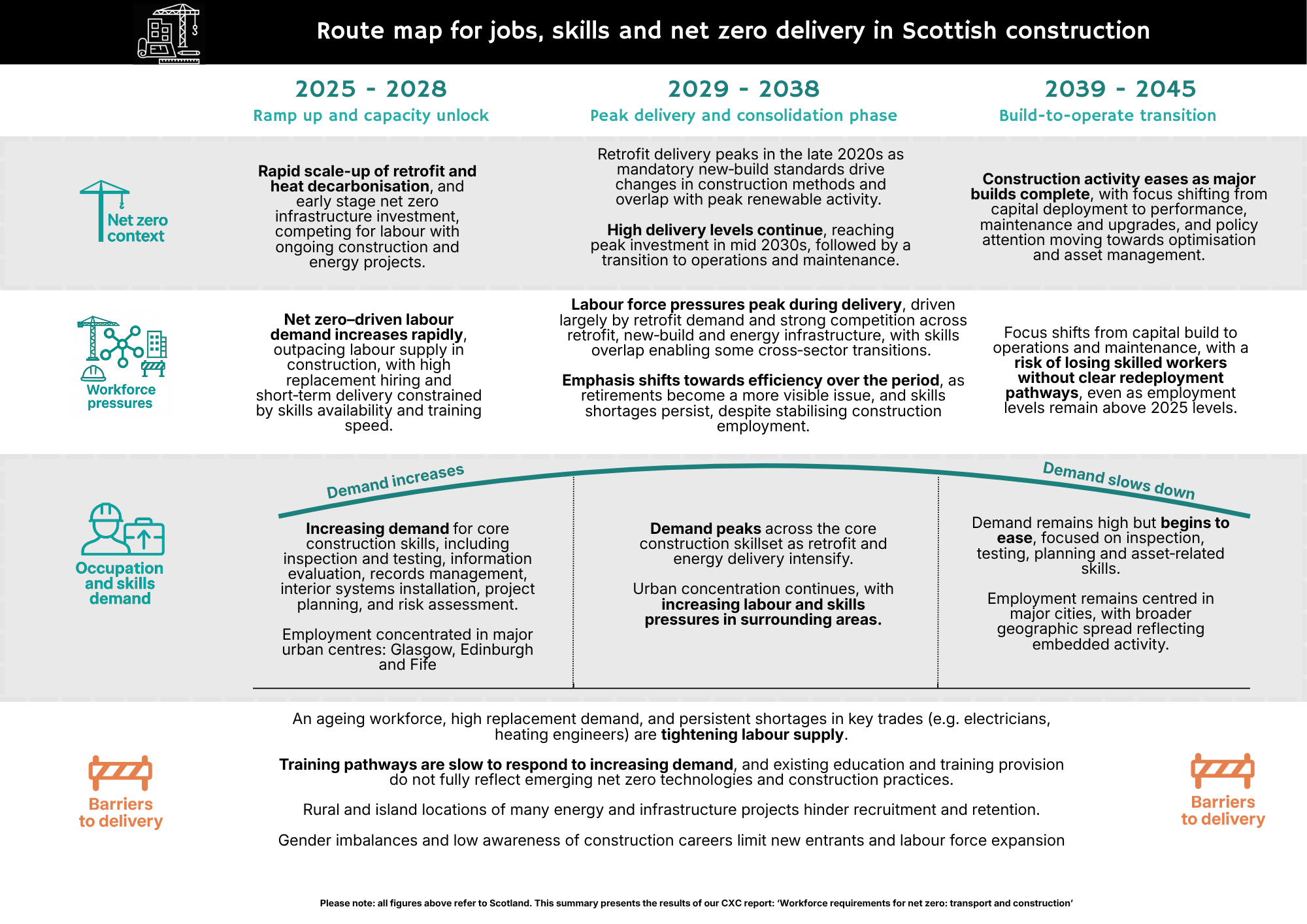
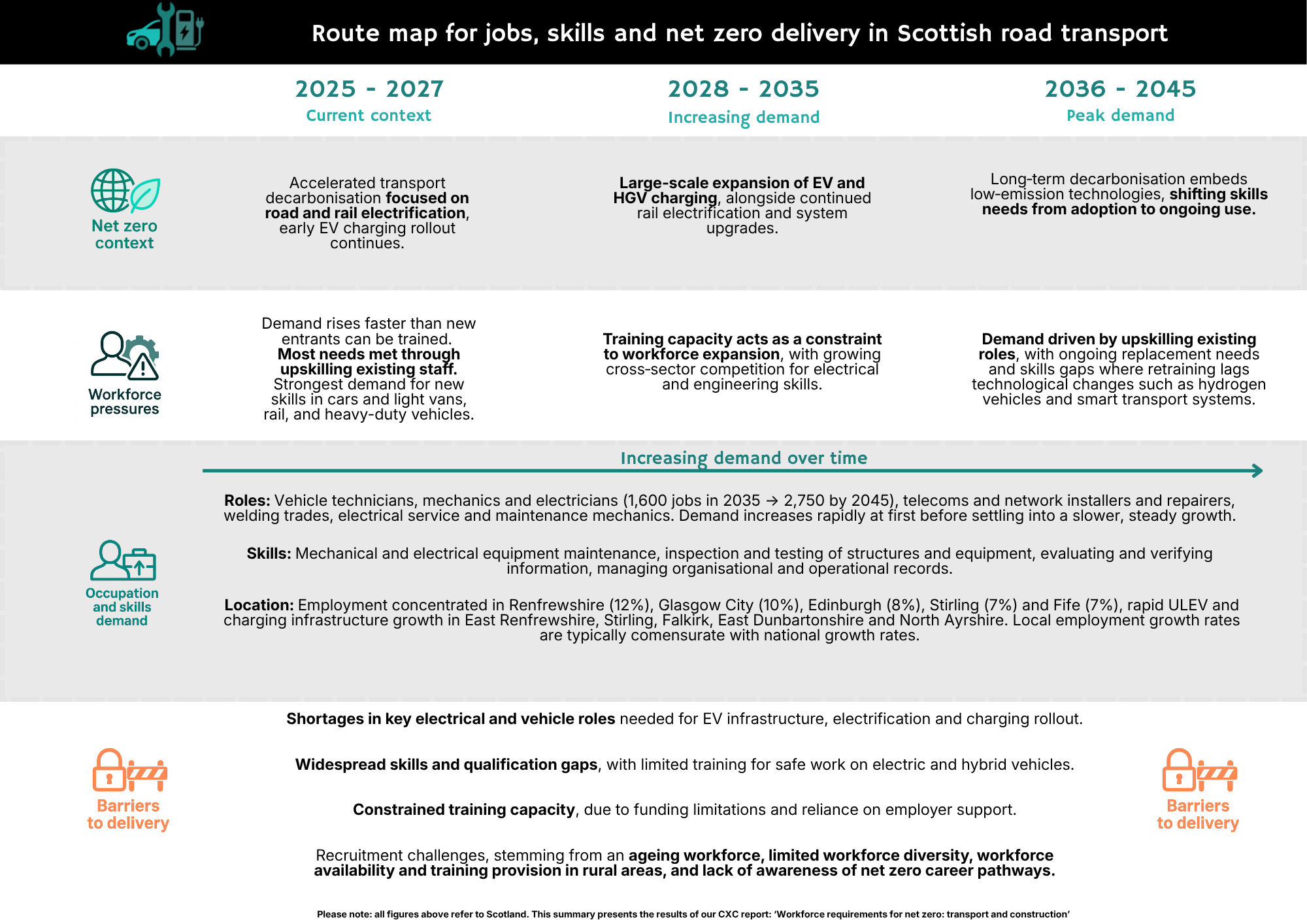
Route maps for the construction sector and transport sector illustrate the expected workforce and skills needs at different stages of the transition.
Key findings
- Transport employment: Employment in vehicle and equipment repair and maintenance is expected to decline slightly by 2045. The additional employment needs associated with net-zero grows from around 200 jobs in 2026 to 2,800 additional jobs by 2045. This reflects the projected growth in Scotland’s electric car fleet, from around 122,000 in 2025 to nearly 3 million by 2045.
- Construction employment: Overall construction employment is expected to grow modestly. Additional employment needs associated with net zero rises from 2,000 jobs in 2026 to around 13,800 additional jobs by 2035. The rollout of technologies such as air source heat pumps will increase demand for workers in renewable energy installation and building retrofit, with installations projected to rise from around 7,000 in 2025 to 1.7 million by 2045. Training will also need to expand to meet demand for specialist construction skills.
- Emerging skills: New technical skills will be needed as electric, renewable energy and digital technologies become more widely used. Workers will also need to adapt their existing skills, with reskilling helping those with petrol and diesel engine expertise move into EV-related roles.
- Moving between sectors: Many technical and practical skills are transferable between transport, construction and other sectors, creating opportunities for workers to move between industries as demand changes. However, sector-specific qualifications and experience may limit how quickly they can transition, making accessible training and clear routes into new roles important.
- Geographical variation: Net zero-related employment in transport and construction is likely to remain concentrated in Scotland’s main urban and industrial regions, including Glasgow, Edinburgh and Aberdeen. These areas already have a large share of the workforce needed to support the transition.
The report concludes that coordinated workforce planning across sectors will be needed to ensure Scotland has the skills required for the net zero transition. Policy priorities include expanding training, supporting upskilling and reskilling, keeping training aligned with new technologies, and making it easier for workers to move between sectors.
If you require the report in an alternative format, such as a Word document, please contact info@climatexchange.org.uk or 0131 651 4783.
Page cover photo by Jeriden Villegas on Unsplash.
Research completed: July 2026
DOI: https://doi.org/10.7488/era/7189
Executive summary
Scotland’s transition to net zero will change the number and types of workers and skills needed in the transport and construction sectors. This report assesses workforce and skills requirements in each sector from 2026 to 2045. It focuses on key activities expected to play a major role in reducing emissions, including renewable energy systems, retrofit programmes to improve the energy efficiency of existing buildings, and the shift to electric transport. The results are presented through sector‑specific route maps for construction and transport, outlining how workforce demand and skills needs develop over time.
Findings
Transport employment
Employment in vehicle and equipment repair and maintenance is projected to decline slightly over the long term, to 2045. However, the expansion of associated technologies is expected to increase demand for new technical skills. Employment linked to electrical vehicle (EV) related activities is projected to increase from around 200 jobs in 2026 to approximately 2,800 jobs by 2045.
The transition is likely to happen mainly by adapting existing jobs. Workers will need skills related to electric and digitally enabled vehicle systems, including electrical systems, battery technologies, and digital tools used to identify and diagnose vehicle problems. Reskilling, which means learning new skills for a different type of work, will also help workers who currently specialise in petrol and diesel engine technologies to move into EV-related activities. The number of electric cars in Scotland is projected to increase from around 122,000 in 2025 to nearly 3 million by 2045.
Construction employment
Overall employment in construction is projected to grow modestly. Activities linked to the net zero transition are expected to grow more rapidly during the early rollout of low‑carbon technologies. For context, the total number of installed air source heat pumps is projected to increase from around 7,000 units in 2025 to approximately 1.7 million by 2045.
Employment linked to net zero construction activities is projected to increase from 2,000 jobs in 2026 to around 13,800 jobs by 2035, before declining from 2039 onwards. A growing share of the workforce will need to adapt existing skills to support renewable energy installation and retrofit. This will require both upskilling – developing new skills within an existing job – and expanding training provision to avoid shortages of workers with specialist construction skills.
Emerging skills
Across both sectors, new skills will be needed as electric technologies, renewable energy systems and digital technologies become more widely used. In transport, these include skills related to EV systems, digital tools for identifying and diagnosing vehicle problems, and connected vehicle technologies. In construction, emerging skills are associated with solar energy systems, smart energy infrastructure, systems to manager energy use in buildings, and technologies and solutions to improve energy efficiency.
Cross-sector workforce mobility
There is significant overlap between the technical skills used in transport and construction, particularly for roles such as electricians, engineering technicians, and telecommunications installers. There is also substantial overlap between skills used in these sectors and in other parts of the economy, especially manufacturing and professional services. This suggests that many core technical and practical skills are transferable between sectors.
For transport-related activities, the greatest overlap with other sectors is in technical skills. For example, 80% of transport sector skills associated with designing and creating are also used in manufacturing and professional services, while 72% of transport sector skills related to operating and monitoring are also used in manufacturing.
For construction, around half of skills are shared with the manufacturing sector. More than half of construction skills in some areas are also shared with professional and technical activities, particularly skills related to higher-level analysis and design.
This overlap creates opportunities for workers to move between sectors as demand changes. However, sector-specific qualifications, certification requirements and experience may affect how quickly workers can transition. Accessible training and clear routes into new roles will therefore be important to support workforce mobility.
Geographical variation
Regional analysis shows that employment in both the construction and transport sectors is concentrated in a small number of urban and industrial regions. This includes major city regions such as Glasgow, Edinburgh and Aberdeen. These areas currently have a large share of the relevant workforce and are likely to remain key hubs for net zero-related activities.
Conclusions
Coordinated, cross-sector workforce planning is critical to ensure there are enough workers with the correct skills to meet the scale and pace of the transition. Our analysis suggests the following policy priorities:
- Expand training in key technical occupations, including electricians, engineering technicians, construction trades and vehicle technicians, to meet future demand.
- Prioritise upskilling and reskilling programmes so that workers can adapt their existing skills to new technologies.
- Ensure training keeps pace with the transition by incorporating renewable energy systems, electrification infrastructure and digital technologies.
- Strengthen collaboration between industry, training providers and government so that training reflects technological developments and changing workforce needs.
- Policies that support workers to move between sectors and develop skills that can be used in different types of work could help address emerging labour shortages.
Glossary and abbreviations
ADAS | Advanced Driver Assistance Systems |
BEMS | Building Energy Management System |
CCC | Climate Change Committee |
CITB | Construction Industry Training Board |
DfT | Department for Transport |
EV | Electric vehicle |
FTE | Full‑Time Equivalent |
GPRS / GPS | General Packet Radio Service / Global Positioning System |
GW | Gigawatt |
HGV | Heavy Goods Vehicle |
LFS | Labour Force Survey |
MW | Megawatt |
ONS | Office for National Statistics |
PV | Photovoltaic |
SIC | Standard Industrial Classification |
SOC | Standard Occupational Classification |
SSC | Standard Skills Classification |
ULEV | Ultra‑Low Emission Vehicle |
Introduction and purpose
Scotland’s legally binding 2045 net zero target is driving major transformation across the economy. This shift is particularly important in the construction and transport sectors, which underpin decarbonisation efforts. Achieving this transformation requires a skilled and adaptable workforce. Existing evidence shows that policymakers and industry lack a clear understanding of how workforce and skills needs will evolve, where shortages will emerge, and which interventions will prove most effective (Climate Change Monitoring Report 2024, Chapter 3: Transport; Built Environment and Construction Factsheet). These challenges affect construction most acutely, where the sector already faces an annual shortfall of more than 5,000 workers (CITB, 2025). Transport also faces significant pressures in the transition to net zero, as it remains Scotland’s highest-emitting sector. Forthcoming policies, such as the Vehicle Emissions Trading Scheme and potential changes to the HGV CO2 emissions regulatory framework, will directly shape workforce demand and training needs (Department for Transport, 2026; Energy and Climate Change Directorate, 2025).
In response, we address these evidence gaps through a detailed assessment of future workforce and skills needs to 2045. We apply a consistent, quantitative skills-mapping framework across the construction and transport sectors. This framework builds on existing analysis, including the Construction Sectoral Skills Assessment 2024, the Climate Emergency Skills Action Plan 2020–2025 (CESAP), and the associated CESAP pathfinder reports (WP1, WP2).
We provide robust, forward-looking evidence to support Scotland’s transition to net zero by examining future workforce demand in these sectors. In particular, this focuses on identifying skills needs, addressing recruitment and retention challenges, and analysing the factors that drive industry investment in workforce development. We present a detailed picture of the workforce required to meet net zero ambitions. This includes needs in energy supply, domestic retrofit, and electric vehicles (including charging points).
For this work, we define ‘net zero’ according to the assumptions and aims set out in the Climate Change Committee’s Balanced Pathway. While different net zero pathways may lead to slightly different outcomes, the broad direction of the results in this study still reflects the scale and scope of the skills landscape across a number of net zero scenarios.
This work builds on existing evidence, which presents the pipeline of various activities needed to achieve Scotland’s net zero target by 2045. In particular, we translate the target pipeline in energy generation, domestic retrofit and EV take-up to employment demand by occupation, and perhaps more informatively, by skills. We forecast workforce demand to 2045, highlight sectoral and cross‑sectoral skills gaps and training needs, and map geographic and temporal variations in workforce requirements across Scotland. By examining employment demand on a skills basis, our work provides government, industry and workers with a clearer picture of the skills, jobs and training requirements needed to enable Scotland’s transition to net zero, a better understanding of the opportunities it presents, and the risks and barriers involved.
Approach
Overview
This section sets out the key assumptions and analytical approach used to interpret net zero scenarios and pathways across the report.
Preparing a net zero technology pipeline
Our approach followed a three-step process for the construction and transport sectors,[1] moving from broad technology analysis to detailed occupational and skills implications. The first stage involved technology mapping, identifying emerging and relevant technologies likely to influence construction and transport under net zero pathways. We then linked these technologies to sectors across installation, operation, and maintenance phases to assess their impact on workforce demand. Finally, we mapped these sectors to occupations using the Standard Occupational Classification (SOC) and occupational shares derived from the Labour Force Survey (LFS), before linking occupations to skills using Skills England’s UK Standard Skills Classification (SSC).
Technologies provide a useful starting point for analysing skills requirements because their deployment shapes the activities that need to be carried out across sectors (Cirillo et al., 2023). Each technology requires specific infrastructure, installation processes, operational systems, and maintenance activities, all relying on particular occupations and skills. Focusing on technologies, therefore, allowed us to link the scale and timing of technology deployment to the workforce capabilities needed for net zero delivery. This process allowed us to quantify skills needs, identify bottlenecks, and highlight training priorities with enough detail to inform planning and policy.
As agreed with the Scottish Government, we used the Climate Change Committee’s (CCC) ‘Balanced Pathway’ scenario from the latest Carbon Budget for Scotland, which outlines a pathway to net zero emissions in Scotland by 2045. Within this framework, we identified key technologies expected to affect construction and transport under net zero pathways, including energy systems, domestic retrofit, and electric vehicles with charging infrastructure. These technologies were selected for their expected emissions-reduction impact and their potential to reshape workforce demand across sectors.
Table 1 outlines the scale and deployment pipeline of key net zero technologies across energy, domestic retrofit, and electric vehicles (including charging points). These projections indicate the potential demand for construction, installation, and vehicle maintenance activities associated with the net zero transition.
Technology | 2025 | 2030 | 2035 | 2040 | 2045 | ||||||
|---|---|---|---|---|---|---|---|---|---|---|---|
Energy – Cumulative installed capacity (GW) | |||||||||||
Wind, of which: | 14.7 | 28.4 | 43 | 56.4 | 58.1 | ||||||
Offshore | 3.2 | 10.1 | 24.2 | 31.9 | 32.2 | ||||||
Onshore | 11.5 | 18.3 | 18.8 | 24.4 | 25.9 | ||||||
Solar PV | 1.1 | 2.3 | 4.8 | 5.5 | 6.2 | ||||||
Hydro | 1.6 | 1.6 | 1.6 | 1.6 | 1.6 | ||||||
Grid storage (inc. battery) | 1.9 | 5.3 | 5.3 | 5.7 | 5.7 | ||||||
Hydrogen | 0 | 0.1 | 0.9 | 3.5 | 4.2 | ||||||
Domestic retrofit – Cumulative deployment | |||||||||||
Air source heat pump | 7,151 | 102,953 | 580,978 | 1,215,376 | 1,753,112 | ||||||
Communal heating conversion | 2,417 | 14,502 | 26,586 | 36,254 | 36,254 | ||||||
Electric heating | 1,966 | 42,077 | 132,374 | 271,740 | 376,960 | ||||||
Ground source heat pump | 102 | 922 | 3,906 | 7,338 | 9,806 | ||||||
Heat network | 0 | 54,910 | 133,332 | 211,615 | 234,707 | ||||||
Hot water tank insulation | 0 | 129,836 | 346,231 | 457,938 | 457,938 | ||||||
Loft insulation[2] | 773 | 22,660 | 32,551 | 32,551 | 32,551 | ||||||
Other | 62,249 | 1,310,678 | 2,652,792 | 2,652,792 | 2,652,792 | ||||||
Electric vehicles – Fleet composition and charge point deployment[3] | |||||||||||
EV buses | 547 | 2,259 | 4,859 | 7,700 | 9,975 | ||||||
EV HGV’s and rigid vehicles | 36 | 2,631 | 13,056 | 26,744 | 35,520 | ||||||
EV vans and motorcycles | 9,100 | 100,268 | 249,436 | 359,590 | 428,745 | ||||||
EV cars | 122,355 | 782,469 | 1,712,967 | 2,466,421 | 2,924,355 | ||||||
EV charge points | 5,626 | 22,720 | 37,841 | 47,614 | 51,958 | ||||||
Peat restoration (hectares) | |||||||||||
Peatlands | 12,750 | 76,500 | 140,250 | 204,000 | 267,750 | ||||||
Table 1: Pipeline. Sources: Economic Impact Scenarios for Scotland’s Energy Transition; Appendix B – Capacity Projections Strong Ambition; Climate Change Committee (CCC) carbon budget methodology; Technology definition aligned to CITB (Domestic Retrofit Workforce Analysis 2025-2050); CCC-Cambridge Economics – Scotland EV data; CCC Scotland’s Carbon Budgets Report
In the energy sector, there is expected to be a substantial expansion in renewable generation capacity, driven primarily by wind. Total wind capacity is projected to increase from 14.7 GW in 2025 to 58.1 GW by 2045. Offshore wind is expected to account for an increasing share of this growth, increasing from 3.2 GW to 32.2 GW over this period. Onshore wind is also expected to increase, although at a slower pace, reaching 25.9 GW by 2045. Solar photovoltaic (PV) capacity is expected to increase steadily from 1.1 GW to 6.2 GW, while grid storage (including batteries) is expected to expand from 1.9 GW to 5.7 GW. Hydrogen deployment is expected to initially be limited, before accelerating from 2035 onwards, reaching 4.2 GW by 2045. Hydro capacity is expected to remain broadly stable.
In the domestic retrofit sector, the pipeline is characterised by a rapid scale-up of low‑carbon heating systems and energy efficiency measures. Air source heat pump deployment is expected to increase considerably, from 7,000 units in 2025 to over 1.7 million by 2045. Electric heating is also expected to expand, reaching 377,000 installations by 2045. The heat network is expected to grow from negligible levels to over 234,000 connections, while communal heating conversion is expected to increase more moderately. Insulation measures, including hot water tank insulation and loft insulation, are expected to be deployed at scale in the earlier years before stabilising.
For electric vehicle activities, the transition is reflected in the rapid growth of the vehicle fleet and supporting infrastructure. Electric cars are expected to account for the largest share, increasing from 122,000 in 2025 to nearly 3 million by 2045. Electric vans and motorcycles are also expected to increase substantially, reaching over 428,000 units by 2045. Heavy goods vehicles and rigid vehicles are expected to increase to over 35,000 units, and electric buses are expected to increase to almost 10,000 units by 2045. A substantial rollout of charging infrastructure is expected, with charge points increasing from 5,600 to 52,000 in 2045. This expected sustained growth implies an ongoing expected demand for installation, maintenance, and electrical infrastructure across the period.
Additionally, we estimated expected peatland restoration activity using national targets and projections from the CCC’s Balanced Pathway. The CCC’s projections indicate a substantial expected increase in restoration, reaching 150,000 hectares of peatland restored or rewetted by 2045. This increase is equivalent to an average annual restoration rate of approximately 12,750 hectares. These estimates inform the assessment of workforce requirements associated with peatland restoration.
This pipeline indicates that the net zero transition will require substantial investment in construction and installation activities, particularly in the short to medium term, followed by increasing demand for operation and maintenance roles. The scale and timing of deployment across energy, domestic retrofit, and transport provide a key input for assessing future workforce and skills requirements (see Sections 5.2 and 6.2).
Sector linking
This section describes the methodology used to translate the investment and delivery pipeline into sector-level workforce requirements.
Sector definition and scope
The pipeline presented in Table 1 provides projections of technology deployment across energy, domestic retrofit, and electric vehicles. To assess the workforce implications of the pipeline, it is necessary to map the associated activities to economic sectors. This is achieved using the Standard Industrial Classification (SIC) framework, which enables alignment with national accounts and labour market data.
The majority of activities associated with the energy and domestic retrofit and peatlands pipeline are mapped to construction (Section F, according to the SIC classification). This is because the delivery of the pipeline is predominantly driven by construction and installation activities, particularly during the build-out phase. The deployment of renewable energy infrastructure requires substantial civil engineering works, including site preparation, foundations, structural assembly, and grid connection. All of these are classed as construction‑related activities. Similarly, domestic retrofit measures, such as the installation of low-carbon heating systems, insulation, and heat networks, are implemented at the building level and rely heavily on construction trades, including electricians, plumbers, and general construction operatives.
In contrast, the electric vehicle (EV) pipeline spans multiple sectors. The maintenance and repair of EVs are mapped to maintenance and repair of motor vehicles (SIC G45), reflecting ongoing servicing and operational requirements. The installation of EV charging infrastructure is mapped to repair and installation of machinery and equipment (SIC C33), capturing the technical and electrical work associated with charging systems. For the purposes of this report, we refer to this group as transport-related activities (vehicle and equipment repair and maintenance).
Converting technology deployment into employment demand
Table 2 summarises the key assumptions and data sources used to convert technology deployment into employment estimates across the energy, domestic retrofit, and electric vehicle technologies. The conversion approach varies by technology type, reflecting differences in how deployment translates into labour demand.
Net zero technology | Assumptions | Source |
|---|---|---|
Energy | Job-years per GW | |
Wind, of which: |
| Rutovitz, J., et al. “Updated employment factors and occupational shares for the energy transition.” |
Offshore wind | 150 | |
Onshore wind | 265 | |
Solar PV | 161 | |
Hydro | 736 | |
Grid storage (inc. battery) | 53 | |
Hydrogen | 736 | |
Domestic retrofit | Workers per deployment | |
Air source heat pump | 0.06 | |
Communal heating conversion | 0.10 | |
Electric heating | 0.03 | |
Ground source heat pump | 0.20 | |
Heat network | 0.21 | |
Hot water tank insulation | 0.01 | |
Loft insulation | 0.03 | |
Other | 0.003 | |
Electric vehicles | Labour intensity | |
EV buses | Maintenance: Every 4 weeks, around 3 hours Repair: Every 4-5 months, around 3 hours | UK vehicle roadworthiness guide |
EV HGV’s and rigid vehicles | Maintenance: Every 6 weeks, around 2 hours Repair: Every 4-5 months, around 3 hours | |
EV vans and motorcycles |
Maintenance: MOT (once a year) around 1 hour
| |
EV cars |
Maintenance: MOT (once a year) around 1 hour
| |
EV charge points | 10.7 jobs per £1 million GVA | |
Peat restoration (hectares) | Labour intensity | |
Peatlands | 0.036 FTE per hectare; around 30% of employment associated with construction-related activities |
Table 2: Employment conversion assumptions and sources. Note: Assumptions are derived from literature and industry reports and reflect typical operating conditions. Where possible, values have been triangulated across multiple sources.
For energy technologies, employment is estimated using job-years per gigawatt (GW) of installed capacity. This is based on the literature on the employment impacts of the energy transition. The coefficients used capture the labour requirements associated with the construction, installation, and operation of energy infrastructure. The employment factors vary across technologies, reflecting differences in labour intensity. Higher values are observed for technologies such as hydro and hydrogen, and lower values for grid storage.
In the domestic retrofit sector, employment is derived using a deployment-per-worker ratio. These ratios link the number of installations to the workforce required to deliver them. The ratios are based on industry evidence and scenario analysis. They reflect the labour requirements associated with installing different retrofit measures, such as heat pumps, insulation, and heat networks. The variation across technologies reflects differences in installation complexity. Labour-intensive measures, such as ground source heat pumps, require greater input from workers per unit of deployment than other interventions, such as insulation.
For electric vehicles, there is a limited availability of standardised data on labour requirements. As such, we draw on industry experience and operational evidence to estimate workforce needs. A bottom-up approach is adopted, using assumptions on inspection frequency, repair rates, and the time required for maintenance and repair. These assumptions are informed by a combination of regulatory guidance, industry standards, and empirical studies. They reflect the ongoing operational nature of labour demand in the transport sector, which is driven by fleet size and utilisation rather than one-off installation activities[4]. For electric vehicle charging infrastructure, employment is estimated using an employment coefficient (jobs per £1 million of output) derived from manufacturing productivity data. This captures the labour required to install and maintain charging infrastructure, linking investment levels to workforce demand.
Finally, for peatland restoration, employment is estimated using a labour intensity expressed in full-time equivalent (FTE) employment per hectare. This is based on available evidence from workforce and economic impact studies. A proportion of this employment is mapped to construction-related activities, reflecting the role of site preparation and restoration works.
Employment estimates are derived by applying the coefficients presented in Table 2 to the technology deployment projections outlined in Table 1. This approach provides a consistent framework for translating projected levels of deployment into workforce requirements across different technologies. The application of these coefficients to the projected deployment pathways produces estimates of employment demand over time. These projections capture the scale and timing of workforce requirements associated with the transition to net zero at sectoral level.
Occupation and skills linking
The sector-level workforce projections, presented in terms of the Standard Industrial Classification (SIC), provide the foundation for estimating occupational and skills demand. Sector employment requirements are mapped to occupations using the UK Standard Occupational Classification (SOC), which classifies jobs by tasks and required skills (see Appendices). The use of SOC ensures consistency with national employment data and enables robust comparison across sectors, geographies, and scenarios.
Occupational employment shares by sector are derived from Labour Force Survey (LFS) data for Scotland over the past five years (2021-2025). Using multiple years reduces short‑term fluctuations and sampling variability, especially for smaller sectors and occupations. This approach provides more stable estimates of each sector’s occupational structure, which we use to allocate projected employment. The occupational structure captures core delivery sectors (such as civil engineering and construction), as well as supporting sectors involved in installation, maintenance, and related professional services.
We then link SOC-based occupational employment to skills requirements using the UK Standard Skills Classification (SSC)[5], a newly developed skills taxonomy released by Skills England (see Appendices). The SSC provides a comprehensive and structured list of skills required by each occupation, allowing occupational projections to be translated into detailed estimates of skills demand. It is structured as a hierarchical framework covering 3,343 individual skills, organised into “skill groups”. These in turn are structured by “skill areas”, linked to 22 high level “skill domains” (see appendix B for more detail). The linkage between SOC and the SSC enables a systematic mapping from sectoral workforce requirements to occupation-specific and skill‑specific needs. Moreover, the SSC is explicitly tailored to the UK labour market context, reflecting UK occupational structures. It incorporates up-to-date information on employer skill demand, including emerging skills such as installing EV charging points, maintaining electrical charging systems, and installing vehicle batteries. This methodology supports a more accurate and policy-relevant assessment of current and future skills needs, particularly in the context of net zero transitions and workforce planning.
We rank skills using a relevance index that combines projected employment levels with information from the UK SSC. The first step links projected employment to occupations, which the SSC then maps to associated skills. This mapping allows us to estimate how many workers are likely to use each skill, based on projected employment by occupation. This component of the index captures the scale of labour demand associated with each skill.
The index also incorporates the frequency with which each skill appears across occupations in the SSC. We count the number of occupations linked to each skill and use this as an additional weighting factor. Skills associated with a larger number of occupations receive higher scores, reflecting their broader relevance across the workforce. This step prevents the index from relying only on employment levels within individual occupations. Instead, the index accounts for how widely a skill is used across different roles.
The relevance index reflects both the scale of employment associated with a skill and the breadth of its use across occupations. This approach highlights both specialised skills linked to high-employment occupations and cross-cutting skills required across a wide range of occupations in the labour market.
Regional analysis
While the main analysis focuses on the net zero transition at the Scotland-level, regional analysis is also provided to support regional planning and policy development. This indicates the occupations needed across regions, while recognising limitations in the granularity and quality of pipeline data at this level.
For the regional analysis, the technology pipeline is disaggregated by council, and the Scotland-level employment estimation framework is applied consistently across council areas. This approach includes the use of employment intensity assumptions and sector‑specific conversion factors to translate technology activity into workforce requirements. Table 3 summarises the sources and methods used.
Technology | Source | ||
|---|---|---|---|
Construction | Energy | Offshore wind | Historic (2014-2024) Scottish council area shares of installed capacity (MW). |
Onshore wind | |||
Hydro | |||
Hydrogen | Live map of active and planned hydrogen projects. | ||
Domestic retrofit | All | Population projections used to estimate the future distribution of domestic retrofit interventions (2025-2045). | |
Transportation | Electric vehicles | EV’s (all vehicle types) | Historic (2009-2025) Scottish council area shares of total EV registrations. |
EV charge points (public only) | Historic (2019-2025) Scottish local authority public EV charge point data. | ||
Table 3: Sectors and council authority allocation methods. Notes: Regional data were not available for grid storage (including batteries) and peatland restoration at the time this document was completed. As these activities account for a small share of total construction employment (less than 1% and 1.6%, respectively), their exclusion from detailed local allocation is not expected to considerably affect overall regional patterns.
For energy technologies, we allocate activity based on historic (2014–2024) Scottish council‑area shares of installed capacity (MW). These historic shares are used to approximate both the relative scale and the pace of technology deployment across regions. To do this, we make the assumption that past spatial patterns provide a reasonable indication of future geographic distribution.
For hydrogen, where consistent historical data are unavailable, we use Hydrogen Scotland’s map of active and planned projects. Areas with a higher concentration of existing or planned hydrogen projects are assumed to have relatively greater employment impacts.
As showed in Section 4.3, domestic retrofit is the largest driver of employment impacts within construction. To allocate retrofit-related activity locally, we use population projections for 2025–2045 to approximate the future distribution of housing-related interventions. The distribution of retrofit activity is closely linked to housing stock, and so population distribution. More densely populated areas, therefore, are expected to generate higher absolute demand for retrofit-related construction employment.
Using the available construction-sector data, we analyse the volume and the speed of each technology deployment at council area, extrapolating trends where necessary. These dimensions are then combined into a composite local indicator, weighted by the estimated employment share generated by each technology. This ensures that technologies with greater employment intensity (i.e. domestic retrofit) proportionately influence the overall spatial distribution.
In the transport sector, electric vehicle (EV) activity is allocated using historic Scottish council-area shares of total EV registrations (2009–2025). As discussed in Section 4.3, the principal driver of employment within the transport pipeline is EV maintenance, making the local distribution of EV uptake a critical determinant of local employment effects[6].
Public EV charging infrastructure is allocated using historic (2019–2025) Scottish local authority data on public charge point deployment. As in the construction sector, we assess both the scale and growth rate of charging infrastructure. These are then integrated into a composite local indicator weighted by the relative employment contribution of each transport technology.
Evidence review and stakeholder workshop
As part of this work, we carried out an extensive and detailed review of existing evidence and research. This review helped develop the approach described above, and helped contextualise the demand-side analysis with evidence of supply-side frictions and barriers, such as recruitment difficulties, skills gaps, and supply pinch-points.
In addition to the evidence review, a series of workshops were held to engage with key construction and transport stakeholders (across government, industry and education) to validate the findings of the evidence review, and gather feedback and expert insights on the study’s approach.
Analysis of net zero workforce requirements: Transport
Context
This section outlines the current structure of employment in Scotland’s transport sector and the emerging workforce implications of the net zero transition. We draw on available evidence to assess the scale and composition of employment, the prevalence of green and transitioning occupations, and the key labour market pressures. We also examine the role of upskilling and reskilling in supporting the transition, alongside regional and sub-sectoral variation in workforce demand.
To provide context, Table 4 shows that Scotland’s transport sector employed 98,000 people in 2022, representing 3.8% of total employment (Skills Development Scotland, 2023). The table also highlights that over half of the workforce is employed in green occupations[7] [8], many of which are expected to experience increasing demand resulting from the transition to net zero.
Details | |
98,000 people (3.8% of total employment in Scotland) | |
Total transport sector employment (2022) | 50,700 workers (52%) were employed in green occupations (defined broadly as occupations affected by the greening of the economy, rather than only exclusively green roles), with nearly 60% of these jobs facing increasing demand due to the transition to net zero1 |
17,000 workers (33.5%) of green jobs require enhanced skills and knowledge2 | |
3,300 workers (6.5%) relate to new and emerging occupations3 |
Table 4: Transport employment (Skills Development Scotland, 2023)
Notes: (1) Increased demand refers to existing occupations having higher employment demand due to green activities, without substantial changes to tasks or worker requirements. (2) Enhanced skills and knowledge describes existing occupations where green activities significantly alter tasks, skills, knowledge, or credentials, while the core purpose of the role remains unchanged. (3) New and emerging occupations arise where green activities create entirely new or substantially transformed roles with distinct work and worker requirements (Dierdorff et al., 2009).
The transport sector differs from other CESAP sectors in having a broadly even split between green and non-green occupations. The high share of roles where green activities considerably alter tasks and skills suggests that the transition in transport will rely primarily on upskilling within existing roles. This pattern indicates adaptation rather than the creation of entirely new occupations. Moreover, these workforce patterns are not evenly spread across Scotland. Lanarkshire and the Glasgow Region accounted for 27% of the transport workforce in 2022, with Edinburgh, East and Midlothian, and Aberdeen City and Shire comprising a further 23% (Skills Development Scotland, 2023). This uneven distribution has important implications for the spatial alignment of skills supply and demand. In particular, as decarbonisation-related infrastructure expands into rural and island regions, workforce availability and training provision may also need to expand in these areas.
Short-term workforce pressures are already evident. For example, despite growing demand for EV maintenance, only 31% of garages currently have the skills to service electric or hybrid vehicles, highlighting a clear short-term skills gap (Skills Development Scotland, 2023). These pressures coincide with ambitious policy commitments, which accelerate demand for new skills. An example of this is the UK Government’s planned phase-out of new petrol and diesel vehicles by 2035. Decarbonisation is driving substantial upskilling and retraining needs across the sector. Whilst much of the transition is expected to occur through upskilling within existing occupations, the literature also suggests that additional workers will be required to meet rising demand associated with electrification and related infrastructure. Table 5 provides a summary of key findings from the literature on workforce demand, skills needs, and labour market trends associated with transport activities. It places a particular focus on the vehicle and equipment repair and maintenance pipeline highlighted in Section 4.2.
Key findings | Details | Source |
|---|---|---|
Projected workforce demand | Additional 24,900 workers were needed by 2025. | (Skills Development Scotland, 2023) |
More than half of demand concentrated in green occupations. | ||
Projected workforce retraining | In 2020, it was estimated that over 65,000 workers will require retraining or upskilling to support EV charging infrastructure, ultra-low emission vehicle maintenance, hydrogen refuelling, and related services over the transition period (2020-2045). | (Skills Development Scotland, 2020) |
Skills shortages | Acute shortages of electricians are already evident, alongside growing demand for electrical engineers, infrastructure planners, and maintenance technicians, particularly in regions with limited local training provision. | (Skills Development Scotland, 2023) (Centre for Sustainable Road Freight, 2025) |
Longer-term projections | Strong growth in employment in low-carbon related technologies linked to Scotland’s wider energy transition. | (Scottish Enterprise, 2024) |
Employment in low-carbon technologies could surpass current oil and gas employment levels, with around 80% of roles concentrated in construction and installation during peak build‑out phases. | ||
More stable operational and maintenance roles sustaining employment thereafter. | ||
Emerging skills demand | Skills demand will emerge unevenly across transport sub-sectors, due to differences in the pace of decarbonisation and the maturity of relevant technologies. There is faster technological change and stronger policy pressures in some sub-sectors, while there is a longer transition period in other sub‑sectors. | (Optimat, 2023) |
Near-term demand | Strongest demand in cars and light vans, rail, and heavy-duty vehicles | |
Longer-term demand | Aviation and maritime decarbonisation expected to drive skills needs over a longer timeframe |
Table 5: Key findings on skills and workforce needs in net zero transport
These findings highlight that transport plays a central role in Scotland’s net zero transition, with increasing demand for green and transitioning occupations. Our review indicates that the workforce shift will rely primarily on upskilling and reskilling existing workers rather than large-scale occupational replacement. We also note that skills demand and workforce pressures vary considerably across regions and sub-sectors, creating challenges for targeted training and effective workforce planning. In the short term, we identify labour shortages in key roles such as electricians and infrastructure-related positions. These shortages coincide with ambitious decarbonisation timelines. Evidence suggests that longer-term employment growth will follow construction-led build‑out phases, before stabilising in operational and maintenance roles. Altogether, these results highlight the strong interconnection between transport and construction workforce needs throughout the transition.
Barriers to delivery and other considerations
Our review identifies multiple barriers that constrain the transport sector’s transition to net zero. These span workforce shortages, training gaps, structural issues, and diversity challenges.
Barrier type | Description |
|---|---|
Shortages in critical occupations | The sector faces acute shortages in key occupations, including electricians, electrical engineers, and mechanics required to develop and maintain EV charging infrastructure and support the electrification of road and rail networks (Skills Development Scotland, 2023). Rural and island regions, such as the South of Scotland and the Highlands and Islands, face the greatest recruitment difficulties. |
A further challenge is the lack of staff trained to repair and maintain Ultra-Low Emission Vehicles (ULEVs). Although three-quarters of garages anticipate servicing ULEVs will form part of their business, only 31% currently have the necessary skills. Common barriers include a perceived lack of near‑term demand (77%) and shortages of appropriately qualified staff (70%), highlighting a misalignment between anticipated market growth and workforce readiness (Skills Development Scotland, 2023). | |
Ageing workforce | Nearly 30% of rail employees are aged over 50, and it was estimated that around 15,000 workers would retire across the UK by 2025 (Skills Development Scotland, 2023). |
Fewer young people are entering the sector, exacerbating skills shortages. | |
Recruitment has also been constrained by Brexit, which reduced access to EU labour. Together, these factors increase pressure on workforce availability at a time of rising demand (Skills Development Scotland, 2023). | |
Workforce diversity | Less than a quarter of transport and storage employees are women, and only 16% of the rail workforce are female (Skills Development Scotland, 2023). |
This imbalance restricts the sector’s ability to attract new entrants and limits the potential labour supply to support net zero initiatives. | |
Training and skills provision | Persistent funding gaps and reliance on employer support limits colleges’ ability to expand training in line with net zero demand (Skills Development Scotland, 2024), (Skills Development Scotland, 2020). |
Less than 10% of vehicle maintenance staff hold recognised qualifications to safely work on electric or hybrid vehicles, and an estimated 15,000 staff will require upskilling or new training by 2032 (Skills Development Scotland, 2023). | |
Decarbonising heavy-duty vehicles (HDVs) and the rail system adds further pressure. Emerging technologies, including battery electric and hydrogen power, as well as marine transport options, will require additional workforce development. Between 34,400 and 38,200 HDV employees were projected to require some level of skills development related to low carbon HDVs by 2026, increasing to 41,000–53,200 by 2032 (Optimat, 2021) | |
This spans staff across manufacturing, charging and refuelling infrastructure, vehicle sales, inspection, repair, and operational occupations. Key barriers include limited commercial returns on training investment, perceived low demand and constrained budgets. | |
Other structural and systemic barriers | Beyond training and recruitment challenges, the transport sector also faces structural and systemic barriers that constrain workforce development. Retaining existing staff remains a challenge, and while interest in entry-level roles is in some cases strong, employers may be unable to absorb and train the volume of workers required to meet future demand. This reflects a broader mismatch between the scale of projected labour needs and the sector’s current capacity and willingness to invest in training new entrants. |
Qualification frameworks are slow to adapt to emerging technologies. Training across further education, higher education, and work-based learning often lags behind new technologies, including hydrogen vehicles and smart transport systems (Skills Development Scotland, 2024) |
Table 6: Workforce barriers constraining the transport sector’s transition to net zero
Net zero workforce requirements
This section examines projected employment levels in activities supporting the net zero transition in transport (vehicle and equipment repair and maintenance), with a focus on the EV pipeline identified above. We present results (a) at the occupational level, (b) by SSC‑defined skills, and (c) across regions.
Employment demand from net zero pathways
The Cambridge Econometrics April 2025 UK forecast estimates that employment in vehicle and equipment repair and maintenance activities will be 69,600 jobs in 2026, decreasing to 65,500 jobs by 2045 (Cambridge Econometrics, 2025).[9] Whilst these projections suggest a modest decrease in employment in the sector, trends may differ across subsectors, with employment in some expected to increase. The projections also exclude explicit assumptions related to the UK’s green transition, including the EV pipeline discussed above. At the time the projections were produced, the UK had published a strategy for its path to reach net zero carbon emissions by 2050 (Department for Energy Security and Net Zero, 2021). While this strategy includes both specific investment commitments and aspirational or goal-based targets, they had not yet been budgeted for or implemented. The level of known planned investments was considered too small to materially affect the macroeconomic outlook (Cambridge Econometrics, 2025).
Consequently, the projections do not reflect more recent policy developments, such as the increased prioritisation of net zero targets and committed investment pipelines, including those associated with the Climate Change Committee’s carbon budgets for Scotland described in previous sections. They should, therefore, be interpreted as a baseline scenario rather than a representation of current policy commitments and planned investments.
Figure 1 shows the additional employment associated with more recent policy plans, particularly EV-related activities, such as charging points installation and vehicle maintenance. The figure indicates that 200 additional jobs will be required in 2026, rising to 2,800 jobs by 2045. These additional jobs are over and above the baseline projections presented earlier, which do not incorporate the effects of the net zero transition.
When combined with the baseline, this implies that total employment in vehicle and equipment repair and maintenance activities would be higher than projected under the baseline alone, partially offsetting the decline associated with conventional internal combustion engine (ICE) activities. These results point to a sustained increase in labour demand associated with the transition to net zero. The growth is driven by ongoing investment in EV technologies and supporting infrastructure. Demand remains elevated over time, reflecting the continuous maintenance requirements of electric vehicles and the expanding size of the EV fleet. This growth forms part of a structural shift, with increasing demand for EV-related jobs coinciding with a gradual decline in roles associated with ICE technologies.
These projections have important implications for workforce development in transport‑related activities. Baseline employment in vehicle and equipment repair and maintenance is projected to decline slightly over the long term. However, the expansion of EV-related activities is expected to increase demand for specific technical capabilities. This indicates that a growing share of the workforce will need to adapt existing mechanical skills to support electrified and digitally enabled vehicle systems. Meeting this demand will require targeted upskilling of the current workforce, particularly in areas such as: electrical systems, battery technologies, and digital diagnostic. Additionally, reskilling pathways that enable workers currently specialised in ICE technologies to transition into EV-related activities will be essential.
As discussed in Section 4, the employment projections are based on the technologies considered and the associated sectoral linkages. In this analysis, the sectoral linkages correspond to maintenance and repair of motor vehicles (SIC G45), and repair and installation of machinery and equipment (SIC C33). Consequently, the number of jobs projected in Figure 1 reflects all occupations associated with these activities (SIC G45 and SIC C33).
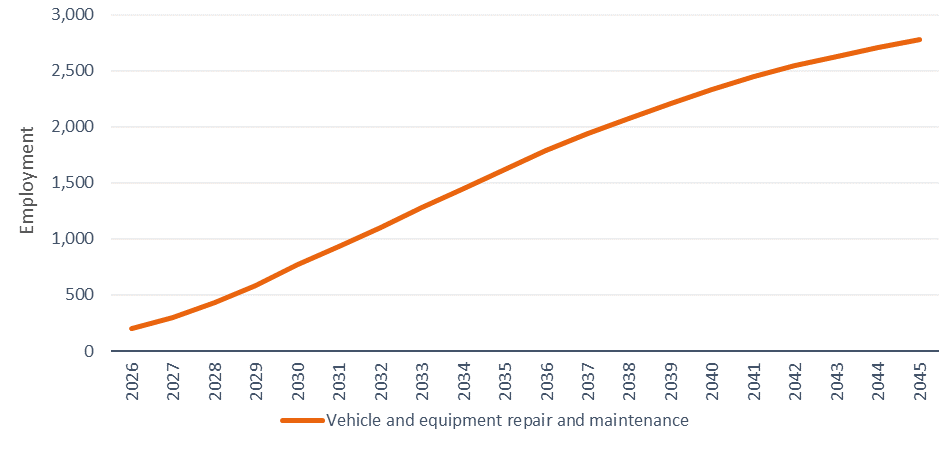
Figure 1: Projected additional employment in the transport sector under net zero pathways, 2026–2045. Source: Cambridge Econometrics. Own calculations
Occupations
While a large share of the employment generated is expected to be directly related to maintenance and repair activities, supporting occupations will also be required. These might include administrative, clerical, and secretarial occupations, providing supporting functions such as appointment scheduling, documentation management, and operational coordination.
At a more granular level, Figure 2 presents the additional projected employment levels across occupational groups involved in vehicle and equipment repair and maintenance. This provides insight into the skills required to fulfil net zero plans for the transport sector. These figures represent additional employment relative to the baseline projections, reflecting the impact of the net zero transition. Overall, employment in all occupational groups is projected to increase as a result of the net zero transition. In particular, skilled trades occupations are expected to account for the largest share of demand. Employment in these roles is projected to increase from 86 additional jobs in 2026 to a peak of 1,180 additional jobs in 2045.
Within skilled trades occupations, particularly strong employment growth is expected in roles associated with zero-emission (ZE) technologies. This growth reflects a transition within the occupation group, as increasing demand for ZE-related maintenance and repair is expected to occur alongside a decline in roles associated with ICE technologies.
Within skilled trades occupations, we expect the following roles associated with ZE-technologies to see particularly strong employment growth. This is expected to account for around 28.7% of the growth in the transport sector between 2026 and 2045:
- Vehicle technicians, mechanics and electricians (SOC code 5231)
- Vehicle body builders and repairers (SOC 5232)
- Telecoms and related network installers and repairers (SOC 5242)
- Electrical service and maintenance mechanics and repairers (SOC 5246)
- Welding trades (SOC 5213)
The second group of occupations in which notable employment growth is expected is sales and customer service occupations. Within this group, we expect the following roles to see particularly strong employment growth. This is expected to account for around 7.3% of the growth in the transport sector between 2026 and 2045:
- Vehicle and parts salespersons and advisers (SOC code 7115)
- Customer service occupations not elsewhere classified[10]
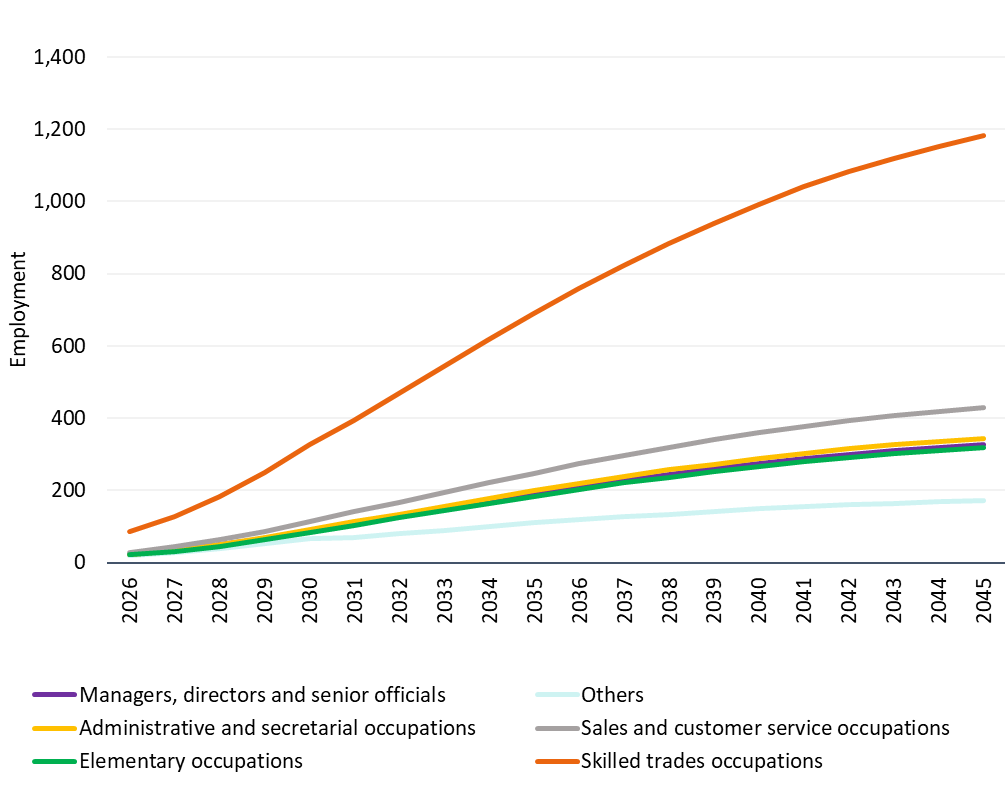
Figure 2: Projected additional employment by occupational group. 2026-2045
Source: Cambridge Econometrics and Labour Force Survey (ONS). Own calculations
The results presented are based on the Climate Change Committee’s Balanced Pathway and other sources, which provide the technology deployment assumptions used to estimate workforce demand in this study. While alternative net zero trajectories may imply different levels of technology deployment and, therefore, different overall employment levels, the broad occupational patterns identified here are unlikely to change. This outcome reflects the fact that most decarbonisation pathways involve large-scale deployment of technologies such as electric vehicles and charging infrastructure, which require installation, operation, and maintenance activities across similar occupational groups. As a result, although the scale of employment may vary across scenarios, demand for occupations linked to technical trades, engineering, installation, and maintenance activities is expected to remain central to the net zero transition.
Skills
Figure 2, while informative, does not explicitly identify the specific skills that will be most in demand during the transition. To address this, we map the skills associated with vehicle and equipment repair and maintenance activities using the newly developed UK Standard Skills Classification (SSC). This provides a more granular understanding of the skills underpinning the net zero transition. As outlined in Section 4.4, the SSC enables both aggregated and disaggregated analyses of skills requirements.
Table 7 presents the skills projected to be in highest demand based on occupational requirements, uses the SSC taxonomy codes. Skills are ranked using a relevance index that combines the projected employment associated with each skill and its frequency within the SSC. This approach ensures that the index captures both the level of employment associated with each skill, and the extent to which it is required across occupations. In practice, skills linked to occupations with higher projected employment and those that are used across a wider range of roles receive higher relevance scores. This allows us to identify not only highly specialised skills, but also those that are widely required across the workforce. The table also distinguishes between Skill Domains (broad categories) and Skill Areas (more detailed classifications), providing a more granular view of skill requirements. This distinction is particularly useful for identifying priority areas for skills development and training.
Our findings indicate that the skill domains[11] projected to be most relevant are:
- Evaluating and Inspecting (from 200 jobs in 2026 to 2,750 by 2045)
- Planning and Resourcing (from 170 to 2,300 jobs)
- Recording and Documenting (from 160 to 2,200 jobs)
- Advising and Supporting (from 150 to 2,100 jobs)
- Maintaining and Repairing (Physical Objects) (from 140 to 1,900 jobs)
At a more detailed level, Table 7 also shows that the most relevant areas include managing organisational and operational records, inspecting and testing structures and equipment, maintaining mechanical and pressurised equipment, evaluating and verifying information. Because the relevance index is derived from the occupational structure and the skills associated with each occupation in the SSC, the relative ordering of skills remains broadly stable over time. In practice, the results therefore indicate that the demand for these skills is expected to increase as employment in the relevant occupations grows, rather than reflecting the emergence of entirely new skills. This level of detail provides a clearer understanding of the specific capabilities required to support the net zero transition within the transport sector.
It is important to note that the table is not intended to identify entirely new skills. In many cases, what may appear to be new skills are in fact existing skills that are being applied or adapted to new technologies. The level of aggregation used in this analysis does not allow us to identify technology-specific skills in detail. For example, the maintenance of electric vehicles requires many of the same diagnostic, inspection, and mechanical maintenance skills traditionally used in servicing internal combustion engine vehicles, although these skills must be adapted to work with electric drivetrains, batteries, and high-voltage systems. Similarly, the installation of electric vehicle charging infrastructure relies on existing electrical installation and inspection skills, which are already used in construction and electrical engineering occupations. In this sense, technological transitions often involve the adaptation and recombination of existing capabilities rather than the creation of entirely new skill sets.
This interpretation is consistent with the broader literature on technological change and skills, which emphasises that many labour market transitions involve upskilling and the adaptation of existing competencies rather than the emergence of completely new skills (OECD, 2022). Evidence suggests that technological change frequently reshapes how skills are used within occupations, often requiring additional training or certification. It requires workers to update and apply existing capabilities in new technological contexts rather than replacing them entirely.
The results in Table 7 provide an indication of the skills most strongly associated with the occupations projected to grow as part of the net zero transition. The table uses SSC classifications to highlight the capabilities that are likely to become increasingly important as demand increases for occupations involved in vehicle and equipment repair and maintenance activities.
Relevance index | Skill Domain | Skill Area |
|---|---|---|
1 | Recording and Documenting (SD.19) | Managing organisational and operational records (SA.095) |
2 | Evaluating and Inspecting (SD.14) | Inspecting and testing structures and equipment (SA.071) |
3 | Maintaining and Repairing (Physical Objects) (SD.21) | Maintaining mechanical and pressurised equipment (SA.100) |
4 | Evaluating and Inspecting (SD.14) | Evaluating and verifying information (SA.077) |
5 | Advising and Supporting (SD.12) | Advising and supporting on legal issues, processes and disputes (SA.062) |
6 | Maintaining and Repairing (Physical Objects) (SD.21) | Maintaining electrical and electronic equipment (SA.104) |
7 | Evaluating and Inspecting (SD.14) | Inspecting and testing facilities, cargo and vehicles (SA.072) |
8 | Advising and Supporting (SD.12) | Advising on vehicles performance and safety (SA.060) |
9 | Marketing and Selling (SD.17) | Developing and implementing marketing strategies (SA.087) |
10 | Planning and Resourcing (SD.03) | Coordinating events, bookings and schedules (SA.016) |
11 | Planning and Resourcing (SD.03) | Procuring and managing supplies (SA.019) |
12 | Communicating and Performing (SD.18) | Communicating complex, technical or sensitive information (SA.089) |
13 | Recording and Documenting (SD.19) | Documenting interviews and compiling reports (SA.094) |
14 | Constructing and Installing (SD.05) | Installing mechanical and pressurised systems and equipment (SA.029) |
15 | Managing and Directing (SD.16) | Leading organisational operations and improvements (SA.082) |
16 | Researching and Analysing (SD.01) | Analysing and interpreting information and data (SA.004) |
17 | Constructing and Installing (SD.05) | Installing electrical and electronic systems and equipment (SA.030) |
18 | Planning and Resourcing (SD.03) | Determining project requirements and plans (SA.018) |
19 | Operating and Monitoring (SD.07) | Joining and moulding components (SA.042) |
20 | Operating and Monitoring (SD.07) | Operating manufacturing and processing machinery and equipment (SA.035) |
Table 7: Skills projected to be in highest demand based on occupational requirements. Source: Cambridge Econometrics and Labour Force Survey (ONS). Own calculations
The analysis can be further disaggregated. As an illustration, Table 8 and Table 9 present the skill requirements for skilled trades and sales and customer service occupations within the activities related to vehicle and equipment repair and maintenance. These are the two occupational groups expected to account for the highest levels of employment. The purpose of this table is to facilitate targeted training and workforce development initiatives tailored to the needs of each group.
The skills presented in Table 8 can be interpreted as bundles of capabilities associated with the occupational groups expected to have the highest employment demand. In the SSC framework, each occupation is linked to multiple skill areas that collectively describe the range of tasks performed within that occupation. As a result, the skills listed in Table 8 should be understood as groups of related competencies that tend to be required together within occupations belonging to the skilled trades and sales and customer service occupational groups.
For skilled trades occupations, the most relevant skill is maintaining mechanical and pressurised equipment, followed by inspecting and testing structures and equipment, evaluating and verifying information, maintaining electrical and electronic equipment, and installing mechanical and pressurised systems. These skills reflect the technical and operational nature of these roles.
Given the central role of skilled trades occupations, particularly, vehicle technicians, mechanics and electricians, in supporting the net zero transition in the transport sector, we analyse the information provided by the SSC at a more disaggregated level. This allows us to identify emerging skills, understood here as skills closely related to the transportation activities outlined in Section 4. Within this subset of skills, several capabilities can be linked to the growing adoption of new vehicle technologies and supporting infrastructure. These include skills related to EV and electrification technologies, such as maintaining electrical charging systems, installing vehicle batteries, and repairing battery components. In addition, advanced vehicle system skills are becoming increasingly relevant, including calibrating vehicle ADAS systems (Advanced Driver Assistance Systems) and inspecting electronic drive systems. The increasing digitalisation of vehicles also creates demand for skills related to digital and connected vehicle systems, such as diagnosing faults on industrial networks, diagnosing and repairing faults in vehicle management systems, and installing GPRS/GPS tracking systems. The growing integration of automated and intelligent systems in modern vehicles highlights the importance of automation and smart system skills, including finding faults in automation control systems and maintaining electrical control systems.
Finally, the analysis also captures a growing demand for electrical and high-voltage skills associated with the expansion of charging infrastructure. This is particularly relevant for heavy-duty vehicles and depot-based charging systems, which require higher-capacity electrical connections and, in some cases, upgrades to local grid infrastructure and substations. While these requirements are not explicitly identified as a separate category within the SSC, they are reflected in skill areas such as maintaining electrical and electronic equipment and installing electrical systems. In practice, this implies an increasing need for workers with advanced electrical competencies, including high-voltage installation, maintenance, and safety procedures.
ID | Skill Area | |
|---|---|---|
SA.100 | Maintaining mechanical and pressurised equipment | |
SA.071 | Inspecting and testing structures and equipment | |
SA.104 | Maintaining electrical and electronic equipment | |
SA.077 | Evaluating and verifying information | |
SA.029 | Installing mechanical and pressurised systems and equipment | |
SA.042 | Joining and moulding components | |
SA.030 | Installing electrical and electronic systems and equipment | |
SA.035 | Operating manufacturing and processing machinery and equipment | |
SA.072 | Inspecting and testing facilities, cargo and vehicles | |
SA.095 | Managing organisational and operational records | |
SA.016 | Coordinating events, bookings and schedules | |
SA.032 | Implementing and refining advanced manufacturing | |
SA.060 | Advising on finance, organisational operations and sustainability | |
SA.004 | Analysing and interpreting information and data | |
SA.008 | Designing industrial machinery, equipment and systems | |
SA.020 | Planning operations, controls and contingencies | |
SA.011 | Designing technical solutions and prototypes | |
SA.031 | Manufacturing, assembling and customising components | |
SA.028 | Installing building interior systems and equipment | |
SA.021 | Designing and managing cloud and network infrastructure |
Table 8: Skills projected to be most in demand for skilled trades and professional occupations. Source: Cambridge Econometrics and Labour Force Survey (ONS). Own calculations
In contrast, sales and customer service occupations (Table 9) place greater emphasis on providing advice on vehicles’ performance and safety; deliver sales presentations; inspect and assess vehicle damage; demonstrate products to customers; and manage customer relationships.
ID | Skill Area |
|---|---|
S.2614 | Provide advice on vehicles performance and safety |
S.0680 | Deliver sales presentations |
S.1302 | Inspect and assess vehicle damage |
S.0686 | Demonstrate products to customers |
S.1691 | Manage customer relationships |
S.2404 | Prepare sales contracts |
S.2772 | Resolve customer complaints |
S.0278 | Build relationships with clients |
S.0380 | Communicate effectively with customers by phone |
S.1151 | Fit vehicle parts or accessories |
S.1516 | Issue purchase orders |
S.0481 | Conduct stock audits |
S.0535 | Coordinate order-picking activities |
S.1134 | Explain technical information to customers |
S.1633 | Maintain service and maintenance records |
S.2371 | Prepare contractual documents |
S.1019 | Enter or update records on business information systems |
S.1779 | Manage stock rotation |
S.3230 | Update computer database information |
S.0200 | Arrange delivery of goods |
Table 9: Skills projected to be most in demand for sales and customer service occupations. Source: Cambridge Econometrics and Labour Force Survey (ONS). Own calculations
Regional analysis (Council areas)
As mentioned in Section 4.5, it is possible to derive indicative estimates of the labour market pressures council areas are likely to face by disaggregating national‑level evidence presented in this report. This can be done using additional data sources such as regional population projections published by the National Records of Scotland, among others.
In the case of the activities related to vehicle and equipment repair and maintenance, Table 10 shows projected increases in activity levels across all council areas, based on local EV uptake and infrastructure deployment patterns. These additional jobs correspond to employment associated with EV-related activities under the net zero transition. This indicates sustained growth across all council areas (consistent with national trends). Activity levels remain highest in larger urban areas such as Renfrewshire, Stirling, the City of Edinburgh, Glasgow City, and Fife. This pattern is expected to translate into high demand for a range of occupations associated with vehicle maintenance and repair, including vehicle technicians, mechanics and electricians; vehicle body builders and repairers; telecommunications and related network installers and repairers; electrical service and maintenance technicians; and welding trades.
Council areas | 2026 | 2030 | 2035 | 2040 | 2045 |
Renfrewshire | 23 | 90 | 197 | 285 | 341 |
Glasgow City | 21 | 79 | 166 | 239 | 285 |
City of Edinburgh | 17 | 64 | 136 | 196 | 234 |
Stirling | 13 | 50 | 107 | 155 | 185 |
Fife | 13 | 49 | 105 | 151 | 180 |
Dundee City | 11 | 41 | 86 | 124 | 147 |
Aberdeenshire | 10 | 37 | 79 | 113 | 135 |
South Lanarkshire | 8 | 31 | 65 | 93 | 110 |
Aberdeen City | 8 | 29 | 60 | 87 | 103 |
North Lanarkshire | 8 | 29 | 59 | 85 | 101 |
Highland | 8 | 29 | 57 | 80 | 95 |
Perth and Kinross | 6 | 24 | 48 | 69 | 82 |
Scottish Borders | 5 | 18 | 39 | 56 | 67 |
West Lothian | 5 | 18 | 39 | 56 | 66 |
Dumfries and Galloway | 5 | 17 | 34 | 48 | 57 |
East Lothian | 5 | 16 | 32 | 45 | 54 |
Midlothian | 4 | 14 | 28 | 41 | 48 |
Falkirk | 4 | 14 | 28 | 41 | 48 |
East Renfrewshire | 3 | 12 | 26 | 38 | 45 |
Angus | 3 | 12 | 25 | 36 | 43 |
East Dunbartonshire | 3 | 11 | 25 | 35 | 42 |
South Ayrshire | 3 | 12 | 25 | 36 | 42 |
Orkney Islands | 3 | 11 | 23 | 33 | 39 |
East Ayrshire | 3 | 11 | 21 | 30 | 36 |
North Ayrshire | 3 | 10 | 21 | 30 | 36 |
Argyll and Bute | 3 | 10 | 21 | 29 | 35 |
Moray | 2 | 9 | 19 | 28 | 33 |
West Dunbartonshire | 2 | 7 | 14 | 20 | 24 |
Inverclyde | 2 | 6 | 13 | 19 | 22 |
Clackmannanshire | 1 | 5 | 10 | 14 | 16 |
Shetland Islands | 1 | 4 | 8 | 11 | 13 |
Na h-Eileanan Siar | 1 | 3 | 6 | 8 | 10 |
Table 10: Projected additional employment supporting the transport sector under net zero pathways by council area and single year, 2026–2045. Source: Cambridge Econometrics and Section 4.5. Own calculations
In addition to the overall stock of vehicles, the pace of growth in both the vehicle fleet and charging infrastructure provides further insight into where demand pressures are likely to intensify. Historical trends indicate that there is rapid expansion in ULEV fleets and charging points in council areas such as Renfrewshire, Stirling, the City of Edinburgh, Glasgow City, and Fife. As a result, these areas are likely to face particularly strong labour market pressures, reflecting both the scale and the growth of demand for EV-related maintenance and repair services.
Analysis of net zero workforce requirements: Construction
Context
Drawing together the evidence reviewed, we highlight several consistent factors shaping the construction workforce in Scotland’s net zero transition. Construction sits at the centre of Scotland’s net zero delivery, underpinning energy efficiency upgrades, large‑scale retrofitting, low-carbon heat deployment, and renewable energy infrastructure. It is consistently identified as a critical enabler of progress across heat decarbonisation, solar deployment, and onshore wind. Across the literature, workforce demand is shown to be closely linked to the scale and pace of investment in these activities.
The tables presented in this section summarise key findings from the literature on workforce demand, labour market pressures, and skills needs in Scotland’s construction sector. The dimensions reported reflect the indicators available in the underlying evidence base, which vary across sources.
Key findings | Details |
Total construction sector employment (2024) |
|
Recruitment and training pressures |
|
Table 11: Construction sector workforce demand and skills Pressures (CITB, 2025)
The evidence reviewed indicates that employment growth is being driven by major infrastructure and retrofit programmes, including rail electrification, renewable energy developments, and building retrofits. The strongest demand is consistently identified for civil engineers, road and rail construction operatives, and steel erectors and metal workers. Demand for these roles and construction project managers is expected to increase steadily through the second half of the decade (CITB, 2025).
Retrofit delivery emerges as a particularly substantial source of workforce demand. At the time the underlying evidence was produced in 2022, around 3,000 renewable heating systems were being installed in Scotland’s homes each year (Skills Development Scotland, 2023). Projections cited in the literature indicate that installation rates would need to increase rapidly to 124,000 systems per year, between 2021 and 2026 (see Table 12). They are expected to peak at over 200,000 installations per year in the late 2020s to meet anticipated regulatory requirements and energy efficiency standards. This implies substantial pressure on the construction workforce across all regions of Scotland.
Year | Annual installation rate |
2022 | Around 3,000 renewable heating systems per year |
2021–2026 | Rapid increase to 124,000 systems per year |
late 2020s | Peaking at over 200,000 systems per year |
Table 12: Projected installation rates of renewable heating systems (Skills Development Scotland, 2023)
Other net zero-related opportunities in construction are expected to expand rapidly across multiple sub-sectors (see Table 13).
Sub-sector | Timeframe | Projected jobs/FTEs | Details |
Heat decarbonisation | 2022–2030 | 5,450 – 16,500 FTE roles | Under the ‘Medium’ scenario. |
Solar sector | By 2030 | 11,000 FTE roles | Majority of roles are construction-related |
Onshore wind | 2024–2027 | 6,900 FTEs (2024), peaking at more than 20,500 FTEs (2027) | Over 90% of roles in construction and installation; many are time-limited and linked to build-out phases |
Longer-term employment will be sustained through operational and maintenance activities |
Table 13: Projected Employment by low-carbon sub-sector (ClimateXChange 2022, 2024)
Construction employment is concentrated in the Glasgow Region, Aberdeen City and Shire, and Edinburgh, East and Midlothian. The evidence also points to marked regional variation in future workforce demand. For onshore wind, Dumfries and Galloway and Highland are projected to account for more than 20% of peak construction and installation workforce demand, while Highland is expected to face sustained demand for operations and maintenance roles into the late 2020s. Wider analysis for the Highlands and Islands suggests that net-zero construction employment could generate substantial, but uneven impacts through to 2040. These impacts will depend on policy choices, infrastructure investment, and grid constraints (HIE, 2025).
The skills profile of the construction workforce is shown to be evolving in response to these demands (Table 14).
Key occupations | Skills needs | Employment trend (2014–2024) | Projected Growth | Main occupational groups | Qualification levels |
Plumbers Heating engineers Insulation installers Civil engineers Technical project managers | Large-scale upskilling and reskilling required | Prolonged decline | Modest recovery in medium term; growth projected to outpace wider Scottish economy | Skilled construction and building trades, professional and managerial occupations | Substantial share of workers holding qualifications at SCQF levels 6 and 7–10 |
Table 14: Key occupations, skills needs, employment trends and qualification levels for heat decarbonisation (Skill Development Scotland, 2024)
Overall, the evidence reviewed indicates that the construction sector faces a combination of strong near-term demand, high workforce churn, and rapidly evolving skills requirements. Employment growth is largely driven by time-limited build-out phases associated with net zero infrastructure, followed by more stable operational and maintenance roles. This evidence reinforces the need for coordinated workforce planning, targeted skills provision, and alignment between construction and related sectors, particularly between transport and energy sectors. This will be essential to support effective delivery of Scotland’s net zero ambitions.
Barriers to delivery and other considerations
Our review identifies a set of interconnected barriers that is limiting the construction sector’s ability to deliver Scotland’s net zero targets (see Table 15). Workforce supply is tightening, as large numbers of experienced workers approach retirement, and recruitment continues to lag behind demand. Training systems struggle to respond at pace, with long apprenticeship routes and limited fast-track options slowing skills supply. Provision has not kept up with rapidly evolving net zero technologies. This reflects both the time required to develop technical competencies through established entry level pathways and the limited capacity of existing training provision to scale rapidly in response to rising demand. As a result, even where new training opportunities are introduced, the process of developing a sufficiently skilled workforce can take several years.
These pressures are intensified in rural and island regions, where projects face persistent recruitment and accommodation constraints. At the same time, shortages in key trades, rising certification requirements, and limited training capacity restrict delivery further. Persistent gender imbalances, urban concentration of employment, and weak perceptions of decarbonisation careers compound these challenges and risk undermining a just transition.
Barrier type | Description |
|---|---|
Ageing workforce and replacement demand | The construction workforce is ageing rapidly. 39% of workers are aged 50 or above, and Skills Development Scotland estimates that 50,000 workers could retire over the next decade (Skills Development Scotland, 2023). |
Recruitment has not kept pace with replacement demand. Earlier estimates suggested a shortfall of 5,200 workers per year (Skills Development Scotland, 2024). More recent evidence lowered this figure to 3,590 workers annually, reflecting changing economic conditions, but significant shortages remain (CITB, 2025). | |
Slow and inflexible entry level pathways | Apprenticeships remain the main entry route into construction (Skills Development Scotland, 2020). Most programmes take up to four years to complete, and this training period creates a long delay between rising demand and workforce supply. |
The CESAP Pathfinder warns that over-reliance on apprenticeships increases delivery risks and recommends expanding alternative entry routes and accelerated reskilling programmes to meet emerging needs faster (CESAP Pathfinder, 2024). | |
Misalignment between training provision and net zero technologies | Evidence from the CESAP (2020) and the CESAP Pathfinder (2023) highlights significant gaps in existing training provision. Current curricula in colleges and universities do not yet adequately reflect emerging net zero technologies or evolving construction practices. Both reports emphasise the urgency of comprehensive curriculum reform to ensure that education and entry level pathways align with future construction methods, low‑carbon materials, and increasingly stringent retrofit standards. |
Regional and geographic constraints | Geographic imbalances in workforce supply create significant challenges for delivering renewable energy projects. Many large renewable energy projects are located in rural and island regions, including Highland, Dumfries and Galloway, and Argyll and Bute. These areas face persistent difficulties in recruiting and retaining local workers for construction, installation, and maintenance roles (ClimateXChange, 2024). |
Projects often rely on temporary workers travelling from outside the region. Limited local accommodation restricts the scale and speed of construction activity. At the same time, construction employment remains concentrated in urban areas. Glasgow, Lanarkshire, Aberdeen City and Shire, and Edinburgh account for the largest workforces and are expected to remain dominant through to 2034 (Skills Development Scotland, 2024). | |
Trade-specific shortages and certification requirements | Trade-specific shortages are worsening as regulatory and certification demands increase. Shortages are most acute in key trades, including heating engineers (Skills Development Scotland, 2024). |
The introduction of PAS 2030 and PAS 2035 has raised quality and compliance requirements for retrofit work. Several new roles now require certification, including Retrofit Advisor, Assessor, Coordinator, Designer, and Evaluator. Training centres able to deliver PAS accreditation remain limited, while high travel and accommodation costs further restrict access, particularly for small firms in rural and island regions. | |
Scale of future workforce demand | National forecasts highlight the magnitude of the workforce challenge ahead. The CITB Construction Workforce Outlook projects a need for 3,590 additional workers each year between 2025 and 2029 (CITB, 2025). |
Demand is highest in absolute terms for construction professionals and technical staff, while civil engineers and road and rail operatives face the fastest relative growth pressures. | |
Gender imbalance and poor career perceptions | Structural barriers are reinforced by persistent gender and perception issues. Men make up 85% of the construction workforce (Skills Development Scotland, 2020), and employers continue to hire young people, women, and ethnic minority groups at lower rates than men. |
CESAP Pathfinder evidence shows that decarbonisation-related careers remain poorly understood by potential entrants (Skills Development Scotland, 2024; CESAP Pathfinder, 2024). Improving career awareness through inclusive recruitment, targeted outreach, and improved career visibility could help to build a more inclusive talent pool and support new entrant retention. |
Table 15: Workforce barriers to the construction sector’s transition to net zero
Net zero workforce requirements
This section examines employment levels in the construction sector and how they evolve over time under net-zero pathways. As described in Section 4, we focus on the effects of domestic retrofit and energy capacity expansion, including wind, solar PV, hydrogen, grid storage, and hydropower. Results are presented at the occupational level, by SSC-defined skills, and across regions.
Employment demand from net zero pathways
The Cambridge Econometrics April 2025 UK forecast estimates that employment in the construction sector will be 171,300 jobs in 2026, increasing to 180,800 jobs by 2045, reflecting growth in general construction activity (Cambridge Econometrics, 2025). Within this context, Figure 3 shows projected additional employment levels associated with technologies expected to be supported by the construction sector under net zero pathways (renewable energy installation and retrofit – Construction).
The projected additional employment demand in construction from the net zero transition in these technologies is estimated to be 2,000 jobs in 2026. This level is projected to double by 2027 and continue to increase steadily, reaching 13,800 jobs by 2035. This is expected to remain relatively stable, before decreasing from 2039 onwards, falling to 6,700 jobs by 2045. Despite this decline, demand in construction from the net zero transition in these technologies remains above initial levels, indicating a lasting structural increase in labour demand associated with the transition to net zero. These projections highlight the distinct phases of employment associated with the net zero transition: rapid early growth, subsequent stabilisation, and a later decline as technologies mature and deployment levels off.
These projections have important implications for workforce development in the construction sector. Overall employment in construction is expected to increase modestly over the long term. Activities linked to the net zero transition, however, are projected to expand more rapidly, particularly during the early deployment phases of low-carbon technologies. This indicates that a growing share of the workforce will need to adapt existing skills to support these activities. Key areas include renewable energy installation, building retrofit, and electrification infrastructure. Meeting this demand will require both upskilling of the current workforce and targeted reskilling to enable workers to move into emerging net zero-related activities. The rapid increase in demand during the early deployment phase also highlights the need for timely expansion of training provision. Such expansion is essential to prevent skills shortages in specialised construction activities.
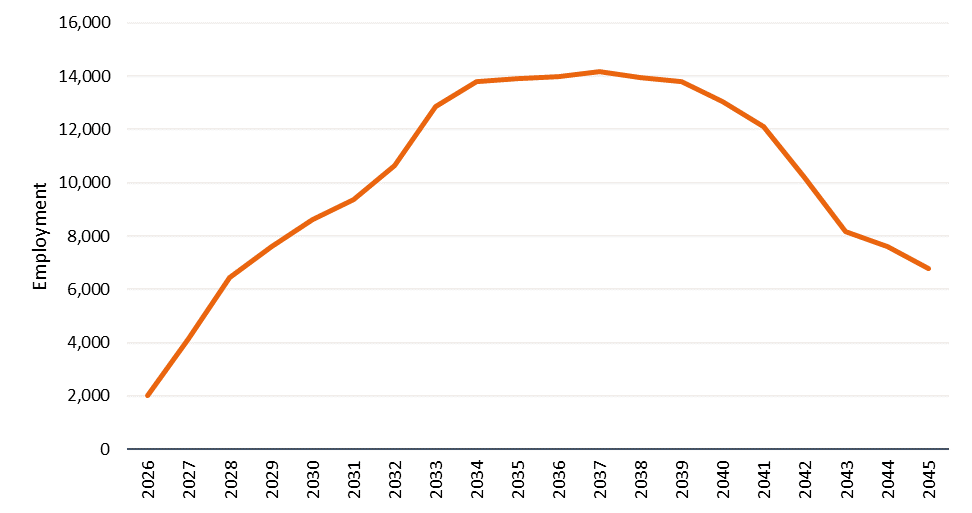
Figure 3: Projected additional employment in the construction sector under net zero pathways, 2026–2045
Source: Cambridge Econometrics. Own calculations
Occupations
Figure 4 shows projected employment levels across occupational groups in the construction sector. Employment in all groups is expected to increase as a result of the net zero transition. Skilled trades occupations are expected to account for the largest share of additional jobs associated with the net zero pipeline, accounting for 1,150 jobs in 2026. Employment in this occupation is expected to increase substantially, peaking between 2034 and 2039 at 9,000 jobs per year. Demand is then expected to decrease to 4,300 jobs by the end of 2045.
Within skilled trades occupations, we expect the following roles to see particularly strong employment growth. This is expected to account for around 47% of the growth in the construction sector between 2026 and 2045.
- Carpenters and joiners (SOC code 5316)
- Electricians and electrical fitters (SOC 5241)
- Painters and decorators (SOC 5323)
- Plumbers and heating and ventilating installers and repairers (5315)
- Roofers, roof tilers and slaters (5314)
The second group of occupations in which there is expected to be strong employment growth is process, plant and machine operatives. Within this group, we expect the following roles to see particularly strong employment growth. This is expected to account for around 8.6% of the growth in the construction sector between 2026 and 2045:
- Scaffolders, stagers and riggers (SOC code 8151)
- Construction operatives n.e.c. (SOC 8159)
- Mobile machine drivers and operatives n.e.c. (SOC 8229)
- Large goods vehicle drivers (SOC 8211)
Professional occupations are also expected to see notable increases, particularly construction project managers and related professionals (SOC 2455) and civil engineers (SOC 2121).
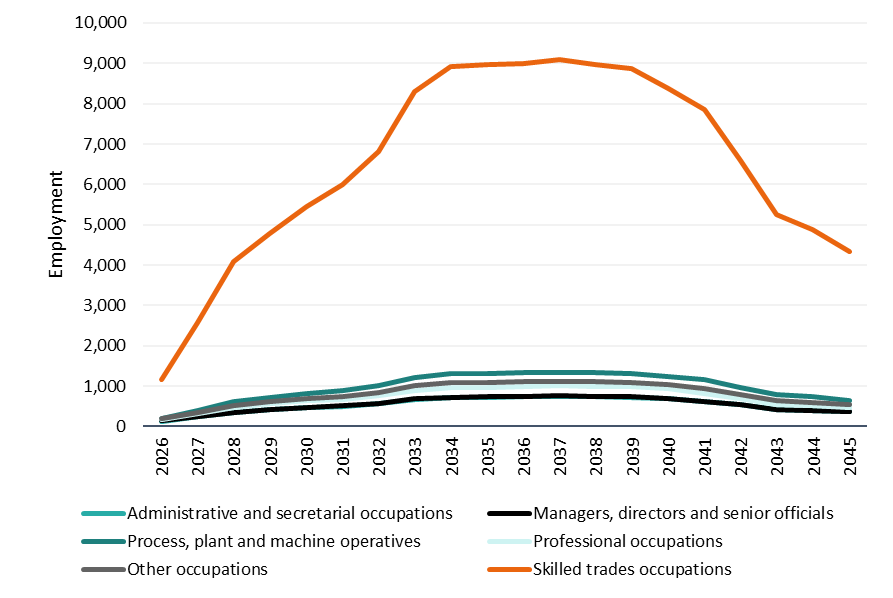
Figure 4: Projected employment by occupational group. 2026-2045
Source: Cambridge Econometrics and Labour Force Survey (ONS). Own calculations
Skills
Figure 4 shows employment trends across occupations, indicating an increase in demand for technical, engineering, and project management skills. However, they do not directly identify the specific skills driving this demand. To address this, we map construction-related occupations to the SSC, providing a more detailed view of the skills required for the net zero transition.
Table 15 presents the skills expected to be in highest demand, ranked according to a relevance index (see Section 4.4). The results indicate that the most in-demand SSC Skill Domains are:
- Evaluating and Inspecting (from 1,900 additional jobs in 2026 to 6,600 by 2045)
- Planning and Resourcing (from 1,800 to 6,200)
- Operating & Monitoring (from 1,700 to 6,100)
- Constructing and Installing (from 1,500 to 5,500)
- Managing and Directing (from 1,500 to 5,500)
At a more detailed level, Table 16 highlights the SSC Skill Areas expected to be most in demand. These include: inspecting and testing structures and equipment; evaluating and verifying information; managing organisational and operational records; installing building interior systems and equipment; and determining project requirements and plans. Together, these results provide a more precise understanding of the specific skills needed to support the construction sector’s net zero transition.
Relevance index | Skill Domain | Skill Area |
|---|---|---|
1 | Evaluating and inspecting (SD.14) | Inspecting and testing structures and equipment (SA.071) |
2 | Evaluating and inspecting (SD.14) | Evaluating and verifying information (SA.077) |
3 | Recording and documenting (SD.19) | Managing organisational and operational records (SA.095) |
4 | Constructing and installing (SD.05) | Installing building interior systems and equipment (SA.028) |
5 | Planning and resourcing (SD.03) | Determining project requirements and plans (SA.018) |
6 | Evaluating and inspecting (SD.14) | Evaluating environments, conditions and risks (SA.074) |
7 | Managing and directing (SD.16) | Leading organisational operations and improvements (SA.082) |
8 | Recording and documenting (SD.19) | Documenting interviews and compiling reports (SA.094) |
9 | Planning and resourcing (SD.03) | Planning operations, controls and contingencies (SA.020) |
10 | Constructing and installing (SD.05) | Building external structures and surfaces (SA.027) |
11 | Maintaining and repairing (physical objects) (SD.21) | Maintaining electrical and electronic equipment (SA.104) |
12 | Accounting and financing (SD.15) | Analysing financial data and forecasting budgets (SA.081) |
13 | Maintaining and repairing (physical objects) (SD.21) | Maintaining mechanical and pressurised equipment (SA.100) |
14 | Planning and resourcing (SD.03) | Procuring and managing supplies (SA.019) |
15 | Operating and monitoring (SD.07) | Colouring, coating or finishing objects (SA.043) |
16 | Constructing and installing (SD.05) | Installing mechanical and pressurised systems and equipment (SA.029) |
17 | Designing and creating (SD.02) | Designing technical solutions and prototypes (SA.011) |
18 | Constructing and installing (SD.05) | Installing electrical and electronic systems and equipment (SA.030) |
19 | Advising and supporting (SD.12) | Advising and supporting on legal issues, processes and disputes (SA.062) |
20 | Researching and analysing (SD.01 | Analysing and interpreting information and data (SA.004) |
Table 16: Skills projected to be in highest demand based on occupational requirements
Source: Cambridge Econometrics and Labour Force Survey (ONS). Own calculations
Table 17 and Table 18 present the skill requirements for (a) skilled trades occupations and (b) process, plant and machine operatives within the construction sector. These are projected to account for the largest share of employment demand. The tables highlight both shared and distinct skill requirements across the two occupational groups. Skilled trades occupations (Table 17) are characterised by a strong emphasis on installation, maintenance, and system integration. They also require key skills related to installing building interior systems, maintaining mechanical and electrical equipment, and planning and evaluating technical operations. These roles also require a combination of technical expertise and analytical capabilities, such as evaluating information, assessing risks, and determining project requirements.
Given the central role of skilled trades occupations in supporting the net zero transition in the construction sector, we analyse the information provided by the SSC at a more disaggregated level in order to identify emerging skills. These are understood to be those skills closely related to the construction activities, as outlined in Section 4. In particular, we focus on carpenters and joiners, and electricians and electrical fitters, given their relatively high employment concentration within the sector.
For carpenters and joiners, the skills associated with these occupations remain largely traditional construction skills, reflecting activities such as installing building components and working with structural materials.
In contrast, the skill set associated with electricians and electrical fitters shows a stronger connection to emerging technologies linked to the net zero transition. Within this subset of skills, several capabilities can be linked to the growing adoption of low‑carbon energy technologies and supporting infrastructure in the construction sector. These include skills related to renewable energy systems, such as installing solar energy systems, maintaining photovoltaic systems, calculating solar panel orientations, operating solar thermal energy systems for hot water and heating, installing inverters, and designing solar energy systems. The transition towards smart energy and grid systems also creates demand for skills such as designing smart grids, monitoring green energy systems, and directing renewable energy production operations. Finally, the growing integration of smart buildings and digital energy technologies highlights the importance of skills such as installing Building Energy Management Systems (BEMS) wiring systems, installing smart home devices, and providing advice on smart home technologies. Alongside these developments, the increasing emphasis on energy efficiency and sustainability requires capabilities such as conducting energy audits and providing advice on energy-saving technologies and strategies to reduce utility consumption.
ID | Skill Area | |
|---|---|---|
SA.028 | Installing building interior systems and equipment | |
SA.077 | Evaluating and verifying information | |
SA.071 | Inspecting and testing structures and equipment | |
SA.043 | Colouring, coating or finishing objects | |
SA.027 | Building external structures and surfaces | |
SA.104 | Maintaining electrical and electronic equipment | |
SA.100 | Maintaining mechanical and pressurised equipment | |
SA.029 | Installing mechanical and pressurised systems and equipment | |
SA.030 | Installing electrical and electronic systems and equipment | |
SA.018 | Determining project requirements and plans | |
SA.042 | Joining and moulding components | |
SA.035 | Operating manufacturing and processing machinery and equipment | |
SA.020 | Planning operations, controls and contingencies | |
SA.074 | Evaluating environments, conditions and risks | |
SA.073 | Evaluating object characteristics, qualities and function | |
SA.031 | Manufacturing, assembling and customising components | |
SA.008 | Designing industrial machinery, equipment and systems | |
SA.019 | Procuring and managing supplies | |
SA.004 | Analysing and interpreting information and data | |
SA.036 | Operating and monitoring outdoor machinery and equipment |
Table 17: Skills projected to be most in demand for skilled trades occupations
Source: Cambridge Econometrics and Labour Force Survey (ONS). Own calculations
In contrast, process, plant and machine operatives (Table 18) are more strongly associated with operational and task-based activities. Key skills include handling and moving materials, operating machinery and vehicles, and monitoring equipment and safety systems. These occupations place greater emphasis on physical and procedural skills and the safe, efficient operation of equipment. These differences underline the need for tailored training and workforce development strategies for each occupational group.
At the same time, there are skills areas of overlap between the two occupational groups, particularly in skills such as inspecting and testing structures and equipment, installing systems, and maintaining machinery. This overlap reflects the interconnected nature of construction activities, where both technical installation and operational execution are required.
ID | Skill Area |
|---|---|
SA.097 | Handling and moving heavy items |
SA.027 | Building external structures and surfaces |
SA.071 | Inspecting and testing structures and equipment |
SA.028 | Installing building interior systems and equipment |
SA.077 | Evaluating and verifying information |
SA.036 | Operating and monitoring outdoor machinery and equipment |
SA.040 | Operating and monitoring safety and control systems |
SA.099 | Operating transport and passenger vehicles |
SA.030 | Installing electrical and electronic systems and equipment |
SA.098 | Handling and moving hazardous materials |
SA.035 | Operating manufacturing and processing machinery and equipment |
SA.082 | Leading organisational operations and improvements |
SA.100 | Maintaining mechanical and pressurised equipment |
SA.102 | Maintaining water systems and equipment |
SA.096 | Sorting and distributing items |
SA.043 | Colouring, coating or finishing objects |
SA.104 | Maintaining electrical and electronic equipment |
SA.095 | Managing organisational and operational records |
SA.020 | Planning operations, controls and contingencies |
SA.029 | Installing mechanical and pressurised systems and equipment |
Table 18: Skills projected to be most in demand for process, plant and machine operatives
Source: Cambridge Econometrics and Labour Force Survey (ONS). Own calculations
Regional analysis (Council areas)
Table 19 presents projected employment requirements in construction by council area, associated with the net zero technology pipeline. The largest projected additional demand is concentrated in the main population centres, particularly Glasgow City, City of Edinburgh, Fife, South Lanarkshire, and North Lanarkshire. Given the national occupational structure, this pattern is expected to generate high demand for key construction occupations, including carpenters and joiners; electricians and electrical fitters; painters and decorators; plumbers, and heating and ventilating installers and repairers; and roofers, roof tilers, and slaters.
Council areas | 2026 | 2030 | 2035 | 2040 | 2045 |
Glasgow City | 178 | 936 | 1,621 | 1,492 | 812 |
City of Edinburgh | 146 | 766 | 1,324 | 1,218 | 662 |
Fife | 106 | 529 | 890 | 807 | 433 |
South Lanarkshire | 129 | 544 | 866 | 807 | 425 |
North Lanarkshire | 93 | 473 | 799 | 723 | 388 |
Aberdeenshire | 96 | 415 | 653 | 591 | 305 |
Highland | 151 | 495 | 674 | 627 | 300 |
Aberdeen City | 63 | 324 | 548 | 494 | 263 |
Renfrewshire | 51 | 271 | 475 | 446 | 246 |
West Lothian | 53 | 265 | 452 | 417 | 226 |
Perth and Kinross | 64 | 261 | 408 | 380 | 198 |
Falkirk | 44 | 221 | 370 | 334 | 178 |
Dundee City | 41 | 212 | 361 | 327 | 176 |
Dumfries and Galloway | 74 | 266 | 377 | 343 | 166 |
East Lothian | 42 | 189 | 314 | 299 | 163 |
Midlothian | 29 | 151 | 268 | 258 | 145 |
Scottish Borders | 55 | 208 | 308 | 284 | 142 |
North Ayrshire | 40 | 189 | 305 | 271 | 140 |
East Ayrshire | 46 | 192 | 297 | 273 | 137 |
East Renfrewshire | 40 | 168 | 268 | 254 | 135 |
East Dunbartonshire | 30 | 155 | 268 | 247 | 135 |
Angus | 33 | 162 | 271 | 245 | 130 |
South Ayrshire | 50 | 192 | 285 | 260 | 130 |
Stirling | 35 | 149 | 236 | 216 | 113 |
Moray | 58 | 191 | 258 | 237 | 112 |
Argyll and Bute | 47 | 166 | 233 | 213 | 103 |
West Dunbartonshire | 23 | 118 | 194 | 171 | 89 |
Inverclyde | 21 | 105 | 171 | 149 | 77 |
Clackmannanshire | 16 | 75 | 123 | 111 | 58 |
Na h-Eileanan Siar | 9 | 39 | 61 | 54 | 27 |
Shetland Islands | 8 | 35 | 56 | 51 | 26 |
Orkney Islands | 8 | 34 | 54 | 49 | 25 |
Table 19: Projected additional employment in the construction sector under net zero pathways by council areas and single year, 2026–2045. Source: Cambridge Econometrics and Section 4.5. Own calculations
In addition to population size, projected growth trends in retrofit and energy-related activity provide further insight into where construction demand is likely to expand most rapidly. Our analysis suggests that there is expected to be relatively strong growth in construction activities in areas such as the Scottish Borders, Stirling, Dundee City, the Highland council area, and Fife. As a result, these areas may face particularly acute labour market pressures, driven both by rising demand and by the need to expand the local skills base to support the transition.
Potential skills cross-over between sectors
Overlaps between construction and transport sectors
Sections 5.2 and 6.2 identify the occupations and skills expected to be most in demand to support net zero objectives within the transport and construction sectors. These sections highlight a degree of overlap between the sectors in relation to required occupations and skills.
In particular, the occupations common to both sectors include:
- Telecoms and related network installers and repairers (SOC code 5242), accounting for 1.8% of employment in transport-related net zero activities and 2.5% in construction-related activities.
- Electricians and electrical fitters (SOC 5241) accounting for 1.7% of employment in transport-related net zero activities and 10.8% in construction-related activities.
- Engineering technicians (SOC 3113), accounting for 1.0% of employment in transport-related net zero activities and 1.1% in construction-related activities.
- Production managers and directors in manufacturing (SOC 1121), accounting for 1.5% of employment in transport-related net zero activities and 0.7% in construction-related activities.
Several specific skills are common to both sectors. Among the most relevant are:
- Managing organisational and operational records (SSC code SA.095)
- Inspecting and testing structures and equipment (SSC SA.071)
- Maintaining mechanical and pressurised equipment (SSC SA.100)
- Evaluating and verifying information (SSC SA.077)
- Advising and supporting on legal issues, processes and disputes (SSC SA.062)
- Maintaining electrical and electronic equipment (SSC SA.104)
- Procuring and managing supplies (SSC SA.019)
- Documenting interviews and compiling reports (SSC SA.094)
- Leading organisational operations and improvements (SSC SA.082)
- Analysing and interpreting information and data (SSC SA.004)
- Installing mechanical and pressurised systems and equipment (SSC SA.029)
- Installing electrical and electronic systems and equipment (SSC SA.030)
- Determining project requirements and plans (SSC SA.018)
This overlap indicates that a subset of technical and engineering occupations is transferable between the two sectors, suggesting scope for labour reallocation to address emerging skill needs. At the same time, it may also generate cross-sector competition for workers with these skills, particularly where supply is constrained. The extent of mobility and competition will depend on the degree of task similarity across sectors, and the availability of targeted training to bridge sector-specific requirements.
Overlaps with other sectors
To broaden the analysis, we analyse the structure of the SSC to identify potential cross‑sectoral overlaps and sources of labour for construction and transport activities supporting net zero. The SSC identifies the skills that are most relevant to specific industry activities (SIC), allowing us to examine how essential skills are distributed across sectors. Using this framework, we identify where essential skills in construction and in transport‑related net zero activities are shared with other sectors. This allows us to highlight potential areas for labour mobility that could support Scotland’s net zero transition.
Transport-related activities supporting the net zero transition
Table 20 shows the extent to which the skills required for transport-related net zero activities are also used in other sectors of the economy. Darker shading indicates a greater degree of shared skills. Shared skills across sectors indicate potential labour mobility between sectors, as workers with comparable skill sets may move between activities as demand evolves. At the same time, shared skill requirements may also create competition for workers across sectors, particularly in occupations where the supply of skilled labour is limited.
The first column of Table 20 lists the skill domains, while the second column reports the number of essential skills within each domain for the construction sector. For example, within the ‘designing and creating’ domain, five key skills are identified: create construction or installation diagrams; design industrial processing systems; create electrical diagrams; produce ultra-precision mechanical systems; and design mechanical equipment.
The remaining columns indicate the extent to which these essential skills are present in other sectors. For instance, two of the “designing and creating” critical skills identified in the transport-related activities are also found in the construction sector. Similarly, within the “researching and analysing” domain three of the skills are also mapped to the manufacturing sector.
Skills Domain | Total skills in the vehicle and equipment repair and maintenance activities | Construction | Manufacturing | Professional, Scientific and Technical Activities | Other sectors1 |
|---|---|---|---|---|---|
Researching and Analysing | 8 | 1 | 3 | 6 | 3 |
Designing and creating | 5 | 2 | 4 | 4 | 0 |
Planning and Resourcing | 8 | 0 | 2 | 0 | 6 |
Programming and Implementing (Digital Tools and Systems) | 3 | 0 | 0 | 1 | 3 |
Constructing and Installing | 31 | 18 | 13 | 0 | 6 |
Manufacturing and Processing | 3 | 0 | 2 | 0 | 0 |
Operating and Monitoring | 32 | 7 | 23 | 2 | 7 |
Advising and Supporting | 3 | 1 | 1 | 2 | 0 |
Educating and Training | 3 | 1 | 1 | 0 | 1 |
Evaluating and inspecting | 38 | 8 | 18 | 16 | 7 |
Accounting and financing | 1 | 0 | 0 | 0 | 1 |
Managing and directing | 8 | 1 | 1 | 0 | 7 |
Marketing and selling | 3 | 0 | 0 | 0 | 2 |
Communicating and performing | 3 | 0 | 0 | 0 | 3 |
Recording and documenting | 4 | 0 | 0 | 1 | 3 |
Handling and transporting | 5 | 0 | 5 | 0 | 4 |
Maintaining and repairing (Physical Objects) | 76 | 7 | 20 | 1 | 15 |
Cleaning and restoring | 2 | 0 | 1 | 0 | 0 |
Table 20: Cross-sectoral overlap in skills associated with transport-related activities supporting the net zero transition. Source: Standard skills classification (SSC). Own calculations
Notes: (1) Other sectors include: mining and quarrying, electricity, gas, steam and air conditioning supply, wholesale and retail trade; repair of motor vehicles and motorcycles, transportation and storage, accommodation and food service activities, information and communication, financial and insurance activities, real estate activities, administrative and support service activities, public administration and defence; compulsory social security, education, human health and social work activities, arts, entertainment and recreation, water supply; sewerage, waste management and remediation activities, other service activities, activities of households as employers, activities of extraterritorial organisations and bodies.
Table 20 reveals a varied pattern of cross-sectoral skills overlap across the skill domains associated with transport-related net zero activities. The highest levels of overlap are observed in technically oriented domains. Within the skill domain of evaluating and inspecting, which represents one of the largest groups with 38 essential skills, there is a high degree of cross-sectoral overlap. 18 of these skills are also present in manufacturing, 16 skills in professional, scientific and technical activities, and eight in construction, with a smaller share (seven skills) found in other sectors. Similarly, operating and monitoring skills exhibit a high degree of overlap with manufacturing (23 skills).
Skills related to designing and creating show substantial alignment with both manufacturing and professional, scientific and technical activities (four key skills in each case). Researching and analysing skills are strongly represented in professional activities (six skills) and, to a lesser extent, manufacturing (three skills).
These patterns indicate that technical, engineering, and operational competencies are highly transferable across sectors, particularly between transport-related activities and manufacturing.
Construction related activities supporting the transition
Table 21 presents the results of potential cross-sectoral overlaps for the construction sector. The first column lists the Skill Domains, while the second column reports the number of essential skills within each domain for the construction sector. For example, within the ‘researching and analysing’ domain, two key skills are identified: reading and interpreting technical instructions, and conducting environmental health investigations.
The remaining columns indicate the extent to which these essential skills are present in other sectors. Darker shading represents a higher degree of overlap. For instance, nine of the ‘designing and creating’ critical skills identified in the construction sector are also found in manufacturing. Similarly, within the ‘constructing and installing’ domain (which represents a core area of construction activity in terms of number of skills), 23 of the skills are also mapped to the manufacturing sector.
Skills Domain | Total skills in the construction | Manufacturing | Professional, Scientific And Technical Activities | Water supply; sewerage, waste management and remediation activities | Other sectors1 |
|---|---|---|---|---|---|
Researching and analysing | 2 | 1 | 1 | 0 | 2 |
Designing and creating | 18 | 9 | 10 | 6 | 5 |
Planning and resourcing | 11 | 1 | 3 | 3 | 3 |
Constructing and installing | 106 | 23 | 1 | 3 | 13 |
Manufacturing and processing | 1 | 1 | 0 | 0 | 0 |
Operating and monitoring | 37 | 14 | 2 | 5 | 8 |
Planting and growing | 1 | 0 | 0 | 0 | 0 |
Advising and supporting | 8 | 1 | 2 | 3 | 1 |
Educating and training | 2 | 1 | 0 | 0 | 1 |
Evaluating and inspecting | 24 | 9 | 11 | 6 | 3 |
Managing and directing | 9 | 2 | 2 | 3 | 2 |
Communicating and performing | 1 | 0 | 0 | 1 | 0 |
Handling and transporting | 2 | 1 | 0 | 2 | 0 |
Maintaining and Repairing (physical objects) | 22 | 9 | 2 | 2 | 9 |
Cleaning and restoring | 2 | 0 | 0 | 1 | 0 |
Table 21: Cross-sectoral overlap of construction skills. Source: Standard skills classification (SSC). Own calculations
Notes: (1) Other sectors include: mining and quarrying, electricity, gas, steam and air conditioning supply, wholesale and retail trade; repair of motor vehicles and motorcycles, transportation and storage, accommodation and food service activities, information and communication, financial and insurance activities, real estate activities, administrative and support service activities, public administration and defence; compulsory social security, education, human health and social work activities, arts, entertainment and recreation, other service activities, activities of households as employers, activities of extraterritorial organisations and bodies.
The results indicate a considerable degree of skills overlap between the construction sector and other sectors in the economy, indicating strong potential for cross-sectoral labour mobility to support the net zero transition. Manufacturing emerges as a key source of transferable skills, with high levels of overlap in domains such as constructing and installing (23 skill out of 106 key skills), designing and creating (9 skills), operating and monitoring (14 skills), and evaluating and inspecting (9 skills). This indicates that workers in manufacturing may possess relevant technical and operational capabilities that could be redeployed to support construction‑related net zero activities.
There is also notable overlap with professional, scientific and technical activities, particularly in higher-level and analytical skill domains. For example, more than half of the skills in designing and creating (10 skills) and nearly half in evaluating and inspecting (11 skills) are shared with this sector.
Sectors such as water supply, sewerage, waste management and remediation activities also show meaningful overlap in specific domains, particularly in evaluating and inspecting (six key skills) and designing and creating (six skills).
Whilst these overlaps suggest potential for labour mobility, the extent to which workers can transition between sectors will depend on the availability of effective reskilling pathways. In practice, transitions across sectors may require additional qualifications, sector-specific experience, or certification requirements, which can limit the speed at which workers redeploy their skills. Industry norms and regulatory frameworks may also constrain mobility if they do not readily recognise transferable skills or alternative pathways into occupations. As a result, even where transferable skills exist, additional training and structured entry pathways may be needed to enable workers from related sectors to move into new roles.
Conclusion
This report assesses the workforce and skills needed as Scotland transitions to net zero in the construction and transport sectors. Using a technology-driven analytical framework, the study translates projected deployment of key net zero technologies into employment demand by sector, occupation and skill. The analysis draws on the Climate Change Committee’s Balanced Pathway scenario, alongside other evidence and modelling assumptions. It focuses on major transition activities such as renewable energy deployment, domestic retrofit, electric vehicle adoption and related infrastructure.
The results indicate that the net zero transition will generate sustained employment demand across both construction and transport-related activities. However, the timing and scale of this demand will vary between sectors. Demand is expected to start increasing in the late 2020s, with the greatest pressures emerging through the 2030s. This may leave a relatively short period to expand training and reskilling opportunities before demand peaks.
Construction employment demand is expected to increase rapidly in the early stages of the transition, driven by large-scale infrastructure deployment and domestic retrofit programmes. Demand is projected to peak in the mid‑2030s before gradually declining as major deployment phases are completed. However, employment is expected to remain above current levels, indicating a lasting increase in workforce demand. In transport-related activities, the transition is expected to change the type of jobs required rather than lead to substantial overall employment growth. Demand for roles linked to zero-emission technologies, including electric vehicle maintenance and charging infrastructure, is expected to increase steadily. Activities related to internal combustion engine technologies are expected to gradually decline.
The scale of this transition is substantial relative to current workforce capacity. Much of the adjustment is expected to occur through upskilling within existing roles. However, rising demand for technical occupations coincides with existing shortages in key areas, including electrical and mechanical skills. This suggests that current training provision may not be sufficient to meet future demand without further expansion.
Skilled trades are expected to account for the largest share of workforce demand across both sectors. In transport-related activities, key occupations include vehicle technicians, mechanics, electricians, electrical service and maintenance technicians, and welding trades. In construction, prominent occupations include carpenters and joiners, electricians and electrical fitters, plumbers and heating installers, painters and decorators, roofers, process and machine operatives, and professional roles such as civil engineers and construction project managers.
The analysis shows that many of the skills needed for the net zero transition already exist within the workforce, but will need to be adapted to new technologies and ways of working. Across both sectors, the most relevant skill areas include evaluating and inspecting, planning and resourcing, recording and documenting, and maintaining and repairing equipment. New skills will also be needed as electrification, digitalisation and low-carbon energy systems become more widely used. In transport, these include skills related to electric vehicle systems, battery technologies, digital diagnostics, and automated control systems. In construction, they include skills related to renewable energy systems, smart building technologies, and energy efficiency solutions – including the installation and maintenance of solar systems, and building energy management systems. Importantly, demand for these skills is expected to intensify over the 2030s, in line with peak deployment across both sectors. This highlights the need to align training provision with expected demand.
Finally, the analysis highlights substantial overlap between the occupations and skills required across construction and transport. Technical occupations such as electricians, engineering technicians, and telecommunications installers are required across both sectors and in other parts of the economy. This reflects the shared infrastructure and technologies that support the net zero transition. The overlap creates opportunities for workers to move between sectors, but could increase competition for people with similar technical skills.
References
Centre for Sustainable Road Freight. (2025). Towards Zero Emission HGV Infrastructure in Scotland: Phase 2 Report . Click or tap here to enter text.
Cardenas Rubio, J., Warhurst, C., Anderson, P., Jeisson, D., & Rubio, C. (2022). Green Jobs in Scotland: An inclusive approach to definition, measurement and analysis. https://warwick.ac.uk/fac/soc/ier
Cambridge Econometrics. (2025). MDM-E3 Annual Economic Forecast: Unpublished.
Cirillo, V., Fanti, L., Mina, A., & Ricci, A. (2023). The adoption of digital technologies: Investment, skills, work organisation. Structural Change and Economic Dynamics, 66, 89–105. https://doi.org/10.1016/j.strueco.2023.04.011
CITB. (2025). Construction Workforce Analysis Scotland 2025 – 2029. Retrieved from https://www.citb.co.uk/cwo/index.html
ClimateXChange. (2022). Clean Heat and Energy Efficiency Workforce Assessment. https://doi.org/10.7488/era/2524
ClimateXChange. (2024). Workforce and skills requirements in Scotland’s onshore wind industry. Retrieved from https://www.climatexchange.org.uk/projects/workforce-and-skills-requirements-in-scotlands-onshore-wind-industry/
ClimateXChange. (2024). Workforce and skills requirements in Scotland’s solar industry. Retrieved from https://www.climatexchange.org.uk/projects/workforce-and-skills-requirements-in-scotlands-solar-industry/
Department for Energy Security and Net Zero. (2021). Net Zero Strategy: Build Back Greener. In Gov.Uk (Issue October). https://www.gov.uk/government/publications/net-zero-strategy
Department for Transport. (2026). Consultation on a New Heavy Goods Vehicle CO₂ Emissions Regulatory Framework for the United Kingdom. https://assets.publishing.service.gov.uk/media/6983430d13622473b51ca9db/new_hgv_co2_emissions_regulatory_framework_for_UK.pdf
Energy and Climate Change Directorate. (2025). Just Transition: draft plan for transport in Scotland: Annex B. In https://www.gov.scot/publications/ecosystem-restoration-code-engagement-paper/. https://www.gov.scot/publications/transition-draft-transition-plan-transport-scotland/
HIE. (2025). Regional Transformational Opportunities in the Highlands and Islands. Retrieved from https://www.hie.co.uk/media/kr3jjbdf/regional-transformational-opportunities-in-the-highlands-and-islands-report-may-2025.pdf
OECD (2022), Skills for the Digital Transition: Assessing Recent Trends Using Big Data, OECD Publishing, Paris,
https://doi.org/10.1787/38c36777-en.
Optimat. (2021). Skills for low carbon Heavy Duty Vehicles. Retrieved from https://www.transport.gov.scot/media/50464/skills-for-low-carbon-hdvs-pdf.pdf
Optimat. (2023). Skills for transport decarbonisation.
Scottish Enterprise. (2024). Economic Impact Scenarios for Scotland’s Energy Transition. Retrieved from https://www.scottish-enterprise.com/media/1ykbucca/the-economic-impact-of-scotlands-energy-transition.pdf
Skill Development Scotland. (2024). Sectoral Skills Assessments. Construction. Retrieved from https://www.skillsdevelopmentscotland.co.uk/media/rleiealf/sectoral-skills-assessment-construction.pdf
Skills Development Scotland. (2020). Climate Emergency. Skills Action Plan 2020-2025 Key Issues And Priority Actions.
Skills Development Scotland. (2023). CESAP Pathfinder. A Dynamic Skills Response to Supporting the Transition to Net Zero. Work Package 1: An Evidence Based Approach to Supporting the Transition to Net Zero. Retrieved from https://www.skillsdevelopmentscotland.co.uk/media/5hcorb5t/cesap-pathfinder-wp1-report.pdf
Skills Development Scotland. (2024). Climate Emergency Skills Action Plan (CESAP) Pathfinder. Final Project Report. Work Package 2. Retrieved from https://www.skillsdevelopmentscotland.co.uk/media/ucmjsq3y/cesap-wp2-final-report.pdf
Appendices
SOC 2020 definitions
The SOC 2020 (Standard Occupational Classification 2020) is the UK’s official system for classifying occupations based on the type of work performed and the skills required. It groups jobs into a hierarchical structure of major, sub-major, minor, and unit groups, enabling consistent analysis and comparison of occupational data across labour market statistics, surveys, and policy research (see Table 22).
Major occupational group | Description |
|---|---|
| This major group covers occupations whose tasks consist of planning, directing and coordinating resources to achieve the efficient functioning of organisations and businesses. Working proprietors in small businesses are included, although allocated to separate minor groups within the major group. Most occupations in this major group will require a significant amount of knowledge and experience of the production processes, administrative procedures or service requirements associated with the efficient functioning of organisations and businesses. |
|
This major group covers occupations whose main tasks require a high level of knowledge and experience in the natural sciences, engineering, life sciences, social sciences, humanities and related fields. The main tasks consist of the practical application of an extensive body of theoretical knowledge, increasing the stock of knowledge by means of research and communicating such knowledge by teaching methods and other means.
|
|
This major group covers occupations whose main tasks require experience and knowledge of principles and practices necessary to assume operational responsibility and to give technical support to Professionals and to Managers, Directors and Senior Officials.
|
|
Occupations within this major group undertake general administrative, clerical and secretarial work, and perform a variety of specialist client-orientated administrative duties. The main tasks involve retrieving, updating, classifying and distributing documents, correspondence and other records held electronically and in storage files; typing, word‑processing and otherwise preparing documents; operating other office and business machinery; receiving and directing telephone calls to an organisation; and routing information through organisations.
|
|
This major group covers occupations whose tasks involve the performance of complex physical duties that normally require a degree of initiative, manual dexterity and other practical skills. The main tasks of these occupations require experience with, and understanding of, the work situation, the materials worked with and the requirements of the structures, machinery and other items produced.
|
|
This major group covers occupations whose tasks involve the provision of a service to customers, whether in a public protective or personal care capacity. The main tasks associated with these occupations involve the care of the sick, the elderly and infirm; the care and supervision of children; the care of animals; and the provision of travel, personal care and hygiene services.
|
|
This major group covers occupations whose tasks require the knowledge and experience necessary to sell goods and services, accept payment in respect of sales, replenish stocks of goods in stores, provide information to potential clients and additional services to customers after the point of sale. The main tasks involve knowledge of sales techniques, a degree of knowledge regarding the product or service being sold, familiarity with cash and credit handling procedures and a certain amount of record keeping associated with those tasks.
|
|
This major group covers occupations whose main tasks require the knowledge and experience necessary to operate and monitor industrial plant and equipment; to assemble products from component parts according to strict rules and procedures and to subject assembled parts to routine tests; and to drive and assist in the operation of various transport vehicles and other mobile machinery.
|
|
This major group covers occupations which require the knowledge and experience necessary to perform mostly routine tasks, often involving the use of simple hand-held tools and, in some cases, requiring a degree of physical effort.
|
Table 22: Standard Occupational Classification (SOC)
Source: ONS
The Structure of the UK Standard Skills Classification (SSC)
The SSC is structured as a hierarchical framework covering 3,343 individual skills needed to perform specific job tasks competently. Each occupational skill is connected to a range of tasks and core skills, where core skills represent broader, transferable capabilities that underpin effective task performance (see Figure 5).
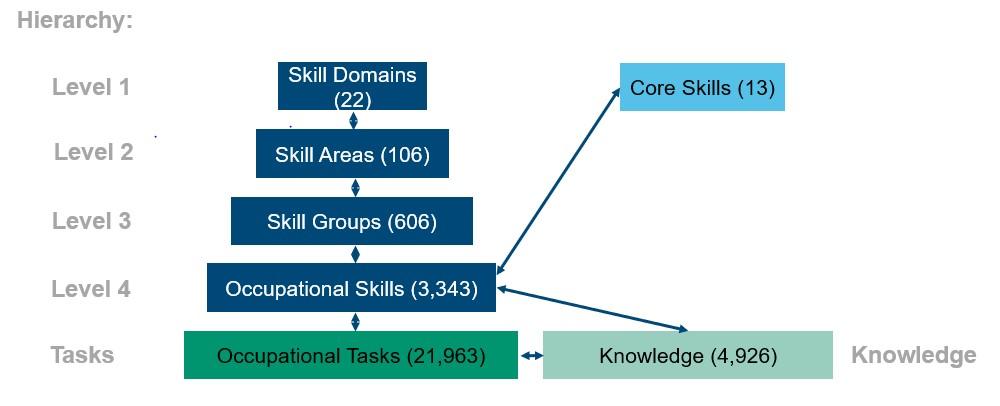
Figure 5: Structure of the Skills Standard Classification
Source: Department for Work and Pensions (DWP) – Skills England
How to cite this publication:
Patel, S. et al. (2026) ‘Workforce requirements for net zero in transport and construction’, ClimateXChange. DOI https://doi.org/10.7488/era/7189
© The University of Edinburgh, 2026
Prepared by Cambridge Econometrics on behalf of ClimateXChange, The University of Edinburgh. All rights reserved.
While every effort is made to ensure the information in this report is accurate as at the date of the report, no legal responsibility is accepted for any errors, omissions or misleading statements. The views expressed represent those of the author(s), and do not necessarily represent those of the host institutions or funders.
This work was supported by the Rural and Environment Science and Analytical Services Division of the Scottish Government (CoE – CXC).
ClimateXChange
Edinburgh Climate Change Institute
High School Yards
Edinburgh EH1 1LZ
+44 (0) 131 651 4783
If you require the report in an alternative format such as a Word document, please contact info@climatexchange.org.uk or 0131 651 4783.
Including vehicle and equipment repair and maintenance. ↑
Loft insulation is modelled as a one-off energy efficiency measure with a 40-year lifetime. The CCC assumes that most eligible homes receive loft insulation during the late 2020s and early 2030s, after which little additional deployment is required. As a result, data for this measure may show no further growth or may be absent in later years. ↑
At the time of reporting, the data referred to charge points. However, following a UK-wide methodology change introduced by the Department for Transport (DfT) and Zapmap on 26 February 2026, the headline metric now counts “EV chargers” instead. As some charge points, particularly rapid and ultra-rapid, can charge more than one vehicle simultaneously, this new measure better reflects overall network capacity and aligns with international standards. The Scottish Government is currently reviewing the implications of this change. ↑
It should be noted that these estimates are based on technical labour requirements and may not fully capture factors such as downtime, training, administrative tasks, and other non-operational activities, which could lead to an underestimation of total workforce needs. ↑
https://www.gov.uk/government/publications/uk-standard-skills-classification-interim-development-report/the-uk-standard-skills-classification ↑
This approach is applied across all vehicle types in the pipeline, including heavy goods vehicles and buses. However, the spatial allocation is based on EV registration patterns, which are largely driven by cars and light vans. As a result, the geographic distribution of HGV and bus activity is approximated using these patterns and may not fully reflect their distinct operational and infrastructure requirements. ↑
Green jobs are occupations affected by the greening of the economy and may take the form of new and emerging roles, existing jobs requiring substantial changes in tasks and skills, or occupations experiencing rising demand (Cardenas Rubio et al., 2022) ↑
This definition captures the number of people working in occupations potentially affected by the greening of the economy. It includes both existing occupations that may undergo transformation due to the green transition and newly emerging occupations (often referred to as pure green jobs). Importantly, not all workers within these occupations necessarily carry out green-related activities. ↑
Cambridge Econometrics (CE) develops annual economic forecasts for all twelve nations and regions (Wales, Scotland and Northern Ireland, and the nine regions of England) in the UK. The forecasts are developed using CE’s Multi‑Sectoral Dynamic Model (MDM-E3) of the UK economy. ↑
This category includes roles such as complain handler, helpdesk operator, etc. ↑
In the SSC, skill domains represent broad groupings of related skills, capturing the main types of activities performed within occupations. Each domain contains several more detailed skill areas, which describe specific capabilities required to perform particular tasks. Identifying the most relevant domains, therefore, provides an overview of the types of capabilities most strongly associated with the projected employment demand, before examining the more detailed skill areas within each domain. ↑
Low-carbon hydrogen is expected to play an important role in helping Scotland reach net zero, particularly in sectors where electrification is difficult, such as heavy industry, shipping and aviation. Understanding how hydrogen deployment could develop under different policy, market and technology conditions is essential for planning this transition.
This research develops a new hydrogen deployment model for Scotland. The model provides Scottish Government with a flexible tool to explore how different assumptions affect hydrogen demand and the infrastructure needed to support it through to 2050.
This report explains how the model was developed and demonstrates its use through two illustrative scenarios:
- Pragmatic scale-up reflects a future where hydrogen use grows steadily, but demand remains the main constraint.
- Industry breakthrough reflects stronger policy support, greater export growth and wider use of hydrogen in sectors where cutting greenhouse gas emissions is particularly challenging.
Key findings
- The report recommends continuing to develop the model as Scotland’s hydrogen sector evolves and using it alongside further analysis of infrastructure costs and future market conditions.
- The model is designed to test different future scenarios and support evidence-based decision making, rather than predict a single outcome.
- In both scenarios, exports drive most of Scotland’s hydrogen demand, with domestic demand led by shipping, aviation, steel and the chemical industry.
- Affordable electricity and timely investment in export infrastructure are the two biggest factors influencing hydrogen deployment. Delays to pipeline connections with the rest of the UK and Europe could significantly limit Scotland’s ability to grow its hydrogen sector and access international markets.
- The findings highlight the need for coordinated policy, competitive electricity prices and investment in export infrastructure to support hydrogen deployment.
For further information, please read the full report.
If you require the report or annex in an alternative format, such as a Word document, please contact info@climatexchange.org.uk or 0131 651 4783.
Page image: Bruno at Unsplash
Research complete March 2026
DOI: https://doi.org/10.7488/era/7184
1. Executive summary
Low-carbon hydrogen has been identified as a critical enabler of the transition to net zero. This is particularly the case in sectors where electrification is technically or economically constrained, such as heavy industry, shipping, aviation, and export markets. Achieving this ambition requires transparent, evidence-based analytical tools that can translate policy assumptions into credible deployment trajectories.
This report presents the findings of a research project commissioned by ClimateXChange (CXC) and the Scottish Government to develop a quantitative hydrogen deployment model for Scotland. The project responds to the need for an updated evidence base on Scotland’s hydrogen potential in light of significant policy, market, and technological developments since the 2020 Scottish Hydrogen Assessment (SHA).
As part of the project, we have created a flexible, user-configurable modelling tool. The model allows Scottish Government and Scottish Enterprise to explore how different policy, economic, infrastructure, and market conditions affect the pace and scale of hydrogen deployment across Scotland’s key sectors through to 2050. We used two illustrative deployment scenarios to test the model’s functionality and represent distinct and plausible futures for Scotland’s hydrogen sector.
The low-carbon hydrogen deployment model
The model is a scenario-based analytical tool for estimating hydrogen demand across Scotland’s key sectors through to 2050. It also estimates the supply-side infrastructure required to meet that demand. The model provides a quantitative, user-friendly framework for translating policy, economic, and technological assumptions into sector-level hydrogen demand projections and infrastructure requirements. It can be used to explore alternative deployment pathways, test key assumptions and support evidence-based decision-making.
The model itself, accompanied by a detailed user guide, was developed for use, and continued development, by Scottish Government and Scottish Enterprise analysts. This report summarises the process of its development and documents its use in testing two scenarios. The model is intended to support scenario testing and exploration of alternative futures, rather than provide a single forecast of Scotland’s hydrogen deployment trajectory. Results should therefore be interpreted as conditional on the policy, market and infrastructure assumptions specified within each scenario.
Two scenarios for hydrogen deployment in Scotland
The first scenario, ‘pragmatic scale-up’, is broadly aligned with the International Energy Agency (IEA) Stated Policies Scenario (STEPS). It reflects a world in which hydrogen grows but demand remains the binding constraint. The second, ‘industry breakthrough’, moves closer to an IEA Net Zero Emissions (NZE) trajectory. It is characterised by centralised infrastructure, high shipping and aviation targets, reliance on green hydrogen, and export development. It is a scenario in which hydrogen becomes a structural pillar of Scotland’s industrial sectors where reducing greenhouse gas emissions is particularly challenging.
Under Scenario 1, total hydrogen demand in Scotland reaches 40.2 TWh by 2050. This is underpinned by 11 GW of green and 135 MW of blue installed production capacity. Exports, (both pure hydrogen flows and derivatives such as ammonia and e-fuels), account for the majority of demand. Domestic consumption is led by shipping, aviation (including sustainable aviation fuels (SAF)), the steel sector, and the chemical industry.
Under Scenario 2, total demand reaches 70.3 TWh by 2050, served by 19.4 GW of green and 0.12 GW of blue production capacity. Exports again represent the largest single component of overall demand, with higher transport sector demand reflecting a more ambitious policy environment.
When considered alongside existing Scottish and UK hydrogen studies, both scenarios are above the most conservative projections and broadly in line with mid-range reference cases. However, they sit below the Scottish Government’s previous headline production ambitions and the most optimistic SHA scenarios.
Implications for hydrogen deployment
The model’s outputs are most sensitive to two parameters: electricity prices and the availability of export infrastructure. Electricity prices directly govern the business case for electrolytic green hydrogen production. The availability of export infrastructure acts as a hard boundary on whether Scotland can access international hydrogen demand. These findings are consistent with the broader literature and reinforce the relevance of both affordable renewable electricity and infrastructure.
We highlight several priorities for policy and investment.
- Targeted policy support to enable a competitive electricity price is essential for driving deployment and hydrogen competitiveness.
- Export infrastructure deserves early and decisive attention. Both scenarios show that exports drive the majority of Scotland’s hydrogen demand, yet export volumes are acutely sensitive to whether pipeline connections to the rest of the UK and the EU are available on time. Delays to these infrastructure routes are shown to significantly constrain overall system scale or alternatively cause sunk investments. The case for accelerating planning, consenting, and investment in inter-UK and EU cross-border hydrogen infrastructure is therefore strong.
This report and model should be treated as a first analytical layer. It focuses on demand-driven deployment under policy and infrastructure conditions and only considers electricity price conditions as a competitiveness cost-related input. No infrastructure deployment cost drives the deployment of hydrogen infrastructure in the model. Further work is recommended to evaluate the total system deployment costs of each scenario, carry out deeper sensitivity analyses, and update the model as Scotland’s hydrogen market continues to evolve.
Glossary/Abbreviations table
ATR | Autothermal Reformer |
BEIS | Department for Business, Energy & Industrial Strategy |
Blue Hydrogen | Hydrogen produced from natural gas via SMR or ATR, with CO2 |
BRIA | Business and Regulatory Impact Assessment |
CCS | Carbon Capture and Storage |
CCUS | Carbon Capture, Utilisation and Storage |
CLI | Competitiveness and Likelihood Indicator |
CO2 | Carbon dioxide – a greenhouse gas produced during combustion and industrial processes, captured in blue hydrogen production pathways. |
CPS | Current Policies Scenario |
CXC | ClimateXChange |
ToC | Theory of Change |
DESNZ | Department for Energy Security and Net Zero |
ELY | Electrolyser |
EU | European Union |
GHG | Greenhouse Gas |
Green Hydrogen | Hydrogen produced via electrolysis using renewable electricity, resulting in near-zero direct carbon emissions. |
GW | Gigawatt |
HAR | Hydrogen Allocation Round |
H2 | Molecular hydrogen — the energy carrier at the centre of this model. |
IEA | International Energy Agency |
IEA CP | International Energy Agency Current Policies |
IMO | International Maritime Organisation |
JRC | Joint Research Centre (European Commission) |
LCHA | Low Carbon Hydrogen Agreement |
MW | Megawatt – a unit of power used to express electrolyser and production capacity. |
NZE | Net Zero Emissions (by 2050) |
NZTC | Net Zero Technology Centre |
p.a. | Per annum – per year. |
rUK | Rest of United Kingdom |
SAF | Sustainable Aviation Fuel |
S-Curve/Logistic Curve | A logistic growth curve used in the model to represent technology adoption within incremental sectors, converting a CLI score into a deployment share. |
SMR | Steam Methane Reformer |
STEPS | Stated Policies Scenario |
TRL | Technology Readiness Level – a scale used to assess the maturity of a technology, applied in the model to calibrate the speed of hydrogen uptake across sectors. |
TWh | Terawatt-hour – a unit of energy used to express large-scale electricity generation or consumption. |
UK | United Kingdom |
UKG | UK Government |
VRES | Variable Renewable Energy Source |
2. Introduction
This report presents the findings of research on the development of a hydrogen deployment model to support policymaking. The research was carried out by Ramboll on behalf of ClimateXChange and the Scottish Government.
Low carbon hydrogen has been identified as a cornerstone of Scotland’s transition to net zero by 2045. This project responds to the need to update the 2020 Scottish Hydrogen Assessment in light of significant policy, market, and technological developments.
Hydrogen is increasingly recognised as a critical enabler of decarbonization across multiple sectors. It is seen as particularly important in industry, long-haul transport, and for process heat, where electrification may be less feasible.
Scotland’s Hydrogen Action Plan (Scottish Government, 2022) sets out ambitions for 5 GW of installed hydrogen production capacity by 2030 and 25 GW by 2045, with a strong emphasis on export potential to Europe. This aligns with the UKG’s ambitions of developing low carbon hydrogen capacity for use in key sectors as outlined in the Hydrogen Strategy update to the market (DESNZ, 2025). Alongside the EU’s REPowerEU initiative (EU Commission, 2026), these strategies collectively signal a growing cross-border demand for clean hydrogen. The Scottish Government’s Hydrogen Sector Export Plan (Scottish Government, 2024) highlights the importance of international competitiveness, underpinned by robust certification and emissions accounting.
3. Methodology
This research was built on three complementary workstreams:
- Literature review: gathering key data and insights to inform model building, assumptions, and scenarios. This ensured an up-to-date technical and policy basis for model development. It delivered inputs for the assumptions, and created a foundation for scenario development. The review covered Scottish and UK policy and strategy documents (including the Scottish Hydrogen Action Plan (Scottish Government, 2022), UK Hydrogen Strategy updates (UK Government, 2022-2025), Clean Power 2030 Action Plan (UK Government, 2024), and relevant low-carbon hydrogen standards and business model frameworks), Scottish technical and market studies, and international benchmarks such as IEA scenarios (including STEPS/CPS) (IEA, 2025) and other public sources. The review was used to define baseline assumptions and parameters, including technology costs, deployment timelines, policy milestones, demand drivers, and key interdependencies across the hydrogen value chain. The outcome of the review feeds into Section 4.1and provides a structured evidence base for modelling choices, scenario narratives, and stakeholder discussions.
- Deployment model development: constructing a dynamic hydrogen deployment scenario model that allows for pathway generation based on different scenario configurations. This addressed the core of the research and delivered the modelling tool that then allows for scenario analysis and exploration of deployment alternatives. Model development included: (i) defining the overall model structure and interlinked input/output sheets; (ii) generating modules and dependencies across hydrogen production, demand, infrastructure, and exports; (iii) identifying and implementing parameters and assumptions; (iv) building a dashboard for user-friendly configuration and output interpretation; and (v) testing and calibration of model functionality. The model captures key relationships such as conversion of supply targets into capacity, links between capacity and build times, infrastructure implications of policy targets, and dependencies between hydrogen production buildout and grid needs. A short description of the model is provided in Section 4, with results generated through annual trajectories to 2050.
- Scenario specification: creation of two distinct scenarios for analysis. This collected the necessary data and variations to create different pathways for hydrogen deployment (summarised in Section 3.2). The scenarios were then used in the deployment model to generate results on the future hydrogen sector in Scotland (Section 5). Scenario design was based on the literature review, related studies, and project experience. Each scenario includes (i) a narrative describing the underlying assumptions and drivers, and (ii) parameter settings for production, demand, infrastructure, exports, and policy/enablers. The two scenarios are aligned with IEA, UK Government, and Scottish Government policy ambitions and targets. These scenarios demonstrate model functionality and provide a basis for deeper sensitivity analyses on the parameters that most strongly influence hydrogen deployment outcomes.
4. Literature review and data
The scope of the study required a deep literature review to establish necessary understanding of the Scottish context and extract relevant data sources. The following sections provide the findings of the review on the Scottish energy landscape and the relevant documents used for model development. We then summarise the two scenarios that were established from the literature review. These scenarios serve as case studies for use of the deployment model.
The Scottish energy landscape
The literature review was used to establish the system context, policy boundaries, and credible deployment pathways for the Scotland hydrogen deployment model before populating detailed technical parameters. In practice, these sources informed (i) the model scope and scenario logic, (ii) the demand sectors and infrastructure pathways represented in the model, and (iii) the policy/commercial assumptions used to interpret results. This was particularly important because hydrogen deployment in Scotland is shaped not only by local resource potential, but also by UK market support frameworks, certification rules, export readiness, and wider European/international market development. The section below sets out the key documents that were used to inform the model design.
At the Scotland level, the Scottish Hydrogen Action Plan (Scottish Government, 2022) provides the primary strategic baseline for domestic and export ambition. This includes the headline production ambition (5 GW by 2030 and 25 GW by 2045) and the broader framing of hydrogen as both a decarbonisation and industrial opportunity. It was used to identify the main demand segments and deployment themes relevant to the model (industry, transport, power system integration, exports, regional clusters/hubs, and enabling infrastructure). The accompanying Business and Regulatory Impact Assessment (BRIA) (Scottish Government, 2022) provided the structure for understanding barriers and delivery risks (e.g., market immaturity, infrastructure needs, investment uncertainty and policy coordination requirements). These informed the way uncertainty is reflected in model dials and scenario ranges rather than treated as fixed outcomes.
The Scottish Government export plan (A Trading Nation: Realising Scotland’s Hydrogen Potential – A Plan for Exports) (Scottish Government, 2024) was then used to add an explicit export-system perspective. This source helped structure how the model considers Scotland’s role not only as a domestic hydrogen producer, but as a future exporter into UK and European markets. It highlighted practical enablers and constraints around export market development. These include demand assurance, certification, transport routes, ports and terminals, storage, and international coordination. These considerations were important for how infrastructure requirements and timing assumptions are framed in the model, particularly where export demand competes with or complements domestic demand growth.
A second group of sources was used to understand the UK-wide policy and commercial framework, which materially affects whether Scottish projects can progress. The UK Government’s Low Carbon Hydrogen Production Business Model (DESNZ, 2022) and the Low Carbon Hydrogen Agreement (LCHA) (BEIS, 2022) were important for understanding the commercial support architecture (e.g., long-term contractual support and price/reference-price concepts), and therefore for interpreting what kinds of projects may be financeable under different market conditions. The Hydrogen Update to the Market (DESNZ, 2025) was used as a current-state snapshot of UK policy progression and programme delivery (e.g., allocation rounds, project support progress, and updates on transport and storage business model development). This helped avoid designing scenarios around outdated assumptions and provided evidence on the pace at which the UK hydrogen market architecture is maturing.
For the power-system interface, the Hydrogen to Power consultation response (DESNZ, 2024) and the Clean Power 2030 Action Plan (UK Government, 2024) were key to understanding the emerging role of hydrogen in dispatchable, low-carbon flexible generation and system balancing. These sources frame hydrogen-to-power as a strategic, but policy-dependent, demand pathway with relevance for long-duration/seasonal balancing and firm capacity provision rather than bulk generation. This was important for defining when hydrogen-to-power demand should appear in scenarios, and how strongly it should be linked to wider electricity-system conditions and policy support. The hydrogen blending consultation document (DESNZ, 2025) was also used, but mainly as a transitional/uncertain demand pathway: it is reflected in the model as an enabler for earlier uptake rather than a core long-term demand assumption.
A third group of sources supported the representation of infrastructure and delivery pathways. The Net Zero Technology Centre (NZTC) Hydrogen Backbone Link (NZTC, 2024) report was used for understanding the strategic case and practical considerations for linking Scotland to European demand centres, including route/infrastructure development thinking and export system integration. The Joint Research Centre (JRC) assessment of hydrogen delivery options (JRC, 2021) and the academic journal article ‘An analysis of the bulk transport of green hydrogen at sea: Comparison between submarine pipeline and compressed and liquefied transport by ship’ (d’Amore-Domenech, R. et al., 2023) provided broader techno-economic context on transport vectors (e.g., pipelines vs shipping and derivative pathways) and how technology choice depends on distance, scale and delivery context. These sources did not directly set final technical parameters, but they strongly informed the infrastructure options represented in the model, i.e., trailers, pipelines and ships.
Finally, the IEA Global Hydrogen Review 2025 (IEA, 2025) and World Energy Outlook 2025 (IEA, 2025) were used as macro-level context sources. The Global Hydrogen Review was especially valuable for understanding the gap between announced project pipelines and projects reaching firm investment stages. It also helped with understanding the continued importance of established demand sectors and the central role of policy support, offtake certainty and infrastructure in unlocking deployment. The World Energy Outlook provided broader power-system and energy-security context (e.g., rising electrification, flexibility needs, grid and resilience constraints), which is relevant for interpreting hydrogen’s role in a future Scottish energy system and for ensuring the model reflects wider system interactions, rather than hydrogen in isolation.
Overall, the literature review provided the evidence base to define a policy-aware, infrastructure-aware and market-aware model structure for Scotland. It informed which dials were necessary in the model (e.g., policy support strength, export ambition, sector uptake, infrastructure rollout timing), the plausible ranges for projected system development, and the main risks and dependencies that should be reflected in scenario interpretation rather than hidden as fixed assumptions.
The representation of Scotland’s current energy system was primarily based on public data from the Scottish Energy Statistics Hub (Scottish Government, 2026), which was used to compile historical datasets on energy, heat and electricity demand. This source also informed the sectoral breakdown of fuel consumption, geographic patterns of consumption, and historical greenhouse gas emissions by type. These datasets were used to establish the baseline system conditions against which hydrogen deployment pathways were assessed.
Variable renewable energy source (VRES) capacity factors were derived from historical installed capacity and actual generation data. This enabled the model to reflect observed system performance and variability, rather than relying solely on generic capacity factor assumptions.
Most of the technical parameters used in the model were drawn from Ramboll’s internal expert knowledge, project experience, and proprietary databases developed across previous hydrogen and energy system studies. These parameters include electrolyser (ELY) efficiencies, low heating values, hydrogen storage characteristics, pipeline specifications, hydrogen tube trailer and shipping assumptions, and conversion/logistics values for hydrogen derivatives such as ammonia, e-methanol and sustainable aviation fuel (SAF). Using these internal sources ensures consistency across technologies and alignment with current engineering practice used in project development.
Scenarios
The research developed two scenarios for hydrogen in Scotland, each of which has a different underlying logic while maintaining an IEA related scope. The two following paragraphs describe the scenarios and their storyline. The scenarios are analysed using the model and results are shown in section 5.
Scenario 1 – “Pragmatic scale-up” (STEPS-aligned; hydrogen grows, but demand remains the binding constraint)
Scotland develops hydrogen in a world that broadly follows the IEA Stated Policies Scenario (STEPS) (IEA, 2025). Governments expand policies beyond what is already enacted. Barriers to new technologies are lower than in a “current policies” world, but aspirational targets are not fully met and new fuels often struggle without continued support. In this context, hydrogen activity expands, but the rate limiter is bankable demand rather than project announcements or supply potential.
Globally, hydrogen demand is still dominated by established uses (refining, chemicals such as ammonia/methanol), while new applications remain small. The IEA notes that new applications are <1% of total hydrogen demand and are heavily concentrated in a limited number of test projects. Scotland therefore prioritises near-term, contractable demand pools (industrial users, refining/chemicals, public procurement) and uses Hydrogen Allocation Rounds / business model instruments to close the cost gap. This reflects the IEA conclusion that stable, predictable demand is a key lever and that firm offtake remains limited, relative to announced project potential.
On supply, Scotland’s comparative advantage is access to low-emissions electricity. However, the “pragmatic” scenario also gives blue hydrogen a meaningful early role. This is because the cost gap for electrolytic hydrogen remains challenging and CCUS-based routes can be competitive in some regions. Accordingly, Acorn CCS progress and an acceptability window for blue hydrogen materially affect the build-out trajectory.
Hydrogen for power system firming/peaking is limited to demonstrations and niche resilience needs, consistent with STEPS’ observation that the dynamism of electricity isn’t automatically matched by strong uptake of low-emissions fuels without policy support.
Exports are a medium-term option, not the backbone: the IEA highlights that hydrogen trade remains limited today and that export-oriented projects often lack off-takers and face infrastructure constraints. Scotland therefore develops export capability cautiously, with realistic delays and selective market focus (UK first; EU later).
Scenario 2 – “Industry breakthrough” (NZE-leaning; hydrogen becomes a strategic pillar for shipping, aviation and industry)
Scotland accelerates hydrogen development in a world moving closer to an IEA Net Zero Emissions by 2050 (NZE)-type pathway (IEA, 2025). In this pathway low-emissions molecules play a larger role because electrification cannot fully decarbonise all end-uses. The use of low-emissions hydrogen and hydrogen-based fuels rise sharply (including high shares in aviation and shipping). Hydrogen-based fuels become a major decarbonisation vector for parts of transport and industry.
In scenario 2, Scotland’s policy framework is designed around the IEA’s central diagnosis that demand certainty is the key lever for investment. Support mechanisms are strengthened, long-term revenue stabilisation expands, and government orchestrates large, credible demand pools (industry clusters, ports, aviation fuel supply chains). The UK and Europe become lead markets for synthetic fuels through SAF mandates that include explicit hydrogen-based sub-targets, creating meaningful e-fuel volumes by 2030 and beyond.
Shipping demand accelerates because the regulatory environment tightens. The IEA describes how the IMO Net-Zero Framework (fuel intensity standard + GHG pricing) can incentivise low-emissions fuels, and that ports and bunkering infrastructure become pivotal early-mover nodes. Scotland leans into this by positioning key Scottish ports as hydrogen-derivatives hubs (ammonia/methanol). This aligns with the IEA’s finding that hydrogen-based fuel handling is concentrated in a limited set of ports and that infrastructure readiness can unlock early offtake.
Export development becomes a cornerstone in hydrogen sector ramp-up. While the IEA cautions that trade is limited today and export projects often lack off-takers, it also shows that trade-oriented project announcements are large and that ammonia/methanol can scale with the right contracts and terminals. Scotland therefore uses aggressive offtake aggregation and export infrastructure build-out, targeting both UK balancing and EU demand growth.
On supply, cheap renewable electricity is fully mobilised (electrolysis at scale). Blue hydrogen plays a time-limited bridging role, contingent on CCS delivery and emissions standards. This reflects the IEA view that multiple production routes can compete depending on costs and policy.
5. Hydrogen deployment model
The deployment model is at the core of this research. This section provides a summary of the purpose, the workflow and the outputs it delivers. The Annex contains a step-by-step description of the model in the form of a user guide. Detailed technical sources are marked within the model.
Purpose and design philosophy
The low-carbon hydrogen deployment model is a scenario-based analytical tool built to estimate hydrogen demand across Scotland’s key sectors through to 2050. It estimates the supply-side infrastructure required to meet that demand. The model was developed to accompany existing qualitative analysis on Scotland’s hydrogen potential. It provides a quantitative, user-friendly framework capable of translating different policy, economic, and technological assumptions into concrete, sector-level hydrogen demand projections and infrastructure requirements.
The model allows users to configure a range of external conditions, energy prices, policy ambition, infrastructure readiness, and others, and observe how sensitive hydrogen deployment is to each of those assumptions. Throughout development, the model structure and its underlying assumptions were refined in close collaboration with the project steering committee. This ensured that the tool was tailored to the specific needs of Scottish policymakers and grounded in the most relevant available evidence. This makes the model serve not just as a forecasting tool, but as a structured framework for stress-testing assumptions, identifying critical dependencies, and supporting evidence-based decision-making.
The model deliberately does not take account of deployment costs to reflect the aim of defining transition possibilities and infrastructure needs. Outputs should be seen to represent transition potential, under certain policy assumptions. The key to the outputs lies in the identification of hydrogen uptake potential per sector, given certain policies.
The model is designed primarily as a scenario exploration and policy testing tool rather than a predictive forecasting model. Its purpose is to assess how different combinations of policy, market, infrastructure and economic conditions may influence hydrogen deployment in Scotland. The outputs should therefore be interpreted as conditional scenarios based on the assumptions and calibration choices embedded within the model, rather than forecasts of future deployment
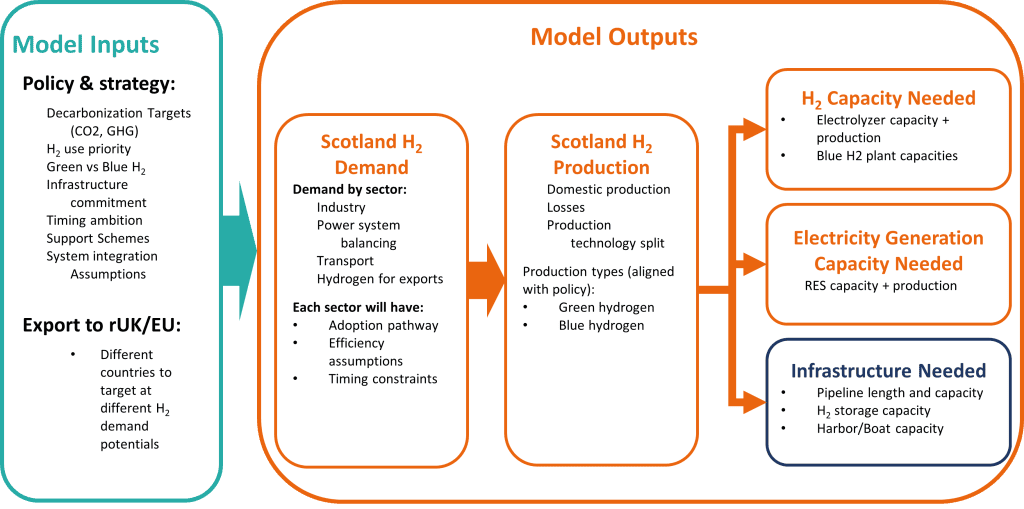
Model workflow
The model is organized into four interconnected modules, covering demand, production, infrastructure, and exports. Each module captures a distinct dimension of the hydrogen system, see Figure 1. These modules are linked through a common set of user-adjustable input parameters, referred to as dials. These represent the external conditions that determine whether hydrogen becomes competitive in a given sector. The dials allow for specifying Scottish factors such as electricity and gas prices, policy and funding strength, and CCUS infrastructure availability. They also address international parameters governing Scotland’s potential to supply hydrogen to the rest of the UK and the EU.
Electricity price inputs, including user-defined values for 2035, 2040, and 2050, and a score for the broader power procurement and grid environment, form the primary driver of competitiveness across the model. Alongside these, sector-specific policy levers capture the strength of support for hydrogen in individual end-use areas, including heat adoption, power generation, shipping, sustainable aviation fuel, and green ammonia production. A further set of infrastructure dials governs the availability of enabling conditions: the status of carbon capture and storage infrastructure, whether hydrogen production is assumed to be centralised or distributed across Scotland, the availability of export routes to the rest of the UK and the EU, and any assumed delays to deployment. Finally, three macroeconomic parameters (cost of labour, tax regime business impacts, and overall macroeconomic tendency), are combined with electricity price indicators into a composite Demand Development Score, which describes the growth or contraction of legacy sector energy demands over the modelling period.
Each dial setting is converted into a normalised score. These scores are combined, using literature-calibrated weightings, into a single Competitiveness and Likelihood Indicator (CLI) for each demand sector. The CLI captures, in a single value, how favourable the overall environment is for hydrogen adoption in a given sector under the chosen scenario. Each sector is assigned a specific deployment threshold: the CLI must exceed this threshold before any hydrogen uptake occurs in that sector. The presence of positive sector-specific policy support reduces the threshold, reflecting how targeted policy can unlock deployment in sectors where hydrogen would not otherwise be competitive on its own.
The CLI score is then used to determine deployment scale through sector-appropriate logic. For capital-intensive, binary sectors (such as potential hydrogen-based steel plants), the CLI triggers discrete investment decisions, reflecting the all-or-nothing nature of large industrial commitments. For more incremental sectors such as distilleries or road transport, a logistic S-curve converts the CLI into the fraction of total energy demand that switches to hydrogen. The shape and position of the curve is calibrated to reflect each sector’s technology maturity and typical investment cycle. Separate CLIs are calculated for rUK and EU export markets to capture Scotland’s relative competitiveness as a hydrogen and derivatives exporter in each of those markets.
Once sector-level hydrogen demand is established, the model builds full annual trajectories from 2026 to 2050. Deployment timing is governed by a combination of a sector start year, a construction or transition period, and any assumed delay. Together, these determine when hydrogen first enters service in each sector. Different sector types follow distinct demand calculation logics. Legacy incremental sectors project demand by applying the CLI-derived uptake share to current energy consumption, adjusted for the efficiency difference between existing fuels and hydrogen. Legacy non-incremental sectors shift demand on a plant-by-plant basis as the CLI crosses relevant thresholds. New capital-intensive industries derive demand from the number of plants triggered by the binary CLI logic multiplied by per-plant hydrogen consumption. New incremental export demands are matched against literature-derived estimates of accessible rUK and EU import markets, modulated by infrastructure availability and assumed build-out timelines. For the domestic aviation sector, an additional SAF mandate calculation runs in parallel with the general deployment logic, and the higher of the mandate-required volume and the model’s standard deployment projection is taken as the binding output.
The blue-green production is configured directly through the blue hydrogen acceptability dials. These set the relative construction share of electrolysis versus methane reforming with carbon capture, the maximum permissible share of blue hydrogen in the overall supply mix, and the years within which blue hydrogen is eligible to enter and exit the system. If Project Acorn is set to be cancelled in the infrastructure dials, the blue hydrogen share defaults to zero regardless of other inputs.
The infrastructure module then translates production volumes into physical asset requirements, pipelines, storage, and distribution. It uses spatial heuristics that account for whether production is assumed to be centralised at hydrogen hubs or dispersed across Scotland’s geography to serve distributed loads.
Outputs
The model produces a comprehensive set of time-series and summary outputs intended to directly inform infrastructure planning and policy analysis. On the demand side, these include annual hydrogen consumption by sector and production pathways from 2026 to 2050, alongside export volumes to rUK and EU markets. On the supply side, the model derives the electrolyser capacity and renewable electricity requirements associated with green hydrogen production, the SMR or ATR plant capacity and CO2 storage volumes associated with blue hydrogen. It also derives the transport and distribution infrastructure, pipelines, storage, and haulage fleet, required to connect supply to demand across Scotland’s geography. All outputs are accessible through a visual dashboard that allows scenario assumptions to be configured, and results observed in a clear and comparable way.
6. Results
The model was run under the two scenarios described in Section 5.2, generating annual hydrogen demand trajectories, production profiles, and infrastructure requirements from 2026 to 2050. The two scenarios are designed to bracket a plausible range of futures: Scenario 1, ‘pragmatic scale-up’, reflects a world of constrained but real hydrogen growth, while Scenario 2, ‘industry breakthrough’, represents an accelerated, NZE-aligned pathway in which hydrogen becomes a structural pillar of Scotland’s industrial sectors where reducing greenhouse gas emissions is particularly challenging. Both scenarios include support through aviation and shipping targets, moderate-to-low electricity prices, and pipeline export infrastructure to the rest of the UK and the EU, though the timing, scale, and ambition of these conditions differ between them. A key distinction is the role of blue hydrogen: the less ambitious scenario includes a meaningful share of methane reforming with carbon capture. This reflects the persistent cost gap for electrolysis in a pragmatic world. The more ambitious scenario converges rapidly on near-exclusively green hydrogen production.
An overview of the key results across the two scenarios is shown in Table 1[1]
Scenario 1 | Scenario 2 | ||||||
2030 | 2040 | 2050 | 2030 | 2040 | 2050 | ||
H2 domestic demand | TWh | 1.2 | 7.9 | 11.3 | 1.4 | 14.4 | 22 |
Green H2 production | TWh | 1.79 | 18.4 | 39.2 | 27.9 | 47.4 | 69.4 |
Green H2 ELY capacity | GW | 1 | 5 | 10.9 | 1 | 13 | 19.4 |
Blue H2 production | TWh | 0 | 1 | 1 | 0 | 0.9 | 0.9 |
Blue H2 SMR capacity | MW | 0 | 135 | 135 | 0 | 122 | 122 |
H2 Export rUK and EU | TWh | 0 | 4.7 | 18.7 | 0 | 21 | 30.9 |
Ammonia Exports | TWh | 0 | 1.0 | 3.1 | 0 | 1.8 | 4.9 |
Methanol for Exports | TWh | 0 | 1.2 | 1.9 | 0 | 2.3 | 3.2 |
SAF Exports | TWh | 0 | 1.3 | 2.2 | 0 | 2.3 | 3.3 |
Scenario 1 – Pragmatic scale-up
Scenario 1 is configured around a distributed deployment of electrolysers, lower overall macroeconomic growth, higher acceptability of blue hydrogen, and low-to-moderate targets for transport sectors. Export infrastructure, i.e., pipeline connections to both the rest of the UK and the EU, is built out but subject to delay, meaning international flows do not begin until 2038. No hydrogen-based heat decarbonisation is assumed.
Under this configuration, total hydrogen demand in Scotland reaches 40.2 TWh by 2050, supported by 11 GW of installed green electrolyser capacity and 135 MW of blue hydrogen production. Demand is modest through the late 2020s, then accelerates between 2030 and 2040 as derivatives export production scales up. A domestic ammonia-for-fertiliser plant is triggered by policies, contributing approximately 2.6 TWh of annual demand. By 2035, cumulative annual demand reaches approximately 9.8 TWh, before growing more gradually to the 2050 endpoint. See Figure 2 for an overview of demand for Scottish hydrogen.
Exports account for a large share of Scenario 1 demand. Pure hydrogen exports to the rest of the UK and the EU reach approximately 18.7 TWh per year by 2050, while hydrogen derivatives exports, primarily ammonia and e-fuels for shipping and aviation markets, contribute a further 7.2 TWh. While the export pipeline infrastructure is eventually built in this scenario, the assumed delays mean that pure hydrogen exports do not commence until 2040 and derivatives exports only begin to ramp meaningfully from 2033 onward.
Scotland’s domestic hydrogen demand reaches approximately 11.4 TWh by 2050. Shipping is the single largest end-use sector, contributing around 4.6 TWh as Scotland’s ports and short-sea routes transition toward ammonia and methanol-based fuels. Aviation, incorporating both general sector uptake and volumes driven by the UK SAF mandate, accounts for approximately 1.5 TWh. Industrial demand is anchored by the chemical industry (approximately 1.8 TWh). The energy sector, hydrogen for power system firming and peaking, demands approximately 1 TWh, with electricity sector end-use adding a further 0.4 TWh. Road transport does not see an uptake, while distilleries and the mineral industry together account for under 0.4 TWh. Heating, light vehicle transport, rail, and paper and wood production do not register material hydrogen demand under this scenario. This is either because the CLI does not exceed sector thresholds or because the assumed policy and infrastructure conditions do not make hydrogen the least-cost decarbonisation option in these areas. Figure 3 shows domestic hydrogen demand across all sectors.
Scenario 2 – Industry breakthrough
Scenario 2 is configured around a centralised deployment of electrolysers with lower reliance on distributed small-scale infrastructure. It has high transport sector targets for both shipping and aviation, low acceptability of blue hydrogen, and more favourable electricity prices. Export infrastructure to the rest of the UK is available on time, while the EU export route is subject to delay. As in Scenario 1, no hydrogen-based heat decarbonisation is assumed. These settings reflect an accelerated policy environment in which strong regulatory support, SAF mandates with hydrogen sub-targets, tightening IMO shipping regulations, and orchestrated industrial demand clusters, enables a step-change in Scotland’s hydrogen deployment, consistent with an NZE-aligned global trajectory.
Under this configuration, total hydrogen demand reaches 70.3 TWh by 2050, supported by an almost entirely green production system totalling approximately 19.5 GW (19.4 GW of installed green electrolyser capacity and 0.12 GW of blue hydrogen). The deployment trajectory is steeper and earlier than in Scenario 1. By 2035, annual demand has already reached approximately 30.7 TWh, driven by the more rapid mobilisation of export infrastructure and the higher transport sector targets. Growth continues, albeit at a more modest pace, through to 2050. The near-complete absence of blue hydrogen in this scenario reflects both the low acceptability dial setting and the expectation that scale-up of green electrolysis, combined with stronger policy support, is sufficient to meet demand from an early stage. See Figure 4 for an overview of demand for Scottish hydrogen.
As in Scenario 1, exports dominate overall demand also in Scenario 2, with derivatives and pure hydrogen exports together accounting for the majority of the 42 TWh total. The earlier availability of the UK export pipeline (on time in this scenario) allows hydrogen trade with the rest of the UK to commence sooner. This strengthens the export revenue case and accelerates the investment rationale for large-scale electrolyser deployment. Domestic demand is driven by a higher-ambition transport sector, with shipping and aviation contributing materially more than in Scenario 1 due to the high regulatory and policy support settings. Industrial hydrogen demand, i.e., steel, chemicals, and associated sectors, follows broadly comparable trajectories to Scenario 1. This is because these sectors are anchored by binary investment decisions that are triggered once the CLI crosses the relevant threshold in both cases. The centralised infrastructure model in Scenario 2 concentrates electrolyser and storage capacity at hubs. This results in a smaller number of decentralised small-scale asset requirements compared to Scenario 1, but requires a more developed inner-Scottish pipeline and transmission system.
Comparison with previous studies
Scenario 1’s projected 40.3 TWh of demand is higher than many more conservative studies. It is well above the FES Falling Behind scenario (~2.9 TWh in 2050), FES Electric Engagement (~10.4 TWh), and the SPICe Spotlight assessment (~14.9 TWh). However, it is notably below the SHA Scenario A H2 Economy result (~65 TWh) and considerably below the Scottish Government’s headline trajectory derived from the Hydrogen Policy Statement, Hydrogen Action Plan, and Trading Nation export plan (which implies approximately 126 TWh by 2050). The result most closely resembles the FES Hydrogen Evolution scenario (~34.5 TWh), but is slightly higher due to the large export volumes that become available once infrastructure is in place. See Figure 6 for a comparison of Scenario 1 with related studies and Figure 7 for a comparison of Scenario 2.
Scenario 2, at approximately 70.3 TWh, comes much closer to the SHA Scenario A H2 Economy benchmark (~65 TWh). It represents the upper end of what a policy-supported, demand-led deployment model credibly projects without assuming full alignment with the most optimistic supply-push scenarios. Like Scenario 1, it remains below the 126 TWh implied by Scottish Government headline targets and the SHA Scenario B Green Export pathway. This underscores the fact that achieving those ambitions would require not only the strong policy and infrastructure conditions embedded in Scenario 2, but also additional demand creation, export market development, and a pace of scale-up that the model’s current calibration does not support. Both scenarios are, however, consistent with the IEA’s assessment that Scotland-scale producers in a STEPS-to-NZE world can expect to occupy the mid-range of the hydrogen deployment spectrum. This means they can be significant contributors to a decarbonising energy system, but constrained by the pace at which global demand for hydrogen and its derivatives actually materialises.
Conclusions
At the core of this research is the development of a hydrogen deployment model. The two scenarios generated by the Scotland hydrogen deployment model represent a test to model functionality as well as an outlook on future system development under IEA related assumptions. The modelling suggests substantial hydrogen deployment in Scotland under a range of future policy and market conditions. Across both scenarios, exports account for the majority of hydrogen demand by 2050, highlighting the importance of Scotland’s ability to access UK and European markets. The results also indicate that electricity prices and the availability of export infrastructure are the most important determinants of deployment, with both factors strongly influencing the scale and pace of hydrogen uptake
Scenario-related considerations
The scenarios show a moderate and a more ambitious outlook for Scotland’s hydrogen sector, spanning a range from approximately 40.2 TWh to 70.3 TWh of total hydrogen demand in 2050. Both scenarios show a period of steep growth between approximately 2030 and 2040 (as export infrastructure, derivatives production, and key industrial investments come online), followed by slower growth through the 2040s. Both scenarios estimate a level of demand in 2050 that is below what can be seen in other studies and projections.
The model’s outputs are most sensitive to two parameters: electricity prices and the availability of export infrastructure. Electricity prices are the primary determinant of the business case for green hydrogen production, directly governing both the competitiveness of electrolysis relative to fossil alternatives and the Competitiveness and Likelihood Indicator scores that drive uptake across most demand sectors. This sensitivity highlights that cheap, reliable access to renewable electricity is the foundational condition for green hydrogen business cases: electricity costs make up the largest component of electrolytic hydrogen production costs.
Export infrastructure availability acts as a hard structural boundary: if pipeline connections to the rest of the UK and the EU are not in place, international hydrogen demand, which accounts for the majority of total modelled deployment in both scenarios, cannot be incorporated regardless of how favourable other conditions are. The findings therefore reinforce the importance of timely infrastructure development alongside continued efforts to secure competitive renewable electricity.
Model development – lessons and next steps
We developed the model to describe deployment of hydrogen and hydrogen related infrastructure in Scotland. It serves as a tool for generating and testing alternative deployment scenarios. It links policy choices and market conditions to hydrogen demand and associated infrastructure requirements. The underlying logic is anchored in determining the demand for hydrogen across different sectors based on the policy landscape and support mechanisms available. Demand for hydrogen translates into the need for hydrogen infrastructure.
The main challenge of implementing policy-driven hydrogen uptake lies in meaningfully combining demand and supply-side support policies for deployment modelling. The approach we took was to work from demand estimation, based on policies. This takes limited account of supply-side-driven uptake of hydrogen. The main aim of this project was to create a user-friendly modelling tool. Within the time and resource available, the capacity for simultaneous modelling of both supply and demand side factors was limited.
The following model refinements may produce more detailed outputs:
- Electricity prices: More detailed electricity price series could improve representation of hydrogen competitiveness.
- Demand data: Improved sector-level demand data and bottom-up estimates of current energy use could enhance the quality of outputs .
- Hydrogen adoption pathways: Better evidence on technology readiness and sector-specific adoption pathways could refine uptake assumptions.
- Technology maturity and adoption: More explicit cost-based assessment of competition between technologies may improve representation of future trade-offs between blue and green hydrogen, alternative transport modes and storage options.
References
International Energy Agency (IEA) (2025) World Energy Outlook 2025. Paris: IEA.
Scottish Government (2024) A Trading Nation: Realising Scotland’s Hydrogen Potential – A Plan for Exports. Edinburgh: Scottish Government.
d’Amore-Domenech, R. et al. (2023) ‘An analysis of the bulk transport of green hydrogen at sea: Comparison between submarine pipeline and compressed and liquefied transport by ship’, Energy, 263, 125905.
Net Zero Technology Centre (NZTC) (2024) Hydrogen Backbone Link: Connecting Scotland to Europe – Report 3. Aberdeen: Net Zero Technology Centre.
Department for Energy Security and Net Zero (DESNZ) (2023) Low Carbon Hydrogen Certification Scheme: Consultation Response. London: DESNZ.
Department for Business, Energy & Industrial Strategy (BEIS) (2022) Low Carbon Hydrogen Production Business Model: Heads of Terms. London: BEIS.
Department for Energy Security and Net Zero (DESNZ) (2025) Low Carbon Hydrogen Agreement (LCHA): HAR1 Key Terms Summary and Explanatory Notes. London: DESNZ.
European Commission, Joint Research Centre (JRC) (2021) Assessment of Hydrogen Delivery Options. Luxembourg: Publications Office of the European Union.
Department for Energy Security and Net Zero (DESNZ) (2025) Hydrogen Update to the Market (July 2025). London: DESNZ.
European Commission, Joint Research Centre (JRC) (2021) Assessment of Hydrogen Delivery Options. Luxembourg: Publications Office of the European Union.
Department for Energy Security and Net Zero (DESNZ) (2025) Hydrogen Update to the Market (July 2025). London: DESNZ.
Department for Energy Security and Net Zero (DESNZ) (2024) Hydrogen to Power: Consultation Response. London: DESNZ.
Department for Energy Security and Net Zero (DESNZ) (2025) Hydrogen Blending into the GB Gas Transmission Network: Consultation Document. London: DESNZ.
Scottish Government (2022) Hydrogen Action Plan: Business and Regulatory Impact Assessment. Edinburgh: Scottish Government.
Scottish Government (2022) Scottish Hydrogen Action Plan. Edinburgh: Scottish Government.
International Energy Agency (IEA) (2025) Global Hydrogen Review 2025. Paris: IEA.
Department for Energy Security and Net Zero (DESNZ) (2024) Clean Power 2030 Action Plan (Main Report). London: DESNZ.
Scottish Government (n.d.) Scottish Energy Statistics Hub. Edinburgh: Scottish Government.
European Commission (2026) REPowerEU. European Commission.
How to cite this publication:
Mouelhi, B., Martin Nieto, C., Lüth, A., Raheli, E., Bush, R. (2026) ‘A Low Carbon Hydrogen Deployment Model for Scotland’, ClimateXChange. DOI https://doi.org/10.7488/era/7184
© The University of Edinburgh, 2026.
Prepared by Ramboll on behalf of ClimateXChange, The University of Edinburgh. All rights reserved.
While every effort is made to ensure the information in this report is accurate as at the date of the report, no legal responsibility is accepted for any errors, omissions or misleading statements. The views expressed represent those of the author(s), and do not necessarily represent those of the host institutions or funders.
This work was supported by the Rural and Environment Science and Analytical Services Division of the Scottish Government (CoE – CXC).
ClimateXChange
Edinburgh Climate Change Institute
High School Yards
Edinburgh EH1 1LZ
+44 (0) 131 651 4783
If you require the report in an alternative format such as a Word document, please contact info@climatexchange.org.uk or 0131 651 4783.
Throughout section 5, hydrogen demand is reported in four categories: (a) domestic demand is hydrogen consumed within Scotland across industrial, transport and energy sectors; (b) pure hydrogen exports is hydrogen exported directly to the rest of the UK or the EU; (c) derivative export demand is hydrogen used in Scotland to produce export products such as ammonia, methanol and SAF; (d) total hydrogen demand is the sum of domestic demand, export demand and hydrogen used for derivative production.
Unless otherwise stated, references to total hydrogen demand include all four components. ↑
Hydrogen derivatives and products (HDPs) are made by combining hydrogen with other elements. These processes make products that can be more easily used, transported or stored than pure Hydrogen.
With Scotland’s ambitious plans to increase low-carbon hydrogen production, HDPs are expected to play an important role in reducing emissions from sectors such as aviation, shipping and road transport. They could also create new export opportunities for Scotland.
This report focuses on ammonia, e-methanol, synthetic aviation fuel (SAF) and other e-fuels (made using hydrogen and captured carbon dioxide). It assesses whether current Scottish, UK, European and international regulations are suitable for supporting the production, storage, transport and use of these fuels. It identifies where they provide a strong foundation and where changes could help the sector grow.
Key findings
- Our study found strong foundations for regulations related to: planning; technology; and health, safety and environmental (HS&E) standards. These include Scotland’s planning and environmental systems, the UK’s Control of Major Accident Hazards (COMAH) framework, and international shipping standards covering hydrogen-derived products.
- Market regulations for hydrogen-derived products are the least fit-for-purpose. A lack of clarity and consistency mean they do not increase confidence in long-term production, and they provide uneven support across products. The key limitations identified are:
- Support is heavily weighted towards sustainable aviation fuel (SAF). Comparable incentives are not available for ammonia, e-methanol or sustainable marine fuels.
- Differences between UK and EU rules for renewable fuels and SAF could reduce Scotland’s export competitiveness.
- Uncertainty in the UK Emissions Trading Scheme (ETS) creates further risk. Power-to-Liquid SAF (e-SAF) is not currently zero-rated, and it is unclear whether the ETS will extend to shipping, reducing confidence in future demand.
Recommendations
- Regulations related to consenting and health, safety and environmental standards (HS&E) should be monitored to ensure they remain fit-for-purpose as the HDP markets and technologies develop.
- Support International Maritime Organization (IMO) proposals to reduce emissions, encouraging future demand for hydrogen-derived marine fuels.
- Most regulations were not designed to support hydrogen-derived products. New support mechanisms, similar to those already available for green hydrogen, could help grow the sector.
- Address gaps and inconsistencies in market rules, including better alignment between UK and EU requirements to support Scottish exports.
- Include e-fuels, including e-SAF, in the UK Emissions Trading Scheme (ETS) and introduce dedicated support for ammonia and e-methanol, similar to existing support for sustainable aviation fuel (SAF).
March 2026
DOI: https://doi.org/10.7488/era/7017
Executive summary
Aims
Scotland has set ambitious climate and hydrogen policies, including an ambition of 5 gigawatts (GW) of low‑carbon hydrogen production by 2030 rising to 25 GW by 2045. Hydrogen derivatives and associated products are expected to play a key role in enabling domestic decarbonisation. They are also expected to help position Scotland as an exporter to meet growing European demand.
Hydrogen derivatives are produced by combining hydrogen with other elements that can be more easily transported and stored. They may then be converted back into hydrogen or used directly as fuels or feedstocks. Where no further processing or conversion occurs before use, the term hydrogen product is used.
This study assesses whether the current regulatory landscape is fit‑for‑purpose to support the growth of hydrogen derivatives and products: ammonia, e‑methanol as well as synthetic aviation fuel (SAF) and wider e-fuels (fuels produced by combining hydrogen with carbon dioxide via electrolysis). Throughout this study these are referred to as hydrogen derivatives and products (HDPs).
The objective is to identify limitations and gaps within the current regulations and propose associated interventions. Drawing on an extensive regulatory review, stakeholder engagement and a criteria-based assessment, this study seeks to answer the following research questions.
- What is the regulatory landscape for ammonia, e‑methanol and SAF in Scotland?
- To what extent is the current regulatory regime fit‑for‑purpose to enable Scottish hydrogen derivative production, storage, transport and end‑use?
- What interventions are needed to create a coherent, safe and effective regulatory environment that accelerates HDPs across the value chain?
The assessment covers fuel types derived from green hydrogen and captured CO₂, and excludes bio‑derived fuels (e.g., bioethanol or biodiesel) and hydrogen production itself. The areas of hydrogen derivative value chain covered include: production in Scotland; storage; transport and use. Our assessment groups regulations by jurisdictions (both domestic and international) and impact area. Impact areas include: consenting and planning; route to market; technical standards and health, safety and environment standards (HS&E). This work follows previous ClimateXChange studies looking at HDP supply chain capabilities (Ella Yip, 2025) and the demand for HDPs (Szebasztian Csernik-Tihn, 2024).
Findings
Our study found strong existing foundations across all jurisdictions for consenting, technology standardisation and HS&E related regulations. These included existing planning, consent and environmental authorisations in Scotland, UK HSE legislations such as COMAH as well as the inclusion of HDPs in international standards under the International Maritime Organisation (IMO).
Route to market regulations, which cover hydrogen derivative related definitions, eligibility requirements and dedicated targets or mandates, were deemed least fit-for-purpose across all jurisdictions. They currently lack the clarity and cross-jurisdictional consistency to fully de-risk long-term production and market demand to maximise opportunities. They further do not provide incentives across all derivatives equally. The key limitations we identified included:
- Uneven support across derivatives
The UK policy landscape is currently skewed toward SAF, represented by the dedicated SAF mandate and revenue support mechanism. No equivalent commercial incentives exist for ammonia or e‑methanol. There is no mandate or incentive for the production of sustainable HDP maritime fuels. - Misalignment between UK and EU regulatory definitions
Definitions and requirements for Renewable Fuels of Non-Biological Origin (RFNBOs) and SAF differ, particularly around greenhouse gas (GHG) emission thresholds, and the proximity of renewable electricity sources. Scotland’s export competitiveness into the EU may be limited if producers comply only with UK requirements. - Uncertainty in the UK Emissions Trading Scheme (ETS)
Power to Liquid SAF (PtL or e-SAF) – produced specifically using CO2 and green hydrogen – is currently not zero-rated within the UK ETS, while the future expansion of the UK ETS to cover maritime sectors remains uncertain. This creates a further commercial risk for producers in terms of more limited offtake potential.
Recommendations
- Consenting and HS&E related regulations should be monitored to ensure they remain fit-for-purpose as the hydrogen derivative market expands and technology develops.
- Regarding specific technical standards and associated routes to market, we recommend supporting the progression of the IMO GHG reduction proposals for marine vessels. This encourages a further future offtake market.
The majority of assessed regulations are not explicitly designed to promote the hydrogen derivative market. Dedicated support options could be considered, in order to further strengthen the sector. Potential interventions can be taken from adjacent sectors such as (green) hydrogen. For example, the Hydrogen Storage Business Model and Hydrogen Transport Business Model currently does not include hydrogen‑derived fuels (e.g., ammonia, e‑methanol). A dedicated mechanism mirrored on these models could be established for the derivative sector. - Other proposed interventions focus on addressing regulatory discrepancies and gaps in the route to market impact area. This includes promoting the alignment between UK and EU requirements and definitions for HDPs. The EU market represents a strong opportunity for Scottish production and export potential. Securing compliance with regulatory requirements will be essential.
- We further recommend the inclusion of e-fuels / e-SAF within the UK ETS, aligning e-fuels with biomass-derived options and with the EU ETS approach. We also recommend a dedicated route to market support framework for ammonia and e-methanol. This could mirror the current support dedicated to SAF in the UK, such as specific mandates or revenue support mechanisms.
We recognise the limits of Scottish Government influence on EU and UK regulations, but our recommendations may usefully inform existing conversations and engagement opportunities to seek improvements in these routes to market.
Glossary & abbreviations
Abbreviations
ADA | Alternative Design Arrangement |
ADR | Agreement concerning the International Carriage of Dangerous Goods by Road |
AFIR | Alternative Fuels Infrastructure Regulation |
ASTM | American Society for Testing and Materials |
ATEX | ATmosphères EXplosibles (EU directives for explosive atmospheres: equipment/workplaces) |
ATJ | Alcohol-to-Jet (SAF production pathway) |
CBAM | Carbon Border Adjustment Mechanism |
CCGT | Combined Cycle Gas Turbine |
CCS | Carbon Capture and Storage |
COMAH | Control of Major Accident Hazards |
CXC | ClimateXChange |
DCO | Development Consent Order |
DESNZ | Department for Energy Security and Net Zero |
DSEAR | Dangerous Substances and Explosive Atmospheres Regulations |
EIA | Environmental Impact Assessment |
ETS | Emissions Trading Scheme |
EU | European Union |
FT | Fischer-Tropsch (chemical process used to convert syngas – a mixture of carbon monoxide and hydrogen – to liquid fuels) |
GB | Great Britain |
GHG | Greenhouse Gas (Emissions) |
HDP | Hydrogen derivatives and products |
HPBM | Hydrogen Production Business Model |
HS&E | Health, Safety and Environment |
HSE | Health and Safety Executive |
IAF | Integrated Authorisation Framework |
ICAO | International Civil Aviation Organization |
IMO | International Maritime Organisation |
LCAF | Low-carbon Aviation Fuel |
LHV | Lower Heating Value |
NOx | Nitrous Oxides |
MCA | Marine and Coastguard Agency |
MTJ | Methanol-to-Jet (SAF production pathway) |
NSIP | Nationally Significant Infrastructure Project |
PtL | Power-to-Liquid |
REACH | Registration, Evaluation, Authorisation and Restriction of Chemicals |
RED | Renewable Energy Directive |
RFNBOs | Renewable Fuel of Non-Biological Origin |
RTFO | Renewable Transport Fuel Obligations |
SAF | Sustainable Aviation Fuel |
SEPA | Scottish Environment Protection Agency |
SOLAS | International Convention for the Safety of Life at Sea |
TNUoS | Transmission Network Use of System (charges) |
UK | United Kingdom |
UK ETS | United Kingdom Emissions Trading Scheme |
VOC | Volatile Organic Compounds |
Glossary of terms and units
Introduction
The production of hydrogen derivatives and products (HDPs) forms an integral part of Scotland’s Hydrogen Action Plan (2022) and 2045 net zero targets. The Scottish Government’s aim is to establish Scotland as a key producer and exporter of hydrogen and hydrogen-derived products. This goal is underpinned by a 5GW low-carbon hydrogen production ambition by 2030, increasing to 25GW by 2045. Scottish export ambitions align with the EU’s goal of importing 10Mt of low-carbon hydrogen from outside of the EU by 2030, a significant part of which is anticipated to be in the form of HDPs.
HDPs are chemicals made by combining hydrogen with other elements so that it becomes easier to store, transport or to use as energy. The main HDPs – ammonia, e-methanol, and sustainable aviation fuel (SAF) – are studied in this report. Only HDPs from green hydrogen were considered, and not those where the hydrogen comes from bio-feedstocks. This means that in the case of SAF, only PtL SAF – also called synthetic aviation fuel or e-SAF – is included.
This study forms part of the Hydrogen Action Plan tasks of ‘building our evidence base’ and ‘identifying market access barriers’ for hydrogen and HDPs (Scottish Government, 2022). In this report, we provide an overview and analysis of the current regulatory landscape for HDPs in Scotland, the wider UK, EU and internationally. We focused on regulations applying to the whole value chain of production, storage, transport, and use. The overarching aim is to identify barriers to developing the Scottish HDPs market. This is important for three reasons: the proximity to 2030 ambitions; the need to create transition opportunities for traditional fossil fuel industries and workforce now; and the anticipated strong competition from other HDPs producers for European import targets. Many relevant route to market regulations sit at UK, EU or international level, limiting direct Scottish Government control over implementation. While the Scottish Government’s overall regulatory influence may be more limited at EU and international level, intervention options can still feed into an aligned Scottish-UK position and overall hydrogen strategy.
The research questions we aim to respond to are:
- What is the regulatory landscape for the core HDPs ammonia, e-methanol, and SAF?
- To what extent is the regulatory landscape fit-for-purpose to enable the growth of the HDPs sector in line with Scottish net zero, just transition and hydrogen ambitions?
- What interventions would be needed to create a coherent, safe, and effective framework that accelerates HDPs across all value chain areas?
To address these questions, we first conducted an extensive literature review of relevant regulations across all four jurisdictional levels. We collated applicable regulations in an extensive database and categorised them against their applicability by fuel type, value chain, and impact area.
The hydrogen derivative fuel types considered are: ammonia, e-methanol, SAF and e-fuel (e.g., e-diesel).
The value chain refers to the activities required to produce, transport, store and use HDPs. Each area has different technical process, risks and regulatory requirements. The value chain areas are: production (Scotland focus), storage, transport and use.
Impact areas refer to aspects that can influence the growth and development of a sector. These are:
- Route to Market – This impact area is used to determine the availability of offtake opportunities and customers for HDPs. Any regulations may affect how easily products can reach the customer. Overall regulatory mandates or targets can impact the size of the market available to the HDP producer, thus affecting the sector’s overall business case. Regulations may also capture market access and funding mechanisms (such as subsidies), providing revenue certainty.
- Technology development and standardisation – As technology improves, it enables a sector to do things more efficiently and/or effectively. It can further open up new markets or growth areas. Technology development has to adhere to a standard for quality. Standardisation thus creates certainty and safety for products to work reliably for the users. With international standards, these allow for products and services to be exported globally and thus accelerate global adoption in the sector.
Technical standards referenced in this study focus on standards that serve as the de facto global market‑entry requirements embedded in regulatory acceptance for certain fuels. An example of this are the American Society for Testing and Materials (ASTM) standards, which in the case of SAF, determine eligibility as aviation fuels. ISO and BSI standards, while important technical references, do not in themselves confer regulatory approval and therefore fall outside the study’s focus on regulation.
- Health, safety and environment (HS&E) – A strong HS&E framework demonstrates that a sector operates safely and responsibly which builds public trust and attracts investors. It prevents incidents which could cause shutdowns and project delays to enable a smoother long-term growth of the sector. For developers or operators, a clear, standardised HS&E framework can reduce project development uncertainty.
- Consenting – A clear and consistent consenting and planning framework can support effective and efficient project development activities. This reduces the risk of project delays and overall uncertainty for project developers and operators. A lack of clear consenting guidelines or uncertain applicability for HDPs may slow or complicate the approvals process, ultimately affecting investor confidence. This could potentially slow the growth of the sector.
We then assessed each regulation to determine suitability for and potential impact on the Scottish HDPs market, using the following criteria:
- Policy intent: To what extent the policy is designed to support development of the HDPs market
- Market impact: How it affects market outcomes in practice with respect to project viability, investment decisions or deployment pathways
- Scope and breadth of impact: How much of the market is exposed to the policy’s effects (e.g., one or multiple derivatives or value chains)
- Certainty and clarity: How clear, stable and well-understood it is and how much requires interpretation for clarity
- Degree of regulatory influence: How easily it can be influenced or changed by Scottish and/or UK Government
An overview of the assessment criteria, scoring approach and weightings is provided in Appendix A. Using the total scores, individual criteria outputs, and associated justifications for each regulation we were able to identify initial gaps, limitations and discrepancies across the regulatory landscape and jurisdictional levels. A stakeholder session was held to validate and refine our initial outputs. These combined outputs then formed the basis of our recommended intervention areas.
To help communicate this complex landscape, we also developed a visual map of all regulations across impact areas and value chain levels. This map is available separate to this report and in Appendix C.
Scope Parameters and Limitations
This study focused solely on regulations regarding the production, storage, transport, and use of HDPs. Only fuel types derived from green hydrogen and a carbon dioxide feedstock were covered, not fuels derived from bio-feedstocks. We also excluded the production of low-carbon hydrogen itself and associated feedstocks such as electricity from renewable energy sources. These topics have already been subject to review and reported on in existing studies[1]
Regulatory landscape for HDPs
In this section, we capture the relevant regulations for HDPs across each of the jurisdictional levels – Scotland, UK, EU and internationally. Each sub-section focuses on one geography, outlining the regulations assessed, the derivatives and value chain elements to which they apply, and their impact areas. The following sub-sections cover each jurisdictional level:
- Scotland
- UK
- European Union
- International
The overarching policy and sector strategies for each geography are laid out to provide context, and to highlight stated policy intent relating to HDPs.
Our intention in this section is to describe the regulatory landscape for ammonia, e‑methanol and SAF produced in Scotland and transported and consumed either domestically or abroad. Section 5 captures the fit-for-purpose analysis with overall assessment outputs accessible in Appendix B.
Where appropriate, the regulations have been grouped together according to impact areas in each geography. Regulations that showed greater relevance in the scoring assessment and subsequent study recommendations were outlined in additional detail for reference.
A visual regulatory map of jurisdictional levels and impact areas accompanies this report.
Scotland
Policy and sector strategy
Scotland set out an ambition of 5GW of renewable and low-carbon hydrogen production by 2030 and 25GW by 2045, in their Hydrogen Policy Statement (Scottish Government, 2020). One of the Scottish Government’s actions from this Statement was to ensure the regulatory, planning and consenting framework for renewable developments would support the scale-up of hydrogen. Hydrogen is an export ambition and HDPs are included as a form of hydrogen transport vector and commodity. Hydrogen derivative developments are subject to an overarching UK regulatory regime. This is discussed further in Section 4.2.
Scottish climate policy
Scotland’s climate policy framework is underpinned by the Climate Change (Scotland) Act (Scottish Government, 2009). This sets a legally binding target for Scotland to achieve net‑zero greenhouse gas emissions by 2045, five years earlier than the UK-wide target. The Act also requires Ministers to set and meet carbon budgets. These carbon budgets will each cover a series of 5-year periods from 2026 to 2045.
In addition, the Scottish Government published its draft Climate Change Plan 2026–2040 (Scottish Government, 2025) in November 2025. This Plan sets out how Scotland intends to meet its first three carbon budgets covering the period 2026–2040, providing a pathway aligned with independent advice from the Climate Change Committee. The draft Plan is currently undergoing public consultation.
Scotland’s draft Climate Change Plan (Scottish Government, 2025) does not address
deployment targets for HDPs such as ammonia and e-methanol. It does mention the Scottish Government’s plan to consider options for increasing SAF production and its use.
Hydrogen Action Plan
The Hydrogen Action Plan (Scottish Government, 2022) positions hydrogen and its derivatives as essential for decarbonising hard‑to‑abate sectors and supporting a just transition. The Plan outlines actions to develop Scotland’s hydrogen economy, including scaling renewable hydrogen production to support derivative fuels for domestic and export markets. It recognises the need for safe, regulated development of derivatives and highlights their potential role in early export pathways to mainland Europe. Direct actions for HDPs in the Plan are in identifying priority export markets internationally and market access barriers for derivatives.
Hydrogen export plan
Scotland published its first hydrogen sector export plan, A Trading Nation: Realising Scotland’s Hydrogen Potential – A Plan for Exports (Scottish Government, 2024) which sets out Scotland’s ambition to become a major exporter of hydrogen and HDPs to European markets, underpinned by ambitions of 5 GW of production by 2030 and 25 GW by 2045. The plan recognises Europe’s rising demand for renewable hydrogen and hydrogen products and positions Scotland as having the renewable capacity, skills and supply‑chain capability to supply derivative fuels at scale.
Scottish regulatory landscape
Scottish regulations relevant to derivatives primarily address procedures in consenting, planning and permitting of certain activities. A UK regulation on Green Freeports which impacts route to market has been included in this section as it is relevant to Scotland. Table 1 captures the assessed regulations for the development of HDPs in Scotland.
Regulation | Derivative | Value Chain Area |
|---|---|---|
The Environmental Authorisations (Scotland) Amendment Regulations 2025 | All | Production Transport |
The Town and Country Planning (Hazardous Substances) (Scotland) Regulations 2015 | All | Production Storage |
The Town and Country Planning (Environmental Impact Assessment) (Scotland) Regulations 2017 | All | Production |
Marine Works (Environmental Impact Assessment) (Scotland) Regulations 2017 | All | Storage Transport |
Finance Act 2021 with Finance (No. 2) Act 2023* – with regards to freeport tax site especially Green Freeports in Scotland | All | Production Storage Transport |
Town and Country Planning (Scotland) Act 1997 | All | Production Storage Transport |
The regulatory landscape is not hydrogen or HDPs specific but is neutral in allowing projects which adhere to the planning framework and regulated activities which require permits to proceed.
- The Environmental Authorisations (Scotland) Amendment Regulations 2025 – which amends the 2018 Regulations to create an Integrated Authorisation Framework (IAF). This framework streamlines the Scottish Environment Protection Agency (SEPA) regulation of waste, water, and industrial activities. These regulations cover activities requiring permits that must be gained separately to planning permission. This streamlined regulation is aimed at enhancing efficiency in the process for hydrogen derivative project developers in Scotland. An overall outcome or evaluation of this aim was not available at the time of writing.
- Marine Works (Environmental Impact Assessment) (Scotland) Regulations 2017 – regulations which govern EIAs for Scottish marine developments within the 12-nautical mile boundary. For hydrogen derivative projects, the water usage, waste discharge as well as infrastructure risks will be considered.
- Finance Act 2021 with Finance (No. 2) Act 2023 – the 2021 Act (UK Government, 2021) and 2023 amendments (UK Government, 2023) set the UK‑wide legal basis for Freeports, including the tax reliefs and commercial incentives available within designated Freeport tax sites. In Scotland, this framework is applied through the Green Freeports, which focus on net‑zero and just‑transition objectives, including low‑carbon fuels and energy transition projects. This makes it relevant to the hydrogen‑derivatives landscape. For example, the Forth Green Freeport identifies opportunities for alternative fuels alongside offshore wind, shipbuilding, modular manufacturing and creative industries. This emphasis on net‑zero activities provides an additional policy route and potential market access point for HDPs.
- Town and Country Planning Act 1997 – the principal consolidating statute that provides the core legal framework for regulating land development, preparing development plans, determining planning applications, and enforcing planning control in Scotland (as significantly amended by later Acts such as the Planning etc. (Scotland) Act 2006 and the Planning (Scotland) Act 2019).
UK
Policy and sector strategy
Strategy and policy on climate, transport decarbonisation, and industrial development all influence direction on HDP production and use. The most relevant UK policies and strategies are outlined below focussing on their relevance to HDPs and the scope of this project.
Climate policy
UK Government is obliged to deliver net zero emissions for the UK by 2050 by the Climate Change Act (UK Government, 2008). Legally binding carbon budgets have been set covering the period out to 2037, and the seventh carbon budget (covering 2038 to 2042) needs to be set by June this year. Additionally, the UK Government has ratified the Paris Agreement.
The Carbon Budget and Growth Delivery Plan (UK Government, 2025) lays out how the Government intends to meet its statutory carbon budgets. This focusses on the period to 2037. HDPs are listed directly as achieving emissions reduction in the following areas:
- Aviation (SAF)
- Shipping (low carbon fuels including ammonia and methanol)
- Road Transport (low carbon fuels including ammonia and methanol)
Deployment assumptions are listed for each of these sectors, but no breakdown is given. Therefore, there are no clearly stated deployment targets for the HDPs that are in the scope of this report.
Maritime Decarbonisation Strategy
The Maritime Decarbonisation Strategy (UK Government, 2025) sets out GHG emissions targets for the maritime sector. (30% reduction by 2030, 80% by 2040, 100% by 2050 relative to 2008 levels). This sets out guiding principles that include a co-ordinated approach to regulation with international bodies such as IMO. The document is clear that there are significant roles for ammonia and methanol in decarbonising the maritime sector. The strategy is focussed on achieving decarbonisation and does not include any targets for or give any direction on the need for domestic UK production of these fuels.
Jet Zero Strategy
The Jet Zero Strategy (UK Government, 2022) recognises that SAF is required to reduce emissions from the aviation sector and included the launch of a SAF mandate as a key objective. Relating to production, a KPI for five commercial scale SAF plants to be under construction was set. PtL SAF is not explicitly mentioned, and the strategy only includes general statements on funding for first of a kind commercial and demonstration advanced fuels plants.
Decarbonising transport
The Decarbonising Transport Strategy (UK Government, 2021) includes the UK Government’s strategy for decarbonising road transport. Electrification, biofuels and hydrogen are included as mechanisms to reduce emissions. This strategy introduced plans to phase out internal combustion engine vehicles in the UK, and these plans have been supported by subsequent governments. That means that while there is support for low carbon drop in fuels as an interim solution (such a biofuels), in the long term this type of fuel will be phased out in the road transport sector. There is no current strategy or policy that supports the use of HDPs in this sector.
Industrial strategy
The UK’s Modern Industrial Strategy (UK Government, 2025) has identified Clean Energy Industries as one of eight strategic sectors. The Clean Energy Industries Sector Plan (UK Government, 2025) includes hydrogen but does not specifically mention HDPs.
Hydrogen Strategy
The UK’s Hydrogen Strategy (UK Government, 2021) sets out a framework for scaling hydrogen production, transport, storage, and use, and set an ambition of 5 GW low carbon hydrogen production by 2030, later doubled to 10GW in the British Energy Security Strategy. There is no mention of HDPs in the Hydrogen Strategy. It does establish policy direction on hydrogen standards and business models that indirectly impact the derivative markets.
An update to the Hydrogen Strategy was due in late 2025 but has not been published at the time of writing this report.
UK regulatory landscape
HDPs are regulated through a combination of industrial safety legislation (e.g., COMAH), environmental consenting, and sector‑specific regimes (e.g., shipping, aviation, and industrial chemicals). As such there are multiple stakeholders split across these areas, including Department for Energy Security and Net Zero (DESNZ), Environment Agency, Health and Safety Executive, and Department of Transport. This results in a fragmented regulatory landscape which limits the strategic direction, market impact and regulation clarity for new projects.
Route to market
The considered route to market regulations within the UK are shown in the table below, highlighting which hydrogen derivative(s) they are applicable to and at what point in the value chain.
Regulation | Derivative | Value Chain Area |
|---|---|---|
Renewable Transport Fuel Obligations (RTFO) and Sustainable Aviation Fuel (SAF) Mandate Technical Guidance | All | Production (Scotland) Use |
Merchant Shipping (Carriage of Dangerous Goods and Harmful Substances) Regulations 2024 | All | Transport |
UK Emissions Trading Scheme (The Greenhouse Gas Emissions Trading Scheme Order 2020) | All | Production (Scotland) Storage |
Energy Act 2023 | Ammonia e-Methanol | Use |
The Renewable Transport Fuel Obligations Order (RFTO) 2007 | Ammonia e-Methanol | Use |
UK Carbon Border Adjustment Mechanism (CBAM) (Finance Bill 2025-26) | Ammonia | Production (Scotland) Use |
Sustainable Aviation Fuel (SAF) Mandate (Renewable Transport Fuel Obligations (Sustainable Aviation Fuel) Order 2004 | SAF | Production (Scotland) Storage |
Sustainable Aviation Fuel (Revenue Support Mechanism) Bill | SAF | Production (Scotland) |
Hydrogen Production Business Model (HPBM) | All | Production (Scotland) |
Many of these regulations do not directly promote HDPs and are driven as a result of decarbonisation targets. Regardless, they have an effect on derivatives. Regulations that will have a market impact on hydrogen derivative products are:
- Energy Act 2023 – provides the statutory framework to implement key elements of UK hydrogen policy. For HDPs, the Act helps enable investment by clarifying market arrangements and government intervention powers. The Act provides the framework for setting up business models and funding structures such as revenue support (e.g., SAF Revenue Support Mechanism, covered further below).
- UK Emissions Trading Scheme (UK ETS) – sets a carbon price on emissions only from the power generation, industry and aviation sectors, improving the relative competitiveness of low‑carbon HDPs versus fossil alternatives. This is being reviewed for expansion to maritime sector in 2026 and waste incineration in 2028. At present, PtL SAF (e-SAF) does not receive zero-rated status. Zero‑rated fuels are assumed to have zero carbon emissions when used, a designation that applies only to biomass‑based SAF.
- Renewable Transport Fuel Obligation (RTFO) – represents the central policy driver for hydrogen‑derived fuels in the relevant transport sector. This includes road vehicles and non-road transports such as non-road mobile machinery (NRMM) and the maritime sector, if the fuel used is a renewable fuel of non-biological origin (RFNBO). It creates demand for eligible RFNBOs through tradable certificates. An eligible RFNBO is required to
- Achieve a 65% GHG emission saving over the whole lifecycle relative to the fossil fuels fuel baseline of 94 gCO2eq/
- demonstrate that the renewable electricity or heat used to produce the RFNBO satisfies regionalisation rules and additionality rules. The regionalisation rule includes demonstrating that the electricity comes from the same region and electricity market where production is located. The additionality rule requires the electricity used to make RFNBO is additional, meaning produced from new, upgraded, and recommissioned production, and not diverted from existing renewable power.
Note this RFNBO definition differs from the EU definition and is further discussed in Section 5.1.1.
- RTFO and Sustainable Aviation Fuel (SAF) Mandate Technical Guidance – provides the guidance on technical requirements which are largely consistent between the RTFO and SAF Mandate, covering classification, carbon and sustainability criteria, GHG calculations and evidence requirements. This guides suppliers and allows RFTO and SAF fuels to be consistent across the UK:
- sets sustainability rules to qualify for certificates with GHG emission savings relative to fossil fuels for SAF having to be equal or above 40%, and for RFNBOs to be equal or above 65%, respectively
- provide evidence requirements, which include documentation for eligible fuel feedstock, process emissions, evidence that fuel can be tracked from source to final delivery and audits within the supply chain
- UK Carbon Border Adjustment Mechanism (CBAM) – legislation to prevent cheaper carbon intensive products being imported into the UK. Importers are charged a fee based on the carbon emissions from goods production. This will be introduced from 1 January 2027 and mainly impacts green ammonia imports (as fertilisers are included), making it more competitive. Methanol and other fuel are not covered in this legislation.
- SAF Mandate – sets a legal obligation on aviation fuel suppliers to supply a minimum proportion of SAF, increasing over time. The mandate therefore acts as a key demand‑side policy for HDPs in aviation, alongside parallel SAF revenue support mechanisms. PtL SAF obligations only start in 2028. In addition, there is currently a consultation to broaden the SAF Mandate eligibility to crop-derived SAF for flexibility.
- Sustainable Aviation Fuel (Revenue Support Mechanism) Bill – this set the regulation for the proposed revenue certainty mechanism for UK SAF production. The legislation for the revenue certainty mechanism is expected to be finalised by the end of 2026.
- Hydrogen Production Business Model (HPBM) – indirectly supports HDPs production by providing revenue support for the hydrogen used for derivatives production. However, hydrogen used to produce energy carriers for export is excluded from HPBM support.
Technology development and standardisation
Technology development and standardisation regulations for HDPs are designed to ensure that when these are used, they are produced, transported and used safely.
Regulation | Derivative | Value Chain Area |
|---|---|---|
The Alternative Fuels Infrastructure Regulations 2017 | All | Use |
Maritime and Coastguard Agency (MCA) Customer Process for Alternative Fuels – Ammonia | Ammonia | Use |
Motor Fuel (Composition and Content) Regulations and the Biofuel (Labelling) (Amendment) (NO. 2) Regulations 2021 | e-fuel (road) | Use |
There are specific regulations that set the technical, safety and operational requirements for developing and using hydrogen‑derivative technologies. Similar to ‘route to market’ related regulations, they do not actively promote the HDPs sector. However, they affect the way derivatives are deployed in the end-user market.
- The Alternative Fuels Infrastructure Regulations – regulation to ensure a common set of standards and functionality for the provision of certain alternative fuel infrastructure. These alternative fuels include electricity, hydrogen, synthetic fuels – which comprise of HDPs – supplied to vehicles or ships in a way which is consistent across the UK.
- Maritime and Coastguard Agency (MCA) Customer Process for Alternative Fuels – Ammonia – IMO have developed interim guidelines for using ammonia as fuel and these can be used by owners/operators wishing to build new vessels or convert existing vessels to run on ammonia. This guidance is used in conjunction with IMO’s International Code of Safety for Ships using Gases or other Low-flashpoint Fuels (IGF Code). The UK policies in Section 4.2.1 have not been clear on the use of ammonia as a fuel. However, this regulation indicates the MCA is preparing for this to be a possibility, which will ease its deployment as a maritime fuel.
Health, Safety and Environment
Health, Safety and Environment (HS&E) related legislation includes the Control of Major Accident Hazards (COMAH) regime and dangerous substances regulations, which govern the safe handling, storage and transport of hydrogen and HDPs.
Regulation | Derivative | Value Chain Area |
|---|---|---|
The Carriage of Dangerous Goods and Use of Transportable Pressure Equipment Regulations 2009 | All | Transport |
Control of Major Accident Hazards (COMAH) Regulations | All | Production (Scotland) Storage |
Pipeline Safety Regulations 1996 | All | Transport |
UK Registration Evaluation Authorisation and Restriction of Chemicals – The REACH etc. (Amendment) Regulations 2021 | All | Production (Scotland) Transport |
Dangerous Substances and Explosive Atmospheres Regulations 2002 (DSEAR) | All | Storage |
The Dangerous Goods in Harbour Areas Regulations 2016 | All | Storage Transport |
Table 4 lists the regulations for HS&E pertaining to HDPs. Most of these are not regarded as a barrier to deployment or constraining market activity, but to support the safe delivery of derivatives. Some of the relevant HS&E regulations for derivatives to note are:
- Control of Major Accident Hazards (COMAH) Regulations – these regulations aim to prevent and mitigate the consequences of major accidents involving dangerous substances. They apply to sites that store or handle large quantities of hazardous chemicals. The regulation is based on the mass of the particular substance so will apply to hydrogen derivative thresholds of ammonia (50 tonnes), methanol (500 tonnes), SAF (2500 tonnes). COMAH would apply to all derivatives – but not all projects as dependent on mass of substances.
- UK REACH etc. (Amendment) Regulations 2021 – applies to most chemical substances that are manufactured in or imported into England, Scotland, and Wales – and covers all HDPs. This has an associated fee and processing time for registration. The EU has its own REACH rules, which differ from UK REACH. Section 5.1.3 discusses the implications of this.
Consenting
Hydrogen derivative production facilities and infrastructure are subject to planning and permitting under UK regulations governing emissions to air, land and water, waste management and industrial installations, as shown Table 5.
Regulation | Derivative | Value Chain Area |
|---|---|---|
Pipelines Act 1962 | All | Transport |
Town and Country Planning Act 1990 | All | Production (Scotland) Storage Transport |
The Environmental Permitting (England and Wales) Regulations 2016 | All | Storage Transport |
Planning and Infrastructure Act 2025 | All | Production (Scotland) Storage |
Planning Act 2008 – Nationally Significant Infrastructure Projects (NSIPs) (includes Development Consent Order) | All | Transport |
In particular, some relevant regulations to highlight are:
- The Environmental Permitting (England and Wales) Regulations 2016 – governs the environmental permitting and protection controls framework for any industrial and waste installations and its emissions. HDPs storage and transport in England and Wales will be regulated, however this will not apply to hydrogen derivative production facilities in Scotland.
- Planning Act 2008 – Nationally Significant Infrastructure Projects (NSIPs) – NSIPs are large scale projects falling into five general categories (energy, transport, water, waste water and waste). This applies primarily to England and Wales. They include projects as diverse as electricity generating projects, reservoirs and hazardous waste facilities. HDPs would fall under Energy and energy infrastructure such as a pipeline carrying HDPs or storage of derivatives.
Cross-border projects covering Scotland and England (such as transport pipelines) will be subject to different regulatory and planning frameworks. For example, for a linear infrastructure project (e.g., cables, pipelines, rail) crossing the border, a project may need a DCO for the English portion, while the Scottish portion requires planning permission under the Town and Country Planning (Scotland) Act 1997. This would also include engaging with two different regulators handling matters – Environmental Agency and Natural Resources Wales regulating England and Wales, and Scottish Environment Protection Agency for Scotland.
European Union
Policy and sector strategy
Europe’s wider strategy and policy for HDPs is informed by the EU Hydrogen Strategy launched in 2020. HDPs are an indirect benefactor of aims to promote the overall demand for clean hydrogen and the recognition that a supportive enabling framework is required to achieve this.
The EU has several initiatives aimed at both promoting the production and use of hydrogen within the economy, with some specifically recognising the role of HDPs. Standing out are the creation of the European Hydrogen Bank and Global Europe Hydrogen Facility designed to accelerate renewable hydrogen deployment by supporting both domestic production and imports to meet 10 million tonnes by 2030. A key aim is to unlock private investment by bridging the price gap between renewable hydrogen and conventional fuels. Additional policy and regulatory frameworks are realised through the EU’s ‘Fit for 55’ Package to reach at least 55% GHG emissions reductions by 2030 compared to 1990 levels.
EU regulatory landscape
Throughout the EU landscape there is a strong focus on route to market-based regulations, with a wide application to the ‘Use’ value chain area.
Route to market
There is significant route to market enablement in the EU via hydrogen specific regulation and policy on HDPs. Standing out in particular are the definitions of what constitutes low-carbon and renewable hydrogen and the eligibility of the resulting products. The assessed regulations are shown in the table below.
Regulations | Derivative | Value Chain Area |
|---|---|---|
EU Renewable Energy Directive III (RED III) | All | All |
EU Emissions Trading Scheme | All | Use |
Fit for 55 – ReFuelEU Aviation | SAF | Use |
Regulation on employment of alternative fuels infrastructure (Regulation (EU) 2023/1804 of the European Parliament and of the Council) | All | Use |
Fit for 55 – ReFuelEU Maritime | Ammonia e-methanol | Storage Use |
EU Gas Directive (2024/1788) and its accompanying Regulation (2024/1789) | Ammonia e-methanol | Use |
EU Carbon Border Adjustment Mechanism (CBAM) | All | – |
There are three key policy instruments within the EU that take direct action in the promotion of hydrogen derivative products:
- Renewable Energy Directive III (RED III) outlines and defines the eligibility criteria particularly for hydrogen and HDPs. Hydrogen derivative criteria are defined within the description of Renewable Fuels of Non-Biological Origin (RFNBOs) as well as setting minimum mandates for use of RFNBOs across many sectors of the EU economy, including industry and transport. The European approach does not penalise international products provided they also meet the domestic eligibility criteria.There are strict eligibility criteria within RED III for RFNBOs (and the source hydrogen) via Delegated Acts:
- GHG saving must by >70% compared to fossil equivalent
- The source of power must be new renewable energy generation that is enabled by the project (alongside temporal and geographical/location constraint of the generating power asset matching hydrogen production with available renewable power generated locally)
- CO2 source restrictions must be complied with, particularly fossil fuel-based emissions. As an example, CCS from Natural Gas powered CCGT will be ineligible beyond 2036.
- RED III requires translation into law by each member state. At the time of writing this study, 25 out of 27 member states have bypassed the deadline to translate into domestic laws.
- ReFuelEU Aviation sets volume requirements for low carbon aviation fuel, SAF, to be utilised within the aviation sector. The requirements are driven by mandates on transport fuel suppliers. There are specific, time bound targets for the use of SAF and particularly synthetic or e-SAF. The latter does not take effect until 2030.
- ReFuelEU Maritime sets GHG intensity targets for ships over a 5000 gross tonnage calling at European ports. It is agnostic to fuel types or the usage of RFNBOs and does not explicitly require or promote their usage within the stated aims.
The EU definition of RFNBOs includes hydrogen itself and is not exclusive to HDPs. Therefore, any mandated use of RFNBOs throughout the economic zone does not ensure the promotion of HDPs exclusively as they will be competing directly with hydrogen itself.
Enabling policy that is indirectly supportive of low carbon HDPs includes the following:
- European Union Emissions Trading Scheme (EU ETS) which incentivises industry to utilise HDPs to avoid carbon emission penalty costs by capping the allowable volume of carbon emissions per sector of the economy. This prices carbon emissions based on supply and demand within the market and also penalises non-compliance with costs. Sectors include aviation and shipping within the capped allowances. Utilising low carbon fuels such as RFNBOs is recognised to reduce emissions intensity, offsetting exposure to carbon emissions costs
- Carbon Border Adjustment Mechanism (CBAM) which aims to protect production of low-carbon goods domestically by exposing non-domestic goods to the same level of domestic eligibility criteria with respect to GHG emissions, or face tariff penalties. This currently only applies to ammonia as a hydrogen derivative, as it is included within fertiliser as one of the five affected sector goods.
The EU ETS states that the emissions cap is agnostic to fuel choice or emissions reduction approach, therefore the adoption of RFNBOs or HDPs is not a direct policy intention. There is, however, a dedicated support mechanism for RED III eligible SAF within the scheme, which both accounts for the lower lifecycle emissions of SAF fuels (reducing the emissions liability of the airline if using SAF) and awards allowances to support price premium of SAF over conventional jet fuel. Similarly, the EU ETS recognises eligible RFNBO fuel usage as reducing the monitored and reported emissions of a stationary installation, and can effectively be used to offset emissions allowance requirements.
Other regulations that are generally supportive of HDPs within the EU include:
- Alternative Fuels Infrastructure Regulation (AFIR) which affects road infrastructure (fuelling stations), airports and ports predominantly. It requires the rollout and installation of alternative fuel supply infrastructure, such as electric charging and hydrogen refuelling. The standards and mandates are not for HDPs, although they are not explicitly excluded from the regulation.
- EU Gas Directive & Regulation (2024/1788, 2024/1789) which has been updated to include provisions for hydrogen pipelines and networks. It has recognition of HDPs ammonia and methanol as supply products relating to hydrogen terminals, particularly for the transformation of these products into hydrogen. It does not have specific provision for the transport of ammonia and methanol as energy carriers themselves (i.e., with own pipeline infrastructure network requirements).
Technology development and standardisation
Drop-in hydrogen derivative fuels or e-fuels are accommodated for within existing EU Fuel Quality Directive. This directive specifies the quality requirements for fuels for example in combustion engines, which will apply the hydrogen derivative drop-in fuels.
Regulations | Derivative | Value Chain Area |
|---|---|---|
EU Fuel Quality Directive (Directive 98/70/EC, as amended by 2009/30/EC) | e-fuels | Use |
Health, Safety and Environment (HS&E)
HDPs are accommodated within existing HS&E regulations within the EU such as EU REACH, which requires the registrations of all chemicals produced or imported into the EU above a certain quality. This is a separate registry from the UK REACH. Similarly, the ATEX regulation provide mandated equipment design requirements of pressurised and explosive substances, including HDPs.
Regulations | Derivative | Value Chain Area |
|---|---|---|
EU Registration Evaluation Authorisation and Restriction of Chemicals (REACH) (Regulation (EC) No 1907/2006) | All | Production Transport |
ATEX Directive 2014/34/EU (equipment) and 1999/92/EC (workplaces) | All | Storage Use |
Other supportive initiatives
In addition to the regulation discussed above there are other supportive instruments within the EU particularly targeting the growth of the hydrogen and hydrogen derivative sector:
- The European Hydrogen Bank is an EU-level financing instrument that, through its international pillar, supports the import of renewable hydrogen and its derivatives (such as ammonia, methanol, and e-fuels) from non-EU countries into the EU. It functions through the design of mechanisms like joint auctions and incentives to bridge price gaps, ensure sustainability standards, and help meet the EU’s 10Mt annual import target by 2030.
- H2Global is a Germany-initiated auction-based funding scheme that facilitates large-scale imports of green hydrogen and derived products from outside the EU/Germany into Europe. The derivatives included are primarily ammonia and methanol. It functions by using public funds to cover price differences between global producers’ offers and European buyers’ willingness to pay, thereby de-risking early projects.
International
Policy and sector strategy
International legislation falls within collaborative organisations that typically have remits for safety, security, and environmental protection. Efforts to progress decarbonisation are prevalent for aviation and marine sectors relating to frameworks for enabling the low carbon fuels including HDPs.
Regulatory landscape
This study reviewed regulations predominantly related to the marine and aviation environment. These are currently the dominating modes of distribution and use of HDPs internationally. The regulatory landscape internally focuses on technology development and standardisation, particular as it pertains to marine vessels.
Route to market
Within the marine sector the IMO has draft legislation targeting decarbonisation which would see a reduction in carbon emissions from combustion of fuels on large vessels over time.
Regulations | Derivative | Value Chain Area |
|---|---|---|
International Maritime Organisation (IMO) Net-Zero Framework | Ammonia e-methanol | Use |
The draft legislation has 2 main policy considerations which may indirectly influence the market of HDPs as low carbon marine fuels:
- Global Fuel Standard (GFS): Sets yearly intensity reduction targets for ship fuel, forcing gradual decarbonization.
- GHG Pricing: Imposes costs on emissions above the standard, with two tiers: a lower price for emissions between base and target, and a higher price for exceeding the target.
Technology development and standardisation
All aspects of the value chain of HDPs are applicable to existing international regulations with respect to technology development and standardisation.
Regulations | Derivative | Value Chain Area |
|---|---|---|
International Civil Aviation Organization (ICAO) Global Framework for SAF, LCAF and other Aviation Cleaner Energies | SAF | ALL |
American Society for Testing and Materials (ASTM) | ALL | Production Use |
International Code of Safety for Ships Using Gases or Other Low-Flashpoint Fuels (IGF Code) SOLAS | Ammonia e-methanol e-fuel | Transport Use |
International Code for the Construction and Equipment of Ships carrying Dangerous Chemicals in Bulk (IBC Code) | Ammonia e-methanol | Transport |
The International Code of the Construction and Equipment of Ships Carrying Liquefied Gases in Bulk (IGC Code) SOLAS | Ammonia | Transport |
International Convention for the Prevention of Pollution from Ships (MARPOL) | Ammonia e-methanol | Use |
The international regulations assessed are described below in relation to three categorisations:
- Marine vessel construction and operation.
- SAF international proliferation (as drop in fuels like eSAF will have less of an infrastructure barrier to adoption as alternative fuels in marine context).
- Fuel specifications
Marine vessel construction and operation
Non-pipeline transport of HDPs relies on the maritime sector and marine vessels. This sector adheres to internationally agreed regulation via the International Maritime Organisation (IMO). Existing IMO codes cover construction, bulk transport and design of vessels utilising HDPs as both a fuel, a refrigerant, and a hydrogen carrier (in the transportation of HDPs). There is an existing risk-based approval pathway within IMO codes for approving new ship types and fuels, via the Alternative Design Arrangement (ADA).
There is also an existing convention particularly for management of marine pollution within the IMO, the International Convention for Prevention of Pollution from Ships (MARPOL). This regulation is effective in limiting pollution from existing marine fuel types, with respect to NOx, SOx, Ozone depleting substances, Volatile Organic Compounds (VOCs), onboard incineration and fuel oil quality. No alternative fuels are included within the fuel type definitions, however, they would be expected to fit within the same rules for pollution. This is particularly relevant for utilising Ammonia as a fuel with respect to SOx emissions. It is expected that this will be managed and controlled by the inherent design of the vessel to ensure the pollution constraints are met (e.g., via the use of selective catalytic conversion technologies onboard vessels).
SAF international proliferation
Global frameworks exist particularly for the promotion of SAF within the aviation industry, via ICAO Global Framework for SAF. Promotion, support and developmental funding is provided via this organisation, of which the UK is a prominent and influential member.
International fuel specification / standards
For the widespread adoption of new fuels (e.g., SAF) standardised testing methods and specification have been created through the American Society for Testing and Materials (ASTM). This is vital for the commoditisation of alternative fuels to be used by aircraft globally. ASTM standards have been developed for all main variants of e-fuel production pathways, ensuring there is no barrier to adoption due to uncertainty of fuel specification.
Health, Safety and Environment (HS&E)
HS&E regulations are typically covered within local jurisdiction, or embedded within the technology development regulations above. It is noted that international carriage of dangerous good by road covers transport of HDPs beyond marine and aviation environments, ensuring full coverage of transport regulations.
Regulations | Derivative | Value Chain Area |
|---|---|---|
Agreement concerning the International Carriage of Dangerous Goods by Road (ADR) | ALL | Transport |
Regulatory gap analysis
Our aim in this section is to address the second and third research question of this study. We explore and discuss the gaps and limitations identified within the regulatory landscapes across and between the different jurisdictional levels, categorised by impact area. These impact areas are ‘Consenting’, ‘HS&E’, ‘Route to Market’ and ‘Technology Development / Standardisation’. To aid assessment we initially reviewed each regulation against a set of pre-determined scoring criteria to help categorise and compare before investigating regulations for gaps and limitations as a more granular level. The assessment methodology and output are shown in Appendix A and Appendix B.
Gaps and limitations
The most significant gaps relate to the Route to Market impact area. Our assessment indicated discrepancies in the treatment or definition of HDPs between jurisdictions as well as the exclusion of one or more of the three derivatives covered in this study.
We also identified wider market gaps that do not necessarily arise from the HDPs regulatory landscape. Examples are outlined separately in Section 5.1.55. While not included within our core analysis scope, they provide useful discussion points on potential actions to promote the wider growth of the derivatives market.
Route to market
Route to market regulations show clear jurisdictional discrepancies that complicate offtake opportunities. Impactful regulations were predominantly EU-led regulations, such as RED III and the EU ETS, which offer a comprehensive and clear support framework with established targets and mechanisms that would incentivise offtake and thus a route to market. Particularly supportive for Scottish HDPs production is the openness for international products under RED III and direct inclusion of derivatives under RFNBO definitions. Although these definitions were deemed comprehensive and supportive in terms of allowing international products and different production methods, market participants have also highlighted them as too restrictive in practice (WoodMackenzie, n.d.). European legislations were considered largely outside the direct influence of Scottish and UK Governments.
Key regulations such as Fit for 55 – ReFuelEU Aviation and FuelEU Maritime offer support to HDPs, but are limited by scope. ReFuelEU Aviation is only applicable to SAF and provisions for synthetic SAF are not expected to come into effect until 2030. This timeframe aligns broadly with realistically expected supply timelines. FuelEU Maritime is not explicitly designed to drive HDPs within the maritime sector. With the options of other fuels or electrification being used, the overall market impact of this regulation on HDPs was deemed to be lower.
The UK route to market landscape heavily favours SAF, with limited support for ammonia and e‑methanol. Overall, there is currently an unclear role particularly for ammonia in the UK’s energy system. The topic is expected to be covered in the next UK Government Hydrogen Strategy Update this year, with an overall greater focus and associated support mechanisms required to incentive wider production and use for this derivative type.
Specific support is only available to e-SAF as a hydrogen derivative via the Sustainable Aviation Fuel (Revenue Support Mechanism) Bill and SAF Mandate (Renewable Transport Fuel Obligations (Sustainable Aviation Fuel) Order 2004. An uncertainty within the Revenue Support Mechanism is found in plans to continue stakeholder engagement on the PtL/e-SAF obligation buy-out price at £5 per litre and the mismatch to anticipated high UK production costs. This pricing mismatch may limit uptake and reduce offtake opportunities. Similar dedicated mandates or wider commercial support frameworks currently do not exist for ammonia and e-methanol. In addition, the SAF Mandate currently does not require PtL/e-SAF to be sourced from the UK, placing local producers in competition with overseas markets.
Limitations identified within the current UK ETS system focused on PtL/e-SAF being excluded from zero-rating and users of PtL/e-SAF not being able to claim reduced emissions allowances as is possible within the EU ETS, resulting in uncertainty of application if the UK and EU ETS were to align in the future. Additional uncertainty in the UK ETS stems from the question of whether maritime sectors will be included in future, with a respective consultation planned for 2026. This makes future treatment of e‑fuels in maritime uncertain, limiting potential offtake routes.
A final limitation to highlight is the difference between UK and EU definitions and criteria for HDPs in their respective regulations. Compared to the EU ETS, the UK ETS regulation currently excludes applications in the maritime sector and has no emissions allowance for PtL/e-SAF. UK and EU definitions for SAF and RFNBOs also differ. EU requirements for RFNBOs currently exceed those of the UK, particularly with regard to the geographic correlation for renewable energy sourcing for derivative production. This currently risks reduced export potential for Scottish-produced e-methanol and ammonia if they only adhere to UK requirements.
As highlighted throughout this section, there are opportunities to reduce barriers to offtake and expand the market by seeking greater alignment between UK and EU jurisdictions. A core focus lies in aligning definitions and criteria for HDPs. Additional market engagement with Scottish producers seeking offtake options can help assess the feasibility and impact of further alignment.
Technology development & standardisation
Our analysis of technical standards identified a regulatory landscape with high degrees of certainty and clarity. Although these standards are not designed to promote derivatives, they do not currently represent barriers. Rather, they are enablers by setting the rules and guidance by which technologies and products, including for HDPs (e.g., ammonia fuelled marine engines) will need to abide.
International frameworks exist that cover the three major hydrogen derivative products. Current legislation does not create barriers to their growth, especially for transporting ammonia and methanol, which are already widely traded.
The standards for fuel testing, and promoting the wider usage of new fuels (ASTM), is available for key HDPs already, such as e-SAF (including PtL, Fischer-Tropsch variant), ammonia, methanol and drop-in motor fuels (e.g., e-diesel). With requirements for utilisation of the drop in fuels already regulated under existing legislation e.g., the UK Motor Fuel Regulations (2021).
For marine transport, the IMO IBC Code and IGC Code frameworks, enables transport of substances, such as ammonia as a hydrogen derivative, but not for its use as a fuel. However, there are existing accommodations for alternative fuels such as ammonia and methanol via the IMO IGF code Alternative Design Arrangement. The main gap is the lack of formalised standards for using HDPs outside the risk‑based ADA process. The IMO has released interim guidance for safely using ammonia as a fuel in marine vessels, which is a positive step in accommodating this hydrogen derivative within the sector.
Health, Safety and Environment
We assessed the HS&E regulatory environment as largely-fit for purpose. Regulations are characterised as agnostic to HDPs specifically, thereby not directly targeting or limiting the growth of the market as a policy intent. There is a low degree of influence of the Scottish Government to introduce amendments in European and Global regulations such as EU REACH, EU ATEX directive and the Agreement concerning the International Carriage of Dangerous Goods by Road. There are areas for efficiency and improvement, however, for instance in the current dual burden of complying with both UK and EU REACH regulations if a Scottish producer was to export to Europe.
Consenting and Development
Scotland and the UK have a supportive consenting landscape, with existing regulations already applicable to HDPs specifically. An example of this is the Town & Country Planning Hazardous Substances (Scotland) Regulations 2015. A Hazardous Substances Consent would be required for on-site storage above the thresholds of 50t for ammonia, 500t for methanol and 2,500t for jet fuel.
The Planning and Infrastructure Act 2025 sets out to accelerate the planning and delivery of critical infrastructure – including those for clean energy projects and NSIPs but HDPs are not explicitly covered. The new Environmental Delivery Plans also require clearer guidance for derivative‑specific facilities, creating uncertainty for developers. Establishing additional clarity is important to de-risk the wider value chain for HDPs produced in Scotland, ensuring barriers or complexities in transport or storage outside of Scotland do not impede local production business cases.
Attempts at improving existing regulations and permitting requirements have already been introduced. An example of this is the Environmental Authorisations (Scotland) Amendment Regulations 2025, which seeks to streamline the regulation of waste, water, and industrial activities outside of the overall planning regime. Initial stakeholder feedback has been that it is still too early to establish if the intended outcome has been achieved. We recommend continued monitoring and engagement with stakeholders on these amendments.
Additional regulatory limitations for consideration
We have identified additional market mechanisms and current challenges within the (green) hydrogen production landscape that could be applicable to HDPs. These represent a wider current limitation where a market promoting mechanism is available to hydrogen production, but not to derivatives. They are worth acknowledging when considering the future growth of the HDPs market in Scotland.
- UK power network and policy costs exemptions
An existing scheme for relief to energy intensive industries offers an exception of up to 90% of Transmission Network Use of System (TNUoS) charges. It is unclear whether electrolytic hydrogen or derivative production will qualify for these exemptions, and for how long this scheme may be active. The Climate Change Levy exemptions currently apply to electrolysis for hydrogen production, reducing the cost of power to green hydrogen producer, however, it is uncertain if further exemptions will follow for power consumed by production of HDPs. - UK hydrogen‑focused regulations do not extend to derivatives
Policies such as the Hydrogen Transport and Storage Business Models exclude hydrogen‑derived fuels (e.g., ammonia, e‑methanol), limiting support for derivative project deployment. Similar mechanisms could be considered for and targeted at the derivatives market specifically. - UK / EU hydrogen certification schemes
There is a mismatch between recognised standards for certifying low carbon hydrogen utilised within the UK and EU. The UK has a single Low Carbon Hydrogen Standard, with no further standard definition to describe HDPs utilising this hydrogen. Currently, this standard is voluntary unless receiving support via HPBM scheme. The EU, however, has a selection of third-party certification schemes (CertifHy EU RFNBO, ISCC EU, REDcert EU, TUV SUD CMS 70). The lack of a singular certification scheme may lead to additional administrative and cost burden for hydrogen derivative producers.
Intervention areas
Xodus identified the following proposed interventions and recommendations based on the gap and limitations analysis in Section 5.1. Interventions cover specific regulation areas and wider market supporting interventions outside of existing HDP regulation. We suggest that route to market interventions are the main priority, given the existing applicability and suitability of the regulatory landscape to accommodate HDPs across the other impact areas. Xodus recognise that the route to market aspects lie primarily within UK and EU jurisdictions, with more limited direct regulatory influence for the Scottish Government. The interventions thus represent overall engagement and discussion topics to promote greater alignment between jurisdictions to benefit the overall hydrogen derivative value chain.
Intervention 1: Inclusion of e-fuels / e-SAF within UK ETS
- Description: Recognise synthetic renewable fuels used by regulated industries as part of the UK ETS, similar to what the EU ETS currently does – both schemes are misaligned at present. Ptl/e-SAF is currently zero rated in the EU and not in UK. Synthetic fuels should be recognised as low or zero emissions within the emission factor available for fuels, similar to biomass implementation currently.
- Changes would remove potential additional burdens on producers to monitor and adhere to two separate ETS definitions and regimes. Inclusion of synthetic fuels within UK ETS would incentivise further offtake and thus promote market growth.
- Associated regulation: UK Emissions Trading Scheme
- Jurisdiction: UK
Intervention 2: Extend suitable hydrogen funding mechanisms to incentivise the production of hydrogen derivatives
- Description: Existing hydrogen incentivisation models recognise the production of hydrogen and hydrogen derivatives where these are not exported as energy carriers. These could be extended to include the direct subsidisation of ammonia production within the Hydrogen Production Business Model and recognise ammonia as a hydrogen storage solution within the Hydrogen Storage Business Model.
- Impacts focus on promoting deployment and offtake by improving the initial economic viability of production plants. The intervention further addresses the current focus on green hydrogen production and similar funding options for SAF.
- Associated regulation: Hydrogen Production Business Model, Hydrogen Storage Business Model
- Jurisdiction: UK
Intervention 3: Targeted end-use and route to market support for ammonia, e-methanol and other e-fuels
- Description: Implementation of instruments and regulations specific to the use of low carbon ammonia, e-methanol and other e-fuels. Support would require dedicated targets for production and consumption of ammonia and e-methanol in Scotland and the UK. A consenting perspective can aim to promote options for fast-tracking associated production plant applications. For targeted financial support an example is the Advanced Fuels Fund (AFF).
- This recommendation is closely aligned with Intervention 2 on expanding the dedicated route to market and offtake support for ammonia and e-methanol. They consider the current focus on dedicated support for SAF (e.g., through the SAF Mandate and Revenue Support Mechanism). The impact of recommendation focuses on promoting market and offtake demand, thus supporting economic viability for producers.
- Associated regulation: AFF, Hydrogen Production Business Model, similar targeted support for ammonia and e-methanol as found in the SAF Mandate
- Jurisdiction: UK
Intervention 4: Explore options to harmonise the UK and EU definition and eligibility criteria of SAF
- Description: The UK SAF Mandate definition and eligibility criteria for SAF are less restrictive than the EU counterpart. Impacts of aligning requirements focus on enhancing efficiency in offtake across multiple jurisdictions. This reduces burden on producers and supports overall viability, market development and export options from Scotland/UK to EU. It is recommended to explore options and associated impacts to harmonise requirements between the two jurisdictions. Stakeholder engagement with producers can further explore the extent of the issue on available market size.
- Associated regulation: UK SAF and ReFuelEU Aviation
- Jurisdiction: UK & EU
Intervention 5: Support progression of IMO GHG reduction proposals for marine vessels
- Description: Support the representation of UK and Scottish interests within IMO forums. Promote inclusion of hydrogen derivative applications within GHG reduction options for marine vessels in support of the Net Zero Framework. This would impact the overall potential offtake market for HDPs where they are used as a marine fuel. Strengthens a further demand market for produced derivatives.
- Associated regulation: IMO Net Zero Framework
- Jurisdiction: International
Conclusion
This study focused on assessing the regulatory landscape for HDPs in Scotland across key market impact areas and different geographical jurisdictions. We considered relevant Scottish, wider UK, EU and international regulations within the HDP and net zero policy context. Our evaluation of key impact areas covered consenting of hydrogen derivative related infrastructure, route to market regulations, technology development and standardisation as well as HS&E related requirements.
Our assessment of the regulatory landscape showed an existing fit for purpose framework particularly within the consenting, standardisation and HS&E related regulations in Scottish, UK and international jurisdictions. Existing regulations for industrial and traditional fossil-fuel based projects are already directly applicable, even where the overall policy intent is not focused explicitly on HDPs. Examples of this have included COMAH, Pipeline Safety Regulations and UK/EU REACH requirements.
Current limitations and gaps within the regulatory landscape were predominantly found to be within the route to market impact area. The UK regulatory landscape here is skewed towards more dedicated support for SAF production and use compared to e-methanol and ammonia. In addition, as there is currently not a support mechanism for the decarbonisation of marine vessels, there is opportunity for the Scottish Government to intervene and further support this.
Our analysis showed a discrepancy in requirements for HDPs in Scotland/UK compared to EU counterparts. Examples of this included the differences between UK ETS and EU ETS extent and a more stringent RFNBO definition in EU regulations overall.
We recognise that the route- to market regulations lie largely outside the Scottish Government’s direct regulatory influence. Interventions were thus proposed to guide future engagement between Scottish, UK and EU regulatory counterparts, focusing on alignment and standardisation of criteria in HDPs. We consider that improved regulatory alignment across different jurisdictions and more targeted support for all hydrogen derivative offtake will be crucial for the underlying business case of hydrogen derivative production.
Progress in these route to market areas would support the path towards more effectively realising Scotland’s ambitions of becoming a hydrogen derivative exporter. At the same time, any local demand for derivative products could be met with a reduced administrative burden or compliance risk for producers.
References
American Society for Testing and Materials (ASTM), 2026. American Society for Testing and Materials (ASTM). [Online]
Available at: https://www.icao.int/SAF/saf-conversion-processes
Ella Yip, D. N. J. W. H. M., 2025. Scotland’s capabilities in producing hydrogen products and derivatives. s.l.:ClimateXChange.
European Parliament and of the Council, 2003. European Parliament ETS DIRECTIVE 2003/87/EC OF THE EUROPEAN PARLIAMENT AND OF THE COUNCIL. [Online]
Available at: https://climate.ec.europa.eu/eu-action/carbon-markets/eu-emissions-trading-system-eu-ets_en
European Parliament, 2006. EU Registration Evaluation Authorisation and Restriction of Chemicals (REACH) (Regulation (EC) No 1907/2006). [Online]
Available at: https://eur-lex.europa.eu/legal-content/EN/TXT/?uri=CELEX:32006R1907
European Parliament, 2014. ATEX Directive 2014/34/EU (equipment) and 1999/92/EC (workplaces). [Online]
Available at: https://eur-lex.europa.eu/legal-content/EN/TXT/?uri=CELEX:32014L0034
European Parliament, 2023. EU Carbon Border Adjustment Mechanism (CBAM). [Online]
Available at: https://eur-lex.europa.eu/eli/reg/2023/956/oj/eng
European Parliament, 2023. Regulation on employment of alternative fuels infrastructure (Regulation (EU) 2023/1804 of the European Parliament and of the Council). [Online]
Available at: https://eur-lex.europa.eu/legal-content/EN/TXT/?uri=CELEX%3A32023R1804
European Parliament, 2024. EU Gas Directive (2024/1788) and its accompanying Regulation (2024/1789). [Online]
Available at: https://eur-lex.europa.eu/EN/legal-content/summary/rules-for-renewable-gas-natural-gas-and-hydrogen-in-the-internal-market.html
European Parliament, n.d. EU Fuel Quality Directive (Directive 98/70/EC), as amended by 2009/30/EC. [Online]
Available at: https://eur-lex.europa.eu/eli/dir/1998/70/oj/eng
European Parliament, n.d. Fit for 55 – ReFuelEU Maritime Regulation 2023/1805. [Online]
Available at: https://eur-lex.europa.eu/legal-content/EN/TXT/?uri=CELEX%3A32023R1805
European Parlianment, 2023. Fit for 55 – ReFuelEU Aviation. [Online]
Available at: https://transport.ec.europa.eu/transport-modes/air/environment/refueleu-aviation/faq-refueleu-aviation_en
ICAO, 2023. International Civil Aviation Organization (ICAO) Global Framework for SAF, LCAF and other Aviation Cleaner Energies. [Online]
Available at: https://www.google.com/url?sa=t&rct=j&q=&esrc=s&source=web&cd=&ved=2ahUKEwi9xOCF4b2SAxVxTkEAHd6eFiwQFnoECBwQAQ&url=https%3A%2F%2Fwww.icao.int%2Fsites%2Fdefault%2Ffiles%2Fsp-files%2Fenvironmental-protection%2FGFAAF%2FDocuments%2FICAO-Global-Framework-on-Av
IMO, 2004. International Code for the Construction and Equipment of Ships carrying Dangerous Chemicals in Bulk (IBC Code). [Online]
Available at: https://www.imo.org/en/ourwork/environment/pages/ibccode.aspx
IMO, 2005. International Convention for the Prevention of Pollution from Ships (MARPOL). [Online]
Available at: https://www.imo.org/en/about/conventions/pages/international-convention-for-the-prevention-of-pollution-from-ships-(marpol).aspx
IMO, 2017. International Code of Safety for Ships Using Gases or Other Low-Flashpoint Fuels (IGF Code) SOLAS. [Online]
Available at: https://www.google.com/url?sa=t&rct=j&q=&esrc=s&source=web&cd=&ved=2ahUKEwjq9MG-7vmRAxUlQ0EAHQzpATMQFnoECDMQAQ&url=https%3A%2F%2Fwww.itfseafarers.org%2Fsites%2Fdefault%2Ffiles%2Fnode%2Fresources%2Ffiles%2FITF%2520Guideline%2520on%2520IGF%2520Code.pdf&usg=
IMO, 2026. International Maritime Organisation (IMO) Net-Zero Framework. [Online]
Available at: https://www.imo.org/en/mediacentre/hottopics/pages/faqs-the-imo-net-zero-framework.aspx
IMO, n.d. The International Code of the Construction and Equipment of Ships Carrying Liquefied Gases in Bulk (IGC Code) SOLAS. [Online]
Available at: https://www.google.com/url?sa=t&rct=j&q=&esrc=s&source=web&cd=&ved=2ahUKEwiqt9H-3_uRAxW2VkEAHcsyKzEQFnoECB0QAQ&url=https%3A%2F%2Ftreaties.fcdo.gov.uk%2Fdata%2FLibrary2%2Fpdf%2F1998-TS0015.pdf&usg=AOvVaw1aAAZ9q9YDJOKHzwKkqNst&opi=89978449
Scottish Government, 2009. Climate Change (Scotland) Act 2009. s.l.:https://www.legislation.gov.uk/asp/2009/12/section/A1.
Scottish Government, 2015. The Town and Country Planning (Hazardous Substances) (Scotland) Regulations 2015. s.l.:https://www.legislation.gov.uk/ssi/2015/181/contents.
Scottish Government, 2017. Marine Works (Environmental Impact Assessment) (Scotland) Regulations 2017. s.l.:https://www.legislation.gov.uk/ssi/2017/115/introduction.
Scottish Government, 2017. The Town and Country Planning (Environmental Impact Assessment) (Scotland) Regulations 2017. s.l.:https://www.legislation.gov.uk/ssi/2017/102/contents.
Scottish Government, 2020. Scottish Government Hydrogen Policy Statement. s.l.:https://www.gov.scot/publications/scottish-government-hydrogen-policy-statement/.
Scottish Government, 2022. Hydrogen Action Plan. [Online]
Available at: https://www.gov.scot/publications/hydrogen-action-plan/documents/
[Accessed 3 February 2026].
Scottish Government, 2024. A Trading Nation: Realising Scotland’s Hydrogen Potential – A Plan for Exports. s.l.:https://www.gov.scot/binaries/content/documents/govscot/publications/strategy-plan/2024/11/trading-nation-realising-scotlands-hydrogen-potential-plan-exports/documents/trading-nation-realising-scotlands-hydrogen-potential-plan-exports/trading-nation-reali.
Scottish Government, 2025. Scotland’s Climate Change Plan – 2026-2040. s.l.:https://www.gov.scot/publications/scotlands-climate-change-plan-2026-2040/pages/1/.
Scottish Government, 2025. The Environmental Authorisations (Scotland) Amendment Regulations 2025. s.l.:https://www.legislation.gov.uk/sdsi/2025/9780111061473/introduction.
Szebasztian Csernik-Tihn, J. M. J. W. H. M., 2024. Review of demand for hydrogen derivatives and products. s.l.:ClimateXChange.
THE EUROPEAN PARLIAMENT AND THE COUNCIL OF THE EUROPEAN UNION, Oct 2023. Renewable Energy Directive III Directive (EU) 2018/2001. [Online]
Available at: https://eur-lex.europa.eu/legal-content/EN/TXT/?uri=CELEX%3A32023L2413&qid=1699364355105
UK Governement, 1996. Pipeline Safety Regulations 1996. s.l.:https://www.legislation.gov.uk/uksi/1996/825/contents.
UK Government, 1962. Pipe-Lines Act 1962. s.l.:https://www.legislation.gov.uk/ukpga/Eliz2/10-11/58/contents.
UK Government, 1990. Town and Country Planning Act. s.l.:https://www.legislation.gov.uk/ukpga/1990/8/contents.
UK Government, 2002. The Dangerous Substances and Explosive Atmospheres Regulations. s.l.:https://www.legislation.gov.uk/uksi/2002/2776/contents.
UK Government, 2007. Renewable Transport Fuel Obligations Order. s.l.:https://www.legislation.gov.uk/uksi/2007/3072/contents.
UK Government, 2008. Climate Change Act. s.l.:https://www.legislation.gov.uk/ukpga/2008/27/contents.
UK Government, 2008. Planning Act. s.l.:https://www.legislation.gov.uk/ukpga/2008/29/contents.
UK Government, 2009. Carriage of Dangerous Goods and Use of Transportable Pressure Equipment Regulations 2009. s.l.:https://www.legislation.gov.uk/uksi/2009/1348/contents.
UK Government, 2015. The Control of Major Accident Hazards Regulations. s.l.:https://www.legislation.gov.uk/uksi/2015/483/contents.
UK Government, 2016. The Dangerous Goods in Harbour Areas Regulations. s.l.:https://www.legislation.gov.uk/uksi/2016/721.
UK Government, 2016. The Environmental Permitting (England and Wales) Regulations. s.l.:https://www.legislation.gov.uk/uksi/2016/1154/contents.
UK Government, 2017. Alternative Fuels Infrastructure Regulations. s.l.:https://www.legislation.gov.uk/uksi/2017/897/contents/made.
UK Government, 2021. Decarbonising Transport. s.l.:https://assets.publishing.service.gov.uk/media/610d63ffe90e0706d92fa282/decarbonising-transport-a-better-greener-britain.pdf.
UK Government, 2021. Finance Act 2021. s.l.:https://www.legislation.gov.uk/ukpga/2021/26/part/4/crossheading/freeports.
UK Government, 2021. Freeports Guidance. s.l.:https://www.gov.scot/policies/cities-regions/green-ports/.
UK Government, 2021. Motor Fuel (Composition and Content) Regulations and the Biofuel (Labelling) (Amendment) (No. 2) Regulations 2021. s.l.:https://www.legislation.gov.uk/ukdsi/2021/9780348224856.
UK Government, 2021. UK Hydrogen Strategy. s.l.:https://assets.publishing.service.gov.uk/media/64c7e8bad8b1a70011b05e38/UK-Hydrogen-Strategy_web.pdf.
UK Government, 2021. UK Registration Evaluation Authorisation and Restriction of Chemicals – The REACH etc. (Amendment) Regulations 2021. s.l.:https://www.legislation.gov.uk/uksi/2021/904/made.
UK Government, 2022. Hydrogen production business model. s.l.:https://www.gov.uk/government/publications/hydrogen-production-business-model.
UK Government, 2022. Jet Zero Strategy. s.l.:https://assets.publishing.service.gov.uk/media/62e931d48fa8f5033896888a/jet-zero-strategy.pdf.
UK Government, 2023. Energy Act 2023. s.l.:https://www.legislation.gov.uk/ukpga/2023/52/contents.
UK Government, 2023. Finance (No. 2) Act 2023. s.l.:https://www.legislation.gov.uk/ukpga/2023/30/contents.
UK Government, 2024. The Merchant Shipping (Carriage of Dangerous Goods and Harmful Substances) (Amendment) Regulations. s.l.:https://www.legislation.gov.uk/uksi/2024/636.
UK Government, 2025. Carbon Budget and Growth Delivery Plan. s.l.:https://www.gov.uk/government/publications/carbon-budget-and-growth-delivery-plan.
UK Government, 2025. Clean Energy Industries Sector Plan. s.l.:https://assets.publishing.service.gov.uk/media/68587856b46781eacfd71de4/industrial_strategy_clean_energy_industries_sector_plan.pdf.
UK Government, 2025. Maritime and Coastguard Agency (MCA) Customer Process for Alternative Fuels: Ammonia. s.l.:https://www.gov.uk/government/publications/mca-customer-process-for-alternative-fuels-ammonia.
UK Government, 2025. Maritime Decarbonisation Strategy. s.l.:https://assets.publishing.service.gov.uk/media/67f4dcb3c2fea2548f4eff64/dft-maritime-decarb-strategy-25.pdf.
UK Government, 2025. Planning and Infrastructure Act. s.l.:https://www.legislation.gov.uk/ukpga/2025/34.
UK Government, 2025. Sustainable Aviation Fuel (SAF) Mandate. s.l.:https://www.gov.uk/government/collections/sustainable-aviation-fuel-saf-mandate.
UK Government, 2025. Sustainable Aviation Fuel (SAF) Revenue Certainty Mechanism Bill 2024-205. s.l.:https://commonslibrary.parliament.uk/research-briefings/cbp-10279/.
UK Government, 2025. The UK’s Modern Industrial Strategy. s.l.:https://assets.publishing.service.gov.uk/media/69256e16367485ea116a56de/industrial_strategy_policy_paper.pdf.
UK Government, 2025. UK Carbon Border Adjustment Mechanism (CBAM) (Finance Bill 2025-26). s.l.:https://www.gov.uk/government/publications/factsheet-carbon-border-adjustment-mechanism-cbam/factsheet-carbon-border-adjustment-mechanism.
UK Government, 2026. RTFO and SAF Mandate Technical Guidance. s.l.:https://assets.publishing.service.gov.uk/media/693984d733c7ace9c4a41f43/rtfo-saf-mandate-technical-guidance-26.pdf.
UK Government, 2026. UK Emissions Trading Scheme (UK ETS). s.l.:https://www.gov.uk/government/publications/uk-emissions-trading-scheme-uk-ets-policy-overview/uk-emissions-trading-scheme-uk-ets-a-policy-overview.
United Nations, 2015. Paris Agreement. s.l.:https://unfccc.int/files/essential_background/convention/application/pdf/english_paris_agreement.pdf.
United Nations, 2023. Agreement concerning the International Carriage of Dangerous Goods by Road (ADR). [Online]
Available at: https://unece.org/transport/standards/transport/dangerous-goods/adr-2023-agreement-concerning-international-carriage
WoodMackenzie, n.d. Hydrogen: 5 things to look for in 2026. [Online]
Available at: https://www.woodmac.com/news/opinion/hydrogen-2026-outlook/?utm_campaign=pandr-lenspr-g&utm_medium=email&utm_source=campaign-email&utm_content=wtw26
Appendices
Assessment methodology
This section gives a more detailed description of the methodology used to assess and score each regulation reviewed within this report across Scotland, UK, EU and international jurisdictions. The full tabulated results are shown in Appendix B.
We started with a comprehensive desk-based literature review of hydrogen derivative relevant regulations and wider jurisdiction policies. All regulations were captured in an Excel database and categorised according to the following aspects:
- Applicable derivatives: which hydrogen derivative(s) the regulation applies to (ammonia, e-methanol, SAF or combination of these)
- Applicability across value chain: which stage of the hydrogen value chain the regulation affects (production, storage, transport or use)
- Primary aspect of impact: the market growth or development factor impacted for HDPs, covering:
- Health, Safety and Environment (HS&E): affects safety requirements, risk management, or operational controls
- Consenting or Permitting: affects planning, permitting, approvals, or regulatory authorisations
- Route to Market: affects demand creation, market access, offtake, or commercialisation
- Technology development or Standardisation: affects technology requirements, standards, or technical development
- Health, Safety and Environment (HS&E): affects safety requirements, risk management, or operational controls
- Expected impact timeframe: the likely timeframe in which the regulation is expected to have most impact on the HDPs market, split into 0-2, 3-5 or 5+ years.
Where a regulation was judged to impact more than one of the impact areas listed above or could not clearly be attributed to a single category then it was given an impact area labelled as Multiple or Cross-Cutting.
Each regulation was further reviewed for specific applicability considerations and limitations in their treatment of HDPs. Findings were used to shape justifications for each assessment score. The assessment criteria, associated definitions and weightings can be seen in Table 12. A focus was to identify the overall policy intent and market impact of a regulation with regards to HDPs, as well as how clear or certain specific requirements or guidance is.
An acknowledgement of regulations only focusing on one derivative specifically – such as the SAF mandate – was reflected in the lower weighting of scope and breadth of impact. A sub-scoring was also introduced for the degree of regulatory influence – with a higher scoring accounting for direct Scottish Government influence and a 2.5 score for UK-level regulation authority.
Individual scores for each aspect of a regulation were then collated to generate a total score for the regulation’s applicability to, and support for the HDPs market. This then provided an indicator of potential areas of concern and limitations as well as regulations that offered a more supportive environment.
In a subsequent step, these scoring indicators were used to revisit regulations to identify specific gaps and discrepancies between jurisdictions. These were then used to inform potential intervention areas and recommendations.
Criteria (Weighting) | Description | High (3) | Med (2) | Low (1) |
Policy Intent (25%) | To what extent the policy is designed to support development of the HDPs market | Explicitly designed to promote or grow the HDPs market (e.g., mandates, incentives, targets) | Neutral or indirectly supportive (e.g., enabling frameworks, safeguards or oversight) | Primarily restrictive (constraining, limiting or prohibiting market activity) |
Market Impact (30%) | How it affects market outcomes in practice | Has a clear net positive effect on project viability, investment decisions, or deployment pathways | Has a neutral effect or limited / indirect influence on market | Has a net negative effect, creating material delays, costs, or barriers to deployment |
Scope and Breadth of Impact (5%) | How much of the market is exposed to the policy’s effects | Affects multiple derivatives and multiple stages of the value chain | Affects one derivative across multiple stages or multiple derivatives at one stage | Affects a single derivative and a limited part of the value chain |
Certainty and Clarity (25%) | How unclear or unstable it is | Clear, stable, and well-understood requirements | Some ambiguity or elements that require interpretation or are under development | Significant uncertainty, ambiguity, or instability that materially affects investment or planning |
Degree of Regulatory Influence (15%) | How easily it can be influenced or changed by UK regulators or government | High (3) Set at Scottish level and can be directly influenced or amended by Scottish Government Med-High (2.5) Set at UK level and can be directly influenced or amended by UK Government | Influenced by UK regulators but constrained by wider frameworks (e.g., international obligations, multi-agency coordination) | Largely determined by international standards, treaties, or external bodies, or regulatory regimes set by other nations, with limited scope for UK-level influence |
Regulatory assessment outputs
The full tabulated results are shown by jurisdiction and the primary aspect of impact. Abbreviations are used for the value chain and derivative types, as follows:
- Value chain area
- Production (P)
- Storage (S)
- Transport (T)
- Use (U)
- Derivative type:
- Ammonia (A)
- E-Methanol (M)
- SAF (S)
Scoring description
The total score shown in the rag review tables on the following pages are weighted averages across the key impact areas with a score between 1 and 3. The total score is a nuanced output, whereby a given score can be used to infer the characteristics of a given regulation, for example:
High scoring (2.5- 3) can be characterised as regulations that are a combination of the following:
- Explicitly designed policy for HDPs that will directly affect a Scotland value chain
- Clear and direct market impact e.g., through targeted support, subsidy, mandates for HDPs and products
- Applies to multiple HDPs across multiple parts of the value chain
- There is a high degree of regulatory influence due to being a regulation under either a Scottish government or UK government jurisdiction
Lower scoring (1.5-2.5) can be characterised as regulations that are a combination of the following:
- Neutral or indirectly supportive regulation for HDPs within a Scottish value chain
- Neutral or indirect effect on the HDPs market, as likely not targeting these substances specifically within the economy
- Applies to a limited number of HDPs (e.g., 1) or only a limited part of the value chain
- The Scottish government has a limited degree of regulatory influence, owing to the fact the regulation is set at beyond the jurisdiction of Scotland or the UK governments (e.g., Internationally)
Scotland full results
HS&E
No Scotland specific regulations were identified for review.
Consenting
The following regulations are all active within Scotland.
Regulation | App. der. | Value chain | Policy intent | Market impact | Scope & breadth of impact | Certainty & clarity | Degree of influence | Final score | Justification |
|---|---|---|---|---|---|---|---|---|---|
The Town and Country Planning (Hazardous Substances) (Scotland) Regulations 2015 | All | P, S | 2 | 2 | 3 | 3 | 3 | 2.45 |
|
The Town and Country Planning (Environmental Impact Assessment) (Scotland) Regulations 2017 | All | P | 2 | 2 | 3 | 3 | 3 | 2.45 |
|
Marine Works (Environmental Impact Assessment) (Scotland) Regulations 2017 | All | S, T | 2 | 2 | 3 | 3 | 3 | 2.45 |
– Regulation Intent is not to build the HDPs market demand but for to assess impact to environment in any marine developments involving HDPs e.g., a pipeline or storage by marine terminal
|
The Environmental Authorisations (Scotland) Amendment Regulations 2025 | All | P, T | 2 | 2 | 3 | 3 | 3 | 2.45 | – This regulation gives a single, simpler integrated authorisation framework for providing authorisation for activities that affect the environment. It indirectly affects the HDPs market as the production of these affect the environment. – Market Impact for ammonia have a neutral effect as the derivatives are expected to comply with regulation with no exception. |
Route to market
No Scotland specific regulations were identified for review.
Technology development & standardisation
No Scotland specific regulations were identified for review.
UK full results
HS&E
All HS&E related legislations were deemed to have an impact timeframe of 0-2 years.
Regulation | Derivative | Value chain | Policy intent | Market impact | Scope & breadth of impact | Certainty & clarity | Degree of influence | Final score | Justification |
|---|---|---|---|---|---|---|---|---|---|
The Carriage of Dangerous Goods and Use of Transportable Pressure Equipment Regulations 2009 | ALL | P, S | 2 | 2 | 3 | 3 | 2.5 | 2.375 | Policy Intent is not to build the HDPs market demand but for safety considerations in transport by rail or road. |
Control of Major Accident Hazards (COMAH) Regulations | ALL | T | 2 | 2 | 3 | 3 | 2.5 | 2.375 | Market Impact – limited influence as safety measures need to be in place for rail and road transport which serves the transport of HDPs |
Pipeline Safety Regulations 1996 | ALL | P, T | 2 | 2 | 3 | 3 | 2.5 | 2.375 | Scope and breadth of impact – regulations would apply to all HDPs |
UK Registration Evaluation Authorisation and Restriction of Chemicals – The REACH etc. (Amendment) Regulations 2021 | ALL | S, T | 2 | 2 | 3 | 3 | 2.5 | 2.375 | Policy Intent is not to build the HDPs market demand but for safety considerations. Regulation is based on the mass of the particular substance so will apply to a small amount of hydrogen storage (>5 tonnes); Derivative thresholds – Ammonia (50 tonnes), Methanol (500 tonnes), SAF (2500 tonnes). Calculation of quantity is cumulative and must consider all qualifying materials on site) |
Dangerous Substances and Explosive Atmospheres Regulations 2002 (DSEAR) | ALL | S | 2 | 2 | 2 | 3 | 2.5 | 2.325 | Market Impact – limited influence as safety measures need to be in place for project viability and as such not a barrier if project needs requirements |
The Dangerous Goods in Harbour Areas Regulations 2016 | ALL | S, T | 2 | 2 | 3 | 3 | 2 | 2.3 | Scope and breath of impact – COMAH would apply to all derivatives – but not all projects as dependent on mass of substances |
Consenting
All consenting related legislation were deemed to have immediate impact timeframes of 0-2 years.
Regulation | App. Der. | Value Chain | Policy intent | Market Impact | Scope & Breadth of Impact | Certainty & Clarity | Degree of Influence | Final Score | Justification |
Pipelines Act 1962 | A, M | T | 2 | 3 | 2 | 3 | 2.5 | 2.625 |
|
Town and Country Planning Act 1990 | ALL | P, S, T | 2 | 2 | 3 | 3 | 2.5 | 2.375 |
|
The Environmental Permitting (England and Wales) Regulations 2016 | ALL | S, T | 2 | 2 | 3 | 3 | 2.5 | 2.375 |
|
Planning and Infrastructure Act 2025 | ALL | P, S, T | 2 | 2 | 3 | 2 | 2.5 | 2.125 |
|
Planning Act 2008 – Nationally Significant Infrastructure Projects (NSIPs) (includes Development Consent Order) | ALL | T | 2 | 2 | 3 | 2 | 2.5 | 2.125 |
|
Route to market
Impact timeframes for route to market regulations cover 0-5 years, with the Renewable Transport Fuel Obligations (RTFO) and Sustainable Aviation Fuel (SAF) Mandate Technical Guidance and wider RFTO set at wider 3–5-year timeframes. The Sustainable Aviation Fuel (Revenue Support Mechanism) Bill currently has a longer impact time frame of 5+ years.
Regulation | App. Der. | Value Chain | Policy intent | Market Impact | Scope & Breadth of Impact | Certainty & Clarity | Degree of Influence | Final Score | Justification |
|---|---|---|---|---|---|---|---|---|---|
Finance Act 2021 with Finance (No. 2) Act 2023 – with regards to freeport tax site especially Green Freeports in Scotland | ALL | P, S, T | 2 | 3 | 3 | 3 | 3 | 2.75 |
|
Renewable Transport Fuel Obligations (RTFO) and Sustainable Aviation Fuel (SAF) Mandate Technical Guidance | ALL | P, U | 2 | 2 | 3 | 3 | 2.5 | 2.375 |
|
Energy Act 2023 | A, M | U | 2 | 2 | 3 | 3 | 2.5 | 2.375 |
|
Hydrogen Production Business Model | A | – | 2 | 2 | 3 | 3 | 2.5 | 2.375 |
|
Merchant Shipping (Carriage of Dangerous Goods and Harmful Substances) Regulations 2024 | ALL | T | 2 | 2 | 3 | 3 | 2.5 | 2.375 |
|
The Renewable Transport Fuel Obligations Order (RFTO) 2007 | A, M | U | 2 | 2 | 2 | 3 | 2.5 | 2.325 |
|
UK Carbon Border Adjustment Mechanism (CBAM) (Finance Bill 2025-26) | A | P, U | 2 | 3 | 1 | 2 | 2.5 | 2.325 |
|
Sustainable Aviation Fuel (Revenue Support Mechanism) Bill | S | P | 3 | 3 | 1 | 1 | 2.5 | 2.325 |
|
Sustainable Aviation Fuel (SAF) Mandate (Renewable Transport Fuel Obligations (Sustainable Aviation Fuel) Order 2004 | S | P | 2 | 2 | 1 | 3 | 2.5 | 2.275 |
|
UK Emissions Trading Scheme (The Greenhouse Gas Emissions Trading Scheme Order 2020) | ALL | P, U | 2 | 2 | 3 | 2 | 2.5 | 2.125 |
|
Technology development & standardisation
Impact timeframes for the guidance and regulations related to technology development and standardisation are focused on 0-2 year periods, with more immediate, existing impacts.
Regulation | App. Der. | Value Chain | Policy intent | Market Impact | Scope & Breadth of Impact | Certainty & Clarity | Degree of Influence | Final Score | Justification |
|---|---|---|---|---|---|---|---|---|---|
The Alternative Fuels Infrastructure Regulations 2017 | ALL | U | 2 | 3 | 3 | 3 | 2.5 | 2.675 |
|
Maritime and Coastguard Agency (MCA) Customer Process for Alternative Fuels – Ammonia | A | U | 2 | 3 | 1 | 3 | 2 | 2.5 |
|
Motor Fuel (Composition and Content) Regulations and the Biofuel (Labelling) (Amendment) (NO. 2) Regulations 2021 | E | U | 2 | 2 | 2 | 3 | 2.5 | 2.325 |
|
EU full results
HS&E
These HS&E regulations are currently active.
Regulation | App. Der. | Value Chain | Policy intent | Market Impact | Scope & Breadth of Impact | Certainty & Clarity | Degree of Influence | Final Score | Justification |
|---|---|---|---|---|---|---|---|---|---|
EU Registration Evaluation Authorisation and Restriction of Chemicals (REACH) (Regulation (EC) No 1907/2006) | All | P, T | 2 | 2 | 3 | 3 | 1 | 2.15 |
|
ATEX Directive 2014/34/EU (equipment) and 1999/92/EC (workplaces) | All | P, S | 2 | 2 | 2 | 3 | 1 | 2.1 |
|
Consenting
Not reviewed at the European block level. Consenting is specific to local jurisdiction.
Route to market
All regulations are active now and expected to impact within 0-2 years, with the exception of ReFuelEU Maritime which is expected to be long terms 5+ years.
Regulation | App. Der. | Value Chain | Policy intent | Market Impact | Scope & Breadth of Impact | Certainty & Clarity | Degree of Influence | Final Score | Justification |
|---|---|---|---|---|---|---|---|---|---|
EU Emissions Trading Scheme | All | U | 3 | 3 | 3 | 3 | 1 | 2.7 |
|
RED III Directive Implementation – Germany (Quota on GHG in Transport) | All | P, U | 3 | 3 | 3 | 3 | 1 | 2.7 |
|
Executive Order on the Reduction of Greenhouse Gases from the Transport Sector and Sustainability | All | U | 3 | 3 | 2 | 3 | 1 | 2.65 |
|
Fit for 55 – ReFuel EU Aviation | SAF | U | 3 | 3 | 1 | 3 | 1 | 2.6 |
|
Regulation on employment of alternative fuels infrastructure (Regulation (EU) 2023/1804 of the European Parliament and of the Council) | All | S, U | 2 | 2 | 3 | 3 | 1 | 2.15 |
|
Fit for 55 – FuelEU Maritime | A, M | S, U | 2 | 2 | 2 | 3 | 1 | 2.1 |
|
EU Gas Directive (2024/1788) and its accompanying Regulation (2024/1789) | A, M | U | 2 | 2 | 2 | 3 | 1 | 2.1 |
|
EU Carbon Border Adjustment Mechanism (CBAM) | A | – | 2 | 2 | 1 | 3 | 1 | 2.05 |
|
Technology Development & Standardisation
Regulation | App. Der. | Value Chain | Policy intent | Market Impact | Scope & Breadth of Impact | Certainty & Clarity | Degree of Influence | Final Score | Justification |
|---|---|---|---|---|---|---|---|---|---|
EU Fuel Quality Directive (Directive 98/70/EC, as amended by 2009/30/EC | e-fuel (e-diesel) | Use | 2 | 2 | 2 | 3 | 1 | 2.1 | Sets the required fuel quality standards that any other renewable / drop-in road fuels will need to comply with if supplying EU. |
Multiple or cross-cutting.
The expected impact timeframe for HDPs through RED III is 3-5 years.
Regulation | App. Der. | Value Chain | Policy intent | Market Impact | Scope & Breadth of Impact | Certainty & Clarity | Degree of Influence | Final Score | Justification |
|---|---|---|---|---|---|---|---|---|---|
EU Renewable Energy Directive III (RED III) | All | P, S, T, U | 3 | 3 | 3 | 3 | 1 | 2.7 | Wide overarching regulation setting mandated targets within the EU for adoption of HDPs in the form of RFNBOs. Sets out targets across industrial, transport including. There is however a risk of delay for member states transposing the Directive mandates into member states Law. The directive entered into force Nov. 2023 with a deadline for member state transposition of May 2025. But as of January 2026, only 2 out of 27 member states have fully transposed the directive into law. Policy indirectly supports global HDPs, however competition exists among hydrogen derivative producers. |
International full results
HS&E
The ADR regulation below is active now.
Regulation | App. Der. | Value Chain | Policy intent | Market Impact | Scope & Breadth of Impact | Certainty & Clarity | Degree of Influence | Final Score | Justification |
|---|---|---|---|---|---|---|---|---|---|
Agreement concerning the International Carriage of Dangerous Goods by Road (ADR) | All | T | 2 | 2 | 2 | 3 | 1 | 2.1 | Regulation to ensure safety transport of goods, including ammonia, methanol and kerosene. Existing rules in place which the HDPs already abide and must continue to abide. ” |
Consenting
Not reviewed at the international level. Consenting is specific to local jurisdiction.
Route to market
The IMO Net-Zero Framework is draft legislation with expected impact in the medium term (3-5 years).
Regulation | App. Der. | Value Chain | Policy intent | Market Impact | Scope & Breadth of Impact | Certainty & Clarity | Degree of Influence | Final Score | Justification |
|---|---|---|---|---|---|---|---|---|---|
International Maritime Organisation (IMO) Net-Zero Framework | A, M | U | 2 | 2 | 2 | 1 | 1 | 1.6 |
|
Technology development & standardisation
Below are standards / guidance, except for the ICAO Global Framework for SAF which is a Strategy / Policy initiative. All are active with an impact timeframe 0-2 years.
Regulation | App. Der. | Value Chain | Policy intent | Market Impact | Scope & Breadth of Impact | Certainty & Clarity | Degree of Influence | Final Score | Justification |
|---|---|---|---|---|---|---|---|---|---|
International Civil Aviation Organization (ICAO) Global Framework for SAF, LCAF and other Aviation Cleaner Energies | S | P, S T, U | 3 | 3 | 2 | 2 | 2 | 2.55 |
|
American Society for Testing and Materials (ASTM) | All | P, U | 2 | 3 | 1 | 3 | 1 | 2.35 |
|
International Code of Safety for Ships Using Gases or Other Low-Flashpoint Fuels (IGF Code) SOLAS | A, M | T, U | 2 | 2 | 2 | 3 | 1 | 2.1 |
|
International Code for the Construction and Equipment of Ships carrying Dangerous Chemicals in Bulk (IBC Code) | A, M | T | 2 | 2 | 1 | 3 | 1 | 2.05 |
|
The International Code of the Construction and Equipment of Ships Carrying Liquefied Gases in Bulk (IGC Code) SOLAS | A | T | 2 | 2 | 1 | 3 | 1 | 2.05 |
|
Multiple or cross-cutting.
No regulations fit within this category.
Regulatory map
How to cite this publication:
Chan, S., Fernandes, J., McWhirr, C., Jurgens, L., (2026) ‘Regulatory Landscape for Hydrogen Derivatives and Products in Scotland’, ClimateXChange. DOI: https://doi.org/10.7488/era/7017
© The University of Edinburgh, 2026
Prepared by Xodus Group on behalf of ClimateXChange, The University of Edinburgh. All rights reserved.
While every effort is made to ensure the information in this report is accurate as at the date of the report, no legal responsibility is accepted for any errors, omissions or misleading statements. The views expressed represent those of the author(s), and do not necessarily represent those of the host institutions or funders.
This work was supported by the Rural and Environment Science and Analytical Services Division of the Scottish Government (CoE – CXC).
ClimateXChange
Edinburgh Climate Change Institute
High School Yards
Edinburgh EH1 1LZ
+44 (0) 131 651 4783
If you require the report in an alternative format such as a Word document, please contact info@climatexchange.org.uk or 0131 651 4783.
>For other reports in this series on hydrogen derivatives and products, please visit the CXC Publication Page, and see ‘Review of demand for hydrogen derivatives and products’ and ‘Scotland’s capabilities in producing hydrogen products and derivatives’. ↑
February 2026
DOI: https://doi.org/10.7488/era/7018
Executive summary
Governments across the world are introducing policy targets to decarbonise heavy duty vehicles (HDVs). This shift presents an economic opportunity for Scottish companies. Scottish Government commissioned this research to identify the current and future economic impact of decarbonisation across three particular supply chains:
- HDV and niche vehicle manufacturing
- HDV charging infrastructure
- Hydrogen refuelling infrastructure
*HDVs are vehicles with gross vehicle weight of more than 3.5 tonnes (for example, heavy goods vehicles, buses, coaches, municipal vehicles, emergency service vehicles). Niche vehicles are those with gross weight of less than 3.5 tonnes (for example, wheelchair accessible vehicles and four by four electric vehicles).
Key findings
- Strong global policy and market forces are accelerating HDV decarbonisation
- The speed of transition varies by type of HDV and low carbon fuels are playing a role alongside zero emission options
- Scottish HDV and niche vehicle manufacturing supply chain activity is concentrated in a few companies
- The HDV charging infrastructure supply chain is mainly service based and is growing
- The HDV hydrogen refuelling infrastructure supply chain is very limited, with the main growth opportunity identified after 2035
- Market demand stimulation is vital but supply side actions are important too
Current make-up and capabilities of supply chains
HDV and niche vehicle manufacturing
- The overall supply chain includes 21 companies with locations in Scotland. We estimate there are between 3,200 and 4,000 jobs in this supply chain, with annual turnover of between £800m and £1,000m.
- The zero emission HDV and niche vehicle manufacturing supply chain is a subset of the above. We identified seven active, or recently active, companies. We estimate there are between 300 and 500 jobs in this supply chain, with an annual turnover of between £80m and £120m.
HDV charging infrastructure
- We identified 15 active companies. We estimate there are between 200 and 400 jobs in this supply chain. There was insufficient evidence to estimate the supply chain turnover.
Hydrogen refuelling infrastructure
- We identified seven active companies and estimate there are less than 100 jobs in this supply chain. There was insufficient evidence to estimate the supply chain turnover.
Supply chain strengths and opportunities
We conducted a SWOT analysis of each supply chain. The strengths and opportunities for each are summarised here.
HDV and niche vehicle manufacturing
Scotland’s main strengths are in niche manufacturing and vehicle integration, rather than mass production. Existing companies have expertise in the building of specialist vehicles, bespoke design, systems integration and aftersales support. However, the manufacturing base is small, fragmented and relies heavily on imported chassis and core systems. The most realistic opportunities for Scottish companies sit in specialist and niche applications, such as municipal and emergency vehicles.
HDV charging infrastructure
A key strength is the presence of established EV charging integrators and service providers with experience in depot-based charging, developed through the bus sector and early HDV projects. There are, however, notable gaps in the supply chain. Opportunities are driven by growing HDV electrification and policy requirements for charging infrastructure both domestically and internationally.
HDV hydrogen refuelling infrastructure
Scotland’s main strength is its practical delivery experience derived from hydrogen mobility projects, particularly for buses and municipal fleets. However, the supply chain is small and capacity constrained. There is significant reliance on a few providers and on imported core equipment. Opportunities for Scottish companies in hydrogen refuelling infrastructure are limited and use-case specific.
Future demand
For the three key supply chains discussed above, we used employment numbers as a proxy for economic growth. Our estimate for the potential change in job numbers to 2030 and 2035 is compared with current job numbers in Table 1.
Supply Chain | Current Jobs | Jobs by 2030 | Jobs by 2035 |
|---|---|---|---|
Overall HDV and niche vehicle manufacturing | 3,200 to 4,000 | 3,200 to 4,500 | 3,200 to 5,200 |
Zero emission HDV and niche vehicle manufacturing (subset of the overall HDV and niche vehicle manufacturing supply chain) | 300 to 500 | 500 to 1,000 | 1,000 to 3,000 |
HDV charging infrastructure | 300 to 400 | 400 to 700 | Uncertain – no estimate |
HDV refuelling infrastructure | Less than 100 | Uncertain – no estimate | Uncertain – no estimate |
Feedback from stakeholders also identified a small number of examples where companies in other sectors have benefited from HDVs decarbonisation, such as clean heat, onshore renewables and civil engineering
Abbreviations
AFIR | Alternative fuels infrastructure regulation |
BEV | Battery electric vehicle |
CAGR | Compound annual growth rate |
CCUS | Carbon capture, utilisation and storage |
EPC | Engineering, procurement and construction |
EV | Electric vehicle |
FTE | Full time equivalent |
HDV | Heavy duty vehicle |
HFCEV | Hydrogen fuel cell electric vehicle |
HGV | Heavy goods vehicle |
HRS | Hydrogen refuelling station |
HVO | Hydrogenated vegetable oil |
ICE | Internal Combustion Engine |
IEA | International energy agency |
OEM | Original equipment manufacture |
SME | Small to medium enterprise |
SWOT | Strengths, weaknesses, opportunities and threats |
TCO | Total cost of ownership |
TEN-T | Trans-European transport network |
ZEHID | Zero emission heavy goods vehicle & infrastructure demonstration programme |
Introduction
Governments across the world are introducing policy targets to decarbonise heavy duty vehicles (HDVs) as part of activities to reduce greenhouse gas emissions. This shift presents an economic opportunity for Scottish supply chains.
This report aims to identify the current and future economic impact of decarbonisation on key supply chains. Findings are based on desk-based evidence and conversations with 27 industry and other stakeholders. We identify active companies and their capabilities in each supply chain and analyse the strengths, weaknesses, opportunities and threats (SWOT) for each. We then estimate how policy drivers might impact demand in the coming decade. Finally, we examine how other sectors in Scotland could benefit from opportunities related to HDV decarbonisation.
This section summarises what the research was trying to achieve and how it was carried out. Further information on this can be found in Appendix A.
Research aims
The aims of this research study were to:
- Identify and assess the current make-up and capability level of
- the Scottish HDV manufacturing supply chain, including HDV manufacturing
- the Scottish HDV charging infrastructure supply chain
- the HDV hydrogen refuelling infrastructure supply chain
- Identify the strengths, weaknesses, opportunities and threats for the existing supply chains
- Identify and assess how demand for Scottish supply chain and manufacturing services may change in future, particularly in light of policy drivers and decarbonisation targets
- Identify how other sectors in Scotland (e.g. low carbon energy, heat in buildings, construction, digital) can benefit from new supply chain opportunities related to HDV decarbonisation
Scope and boundaries
The supply chains of interest are:
- HDV and niche vehicle manufacturing – manufacture of physical and/or digital products. This includes the supply chain currently active in the manufacture of fossil fuel powered vehicles as well as the subset of this that is already active in the manufacture of zero emission vehicles.
- HDV charging infrastructure – manufacture of physical and/or digital products and the delivery of services associated with design, installation, operation and maintenance.
- Hydrogen refuelling infrastructure – manufacture of physical and/or digital products and the delivery of services associated with design, installation, operation and maintenance.
The research DOES cover:
- Companies currently active in these supply chains and those with the capabilities to potentially become active in future
- Battery electric, hydrogen fuel cell and hydrogen combustion powertrains
The research DOES NOT cover:
- Hydrogen production and transportation activities
- Biofuel, biomethane or hydrogenated vegetable oil (HVO) fuelled HDV activity
- Retrofitting of the existing HDV fleet with decarbonisation technologies
Research method
The research was carried out between October 2025 and February 2026. It consisted of desk research, one-to-one consultations with 27 industry and other stakeholders from across the three supply chains and a validation workshop, attended by 13 industry and other stakeholder from ten organisations.
It is helpful to further define some of the key terms we use in this report to help clarify the scope:
- Overall HDV and niche vehicle manufacturing supply chain – this includes all companies involved in the manufacture of HDVs and niche vehicles, regardless of the technology used to power the vehicle. This supply chain therefore includes companies that are currently only involved in the manufacture of diesel powered HDVs and niche vehicles, companies that are currently only involved in battery electric powered vehicles and companies involved in a mix of several technologies. It is important that we capture this overall supply chain as companies currently active only in diesel powered vehicle manufacture will need to consider moving into zero emission powered vehicles as HDVs are decarbonised
- Zero emission HDV and niche vehicle manufacturing supply chain – this is a subset of the overall HDV and niche vehicle manufacturing supply chain. It is useful to separately identify the make-up and capabilities of this supply chain to understand the current economic contribution by companies already active in responding to the decarbonisation of HDVs
- The category of ‘niche vehicles’ includes Scottish companies involved in production of battery electric wheelchair accessible vehicles and full electric 4×4 vehicles that are under the weight threshold of 3.5 tonnes, meaning they are not classed as HDVs
- Companies identified as having the potential to become active have been identified as part of this study. These are companies that have been reviewed using desk-based, publicly available, information, such as websites. This is useful to understand the extent to which there are companies have the potential to develop goods and services relevant to one, or more, of the three supply chains being investigated. It is also useful to note that only a small proportion (less than 5%) of the companies identified as being potentially active have confirmed that they are actually interested in doing so. The others have capabilities that have been assessed as potentially relevant.
Desk research was used to identify companies active, and having the potential to become active, in the three supply chains, to build an understanding of the composition of each.
This desk research also identified estimates of employment numbers and turnover for each company. We cross-checked the lists of active companies with stakeholders and added those we had not identified during the desk research. We categorised each company’s capabilities by assigning them to different segments of the supply chains.
We used a combination of desk research and stakeholder feedback to identify the strengths, weaknesses, opportunities and threats relevant to each of the supply chains.
We used the findings of the desk research to understand the nature and timing of HDV decarbonisation and how this might impact on the number of jobs in each of the supply chains between now and 2030 and 2035. We used number of employees as the best available proxy for economic growth of the supply chains. We tested this understanding of how HDV decarbonisation would impact on the supply chains with industry and other stakeholders, both through one-to one consultations and in a group workshop.
During our discussions with stakeholders, we also identified a small number of examples of how companies from other sectors have benefited from the decarbonisation of HDVs.
A more detailed description of the research method can be found in Appendix A.
The context for HDV decarbonisation
Policies in support of HDV decarbonisation
Internationally, governments are moving to decarbonise HDVs through a mix of regulation, long-term targets and public funding. There is broad recognition that HDVs are harder to decarbonise than cars and vans. Vehicles are more expensive, infrastructure requirements are greater, and operators face tighter margins. As a result, leading countries are not relying on market forces alone. They are setting clear end dates for diesel sales, placing obligations on manufacturers and fleets, and investing directly in vehicles and infrastructure.
Many countries have now committed to 100% zero-emission HDV sales by 2040 under the Global Memorandum of Understanding on Zero-Emission Medium- and Heavy-Duty Vehicles. In the strongest cases, these commitments are backed by binding domestic regulation. The European Union has established the most comprehensive framework. Its CO₂ emission performance standards require manufacturers to achieve progressively deeper emissions reductions, reaching a 90% reduction by 2040 (EU Regulation 2019/1242). The rules apply across most truck and bus categories and are supported by mandatory monitoring and financial penalties for non-compliance. This provides long-term certainty to industry and sends a clear signal on the direction of travel.
The United Kingdom is currently consulting on a new HGV CO2 emissions regulatory framework, setting out a pathway towards the government’s intention of ending the sale of new non-ZE HGVs up to and including 26 tonnes by 2035, and all new non-ZE HGVs by 2040. (UK Government, 2026). This approach is supported by targeted public funding. The Zero Emission HGV and Infrastructure Demonstrator (ZEHID) programme is investing around £200 million to deploy zero-emission trucks and develop charging and hydrogen refuelling infrastructure. The aim is to test real-world performance, reduce cost uncertainty and inform future policy development (Innovate UK Business Connect, 2024).
In North America, regulation is combined with significant financial support. The United States has introduced strong state-level fleet requirements alongside large federal grant programmes to support vehicle purchases and infrastructure rollout (EPA, 2024). Canada has also set a 2040 sales target and is investing in charging and refuelling infrastructure to enable uptake. These measures are designed to stimulate early demand and support domestic supply chains.
China is playing a central role in global HDV decarbonisation. It has deployed large-scale subsidies and regional mandates, particularly in logistics hubs and freight corridors. This has enabled rapid deployment of zero-emission trucks and buses in targeted applications (ICCT, 2025) Although approaches vary across provinces, the overall scale of intervention is significant.
Several European countries are placing strong emphasis on infrastructure as a critical enabler. Spain is combining fleet support under Real Decreto 983/2021 with hydrogen investment programmes such as H2 Pioneros, linking transport decarbonisation with industrial and regional policy (Gobierno de España, 2021; MITECO, 2023). Norway operates competitive funding schemes that support zero-emission trucks and associated charging infrastructure, prioritising projects that deliver the greatest emissions reduction per unit of public funding (Enova, 2025). The Netherlands has adopted a similar model through its Hydrogen in Mobility subsidy scheme, which supports both hydrogen vehicles and refuelling stations (Netherlands Enterprise Agency, 2025). Ireland and Denmark are also investing in vehicle grants and infrastructure to support the transition (ZEVI, 2024; Danish Ministry of Transport, 2021).
Overall, the strongest policy frameworks combine three elements: clear long-term targets, enforceable regulatory standards and sustained public investment. The European Union, the United Kingdom, the United States, China, Norway and the Netherlands stand out in this regard. International evidence suggests that regulation alone is insufficient. Coordinated action across vehicles, infrastructure and market development is required to deliver large-scale change and to position domestic industries for emerging global opportunities.
Market trends in HDV decarbonisation
This section summarises the key market trends for the three supply chains. Understanding the market trends is important to identifying and assessing the likely nature, scale and timing of HDV decarbonisation. This will drive changes in demand for goods and services provided by the three supply chains we are investigating in this study.
A more detailed description is provided in Appendix B.
HDV and niche vehicle manufacturing
International Energy Agency (IEA, 2025) is projecting that around 20% of new global bus sales and 13% of new global heavy truck sales in 2030 will be battery electric.
The European Automobile Manufacturers Association reports that, globally, around 2.9 million HGVs and 362 thousand buses were manufactured in 2024 (ACEA, 2024). Around 20% of buses sold around the world in 2024 were zero emission, either battery electric vehicles (BEV) or hydrogen fuel cell electric vehicles (HFCEV), compared with only 3% of HGVs.
China is by far the largest national market, with Europe and North America also significant regional markets (IEA, 2025). In the EU, Germany, France, the Netherlands and Sweden account for 85% of zero emission HDV sales (Mulholland, E., et al, 2025).
In the UK, in 2024, there were 50,987 newly registered HGVs, of which 268, or 0.5%, were zero emission battery electric. In the same year, 9,919 new buses and coaches were registered in the UK, with 1,719, or 17.3%, of these being zero emission battery electric.
In Scotland, in 2024, there were 3,958 newly registered HGVs, with 12 of these, or 0.3%, being zero emission battery electric. In the same year, 663 new buses and coaches were registered, of which 74, or 11.2%, were zero emission battery electric (Department for Transport 2026 [4] and [5]).
Charging infrastructure
The International Energy Agency (IEA, 2024), expects significant growth in the stock of HDV charging devices installed, globally, estimating a twenty-fold increase by 2035.
China is the market leader in the adoption of electric buses and electric trucks and therefore is the also market leader in deployment of heavy-duty charging devices (IEA, 2024).
After China, Europe is the second largest market for electric bus and electric truck sales with the accompanying need for charger installation (IEA, 2024). The countries in Europe with the highest projected demand for battery electric truck charging infrastructure are Germany, Italy, France, Poland and Spain, collectively accounting for more than 70% of the total charging needs in the EU-27 (Basma, H and Schmidt, J. ,2025).
In the UK, it is projected that there will be a need for 400,000 truck chargers serving HGVs by 2050 (Drake, W. et al, 2023). Reports reviewed for this study found differences of opinion on the extent to which HGV charging devices would be located in the depot. One report assumed that 93% of HGV chargers would be based in depots (Drake, W. et al, 2023) whilst another stated an expectation that 77% of HGV charging would take place at depots (Energy UK, 2025).
Charging will typically take place overnight and most charging devices (97%) will be less than 100kW capacity. Public opportunity charging will require chargers with high capacity for quicker charging times. It is projected that 2,000 350kW and 1,200 1MW chargers will be required by 2050 (Drake, W. et al, 2023).
Licenced HGVs in Scotland represent 6.9% of HGVs licenced in the UK, based on Q3 2025 data (Department for Transport, 2026 [3]). It could be assumed that a similar proportion of HGV charging devices will be installed in Scotland, meaning approximately 27,600 installed by 2050 (based on UK data from Drake, W. et al, 2023). If these charging devices were installed equally over the period 2026 to 2050 then annual installations of HGV chargers would be just over 1,100 per year in Scotland. However, HGV operations in Scotland can differ materially from the UK average in ways that affect charging demand. For example, routes are often longer and less densely connected, with more variable terrain and harsher weather conditions. These factors can increase energy consumption per journey and, in turn, raise the frequency and duration of charging required per vehicle. At the same time, the spatial distribution of logistics activity in Scotland may reduce opportunities for high utilisation of individual charging sites compared to more densely populated parts of the UK. This could mean a greater number of chargers are needed to provide adequate coverage and resilience, even if utilisation rates per charger are lower. Taken together, these differences mean that Scotland’s share of charging infrastructure demand may not scale directly in line with its share of the HGV fleet.
The rate of electric heavy duty vehicle adoption will be influenced by the extent to which fleet operators use low carbon fuels, such as biomethane, HVO and biodiesel, as a means to decarbonisation their vehicles in the short term. For example, this is a strategy supported by both Logistics UK (Logistics UK, 2025) and the Road Haulage Association (Road Haulage Association, 2025), both representative bodies for the freight transport sector. If fleet owners follow this strategy in the short term, then this could delay some purchases of battery electric vehicles and reduce the associated demand for charging infrastructure.
Hydrogen refuelling infrastructure
Hydrogen refuelling stations (HRS) rollout is modest compared to charging infrastructure deployment. As of 2024, there were approximately 1,160 HRSs worldwide, mostly confined to Germany, Japan, and South Korea, compared to 4.5 million EV charging stations (Mohapatra, 2025).
The value of the global hydrogen refuelling station market was estimated at about USD 1.00 billion in 2025 and is projected to grow at a 19.8% CAGR over the period 2025 – 2033, inclusive of all applications including passenger vehicles (Grand View Research, 2026).
The EU has committed €600 million through the Alternative Fuels Infrastructure Facility to support 38 new hydrogen refuelling stations (European Commission, 2025). Member states must install one HRS every 200 km along the core of the Trans-European Transport Network (TEN-T), where minimum transport movement thresholds are exceeded. The aim is to complete these installations by 2030 with interim targets set for 2025.
In 2023, the UK had zero fuel cell HGVs in operation and only 6 HRSs. Scotland had four hydrogen refuelling stations for public use (Transport Scotland, 2022). Two of which are based in Aberdeen to support the fleet of bus and municipal hydrogen HDVs with further stations in Orkney and outside Edinburgh. The need for a minimum viable network of hydrogen refuelling stations is limiting deployment of hydrogen powered HDVs (Hydrogen UK, 2023). Cost of hydrogen fuel is also a limiting factor, according to some stakeholders. Strong near-future deployment opportunities lie in off grid refuelling applications for construction based HDVs with full HDV rollout expected to grow from 2035 onwards.
Current make-up and capabilities of supply chains
This section uses the findings of the desk-based research and feedback from stakeholders to identify and assess the current make-up and capabilities of the Scottish HDV and niche vehicle manufacturing, HDV charging infrastructure and HDV hydrogen refuelling infrastructure supply chains.
HDV and niche vehicle manufacturing
Overall HDV and niche vehicle manufacturing supply chain
The overall HDV and niche vehicle manufacturing supply chain includes 21 companies with manufacturing locations in Scotland. This includes manufacturers, and their supply chains, active in fossil fuel and zero emission HDVs and niche vehicles. Combined, we estimate these companies employ 4,402 people and generate turnover of £1,123 million. It should be noted that these figures are indicative as some of the companies reported employment and turnover includes contributions from operations located outside of Scotland. In addition, some of these companies are also involved in other markets, in addition to HDVs and niche vehicles, so the total HDV and niche vehicle employment and turnover is less than the amounts stated. We estimate that 12 of these 21 companies are exclusively active in the HDV and niche vehicle manufacturing supply chain. These 12 companies employ 3,251 people and generate annual turnover of £804 million. We estimate that the current employment range for this supply chain is between 3,200 and 4,000. We also estimate that current turnover ranges between £800m and £1,000m.
An overview of the number of companies active in each supply chain segment is shown in Table 2.
Materials | Subsystems | Systems | OEMs | Others | Niche |
|---|---|---|---|---|---|
0 | 7 | 0 | 7 | 5 | 2 |
The most economically significant segment of the overall HDV and niche vehicle manufacturing supply chain is the HDV Original Equipment Manufacturer (OEM) segment. Based on the employee numbers of the seven HDV OEMs in this segment, compared to the total 21 companies in the overall supply chain, it represents 72% of the total supply chain. The niche vehicle manufacturing segment, with two companies, is the next most significant segment of the supply chain, representing 20% of the total supply chain.
Zero emission HDV and niche vehicle manufacturing supply chain
Seven of the 21 companies active in the overall HDV and niche vehicle manufacturing supply chain are also active in the zero emission HDVs and niche vehicle manufacturing supply chain. Combined, these seven companies employ 3,005 employees and generate annual turnover of £792 million. However, our research indicates that the number of people currently employed in Scotland in the zero emission HDV and niche vehicle manufacturing supply chain is limited to several hundred. Based on stakeholder feedback and desk research, we estimate 85% to 90% of the HDV and niche vehicles manufacturing activity in Scotland uses diesel internal combustion engines and 10% to 15% being zero emission vehicles, almost all of these being buses. We also estimate, based on a combination of stakeholder feedback and desk research, that six of the seven zero emission HDV and niche vehicle manufacturing supply chain companies have a low single digit percentage of their employees engaged in zero emissions activities. We estimate that only Alexander Dennis Limited has a significant proportion of its HDV (bus) manufacture that is zero emissions. This is based on sector wide data about the proportion of new bus sales that are zero emission in the UK as we were unable to obtain data directly from the company for this study. We have used the resulting estimate, of 10% to 15% of HDV and niche vehicle manufacturing in Scotland being zero emission, to estimate associated zero emission employment to be between 300 and 500 and zero emission annual turnover to be between £80m and £120m.
An overview of the number of companies active in each supply chain segment is shown in Table 3.
Materials | Subsystems | Systems | OEMs | Others | Niche |
|---|---|---|---|---|---|
0 | 1 | 0 | 4 | 0 | 2 |
The OEM and niche vehicle manufacturing segments of the overall HDV and niche vehicle manufacturing supply chain are assessed as being the most economically significant, based on proportion of employment in those sectors. The OEM segment is the most economically significant of the zero emission HDV and niche vehicle manufacturing supply chain. The companies active in these segments are shown in Figure 1.
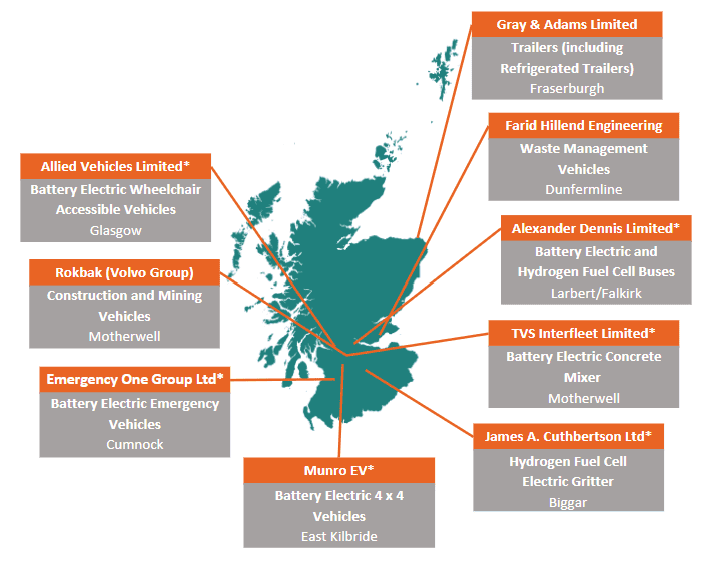
An additional company, H2 Vehicle Systems, was registered last year and is focused on emissions reduction from diesel HDVs; it is also seeking to develop hydrogen powered HGVs. There are no Scotland-based manufacturers of chassis that are used in HGVs.
There are seven companies that are active in design and manufacture of subsystems that are used in HDVs, including mechanical, hydraulic, electrical and electronic components, and five others that design and manufacture bodywork for HDVs and niche vehicles.
Companies with potential to become active
Based mainly on desk research, we have identified 102 companies as having relevant capabilities, meaning they have theoretical potential to become active in the zero emission HDV manufacturing supply chain. Of this total, 96 could provide mechanical, hydraulic, electrical and electronic system and subsystem design and manufacture. This includes, for example, sensors, control systems, power convertors and drive systems. There are also companies offering precision engineering services for the design and manufacture of parts, and others manufacture and supply materials for structural components and interior fittings.
Together, the subsystem and system capabilities in Scotland could support the further development and customisation of zero emission HDVs. Each of these companies could, potentially, work with existing OEMs to customise and optimise zero emission HDVs for specific purposes. This could include, for example:
- lightweighting, through the use of composite materials
- improving the energy efficiency of auxiliary equipment, through the design of electrical, mechanical and hydraulic subsystems
- enhanced software control of systems to optimise use and minimise energy consumption, for example through using telemetry data
However, we do not have sufficient information on whether these companies would view the zero emission HDV manufacturing supply chain as an opportunity.
Scotland’s role in the rest of the UK and international markets
Based on interviewee feedback, we have confirmed that seven of the 21 companies active in this supply chain export to markets outside the UK. Others may also export but we did not find evidence during our research to confirm this. We have also confirmed that three of the seven companies active in the zero emission HDV and niche vehicle supply chain export to markets outside the UK. Others may also export but we did not find evidence during our research to confirm this.
Role of the supply chain in other sectors
Companies that are further back in the supply chain have opportunities to sell into other net zero supply chains, including other forms of transport such as automotive, rail, and maritime.
Challenges faced
The main issue facing companies that are trying to enter the market for decarbonised HDV and niche vehicles is that customer demand is still very low. The majority of sales, particularly in the UK, are for fossil-fuel powered HDVs. Feedback from our interviews with companies and other stakeholders is that uncertainty around the deadlines for mandating zero emission HDVs is not stimulating demand compared to the situation where credible regulated deadlines were in place.
While an increasing percentage of buses are now electric, most of the OEMs supplying these vehicles are located outside of Scotland and the UK. As the majority of systems and sub-systems are integrated by the bus OEM, there is a much smaller opportunity for Scotland-based companies to become part of these supply chains.
The opportunities are greater for those supplying OEMs that design and manufacture specialised vehicles, but even here, feedback from our interviews strongly suggests that demand for zero emission vehicles will remain low due to customer concerns regarding duty cycles and opportunities to recharge or refuel the vehicle during use.
Stakeholders representing relevant industry associations whose members operate HGVs, confirmed that at present there is interest from their members regarding zero emission vehicles. There are also concerns, particularly around total cost of ownership (TCO) and the perceived increased costs of charging and hydrogen refuelling would have on their operations. There was universal concern regarding the impacts on SMEs, which represent the majority of HGV users, particularly haulage firms. Most of those interviewed believe that it is likely only larger operators, particularly those who want to be first movers, will adopt zero emission technologies prior to legislation coming into force. The only exception to this would be if the customer of the haulage firm required a reduction in scope 3 emissions (i.e., from its supply chain). In these cases, there is competition from low carbon fuels, such as biomethane or HVO as an alternative solution to zero emission vehicles. It was clear from these discussions that smaller companies, in particular, would like to see commitment from government on when legislation will come into force and assurances that the necessary charging and refuelling infrastructure will be in place, before they would commit to purchasing/operating a zero emission HDV. A lack of hydrogen refuelling infrastructure was highlighted by another stakeholder as the prime reason that they had stopped operating HFCEVs.
Companies further back in the supply chain told us that they tend to be more reactive to what customers need. They can supply into zero emission HDV manufacturing but equally could supply into OEMs that are manufacturing diesel powertrain vehicles. In many cases these companies supply a range of sectors and application areas, with automotive and HDV being just one. Overall, there are likely to be opportunities for such companies in the future, but this will be dictated by decisions made by the OEMs.
Charging infrastructure
We have identified 15 companies active in the HDV charging infrastructure supply chain with locations in Scotland. All of these companies are involved in other activities not related to HDVs. Eight of the 15 companies also have operational locations outside of Scotland. Employment and turnover data identified from desk research covers all activities in all locations of each company. It has, therefore, not been possible to use the desk-based data to reliably estimate the proportion of the total employment and turnover associated with the HDV charging infrastructure projects and carried out by staff based in Scotland.
Instead, we spoke with six of the 15 HDV charging supply chain companies and, based on these discussions, we are able to report an indicative level of current employment associated with HDV charging infrastructure work and carried out by employees based in Scotland. Companies provided information on employment related to HDV charging infrastructure activities but not turnover. This was due to a combination of the interviewees finding it easier to provide data on employment and it being less commercially sensitive than turnover data.
Based on the discussions with the six HDV charging infrastructure supply chain companies, we identified 114 employees, operating from a Scottish location that work on HDV charging infrastructure activities. It is estimated that there are between 200 and 400 employees, across all 15 supply chain companies, that are active HDV charging infrastructure projects. This estimate was tested at the validation workshop held during this study and the attending stakeholders confirmed this is a reasonable estimate. It is not possible to be more precise given the lack of data from the nine companies not interviewed as part of this study.
Based on feedback from stakeholder interviews and desk research it is reasonable to estimate that at least 90% of employment is related to the design and installation and operations and maintenance segments of the supply chain. We have not been able to reliably allocate employment numbers to a single segment of the supply chain as seven of the 12 companies active in design and installation are also active in the operation and maintenance segment. We do not have data on the activity split for the companies involved in these segments and are, therefore, unable to allocate employment numbers separately between them.
An overview of the current make-up and capability level of the Scottish HDV charging infrastructure supply chain, is shown below.
An overview of the number of companies active in each supply chain segment is shown in Table 4 (please note that the figures in Table 4 total more than the 15 companies we identified for this supply chain. This is due to some companies being active in more than one segment of the supply chain).
Materials | Parts & System Manufacture | Systems Integrator/ OEM | Design and Installation | Ownership | Operations and Maintenance |
|---|---|---|---|---|---|
0 | 1 | 0 | 12 | 4 | 7 |
The 12 companies active in the design and installation and operation and maintenance segments are show in Figure 2.
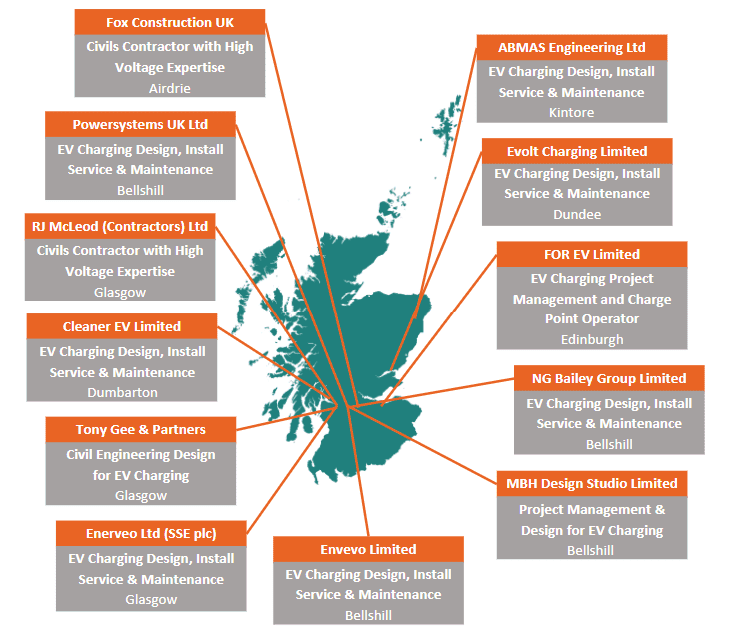
Four companies have also been identified as being owners of HDV charging infrastructure facilities: First Bus, FOR EV, Green Wheel Electric and Enerveo. The company included in the charger parts, components and systems manufacture segment has not been identified in this report due to this activity not being in the public domain.
Companies with potential to become active
We have identified 60 companies with capabilities potentially relevant to the charging infrastructure supply chain. We found no evidence that any of these were currently active in this supply chain. Our assessment of their capabilities was made based on reviewing information on their websites and most have not confirmed if they are interested in entering the supply chain.
The supply chain segment assessed as having the most potentially relevant companies was design and installation. Some of the companies identified in this segment also had capabilities that are potentially relevant to operation and maintenance. The companies were, typically, either low voltage EV charging installers, high voltage electrical contractors or civils contractors with experience in different sectors. To enter the HDV charging infrastructure market, the low voltage EV charging installers would have to develop new skills and competences to work on high voltage systems and become familiar with the installation requirements of different charging devices. Civils contractors may also require additional accreditations to work in high voltage environments. High voltage electrical contractors are likely to face the lowest barriers to entering this market of all the potential companies identified. This is due to the nature of their existing experience and skills being very similar to what is required to design and install HDV charging infrastructure.
Potential parts and systems manufacturers, for both fixed and mobile charging equipment, were identified. This covered enclosure fabrication, electronic components and devices, embedded software and cables, connectors and sockets. To enter the charging infrastructure market, these companies would have to develop supply chain relationships with manufacturers of HDV charging equipment. No manufacturers of this kind are currently located in Scotland. It is challenging to develop relationships with geographically remote customers unless there are unique attributes to the parts and systems these companies are able to supply. This could include circumstances where, for example, the potential Scottish supplier has parts or systems protected by intellectual property rights.
Six companies were identified as having the potential to manufacture fixed HDV chargers and two with the potential to manufacture mobile HDV chargers. Most of these companies are currently active in low voltage charger manufacture. It has not been confirmed if they are interested in investigating the HDV charger market.
One existing HDV charger manufacturer, located outside of Scotland, was identified as a potential inward investor for assembly activities. It has not been named due to confidentiality considerations.
Scotland’s role in the rest of the UK and international markets
We have confirmed that four of the 15 companies active in the HDV charging infrastructure supply chain export to markets outside the UK. Others may also export but we did not find evidence during our research to confirm this.
We spoke with three of these four exporting companies. In all three cases the companies described how they successfully delivered an HDV charging infrastructure design and installation project in the UK for an international customer. Having demonstrated competence in this type of project the same client then contracted with them to deliver the same type of project in overseas markets.
Two companies in the Scottish charging infrastructure supply chain described having offices in overseas companies. This includes the United Arab Emirates, which was described as having very similar electrical installation standards as the UK. Other examples of target international markets include countries in Europe such as Sweden and Germany.
Whilst there is evidence of international markets being accessible to electrical design and installation companies it is possible that opportunities for civil engineering contractors will be restricted to Scotland and the rest of the UK. This is due to reliance on capital intensive equipment that is not easy to transfer to overseas locations.
Four of the supply chain companies located in Scotland were part of a UK or international group. This means that the locations in Scotland typically service just the Scottish market or the UK market, depending on where other offices in the wider group are located. In these cases, the opportunities arising internationally will be serviced directly from other locations closer to those markets.
Role of the supply chain in other sectors
Some of the active supply chain companies identified are focused only on EV charging markets covering all sizes of vehicle, including HDVs.
Other companies have a wider target market and provide services to other sectors. For example, an electrical design and installation company servicing electrical systems works in the commercial and industrial sectors. The ability to carry out high voltage electrical projects has very wide applications, including in other sectors where decarbonisation is being driven by electrification.
Civil engineering design and installation contractors also have a wide range of application sectors for their services. Some of these may be closely connected to net zero, such as installation of district heat networks and wind farm development. Other civils work is not connected to net zero, such as expansion of the road transport network.
Challenges faced
The main challenge faced by companies in this supply chain is the current low demand from HDV operators. The main reason for this low demand is uncertainty amongst HDV operators about hard deadlines for when zero emission vehicles only will be available on the new vehicle market. All stakeholders recognise the long-term shift to decarbonised HDV fleets but, without an immediate regulatory or commercial reason to switch, there is limited incentive.
There is also uncertainty about which powertrain option to invest in amongst operators. Representative bodies, such as Logistics UK and the Road Haulage Association are lobbying for low carbon fuels to play more of a role in the short-term decarbonisation of fleets. Although these are not zero-emission solutions, they are commercially proven and an attractive option for some operators seeking to demonstrate action on greenhouse gas emission reduction to their customers. Pursuing this as a decarbonisation option in the short term could delay the adoption of zero emission HDVs and the charging and refuelling infrastructure they will require.
Other challenges
- Low operator awareness of, and skills required for, fleet decarbonisation plus limited awareness of Scottish supply chain options
- Sporadic short term grant funding for operators
- Grid capacity constraints and connection queues
- Availability of finance for fleet operators
- Physical space constraints in HDV depots
- Skills shortages in key areas, such as high voltage design engineering
- Training gaps for low voltage charger installers interested in high voltage HDV charging installation
Hydrogen refuelling infrastructure
We have identified seven companies active in the HDV hydrogen refuelling infrastructure supply chain with locations in Scotland. All of these companies are involved in other activities not related to HDVs. This means that it has not been possible to use company level employment and turnover data, identified during the desk research, to estimate the scale of HDV activity.
We spoke with two of the seven supply chain companies and a further six stakeholders with knowledge of the hydrogen economy. Based on these discussions, we estimate that the HDV hydrogen refuelling infrastructure supply chain employs fewer than 100 people in Scotland. As with the charging infrastructure supply chain, there is very limited manufacturing activity, with only two of the seven supply chain companies being active in components and systems manufacture. Most equipment used by the Scottish companies being sourced from the rest of the UK or overseas and integrated by companies in the Scottish supply chain rather than manufacturing original equipment. Based on our discussions with stakeholders, the limited number of jobs within the HDV hydrogen refuelling infrastructure supply chain are concentrated across systems integration, design, construction and installation and ownership, operation and maintenance. It has not been possible to calculate exact percentages of jobs in each of the supply chain segments as six of the seven companies are active in more than one segment and we do not know the relative split of activity between segments. Although all seven supply chain companies were approached for interview, only two participated, meaning there is insufficient data available to estimate the exact breakdown of employment by supply chain segment. There is also insufficient data available to allow us to estimate the turnover for this supply chain as those companies who did speak with us preferred to provide information about employment levels rather than turnover.
An overview of the number of companies active in each supply chain segment is shown in Table 5 (please note that the figures in Table 5 total more than the seven companies we identified for this supply chain. This is due to some companies being active in more than one segment of the supply chain).
Materials | Parts & System Manufacture | Systems Integrator/ OEM | Design, Construction & Install | Ownership, Operations and Maintenance |
|---|---|---|---|---|
0 | 2 | 4 | 5 | 4 |
The seven companies active in the hydrogen refuelling infrastructure supply chain are show in Figure 3.
Companies with potential to become active
Our research has also identified 19 companies with the potential to become active in the hydrogen refuelling infrastructure supply chain. This assessment was made through review of their capabilities, e.g. based on information on their websites, and suggestions made by stakeholders during the consultation period that highlighted potential activity.
Most of these companies have capabilities that are potentially relevant to the component and system manufacturing segments of the supply chain. Identified companies are either already active in adjacent component supply chains or developing capabilities in hydrogen specific supply chains. The types of components include compressor and decompressor equipment, pipework, valves, metal tanks / vessels, nozzles and tubes, sensors. For example, Stewart Buchanan Gauges Ltd is designing and developing hydrogen valves, which could be relevant to the HDV hydrogen refuelling infrastructure supply chain.
The design, construction and installation companies identified mostly offer concept design, detailed design, and health and safety consultancy and support services that include hydrogen safety. It has not been confirmed whether work has been done in the hydrogen refuelling market specifically.
Scotland’s role in the rest of the UK and international markets
The UK hydrogen refuelling market is at a very early stage of development. There is limited completed or planned refuelling infrastructure. However, where it has been developed, these refuelling sites have generally been delivered by Scottish OEMs and systems integrators.
In terms of international markets, feedback from stakeholders confirms that Scotland-based systems integrators and OEMs are providing, or have provided, services and products to international markets including Europe and Asia. However, it was noted that the likelihood of entering the Chinese market is now limited due to central government financial support and rapid deployment leading to high levels of in market competition. The decline of demand in the USA market since the beginning of the current Government Administration has been damaging to what has been a core market for Scottish companies.
Role of the supply chain in other sectors
The design of the system for hydrogen refuelling infrastructure is unique to the end-use, however opportunities exist in adjacent hydrogen sectors as they develop including off-grid power generation and distribution, hydrogen storage and transport. The core hydrogen technologies and capabilities can be energy storage and refuelling applications, with stakeholder feedback identifying that there is more activity in the energy storage segment at present.
Further back in the supply chain the component manufacturers generally transition from legacy oil and gas industries and deliver components that can be used in other net zero markets including the broader hydrogen derivatives market. This could include ammonia for the decarbonisation of maritime as well as other potential applications in energy generation and storage utilising liquid or gaseous vectors and mechanical components for applications such as pumped hydro. The challenge for the supply chain is the slow progress and certainty around the development of these other net zero markets.
Challenges faced
The central challenge faced by this supply chain is a lack of clear and positive policy intent. Further, the dangers of a net zero targets easing to allow for a small amount of fossil fuel use poses a threat to the development of the hydrogen refuelling market, resulting in it becoming a marginal technology to address residual emissions rather than a primary route to decarbonisation. It was recognised through consultation with stakeholders that hydrogen (more generally) but particularly hydrogen HDVs will likely play a comparatively small but critical role in the achievement of net zero targets. The technology will likely occupy a marginal role in the achievement of the final, hard to abate reductions necessary for net zero. If policy goals shift towards allowing a small role for fossil fuels, the hydrogen economy is likely to contract.
Attracting finance to enable pilot market activity that can demonstrate commercial viability has also been identified as a key challenge.
A lack of component certification standards for hydrogen refuelling infrastructure applications was also identified as a challenge to the development of compliant components.
We note that international markets have more proactively set targets and support mechanisms for the deployment of hydrogen refuelling stations and hydrogen HDVs more broadly. One stakeholder noted that it would be helpful for the supply chain to have a clear point of contact within Transport Scotland to discuss challenges and opportunities related to hydrogen refuelling. Further challenges beyond the scope of this project include the cost of energy, the cost of producing and transporting hydrogen, and consequently, the levelised cost of hydrogen.
SWOT Analysis
Summaries of the key findings of the SWOT analysis for each supply chain are shown in Table 6: SWOT analysis – HDV and niche vehicle manufacturing supply chain, to Table 8: SWOT analysis – HDV hydrogen refuelling supply chain.
Strengths | Weaknesses |
Scotland has specialist HDV manufacturers and integrators with capability in bespoke vehicle design, integration and aftersales support | The manufacturing base is small and fragmented, with limited OEM capability |
Existing strengths in control systems, software, telematics and energy management are transferable to zero-emission HDVs | Most zero-emission HDV activity (outside buses) remains pilot-scale, with minimal demand and no measurable employment growth to date |
Manufacturers are embedded in public-sector procurement, which supports early trials and specialist applications where OEM solutions are less mature | Heavy reliance on imported chassis and systems limits value capture and exposure to external OEM decisions |
Opportunities | Threats |
UK and EU zero-emission targets have the potential to create a long-term market for compliant vehicles and systems | Strong international competition, particularly from large Chinese OEMs, limits Scotland’s competitiveness in zero-emission HDV manufacturing |
Niche and specialist vehicles (e.g. refuse, emergency and municipal) offer the most realistic entry points for Scottish manufacturers | Weak and uncertain market demand, driven by high vehicle costs and limited infrastructure, undermines investment confidence |
Growth is most likely in integration, engineering services, software and lifecycle support | Low confidence amongst some supply chain companies that 2035 and 2040 zero emission HDV policy targets will be enforced as currently stated |
Scotland’s main strengths are in niche manufacturing and vehicle integration, rather than mass production. Existing companies have expertise in the building of specialist vehicles, bespoke design, systems integration and aftersales support. Capabilities in software, control systems and energy management are largely transferable to zero-emission HDVs and align with areas where future value is expected to sit. Strong links to public-sector procurement have enabled early trials and demonstrator projects, generating learning even where commercial outcomes remain uncertain.
The analysis, however, highlights some significant weaknesses. The manufacturing base is small, fragmented and relies heavily on imported chassis and core systems. Scottish companies, therefore, have very limited influence over technology pathways or product availability, which are shaped by global OEM decisions. Zero-emission HDV production (outside buses) remains at pilot scale, with no clear evidence of employment growth to date. High vehicle costs, limited infrastructure and weak customer demand reinforce a cautious, wait-and-see approach across the supply chain.
Opportunities are largely policy-driven rather than market-led. UK and EU emissions standards and demonstrator funding create long-term demand for zero-emission vehicles, but the most realistic opportunities for Scottish companies sit in specialist and niche applications, such as municipal and emergency vehicles, and in service-led activities including integration, engineering support and digital systems.
The threats are significant. International competition, particularly from large Chinese OEMs, constrains Scotland’s ability to compete on cost or scale. Uncertain demand, high upfront costs and reliance on global supply chains increase commercial risk. Stakeholder feedback from some company and other stakeholders expressed doubt that policy targets for zero emission HDVs will be enforced as stated, and viewed this as leading to market uncertainty.
Strengths | Weaknesses |
Scotland has an established EV charging supply chain with practical experience in depot-based charging, including early HDV applications | Only one domestic manufacturer of HDV charging device components, with most value coming from services rather than equipment |
Scottish-based integrators and service providers already deliver design, grid connection, installation and operations, with growing HDV-related employment | Shortages of skilled contractors and engineers for high-power and large-scale installations may constrain delivery and scale-up |
Current Scottish capabilities align well with the expected dominance of depot charging for HDVs to 2030 | HDV charging remains early-stage and fragmented, with limited infrastructure coverage beyond pilots and bus depots |
Opportunities | Threats |
Strong growth in HDV electrification will create demand for depot charging, grid upgrades, and system operation, where Scotland already has capability | Grid capacity constraints and high connection costs risk slowing deployment, particularly for high-power sites |
Companies report clear potential for job growth in Scotland, particularly in engineering, design and operations linked to HDV charging in Scotland, UK and export markets | Policy and funding uncertainty, including short-term grant schemes and lack of clarity about regulatory deadlines, undermine market and supply-chain confidence |
EU and UK policy requirements for HDV charging corridors and depots support longer-term market demand | Skills shortages and reliance on imported hardware increase the risk that economic value and ownership shift to large international providers |
A key strength is the presence of established EV charging integrators and service providers with experience in depot-based charging, developed through the bus sector and early HDV projects. This aligns well with evidence that depot charging will dominate HDV charging to 2030. Scottish companies already provide design, grid connection, installation and operations services, and some are seeing early employment growth linked to HDV charging.
There are, however, notable gaps in the supply chain. Only one domestic manufacturer of HDV charging components was identified, providing cooling systems for HDV chargers. The Scottish supply chain relies heavily on imported equipment. Skills shortages, particularly for high-power installations, and limited training provision constrain the pace of deployment. HDV charging infrastructure remains limited, with activity concentrated in pilots and early depot projects. Uncertainty about current and future demand for HDV charging infrastructure, combined with stop-start grant funding, have reduced confidence among both fleet operators and infrastructure providers.
Opportunities are driven by growing HDV electrification and policy requirements for charging infrastructure both domestically and internationally. These create potential for job growth and positive economic impact in the installation, operations and maintenance segments of the supply chain, rather than in manufacturing.
The main threats relate to delivery risk and investment confidence. Grid capacity constraints, high connection costs and short-term funding cycles all have a negative impact on deployment. The lack of domestic manufacturing of HDV charging devices, and very limited component supply chain, limits the value retained in the Scottish supply chain.
Strengths | Weaknesses |
Scotland has practical experience in hydrogen mobility and refuelling from public-private projects in buses and municipal fleets | The supply chain is small, capacity-constrained and highly dependent on a few providers, which limits competition and resilience |
A small number of Scottish-based integrators can deliver end-to-end hydrogen refuelling projects, including design, installation and operations | Most critical refuelling equipment is imported, restricting Scottish supply chain activity to integration and maintenance |
Scotland’s extensive renewable electricity infrastructure supports the long-term potential for green hydrogen production linked to refuelling | Activity remains pilot-led and fragmented, with limited coordination between hydrogen production, vehicles and refuelling |
Opportunities | Threats |
Hydrogen refuelling is most viable in specific HDV use cases with high utilisation and centralised depots, such as buses and refuse vehicles | Weak fleet demand, high vehicle and fuel costs, and limited OEM activity in hydrogen powered HDVs undermine infrastructure utilisation and roll out |
UK and international policy frameworks and demonstrator funding support continued trials and targeted deployment | Battery-electric HDVs are scaling faster and at lower cost, restricting hydrogen to niche roles |
Scottish firms can realise economic benefits in system integration, EPC delivery and operations, and apply these capabilities in overseas markets | Policy uncertainty, high capital costs and reliance on a small international equipment market increase delivery and investment risk |
Scotland’s main strength is its practical delivery experience derived from hydrogen mobility projects, particularly for buses and municipal fleets. A small number of Scottish-based companies can deliver end-to-end refuelling projects and have developed strong safety, engineering and operational expertise. Scotland’s renewable electricity base also supports the long-term potential for green hydrogen, where refuelling is co-located with production.
The analysis, however, highlights significant weaknesses. The supply chain is small and capacity constrained. There is significant reliance on a few providers and on imported core equipment. Projects are, typically pilots or demonstrators and have been delivered on a standalone, case-by-case basis, with limited coordination between hydrogen production, refuelling infrastructure and vehicles, except for the coordinated approach of Aberdeen City Council. Failed or stalled projects have reduced confidence among public-sector sponsors and fleet operators.
Opportunities for Scottish companies in hydrogen refuelling infrastructure are limited and use-case specific. Evidence gathered during this study suggests hydrogen is most viable for HDV applications with high utilisation and predictable duty cycles where purchase agreements can be forecast, for example, buses or refuse vehicles. Policy frameworks and demonstrator funding continue to support trials and demonstrators and there is potential for Scottish companies to participate in roles such as system integration, EPC delivery and operations, rather than in equipment manufacture.
The main threats relate to low demand and sidelining of hydrogen adoption in long-term policy and strategy. High vehicle and fuel costs, limited hydrogen powered HDV manufacture and uncertain utilisation undermine the commercial case for refuelling infrastructure. The use of battery electric HDVs is scaling more quickly and at a lower cost. Ongoing policy uncertainty, high capital costs and reliance on small global equipment supply chains further increase investment and delivery risks.
Our detailed analysis of the strengths, weaknesses, opportunities and threats for each supply chain is provided in Appendix C.
Future demand changes for each supply chain
This section considers the potential change in demand of the three supply chains in Scotland as a response to the decarbonisation of HDVs. For the estimation of the current economic size of the HDV and niche vehicle manufacturing supply chain we have been able to use both turnover and employment data. Due to a lack of robust turnover data for the remaining two supply chains, from both desk research and stakeholder interviews, we have used employment estimates as a proxy for change in demand and all future economic size estimates. We recognise that using employment data has limitations in the extent that it can reflect changes in productivity. We consider 2030 and 2035 timeframes. No account has been made for any inward investment contribution to the supply chains in our estimated future economic size. Whilst we believe inward investment could be an important contributor to supply chain growth, the level of uncertainty about the scale of any such activity is too high to quantity the resulting impact. The employment projections are based on the growth of the existing supply chain companies.
We reviewed desk-based evidence to identify the nature, scale and timing of the shift to decarbonised HDVs. This provided context for how the market demand would change for the three supply chains covered in this study.
We spoke with 27 industry and other stakeholders covering all three supply chains. We combined the feedback from these stakeholders with what we found from the desk-based review. We used this to develop a view of what could happen to the number of jobs in Scotland in these supply chains from now until 2030 and then to 2035. We focused on employment numbers as a proxy for economic growth as stakeholders were more willing and able to provide data on projected employment than projected turnover.
We presented our emerging findings, about the scale of jobs growth in each of the three supply chains to 2030 and 2035, to a group of 13 industry and other stakeholders at a workshop. Some stakeholders had differing opinions on how quickly decarbonisation of HDVs will occur. Some point to parts of the HDV market where it can already be more cost effective to buy zero emission vehicles. For example, city buses and lighter heavy goods vehicles (HGVs). Others highlight the position of many HGV fleet operators that low carbon fuels, such as biomethane and hydrogenated vegetable oil (HVO), should play an important role in decarbonisation of HGVs in the short term, therefore delaying the uptake of some zero emission vehicles. However, there was broad agreement by the majority of stakeholders that the indicative scale and timing of job growth in each of the three supply chains was reasonable, given their understanding of HDV decarbonisation to 2030 and 2035.
Based on this, our estimate for the potential change in job numbers across each supply chain, to 2030 and 2035 is compared with current job numbers in Table 9.
Supply Chain | Current Jobs | Jobs by 2030 | Jobs by 2035 |
|---|---|---|---|
Overall HDV and niche vehicle manufacturing | 3,200 to 4,000 | 3,200 to 4,500 | 3,200 to 5,200 |
Zero emission HDV and niche vehicle manufacturing (subset of the overall HDV and niche vehicle manufacturing supply chain) | 300 to 500 | 500 to 1,000 | 1,000 to 3,000 |
HDV charging infrastructure | 300 to 400 | 400 to 700 | Uncertain – no estimate |
HDV refuelling infrastructure | Less than 100 | Uncertain – no estimate | Uncertain – no estimate |
HDV and niche vehicle manufacturing supply chain, including zero emissions
Based on stakeholder feedback we estimate that the size of the overall HDV and niche vehicle manufacturing supply chain is likely to remain stable or have modest growth in line with market demand for HDVs. We expect the global market demand for HGVs and buses and coaches to be less than 5% annually: 3.9% according to Grandview Research (2023) and 4.2% according to Research and Markets (2025). Within this overall supply chain, the zero emissions HDV and niche vehicle manufacturing activity is projected to move existing employment from fossil fuel vehicle manufacture to zero emission vehicle manufacture. There was some uncertainty expressed by one stakeholder about whether the pace of change would be slower than these projections suggest but the view by most stakeholders was that it was a reasonable estimate.
HDV charging infrastructure supply chain
The charging infrastructure stakeholders feedback consistently reported a significant projected increase in employment to 2030 related to HDV charging infrastructure, driven by a quickening pace of Heavy Goods Vehicle (HGV) decarbonisation. There was uncertainty about the level of jobs by 2035 due to concerns that regulatory targets to mandate new HDV sales to be net zero have not yet been established for the UK and a perceived risk that targets could subsequently be changed in future.
Hydrogen refuelling supply chain
Stakeholder feedback and desk research suggests that any significant jobs growth in hydrogen refuelling infrastructure supply chain would likely take place after 2035. One stakeholder highlighted the risk that regulatory targets could be softened to require a high level of zero emission HDV adoption rather than complete zero emission adoption. They viewed this as a risk to current investment and an issue that could significantly curtail employment growth in the supply chain in future. Stakeholder feedback and desk-based research suggests that hydrogen refuelling will play a targeted but modest role in HDV decarbonisation. This may emerge through the development of a trunk road network approach to establish a minimum viable operating model for HDV refuelling infrastructure and, therefore, hydrogen HDV operation. This approach is being followed in Europe with regulatory and fiscal support from the European Commission. An alternative could be infrastructure funded by the private sector on a case-by-case basis. Shorter-term opportunities exist in the deployment of mobile refuelling solutions, where battery electrification and recharging is not suitable, such as mining and some agricultural purposes.
Cross-check of job projection estimates made in this study
We have compared our estimates of future job numbers with those made in a previous study (Scottish Enterprise 2024). This Scottish Enterprise study provides ranges of full time equivalent (FTE) jobs related to capital investment and operation & maintenance under two scenarios. The first scenario is ‘Business as Usual’, which assumes the rate of change is slower with less appetite for change at consumer level with the Net Zero target being missed. The second scenario is ‘Strong Ambition’, which assumes high levels of deployment driven by societal change and strong policy support. Table 10 provides upper and lower job number estimates for different supply chains, calculated from data in the Scottish Enterprise report. The lower number in each cell is the estimated job numbers under the Business as Usual scenario. The second figure in each cell is the estimated job numbers under the Strong Ambition scenario. The Scottish Enterprise data for the sectors equivalent to the supply chains being investigated in this study are shown in Table 10.
Sector (SE) | Equivalent supply chain in this study | 2025 FTE range | 2030 FTE range | 2035 FTE range |
|---|---|---|---|---|
EV Buses/HGVs | Zero emission HDV manufacturing | 189 to 488 | 485 to 2,372 | 1,459 to 7,331 |
H2 Buses/HGVs | Zero emission HDV manufacturing | 29 to 58 | 48 to 134 | 82 to 284 |
EV Chargers – All | HDV charging | 87 to 235 | 330 to 888 | 789 to 1,861 |
Hydrogen Refuelling | HDV hydrogen refuelling | 30 to 105 | 52 to 238 | 105 to 536 |
We observe that the current and future employment estimates we made for the three supply chains, in this study, (shown in Table 9) are broadly compatible within the ranges of the two scenarios stated in the Scottish Enterprise (2024) report. Note that Table 10 provides job estimates for the zero emission HDV manufacturing supply chain only and not the overall HDV and niche vehicle manufacturing supply chain.
Comparison of HDV decarbonisation driven jobs growth with growth in other sectors
It is also useful to compare the current size and growth potential of the HDV related supply chains with some other sectors in the Scottish economy. This provides a context to the potential contribution of job growth from the decarbonisation of HDVs with potential job growth in other sectors. Table 11 shows current and projected employment growth from the same Scottish Enterprise study (Scottish Enterprise 2024).
Supply chain | 2025 FTE range | 2030 FTE range | 2035 FTE range |
|---|---|---|---|
Offshore Wind | 6,164 to 11,068 | 11,291 to 25,738 | 23,278 to 67,121 |
Heat Pumps | 1,089 to 6,589 | 3,516 to 14,119 | 4,647 to 13,105 |
Heat Networks | 878 to 939 | 269 to 659 | 334 to 2,107 |
Hydrogen Production | 51 to 160 | 257 to 8,039 | 151 to 6,181 |
CCUS | 665 to 1,028 | 1,383 to 2,062 | 1,348 to 1,585 |
We observe that, by 2035, the number of jobs estimated for the supply chains driven by HDV decarbonisation (those shown in Table 10) is lower than the estimated job growth in offshore wind and heat pumps but comparable to hydrogen production and higher than heat networks and CCUS.
Benefits to other sectors from HDV decarbonisation
We looked for examples of where companies in other sectors, currently outside of the three HDV supply chains might benefit from HDV decarbonisation. We did this through stakeholder interviews and desk-research.
Companies in different parts of the construction sector have skills and capabilities relevant to the civil engineering aspects of development of charging infrastructure and hydrogen refuelling infrastructure. This includes early surveying, planning and design of civil works and also civil engineering contractors to carry out groundworks in preparation for the installation of electrical infrastructure or hydrogen refuelling equipment.
Companies in the renewable energy generation sector can move downstream into the development and provision of charging stations using their expertise in planning and project management. We identified one example of this, with Greenwheel Electric Ltd in the process of planning an electric only charging station in West Dunbartonshire. Greenwheel Ltd is part of Muirhall Energy, an established onshore wind developer. This enables Greenwheel to provide a 100% renewable electric charging station offering.
Companies in the clean heat sector can use their technologies to provide systems capable of electrifying HDV truck cabins and buses, to reduce the draw on electricity from the main vehicle battery. We are aware of one company that has taken part in a pilot project to provide heat for an electric bus using their technology usually deployed in home heating. We are also aware of a company with a heat pump technology also being used to provide a cooling system for an HDV charger manufacturer. We cannot name these companies due to commercial confidentiality.
Stakeholder views on maximising economic opportunities
We asked stakeholders from each of the three supply chains to identify what could be done to maximise the economic opportunities from the decarbonisation of HDVs. A broad range of demand side and supply side suggestions were made. These are summarised in Figure 4.
The suggestions made by interviewees, in relation to each of the three supply chains, are described in more detail in the following sections. Further details are in Appendix D.
HDV and niche vehicle manufacturing
- Increased clarity of regulation and when new HDV sales must be zero emission
- Long term, stable funding for operators to overcome total cost of ownership (TCO) issues
- Support for operators to access financial models to fund vehicle and infrastructure investment
- Improving skills provision for companies to safely work on OEM supplied BEV and HFCEV chassis when using these as a base to build customised HDVs
Charging infrastructure
- Policy and regulatory certainty for HDV operators and manufacturers
- Long term, stable funding for operators to overcome TCO issues
- Coordinated research to understand locations where grid reinforcement is required and managing future connection queues
- Support existing companies to enter the HDV charging manufacturing supply chain and attract inward investment opportunities
- Promote Scottish supply chain capabilities to Scottish operators, including networking at existing public HDV charging sites
- Invest in more in Graduate Apprenticeships to address areas of skills shortages, such as high voltage electrical design engineering
- Support low voltage charger installers to upskill if they are interested in entering the high voltage HDV charging installation market, including establishing links with charging device manufacturers
- Raise awareness of the market opportunities for civil engineering contracts and support skills development to work in high voltage environments
Hydrogen refuelling infrastructure
- Clear long-term policy confirming 100% net zero target
- Development of industry standards to support hydrogen system component development
- Promote Scottish supply chain companies to fleet operators and identify the main Government/Transport Scotland contact points for the supply chain
Conclusions
Strong global policy and market forces are accelerating HDV decarbonisation
We identified strong drivers for HDV decarbonisation, resulting in a clear direction of travel. This includes regulation and funding support from governments in major markets, including China, Europe and North America. Market drivers are also arising from companies that are increasingly demanding evidence from their supply chains that real action is being taken to reduce greenhouse gas emissions.
The speed of transition varies by type of HDV and low carbon fuels are playing a role alongside zero emission options
Many countries, including the UK, have set target dates by which sales of new diesel and petrol HDVs will be replaced by zero emission HDVs. The regulatory measures to support this are still being consulted on at a UK level. The feedback we received from stakeholders interviewed for this study highlights different views about how quickly the transition to zero emission HDVs is likely to happen.
Some stakeholders highlight examples of companies buying zero emission HDVs, without any grant funding support, due to the total cost of ownership being lower than traditional diesel alternatives. This has typically been in the bus market and lighter end of the HGV market.
Other stakeholders suggested that fleet operators are using low carbon fuels, such as biomethane and HVO in the short term for cost and proven performance reasons. Two of the main HGV fleet operator representative bodies are in favour of using low carbon fuels as a decarbonisation technology and this would likely contribute to delay in investment in battery electric and hydrogen powered HDVs.
Scottish HDV and niche vehicle manufacturing supply chain activity is concentrated in a few companies
We identified nine companies in Scotland during this study as being active in the manufacturing of HDVs or niche vehicles. Six of these are active, or have recently been active, in zero emission HDVs. An additional 12 companies are involved in the manufacturing supply chain, with only one of these having been active in zero emission manufacturing. In most of these companies, the transition to zero emission vehicles is likely to lead to safeguarding of existing jobs as diesel vehicle manufacturing is displaced. Currently the 22 active companies employ several thousand employees, with a few hundred of these being active in zero emission activities. Exporting is a key route to market for most of the companies in this supply chain. Although an additional 103 companies with Scottish locations have been identified as having potentially relevant capabilities, only three were identified as developing new products targeting this supply chain. For the remaining potential companies, there is uncertainty about whether they are either aware or interested in entering the supply chain. If they chose to do so there would be significant barriers if they did not have a clear, unique proposition.
The HDV charging infrastructure supply chain is mainly service based and is growing
We identified 15 active companies with locations in Scotland in this supply chain. We estimate that current employment is between 300 and 500 and the focus is on design, installation, ownership, operation and maintenance. Only one parts manufacturer, producing cooling systems for a large charging device manufacturer, was identified. Some companies in this supply chain are already active in European and Middle East markets, delivering HDV design and installation projects. All companies interviewed from this supply chain expect significant growth in their HDV charging business. An additional 60 companies were identified as having capabilities potentially relevant to this supply chain. Some of these are currently involved in the manufacture of charging devices for cars and light vans and it is not known whether they view HDV charging manufacture as a market development opportunity. Others are involved in installation of domestic and light commercial charging infrastructure and would need additional skills development to enter the HDV charger installation market. Again, it is not known how many of these companies view the HDV market as a realistic opportunity.
The HDV hydrogen refuelling infrastructure supply chain is very limited with the main growth opportunity identified after 2035
We identified seven companies with Scottish locations as being active in the hydrogen refuelling infrastructure supply chain. We estimate that total current employment is fewer than 100. There is limited manufacturing capability in Scotland, with most systems integrators sourcing equipment from outside of Scotland. Most of the activity in this supply chain relates to hydrogen refuelling infrastructure design, installation and operation for demonstrators. The main focus is on supporting hydrogen powered buses and public sector vehicle fleets. Discussions with stakeholders in this sector highlighted that the most significant uncertainties relate to the timing of additional hydrogen powered HDV deployment and no future employment growth estimates have been made. There was general agreement from stakeholders that significant levels of adoption would take place mid to late 2030’s but this is very dependent on HDV decarbonisation policies being ‘zero emission’ rather than ‘almost zero emission’.
Market demand stimulation is vital but supply side actions are important too
Various initiatives already exist at government and industry level to stimulate market demand for zero emission vehicles and the associated charging or hydrogen refuelling infrastructure. Key actions, which are already well understood, include clear and stable policy, consistent funding support, clear regulations and addressing grid capacity and connection constraints. Stakeholders interviewed for this study also highlighted several actions addressing specific supply side issues. These includes awareness raising and networking with fleet operators, particularly for SMEs, to highlight Scottish supply chain capabilities. The importance of addressing current and future skills shortages in electrical design and installation and training capacity to upskill low voltage EV charging installers are also examples of supply side actions required to maximise economic opportunities for the Scottish supply chains.
References
ACEA (2024) Economic and Market Report Global and EU auto industry: Full year 2024. Available at: https://www.acea.auto/publication/economic-and-market-report-global-and-eu-auto-industry-full-year-2024/ (Accessed 12 November 2025)
Basma, H and Schmidt, J. (2025) Charging Infrastructure Needs for Battery Electric Trucks in the European Union by 2030. International Council on Clean Transportation. Available at: https://theicct.org/wp-content/uploads/2025/10/ID-476-–-EU-BETs_report_final-1.pdf (Accessed 08 January 2026)
BloombergNEF (2025) Zero Emission Commercial Vehicles – Accelerating the Transition. Available at: https://assets.bbhub.io/professional/sites/24/Zero-Emission-Commercial-Vehicles-Factbook-2025.pdf (Accessed 08 January 2026)
CSIRO and GHD (2023) Hydrogen Vehicle Refueling Infrastructure: Priorities and opportunities for Australia. Available at: https://elecseed.com.au/wp-content/uploads/2023/08/Hydrogen_Vehicle_Refuelling_Infrastructure_Report.pdf (Accessed 18 November 2025)
Danish Ministry of Transport (2021) Infrastructure Plan 2035. Available at: https://www.trm.dk/politiske-aftaler/2021/aftale-om-infrastrukturplan-2035-aftale/ (Accessed 13 November 2025)
Department for Transport (DfT) and Driver and Vehicle Licensing Agency (DVLA) (2026) [1] Data Table Veh0556 – Heavy goods vehicles registered for the first time by gross vehicle weight (tonnes). Available at: https://www.gov.uk/government/statistical-data-sets/vehicle-licensing-statistics-data-tables#all-vehicles (Accessed 02 February 2026)
Department for Transport (DfT) and Driver and Vehicle Licensing Agency (DVLA) (2026) [2] Data Table Veh0601 – Licensed buses and coaches at the end of the year by body type detail. Available at: https://www.gov.uk/government/statistical-data-sets/vehicle-licensing-statistics-data-tables#all-vehicles (Accessed 02 February 2026)
Department for Transport (DfT) and Driver and Vehicle Licensing Agency (DVLA) (2026) [3] Data Table Veh1104 – Licensed Vehicles at the end of the quarter by body type and region. Available at: https://www.gov.uk/government/statistical-data-sets/vehicle-licensing-statistics-data-tables#all-vehicles (Accessed 04 February 2026)
Department for Transport (DfT) and Driver and Vehicle Licensing Agency (DVLA) (2026) [4] Data Table Veh1154 – Vehicles Registered for the first time by body type and region: Great Britain and United Kingdom. Available at: https://www.gov.uk/government/statistical-data-sets/vehicle-licensing-statistics-data-tables (Accessed 11 February 2026)
Department for Transport (DfT) and Driver and Vehicle Licensing Agency (DVLA) (2026) [5] Data Table Veh0171 – Ultra low emission vehicles (ULEVs) registered for the first time by body type and fuel type, including breakdown of generic models: Great Britain and United Kingdom. Available at: https://www.gov.uk/government/statistical-data-sets/vehicle-licensing-statistics-data-tables (Accessed 11 February 2026)
Drake, W. et al (2023) Why Great Britain’s long-distance, heavy-duty HGVs can go battery electric – and what needs done to achieve this, Element Energy/ ERM. Available at: https://www.erm.com/contentassets/553cd40a6def42b196e32e4d70e149a1/phase-two-report-use-cases-that-do-need-public-charging.pdf (Accessed 08 January 2026)
Energy UK (2025) Driving electrification in the road freight sector. Available at: https://www.energy-uk.org.uk/publications/driving-electrification-in-the-road-freight-sector/ (Accessed 02 March 2026)
Enova (2025) Support scheme for heavy-duty zero-emission vehicles. Available at: https://www.enova.no/nb/bedrift/landtransport/stottetilbud-innen-landtransport/tunge-nullutslippskjoretoy (Accessed 13 November 2025)
EPA (2024) EPA awards over $735 million for clean heavy-duty vehicles. Available at https://driveelectric.gov/news/epa-clean-heavy-duty-vehicles-awards (Accessed 13 November 2025)
European Commission (2024) Regulation (EU) 2023/1804 of the European Parliament and of the Council of 13 September 2023 on the deployment of alternative fuels infrastructure. Available at: https://eur-lex.europa.eu/legal-content/EN/TXT/?uri=CELEX%3A32023R1804 (Accessed 07 January 2026)
European Commission (2025) EU awards over €600 million to alternative fuel projects to boost zero-emission mobility. Available at: https://cinea.ec.europa.eu/news-events/news/eu-awards-over-eu600-million-alternative-fuel-projects-boost-zero-emission-mobility-2025-11-17_en (Accessed 26 November 2025)
European Commission (2025) [2] Ministerial Declaration on the Clean Transport Corridor Initiative. Available at: https://transport.ec.europa.eu/document/download/e49b6a7a-8f8a-4901-b8ba-b9f88aed8683_en?filename=CTCI-ministerial-declaration.pdf (Accessed 07 January 2026)
European Parliament news (2024) MEPs adopt stricter CO2 emissions targets for trucks and buses. Available at: https://www.europarl.europa.eu/news/en/press-room/20240408IPR20305/meps-adopt-stricter-co2-emissions-targets-for-trucks-and-buses (Accessed 28 January 2026)
Grand View Research (2023) The Global Commercial Vehicles Market Size and Outlook, 2023 – 2030. Available at: https://www.grandviewresearch.com/horizon/outlook/commercial-vehicles-market-size/global (Accessed 02 March 2026)
Grand View Research (2026) Hydrogen Fueling Station Market (2026-2033). Available at: https://www.grandviewresearch.com/industry-analysis/hydrogen-fueling-station-market-report (Accessed 28 January 2026)
Gobierno de España (2021) Real Decreto 983/2021, de 16 de noviembre. Boletín Oficial del Estado. Available at: https://www.boe.es/eli/es/rd/2021/11/16/983 (Accessed: 13 November 2025)
Herit, A., Hildebrandt, E. and Becker, H. (2024) Building Europe’s electric-truck charging infrastructure, McKinsey & Company. Available at: https://www.mckinsey.com/industries/automotive-and-assembly/our-insights/building-europes-electric-truck-charging-infrastructure (Accessed 07 January 2026)
Hydrogen Europe (2025) The need for a combined approach to zero-emission transport. Available at: https://hydrogeneurope.eu/policy-priorities/h2-mobility/ (Accessed 10 December 2025)
Hydrogen UK (2023) Hydrogen Transport Benchmarking. Available at: https://hydrogen-uk.org/wp-content/uploads/2023/03/HUK_Hydrogen-Transport-Benchmarking_online-Mar23.pdf (Accessed 14 November 2025)
Innovate UK Business Connect (2024) Zero Emission Heavy Goods Vehicles and Infrastructure Programme. Available at: https://iuk-business-connect.org.uk/programme/zero-emission-heavy-goods-vehicles-and-infrastructure/ (Accessed 13 November 2025)
International Council on Clean Transportation (ICCT) (2025) Zero-emission medium- and heavy-duty vehicle market in China: 2024 update. Available at: https://theicct.org/publication/ze-mhdv-market-china-2024-mar25/ (Accessed 14 November 2025)
International Energy Agency (IEA) (2024) Global EV Outlook 2024. Available at: https://www.iea.org/reports/global-ev-outlook-2024 (Accessed 07 January 2026)
International Energy Agency (IEA) (2025) Global EV Outlook 2025. Available at: https://www.iea.org/reports/global-ev-outlook-2025/trends-in-heavy-duty-electric-vehicles (Accessed 07 January 2026)
International Energy Agency (IEA) (2025) [2] Subsidies for FCEV program (Round 3). Available at: https://www.iea.org/policies/28065-subsidies-for-fcev-program-round-3 (Accessed 18 November 2025)
Logistics UK (2025) Powering change: building a credible plan for decarbonising road logistics. Available at https://logistics.org.uk/research-hub/reports/powering-change-building-a-credible-plan-for-decar (Accessed 07 January 2026)
Milence (2025) The Readiness of Public Charging Infrastructure for Electric Long-Haul Trucks. Available at: https://milence.com/press-release/milence-white-paper-assesses-infrastructure-readiness-and-calls-for-targeted-action-to-accelerate-the-pace (Accessed 07 January 2026)
Ministerio para la Transición Ecológica y el Reto Demográfico (MITECO) (2023) MITECO adjudica 150 millones de euros en la segunda edición de H2 Pioneros a 12 nuevos proyectos de hidrógeno renovable. Available at: https://www.miteco.gob.es/es/prensa/ultimas-noticias/2023/11/miteco-adjudica-150-millones-segunda-edicion-h2-pioneros-12-nuevos-proyectos-hidrogeno-renovable.html (Accessed 13 November 2025)
Mohapatra, A (2025) Hydrogen Powered Vehicles Face a Rough Road, S&P Global. Available at: https://www.spglobal.com/automotive-insights/en/blogs/2025/10/hydrogen-powered-vehicles-face-rough-road (Accessed 12 November 2025)
Mulholland, E. (2025) Race to Zero: European Heavy-duty Vehicle Market Development Quarterly (January – June 2025) (International Council on Clean Transportation). Available at: https://theicct.org/publication/r2z-eu-hdv-market-development-quarterly-january-june-2025-sept25/ (Accessed 12 November 2025)
Mulholland, E. et al (2025) Within reach – the 2025 CO2 targets for new heavy-duty vehicles in Europe, (International Council on Clean Transportation). Available at: https://theicct.org/publication/co2-targets-for-new-hdvs-in-europe-sept25 (Accessed 12 November 2025)
Netherlands Enterprise Agency (RVO) (2025) Hydrogen in Mobility Subsidy Scheme (SWIM). Available at: https://www.rvo.nl/subsidies-financiering/waterstof-mobiliteit (Accessed 13 November 2025)
Otto,T. et al (2024) Comparing hydrogen refueling concepts for heavy-duty vehicles. International Journal of Hydrogen Energy. Available at: https://juser.fz-juelich.de/record/1039806/files/1-s2.0-S0360319925005580-main.pdf (Accessed 18 November 2025)
Research and Markets (2025) Heavy Commercial Vehicles Market Outlook 2026 to 2034. https://www.researchandmarkets.com/report/heavy-commercial-vehicle-market (Accessed 02 March 2026)
Road Haulage Association (2025) The future of fleets – Informing the net zero transition for commercial vehicles. Available at: https://www.rha.uk.net/Campaigns/Publications (Accessed 09 February 2026)
Scottish Enterprise (2024) Economic Impact Scenarios for Scotland’s Energy Transition. Available at: https://www.scottish-enterprise.com/media/1ykbucca/the-economic-impact-of-scotlands-energy-transition.pdf (Accessed 09 February 2026)
Scottish Government (2025) Scotland’s Climate Change Plan – 2026 – 2040. Available at: https://www.gov.scot/publications/scotlands-climate-change-plan-2026-2040/pages/13/ (Accessed 02 February 2026)
Suneson, A. et al (2025) Don’t miss the bus: New strategies for European bus and coach OEMs (McKinsey & Company). Available at: https://www.mckinsey.com/features/mckinsey-center-for-future-mobility/our-insights/dont-miss-the-bus-new-strategies-for-european-bus-and-coach-oems (Accessed 12 November 2025)
Transport Scotland (2022) HGV Energy Infrastructure Opportunities and Challenges. Available at: https://www.transport.gov.scot/publication/meeting-hgv-energy-infrastructure-zero-emission-truck-taskforce-25-august-2022/hgv-energy-infrastructure-opportunities-and-challenges/ (Accessed 29 January, 2026)
UK Government (2026) Consultation on a New Heavy Goods Vehicle CO2 Emissions Regulatory Framework for the United Kingdom. Available at: https://assets.publishing.service.gov.uk/media/6983430d13622473b51ca9db/new_hgv_co2_emissions_regulatory_framework_for_UK.pdf (Accessed 02 March 2026)
Utomo, D. et al (2025) Towards Zero Emission HGV Infrastructure in Scotland: Phase 2 Report, Centre for Sustainable Road Freight at Heriot-Watt University (for Transport Scotland). Available at: https://www.csrf.ac.uk/wp-content/uploads/2025/07/Transport-Scotland-Stakeholder-Report-FINAL.pdf (Accessed 08 January 2026)
Zero Emission Vehicles Ireland (ZEVI) (2024) Zero Emission Heavy Duty Vehicle Purchase Grant Scheme. Available at: https://www.zevi.ie/supports-schemes/zero-emission-heavy-duty-vehicle-purchase-grant-scheme (Accessed 13 November 2025)
Zhu, Shirly (2025) 80% of global hydrogen refueling stations are located in just five countries, Interact Analysis. Available at: https://interactanalysis.com/insight/80-of-global-hydrogen-refueling-stations-are-located-in-just-five-countries/#:~:text=Regionally%20speaking%2C%20Asia%20Pacific%20has,site%20stations%20with%20hydrogen%20production. (Accessed 18 November 2025)
Appendices
Research method – further detail
The research method used for this study consisted of:
- Desk based research
- Development of a categorisation framework for each of the three supply chains
- Development of supply chain database structures
- Initial population of the supply chain databases
- Identification and review of relevant policy and market information
- Stakeholder engagement
- Preparation of engagement materials
- Preparation of target stakeholder lists
- Conducting stakeholder interviews
Desk based research
Development of a categorisation framework for each of the three supply chains
The first task of the desk-based research was to develop and agree a framework for the three supply chain segments being investigated:
- HDV and niche vehicle manufacturing supply chain
- HDV charging infrastructure supply chain
- HDV hydrogen refuelling infrastructure supply chain
The three supply chain structures used to categorise companies were as follows:
HDV and niche vehicle manufacturing supply chain:
- Material manufacturers
- Polymers, composites and rubbers
- Metals and alloys
- Ceramics
- Other
- Sub-systems and components manufacturers
- Electrical components and systems (wiring, cables, connectors, etc)
- Electronic components and systems (displays, sensors, processors, lighting, power electronics, etc)
- Mechanical components and systems (bearings, gears, etc)
- Hydraulic and pneumatic systems (pumps, compressors, valves, etc)
- Seals, gaskets, and tubing
- H2 storage tank
- Exterior panels and glazing
- Interior panels, enclosures and fittings
- Other
- System manufacturers
- Drivetrain
- Battery systems
- Fuel cell systems
- HV system
- Thermal management systems (for energy supply and for cabin)
- Chassis and frame (including suspension, steering, and braking)
- Embedded software systems
- Other
- System integrator/OEM
- Heavy goods vehicles
- Buses and coaches
- Agriculture / forestry vehicles (tractors, combines, harvesters, etc)
- Construction vehicles (excavators, rollers, dump trucks, etc)
- Other on-road HDVs (fire appliances, refuse trucks, tankers, etc)
- Other off-road HDVs (mining, quarrying, etc)
- Other
- Other
- Software/ digital – aftermarket (e.g. telematics)
- HDV conversion – full battery electric
- HDV conversion – hydrogen fuel cell
- HDV conversion – hydrogen ICE
- Other
- Non HDV niche vehicle manufacture
HDV charging infrastructure supply chain:
- Material manufacture
- Metals
- Polymers
- Other
- Fixed charger component and system manufacture
- Enclosures
- Cables, connectors and sockets
- Semiconductor chips
- Electronic components and devices
- Communication components and devices
- Sensors
- Displays
- Embedded software
- Other
- Fixed charger systems integrator / OEM
- Design, construction and installation
- Design and planning
- Site inspection and preparation (civil engineering)
- General site construction
- Engineering, procurement and construction (EPC)
- High voltage / grid connection
- Other
- Ownership
- Site owners
- Asset owners
- Operation and maintenance
- Charge point operators
- Maintenance services
- Other
- Mobile charger component and system manufacture
- Enclosures
- Cables, connectors and sockets
- Semiconductor chips
- Electronic components and devices
- Batteries
- Sensors
- Displays
- Embedded software (inc. battery management system BMS)
- Chassis
- Wheels/traction system
- Other
- Mobile charger systems integrator/OEM
- Mobile charger systems maintenance
HDV hydrogen refuelling infrastructure supply chain:
- Material manufacture
- Metals
- Polymers
- Other
- Components and systems manufacture
- Enclosures
- Nozzles and tubes
- Pipework
- Valves
- Compressor and decompressor equipment
- Dispensers
- Regulators / controllers
- Sensors
- Displays
- Electronic components and devices
- Embedded software
- Metal tanks / vessels
- Composite tanks / vessels
- Systems integrator / OEM
- Fixed systems
- Mobile systems
- Design, construction and installation
- Concept design engineering and consultancy
- Detailed component design
- Engineering, procurement and construction (EPC)
- Detailed site design and planning
- Health, safety and environmental consultancy
- Site inspection and preparation (civil engineering)
- Equipment installation and commissioning
- General construction
- Other
- Ownership, operation and maintenance
- Site owners / operators
- Asset owners / operators
- Maintenance services
- Other
Development of supply chain database structures
Using the above supply chain frameworks, we created MS Excel based databases to record:
- Companies either active, or with the potential to become active, in the supply chain
- Supply chain position (based on the agreed frameworks)
- Technology area (e.g. battery electric or hydrogen fuel cell electric)
- Geographical location (postcode, local authority area, economic development region)
- Number of employees and, where obvious from the activities of the company or through company interview, an estimate of the number of employees involved in the relevant supply chain
- Turnover of the company (where available) and, where obvious from the activities of the company or through company interview, an estimate of the turnover involved in the relevant supply chain – note that publicly available data on actual turnover is typically only available for larger companies
- Whether the company exports or not, where such data exists in the public domain or via company interviews. In the case of interviewed companies we also sought an approximate % breakdown of the domestic/export (outside UK) turnover related to the relevant supply chain
Initial population of the supply chain databases
We populated the supply chain databases based on our previous knowledge of companies from other studies, supplemented by additional desk research. This additional desk research included reviewing trade news sites, such as Freight Carbon Zero. We also used our subscription-based access to a proprietary database, which allowed us to generate lists of companies. We reviewed all companies identified via these methods to ensure quality control of the supply chain databases we created. This involved reviewing the online presence of all companies identified via this route using company websites, LinkedIn profiles and posts, etc.). The initial population was supplemented by feedback from the stakeholder interviews later in the study.
Identification and review of relevant policy and market information
We identified and reviewed numerous data sourced. Those used in the development of this report are included in the references section.
Stakeholder engagement
Preparation of engagement materials
We prepared a draft briefing note for the study. This contained details of the study background, scope and intended uses of the outputs. The briefing note included the information, legally required under GDPR regulations, to provide potential stakeholders with the opportunity to confirm their informed consent to participate. This included information about what personal data would be collected, how it would be processed, their right to withdraw consent and the data deletion policy.
A draft list of discussion topics was also developed to capture the information necessary to contribute, alongside the secondary research, to answering all of the study research questions.
Preparation of target stakeholder lists
We collated a list of 89 stakeholders and contacted them via email along with the briefing document. The stakeholder list had representation across all three supply chains and included companies and other stakeholders, such as support organisations and sector representative bodies.
Conducting stakeholder interviews
A total of 27 interviews were carried out over MS Teams (30% engagement rate), exceeding the planned target of 20-25.
In addition to these one-to-one interviews, we held an online validation workshop in January 2026, where initial findings were presented and discussed prior to the report being produced. This provided an opportunity to test and validate the findings. A total of 13 people, from seven companies and three support organisations/representative bodies, attended.
Market trends in HDV decarbonisation
Understanding the market trends is important to identifying and assessing the likely nature, scale and timing of HDV decarbonisation. This will drive changes in demand for goods and services provided by the three supply chains we are investigating in this study.
HDV and niche vehicle manufacturing
Globally, around 2.9 million HGVs and 362 thousand buses were manufactured in 2024 (ACEA, 2024). Asia had the largest share, accounting for around 56% of HGVs and 62% of buses, with China responsible for around 60% of HGVs and 52% of buses manufactured in Asia in 2024.
Around 20% of buses sold globally in 2024 were zero emission, either BEV or HFCEV, compared with only 3% of HGVs. However, global zero emission bus sales have remained fairly constant at between 60,000 and 70,000 per year, over the last five years, while sales of zero emission HGVs grew from around 20,000 in 2020 to 96,000 in 2024 (IEA, 2025). Asia dominates both markets, with 79.7% of zero emission bus and 83.3% of zero emission HGV global sales. Europe came second with 13.9% of zero emission bus and 12.4% of zero emission HGV global sales, followed by North America with 1.9% and 2.0% respectively. Other global regions accounted for less than 1% of sales of both vehicle types. China is by far the largest national market, accounting for 68.2% of zero emission bus and 82.2% of zero emission HGV sales in 2024. It should be noted that China was an early adopter and that around 65% of China’s current electric bus fleets were in service before 2019. Figure 5 and Figure 6 provide further detail of global sales of zero emission buses and HGVs respectively (IEA, 2025).
In the EU, sales for all HDVs dropped by 15% in 2025 compared with 2024, to 176,000 units (IEA, 2025). However, registration of zero emission HDVs grew by 45% over the same period to 4,100, or 1.7% of all HDV registrations. 22% of new buses were zero emission, compared with 19% of medium and light goods vehicles and only 1.4% of HGVs. In total there were more than 100 BEV and 20 hydrogen fuel cell (HFC) HDV models available in the EU in 2025 (Mulholland, E., et al, 2025). 35% of all zero emission HDV sales were in Germany, followed by France (27%), the Netherlands (15%) and Sweden (8%). However, the percentage of total sales that were zero emission vary on a national basis, with, for example, 7% of all HGV sales in Sweden being zero emission compared with only 1.8% in Germany, and 64% of all bus sales in Denmark being zero emission compared with 24% in Germany (Mulholland, E., et al, 2025). The leading zero emission OEMs in the EU are Volvo and Renault for HGVs, Ford and Mercedes for light/medium goods vehicles, and Mercedes and MAN for buses. Chinese OEMs (mainly BYD and Yutong) secured 21% of the zero-emission bus market and surveys of bus operators suggest that this could climb higher, should Chinese OEMs be able to offer ownership cost savings of 10-20% versus European OEMs (Suneson, A. et al, 2025).
In the UK, in 2024, there were 50,987 newly registered HGVs, of which 268, or 0.5%, were zero emission battery electric. In the same year, 9,919 new buses and coaches were registered in the UK, with 1,719, or 17.3%, of these being zero emission battery electric. (Department for Transport, 2026 [4] and [5]).
In Scotland, in 2024, there were 3,958 newly registered HGVs, with 12, or 0.3%, of these being zero emission battery electric. In the same year, 663 new buses and coaches were registered, of which 74, or 11.2%, were zero emission battery electric. (Department for Transport, 2026 [4] and [5]).
There are strong policies, often supported by significant investments, around the world to support the introduction of zero emission HDVs, including: in the EU a target of 100% of city bus sales as zero emission by 2035 and reduction of emissions from other HDVs by 90% by 2040 (EU Parliament news, 2024), and the UK Government’s Zero Emission HGV and Infrastructure Demonstrator (ZEHID) programme (Innovate UK, 2024) aiming to support the transition to net zero by 2050. Despite this, there are other considerations, including the US decision to repeal various electric vehicle targets, that mean that the overall projected market share of electric HDVs is now less than was projected in 2024. Nevertheless, the International Energy Agency is projecting that around 20% of new global bus sales and 13% of new global heavy truck sales in 2030 will be electric (IEA, 2025).
Charging infrastructure
The International Energy Agency (IEA, 2024), expects significant growth in the stock of HDV charging devices installed, globally, to 2030 and also to 2035. Its report looks at two future scenarios. The first is called Stated Policies, referred to as STEPS, and this is what is thought the growth will be with the existing policies that are already in place. The second scenario is called Announced Pledges Scenarios, referred to as APS, and this is what is thought the growth will be if additional policies, which have been announced but not implemented, are added to what is already in place. Figure 7 shows 1 million charging devices installed by 2023, rising to between 5.5 million and 6.6 million chargers by 2030 and between 13.8 million and 17.9 million by 2035. Most of these HDV chargers will be installed in truck and bus depots, with a small percentage (less than 1% in 2035) being opportunity chargers, which means, for example, at motorway service areas.
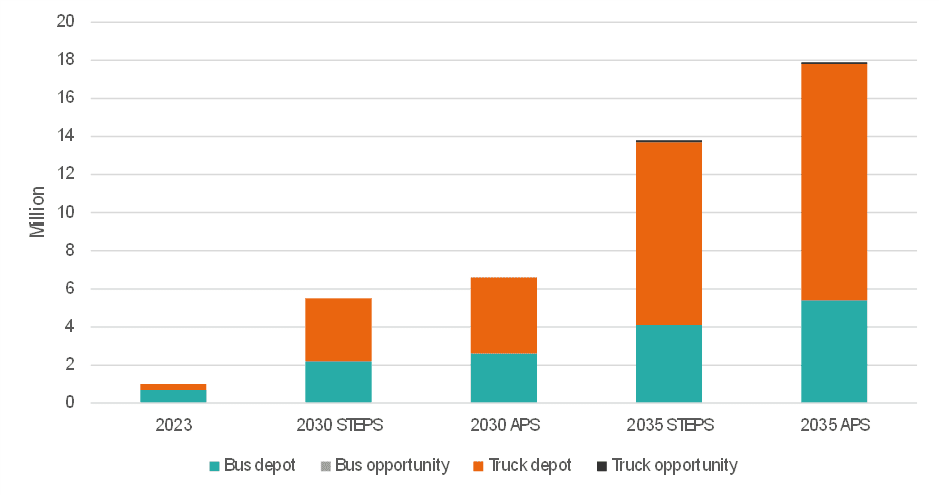
China is the market leader in the adoption of electric buses and electric trucks and therefore is also market leader in the deployment of heavy-duty charging devices (IEA, 2024). China is also leading on manufacturing heavy duty trucks that are enabled for battery swapping, which is much quicker than plug-in charging.
After China, Europe is the second largest market for electric bus and electric truck sales with the accompanying need for charger installation (IEA, 2024). The countries in Europe with the highest projected demand for battery electric truck charger infrastructure are Germany, Italy, France, Poland and Spain, collectively accounting for more than 70% of the total charging needs in the EU-27 (Basma, H and Schmidt, J. ,2025). The European Commission has introduced the Alternative Fuels Infrastructure Regulation which mandates Member States to build out publicly accessible charging infrastructure on main road networks (European Commission, 2024). HDV manufacturers are also working together to roll out fast charging infrastructure to help overcome fleet operator concerns about lack of charging availability (Milence, 2025). By 2030, Europe will require more than 300,000 public and private charge points for medium and heavy-duty trucks, compared to approximately 10,000 in 2024, at an estimated cost of €7 billion (Herit, A., Hildebrandt, E. and Becker, H., 2024).
Hydrogen refuelling infrastructure
The roll out of hydrogen refuelling stations (HRS) is modest compared to charging infrastructure deployment. As of 2024, there were approximately 1,160 HRSs worldwide, mostly confined to Germany, Japan, and South Korea, compared to 4.5 million EV charging stations (Mohapatra, 2025). The value of the global hydrogen refuelling station market was estimated about USD 1.00 billion in 2025 and is projected to grow at a 19.8% CAGR over the period 2025 – 2033, inclusive of all applications including passenger vehicles (Grand View Research, 2026). The growth in hydrogen powered mobility and related infrastructure is expected to peak in 2040 – 2050, led by HDVs as existing constraints such as limited hydrogen production, refuelling storage, and delivery technologies are addressed. Refuelling stations will likely have to deploy a range of refuelling pressures to cater for different vehicle technologies and requirements, in the early stages of deployment, whilst the market guides the dominant technology selection. At present, refuelling stations are predominantly focused on 350 bar refuelling as this is the most cost effective despite the improved efficiency of 700 bar refuelling for HDVs. A recent Hydrogen Energy Journal (Otto et.al, 2024) article found liquid hydrogen refuelling to be more cost effective than gaseous refuelling for HDVs, offering higher flow rates, lower station energy demand and simpler station design. Estimated refuelling costs were €0.16 to €0.58 per kilogram for liquid hydrogen compared with €1.02 to €3.73 per kilogram for gaseous hydrogen, with further component development and standardised protocols identified as key enablers for infrastructure deployment.
Hydrogen-powered HDVs are likely to represent a delayed or smaller share of zero-emission vehicles compared with electrification over the next decade.
As of 2025, 62% of the world’s hydrogen refuelling stations are in Asia (Zhu, 2025). China leads expansion with major hydrogen fuel cell electric vehicle (HFCEV) subsidies, highway-based HRS deployment, toll exemptions for hydrogen trucks, and provincial station incentives, targeting 50,000 fuel-cell vehicles and up to 200,000 tonnes per year of green hydrogen production by 2025 (IEA, 2025, [2]). South Korea plans 280 liquid hydrogen stations by 2030, supported by strong public – private partnerships (Zhu, 2025). India aims to deploy 1,000 hydrogen trucks and buses by 2030, though infrastructure plans are unclear. Australia and New Zealand are at earlier stages, with Australia operating 13 HRS and New Zealand 6, largely driven by local companies and pilot deployments (CSIRO and GHD, 2023). North America has experienced significant slowdown in hydrogen markets due, in part, to policy decisions of the current Administration in the USA.
In February 2025, H2 Mobility announced closure of several HRSs in German cities, shifting focus from urban light vehicle applications to larger infrastructure for commercial vehicles and buses with 350, 500, and 700 bar options (Mohapatra, 2025). The EU has committed €600 million through the Alternative Fuels Infrastructure Facility to support 38 new hydrogen refuelling stations (European Commission, 2025). Member states must install one HRS every 200 km along the TEN-T core network, with minimum levels of passing HDV transport. The aim is to complete installation by 2030 with interim targets set for 2025. Binding EU targets require a 90% reduction in HDV emissions by 2040 and zero emission for urban buses, supported by policies that ease barriers to scale-up (Hydrogen Europe, 2025). Despite this, Hydrogen Europe expects hydrogen HDVs and refuelling to lag battery electric solutions until at least 2030.
It is likely that in the UK investment in infrastructure will have to happen before hydrogen powered HDVs are adopted in significant numbers. In 2023, the UK had zero deployed heavy-duty fuel cell trucks and only 6 HRSs. As of 2022, Scotland had four hydrogen refuelling stations for public use (Transport Scotland, 2022). Two of which are based in Aberdeen to support the fleet of bus and municipal hydrogen HDVs with further stations in Orkney and outside Edinburgh. Without a minimum viable network of hydrogen refuelling stations deployment of hydrogen HDVs will be limited (Hydrogen UK, 2023). Strong near-future deployment opportunities lie in off grid refuelling applications for construction based HDVs with full HDV rollout expected to grow from 2035 onwards.
Detailed SWOT Analysis
HDV and niche vehicle manufacturing supply chain SWOT
Strengths
- Scotland has a small number of specialist HDV manufacturers and integrators (e.g. buses, emergency vehicles, refuse, gritters, temperature-controlled bodies) with application-specific knowledge rather than being involved in mass-market production
- Some companies (e.g. Emergency One, Gray & Adams, James A Cuthbertson, Farid-Hillend) have capabilities in vehicle integration, bespoke design, and aftersales support
- There is evidence of some limited export activity, mainly by Emergency One that has significant and growing international export activity in relation to its diesel vehicles. It has also exported a small number of zero-emission vehicles
- Rokbak is referenced as part of the top end of the HDV value chain in Scotland and is implicitly export-oriented through its mining and construction markets, which are typically international in nature
- There is demonstrable capability in control systems, energy management systems, telematics, and software-driven optimisation (e.g. battery management, route-aware energy optimisation). These capabilities are largely transferable to zero-emission HDVs (BEV and hydrogen), even if current market pull is weak
- Scottish manufacturers are well embedded in public-sector procurement (local authorities, emergency services), providing familiarity with regulated markets and specialist use cases where OEM solutions are less mature
- Interviewees consistently note that Scotland has experience and expertise in hydrogen technologies that could be applied to zero-emission HDVs, at a knowledge and R&D level, even if commercial delivery has been weak
- Scottish public bodies (e.g. local authorities, Transport Scotland) have been willing to act as early adopters and demonstrator partners, providing capital support and participating in trials for zero-emission HDVs and associated infrastructure. This has resulted in real-world pilots, learning exercises, and prototype deployments, even where projects have struggled to deliver sustained operational outcomes
- Scotland operates within a clear UK and international policy framework that is committed to 100% zero-emission HDV sales by 2040, supported by regulatory standards and funding programmes such as ZEHID
Weaknesses
- Scotland has only a very small number of companies with full OEM or chassis-design capability; most are, primarily, assemblers, converters or bodybuilders, rather than system owners
- Most depend on imported core systems (chassis, batteries, power electronics, fuel cells), sourced from European or even global manufacturers
- As Scottish companies rely on imported chassis and systems, strategic decisions by European, Asian, or global OEMs directly shape what Scottish manufacturers can offer. This limits Scotland’s ability to influence technology pathways (e.g. BEV vs hydrogen) and increases vulnerability to shifts in OEM priorities
- The historic component manufacturing base has largely disappeared, leaving a “hollowed-out” supply chain with limited depth
- The overall scale of HDV manufacturing in Scotland is small, with a relatively high cost base, particularly compared with European and global competitors. This means that Scotland is not considered to be internationally competitive in zero-emission HDV manufacturing
- Most HDVs produced or integrated in Scotland are diesel powered, with zero-emission vehicles representing only a very small proportion of output.
- Most manufacturers report minimal customer demand for BEV or hydrogen HDVs and adoption is seen as policy-driven rather than market-driven, leading to hesitancy and “wait-and-see” behaviour across the supply chain
- Vehicle costs (particularly BEV and hydrogen chassis) are consistently cited as prohibitive, thereby limiting demand
- Charging and hydrogen refuelling infrastructure is viewed as inadequate, unreliable, or too uncertain to support operational deployment. Hydrogen projects in particular are described as fragmented, poorly coordinated, and failing to deliver end-to-end solutions. These issues are also contributing to limited demand
- Smaller manufacturers lack the resources to invest in high-voltage training, facility upgrades, or in-house zero-emission R&D without clear demand signals
- Competition for skilled engineers (e.g. from aerospace and other sectors) can constrain company growth
- Although public support for zero-emission HDVs is acknowledged, it is perceived by a number of interviewees as fragmented and risk-averse. The projects funded to date have not translated into clear, coordinated supply-chain development
- UK-wide programmes (e.g. ZEHID) are acknowledged, but Scottish participation, in terms of manufacturing, appears limited. As a result, learning, data, and supply-chain development benefits are not strongly feeding into Scottish manufacturing capabilities
Opportunities
- Binding UK and EU CO₂ performance standards require steep emissions reductions from HDV manufacturers to 2040, creating a guaranteed long-term market for zero-emission vehicles and associated components
- To meet these targets, well over one-third of new medium and heavy-duty trucks sold in Europe will need to be zero-emission by 2030, significantly increasing demand for compliant vehicles, systems, and sub-assemblies
- UK government funding of approximately £200 million through the ZEHID programme supports vehicle deployment, infrastructure build-out, and real-world trials, creating opportunities for manufacturers and Tier 1 – 3 suppliers to participate in funded projects and supply chains
- Demonstration activity supports learning-by-doing, product validation, and early revenues for companies involved in zero-emission HDV technologies.
- Registrations of zero-emission HDVs in the EU grew by 45% between 2023 and 2024, with increasing model availability across trucks and buses, indicating accelerating market momentum that benefits manufacturers positioned in these segments
- Battery-electric HDVs are expected to dominate early adoption due to increasing range (500–700 km) and broad OEM engagement, creating opportunities across electric drivetrains, power electronics, batteries, and vehicle integration
- Niche vehicles (e.g. refuse vehicles, emergency vehicles, gritters, construction and municipal vehicles) are less well served by OEM zero-emission offerings than standard long-haul trucks. Scottish companies already active in specialist vehicle build, integration and/or conversion could participate in these segments if demand materialises
- The transition to zero-emission HDVs is expected to drive service-led revenue models (e.g. vehicle-as-a-service, battery-as-a-service), with a majority of future profits projected to come from services rather than vehicle sales, opening opportunities for supply-chain companies to move up the value chain
- There are also opportunities in energy management systems, control software, telematics, battery management, route optimisation and auxiliary load optimisation for battery electric, and to a lesser extent hydrogen, HDVs. These opportunities sit mainly at component, sub-system or service level, rather than full vehicle manufacture
- Some interviewees suggest that attracting an anchor OEM or Tier-1 supplier of scale could enable parts of the domestic supply chain to be rebuilt. This is identified as conditional and uncertain, rather than a current strength or guaranteed outcome
- Transition to BEV and hydrogen HDVs would require new skills in high-voltage systems, hydrogen safety, maintenance and infrastructure servicing. There could, therefore, be potential opportunities in training, certification and technical support services, subject to market uptake
Threats
- Global zero-emission HDV manufacturing is currently dominated by Chinese OEMs, that produced approximately 230,000 zero-emission HDVs in 2024 alone, creating strong price and scale competition for European-based supply chains
- Chinese manufacturers are gaining share in specific segments such as electric buses, with European operators considering them where cost savings of 10–20% can be achieved. This increases competitive pressure on UK and European manufacturers and suppliers
- Despite general growth the demand for HDVs, market penetration of zero emission heavy trucks remains very low (around 1–2% of new sales in the EU), creating uncertainty over near-term production volumes and making it difficult for suppliers to justify large-scale capital investment
- Adoption is uneven across countries and vehicle categories, which is resulting in demand volatility for manufacturers and their supply chains
- Some existing Scottish HDV manufacturers face commercial uncertainty, including restructuring, relocation or reduced activity. The potential loss or downsizing of OEM-level capability could further weaken the domestic supply chain and reduce critical mass
- Compliance with tightening CO₂ standards carries financial penalties for manufacturers that fail to meet targets, increasing cost pressure throughout the supply chain
- Smaller manufacturers and suppliers face higher relative risk due to the cost of retooling, certification, and technology development required to support zero-emission platforms
- Market uptake of zero-emission HDVs is strongly dependent on the parallel rollout of charging and hydrogen refuelling infrastructure, which remains incomplete and uneven, limiting demand certainty for manufacturers
- Competing technology pathways (battery-electric versus hydrogen fuel cell) create strategic risk for suppliers that must choose where to invest without clarity on long-term market dominance
- Zero-emission HDVs currently involve significantly higher upfront costs than diesel equivalents
- Many fleet operators, particularly SMEs, report low confidence in costs, technology maturity, infrastructure availability and financial models for zero-emission HDVs
- Weak or delayed demand threatens the viability of any domestic manufacturing or supply-chain investment
- Multiple stakeholders express low confidence that current 2035 and 2040 zero-emission targets will be enforced as stated
- Changes or delays to policy signals reduce incentives for manufacturers, suppliers and operators to invest in zero-emission HDVs or related infrastructure
- Several interviewees raise concerns about the survivability of small OEMs, start-ups and infrastructure providers over the next 5–10 years. This creates risk for operators and public bodies committing to vehicles or infrastructure with long asset lives
- Transition to zero-emission HDVs requires specialist skills in high-voltage and hydrogen systems. Competition from other sectors (e.g. aerospace, energy, defence) risks diverting skilled labour away from HDV manufacturing and support
- Whilst changes have been made to maximum weight limits for HDV tractor units, to allow for the extra weight of batteries, this change has not been made for trailer units. This is a threat to companies involved in refrigerated trailer manufacture that would like to use batteries to provide the refrigeration but are constrained by the weight limits
EV charging infrastructure supply chain SWOT
Strengths
- Scotland has several established EV charging systems integrators with direct experience in bus and emerging HGV depot charging, including end-to-end capability across design, planning, installation management, operations, and maintenance
- Companies such as FOR EV, Envevo, eVolt Charging (SWARCO) and Cleaner EV are already delivering high-power depot charging, with HDV activity forming a growing share of their business and employment in Scotland
- Some companies report that HDV charging already accounts for a significant proportion of Scottish jobs, with expectations of further growth to 2030
- Scottish operators and suppliers have practical experience delivering depot charging infrastructure for buses and, to a lesser extent, HDVs. Examples include electrification of bus depots (e.g. First Bus depots in Glasgow and Aberdeen) and early HDV depot installations (e.g. John G Russell, forestry and logistics sites)
- Depot charging is identified in multiple sources as the dominant charging model for HDVs to 2030, aligning Scottish experience with expected market structure
- Scotland has a number of Independent Distribution Network Operators (IDNOs) and grid-connection specialists with Scottish offices (e.g. Energy Assets, GTC, Last Mile, SSE/Optimal Power Networks) that support HDV charging delivery
- A reasonable local supply chain exists for surveys, engineering design, and project development, which are required early in HDV charging projects
- Interviewees noted positive roles played by Transport Scotland, Innovate UK and ZEHID in mapping routes, supporting demonstrations, and generating operational data for HDV charging and fleets
- Scotland is perceived as a good testbed for the development and deployments of depot-focused HDV charging due to geography, duty cycles, and fleet characteristics
- Evidence from international and UK studies shows that depot and semi-private charging will dominate HDV charging to 2030, with public en-route charging a much smaller share. Scotland’s strongest current capabilities, depot charging, fleet software, grid connections and integration services, align with this projected market structure.
- Some companies report rapid growth in Scottish employment linked to EV and HDV charging, particularly in design, engineering and operations roles.
- Experience from the bus sector has transferred into HGV charging projects, reducing early-stage delivery risk
- Scottish-based providers offer a range of commercial models, including, capital purchase, charging-as-a-service, long-term operating and maintenance contracts, asset-sharing and third-party access to depot infrastructure. The availability of multiple models reduces adoption barriers and, therefore, helps to drive market uptake
Weaknesses
- There are no HDV charging hardware OEM manufacturers based in Scotland, and limited UK manufacturing more broadly, reducing opportunities for local value capture beyond integration, installation, and services
- Much of the HDV vehicle and charger OEM ecosystem is based outside Scotland, limiting pull-through into local supply chains
- Stakeholder feedback identifies a limited number of civils contractors in Scotland with the certification, experience, and competence to deliver large-scale, high-power HDV charging installations, particularly in hazardous or fuel-station environments
- Stakeholder feedback also reports that very few Scottish contractors currently identify as being active in HDV charging installations, and HDV charging skills are not widely held
- The HDV charging market is early-stage and fragmented, with limited numbers of electric HGVs in operation; operators lacking confidence due to limited shared experience. This is limiting market demand
- Grant-driven demand has previously distorted market timing, with stop-start funding leading to delayed investment decisions
- HDV charging infrastructure in Scotland remains very limited in number, with most activity focused on small pilots, early depot installations or bus depots, rather than widespread freight or haulage coverage
- Public en-route HDV charging infrastructure is sparse, with most freight operations expected to rely on depot charging that is not yet widely available
- Depot electrification for HDVs faces space constraints, particularly where high-power chargers displace operational or parking space
- There is a lack of shared knowledge and structured education for haulage operators, many of whom are new to electrification and cautious due to previous poor experiences or lack of trusted advice
- Charging infrastructure capacity remains unevenly distributed, with weaker coverage in rural, island and remote areas
- Maintenance and uptime requirements are more difficult to meet in these locations due to distance, workforce availability and cost
- Training provision in Scotland for large-scale EV charging installations is limited, with no colleges identified as offering relevant qualifications (beyond courses focused on domestic or small commercial charging)
- Interviewees highlighted shortages of suitably trained High Voltage design engineers, electrical engineers and power engineers, creating risks to scale-up and maintenance capacity, particularly outside the Central Belt
- Grant schemes for depot and fleet charging are described as short-notice, time-limited and inconsistent, creating uncertainty and delaying investment
- First-come-first-served funding structures tend to favour large operators, limiting access for SMEs
- HDV charging infrastructure is capital intensive, with uncertain utilisation rates in the early market.
- Public charging hubs are described as a high-risk investment, particularly where uptake is uncertain or policy signals are unclear.
- Concerns were expressed about the long-term survivability of smaller charging start-ups, increasing perceived risk for fleet operators.
- Evidence points to a lack of shared planning and information between charge-point developers, site owners and HDV operators. This means that infrastructure siting decisions are not always aligned with actual freight routes or operational patterns, increasing risk of under-utilisation
Opportunities
- Global HDV charging capacity is projected to grow approximately twenty-fold by 2035, driven by increasing electrification of buses and trucks
- Under both IEA scenarios, total deployed HDV charger stock increases significantly between 2023 and 2035, with depot charging representing the dominant share of installations
- Truck depot chargers are projected to grow more rapidly than bus depot chargers to both 2030 and 2035, despite bus depot charging being more established today
- By 2030, Europe is expected to require over 300,000 public and private HDV charge points, with infrastructure investment estimated at €7 billion by 2030 and €40 billion cumulatively by 2040
- Most HDV charging infrastructure investment to 2030 is expected in private depots and semi-public hubs such as logistics and industrial sites, representing the majority of forecast capital expenditure
- Overnight depot charging is expected to grow fastest for HDVs with predictable routes and daily mileages below 200 km, including city buses and urban delivery fleets
- These market drivers and trends suggest opportunities for design, grid connection, installation, operation and maintenance services focused on fleet depots rather than public roadside charging. This will create demand for higher-power chargers (including megawatt-scale), depot upgrades and associated grid works, even if deployment remains uneven in the near term
- The European Commission Alternative Fuels Infrastructure Regulation (AFIR) creates legally binding requirements for the rollout of high-power public HDV charging along the TEN-T network between 2025 and 2030, supporting demand for compliant charging infrastructure
- The Clean Transport Corridor Initiative reinforces AFIR implementation by coordinating cross-border HDV charging deployment across major European freight corridors
- Multiple commercial models are emerging, including charging-as-a-service, OEM-led advisory models, and specialist charging point operator-led public hubs, creating opportunities across equipment supply, financing, installation, and operations
- Increasing scale and complexity of depot charging creates demand for fleet charging management software, including scheduling, power management, access control, billing and data reporting
- Increased charger utilisation rates significantly reduce levelised infrastructure costs per kWh, improving the economic case for infrastructure deployment
- Some fleet operators (e.g. bus depots) are opening depot charging infrastructure to third parties during off-peak periods. This suggests opportunities in shared-use models, site management, customer access systems and on-site operations, subject to safety and contractual constraints
- Interviews and market evidence point to likely future HDV charging at ports, logistics hubs, rail freight terminals and motorway service areas, often as stand-alone sites rather than extensions of existing fuel stations. This creates potential demand for planning, civil engineering, grid reinforcement, site development and long-term operation, though projects could be complex and capital intensive
- Expansion of EV and HDV charging will require more trained engineers and technicians for design, installation and maintenance. As there is limited current training provision there are opportunities in training delivery, certification support and maintenance services, particularly for large-scale and high-power installations
- Interviewees suggest opportunities to increase employment, with companies reporting plans to scale to 100+ HDV-related roles by 2030 (from a current baseline of 10s of jobs), particularly in design, engineering, systems integration and operations
- Some Scottish-based charging infrastructure companies report early export activity, primarily in design, project management and systems integration, often following UK customers into overseas markets
- These opportunities are service-led rather than hardware-led and remain secondary to the UK market
Threats
- Limited availability of grid connection capacity and the cost of grid upgrades are identified as key barriers, particularly for high-power and megawatt-scale charging installations
- Strengthening of substations is required at a significant proportion of identified en-route charging locations, adding cost and complexity to deployment
- Competition for grid capacity (including from data centres and other large users) is reported as a growing risk.
- Availability of finance for fleet operators to invest simultaneously in HDVs and charging
- High upfront capital requirements, particularly for public high-power charging hubs, create exposure to utilisation risk if fleet uptake is slower than projected and, therefore, potentially undermining business cases for both public and private charging sites
- Approvals for charging stations and physical space constraints at depots, logistics hubs, highway sites, and safe parking areas are cited as barriers to deployment
- Public charging sites, while fewer in number, require very high power levels, increasing complexity of siting and permitting
- Alternative solutions such as battery swapping and electric road systems are referenced as potential substitutes for wired charging in some markets, particularly outside Europe, creating uncertainty over long-term infrastructure configurations
- Megawatt chargers represent a small proportion of total charger numbers but a disproportionate share of installed power, increasing exposure to technology standardisation and cost risks
- Frequent changes, delays or short-notice grant schemes create uncertainty for investors, charging providers and fleet operators
- Lack of long-term policy clarity on vehicle phase-out dates, grant continuity and infrastructure support discourages speculative investment in charging hubs, particularly for HDVs
- There are some concerns about the long-term survivability of smaller charging providers and start-ups, particularly in a capital-intensive, low-utilisation early market
- Market exits or consolidation could leave operators dependent on a small number of large providers, increasing cost and risk
- Shortages of appropriately trained electricians, engineers and maintenance personnel threaten delivery timelines and ongoing reliability
- Limited training provision for large-scale and megawatt charging systems increases the risk of bottlenecks as deployment scales
- Charging infrastructure remains less viable in rural, island and remote areas, where grid reinforcement, maintenance response times and utilisation are more challenging
- Public-sector service-level requirements can further increase costs and delivery risk in these locations
- With no domestic charger hardware manufacturing and reliance on imported equipment, Scotland risks capturing mainly service-level value, even if deployment accelerates
- Large international charging networks and energy companies may dominate future HDV charging hubs, limiting local supply-chain participation
Hydrogen refuelling infrastructure supply chain SWOT
Strengths
- There have been a number of hydrogen mobility and refuelling projects (e.g. buses, refuse vehicles, council fleets) delivered in Scotland, particularly in Aberdeen, providing real-world operational learning and proof of concept
- Companies such as Logan Energy and Hydrasun operate as EPC-style integrators, delivering end-to-end hydrogen refuelling solutions including design, procurement, installation, commissioning and servicing, with experience across multiple projects
- Large, multi-partner initiatives such as the Th2istle Project in the north east of Scotland plan to integrate hydrogen production, mobility applications (including HDVs), and agriculture, construction and industrial uses supporting the development of local clusters of hydrogen production and use
- Hydrogen refuelling projects have benefited from European, UK and Scottish public funding, through Horizon Europe and national demonstrator programmes, enabling early market activity despite weak commercial demand
- Stakeholders highlighted Scotland’s renewable electricity base as strategically attractive for green hydrogen production, supporting the long-term viability of hydrogen production for refuelling infrastructure
- Scotland has engineering and manufacturing companies capable of producing hydrogen-compatible components, including valves, gauges and pressure-rated equipment. These companies already supply some hydrogen applications internationally, even where domestic hydrogen mobility demand is limited.
- Scottish hydrogen refuelling integrators and component suppliers are active in some international markets, particularly in Europe and Asia but generally more so in a hydrogen coordinator capacity. Activity in HDV hydrogen refuelling is limited.
Weaknesses
- Scotland has a very limited number of active hydrogen refuelling infrastructure providers, many of whom are already operating at or beyond capacity. This constrains delivery capability, limits competition, and increases costs and lead times
- The Scottish market depends heavily on a small number of companies (e.g. system integrators and EPC-style providers). When individual companies exit, pause activity, or fail to deliver, there are few alternative domestic suppliers available
- While Scotland has capable engineering companies upstream, most critical refuelling components are sourced from outside Scotland. Even project sponsors and councils reported limited visibility of Scottish supply chain participation, weakening local economic impact
- With no domestic manufacture of complete refuelling stations or core systems, Scotland risks capturing value mainly in integration, construction and maintenance, even if hydrogen refuelling deployment increases
- Project owners highlighted a shortage of hydrogen-skilled engineers and technicians in Scotland, affecting delivery, maintenance, and long-term operability of refuelling assets
- Scottish engineering companies reported an inability to commit to hydrogen product development or certification due to unclear or shifting standards (e.g. BSI), limiting their participation in refuelling infrastructure projects
- Hydrogen refuelling projects have been developed on a fragmented, project-by-project basis, with limited coordination between production, infrastructure, vehicles, and end users, increasing risk and reducing learning and knowledge transfer
- Failed or stalled hydrogen HDV refuelling projects in Scotland have reduced confidence among councils and public bodies in the domestic supply chain’s ability to deliver reliably
Opportunities
- Hydrogen refuelling is viewed as most viable for specific HDV applications where utilisation rates are high (e.g. buses, refuse vehicles, city logistics, clustered depot fleets) and where centralised refuelling can be coordinated and duty cycles are predictable
- UK government funding of approximately £200 million through the ZEHID programme supports vehicle deployment, infrastructure build-out, and real-world trials, creating opportunities for manufacturers and Tier 1-3 suppliers to participate in funded projects and supply chains
- Scottish and UK-based integrators can generate economic benefits by acting as system designers and integrators, assembling largely imported components into bespoke refuelling solutions and providing ongoing operations and maintenance services
- Refuelling infrastructure is seen as a critical enabler for downstream hydrogen applications. Successful deployment, where hydrogen refuelling is co-located with production, could unlock demand for hydrogen vehicle deployment
- Several companies active in Scotland already deliver hydrogen refuelling or storage projects internationally (Europe, Asia), suggesting that capabilities developed domestically could be applied in more advanced or faster-moving overseas markets
- International policy frameworks (e.g. EU AFIR, national hydrogen strategies) mandate hydrogen refuelling along key freight corridors and set HDV decarbonisation targets to 2040. These frameworks create long-term, externally driven opportunities for hydrogen refuelling infrastructure
Threats
- Fleet operators have, to date, only limited interest in hydrogen vehicles due to high costs, limited vehicle availability, and operational uncertainty. This is suppressing demand for refuelling infrastructure regardless of Scottish capability
- Hydrogen refuelling stations are capital intensive, with compressors and storage systems representing major cost components. These costs are particularly difficult to justify at low utilisation levels typical of early HDV deployment
- Hydrogen production costs, closely linked to electricity prices, remain high, with parity to diesel estimated at ~£9/kg. This weakens the commercial case for refuelling infrastructure and is largely outside the control of the Scottish supply chain
- Stakeholders reported delayed UK Government strategy publication, withdrawn or paused funding, and shifting UK and Scottish government priorities, leading to cancelled projects and stalled final investment decisions
- Battery-electric HDVs and charging infrastructure are cheaper, faster to deploy, and scaling rapidly. Multiple stakeholders noted that electrification now covers most HDV use cases, increasingly restricting hydrogen to niche applications
- Hydrogen HDV OEMs are limited in number, with some exiting the market or being acquired. This reduces vehicle choice, increases risk for financiers, and undermines confidence in long-term infrastructure utilisation
- Other countries (e.g. Germany, Netherlands, parts of Asia) have clearer strategies, stronger infrastructure rollouts, and better market coordination, drawing investment and supplier focus away from Scotland
- Core refuelling equipment (e.g. high-throughput compressors, dispensers, cryogenic systems) is supplied by a small number of international manufacturers. This limited supplier base is leading to long lead times and is increasing the risk of delays, cost escalation and maintenance downtime
- As hydrogen refuelling infrastructure requires specialist skills, project delivery and maintenance depend on a limited pool of experienced companies and individuals. If these companies downsize or exit the market, there are few readily available alternatives
Industry views on how to maximise the economic opportunities
HDV and niche vehicle manufacturing supply chain
The main obstacle to zero emission HDV and niche vehicle manufacturing is the lack of clarity about when legislation will come into force that mandates that sales of new HDVs must be zero emission. The uncertainty about timing and location of charging and hydrogen refuelling infrastructure is also a barrier. This is preventing the customers of the HDV manufacturing supply chain from ordering zero emission vehicles. If these obstacles can be addressed, then other considerations regarding total cost of ownership (TCO) and new financing models can also be addressed.
Discussions with OEMs indicate that additional support will be required to up- or re-skill their staff to work with both BEVs and HFCEVs. For example, one of the conversion manufacturers that was interviewed has to use the OEM that provides the chassis to power down the HGV prior to working on it (e.g. for maintenance and repair) and power up the vehicle afterwards. Delivering these skills is likely to require specialist training facilities, perhaps building on that already provided by the further education (FE) sector for zero emission private and light goods vehicles. In addition, there will need to be consideration of how training is delivered to new entrants to the workforce, who will require knowledge of conventional diesel and zero emission powertrains, during the period where both are in use.
HDV charging infrastructure supply chain
All of the charging infrastructure stakeholders interviewed highlighted the need for policy and regulatory certainty. This includes certainty around long term, stable funding to support operators with the costs of zero emission vehicles and charging infrastructure. It also includes clarity about when the HDV manufacturers will be required to place only zero emission vehicles on the new sales market.
Co-ordinated planning of future HDV depot charging needs was also highlighted as a required action. This information could be communicated to grid operators to identify where grid reinforcement work would be required and help plan for future connections demand.
Growing the Scottish HDV charging device manufacturing capability was also highlighted as an action, including parts, components and finished original equipment. This could involve pursuing both inward investment opportunities and providing innovation support to existing and new Scottish companies interested in entering this sector.
Interviewees reported that it would be beneficial to improve the awareness of the HDV charging infrastructure supply chain in Scotland amongst HDV operators. One stakeholder suggested a ‘show and tell’ type event at an existing public HDV charging site.
Actions related to developing skills and competencies were also highlighted by several stakeholders in this supply chain. More funding for Graduate Apprenticeships was highlighted as a helpful supporting action. Examples of skills in short supply included high voltage design engineers. Developing accessible high voltage charging installation training for companies currently active in low voltage EV charger installation was also highlighted as a way to increase capacity in the supply chain. This could involve improving links between charger manufacturers, colleges and private training providers. Increasing capacity in the civil engineering contractor part of the supply chain was also highlighted as important. This would include raising awareness of the business opportunity and the route to developing skills and competencies to carry out civils work in high voltage environments.
HDV hydrogen refuelling infrastructure supply chain
Consultations repeatedly identified the need for clear, long-term policy that positively enforces net zero targets including phase-out of internal combustions engine vehicles. This underpins confidence in all the included supply chains. At present, the role of hydrogen refuelling infrastructure in reducing HDV emissions is unclear due to a lack of acknowledgement in policy strategy, driving uncertainty and risk for investors and the supply chain. A clear and sequential positioning of hydrogen HDVs and refuelling infrastructure in policy will provide enough clarity for the public and/or private sector to begin project planning to develop a trunk network with hotspot and highway nodes. In the meantime, support for mobile refuelling solutions would benefit market development. This would help the supply chain to capabilities in ongoing operations and maintenance to develop skills and competences.
The development of industry standards for hydrogen components for refuelling applications would benefit the component manufacturers that underpin the supply chain and could, potentially, open other energy transition opportunities for companies that can operate to these standards.
Promoting Scottish supply chain companies to fleet operators and providing details of the key Government / Transport Scotland contact points for the hydrogen refuelling infrastructure supply chain were also identified as useful actions.
How to cite this publication:
Taylor, J., Creamer, D., Leigh, E., Morrison, M. (2026) ‘Scotland’s HDV supply chain and net zero’ ClimateXChange
© The University of Edinburgh, 2026
Prepared by Optimat Limited on behalf of ClimateXChange, The University of Edinburgh. All rights reserved.
While every effort is made to ensure the information in this report is accurate as at the date of the report, no legal responsibility is accepted for any errors, omissions or misleading statements. The views expressed represent those of the author(s), and do not necessarily represent those of the host institutions or funders.
This work was supported by the Rural and Environment Science and Analytical Services Division of the Scottish Government (CoE – CXC).
ClimateXChange
Edinburgh Climate Change Institute
High School Yards
Edinburgh EH1 1LZ
+44 (0) 131 651 4783
If you require the report in an alternative format such as a Word document, please contact info@climatexchange.org.uk or 0131 651 4783.
Governments across the world are introducing policy targets to decarbonise heavy-duty vehicles (HDVs) – those with a gross vehicle weight of over 3.5 tonnes. This transition presents significant opportunities for Scottish businesses.
With this in mind, this research aims to identify the current and future economic impacts of HDV decarbonisation across three key supply chains:
- HDV and niche vehicle manufacturing
- HDV charging infrastructure
- Hydrogen refuelling infrastructure
The report examines the scale, strengths, weaknesses and growth potential of the above supply chains, including how demand could evolve to 2030 and 2035. The report findings are visualised in an accompanying infographic.
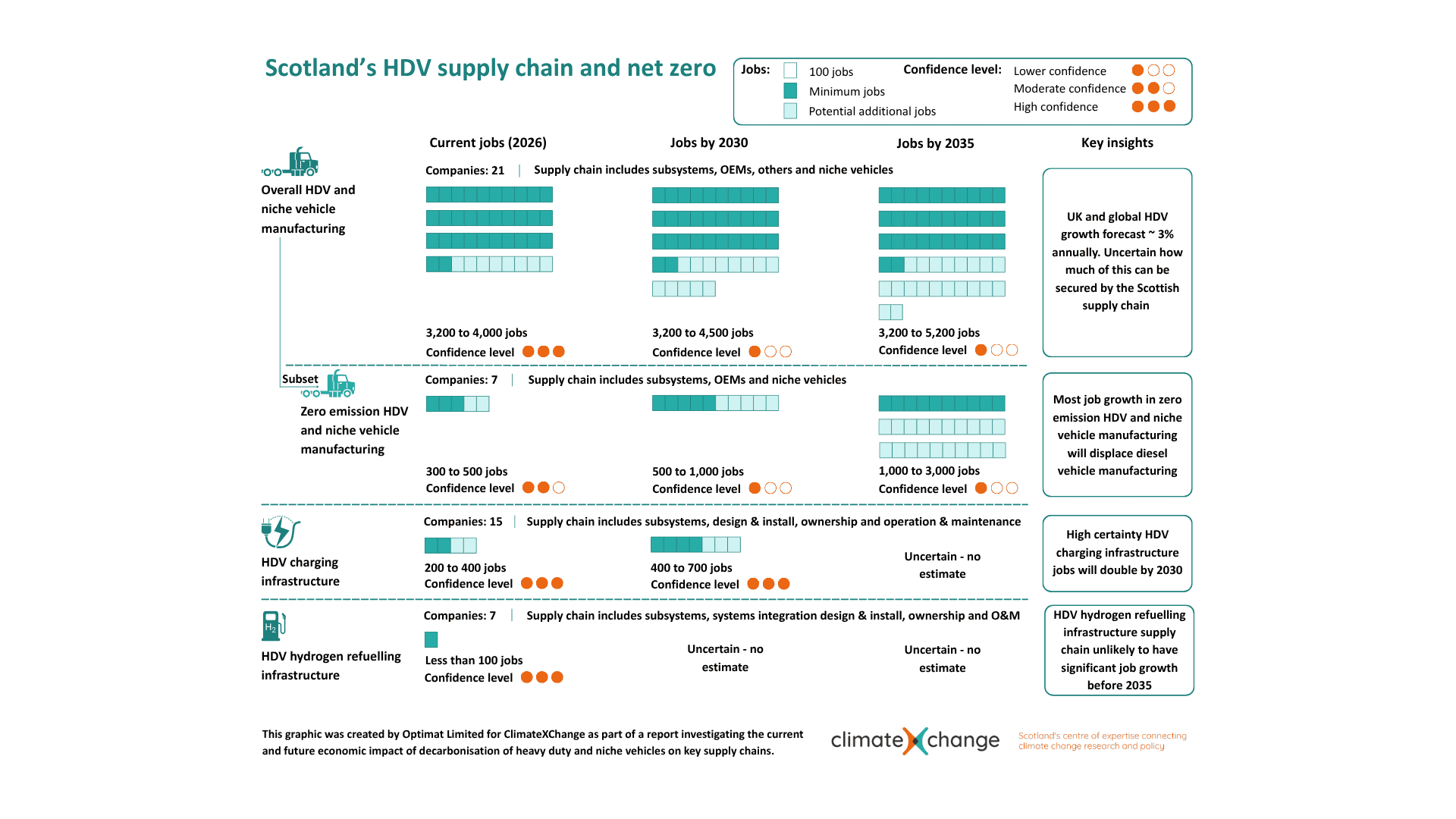
Key findings
For further information, please read the full report.
- Strong global policy and market drivers are accelerating the decarbonisation of HDVs.
- The pace of transition varies across different vehicle types, with low-carbon fuels expected to play a role alongside zero-emission technologies.
- Scotland’s HDV and niche vehicle manufacturing capability is concentrated in a relatively small number of specialist companies.
- The HDV charging infrastructure supply chain is predominantly service-based and is expected to continue growing as vehicle electrification increases.
- The hydrogen refuelling infrastructure supply chain is currently small, with the greatest growth opportunities expected after 2035 and in specific use cases.
- Stimulating market demand will be essential to support supply chain growth, alongside targeted supply-side actions to strengthen Scottish capabilities and maximise economic opportunities.
If you require the report or annex in an alternative format, such as a Word document, please contact info@climatexchange.org.uk or 0131 651 4783.
Scotland’s businesses, infrastructure, communities and natural environment face increasingly severe climate change impacts. Yet, the actions required to adapt to those changes – how they will evolve over time, what they will cost, and who should pay – remain poorly understood.
This report provides the first estimate of Scotland’s climate adaptation investment needs through to 2040 across five sectors:
- agriculture;
- communities (focused on flooding);
- the natural environment (focusing on woodland creation, peatland, nature restoration);
- transport (focusing on trunk roads, motorways, railways); and
- water (focusing on public water and wastewater services).
This work is intended to support the Scottish Government in building an evidence base ahead of the fourth Scottish National Adaptation Plan (SNAP4).
Estimating future adaptation cost is inherently challenging. It requires assumptions about future warming, the level of climate risk that society are willing to tolerate, and the associated scale of adaptation and residual damages. Deep uncertainty in climate projections, socioeconomic change, asset vulnerability, and political priorities make precise modelling both challenging and resource intensive.
As a result, the findings in this report should be treated as pragmatic, evidence-based approximations that indicate the order of magnitude of investment needs—not definitive targets.
Estimated climate adaptation investment need
Adaptation investment needs across the sectors and subsectors assessed in this study are estimated at £7.8–£14.2 billion between 2026 and 2040, or £566–£1,027 million per year.
Previous estimates from the Climate Emergency Response Group, Paul Watkiss Associates, and the Office for Budget Responsibility suggested Scotland’s total adaptation costs would range from £196 million to £1,340 million per year from 2030 onwards. These are based on UK wide analyses and international benchmarks. Sector specific estimates in this study fall within that range. However, because this analysis covers fewer sectors than the Scottish National Adaptation Plan, the findings suggest that Scotland’s full adaptation investment needs may be higher than previously anticipated.
The results in this report carry low confidence and should be viewed as indicative, not precise. The sector-specific figures represent order of magnitude estimates designed to inform policy discussion and future research, rather than definitive costings.
The macroeconomic effects of investing in climate adaptation
This research also looks at macroeconomic modelling to estimate the wider economic effects of similar levels of adaptation spending.
A full assessment of the macroeconomic costs and benefits of adaptation were beyond the scope of the study. However, the study did model the direct economic effects of adaptation spending across sectors. It also explored how different approaches to cost recovery affect economic activity, employment, and household incomes.
The modelling consistently shows that adaptation spending generates a positive economic stimulus during the investment period, supporting jobs and output particularly in construction, engineering, and land-based supply chains. However, the way costs are recovered – whether through income-tax, charges or through public spending cuts – matters considerably.
How will costs be borne by households, businesses, and the public sector?
The researchers made additional analysis of how adaptation costs might be shared between the public and private sectors.
The study investigated how adaptation is currently funded in each of the sectors. Climate adaptation in Scotland is currently funded predominantly by the public sector. However, households and businesses pay more than previously understood, through Council Tax and Non-domestic rates. Households and businesses also bear some costs directly, for example through property-level insurance and on-farm investments, but this remains modest in most sectors.
This balance is unlikely to shift fundamentally. Most of the adaptation investment – including flood protection, transport resilience, and natural flood management – generates little or no direct financial return and is therefore structurally dependent on public funding. Analysis suggests that approximately three-quarters of adaptation investment needs will require public financing regardless of innovations in private finance mechanisms.
Scope to boost private sector participation
The study reviewed the innovative funding and financing models being used internationally and within Scotland. Analysis found that there is modest potential to increase private sector participation in adaptation funding and financing across all five sectors, and a range of innovative mechanisms are emerging. These include parametric insurance in agriculture, biodiversity credits and voluntary carbon markets in the natural environment, green and resilience bonds for flood and transport infrastructure, and catchment co-investment models in water.
Recommendations
The research report includes several recommendations for further research. These include developing adaptation targets and risk tolerance thresholds, strengthening the evidence base for the “triple dividend”, and creating frameworks for prioritising actions that account for rural vulnerability, social equity, and Just Transition principles.
For additional recommendations and details of how the investment estimate where reached, please read the report.
If you require the report in an alternative format, such as a Word document, please contact info@climatexchange.org.uk or 0131 651 4783.
Research completed: March 2026
DOI: https://doi.org/10.7488/era/7087
Executive summary
Background and purpose
Scotland’s businesses, infrastructure, communities and natural environment face increasingly severe climate change impacts. Yet, the required adaptation actions – how they will evolve over time, what they will cost, and who should pay – remain poorly understood.
This report provides the first estimate of Scotland’s climate adaptation investment needs through to 2040 across five sectors (and eight subsectors):
- agriculture;
- communities (flooding);
- the natural environment (woodland creation, peatland, nature restoration);
- transport (trunk roads, motorways, railways); and
- water (public water and wastewater services).
It then presents two further discrete analyses: macroeconomic modelling to estimate the wider economic effects of similar levels of adaptation spending, The five sectors were chosen to reflect the diverse approaches required to assess indicative adaptation costs. We examine four aspects of climate adaptation investment: required investment, its macroeconomic impacts, public-private funding splits, and the potential to mobilise private capital. This work is intended to support the Scottish Government in building an evidence based ahead of the fourth Scottish National Adaptation Plan (SNAP4).
Estimating future adaptation cost is inherently challenging. It requires assumptions about future warming, the level of climate risk that society are willing to tolerate, and the associated scale of adaptation and residual damages. Deep uncertainty in climate projections, socioeconomic change, asset vulnerability, and political priorities make precise modelling both challenging and resource intensive. As a result, the findings in this report should be treated as pragmatic, evidence-based approximations that indicate the order of magnitude of investment needs—not definitive targets.
Why adaptation investment matters
Failing to invest in mitigation and adaptation carries significant economic costs. Estimates for this study suggest climate change could reduce GDP by 0.3-0.4% a year in the 2030s, rising to 1.2-1.6% by the 2050s and 1.6-3.3% by the 2070s. Other studies project higher impacts but these depend on the models and assumptions used. The Scottish Environment Protection Agency estimate that flooding alone already costs Scotland an estimated £500 million per year. Adaptation can reduce these damages, but it also requires upfront investment, is rarely fully effective, and involves trade‑offs between expenditure and residual risk. The key question is therefore not whether to invest in adaptation, but how much and who should pay.
Adaptation investment also delivers wider benefits, often described as the “triple dividend”: avoided losses, economic gains, and social and environmental co-benefits such as biodiversity improvements, carbon sequestration, and better mental health. These co-benefits further strengthen the economic case for adaptation.
Climate costs are projected to rise significantly beyond 2040. The research and strategic priorities below are therefore time-sensitive: early action on adaptation can reduce long-run costs and delivers benefits that delayed investment may not recover.
Estimated climate adaptation investment need for Scotland in five sectors
Adaptation investment needs across the five sectors and eight subsectors assessed in this study are estimated at £7.8–£14.2 billion between 2026 and 2040, or £566–£1,027 million per year. Sector and subsector level results are shown in Table 1.
Previous estimates from the Climate Emergency Response Group, Paul Watkiss Associates, and the Office for Budget Responsibility – based on UK wide analyses and international benchmarks – suggested Scotland’s total adaptation costs would range from £196 million to £1,340 million per year from 2030 onwards. The sector specific estimates in this study fall within that range. However, because this analysis covers fewer sectors than the Scottish National Adaptation Plan, the findings suggest that Scotland’s full adaptation investment needs may be higher than previously anticipated.
The study also compared the estimated annual adaptation investment needs to current allocations in the Scottish budget. It found that only the agriculture sector is likely meeting its adaptation needs. The communities (flooding), transport, and nature sectors will likely require additional investment to maintain current risk levels. We could not assess the water sector due to a lack of available information on existing adaptation spending.
The results in this report carry low confidence and should be viewed as indicative, not precise. Confidence levels vary by sector (Table 1) due to fragmented data, limited understanding of asset vulnerability, and the lack of clear adaptation targets to scale investment needs. Where Scottish specific data was unavailable, we crosschecked estimates with international comparisons, which also have limitations because of differing risks and institutional contexts. These figures therefore represent order of magnitude estimates designed to inform policy discussion and future research, rather than definitive costings.
|
Sector |
Sub-sector / approach |
Investment estimate (£m) |
Investment estimate (£m/yr) |
2026/27 budget (£m/yr) |
Confidence |
Investment estimate source |
|---|---|---|---|---|---|---|
|
Agriculture |
£2,347m – £3,091m |
£167.6m– £220.8m | £167.6m – £220.8m | Low |
Scottish Government Budget | |
|
Communities |
Capacity building |
£102m |
£7.3m | £6.9m |
Medium |
Scottish Government Budget |
|
Property flood protection |
£885m – £1,102m |
£63.2m – £78.7m | £42m |
Low |
Scottish Government & DEFRA, HM Government | |
|
Property flood resilience |
£10.5m – £52m |
£0.8m – £3.7m |
Unknown |
Medium |
JBA Risk Management2025 | |
|
Natural environment |
Woodland creation |
£115m |
£8.2m | £2.3m |
Low – Medium |
Scottish Government Draft Climate Change Plan |
|
Peatland restoration |
£236m |
£16.8m | £5.6m |
Low – Medium |
Scottish Government Draft Climate Change Plan | |
|
Natural restoration |
£73m |
£5.2m | £5.2m |
Low – Medium |
NatureScot | |
|
Transport |
Rail[1] |
£1,582m – £4,734m |
£113m- £338.1m | ≈ £87.8m |
Medium |
Network Rail Scotland |
|
Trunk roads and motorways |
£1,418m – £2,213m |
£101.3m – £158.1m | £82.3m |
Very low |
Scottish Government Budget | |
|
Water |
Scottish Water[2] |
£1,067m – £2,466m |
£82.1m – £189.7m |
Unknown |
Medium |
Scottish Water |
|
Total |
£7,835.5m – £14,182.8m |
£565.5m – £1,026.6m |
The macroeconomic effects of investing in climate adaptation
A full assessment of the macroeconomic costs and benefits of adaptation were beyond the scope of the study. However, the study did model the direct economic effects of adaptation spending across sectors. It also explored how different approaches to cost recovery affect economic activity, employment, and household incomes.
The modelling consistently shows that adaptation spending generates a positive economic stimulus during the investment period, supporting jobs and output particularly in construction, engineering, and land-based supply chains. However, the way costs are recovered matters considerably. Income-tax-based recovery is progressive but dampens household consumption and reduces activity in consumer-facing sectors. Charging-based approaches – such as higher food prices in agriculture or water bills in the water sector – tend to be regressive, falling disproportionately on lower-income households for whom essential goods represent a larger share of budgets. Recovery through public spending cuts generates the most widespread economic losses, particularly across service sectors. Funding design is therefore important to consider alongside investment scale.
These results should not be interpreted as a full cost-benefit assessment of adaptation. The modelling captures the demand-side effects of spending and cost recovery, but does not account for avoided climate damages, residual risks, or the broader triple dividend of adaptation.
How will costs be borne by households, businesses, and the public sector?
The study investigated how adaptation is currently funded in each of the sectors. Climate adaptation in Scotland is currently funded predominantly by the public sector. Central and local government fund and finance most adaptation-relevant expenditure across transport, flood management, water infrastructure, agriculture, and the natural environment. This is largely through existing budget lines that deliver multiple objectives alongside adaptation. However, households and businesses pay more than previously understood, through Council Tax and Non-domestic rates. Households and businesses also bear some costs directly, for example through property-level insurance and on-farm investments, but this remains modest in most sectors.
This balance is unlikely to shift fundamentally. Most of the adaptation investment – including flood protection, transport resilience, and natural flood management – generates little or no direct financial return and is therefore structurally dependent on public funding. Analysis suggests that approximately three-quarters of adaptation investment needs will require public financing regardless of innovations in private finance mechanisms.
Scope to boost private sector participation
The study reviewed the innovative funding and financing models being used internationally and within Scotland. Analysis found that there is modest potential to increase private sector participation in adaptation funding and financing across all five sectors, and a range of innovative mechanisms are emerging. These include parametric insurance in agriculture, biodiversity credits and voluntary carbon markets in the natural environment, green and resilience bonds for flood and transport infrastructure, and catchment co-investment models in water. However, several important caveats apply:
- Scaling private investment will not happen through market forces alone. It will require concerted public policy action, enabling conditions, and in many cases public co-financing to de-risk private investment. The private sector’s role is best understood as complementary to, rather than a substitute for, public adaptation finance.
- There is a critical distinction between private financing (where private capital provides upfront funding) and private funding (where costs are ultimately borne by the private sector rather than transferred back to government or consumers). Many instruments that appear to increase private participation in practice shift the funding burden, rather than share it. Policy ambitions to mobilise private capital should be assessed against this distinction.
- High benefit-cost ratios in the adaptation literature typically reflect societal and environmental returns, including non-market values that generate no cash flow. Private investors assess financial returns, incremental revenues and recoverable costs, which are considerably lower. Treating strong societal co-benefit ratios as evidence of private investment attractiveness risks generating unrealistic expectations about the scale of private finance that can realistically be mobilised.
Recommendations
The report lays out the following key recommendations, in no particular order:
Table 2: Key recommendations for further research and strategic priorities.
|
Theme |
Research priority |
Strategic priority |
|---|---|---|
|
Adaptation targets, objectives & risk tolerance |
|
|
|
Asset level vulnerability & investment pipelines |
|
|
|
Financial transparency & attribution |
|
|
|
Triple dividend evidence base |
|
|
|
Distributional impacts |
|
|
|
Cross‑sector collaboration |
|
|
|
Prioritisation |
| |
|
Private finance mobilisation |
| |
|
Monitoring and evaluation |
|
Glossary
|
Annual Average Loss (AAL) |
The expected average financial loss from flood events in any given year, calculated across all possible flood scenarios weighted by their probability of occurrence. |
|
Adaptation pathways |
A planning approach that sequences adaptation actions over time, allowing for adjustments as climate change and its impacts become better understood. |
|
Bottom-up costing |
An approach to estimating adaptation investment needs that builds cost estimates from detailed, project-level information gathered from engineers, contractors and technical specialists, or from specific policy objectives where budget lines can be scaled up. |
|
Computable General Equilibrium model (CGE model) |
An economic modelling framework that simulates the interactions between different sectors of an economy to assess the broader macroeconomic impacts of policy changes or external shocks, such as climate change. |
|
2026/27 Climate Taxonomy |
A classification system, published alongside the Scottish Government budget, that identifies budget lines according to their impact on climate change mitigation and adaptation. |
|
Community Benefit Funds (CBFs) |
A community benefit fund is a voluntary, typically annual, financial contribution provided by developers to local communities hosting major projects, such as renewable energy sites. |
|
Consumer Price Index (CPI) |
Presents the percentage change in prices that consumers pay for goods and services. |
|
Control Period (CP) |
Network Rail’s fixed five-year funding and planning cycle that sets budgets and outputs for the railway (e.g. CP7: 1 April 2024 – 31 March 2029). |
|
Expected Annual Damages (EAD) |
The average annual financial cost of flood damage calculated across return periods, accounting for both the likelihood and severity of events. |
|
Gross Value Added (GVA) |
A measure of the value of goods and services produced in an area, industry or sector of an economy, used here as a proxy for scaling adaptation investment estimates across countries. |
|
Major Capital Investment (MCI) |
Large-scale, transformational infrastructure schemes where continued operations would otherwise become impossible as a result of a changing climate. |
|
Natural Flood Management (NFM) |
An approach to reducing flood risk that works with natural processes, for example through wetland creation, tree planting or river restoration, to slow the flow of water and reduce peak flood levels. |
|
Organisation for Economic Co-operation and Development (OECD) |
An international, intergovernmental forum of 38 developed market-based economies established in 1961 to stimulate economic progress and world trade. Headquartered in Paris, it provides data, policy analysis, and standards to promote prosperity, equality, and well-being. |
|
Office for Budget Responsibility (OBR) |
The Office for Budget Responsibility was created in 2010 to provide independent and authoritative analysis of the UK’s public finances. |
|
Operations, Support, Maintenance and Renewals (OSMR) |
The category of Network Rail Scotland investment covering day-to-day operational response to weather, preventative and reactive maintenance, and asset renewals. |
|
Property Flood Resilience (PFR) |
Measures applied at the individual property level to reduce the risk of flooding or minimise flood damage, such as flood doors, air brick covers, or non-return valves. |
|
Potential Vulnerable Areas (PVAs) |
Areas identified by SEPA as being at significant risk from flooding, which form the basis for Flood Risk Management Planning in Scotland. |
|
Representative Concentration Pathway (RCP) |
A greenhouse gas concentration trajectory used in climate modelling to represent different possible futures based on varying levels of emissions (e.g. RCP 4.5 is a moderate emissions scenario; RCP 8.5 is a high emissions scenario). |
|
Residual damage |
The climate-related losses or damages that remain even after adaptation measures have been implemented, reflecting the limits of adaptation effectiveness. |
|
Scottish Environment Protection Agency (SEPA) |
Scotland’s environmental regulator, responsible for flood risk assessment, flood warning, and producing Scotland’s Flood Risk Management Plans. |
|
Scottish National Adaptation Plan 3 (SNAP3) |
The third Scottish National Adaptation Plan, covering 2024–2029, setting out actions to achieve five national outcomes for climate resilience across society, the economy and the environment. |
|
Scottish National Adaptation Plan 4 (SNAP4) |
The fourth Scottish National Adaptation Plan will cover 2029 – 2034, setting out actions to better adapt Scotland to the changing climate. |
|
Strategic Review 27 (SR27) |
Scottish Water’s regulatory investment planning period covering 2027–2032, within which adaptation investment needs are assessed and costed. |
|
Sustainable Urban Drainage Systems (SUDS) |
Drainage infrastructure designed to manage surface water in a way that mimics natural drainage, reducing flood risk, improving water quality and enhancing the urban environment. |
|
Top-down costing |
An approach to estimating adaptation investment needs that uses economic models and sector-level damage assessments to derive aggregate cost estimates, typically without detailed project-level information. |
|
Triple dividend |
The three categories of benefit that adaptation investment can deliver: (1) avoided climate losses; (2) wider induced economic benefits such as infrastructure investment stimulus; and (3) social and environmental co-benefits such as biodiversity gains and improved mental health. |
|
UK Climate Projections 2018 (UKCP18) |
The most recent set of probabilistic climate projections for the UK, produced by the Met Office, used to inform climate risk assessments and adaptation planning across multiple sectors. |
|
Value transfer |
A method of estimating costs or benefits by applying findings from existing studies in comparable contexts (e.g. other countries or regions) to a new setting, adjusted for relevant differences such as economic scale or population. |
Introduction
Overview, aim and scope
Tackling the climate emergency is a priority area for the Scottish Government – alongside eradicating child poverty and growing the economy and delivering high quality sustainable public services (Scottish Government, 2025a). As part of tackling the climate emergency, three questions have emerged associated with the need to better understand:
- The costs of the Scottish Government climate change ambitions for adaptation and the residual damage of necessary trade-offs.
- The macroeconomic effects of climate impacts and adaptation.
- How these costs are being met today, and options for how these costs will be met by different groups, including public and private sectors.
This project provides an initial exploration of some of these issues. In doing so, it supports the Scottish Government in developing an evidence base on the potential costs of climate adaptation across a range of sectors. This is important information to assist in strategically planning and driving forward future adaptation action, in line with Scotland’s National Adaptation Plan.
The analysis focuses on three interconnected research objectives:
- Estimate adaptation investment needs for five sectors – agriculture, communities (focusing on flooding), natural environment (woodland creation, peatland restoration and nature restoration), transport (trunk roads and motorways and railways), and water (supply and treatment) – until 2040. This should be aligned with the with adaptation objectives defined in the Scottish National Adaptation Plan 3 (SNAP3) 2024–2029;
- Assess the likely investment split, over time, between the public sector, private sector businesses and individuals for each sector; and
- For each sector, identify the potential to support private sector participation in funding and financing adaptation, highlighting barriers to scale, and recommending policy instruments to mobilise private capital.
Context: climate risks in Scotland
Scotland’s businesses, infrastructure, communities and environment are becoming increasingly exposed to climate change. These impacts carry serious economic consequences.
The estimated impact of climate change on the UK’s economy differs depending on the climate scenarios used and wider socio-economic assumptions made within modelling. This study assessed the results for Scotland using results from a major EU project (Bosello et al., 2020). Across several climate scenarios, these suggests that from 2030 Scotland’s economy could be 0.3 – 0.5% smaller each year. By 2050, losses could rise to 1.2 – 1.6%, increasing further to 1.5 –3.3% by the 2070s. These are shown in Figure 1, and have been used as the basis for supporting subnational assessments of economic impacts in Scotland (e.g. Climate Ready Clyde, Highland Adapts, South East Scotland and Forth Valley).
Figure 1: Projected impact of climate change on GVA in Scotland for a range of future climate scenarios using Shared Socioeconomic Pathways 2 (SSP2). High Investment Mobility. SSP2 is also known as ‘middle of the road’ and assumes the world follows a path in which social, economic and technological trends to not shift markedly from historical patterns…
A second study, Rising et al. (2022), included additional risks, such as low-probability high-impact events, projecting that under current policies – and compared to a 2000 baseline – the total cost of climate change damages to the UK are projected to increase from 1.1% of GDP at present to 3.3% by 2050 and up to 7.4% by 2100 (Rising et al., 2022). Furthermore, the Office for Budget Responsibility (OBR) estimate that the cost of climate change could even reduce the UK level of GDP by 8% by 2070 if the world was to warm by 3oC by the end of the century (Office for Budget Responsibility, 2025).
While adaptation can significantly limit climate related damages, fully eliminating climate risk is neither technically feasible nor economically rationale (Rexer & Sharmer, 2024). This means that even robust adaptation actions will leave some residual risk, highlighting the need to target measures that deliver the greatest benefit relative to their cost.
The Climate Change (Scotland) Act 2009 requires a National Adaptation Plan to be published every five years, aligned with the latest UK Climate Change Risk Assessment (CCRA). The latest, SNAP3, covers 2024 – 2029. SNAP3 sets out outcomes, delivery objectives and policy actions. It the first UK Adaptation Plan to also be supported by a monitoring and evaluation framework to track progress. However, specific objectives around risk reduction, as well as associated costs or budgetary allocations remain undefined in Scotland and across the UK.
As the Scottish Government prepares to receive the upcoming fourth UK Climate Change Risk Assessment (CCRA4) and Well Adapted UK report, there is growing recognition of the need to be more specific about the assumptions underpinning adaptation planning, and the costs and benefits. The Climate Change Committee (CCC) recommends that the Scottish Government introduce quantified, timebound adaptation targets to better track progress and strengthen accountability, consistent with preparing for +2°C warming by 2050 while managing risks associated with up to +4°C by the end of the century (Scottish Government, 2025b). However, setting such targets requires clarity on the level of climate risk that government and society are willing to tolerate.
This raises the important question of the acceptable level of risk, and for whom. Different communities, sectors and social groups will be affected in different ways. Given these complexities, developing adaptation targets will likely require broader engagement, including opportunities for the public and stakeholders to contribute to discussions about acceptable levels of risk. It also involves considering who pays – raising questions of equity and risk ownership. As such, adaptation target setting can be closely linked to Just Transition principles.
Defining the level of climate risk that is acceptable is therefore closely associated with the question of how much adaptation investment is needed, and who should pay for it.
Yet current evidence on these questions for Scotland is limited. There are partial estimates of adaptation investment need within the literature, but no agreed sector-specific adaptation targets, no systematic estimates of the investment required to meet them, and no established framework for understanding how costs should be shared between the public sector, private sector, and individuals.
This gap matters: without a clearer picture of adaptation investment needs, it is difficult to plan strategically, allocate budgets effectively, or make the case to mobilise private capital alongside public expenditure. But it is also challenging due to the deep uncertainty of climate change – including our warming trajectories and socioeconomic change.
This report seeks to begin closing that gap. Drawing on a range of analytical methods and the best available evidence across five sectors – agriculture, communities (flooding), transport, water, and the natural environment – it provides indicative estimates of Scotland’s adaptation investment needs to 2040, an assessment of public-private investment splits, and an exploration of opportunities to increase private sector participation in financing Scotland’s adaptation.
This report is structured as follows:
- Section 2 sets out a general account of the economics of adaptation. This sets out the conceptual framework for estimating investment needs, and approaches exploring the public-private investment split. It also positions the existing evidence base for Scotland.
- Section 3 presents our approach and methods.
- Section 4 provides sector-specific results for agriculture, communities (floods), the natural environment, transport, and water. It explores adaptation investment needs, macroeconomic effects and wider impacts, and funding and financing arrangements across all five sectors.
- Section 5 presents a summary of our analysis
- Section 6 outlines recommended research and strategic priorities.
The economics, costing and financing of adaptation
The economics of adaptation
In simple terms, adaptation costs and benefits can be estimated by first assessing the current and future impacts of climate change, then evaluating how much these impacts can be reduced and at what cost (Boyd and Hunt, 2004; UNFCCC, 2009). Adaptation measures can substantially reduce damages, but even well-designed strategies involve trade-offs: investing more in adaptation may deliver greater risk reduction but also increases cost. As a result, reducing risk to zero is neither technically feasible nor economically desirable, and some residual risk will always remain (Rexer & Sharma, 2024).
The scale of costs and benefits depends heavily on chosen objectives. For example, whether aiming for economic efficiency, reducing risks to acceptable levels, or maintaining today’s relative level of climate risk despite worsening conditions. In practice, estimating adaptation costs is highly complex because of deep uncertainty, with issues of socioeconomic change, future emissions, climate models, regional scenarios, impacts, adaptation responses, and political priorities combining to make modelling challenging (Wilby and Dessai, 2010; Taylor et al., 2025; Valverde et al., 2022). These uncertainties make it challenging to assess costs and benefits, creating the potential for over or underestimation of investment.
Despite this, there are some examples. These include national design standards for flood risk (e.g.to a 1-in-200-year event in Scotland, or up to 1-in-10,000-year in the Netherlands (Westerhof et al., 2023)), and emerging work on resilience in warming trajectories more broadly. The UK Government’s Long Term Investment Scenarios explore the optimum levels of investment under different climate scenarios and then use that to guide the spending envelope in the UK’s Flood and Coastal Erosion Risk Management (Environment Agency, 2021). And on reference scenarios, the Climate Change Committee has advised the UK Government to plan for 2 degrees of warming and prepare for 4, while in France the French Government has adopted a reference trajectory of four degrees.
Furthermore, adaptation investment can deliver multiple co-benefits, collectively known as the ‘triple dividend’ (Global Commission on Adaptation, 2019):
- The first dividend relates to avoided losses from successful adaptation. For example, a home that doesn’t flood because flood defences were built.
- The second relates to induced economic benefits such as the stimulus to the economy. For example, from capital investment in infrastructure development projects.
- The third includes social and environmental benefits. For example, afforestation projects that slow water runoff to rivers provide flood mitigation but also deliver biodiversity gains, carbon sequestration, and mental health benefits through green space access.
Considering all three dividends has the potential to improve the economic rationale of investing in climate change adaptation (Figure 2). In this report, while our analyses partially explore triple dividend benefits, it is beyond the scope of work to comprehensively consider wider savings made on triple dividends (see Section 8 on next steps).
Figure 2: The economics of adaptation. The orange line shows projected climate change impacts on GDP (%) without adaptation; the teal line shows residual damages with adaptation. The gap between them represents the gross benefits of adaptation – subtracting the cost of adaptation yields the net benefits, comprising components such as avoided losses and economic, social and environmental co-benefits. Shaded areas indicate indicative uncertainty ranges only. The benefit breakdown is illustrative and not to scale. Adapted from Boyd and Hunt (2004), Global Commission on Adaptation (2019), and Watkiss et al. (2026a).
Apportioning adaptation costs
A key challenge in estimating adaptation investment needs is defining what constitutes ‘adaptation’ and how to attribute costs when activities serve multiple purposes. Climate adaptation rarely occurs in isolation – it is typically integrated into broader investment programmes, delivered alongside other policy objectives, or embedded within routine infrastructure maintenance and renewal. This raises practical questions for cost estimation: should we count the full cost of a project that includes adaptation as one of several objectives, or only the incremental cost of climate-proofing measures above a baseline investment?
To address this, the study adopted the adaptation cost taxonomy developed by the Multilateral Development Banks (MDBs), which has been widely applied internationally to track adaptation finance and compare investment needs across countries (MDB, 2022). This taxonomy categorises adaptation investments into three types based on the role adaptation plays in the overall investment (Figure 3):
Figure 3 Taxonomy of adaptation costs. Adapted from Watkiss et al. (2026a) based on Multilateral Development Banks (2023).
- Building climate adaptation into proposed programmes and investments (climate proofing). For example, to include climate change in the design standards for new road investments. In this case, adaptation is not a major objective. Instead, assessments investigate the incremental costs of adaptation, over and above the core programme / investment costs.
- Targeted/pure adaptation programmes and investments (targeted adaptation). In this case, the primary objective of the policy, programme or project is adaptation to climate change. For example, investing in coastal flood protection to address sea-level rise. In this case, the total costs of the investment are counted as adaptation.
- Investments with multiple benefits that include adaptation (mixed objectives). Sitting between the two extremes above are a set of cases where adaptation is one of several objectives of the policy, programme or project (a secondary or significant objective). For example, investing in peatland restoration will lead to greater resilience of the peatland (to climate change) as well as off-site benefits (water management) but this investment is primarily associated with biodiversity and ecosystem services. In this case a proportion of the cost is attributed to adaptation, but this is often difficult to do accurately and involves more subjective decisions.
These distinctions are important for climate adaptation investment estimation and the economic rationale for investment. However, this categorisation can create potential for confusion in practice. Activities that might have been pursued primarily for economic development, environmental restoration, or other policy goals can be classified as ‘adaptation’ if they deliver climate resilience benefits – even when adaptation was not the original or primary driver. This raises important questions about additionality: would the investment have proceeded anyway without climate considerations?
Approaches to costing adaptation investment
International approaches
There is no single ‘correct’ method for costing climate adaptation. Instead, there are a variety of approaches, and the most appropriate approach depends on the context. Factors such as specific objectives, analysis level, measure types, and critically, the available data and resources all influence the choice (World Bank, 2024; Taylor et al., 2025).
Climate adaptation objectives can be framed in several ways – by setting targets based on future warming levels, engineering resilience standards, specific risk reduction goals, economic thresholds, or process-based requirements (World Bank, 2024). Each framing influences the scale of action, investment needs, and acceptable levels of residual risk. These choices shape how ambitious adaptation efforts must be, the types of projects prioritised, and the balance between public, private, and household responsibilities. Higher resilience standards typically require greater upfront investment, while economic optimal or process-based approaches may lower costs but leave more risk unaddressed (Taylor et al., 2025).
Costing methodologies exist on a spectrum: ‘top-down, science-first’ approaches use economic models and sector-level damage assessments to estimate aggregate costs, while ‘bottom-up, policy-first’ approaches build estimates from detailed project-level information gathered from contractors, engineers, and technical specialists, focused on answering specific near-term questions. There are also hybrid methods that blend top-down and bottom-up approaches. The World Bank identifies various tools and approaches for both sets of methods including top-down sector integrated assessment models (IAMs), computable general equilibrium (CGE) models, through to bottom-up sector-based costing, climate adaptation markups, and budget tagging approaches at the more granular level (World Bank, 2024).
The most accurate estimates for appraisal or project delivery come from bottom-up costing based on detailed contractor quotes. However, this approach requires substantial resources, data availability, time, and technical capacity to progress projects through to a level of maturity which can provide this, and this is not always available (Taylor et al., 2025).
European estimates
Multiple European countries have recently attempted to quantify their national adaptation investment needs, each developing similar, yet distinct, methodologies suited to their institutional context and data landscape. To inform the approach to Scotland, this study reviewed literature from these studies and drew key lessons from each, as follows:
Austria took a parallel approach (Knittel et al. 2017), adopting a top-down budget review using expert interviews to assign flexible apportionments of current spending to climate adaptation (such as 60% for flood infrastructure for example) and bottom-up costing of 67 National Adaptation Strategy measures grouped into cost bands. The two methods produced different results, €488m/yr versus €385m/yr respectively, revealing they measured fundamentally different things: current government activity versus strategic intent (Knittel et al., 2017).
France compiled existing estimates across 15 policy areas, gathering what stakeholders had already produced and providing unit-cost benchmarks from completed projects. It was openly acknowledged this represented ‘what exists’ in planning discussions rather than rigorous comprehensive costing (Dolques et al., 2025).
Spain aggregated funding from multiple sources, historical environmental spending, COVID recovery allocations, and department budgets, applying different percentages based on how directly measures addressed adaptation (100% for flood defences, 40% for ecosystem restoration, 10% for co-benefits). This reached €1.55bn for 2021-2025, though many costs remained undefined and excluded (MITECO, 2020).
Bulgaria grouped measures into Low/Medium/High-cost bands (up to €1m, €1-100m, over €100m) but using specific figures where detailed studies existed, such as €347.81m for irrigation from cost-benefit analysis (Dale & Zhekova, 2019).
Croatia took a strategic approach, developing a prioritised 20-year portfolio of adaptation investments (€3.6bn) through climate modelling and stakeholder workshops, then justifying the annual cost (€183m) by showing it was less than current average damages from extreme weather (€295m) (Croatian Parliament, 2020).
EU level analysis by Neumann et al. (2025) compiled national studies, adjusted them for different emission scenarios and hazards, then extrapolated to countries lacking data using sector economic output as a proxy. Transport estimates drew on seven national studies while agriculture relied on only three, highlighting persistent data gaps (Neumann et al., 2025). A separate EU level study (European Commission, 2026) conducted a bottom-up analysis, which reviewed member state risk assessments, identified and costed relevant measures and then scaled them to the EU. This suggests annual investment needs of €69bn/year to 2050, dominated by infrastructure and ecosystem investments.
There have also been estimates for the UK. These have focused on the costs of adaptation today by categorising actions in the National Adaptation Plan (NAP) in line with Multilateral Development Bank (MDB) taxonomies and estimating investment needs (Watkiss et al., 2026a), though there have been some estimates for future costs as part of the forthcoming Well Adapted UK report (e.g. in Watkiss et al, 2026b and others).
All these studies were transparent about the limitations of the methods used, acknowledging uncertainty rather than presenting false precision. They demonstrated that pragmatic, evidence-led approaches are essential given current data constraints, and framed estimates as ‘evolving documents’ requiring iterative refinement, not as definitive adaptation investment estimates.
Existing estimates for adaptation investment need
Globally, climate finance flows have grown significantly, with total flows reaching US$1.9 trillion in 2023 and private contributions exceeding US$1 trillion for the first time. However, the vast majority of this is directed towards mitigation, with Climate Policy Initiative (2025) estimating only 3.4% is going towards adaptation. The latest United Nations Environment Programme (UNEP) estimates show that developing countries will need at least US$320bn/yr – $400bn/yr for adaptation by 2035, which is roughly ten times higher than today’s international public adaptation finance flows (Watkiss and England, 2025).
To date, there has been limited research specific to Scotland on climate change adaptation investment need. Estimates are instead deduced from broader studies, ranging from £196–£1,340m per year:
- A recent World Bank study suggests that near-term adaptation investment for the EU27 could amount to 0.1% – 0.4% of GDP annually by 2030 (World Bank, 2024). Scotland’s Climate Emergency Response Group (CERG) applied these values to Scotland, estimating £196 – £784m per year by 2030 (CERG, 2024).
- Indicative estimates for the UK suggest adaptation costs of around £5bn/yr to 2030 for a subset of priority risks, rising to £10bn/yr or more when all 61 CCRA3 risks and proactive adaptation measures are included (Watkiss, 2022). These figures are expected to increase significantly after 2030 as the number of high magnitude climate risks grows from 12 to 21 by the 2050s. Yet these estimates remain partial and indicative, with substantial gaps in sectoral coverage, inconsistent assumptions, and a bias toward engineering solutions rather than social or institutional adaptation (Watkiss, 2022). Using Watkiss (2022) values, and assuming Scotland accounts for 7.5% share of UK economic output as a proxy (Harari & Murray, 2024), implies adaptation costs of approximately £375 – £750m per year.
- Analysis by the Office for Budget Responsibility (OBR) suggests adaptation costs of around 0.3% of GDP per degree of warming (OBR, 2021). The OBR also highlights that adaptation costs are likely to rise unevenly over time, with larger and more frequent economic shocks expected later in the century. Using 2024 prices, these costs are equivalent to £670 – £1,340m per year for Scotland under 1 – 2°C of warming respectively.
Scotland’s specific vulnerabilities and policy landscape mean these broader UK estimates may not accurately reflect Scotland’s climate adaptation investment need. For example, Scotland faces a distinctive combination of climate hazards and geographic contexts. This includes a higher proportion of woodland and peatland, topographic challenges, and 93 inhabited islands, that may not be captured by downscaling UK-wide estimates based on Scotland’s share of GDP. The CCRA3 Scotland summary is also the only national summary to identify flooding as the most severe and costliest hazard to businesses, further highlighting the limitations of direct comparison to UK-level estimates.
Investment need will also vary within Scotland, with some regions more vulnerable to climate risks. Nascent estimates of the public sector adaptation gap in Glasgow City Region (Climate Ready Clyde, 2021) suggested a gap of £187m in 2018/19 alone for the region’s local authorities and the health board, equivalent to around 2% of combined local authority and NHS expenditure across the region’s eight councils and two health boards. No other regional estimates in Scotland have been published.
While national climate adaptation investment estimates are lacking, some public bodies, such as Scottish Water and Network Rail Scotland, have conducted bespoke asset climate vulnerability assessments and initial adaptation cost estimates to facilitate strategic business planning (e.g., Network Rail Scotland, 2024; Scottish Water, 2025). Others have more limited research on specific adaptation investment need. Therefore, while some sector specific information exists, it is fragmented.
As well as absence of Scotland-wide adaptation estimates, there is a lack of robust estimates of the wider returns from adaptation investment. These include avoided climate damages, economic benefits, and broader socio-environmental gains that comprise the ‘triple dividend’ of adaptation.
Who pays for adaptation?
Financing versus funding
A critical but often overlooked distinction in climate adaptation investment is the difference between financing and funding (Watkiss and England, 2025). Financing refers to where the upfront money comes from, whether public grants, government borrowing, sovereign green bonds, or private capital, and the financial instruments and terms involved. Funding, by contrast, refers to who ultimately pays for the adaptation over the lifetime of the investment, whether through public budgets, taxation, or user charges. This distinction matters because private sector involvement can help close the financing gap without necessarily closing the funding gap: costs may simply be transferred back to governments or households rather than genuinely shared.
This is illustrated in Figure 4, which shows options for delivery of a programme of coastal flood protection in a developing country context. Here, the delivery is provided by the private sector, who build the contract. The financing can be provided in many ways, including from public budget, tax rises, or private sector financing through the capital markets. These are important since there is much greater potential for private sector financing than for developing business. For example, it is possible to attract significant amounts of private sector financing to support public sector investment, but ultimately government repays with interest. Therefore, it is important to consider whether we are seeking to boost private sector funding (i.e. the proportion of companies and businesses that actually contribute to the costs of adaptation), or merely the financing.
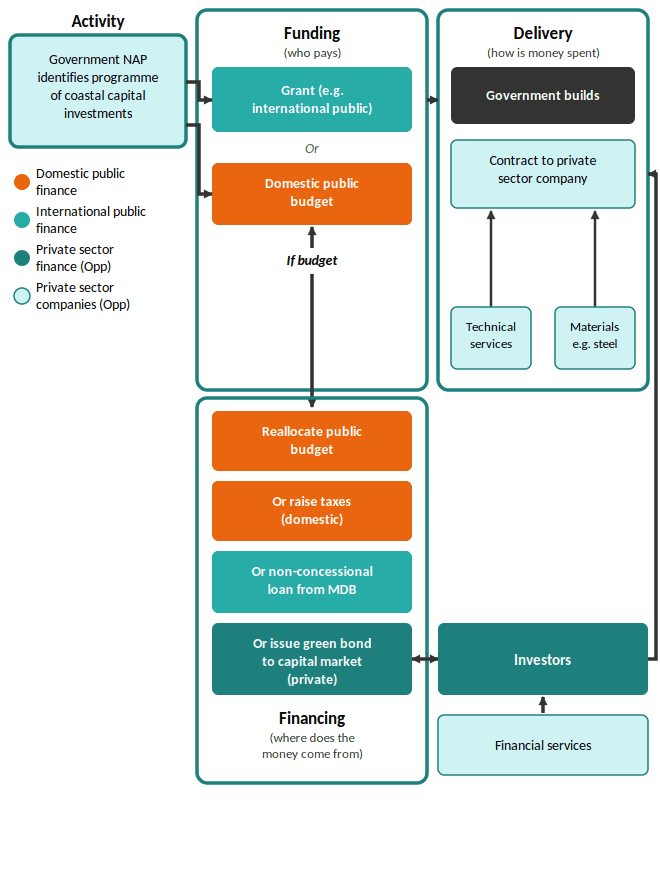
Figure 4: A simple example of the financing, funding, and delivery of adaptation for coastal protection. Source: Watkiss and England. 2025.
The role of public and private sectors
In recent years, there have been substantial efforts to better understand the factors which can inform whether such activities should be funded by the private or public sectors. These include whether the costs and benefits of activities are public or private as well as the level of financial returns they offer. These can be none/limited (and are therefore typically public), below-market or market level returns (OECD, 2023). The level of market returns for many adaptation options have been classified in Table 3, and these have been reviewed and updated to be relevant to the sectors in scope of this study:
Table 3 – Adaptation activities and potential returns in developed countries for the sectors explored in the study. Updated from Watkiss and England, 2025 and OECD, 2023.
|
Sector and activity |
Typical nature of investment |
Typical level of return | ||
|
Public |
Below market |
Market | ||
|
Coastal, river and surface water flood | ||||
|
Protection (coastal and river floods) |
Public |
ü | ||
|
Early warning services |
Public |
ü | ||
|
Natural flood risk management / NbS |
Public |
ü | ||
|
Property Level Flood Resilience and Resistance |
Private |
ü |
ü |
ü |
|
Water | ||||
|
Integrated water resources management (IWRM) |
Public |
ü | ||
|
Supply and distribution |
Mixed |
ü |
ü |
ü |
|
Demand management, inc. efficiency measures |
Mixed |
ü |
ü |
ü |
|
Agriculture | ||||
|
Research and Development |
Mixed |
ü |
ü |
ü |
|
Extension services |
Mixed |
ü |
ü |
ü |
|
Climate-smart agriculture |
Mixed |
ü |
ü |
ü |
|
Irrigation |
Mixed |
ü |
ü |
ü |
|
Trade and trade infrastructure |
Mixed |
ü |
ü |
ü |
|
Infrastructure | ||||
|
Transport (road and rail) |
Mixed |
ü |
ü | |
|
Biodiversity and Ecosystems | ||||
|
Protected areas |
Public |
ü |
ü | |
|
Capacity building, institutional strengthening, awareness |
Public |
ü |
ü | |
|
Forestry |
Mixed |
ü |
ü |
ü |
Building on this approach, UNEP (2025) outline a useful typology (adapted into Figure 5) for understanding where public and private actors are best placed to act, based on the combination of level of returns and whether the costs and benefits are public, private or joint. These can be used to help classify a broad range of activities which are funded by either the public sector, private sector, or a mix of both.
Type A actions are public goods, such as major flood protection schemes, that generate little or no financial return and are therefore typically initiated and funded by government. Type B actions involve a mix of public and private costs and benefits, and where returns are typically below market. For example, supporting climate-smart agriculture. These typically involve blended finance arrangements. Type C actions sit within existing well-functioning markets and generate commercial returns, such as industrial cooling systems, and would be expected to be entirely privately financed and funded.
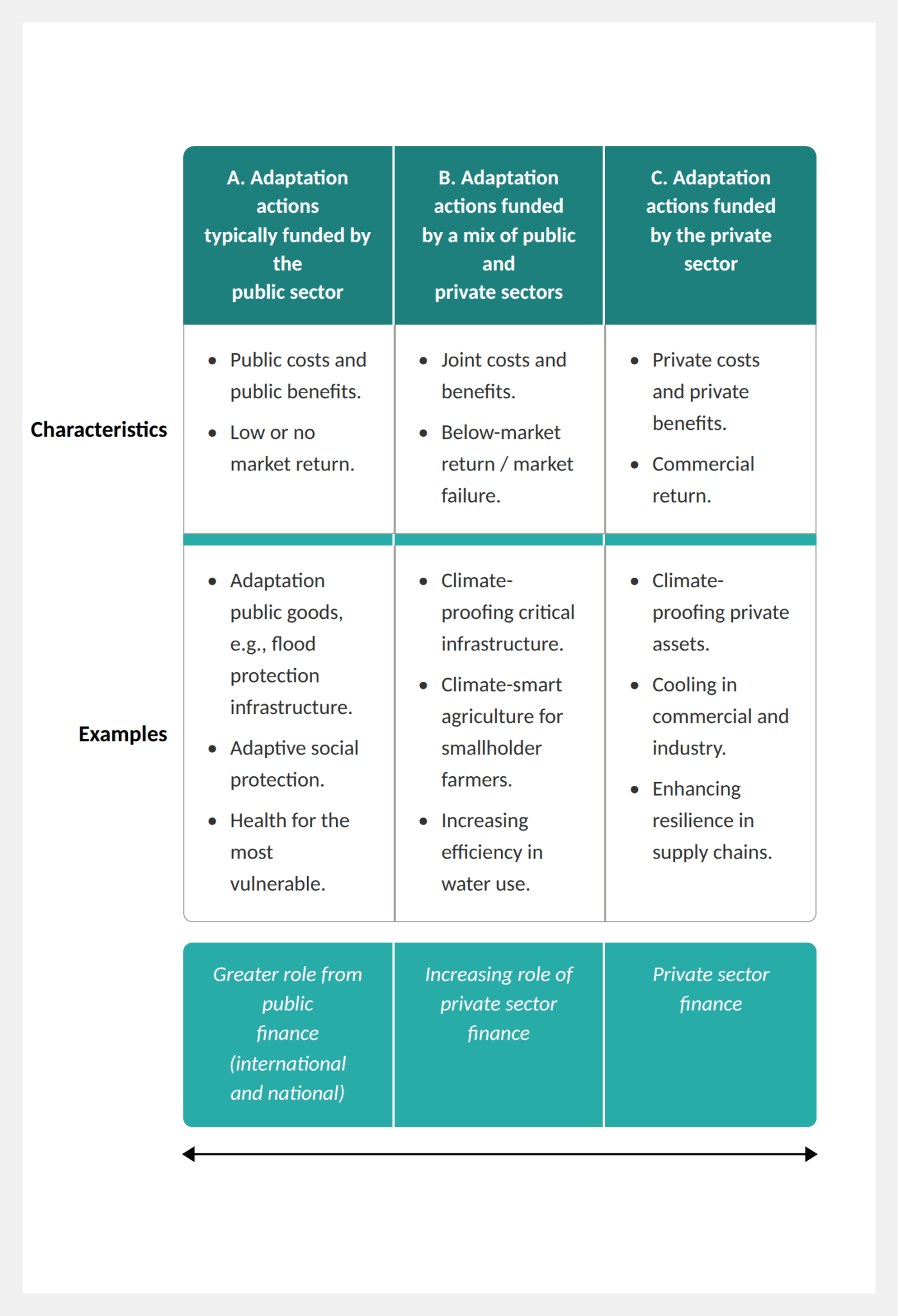
Figure 5: Simplified categorisation of adaptation types (A-C) and opportunities for private sector engagement. Adapted from UNEP (2025).
Barriers to adaptation finance
Private sector investment in climate adaptation remains persistently low, despite adaptation often delivering high economic returns for society (World Bank, 2024).
The core problem is that while the societal benefits of adaptation can be substantial, the financial returns that matter to private investors are much lower. Adaptation frequently reduces losses or damages and generates limited revenues, making it difficult to construct a viable business case for private finance. This is especially the case, given the opportunity cost of capital, and difficulties of modelling climate-related disruption in cashflows and returns (Watkiss and England, 2025). There are also issues of discounting, where costs arise today, but benefits occur far in the future and are therefore higher. The private sector also uses higher discount rates than the 3% in the public sector (HM Treasury, 2026), compounding this issue.
Many studies reporting high benefit-to-cost ratios for adaptation are measuring economic or societal returns, which include non-market benefits such as environmental value. Private investors, however, assess financial returns, incremental revenues and cash flows, which are considerably lower. This distinction is frequently misunderstood and leads to unrealistic expectations about the role private finance can play (Watkiss and England, 2025).
Watkiss and England (2025) identify five main categories of barrier to adaptation finance:
- Information barriers, including insufficient data on climate risks and limited investor understanding of adaptation as an asset class.
- Market failures, including public good characteristics and underdeveloped adaptation markets.
- Behavioural barriers, including low perceived urgency and limited willingness to pay for risk reduction.
- Policy and governance barriers, including weak or conflicting regulation and poor cross-sector coordination.
- Financial and bankability barriers, including long payback periods, small project sizes, high complexity, and limited replicability.
Scaling private investment into publicly identified adaptation priorities remains a significant challenge, particularly for smaller, fragmented projects involving many actors and beneficiaries.
Boosting private sector opportunities
Globally, current private sector contributions to climate adaptation are very small (approximately 3% of total needs). Even with substantial innovation and concerted effort, the private sector is expected to deliver only around 15% of required adaptation by 2035, with even less in least developed countries and small island developing states (Watkiss & England, 2025). However, this varies significantly based on country and sector structure. Recent analysis of the UK’s third National Adaptation Plan finds much higher numbers, suggesting around 45% of total adaptation costs are borne by private households and businesses (Watkiss et al., 2026a), in part driven by the privatised nature of the water sector in England. As Scottish Water is publicly owned, the equivalent figure for Scotland is likely to be lower, with a greater share of adaptation costs falling to the public sector.
As a result, climate adaptation is currently funded predominantly by the public sector, both globally and within the Scotland. Central and local government fund most adaptation-relevant expenditure across transport, flood management, water infrastructure, agriculture and the natural environment, largely through existing budget lines that deliver multiple objectives alongside adaptation, climate-proofing, or pure adaptation investment (e.g. for flood protection). Across all sectors, households and businesses also bear some adaptation costs directly. For example, through property level insurance or on-farm investments. However, this remains modest.
Crucially, scaling up private sector participation will not happen through market forces alone. It will require concerted public policy action, enabling conditions, and in many cases public co-financing to de-risk private investment. The private sector’s role is therefore best understood as being complementary to, rather than a substitute for, public adaptation finance (Watkiss and England, 2025).
Governments can adjust the financial characteristics of adaptation activities to increase private sector participation, either at the market level or at the level of individual investments. At the market level, this can include improving existing markets (e.g. through better provision of climate risk information), creating new markets (e.g. through water credits), or supporting public provision where markets fail (Greenhill et al., 2026). At the level of individual investments, policy and regulation or blended finance arrangements can be used to alter financial characteristics and improve commercial viability (World Bank, 2019; Watkiss and Ward, 2025). Where neither approach is sufficient, there remains scope to diversify the range of public financing sources and instruments. This is illustrated in the decision tree in Appendix A.
Climate justice considerations
Another significant consideration within the costs of adaptation are the distributional aspects, and the need for a “just resilience”. The CCC report to Scottish Government on climate adaptation and just transition in 2022 highlighted that fairness in adaptation is strongly linked to just transition concepts, and it is crucial to consider distributional effects to ensure effective and fair adaptation (CCC, 2022). Several characteristics that lead to increased vulnerability and reduced adaptive capacity to climate risk were identified, and include low-income groups, the very young and the elderly, and those in rural regions. The CCC recommended that policy to help address adverse distributional impacts should be routed in an understanding of the distributional effects of climate risks and opportunities.
While climate risks are unevenly distributed and demand equitable responses (European Environment Agency, 2025), they also involve costs. Such costs can be explored from several perspectives. A simplified set of approaches is shown in Table 4, ranging from most targeted to those most socialised, though in reality the approach may be context specific.
Table 4: Indicative approaches to guide who should pay for adaptation: Adapted from Paul Watkiss Associates.
|
Approach |
Description and examples |
Justification |
|
Costs borne by those at risk |
Those directly exposed to risks bear the costs of adaptation (e.g. PFR) |
Beneficiaries should pay costs |
|
Costs socialised amongst users |
Investment in water / rail networks for adaptation through water bills and ticket sales |
Efficiency, user pays |
|
Maximise social welfare – prioritise dense population |
Use of Cost-Benefit analysis to maximise (e.g. flood defences in England) |
Social welfare, cost effectiveness |
|
Costs socialised across society |
Adaptation of nature and biodiversity, flood protection |
Public goods, fairness or equity |
|
Adaptation responsibility based on historic and current emissions |
Highest emitters pay for adaptation (e.g. Green Climate Fund, Adaptation Fund) |
Adaptation costs driven by historic emissions / most wealthy |
The CCC recommended that policy to help address adverse distributional impacts should be rooted in an understanding of the distributional effects of climate risks and opportunities.
Early work underway globally is considering some of the principles behind the costs of adaptation. The Government of New Zealand (2025), set out some early principles in its National Adaptation Framework such as ensuring pre-and post-climate event costs are shared across society and over time, and that the public sector is used to incentivise private sector action, and to take market-based approaches that adjust over time. While beyond the scope of this report, it is noted that such considerations may have the potential to significantly vary relative distribution of costs.
Knowledge gaps and challenges
Evidence gaps in Scotland’s adaptation investment landscape
It is important to note here that adaptation investment, globally, is poorly understood, and many countries are, like Scotland, working to quantify their national adaptation investment needs. Scotland faces multiple knowledge gaps around climate adaptation investment. These include:
- No clear understanding of the total investment required across sectors, including whether this will involve millions or billions of pounds, or how this spending will be distributed with time.
- No detailed picture of what climate adaptation investment could deliver for different sectors.
- No specific, measurable, achievable, relevant and time-bound (SMART) adaptation objectives under SNAP3.
- No assessment of associated costs of not adapting, and/or expected residual damages.
- No budget allocation for each SNAP3 objective.
These knowledge gaps make it difficult to determine whether a financing gap exists or how large that gap might be in Scotland.
Broader knowledge gaps in Scotland and beyond include:
- Lack of robust estimates of the wider returns from adaptation investment, including avoided climate damages, economic benefits, and broader social and environmental gains that comprise the ‘triple dividend’ of adaptation.
- Limited research exploring opportunities for blended public-private funding partnerships to support climate change adaptation spending.
Further research on these broader topics is key to ensuring and prioritising just and equitable climate adaptation solutions in Scotland.
Box 1: Challenges and limitations
Estimating Scotland’s climate adaptation investment need is inherently challenging. This work provides an initial method, approach, and set of assumptions to estimate climate adaptation spending across sectors. It is intended as a first step that will require further development. The figures presented should therefore be treated as indicative, order of magnitude estimates rather than precise calculations. Readers and peers are encouraged to build on this analysis by adding new assumptions, incorporating additional sub-sectors or hazards, or testing alternative scenarios and risk-tolerance thresholds.
The key data limitations and challenges underlying these estimates include:
Baseline spending: Incomplete information on current adaptation expenditure across Scotland makes it difficult to establish a reliable baseline from which to measure progress or scale up investment.
Asset vulnerability: Comprehensive inventories of climate-vulnerable assets are lacking in most sectors, and there is limited understanding of how vulnerability will evolve as the climate changes.
Climate and socio-economic uncertainty: Projections of how Scotland’s climate will change over the coming decades remain uncertain, as does the evolution of the broader socio-economic and political landscape.
Risk tolerance: Without clearly defined government risk tolerance thresholds or adaptation objectives for each sector, it is difficult to establish an ‘end goal’ against which investment needs can be scaled.
Scope limitations: The analysis focuses on selected sub-sectors and key hazards; many relevant adaptation actions and climate risks across Scotland’s wider economy are not included.
Methodological assumptions: Estimates rely on assumptions regarding appropriate adaptation objectives for 2040 and whether spending continues at current levels or scales up in line with growing climate risks.
Study methods
Our approach
Scotland faces similar challenges in estimating climate adaptation investment need to those across Europe, and the fragmented data landscape means no single method could be applied consistently across all sectors. The study therefore adopted a pragmatic, multi-stage and multi-method approach:
- estimating adaptation costs for each sector using the most appropriate costing method given available evidence;
- feeding these into a macroeconomic model to explore the economic impacts of different financing routes;
- mapping current governance arrangements to understand how adaptation is being paid for today; and,
- exploring the potential to increase private sector participation.
Due to resource and data limitations, the three analyses were conducted separately, with differing underlying assumptions. The cost estimates, macroeconomic modelling, and funding analysis are therefore not directly comparable with one another. Each is intended as a broad exploratory assessment, and further integrated analysis would be needed to draw firm conclusions across all three components.
Throughout, developing robust estimates also required identifying which SNAP3 targets and objectives are relevant to each sector and considering wider socio-economic context beyond climate risk alone. The detailed steps are shown below.
Step 1: Adaptation costing
Adaptation objective setting
We adopted 14 of the 23 objectives set out in SNAP3 (Scottish Government, 2024a). The selected objectives covered four of the five broader SNAP3 outcome areas identified by the Scottish Government: Public Services (PS), Economy, Business & Industry (B), Nature Connects (NC), and Communities (C) (Scottish Government, 2024a). Objectives relevant to the fifth SNAP3 outcome area, Connected and Engaged Society (CE), were not included in the scope of this analysis. The specific sectors, objectives and corresponding outcome explored within our analysis area are summarised in Table 5.
Table 5: Climate change adaptation outcome area and objectives from SNAP3 that align with the five sectors considered in our work were selected and, where relevant, amended. Sectors not explored – due to resource constraints – are crossed through in the objectives below.
|
Sector |
SNAP3 outcome area and objectives |
|---|---|
|
Agriculture |
B2: Farming, |
|
Communities |
C1: Regional collaborations are driving inclusive, effective and place-based adaptation across all of Scotland. |
|
C2: Communities and individuals are supported, informed, and able to take locally led adaptation action, supporting local priorities and resilient, healthy, and equitable places. | |
|
C3: Communities and individuals are able to prepare for, respond to and recover from emergencies in a way that builds future climate resilience, complements the work of emergency responders and protects those with vulnerabilities to multiple risks. | |
|
C4: New buildings are designed for a future climate, and opportunities for adaptation in existing buildings are taken during maintenance or retrofit. | |
|
C6: Coastal communities are preparing for and adapting to coastal erosion and sea level rise. | |
|
PS2: People can access the public services they need, and critical assets, systems and networks are resilient to the impacts of the changing climate. | |
|
Natural environment |
B2: Nature-based solutions are protected and enhanced to enable healthier, cooler, water resilient and nature-rich places. |
|
NC1: Landscape scale solutions are implemented for sustainable and collaborative land use including protecting and enhancing Scotland’s soils. | |
|
NC3: Development planning (including Local Development Plans and associated delivery programmes) takes current and future climate risks into account and is a key lever in enabling places to adapt. | |
|
NC4: Nature networks across every local authority area are improving ecological connectivity and climate resilience, alongside other transformative national actions to halt biodiversity loss by 2030. | |
|
NC6: Resilient natural carbon stores and sinks (such as peatland, forests and blue carbon) are supporting Scotland’s net zero pathway, alongside timber production, biodiversity gains, flood resilience and the priorities of local communities. | |
|
Transport |
PS4: The transport system (trunk roads, rail, |
|
PS2: People can access the public services they need, and critical assets, systems and networks are resilient to the impacts of the changing climate. | |
|
Water |
PS2: People can access the public services they need, and critical assets, systems and networks are resilient to the impacts of the changing climate. |
|
PS3: Partnerships for water resource planning and rainwater drainage networks are active in prioritised catchments to support climate resilient places and drought and flooding resilience. |
The sectors and sub-sectors included in our study are defined as follows:
Table 6 Sectors and sub-sectors explored within this analysis
|
Sector |
Sub-sector |
|---|---|
|
Agriculture |
|
|
Communities |
|
|
Natural environment |
|
|
Transport |
|
|
Water |
|
Note that, due to resource constraints, a range of other key sectors – for example, energy, telecommunications, and health – have not been explored in this report. Furthermore, even within the sectors we have examined, we have not conducted full sectoral analyses. For example, within transport, adapting ferries, aviation, and canals was not included in the analysis due to resource constraints. Consequently, the results should be interpreted accordingly.
Context setting
To estimate the uplift or scaling factors for adaptation investment needs to 2040, we considered how wider socio‑economic conditions, such as population change, economic growth and sectoral investment trends, might evolve over time. These factors can be important. For example, estimating future flood defence needs can require assumptions about future population distribution, while economic growth and inflation trajectories influence both the cost of adaptation measures and the scale of potential economic losses.
In practice, this broader socioeconomic context was only relevant to a limited part of our analysis. Most estimates relied on sector specific data and updated risk information – such as SEPA’s revised flood risk mapping or current housing stock – rather than the national socioeconomic scenarios developed for CCRA3. As a result, although we originally intended to use the central CCRA3 socioeconomic scenarios to inform investment scaling, these were largely not required in the final workflow.
If needed for future updates, this contextual information can be revisited, but for the purposes of this assessment it played only a minor supporting role.
Apportioning adaptation spend
Following the MDB taxonomy introduced in Section 2.2, this study applied different cost attribution approaches across the five sectors depending on the type of adaptation investment and available evidence. The specific methods used for each sector are detailed below and further elaborated in the sector-specific analyses (Section 4).
Climate-Proofing (Incremental Costs)
For infrastructure investments where adaptation is integrated into planned programmes but not the primary objective, we estimated incremental costs above baseline investment, for example:
- Transport (trunk roads and motorways): We applied relevant climate-proofing uplifts from the literature to Scottish Government 2026/27 budget lines for road maintenance and renewal. These uplifts reflect the additional investment required to design infrastructure for future climate conditions rather than historical baselines. For example, upgraded drainage capacity to handle more intense rainfall, enhanced slope stabilisation for increased landslide risk, or heat-resistant surfacing materials. The baseline represents the investment that would proceed regardless of climate change; the uplift captures the incremental adaptation cost.
Mixed Objectives (Apportioned Costs)
For investments delivering multiple benefits including adaptation, we apportioned costs based on expert judgment in consultation with Paul Watkiss Associates, who have extensive experience applying the MDB taxonomy internationally. For example:
- Woodland creation: Forestry investment delivers multiple benefits including timber production, carbon sequestration (mitigation), biodiversity, recreation, and climate adaptation (ecosystem resilience, water regulation, reducing downstream flood risk). We reviewed stated objectives in Scottish Government forestry programmes and applied expert judgment from Paul Watkiss Associates, aligned with on-going UK level adaptation investment need research, to determine what proportion of woodland creation costs should be attributed to adaptation.
- Peatland restoration: Peatland restoration similarly delivers carbon sequestration, biodiversity recovery, water quality improvements, and adaptation benefits (enhanced water storage and flow regulation reducing flood peaks, maintaining ecosystem function under climate stress). We assessed the relative emphasis on these objectives in Scotland’s peatland restoration programmes and apportioned costs, accordingly. These apportionments were cross-checked through expert review with Paul Watkiss Associates.
- Nature restoration: We applied similar logic to wider nature restoration funding, examining whether investments prioritise climate resilience objectives (e.g., creating ecological corridors to enable species migration under climate change, restoring coastal habitats for natural flood defence) or primarily target biodiversity and ecosystem health goals, and attributed costs proportionally.
Different analysts might reasonably apply different attribution percentages to the same mixed-objective investments, as there is no objectively correct answer to how investment should be apportioned across multiple objectives, including the distinction between climate adaptation and mitigation. The percentages applied in this study are therefore documented transparently in the sector-specific analyses (Section 4) and supplementary data.
Targeted adaptation (pure adaptation)
For dedicated adaptation investments where climate risk reduction is the primary or sole objective, we counted total programme costs:
- Flood protection schemes: We examined historic budget allocations from Scottish Government expenditure data and uplifted these to current construction prices using appropriate indices. Estimates drew on SEPA’s updated flood risk mapping and UK-wide research on flood defence costs, scaled to Scotland’s exposure and asset base.
- Property-level flood resilience (PFR): We scaled recent UK research on PFR costs and uptake rates in proportion to Scotland’s residential and non-residential building stock at flood risk, using SEPA flood risk data to estimate the exposed population.
- Capacity building (communities): We engaged with Scottish Government policy teams to identify planned and potential future investment in community-level adaptation capacity, resilience planning, and climate literacy programmes where adaptation is the primary objective.
Sector-specific considerations
A pragmatic, multi method strategy was adopted that used the most appropriate costing approach for each sector, determined by data availability and evidence maturity. The core approaches drawn upon were:
- Drawing on existing sectoral analysis of initial adaptation investment estimates for specific plausible future scenarios (e.g., water and rail).
- Applying relevant climate proofing uplifts from the literature to relevant Scottish Government 2026/27 budget lines (Scottish Government 2026b), reflecting changing climate risks (e.g., trunk roads and motorways).
- For each plan or budget line, including the Scottish Government Draft Climate Change Plan (CCP) (2025) and the Scottish Government 2026/27 budget (Scottish Government, 2026b), the multiple objectives were examined to identify the proportion of investment directly related to adaptation (e.g., agriculture, woodland creation, peatland restoration, and nature restoration).
- Examining and uplifting historic budget allocations to current construction index prices (e.g., flood protection schemes).
- Drawing on wider UK research and scaling estimates in proportion to Scotland’s building stock or relevant assets (e.g., flood-protection schemes and property level flood resilience).
- Engaging with Scottish Government policy teams to discuss likely investment changes for spending with adaptation relevance (capacity building within communities).
- Applying value transfer methods by exploring how adaptation cost estimates compare when scaled to the Scottish context, drawing on Neumann et al. (2025) as an international benchmark for agriculture and transport infrastructure, and on UK Government (2025) analysis for flood protection schemes.
- Undertaking expert review to cross-check estimates against parallel analysis being undertaken for the Climate Change Committee’s Well Adapted UK report, due for publication in Spring 2026.
For further detail on methodological approach used, please see the sector-specific analyses, the appendices B and C (for additional information on Network Rail Scotland and Scottish Water’s analysis respectively), and supplementary data.
Step 2: Estimating macro-economic effects of spending
Macro-economic effects
Fully modelling the costs and benefits of adaptation, including all potential avoided damages, productivity improvements, health gains, and environmental co-benefits, is extremely resource intensive and was beyond the scope of this project. Instead, the Centre for Energy Policy at the University of Strathclyde used a Computable General Equilibrium (CGE) model of the Scottish economy to explore one deliberately narrow but important question: what are the direct economic effects of additional climate adaptation investment in Scotland, and what economic activity does this spending stimulate?
CGE models are widely used by governments and research institutions, including HM Treasury and the Scottish Government, to understand how changes in one part of the economy ripple through the rest. For this study, a model was used that represents the Scottish economy across 30 broad sectors and is built on Scottish Government Input-Output tables from 2019, chosen to reflect the structure of the economy before the disruptions of Covid-19 and the war in Ukraine. The model traces how adaptation spending affects prices, production, employment, and incomes across sectors, and how these effects in turn influence government revenues and public finances. It also accounts for how wages and employment interact. It allows for migration in and out of Scotland depending on relative economic conditions. Finally, it divides households into five income groups to understand how different parts of society might be affected.
For this research, we assumed that climate change adaptation is a form of capital spending that does not create additional production capital for production sectors. Instead, it allows them to maintain the same production capacity, which would be at risk in the face of climate change.
Understanding the modelling approach: spending and cost recovery
To make the modelling approach clearer, it is helpful to think of adaptation in two phases:
Phase 1: Sectoral spending for climate adaptation measures
In Phase 1 the scope of the work is to model how the spending flows through the Scottish supply chains. We model how the sector makes additional purchases of goods and services to deliver adaptation measures (for example, construction materials, engineering services, flood defences, or restoration work). This spending initially flows through Scottish supply chains, creating economic activity in the sectors that deliver the work and in households that benefit from the associated wages and employment.
Phase 2: Cost recovery
Over time, the sectors and/or government need to recover the costs of adaptation. Each sector may have a different cost recovery approach, depending on its business models and economic structure. We modelled three stylised approaches to illustrate the broad channels through which different funding choices affect the economy:
(1) “Government pays, funded through income tax” (used for Communities, Rail and Trunk roads) may have the following implications:
- Income tax rates rise to cover adaptation costs.
- Household disposable incomes fall, especially for higher earners.
- Consumer spending is dampened across society.
- This approach is typically progressive, as those earning more pay a larger share.
- Government spending in other areas (health, education, etc.) is preserved.
(2) “Government pays, funded through government spending cuts” (used for Natural environment) may have the following implications:
- Public spending declines towards all sectors to cover adaptation costs.
- Public administration/defence, education, and tertiary sectors suffer most.
- This approach tends to be mixed.
(3) “Industry pays, funded through higher prices” (used for Agriculture and Water) may have the following implications:
- The adapting sector faces a cost they have to cover, which firms pass on to consumers through higher prices.
- Higher prices reduce export competitiveness (assuming similar price increases are not also happening abroad), which reduces demand for Scottish goods.
- This approach tends to be regressive, as lower-income households spend a relatively larger share of their budgets on essential goods and services.
Important caveats
All approaches are highly stylised and are used to illustrate the broad economic channels and trade-offs that different funding choices create. In reality, adaptation funding is likely to involve a blend of government and industry contributions, as well as other mechanisms such as borrowing, grants, or targeted levies. The scenarios presented here should be treated as illustrative, helping to understand the direction and scale of potential impacts rather than precise forecasts.
More detail on the methodological approach and more detailed analysis of selected sectors can be found in Appendix D.
Note: The macroeconomic modelling cannot be taken as an assessment of the costs and benefits of adaptation. While the modelling captures the direct economic stimulus of adaptation spending and the effects of cost recovery, it does not model residual damages. Neither does it quantify the full range of avoided climate damages, increased resilience, reduced disruption to businesses and households, improved business continuity, health gains, long-term productivity benefits, or environmental co-benefits that underpin the wider “triple dividend” of adaptation. The results should therefore be interpreted as a conservative and partial estimate, representing only one dimension of the economic effects – the demand-side impacts of the spending and its financing – rather than the full spectrum of costs and benefits of adaptation.
Steps 3 and 4: Estimating current and future private sector contributions
In each of the sectors represented in the report, there are existing models which are being used to cover the costs of adaptation today. To explore the current and future potential splits, the project documented the broad governance models of each sector today. We then carried out a qualitative evaluation of the potential use of blended finance, regulation and policy and innovative models. We note that these vary significantly based on the broad structure of the sector, and appetite for change.
Our focus has been on the theoretical potential to increase private sector contributions (noting that this may not be ultimately desirable). This is based on the need to prioritise public sector expenditure on those areas which cannot be met by private sector or households directly. The range of models explored includes:
- Innovative models using private finance to provide upfront capital
- Models which increase private sector funding for adaptation
- Provision of adaptation goods and services (which ultimately reduce costs for public and private sector activities
To identify potential innovations, we drew on the Paul Watkiss Associate database of innovative accelerators (England et al., 2023; United Nations Environment Programme, 2024), as well as recent wider work exploring financing options (Watkiss and England, 2025). Further supplemental models were identified through desk-based searches during this project. We undertook a rapid review and used expert judgement to extract innovative approaches that they felt were potentially relevant in a Scottish context.
Due to the limited resources available for the project, the review has inevitably been ‘light touch’ but serves as the basis for further exploration and discussion to inform the development of SNAP4, as well as the future business models of public bodies such as Scottish Water or Network Rail.
Prices
All prices in the report are presented in 2026/27 prices. For the period 2025/26 to 2026/27, a nominal growth rate of 2% per annum has been applied, consistent with the Bank of England’s long-run inflation target. See the supplementary data for further detail.
Sector-specific analysis
The results derived are detailed below. For each sector – agriculture, communities (flooding), transport, water and natural environment – we highlight (1) key risks and adaptation opportunities, (2) information regarding current investment in climate adaptation, (3) the estimates of adaptation investment need, (4) the wider (co)-benefits of such spend, (5) the current governance, and (6) funding and financing arrangements.
Agriculture
Key climate risks and adaptation opportunities
Agriculture in Scotland faces a complex and intensifying range of climate-driven pressures. More frequent extreme rainfall events are already causing excess waterlogging, which has been shown to be a greater current risk to wheat yields than heat or water stress (risk N6 in CCRA3). Hotter, drier summers are reducing the suitability of high-quality arable land due to drought risk. The 2018 drought illustrated how quickly these pressures cascade through supply chains, with reduced malt barley yields and distilleries halting production due to low river flows. Fluvial flooding on major river catchments such as the Tay and Tweed continue to damage agricultural land, and projections suggest the area of Scotland’s best-quality farmland at risk from flooding could rise by over 30% by the 2080s under a +2°C scenario. Warmer conditions are also driving increases in pests, pathogens and invasive species (CCRA3 risk N7), from potato blight and cyst nematodes to Bluetongue virus, posing escalating threats to crops, livestock and soil health (Sniffer, 2021). Together, these pressures are expected to push agricultural climate risk, as stated in the CCRA3, from medium to high in the coming decades (Sniffer, 2021).
Addressing these risks requires an integrated, forward-looking approach to land-use planning and farm management. Key priorities identified by CCRA3 (2021) include updated land capability assessments using UKCP18 data to guide decisions on where agricultural systems remain viable, alongside improved skills and knowledge exchange, crop diversification, and better soil and water management. Expanded pest and disease monitoring, stronger biosecurity, and wider uptake of integrated pest management are also highlighted, as is the need to align adaptation with net zero strategies to avoid introducing new vulnerabilities. Stronger research, improved coordination between government and land managers, and a more strategic cross-sector approach will be essential to safeguard Scotland’s long-term agricultural productivity as climate pressures intensify (Sniffer, 2021).
Current spending and context
It is not possible to outline how much capital the Scottish Government currently allocates specifically toward climate adaptation of agriculture. This is because climate adaptation investment is currently folded into budget lines with multiple other objectives such as emissions reductions, increased biodiversity and wider farm support. However, the Scottish Government 2026/27 Climate Taxonomy highlights that £221m worth of allocated budget within agriculture have a positive impact on adaptation. Similarly, to our knowledge, there is no available evidence on private sector investment for adaptation of agriculture within Scotland.
Adaptation investment need
Budget lines from the Scottish Government’s 2026/27 Climate Taxonomy with a positive impact on adaptation were used as the primary basis for estimating mixed-objective investment need for agriculture (Table 7). Spending was assumed to continue in nominal terms to 2040, with no uplift applied for increasing climate risk over the period. It should also be noted that some budget lines with positive adaptation impacts may not have been captured, for example, the Farm Advisory Service and Knowledge Transfer and Innovation Service sits under ‘Business Development’ in the Scottish Budget and has not been included, despite likely supporting adaptation through improved uptake of resilient practices.
It is important to note that these budget lines deliver multiple benefits alongside adaptation, including climate mitigation, soil health improvements, biodiversity gains, and wider farm business productivity. Disentangling the proportion of each line attributable specifically to adaptation is particularly challenging in agriculture, where weather and climate resilience – and therefore adaptation – are integral to sectoral success. For this reason, no specific proportion of any budget line was allocated to adaptation in isolation; instead, the whole budget line was included. Estimated costs should therefore be understood as representing a bundle of co-benefits of which adaptation is one component.
Table 7: Budget lines from the Scottish Government Climate Taxonomy 2026/27 that were included in adaptation investment need analysis for agriculture, and associated adaptation rating (Positive – High or Positive – Low) which represents the likely impact (and extent of impact) of the budget line on adaptation, e.g. ‘Positive – High’ is a positive impact that is likely to be highly beneficial.
|
Budget lines included in analysis |
2026/27 budget (£m) |
Adaptation rating |
|---|---|---|
|
Pillar 1 – Greening Payments |
£142m |
Positive – High |
|
Agricultural Modernisation Fund |
£26m |
Positive – Low |
|
Scottish Rural Network |
£0.87m |
Positive – Low |
|
Agri Environmental Measures Resources |
£21m |
Positive – High |
|
Agri Environmental Measures Capital |
£4.7m |
Positive – High |
|
Public Good Advice |
£2m |
Positive – Low |
|
Veterinary Grants |
£0.8m |
Positive – Low |
|
Animal Diseases |
£23.5m |
Positive – Low |
Table 8 outlines our estimate of mixed objective investment need – including adaptation – for agriculture. This estimate ranges from £168m/yr for budget lines associated with a high positive impact on adaptation to £221m/yr where budget lines with a low positive impact on adaptation are also included.
We cannot give an estimate of adaptation investment need for agriculture in isolation. However, if the current level of spend is maintained out to 2040, total investment in budget lines associated with a positive impact on adaptation in agriculture would amount to between £2,347m – £3,091m, or equivalent to £167.6m – £221m per year over the period 2026–2040 (Table 8).
Table 8: Lower and upper estimates of the mixed-objective investment need (including climate adaptation) for agriculture, based on budget lines in the Climate Taxonomy 2026/27 with a positive impact on adaptation. Values are in 2026/27 prices.
|
Lower estimate |
Upper estimate | ||
|---|---|---|---|
|
Cost p.a. (£m/yr) |
Total up to 2039/40 (£m) |
Cost p.a. (£m/yr) |
Total up to 2039/40 (£m) |
|
£167.6m/yr |
£2,347m |
£221m/yr |
£3,091m |
These estimates were triangulated by scaling adaptation cost estimates from Neumann et al. (2025) to the Scottish context as an international benchmark. Neumann et al. (2025) estimated EU agricultural adaptation costs at approximately 0.04% – 0.06% of GDP per year under moderate to high emissions scenarios. Applying this range to Scotland’s GDP yields an indicative figure of £90m – 142m/yr (2026/27 prices). Scotland’s agricultural GVA (approximately £2.2bn, around 1% of GDP) is broadly comparable to the EU average (approximately 1.2% of EU GDP), supporting the plausibility of this transfer as a cross-check (Scottish Government, 2025c; Eurostat, 2026). However, this comparison should be treated with caution: the nature and projected intensification of climate hazards vary considerably across EU member states and diverges from Scotland’s risk profile in important respects. These figures were therefore used as an indicative benchmark to assess how our estimates compare at an international level, and are not included in our reported adaptation investment need figures.
We also conducted separate exploratory research to highlight the challenges and opportunities of using bottom-up analysis to cost climate change adaptation investment need for specific agriculture actions (see Case study 1).
Case study 1: Exploratory bottom-up analysis of agricultural adaptation actions
While budget tagging reveals how much is being spent, it does not indicate what this delivers for climate resilience or whether current levels are sufficient. As an exploratory supplement to the primary budget-line estimates, indicative cost estimates were developed for 33 adaptation actions identified in a Scottish Government RESAS report, to showcase how investment need estimates could iteratively improve to become asset- and action-based going forward. This analysis should be regarded as a proof-of-concept; further data collection and expert elicitation would be needed to improve future estimates and develop associated adaptation pathways.
Costs were sourced from academic and grey literature, with confidence ratings assigned to each source, and scaled to Scotland’s agricultural land area using land-use archetypes from the CCC’s Rural Land Use Types report (Thomson et al., 2025). Complete scaled cost estimates were produced for 19 of the 33 actions. Where data permitted, an exploratory cost-benefit analysis was undertaken for selected actions, including diversified crop rotations, examining potential impacts on yields, soil erosion, and fertiliser use.
The exploratory CBA for diversified crop rotations suggests potential monetised benefits totalling £856m–1.1bn between 2026 and 2040 for reduced soil erosion, increased crop yields and reduced fertiliser usage. Relative to an estimated total action cost of £3.5bn, this represents 25–31% of the potential investment directly benefiting agricultural productivity. Furthermore, other public good benefits not explored from diversified crop rotations could include other benefits such as increased biodiversity and improved water retention that were not explored here.
These figures assume each action is applied across all eligible land, which is an over estimation. Further information on the results, assumptions made, confidence ratings, and recommended further research steps are provided in Appendix E and the supplementary data.
Macroeconomic effects and wider impacts
Macro-economic impacts
We assumed the agriculture sector requires approximately £2.3bn of adaptation investment between 2026 and 2040, around £150m/yr (based on rounding down the analysis in Section 4.1.3). This spending is distributed across construction, the agriculture sector itself, all other manufacturing, and wholesale/retail (vehicles).
Without cost recovery (a modelling device to isolate the spending effect): The programme generates GDP and employment gains during the spending period, with around 80% concentrated in the sectors directly delivering the works – construction, all other manufacturing, wholesale/retail (vehicles), and agriculture itself. Positive spillovers reach consumer services as household incomes rise. Employment and GDP impacts track each other closely because the agriculture adaptation supply chain involves relatively capital-intensive activities such as specialised equipment and infrastructure. As with other sectors, these benefits fade after spending concludes.
With “industry pays” cost recovery (a stylised scenario): When farmers bear adaptation costs and pass them to consumers via higher food prices, the effects are regressive. By 2040, the lowest-income households face price increases of 0.09%, compared with 0.07% for the highest-income households, because food represents a much larger share of poor households’ budgets. Higher food prices erode real incomes and household consumption across all income groups, while reduced export competitiveness further dampens GDP and employment. Because agriculture is one of Scotland’s most labour-intensive sectors – employing 8.5 workers per £1m of output, well above the economy-wide average of 6.6 – the concentrated negative impacts trigger significant job losses that spill across the wider economy. Scotland’s labour mobility means workers leave rather than accept wage cuts, prolonging the employment losses.
Policy implications: An “industry pays” approach financed through higher food prices risks regressive impacts on low-income households and substantial employment losses. While adaptation spending itself stimulates construction and manufacturing, the method of cost recovery determines whether these gains are preserved or eroded, and which parts of society bear the burden.
Current governance, funding and financing arrangements
Agriculture is a market sector but is heavily supported by the public sector (Figure 6). See Appendix F for further information on how this support is planned to change.
A key challenge in the agriculture sector is disentangling the adaptation costs from the other objectives, as the sector involves a mix of activities. There are some dedicated adaptation activities, but other agri-environment objectives include actions to improve productivity, with private costs and benefits, but supported by public activities. Furthermore, it is also challenging to differentiate adaptation actions from wider activities to boost yields or achieve other objectives.
Therefore, rather than looking at activities, the study took an alternative approach which explored the relative income sources for farms. Scottish Government produces estimates on the annual income from farms, including their makeup (Scottish Government, 2025d) shown in Appendix F. These show that agricultural activity in Scotland is typically lossmaking, except for dairy and general cropping, and that agricultural support payments make up a significant share of all farm income. The survey excludes sectors which do not receive support, such as pigs, poultry and horticulture.
The results suggest that loss-making farms may struggle to invest in adaptation measures and that the majority of the ability to invest in adaptation is likely to come through support payment income. We assume that adaptation action is mainstreamed into general agricultural support.
To derive estimates of private sector contribution we started by assuming that for farm types where agriculture is not profitable, all agricultural adaptation is paid for by the public sector. For those sectors where agricultural income is profitable, we assume 50% co-investment, assuming farmers can contribute to those areas which support adaptation. For those sectors excluded for support payments, we assume adaptation costs are 100% private. These assumptions were then applied to output of holdings by farm type from the 2025 Scottish Agricultural Survey. The results suggests that 33% of investment in adaptation is likely to be from the private sector. However, given the overlap with many other objectives and activities (including flood management), the uncertainty on the types of interventions and how they vary by farm type, as well as the fact that many of the grant schemes require co-investment from farmers. the confidence in such apportionment is low.
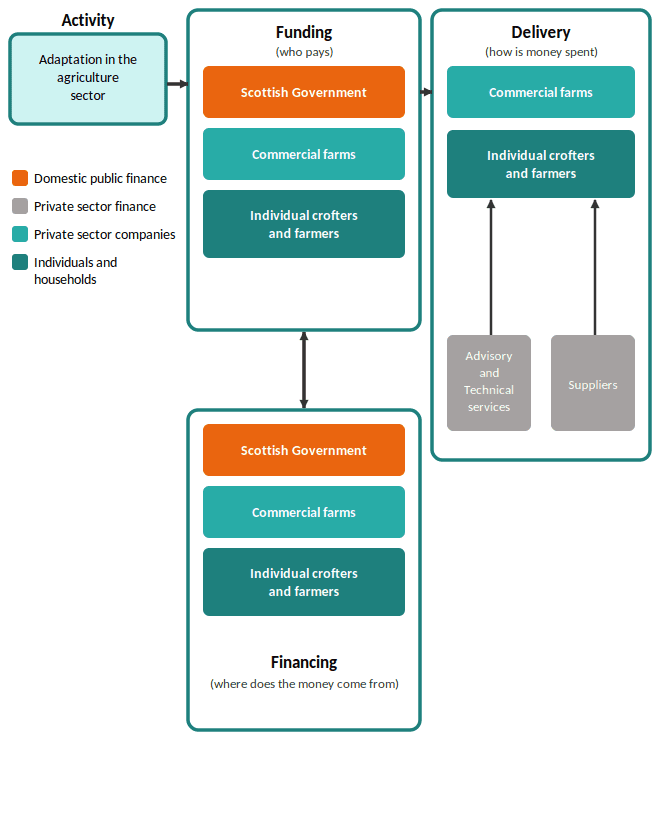
Figure 6 Financing, funding, and delivery arrangements for adaptation in agriculture.
Innovation that could boost private sector participation
Agriculture is one of the sectors where there is the greatest amount of innovation. There are a range of opportunities to leverage private finance for agriculture adaptation – especially as part of the wider agricultural reform programme. In general, blended finance offers a significant opportunity to incentivise further opportunities for investment in adaptation. For example, it can mainstream adaptation into loan requirements for agricultural investment, or support investment in dedicated adaptation activities. In Scotland, elements of nature restoration on farmland could be financed through biodiversity credits. Blended public-private models such as the Scottish Government £1m Agritourism Investment Scheme – offering grants of up to £50,000 covering 40% of eligible capital costs – can support farm diversification and rural resilience (Savills, 2026).
These can also be complemented by other models which support investment, including from suppliers interested in value chain resilience, or using offtaker agreements.
There are also specific models for investment that target particular activities or parts of the supply chain. For example, use of Public Private Partnership (PPPs) for climate resilient seeds, or the use of digital platforms to provide weather and advisory services) to support farm activities. In addition, parametric insurance offers faster, more transparent cover for systemic risks including drought, flooding, frost and yield shortfalls. It pays out automatically when pre-agreed environmental thresholds are met, rather than requiring loss assessment (Descartes, 2026). Parameters must be carefully designed to avoid leaving farmers exposed to events that fall outside agreed trigger conditions.
Shared rural infrastructure offers a further avenue for cost-effective private investment. Co-operative models – for example, shared grain stores and drying equipment – spread capital costs across multiple businesses while building collective resilience to weather-related yield losses. Similarly, investment in commercial deer carcass processing infrastructure, including improved Approved Game Handling Establishments (AGHEs), could support the economic viability of deer management, which delivers biodiversity, habitat restoration, and natural flood risk management benefits alongside commercial returns. Where shared infrastructure generates both adaptation outcomes and commercial revenues across multiple beneficiaries, blended public-private financing is well suited and could be supported through existing rural development funding mechanisms (World Bank, 2019).
Finally, there are newer and more experimental models being developed, such as the use of Resilience Credits; summarised in Table 9. While conceptually similar to carbon credits, they are more challenging to operationalise due to the conceptual challenges of adaptation, such as avoided future losses and the local place-based context of adaptation and resilience.
Table 9: Examples of innovative models for private participation in agriculture, with cost recovery model. Source: Updated from Watkiss and England (2025).
|
Model |
Examples |
Cost recovery model |
|
Blended finance |
Many examples of public and private investment, e.g. World Bank (2019), Scottish Government Agri-Environment schemes |
User pays but can generate value addition through financial return (adaptation goods and services) |
|
Concessional Credit Lines (e.g. SNIB) |
Many examples of below-market loans and guarantees | |
|
Offtaker agreements / Supply chain finance |
AMRU Rice (McNally et al., 2024) | |
|
Ex-post proof sharing Warehouse receipt financing Value chain integration |
International Finance Corporation’s (IFC’s) Global Warehouse Finance Program (IFC, n.d.) | |
|
Digital platforms (weather and advisory |
GeoKrishi (GeoKrishi, n.d.) | |
|
Resilience credits (reward investment in adaptation) |
IFAD (Puri and Chowdhury, 2023) | |
|
Seed value chain |
Tolerant seed multiplication (IFC, 2019) | |
|
PPPs for seed companies |
FAO public–private blended finance facility for climate-resilient rice landscapes (Damon, 2023) |
Communities
Key climate risks and adaptation opportunities
Flooding is the largest climate-driven threats to communities and the built environment in Scotland, with exposure increasing across riverine, coastal and surface water systems (SEPA, 2025). Surface water flooding is the most widespread form of flooding as more frequent extreme rainfall events are overwhelming drainage networks and intensifying surface water flooding. Approximately 400,000 properties are currently at risk from a 1-in-200-year flood event (SEPA, 2025). Flooding already costs Scotland an estimated £500m every year – and that figure will likely grow (SEPA, 2025). Beyond physical damage, flood events trigger persistent mental health impacts, particularly where households face prolonged displacement or repeated flooding. In addition, the burden falls disproportionately on socially vulnerable coastal, urban and rural communities (Sayers et al., 2018; Song et al., 2025). As climate change and population growth converge, exposure is projected to extend into areas with no historical flooding experience.
Addressing these risks requires a coordinated, forward-looking approach to spatial planning, infrastructure design and community-level adaptation. Key priorities identified by CCRA3 (2021) include stricter controls on development in flood-exposed areas, greater enforcement of Sustainable Drainage Systems (SuDS), wider uptake of Property Flood Resilience (PFR) measures, and better integration of natural flood management alongside traditional defences. CCRA3 (2021) also highlight improved flood forecasting, public warning systems and more targeted investment in vulnerable communities, alongside updated planning policies that embed climate-ready design principles. As surface water flooding is projected to increase under all climate scenarios, a strategic approach combining planning, infrastructure, social policy and community engagement will be critical to safeguarding people and places (Sniffer, 2021).
Current spending and context
Flood protection schemes
The Scottish Government has maintained a long-term baseline of £42m/yr for flood protection schemes since at least 2015/16, supplemented by a one-off top-up of £150m. Together this totals £570m invested in flood resilience over 2016–2026 (Scottish Government, 2024a; Scottish Government, 2025e). Local authorities also contribute to the cost of building major flood schemes. In the national ‘cycle 1’ scheme, it is estimated that the Scottish Government pays for 80% of the costs and local authorities pay for the remaining 20% of the costs. If costs increase after a specific point in the process, local authorities must pay for those increases. Local authorities also pay for ongoing maintenance once the flood schemes have been built (Audit Scotland, 2025).
Of the 40 flood protection schemes in ‘cycle 1’ (2016–2021) originally deemed eligible for funding, eight were subsequently abandoned and one was separated into a dedicated taskforce, leaving 31 viable schemes. As of early 2026, 21 of these have been completed. One is currently under construction, and a further six schemes are expected to have main construction contracts in place by March 2026. Three remain eligible for funding. However, projected costs across the programme have escalated significantly. For example, the Hawick scheme rose from £37.4m to £78.6m, Musselburgh from £8.9m to £106m, and Dumfries Whitesands from £18.9m to £68.6m (Internal Scottish Government Data – collected from local authorities in November 2024).
On average this investment has protected approximately 600 additional homes per year from flooding between 2016–2026 (Scottish Government, 2025e). However, climate change is exposing an estimated additional 3,000 properties to flood risk each year (SEPA, 2025), meaning that even if the flood protection scheme cycle was fully delivered, it would struggle to keep pace with the scale of need.
Property flood resilience
Property flood resilience (PFR) measures are an important complement to wider flood protection schemes, with particular suitability for managing surface water flooding (Pettit et al., 2020). PFR measures include resistance measures that prevent water entry and resilience measures that reduce damage and speed recovery. Currently, only a small share of Scotland’s flood protection budget is directed towards PFR, despite its potential to provide cost-effective protection for properties exposed to frequent flooding. JBA Risk Management (2025) identifies 4,679 PFR-eligible properties in Scotland with a payback period of 3–5 years, drawn from a wider total of 116,073 properties considering Great Britain, England, Wales and Scotland. However, this represents only a fraction of the likely need – at least 81,000 homes have been identified as suitable for PFR more broadly (Petitt et al., 2020). This figure predates SEPA’s updated flood risk assessment and may therefore underestimate current exposure. This suggests that the near-term investment requirement for properties where PFR is highly cost-effective is relatively modest and well-defined. However, the investment need across the broader pool of suitable properties is considerably less certain, requiring further research.
Capacity building
Climate Action Hubs, Adaptation Scotland, and Climate Ready Regions are the three main Scottish Government programmes delivering systemic capacity building for adaptation beyond infrastructure interventions. These programmes are intended to support communities, businesses, and public bodies to understand and respond to a wide range of climate hazards including flooding, heat, drought, sea level rise, and storms. The Adaptation Scotland Programme works across a broad range of sectors beyond communities. A proportion of Climate Action Hubs activity relates to mitigation rather than adaptation. In both cases, full budget allocations have been retained as spending cannot be reliably disaggregated between adaptation, mitigation, and other functions.
Drainage partnership funding – representing important capacity building at the catchment level – is included within adaptation cost estimates for the water sector and is not included here to avoid double-counting.
Adaptation investment need
This analysis focuses on flood risk management to assess climate adaptation investment needs for communities, covering flood protection schemes, property flood resilience (PFR), natural flood risk management, and wider capacity building. Some flood adaptation measures, such as improved hydrological modelling and early warning systems, have not been costed here and would add to the overall investment need. Other hazards affecting communities – including coastal erosion, drought, heatwaves and wind – fall outside the scope of this analysis and could be explored in further work.
Flood risk management entails a wide range of activities. Our research sought to cover expenditure across four main spending lines: (a) flood protection schemes, (b) property flood resilience (PFR), (c) natural flood risk management (implicitly included in the natural environment budget), and (d) wider capacity building.
This was challenging for two reasons: firstly, it was difficult to establish how Scotland’s current budget is allocated across these spending lines. Secondly, there was an absence of quantified targets or risk-tolerance levels against which investment needs could be scaled. For example, if the Scottish Government were to commit to protecting all high flood risk social housing, it would be possible to identify the number of eligible properties and estimate protection costs accordingly, but without such targets, scaling investment needs requires assumptions that introduce additional uncertainty. As a result, multiple complementary methods were used to assess investment need, with the caveat that there may be a small degree of double-counting between individual estimates. Estimating potential avoided losses from flood risk investment was also particularly challenging in this sector.
Flood protection schemes
To estimate future investment requirements for flood protection schemes, we take two approaches:
- We uplift the historic baseline funding of £42m/yr, in place from at least 2015/16 (Audit Scotland, 2025), using the ONS construction price index. This yields an estimated £63m/yr and a total projected requirement of £882m for the period 2026 to 2040 (Table 5).
- We take DEFRA flood protection commitments of £7.9bn for England between 2025 and 2035 (UK Government, 2025) and scale to Scotland based on dwelling stock. This yields an equivalent figure of £79m/yr, or £1,102m over 2026–2040. This value-transfer approach rests on assumptions of comparable housing stock, property type, and flood risk exposure with the wider UK and should be treated with appropriate caution.
Both figures are presented in Table 10 to reflect the inherent uncertainty in projecting long-term flood protection expenditure. Together, these approaches indicate an adaptation investment need for communities via flood protection schemes of £885m – £1,102m over the period 2026–2040.
Table 10: Property flood protection scheme climate adaptation estimates 2026–2040, assuming uplift of Scotland’s historic £42m/yr guaranteed spend for the historic Scottish budget scaled, and 10% of wider UK pledge to be proportionate to Scottish dwellings.
|
Flood protection schemes | |||
|---|---|---|---|
|
Historic Scottish budget scaled |
DEFRA pledge (Scotland equivalent) | ||
|
Cost p.a. (£m/yr) |
Total up to 2039/40 (£m) |
Cost p.a. (£m/yr) |
Total up to 2039/40 (£m) |
|
£63.2m/yr |
£885m |
£78.7m/yr |
£1,102m |
This estimate is likely conservative, as it captures only Scottish Government central funding. Local authorities also contribute toward flood protection investment. For example, within ‘cycle 1’ local authorities contributed an estimated 20% of the investment need and the cost of maintenance (Audit Scotland, 2025).
Property flood resilience
Investment need for property flood resilience (PFR) was estimated by applying unit costs from JBA Risk Management (2025) to the 4,679 PFR-eligible properties in Scotland identified as having a payback period of approximately 3–5 years. This focus on properties with the strongest return on investment reduces the risk of double-counting with the wider flood protection budget, while reflecting the economic case for targeted intervention. Unit costs of approximately £2,250 per property for limited PFR measures (e.g., temporary flood barriers for doors, air brick covers, toilet bungs) and £11,000 for standard measures (e.g., permanent flood doors, extensive waterproofing / re-pointing of external walls) were applied accordingly.
By multiplying the average cost per property for limited measures (£2,250) and for standard measures (£11,000) by properties eligible with a short payback period (4,679 properties), calculations indicate an adaptation investment need for communities via property flood resilience measures of £10.5m – £51.5m over the period 2026–2040, equivalent to £0.75m/yr – £3.68m/yr (Table 11).
Table 11: Property flood resilience climate adaptation investment need where payback time is likely approximately 5 years, using JBA Risk Management (2025) data
|
Property flood resilience | |||
|---|---|---|---|
|
Limited measures |
Standard measures | ||
|
Cost p.a. (£m/yr) |
Total up to 2039/40 (£m) |
Cost p.a. (£m/yr) |
Total up to 2039/40 (£m) |
|
£0.75m/yr |
£10.5m |
£3.68m/yr |
£51.5m |
The economic case for investment is reinforced by JBA Risk Management (2025) analysis of Annual Average Losses (AAL), which indicates that delivering standard PFR measures across all 4,679 eligible properties could reduce AAL from £22.8m to £11.1m – a saving of £11.7m per year, suggesting the full cost of standard intervention would be recovered through avoided flood damages within approximately five years.
Capacity building activities
Capacity building investment need was estimated by reviewing expected funding pathways for three programmes, in consultation with Scottish Government policy teams. Climate Action Hubs are estimated at £6m/yr (£84m to 2039/40); Adaptation Scotland at £0.4m/yr (£6m to 2039/40); and Climate Ready Regions at £0.55m/yr rising to £0.9m/yr between 2026 and 2029, remaining at £0.9m/yr through to 2039/40 (£12m to 2039/40). Case study 2 highlights one of the Climate Ready regions funded initiatives. Furthermore, it should be noted that capacity building investment need spans risks beyond flooding – including storms, drought, wildfires, and heatwaves – and encompasses some capacity building for climate mitigation that could not be disentangled from adaptation spend. Together, our calculations indicate adaptation investment need for communities via capacity building amount to £102m between 2026–2040 (Table 12).
Table 12: Estimated climate adaptation investment need for capacity building activities within the communities’ sector between 2026–2040. Costs in 2026/27 prices.
|
Capacity building activities | ||
|---|---|---|
|
Standard measures | ||
|
Action |
Cost p.a. (£m/yr) |
Total up to 2039/40 (£m) |
|
Climate action hubs |
£6m/yr |
£84m |
|
Adaptation Scotland |
£0.4m/yr |
£6m |
|
Climate ready regions |
£0.55m – £0.9m/yr |
£12m |
|
Total: |
£102m | |
These figures assume current spending levels, increasing nominally, are sufficient to meet future adaptation capacity building needs – an assumption that may warrant revisiting as Scotland’s adaptation requirements become better understood.
Case Study 2: University of Strathclyde Raingarden Parklet Case Study
The Raingarden Parklet, led by Hope in Place CIC and supported by Civic, is an innovative piece of green urban infrastructure designed, created, and built in Glasgow. It represents a new approach to sustainable urban drainage systems (SuDs). It aims to reduce peak run off during intense rainfall. while simultaneously creating social value through education, training, and pathways into green jobs.
The modular unit measures 4.5m × 1.5m × 1.2m and costs approximately £10,000 to design and manufacture. The University of Strathclyde secured £15,000 through Climate Ready Regions funding via Climate Ready Clyde, covering the parklet and a proportion of the £15,000 – £20,000 installation costs.
The final location outside the Andersonian Library was selected through stakeholder consultation against criteria including flood risk, footfall, and connection to local drainage infrastructure. It demonstrates what can be achieved in a single car parking space and offering a visible symbol of Glasgow’s shift towards greener, healthier streets.
Beyond flood resilience, the pilot delivers co-benefits across public realm enhancement, green skills and employment, and justice system reform. The parklet was constructed in HMP Barlinnie using recycled materials, with profits funding a training pathway towards a ‘Green Skills Factory’ at the new HMP Glasgow and the project fostering broader community-university collaboration. This has the potential to act as a catalyst for further investment in modular, scalable adaptation solutions that deliver integrated benefits for society, the environment, and the economy.

Example of a raingarden parklet. Image credit: Ben Raw.
Total adaptation investment need for communities through flood measures.
In total, the adaptation investment need estimate for communities – focusing predominantly on flood management – is £997.5m – £1,256m between 2026–2040, equivalent to £71.2m/yr – £89.7m/yr (Table 13).
Table 13: Estimated climate adaptation investment need for flood protection schemes, property flood resilience and capacity building between 2026 – 2040. 2026/27 prices.
|
Sub-sector |
Cost p.a. (£m/yr) |
Total up to 2039/40 (£m) |
|---|---|---|
|
Flood protection schemes |
£63.2 – £78.7m/yr |
£885 – £1,102m |
|
Property flood resilience |
£0.75 – £3.68m/yr |
£10.5 – £52m |
|
Capacity building |
Approx. £7.29m/yr |
£102m |
|
Total |
£71.2 – £89.7m/yr |
£997.5 – £1,256m |
Macroeconomic effects and wider impacts
Macroeconomic impacts
The communities sector adaptation package, covering regional hubs, property flood resilience and flood protection schemes, amounts to around £978m between 2026 and 2040, approximately £65m/yr. This is slightly lower than the figures quoted in section 4.2.3.4 because of rounding and the pricing being in different years.
Without cost recovery (a modelling device to isolate the spending effect): By 2040, Construction records an output gain of £38m and roughly 575 jobs, while architectural services and “all other services” add £9m in output and 120 jobs. Modest positive impacts appear in wholesale and retail trade, fabricated metals, manufacturing and primary sectors, reflecting supply-chain linkages. The overall effect is a modest but broadly positive local economic boost centred on construction, professional services and local services.
With “government pays” cost recovery (a stylised scenario): When the Scottish Government recovers costs through higher income tax, construction retains most of its gains, recording £35m in output and around 530 jobs. Architectural services and supply-chain activities such as fabricated metals and steel also remain positive. However, consumer-facing sectors reverse direction. Retail (excluding vehicles) shifts from a £1.7m gain and 36 jobs in the no-recovery case to a £2.8m loss and 59 fewer jobs once taxes rise. Similarly, “all other services” flips from an £8.6m gain and 114 jobs to a £15m loss and 187 fewer jobs. Financial services, travel, transport, manufacturing and energy sectors also turn negative as squeezed household incomes reduce demand. In simple terms, higher income taxes reduce disposable incomes, which reduces consumer spending, putting pressure on retail, hospitality and service jobs.
Policy implications: Even relatively modest adaptation programmes provide meaningful local benefits in construction and professional services. However, income-tax recovery dampens broader gains: it is more progressive than raising prices for essential goods, but it still reduces household budgets and activity in consumer-facing sectors. Policymakers need to weigh these short-term sectoral effects against the long-term flood protection and community resilience benefits.
Wider impacts
The economic case for adaptation investment in flood resilience for communities is strong. Defra estimates that every £1 spent on flood defences prevents around £8 in economic damage (UK Government, 2025). Furthermore, the expected annual cost of flooding impacts in Scotland is now approximately £260m/yr (Scottish Government, 2025e), with multi-hazard events, such as the associated flooding from 11 named storms between November 2015 and March 2016, negatively impacting the UK economy by 0.08% of GDP (Office for Budget Responsibility, 2024). Consequently, the potential avoided losses from sustained investment in flood protection schemes remain substantial. Note, further research is required to develop a full understanding of the wider co-benefits associated with investing in flood protection schemes, PFR and wider capacity building.
Current governance, funding and financing arrangements
Flood risk management is currently predominantly funded by the public sector as illustrated in Figure 7. This includes direct funding from Scottish government for schemes. Responsibilities are set out under the Flood Risk Management (Scotland) Act 2009. Most flood investment is provided by Scottish Government, who provide £42m/yr. However, this is provided at an intervention rate of 80%, with an additional 20% from local authorities from general ringfenced funding. Assuming this is spent, an additional £8.4m a year is provided by local authorities. Allocating the same percentage of private sector contribution (37%) as for transport, suggests that around £3.1m (37% of £8.4m) a year is contributed by households and businesses.
Some levels of PFR are funded by households, both domestically and through Flood Re’s Build Back Better scheme (a joint initiative between the UK insurance industry, see Innovation section, below), but this is relatively low. Details of the number of properties ceded to flood Re, or properties provided with PFR, are not publicly available. The Flood Re market study assumes around 500 – 550 residential properties a year going through (Borio and Kassian, 2023). This suggests around £540,000 a year in contributions, though both the Borio and Kassian (2023) study and Pettit et al. (2020) highlight most of these schemes are publicly funded or subsidised. Therefore, for the purposes of the study, we assume the total contribution to floods indirectly via Council Tax and Non-Domestic Rates to be roughly 7%.
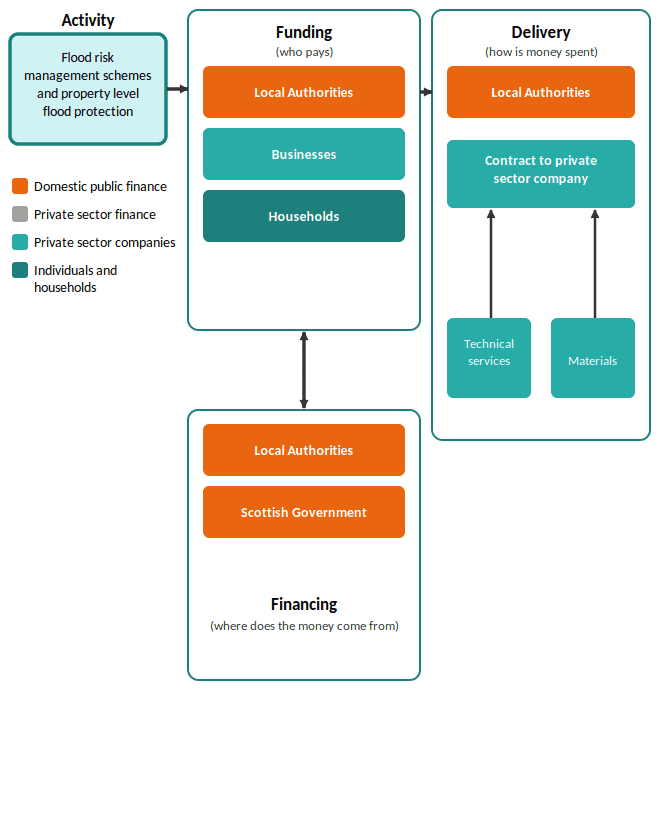
Figure 7: Financing, funding, and delivery arrangements for adaptation in flood protection schemes and property flood resilience.
Innovation that could boost private sector participation
Opportunities to leverage private investment in adapting to changing flood risk in Scotland could include:
Scotland Bond Issuance programme: Scottish Government is in the process of putting in place the mechanisms to facilitate the issuance of bonds, having obtained a credit rating and appointing banks and legal advisors (Scottish Government, 2026a). This has been used in the UK to provide upfront financing for Flood and Coastal Erosion Risk Management, with UK Government reporting on use of proceeds. Similar mechanisms could be used to provide a significant boost to available capital investment.
The FloodRe ‘build back better’ scheme: For communities impacted by flooding, it is likely their properties will be eligible for the FloodRe ‘build back better’ scheme, a joint initiative between the UK insurance industry and the UK Government, which offers householders the chance to install property flood resilience measures up to the value of £10,000 when repairing their properties after a flood (FloodRe, 2023). No data is currently published on use, but uptake is thought to be low.
Scotland’s current resilience organisations: These span Regional and Local Resilience Partnerships, Community Resilience Committees, and Category 1 and 2 responders (Brett et al., 2026). They represent a cost-effective foundation for building adaptation capacity without requiring entirely new delivery structures. Embedding adaptation within local authority contingency planners, local resilience partnerships, and community councils offers a pragmatic route to scaling capacity building across Scotland’s communities and institutions. Private sector organisations, particularly utility and transport operators operating as Category 2 responders, are well positioned to potentially contribute co-funding and expertise to this capacity building as part of their existing statutory obligations and business continuity responsibilities.
There are multiple opportunities to increase both private sector funding and financing. Financing opportunities relate to the use of a range of debt financing instruments, such as green bonds, to support adaptation. There have also been examples where development banks have provided commercial funds to help local authorities address fiscal space constraints. In addition, there have been some examples in England where the use of PPPs has been used to unlock private sector financing for flood defences. In a similar vein, Land Value Capture and Tax Increment Financing provides an option to unlock future revenue streams through increases in land value or development through investment in flood defences. Parametric insurance has also been used to provide upfront protection for coral reefs which serve as flood defences as well as payouts for recovery.
There are also schemes which encourage private sector funding (summarised in Table 14), such as direct contributions to flood risk management schemes. Evidence from the National Audit Office suggests that around 9% of total contributions to flood defences in England came from businesses (National Audit Office, 2023) – but also from more local schemes, such as the use of climate resilience districts or water funds. There is also the potential for the use of tourism taxes and levies, as well as dedicated levies for climate resilience, such as those in Greece or Italy (Venice). There are also models which leverage revenue streams from co-investment such as in the Netherlands where revenues from wind turbines have been used to partially fund dikes.
Table 14: Examples of innovative models for private participation in flood protection, with cost recovery model. Source: Authors, updated from Watkiss and England, 2025.
|
Model |
Examples |
Cost recovery model |
|
Green bonds / resilience bonds |
UK green bonds (gilts) include coastal projects (UK Debt Management Office, n.d.) European Bank for Reconstruction and Development climate resilience bonds (Bennett, 2019) |
Government pays |
|
Public Private Partnership (PPPs) |
UK Broadlands (Jacobs, n.d.) / US Fargo |
Mixed |
|
Parametric insurance |
Quintana Roo (Green Finance Institute, 2024a) |
User pays (public and private sources) |
|
Local water use charges or taxes |
Copenhagen Cloudburst (City of Copenhagen, 2012) |
User pays (local public and private) |
|
Land Value Capture / Tax Increment Financing |
Mission Rock Bhutan Phuentsholing Township Development (ADB, 2018) |
User pays |
|
Mitigation co-benefits |
RWE wind turbines on dikes, Netherlands (Windpowernl, 2022) |
Co-benefit streams – energy sales |
|
Private co-funding of flood defences |
UK Flood and Coastal Erosion Risk Management Strategy |
Business pays |
|
Increased private contribution to PFR |
UK assessment (Wood Environment & Infrastructure Solutions UK Limited, 2019) |
User pays (private) (Possible insurance benefit). |
|
Climate resilience districts |
US (California, Connetticut), |
Businesses pay |
|
Tourist taxes / Levies |
Hawaii (Jacobo, 2025), Venice, Greece |
User pays |
|
Concessional Finance |
National Wealth Fund, Wales |
Government pays |
Natural environment
Key climate risks and adaptation opportunities
Peatland
Scotland’s peatlands face serious and accelerating degradation from multiple climate pressures. Heavier rainfall increases erosion and carbon-rich sediment loss, while warmer, drier summers accelerate oxidation and peat loss – with degraded lowland peatlands already losing 1–2 cm of soil depth annually. Heightened wildfire risk adds further pressure, and many peatlands remain inadequately monitored, meaning the true extent of degradation may be underestimated. Climate risk is projected to rise from medium to high, with the potential for irreversible loss of peatland functions including carbon storage, biodiversity support and water regulation (Sniffer, 2021).
Reversing this degradation requires more comprehensive monitoring of peat condition, integrated land-use policies prioritising protection and restoration, and targeted guidance for land managers on re-wetting, water management and erosion prevention. Peatland adaptation must also align closely with mitigation strategies. For example, directing woodland expansion onto mineral soils rather than peat, and stress-testing net zero measures against future climate risks. Better research on climate impacts to carbon stores, more systematic soil carbon monitoring, and strategic cross-sector land-use planning across agriculture, forestry and coastal zones will be essential to safeguard water quality, flood regulation and the reliability of Scotland’s greenhouse gas projections as the climate shifts (Sniffer, 2021).
Forestry
Scotland’s forestry sector faces serious and interconnected climate threats (risks N6, N8 and N9 in CCRA3). Rising temperatures and increasing drought, particularly in central and eastern regions, are reducing growth rates, affecting timber quality and shifting species viability. Commercially important species such as Sitka spruce are losing ground to more drought-tolerant alternatives. Broadleaved species face severe stress from more frequent extreme weather. Warmer conditions are also accelerating the arrival and spread of pests, pathogens and invasive species, including Phytophthora ramorum, Dothistroma needle blight and bark beetles, compounded by increasing deer damage. Overall risk is projected to rise from medium to high under future warming, while potential opportunities from longer growing seasons and expanded species suitability remain largely unrealised due to adaptation barriers (Sniffer, 2021).
Building forestry resilience requires integrated action across several fronts. Strategic land-use planning must embed both adaptation and mitigation objectives, with clearer decisions about which forest types and locations remain viable as conditions change. Improved surveillance and biosecurity at ports of entry, better soil and water management, strengthened wildfire preparedness, and diversified woodland species and structures will all help spread risk and improve long-term productivity. Warmer temperatures do create opportunities for previously unsuitable species such as Douglas fir and fast-growing bioenergy trees, but realising these benefits requires deliberate research and field trials. Enhanced cross-sector coordination, better knowledge exchange with land managers, and targeted research into future-adapted management systems will be essential to maintain carbon storage, support Net Zero transitions, and preserve the ecological and economic value of Scotland’s woodlands as the climate shifts (Sniffer, 2021).
Nature restoration
There are also multiple adaptation opportunities within the nature restoration that align with wider biodiversity and carbon mitigation targets. Case study 3 outlines on-going research NatureScot is conducting to explore catchment scale nature restoration cost estimates.
Case study 3: Catchment scale nature restoration, NatureScot
Context
- NatureScot is working with SEPA, Scottish Water, FLS and Scottish Forestry to review and prioritise landscape / catchment scale nature restoration projects across Scotland (Scottish Biodiversity Strategy Action 2.1) and align this with SNAP3 objective NC2 on landscape scale approaches to climate adaptation and river basin management planning.
Preliminary cost estimates
NatureScot have started to estimate the costs of restoring catchments across Scotland and work is underway to refine these. Early in financial year 2026/27 they hope to have indicative costs for catchment scale restoration across Scotland, likely to be in the region of £5bn. Through 2026/27 they will develop a costed pipeline of projects out to 2045, refining the cost estimates at project scale to inform an Investment Plan for delivery.
Current methods use GIS analysis and cost assumptions based on existing projects. During 2026/27, the projects themselves will estimate costs to inform a more accurate cost estimate.
Key challenges and opportunities for climate adaptation at a catchment scale:
- Lack of evidence on the costs of natural flood management
- Lack of evidence to support quantification of benefits and to inform a business case
- Lack of long-term commitments to the funding streams that currently pay for restoration and insufficient funding for the scale of the challenge
- Immature nature finance market which is not yet delivering private investment at the scale required.
Current spending and context
Current Scottish Government spending includes specific investment in nature based climate solutions. For 2026/27, the Scottish Budget allocates £28m for peatland restoration, supporting the restoration of over 10,000 hectares of degraded peatland. A further £37m is committed to woodland creation, aimed at delivering more than 12,000 hectares of new woodland (Scottish Government, 2026b). In addition, £26m is allocated through the Climate Taxonomy for nature restoration activities, supporting wider ecological recovery and contributing to long-term climate adaptation and resilience objectives (Scottish Government, 2026c).
Adaptation investment need
Cost estimates for the natural environment draw on the Scottish Government’s draft Climate Change Plan (CCP) and Scottish Budget Climate Taxonomy (2026/27), with expert-elicited proportions assigned to reflect the share of costs attributable to adaptation. These proportions, 25% for peatland restoration, 6.25% for woodland creation, and 20% for wider nature restoration, were derived by examining the mixed objectives of each budget line and assigning a share to adaptation relative to co-benefits such as carbon mitigation, biodiversity gain, and flood alleviation. For peatland restoration, for example, carbon mitigation is the primary objective of the CCP spend, with flood reduction and biodiversity functioning as secondary objectives; the adaptation proportion reflects this hierarchy. These proportions were cross-checked through expert review with Paul Watkiss Associates, drawing on comparable apportionment approaches used in parallel Climate Change Committee analysis for England (Watkiss et al., 2026a). No uplift for increasing climate risk was applied to these estimates up to 2040. It should be noted that other relevant actions – including wildfire management and enhanced monitoring of peatland and woodland restoration – have not been costed here and would add to the overall investment need.
Peatland
Scotland’s draft CCP projects peatland restoration ramping up from approximately 15,400 ha/yr in 2026 to just over 22,500 ha/yr from 2030 onwards, totalling 319,489 ha by 2040, contributing toward the wider Scottish Government target of 400,000 ha of peatland restoration by 2040. Total peatland restoration costs were estimated using the draft CCP central estimate of £2,894/ha (capital and resource combined), assuming a mix of peat types restored across 2026 – 2040, with capital costs derived from Glenk et al. (2025) using 2022 grant data uplifted to current prices using ONS GDP deflators. Applied to the CCP’s restoration target, this yields a total cost of £925m (£66m/yr) in 2025/26 prices for 2026–2040. A 25% adaptation apportionment was applied on the basis that, while the off-site adaptation benefits of peatland restoration represent a relatively modest share of overall benefits, there are also meaningful on-site benefits to the peatlands themselves. The UK National Adaptation Plan similarly cites climate resilience as one of four core benefits of restoration (Watkiss et al., 2026a).
We estimate climate adaptation investment need for peatland restoration at £236m to 2040, equivalent to £16.8m/yr. It is important to note that peatland restoration costs are subject to considerable uncertainty, varying significantly by peat type, depth, location, site accessibility, and contracting arrangements. Okumah et al. (2019) report a median restoration cost of £1,009/ha, with a range of £3,707 between minimum and maximum estimates. Glenk et al. (2025) report costs ranging from £191/ha at the 5th percentile to £4,483/ha at the 95th percentile. This wide cost distribution means peatland restoration estimates should be treated with particular caution. Further research to better constrain unit costs would meaningfully improve the robustness of future investment needs assessments.
Woodland creation
Scotland’s draft CCP projects woodland creation ramping up from 12000 ha/yr in 2026 to 18,000 ha/yr from 2029 onwards, totalling 258,000 ha between 2026–2040. For woodland the study used the central estimates of total costs provided by the Scottish Government. These estimates include the total capital, maintenance and administration costs between Scottish Government and businesses at a total of £1,799m to 2040.
Apportioning a share of this expenditure to climate adaptation is not straightforward. The primary objective of woodland creation is carbon mitigation, and woodlands can in some cases increase certain climate risks. For example, this can be through disease spread, fallen trees from storms, and increased vegetation growth affecting critical infrastructure (e.g., Bebber et al., 2025; Network Rail Scotland, 2024). Identifying the adaptation-specific component therefore required an evidence-based approach.
To apportion a share of expenditure, we drew on the Economic and Natural Capital Assessment (ENCA) database to compare the economic value of flood control benefits delivered by woodland creation and peatland restoration, expressed in £/ha/yr. Flood control was the only comparable adaptation benefit available to us in consistent monetary terms across both habitat types. The evidence indicates that flood control benefits from woodland creation are approximately four times lower than those from peatland restoration per hectare (Broadmeadow et al., 2023; Morris and Camino, 2011). Having assigned a 25% adaptation apportionment to peatland restoration on this basis, we therefore applied a proportionally scaled figure of 6.25% to woodland creation. This apportionment was cross-checked through expert review with Paul Watkiss Associates.
We recognise that this approach captures only one dimension of adaptation value – flood control – and that other potential adaptation benefits of woodland creation, such as shade provision, slope stabilisation, and reduced surface runoff, are not reflected in the apportionment. This figure should therefore be treated as a conservative estimate and is identified as a priority area for further research and methodological development.
We estimate climate adaptation investment need for woodland creation at £8.2m per year or £115m between 2026–2040.
Nature restoration
Finally, there is an additional budget line in the Scottish Budget 2026/27 (Scottish Government, 2026b) relating to nature restoration. The Climate Taxonomy identifies a nature restoration budget line of £26m/year, relating to policy development and implementation to manage and restore Scotland’s biodiversity and landscapes. This also includes provision of the Nature Restoration Fund and continued commitment to the Central Scotland Green Network (Scottish Government, 2026c), at a consistent level of funding. By assessing the multiple objectives of nature restoration, we assume 20% of these benefits are related to adaptation. We estimate climate adaptation investment need for nature restoration at £5.2m/yr for a total of £73m between 2026–2040.
Total adaptation investment need for natural environment
We estimate climate adaptation investment need for peatland restoration, woodland creation and nature restoration at £16.8m/yr, £8.2m/yr and £5.3m/yr respectively, totalling £30.2m/yr, or approximately £423.8m between 2026–2040 (Table 15).
Table 15: Estimated climate adaptation investment need for peatland restoration, woodland creation and nature restoration between 2026–2040. These costs represent a proportion of the total spend from the Climate Change Plan or the Scottish Budget that is related to adaptation for woodland creation (6.25%), peatland restoration (25%) and nature restoration (20%) accordingly. In 2026/27 prices.
|
Sector |
% Apportionment |
Cost p.a. (£m/yr) |
Total up to 2039/40 (£m) |
|---|---|---|---|
|
Peatland restoration |
25% |
£16.8m/yr |
£236m |
|
Woodland creation |
6.25% |
£8.2m/yr |
£114.7m |
|
Nature restoration |
20% |
£5.2m/yr |
£73.1m |
|
Total |
£30.2m/yr |
£423.8m |
Macroeconomic effects and wider impacts
Macroeconomic impacts
For natural environment, we’ve modelled the total spending outlined in the Climate Change Plan and nature restoration budget (as opposed to the adaptation portion of £423.8m – see Section 4.3.3.4). This totals just over £3bn between 2026–2040, around £200m/yr.
Without cost recovery (a modelling device to isolate the spending effect): The programme generates substantial gains in “other primary” activities – forestry and land-use sectors – where output rises by around £92m and employment by roughly 1,050 jobs by 2040. Agriculture adds £1m in output and 14 jobs. Construction gains £11m in output and 170 jobs, while “all other services” contributes around £29m and 380 jobs. The overall effect is a broad-based but especially land-focused expansion, reflecting the labour-intensive and locally embedded nature of restoration activities.
With “government pays” via expenditure cuts in all areas (a stylised scenario): When costs are recovered through public spending cuts, widespread reversals occur, particularly in service sectors. “All other services” shifts from a gain of £29m and nearly 380 jobs to a loss of roughly £102m and around 1,300 jobs. Education moves from a gain of £2.8m and 60 jobs to a loss of nearly £25m and over 520 jobs. Public administration records a decline of about £43m and nearly 480 jobs. Retail, financial services and transport flip from modest gains to losses. Even the core land-use sectors are affected: “Other primary” moves from a gain of around £92m to a small loss, and construction swings from a gain of £11m and 170 jobs to a loss of around £14m and 200 jobs. Manufacturing gains are largely erased. The aggregate effect under income-tax funding is contractionary by 2040, meaning that while restoration work still channels activity into land-use sectors, the broader economic impact turns negative once cost recovery is factored in.
Policy implications: Land-based adaptation can boost rural employment and supply chains significantly, but spending-cut recovery creates widespread service-sector losses that outweigh the direct stimulus. This highlights an acute trade-off between using spending cut and preserving activity in consumption-dependent and public-service sectors. The results exclude long-term ecosystem, carbon sequestration, flood risk reduction and recreation benefits, which are particularly important for Scotland’s climate and biodiversity goals.
Wider impacts
Woodland creation and peatland restoration generate multiple co-benefits beyond direct climate adaptation. These include carbon storage, biodiversity gain, water quality improvement, air quality, temperature regulation, flood regulation, recreation, and physical health. Resource constraints prevented a comprehensive review of all co-benefits; however, we have estimated the value of a selected range, assuming that the peatland restoration and woodland creation targets for 2026 –2040 set out in the draft CCP (see section 4.3.3) are successfully completed, to current climate resilience standards, and established by 2050.
Should the 319,488 ha of peatland targeted under the draft CCP be successfully restored between 2026 and 2040, this could generate approximately £267m/yr in flood control and storm buffering benefits, £191m/yr in water quality benefits, and £199m/yr in biodiversity benefits (Table 16).
Should the 258,000 ha of woodland targeted for creation between 2026 and 2040 be successfully established to climate-resilient standards, a range of co-benefits could be realised by 2050, once the woodland has had time to develop. These include flood storage (£29m/yr–£54m/yr), recreation and health benefits (£383m/yr), biodiversity benefits (£46m/yr), and avoided mental health costs (£48m/yr) (Table 16).
These figures carry considerable uncertainty, reflecting both the pace of establishment and the assumptions underpinning each co-benefit category. They nonetheless demonstrate that the economic case for woodland creation as a climate adaptation investment strengthens substantially when co-benefits are considered. It also demonstrates that the investment need estimates presented above likely understate the full economic value of this expenditure.
Table 16 Estimated value of a range of co-benefits (£m/yr) for 258,000ha of established woodland, and 319,488ha of established peatland restoration in 2026/27 prices.
|
Sub-sector |
Co-benefit |
Total benefits (£m/yr) |
Source |
|---|---|---|---|
|
Woodland creation |
Flood storage |
£29m/yr – £54m/yr |
Broadmeadow et al. 2023 |
|
Additional recreation and health |
£391m/yr |
Scarpa, 2003 | |
|
Biodiversity |
£46m/yr |
Willis et al., 2003 | |
|
Avoided mental health costs |
£50m/yr |
Shanahan et al., 2016 | |
|
Peatland restoration |
Flood control and storm buffering |
£267m/yr |
Morris and Camino, 2011 |
|
Water quality |
£191m/yr |
Morris and Camino, 2011 | |
|
Biodiversity |
£199m/yr |
Morris and Camino, 2011 |
Current governance, funding and financing arrangements
Peatland restoration
To deliver the Scottish Government targets for peatland restoration, Scottish Government funds five delivery partners to undertake peatland restoration to meet these targets: NatureScot, Loch Lomond and Trossachs National Park Authority, Cairngorms National Park Authority, Forestry and Land Scotland and Scottish Water seen in Figure 8 (Scottish Government 2023a). There have been some elements to crowd fund in private sector finance but for now this investment is presumed to be purely public. Beyond public funding, there has been minimal investment in peatland restoration from private sources to date, including through voluntary carbon markets (Scottish Government, 2023a).
Figure 8: Financing, funding, and delivery arrangements for adaptation in peatland restoration. Adapted from Paul Watkiss Associates.
Woodland creation
The governance landscape for woodland creation is complicated, summarised in Figure 9. It is overseen and delivered by two executive agencies – Scottish Forestry and Forest and Land Scotland. Scottish Forestry is the government agency responsible for forestry policy, regulation and grant schemes. Forestry and Land Scotland are the operational land-management agency for the forest estate. However, much planting occurs on private land and for commercial purposes. Investment in new woodland creation is supported by grants through the Forestry Grant Scheme. This supports the creation of new woodland, as well as management of existing woodlands and investments in forest infrastructure such as protection.
An evaluation of the previous phase of the Forestry Grant Scheme for Scotland highlighted that the grants are unlikely to cover the total cost of the investment (Scottish Forestry, 2025). This means there will be residual costs associated with long term management and felling that will need to be met by the private sector. However, there is no data on the proportion of this investment. Given this, we have not been able to generate reliable investments in the split of public and private sector investment in adaptation. The governance arrangements for nature restoration more broadly have not been mapped in detail due to the limited resources for the study.
Figure 9: Financing, funding, and delivery arrangements for adaptation in woodland creation.
Innovation that could boost private sector participation
While nature and ecosystems have broadly public characteristics, there are a range of mechanisms (see Table 17) that can support private sector involvement in adaptation and provision of ecosystem services.
The first cluster relate to the benefits derived from ecosystems. These include dedicated payment for ecosystem services schemes, but also carbon and biodiversity credits, or for loss reduction, noting that these are co-benefits and that the locations of planting need to coincide with those needed for risk reduction, and that in such schemes the revenues are too small and benefits arise (Watkiss and Hunt, 2024; England et al., 2025). The Scottish Government, NatureScot and SEPA are supporting CreditNature, selected through the CivTech innovation accelerator, to develop a voluntary biodiversity credit market for Scotland. This will be guided by the British Standards Institute’s Nature Investment Standards programme and the Scottish Government’s Natural Capital Markets Framework (Scottish Government, 2023b; Scottish Government, 2024b; NatureScot, 2026). Similarly, in England, the introduction of Biodiversity net gain is also supporting the development of a market and is beginning to unlock new investment in ecosystem restoration (e.g. Avon Needs Trees).
There are some examples of private and corporate investment. Philanthropic investment has included around £50m over three years for rewilding across privately managed Scottish estates (BBC, 2019). Diageo has committed up to £5m over five years to restore up to 3,000 hectares of degraded peatland by 2030 – illustrating how businesses with supply chain dependencies on healthy ecosystems can become adaptation co-funders (Diageo, 2026). However, these are likely to be relatively modest and opportunistic.
A second cluster relates to investment based on sustainability outcomes, whereby the terms of financing are preferential based on the impact. This includes payment for ecosystem services, sustainability linked loans, as well as direct investments in nature-positive businesses and redeemable equity. There have been efforts by the Scottish National Investment Bank to provide concessional credit lines to support. For example, the SNIB recently provided a £50m cornerstone investment to the Gresham House Forestry Fund, 60% of which will be invested in Scotland, and which includes commitment to climate resilience (Scottish National Investment Bank, 2026).
Finally, there are also a cluster of insurance-based innovations. For example, in Colombia, the City of Bogota has extended previous work by The Nature Conservancy (TNC) on Water Funds. This provides a proactive fund where beneficiaries pay into funds which support proactive risk reduction as well as offering parametric insurance for response and recovery. In Mexico, the Quintana Roo coral reef scheme sees local businesses and tourists paying in alongside government to support reef protection and receive parametric insurance. In addition, the NATURANCE and PIISA Horizon Europe projects examining how disaster risk financing can be combined with nature-based solutions to develop scalable insurance products (Climate-ADAPT, 2026).
Table 17: Examples of innovative models for private participation in natural environment, with cost recovery model. Source: Authors, updated from Watkiss and England, 2025.
|
Model |
Examples |
Cost recovery model |
|
Anticipatory parametric insurance for damage reduction |
Paramos Wildfire Facility, Colombia |
User pays |
|
Blockchain carbon credits for ecosystem services |
AirEco (Indonesia) (SEED, n.d.) |
User pays |
|
Online platform with blockchain tokens, and enhanced Monitoring, Reporting, and Verification |
Global Mangrove Trust (Thailand) (SEED, 2018) |
User pays |
|
Voluntary carbon markets (with NbS projects) |
REDD+ examples, such as Mai Ndombe REDD+ project (Democratic Republic of Congo) and Lariba REDD+ project (Zimbabwe) Reforestation/afforestation projects such as CommuniTree Carbon Program (Nicaragua) Regenerative agriculture projects such as Nature Carbon (Cerrado Biome) (Brazil) |
Private sector pays |
|
Biodiversity credits/offsets |
Ambatovy Minerals Project (Madagascar) (World Bank Group, 2016) Lom Pangar Hydropower Project (Cameroon) Savimbo (Colombia, Colombian Amazon) (Dasgupta, 2024) WWF Pilot Projects (Tanzania) (WWF, n.d.) |
Private sector pays but can generate value addition through financial return |
|
Payment for Loss Reduction |
Restoration Insurance Service Company (RISCO) (Philippines, Mexico, Brazil, Malaysia) – mangroves (CPI, n.d.) |
User pays |
|
Sustainability premium and traceability app |
Monsoon Tea Company (Thailand) (GSMA, 2024) |
User pays |
|
Investment fund for nature-positive businesses |
Tropical Resilience Fund (Africa, Latin America, East/Southeast Asia) (Global Innovation Lab for Climate Finance, n.d., a) |
Private sector pays |
|
Payment for ecosystem services |
The Nature Conservancy (TNC) Water Funds Portfolio (TNC, 2024) BIOFIN – capacity building in identifying and implementing relevant ecosystem services payments (BIOFIN, 2024a) Forest Resilience Bond (California, US) (Green Finance Institute, 2024b) UN-REDD Programme Initiatives |
User pays |
|
Sustainability Linked Loans |
ING’s Nature Framework and SLLs (Europe) (ING, 2025) |
User pays |
|
Direct investment in NbS-generating businesses/ projects (equity-based) |
Cacao Oro de Nicaragua (sustainable agroforestry for cacao production) (GIZ, 2023) African Conservation and Communities Tourism (ACCT) Fund (eco-tourism supporting conservation) (GIZ, 2023) |
User pays |
|
Impact bonds (e.g. conservation impact bonds) |
Deshkan Ziibi Conservation Impact Bond (DZCIB) (Canada) (Arjaliès, 2024) |
Government or philanthropic organization pays |
|
Blended Finance for NbS |
SNIB FORESTRY Amazon Biodiversity Fund (Brazil) (Ivory, 2025) Tropical Forest Forever Facility (Brazil/World Bank) (weADAPT 2025) |
Consumer/end user pays and gets access to better services, cost savings, or enhanced ecosystem benefits. |
|
Redeemable equity |
Regenera Ventures Fund (Mexico) (Brasil-Leigh et al., 2024) |
User pays |
|
Certification and Standardization |
Certification of NbS portfolios (Morocco, Senegal) (GEF, 2021) |
Government and businesses pay |
|
Insurance and risk-transfer mechanisms |
Quintana Roo Coral Reef Insurance (Mexico) (GIZ, 2023) |
Consumers pay via tourism, and taxpayers via government, while benefiting from public goods – tourism assets, reduced disaster risk, and ecosystem health. |
|
Platform / ecosystem development |
SCALE (global) |
Government pays |
Transport
Key climate risks and adaptation opportunities
Road networks
Scotland’s road network faces a complex and intensifying set of climate-driven pressures threatening long-term reliability, safety and connectivity. More intense rainfall is accelerating surface water flooding, overwhelming drainage systems and causing recurring closures on trunk and local roads alike. In upland and rural areas, where single-access routes are common, even short-lived disruptions can isolate communities and disrupt supply chains. Saturated soils and steep topography are heightening landslide risk, most visible along routes such as the A83 at the Rest and Be Thankful, where repeated slope failures have led to long detours and escalating maintenance costs. Extreme temperatures add further stress, damaging pavements and bridges in summer while winter storms bring wind hazards, fallen debris and ice-related disruption (Sniffer, 2021).
Strengthening resilience will require a more strategic, forward-looking approach to maintenance, planning and design. Key priorities include identifying road corridors most vulnerable to flooding and slope failure, scaling up green-blue infrastructure and Sustainable Drainage Systems, improving drainage capacity, and applying soft-engineering approaches such as vegetation management to stabilise slopes. Better condition monitoring, data sharing and early-warning systems for rainfall, wind and landslide risk can support more proactive hazard management. For new infrastructure, mainstreaming climate adaptation into design standards will be essential to avoid costly retrofits, while stronger resilience indicators and more consistent climate risk assessment across local road authorities will be critical to closing Scotland’s current adaptation gap (Sniffer, 2021).
Rail networks
Scotland’s rail network, spanning over 1,700 miles and 360 stations across diverse and challenging terrain, is already experiencing the impacts of a changing climate, with risks projected to intensify over the coming decades (Network Rail Scotland, 2024). Observed changes include warmer average temperatures, altered rainfall patterns, and an increase in the frequency and severity of extreme weather events.
More intense and prolonged rainfall increases the likelihood of surface water and river flooding, as well as saturated ground conditions, contributing to earthwork instability. Embankments and cuttings, many of which are Victorian era assets, are becoming increasingly vulnerable to failure, leading to disruption, safety risk and higher maintenance demand. Storms and high winds continue to cause disruption through fallen trees, debris and damage to exposed assets, while coastal routes face longer term risks from erosion, sea level rise and increased wave action (Network Rail Scotland, 2024).
Higher temperatures are an emerging and growing risk, with hotter and more frequent heat events increasing the incidence of rail buckling, overhead line sag and emergency speed restrictions, affecting network performance and reliability (Network Rail Scotland, 2024).
Wind, flooding and snow are consistently the most disruptive and costly weather hazards on the Scottish network, with weather related disruption incurring significant Schedule 8 compensation costs (payments made to train operators following unplanned disruption) over the past decade (Network Rail, 2024). Around 90% of Network Rail assets are as they were when installed before the year 2000 and were not designed to contend with the more aggressive weather conditions now being experienced or forecast for the future under climate change (Network Rail, 2024).
Network Rail Scotland’s key adaptation priorities include delivering revised climate change risk assessments to identify future vulnerable locations, developing a long-term adaptation strategy using an adaptation pathways approach, and enhancing monitoring and assurance of resilience actions across the network (Network Rail Scotland, 2024).
In addition to spending on infrastructure, there may be some spending being undertaken on rolling stock companies (ROSCOs), but this is not available and therefore excluded from estimates of adaptation investment need.
Current spending and context
Specific information on the cost of climate proofing trunk roads and motorways within Scotland is currently not available. However, the Scottish Budget 2026/27 allocates approximately £82m to adaptation and resilience for trunk roads and motorways (Scottish Government, 2026c). This budget line covers trunk road adaptation schemes to improve network resilience to climate change and severe weather, casualty reduction measures, and Traffic Scotland operational commitments.
Furthermore, Network Rail Scotland has already spent £103.1m of primary resilience interventions to date in control period 7 2024–2029 (CP7). The largest shares have been directed at earthworks (£59.8m) and drainage (£27.7m), reflecting the priority placed on managing slope instability and flood risk across the network.
Adaptation investment need
Transport adaptation investment need was assessed across two sub-sectors: trunk roads and motorways, and rail. Other transport modes, including ferries, canals, aviation, and active travel, have not been included in this analysis and would add to the overall investment need.
Road networks
There is limited information regarding future investment need for climate adaptation on the road network. Strategic Transport Projects Review 2 (STPR2) estimates indicate a capital cost banding of £1bn – £2.5bn over the life of the review from 2022–2042 (Jacobs & AECOM, 2022), reflecting the anticipated scale of investment required to adapt the trunk road and motorway network to climate change. However, this figure was explicitly indicative rather than a precise cost estimate, based primarily on adaptation to flooding at highly exposed locations and not accounting for the full range of relevant climate hazards, including landslides, high winds, scour, and high temperatures. Transport Scotland anticipated that a dedicated Trunk Roads Climate Change Adaptation Plan would establish more robust costs in due course and does not consider the STPR2 figures sufficiently reliable for planning purposes.
To estimate adaptation investment need for trunk roads and motorways, we explored current Scottish Government budget lines with a neutral or positive adaptation influence were identified from the Scottish Budget 2026/27 and associated Climate Taxonomy (Scottish Government, 2026b; 2026c). The Transport Portfolio contains 15 budget lines associated with the Trunk Road Network, of which four, relating to network depreciation and PPP payments, were excluded as not relevant to climate adaptation, leaving 11 budget lines for analysis (Table 18).
Table 18: Budget lines from the Scottish Government Climate Taxonomy 2026/27 that we included in adaptation investment need analysis via exploring the additional ‘climate proofing’ spend or the whole budget.
|
Budget lines included in analysis |
2026/27 budget (£m) |
Climate proofing / whole budget |
|---|---|---|
|
Capital Land and works |
£223.26m |
Climate proofing |
|
Tay Road Bridge Capital Grant |
£3.09m |
Climate proofing |
|
Tay Road Bridge Resource Grant |
£2.2m |
Climate proofing |
|
Adaptation and resilience |
£82.32m |
Whole budget |
|
Bridge Strengthening and Repairs |
£149m |
Climate proofing |
|
Woodside Viaduct |
£23.7m |
Climate proofing |
|
Trunk Roads Structural Repairs |
£142m |
Climate proofing |
|
Routine and Winter Maintenance |
£172.34m |
Climate proofing |
|
Safety Camera |
£8.2m |
Climate proofing |
|
Other Trunk Road Expenditure |
£14.28m |
Climate proofing |
|
Road Safety |
£19.36m |
Climate proofing |
Two approaches were applied to these budget lines. For ten of the eleven lines, a climate-proofing uplift was applied to estimate the additional investment required to maintain network resilience under a changing climate. Uplift factors of 2.5% and 10%, representing the lower and upper bounds of the additional cost of climate-proofing infrastructure, were drawn from scaling factors in the Asian Development Bank (2014) and World Bank (2019). Crucially, the uplift itself – that is, the difference between the original and uplifted budget – represents the estimated additional spend attributable to climate-proofing, rather than the total uplifted budget. For the adaptation and resilience budget line, the full budget allocation was retained, as this line is wholly directed at adaptation activity.
Applying the climate proofing approach and budget lines outlined in Table 17, the estimated adaptation investment needed for trunk roads and motorways is between £101.2m–£158.06m/yr, amounting to approximately £1,417.52m–£2,212.82m over the period 2026–2040 (Table 19).
Table 19: Climate change adaptation investment need for trunk roads and motorways between 2026-2040. Presented in 2026/27 prices.
|
Transport (road) | ||
|---|---|---|
|
Period |
Lower estimate (2.5% uplift) (£m) |
Upper estimate (10% uplift) (£m) |
|
Total (2026– 2040) (£m) |
£1,417.52m |
£2,212.82m |
|
Total (2026–2040 p.a.) (£m/yr) |
£101.25m |
£158.06m |
Local road networks, maintained by local authorities rather than Transport Scotland, are not captured in this analysis. These represent an additional and likely material cost that is expected to grow as climate risk intensifies but fell beyond the scope of the present study. Several methodological limitations are also worth noting. Some budget line descriptions overlap, introducing a degree of potential double-counting (see supplementary data for more detail). The 2.5% and 10% uplift range is derived from international infrastructure literature and may not fully capture the specific risk profile of Scotland’s trunk road network. Applying a larger uplift – as some international studies have suggested may be appropriate for higher emissions scenarios – would yield considerably higher estimates, suggesting the figures presented here may be conservative.
These estimates were triangulated by scaling adaptation cost estimates from Neumann et al. (2025) to the Scottish context as an international benchmark. Neumann et al. (2025) estimated EU transport adaptation costs at approximately 0.04%–0.06% of GDP per year under moderate to high emissions scenarios. Applying this range to Scotland’s GDP yields an indicative figure of £90m – £142m/yr (2026/27 prices), which is broadly consistent with the trunk roads and motorways estimate presented above. However, this comparison should be treated with caution: the nature and projected intensification of climate hazards vary considerably across EU member states and diverges from Scotland’s risk profile in important respects. Furthermore, Neumann et al. (2025) does not provide a breakdown between road and rail spending, limiting the precision of this transfer. These figures were therefore used as an indicative benchmark to assess how our estimates compare at an international level, and are not included in our reported adaptation investment need figures.
Transport Scotland is also actively working to better understand the scale of investment needed for adapting trunk roads to be resilient to climate change. For example, they are developing the Vulnerable Locations Operational Group (VLOG) prioritisation tool to identify climate-vulnerable locations across the trunk road network and better constrain the costs of necessary upgrades and renewals (see case study 4). Consequently, the indicative adaptation investment estimates outlined in this report are expected to be further refined as this ongoing analysis matures.
Case Study 4: Vulnerable Locations Operational Group (VLOG) prioritisation tool
The Vulnerable Locations Operational Group (VLOG) prioritisation tool, developed by Transport Scotland, identifies which parts of Scotland’s trunk road network are most vulnerable to climate change and where investment is most needed. By bringing together asset information to assess exposure, sensitivity, and adaptive capacity, the tool provides a consistent, evidence-based approach to understanding climate risks and prioritising funding across the wide range of geotechnical and geometric challenges throughout Scotland’s network.
The tool uses a scoring and ranking system that evaluates locations against a range of factors including whole-life asset costs, effectiveness of risk reduction, environmental benefits, social impacts, and economic consequences of route disruption. This allows different locations and interventions to be compared fairly and transparently, with quality checks, peer review, and alignment with existing appraisal and business case processes built in to ensure decisions can be reviewed and approved through established governance structures.
Over time, the VLOG tool will help Transport Scotland baseline and monitor how climate-related risks evolve as projects progress and conditions change. For adaptation planning specifically, understanding which locations are most vulnerable and what interventions deliver the greatest risk reduction is essential for ensuring investment is targeted where it will have most impact – moving beyond reactive maintenance towards proactive, planned adaptation. Critically, the tool will enable more asset-based adaptation investment need estimates, moving beyond the indicative budget-line approach used in this report towards a robust, location-specific evidence base for future climate resilience planning across Scotland’s trunk road network.
Image: Example of VLOG prioritisation tool dashboard outlining climate-vulnerable sites.
Rail networks
Interpretation of Network Rail Scotland Investment estimates
The rail investment figures presented here represent indicative, scenario‑based estimates developed by Network Rail Scotland to explore the potential scale of climate adaptation investment required to maintain current levels of service and safety under future climate conditions.
The upper end of the range reflects a plausible future pathway that includes what are currently hypothetical transformational capital interventions at particularly vulnerable locations, which may or may not be required depending on how climate risks evolve over time, and how Network Rail chooses to sequence interventions that are required based on its adaptation pathways programme.
As with other sectors, the absence of agreed levels of service and climate risk‑tolerance targets means these figures are best understood as order‑of‑magnitude planning assumptions, intended to inform strategic discussion rather than define investment requirements.
Investment need estimates
Investment need estimates for the Scottish rail network were drawn directly from high-level analysis Network Rail Scotland’s internal climate adaptation assessment. This draws on climate-based modelling, expert judgement, and current spending patterns to project costs across two categories of spend: (a) operations, support, maintenance and renewals (OSMR), which covers the ongoing costs of maintaining a climate-resilient network; and (b) major capital interventions (MCI), which covers larger-scale infrastructure investment at vulnerable locations. Full details of the underlying methods, assumptions, and calculations are provided in Appendix B.
Total potential adaptation investment requirements for the Scottish rail network are estimated at between £113m–£338.1m/yr, amounting to £1,581.8m–£4,733.6m when operations, support, maintenance and renewals (OSMR) and major capital interventions (MCI) are included over the period 2026–2040 (all figures in 2026/27 prices) (Table 20). This spend would cover increased operational and maintenance activity in response to more frequent severe weather. Such activity includes additional seasonal treatment trains, emergency speed restrictions, and reactive repairs following weather-induced failures, targeted renewals to address accelerated asset degradation across drainage, earthworks, and track. At the upper end, it includes hypothetical transformational capital schemes at locations where incremental intervention alone cannot sustain current service levels, such as infrastructure re-alignment in response to coastal erosion.
The wide range between lower and upper bounds, particularly for MCI, reflects the inherent difficulty of projecting major capital requirements over long time horizons. Network Rail Scotland note that ongoing work under their Adaptation Pathways Programme is expected to narrow these ranges as vulnerable locations become better characterised. These figures represent one plausible investment scenario focused on continued service delivery; alternative investment scenarios could reasonably be explored.
Table 20: Estimated climate change adaptation investment need for Network Rail Scotland, 2026–2040, based on CP7 remaining spend, CP8 and CP9 allocations under a continued service scenario, and pro-rated 2039/40 spend. All figures uplifted to 2026/27 prices (assuming 2% nominal growth per annum) from 2023/24 base prices provided by Network Rail Scotland.
|
Transport (rail) | ||||
|---|---|---|---|---|
|
Operations, support, maintenance and renewals (OSMR) |
Operations, support, maintenance and renewals (OSMR) + major capital interventions (MCI) | |||
|
Period |
Lower estimate (£m) |
Upper estimate (£m) |
Lower estimate (£m) |
Upper estimate (£m) |
|
Total (£m) |
£998.2m |
£1,815.3m |
£1,581.8m |
£4,733.6m |
|
Total (£m/yr) |
£71.3m/yr |
£129.7m/yr |
£113m/yr |
£338.1m/yr |
Case Study 5: Extreme rainfall and landslides at the Falls of Cruachan
The Oban branch of the West Highland Line plays a vital role connecting rural communities around Oban with the rest of Scotland, running alongside the A85 trunk road through mountainous terrain with limited diversionary routes when disruption occurs. The Northwest Highlands are the wettest area of Great Britain. Parts of the railway line – particularly near the Falls of Cruachan – are highly susceptible to landslides due to prolonged heavy rainfall, steep topography, and proximity to unstable slopes. In December 2022, approximately 100 tonnes of material moved down Ben Cruachan’s slopes onto the railway and A85, caused by a blocked culvert overtopped during adverse weather.
Temporary repairs to reopen the railway, including slope stabilisation, signalling repairs, and new track, cost approximately £0.5m. A more permanent fix is now underway at a cost of £3m, encompassing drainage renewal, soil nailing, erosion protection, and lightweight catch fences. Control period 7* plans also include approximately £5m for ongoing vegetation removal and maintenance of the line’s stone signals, which date to 1882 and are approaching life expiry.
Further investment will be required in later years to provide a longer-term solution as increasing frequency of adverse weather events heightens landslide risk. Network Rail Scotland’s current view is that resilience work will combine low-to-medium capacity catch fences with modern instrumented barrier technology along the four-mile length. This is at an estimated cost of circa. £5m in CP8, alongside continued improvement of drainage asset maintenance to better manage water movement during heavy rainfall events. Longer-term options under consideration through Network Rail Scotland’s climate change adaptation pathways programme include a combination of nature-based solutions, such as enhanced vegetation management to stabilise slopes, alongside engineered interventions, reflecting a broader shift towards integrated, pathway-based approaches to managing climate risk on vulnerable parts of the network.
*A control period is Network Rail’s fixed five-year funding and planning cycle that sets budgets and outputs for the railway (e.g., CP7 1 April 2024 – 31 Mar 2029).

Image: Landslide over railway at Falls of Cruachan.
Macroeconomic effects and wider impacts
Macro-economic impacts
Trunk roads and motorways
For macroeconomic modelling we assume trunk roads and motorways require the adaptation investment between 2026–2040 of approximately £90m/yr. These have differing pricing years compared to section 4.4.3.1. This spending flows primarily to construction and wholesale/retail (vehicles), with significant additional activity in public administration, architectural services and a wide range of supply-chain sectors.
Without cost recovery (a modelling device to isolate the spending effect): By 2040, construction gains £12.7m in output and 191 jobs, while wholesale/retail (vehicles) adds £29m in output and 516 jobs. Supply-chain effects spread to fabricated metals, manufacturing, energy and primary sectors, and household consumption spillovers boost retail, financial and travel services. No major sector is worse off during the construction period; the programme delivers broad-based increases in output and employment across the economy.
With “government pays” cost recovery (a stylised scenario): When costs are recovered through higher income tax, the core delivery sectors retain net gains. Construction still adds £3.6m in output and 43 jobs, wholesale/retail (vehicles) retains £26.6m in output and 472 jobs, and public administration adds £5.5m and 55 jobs – because they remain central to the works. However, many consumer-facing sectors flip to losses. Retail (excluding vehicles) loses £3.7m in output and 88 jobs, while “all other services” records a loss of £24.3m and 385 jobs. Manufacturing and primary sectors similarly shift from gains to losses as higher income tax squeezes household spending and raises labour costs, reducing demand and competitiveness.
Policy implications: Without cost recovery, roads adaptation delivers a strong temporary stimulus across the economy. With income-tax funding, construction and vehicle-related sectors still gain, but many consumer and trade-exposed sectors lose activity and jobs. Policymakers must balance fiscal sustainability against these short-term economic effects and against the long-term resilience benefits of climate-ready road infrastructure.
Rail Network
Using the lower estimate for investment in operations, support, maintenance and renewals (OSMR) and major capital interventions (MCI), rail network climate adaptation requires approximately £100m/yr of investment from 2026–2040. The spending flows primarily to wholesale/retail (vehicles) for rolling stock maintenance and replacement, construction for network reinforcement, and public administration for programme management.
Without cost recovery (a modelling device to isolate the spending effect): The programme creates a demand stimulus that peaks at 0.5% GDP growth (around £100m) and 1,500 FTE jobs by 2040. The sectors delivering the works experience the largest gains, with positive spillovers to consumer services as higher household incomes boost spending. Prices rise only modestly as workers migrate to Scotland to meet labour demand, easing wage pressures. All sectors benefit or remain unaffected during the investment period, though these impacts fade roughly 15 years after spending ends.
With “government pays” cost recovery (a stylised scenario): When the Scottish Government recovers costs through higher income tax, the GDP and employment gains are largely eroded and turn temporarily negative in many sectors. Higher income tax reduces household disposable incomes, particularly for higher earners, dampening the consumption that drove much of the initial stimulus. At the same time, employers partly absorb the tax rise through wage bargaining, raising their production costs and pushing prices higher for longer, which weakens Scotland’s export competitiveness. The core delivery sectors – wholesale/retail (vehicles), construction, and public administration – retain smaller gains because they remain central to the works, but consumer-facing services such as “all other services” experience significant job and output losses.
Policy implications: Income-tax funding can protect long-term rail resilience, but it imposes short- to medium-term costs in terms of growth, employment and real incomes, particularly for higher-income households. Policymakers need to weigh these costs against the avoided disruption and economic losses from climate-damaged rail infrastructure.
Current governance, funding and financing arrangements
Road networks
Delivery arrangements for road infrastructure investment are shown in Figure 10, the majority of which is funded through the public sector. Transport Scotland pays for investment on the trunk road network and contracts a range of companies to ensure Scottish trunk roads are safe, efficient and well management (Transport Scotland n.d). This includes both maintenance contracts (provided by Amey and Bear Scotland), but also a range of Design, Build, Finance and Operations (DBFO) contracts. Local roads are managed by local authorities, who pay for investment in the local road network. Scottish Government (including Transport Scotland) spent £3bn on transport in 2023/24. Local Authorities spent £1.17bn in 2023/24 (Transport Scotland, 2025).
While all adaptation costs for the trunk road network are met from government, local costs are met by local government from a mix of sources. Local Government spent £27bn in 2024/25 from four sources of income. Excluding service income (which is ringfenced for uses such as early learning and childcare but not transport) the remaining £16bn came from Scottish Government grant (63%), council tax (18%) and non-domestic rates (19%) (Scottish Government, 2026d). Assuming that adaptation costs are evenly apportioned across funding sources, applying these shares to the relative share of the total investment, we estimate that private sector contributes around 10% of the costs of adaptation, split evenly between households and businesses.
Figure 10: Financing, funding, and delivery arrangements for adaptation in road networks.
Rail networks
The rail sector is a complicated set of governance arrangements (summarised in Figure 11), since rail infrastructure, services and rolling stock are managed by separate organisations. Network Rail manages railway infrastructure. It generates a range of income from access charges, commercial income and an electricity for traction programme. The majority of rail services in Scotland are publicly provided by ScotRail through Scottish Rail Holdings Ltd (SRH Limited), an arm’s length company owned and controlled by Scottish Government (Transport Scotland, n.d), though other franchise operators (e.g. Avanti) run services serving the wider UK.
Whilst the study has not generated estimates of required adaptation spend for rolling stock, this is also important. Rolling stock is privately owned and leased from Rolling Stock Operating Companies (ROSCOs), who have invested over £20bn in rolling stock since 1995 (Mather, 2025). Payments are made from the train operating companies to ROSCOs for the lease of the stock – in 2024/25 these totalled about £2.7bn in the UK (Office of Road and Rail, 2025). Scotland intends to also continue securing financing for the stock, and a lease model (Scotrail, 2026).
Figure 11: Financing, funding, and delivery arrangements for adaptation in the Scottish rail sector.
There are already significant efforts ongoing to consolidate the sector. The UK Government is bringing franchises into public ownership as contracts expire, it is consolidating track management and rail services under Great British Rail to provide overall coordination of track and timetable franchising under one guiding arm. All franchises are expected to be due back in public ownership by the end of 2027. Under this model, Scottish ministers will set a rail strategy for Scotland and fund GBR to provide Infrastructure in Scotland (Department for Transport, 2025), while ScotRail will continue to deliver services. The government expects the leasing of rolling stock from ROSCOs to continue where such investments offer value for money (Mather, K., 2025). Figure 11 represents the funding arrangements following this transition.
To provide an initial view on the split of funding for adaptation, the study used the aggregate income and expenditure for the UK Rail Sector for Scotland (ORR, 2025). This breaks down the relative total income from different sources for the overall sector, and the expenditure, excluding internal money flows. This shows that in 2024/25, government funding made up 66% of all rail sector income, with the remainder coming from passenger income (29.6%) and the remainder coming from industry (1.8%) and freight industry (2.8%). However, looking over time, there has been significant variation in this split, with 50% of income at one point coming from private income. At present, it is assumed Network Rail does not apportion or ringfence income, meaning that adaptation costs are assumed to be split between public and private sector in the same proportions.
Innovation that could boost private sector participation
For transport, road user charging, including city centre congestion charging and expanded parking zones, could generate revenues to help fund climate-resilient infrastructure upgrades. Toll financing on major road networks or adaptation projects offers a further avenue, with potential for private operators to contribute to or co-finance expensive resilience interventions in exchange for revenue streams from infrastructure users. Similarly, there is the potential to mainstream adaptation costs into rail ticket prices. This could be to fund maintenance but can also be blended into PPPs to provide support to capital investment.
There is also the potential to leverage wider infrastructure investment. SSEN Transmission’s commitment of over £200m to Highland roads and bridges demonstrates how major private infrastructure developers can contribute meaningfully to transport resilience as a condition of their wider operations (SSE, 2026).
Finally, there are a typical spread of debt financing models which could be used, such as the use of green bonds or sustainability linked loans. There also more innovative investment approaches such as Collective Investment Vehicles (CIVs), which enable diversification of risk and attract private capital for adaptation investments. One prominent example is the Urban Resilience Fund. Managed by Meridiam and supported by the Rockefeller Foundation, this is a €500m investment fund, split between Africa and OECD countries, and includes a €20m catalytic capital fund for project preparation. Other examples are given in Table 21.
Table 21: Examples of innovative models for private participation in Transport, with cost recovery model. Source: Authors, updated from Watkiss and England, 2025.
|
Model |
Examples |
Cost recovery model |
|
Collective Investment Vehicles |
Urban Resilience Fund, Meridam |
Government pays |
|
Climate-smart PPPs for Roads |
Kuala Lumpur Smart Tunnel, Malaysia |
Government pays |
|
Tolls |
World Bank PPP guidance |
User pays |
|
Hypothecated taxes (e.g. Congestion charging, road user charging) |
London |
User pays |
|
Climate Insurance-linked Infrastructure Financing |
Climate Insurance-Linked Resilient Infrastructure Financing (CILRIF) |
User pays |
|
Sustainability-linked bonds / debt finance |
Song and Medda, 2021 |
Government pays |
|
Climate resilience districts / Business Improvement districts |
US (California and Connetticut) |
Local businesses and households pay |
Water
Key climate risks and adaptation opportunities
Scotland’s water supply systems face increasing climate-driven pressures. Rising temperatures, shifting rainfall patterns and growing demand are placing new stresses on water resources (Sniffer, 2021). Projections indicate that under +2°C and +4°C scenarios, several regions could experience supply-demand deficits by mid-century (Scottish Water, 2024). Reservoirs in Scotland are increasingly vulnerable to extreme rainfall, high inflows and warmer temperatures, which can erode embankment integrity and reduce water quality. While current adaptation measures keep public water supply risk in the low category, more than half of Scotland’s population could be at risk of water scarcity by 2050 during very dry periods (Scottish Government, 2023c). River flooding currently affects 279 Scottish Water assets during frequent storm conditions, with a further 11 Scottish Water assets projected to face increased fluvial exposure beyond 2050. Surface water flood risk is also set to grow, with 8 Scottish Water assets at increased risk by 2050, rising to 171 by 2080 (Scottish Water, 2024).
The wastewater system faces similar pressures, with more intense rainfall driving sewer overflows, inundating treatment works and raising pollution risk (Sniffer, 2021). River flooding already affects 720 of Scottish Water’s wastewater assets during frequent storm conditions, with a further 194 projected to face increased fluvial exposure beyond 2050 (Scottish Water, 2024). Surface water flood risk is set to escalate further, from 65 wastewater assets at increased risk by 2050 to 463 by 2080 (Scottish Water, 2024).
Reducing these risks requires maintaining and strengthening Scotland’s proactive approach to water management through long-term, evidence-based investment. Future resilience will depend on integrating climate projections into reservoir inspection regimes, infrastructure planning and risk assessments, ensuring systems are designed for higher peak flows and more volatile conditions. Demand-side measures, including leakage control, metering and behavioural change, will be increasingly critical, as CCRA3 shows that only scenarios incorporating additional adaptation result in sustained supply-demand surpluses. For wastewater, targeted investment in flood-exposed sites, expansion of green-blue infrastructure, and upgrades integrating SUDs and nature-based solutions will be essential. A more systematic approach aligning water resource planning with climate risk modelling, alongside strategic catchment-wide thinking, will be critical to ensuring Scotland’s water systems remain robust and secure as climate pressures intensify (Sniffer, 2021).
Private water supplies (Lawson and Davies, 2025) serve approximately 3.5% of Scotland’s population, mostly in more remote rural areas. Risk to private supplies is less well understood, but they are likely to be particularly vulnerable to water scarcity events (DWQR, 2024). Requirements and effective measures to support climate resilient private water supplies are far less understood than public water systems, even though private water supplies are more vulnerable. At a supply-level, private water supply owners are responsible for investment to upgrade the system – and they are responsible for reporting issues such as water availability to their local authority. Private water supply owners may be eligible for a Scottish Government grant of up to £800 to improve their existing private water supply (mygov.scot, 2025), though this initiative is not focused on climate resilience. For example, a switch from surface to bore supply is considered to offer climate resilience (Rivington et al., 2020).
Climate adaptation in the water sector can also overlap with initiatives in the natural environment, particularly nature-based solutions aiming to slow run-off and increase water quality like the Loch Katrine programme (see case study 6).
Case Study 6: Loch Katrine Catchment Management, Scottish Water
Loch Katrine, located within the Loch Lomond and Trossachs National Park, is the primary source of drinking water for Glasgow. Climate modelling of key water quality parameters, under 2050 and 2080 scenarios, projects a deterioration in raw water quality beyond the treatment capacity of existing works, driven by the warmer, drier summers and more intense rainfall events associated with climate change. Without intervention, this trajectory would necessitate significant capital upgrades to Glasgow’s water treatment infrastructure.
Scottish Water, in partnership with long-term tenant Forestry and Land Scotland (FLS), has developed a 10-year Land Management Plan (LMP) for the 9,500-hectare Loch Katrine catchment, approved by Scottish Forestry in 2024 (Forestry and Land Scotland, 2023). Scottish Water will invest £11m across multiple investment periods in two core programmes: (1) 4,600 hectares of native woodland creation, largely through rewilding and natural regeneration, expanding woodland from the loch shores into higher elevations; (2) up to 2,000 hectares of peatland restoration and management – through rewetting, reprofiling, and encouraging sphagnum moss to restore the peatland’s capacity to retain water and slow surface runoff.
Peatland restoration receives co-funding through Peatland ACTION, the Scottish Government’s national programme backed by a £250m commitment to restore 250,000 hectares of peatland by 2030.

Image: Loch Katrine. Taken from Scottish Water: Loch Katrine Woodland Creation and Peatland Restoration – Scottish Water.
By stabilising soils and locking carbon into the landscape rather than allowing it to run off into the water environment, the catchment management measures aim to halt the modelled deterioration in raw water quality. Healthy woodland and functioning peatland slow surface runoff, reduce the volume of organic matter reaching the loch, and improve the resilience of the catchment to both drought and extreme rainfall. In doing so, the LMP is expected to offset the need for significant capital investment in treatment process upgrades that would otherwise be required, making it a proactive, nature-based alternative to reactive infrastructure expenditure. Beyond the water quality rationale, the LMP is projected to deliver over 700,000 tonnes of CO₂e sequestered over 60 years and a 40% improvement in biodiversity across the site (Scottish Water, 2026d).
Loch Katrine illustrates how proactive catchment management can function as a cost-effective climate adaptation strategy, deferring capital infrastructure costs while delivering carbon, biodiversity, and water quality co-benefits.
Current spending and context
We do not have specific information on Scottish Water’s current climate adaptation investment. However, several ongoing programmes demonstrate adaptation relevant investment. For example, Scottish Water is developing a major demand reduction programme in response to projected summer water shortages, including an estimated 260Ml/d deficit by 2050 under a 1-in-150-year drought scenario. A £1.8m domestic smart monitoring trial launched in Dundee in 2025 (2,300 monitors) is testing whether providing households with real time usage data can reduce consumption, with results expected in 2028 (Scottish Water, 2026b). This builds on a successful pilot with 3,000 business users in Inverness and Orkney and underpins a planned £60m national rollout of smart meters for 130,000 business customers (Scottish Water, 2026a). The rollout aims to achieve an 80Ml/d reduction by 2039 through reduced customer side leakage, improved network leakage detection, and behaviour change. These initiatives help reduce pressure on water resources during hotter, drier summers and strengthen overall system resilience.
Adaptation investment need
Investment need estimates were drawn from Scottish Water’s Strategic Review (SR)27 of Charges Business Plan (2027/28–2032/33) and associated technical appendix, combined with their longer-term indicative adaptation investment estimate of £2 – 5bn to 2050 (Scottish Water, 2026a; Scottish Water, 2026c). The portion of the longer-term estimate falling within the 2033–2040 research window was incorporated alongside the SR27 allocation. Note that 2026/27 is not included as these data were not available. Full details of these underlying methods, assumptions, and calculations can be found in Appendix C.
Total climate change adaptation investment requirements for Scottish Water over 2027– 2040 are estimated at between £82.1m – £189.7m per year, equivalent to £1,067.3m –£2,465.9m in 2026/27 prices (Table 22). We do not include 2026/27 as this information is not available. For SR27 (2027/28 – 2032/33), the lower estimate is £357.9m and upper estimate is £471.3m. This SR27 investment spans operational resilience (including standby generators at 52 sites to guard against storm-related power outages); asset resilience measures to address drought pressure on water supply and sewer flood risk from increasingly extreme rainfall; and catchment-scale transformation through pioneer catchment pilots and drainage partnerships. The upper estimate for SR27 also includes retained risks such as water quality and the water environment (Scottish Water, 2026a). Scottish Water has developed a long-term indicative adaptation investment estimate of £2 – 5bn to 2050. Deducting the SR27 allocation, the remaining estimate of required investment is distributed equally across annual periods from 2033/34 to 2049/50, with the portion falling within the research window (2033/34–2039/40) incorporated here.
The widening range between lower and upper adaptation estimates in later periods reflects the inherent uncertainty in projecting long-term adaptation investment need as climate risks intensify. It should also be noted that there is potential for some double counting with peatland-related climate adaptation grants for Scottish Water catchments possibly also included elsewhere in this analysis.
Table 22: Climate change adaptation investment need estimate for Scottish Water 2027– 2040 using the information from the draft SR27 business plan (including the technical annex on adaptation). All figures uplifted to 2026/27 prices (assuming 2% nominal growth per annum) from 2024/25 base prices provided by Scottish Water.
|
Period |
Lower estimate (£m) |
Upper estimate (£m) |
|---|---|---|
|
2026/27 |
Not included in analysis |
Not included in analysis |
|
2027/28 – 2032/33 |
£357.9m |
£471.3m |
|
2033/34 – 2039/40 |
£709.4m |
£1,994.6m |
|
Total (£m) |
£1,067.3m |
£2,465.9m |
|
Total (£m/yr) |
£82.1m/yr |
£189.7m/yr |
Macroeconomic effects and wider impacts
Macro-economic stimulus
For macroeconomic modelling, we assumed there is £1bn adaptation investment between 2026 and 2040, approximately £67m/yr. The spending flows primarily to construction for infrastructure upgrades, with additional demand for engineering services, fabricated materials manufacturing and equipment suppliers. Note, this modelling was developed by Centre for Energy Policy at the University of Strathclyde, Scottish Water have not provided these figures.
Without cost recovery (a modelling device to isolate the spending effect): By 2040, construction gains £36m in output and 536 jobs, while architectural services add £1.8m and 27 jobs. Fabricated metals, manufacturing and wholesale/retail (vehicles) see modest supply-chain gains. The water/sewerage sector itself records a small direct gain of £1.1m and 5 jobs, and “all other services” benefits from household income spillovers, adding £10.5m and 140 jobs. The overall effect is a modest but broadly positive stimulus centred on construction and engineering supply chains.
With “industry pays” cost recovery (a stylised scenario): When Scottish Water recovers costs through higher water charges, the water/sewerage sector experiences the largest proportional loss across all scenarios examined. It shifts from a gain of £1.1m and 5 jobs to a loss of £37.5m and 156 jobs. Construction retains a reduced gain of £22m and 332 jobs because it remains central to delivering the infrastructure works, but most other sectors flip to negative impacts. “All other services” loses £24m and 345 jobs, while retail (excluding vehicles), financial services, education, manufacturing and electricity all record output and employment losses. In the CGE model, higher water charges raise business costs economy-wide, reducing competitiveness, while also acting as a regressive consumption tax on households since water is an essential service that low-income households cannot avoid.
Policy implications: An “industry pays” approach via water charges concentrates severe impacts on the water/sewerage sector itself and raises costs across all businesses and households, with regressive effects. Alternative or blended funding approaches merit serious consideration to avoid undermining both the sector and the broader economy, while recognising that these results exclude the substantial avoided benefits in terms of water security, public health and climate resilience.
Wider impacts
The economic case for adaptation investment in the water sector is strong. Evidence reviewed as part of the third UK Climate Change Risk Assessment (CCRA3) finds high benefit-to-cost ratios (BCRs) across a range of water sector measures (Watkiss, 2022). Water efficiency measures deliver the highest returns, with an average BCR of just over 10:1. So every £1 invested in water efficiency measures returns over £10 in net economic benefits. Upland peatland restoration shows similarly high but more variable returns, reflecting the site-specific nature of these investments. This is directly relevant to catchment management approaches such as the Loch Katrine Land Management Plan outlined in Case Study 6. Furthermore, flood preparedness and protection average a BCR of around 5:1, while making new infrastructure resilient averages 4:1 (Watkiss, 2022). Beyond these direct economic returns, adaptation investments frequently generate important co benefits. As well as reducing potential losses from climate change, they often deliver direct economic gains and social or environmental benefits. It is important to note that these BCRs are indicative. Actual returns are highly site and context specific, and uncertainty around the future scale of climate change means quantification of benefits remains challenging.
Current governance, funding and financing arrangements
Water provision in Scotland is in public ownership, Scottish Water is a public corporation providing potable water to 97% of households and businesses in Scotland and wastewater services to 93% (Scottish Government, 2026e). The Scottish Water business plan indicates that around 90% of all the cost of providing water and wastewater services is met by customer charges, with the remainder (£170m a year) met by Scottish Government (Scottish Water, 2025a).
Scottish Water’s regulated business supplies water and wastewater services to households and is also the wholesaler to the water retail market for businesses in Scotland. For the financial year 2024/25, around 73% of the total income was from households, with the remainder from wholesale businesses (Scottish Water, 2025b). See Table 23 for recent regulated business revenue.
Table 23: Scottish Water regulated business revenue. Decreases shown in brackets. Source: Scottish Water (2025b)
|
FY25 (£m) |
FY24 (£m) |
Increase/(decrease) (£m) | |
|---|---|---|---|
|
Household |
£1,154m |
£1,050m |
£104m |
|
Wholesale |
£410m |
£382m |
£28m |
|
Other |
£15m |
£17m |
£(2)m |
|
Total revenue |
£1,579m |
£1,449m |
£130m |
Beyond its core regulated business, Business Stream, Scottish Water’s retail subsidiary, competes as a licensed provider in both the Scottish and English markets, holding around a 20% share of the English market. It operates under a Governance Code agreed with the Water Industry Commission for Scotland and has its own independent board and management team. Non-regulated commercial activities, including renewable energy and innovative water technologies, are undertaken separately through Scottish Water Horizons (Scottish Water, 2025b).
The organisation has previously used Private Finance Initiative (PFI) models to finance infrastructure investment. However, these have run their course and over the next SR period, all but one of the PFI contracts will return to public ownership. The intention in the business plan is to keep all lending the same, and for additional investments in the network to be covered by user charges.
For the purposes of this study, we assume that the majority of the costs of adaptation are paid through Scottish Households and businesses, since the relative surplus from the other activities are relatively low (Business stream group had an £18m surplus before tax). The arrangements are set out Figure 12.
Going forward, Scottish Water expects the nominal borrowing from Scottish Government to stay the same, and the increased expenditure to be funded through households and businesses. The current business plan projects the proportion of expenditure to rise from 90% to 94% (Scottish Water, 2026c).
Figure 12: Financing, funding, and delivery arrangements for water and wastewater adaptation investment in Scotland.
Innovation that could boost private sector participation
In the water sector, options to boost private sector participation are more constrained given that Scottish Water operates as a publicly owned utility and the majority of investment is already funded through consumer bills.
There are also a spectrum of options relating to private financing (Table 24). The first is a basket of financing arrangements (Sustainability linked finance, Collective Investment Vehicles) that can be used but require long-term commitments to repayment or creation of revenue streams. However, in reality, their potential is likely to be limited since borrowing terms from Scottish Government are likely to be highly attractive, and future investment may also be linked to the plans for a new Scottish government bond. Full privatisation, while theoretically a financing option, is not considered a realistic or desirable pathway in the Scottish context.
There are also models which support private financing of specific assets, such as Public private partnerships (PPPs). However, while PPPs have previously been used to finance investment in Scottish Water infrastructure, the current direction of travel, bringing such infrastructure into public use, suggests limited appetite in practice.
Finally, there are alternatives which enhance contributions from businesses and consumers due to water-related benefits. In relation to billing, there are also alternative options for enhancing cost recovery through water tariffs. Many households in Scotland do not have water meters and are charged for installation, so such a programme could incentivise use and more accurately reflect usage. There is also the potential to enhance contributions from large businesses and landowners. For example, in Scotland, Diageo are already investing in upstream peatland restoration for flood management at their distillery. These may be able to be extended to cover akin to water funds which co-invest to improve efficiency and costs. It also noted that the hydrogen and digital sectors are also likely to increase water demand, and so may offer further potential. Developing clearer frameworks for how such investments are valued and attributed across multiple beneficiaries would help unlock this potential at greater scale.
Table 24: Examples of innovative models for private participation in water with cost recovery model. Source: authors, updated from Watkiss and England (2025).
|
Model |
Examples |
Cost recovery model |
|
PFI/ PPP |
Kigali Bulk Water Project (Rwanda) (Blended Finance Taskforce and Systemiq, n.d.) |
User pays and government pays |
|
Water Funds |
Norfolk Water Fund TNC |
User pays |
|
Collective Investment Vehicles |
Water Equity Global Access Fund IV (Heading For Change, n.d.) |
User pays |
|
Sustainability-linked finance |
Pennon Group Green Finance Framework (UK) (Pennon, 2024) |
User pays |
|
Syndicated Loans |
Enhancing Water and Sanitation Resilience with IDB Invest and partners (Brazil) (IDB Invest, 2025 |
User pays |
|
Securitization, Guarantees and Credit Enhancement |
Water Finance Facility (Kenya) Pooled Water Fund (Blended Finance Taskforce and Systemiq, n.d.) |
User pays |
|
Project aggregation |
Climate Adaptation Notes |
User pays |
|
Micro finance |
Water Credit Initiative (Water.org, n.d.) |
User pays |
|
Supply chain finance |
Sanivation (Africa) (Sanivation, n.d.) |
Government pays and private sector pays / new revenue model |
|
Metering |
CityTaps (Kenya) (The Global Innovation Fun, n.d.) |
User pays through more accurate charging |
Summary of findings
The evidence base on the cost of climate adaption in Scotland -and how this will change with time – is limited.
This study aimed to develop and test a preliminary approach that could be used to inform the potential indicative costs of climate adaptation across a range of sectors in Scotland.
We use a multi method approach to explore four dimensions: investment needs, the macroeconomic effects of such needs, public-private funding splits, and scope to mobilise private capital. Here, we present the key findings from the work which focussed on areas within five sectors: agriculture, communities (flooding), natural environment (woodland creation, peatland restoration and nature restoration), transport (trunk roads and motorways and railways), and water (public water and wastewater services).
Investigating climate change adaptation investment need
Investment needs were estimated using a pragmatic, multi-method approach tailored to the data availability and evidence maturity of each sector. Methods included drawing on existing sectoral analyses, applying climate-proofing uplifts to Scottish Government budget lines, scaling from UK-wide research, and using expert judgement to apportion investment with mixed objectives directly to adaptation.
We find that climate adaptation investment need for the five analysed sectors totals £7.8–£14.2 billion for 2026–2040, or £566–£1,027 million per year (Table 25).
Table 25: Summary of estimated climate change adaptation investment need for areas within the five sectors included in our study, for the period 2026 – 2040 (2026/27 prices). Where available, current budget (or estimates) are presented alongside estimated investment need, with a RAG rating indicating whether current spend meets the estimated need (green), falls within 20% below it (amber), or is more than 20% below it (red). An expert-elicited investment need estimate confidence rating is assigned to each sector/sub-sector estimate, alongside the primary source from which it was derived. *Note Scottish Water estimates are for 13 years from 2027– 2040.
|
Sector |
Sub-sector / approach |
Investment estimate (£m) |
Investment estimate (£m/yr) |
2026/27 budget (£m/yr) |
Investment estimate confidence |
Investment Estimate Source |
|---|---|---|---|---|---|---|
|
Agriculture |
£2,347m – £3,091m |
£167.6m/yr – £220.8m/yr |
£167.6m/yr – £220.8m/yr |
Low |
Scottish Government Budget | |
|
Communities |
Capacity building |
£102m |
£7.3m |
£6.9m |
Medium |
Scottish Government Budget |
|
Property flood protection |
£885m – £1,102m |
£63.2m – £78.7m |
£42m |
Low |
Scottish Government & DEFRA, HM Government | |
|
Property flood resilience |
£10.5m –£52m |
£0.8m- £3.7m |
Unknown |
Medium |
JBA Risk Management 2025 | |
|
Natural environment |
Woodland creation |
£115m |
£8.2m |
£2.3m |
Low – Medium |
Scottish Government Draft Climate Change Plan |
|
Peatland restoration |
£236m |
£16.8m |
£5.6m |
Low – Medium |
Scottish Government Draft Climate Change Plan | |
|
Natural restoration |
£73m |
£5.2m |
£5.2m |
Low – Medium |
NatureScot | |
|
Transport |
Rail[3] |
£1,582m –£4,734m |
£113m –£338.1m |
≈ £87.8m |
Medium |
Network Rail Scotland |
|
Trunk roads and motorways |
£1,418m –£2,213m |
£101.3m – £158.1m |
£82.32m |
Very low |
Scottish Government Budget | |
|
Water* |
Scottish Water[4] |
£1,067m –£2,466m |
£82.1m – £189.7m |
Unknown |
Medium |
Scottish Water |
|
Total |
£7,835.5m – £14,182.8m |
£565.5m – £1,026.6m |
The macroeconomic effects of investing in climate adaptation
While a full assessment of the macroeconomic costs and benefits of adaptation was beyond the scope of this report, the study used a Computable General Equilibrium (CGE) model of the Scottish economy to explore the direct economic effects of adaptation spending across sectors and consider how different approaches to cost recovery affect economic activity, employment, and household incomes.
The modelling shows that adaptation spending can generate a positive economic stimulus during the investment period across all sectors studied. However, the way costs are recovered matters considerably, with effects varying by sector and recovery mechanism:
- Agriculture: Adaptation spending would stimulate construction, manufacturing, and agricultural supply chains. However, recovering costs through higher food prices would disproportionately affect lower-income households and risk significant job losses given agriculture’s labour-intensive nature.
- Communities: Flood adaptation would generate meaningful local gains in construction and professional services. If costs were recovered through income tax, broader consumer spending would be dampened, with retail and service sectors potentially flipping from gains to losses.
- Natural environment: Land-based restoration would generate substantial rural employment gains, particularly in forestry and land-use sectors. Recovery through public spending cuts could produce widespread losses across service, education, and public administration sectors that outweigh the direct stimulus.
- Transport (roads and rail): Adaptation spending would deliver broad-based construction and supply-chain gains. Income-tax recovery could erode much of this stimulus, particularly affecting consumer-facing sectors and export competitiveness.
- Water: Recovering costs through higher water charges would concentrate severe impacts on the water sector itself and could act as a regressive tax on households and businesses for whom water is an unavoidable essential service.
These results should not be interpreted as a full cost-benefit assessment of adaptation. The modelling captures the demand-side effects of spending and cost recovery, but does not account for avoided climate damages, residual risks, or the broader triple dividend of adaptation.
Current funding and financing arrangements
For each of the areas within the five sectors included in our study, we calculated indicative estimates of the current and future contributions from the private sector towards adaptation investment. These are highly speculative and represent a first pass attempt at quantifying the current and potential contributions of the private sector to adaptation costs.
We find that currently investment is predominantly public across most sectors and sub-sectors. Private contributions range from negligible (peatland restoration) to around a third (agriculture). Water represents a notable exception where approximately 90% of costs are met through household and business customer charges. These are shown below, alongside the typical levels of financial returns for the activities (Table 26).
Table 26: Current and future maximum potential of private sector contributions to adaptation. Private sector contributions include households, businesses and financial institutions. Source: Updated from Watkiss and England, 2025.
|
Sector |
Nature of Investment in baseline (Scotland) |
Typical level of financial returns without innovation |
Private sector contributions (funding and finance) | |||
|
Public |
Below-market |
Commercial Returns |
Current |
Future (Potential) | ||
|
Agriculture |
Mixed |
X |
X |
X |
33% |
35% |
|
Communities – Flood protection. |
Mixed (Public for protection, early warning and NBS, private for household measures) |
X |
7% |
15% | ||
|
Natural environment – Peatland |
Public |
X |
0% |
5 – 10% | ||
|
Natural environment – Forestry |
Mixed |
X |
X |
x |
Not quantified |
Not quantified |
|
Natural environment – Nature restoration |
Public |
X |
0% |
10% | ||
|
Transport – Rail |
Mixed |
X |
X |
40% |
45% | |
|
Transport – Road |
Mixed |
X |
X |
10% |
15% | |
|
Water |
Private |
X |
X |
90% |
100% | |
Innovations that could boost private sector participation
Opportunities to increase private sector contributions vary considerably by sector (Table 25). They include blended finance and parametric insurance in agriculture; green bonds, land value capture, and property-level flood resilience schemes for flooding; biodiversity and carbon credits alongside payment for ecosystem services in the natural environment; road user charging, tolls, and collective investment vehicles in transport; and water funds and sustainability-linked finance in the water sector, though options here are more constrained given Scottish Water’s public ownership model.
It was not possible to apply these estimates to the total figures for adaptation spend due to methodological differences in scope. However, the results suggest that for the five sectors explored, there is modest potential to boost private sector participation in adaptation funding and financing. While the numbers are modest in percentage terms, this nonetheless highlights real opportunity to increase private contributions, which will become increasingly important as costs are projected to rise significantly. Scottish Government and associated non-departmental public bodies should therefore consider this as part of the development of SNAP4.
Who pays for adaptation?
A clear structural tension running through all five sectors is the question of who pays for adaptation. Private finance can help meet upfront costs but rarely reduces the underlying funding burden. Costs are frequently transferred back to government or consumers, meaning private sector participation should be understood as complementary to, rather than a substitute for, public funding. This is reinforced by the nature of Scotland’s adaptation priorities. The majority of these fall within Type A and B categories (see Section 2.2 and Figure 3), implying that approximately three-quarters of investment needs must be publicly funded. Scaling private participation will therefore require active policy intervention, enabling conditions, and public co-financing to de-risk investment – it will not emerge through market forces alone.
How adaptation costs are ultimately recovered also has significant distributional consequences: income-tax funding spreads cost progressively but suppresses household consumption, while price-based approaches risk being regressive in essential sectors such as agriculture. Funding design is therefore as consequential as investment scale.
Across all sectors, the co-benefits of adaptation investment – avoided losses, economic stimulus, and socio-environmental gains – can substantially strengthen the economic rationale for action, particularly from a public sector perspective. However, these benefits are rarely fully monetised, meaning investment cases are systematically understated. Crucially, while co-benefits reinforce the public sector case for sustained funding, they do not necessarily translate into financial returns for private investors. This distinction helps explain the persistent gap between headline benefit-cost ratios and the limited appetite of private capital for adaptation investment.
Uncertainties and challenges
Our findings are a first attempt to quantify Scotland’s climate adaptation investment need across five sectors and should be interpreted accordingly. Significant uncertainties and methodological limitations attach to each dimension of the analysis.
Adaptation investment need estimates
Costing approaches vary considerably, from detailed sector/subsector assessments (rail, water), to climate-proofing uplifts on budget lines (roads), to apportionment of mixed-objective spend (natural environment), to value transfer approaches (communities – flood protection schemes). The breadth of approaches limits comparability across sectors and introduces varying degrees of uncertainty, as reflected in the confidence ratings in Table 23. The investment estimates presented in this report are indicative and order-of-magnitude in nature.
Key challenges and wider sources of uncertainty include:
Undefined risk tolerance thresholds
- Without agreed adaptation objectives or acceptable risk levels for each sector, investment need cannot be scaled against a definitive end-goal. The figures we present reflect assumptions about continued or modestly scaled-up spending rather than what might be required to meet specific resilience outcomes.
Partial sectoral coverage
- Many sectors such as energy, telecommunications, and health were not included in our analysis due to resource constraints. Furthermore, the sectors included in our analysis are only partially covered. For example, for transport, we included only rail infrastructure and motorway and trunk roads, we did not include local road networks, ferries, aviation, canals, and active travel. The communities sectoral analysis focused on flood risk management only. Adaptation investment needs for storm, drought, coastal erosion, heat risks and other factors that will affect communities were not considered.
Deep uncertainty in underlying drivers
- Future climate trajectories, socio-economic and geopolitical change all remain uncertain.
Mixed objective apportionment
- Apportionment fractions, (for example, the adaptation share attached to peatland restoration, woodland creation, and agricultural support) carry considerable uncertainty. They were derived through exploring the listed multiple objectives of each investment area and then using expert elicitation to attach an estimate apportionment, rather than empirical evidence.
Risk of double-counting
- In some areas, the same expenditure may be captured under more than one sector. For example, peatland grants administered through Scottish Water catchment programmes may overlap with peatland restoration budgets counted within the natural environment sector.
Public-private investment split
The estimates of current and potential private sector contributions to adaptation funding are highly speculative and should be treated as illustrative rather than definitive. This relates to the following challenges:
Limited baseline data
- Private sector adaptation expenditure is largely unrecorded across all five sectors. In agriculture, it is folded into support payment income streams; in transport, it is estimated from aggregate local government finance data; in water, it reflects consumer billing structures rather than genuine private risk-bearing. These limitations make cross-sector comparisons unreliable.
Definitional ambiguity between financing and funding
- Instruments such as green bonds, sustainability-linked loans, or PPP arrangements can mobilise upfront private capital, but costs are typically repaid through public budgets, regulated consumer charges, or government guarantees. Private participation therefore tends to alter the timing and vehicle of finance without necessarily reducing the public funding burden.
Rapidly shifting governance landscape
- The consolidation of rail services under Great British Rail, development of Scottish Government bond issuance mechanisms, and evolving frameworks for biodiversity and carbon credits could all materially alter funding arrangements over the period to 2040, making future contribution estimates uncertain.
Structural limits on private participation
- Most of Scotland’s adaptation priorities fall within Type A or B categories (public goods or mixed-benefit activities with below-market returns). This means the majority of climate adaptation investment needs are likely to require public funding regardless of innovation in finance mechanisms.
Capturing wider co-benefits
The economic case for adaptation investment is substantially strengthened when the full triple dividend is considered. However, this report’s treatment of co-benefits is partial:
Limited co-benefits quantification in several sectors
- Across all sectors, we have not explored the avoided losses of adaptation due to resource constraints.
- Excluding economic stimulus, we have provided minimal evidence for the wider social, economic and environmental co-benefits of adaptation.
- Where estimates are provided, notably for peatland restoration and woodland creation, these draw on literature values that carry their own uncertainty ranges and depend heavily on the pace and scale of successful delivery. More research is needed to capture the co-benefits of adaptation investment across Scotland.
Attribution challenges
- Where adaptation investment delivers multiple outcomes, assigning economic value to the adaptation-specific component requires further subjective apportionment. The same hectare of restored peatland contributes to carbon sequestration, biodiversity gain, flood management, and water quality improvement simultaneously, making clean attribution inherently imprecise.
Conflation of societal and financial returns
- High benefit-cost ratios in the literature typically reflect economic and environmental returns measured at a societal level, including non-market values that generate no cash flow. Private investors assess financial returns, incremental revenues and recoverable costs, which are considerably lower. Consequently, treating strong societal co-benefit ratios as evidence of private investment attractiveness risks overstating the potential for private finance mobilisation.
Recommended priorities
Recommended research priorities
While this project provides a first estimate of Scotland’s adaptation investment needs, it has identified significant gaps that require further data, research and analysis.
- Adaptation objectives and risk tolerance
- Develop specific, quantified adaptation targets and sector-specific risk tolerance thresholds aligned with climate scenarios and socioeconomic assumptions.
- Use these objectives to enable meaningful gap analysis between current spending and investment need, and to support the development of SNAP4.
- Asset-level vulnerability and investment pipelines
- Develop comprehensive, spatially referenced vulnerability inventories across all five sectors included in this analysis.
- Move from broad climate vulnerability assessments to spatially specific prioritisation of sites, assets, and interventions, building on existing work such as the Transport Scotland VLOG prioritisation tool and the Network Rail Scotland Adaptation Pathways Programme.
- Integrate existing data sources, including Coastal Climate Adaptation Plans, SEPA flood risk assessments, and emerging sectoral tools, into the development of future adaptation investment plans.
- Financial transparency and attribution
- Improve the granularity in public budget reporting, including clearer disaggregation of adaptation spend from mitigation, and other objectives.
- Undertake dedicated methodological work in agriculture to isolate the adaptation-specific component of spending and assess whether current budgets levels are appropriate for changing climate risks.
- Triple dividend
- Avoided losses: build the evidence base on avoided losses associated with adaptation investment across all sectors in Scotland, drawing on top-down modelling approaches and/or sector-specific data sources where available.
- Economic stimulus: quantify the economic stimulus effects of adaptation investment, including employment, supply chain, and distributional impacts. CGE modelling offers a promising approach for capturing these macroeconomic and regional effects.
- Social and environmental co-benefits: assess the wider social and environmental co-benefits of adaptation investment across sectors. This research could include a combination of reviewing existing literature and associated data, wider stakeholder engagement and/or practical field-based research for sectors such as natural environment and agriculture.
- Distributional impacts
- Conduct targeted research on the distributional consequences of different financing approaches – income-tax, price-based, and charge-based – and on compensating policy measures to support more equitable funding design.
- Cross-sector collaboration
- Develop mechanisms and spaces to share adaptation research and delivery across sectors, building on existing forums such as the Climate Ready Infrastructure Scotland (CRIS) Forum.
- Further explore efficiency gains from catchment-scale management approaches, where investment simultaneously delivers water quality, biodiversity, flood management, and carbon sequestration benefits.
- Map how adaptation priorities can be embedded within existing cross-cutting frameworks spanning civil contingencies, biodiversity governance, spatial planning, and infrastructure regulation, with Local Resilience Partnerships and the Scottish Wildfire Forum as existing entry points.
Prioritisation
A further challenge that cuts across all sectors is how to prioritise adaptation investment when resources are constrained. Standard cost-benefit frameworks tend to favour investment in areas of dense population, maximising the number of beneficiaries per pound spent, for example directing flood protection spending towards urban centres. However, several of the sectors and sub-sectors assessed in this report are most acutely exposed to climate risk in rural and remote areas. This includes transport routes, agricultural land, peatland, and water supplies serving dispersed communities. This creates a structural tension between economic efficiency and equity and raises important questions about who adaptation investment is designed to protect. Future work should explore how prioritisation frameworks can be developed that explicitly account for rural vulnerability, social equity, and Just Transition principles alongside conventional cost-benefit criteria ensuring that investment decisions do not systematically disadvantage the people and environment that face the greatest climate exposure.
Recommended strategic priorities for adaptation investment
A national strategy for adaptation investment must begin by recognising that different sectors are at different stages of the adaptation investment cycle. For example, in communities, the priority is shifting from capacity building towards delivery, mobilising resources for property flood resilience and scaling flood protection schemes at pace. In transport, the immediate need is moving from risk assessment and vulnerability mapping towards robust costing and prioritised investment programmes. In the natural environment, the strategic focus could be to further develop the private finance ecosystem, accelerating the maturity of biodiversity credit and voluntary carbon markets to draw in private capital at scale.
Across all sectors, there is value in ensuring that adaptation objectives are embedded within existing spending programmes. For example, infrastructure maintenance, rural development funding, housing retrofit, and land management schemes. This requires improved budget tagging, clearer apportionment guidance, and stronger policy levers to ensure that co-funded programmes deliver credible adaptation outcomes alongside their primary objectives.
Private finance mobilisation also requires a more coherent national approach. While opportunities exist across all five sectors, they are currently fragmented, small-scale, and unevenly distributed. A clearer national strategy should identify which mechanisms are most appropriate for each sector, what enabling conditions are required, and how public co-financing can be used most effectively to de-risk private investment. This could include drawing on international experience with blended finance, green bonds, and nature finance markets, while remaining realistic about the fundamental limits of private capital in funding what are, in most cases, public goods. Underpinning all of this is the need for an improved monitoring and evaluation framework for adaptation investment specifically. As adaptation investment programmes scale up, a consistent and transparent approach to tracking expenditure, outputs, and outcomes across sectors will be essential for accountability, learning, and iterative improvement, aligned with the SNAP3 requirements but going further to capture financial flows and asset-level progress.
A summary of the recommended strategic priorities for adaptation investment is provided in Box 2 below.
Box 2: Summary of strategic priorities for adaptation investment
- The development of quantified adaptation targets and asset-level vulnerability inventories are the most important near-term research priorities, providing the foundations for robust investment need estimates and long-term adaptation pathways.
- The improvement of financial attribution through improved budget tagging, clearer disaggregation of adaptation from co-objectives, and fuller quantification of the triple dividend, is important for making a credible and comprehensive economic case for sustained public investment.
- Cross-sector collaboration, both in sharing research and delivery costs and in embedding adaptation within existing governance networks, offers significant efficiency gains that are currently underexploited.
- Investment strategies must be sector-differentiated, reflecting where each sector sits in the adaptation cycle, and focused on building investment-ready pipelines capable of attracting both public and private finance at scale.
- A shared monitoring and evaluation framework, specifically focused on adaptation investment, aligned with SNAP3, but capturing financial flows and asset-level outcomes, is a precondition for accountability and iterative improvement as the Scottish adaptation programme expands.
Acknowledgements
We would firstly like to thank the Scottish Government and ClimateXChange for their continued support with this project.
We would also like to thank the organisations and individuals that contributed information and/or case studies to this report, including: Scottish Water, Network Rail Scotland, Transport Scotland, FloodRe, University of Strathclyde, Hope in Place CIC and NatureScot.
Additionally, we would like to thank the individuals that contributed to preparing this report and analysis, including David Sturgess and Adam Hughes-Buchanan (both University of Strathclyde) and Andrew Moxey and Paul Watkiss (both Paul Watkiss Associates).
Finally, we would like to acknowledge the support from ATTENUATE project for their contributions on the conceptual framing, costing and financing (funded by UK Research & Innovation; grant number UKRI282). ATTENUATE is a collaborative project focused on unlocking private sector funding for climate adaptation, building the case for greater public sector investment, and addressing governance barriers to investment and is supported by the UKRI-Defra ‘Maximising UK Adaptation to Climate Change’ programme. For more information, see www.lse.ac.uk/granthaminstitute/projects/attenuate.
References
Asian Development Bank (2026) Climate Adaptation Investment Plan for the Water Sector in Bhutan.
Audit Scotland (2025) Flooding in Communities: Moving Towards Flood Resilience. Edinburgh: Audit Scotland. Available at: https://audit.scot/uploads/2025-08/nr_250828_flooding_in_communities.pdf (Accessed: 10/02/26).
BBC (2019). Anders Povlsen: Why a Danish billionaire bought the Highlands. Available at: https://www.bbc.co.uk/news/uk-scotland-47803110#:~:text=They%20have%20embarked%20on%20an,100m%20is%20far%20from%20understated (Accessed 24/02/26, 13:00).
Bebber, D. P., Maclean, I. M., Mosedale, J. R., & Youngman, B. D. (2025). Potential impacts of plant pests and diseases on trees and forests in the United Kingdom. Plants, People, Planet, 7(5), 1538-1550.
Bosello, F., Standardi, G., Parrado, R., Dasgupta, S., Guastella, G., Rizzati, M., Pareglio, S., Schleypen, J., Boere, E., Batka, M., Valin, H., Bodirsky, B., Lincke, D., Tiggeloven, T., & van Ginkel, K. (2020). D2.7: Macroeconomic, spatially‑resolved impact assessment (Version 0.6, revised March 2022). COACCH Project, Horizon 2020 Grant Agreement No. 776479. https://www.coacch.eu/wp-content/uploads/2018/03/D2.7_revMAR2022.pdf
Borio, I., & Kassian, J. (2023). Property flood resilience: Market study. Flood Re. https://www.floodre.co.uk/wp-content/uploads/20759_Flood_Re_PFR-Report_2023.pdf
Boyd, R., and A. Hunt. (2004). “Costing the Impacts of Climate Change in the UK: Overview Guidelines. (Metroeconomica).” UK Climate Impacts Programme Technical Report. http://www.ukcip.org.uk/images/stories/Pub_pdfs/Costings%20overview.pdf.
Brett, L., Cha, Y., & White, C. J. (2026). Impactful Weather and Multi‐Hazard Events: Lived Experiences From Rural Scotland. Climate Resilience and Sustainability, 5(1), e70035.
Broadmeadow, S., Nisbet, T., Valatin, G. (2023). Revised valuation of flood regulation services of existing forest cover to inform natural capital accounts. Forest Research. Available at: https://cdn.forestresearch.gov.uk/2023/01/Revised-valuation-of-flood-regulation-services-of-existing-forest-cover-2023.pdf
Climate-ADAPT, 2026. Nature for Insurance, insurance for nature (NATURANCE). Available at:https://climate-adapt.eea.europa.eu/en/metadata/projects/nature-for-insurance-insurance-for-nature (Accessed 24/02/26, 13:25).
Climate Change Committee (CCC) (2022). The just transition and climate change adaptation.
Available at: https://www.theccc.org.uk/wp-content/uploads/2022/03/CCC-The-just-transition-and-climate-change-adaptation.pdf (Accessed: 09/03/2026).
Climate Ready Clyde (2021). Glasgow City Region Climate Adaptation Strategy and Action Plan: Finance Adaptation Gap Estimates 2018/19. Climate Ready Clyde Secretariat, supported by Paul Watkiss Associates. Available at: https://climatereadyclyde.org.uk/wp-content/uploads/2021/06/15-Finance-Adaptation-Gap-Estimates.pdf
Climate Policy Initiative (CPI) (2025) ‘Global Landscape of Climate Finance 2024. Insights for COP29’. Available at: https://www.climatepolicyinitiative. org/publication/global-landscape-of-climate-finance-2024/
Croatian Parliament (2020) Strategy for Adaptation to Climate Change in the Republic of Croatia for the Period up to 2040 with a View to 2070. Zagreb: Hrvatski sabor. Available at: https://narodne-novine.nn.hr/clanci/sluzbeni/2020_04_46_921.html (Accessed: 10/11/25, 15:00).
Dale, N., & Zhekova, S.(2019). National Climate Change Adaptation Strategy and Action Plan. Republic of Bulgaria. Available at: https://www.moew.government.bg/static/media/ups/categories/attachments/Strategy%20and%20Action%20Plan%20-%20Full%20Report%20-%20%20ENd3b215dfec16a8be016bfa529bcb6936.pdf
Department for Environment, Food & Rural Affairs (DEFRA) and Environment Agency (2025) Hundreds of Thousands of Homes and Businesses to Benefit from Largest Flood Defence Investment Programme in History. London: HM Government. Available at: https://www.gov.uk/government/news/hundreds-of-thousands-of-homes-and-businesses-to-benefit-from-largest-flood-defence-investment-programme-in-history (Accessed 10/02/26, 10:00).
Department for Transport (2025) Railways Bill factsheet: introducing and designing Great British Railways. Published 5 November 2025. Available at: https://www.gov.uk/government/publications/railways-bill/railways-bill-introducing-and-designing-great-british-railways (Accessed: 23/03/2026).
Descartes (2026). Parametric Insurance for the Agricultural Industry. Available at: https://descartesunderwriting.com/industries/agriculture (Accessed 24/02/26).
Diageo (2026). Peatlands. Available at: https://www.diageo.com/en/esg/sustainability/peatlands (Accessed 24/02/26, 16:00).
Dolques, G., Dépoues, V. and Thomazeau, F. (2026) Adapting France to +4°C: Current Resources, Additional Needs, and Funding Options. Paris: Institute for Climate Economics (I4CE). Available at: https://www.i4ce.org/wp-content/uploads/2025/10/Adapting-France-to-4%C2%B0C.pdf (Accessed: 06/11/25, 10:00).
Drinking Water Quality Regulator for Scotland (DWQR) (2024) Private Water Supplies: Drinking Water Quality in Scotland 2023. Published September 2024. Available at: https://dwqr.scot/media/xpxnhhxz/private-water-supply-annual-report-2023.pdf
England, K., Watkiss, P., & Hunt, A. (2023). Adaptation finance case study 2023: Craigleith Retail Park demonstrator. Adaptation Scotland. https://adaptation.scot/app/uploads/2024/09/adaptation-finance-case-study-2023.pdf
England K., Moxey, A. and Watkiss, P. (2024) Economic assessment of climate risks and opportunities for South East Scotland. Task 1: High level analysis of economic impacts and costs of adaptation. Available at: https://climatereadyses.org.uk/wp-content/uploads/2025/06/2a-PWA-2025-Economic-Implications-of-Climate-Change-for-ESES-Part-1.pdf
Environment Agency (2021) Long‑term Investment Scenarios (LTIS) 2019. Updated 1 July 2021. Available at: https://www.gov.uk/government/publications/flood-and-coastal-risk-management-in-england-long-term-investment/long-term-investment-scenarios-ltis-2019
Eurostat, 2026. Gross domestic product at market prices (Updated 20/02/2026). Available at:https://ec.europa.eu/eurostat/databrowser/view/TEC00001/bookmark/table?lang=en&bookmarkId=e3030c9f-8b66-48ae-b1be-43199d1060eb&c=1622804233798 (Accessed 10/01/2026).
FloodRe (2023). What is Build Back Better? Available at: https://www.floodre.co.uk/faq/what-is-build-back-better/ (Accessed 15/01/2026)
Forestry and Land Scotland (2023) Loch Katrine Land Management Plan 2023–2033: Central Region. Forestry and Land Scotland. Available at: https://forestryandland.gov.scot/media/ehcnlz1v/loch-katrine-central-land-management-plan-2023-33.pdf (Accessed: 31/03/2026)
Global Commission on Adaptation (GCA) (2019). Adapt Now: A Global Call for Leadership on Climate Resilience. Global Centre on Adaptation and World Resources. Available at: https://gca.org/reports/adapt-now-a-global-call-for-leadership-on-climate-resilience/
Government of New Zealand (2025) National Adaptation Framework. Available at: https://environment.govt.nz/publications/national-adaptation-framework/
Greenhill, S., Hsiang, S., Balboni, C., Barrage, Bolliger I. W., , Boomhower, J., Diaz, D., Hannah Druckenmiller, Teevrat Garg, Miyuki Hino, Harrison Hong, Carolyn Kousky, Jeremy Martinich, Ishan Nath, Kimberly L. Oremus, R. Jisung Park, Toan Phan, Jonathan Proctor, Will Rafey, Marcus C. Sarofim, Schlenker, W., and Simon, B. (2026) Using markets to adapt to climate change. Science 391,662-664.DOI:10.1126/science.aea7431 https://www.science.org/doi/10.1126/science.aea7431
Harari, D. and Murray, A. (2024) Scotland’s Economy. Debate Pack CDP-2024-0126. London: House of Commons Library. Available at: https://researchbriefings.files.parliament.uk/documents/CDP-2024-0126/CDP-2024-0126.pdf (Accessed: 12/12/26, 11:00).
HM Treasury (2026) The Green Book: Appraisal and Evaluation in Central Government. Updated 5 February 2026. Available at: https://www.gov.uk/government/publications/the-green-book-appraisal-and-evaluation-in-central-government/the-green-book-2026
Jacobs and AECOM (2022) Strategic Transport Projects Review: Protecting out climate and improving lives. Appendix I: Recommendation Appraisal Summary Tables. December 2022. Available at: recommendation-31-trunk-road-and-motorway-network-climate-change-adaptation-and-resilience.pdf
JBA Risk Management (2025). Reducing Flood Risk: Which Homes Are Most Suitable for PFR? Phase 1: National‑Level Analysis. 2025. Flood Re. Available at: https://www.floodre.co.uk/wp-content/uploads/JBA-Flood-Re-Phase-1-Report.pdf
Knittel, N. et al. (2017) The Costs of Climate Change Adaptation for the Austrian Federal Budget. PACINAS Working Paper #04. Available at: http://anpassung.ccca.at/pacinas/wp-content/uploads/sites/3/2017/07/10_Knittel-et-al-WP4-2017.pdf (Accessed: 06/11/25, 9:30).
Lawson, E. and Davies, D. (2025) Scotland’s water industry: overview of regulation and key challenges. SPICe Briefing SB 25‑52. 28 October 2025. Available at:https://bprcdn.parliament.scot/published/2025/10/28/50cd1cc7-b177-4564-b032-afc96aeeebc7/SB%2025-52.pdf
Mather, K. (2025) Rolling Stock: Procurement. Written question 92441, tabled on 18 November 2025. Available at: https://questions-statements.parliament.uk/written-questions/detail/2025-11-18/92441/ (Accessed: 23/03/2026).
Multilateral Development Bank (2023). 2022 Joint Report on Multilateral Development Banks’ Climate Finance. Available at: https://doi.org/10.18235/0005182
Ministry for Ecological Transition and the Demographic Challenge (MITECO) (2020) National Climate Change Adaptation Plan: Work Programme 2021–2025. Madrid: MITECO. Available at: https://www.miteco.gob.es/content/dam/miteco/es/cambio-climatico/temas/impactos-vulnerabilidad-y-adaptacion/pt1-pnacc_tcm30-535273.pdf
Morris, J., & Camino, M. (2011). Economic assessment of freshwater, wetland and floodplain (FWF) ecosystem services. UK National Ecosystem Assessment Working Paper, Cranfield University.
mygov.scot. (2025). Apply for a private water supply grant. Available at: https://www.mygov.scot/private-water-supplies/apply-for-grant (Accessed 20/03/2026, 15:00)
National Audit Office. (2023). Resilience to flooding [Press release]. Available at: https://www.nao.org.uk/press-releases/resilience-to-flooding/ (Accessed 23/03/2026 at 10:00).
NatureScot (2026) FIRNS – The Facility for Investment Ready Nature in Scotland. Available at: https://www.nature.scot/funding-and-projects/firns-facility-investment-ready-nature-scotland (Accessed: 24/02/26, 17:00).
Network Rail (2024) Weather Resilience and Climate Change Adaptation (WRCCA): Summary of Regional Plans for 2024–2029. Available at: https://www.networkrail.co.uk/wp-content/uploads/2024/04/CP7-WRCCA-Plans-combined-summary-of-all-regions-April-2024.pdf (Accessed 01/04/2026).
Network Rail Scotland (2024). Climate Ready Plan 2024–2029. Scotland’s Railway. Available at: https://www.networkrail.co.uk/wp-content/uploads/2024/04/Scotlands-Railway-CP7-Climate-Ready-WRCCA-Plan.pdf (Accessed:09/03/2026).
Neumann, T., Martinez Botia, L., de Goër de Herve, M., Zink, V., Tröltzsch, J. & Tarpey, J. (2025). Knowledge development and application concerning costs of adaptation compared to costs of inaction: Final report. European Environment Agency.
Available at: https://www.ecologic.eu/sites/default/files/publication/2026/Knowledge-adaptation-costs-70812.pdf (Accessed: 07/01/2026).
OECD (2023) ‘Scaling Up Adaptation Finance in Developing Countries: Challenges and Opportunities for International Providers, Green Finance and Investment’, OECD Publishing, Paris, https://doi.org/10.1787/b0878862-en.
Office for Budget Responsibility (OBR) (2021) Fiscal Risks Report. CP 453. London: HM Treasury. Available at: https://obr.uk/docs/dlm_uploads/Fiscal_risks_report_July_2021.pdf
Office for Budget Responsibility. (2024). Estimating the direct fiscal costs of flooding. Available at: https://obr.uk/box/estimating-the-direct-fiscal-costs-of-flooding/ (Accessed 23/03/2026).
Office for Budget Responsibility. (2025). Fiscal risks and sustainability (CP 1343). Presented to Parliament by the Exchequer Secretary to the Treasury, July 2025. ISBN 978‑1‑5286‑5653‑5. Available at: https://obr.uk/docs/dlm_uploads/Fiscal-risks-and-sustainability-report-July-2025.pdf
Office of Rail and Road (2025) Rail industry finance (UK): April 2024 to March 2025. Available at: https://dataportal.orr.gov.uk/media/ptafpcco/uk-rail-industry-finance-2425.pdf (Accessed: 23 March 2026).
Pettit, A., Kerr, H., JBA Consulting (2020). Property Flood Resilience – Scottish Baseline Study. ClimateXChange. Available at: https://doi.org/10.7488/era/493.
Rexer, Jonah Matthew & Sharma, Siddharth (2024). “Climate Change Adaptation : What Does the Evidence Say ?,” Policy Research Working Paper Series 10729, The World Bank.
Rising J, Dietz S, Dumas M, Khurana R, Kikstra J, Lenton T, Linsenmeier M, Smith C, Taylor C, Ward B (2022) What will climate change cost the UK? Risks, impacts and mitigation for the net zero transition. London: Grantham Research Institute on Climate Change and the Environment, London School of Economics and Political Science. Available at: https://www.lse.ac.uk/granthaminstitute/wp-content/uploads/2022/05/What-will-climate-change-cost-the-UK-risks-impacts-mitigation-1.pdf.
Sayers, P., Penning-Rowsell, E. C., & Horritt, M. (2018). Flood vulnerability, risk, and social disadvantage: current and future patterns in the UK. Regional environmental change, 18(2), 339-352.
Rivington, M., Akoumianaki, I and Coull, M. (2020). Private Water Supplies and Climate Change The likely impacts of climate change (amount, frequency and distribution of precipitation), and the resilience of private water supplies. CRW2018_05. Scotland’s Centre of Expertise for Waters (CREW). Available online at: crew.ac.uk/publications.
Savills (2026) Savills Welcomes Launch of Scotland’s Agritourism Investment Scheme as Timely Catalyst for Rural Diversification. Available at: https://www.savills.co.uk/insight-and-opinion/savills-news/388031/savills-welcomes-launch-of-scotland-s-agritourism-investment-scheme-as-timely-catalyst-for-rural-diversification (Accessed: 23/02/26, 14:00)
ScotRail (n.d.) About ScotRail. Available at: https://www.scotrail.co.uk/about-scotrail (Accessed: 23/03/2026).
ScotRail (2026) ScotRail launches finance procurement phase for new trains, Last updated: 27 February 2026. Available at: https://www.scotrail.co.uk/about-scotrail/news/scotrail-launches-finance-procurement-phase-new-trains-0 (Accessed: 23/03/2026).
Scottish Environment Protection Agency (SEPA) (2025). National Flood Risk Assessment 2025: Understanding Current and Future Flood Risk in a Changing Climate. December 2025. Available at: https://beta.sepa.scot/media/2kliy0j5/national-flood-risk-assessment-2025.pdf
Scottish Forestry (2025) An evaluation of the Forestry Grant Scheme 2015–2021. Available at: https://www.forestry.gov.scot/sites/default/files/pub-documents/PDF_Grants_and_Funding_Reviews_and_Evaluation_FGS_13082025_V1.0.pdf
Scottish Government. (2023a). £250 million funding package spend for peatland restoration: EIR release. Available at: https://www.gov.scot/publications/gbp250-million-funding-package-spend-for-peatland-restoration-eir-release/ (Accessed 15/03/2026).
Scottish Government (2023b). Mobilising private investment in natural capital. Available at: https://www.gov.scot/binaries/content/documents/govscot/publications/research-and-analysis/2023/04/mobilising-private-investment-natural-capital/documents/mobilising-private-investment-natural-capital/mobilising-private-investment-natural-capital/govscot:document/mobilising-private-investment-natural-capital.pdf
Scottish Government. (2023c). Tackling the impacts of climate change and water scarcity. Available at: https://www.gov.scot/news/tackling-the-impacts-of-climate-change-and-water-scarcity/
Scottish Government. (2024a). Scottish National Adaptation Plan 2024–2029. Available at:
https://www.gov.scot/publications/scottish-national-adaptation-plan-2024-2029-2/documents/
Scottish Government. (2024b). Natural capital market framework. Available at: https://www.gov.scot/binaries/content/documents/govscot/publications/advice-and-guidance/2024/11/natural-capital-market-framework/documents/natural-capital-market-framework/natural-capital-market-framework/govscot:document/natural-capital-market-framework.pdf
Scottish Government (2025a). Programme for Government 2025 to 2026. Available at: https://www.gov.scot/publications/programme-government-2025-26/pages/5/ (Accessed 09/03/2026).
Scottish Government (2025b) Scottish National Adaptation Plan Annual Progress Report 2024–2025. SG/2025/108. Edinburgh: Scottish Government. Available at: https://www.gov.scot/binaries/content/documents/govscot/publications/progress-report/2025/06/scottish-national-adaptation-plan-annual-progress-report-2024-2025/documents/scottish-national-adaptation-plan-annual-progress-report-2024-2025/scottish-national-adaptation-plan-annual-progress-report-2024-2025/govscot%3Adocument/scottish-national-adaptation-plan-annual-progress-report-2024-2025.pdf
Scottish Government (2025c) GDP Quarterly National Accounts, Scotland: 2024 Quarter 4 (October to December). Edinburgh: Scottish Government. Available at: https://www.gov.scot/binaries/content/documents/govscot/publications/statistics/2025/04/gdp-quarterly-national-accounts-2024-q4/documents/publication-download/publication-download/govscot%3Adocument/GDP%2BQNAS%2B-%2BPublication%2B-%2B2024Q4.pdf
Scottish Government (2025d). Scottish farm business income: Annual estimates 2023–2024. Available at: https://www.gov.scot/publications/scottish-farm-business-income-annual-estimates-2023-2024/pages/breakdown-of-farm-income/ (Accessed 23/03/2026).
Scottish Government (2025e) National Flood Resilience Strategy. Edinburgh: Scottish Government. Available at: https://www.gov.scot/binaries/content/documents/govscot/publications/strategy-plan/2024/12/national-flood-resilience-strategy-3/documents/national-flood-resilience-strategy/national-flood-resilience-strategy/govscot%3Adocument/national-flood-resilience-strategy.pdf
Scottish Government (2026a) Next step on bonds plan. Available at: https://www.gov.scot/news/next-steps-on-bonds-plan/
Scottish Government (2026b) Scottish Budget 2026 to 2027. Edinburgh: Scottish Government. Available at: https://www.gov.scot/publications/scottish-budget-2026-2027/ https://www.gov.scot/publications/scottish-budget-2026-2027/documents/
Scottish Government (2026c) Scottish Budget 2026 to 2027: climate change taxonomy. Edinburgh: Scottish Government. Available at: https://www.gov.scot/publications/scottish-budget-2026-2027-climate-change-taxonomy/documents/ (Accessed: 13/01/26)
Scottish Government. (2026d). The funding of local government in Scotland, 2026–2027. Available at: https://www.gov.scot/publications/funding-local-government-scotland-2026-27/pages/2/
Scottish Government (2026e) Water services – investing in and paying from 2027: consultation. Published 6 January 2026. Available at: https://www.gov.scot/publications/water-services-investing-paying-2027/pages/2/ (Accessed: 23/03/2026).
Scottish National Investment Bank. (2026). Gresham House Forestry Fund. Available at: https://www.thebank.scot/portfolio/gresham-house-forestry-fund (Accessed 23/03/26).
Scottish Water (2024) Scottish Water Climate Change Adaptation Plan. Available at: 290224ScottishWaterAdaptationPlan.pdf (Accessed 31/03/2026).
Scottish Water (2025b) 2024/25 Scottish Annual Report and Accounts. Performance and prospects. Available at: https://www.scottishwater.co.uk/-/media/ScottishWater/Document-Hub/Key-Publications/Annual-Reports/SCW2799-Annual-Report-2025_Interactive-FULL-V12-NOT-Signed-AG.pdf
Scottish Water (2026a) SR27 Business Plan 2027-2033 Technical Appendices. Dunfermline: Scottish Water. Available at: https://www.scottishwater.co.uk/help-and-resources/document-hub/key-publications/delivery-and-business-plans (Accessed: 23/03/2026).
Scottish Water (2026b). Dundee domestic smart monitoring trial. Available at: https://www.scottishwater.co.uk/In-Your-Area/Investments-in-Your-Area/150125-Dundee-Smart-Monitoring (Accessed 12/02/2026, 16:00).
Scottish Water (2026c) Final Business Plan 2027–2033: Investing in Scotland’s Future. Available at: https://www.scottishwater.co.uk/-/media/scottishwater/document-hub/key-publications/delivery-and-business-plans/business-plan-sr27/260226scottishwaterfinalbusinessplan2027to033.pdf (Accessed: 23/03/2026).
Scottish Water (2026d) Loch Katrine Woodland Creation and Peatland Restoration. Available at: https://www.scottishwater.co.uk/In-Your-Area/Investments-in-Your-Area/070125-Loch-Katrine-woodland-creation (Accessed 31/03/2026).
Shanahan, D., Bush, R., Gaston, K. et al. (2016) Health Benefits from Nature Experiences Depend on Dose. Sci Rep 6, 28551. Available at: https://doi.org/10.1038/srep28551.
Sniffer (2021). Evidence for the third UK Climate Change Risk Assessment (CCRA3) – Summary for Scotland. Available at: CCRA-Evidence-Report-Scotland-Summary-Final-1.pdf
Song, C., Atun, F., Blanford, J. I., & Anthony, C. (2025). Impact of flooding on the social and mental health of older adults-A scoping review. Water Security, 25, 100190.
SSE (2025) SSEN Transmission First Business to Sign the Highland Social Value Charter. Available at: https://www.sse.com/news-and-views/2025/11/ssen-transmission-first-business-to-sign-the-highland-social-value-charter/ (Accessed: 24/02/26, 15:00).
Taylor, R., England, K. and Eggert, A. L. (2025) Developing an Adaptation Investment Plan. Guidance for facilitators. Deliverable 3.1 of the CLIMATEFIT project.
Thomson, A. et al. (2025) UK Rural Land Use Archetypes – Part 2: Transforming Rural UK Land-Use to High-Carbon Store, Climate Resilient, Nature Rich and Economically Productive Systems. Prepared for the Climate Change Committee. Wallingford: UK Centre for Ecology & Hydrology (UKCEH). Available at: https://www.theccc.org.uk/wp-content/uploads/2025/05/UK-Rural-Land-Use-Archetypes-%E2%80%93-Part-2.pdf
Transport Scotland. (n.d.). The trunk road network. Available at: https://www.transport.gov.scot/transport-network/roads/the-trunk-road-network/#64509
Transport Scotland (n.d.) Scotrail Franchise. Available at: https://www.transport.gov.scot/public-transport/rail/scotrail-trains-limited-and-caledonian-sleeper-limited/
Transport Scotland (2025) Scottish Transport Statistics 2024. Chapter 10 Finance. Available at: https://www.transport.gov.scot/publication/scottish-transport-statistics-2024/
United Nations Environment Programme (2024). Adaptation Gap Report 2024: Come hell and high water — As fires and floods hit the poor hardest, it is time for the world to step up adaptation actions. Nairobi. Available at: https://doi.org/10.59117 /20.500.11822/46497.
Valverde, M.J., Tamayo Tabares, E., Umana, G., Neumann, T., Arvis, B., Cauchy, A., Bourkane, I., Tarpey, J., McDonald, H. & Tröltszch, J. (2022). Costs of Adaptation vs Costs of Inaction. Final Report. Prepared for the European Environment Agency. Ecologic Institute, 24 February 2022. Available at: https://www.ecologic.eu/sites/default/files/publication/2024/2633-10-Cost-of-Adaptation-vs-Cost-of-Inaction-web.pdf
Watkiss, P (2022). The Costs of Adaptation, and the Economic Costs and Benefits of Adaptation in the UK. Policy Paper.
Watkiss and England (2025): Adaptation finance and the private sector: opportunities and challenges for developing countries. Zurich Climate Resilience Alliance. Available at: https://www.mercycorps.org/sites/default/files/2025-09/zcra-private-finance-evidence.pdf
Watkiss, P., England., K., Hunt, A., Watkiss, O and Sayer. P. (2026a) The Costs of Adaptation: Analysis of the National Adaptation Programme 3. Supporting research to the Climate Change Committee. March 2026
Watkiss, P., England., K., Hunt, A., Watkiss, O and Sayer. P. (2026b) The Costs of Adaptation for UK Transport and Land Systems. Supporting research to the Climate Change Committee. March 2026
Westerhof, S. G., Booij, M. J., Van den Berg, M. C. J., Huting, R. J. M., & Warmink, J. J. (2023). Uncertainty analysis of risk-based flood safety standards in the Netherlands through a scenario-based approach. International Journal of River Basin Management, 21(3), 559–574. https://doi.org/10.1080/15715124.2022.2060243
Willis, K.G. et al. (2003) The Social and Environmental Benefits of Forests in Great Britain. Report to Forestry Commission Edinburgh. Newcastle: Centre for Research in Environmental Appraisal & Management (CREAM), University of Newcastle. Available at: https://www.forestry.gov.scot/sites/default/files/pub-documents/PDFReport_EconomicResearch_Social_Environment_Benefits_Forests_Main_Report_01072003.pdf
Woodland Carbon Code (2026) The Quality Assurance Standard for UK Woodland Carbon Projects. Available at: https://www.woodlandcarboncode.org.uk/ (Accessed: 09/12/26, 10:00)
World Bank (2019). Bangladesh Climate-Smart Agriculture Investment Plan: Investment Opportunities in the Agriculture Sector’s Transition to a Climate Resilient Growth Path. World Bank. Available at: http://hdl.handle.net/10986/32742
World Bank (2024). Climate Adaptation Costing in a Changing World. Washington, DC: World Bank. Available at:
https://documents1.worldbank.org/curated/en/099050224072021662/pdf/P179070140a07209a1b5d012d978862b4ff.pdf
Appendices
Decision tree for assessing private sector potential in adaptation. Image source: ADB, 2026.
Detailed methods: Network Rail Scotland
Network Rail Scotland calculated future adaptation investment needs using UKCP18 climate projections under two scenarios: RCP 6.0 (medium emissions, ~2°C warming by c.2055) and RCP 8.5 (high emissions, ~2°C by c.2045, ~4°C by c.2080). The analysis assumed maintaining current service levels and asset condition at Control Period 7 (CP7) * exit levels, aligned with CCC guidance from October 2025. However, it is important to note that this represents just one potential ‘investment future’. Ultimately there are multiple other plausible futures (including changes to service provision targets, transport modal shift, prioritisation of investment in rail, changes to safety tolerance levels, or other external factors) that would all likely have different adaptation investment needs associated with them.
Currently, Network Rail Scotland uses two complementary approaches to track weather and climate resilience investment for CP7. The top-down approach assesses standardised intervention types and applies nationally agreed percentages to reflect their contribution to resilience (e.g., 100% of cost attributed to drainage renewals would count towards ‘resilience’, recognising that this type of intervention is fundamentally about the management of water on their infrastructure. Whereas only 50% of the cost associated with overhead line renewals would contribute to resilience, recognising that the driver of renewal is likely condition of asset, but that the renewed asset is inherently more resilient to hot weather). A bottom-up approach uses expert-led qualitative engineering assessment to identify specific schemes contributing to network resilience. Together, the two approaches established a CP7 baseline of £400m total in asset interventions that deliver a weather and/or climate resilience benefit (2024/25–2028/29).
Network Rail Scotland’s future potential adaptation investment calculations are structured across multiple cost categories: operations and support (operational response to extreme weather, seasonal treatment trains, emergency speed restrictions); maintenance (preventative and reactive maintenance, inspections, monitoring); network resilience renewals catch-up (addressing current renewal backlog); network resilience renewals additional (business-as-usual renewals responding to enhanced asset degradation from climate change); and location-specific renewals (targeted interventions at sites with specific weather and climate challenges). Furthermore, estimates for major capital interventions – large-scale transformational schemes where continued operations would otherwise be impossible as a result of changing climate – are also calculated, though with a large uncertainty range.
For each category, subject matter experts developed cost ranges based on considerations such as historical data, operational experience, climate projections, asset models maintained by Network Rail Technical Authority, and anticipated increases in weather event frequency and severity. Estimates were produced for both operations, support, maintenance, and renewals (OSMR), as well as OSMR combined with the additional inclusion of major capital interventions. The estimates produced represent additional investment required in each of CP8 (2029/30–2033/34) and CP9 (2034/35–2038/39) above CP7 baseline levels.
For our research period 2026/27–2039/40, we assumed the following: CP7 remaining spend from 2026/27 onwards; full CP8 investment estimates; full CP9 investment estimates; and, a pro-rated single year for 2039/40 (one-fifth of CP9 costs). All figures from Network Rail Scotland were quoted in 2023/24 prices and uplifted to 2026/27 prices. These figures assume maintaining a broadly similar service level and asset condition to that of CP7 and should be interpreted as one plausible investment future only.
Network Rail Scotland are undertaking active work to refine and improve these cost estimates. As part of their Adaptation Pathways Programme, they are working at pace to understand what potentially vulnerable locations may require future adaptation investment – the outputs of this work will allow them to narrow the indicative investment cost ranges included in this study.
* A Control Period is Network Rail’s fixed five‑year funding and planning cycle that sets budgets and outputs for the railway (e.g., CP7: 1 Apr 2024 – 31 Mar 2029).
Detailed methods: Scottish Water
Scottish Water uses a wide range of climate and operational models to understand how future weather will affect its services in the Strategic Review (SR) SR27. This includes UKCP18 climate projections, water-resource models to assess drought impacts, catchment-deterioration models to understand future water-quality risks, rainfall-uplift and flood-modelling tools developed with UKWIR, Newcastle University and the Met Office, and mapping of flood and coastal-erosion exposure using SEPA flood maps and Dynamic Coast. Together, these tools allow Scottish Water to test resilience under both +2°C and +4°C global-warming scenarios.
Using these models, Scottish Water assessed 126 climate-related risks. Each risk was evaluated for both likelihood and impact, covering potential effects on customers, compliance, finances, health and the environment. This structured assessment helps the organisation prioritise where adaptation is most urgent and where investment will deliver the greatest resilience benefits.
Scottish Water’s adaptation actions fall into three categories: operational resilience, asset resilience, and service transformation. Most adaptation is embedded within core investment programmes, for example upgrading water-supply systems, wastewater networks and treatment works to cope with future rainfall and drought conditions. Some actions are key-driver investments where climate change is the primary reason for action, while others are retained risks where climate impacts are recognised but investment is not yet justified. A smaller set of actions are transformational, such as blue-green infrastructure, catchment-scale nature-based solutions and customer behaviour-change programmes.
For long-term planning, Scottish Water planning experts and technical consultants used early qualitative risk assessments to develop an indicative £2–5bn investment estimate for climate adaptation up to 2050. For the research period 2027/28–2039/40, SR27 spend (2027/28–2032/33) is taken directly from Scottish Water’s draft SR27 business plan. For the period 2033/34 onwards, the remaining budget — calculated by deducting the SR27 allocation from the lower and upper bounds of the £2–5bn long-term estimate — is distributed equally across annual periods from 2033/34 to 2049/50, with only the portion falling within the research window (2033/34–2039/40) included in the totals presented here. All figures provided by Scottish Water in 2024/25 prices have been uplifted to 2026/27 prices assuming 2% nominal growth per annum
Detailed methods and analysis: Modelling the economy-wide impacts of climate change adaptation spending.
Methodology:
For this work we have used the AMOSENVI, computable general equilibrium (CGE) model of the Scottish economy. The model captures all the sectors of the Scottish economy, aggregated into 30 broader sectors to allow us to trace the interactions between sectors and identify the drivers behind the results we observe. This is one of the key strengths of CGE modelling; it allows us to capture how the spending of different sectors to adapt to climate change affect prices and through that the wider Scottish economy.
Our model uses the 2019 edition of the Scottish Input-Output (IO) tables, published annually by the Scottish Government. This version is the latest currently available, where the Scottish economy is not affected by the Covid-19 pandemic or the Russian invasion of Ukraine and the impact it had on international energy prices. This way, 2019 data allow us to study how climate change adaptation spending might impact a version of the Scottish economy unaffected by major international incidents.
In our model, we assume that Scottish workers have the power to bargain for their wages, which is inversely related to the unemployment rate in the Scottish economy. This way, when unemployment is low, workers have the ability to bargain for higher wages and vice versa. However, we also assume that Scotland is an open economy, meaning that workers can freely migrate in and out of Scotland. When Scottish unemployment is lower and real wages are higher compared to the rest of UK (RUK) and the rest of the world (ROW), workers migrate to Scotland, increasing the labour supply. The opposite is true when Scotland experiences high unemployment and low real wages.
Wages are mostly important for the consumption of households. In this version of AMOSENVI, households are disaggregated to quintiles based on their gross income, with HG1 including 20% of the lowest income households and HG5 including 20% of the highest income households. Not all households are affected in the same way from changes in the economy, such as the climate adaptation spending, so this disaggregation allows us to capture the distributional impacts across the different household income groups. Households consume based on their disposable income, which is affected, apart from the wage and employment levels, from taxation such as income tax.
Income tax is a key, but not the only, source of revenue for the Scottish Government, which our model also includes. The income tax rate is normally fixed, but we also include scenarios where the income tax rate is adjusted to cover the cost of climate change adaptations in different sectors. Apart from raising revenue, the government also purchases goods and services from Scotland, RUK and abroad. Typically, government spending is fixed in real terms. However, for this work we use the government spending as a mechanism to model the adaptation spending.
Modelling adaptation spending
For the purpose of this work, we assume that climate change adaptation is a form of capital spending that does not create additional production capital for production sectors. Instead, it allows them to maintain the same production capacity, which would be at risk in the face of climate change.
This assumption has two main implications:
- The breakdown of each sector’s spending matches where they would spend their investments to create new capital or to maintain their existing capital.
- Climate change adaptation is a one-off spending. Once it is concluded and the associated cost is recovered, there is not further impact to the Scottish economy, which is gradually returning to its pre-spending level.
The latter assumption can be altered to assume the need for recurring spendings to address the challenges of climate change on an ongoing basis. However, to model the ongoing spending, more information is necessary to estimate how the adaptation cost might change over time and as climate change intensifies. Hence, we have opted to model a one-off spending based on the information currently available to us.
In terms of the spending, we model it as additional government purchases by the Scottish Government. Subsequently, we model the cost recovery in two main ways, depending on the sector that is adapting to climate change. We model a ‘government pays’ approach, where government covers the adaptation cost and raises the income tax to raise the necessary funds. Alternatively, we model an ‘industry pays’ approach, where the government still makes the necessary purchases of goods and services and then increases the indirect business tax rate of the adapting sectors so that they cover the adaptation cost.
Table D1: Climate adaptation spending in different parts of the Scottish economy (in 2025 prices).
|
Sector |
Sub-sector |
Investment estimate 2026-2040 (£m) |
Investment estimate 2026-2040 (£m/yr) |
|
Agriculture |
|
£2,269m |
£151m/yr |
|
Communities |
Regional hubs |
£98m |
£6.6m/yr |
|
Property flood resilience |
£867m |
£58m/yr | |
|
Flood protection schemes |
£578m |
£39m/yr | |
|
Natural environment c |
Woodland creation |
£1,769m |
£118m/yr |
|
Peatland restoration |
£909m |
£61m | |
|
Nature restoration |
£358m |
£24m/yr | |
|
Transport |
Rail |
£1,538m |
£103m/yr |
|
Trunk roads and motorways |
£8,170m |
£545m/yr | |
|
Water |
Scottish Water |
£1,009m |
£67m/yr |
We model the adaptation cost for 5 production sectors, as well as some more generic adaptation spending that is not linked to any specific production sector. The sectors, as well as the cost and who pays for it are reflected on Table D1. Please note that our original information included estimates in different price years. To improve the comparability between the different results, we adjust all the values in Table 1 and the values reported in our results to 2025 prices, using the UK GDP deflators.
Adaptation of Rail transportation
Constantly exposed to the elements, transportation services and their necessary equipment are facing the implications of climate change more than other sectors in the Scottish economy. Updates in different parts of the network and the trains themselves will be necessary to ensure that disruptions and safety concerns are kept to a minimum. Figure D1 presents how the adaptation spending of ‘Rail transportation’ is distributed across different Scottish sectors.
 Figure D1. Breakdown of ‘Rail transportation’ adaptation spending
As we can see in Figure D1, ‘Rail transportation’ needs to spend a significant amount on construction services, to maintain and reinforce the rail network to cope with the effects of climate change. The most significant share of the spending though is directed to ‘Wholesale & Retail – vehicles’. This sector is most focused on the sales, maintenance and repair of vehicles, including trains and carriages, which is obviously crucially important for the expansion of the and maintenance of the trains. It is reasonable to expect then that similarly large spendings will be required in adapting to climate change. Besides those two sectors, some spending on engineering and relevant specialised services is expected, currently included in ‘All other services’.
The impacts in the absence of cost recovery
Climate adaptation spending introduces a demand shock to the Scottish economy that leads to gross domestic product (GDP) and employment gains. The gains are originally observed in the sectors delivering the rail adaptation activity. Shortly after, the additional employment required to deliver the adaptation and the wage gains that this employment requirements drive, trigger an increase in household consumption that fuels further GDP and employment gains. See Figure D2.
Figure D2. Scottish GDP, employment and CPI impacts from climate change adaptation spending in Rail Transportation
The GDP gains peak at the end of the spending period in 2040[5], as are the employment gains. By 2040, the Scottish GDP grows by 0.54% (£99m in 2025 prices) along with the creation of 1,490 full-time equivalent (FTE) jobs (0.063% employment gains). Interestingly, the economy-wide prices, reflected by the consumer price index (CPI) are peaking in the first year of the adaptation spending, when we observe the Scottish CPI increasing by 0.026%. This price increase is fuelled by the demand for workers, which pushes the cost of workers upwards. Subsequently, more workers migrate to Scotland to benefit from the increased employment opportunities and the higher wages. The expansion of the labour force eases the pressures on wages, so we observe smaller price increases despite the increased employment and household consumption.
The gross value added (GVA) and employment impacts are not distributed uniformly across all the sectors. As shown in Figure D3 for 2040, most GVA is generated in sectors heavily involved in delivering the climate adaptation of ‘Rail transportation’. Further gains are achieved in sectors where households spend their additional income, such as ‘All other services’. In all other sectors the gains are negligible.
Figure D3. 2040 gross value-added impacts per sector due to climate adaptation spending in Rail Transportation
We observe a similar picture in relation to employment (see Figure D4). Some small differences are present, depending on the labour intensity of each sector, but broadly the picture resembles what we see for GVA. An important thing to point out is that in the absence of cost recovery considerations, all Scottish sectors benefit, or at least are unaffected, by the climate adaptation spending for ‘Rail transportation’.
However, all these impacts are temporary. Figure D2 indicates that shortly after the end of the climate adaptation spending, the gains are eroded with the economy returning to the original levels[6]. Approximately 15 years after the end of the spending period, almost none of the benefits from the adaptation spending can be observed.
Figure D4. 2040 employment impacts per sector due to climate adaptation spending in Rail Transportation
The effect of cost recovery via the income tax
The results change both qualitatively and quantitatively if we also consider how the costs will be recovered. For ‘Rail transportation’, because of the nature of the infrastructure that will need to be adjusted, we assume that it will be the government paying for the adaptation and therefore recovering the cost. We have considered the adjustment of the income tax rate as a mechanism to raise the funds required to deliver climate change adaptation in ‘Rail transportation’.
Figure D2 demonstrates that when the adaptation costs are recovered via increases in the income tax, the GDP and employment gains are reversed and the Scottish economy is, temporarily, negatively affected. Income tax increases affect the economy in two main ways. First, a higher income tax restricts the disposable income of households. The lowest income quintile, HG1, is largely unaffected by the income tax increase, while the highest income households of HG5 are observing the highest, in both percentage and absolute terms, real income losses. This reduction in households’ real disposable income, erodes any potential gains emerging from increased household consumption.
Second, the income tax increase is to some extent internalised by the employers as part of the wage bargaining process. Therefore, even though the real take home wage of employees decreases due to increased unemployment, the labour cost to businesses increases, pushing their production cost upwards. This is reflected in the higher, and longer-lasting, CPI impacts when the costs are recovered via the income tax. The higher economy-wide prices further erode household consumption, while also reducing the competitiveness, and by extension the exports, of Scottish sectors, further contributing to the negative economy-wide outcomes.
Of course, similarly to the ‘no recovery’ case, the impacts are not distributed evenly across all the sectors (see Figure D3 and Figure D4). The heavy involvement of ‘Wholesale/Retail – vehicles’, ‘Construction’ and ‘Public admin/defence’ in delivering the adaptation spending, somewhat insulates them against the effects of the income tax increases and allows them to still achieve, smaller scale, GVA and employment gains. Other sectors like ‘All other services’ experience a radical reversal of their GVA and employment impacts, reflecting the combined effects of higher labour costs and lower household consumption.
Adaptation of the Agriculture sector
Undoubtedly, one of the sectors that are most likely to be affected by climate change, and therefore requiring significant spending to adapt to the potential changes, is agriculture. However, it is an umbrella sector encompassing a wide range of products, farming techniques and technologies. Hence, the range sectors involved in adapting agriculture production to the challenges of climate change is expected to be broad. Figure D5 demonstrates this wide range of sectors.
Figure D5. Breakdown of ‘Agriculture’ adaptation spending
The breakdown for ‘Agriculture’ adaptation spending is quite different to the spending for ‘Rail transportation’. Here, ‘Construction’ is expected to play a more significant role, which is to be expected as new infrastructure will be required to ensure the ongoing agricultural production. Other large spendings are expected in part of the ‘Agriculture’ sector itself, as well as on ‘All other manufacturing’ and ‘Wholesale/Retail – vehicles’.
Agriculture adaptation without cost recovery
In may ways, the climate adaptation spending for ‘Agriculture’ leads, qualitatively, to the same impacts as in the ‘Rail transportation’ case, in the absence of cost recovery. Quantitatively though the impacts are different, driven in part by the large spending required for the adaptation of ‘Agriculture’ and the different composition of sectors involved. The qualitative similarities of the two adaptation cases can be visually confirmed by comparing Figure D6 to Figure D2.
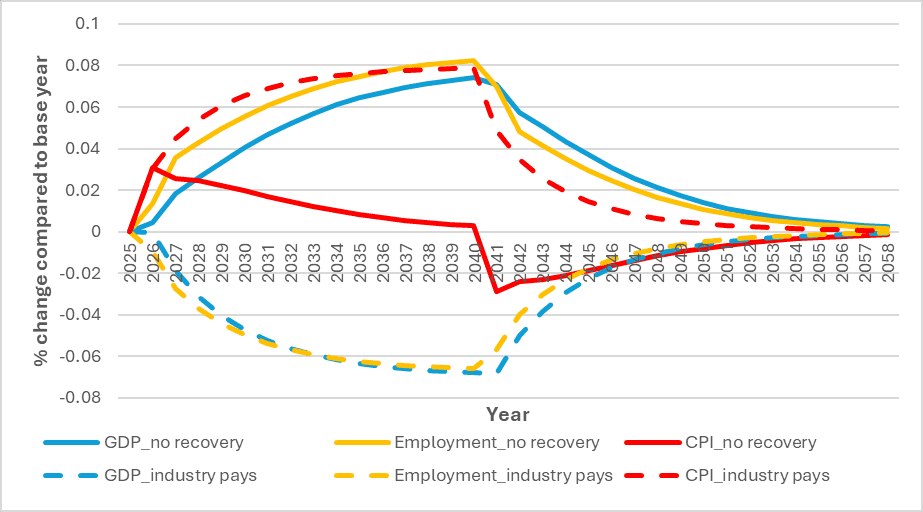
Figure D6. Scottish GDP, employment and CPI impacts from climate change adaptation spending in Agriculture
One notable difference between the two cases is that employment more closely tracks the GDP impacts, both time-wise and as a percentage change. The smaller gap between the employment and GDP impacts in the ‘Agriculture’ case suggests that the sectors involved in the adaptation spending of this sector are more capital- and less labour-intensive compared to the sectors involved in the adaptation of ‘Rail transportation’.
Furthermore, the distribution of the GVA and employment gains across the different sectors is also different to the ‘Rail transportation’ case (see Figure D7 and Figure D8), as is greatly influenced by the breakdown of the sectors that deliver the ‘Agriculture’ adaptation (shown in Figure D5). Despite the differences in the distribution, some qualitative characteristics remain the same, in that a small number of sectors contribute around 80% of the total GDP gains and that again 80% of the employment gains are concentrated in the same small number of sectors.
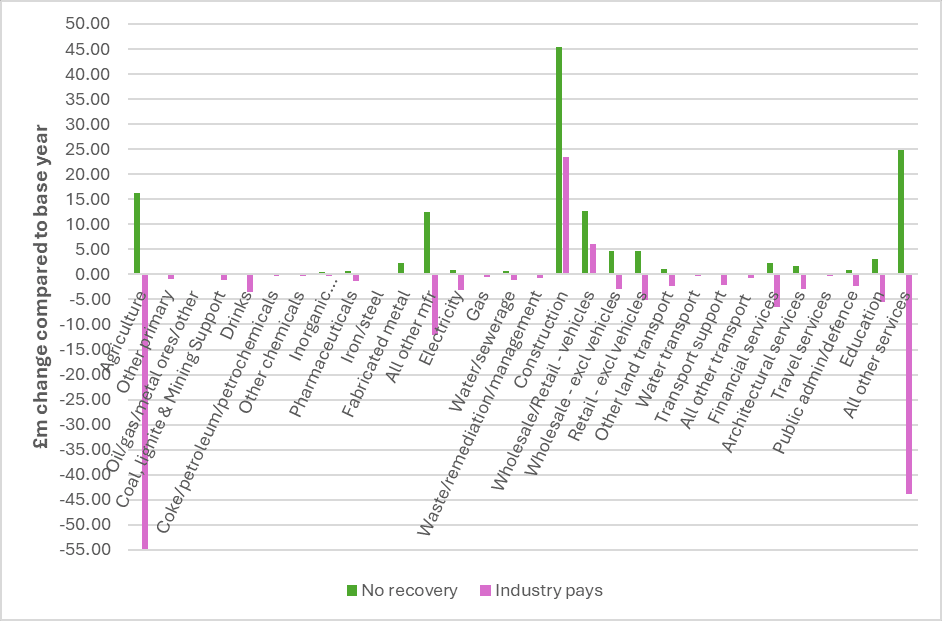
Figure D7. 2040 gross value-added impacts per sector due to climate adaptation spending in Agriculture
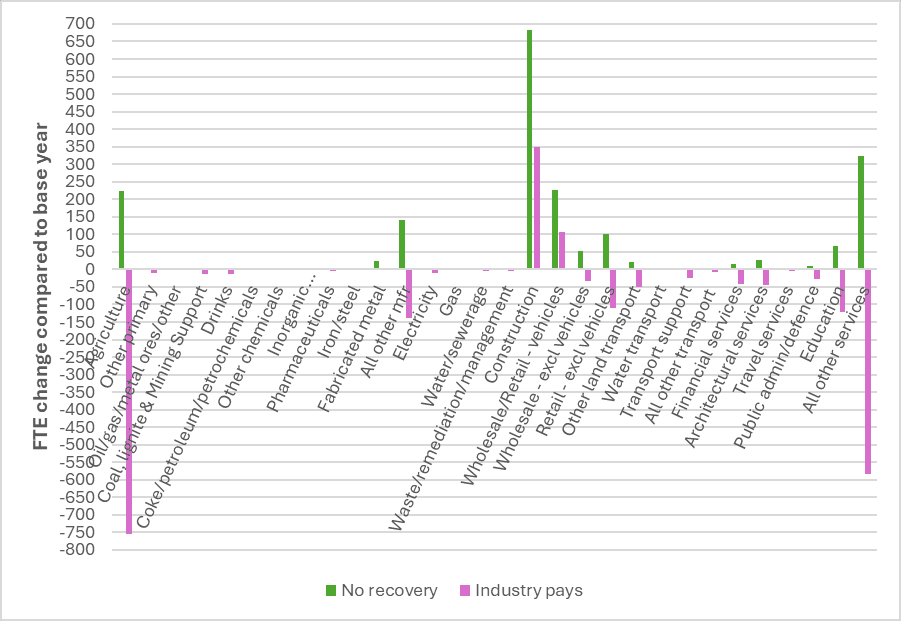
Figure D8. 2040 employment impacts per sector due to climate adaptation spending in Agriculture
Accounting for ‘who pays’ for the ‘Agriculture’ adaptation
In the ‘Rail transportation’ case we assumed that the sector itself, and the infrastructure developments that may be required, meant that the government was likely to pay the adaptation cost and recover it via fiscal instruments, such as changes in the income tax rate.
‘Agriculture’ though is different, with many small producers contributing to the sector rather than consisting of a handful of firms. This being the case, it is very likely that the farmers themselves will have to cover the adaptation cost and subsequently pass it to the consumers via the price of their farming goods. This ‘industry pays’ approach leads to different impacts across the wider economy. A key difference is that an ‘industry pays’ approach is regressive in nature. Indeed, looking at the CPI for each household group we can see that, by 2040, the lowest income households in HG1 experience broader price increases of 0.088%, while the highest income households in HG5 experience price increases of 0.073%. The difference is driven in part by the spending in agricultural produce, which is a larger share of the total consumption of low-income households; hence, any price increases in agriculture products leads to greater CPI pressures to this specific income quintile.
Generally, agriculture products are an important component of the consumption of all households and a price increase to recover the adaptation spending can trigger the significant economy-wide CPI pressures observed in Figure D6. These economy-wide price increases erode the purchasing power of all households and lead to reduced household consumption, reduced GDP and employment. Coupled with the export losses that increased prices trigger, lead to the negative picture presented in dashes in Figure D6.
A further important implication of the ‘industry pays’ approach here is that it affects one of the most labour-intensive sectors in the Scottish economy, employing 8.5 FTE workers per £m of output. With concentrated impacts on the sector, we see in Figure D8 that significant employment losses are triggered, contributing to the larger net employment losses across the Scottish economy.
In an economy where movement of labour in and out of the economy is challenging, the unemployment increase associated with job losses would trigger labour cost reduction processes that would help cushion the negative impacts to the economy. However, we assume that workers can move freely in and out of Scotland. Increased unemployment and reductions in the real wage, fuelled by the CPI increase, incentivise workers to leave Scotland, ultimately easing the changes in the unemployment rate. But this prevents the cushioning labour cost reductions from materialising, leading to reduced employment, reduced purchasing power per worker, but also higher labour costs for the businesses. The combination of all these effects leads to the significant economy-wide losses, throughout the cost recovery period.
Agriculture: Climate adaptation exploratory analysis
This case study presents an exploratory analysis of the costs associated with climate adaptation actions for Scottish agriculture. It draws on thirty-three actions identified as suitable for the Scottish context in a report published for the Scottish Government’s Rural and Environment Science and Analytical Services (RESAS). Available evidence, targets, and contextual information – see supplementary data – were used to estimate the potential deployment of each action across Scotland. Costs were scaled using land use archetypes from the Climate Change Committee’s Rural Land Use Types report (Thomson et al., 2025). The resulting estimates should be regarded as first-pass figures requiring further expert elicitation to be refined. Where the scope of the analysis permitted, an exploratory cost-benefit analysis was undertaken for selected actions, examining potential impacts on yields, soil erosion, disease risk, productivity, and biodiversity.
Action Identification
The thirty-three adaptation actions drawn from the RESAS report span arable, pastoral, and universal categories, and carry ratings for both impact and complexity across three levels: low, medium, and high. Prior to costing, two actions were excluded on the grounds that they are implicitly captured within the overarching action ‘diversifying Ccrop rotations’: namely, ‘crop introductions and diversification’ and ‘use of more resistant crop varieties’.
Cost information
Cost information was sourced from academic and grey literature, with a confidence rating (low, medium, or high) assigned to each source. Of the thirty-three actions, cost estimates were successfully obtained for twenty-one. The remaining twelve could not be costed due to an absence of relevant literature with associated expenditure data. In addition, two further actions identified during the literature review process — biocontrol and organic conversion — were incorporated into the analysis on the basis that sufficient cost data were available. Both were considered of material relevance to Scottish agriculture. All costs were adjusted to 2026/27 prices and converted to pound sterling where necessary. Further detail regarding the specific assumptions underpinning individual cost estimates is provided in the supplementary data.
Scaling costs
To scale unit adaptation costs (typically expressed in £/ha) to the applicable Scottish agricultural land area, the Climate Change Committee’s Rural Land Use Types report was employed (Thomson et al., 2025). This report disaggregates Scotland’s total agricultural land stock into ten archetypes, of which the six largest were selected for this analysis, together accounting for 97.9% of Scottish agricultural land: highly degraded lowland organic soils (117,300 ha); degraded upland grazing land and forest on organic soils (619,900 ha); hilly farmland on improved and semi-natural grassland on non-organic soils (106,400 ha); open pasture on the upland fringe (814,300 ha); acid grasslands on hilly uplands (767,400 ha); and arable on sandy soils (511,900 ha).
The report further disaggregates each archetype by land cover, as illustrated in Figure E1, across categories including arable and horticulture, acidic grassland, and coniferous woodland. These breakdowns were used to delineate the proportion of each archetype applicable to the scaling of adaptation action categories: arable, livestock, grassland, and universal.
Where data on the current extent of action deployment were available, this was deducted from the target area prior to scaling, ensuring that cost estimates reflect remaining deployment requirements rather than total potential coverage. The general scaling methodology proceeded as follows: the per-hectare cost of each action was multiplied by the applicable target area and, where actions were costed on an annual basis, further multiplied by the fourteen-year adaptation period to produce a total cost estimate covering 2026/27 to 2039/40. In certain cases, e.g., the application of green pesticides, the number of applications per year was incorporated into the calculation before extrapolation across the full period. Full details of the assumptions and methodologies applied to individual actions are provided in the supplementary data.
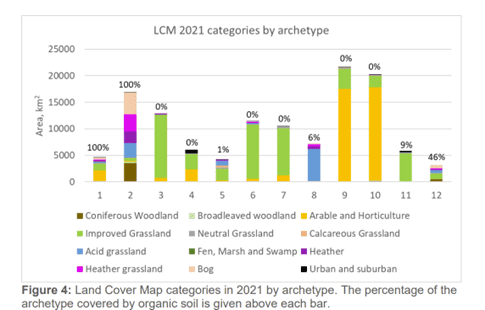
Figure E1: Land Cover Map categories in 2021 by archetype. The percentage of the archetype covered by organic soil is given above each bar – fig.4 from Thomson et al. (2025) – used to assist adaptation action cost scaling.
Complete scaled exploratory cost estimates for the fourteen-year period were produced for nineteen adaptation actions in total, presented in full in Supplementary Table X with associated confidence ratings and contextual information. A subset of six illustrative actions is excerpted in Table E1.
Table E1: Six example adaptation actions with associated scaled costs.
|
RESAS action |
RESAS category |
Action cost estimate |
Target area (ha) |
Scaled cost (2026-40) |
|
Diversified crop rotations – Impact: HIGH, complexity: LOW |
Arable | £254/ha implementation and £495/ha/yr running [7] |
482035 |
£3,462,939,440 |
|
Alterative tillage techniques – Impact: HIGH, complexity: MEDIUM |
Arable | £814/ha implementation and £42/ha/yr running[8] |
431272 |
£604,643,344 |
|
Adjusting or reducing stocking rates – Impact: HIGH, complexity: LOW |
Livestock | £69.46/ha/yr [9] |
1755415 |
£1,707,035,763 |
|
Virtual fencing technology – Impact: MEDIUM, Complexity: MEDIUM |
Livestock | £3791 set up + £57 per collar [10] |
N/A |
£531,990,570 |
|
Enhanced production on marginal land – Impact: LOW, complexity: HIGH |
Grassland | Government budget for LFA is £65.5M for 2026/27 [11]LFA is 86% of total agricultural land (5.16M ha12]) = 4.44M haCost per hectare of LFA: £14.76/ha/yr13 |
1419739.6 |
£293,374,991 |
|
Agrivoltaics – Impacts: MEDIUM, Complexity: HIGH |
Universal | Capital expenditure £7950/ha AND operational expenditure: £4300.96/ha/yr 14 |
3237 |
£220,645,055 |
Exploratory cost-benefit analysis
Exploratory cost-benefit analysis (CBA) was undertaken for the adaptation action ‘diversified crop rotations’, examining potential monetary benefits resulting from this action. These included increased crop yields of between 10% and 25%; reduced losses from soil erosion of up to 90%; and fertililser usage savings of 30%.
The result, shown in Table E2,outlines the potential monetised benefits between 2026 and 2040 of £1.1bn- £856M. This means that 24.7% to 31.4% of the total could be returned by increased crop yields, reduced losses and reduced fertiliser cost.
This is not an exhaustive CBA but indicative of the potential of these actions relative to a do-nothing scenario.
Table E2: Exploratory cost benefit analysis for diversified crop rotation
|
Cost benefit description |
+25% yield value |
+10% yield value |
Crop yield increase of 10-25% [15]1.53B total crop output (2024) [16] |
£382,500,000.00 |
£153,000,000.00 |
Reduced losses of up to 90% in yield value from soil erosion (calculated using +10% and +25% yield value)Approx 19.2% of Scottish arable land at risk of soil erosion[17]Assume therefore, that 19.2% of crop output value (1.53B) at risk consequently.Soil erosion causes losses in crop productivity of 0.43% [18] |
£19,894,896.00 |
£17,507,508.48 |
30% fertilizer cost saving relative to cost of fertilizers currently widely in use.19Total UK spend on fertilizer 2023 = £1.36 Billion 20Scotland share of UK agricultural land = ~12% |
£685,440,000.00 |
£685,440,000.00 |
|
Total monetised benefits |
£1,087,834,896.00 |
£855,947,508.48 |
|
Diversified crop rotations scaled cost (base) |
£3,462,939,440.00 | |
|
NET COST of diversified crop rotations after accounting for savings in fertilizer usage, reduced losses from soil erosion and increased yield value, all as a direct result of this action (= Base cost – Total monetised benefits) |
£2,375,104,544.00 |
£2,606,991,931.52 |
Several important limitations should be noted when interpreting these results:
- Cost estimates assume that each action is applied across all land eligible for that measure, which is likely to overestimate real-world uptake; results should therefore be interpreted as upper-bound estimates.
- In practice, interventions would be carefully selected and targeted, and not all actions would necessarily be deployed across the full eligible area.
- Limited data on the current extent of adaptation adoption makes it difficult to accurately determine the remaining deployment gap for individual actions.
- Cost data were unavailable for several actions that are nonetheless considered significant for Scottish agricultural adaptation; these would benefit from dedicated expert costing exercises.
- The analysis does not account for the potential impact of increasing climate risk on the cost or effectiveness of adaptation actions over the period.
Scaling was not feasible for certain actions due to data limitations. Costing shelterbelts, for example, would require data on the total perimeter of agricultural land. Costing enhanced livestock housing design would require detailed information on existing infrastructure and the degree of upgrade required. In the latter case, the only cost data identified were sourced from European literature, providing a range of €5,000 to €100,000 per unit — figures that may not be directly transferable to the Scottish context.
Wider policy and economic context for agriculture:
Policy context
The Agricultural and Rural Communities (Scotland) Act 2024 set out the legal framework for transforming Scotland’s farm support system, replacing former Common Agricultural Policy (CAP) schemes with a four‑tier framework by 2027. The reforms aim to shift agricultural support toward delivering environmental and climate outcomes while still underpinning food production and rural livelihoods. Central to this shift is the Whole Farm Plan, which requires farmers to baseline their environmental performance and adopt practices that reduce emissions, restore nature, and improve efficiency. Implementation will be gradual: initial changes begin in 2025, consolidation of payments and “Enhanced Greening” follow in 2026, and by 2027-28 the full framework, alongside new agri‑environment, forestry, and capital support measures, will be in place.
Overall, the new system moves from unconditional payments to support linked to specific outcomes across Tiers 1–4, balancing farm productivity with climate adaptation, mitigation, and biodiversity goals. Tier 1 provides core direct income support, evolving from the Basic Payment Scheme but tied to meeting baseline environmental and regulatory standards. Tier 2 rewards enhanced environmental delivery, including greening measures and likely future integration of the Less Favourable Area Support Scheme (LFASS). Tier 3 offers elective, targeted support for specific environmental or land‑management actions, replacing schemes like AECS and FGS. Tier 4 delivers complementary capital grants, skills development, and advisory services to help businesses adopt new practices. While the approach builds on what many farms already do, Tier 2 and Tier 3 are expected to drive the greatest climate‑adaptation impacts – though separating adaptation from mitigation remains a challenge in practice. The subsidy landscape is likely to continue evolving as budgets and schemes consolidate under the new structure. More information available at: 0624 Future Support Briefing.pdf
Economic context
Figure F1: Breakdown of contributions to farm income by farm type, 2023-24. Source: Scottish Government, 2025d.
How to cite this publication:
Brett, L., White, C.J., England, K., Calvillo Munoz, C., Roberts, J.J. (2026) ‘Investigating climate change adaptation investment need across five sectors in Scotland (2026 – 2040)’, ClimateXChange. DOI: https://doi.org/10.7488/era/7087
© The University of Edinburgh, 2026
Prepared by the University of Strathclyde on behalf of ClimateXChange, The University of Edinburgh. All rights reserved.
While every effort is made to ensure the information in this report is accurate as at the date of the report, no legal responsibility is accepted for any errors, omissions or misleading statements. The views expressed represent those of the author(s), and do not necessarily represent those of the host institutions or funders.
This work was supported by the Rural and Environment Science and Analytical Services Division of the Scottish Government (CoE – CXC).
ClimateXChange
Edinburgh Climate Change Institute
High School Yards
Edinburgh EH1 1LZ
+44 (0) 131 651 4783
The figures represent one scenario-based estimate of potential adaptation-related spend required to maintain current service levels under future climate conditions – there are many potential future scenarios, each returning different potential investment requirements. ↑
Note Scottish Water estimates are for 13 years from 2027/28 – 2039/40. ↑
The figures represent one scenario-based estimate of potential adaptation-related spend required to maintain current service levels under future climate conditions – there are many potential future scenarios, each returning different potential investment requirements. ↑
Note Scottish Water estimates are for 13 years from 2027/28 – 2039/40. ↑
We have modelled the impacts based on the available estimates on adaptation spending over the next 15 years, until 2040. If further adaptation spending is required then the economy-wide impacts will continue. In that case more analyses will be needed to explore the implications of extended adaptation spending. ↑
The modelled shock to the economy has completed, so in the absence of a shock the economy returns back to the baseline. ↑
https://ieep.eu/wp-content/uploads/2024/07/The-costs-and-benefits-of-transitioning-to-sustainable-agriculture-IEEP-2024.pdf ↑
- https://ieep.eu/wp-content/uploads/2024/07/The-costs-and-benefits-of-transitioning-to-sustainable-agriculture-IEEP-2024.pdf
- https://www.gov.wales/sites/default/files/publications/2023-12/atisn19234doc1.pdf ↑
10. https://doi.org/10.33988/auvfd.837485 ↑
11. https://www.gov.scot/publications/scottish-rural-development-programme-2014-2020-ex-post-evaluation-annex-scheme-summary-report/pages/11/ ↑
12. https://www.gov.scot/publications/results-from-the-scottish-agricultural-census-june-2024/pages/most-of-scotlands-area-is-used-for-agriculture/ ↑
13. https://www.gov.scot/binaries/content/documents/govscot/publications/corporate-report/2026/03/scottish-budget-2026-2027/documents/scottish-budget-2026-2027/scottish-budget-2026-2027/govscot%3Adocument/scottish-budget-2026-2027.pdf (Table 11/02) ↑
14. https://www.sciencedirect.com/science/article/pii/S0038092X24004390 ↑
15 (PDF) Benefits of Crop Rotation (UK Scenario) 25032025 ↑
16. Value of output remains stable – Total income from farming estimates: 2018-2024 – gov.scot ↑
17. https://www.gov.scot/publications/developing-method-estimate-costs-soil-erosion-high-risk-scottish-catchments/pages/8/ ↑
18. https://onlinelibrary.wiley.com/doi/full/10.1002/ldr.2879 ↑
19 (PDF) Benefits of Crop Rotation (UK Scenario) 25032025 ↑
20. Value of output remains stable – Total income from farming estimates: 2018-2024 – gov.scot ↑