
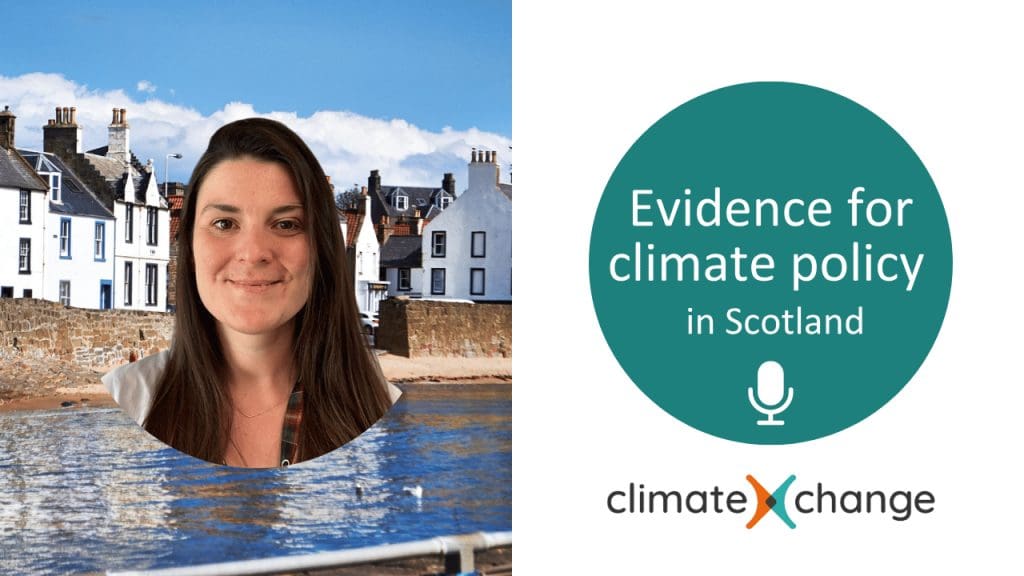
Kay White manages our projects on climate resilience and social change. She is on secondment from her role as a Senior Policy Adviser for Climate Adaptation at the Scottish Government.
In a recent podcast interview, we discussed the knowledge exchange workshop she organised in collaboration with the Scottish Government called ‘Opportunities for financing a climate resilient Scotland’.
Why was this workshop needed in the context of Scottish climate policy?
Financing adaptation is about measures to ensure that Scotland’s businesses, communities, public services and nature are resilient in the face of a changing climate. It’s vitally important and there are challenges to financing adaptation as well as massive opportunities.
The challenges are broadly understood as the scale of finance needed to build resilience across society and recognition that this cannot be solely funded by the public purse. This means that investors, insurers, banks and other partnerships are needed to tackle the issue.
It’s also sometimes tricky to make a traditional business case for adaptation investment as returns can sometimes be felt over the longer term or can be felt as the absence of something. The absence of a flooding event, or damage caused by that, is good adaptation investment but it is hard to quantify.
There are also many opportunities from investment in adaptation to society, to the economy and in our ability to reach net zero.
What were the main aims of the workshop?
The workshop aimed to bring together policymakers, practitioners, both in the public sector and private actors, as well as academics and research institutions, to try and understand these challenges and opportunities better.
In 2024, as part of the 3rd Scottish National Adaptation Plan, the Scottish Government committed to establishing a short-life adaptation task force, or advisory group, on adaptation finance. This recognises that closing the adaptation finance gap, which is the difference between current spend on adaptation measures and the likely spend needed for resilience, will require specialist knowledge and skills.
The workshop aimed to discuss the remit, membership and timeframe of this task force drawing on the expertise in the room.
What format did the workshop take?
The workshop was broadly in three parts. In the first session, we held a panel discussion with experts discussing the challenges and opportunities for financing adaptation, as well as background on the fiscal landscape in Scotland.
The second session was a bit more practical and looked at case studies. We learned how the enabling environment for adaptation is being established through things like investment decision-making practices in the Scottish National Investment Bank, partnership delivery in the green finance space and international examples from other regions facing similar challenges to Scotland.
In the third session, taking into account the discussion from the morning, we looked at the remit of the task force. We discussed what its main focus should be, the membership and also the timeframe.
We based this discussion around a paper published in 2023 by Adaptation Scotland on insights and opportunities for adaptation finance. The different actions in this paper framed the discussion.
What were the main discussion points and outcomes from the workshop?
In terms of the Scottish Government adaptation task force, there were a number of recommendations which came out of the workshop.
There was support for the creation of the task force with membership suggestions from private, public and third sector organisations.
Most participants thought that the task force should focus on quantifying the finance needed for increasing resilience in Scotland, indicating in which areas, either geographically or in terms of sectors of the economy, the spend should be prioritised. A possible output of this could be an adaptation investment plan for Scotland.
When discussing the challenges and opportunities around adaptation finance, there were a few key findings.
Firstly, that innovative partnerships, across multiple organisations in the private and the public sector, are required to address the sizeable adaptation gap. With this challenge comes multiple opportunities for realising co-benefits across the economy and society, and for investing in Scotland’s infrastructure and communities.
An example of this is the work to restore the Dreel Burn in Fife, a collaboration between Fife Coast and Countryside Trust, the North Star Transition Group and Scottish Government.
Looking at international examples, we found that no countries have completely nailed financing adaptation. However, there are valuable initiatives and examples of good practice in the international sphere, the UK and in Scotland.
There are real opportunities to learn from these pockets of excellence and apply them to the Scottish context, as well as scaling up smaller projects and frameworks into larger, more bankable investment actions which can be replicated.
The event report produced after this event and published on the ClimateXChange website also includes a library of case studies as an appendix, which details some of these really interesting projects going on across the world.
Who might find the report from the workshop useful and why?
The report would be a really useful summary for those working in the private sector, in banks or insurance companies, to help them try and understand the challenges and opportunities for financing adaptation in quite a succinct manner.
It also provides useful links to relevant documents.
The case study library can help readers understand what’s going on in other regions across the world and in other sectors of the economy. That might be useful inspiration for building collaborative networks to make business cases for further finance.
It’s also hoped that this report will help recruit members to a Scottish Government advisory task force.
What are the next steps for research in this area?
A key gap identified as part of the workshop was the involvement of the banking and insurance sectors. The Scottish Government plans to try and engage these sectors and understand the barriers and opportunities to investment from their perspective.
ClimateXChange is also looking to further develop a project exploring the costs of climate adaptation in Scotland to support future investment and policy decision making.
ClimateXChange podcast
This is a summary of episode 14 of our podcast: Evidence for climate policy in Scotland – CXC podcast
Report
The report from the workshop can be found on our Publications page: Opportunities for financing a climate resilient Scotland – Event report
Related projects
Economic opportunities in Scotland’s net zero and climate adaptation economy
Planning for coastal change adaptation in Scotland
Monitoring outcomes of the third Scottish National Adaptation Plan