

Decarbonising Scotland’s HGVs through retrofit and repowering
Research completed: January 2026
DOI: https://doi.org/10.7488/era/7421
Executive Summary
Background
Scotland has a major opportunity to accelerate progress on decarbonising its HGV fleet. Although HGVs make up less than 2% of vehicles on the road, they generate around 13% of road transport emissions, meaning targeted action in this sector can deliver disproportionate benefits. Scotland’s ambitious, legally-binding climate goals necessitate investment. Scotland is also aligned with UK‑wide commitments to phase out non‑zero‑emission HGVs by 2035 for vehicles under 26 tonnes and by 2040 for all new HGVs. This creates a clear pathway for long term industry transition. Measures such as modal shift from road to rail freight and the rollout of zero‑emission HGVs are developing and steadily gaining traction as technology and markets evolve.
With these long‑term changes underway, Scotland now has a valuable opportunity to pursue practical interim solutions that cut tailpipe emissions from the existing HGV fleet, support operators through the transition, and deliver meaningful progress in the near-term. Retrofitting and repowering HGVs could assist in meeting these goals.
Euro emissions ratings are European Union regulated limits on tailpipe air polluting chemicals that are adopted in the UK. Euro 6 is latest standard and represents the current strictest standard for regulating vehicle pollution. Retrofitting involves upgrading older vehicles (primarily Euro 4/5) with technologies such as diesel particulate filters (DPFs) and selective catalytic reduction (SCR) to meet Euro 6 standards. This approach significantly reduces local air pollutants (NOₓ and particulate matter (PM)) but does not deliver meaningful carbon (CO₂) savings, unless dual fuel hybrid retrofitting is adopted (for example gas or hydrogen are combined with diesel and/or biofuels). Retrofitting is therefore best aligned with local air quality policies, such as Low Emission Zones, rather than Scotland’s overarching climate abatement goals.
Repowering refers to rebuilding HGVs with alternative powertrains, including battery-electric, hydrogen fuel cell, or dedicated biomethane gas systems. Repowering (specifically battery-electric and hydrogen) offers true zero-emission solutions at the tailpipe and delivers substantial carbon reductions, directly supporting Scotland’s climate targets. A key distinction is that retrofit primarily improves air quality, while repower is required for meaningful carbon reduction.
Findings
Our analysis of Scotland’s HGV market found that rigid vehicles (about two-thirds of the fleet) and articulated vehicles in the Highlands and Islands present the strongest opportunities for intervention. Older, non-Euro 6 vehicles (especially DAF rigid and Volvo/Scania artic models) are prime candidates for retrofit and repower programmes. They are amongst the more popular models, and so can create blueprints for repower technologies.
Retrofitting involves upgrading older vehicles (primarily Euro 4/5) with technologies such as diesel particulate filters (DPFs) and selective catalytic reduction (SCR) to meet Euro 6 standards. While this approach significantly reduces local air pollutants (NOₓ and particulate matter (PM)), it does not deliver meaningful carbon (CO₂) savings, unless dual fuel hybrid retrofitting is adopted. As a result, retrofit is best aligned with local air quality policies, such as Low Emission Zones, rather than Scotland’s overarching climate abatement goals. The economic case for retrofitting is weak for most operators, as payback periods often exceed typical fleet replacement cycles. Many operators opt for purchasing used Euro 6 vehicles, which offer compliance and reliability at comparable or lower cost.
In contrast, repower involves rebuilding HGVs with alternative powertrains, including battery-electric, hydrogen fuel cell or dedicated biomethane gas systems. Repowering (specifically battery-electric and hydrogen) offers true zero-emission solutions at the tailpipe and delivers substantial carbon reductions, directly supporting Scotland’s climate targets. Repower solutions, particularly battery-electric and biomethane, show better payback potential and are more attractive for operators intending to retain vehicles for longer periods. Battery-electric repower is best suited to depot-based, predictable routes, while biomethane gas repower is more appropriate for high-mileage, long-distance operations. Hydrogen repower, though promising for heavy-duty, long-haul applications, remains high-risk due to cost, infrastructure, and market immaturity.
Based on our analysis of all vehicles over 7.5 tonnes, retrofitting all Euro 4/5 HGVs in Scotland through DPF and SCR solutions could remove up to 584 tonnes of NOₓ and 27 tonnes of PM annually. This is equivalent to taking thousands of cars off the road each day. However, this approach achieves negligible carbon (CO₂) abatement. In contrast, repowering the same vehicles to electric (for instance) could eliminate 1.08 million tonnes of CO₂ annually. This is about 57% of current HGV emissions. Even so, this falls short of the 75% reduction target, indicating that repowering alone will not be sufficient, and action must eventually extend to Euro 6 vehicles and be paired with accelerated innovation and policy support.
Taken together, this indicates that retrofit is best viewed as a targeted, interim measure, while repower provides the more credible pathway for decarbonisation.
Conclusions
Current policy strongly favours electrification, with funding and incentives directed towards new zero-emission vehicles. Retrofit and repower options are technically eligible but under-supported, facing barriers such as limited funding, unclear certification, and operational uncertainty. Stakeholder engagement highlighted the need for a balanced approach – supporting retrofit and repower as interim measures while maintaining momentum towards full fleet renewal. Multi-year funding, procurement alignment, and standardised accreditation could help scale these solutions and deliver near-term tailpipe emissions reductions.
Scotland’s path to HGV decarbonisation is complex and requires a blended, route-sensitive approach. Retrofitting offers immediate air quality benefits but limited climate impact, while repowering, especially with battery-electric and biomethane, aligns more closely with long-term climate ambitions. The evidence from this research indicates that retrofit should be viewed as a transitional measure, primarily for LEZ compliance and air quality improvement, while repower provides a more credible pathway to emissions reduction. To support Scotland’s emissions reduction targets, the findings suggest that policy could prioritise repower solutions, while addressing economic and operational barriers and supporting a managed transition for operators. Only through coordinated action and targeted investment can Scotland deliver meaningful tailpipe emissions reductions in the near term while enabling a shift to a zero-emission HGV fleet in the future.
Glossary / Abbreviations table
BEAR | Bus emissions abatement retrofit |
BEV | Battery electric vehicle |
Capex | Capital expenditure |
CCC | Climate Change Committee |
CCP | Climate Change Plan |
CNG | Compressed natural gas |
CO₂ | Carbon dioxide |
CVRAS | Clean Vehicle Retrofit Accreditation Scheme |
DfT | Department for Transport |
DOC | Diesel oxidation catalyst |
DPF | Diesel particulate filter |
eHGV | Electric HGV |
EU | European Union |
FC/FCEV | Fuel cell electric vehicle |
GHG | Greenhouse gas |
GVA | Gross value added |
HGV | Heavy goods vehicle |
HMRC | His Majesty’s Revenue and Customs |
ICE | Internal combustion engine |
ITL | International territory level |
kWh | Kilowatt-hour |
LEZ | Low emission zone |
LCHS | Liquified compressed hydrogen storage |
LGV | Light goods vehicle |
LH₂ | Liquid hydrogen |
LNG | Liquified natural gas |
MPG | Miles per gallon |
NOx | Nitrogen oxide |
OEM | Original equipment manufacturer |
O-licence | Operator licence |
Opex | Operating expenditure |
OZEV | Office for Zero Emissions Vehicles |
PM | Particulate matter |
RCV | Refuse collection vehicle |
RTFO | Renewable Transport Fuel Obligation |
SCR | Selective catalytic reduction |
SMMT | Society of Motor Manufacturers and Traders |
SME | Small–medium enterprise |
TCO | Total cost of ownership |
TWh | Terawatt-hour |
UK | United Kingdom |
V2G | Vehicle-to-grid |
ZEHID | Zero emission HGV infrastructure demonstrator |
ZETT | Zero emission truck taskforce |
ZEVRAS | Zero Emission Repower Accreditation Fund |
Introduction
Background
Heavy Goods Vehicles (HGVs) present one of the greatest opportunities for emissions reduction in Scotland’s transport sector. Although they represent less than 2% of the vehicle fleet, they account for around 13% of road transport emissions (Transport Scotland, 2025a). Addressing this disproportionate impact could deliver significant progress towards climate targets over the next 5–10 years. HGVs continue to dominate freight because they are cheaper, faster, and more flexible than alternatives (MDS Transmodal, 2019).
The 2020 Climate Change Plan Update (CCPu) called for both carbon reductions and tailpipe emissions cuts. Published in November 2025, Scotland’s Climate Change Plan (2026-2024) draft acknowledges that, though policy progress has been made for reducing HGV emissions, the technology and market readiness are not yet sufficient for rapid progress in the interim (Scottish Government, 2025a). Scotland does not have its own bespoke deadlines for phasing out non-zero-emission HGV sales and instead aligns with wider UK Department for Transport (DfT) targets. New HGVs under 26 tonnes sold in the UK must be zero-emission by 2035, and all HGVs sold in the UK must be zero-emission by 2040 (DfT, 2022).
The CCC’s analysis for the Seventh Carbon Budget assumes that battery-electric vehicles are chosen to decarbonise all HGVs, projecting that by 2040, nearly two-thirds of HGVs battery-electric vehicles are electric (CCC, 2025). Direct electrification is more efficient than producing hydrogen, which is likely to remain a niche solution for vehicles that are hard to electrify. Transport Scotland’s current plans for electric HGVs (eHGVs) broadly align with this view, positioning Battery Electric Vehicles (BEVs) at the core of future decarbonisation (Transport Scotland, 2024a).
The current Programme for Government 2025-2026 (Scottish Government, 2025b) identifies several key pillars supporting the HGV sector. This includes the Freight Facilities Grant, which is £4 million to encourage a shift of HGV freight onto rail. It also includes support for zero-emission HGVs through the HGV Market Readiness Fund (see Transport Scotland, n.d), addressing the ‘chicken and egg’ problem by developing market readiness and identifying strategic investment proposals for both vehicles and infrastructure to build sector confidence. Finally, the Scottish Government has committed to skills investment for decarbonisation which funds a just transition to ensure the workforce and supply chain are prepared to work with alternative fuels.
Despite these commitments, on-the-ground deployment and scaling remain limited. Further work is required to pilot and assess the commercial and operational feasibility of the various options. The CCC notes that the long-term strategy is “significantly off-track,” (CCC, 2024, p.38) as road freight has not yet reduced substantially through modal shift, rail freight volumes remain uncertain, and zero-emission HGV technologies are still developing. For example, most freight in Scotland moves by road, so even doubling rail’s share from its current 3-4% (SPICe, 2026) to 6-8% would only make a small dent in emissions reduction.
This presents a pressing gap between long-term decarbonisation targets and the need for near-term emissions reductions from the existing fleet. UK targets aim to phase out new conventionally fuelled HGVs <26 tonnes by 2035 and remaining HGVs by 2040. While Scotland develops its long-term strategy, it is essential to understand how the existing HGV fleet can contribute to interim emissions reductions. This study assesses the role that retrofitting and repowering existing HGVs vehicle could play as interim measures in closing this gap.
Method
We developed the following methodology to understand the role retrofit and repower could play in decarbonising Scotland’s HGV fleet and whether a Scottish retrofit market is feasible over the next ten years. This approach allows the study to assess not only technical feasibility, but the likelihood of real-world adoption.
Identifying where retrofitting and repowering has potential across Scotland’s HGV market
We carried out a detailed desktop study to understand the current HGV landscape in Scotland. This included analysing commodity movements, regional variations in vehicle age, fuel type and manufacturer, and the distribution of fleet types across O-licence holders (respective data sources can be found in Appendix A). This helped us identify where retrofitting and repowering could be targeted for the greatest emissions reductions and which vehicle groups and regions may offer viable use cases.
Identifying what retrofitting and repower options are available
We reviewed current retrofit and repower technologies, how each system works and where they have previously been deployed at scale. Case studies from the UK and international markets were examined to understand what has succeeded elsewhere.
Identifying how retrofitting and repowering could be implemented at scale in Scotland
This stage analysed how retrofit and repower could realistically be deployed across Scotland’s HGV market. This involved a review of the policy framework, testing commercial and operational feasibility, the financial impact on operators, and how retrofit business models would function in practice. This approach allows the study to assess not only technical feasibility, but the likelihood of real-world adoption. To do this, we combined the findings from the first two stages with extensive stakeholder engagement, including:
- Two workshops (public sector and private sector), plus follow-up discussions with multiple organisations
- One-to-ones with five retrofit and repower providers
- One-to-ones with three original equipment manufacturers (OEMs)
- An operator survey to understand fleet profiles and interest in retrofit and repower
- Follow-up interviews with survey respondents for deeper insight
Developing potential pathways for Scotland
The final stage of the project brought together all findings to outline potential pathways for deploying retrofit and repower in Scotland. These pathways illustrate how different scenarios vary under varying levels of uptake.
What are retrofitting and repowering?
Retrofitting involves modifying an existing an existing vehicle to reduce emissions while retaining the original engine. Usually, retrofitting applies to older Euro Standards vehicles (Euro 5 or older) to bring them in line with the latest Euro 6 standards through the fitment of Diesel Particulate Filters (DPFs) and/or Selective Catalytic Reduction (SCR) technologies. Hybrid retrofit technologies, including electric, hydrogen and gas, retain the existing diesel engine but modify the vehicle so it can be assisted by an electric motor and battery or operate on an alternative fuel. This creates a ‘dual‑fuel’ system, allowing the vehicle to run on either fuel independently.
Repowering involves removing the existing powertrain and replacing it with an alternative system, stripping back the vehicle entirely to its chassis and rebuilding the engine. Repowering in this study refers to rebuilding diesel HGVs as low and zero emission alternative fuels, including gas power, hydrogen, and battery electric, which does include CO2 savings. Several retrofit and repower technologies have been researched as part of this study. Table 1 provides a description of what they are and how the vehicles are modified. See also Table 19 in Appendix E.
The key distinction is that retrofit primarily reduces local air pollutants, while repower can deliver substantial carbon emissions reduction, including zero tailpipe emissions in some cases.
Retrofit or Repower | Technology | Description |
Retrofit Reduces PM by 99% | Diesel Particulate Filter (DPF) | A device fitted in the exhaust system that captures and stores soot particles to prevent them from being released into the air |
Retrofit Reduces NOx by 90-99% | Selective Catalytic Reduction (SCR) | A device in the exhaust system that injects AdBlue to convert NOₓ into nitrogen, water vapour, and small amounts of CO₂ |
Repower Zero emission at tailpipe | Electric Repower | The vehicle’s existing diesel engine and transmission is replaced with an electric drivetrain system (including electric motors, control systems, and inverters) and control software |
Repower Reduces PM by 95%, NOx between 50% and 80%, CO2 20% or up to 90% if Biomethane used | Gas Repower | The vehicles diesel engine and tanks are removed and replaced with a spark-ignition gas engine, compressed natural gas (CNG) cylinders or liquified natural gas (LNG) cryogenic tanks (these include valves, pressure regulators, and safety features). The fuel & injection, exhaust & emissions and parts of the ancillary systems are also replaced along with the engine control unit & software |
Repower Zero emission at tailpipe | Fuel Cell Electric Repower (Hydrogen) | Most of the diesel powertrain and fuel system is replaced with a new hydrogen fuel system, electric powertrain, fuel-cell power system, batteries, auxiliary and control systems. Electric truck powered by hydrogen |
Retrofit Technology dependent (see Appendix E) | Hybrid Retrofit | These come in various forms including electric, hydrogen and gas. This involves keeping the diesel engine and modifying it to either be assisted by an electric motor and battery or converting it to run on an alternative fuel. The vehicles become ‘dual fuel’ and can run on either fuel independently |
There are multiple examples of retrofit and repower being applied across the UK and internationally. A detailed review of these national and international case studies, including key lessons and implications for Scotland’s HGV market, is provided in Appendix B.
Scotland’s HGV fleet profile – Identifying where retrofit or repowering interventions are most viable
This section analyses Scotland’s HGV fleet to identify where retrofit and repower interventions are most likely to be viable. It explains what kind of goods are transported, where they are going, and what types of HGVs are being used. This includes their size, age, and manufacturer by regional level. Understanding these is the first steps in identifying where retrofitting could be targeted for the greatest emissions reductions. The following statistics were derived through analysis of raw data provided in Excel spreadsheets (with references to data sources throughout the chapter). Key sources include Society of Motor Manufacturers and Traders (SMMT), Transport Scotland, UK Government and the Department for Transport (DfT). We interrogated these datasets using filtering, pivot tables, and formula-based calculations to extract relevant metrics and summarise trends.
The purpose of this section is to identify where retrofit and repower are most likely to be viable in practice, based on fleet characteristics and operating patterns.
Market Review
Commodities and Goods Moved
In 2023, Scotland moved 150.8 million tonnes of freight (Transport Scotland, 2023a). Transport Scotland data tells us about origin-destination commodity movement by HGV (2023a). This means tracking what goods (commodity) are being moved by from where (origin) to where (destination). We can confidently state that the bulk of this tonnage was carried by HGVs given the data does not include pipeline or rail freight. A small amount could be attributed to coastal shipping. The data shows that most freight (117.3 million tonnes, 78%) stayed within Scotland, while 17.9 million tonnes (12%) were exported and 15.6 million tonnes (10%) were imported. Food, drink, and tobacco were Scotland’s largest imports and exports, making up 38% of imports and 19% of exports. For internal movements, forestry products, agricultural materials, and minerals accounted for over half (51%) of HGV freight (Transport Scotland, 2023a).
In the key datasets, Scotland’s origin and destination areas are broken down into five regions by International Territory Level 2 (ITL2) (see Appendix A for visual guide): Highlands and Islands, North Eastern Scotland, Eastern Scotland, West Central and Southern Scotland. From this data, we found that three of Scotland’s regions (Highlands & Islands, Southern, and North Eastern Scotland) move more metals by HGV than any other commodity. In Eastern Scotland the largest origin and destination commodity is food. In many regions the highest destination commodity is the highest origin commodity. This could suggest that significant numbers of HGV trips are regional, rather than long-distance trips. Data used in Section 2.1.2 does confirm that a majority of trips are shorter, supporting the idea that there are more regional movements. However, further analysis of trip length and distance travelled per day would be required to confirm this.
Table 7 and Table 8 in Appendix A show the breakdown of top origin-destination commodities for each region in Scotland. Key findings are:
- Eastern Scotland is the largest regional HGV tonnage zone, 32% of Scotland’s HGV journeys start there and 31% end there.
- West Central and Southern Scotland each handle 20–25% of Scotland’s HGV tonnage (and are the second / third largest regional HGV tonnage zones).
- The North East and Highlands & Islands account for only 8–13%, representing the smallest share of HGV tonnage in Scotland.
Distance Travelled
In 2022, the DfT recorded 140 million tonnes freight tonnage across Scotland (DfT, 2022) This is slightly less HGV than Transport Scotland in 2023, but we use the DfT dataset because it also captures the typical movement and journey length of HGVs. The data captures tonnes moved by distance travelled to create a percentage of tonne kilometres. Figure 1 shows that in Scotland, over half (65%) of all freight trips travelled 100 km or less, with 19% moving no more than 25 km. Only around 8% of HGV journeys exceeded 300 km, indicating that most freight movement is relatively short distance. It should be noted that this data only captures single trip movements and does not consider that a single HGV may cover multiple trips in one day as alluded to in section 2.1.1.
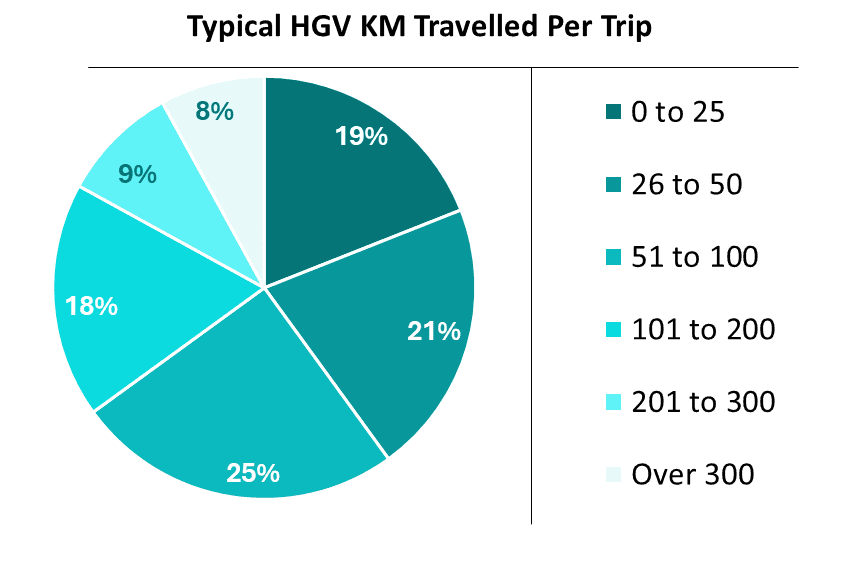
Figure 1 Distance Travelled by HGV per trip in Scotland in 2022 (DfT, 2022)
This pattern of predominantly short-distance journeys suggests strong potential for depot-based repower solutions, particularly battery-electric vehicles.
HGVs in operation
In Scotland, 83% of operators run fleets of ten or fewer vehicles, 14% manage between 11 and 50, and only 3% operate more than 50 vehicles. This highlights Scotland’s strong base of small and medium-sized enterprises (SMEs) within the freight sector.
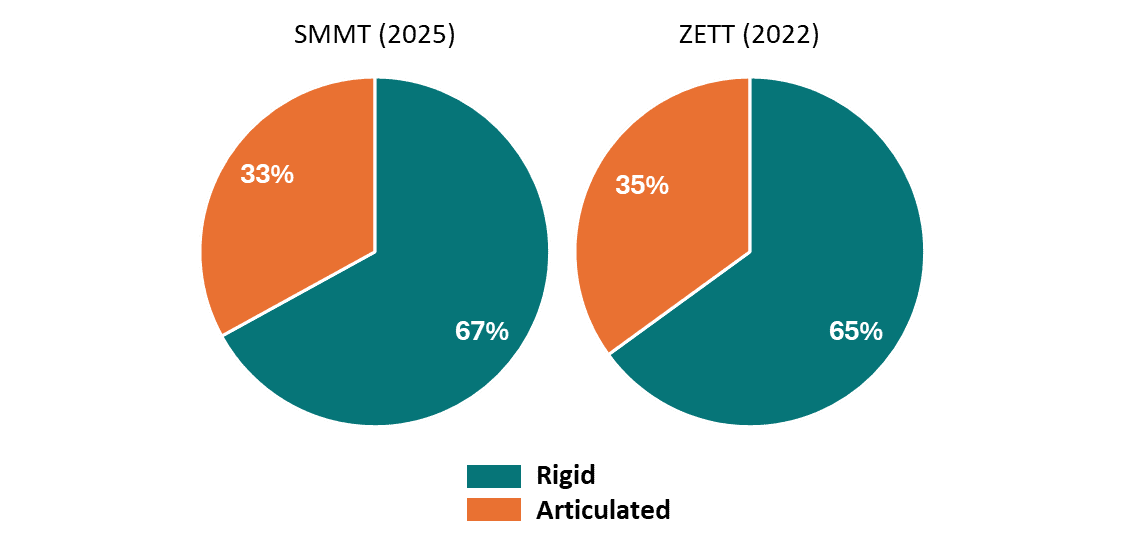
Both Transport Scotland (2023) and the DfT (2024a) estimate that around 36,500 vehicles are HGV. Among HGVs, 65–70% are rigid and 30–35% are articulated, according to the Zero Emission Truck Taskforce (ZETT, 2022) and the SMMT (SMMT, 2025). Figure 2. Table 9 in Appendix A shows how many businesses are registered in each ITL2 area with a license to operate HGVs. Strathclyde holds the largest share of registered HGVs, amounting to 38% of the national total (SMMT, 2025).
The dominance of small operators may limit uptake of higher-cost interventions, reinforcing the importance of commercially viable solutions.
Vehicle Fuel Split
A majority of Scotland’s HGV fleet remains diesel-powered. According to DfT 2024 data, 36,253 out of 36,436 HGVs (over 99%) use diesel. Only 39 are BEV, 78 run on gas, 63 use petrol, and three with other alternative fuels. The 2025 SMMT data similarly indicates that 99.8% of vehicles over 7.5 tonnes are still diesel, with 29 BEV, six hydrogen diesel, two petrol and 27 ‘other’ (likely gas). Both sources show minimal progress towards alternative fuel adoption within Scotland’s freight and HGV sector.
Vehicle Age and Euro Standards
The 2025 SMMT data lists all goods vehicles registered in Scotland, broken down by manufacturer, age, region and whether they are rigid or articulated. The data is broken down into nine historical Scottish regions, rather than the five ITL2 regions used in previous data analysis. These regions are Highlands & Islands; Strathclyde; Central; Dumfries & Galloway; Scottish Borders; Lothian; Fife; Tayside; and Grampian.
Only vehicles over 7.5 tonnes were included for age analysis, because many vehicles between 3.5t and 7.5t are light good vehicles (LGVs), converted vans or camper‑vans. According to this dataset, there are 31,607 diesel HGVs over 7.5 tonnes in Scotland. This is closely aligned with previous estimates outlined by both Transport Scotland and the DfT with converted vans or camper‑vans removed. Table 10 in Appendix A shows the total number of vehicles, the split between articulated and rigid, their average age and the share of the fleet meeting Euro 6 emissions standard. Euro 6 is assumed for any diesel vehicle registered from 2015 onwards [RAC, n.d].
Nationally, articulated HGVs have a higher share of Euro 6 compliance (86%) compared with rigid HGVs (63%). Rigids are generally older, averaging 10 years, while articulated vehicles average 6.7 years. This age difference may reflect operational and market factors. Articulated vehicles often cover longer trunking routes and reach high mileage sooner (DfT, 2024b), which may encourage operators to replace them more often. In contrast, rigid vehicles are more flexible for local delivery or secondary use, meaning they can remain in service longer. It is generally found that larger firms may replace trucks every 3‑5 years, while smaller operators often retain vehicles 7+ years (DfT, 2024c; AEA, 2010).
Regionally, clear patterns in Euro Standards emerge in Scotland’s HGV fleet (SMMT, 2025). Some key points to note are:
- Central Scotland stands out for its younger fleet, with 94% of arctics meeting the Euro 6 standard, compared to 72% of rigids.
- On average in Central Scotland, articulated HGVs are 5.6 years old and rigids 7.8 years, both younger than Scottish and UK averages.
- The Highlands region has the lowest proportion of Euro 6‑compliant articulated HGVs (77%).
- The Scottish Borders has the oldest rigid HGVs, averaging 12.5 years, a sign that older, higher‑emitting vehicles are still common there.
- Dumfries and Galloway show the largest gap between articulated and rigid: 87% of articulated HGVs are Euro 6, but only 52% of rigids meet the standard.
This highlights where retrofit or repower could be targeted to achieve the greatest emissions reduction in the near term.
Original Equipment Manufacturers
The 31,607 HGVs in the SMMT data (2025) are manufactured by 45 OEMs. This includes 40 known and 5 unknown manufacturers (of either British, German, Italian or United States descent). Nationally, the top eight OEMs in Scotland are shown in Table 2.
OEM | Number of Registered Vehicles in Scotland |
DAF Trucks | 9784 |
Scania | 6657 |
Volvo | 4784 |
MAN | 3393 |
Mercedes | 2587 |
Iveco | 1475 |
Renault Trucks | 1353 |
Isuzu | 449 |
The most common rigid HGV models in Scotland are the DAF LF, DAF CF, Volvo FM, and Scania P Series. Together, they make up about 46.5% of all rigid (7.5t+) HGVs in the country. For articulated HGVs, the most popular tractor units are the Volvo FH, Scania R Series, DAF XF and MAN TGX, which make up around 58% of all articulated vehicles registered in Scotland (see Appendix A). The average age of the popular rigid models is older than that of the popular articulated models, which fits with normal replacement cycles identified above. The only exception is the Scania P Series, which does not follow this trend.
Table 19 in Appendix A shows how preferred OEMs vary by region for both articulated and rigid fleets, along with the total number of vehicles registered in each area. Overall, Scania is the most popular choice for articulated units, with Tayside being the only region where Volvo takes the lead instead. For rigid vehicles, all regions show a strong preference for DAF. Other commonly chosen OEMs at the regional level include Iveco, Mercedes, MAN and Renault Trucks.
Rigid HGVs (46.5% of rigid fleet from following four) | ||
Make and Model | Number Registered (% of total rigid fleet) | Average Age |
DAF LF | 4279 (21%) | 8.9 |
DAF CF | 3118 (15%) | 6.4 |
Volvo FM | 1295 (6%) | 7.5 |
Scania P Series | 956 (4.5%) | 3.6 |
Articulated HGVs (58% of artic fleet from following four) | ||
Make and Model | Number Registered (% of total artic fleet) | Average Age |
Volvo FH | 2252 (21%) | 6 |
Scania R Series | 1721 (16%) | 5.5 |
DAF XF | 1446 (13%) | 5.8 |
MAN TGX | 858 (8%) | 4.7 |
Emerging picture for retrofit and repower
This section indicates where retrofit or repower interventions are most likely to be effective in achieving the greatest emissions reductions at a regional level across Scotland, based on the parameters of commodity, HGVs in operation, vehicle age, and vehicle manufacturer. It does not account for the external factors that influence how vehicles are used, such as the business models they operate under, the finance agreements in place, and how their routes are scheduled. These factors are explored in following sections of the report.
Commodity Movements
It is difficult to judge which commodities are suitable for retrofit or repower without knowing specific vehicle demand, load weights, and routing. However, general patterns can be identified.
Commodities that require refrigeration; such as food and pharmaceuticals, or use power take-off systems, like tippers and tankers, need extra auxiliary power. This makes energy modelling and repower choices more complex when they switch to alternative fuels. Commodities with tight delivery windows, such as parcels and fresh food, may also struggle because their duty cycles rely on diesel-like performance and cannot tolerate long charging or refuelling times (Fisher, 2024). High-payload commodities, such as aggregates and construction materials, already operate close to weight limits; adding battery weight may reduce payload too much. Chemical / fuel transport should avoid hydrogen because of safety concerns (Calabrese, M. et al., 2024).
Commodities like waste collection, local deliveries and general groupage are often good candidates. These fleets usually have predictable, stop-start routes that suit regenerative braking and regular depot returns, making charging or refuelling more manageable (Volvo Trucks, 2025). General groupage refers to when there are multiple small shipments from different customers that are consolidated into one larger load so they can be transported more efficiently and cheaply. Western Central and Eastern Scotland move a combined 12 million tonnes of general groupage and 9 million tonnes of waste per year (2023), more than the rest of Scotland combined.
HGVs in Operation
Given Eastern, Southern and West Central Scotland have the highest number of O-licence registered businesses, there is a larger and more varied pool of fleets to work with. This increases the chance of finding operators whose duty cycles, payloads and assets are suitable for early trials of retrofitting or repowering because these areas offer more vehicle types, business models, and operational patterns.
West Central and North Eastern Scotland also have the highest percentage of restricted O-licences. This means many operators in these regions only carry their own goods rather than providing haulage for others. It is likely that most HGV routes are linked to their own production sites, which suggests they could be strong early candidates for retrofit and repower because their vehicles usually return to base, and changes to duty cycles are easier to control internally. This is taken as an assumption at this stage.
Vehicle Age and Euro Standards
Vehicle age illustrates where greatest tailpipe emission reduction could be achieved by understanding the percentage of vehicles Euro 5 or older. While Euro 6 is not explored in detail here, it is important to note that focusing solely on Euro 4 and Euro 5 vehicles will not deliver the scale of tailpipe emissions reduction required to meet Scotland’s interim targets (e.g. 75% emissions reduction by 2030 and 90% by 2040), nor will retrofitting support the Scottish Government’s explicit ambition for carbon reduction (see Emissions Savings). Dumfries and Galloway has around 357 rigid vehicles that are not Euro 6, while the Scottish Borders has approximately 242. Articulated fleets should be targeted in the Highlands and Islands, which have about 874 HGVs below Euro 6, the highest relative percentage of any region in Scotland.
Throughout the rest of this report, we identify that there is no universally optimal lifecycle point for retrofit (see Table 22 in Appendix E and Section 3), as payback periods are generally too long for typical fleet replacement cycles. We find that repower solutions (notably gas and electric) offer better payback than retrofitting and could be viable if carried out towards the end of the operator’s usual vehicle replacement cycle.
Original Equipment Manufacturer
While retrofit and repower options could technically be fitted across most HGV models, focusing on common OEMs can help scale interventions efficiently. Vehicles from Scania, DAF, Volvo, Mercedes, MAN, and Renault are most common in Scotland. These could provide the greatest opportunity for consistent “blue-print” retrofit or repower programmes.
High Level Section Summary
Scotland’s retrofit landscape suggests beginning with older, non‑Euro 6 rigid fleets on common DAF platforms (LF/CF), particularly in Dumfries & Galloway and the Scottish Borders. This should focus on waste, local delivery and general groupage duty cycles that benefit from depot returns and stop‑start operation. For articulated units, the data suggests concentrating first on dominant tractor platforms (Volvo FH, Scania R, DAF XF, MAN TGX) in the Highlands & Islands, where Euro 6 uptake is weakest, using Central Scotland’s younger, Euro‑6‑heavy fleets to standardise repeatable programmes with the same OEMs. Across Scotland, prioritising DAF, Scania, Volvo and MAN provides the widest coverage for scalable retrofit/repower “blue‑prints,” while validating auxiliary loads, payload constraints, and operator business models before scaling.
Retrofit and repower feasibility and impact – identifying what options are available
Section 3 assesses the feasibility, operational implications and economic viability of retrofit and repower technologies in Scotland’s HGV fleet. This section explores what technologies identified in Table 1 could be implemented in Scotland based on feasibility, operational viability, and economic impact on operators. To support and complement this qualitative analysis, Appendix E presents the detailed quantitative evidence base, summarising the technical feasibility, operational impacts, and economic analysis for each retrofit and repower technology reviewed in this study. This provides a Red-Amber-Green (RAG) analysis to support high level early direction of the technology types for further exploration. The aim is to determine not only what is technically feasible, but which options are likely to be viable in practice.
Readers are strongly encouraged to use Section 3 in conjunction with Appendix E. While Section 3 synthesises the main themes and stakeholder perspectives, Appendix E provides the underlying data, comparative tables, and supporting calculations that underpin the qualitative conclusions. This side-by-side approach allows for a more comprehensive understanding of both the practical realities and the quantitative evidence base for retrofit and repower options in Scotland’s HGV sector.
Retrofitting
The following section provides an overview of the retrofitting technology reviewed as part of this study. More detail, including total cost of ownership (TCOs) and references to data capture are provided in Appendix E.
DPF and SCR retrofitting
Retrofitting is not a true zero-emission solution as it does not eradicate tailpipe emissions (Kelly and Gonzales, 2016). While these technologies can deliver significant improvements in emissions of NOₓ and particulate matter, they do not provide meaningful carbon reduction and are unlikely to be financially viable for most operators. Usually, retrofitting applies to older Euro Standards vehicles (anything Euro 5 or older) to bring them in line with the latest Euro 6 standards through the fitment of Diesel Particulate Filters (DPFs) and/or Selective Catalytic Reduction (SCR) technologies. Upgrading HGVs from Euro 4/5 to Euro 6 standard can significantly reduce nitrogen oxide (NOx) and particulate matter (PM) emissions (Energy Savings Trust, 2024). Euro 6 engines have much stricter emission limits than Euro 4/5. Real world measurements (ICCT, remote sensing) show that Euro 4/5 HGVs typically emit 0.5-0.6 g NOx per km, while Euro 6 emits 0.2-0.4 g or lower. DPFs reduce PM emissions by 90-98% (Eminox, 2025). Though PM reductions are small (hundredths of grams per km), percentage reductions are high.
Technical and environmental feasibility
Stakeholder engagement with technology providers and fleet operators revealed these technologies are all compatible with Euro 4/5 vehicles and provide a straightforward way to bring these vehicles up to current Euro 6 tailpipe emissions standards. DPF retrofits are particularly suited to urban and LEZ zones where PM is regulated. SCR is better for long-haul or highway routes where NOₓ is the concern. Combining the two retrofits ensures Euro 6 compliance.
These forms of retrofit technology are all mature and widely used across HGV fleets. They typically last for 5-10 years once fitted, depending on duty cycle and maintenance. DPF’s can reduce PM by up to 99%. However, they have no impact on carbon dioxide (CO2) or NOx. SCRs reduce NOx (by 90-99%) (IPU Group, n.d) but provide no CO2 emission reduction benefit. This is because CO₂ emissions are primarily determined by fuel consumption and engine efficiency, which remain largely unchanged through DPF and SCR systems, as these are add-on exhaust after-treatment devices rather than modifications to the engine itself. Only once the engine and combustion method/type of fuel are changed will there be notable changes to carbon emissions. The Zemo Partnership, a non-profit partnership that seeks to accelerate the UK’s transition to zero-emission transport in the UK, identified this issue in their review of low‑carbon options for HGVs (Zemo Partnership, 2009). Their assessment of different technologies found that at typical operating speeds, neither DPF or SCR after treatments deliver carbon abatement and can even increase fuel consumption, which in turn raises CO₂ emissions (by 1-2% for DPF usage and 2-4% for SCR usage). Though the technologies have improved in efficiency since the 2009 study, these retrofit options would still not reduce the CO2 emissions of HGVs.
In terms of emissions targets, this will significantly improve air quality, albeit have no impact on primary GHG climate abatement targets stipulated by the CCC and Scottish Government. The end of this chapter reviews what emissions savings could look like should Euro 4 and Euro 5 HGVs be targeted with different technologies.
Operational impacts
Across our stakeholder engagement, the case for appendage retrofit, such as DPF and SCR, was mostly context-dependent but was generally seen as offering limited long-term value. They have little to no impact on operational performance and only take 1-3 days to install. All these factors make them a potentially low risk option for Scotland’s large share of SMEs.
Economic analysis
While capital costs for DPF or SCR upgrades appear attractive, a broader economic assessment shows retrofits are often not necessarily financially viable. Many operators replace their vehicles within 5-7 years, meaning HGVs eligible for retrofit may not have enough remaining life to justify the investment or achieve payback (Panik, 2022; Expert Market, n.d.; survey responses in Appendix C). When the initial cost of the retrofit, and the additional maintenance and cost of AdBlue are factored in, the technology does not achieve payback within a 5-year period unless the vehicle is to be used in a Low Emission Zone (LEZ) regularly. Retrofitting a vehicle nearing end-of-life is particularly unattractive given the risk of future regulatory requirements, such as stricter emissions measures in LEZs, which would render the retrofit non-compliant. This can impact operators’ inclination to invest in this type of retrofit. In reality, retrofits only make sense where a vehicle has sufficient remaining economic life, a scenario more applicable to buses, which can remain in service 12–15 years, than to typical HGVs.
For most operators, purchasing a used Euro 6 vehicle makes more sense than retrofitting older stock with DPF / SCR technology. The UK and European second-hand HGV market offers vehicles across body types, mileages, and configurations at competitive prices. Prices are often comparable to, or only marginally higher than, a full DPF / SCR retrofit. For example, £10,000-£50,000 for used Euro 6 vehicle (Autotrader, 2025) vs £15,000-25,000 for retrofit (Energy Saving Trust, 2024]. Fleet operators and retrofit technology suppliers engaged during this study highlighted that second-hand Euro 6 HGVs come with known performance, residual value, and OEM support, whereas retrofits carry additional downtime, maintenance needs, and warranty uncertainties. To support this, the OEMs we engaged with also prioritise selling new vehicles rather than modifying older ones, leaving retrofit opportunities to specialist third-party suppliers.
Hybrid dual-fuel gas retrofit
Hybrid retrofit technologies, including electric, hydrogen and gas, retain the existing diesel engine but modify the vehicle so it can be assisted by an electric motor and battery or operate on an alternative fuel. This creates a ‘dual‑fuel’ system, allowing the vehicle to run on either fuel independently. This in turn reduces tailpipe CO₂ emissions.
Technical and environmental feasibility
Dual-fuelled gas-powered HGVs can operate on CNG, LNG or biomethane in either compressed or liquefied form, in addition to diesel. Stakeholder engagement with gas technology providers revealed dual-fuel gas technologies are most compatible with vehicles under 10 years old (e.g. Euro 5/6). Older vehicles can be retrofitted in this way but the process is more complex. Dual-fuel gas retrofits are particularly suited to heavier vehicles (40t+), operating over higher mileages, and that are depot-based with partial access to gas refuelling.
This retrofit technology is mature and has been adopted by UK and EU fleets. Feedback from industry suggests gas is viewed by many as a transitional short / medium term solution as it reduces tailpipe emissions but is not zero-emission. The technology can last for 10 years+ with proper maintenance.
Dual-fuel gas vehicles can deliver 20% lower tailpipe CO₂ emissions and provide reductions in NOx when compared to a diesel internal combustion engine (ICE) equivalent. The Low Carbon Truck Trial found dual-fuel systems to exhibit a wide range of CO₂ performance, with only about 6% Well-to-Wheel reduction in some cases (DfT, 2016). The main environmental challenge with this type of retrofit is the release of unburned methane during operation, known as ‘methane slip’ (Alternatech, 2025). Methane has a global warming potential around 30 times higher than CO₂, meaning small leaks from the exhaust can negate most of the expected emissions saving. Although methane-reducing catalysts are in development, they are not yet commercially mature.
Operational impacts
Dual-fuel gas retrofits maintain comparable operational performance, with only a moderate payload penalty (300–600 kg) and a slight reduction in range. Installation typically takes around five days, and ongoing maintenance is required for gas injectors, high-pressure tanks, and filters (Alternatech, 2025). The main operational constraint is Scotland’s limited CNG/LNG refuelling infrastructure. This often forces vehicles to revert to diesel, undermining both cost and emissions benefits. Additional training and safety requirements add further burdens, especially for smaller operators.
Economic analysis
Stakeholder engagement with gas technology providers indicates dual-fuel gas retrofits typically cost £15,000 per HGV, with around £400 per year in extra maintenance. Although some suppliers claim payback periods of just over 2 years, these rely on consistently replacing diesel with gas. Most Scottish operators cannot achieve this due to route patterns, limited refuelling infrastructure, and driver behaviour. Again, the Low Carbon Truck trial supports this, finding only one in five vehicles achieved payback within six years (DfT, 2016). This means that many Scottish operators would likely dispose of the vehicle before recovering costs. As a result, the business case for gas retrofit is weak for most Scottish fleets.
Summary of opportunity for retrofitting
Operational performance of retrofit technologies is highly dependent on duty cycle. Stop-start driving, short trips and cold running can prevent effective DPF regeneration, reduce SCR efficiency and limit gas substitution. This means that emissions improvements cannot be consistently guaranteed, particularly on rural or low-speed routes. Any financial return is therefore driven by regulatory compliance such as in LEZs and refuelling availability, rather than by operational or fuel savings.
Technology providers report strong experience in bus retrofits, but HGV work remains limited and focused on niche vehicles. Around 90% of retrofit activity is in the bus sector, which cannot simply be transferred to trucks due to higher drivetrain stress, more variable loads and duty cycles, and a stronger second-hand market that favours vehicle replacement.
As shown in Appendix C, 18 of 25 respondents in the survey indicated they would not be interested in a retrofit programme. This was mainly because financial, operational and market factors make HGV retrofits unattractive. Short lifespans limit payback, performance varies by use case, gas refuelling is scarce, and used Euro 6 trucks usually offer a simpler, lower-risk alternative. Limited OEM support and provider experience in the HGV sector further constrains uptake.
Several thousand Euro 4/5 trucks in Scotland could benefit by retrofitting to a Euro 6, particularly rigid fleets in the Borders and Dumfries & Galloway and articulated fleets in the Highlands & Islands (see 2.1 Market Review). However, stakeholders consistently report that buying used Euro 6 vehicles is more commercially viable than retrofitting. Retrofit remains most suitable only for specialist or bespoke vehicles that have long service lives and no easily available replacements.
Hybrid dual‑fuel gas retrofit is less attractive because the environmental benefits are undermined by methane slip, which can negate most CO₂ savings, while operational performance is inconsistent due to duty‑cycle limitations and Scotland’s sparse gas refuelling infrastructure. This results in a wasted retrofit where operators have retrofitted the vehicle for dual fuel, but are still only using diesel. This prevents a payback before the vehicle is sold or removed from the fleet.
Repowering
Repower technologies offer a range of potential outcomes, with feasibility and suitability varying depending on vehicle type, duty cycle, and infrastructure availability.
The following section provides an overview of the repower technology reviewed as part of this study and their feasibility, operational implications and economic viability. More detail, including TCOs and references to data capture, is provided in Appendix E. Repower options considered are gas, battery-electric and fuel-cell electric (hydrogen). Electric repowering received the most attention during engagement due to its zero-emission status, growing market uptake and more established supply chain, while gas and hydrogen were discussed to a lesser extent.
The suitability of each repower option differs significantly depending on operational context, and is assessed below.
Dedicated gas repowering
Technical feasibility
Dedicated gas-powered HGVs operate on CNG, LNG or biomethane. Stakeholder engagement with gas technology providers revealed gas repowering is compatible with vehicles under 10 years old (e.g. Euro 5/6). Similarly to dual-fuel gas vehicles, older vehicles can be repowered, but it is not recommended. Gas repowers are particularly suited to vehicles operating in lower weight categories (e.g. <40t), over high mileages that are depot-based, with reliable CNG/LNG or biomethane refuelling. This technology is mature and widely deployed across UK and EU fleets. Although it significantly reduces tailpipe emissions it is not zero-emission. The technology can last for 10 years+ with proper maintenance.
Operational impacts
Operationally, this technology has no range constraints. Some vehicles can cover 500km without needing to refuel. However, dedicated gas repower vehicles have historically faced some payload constraints, with a loss of 600 – 900kg. While this hasn’t been an issue for volume limited operations such as parcels and retail, it has caused problems for those carrying dense or weight-limited goods (e.g., aggregates, beverages, construction materials). Some vehicle OEMs have overcome this issue and developed their own vehicle capable of operating at 44t gross vehicle weight. The installation process also takes 2 – 4 weeks, which can significantly disrupt operations, especially for SMEs with limited fleet capacity.
One of the biggest limitations for this type of repower is that Scotland has very few refuelling stations, making it difficult for operators in some parts of the country to rely on gas for regular routes. The UK Government is actively trying to overcome this by backing projects to expand biomethane (Bio-CNG) refuelling capacity across the country, including Scotland (UK Government, 2024).
Economic analysis
Stakeholder engagement with gas technology providers suggested dedicated gas (CNG / LNG / Biomethane) repower systems can cost around £30,000. Maintenance costs are similar to that of gas dual-fuel retrofits, adding about £400 per year. The payback can be short (approx. 1.5 years), with the cost of biomethane being 30% cheaper than diesel. The UK government offers structural support through fuel duty incentives and broader initiatives for alternative fuels to help manage costs and encourage the use of lower-emission vehicles. This includes the fuel duty differential which applies to natural gas and biomethane and is substantially lower (over 50%) than the duty on diesel (HMRC, 2025). The government has committed to maintaining this difference until 2032, which provides long-term business certainty and underpins the economic case for using gas HGVs, effectively helping operators manage their running costs compared to diesel fleets. There is also the Renewable Transport Fuel Obligation (RTFO) which encourages biomethane and other renewable gases by requiring suppliers to include a share of renewable fuel (DfT, 2025). The Fuel Duty Freeze is currently extended to March 2026, which temporarily reduces rates (including for gas fuels) by 5 pence per litre, helping keep fuel costs lower (HMRC, 2025).
Summary
The economic, environmental, and operational evidence suggests that dedicated gas repower trucks, particularly biomethane, could support decarbonisation in Scotland’s HGV sector. It is especially appropriate for heavier vehicles on demanding duty cycles where electric options are not yet suitable.
Overall, gas repower offers a practical interim solution for high-mileage operations where electrification is not yet viable, but remains dependent on refuelling infrastructure.
Dedicated fuel cell electric (hydrogen) repower
Technical feasibility
Stakeholder engagement with hydrogen repower providers showed these technologies are compatible with Euro 5/6 vehicles with robust chassis and electronic controls. Hydrogen repower is best suited to heavier HGV weight categories, needing to do high mileages whilst needing fast refuelling. Hydrogen is a zero emission technology and is viewed by industry as a long-term solution for long haul decarbonisation.
This repower technology is still emerging and there are very few HGVs currently in use. Hydrogen trials are taking place across Scotland, particularly in Aberdeen (hydrogen production) and Glasgow (ZEHID HGV hydrogen trials). However, attempts to explore hydrogen as an interim repowering solution during engagement were met with limited enthusiasm and scepticism. It is not known exactly how long Hydrogen repowers last, but it is expected to be at least 10 years providing vehicles are regularly serviced.
Operational impacts
Unlike some of the other technologies reviewed as part of this study, hydrogen repower does not experience any limitations with range or payload loss. However, our research and stakeholder discussions indicate that there is still uncertainty about hydrogen repowers’ commercial and operational viability in the near- to medium-term, and deployment of HGVs remains niche. Downtime during fitment of the technology is 4-8 weeks. In both of the workshops for this study, hydrogen was consistently described as a longer-term solution for Scottish HGVs rather than a near-term option. Stakeholders highlighted major challenges around vehicle and fuel costs, limited refuelling infrastructure, and the lack of commercially available assets. Operators also expressed concerns about operational performance, safety requirements, and the need for specialised training. While hydrogen may have a future role in long-haul and heavy-duty applications, participants agreed it is not yet viable at the scale or speed required to meet Scotland’s 2030 targets.
Operationally, the hydrogen repower provider we spoke with noted that hydrogen fleets in Scotland face major logistical challenges in storage, transport, and distribution. The provider emphasised that these issues must be resolved before repowering at scale becomes feasible.
Hydrogen also faces limitations in a “technology-agnostic” strategy for hard-to-electrify sectors. Much of the hydrogen available today is produced via steam-methane reforming (“grey” hydrogen), which undermines its decarbonisation potential. Non-electric repowering options such as sustainably sourced hydrogen are scarce, and Scotland’s multi-fuel infrastructure remains sparse (SASHA Coalition, 2025). Replicating models such as the open-access Tyseley Energy Park in the English Midlands could build operator confidence and encourage investment. According to Transport Scotland (2025b), there are four hydrogen refuelling stations available in Scotland (two in Aberdeen and one each in Orkney and the Central Belt). This highlights that the network is limited and not yet proven for large-scale fleets. Expansion of the refuelling infrastructure would require time and substantial funding.
Economic analysis
Conversations with a hydrogen retrofit provider confirmed that hydrogen remains prohibitively expensive, both for vehicle retrofits and refuelling. The provider’s business model relies heavily on grant funding and public-private collaboration. This is a risky proposition for SME HGV operators, who may be unable to absorb the fuel cost premium or justify retrofit investment within typical fleet replacement cycles. Operators would require specialised training to handle hydrogen safely, potentially including flame-proof infrastructure at depots. Even in a “closed loop” model, where local hydrogen supply serves nearby fleets, scaling to a national or regional HGV retrofit programme would demand major capital investment. Without this, hydrogen trucks remain confined to small-scale pilots. These risks outweigh the potential benefits for many SMEs.
Maintenance costs are similar to diesel vehicles. The cost of a hydrogen HGV repower is around £200,000 per vehicle, with fuel prices ranging from £39.84/kg for green hydrogen to £23.52/kg for non-liquified compressed hydrogen storage (LCHS) (Geopura, 2025). Even when using a lower modelled fuel price of £15/kg, the technology does not achieve payback within a 5-year period. Scaling production would require immense volumes of renewable electricity (150–190 TWh/year), pushing operator costs higher (unless subsidised) and placing additional pressure on the grid.
Summary
Given high production costs, high vehicle costs, uncertain carbon intensity, limited refuelling infrastructure and operational barriers, our research shows that hydrogen repowering for HGVs in Scotland is high-risk.
Dedicated battery electric repower
Technical feasibility
Battery electric technology providers stated that their repower is compatible with Euro 5/6 vehicles under 12 years old with robust chassis and electronic controls. Providers say type of repower is best suited to predicable urban and regional routes and deployed on lower weight categories (e.g. rigids weighing <18t and arctics <42t) because the battery technology is still developing for longer, unpredictable routes with heavier vehicles. This repower technology remains in development and has so far been used mainly in refuse collection vehicles and buses. Battery electric repowers are expected to last upwards of 10 years providing the vehicles are well looked after. Battery electric HGVs produce zero tailpipe emissions. The UK Government is supporting their adoption, alongside hydrogen fuel cells, via demonstration programmes and infrastructure funding (e.g., the ZEHID Programme).
Operational impacts
eHGVs experience significant payload loss (2 tonnes depending on vehicle, battery size, and route) and are also affected by range constraints (300-500km). Maintenance of eHGVs is simpler, however, than their diesel counterparts, for example due to absence of oil changes, fewer moving parts and regenerative braking that prolong brake life (Baldwin, 2025]. This reduces the lifetime maintenance cost by about 20-30%. Vehicle downtime during fitment of the technology is around 1-2 weeks. However, an initial blueprint needs to be created for any new make and model of vehicle before it can be mass produced. This can take 7-8 months before being fitted using a plug-and-play approach.
Keeping vehicles working is vital for all operators. When new technology causes longer downtime, slower delivery times, or needs special repairs and equipment, it can make operations less reliable. This is a bigger problem for operators with smaller fleets because they have fewer spare vehicles to keep things moving. Even if electric repowered vehicles were offered at low cost, practical considerations such as duty cycles, access to charging, and fleet flexibility would still heavily influence uptake. Our stakeholder engagement suggests that many SMEs would potentially still be reluctant to adopt repower solutions.
Repower solutions are likely to be more viable for depot-based operations, where operators have the space and facilities to accommodate the required infrastructure. Centralised fleet management and the ability to stagger vehicle deployment allows these operators to trial new technologies with less risk of damaging business continuity. Having access to HGV charging infrastructure such as that offered by coach operator Ember at Dundee and Aberdeen (Zenobe, 2025) could shift operators’ perspectives on how they charge their vehicles without having to rely on back-to-base depot charging.
Economic analysis
Whilst the initial cost of producing the blueprint is higher, stakeholder feedback highlighted the production of the same HGV type and model is around a third of the cost (approximately £100,000) of a new eHGV. This is still more expensive than purchasing a new Euro 6 diesel vehicle (£80,000–£120,000) (Simpson, 2023). The operational savings of eHGVs can be high. eHGVs are estimated to consume 70–80% less energy than their diesel counterparts for the same distance. For instance, a truck covering 400,000 km could see diesel fuel costs of approximately £180,000, whereas electricity for an electric alternative would amount to around £140,000. Over five years that can save about £120,000 (Fielden, 2025). Suppliers of electric repower HGVs have suggested the payback period can be just over 3 years, although this is extremely sensitive to energy price assumptions, vehicle Capex, and access to smart charging.
Fleet operators we engaged with for this research who have or are looking to adopt eHGVs prioritise in investment for charging / refuelling infrastructure at their depots, as this is how they operate a diesel powered fleet. The cost of the infrastructure, hardware, civils, and grid connections etc. can be extremely expensive. Fast chargers (50kW) alone can cost £20,000 (Cenex, 2025). Alternatively, operators could use on en-route charging and public facilities. Transport Scotland have identified that there are currently 23 high powered en-route chargers for eHGVs with a minimum of 40 more needed (Transport Scotland, 2025d). Though development of these charging hubs is underway, the network in Scotland is still in its infancy and supports the understanding that depot charging will be essential for operators (Ross, 2025; Fastned, 2025). Additional complexities, such as electrical grid upgrades and engagement with distribution network operators, further inflate operational expenditure and planning burdens. This makes electric repower a high-risk strategy for many operators.
Summary
Battery-electric HGV repowering offers a credible zero-emission pathway for suitable fleets, particularly those with predictable, depot-based operations and access to charging infrastructure. Although the technology is still maturing, payload and range constraints are improving, maintenance costs are lower than diesel, and strong UK Government support is accelerating uptake. For operators able to invest in depot charging, who can manage initial lead times and who do not carry dense or weight-limited goods, electric repower can deliver meaningful long-term savings and support a strategic transition toward a fully zero-emission fleet (see Section 4).
Overall, electric repower is most viable for depot-based operations with predictable routes, but remains constrained by infrastructure, upfront cost and demanding duty cycles.
Comparison of cost/benefit for all technologies
Table 4 provides a breakdown of the net cost / benefit for each of the technologies reviewed as part of this study over a 5-year period.
5-yr net cost / benefit | Payback | ||
DPF retrofit | £12,875 cost | No payback (unless LEZ) | |
SCR retrofit | £29,060 cost | No payback (unless LEZ) | |
Combined DPF + SCR | £40,185 cost | No payback (unless LEZ) | |
Dual-Fuel retrofit | £21,020 benefit | 2.08 yrs | |
Dedicated Biomethane repower | £59,885 benefit | 1.67 yrs | |
Battery-Electric repower | £54,450 benefit | 3.24 yrs | |
Hydrogen repower | £798,975 cost | No payback at £15/kg H₂ |
This comparison highlights that while repower technologies offer stronger emissions and economic potential than retrofit, their viability depends heavily on operational context and infrastructure availability.
Original equipment manufacturers
Feedback from OEMs suggested HGV operator choices tend to be shaped by familiarity, reliability, and available trials rather than clear market dominance. This diversity makes market upscaling of retrofit and repower solutions more challenging, as compatibility varies widely across chassis, drivetrains, and specialised vehicle configurations, increasing engineering complexity and cost. Lessons from the bus sector, where repower programmes work due to a centralised, predictable market, do not translate easily to the more fragmented and faster-turnover HGV sector. OEMs are more inclined to sell new vehicles than modify older ones, leaving most retrofit opportunities to specialist third-party providers. Although repower systems often include their own warranties, OEMs caution that modifications may void original warranty cover, creating added financial and operational risk for operators (particularly SMEs), making retrofit and repower options less appealing.
Opportunity for repowering
Repower technologies offer a range of opportunities to support Scotland’s transition toward lower and zero-emission HGV operations, but their suitability depends heavily on vehicle type, duty cycle, and infrastructure access. As alluded to earlier in the report, 45% of all Scottish HGV freight is moved within 100 km, and most journeys begin and end within the same region (Transport Scotland, 2022d). This concentration of short, predictable routes presents a strong opportunity for battery-electric repowering, particularly for rigid vehicles operating depot-based cycles. For these operators, electric repowers could integrate well with existing practices, as shorter journeys are unlikely to rely on en-route charging and can be supported by depot charging infrastructure where grid capacity is more readily deployable (Scottish Government, 2019; SP Energy Networks, 2024). As electric HGV technology continues to mature, with improving ranges, lower maintenance costs, and significant government support, repowering offers a viable zero-emission transition pathway for a substantial share of Scotland’s fleet. Repowering may be more attractive than purchasing a new eHGV given it is one third of the cost and payback can be achieved in as little as 3.24 years according to calculations shown in Table 22, Appendix E.
For longer, more demanding journeys, which account for around 10% of Scottish HGV activity, repower suitability becomes more challenging. These routes often involve heavier loads, cross-regional travel, and the need for consistent long-range performance, making current electric solutions less practical due to range limits and gaps in national charging networks (Transport Scotland, 2024e; Transport Scotland, 2025d). In these contexts, dedicated gas repowers, particularly biomethane, present an opportunity to deliver meaningful tailpipe emissions reductions while maintaining operational flexibility for heavier vehicles on intensive duty cycles. These technologies align more closely with existing refuelling practices and can provide an interim decarbonisation route where electrification is not yet feasible.
Hydrogen repowering, while promising in principle for long-distance, high-payload operations, remains speculative and high-risk today. Current high vehicle and fuel costs, uncertain carbon intensity, and Scotland’s current limited hydrogen refuelling infrastructure restrict near-term viability. As such, without substantial cost reductions and infrastructure expansion, hydrogen is unlikely to play a meaningful repower role in the immediate decarbonisation strategy.
Overall, Scotland’s diverse freight profile creates differentiated opportunities for repower technologies. The analysis suggests that:
- Battery-electric repowers are best suited to rigid and lighter articulated vehicles operating short, predictable, depot-based routes, where zero-emission operation and depot charging are feasible.
- Biomethane gas repowers are most appropriate for heavier vehicles engaged in high-mileage, long-distance duty cycles, especially where reliable refuelling infrastructure exists and electrification is not practical.
- Hydrogen repowering may become viable for heavy-duty, long-haul applications in the future, but is currently limited by cost and infrastructure constraints.
- Retrofit solutions (such as DPF/SCR) remain relevant for older vehicles needing LEZ compliance, though their impact on greenhouse gas emissions is modest.
Emissions savings through repowering
Scotland’s Climate Change Act (2019) sets a target to cut greenhouse gas emissions by 75% from 1990 levels by 2030, with transport playing a key role (Transport Scotland, 2021). In 2018, HGVs produced about 1.9 MtCO₂e, roughly 12.6% of transport emissions (Transport Scotland, 2020). Although this figure is from 2018, emissions have only fallen by around 0.5% since 1990, so it’s a reasonable proxy for the baseline (see Transport Scotland, 2020).
This section shows the emissions savings that could be achieved through repowering HGVs. It focuses on the potential scale of impact, rather than deployment feasibility. Switching HGVs to electric or hydrogen makes them zero-emission, which also includes a complete carbon reduction. This highlights the fundamental difference between repower and retrofit, with repower offering substantially greater potential for carbon reduction. Appendix F shows the tailpipe emissions savings that can be achieved through widely available DPF and SCR retrofitting and repowering HGVs.
Understanding respondent A’s emission savings
To illustrate potential tailpipe and carbon emissions savings, we have calculated used the case of ‘Respondent A’ from the survey that we issued as part of this research. Respondent A has two groups of HGVs fit for retrofitting: 50 Euro 4 and 50 Euro 5. Each vehicle travels approximately 300 km per day.
If the 50 Euro 4 and 50 Euro 5 vehicles were repowered to electric or hydrogen, there would be a 100% NOₓ and PM emissions saving. The total daily savings if repowered to electric/hydrogen would be: NOₓ 210 kg / day (= 350,000 cars) and PM 30 kg / day (= 300,000 cars). Appendix F: Tailpipe emissions reductions shows detailed calculations for these.
With repower there are significant carbon emission savings. According to ICCT (2016) and EU VECTO baseline data, long-haul HGVs emit around 800–1,200 g CO₂ per km (0.8–1.2 kg/km), depending on weight and duty cycle. The difference in CO2 emissions between Euro 4 and Euro 5 is negligible, so we group Respondent A’s 100 vehicles together. We average the CO₂ emissions for a diesel HGV at 1,000 g/km (1 kg/km) and know that electric/hydrogen = 0 g/km tailpipe CO₂. Savings can be calculated as:
Per truck per day:
- 1,000 g/km × 300 km = 300,000 g = 300 kg CO₂
For 100 trucks per day:
- 300 kg × 100 = 30,000 kg = 30 tonnes CO₂
For a Ford Focus 1.0L EcoBoost (Euro 6 petrol), the official CO₂ emissions are 105-114 g/km, depending on the exact variant and transmission. If we assume the car travelling 20 km per day (as per Transport Scotland 2023 data), we can calculate:
Emissions per day per car:
- 110 g/km × 20 km = 2,200 g = 2.2 kg CO₂ per day per car
Respondent A’s daily fleet CO2 savings are equivalent to:
- CO₂: 30,000 kg ÷ 2.2 kg = 13,636 cars

This illustrates the scale of emissions reduction that could be achieved through repower at fleet level.
NOx
Streamlining – repowering DAF rigids over 10 years old
Focusing on popular models helps baseline and blueprint when considering battery-electric repowering. According to 2025 SMMT data analysis, DAF (notably the DAF CF and LF) make up 36% of the rigid fleet. We have identified in Chapter 2 and Appendix A that rigid HGVs in particular have a lower Euro 6 compliancy rate across Scotland. Understanding the share of DAF vehicles over 10 years old helps to show how emissions reduction can be targeted and offer the best emissions reduction potential in the interim.
Based on SMMT data, 2,225 diesel rigid DAF HGVs (over 7.5t) are Euro 5 or older.
We take the same calculations used for Respondent A to calculate the total emissions savings if the DAF fleet is repowered using zero-tailpipe emissions technologies (hydrogen or electric). The carbon savings per day can be calculated as follows:
Per truck per day:
- 1,000 g/km × 280 km = 280,000 g = 280 kg CO₂
For 2,225 trucks per day:
- 280 kg × 2,225 = 623,000 kg = 623 tonnes CO₂
The CO2 savings are equivalent to:
- CO₂: 623,000 kg ÷ 2.2 kg = 283,182 Ford Focus cars travelling 20km per day
National baselining
National level assumptions can be made to estimate the emissions savings potential across the sector if all Euro 5 or older HGVs were repowered to electric or hydrogen. Based on SMMT data, 9,274 diesel HGVs (over 7.5t) are Euro 5 or older (5,249 Euro 4 or older and 4,025 Euro 5).
As well as information on average distance travelled by rigids (280 km), the ZETT’s Industry Overview and SWOT Analysis Report (2022) also highlights average articulated HGV mileage at 400 km. Based on about 65% of Scotland’s HGV fleet being rigid, we can weight this to estimate daily average mileage of around 320 km for a typical HGV in Scotland.
- NOx: 9 g/km × 320 km × 9,274 = 26.71 tonnes/day
- PM: 1.5 g/km × 320 km × 9,274 = 4.45 tonnes/day
- CO2: 1000 g/km × 320 km × 9,274 = 2,968 tonnes/day
All Euro 5 or older HGVs Repowered (Electric or Hydrogen) | Daily Savings | Annual Savings |
NOx | 26.71 t | 9,749 t |
PM | 4.45 t | 1,624 t |
CO2 | 2,968 t | 1.08 million t |
This demonstrates that repowering the existing Euro 4 and Euro 5 fleet could deliver substantial emissions reductions, but would still be insufficient on its own to meet Scotland’s interim carbon emissions reduction targets.
Emissions conclusions
While retrofitting offers meaningful reductions in NOₓ and PM, repowering to electric or hydrogen delivers far greater benefits, completely eliminating tailpipe emissions and achieving substantial carbon savings.
If solely DAF rigid vehicles were targeted and all 2,225 Euro 4/5 DAF rigids were repowered, this would remove around 227.3 thousand tonnes of CO2 per year, which equates to 12% of the CCPu’s 2030 interim target. As shown in Table 6, repowering all Euro 4 and Euro 5 HGVs would remove about 1.08 Mt CO₂, or 57% of current HGV carbon emissions, which is still short of the 75% reduction target. This shows that full repowering of these vehicles alone will not meet Scotland’s interim goals for reducing GHG emissions from the sector.

Caveats and variables
We do not quantify emission reduction savings for gas repowering on a case-by-case level. At a high level however, gas repowered vehicles can deliver significantly stronger tailpipe emissions savings than their dual-fuel counterparts. According to a recent independent report, modern CNG HGVs emit less than half the NOₓ and particulates of the cleanest diesel vehicles, plus ~15% GHG (CO₂e) reduction with fossil CNG, rising to 84% GHG saving for biomethane (CNG Services, 2025). This is further supported by additional evidence that suggests biomethane from organic waste can deliver >80% CO₂ emission reductions, >70% NOₓ reduction and ~99% less PM versus diesel (GreenFleet, 2021). Appendix E includes a high-level summary of emissions reduction.
Calculations in this section are based on multiple data sources and represent high-level estimates of potential emissions reductions. What has not been estimated in these assumptions are the extraneous variables – factors that are harder to measure quantitatively, such as driver behaviour, weather, and traffic conditions. For more accurate future estimates, extraneous variables like driver behaviour, weather, and traffic will need to be considered for each fleet on a case-by-case basis.
Policy environment and market enablers
Both the Scottish and UK Governments have set legally binding climate targets to decarbonise road transport, supported by strategy and policy designed to accelerate the shift to zero-emission vehicles. Scotland’s targets are five years ahead of the UK’s wider net-zero trajectory, with interim targets of a 75% emissions reduction by 2030 and 90% by 2040. Key policies relevant to HGV retrofit and repower are as follows (for more detail see Appendix D).
- Scotland’s Climate Change Plan Update (Scottish Government, 2020 and 2025)
- A HGV Decarbonisation Pathway for Scotland (Transport Scotland, 2024f)
- Scottish Government Programme for Government 2025/2026 (Scottish Gov, 2025)
- Low Emission Zones (LEZs) in Glasgow, Edinburgh, Aberdeen, and Dundee
- Net Zero Nation Strategy (Scottish Government, 2021)
These policies provide a strong regulatory and strategic framework. However, this framework is more clearly aligned with long-term electrification than with interim retrofit or repower solutions. Legal targets set by the CCC and compliance mandates via LEZs ensure operators reduce emissions. Programs like the Programme for Government and the HGV Decarbonisation Pathway and the HGV Market Readiness Fund support this through funding, infrastructure planning, and transitional support as operators move to cleaner technologies. This section assesses how the current policy environment supports, or constrains, the deployment of retrofit and repower solutions.
4.1 Stakeholder insights
Workshops with public and private sector stakeholders (See Appendix F) highlighted that current policy continues to prioritise electrification for road transport, while hydrogen is seen as suitable for niche sectors such as long-haul operations, industry, or aviation. The workshop with the private sector added more detail about how this focus can unintentionally block progress for retrofit and repower solutions. Several participants noted that although retrofit and repower are mentioned in strategy documents, funding and infrastructure priorities still overwhelmingly favour full electrification. They suggested this creates a “policy blind spot” where retrofit options are technically eligible but rarely supported in practice, reducing confidence for manufacturers and operators to invest.
Participants felt that hydrogen policy is unclear and disconnected from real-world freight needs, with no clear plan for refuelling infrastructure or vehicle rollout. As a result, most operators tended to see hydrogen as a distant or uncertain option. Gas was mentioned as a fuel that once seemed like a good short-term transition but has since lost policy backing due to its limited carbon benefits and methane slip concerns. Many operators felt cautious about investing in new technologies without stronger, more consistent policy direction. From engagement, participants noted that policy landscape (in terms of net zero options in Scotland) is clearly trending towards battery electric, which could influence the technology choice in repowering.
Building on this, stakeholders highlighted that while government strategies often talk about “technology neutrality,” in practice most funding and incentives are directed toward new electric vehicles rather than adapting the existing diesel fleet. This was seen as a missed opportunity, given the potential of retrofit and repower to deliver quicker, lower-cost emission reductions, especially for operators using older diesel fleets who cannot yet afford full fleet replacement.
The discussions also reinforced the idea that policy certainty and coordination are essential. Both public and private sector participants emphasised that short-term, competitive government grants and loans can discourage investment and slow innovation. The private sector workshop called for a more joined-up approach across national and local governments, aligning climate, air quality, and transport policies so retrofit and repower can sit alongside zero-emission vehicle strategies rather than compete with them. Participants noted that procurement and regulation such as LEZ enforcement or targeted grants for fleet upgrades, could help create demand for retrofit services if designed properly.
Finally, new themes emerged around industry readiness and confidence. Stakeholders said there is strong technical interest in retrofit and repower, but the lack of standardisation, certification frameworks, and warranty assurances makes operators cautious. The availability of and learning from current incentives/schemes is highlighted in Appendix D. Smaller hauliers felt that policy mechanisms do not yet reflect their financial realities or operational risks. The group agreed that addressing these barriers, through clearer policy signals, guaranteed funding cycles, and quality assurance frameworks, would help build trust in the retrofit market and allow it to scale more effectively across Scotland.
4.2 Policy summary
Scotland’s policies strongly support HGV decarbonisation, particularly through electrification, with clear targets and funding streams for new zero-emission vehicles. Based on our assessment of policy documents and engagement with stakeholders, retrofit and repower options appear under-supported. While technically eligible in some frameworks, our research and findings suggest limitations on funding, unclear certification, and uncertain operational guidance. Hydrogen and gas policy is also fragmented, creating further uncertainty for operators considering alternative fuels.
Limited policy direction may constrain development of the retrofit market and reduce the potential for interim emissions reductions. Conversely, significant investment in retrofit technologies may extend the operational life of existing vehicles, which could delay uptake of new zero-emission HGVs. Factors such as multi-year funding, fleet procurement alignment, and introduction of retrofit and repower initiatives, running parallel to the transition to new zero-emission fleets could contribute to a balanced approach. This approach could enable interim decarbonisation while maintaining momentum toward Scotland’s long-term net zero targets.
Overall, while the policy framework strongly supports long-term decarbonisation, it provides less clarity and consistency for interim solutions such as retrofit and repower.
Potential scenarios – identifying how options could be implemented at scale
This section sets out potential pathways for retrofit and repower in Scotland’s HGV Fleet. The scenarios presented illustrate different approaches to deployment, highlighting trade-offs between emissions impact, feasibility and timing. They draw upon the fleet characteristics identified in Section 2 and the feasibility assessment in Section 3.
Scenario A – Target low carbon retrofit (2026-2030)
This scenario focuses on targeted retrofit as a near-term measure to improve air quality, with limited impact on carbon emissions. This pathway focuses on operators, particularly SMEs, with a high concentration of Euro 4/5 vehicles. It targets two priority areas:
- Operators with depots located in air quality management areas where Euro 6 upgrades are essential to meet local air quality requirements and protect public health
- Operators in regional hotspots with low Euro 6 uptake i.e. articulated fleets in the Highlands and Islands, and rigid fleets in Dumfries & Galloway and the Borders. Intervening in these areas would deliver wider tailpipe emissions improvements and help prevent regional disparities, ensuring progress is not limited to traditional focus areas such as Glasgow and Edinburgh
This scenario sees Scotland prioritising DPF and SCR retrofits, while zero-emission vehicle adoption continues to grow. Niche applications of dual-fuel hydrogen or gas systems could still be viable where there is a clear business case and the technology is operationally feasible. Overall, this pathway provides a quicker and more cost-effective way to clean up the existing fleet than purchasing new zero-emission vehicles or undertaking full repowers.
The pathway could begin with local authority and public-sector fleets to build demand and confidence in retrofit solutions. We have identified that retrofitting Euro 4/5 vehicles to Euro 6-like standard is generally less financially attractive than buying a second-hand Euro 6, so targeted policy and incentives are essential. Scrappage schemes, clean vehicle retrofit accreditation scheme (CVRAS)-style accreditation, or LEZ compliance funding would help make retrofits more viable, reducing emissions in urban areas while maintaining operational continuity for rural and regional fleets.
As we have identified from the SMMT data (2025), there are just under 10,000 HGVs over 7.5t that are diesel Euro 4/5 (or older). There is no publicly available Scottish data showing the exact annual conversion rate from Euro 4/5 to Euro 6 for HGVs. We assume that transitioning all Euro 4/5s to Euro 6 by 2030 is too ambitious and unlikely. A more plausible target would be about 20-30% of this stock, based on fleet replacement cycles and some upscaling of retrofit programmes.
Further limitations include scaling up retrofit technology providers, assurance and warranty considerations, and accreditation availability, which were outlined in the stakeholder engagement. This pathway remains a true interim measure, with CO₂ savings negligible compared to full zero-emission deployment, as tailpipe emissions are still present. The emissions reduction for Scotland is considerable when factoring in PM and NOx, as identified in the Emissions Reduction section of Chapter 3. For instance, retrofitting all Euro 4 and 5 HGVs over 7.5t would equate to 1.6 tonnes of NOx and 76 kg of PM removed each day.
Additionally, there is a significant risk for operators (particularly those with smaller fleets) that investment in retrofit technologies may become stranded within a few years if evolving legislation, procurement frameworks, or supply chain emissions requirements (Scope 2/3) accelerate the transition to zero-emission vehicles. This uncertainty may deter investment in retrofit solutions and underscores the importance of clear policy signals and transitional support to manage the risk of early obsolescence.
Scenario B: Scaling electric repower (2026 – 2040)
This scenario prioritises electric repower as the primary pathway to emissions reduction, particularly for depot-based and predictable operations.
Stakeholder engagement shows strong interest in electric solutions, highlighting an opportunity to explore electric repower of HGVs. Public sector fleets are particularly suited to this approach, as they usually operate more predictable, regimented cycles that make charging easier to plan.
Electric repower is attractive because battery electric powertrains are falling in cost. Repowering a vehicle currently costs around 30-40% of a new electric HGV, with prices expected to fall further as the market develops (Tighe, 2025). Scotland’s experience with electric buses and utility vehicles offers a proven foundation that helps strengthen the business case for HGV electrification. Repowering electric HGVs also delivers on long-term zero-emission compliance while extending vehicle lifecycles by 8-12 years (Magtec, 2025), offering good payback opportunities and potential for a second-hand resale market. Scotland could work towards its long-term strategy in the interim with electric repower while the new zero-emission market matures.
Phasing out diesel across all 31,607 HGV freight vehicles between 2026 and 2040 would require replacing or converting 2,258 vehicles per year. This annual uptake is not realistic in the near term, given the current state of the electric HGV market, both in terms of assets and infrastructure. Focusing initially on rigid vehicles would be easier, as they comprise around two-thirds of the fleet. Concentrating on popular models like the DAF LF and DAF CF (rigids) and Scania and Volvo (articulated) creates a ‘repower blueprint’ that improves cost, efficiency, and speed for retrofit providers, as they apply the technology to the same assets. Even if a blueprint was created for common vehicles, then the rate of electrification would need to grow exponentially – starting modestly in the 2020s while the technology is still smaller scale and increasing through the 2030s. We can see from, the emissions reduction analysis that repowering all Euro 4/5 rigid DAFs (over 7.5 tonnes) only scratches the surface by reducing HGV carbon emissions a mere 12% (with a target of 75% in the sector [based on 1990 levels] by 2030). Nevertheless, electric repowering presents a strong opportunity to build early momentum in the 2020s, helping to reduce emissions now and easing the pressure to transition the remainder of the fleet later through the 2030s.
Large private operators are well placed to trial electric repower, as they can usually better-absorb vehicle downtime and gain operational experience before committing to the higher capital cost of new zero-emission fleets (KleanDrive, 2025). Smaller operators could participate where funding is available, routes are predictable (typically RDC-to-RDC), and charging infrastructure is accessible. A practical starting point would be rigid fleets in urban and semi-rural areas, particularly Dumfries & Galloway and the Borders, since rigid vehicles are easier to electrify due to chassis configurations and payload capacity, and we know there are more rigids in this region than articulated vehicles.
The main barrier to this pathway is infrastructure. Electric repower requires scaling up the network of providers. From our engagement we understand that OEMs are not currently offering widespread services. Grants and incentives will be key to encouraging trials, building market confidence, and expanding capacity. However, the most feasible early opportunities are in urban areas with shared depots and sufficient grid capacity. Rural and semi-rural areas, such as the Highlands, risk being left in a technology blind spot without additional support.
Scenario C: Electric repower supported with dedicated gas (2026 – 2040)
This scenario combines electric repower with biomethane solutions to address both short-distance and long-haul operations.
Scenario C builds on the electric repowering pathway set out in Scenario B but adds dedicated gas or hydrogen repower as complementary options. The purpose of this mixed approach is to reduce the pressure on battery-electric solutions and provide practical alternatives in areas where electrification remains technically or economically challenging. This creates a more resilient transition and avoids over-reliance on a single technology.
A combined approach is particularly important for long-haul transport. Battery-electric HGVs currently face limitations because their energy density is lower than diesel, meaning they require large, heavy battery packs to achieve long-range operation. This makes certain routes, such as long-distance trunking between Scotland and England, difficult to electrify in the short to medium term. High-energy plant and specialist equipment face similar issues. Many machines have continuous auxiliary loads and operate across long duty cycles, making pure battery systems costly or impractical.
Dedicated gas could be explored to start to plug these gaps. Biomethane is an especially attractive option due to its renewable nature and contribution to the circular carbon economy. Using gas-powered trucks in the near term, even if they begin on non-renewable CNG or LNG with marginal tailpipe emissions savings, helps stimulate that demand for biomethane (Zemo Partnership & LowCVP, 2021).
As more assets are repowered or manufactured to run on gas, increasing market demand encourages additional investment in anaerobic digestion capacity and helps develop a stable, long-term biomethane supply chain. This supports a sustainable alternative fuel market that can operate alongside, rather than in competition with, electric vehicles.
As set out in Scenario B, electric repower remains the central pathway. However, uptake and scalability may not expand at the pace required to meet Scotland’s interim and long-term climate targets. Including smaller markets for gas and hydrogen therefore provides resilience, ensuring that Scotland maintains progress toward low- and zero-emission outcomes even if the battery-electric market grows more slowly than planned. This scenario effectively keeps gas and hydrogen “on standby” as a failsafe to bolster the transition while the electric market matures.
Taken together, these scenarios show that while retrofit can deliver near-term air quality benefits, meaningful emissions reduction would be achieved primarily by repower, particularly electric solutions. Overall, scaling repower solutions offers the most credible pathway to carbon emissions reduction, while retrofit plays a more limited, transitional role focused on air quality.
Conclusion
We investigated the potential for retrofitting and repowering to decarbonise Scotland’s HGV market, the available options, and how these can be implemented at scale. This was informed by stakeholder focus groups, surveys, expert interviews, and the analysis of multiple data sets. Scotland’s path to HGV decarbonisation is complex and requires a clear distinction between short-term and long-term solutions.
Retrofitting through SCR and DPF only tackles air quality, reducing NOₓ and PM but leaving CO₂ emissions largely unchanged unless dual fuel systems are explored. There is a near‑term opportunity in these air‑quality retrofits for older Euro 4/5 trucks where LEZ compliance is critical. For most operators, however, replacing older HGVs with second-hand Euro 6 vehicles is more commercially viable than retrofitting the older stock due to payback periods being too long. Therefore, retrofitting is likely to have a limited role in Scotland’s interim transition to zero emission HGVs. Retrofitting therefore offers immediate air quality benefits but has limited impact on carbon emissions, while repowering aligns more closely with long-term decarbonisation.
In terms of repowering technology, battery-electric repower aligns most closely with Scotland’s long-term ambitions and is cheaper for operators than purchasing a new eHGV. Our findings would suggest that it is well suited to the large share of freight moved on short and predictable routes. Nevertheless, eHGV uptake is currently constrained by supply chain maturity and infrastructure readiness. Fleet operators have shown concerns about electric repower, capital outlay, downtime, and payback uncertainty. Electric repower therefore holds strong emissions-reduction potential but feasibility depends on supply chain readiness and reduction of financial and operational risks for operators.
To avoid technology lock-out, dedicated gas repower, particularly biomethane, could potentially fill the gap for heavier, longer-distance operations where electrification is limited. The technology is technically mature, cost-effective to operate and offers substantial tailpipe emissions reductions. However, Scotland does not currently have gas refuelling infrastructure at scale, which restricts deployment. This challenge mirrors the issues faced by dual fuel gas and diesel retrofit systems: when gas is unavailable, vehicles revert to running on diesel, undermining both emissions benefits and payback expectations. In addition, any gas‑based solution must carefully manage methane slip, as even small releases can significantly reduce overall environmental performance.
This research would suggest that the role of hydrogen is currently limited due to high costs, safety requirements, and the limited availability of green hydrogen. This project has primarily identified hydrogen as a non-option for large-scale repower because current policy and market signals favour electrification. Secondary support scaling of gas repower appears more feasible than hydrogen. However, hydrogen should not be discounted entirely. It may play a useful niche role in longer term climate abatement, specifically in heavy-duty, long-range applications where neither electric nor gas systems are currently feasible. In these cases, hydrogen could function as a strategic buffer, preventing technology lock-out and keeping the pathways to future zero-emission options open.
To enable the greatest number of conversions to repowered vehicles with the least engineering effort, focusing on popular models helps to create blueprints, especially for battery-electric repowering. Rigid vehicles account for roughly two-thirds of Scotland’s HGV fleet and present the strongest near-term opportunity for impact. For the purpose of blueprinting, rigid DAF models offer a strong starting point. Articulated fleets, particularly in the Highlands and Islands, also present opportunities. However, there are added challenges for electrification such as load and distance due to the region’s geography, which places greater pressure on vehicle range.
The timing of intervention is critical. Electric or gas repowering solutions offer short payback windows and can provide additional benefits to operators such as reduced operating costs. If an operator were to repower a vehicle at the end of their normal 5 – 7 year replacement cycle, they could effectively extend the life of the vehicle considerably, effectively providing a near-new asset and encouraging operators to maximise asset longevity. The extensive refit and refurbishment make repowering similar to having an almost new vehicle. This can encourage operators to shift behaviour towards maximising asset longevity, which can significantly reduce overall lifetime vehicle costs. This is highly case-specific and depends on factors such as asset ownership, duty cycles, and auxiliary loads. However, it highlights that lifecycle economics strongly favour repower over retrofit for most mainstream HGVs
Due to the regional variation in HGV fleet makeup, we found that substantial emissions reduction opportunities exist in Dumfries and Galloway, the Scottish Borders, and Highlands and Islands. These areas have notably lower Euro 6 compliance rates, and addressing this disparity could support a more balanced national approach to climate change mitigation.
Euro 4/5 vehicles should be targeted before Euro 6 to see the greatest emissions reductions. These older engines and vehicles are heavier polluters and present the largest opportunity for improvement. Operators are far more likely to be seeking replacements for Euro 4/5 vehicles, as they tend to be more costly to maintain, less reliable, and increasingly non‑compliant with tightening regulations. As a result, intervention at this stage is both more impactful and more commercially meaningful for operators, whereas Euro 6 vehicles already meet stricter standards and deliver comparatively smaller gains from retrofit or repower. However, the evidence presented in this research demonstrates that focusing solely on the older Euro 4 and Euro 5 (over 7.5t) HGVs through retrofitting or repowering would not deliver the interim target of a 75% reduction in GHG emissions by 2030. Even if every Euro 4 and Euro 5 vehicle were converted or replaced with electric alternatives, the maximum achievable reduction would be approximately 57% of Scotland’s annual HGV emissions. This shortfall underscores a critical reality: to meet the 75% target, emissions reduction measures must extend to Euro 6 HGVs during the interim period. However, this requirement introduces significant complexity and may render the target overly ambitious. Further research, market engagement and policy innovation would be needed to engage the HGV sector in decarbonising the newer Euro 6 vehicles in the current fleet.
In summary, electric repower offers the strongest long-term zero-emission operation for short to medium routes, while biomethane and other gaseous fuels provide a practical option for heavy, long-distance operations. Hydrogen may become viable in the future as infrastructure and economics develop. A route-sensitive approach, aligning technology choices with operational duty cycles, provides a realistic pathway for reducing tailpipe emissions while maintaining fleet reliability and flexibility. By focusing on regional opportunities, and lowering financial and operational risks for operators, Scotland could progress toward an equitable transition that delivers tailpipe emissions reductions now while laying the foundation for a zero-emission HGV fleet over the long term.
References
AEA (2010) Market Background Study v2: Average lifetimes of rigid and articulated HGVs. Available at: https://www.zemo.org.uk/assets/reports/AEA%20Market%20Background%20Study%20v2%20FINAL.pdf (Accessed: 20 November 2025).
Auto Trader Trucks (2025) DAF CF 480 FTG 6×2 (Euro 6) tractor unit. [online] Auto Trader Trucks. Available at: https://trade.autotrader.co.uk/trucks/used-trucks/tractor-units
Balfour Beatty (2024) Driving Decarbonisation with Hydrogen Hybrid Technology. Available at: https://www.balfourbeatty.com/sustainability/sustainability-showcase/driving-decarbonisation-with-hydrogen-hybrid-technology/
Baldwin, G. (2025) The shift to electric trucks: what UK fleets need to know. James Hart Chorley. Available at: https://jameshartchorley.co.uk/the-shift-to-electric-trucks-what-uk-fleets-need-to-know/ [Accessed 11 Sep. 2025].
Cenex (2025) Costs – BETT guidance. BETT – Battery Electric Truck Trial. [online] Available at: https://bett.cenex.co.uk/guidance/costs
CNG Services (2025) New independent report shows gas is lowest carbon and cleanest fuel option for heavy goods vehicles. [online] CNG Services. Available at: https://www.cngservices.co.uk/2025/09/08/new-independent-report-shows-gas-is-lowest-carbon-and-cleanest-fuel-option-for-heavy-goods-vehicles/
Climate Change Committee (CCC) (2020) Analysis to Provide Costs, Efficiencies and Roll‑Out Trajectories for Zero‑Emission HGVs, Buses and Coaches. London: Committee on Climate Change / Element Energy. Available at: https://www.theccc.org.uk/publication/analysis-to-provide-costs-efficiencies-and-roll-out-trajectories-for-zero-emission-hgvs-buses-and-coaches-element-energy/ (Accessed: 31 July 2025).
Climate Change Committee (CCC) (2024a) Scotland’s 2030 climate goals are no longer credible. Available at: https://www.theccc.org.uk/2024/03/20/scotlands-2030-climate-goals-are-no-longer-credible/ (Accessed: 15 Sep. 2025).
Climate Change Committee (2025) The Seventh Carbon Budget. Available at: https://www.theccc.org.uk/publication/the-seventh-carbon-budget/#publication-downloads
Calabrese, M. et al. (2024) ‘Hydrogen Safety Challenges: A Comprehensive Review on Production, Storage, Transport, Utilization, and CFD‑Based Consequence and Risk Assessment’, Energies, 17(6), p. 1350. doi:10.3390/en17061350.
Department for Transport (2016) Low Carbon Truck and Refuelling Infrastructure Demonstration Trial: Final Report. [online] Available at: https://www.gov.uk/government/publications/low-carbon-truck-and-refuelling-infrastructure-demonstration-trial-final-report
Department for Transport (2019) Road Freight Statistics 2019. Available at: https://www.gov.uk/government/statistics/road-freight-statistics-2019 (Accessed: 16 Sep. 2025).
Department for Transport (2022) Call for evidence on exemptions to the 2035 phase-out date for the sale of new non-zero emission HGVs 26 tonnes and under. GOV.UK. Available at: https://www.gov.uk/government/calls-for-evidence/exemptions-to-2035-phase-out-date-for-the-sale-of-new-non-zero-emission-hgvs-26-tonnes-and-under (Accessed: 15 Sep. 2025).
Department for Transport (2024a) Vehicle licensing statistics: 2023. Available at: https://www.gov.uk/government/statistics/vehicle-licensing-statistics-2023/vehicle-licensing-statistics-2023 (Accessed: 15 Sep. 2025).
Department for Transport (2024b) Understanding the Road Freight Market, Final Report. Available at: https://assets.publishing.service.gov.uk/media/66fd22b130536cb927482a92/dft-understanding-the-road-freight-market.pdf (Accessed: 20 November 2025).
Department for Transport (2024c) Domestic road freight statistics, United Kingdom: 2024. London: GOV.UK. Available at: https://www.gov.uk/government/statistics/road-freight-statistics-2024/domestic-road-freight-statistics-2024 (Accessed: 20 November 2025).
Department for Transport (2025) The Renewable Transport Fuel Obligation (RTFO): an essential guide. [online] GOV.UK. Available at: https://www.gov.uk/government/publications/about-the-rtfo/the-rtfo-an-essential-guide
Energy Saving Trust (2024) Why you might be better off retrofitting rather than replacing fleet vehicles. [online] Available at: https://energysavingtrust.org.uk/why-you-might-be-better-off-retrofitting-rather-than-replacing-fleet-vehicles/
Expert Market. (n.d.) When to retire or replace fleet vehicles. Available at: https://www.expertmarket.com/uk/vehicle-tracking/retire-replace-vehicles (Accessed: 5 January 2026).
Fastned (2025) Fastned, UK’s best-rated electric vehicle (EV) charging station operator, brings ultra-rapid charging to Scotland’s west coast. Available at: https://www.fastnedcharging.com/hq/en/fastned-uks-best-rated-electric-vehicle-ev-charging-station-operator–brings-ultra-rapid-charging-to-scotlands-west-coast [Accessed 16 Sep. 2025].
Fielden, B. (2025) The Cost of Waiting to Electrify Your Transport Refrigeration. Sunswap. Available at: https://www.sunswap.co.uk/blog/the-cost-of-waiting [Accessed 11 Sep. 2025].
Fisher, J. (2024) NACFE study details zero-emission reefer challenges. FleetOwner. Available at: https://www.fleetowner.com/emissions-efficiency/article/55236437/challenges-and-opportunities-in-zero-emission-refrigerated-transport [Accessed 16 Sep. 2025].
Ford Media Center (2016) 1.0 litre EcoBoost wins best small engine ‘Oscar’ for 5th year running, the engine of choice for 1 in 3 UK customers. Available at: https://media.ford.com/content/fordmedia/feu/gb/en/news/2016/06/02/1-0-litre-ecoboost-wins-best-small-engine-oscar-for-5th-year-run.html (Accessed: 20 November 2025).
GeoPura Ltd. (2025) Low Carbon Hydrogen Supply – Hydrogen spot pricing. [online] GeoPura. Available at: https://www.geopura.com/products/zero-emission-fuels/low-carbon-hydrogen-supply/#hydrogen-spot-price
GreenFleet (2021) Why it’s time to maximise use of biomethane as transport fuel. [online] GreenFleet. Available at: https://greenfleet.net/features/25112021/why-its-time-maximise-use-biomethane-transport-fuel
HM Revenue & Customs (2025) Fuel duty: extension to the cut in rates to March 2026. [online] GOV.UK. Available at: https://www.gov.uk/government/publications/fuel-duty-extension-to-the-cut-in-rates-to-march-2026/extension-to-the-cut-in-fuel-duty-rates-to-march-2026
Hyliko (2024) Hyliko begins testing its hydrogen retrofit truck – FCEV. Hyliko. Available at: https://hyliko.com/en/news/hyliko-starts-testing-its-truck-retrofit-hydrogen-fcev (Accessed: 20 November 2025).
International Council on Clean Transportation (ICCT). (2016). Urban off-cycle NOx emissions from Euro IV/V trucks and buses. Washington, DC: ICCT. Available at: https://theicct.org/wp-content/uploads/2021/06/ICCT_WP18_urban_Nox_emissions.pdf [Accessed 2 Jan. 2026]
IPU Group (no date) Selective Catalytic Reduction (SCR) system. IPU. Available at: https://www.ipu.co.uk/products/selective-catalytic-reduction-system-scr (Accessed: 20 November 2025).
Kelly, K. and Gonzales, J. (2016) What Fleets Need to Know About Alternative Fuel Vehicle Conversions, Retrofits, and Repowers. National Renewable Energy Laboratory. Available at: https://afdc.energy.gov/files/u/publication/afv_conversions_retrofits_repowers.pdf (Accessed: 15 Sep. 2025).
KleanDrive (2025) KleanDrive and Welch Group announce HGV electric repower partnership. Cambridge Network. Available at: https://www.cambridgenetwork.co.uk/news/kleandrive-and-welch-group-announce-hgv-electric-repower-partnership/ (Accessed: 21 November 2025).
Lister, M. (2024) Balfour Beatty: Retrofits hydrogen hybrid system to HGVs, proving success, Driving Hydrogen, 27 August. Available at: https://drivinghydrogen.com/2024/08/27/balfour-beatty-retrofits-hydrogen-hybrid-system-to-hgvs-proves-success/
Lothian Buses (2023) Kleanbus will convert 18 Volvo B5TLS from Lothian Buses to electric. Available at: https://kleandrive.earth/sustainable-bus-kleanbus-will-convert-18-volvo-b5tls-from-lothian-buses-to-electric/?foo=bar
Magtec (2025) The technology is ready, the demand is there – it’s time to repower now. Magtec. Available at: https://magtec.co.uk/the-technology-is-ready-the-demand-is-there-its-time-to-repower-now/ (Accessed: 21 November 2025).
MDS Transmodal (2019) Understanding the UK Freight Transport System. Future of Mobility: Evidence Review. Government Office for Science. Available at: https://assets.publishing.service.gov.uk/media/5c614f7340f0b676c66a2620/fom_understanding_freight_transport_system.pdf (Accessed: 16 Sep. 2025).
Panik, P. (2022) Fleet Vehicle Replacement Timeline: When and How to Replace. Fleetio. Available at: https://www.fleetio.com/blog/how-to-calculate-vehicle-replacement-timeline (Accessed: 5 January 2026).
RAC (no date) Euro emissions standards. Available at: https://www.rac.co.uk/drive/advice/emissions/euro-emissions-standards/ (Accessed: 20 November 2025).
Ross, K. M. (2025) E.ON unveils plans for ultra-rapid EV charging hubs across Scotland. EV Infrastructure News. Available at: https://www.evinfrastructurenews.com/public-charging/e-on-unveils-plans-for-ultra-rapid-ev-charging-hubs-across-scotland [Accessed 16 Sep. 2025].
SASHA Coalition (2025) UK Green Hydrogen Factsheet. [online] SASHA Coalition. Available at: https://www.sashacoalition.org/factsheet-uk-hydrogen-text
Scottish Government (2019) Vision for Scotland’s Electricity and Gas Networks: Detail 2019–2030. Available at: https://www.gov.scot/publications/vision-scotlands-electricity-gas-networks-2030/ (Accessed: 15 Sep. 2025).
Scottish Government (2020) Update to the Climate Change Plan 2018–2032. Edinburgh: Scottish Government. Available at: https://www.gov.scot/publications/net-zero-nation-public-engagement-strategy-climate-change/ (Accessed: 31 July 2025).
Scottish Government (2021) Net Zero Nation: Public Engagement Strategy for Climate Change. Edinburgh: Scottish Government. Available at: https://www.gov.scot/publications/net-zero-nation-public-engagement-strategy-climate-change/ (Accessed: 31 July 2025).
Scottish Government / Transport Scotland (2024) Low Emission Zones. Available at: https://www.transport.gov.scot/our-approach/environment/low-emission-zones/ (Accessed: 21 Nov. 2025).
Scottish Government (2025a) Scotland’s Climate Change Plan 2026–2040. Available at: https://www.gov.scot/publications/scotlands-climate-change-plan-2026-2040/ (Accessed: 2 December 2025).
Scottish Government (2025b) Programme for Government 2025-26. Edinburgh: Scottish Government. Available at: https://www.gov.scot/publications/programme-government-2025-26/ (Accessed: 31 July 2025).
Scottish Parliament Information Centre (SPICe) (2026) Draft Climate Change Plan – Transport: A vehicle for change? Available at: https://spice-spotlight.scot/2026/01/28/draft-climate-change-plan-transport-a-vehicle-for-change/ (Accessed: 17 March 2026).
Simpson, R. (2023) Repowering RCVs. Transport Engineer. Available at: https://www.transportengineer.org.uk/content/features/repowering-rcvs (Accessed: 15 Sep. 2025).
Singularity Automobiles (2025) RePower: Convert existing trucks to fully electric. Singularity Automobiles. Available at: https://singularityautomobiles.com/repower (Accessed: 20 November 2025).
SP Energy Networks (2024) Network Development Plan – SP Manweb Parts 1 & 2. Available at: https://www.spenergynetworks.co.uk/userfiles/file/SP_Energy_Networks_2024_Network_Development_Plan_-SP_Manweb_Parts_1and2-_Main_Report.pdf (Accessed: 15 Sep. 2025).
Scottish Parliament Information Centre (SPICe) (2026) Draft Climate Change Plan – Transport: A vehicle for change? Available at: https://spice-spotlight.scot/2026/01/28/draft-climate-change-plan-transport-a-vehicle-for-change/ (Accessed: 17 March 2026).
Thompson, G., Posada, F., Badshah, R. and Miller, J. (2023) NOx emissions from heavy-duty vehicles in Europe: 2022 update. Washington, DC: International Council on Clean Transportation.
Tighe, J. (2025) KleanDrive’s modular driveline conversion is priced at 35–45% of a new BEV. KleanDrive. Available at: https://kleandrive.earth/ (Accessed: 21 November 2025).
Transport Scotland (n.d.) Heavy Goods Vehicle Market Readiness Fund. [Online] Available at: https://www.transport.gov.scot/our-approach/environment/heavy-goods-vehicle-market-readiness-fund/ (Accessed: 5 January 2026).
Transport Scotland. (2020) Carbon Account for Transport–No. 12: Road emissions by vehicle type. Available at: https://www.transportscotland.gov.uk/publication/carbon-account-for-transport-no-12-2020-edition/road-emissions-by-vehicle-type/ (Accessed: January 2026)
Transport Scotland. (2021) Our climate and environmental responsibilities. Available at: https://www.transportscotland.gov.uk/publication/corporate-plan-2021-24/our-climate-and-environmental-responsibilities/ (Accessed: January 2026)
Transport Scotland (2022) HGV Energy Infrastructure Opportunities and Challenges. Transport Scotland. Available at: https://www.transport.gov.scot/publication/meeting-hgv-energy-infrastructure-zero-emission-truck-taskforce-25-august-2022/ (Accessed: 21 November 2025).
Transport Scotland (2022d) Scottish Transport Statistics 2022 – Chapter 03: Road Freight. Available at: https://www.transport.gov.scot/publication/scottish-transport-statistics-2022/chapter-03-road-freight/ (Accessed: 15 Sep. 2025).
Transport Scotland (2023) Transport and Travel in Scotland 2023. Available at: https://transportscotland.gov.uk/media/rtapop2p/transport
and travel in scotland 2023 pdf version.pdf (Accessed: 20 November 2025).
Transport Scotland (2023a) Scottish Transport Statistics 2022: Chapter 3 – Road Freight. [pdf] Available at: https://www.transport.gov.scot/media/53043/chapter-3-road-freight-scottish-transport-statistics-2022.pdf [Accessed 11 September 2025].
Transport Scotland (2023b) HGV Energy Infrastructure in Scotland, Hydrogen Vehicles. [online] Transport Scotland. Available at: https://transportscotland.gov.uk/media/52911/hgv-energy-infrastructure.pdf
Transport Scotland (2024a) Electric Vehicle Public Charging Network Implementation Plan: Background. Available at: https://www.transport.gov.scot/consultation/electric-vehicle-public-charging-network-implementation-plan/background/ (Accessed: 31 July 2025).
Transport Scotland (2024e) Scottish Transport Statistics 2024 – Chapter 3: Road Freight. Available at: https://www.transport.gov.scot/media/vdhp3iic/chapter-3-road-freight-scottish-transport-statistics-2024.pdf (Accessed: 15 Sep. 2025).
Transport Scotland (2024f) ‘Zero Emission Truck Taskforce – HGV Decarbonisation Pathway’. Available at: https://www.transport.gov.scot/our-approach/environment/zero-emission-truck-taskforce/ (Accessed: 16 Sep. 2025).
Transport Scotland (2025a) Heavy Goods Vehicle Market Readiness Fund. Available at: https://www.transport.gov.scot/our-approach/environment/heavy-goods-vehicle-market-readiness-fund/ (Accessed: 15 Sep. 2025).
Transport Scotland (2025d) ‘Zero Emission Truck Taskforce’. Available at: https://www.transport.gov.scot/our-approach/environment/zero-emission-truck-taskforce/ (Accessed 16 Sep. 2025).
UK Government (2024) More than £70 million to turbocharge the future of clean transport. [online] GOV.UK. Available at: https://www.gov.uk/government/news/more-than-70-million-to-turbocharge-the-future-of-clean-transport
UK Government (2025) Traffic Commissioners: goods and public service vehicle operator licence records – OLBSLicenceReport_Scotland [Dataset]. Available at: https://www.data.gov.uk/dataset/2a67d1ee-8f1b-43a3-8bc6-e8772d162a3c/traffic-commissioners-goods-and-public-service-vehicle-operator-licence-records/datafile/f80c64e0-f05b-4e4d-b8d0-41e46a7d4382/preview (Accessed: 20 November 2025).
Veolia (2024) Veolia successfully completes pioneering V2G trial in the UK. Available at: https://www.veolia.com/en/our-media/press-releases/veolia-successfully-completes-pioneering-v2g-trial-uk-waste-collection
Volvo Trucks (2025) Why electric trucks are a perfect fit for garbage collection. Available at: https://www.volvotrucks.co.uk/en-gb/news/magazine-online/2025/sep/why-electric-trucks-are-a-perfect-fit-for-garbage-collection.html (Accessed: 20 November 2025).
Zemo Partnership & LowCVP (2021) Market opportunities to decarbonise heavy duty vehicles using high blend renewable fuels. LowCVP/Zemo. Available at: https://www.zemo.org.uk/assets/lowcvpreports/Market_opportunities_decarb_HDVs%20using%20HBRF_2021_.pdf (Accessed: 21 November 2025).
Zenobē (2025) A summary of shared EV charge points for heavy vehicles (eHGVs) in the UK. [online] Zenobē. Available at: https://www.zenobe.com/insights-and-guides/a-summary-of-shared-ev-charge-points-for-heavy-vehicles-in-the-uk/
Zhang, S., Wu, Y., Liu, H. and Fu, L. (2014) Real-world emissions of Euro IV and V heavy-duty diesel vehicles. Washington, DC: International Council on Clean Transportation.
Zero Emission Truck Taskforce (2022) Industry Overview and SWOT Analysis. Edinburgh: Transport Scotland. Available at: https://www.transport.gov.scot/media/ritjw2te/industry-overview-and-swot-analysis.pdf (Accessed: 20 November 2025).
Zemo Partnership (2009) Review of low carbon technologies for heavy goods vehicles: Annex, Zemo Partnership/ Ricardo plc. Available at: https://www.zemo.org.uk/assets/reports/Review%20of%20low%20carbon%20technologies%20for%20heavy%20goods%20vehicles%20Annex.pdf (Accessed: 17 March 2026).
How to cite this publication:
Nankivell, J. and Chawner, J. (2026) Decarbonising Scotland’s HGVs through retrofit and repowering, ClimateXChange. https://doi.org/10.7488/era/7421
© The University of Edinburgh, 2026
Prepared by Ipsos UK on behalf of ClimateXChange, The University of Edinburgh. All rights reserved.
While every effort is made to ensure the information in this report is accurate as at the date of the report, no legal responsibility is accepted for any errors, omissions or misleading statements. The views expressed represent those of the author(s), and do not necessarily represent those of the host institutions or funders.
This work was supported by the Rural and Environment Science and Analytical Services Division of the Scottish Government (CoE – CXC).
ClimateXChange
Edinburgh Climate Change Institute
High School Yards
Edinburgh EH1 1LZ
+44 (0) 131 651 4783
If you require the report in an alternative format such as a Word document, please contact info@climatexchange.org.uk or 0131 651 4783.
Appendices
1. Scotland’s HGV fleet profile
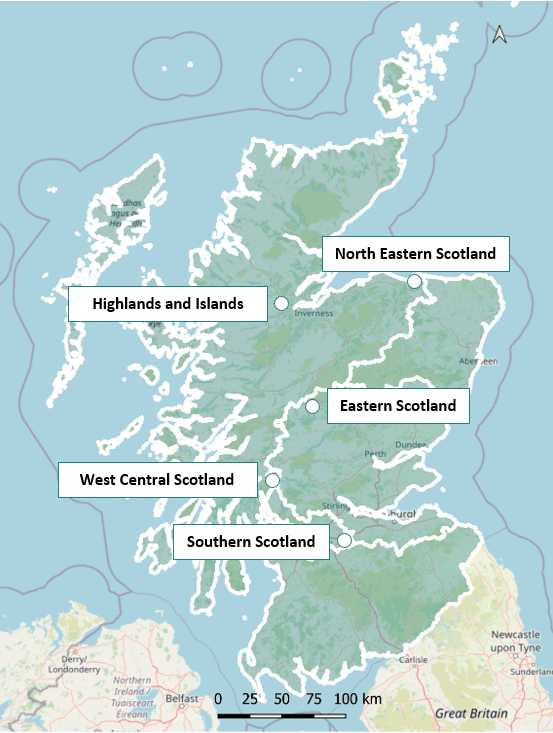
ITL2 Region in Scotland | Share of Goods Moved (Origin) (%) | Major Commodities (mtkm*) | Supplementary Commodities (≥1) (mtkm*) |
Highlands and Islands | 16 million tonne km (13%) | Metal: 4 Groupage:4 Agriculture: 3 | Food: 2 Waste: 1 Coke: 1 |
North Eastern Scotland | 12 million tonne km (10%) | Metal: 3 Groupage: 3 Agriculture: 2 Food: 2 | Waste: 1 Empty: 1 |
Eastern Scotland | 38 million tonne km (31%) | Food: 7 Metal: 6 Agriculture: 6 | Groupage: 5 Waste: 5 Coke: 3 Empty: 2 Wood: 1 Chemicals: 1 Glass: 1 Housing: 1 |
Southern Scotland | 31 million tonne km (25%) | Metal: 7 Groupage: 6 Agriculture: 5 | Food: 3 Waste: 3 Wood: 3 Coke: 1 Empty: 1 Glass: 1 Housing: 1 |
West Central | 25 million tonne km (20%) | Groupage: 7 Metal: 5 Food: 4 | Waste: 1 Housing: 1 Empty: 1 Glass: 1 Mail: 1 |
*Mtkm = million tonne kilometres. Mtkm is a standard freight transport metric and measures freight by weight of goods moved (tonnes) multiplied by distance travelled (kilometres). If you move 1 million tonnes of goods over 1 kilometre, that equals 1 million tonne kilometres (mtkm).
ITL2 Region in Scotland | Share of Goods Moved (Destination) (%) | Major Commodities (mtkm) | Supplementary Commodities (≥1) (mtkm) |
Highlands and Islands | 15 million tonne km (12%) | Metal: 4 Groupage:4 Agriculture: 3 | Food: 2 Waste: 1 Coke: 1 |
North Eastern Scotland | 10 million tonne km (8%) | Metal: 3 Groupage: 3 Food: 2 | Waste: 1 Empty: 1 |
Eastern Scotland | 41 million tonne km (32%) | Food: 7 Metal: 6 Agriculture: 6 | Waste: 5 Empty: 3 Coke: 2 Glass: 2 Empty: 2 Wood: 1 Chemicals: 1 Transport: 1 Housing: 1 |
Southern Scotland | 30 million tonne km (24%) | Metal: 6 Groupage: 5 Food: 5 | Waste: 3 Agriculture: 3 Coke: 2 Wood: 2 Empty: 1 Glass: 1 Chemicals: 1 Housing: 1 |
West Central | 31 million tonne km (24%) | Groupage: 10 Food: 6 Metal: 5 | Waste: 4 Agriculture: 1 Housing: 1 Empty: 1 Glass: 1 Mail: 1 Chemicals: 1 |
ITL2 Region in Scotland | Number of Registered Businesses with an Operator License | Split by Operator License Type (%) | Business by Fleet Size (Number of Vehicles) (%) |
Highlands and Islands | 829 | Restricted: 40% National: 51% International: 9% | Small (≤10): 85% Medium (>10, ≤50): 12% Large (>50): 3% |
North Eastern Scotland | 648 | Restricted: 46% National: 42% International: 12% | Small (≤10): 82% Medium (>10, ≤50): 15% Large (>50): 3% |
Eastern Scotland | 1661 | Restricted: 45% National: 44% International: 11% | Small (≤10): 82% Medium (>10, ≤50): 14% Large (>50): 4% |
Southern Scotland | 1398 | Restricted: 45% National: 41% International: 14% | Small (≤10): 86% Medium (>10, ≤50): 12% Large (>50): 2% |
West Central | 1147 | Restricted: 46% National: 42% International: 12% | Small (≤10): 78% Medium (>10, ≤50): 18% Large (>50): 4% |
Region in Scotland* | Total Number of Diesel Vehicles Registered Over 7.5 Tonnes (% of total)* | Articulated and Rigid Split (Actual Value)* | Average Age of Fleet in Years | Euro 6 Compliance (%)* |
Highlands and Islands | 3057 (10%) | Rigid: 2132 Artic: 925 | Rigid: 10.2 Artic: 7.7 | Rigid: 59% Artic: 77% |
Grampian | 4098 (13%) | Rigid: 2193 Artic: 1905 | Rigid: 10.3 Artic: 6.8 | Rigid: 62% Artic: 86% |
Tayside | 2327 (7%) | Rigid: 1652 Artic: 675 | Rigid: 10.3 Artic: 6.7 | Rigid: 62% Artic: 87% |
Fife | 1596 (5%) | Rigid: 1069 Artic: 527 | Rigid: 10.7 Artic: 6.7 | Rigid: 59% Artic: 86% |
Lothian | 4114 (13%) | Rigid: 3160 Artic: 954 | Rigid: 8 Artic: 6.4 | Rigid: 77% Artic: 90% |
Borders | 689 (2%) | Rigid: 457 Artic: 232 | Rigid: 12.5 Artic: 7.8 | Rigid: 59% Artic: 77% |
Dumfries and Galloway | 1366 (4%) | Rigid: 744 Artic: 622 | Rigid: 11.5 Artic: 6.5 | Rigid: 52% Artic: 87% |
Central Region | 2206 (7%) | Rigid: 1350 Artic: 856 | Rigid: 7.8 Artic: 5.6 | Rigid: 72% Artic: 94% |
Strathclyde | 12,154 (38%) | Rigid: 7946 Artic: 4208 | Rigid: 8.1 Artic: 6.4 | Rigid: 74% Artic: 87% |
*Regional breakdown is different to ITL2 regions used in Transport Scotland and O-License data, SMMT used the 9 regions shown.
*31,607 vehicles analysed (diesel and over 7.5 tonnes)
*Articulated and rigid split is actual value and not estimated like in Table 9.
*Euro 6 assumed for vehicles registered 2015 or later (RAC, n.d)
Region in Scotland | Top Artic OEMs (Number of Registered Vehicles in Region) | Top Rigid OEMs (Number of Registered Vehicles in Region) |
Highlands and Islands | Scania (337), Volvo (285), DAF (167), MAN (41) | DAF (672), Scania (384), Volvo (298), Mercedes (268) |
Grampian | Scania (539), Volvo (466), DAF (346), Renault (183) | DAF (745), Mercedes (383), Scania (341), MAN (251) |
Tayside | Volvo (215), DAF (153), Scania (144), Iveco (80) | DAF (533), Scania (299), Iveco (211), MAN (181) |
Fife | Scania (166), MAN (116), Volvo (84), DAF (75) | DAF (330), Scania (165), MAN (137), Mercedes (125) |
Lothian | Scania (289), DAF (227), Volvo (166), MAN (121) | DAF (1289), MAN (460), Scania (380), Mercedes (264) |
Borders | Scania (120), Volvo (38), DAF (37), Mercedes (16) | DAF (179), MAN (78), Scania (69), Mercedes (30) |
Dumfries and Galloway | Scania (242), DAF (166), Volvo (107), Renault (32) | DAF (261), Scania (119), MAN (111), Renault (49) |
Central Region | Scania (280), MAN (212), Volvo (155), DAF (141) | DAF (485), Scania (309), Mercedes (146), Volvo (132) |
Strathclyde | Scania (1184), DAF (1037), Volvo (931), Renault (337) | DAF (2941), Scania (1290), Volvo (1185), MAN (798) |
2. Case studies
Balfour Beatty hydrogen retrofit project – Scotland (Launched 2024)
Overview
In 2024, Balfour Beatty began retrofitting heavy vehicles with a hybrid hydrogen system. They successfully retrofitted three vehicles in Scotland with this technology: two salt spreader HGVs and one Impact Protection Vehicle. After being trialled on the Connect Roads M77/Glasgow Southern Orbital project, the HGVs achieved a carbon emission reduction of approximately 26%. Moving forward, Balfour Beatty is conducting further tests and research to identify potential improvements. They have also established a green hydrogen supply chain, on-site storage, and refuelling infrastructure for these vehicles.
These retrofits followed a two-year collaboration with ULEMCo, Logan Energy, and PlusZero Power. Funding was secured both internally and externally, including £243,000 from the Scottish Government.
The primary motivation for this initiative was to demonstrate the viability of hydrogen technology, with the long-term ambition of converting Balfour Beatty’s entire fleet. While they have not yet reached their 30% emission reduction target, the project has yielded several valuable lessons to motivate further industry uptake and innovation.
Balfour Beatty has stated that while hydrogen may not be the ultimate solution for decarbonising heavy plant and equipment, it presents a fast and effective interim measure to reduce emissions. An article in driving hydrogen news (Lister, 2024), highlighted additional benefits of hydrogen hybrid systems, including:
- Equipment retains the option of operating in diesel-only mode, which is advantageous while hydrogen infrastructure continues to develop
- Vehicle operation remains unchanged, removing the need for additional driver training
- Vehicles automatically switch to hydrogen mode once engines reach optimal operating temperatures
To support new fuelling procedures, operatives have been issued with antistatic clothing to prevent the ignition of hydrogen gas due to static electricity. Balfour Beatty has also partnered with Hydrasun to ensure staff are professionally trained in hydrogen handling, significantly mitigating safety risks.
Despite its potential, the company has acknowledged that hydrogen supply may pose a barrier to the initiative’s scalability. However, the availability of hydrogen in Scotland is projected to improve in 2026, as multiple government and private sector investments materialise. Currently, Balfour Beatty relies on a single green power supplier, PlusZero Power, via the Aberdeen City Hydrogen Energy Storage facility operated by Aberdeen City Council. Any downtime or maintenance at this facility could halt operations.
Furthermore, the company has discovered that mobile hydrogen supply units are essential for the construction sector. On-site refuelling is crucial, particularly for plant machinery that cannot be easily transported to highways, as off-site refuelling leads to costly downtime. After assessing multiple refueller units, Balfour concluded that suitability depends on the intended end-use and expected volume requirements, which can significantly impact lead times. While still in its preliminary stages, Balfour Beatty’s hydrogen retrofit programme demonstrates both the potential and the complexity of decarbonising heavy vehicles. Lessons from this initiative may inform broader transport and infrastructure policy across the UK (Balfour Beatty, 2024a, 2024b).
Implications for retrofit and repower in Scotland
The Balfour Beatty hydrogen retrofit programme demonstrates that decarbonising heavy vehicles through hybrid hydrogen systems is technically feasible and can deliver meaningful emissions reductions. While not fully zero-emission, these retrofits provide an effective interim solution, allowing vehicles to operate in diesel mode while hydrogen infrastructure continues to develop. The programme highlights the importance of operational integration. Vehicles automatically switch to hydrogen mode, eliminating the need for additional driver training, and safety measures such as antistatic clothing and staff training mitigate hydrogen handling risks.
The initiative also underscores the critical role of infrastructure and supply chain planning. On-site and mobile refuelling are critical for certain sectors to prevent costly downtime, while reliance on a single supplier creates scalability risks. This underscores the need for a resilient and well-structured logistics network. Collaborative partnerships with technology providers and funding support, including government grants, have been key to the project’s success. Overall, the programme offers valuable insights for HGV retrofit and repower in Scotland. It shows that careful assessment of vehicle type, route profiles, and refuelling requirements, combined with strong safety protocols and infrastructure planning are necessary to enable interim decarbonisation while supporting the transition to fully zero-emission fleets.
References
Balfour Beatty, 2024a. Balfour Beatty fuels its decarbonisation effort by retrofitting heavy vehicles with a hybrid hydrogen system. [online] Available at: https://www.balfourbeatty.com/media-centre/latest/balfour-beatty-fuels-its-decarbonisation-effort-by-retrofitting-heavy-vehicles-with-a-hybrid-hydrogen-system/
[Accessed 1 September 2025].
Driving Hydrogen, 2024. Balfour Beatty retrofits hydrogen hybrid system to HGVs, proves success. [online] Available at: https://drivinghydrogen.com/2024/08/27/balfour-beatty-retrofits-hydrogen-hybrid-system-to-hgvs-proves-success/ [Accessed 1 September 2025].
Highways Industry, 2024. Balfour Beatty fuels decarbonisation effort by retrofitting heavy vehicles with a hybrid hydrogen system. [online] Available at: https://www.highwaysindustry.com/balfour-beatty-fuels-decarbonisation-effort-by-retrofitting-heavy-vehicles-with-a-hybrid-hydrogen-system/ [Accessed 1 September 2025].
Veolia UK – Retrofit of Refuse Collection Vehicles – UK (Launched 2024)
Overview
In 2024, Veolia announced the successful completion of vehicle-to-grid (V2G) trials, enabling waste collection trucks to feed stored energy from their batteries back into the UK power grid. This initiative was launched in response to the UK Government’s goal to decarbonise the National Grid by 2035, set against projections that national energy demand could double by 2050.
The trials were delivered in partnership with electric vehicle charger manufacturer Turbo Power Systems (TPS), vehicle repower specialists Magnetic Systems Technology (Magtec), EV charge point management software provider Fuuse, and technology partner Advantics.
The system enables the batteries of waste collection trucks to both charge from the grid and discharge stored energy back into it. This dual functionality means that trucks can supply power during periods of peak energy demand, while also storing surplus renewable energy for future use. This is made possible through bi-directional charging technology, which allows electricity to flow in both directions between the grid and the vehicle battery.
Waste collection vehicles were chosen for these trials due to their large battery capacity, approximately six times that of a standard electric car, and because they are typically idle during peak grid usage times in the evening.
Initial trial results showed that two specially designed bi-directional vehicles were able to charge and discharge a total of 110kW of energy. According to Veolia, this amount of energy is sufficient to power approximately 110 homes for two hours during peak demand periods.
Following the successful trials, Veolia has announced plans to test this technology further in partnership with Westminster City Council, which is already undertaking an ambitious electrification programme. Westminster has committed £20 million to deploy 45 zero-emission electric refuse collection vehicles and aims to eventually electrify its entire fleet of approximately 80 trucks. Each electric refuse truck is estimated to reduce CO₂e emissions by up to 89% compared to a traditional diesel-powered vehicle.
Looking ahead, Veolia aims to electrify all 18,000 of its refuse vehicles across the UK by 2040. If successful, this could provide up to 200MW of flexible power capacity per day, contributing to national energy resilience and sustainability. With municipal vehicles operating predictable daily routes and returning to depots overnight, they represent ideal candidates for future V2G applications, offering dual benefits of carbon reduction and energy resilience. Veolia’s pioneering V2G trials not only showcase innovative uses of electric fleet technology but also reinforce the vital role of municipal services in supporting national energy resilience (Veolia, 2024a; Veolia, 2024b; Zemo Partnership, 2024).
Implications for retrofit and repower in Scotland
Veolia’s V2G trials show the potential for large municipal vehicles to act as both transport assets and grid resources. By using depot-based RCVs with predictable duty cycles, the trials proved that bi-directional charging can deliver meaningful grid benefits while supporting decarbonisation. For HGVs in Scotland, this highlights an opportunity. Repower programmes could be designed not just to reduce emissions / carbon abatement in the vehicles themselves, but also to create new revenue streams through grid services, improving the overall business case for electric repower in particular.
The case study highlights several barriers. Implementing V2G requires major depot upgrades, investment in specialised hardware, and careful management of battery degradation. Operators, particularly SMEs, face challenges such as high upfront costs, downtime during repowering, and uncertainty around grid service revenues. Without financial incentives, market guarantees, or infrastructure support, this service is unlikely to be adopted quickly and is better suited to larger fleets with greater capital or those seeking to explore V2G options for electric repowered vehicles.
For Scotland, the main lesson is that targeted pilots with municipal fleets could provide proof of concept. By focusing on fleets with depot-based operations and predictable routes, supported by tailored finance and early engagement with grid operators, retrofit and repower options could become more feasible.
References
Veolia (2024). Veolia successfully completes pioneering V2G trial in the UK: Waste collection trucks become a flexible energy source to boost energy security. [online] 12 January 2024. Available at: https://www.veolia.com/en/our-media/press-releases/veolia-successfully-completes-pioneering-v2g-trial-uk-waste-collection [Accessed 15 September 2025].
Current-News (2024). Veolia completes V2G trial using UK waste collection trucks. [online] 15 January 2024. Available at: https://www.current-news.co.uk/veolia-completes-v2g-trial-using-uk-waste-collection-trucks/ [Accessed 15 September 2025].
chargedevs.com. (2024). Veolia completes refuse truck vehicle-to-grid trial in the UK. [online] 12 January 2024. Available at: https://chargedevs.com/newswire/veolia-completes-refuse-truck-vehicle-to-grid-trial-in-the-uk/ [Accessed 15 September 2025].
BEAR Programme – Scotland (Launched 2018)
Overview
The Scottish Bus Emissions Abatement Retrofit (BEAR) Programme is a government-led initiative aimed at reducing harmful vehicle emissions in Scotland’s most polluted urban areas. First introduced in 2018 by Transport Scotland, the programme focuses on supporting low emission retrofitting of buses and coaches, ensuring they meet at least Euro 6 emission standards
This initiative directly supports the implementation of LEZs across Scotland’s four largest cities (Glasgow, Edinburgh, Dundee, and Aberdeen) as well as other designated AQMAs. LEZs are designed to reduce harmful pollutants such as nitrogen dioxide (NO₂) and PM (PM10/PM2.5) that contribute to poor public health outcomes in urban environments.
Funding from the BEAR programme supports the installation of CVRAS-approved technologies, primarily:
- Selective Catalytic Reduction (SCR) systems – which target and reduce NOx emissions from diesel engines.
- Diesel Particulate Filters (DPFs) – which remove harmful PM.
- Repowered drivetrains – including transitions from diesel to low- or zero-emission powertrains, where feasible.
Between 2018 and 2022, the BEAR programme invested £21 million, supporting the retrofit of over 1,100 buses and coaches across Scotland. In 2023–2024, an additional £3.26 million was allocated to support continued compliance with expanding LEZ regulations.
Each eligible operator could receive up to £1.14 million in funding, depending on fleet size, retrofit technology, and location of operation. Priority was given to operators based in or frequently operating within LEZ cities or AQMA regions.
Scotland’s BEAR initiative exemplifies how public funding can catalyse private sector action on decarbonisation and air quality improvement. By enabling fleet operators to upgrade existing diesel vehicles, the programme avoids premature scrappage while supporting compliance with tightening environmental regulations. Crucially, the BEAR programme also sets a precedent for other UK and international cities considering emissions reduction without full vehicle replacement, which is often cost-prohibitive for smaller operators.
While the BEAR programme has achieved significant coverage, challenges remain. Retrofitting is technically complex, particularly for older fleets, and there is a limited number of CVRAS-approved suppliers in the UK market. Additionally, integrating retrofits with future zero-emission fleet strategies (e.g. battery electric or hydrogen buses) requires strategic alignment to avoid duplication of investment.
However, BEAR offers a replicable and scalable model of how retrofit-first approaches can bridge the gap between current diesel fleets and future net-zero goals. The Scottish Government has signalled continued interest in supporting vehicle retrofits as part of its broader Climate Change Plan and Transport Scotland’s National Bus Strategy.
Implications for retrofit and repower in Scotland
BEAR demonstrates how targeted public funding and regulatory alignment can unlock large-scale retrofit adoption. BEAR tied financial support to approved technologies and measurable outcomes, ensuring confidence that emission reductions were delivered in practice. The main success factors were the combination of funding, certification, and monitoring. This offers a clear framework that could be adapted to HGV retrofit and repower, where operators face similarly high upfront costs and concerns about technology performance.
For HGVs, the BEAR experience highlights both opportunities and limitations. Financial incentives remain critical to bridging the cost gap, especially for SMEs that dominate the freight sector. Assurance mechanisms can build trust among operators, regulators, and customers. At the same time, the bus sector benefits from depot-based, predictable operations, which make retrofits easier to implement and monitor. The HGV market is far more fragmented, with diverse duty cycles and operating models, meaning that any retrofit scheme would need greater flexibility in eligible technologies and stronger alignment with infrastructure investment. Nevertheless, BEAR shows how retrofit-first policies can act as an essential bridge, extending the life of existing fleets, delivering near-term emissions benefits, and supporting compliance with LEZs while Scotland scales up zero-emission vehicle and infrastructure deployment.
References
Transport Scotland. (2023). Scottish Bus Emissions Abatement Retrofit Fund. [online] Available at: https://www.transport.gov.scot/public-transport/buses/scottish-bus-emissions-abatement-retrofit-fund/ [Accessed 15 September 2025].
Transport Scotland. (2021). Up to £5.7 million available for bus retrofitting. [online] 30 July 2021. Available at: https://www.transport.gov.scot/news/up-to-57-million-available-for-bus-retrofitting/ [Accessed 15 September 2025].
Transport Scotland. (2021). £6.2 million to reduce bus emissions. [online] 15 December 2021. Available at: https://www.transport.gov.scot/news/62-million-to-reduce-bus-emissions/ [Accessed 15 September 2025]
Lothian Buses – KleanDrive Electric Repowering Scotland (2023)
Overview
In 2023, KleanDrive delivered a large-scale electric repower programme for Lothian Buses, converting 18 Volvo B5TL diesel double-deckers into full battery-electric vehicles. The project aimed to demonstrate the commercial and operational viability of repowering as an alternative to new electric bus procurement, while extending vehicle life and reducing lifecycle emissions. The work was commissioned directly by Lothian Buses and delivered by KleanDrive, who supplied the full electric drivetrain and repower solution. Funding came from operator investment, as government grants currently do not support repowering. KleanDrive also collaborates with financial partners to offer alternative financing models for future projects.
The repower programme replaced the original diesel drivetrains with modular Zero emission electric powertrains including motors, inverters and control systems, optimised for the buses’ duty cycles. Retrofitting costs approximately one-third of a new electric bus, and significantly extended vehicle life (10+ additional years). The plug-and-play drivetrain system was fully assembled and tested off-vehicle, enabling rapid installation by local mechanics. The repowered buses retained full performance suitability and offered a range of up to 190 miles, depending on conditions. Cosmetic refurbishment allowed the converted buses to look and operate like new.
The most significant constraints were the need for charging infrastructure and the upfront development cost of the vehicle “blueprint. However, while the initial prototyping is expensive, it can be reused for future vehicles of the same chassis, improving cost-effectiveness at scale. Lothian Buses’ repower programme demonstrates the feasibility, economic advantages, and operational performance of electric repowering as a decarbonisation pathway for existing fleets. With a modular, ISO 26262-certified drivetrain and fast installation process, KleanDrive’s approach offers operators a scalable and lower-cost alternative to a new vehicle purchase.
Lessons from this project highlight the importance of infrastructure planning, model-specific blueprinting, and supportive policy to accelerate wider adoption across UK bus and HGV fleets. In 2025, KleanDrive has also announced initiatives with First Bus converting 30 existing Wrightbus Streetdeck double-decker buses from diesel to electric and Welch Group to convert 18-tonne rigids.
References
See: Lothian Buses (2023) Kleanbus will convert 18 Volvo B5TLS from Lothian Buses to electric. Available at: https://kleandrive.earth/sustainable-bus-kleanbus-will-convert-18-volvo-b5tls-from-lothian-buses-to-electric/?foo=bar
See: KleanDrive (2025) KleanDrive has announced the conversion of 30 Streetdecks for operator First Bus. Available at: https://kleandrive.earth/elementor-24918/?foo=bar
See: KleanDrive (2025) KleanDrive and Welch Group announce HGV Electric Repower partnership. Available at: https://kleandrive.earth/elementor-24963/?foo=bar
Mexico City – DPF Retrofit for HGVs (Launched 2005)
Overview
In 2015, Mexico City launched its pilot DPF retrofit programme for buses. The programme was run through the Centre for Sustainable Transport, a Mexico City-based non-governmental organisation, which was awarded $511,000 in grants for the project. Funding was provided by the US Environmental Protection Agency (EPA) and EMBARQ (part of the World Resources Institute).
The pilot built on the successful real-world testing of retrofits in 2005 by SEDEMA with CTS-Embarq Mexico, the US EPA, and USAID. These earlier tests found DPFs to be effective in reducing both particle numbers and the mass of particulate emissions. The project combined ultra-low sulphur diesel with retrofit technologies, including DPFs, to reduce PM emissions and other pollutants by up to 90%.
Twenty buses were selected: eight 2001 AYCO International models, eight 1991 Mercedes-Benz Prototype models, and four 2002 Mercedes Torino models. The buses operated for a period of ten months. Tailpipe emissions were measured at various stages of the trials using the Ride-Along Vehicle Emissions Measurement (RAVEM) system. This records hydrocarbons (HC), carbon monoxide (CO), carbon dioxide (CO₂), nitrogen oxides (NOx), and particulates in real time. Measurements were taken under baseline conditions (before improvements were made), at stabilisation (after 4,000 km of operation), and at performance (after 55,000 km of operation).
Training was provided for 20 mechanics and 40 bus operators, who learnt how to install and use the emission control devices, as well as driving techniques to ensure optimal performance. The third round of emissions testing showed that retrofitted vehicles maintained, and in some cases improved, reductions in exhaust pollutants. DPFs proved highly effective, cutting PM emissions by 83–92%, while diesel oxidation catalysts (DOCs) delivered only modest reductions of 22–29% and were largely ineffective against fine PM. This suggests that repowering or replacing older vehicles may be a better option for addressing emissions from the dirtiest buses. NOx reductions of around 5–10% were partly attributed to the use of ultra-low sulphur diesel (ULSD), although results varied significantly depending on driver behaviour, which also influenced CO₂ and fuel consumption. The project further underscored the importance of proper maintenance, particularly fixing exhaust leaks before and after installing retrofit equipment, to ensure long-term performance.
Drawing on these results, EMBARQ recommended a two-part strategy. Firstly, retiring or replacing the oldest and most polluting vehicles with modern buses equipped with advanced emissions controls. Secondly, retrofitting newer fleets with DPFs and ULSD fuel to achieve up to 90% cleaner operations. Although retrofitting older, mechanically controlled vehicles can deliver modest improvements, the most hazardous ultra-fine particles are best addressed through fleet renewal. Taken together, this retire/replace/retrofit approach offers a cost-effective and scalable pathway to improve air quality in cities with air pollution issues.
Implications for retrofit and repower in Scotland
The Mexico City DPF retrofit programme highlights how structured monitoring and evaluation can ensure retrofitted vehicles deliver measurable emission reductions. By targeting specific vehicle types, ages, and OEMs, the programme shows that retrofits are effective for newer fleets but less so for the oldest vehicles, where repower or replacement may be needed. Though the programme was launched in 2005, the motive of the project and the evaluation methods can be replicated at scale for 2025. What is interesting is that repowered drive trains were not a viable option in 2005 (at least not on the scale of today) and so retrofit would have been only real option. However, this demonstrates that a Scotland HGV fleet retrofit / repower programme does not have to re-invent the wheel, learning from case studies like Mexico twenty years ago.
This shows that retrofit can be a cost-effective interim solution for early abatement, while longer-term zero-emission technologies are scaled up. The case also emphasises the importance of training, maintenance, and operational procedures, providing lessons for Scotland on combining financial incentives, technical support, and monitoring to maximise the impact of HGV retrofit and repower initiatives.
References
Schipper, L., Wayne, W.S., McKain, D.L., Clark, N.N., & Rivero Borrell, E. (2006). Cleaner buses for Mexico City, Mexico: From talk to reality. Transportation Research Record: Journal of the Transportation Research Board, 1987(1), 42–53. https://doi.org/10.1177/036119810619870010 [Accessed 12 September 2025]
Stevens, G., & Schipper, L. (2005). A benefit-cost analysis of retrofitting diesel vehicles with diesel particulate filters in Mexico City. Environmental Science & Technology, 39(16), 6163–6170. https://doi.org/10.1021/es0508837 [Accessed 12 September 2025]
United States Environmental Protection Agency (EPA). (2005). Cleaning up the fleet: Case study from Mexico City. [PDF document]. Retrieved from https://archive.epa.gov/international/air/web/pdf/cleaning_up_the_fleet.pdf [Accessed 12 September 2025]
Quantron Hydrogen Fuel Cell Repower, Heavy Duty Vehicles – Germany and UK (Launched 2021)
Overview
In 2021, German-based Quantron AG launched its hydrogen fuel cell programme in partnership with Ballard Power Systems. This collaboration integrated Ballard’s advanced FCmove™ heavy-duty fuel cell modules into Quantron’s platforms and marked the beginning of the company’s commercial roll-out of both light and heavy-duty hydrogen fuel cell electric vehicles (FCEVs) across Europe.
The partnership led to the development of two flagship products. The QLI FCEV, Europe’s first hydrogen fuel cell light-duty truck, has already entered fleet service, including five vehicles deployed by IKEA in Austria. The manufacturer claims a range of up to 450km, refuelling times under ten minutes, and multiple body variants, the QLI demonstrates the viability of hydrogen for urban and regional logistics. Complementing this, the QHM FCEV Aero was developed for long-haul transport. This heavy-duty model can travel up to 700km on a single tank of hydrogen, 1,500km in a “Scandinavia” configuration, and features an aerodynamic nose design that reduces drag by 20% and extends range by approximately 10%. By integrating tanks directly into the chassis, Quantron preserved trailer compatibility while avoiding bulky rear “backpack” designs.
Demonstrations and early commercial uptake have followed rapidly. In the UK’s Tees Valley region, Quantron is delivering 14 hydrogen vehicles (12 light transporters and two heavy-duty trucks) as part of a 20-vehicle trial. The project is supported with £7 million from the UK Government as part of the Tees Valley Hydrogen Transport Hub Competition and delivered in partnership by Innovate UK. A green hydrogen refuelling station is also being built as part of this project. In Germany, deployments include a pay-per-use arrangement with Hylane (a leading zero-emission commercial vehicle rental company in Europe) for last-mile operations, showing how flexible business models can accelerate fleet adoption.
Recognising that hydrogen vehicle adoption depends heavily on refuelling infrastructure, Quantron formed a strategic joint venture, HEMTRON, with Oilinvest Group. This partnership leverages Oilinvest’s existing network of more than 2,450 Tamoil and HEM fuel stations to develop hydrogen refuelling capacity across Europe.
Quantron has also positioned itself uniquely in the market by offering its Quantron-as-a-Service ecosystem. This model bundles vehicles, financing, maintenance, insurance, telematics, and hydrogen refuelling into a per-kilometre package. The company projects that, as hydrogen production costs decline, its hydrogen trucks could achieve cost parity with diesel models as early as 2026.
Together, these developments show that Quantron’s retrofit / repower, and vehicle integration strategy is more than technological innovation. By combining vehicle engineering, infrastructure partnerships, and service models, the company is making hydrogen fuel cell technology both practical and competitive in the heavy transport sector.
Implications for retrofit and repower in Scotland
This example highlights how hydrogen retrofit or repower could reduce emissions while simultaneously creating wider benefits beyond the transport sector. The development of green hydrogen refuelling hubs and partnerships, such as HEMTRON in Europe, illustrates the potential for an integrated value chain where energy, jobs, and skills are generated across multiple sectors.
The Quantron model shows that providing bundled solutions (including vehicle financing, maintenance, insurance, telematics, and refuelling) reduces operational barriers for fleet operators, increasing adoption feasibility. While hydrogen remains more complex and resource-intensive than battery retrofits, the case reinforces that interim retrofit or repower solutions can be positioned strategically to decarbonise Scotland’s HGV fleet while supporting a broader low-carbon economy in secondary sectors.
References
Euro 6 Diesel Coach Converted to Bio-CNG (referenced at Bio-GNV in France) – France (Launched 2025)
- Ballard Power Systems and Quantron AG (2021) ‘Ballard Power Systems and Quantron AG announce a strategic partnership for the development of hydrogen fuel cell electric trucks’, PR Newswire, 7 September. Available at: https://www.prnewswire.com/news-releases/ballard-power-systems-and-quantron-ag-announce-a-strategic-partnership-for-the-development-of-hydrogen-fuel-cell-electric-trucks-301370178.html (Accessed: 15 September 2025).
- Quantron AG and Ballard Power Systems (2023) ‘Quantron hydrogen fuel cell trucks ready for delivery in Europe’, CCJ Digital, 5 September. Available at: https://www.ccjdigital.com/alternative-power/hydrogen-fuel-cell/article/15546292/quantron-hydrogen-fuel-cell-trucks-ready-for-delivery-in-europe (Accessed: 15 September 2025).
- Ballard Power Systems and Quantron AG (2023) ‘Quantron and Ballard Power Systems introduce fuel cell-powered trucks ready for delivery’, Fuel Cells Works, 1 September. Available at: https://fuelcellsworks.com/news/quantron-and-ballard-power-systems-introduce-fuel-cell-powered-trucks-ready-for-delivery/ (Accessed: 15 September 2025).
Overview
A groundbreaking project launched in France in early 2025 saw the world’s first conversion of an IVECO Crossway Euro VI diesel coach to run on Bio-CNG (Bio-GNV). This initiative was the result of a collaboration between the engineering firm CRMT and the transport operator Berthelet, with additional involvement from the public transport authority Transdev and the Pays de la Loire region. The converted coach was subsequently put into service as a school bus.
The conversion involved replacing the diesel engine with a methane-powered equivalent, installing a full CNG fuel circuit, fitting a depollution system, recalibrating the gearbox controls, integrating a CNG auxiliary heater, and mounting a fuel tank that delivers a range of approximately 300 km (ideal for regular school routes). The repower used Bio-GNV, meaning biomethane derived from renewable sources, rather than conventional fossil CNG. This repower achieved notable environmental and economic benefits including a 70% reduction in nitrogen oxides (NOₓ), 80% reduction in fine particles (size > 23 nm), a significant decrease in CO₂ emissions and extended vehicle lifespan. The conversion was roughly 50% of the cost of purchasing a new coach and ensured full compliance with current and future regulations (Crit’Air 1 certification and LEZ access).
Beyond the immediate retrofit, the project signals CRMT’s readiness to scale the solution. Following this success, the organisation is preparing industrialised retrofit kits for rapid deployment and is exploring scaling options, aided by streamlined installation processes learned from this first prototype. This Bio-GNV coach demonstrates that performance, sustainability, and cost control can be combined, offering an innovative, available, and credible alternative to diesel – a crucial step toward wider decarbonisation of public transport fleets.
Implications for retrofit and repower in Scotland
The French Bio-GNV project provides valuable lessons for interim HGV retrofit and repower strategies. It demonstrates that predictable routes, such as regional deliveries, can achieve meaningful emissions reductions without the need for immediate full zero-emission replacements.
Financially, the French case highlights the cost-effectiveness of retrofit and repower approaches, which could make interim decarbonisation more viable for SMEs and other operators that may struggle to invest in new zero-emission HGVs. Operational feasibility is another key takeaway. The converted coach maintained adequate range and functionality, showing that repowered vehicles can meet day-to-day operational requirements without causing downtime or disruptions. This demonstrates that hydrogen and gas repower could be explored alongside electric repower as different use cases require tailored predictability, access, cost, and reliability of different fuel types.
The case also illustrates the importance of scalability and standardisation. CRMT is preparing industrialised retrofit kits to streamline future deployments. This suggests that Scotland could adopt similar models to roll out HGV retrofits efficiently with accredited suppliers once trials and successful pilots have taken place. However, HGVs typically have more varied duty cycles and payload requirements than coaches, and renewable fuel supply chains must be robust to support wider adoption.
References
CRMT (2025). Inauguration of a world first in Sarthe: the first Euro VI Diesel coach converted to BioGNV by CRMT. Available at: https://www.crmt.fr/en/news/ [Accessed 10 Sep. 2025].
Gaz-Mobilité (2025a). Rétrofit bioGNV: la région Pays de la Loire pionnière avec la conversion de cet autocar diesel Euro VI. Available at: https://www.gaz-mobilite.fr/actus/retrofit-biognv-conversion-autocar-scolaire-diesel-euro-vi-pays-de-la-loire-4146.html [Accessed 10 Sep. 2025].
GNVMagazine (2025). Transdev and Pays de la Loire unveil an Aléop bus equipped with a biogas engine. Available at: https://www.gnvmagazine.com/en/transdev-and-pays-de-la-loire-unveil-an-aleop-bus-equipped-with-a-biogas-engine/ [Accessed 10 Sep. 2025].
Survey Results and Analysis
Appendix C provides a breakdown of the responses to the operator survey.
The survey comprised of 29 questions (including open ended comments box answers). 25 operators responded to the survey with details on their fleets and their thoughts on and propensity to retrofitting and repowering. Answers can be grouped into eight themes:
- Basic fleet information
- Operating centres
- Key focus for future alternative fuels
- HGV mix
- Views on retrofitting
- Factors determining vehicle replacement
- Motives for retrofitting
- Take on key support themes
Basic fleet information
Distance travelled per day (per vehicle) | Count | % of respondents |
< 50 km | 1 | 4% |
50–100 km | 6 | 24% |
101–200 km | 8 | 32% |
201–300 km | 3 | 12% |
> 300 km | 7 | 28% |
Total | 25 | 100% |
Fleet size (vehicles) | Count | % of respondents |
1–5 | 2 | 8% |
6–10 | 3 | 12% |
11–20 | 2 | 8% |
21–50 | 3 | 12% |
51–100 | 4 | 16% |
≥101 | 11 | 44% |
Total | 25 | 100% |
Operating centres
Location | Mentions | Share of mentions |
Central Belt | 17 | 36% |
Tayside | 10 | 21% |
North Scotland | 8 | 17% |
North East Scotland | 7 | 15% |
South Scotland | 5 | 11% |
Total | 47 | 100% |
Fuel considered | Count | % of respondents |
Electric | 16 | 64% |
HVO | 11 | 44% |
Hydrogen | 10 | 40% |
CNG | 5 | 20% |
Biodiesel | 3 | 12% |
Not considering | 4 | 16% |
Total | 49 |
HGV mix
Fuel type | Count | Share of fleet |
Diesel | 2619 | 89% |
Biodiesel | 199 | 6% |
HVO | 82 | 3% |
CNG | 43 | 1% |
Electric | 7 | 0% |
LNG | 1 | 0% |
Total | 2951 | 100% |
Configuration | Count | Share of base |
Rigids (total) | 1455 | 54% |
• 3.5–12 t | 399 | 14% |
• 12–26 t | 788 | 27% |
• >26 t | 410 | 13% |
Articulated | 1354 | 46% |
Total | 2951 | 100% |
Euro class | Count | Share of base |
Euro 6 | 2825 | 96% |
Euro 5 | 73 | 2% |
Euro 4 or older | 53 | 2% |
Total | 2951 | 100% |
Views on retrofitting
The views on retrofitting were mostly nonchalant or negative. Seven of the 25 respondents said they would consider retrofitting, while 18 said they would not consider retrofitting. The negatives were attributed to initial cost, lack of supporting infrastructure and both the uncertainty/changes to maintenance regime. Those who were interested in retrofitting cited good access too incentives and grants, urban access, innovation leading, sustainability and long term cost savings.
Vehicle replacement
The most common answer for vehicle replacement was old age (14), followed by mileage and reliability (each 9), carbon footprint of vehicle (5), new technology emerging (3), driver retention and resale value (each 2) and other factors (1) that were not specified.
Replacement Cycle | Count | Share |
3-5 years | 1 | 4% |
5-7 years | 13 | 52% |
7-11 years | 9 | 36% |
Did not answer | 2 | 8% |
Total | 25 | 100% |
Motives for retrofitting
Many respondents reiterated they had no interest in retrofitting (12), followed by a key interest in hydrogen shown (5), willingness and open to retrofitting (2) and identifying at this stage that cost and financing affects their decision (1).
For those who were not willing to retrofit, respondents mostly cited it was due to high initial cost (16), followed by limited availability of retrofit options (7) and range and refuelling concerns (7).
Take on key support themes
When asked about what could support the sector to encourage retrofit and repower, most of the respondents said they would find investment in infrastructure very helpful (17), followed by financial support (14) and policy and regulation (11).
Policy Document Review
Appendix D provides more detail on the five policies outlined in the report and incentives / support mechanisms. The policies have been reviewed in line with their impact on retrofitting and repower in Scotland.
Scotland’s Draft Climate Change Plan: 2026-2040
Scotland’s draft Climate Change Plan (CCP) for 2026–2040, published in November 2025, outlines policies to achieve net-zero emissions by 2045. The plan prioritises decarbonising heat, phasing out petrol and diesel cars by 2030, expanding woodland and peatland restoration, and promoting renewable energy. It aims for significant emissions reductions across sectors such as transport, industry, and agriculture, while supporting a just transition for communities.
The CCP sets ambitious interim emissions reduction targets, aiming for a 57% cut by 2030, 69% by 2035, 80% by 2040, and 94% by 2045 compared to 1990 levels. For the transport sector, the plan prioritises expanding electric vehicle infrastructure, investing in public transport and active travel to encourage a shift away from single-occupancy car use, and promoting zero-emission HGVs and freight systems through alternative fuels and logistics solutions. It also targets decarbonisation of aviation and maritime transport, supports regional pilot projects such as hydrogen and electric mobility in rural areas, and emphasises alignment with national and local strategies to ensure coordinated carbon reduction efforts.
HGV Decarbonisation Pathway for Scotland – ZETT
Scotland’s HGV Decarbonisation Pathway, launched in March 2024 and developed through the ZETT, represents 18 months of cross sector collaboration – including representatives from haulage, energy, manufacturing, government, finance, and unions to assess and overcome barriers to alternative fuel HGVs in Scotland (Scottish Government, 2024a). It identifies four core challenges including:
- Access to energy infrastructure
- New financial models
- Confidence in technological and commercial change
- Workforce skills
While the long-term vision focuses on zero-emission technologies, the pathway acknowledges that immediate widespread adoption of such technologies may not be feasible due to various constraints, including technological maturity, infrastructure readiness, and financial considerations. Therefore, the pathway supports interim solutions to bridge the transition to full decarbonisation, highlighting opportunities achievable through retrofitting and repowering existing HGVs.
For instance, interim measures include accelerating infrastructure development with appropriate support mechanisms to encourage uptake of eHGV chargers and alternative fuels, alongside increased use of low-carbon fuels such as renewable diesel and hydrogen, including dual-fuel and zero-emission fuel cell retrofit strategies.
Scottish Government Programme for Government
The Programme for Government 2025–26 sets out the Scottish Government’s annual priorities to deliver on its statutory climate targets and broader net zero commitments (Scottish Government, 2025). It emphasises accelerating the decarbonisation of transport, expanding renewable energy infrastructure, and supporting businesses and communities in the transition to a greener economy.
The EV fund identified in the programme suggests there may be funds available to support retrofit / repower efforts (charging, hydrogen, etc.). The programme identifies government market signals as a critical commitment to drive retrofit and repower supply chain development. This is intended to make these options viable interim solutions, particularly for mixed-duty HGV operations, while the zero-emission market continues to mature.
Low Emission Zones (Glasgow, Edinburgh, Aberdeen, Dundee)
Scotland’s LEZ’s were introduced in Aberdeen, Dundee, Edinburgh and Glasgow between May 2022 and June 2024 to restrict access for the most polluting vehicles and improve urban air quality (Transport Scotland, 2024a). Vehicles must meet minimum emission standards (Euro 4 for petrol cars, Euro 6 for diesel cars and vans, and Euro 6 for buses, coaches, and HGVs) otherwise the driver may incur a penalty charge starting at £60. The schemes operate 24/7 and rely on ANPR enforcement. They are backed by grant funding via the Low Emission Zones Support Fund, which helps vulnerable individuals and small businesses to upgrade vehicles or switch to cleaner transport modes.
LEZs create a regulatory mandate. If an existing HGV is non-compliant, it either must be replaced, retrofitted, repowered, or risk penalty. This creates demand for retrofit / repower solutions. Transport Scotland has highlighted that financial support should accompany LEZs to mitigate the risk of business failures, as the absence of incentives could pose significant challenges for SMEs and the broader freight network (see Scottish Government, 2024). While LEZs encourage the transition to low and zero emission HGVs, supporting retrofit and repower markets, they must align with Scotland’s Just Transition by enhancing support mechanisms to help operator fleets achieve LEZ compliance.
Net Zero Nation Strategy (2021)
Scotland’s Net Zero Nation strategy provides a five-year framework to engage the public in delivering climate action, built around the principles of Understand, Participate, and Act (Scottish Government, 2021). The strategy emphasises engaging communities in shifting towards sustainable travel choices such as increased walking, cycling, and public transport use while supporting acceptance of policies like the wider transition to zero emission vehicles.
While the Strategy does not explicitly mention retrofit / repower, its framing of a “just transition” and “accelerated decarbonisation” supports the motive that any interim measure to accelerate decarbonisation does not exclude SMEs from markets or force premature scrappage. Retrofit and repower also cover the Strategy’s circular economy alignment; it extends vehicle lifespans and avoids unnecessary waste.
Stakeholders consistently highlighted incentives and funding as key to encouraging retrofit and repower adoption. The support required differs by operator type: larger operators often seek funding linked to broader infrastructure partnerships, while smaller operators prefer direct support for retrofit assets.
Understanding the rules of each funding stream is critical. Some require accredited technology or approved partners to unlock grants. Notably, future funds are expected to focus on zero-emission solutions, favouring repower over low-emission retrofit. Key schemes include:
Direct Retrofit and Repower Support:
Zero Emission Repower Accreditation Fund (ZEVRAS [and CVRAS]): CVRAS-approved kits typically make vehicles accepted for Scottish LEZs. This is aligned with the Low Emission Zone Support Fund and caps approved retrofit funding support (for HGVs) at £16,000 per vehicle.
Low Emission Zone Support Fund: £2 million available 2025-2026 with 80% funding for retrofitting LGVs (capped at £5000) and HGVs (capped at £16,000).
Research, Development and Trialling – Supporting the Same Motive:
HGV Market Readiness Fund: £2 million available 2025-2026 with up to £20,000 per operator for assessments and strategic review of HGV decarbonisation routes. Can support demonstrations and market enablement for zero-emission HGVs (including repower solutions) where they help prove commercial readiness of tech/infrastructure.
Zero Emission HGV Infrastructure Demonstrator Fund: more complex research and development where operators are supporting with delivery partners to trial low and zero emission HGV technologies. John G Russell Transport are currently planning their hydrogen and electric truck trials in Scotland (new zero emission vehicles), while Welch Group in Cambridgeshire (England) are actively working with repower suppliers to run a repowered truck alongside new zero-emission HGVs and conventional diesel HGVs.
Drive35: £2.5 billion over a ten-year period for research and development support for zero-emission technologies. Drive35 is not a “fleet-purchase” pot, but it is quietly shaping the ecosystem operators would rely on for their day-to-day fleet operations. For instance, increases demand and capacity (thus the economy of) zero and low emission HGV technologies.
Further Examples to Leverage from or Indirectly Offer Support:
Bus Emission Abatement Effort (BEAR) and ScotZEB: Not directly fundable for HGVs, but: copy the commercial templates, share depots where practical, and tap the same suppliers trained on Scottish zero emission powertrains/charging.
Freight Facilities Grant: Though not for retrofit and repower directly, the movement of projects funded by this grant will explore decarbonisation opportunities through modal shift. By shifting a trunk leg off the road, operators avoid the full operating/maintenance cost of HGVs for that mileage. Resultingly, the capital that would have been tied up in purchasing a new diesel unit can be diverted to retrofit and repowering for the remainder of the HGV fleet.
Office for Zero Emission Vehicles (OZEV): OZEV have several funding streams that might not be directly for retrofit / repower but can be leveraged to support it. For instance, the depot charging scheme offers up to £1 million per operator to install chargers, which could encourage electric repowering of some of their fleet, significantly de-risking an operator’s infrastructure buildout.
Retrofit and repower summary
Appendix E provides an overview of the technical feasibility operational impacts and economic analysis of each of the technologies reviewed as part of this study.
Technical Feasibility
Table 19 provides a high-level overview of the technical feasibility of each of the technologies. This includes the best operational use cases / duty cycles, vehicle compatibility, strategic value, current availability, longevity, and potential emissions savings for each of the technologies. Where appropriate, boxes have been RAG rated:
- Green: Indicates a strong or favourable assessment. The technology is considered highly viable or effective for the criterion in question.
- Amber: Indicates a mixed or moderate assessment. The technology may be viable in certain contexts or with caveats – there may be some barriers, uncertainties, or limitations that need to be addressed.
- Red: Indicates a weak or unfavourable assessment. The technology faces significant barriers, is not currently viable, or has major drawbacks for the criterion in question
Factor | Technology | ||||||
|---|---|---|---|---|---|---|---|
Retrofit | Repower | ||||||
DPF only | SCR only | Combined DPF & SCR | Gas (Dual Fuel) | Dedicated Gas (CNG / LNG / Biomethane) | Electric | Hydrogen | |
Best operational use case/ duty cycle | Urban / LEZ zones where PM is regulated | Long-haul or highway routes where NOₓ is the concern | Mixed urban and highway, high compliance requirements (Euro VI compliance) | High-mileage/higher weight category (e.g. 40t+) depot-based fleets with partial access to gas refuelling | Depot-based, high-mileage/lower weight category (e.g. <40t) routes with reliable CNG/LNG or biomethane refuelling | Urban/regional predictable routes / lower weight categories (e.g. <18t rigids and <42t artic) | High mileage / higher weight category fleets needing fast refuelling |
Technical Suitability | Compatible with Euro IV and V | Compatible with Euro IV and V | Compatible with Euro IV and V | Compatible with Euro V – vehicles under 10 years old | Compatible with Euro V – vehicles under 10 years old | Compatible with Euro V and VI (vehicles under 12 years old) with robust chassis and electronic controls | Compatible with Euro V and VI with robust chassis and electronic controls |
Strategic Value | Useful for LEZ compliance | Useful for air quality, not climate targets | Full compliance (PM + NOx) but not carbon reducing | Transitional solution (short/medium term. Reduces emissions but not zero-emission | Transitional solution (short/medium term) Significantly reduces emissions but not zero-emission | Long-term solution for HGVs although technology not ready for heaviest weight class of rigid or artic. Zero emission | Long-term solution for long haul decarbonisation Zero emission |
Availability | Mastered, widely used | Mastered, widely used | Mastered, widely used | Mature, deployed in UK and EU fleets | Mature, deployed in UK and EU fleets | Evolving, growing no. of vehicles adopted | Emerging, very few vehicles in use, prototypes |
Longevity | 5–10 years depending on duty cycle and maintenance | 5–10 years, depending on duty cycle and maintenance | 5–10 years, depending on duty cycle and maintenance | Up to 10 years with proper maintenance | Up to 10 years with proper maintenance | 10 years | 10 years |
Emission reduction | Reduces PM (up to 99%) but not CO₂ or NOx. | Reduces NOx (90-99%) but no CO₂ benefit | Reduces PM (up to 99%) + NOx (90-99%) but no CO₂ benefit | 20% CO₂ reduction and up to 10% NOx reduction. Methane slip can negate the benefits of using gas as a fuel | Reduces PM (~95% lower), NOx (50–80%), CO₂e (fossil CNG/LNG) 5–15% lower, CO₂e (biomethane) 65–85% lower | Zero emission | Zero emission |
Operational Impacts
Table 20 provides a high-level overview of the operational impacts of each of the technologies. This includes additional maintenance vs. standard diesel ICE, level of risk and dependency on refuelling infrastructure, impacts on payloads / range and the time it takes to fit the technology.
Factor | Technology | ||||||
|---|---|---|---|---|---|---|---|
Retrofit | Repower | ||||||
DPF only | SCR only | Combined DPF & SCR | Gas (Dual Fuel) | Dedicated Gas (CNG / LNG / Biomethane) | Electric | Hydrogen | |
Maintenance | DPF cleaning, ash removal every ~50k–100k km | AdBlue system, dosing, NOₓ sensors | Both DPF + SCR maintenance | Gas injectors, high-pressure tanks, filters | High-pressure gas tanks, regulators, safety checks; engine tuning may be needed | Battery/drive unit low maintenance; charger dependency | High-pressure hydrogen + engine tuning – strict protocols and specialist skills |
Risk / infrastructure Dependency | Low risk | Low risk | Low risk | Medium risk | High risk | High risk | Very high risk |
Standard diesel | Diesel + AdBlue | Diesel + AdBlue | Diesel + gas, refuelling planning needed | Requires CNG/LNG (few public refuelling stations, regional coverage uneven) | Requires charging infrastructure (limited depot or public) | Requires hydrogen depot (very sparse) | |
Operational performance (e.g. payload range) | None | None – adds AdBlue tank (50–100L) | None – Slight weight impact from combined system | Moderate payload loss (300–600 kg) | Significant payload loss (600–900 kg) | Significant payload loss (2 tonnes depending on vehicle, battery size, and route | Minor payload loss |
Range slightly reduced vs diesel | Range ~300–400 miles typical per tank | Range – short haul <300km, long haul 300-500km | Range similar to diesel | ||||
Downtime during fitment | 1–2 days to install | 1–3 days to install | 2–3 days to install | 5 days to install | 2-4 weeks to install | new HGV blueprint 7–8 months; after that 2–4 HGVs per week | Approx. 4-8 weeks |
Economic Analysis
Table 21 provides a high-level economic analysis for each of the technologies including capital costs, fuel/running costs, payback potential, and TCO. Calculations are based on the following baseline assumptions.
| Value (consistent baseline) | |
Annual mileage | 75,000 miles[1] / 120,700km per year | |
Diesel consumption | ||
Diesel use | 42,245 L (120,700 × 0.35) | |
Diesel price | £1.45/L[4] | |
Baseline diesel spend | £61,255 / year (42,245 L × £1.45) | |
AdBlue price | £1/L[5] | |
AdBlue use (5% of diesel volume) | £2,112 / year (0.05 × 42,245 = 2,112 L at £1/L) | |
Electricity price (standard tariff) | £0.24/kWh[6] | |
Energy use assumption | 1.1 kWh/km[7] | |
Hydrogen price | £15/kg[8] | |
Biomethane price | £1.05/kg[9] | |
LEZ charge (if non-compliant) | £60/day[10] (only applied when relevant) | |
Analysis period | 5 years |
Notes and caveats
- These are illustrative, consistent calculations to compare technologies under the same baseline usage and the diesel price. Actual results vary by exact vehicle model, local fuel/energy prices, duty cycle, grant funding, and maintenance regimes.
- The EV and hydrogen outcomes are extremely sensitive to energy price assumptions, vehicle capex (may be lower with purchase or grants), and access to smart charging or hydrogen at scale. If electricity price falls or capital subsidies apply, EV payback improves sharply.
- Dual-fuel and dedicated-gas economics assume access to gas (CNG/biomethane) at depot prices, public refuelling limits and payload penalties affect operational viability.
- DPF/SCR are primarily compliance/emissions measures — they rarely pay back from fuel savings alone unless Clean Air Zone/LEZ fines are avoided or subsidies exist
Factor | Technology | ||||||
|---|---|---|---|---|---|---|---|
Retrofit | Repower | ||||||
DPF only | SCR only | Combined DPF & SCR | Gas (Dual Fuel) | Dedicated Gas (CNG /LNG/Biomethane) | Electric | Hydrogen | |
Approx capital cost | £4,000 per truck | £17,000 per truck | £20,000 per truck | £15,000 per truck | £30,000 per truck | one-third cost of new eHGV (approx. £100,000) | Approx. £200,000 per truck |
Fuel /running cost | Minor increase in fuel cost (2% £1,225 / yr) | None | Minor increase in fuel cost (2% £1,225 / yr) | Diesel displacement: 40% replaced by gas | Biomethane 30% cheaper per mile | Electric efficiency: 1.1 kWh/km (fluctuates depending on environment) | Hydrogen consumption: 10 kg/100 km |
AdBlue £2,112/yr | AdBlue £2,112/yr | Extra £400 maintenance per/yr | Electricity price: £0.24/kWh | ||||
Extra £550 maintenance per /yr | Extra £300 maintenance per / yr | Extra £700 maintenance per / yr | Fuel price advantage: biomethane ≈ 30–40% cheaper per energy unit | Diesel avoided: full displacement | Hydrogen price: £15-25/kg | ||
Extra £400 maintenance per/yr | Maintenance: −30% vs diesel (saving £1,500/year) | Maintenance: similar to diesel | |||||
Payback Potential | No payback (unless LEZ) | No payback (unless LEZ) | No payback (unless LEZ) | ~2.08 yrs | ~1.67 yrs | ~3.24 yrs | No payback at £15/kg H₂ |
TCO (5 yr net cost/ benefit) | 5-yr Total Cost: £12,875 | 5-yr Total Cost: £29,060 | 5-yr Total Cost: £40,185 | 5-yr Net Benefit: £21,020 | 5-yr Net Benefit: £59,885 | 5-yr Net Benefit: £54,450 | 5-yr Total Cost: £798,975 |
The 5-year TCO and payback figures have been estimated as follows:
- DPF retrofit
- Capex: £4,000
- Fuel penalty: 2% → 0.02 × 42,245 = 845 L × £1.45 = £1,225/year
- Maintenance: £550/year
- Total extra annual cost: £1,225 + £550 = £1,775
- 5-year opex: 5 × £1,775 = £8,875
- 5-year total cost: £4,000 + £8,875 = £12,875
- Payback: N/A (compliance measure, no fuel savings)
2. SCR retrofit
- Capex: £17,000
- AdBlue cost: £2,112/year
- Maintenance: £300/year
- Total extra annual cost: £2,112 + £300 = £2,412
- 5-year opex: 5 × £2,412 = £12,060
- 5-year total cost: £17,000 + £12,060 = £29,060
- Payback: N/A (fuel savings negligible)
3. Combined DPF and SCR retrofit
- Capex: £20,000
- Fuel penalty (DPF): £1,225/year
- AdBlue cost: £2,112/year
- Maintenance: £700/year
- Total extra annual cost: £1,225 + £2,112 + £700 = £4,037
- 5-year opex: 5 × £4,037 = £20,185
- 5-year total cost: £20,000 + £20,185 = £40,185
- Payback: N/A
4. Dual-Fuel (Diesel + Gas) retrofit
- Capex: £15,000
- Diesel displaced: 40% → 0.4 × 42,245 = 16,898 L
- Fuel saving (per L equivalent): £0.45 → 16,898 × 0.45 = £7,604/year
- Maintenance: £400/year
- Net annual saving: £7,604 − £400 = £7,204/year
- 5-year gross saving: 5 × £7,204 = £36,020
- 5-year net benefit (savings − capex): 36,020 − 15,000 = £21,020
- Payback: 15,000 / 7,204 = 2.08 yrs
5. Dedicated Gas (CNG / LNG / Biomethane) repower
- Incremental capex vs diesel: £30,000
- Fuel saving: 30% of diesel spend → 0.3 × £61,255 = £18,377/year
- Maintenance: £400/year
- Net annual saving: £18,377 − £400 = £17,977/year
- 5-year gross saving: 5 × £17,977 = £89,885
- 5-year net benefit: 89,885 − 30,000 = £59,885
- Payback: 30,000 / 17,977 = 1.67 yrs
6. BEV repower
- Capex / premium: £100,000
- Energy consumption: 1.1 kWh/km × 120,700 km = 132,770 kWh
- Electricity cost: 132,770 × £0.24 = £31,865/year
- Diesel avoided: £61,255/year
- Maintenance saving: £1,500/year
- Net annual saving: £61,255 − £31,865 + £1,500 = £30,890/year
- 5-year gross saving: 5 × £30,890 = £154,450
- 5-year net benefit: 154,450 − 100,000 = £54,450
- Payback: 100,000 / 30,890 = 3.24 yrs
7. Hydrogen repower
- Capex / premium: £175,000
- H₂ consumption: 10 kg/100 km → 120,700 / 100 × 10 = 12,070 kg/year
- Hydrogen cost: 12,070 × £15 = £181,050/year
- Diesel avoided: £61,255/year
- Net annual extra cost: £181,050 − 61,255 = £119,795/year
- 5-year extra operating cost: 5 × 119,795 = £598,975
- 5-year total cost: 200,000 + 598,975 = £798,975
- Payback: None at £15/kg H₂
Technology | 5-yr net cost / benefit | Payback | |
DPF retrofit | £12,875 cost | No payback (unless LEZ) | |
SCR retrofit | £29,060 cost | No payback (unless LEZ) | |
DPF + SCR | £40,185 cost | No payback (unless LEZ) | |
Dual-Fuel retrofit | £21,020 benefit | 2.08 yrs | |
Dedicated Biomethane repower | £59,885 benefit | 1.67 yrs | |
Battery-Electric repower | £54,450 benefit | 3.24 yrs | |
Hydrogen repower | £798,975 cost | No payback at £15/kg H₂ |
Appendix F: Tailpipe emissions reductions
Table 5 sets out the Euro 4/5 to Euro 6 emissions savings where we see NOx and PM savings.
DPF and SCR Upgrades | Euro 4 to 6 | Euro 5 to 6 | ||
NOx Savings | Typically 0.6 g NOx/km saved | 65-80% reduction | Typically 0.5 g NOx/km saved | 60-75% reduction |
PM Savings | Typically 0.03 g PM/km saved | 90-98% of tailpipe PM removal achieved | Typically 0.02 g PM/km saved | 90-98% of tailpipe PM removal achieved |
Understanding Respondent A’s tailpipe emissions savings
To illustrate potential tailpipe emissions savings, we have calculated used the case of ‘Respondent A’ from the survey that we issued as part of this research. Respondent A has two groups of HGVs fit for retrofitting: 50 Euro 4 and 50 Euro 5. Each vehicle travels approximately 300 km per day. Daily savings calculations (in line with Table 5) are as follows:
Euro 4 trucks:
- NOx: 0.6 g/km × 300 km × 50 trucks = 9,000 g = 9 kg NOx
- PM: 0.03 g/km × 300 km × 50 trucks = 450 g PM
Euro 5 trucks:
- NOx: 0.5 g/km × 300 km × 50 trucks = 7,500 g = 7.5 kg NOx
- PM: 0.02 g/km × 300 km × 50 trucks = 300 g PM
Combined fleet savings:
- NOx: 9 + 7.5 = 16.5 kg/day
- PM: 450 + 300 = 750 g/day
To make these savings easier to understand, we compare them to a typical UK car, a Ford Focus 1.0L EcoBoost (Euro 6 petrol – see Ford Media Centre, 2016), which drives 20 km per day (based on findings of typical passenger car journey lengths from Transport Scotland, 2023).
Emissions per day per car:
- NOx: 0.03 g/km × 20 km = 0.6 g/day
- PM: 0.005 g/km × 20 km = 0.1 g/day
Respondent A’s fleet savings are equivalent to:
- NOx: 16,500 g ÷ 0.6 g = 27,500 cars
- PM: 750 g ÷ 0.1 g = 7,500 cars
This shows that retrofitting / upgrading a small HGV fleet to Euro 6 can have the same effect as removing thousands of cars from the road for a day in terms of NOx and PM emissions reduction.
If the 50 Euro 4 and 50 Euro 5 vehicles were repowered to electric or hydrogen, there would be 100% NOₓ and PM emissions saving. According to the ICCT (2016), the average Euro 4 NOₓ emissions are 9 g/km and PM emissions are 1.5 g/km, while Euro 5 averages 5 g/km for NOₓ and 0.5 g/km for PM. For Respondent A’s fleet, this equates to:
Euro 4 trucks:
- NOₓ: 9 g/km × 300 km × 50 trucks = 135,000 g = 135 kg / day
- PM: 1.5 g/km × 300 km × 50 trucks = 22,500 g = 22.5 kg / day
Euro 5 trucks:
- NOₓ: 5 g/km × 300 km × 50 trucks = 75,000 g = 75 kg / per day
- PM: 0.5 g/km × 300 km × 50 trucks = 7,500 g = 7.5 kg / per day
Total daily savings if repowered to electric/hydrogen:
- NOₓ: 135 kg + 75 kg = 210 kg / day
- PM: 22.5 kg + 7.5 kg = 30 kg / day
When comparing to the calculation against the car (see above), the reduction seen from full repower is much greater than just retrofitting:
- NOₓ: 210,000 g ÷ 0.6 g = 350,000 cars
- PM: 30,000 g ÷ 0.1 g = 300,000 cars
Streamlining tailpipe emissions savings – Focusing on DAF Rigids Over 10 Years Old
We have identified in Chapter 2 and Appendix A that rigids in particular have a lower Euro 6 compliancy rate across Scotland. According to 2025 SMMT data analysis, DAF (notably the DAF CF and LF) make up 36% of the rigid fleet. Understanding the share of DAF vehicles over 10 years old helps to show how emissions reduction can be targeted. We review those over 10 years old as these vehicles are not Euro 6 compliant and so offer the best emissions reduction potential in the interim. Focusing on popular models helps baseline and blueprint when considering battery-electric repowering too.
Based on SMMT data, 2,225 diesel rigid DAF HGVs (over 7.5t) are still Euro 5 or older. The SMMT data shows that there are 1,353 Euro 5 and 872 Euro 4 (or older). Unlike Respondent A, we cannot assume all vehicles travel 300km per day. However, in the ZETT’s 2022 Industry Overview and SWOT Analysis Report, the average daily mileage of rigid HGV is 280km in Scotland. We can use this data to baseline emissions savings similar to Respondent A:
Euro 4 trucks:
- NOₓ: 0.6 g / km × 280 km × 872 = 146,496 g = 146.5 kg / day
- PM: 0.03 g / km × 280 km × 872 = 7,325 g = 7.3 kg / day
Euro 5 trucks:
- NOₓ: 0.5 g/km × 280 km × 1353 = 189,420 g = 189.4 kg / day
- PM: 0.02 g/km × 280 km × 1353 = 7,577 g = 7.6 kg / day
Combined fleet savings:
- NOx: 146.5 + 189.4 = 335.9 kg / day
- PM: 7.3 + 7.6 = 14.9 kg / day
When we compare the emissions reductions to the Ford Focus 1.0L EcoBoost (Euro 6 petrol), which drives 20 km per day, we see a significant drop in emissions. The equivalence when converting all DAF rigid Euro 4/5s to Euro 6 equals:
- NOx: 335,900 g ÷ 0.6 g = 559,830 cars
- PM: 14,900g ÷ 0.1 g = 149,000 cars
National Baselining
Based on SMMT data, 9,274 diesel HGVs (over 7.5t) are Euro 5 or older: 5,249 Euro 4 or older and 4,025 Euro 5. As well as information on average distance travelled by rigids (280 km), the ZETT’s 2022 Industry Overview and SWOT Analysis Report also highlights average articulated HGV mileage at 400 km. Based on about 65% of Scotland’s HGV fleet being rigid, we can weight this to estimate daily average mileage of around 320 km for a typical HGV in Scotland. National level assumptions can then be made to estimate the emissions savings potential across the sector:
Euro 4 trucks (5,249 vehicles) – (note: reduction could be even greater as some of these vehicles may be older, Euro 3, Euro 2 etc.):
- NOx: 0.6 g/km × 320 km × 5,249 = 992 kg/day
- PM: 0.03 g/km × 320 km × 5,249 = 50 kg/day
Euro 5 trucks (4,025 vehicles):
- NOx: 0.5 g/km × 320 km × 4,025 = 640 kg/day
- PM: 0.02 g/km × 320 km × 4,025 = 26 kg/day
All HGVs Retrofitted to Euro 6-like standard | Daily Savings | Annual Savings |
NOx | 1.6 t | 584 t |
PM | 76 kg | 27 t |
Appendix G: Stakeholder engagement
Two stakeholder workshops were conducted to gather insights from both public and private sector representatives. The first workshop involved 8 participants from governing bodies, not-for-profit organisations, and executive non-departmental public bodies, focusing on motivations for retrofit and repower and the role of public bodies in funding and policy levers. This was supplemented by 3 one-to-one follow-up interviews for deeper insight. The second workshop brought together 13 private sector participants, primarily from industry bodies representing key sectors within Scottish freight and logistics, to discuss practical challenges to decarbonisation and emissions reduction and to align industry perspectives with public sector findings. In total, 21 participants took part; 8 in Workshop 1 and 13 in workshop 2.
https://www.rha.uk.net/Portals/0/Membership/Annual%20Cost%20and%20Pay%20Surveys/Cost_Tables_2023.pdf?ver=2022-12-19-125925-587#:~:text=Typical%20miles%20per%20annum,different%20for%20your%20own%20fleet. ↑
Daf CF, DAF trucks ↑
https://www.webfleet.com/en_gb/webfleet/blog/how-much-diesel-does-a-truck-use-per-mile/#:~:text=Average%20diesel%20consumption%20per%20mile,consumes%20for%20the%20same%20distance. ↑
https://www.gov.uk/government/statistics/weekly-road-fuel-prices ↑
https://www.adblue-guide.com/buy-adblue-cheapest-price#:~:text=20%2Dlitre%20can%3A%20%C2%A32,VAT%20%2F%20litre ↑
https://fleetdecarbonisationtoolkit.energysavingtrust.org.uk/t/decarbonisation-strategy/total-cost-of-ownership/heavy-commercial-vehicles/ ↑
https://www.cenex.co.uk/app/uploads/2024/02/BETT-End-of-Trial-Dissemination-Report.pdf ↑
https://www.letstalkleasing.co.uk/news/hydrogen-car-fuelling-costs ↑
CNG fuels ↑
https://www.glasgow.gov.uk/article/3982/Glasgow-s-LEZ-Key-Information ↑