

Exploring opportunities to build a climate resilient economy
Research completed: May 2026
Executive summary
Aims
Policy has traditionally framed climate adaptation as managing risk and avoiding losses. This framing is changing. Across Scottish and European policy, adaptation is increasingly recognised as an economic opportunity that can support resilience, innovation and new markets. Our research responds to Scottish Government interest in better understanding these economic opportunities. We provide evidence on:
- where economic opportunities linked to climate adaptation and Scotland’s changing climate may arise
- how these markets are likely to evolve over time
- where Scotland has, or could build, a sustained competitive advantage
Our analysis synthesises existing Scotland-specific literature and insights from 15 interviews with stakeholders from the built environment, food and agriculture, and finance and insurance sectors. It aims to provide a broad characterisation of Scotland’s adaptation economy overall, with a deeper dive into further detail for some priority sectors.
Limitations
The evidence base for climate adaptation economic opportunities in Scotland is limited and fragmented, which constrains the strength of conclusions that can be drawn. There is very little Scotland-specific data on market size, structure, or growth, and UK-level evidence is also sparse and largely focused on adaptation costs rather than opportunities. Most available data on market dynamics is global in scope and not specific to adaptation as a distinct area of economic activity. As a result, it was not possible to robustly quantify the scale or growth potential of individual opportunities, or to compare their relative importance.
To address these gaps, the analysis draws on a combination of global evidence, proxy indicators (such as company activity and sector trends), and qualitative interviews with stakeholders. While this provides useful insight into emerging market signals and practical considerations, it relies on assumptions about how global trends may apply to Scotland and, in some cases, on a limited number of perspectives. Interview findings are therefore indicative rather than representative.
Assessment of international competitive advantage is also constrained by a lack of comparable data on other countries’ capabilities and market positions. As a result, conclusions in this area are exploratory and based on alignment between Scotland’s existing strengths and areas of emerging global demand, rather than detailed competitor analysis. Overall, the findings should be understood as identifying areas of potential opportunity and strategic direction, rather than providing a quantified assessment of economic value or a definitive basis for prioritisation or investment decisions.
Findings
The economic opportunities
From our literature review, we identified a broad range of economic opportunities associated with climate adaptation across Scotland. In total, these opportunities span 14 sectors of the economy where adaptation is expected to drive demand for new goods, services, and technologies.
Three sectors stood out as particularly significant and were prioritised for further analysis due to their strategic importance and cross-cutting relevance within the wider policy landscape: The opportunities across the sectors, and within the prioritised sectors, are illustrated in the accompanying visual summary.
Built environment: Climate adaptation activity in the sector is driven by immediate risks such as intense rainfall, surface water flooding, and overheating, creating demand for retrofit, drainage, and climate-informed infrastructure design. Potential economic opportunities for Scotland centre around providing services, skills, and coordinated delivery in areas including flood resilience, retrofit of existing building stock, climate risk analytics, and nature-based solutions.
Food and agriculture: Climate adaptation within agriculture is focused on managing volatility in rainfall, temperature, and water availability, which in turn impact business continuity, yield stability, and resource security. Potential economic opportunities for Scotland include developing climate-resilient crops, water management expertise, digital agri-tech and advisory services, and landscape-scale land management models. These goods and services provide marginal economic gains, but durable value, when embedded within farm systems and rural food and drink supply chains.
Finance and insurance: Climate change is already impacting asset values, insurance eligibility, and systemic risk, with flooding the dominant hazard in this sector. Analytics, modelling, and disclosure are driving current market activity. Potential economic opportunities for Scotland lie in climate risk analytics services, insurance model innovation, and pioneering place-based lending and investment models that incentivise building resilience.[1]
Market evolution
Whether climate adaptation opportunities emerge in the short or long term largely depends on how quickly climate risks translate into clear market signals (such as regulation, insurance pricing, or immediate operational costs) and whether the required technologies, skills, financing models, and governance structures are in place. Based on the available data, our research suggests that the following areas may see growth:
- Built environment: Flood and drainage solutions, responding to climate hazards and increased infrastructure investment (for new climate-ready assets and maintenance of existing).
- Food and agriculture: Targeted nature and water stewardship pilots, mainly place-based and project-led, to mitigate supply chain and operational risks; incremental agricultural adaptation, where actions reduce short-term costs or risks driven by climate change impacts (e.g. water availability or flooding).
- Finance and insurance: Risk analytics and disclosure services, driven by finance, insurance and regulatory demand (ISSB/TNFD[2]); Early resilience standards and signals (including performance evidence for resilience features, emerging certification approaches and insurance-led incentives), which improve visibility of adaptation performance.
Some opportunities are long term (ten years and beyond) due to the requirement for structural changes in the economy to realise their full potential, such as more consistent policy signals, mainstreaming of standards, and availability of specialist skills. If the necessary market infrastructure is put in place, we find that new or substantially expanded markets in Scotland could include:
- Resilience-linked insurance and lending, in which premiums and lending terms reward businesses with lower exposure to climate-related risks
- Large-scale retrofit programmes
- Catchment-scale and place-based delivery of nature-based solutions and water management programmes
- Maturing ecosystem service and nature-based markets (dependent on stable metrics and demand)
- Climate-resilient forestry and land portfolios, attracting long-term investment.
Opportunity areas where Scotland could build sustained competitive advantage
The available data and existing research base severely limited our ability to draw conclusions about those climate adaptation services or technologies that could be opportunities for Scotland to build a sustained competitive advantage internationally. A robust competitor analysis of Scotland’s potential areas of growth would require data for these markets in Scotland as well as internationally, which we were unable to identify.
Recommendations
Due to the emerging nature of climate adaptation and the limitations in the available evidence base, it is not currently possible to robustly quantify the scale of the economic opportunity for Scotland or to prioritise opportunities based on comparative economic value. Instead, this research provides a structured assessment of where opportunities are likely to arise, and the conditions required for them to develop. Within these constraints, the analysis identifies a set of opportunity sectors where climate risks are already translating into market signals and where Scotland has relevant capabilities. These findings are supported by a combination of literature and stakeholder insight, although in many cases they should be understood as informed judgements rather than definitive conclusions.
The research suggests that Scotland’s potential lies in deepening services and technologies which are already helping the country adapt to climate change. By building on areas of strength, Scottish businesses can develop integrated capabilities and systems that respond to domestic climate pressures and can be adapted and exported over time. Areas such as retrofitting buildings, water management at catchment scale, climate risk analytics, and new financial models relating to natural capital and adaptation represent plausible pathways but require further evidence to assess their scale and competitiveness. This study shows that public sector actors can accelerate economic adaptation opportunities by acting as market enablers by:
- Improving data quality, standards and independent assurance to ensure resilience measures are recognised and rewarded in planning, insurance, and financial decision-making.
- Developing a skilled workforce aligned with long-term adaptation needs, including technical, analytical and place-based delivery capabilities.
- Providing consistent, long-term policy signals that shift incentives away from least‑cost and short‑term decisions.
- Enabling project aggregation and coordinated, place-based delivery models to build scale, reduce risk, and improve investor confidence of adaptation projects.
Adaptation is unlikely to generate rapid or easily measurable economic growth in the short term. However, it represents a durable and growing area of economic activity, closely linked to the physical impacts of climate change and therefore likely to become more material over time. There is an opportunity for Scotland to position itself as a place that develops and demonstrates effective adaptation approaches. Realising this opportunity will depend on strengthening the evidence base, validating emerging opportunities, and addressing the structural barriers identified in this study.
Introduction and purpose
Purpose
Policy context
Climate change is already affecting Scotland’s economy. While adaptation has traditionally focused on managing risk, Scottish and UK policy increasingly recognise it as an economic opportunity that can support resilience, innovation and market development. This shift is reflected in the Third UK Climate Change Risk Assessment (UKCCRA3) (Defra, 2022), and Scotland’s National Adaptation Plan 2024-2029 (SNAP3) (Scottish Government, 2024). These frameworks acknowledge rising climate-related costs while highlighting opportunities for new services, technologies and business models that support adaptation and respond to climate-driven changes in demand and production.
Why this study was needed
There is growing analysis of Scotland’s climate mitigation economy, particularly linked to net zero and the energy transition. However, there has been less attention on climate adaptation as an economic opportunity. Existing work is fragmented across sectors and regions. Much of it focuses on risks, costs, or specific adaptation actions, rather than on how adaptation may shape markets, competitiveness, and economic activity. This gap may be partly due to missing quantitative data, but it also reflects how adaptation has been framed in research and policy to date. Adaptation is not commonly examined as an economic opportunity in its own right, particularly at the macro level, across multiple sectors. Our research responds to a Scottish Government policy interest in better understanding these opportunities. We provide evidence on where economic opportunities linked to climate adaptation may arise, how opportunities could evolve, and what this means for policy and delivery bodies.
Research questions
Our research set out to address the following research questions and objectives:
- What are the economic opportunities resulting both from climate adaptation and changes in Scotland’s climate?
- How are Scottish and international markets for climate adaptation goods and services expected to evolve over the short term (five years) and long term (10+ years)?
- In which climate adaptation markets does Scotland have or could build a sustained international competitive advantage?
- Based on the future opportunities identified, provide an assessment of Scotland’s international competitive advantage and potential economic growth.
Research process
Due to the nature of climate adaptation as an emerging and novel space, we developed and revisited our project methodology in an agile way, in collaboration with the project steering group. This section provides an overview of the methodology and research journey of this project, including key decisions which changed the course of the project and have implications for results. A detailed methodology is given in Appendix A Detailed methodology and assumptions.
Setting the scope: What we mean by the “adaptation economy”
For the research, we have defined the adaptation economy as goods, services, technologies and delivery models that reduce impacts, or enable responses to the impacts of climate change. This includes both activities that build resilience to climate risks, such as drainage, or climate monitoring services, and opportunities arising from Scotland’s changing climate, such as shifts in land suitability or production conditions.
Our definition draws on, but does not replicate, earlier work, such as the report on the Adaptation Economy of the Glasgow City Region (k-Matrix, 2019), that focused on measuring existing economic activity linked to extreme weather. In contrast, our research is forward-looking and exploratory, recognising emerging and evolving markets that are not captured in current economic statistics. It is not intended to provide a comprehensive taxonomy of all adaptation-related activity.
Mitigation-only activities, which target a reduction in CO2 emissions, are out of scope unless they materially enable resilience of adaptation outcomes (e.g. retrofit activities with clear adaptation co-benefits). As a result, opportunities related to decarbonisation or renewable energy were excluded, as they were more aligned to climate mitigation.
We consider two broad time horizons:
- Short term: approximately the next five years
- Long term: ten years and beyond
These horizons reflect likely phases of market development rather than forecast certainty, with uncertainty increasing over longer timeframes.
Methodology overview
Our research adopted a structured synthesis approach, ensuring that findings drew on multiple independent sources. Our approach reflects the fact that adaptation markets are still emerging. Quantitative data is often limited, but behavioural signals, regulatory shifts, insurance priorities and operational impacts provide strong, credible indicators of how and where economic value is likely to emerge. Our approach was broken down into the following steps:
Phase 1: Synthesising existing global, UK, and Scotland‑specific literature, sector and market analyses. We reviewed sources including academic, grey and policy literature for similar and overlapping opportunities. In consultation with the steering group, we selected three sectors for further analysis: Built Environment, Food and Agriculture, and Finance and Insurance (see next section Results of evidence review and three focus sectors).
Phase 2: A synthesis of available market evidence (at Scotland, UK, or international level, depending on availability) for the shortlisted opportunity areas, supplemented where necessary by additional targeted searches. Rather than attempting formal market sizing, the analysis focused on developing qualitative market narratives, covering:
- Key demand drivers (e.g. regulation, insurance, operational disruption)
- Barriers and enabling factors
- Short-term (around five years) and long-term (10+ years) growth potential
Phase 3: Validating the findings from above through 15 semi‑structured interviews with practitioners across the Built Environment, Food and Agriculture, and Finance and Insurance sectors. We used industry insight to sense-check, contextualise, and challenge findings in the literature, as well as add perspectives on demand drivers and barriers for scaling.
Phase 4: Thematic analysis of interviews and integrating findings from literature and interviews.
Results of evidence review and three priority sectors
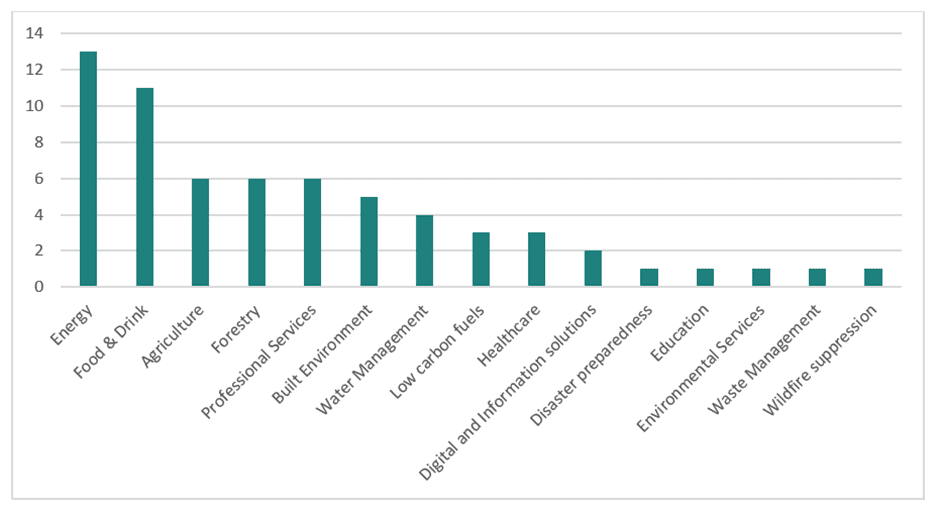
We sought to understand which are the economic sectors for which climate adaptation is most relevant, based on how frequently different sectors are mentioned within climate adaptation research and publications. From the evidence review, we identified 64 specific climate-adaptation economic opportunities (i.e. climate adaptation services and goods; see Appendix B Detail on outputs of literature analysis). These opportunities related to 14 economic sectors. Figure 1 shows the number of opportunities associated with each sector.
Once we had completed the analysis summarised in Figure 1, we considered how best to focus the remainder of our research. We prioritised three sectors for further analysis, with steering group input, based on the following:
- Excluding mitigation-based activity: We deemed opportunities that fell under the definition of “climate mitigation” to be out of scope for this work; this included the energy sector, where opportunities were predominantly related to reducing greenhouse gas emissions.
- Merging similar sectors: We combined similar sectors, as opportunities and dependencies were shared across them; for example, agriculture and food and drink became Food and Agriculture, as most interventions in these supply chains are land-based and overlapping. Within Professional Services, we identified two opportunities: engineering and environmental consulting, and financial services and insurance. In consultation with the steering group, we drew out financial services and insurance as its own sector, to reflect the cross-sectoral attributes and emerging technologies within the field. Engineering and environmental consultancy features were explored within in the Built Environment sector.
- Prioritising emerging and under-researched sectors: Forestry was excluded as it was felt that there is good existing evidence for the adaptation opportunities in this sector (Beauchamp, 2018) (Forestry and Land Scotland, 2021) (Forestry Commission, 2023) and some woodland-based interventions were captured as opportunities within Agriculture and Finance and Insurance sector.
To summarise, the report prioritises three sectors identified through the literature review as offering strong potential for adaptation-related opportunities for Scotland, which are key areas of policy interest. These are:
Built Environment: Scotland has a large and long-lived asset base and infrastructure stock which is exposed to climate risks. Long-term investment decisions drive demand for adaptation solutions.
Food and Agriculture: Highly sensitive to climate conditions. Changes in temperature, rainfall, and pests create both risks and niche opportunities across land use and supply chains.
Finance and Insurance: Key system levers for pricing climate risk, incentivising investment, and shaping adaptation outcomes across the wider economy.
The organisations of stakeholders interviewed for each sector are given in Table 1
Sector | Interviewees |
Built environment |
Built Environment Forum Jacobs Two participants who wished to remain anonymous |
Food and Agriculture | Mucklebrig Scottish Agricultural Organisation Society Three participants who wished to remain anonymous |
Finance and Insurance |
Flood Re Transition Finance Scotland Two participants who wished to remain anonymous |
Strengths and limitations of chosen approach
Approach taken and evidence base
Our approach sought to balance a Scottish-specific perspective with a forward-looking assessment of emerging markets, while recognising the limitations of available data. We aimed to ground the analysis in Scotland’s specific climate risks, economic structure, regulatory environment, and asset base, rather than relying on generic global narratives. However, in practice, there is very limited Scotland-specific evidence on climate adaptation economic opportunities, particularly in relation to market size, structure, and growth. This constrained the extent to which a fully evidence-led, place-based assessment could be undertaken.
Given these limitations, we combined desk-based research with qualitative interviews to build a more complete picture. The literature review drew on a wide range of sources, including academia, financial institutions, consultancies, government agencies, industry bodies, NGOs, and think tanks. However, the evidence landscape is fragmented and uneven. Most available analysis focuses on climate risks and adaptation costs, rather than economic opportunities (Beauchamp, 2018). Where market data does exist, it is typically global in scope and not specific to adaptation as a distinct category of economic activity (Foyn & Skinner, 2024). There were a few standout exceptions to this, which are described in the list below, under Implications and considerations for future research.
The use of qualitative interviews helped to partially mitigate these gaps (providing insight into procurement dynamics, insurance-led behaviour, and supply chain responses), but only to a limited extent. While these interviews were valuable in providing context and grounding, they are not statistically representative and, in some cases, reflect individual or sector-specific perspectives rather than a clear consensus. In several instances, the analysis necessarily draws inferences from a limited number of viewpoints, and these should be interpreted as indicative rather than definitive.
A further component of the approach was a forward-looking assessment of market formation. Given the lack of historical economic data, the analysis focuses on drivers of future demand (such as climate risk, regulatory change, and investment trends) rather than attempting to quantify existing markets. This reflects the reality that adaptation markets are still emerging and not systematically measured.
Limitations and confidence in findings
A central limitation of this research is the lack of robust quantitative data. It was not possible to estimate the scale, value, or growth trajectories of individual opportunities in a consistent or comparable way. As a result, the analysis cannot determine the relative importance of different opportunities or provide a clear sense of their economic contribution. Where Scottish or UK-specific data was unavailable, global market trends and proxy indicators (such as company reports or sector-level forecasts) were used to inform the analysis. While these provide useful context, they rely on assumptions about how global dynamics may be applicable to Scotland, which are plausible but not empirically validated.
There are also significant constraints in assessing international competitive advantage and export potential. A rigorous assessment would require detailed comparative data on other countries’ capabilities, market structures, and investment pipelines, which was not available. As a result, our assessment is based on an asset-based lens, considering where Scotland’s existing strengths may align with emerging global demand, and on identifying international contexts with similar climate risks or infrastructure challenges. While this provides a useful starting point, it remains exploratory and does not constitute a comprehensive competitor analysis. Confidence in findings related to competitive advantage is therefore relatively low.
Relying on information in this report
Based on the available evidence, our research identifies the types of economic opportunities that are likely to emerge in response to climate change, the sectors in which these opportunities are most likely to arise, and the key drivers shaping market development. It also provides an initial assessment of where Scotland’s existing assets and capabilities may position it to participate in these emerging markets. However, the study cannot robustly quantify the scale or value of these opportunities, compare their relative importance, or provide a definitive assessment of Scotland’s competitive advantage internationally. In all cases, findings should be understood as informed judgements based on partial evidence, rather than as conclusive results.
These limitations have important implications for how the findings should be used. The analysis is best understood as identifying areas of potential opportunity and informing strategic direction, rather than providing a basis for detailed prioritisation, investment decisions, or economic forecasting. There is currently insufficient evidence to support a more granular or quantitative assessment.
Implications and considerations for future research
Most sources on future economic opportunities related to climate change adaptation were global in scope and not granular enough to provide a basis to make claims about the outlook for Scotland. However, our literature review did include some exceptions to this, sources which investigated specific Scottish industries or regions under climate change future scenarios, and evaluated opportunities, not just risks and costs:
- The k-Matrix study for the Glasgow City Region is one of the few examples attempting to quantify adaptation-related economic activity in a Scottish context and is therefore referenced frequently throughout our report. However, it represents a static snapshot and is not easily comparable with other sources, nor has it been updated over time (k-Matrix, 2019).
- The ClimateXChange report “Scoping and sizing the Scottish Adaptation & Resilience (Climate Change) (A&RCC) Economy: An overview of methods” provides a solid starting point for how to go about an economy-wide assessment but highlights major data gaps which have not yet been addressed (Bonaventura, 2018).
- The ClimateXChange report “Economic opportunities in Scotland’s net zero and climate adaptation economy” provides an economy-wide, “updated coherent assessment of key potential opportunities for Scotland.” However, it is broad in scope, including mitigation, and does not provide in-depth sector analysis (O’Gorman, et al., 2024).
- The Highlands Adapts report “Highland Climate Risk & Opportunity Assessment” and accompanying Sector Reports on Energy, Food and Drink, and Forestry and Timber are exemplary of the type of focused analysis which could form the basis for a more accurate economy-wide assessment. These sources give specific monetary figures for costs and benefits arising from climate change for the region and key sectors (England, et al., 2024) (Hunt, et al., 2024).
These are the sort of investigations and sources which would patch the gaps in the available evidence. By evaluating the known and unavoidable impacts of climate change on specific Scottish industries or regions, and in particular any emerging advantages or opportunities. These are the building blocks by which a future economy-wide review could provide a more robust and accurate picture of the opportunities for Scotland, which would address the limitations faced in this report.
Addressing these gaps would require a step change in the evidence base. This could include more systematic measurement of adaptation-related economic activity in Scotland, targeted market studies for priority sectors, and comparative analysis of international competitors. There is also a need for improved integration of climate risk data with economic and sectoral data, as well as more structured engagement with industry and investors. While some of these gaps could be addressed through further research, others reflect the early-stage nature of adaptation markets and may take time to resolve.
Economic opportunities for Scotland: Findings from priority sectors
We identified Built Environment, Food and Agriculture, and Finance and Insurance as the three priority sectors with economic opportunities. For each, we describe the main adaptation-related economic opportunities, how these markets could develop, and examples of technologies or services within which Scottish businesses could have potential to export internationally.
Table 2 summarises the opportunities associated with each priority sector and indicative timescales for each. Short-term opportunities are those which can be taken up at present; Long-term opportunities require further market or infrastructure development to scale and achieve their full value or potential; Opportunities which span both timescales can be taken up now and will likely continue to be important into the future.
Short term | Long term | |
Built Environment | ||
Flood resilience and drainage solutions | X | |
Nature based and hybrid solutions in the built environment | X | |
Retrofit for climate resilience | X | X |
Climate risk data, assessment and advisory services | X | X |
Food and Agriculture | ||
Climate‑resilient crops and agricultural inputs | X | |
Water management and on‑farm resilience measures | X | X |
Digital agri-tech, data, and advisory services | X | X |
Land‑based and landscape‑scale adaptation approaches | X | |
Finance and Insurance | ||
Climate risk analytics and catastrophe modelling | X | X |
Risk transfer and insurance innovation | X | |
Resilience-linked lending and investment | X | |
Nature-based and place-based finance models | X |
Timeframes for opportunities
Adaptation opportunities tend to develop in the short term where climate risks are already visible, affecting the bottom line, and supported by established delivery mechanisms. For example, flood resilience, drainage upgrades, climate risk analytics, and advisory services are expanding quickly because extreme weather events, insurance pressures, regulatory standards, and infrastructure investment pipelines are already creating demand. In contrast, opportunities that require new valuation frameworks, institutional coordination, or longer-term behavioural change (e.g. nature-based solutions, landscape-scale land management, or resilience-linked finance) tend to develop more gradually. These markets depend on enabling conditions such as credible metrics, financing mechanisms, supportive policy frameworks, and skilled delivery networks. As a result, the pace of growth in the adaptation economy is shaped less by the existence of climate risk itself and more by how effectively that risk is translated into investable projects, regulatory requirements, and scalable business models.
Short-term growth is in established services markets (next five years). Over the longer term, growth in adaptation markets is likely to depend on governance, standards, and investment frameworks, rather than rapid technological change. This evolution offers economic potential, particularly where Scotland leverages its natural assets, scientific capabilities, and policy frameworks to build competitive niches. Scotland’s strongest potential lies in high-value services (e.g. climate data and analytics) and emerging natural capital models through domestic delivery and exports, while addressing skills and standards gaps.
Built Environment
Sector context and climate drivers
Buildings and infrastructure are long-lived, capital-intensive assets that are already exposed to changing weather conditions. Climate risks are affecting the performance, insurability, and value of buildings and infrastructure. The condition of existing buildings is a critical vulnerability, particularly older and historic stock that is often not windproof or watertight, increasing repair costs, insurance risk, and barriers to reuse.
“And then there is a reality that by the time we get to 2050, 80% of the buildings in Scotland will already have been built, so we need to make sure we are using them much better. It is not a good use of resources to continually demolish and build new […] We do not need to build new in the edge of towns and face issues with disconnection and transport” (Quote from interviewee from Built Environment Forum).
Interviews consistently emphasised that surface water flooding and intense rainfall are “here and now” risks, shaping immediate demand for flood resilience, drainage, and asset protection measures, while overheating is recognised as an emerging concern in Scotland, particularly in schools, housing, and public buildings. Longer‑term risks such as sea‑level rise and coastal change are recognised but are often deferred in decision‑making, even though interviewees noted that the scale of future investment required to adapt to rising seas will be substantial. These pressures directly shape short‑term investment priorities and create sustained demand for adaptation in retrofit, infrastructure upgrades, and design standards.
Economic opportunities
Previous literature identified the built environment sector as the largest climate change adaptation sub-sector in Scotland, with total sales value at £131.1m in 2016-17 (k-Matrix, 2019), while Trittip et al. estimate the addressable global market for resilient buildings by 2030 to be USD $400 – 500 billion (Trittip, et al., 2025).
Interview and literature evidence points to four core adaptation‑related opportunity clusters where climate risk is already translating into economic activity or credible future markets. Growth in the built environment adaptation economy comes primarily from services, skills and coordinated delivery, rather than from new products alone. Scotland’s opportunity lies in turning domestic adaptation challenges into exportable expertise.

Flood resilience and drainage solutions | 
Nature based and hybrid solutions in the built environment |

Retrofit for climate resilience | 
Climate risk data, assessment and advisory services |
Flood resilience and drainage solutions
What the opportunity is: Goods and services that reduce flood damage and disruption. This includes sustainable drainage systems (SuDS), property-level flood resilience measures, permeable paving, drainage upgrades, and hybrid grey-green infrastructure.[4]
Evidence base: Flood resilience is one of the most consistently cited adaptation opportunities in the Scottish literature (Bonaventura, 2018) (England, et al., 2024) and in 2016-2017 was estimated to make up 18% of Scotland’s adaptation and resilience economy, with sales estimated at £80.4m (k-Matrix, 2019). For more than 15 years, the Scottish Government has committed £47 million annually to local authorities and an additional £150 million since 2020 over the course of parliament for flood risk management actions (Scottish Government, 2024). Flood management and water‑related services was identified as one of the most mature segments of built‑environment adaptation. Whilst quantitative evidence was not identified in the literature, interviewees noted that SuDS and permeable paving “are definitely happening” (interviewee from Built Environment) and that flood and drainage solutions are already established in Scotland. Interviewees described flood events and insurance requirements as key triggers for action, particularly in urban areas with surface water challenges. A market study by FloodRe estimated that the Property Flood Resilience sector in the UK is £20-25 million, in which approximately £13-16 million constitute residential market and £7-9 million from commercial and institutional work (Flood Re, 2023).
Flood and drainage solutions are already embedded in infrastructure programmes, local authority pipelines, and utility investment. This reflects the immediacy of surface water flooding, repeated flood events and regulatory pressure on local authorities and infrastructure operators. For example, the 2025 National Standards mandate runoff hierarchies and multi-functional designs for all major developments (Webber, 2025). Scotland’s National Flood Resilience Strategy (2024) is also expected to sustain demand through asset protection and local authority mandates (Scottish Government, 2024). This creates a relatively stable, long‑term market for civil engineering, design services, equipment, and maintenance.
Timescale: Short term – Happening now but tailing off over the longer term as flood resilience measures are mainstreamed in built-up environments.
Who captures value: Value is captured primarily by engineering consultancies, landscape and drainage specialists, construction SMEs, with strong spillovers into digital monitoring, modelling, and maintenance services. Much of the employment impact is local, with potential for scaling through frameworks and programmes.
Nature‑based and hybrid solutions in the built environment
What the opportunity is: Use of nature‑based solutions, including green (e.g. green roofs walls and woodland) and blue (wetlands) as well as hybrid (grey and blue/green infrastructure) in urban or rural settings to manage flood risk, heat, and water quality at building, neighbourhood, and catchment scales.
Nature‑based solutions can deliver multiple benefits (risk reduction, public realm, biodiversity, amenity), making them attractive in principle. However, interviewees emphasised that these solutions rarely “stack up” at individual project level, meaning economic value emerges most clearly when delivered as programmes or systems rather than discrete assets.
Evidence base: A report by the Green Finance Institute (2021) estimated a £20 billion spending gap for Scotland to meet nature-related outcomes[5] from 2022-2032, in which £9 billion is for climate mitigation through bio-carbon such as woodlands creation or peatland restoration. The spending gap for natural flood management[6] is £354 million for the UK (Green Finance Institute, 2021) (UKGBC, 2022). Interviews repeatedly highlighted strong conceptual support for nature‑based solutions, alongside clear constraints relating to valuation, funding models, and time horizons. Interviews highlighted planning capacity and coordination as both constraints and opportunities.
Timescale: Long term – Already happening (albeit at smaller scale than flood resilience and drainage solutions) and have strong policy and conceptual support but scaling them into mainstream delivery models is a long-term process. Market growth depends more on institutional change, including planning regulations, funding models, skills, and delivery networks pointing to gradual transition.
Who captures value: Environmental consultancies, landscape designers, maintenance services (i.e. public works, responsible for maintaining green infrastructure features in good condition), engineers, monitoring and data providers, and land-based supply chains, with long-term potential for finance and insurance involvement as valuation methods improve.
Retrofit for climate resilience
What the opportunity is: Retrofitting (or ‘climate proofing’) existing buildings to improve resilience to flooding, wind, moisture ingress, and overheating. This includes fabric‑first measures,[7] drainage upgrades, ventilation and shading, and building‑specific flood resilience measures.
Evidence base: Around 80% of UK’s 2050 building stock already exists (LETI, 2021), with Scotland having a particularly large share of pre‑1919 and historic buildings (Reguis, et al., 2023). While quantitative data on markets are lacking in the literature, interviewees described retrofit as a “huge and unavoidable” opportunity for Scotland, with demand spread across towns, cities, and rural areas. Retrofit activity supports local and regional supply chains, skilled trades, and small and medium‑sized enterprises and creates long‑duration demand rather than one‑off projects. Retrofit remains one of the most important levers for decarbonising with £1.5 billion allocated by the UK government to support fuel-poor households. In response, local authorities are establishing regional partnerships for local, place-based retrofit strategies that deliver wider benefits such as resilience, health, and employment outcomes (UKGBC, 2025).
The literature highlights retrofit as a central pathway for delivering adaptation alongside mitigation (Garnett & Nissen, n.d.) (O’Gorman, et al., 2024), with 29 million homes in the UK requiring retrofitting before 2050 (UKGBC, 2025). Interviewees highlighted that many buildings are not windproof or watertight, increasing repair costs and leading to cascading damage with each storm. Interviewees emphasised that adaptation is already happening through retrofit but is rarely labelled as such. Retrofitting for climate adaptation, such as ensuring property-level flood resilience, is largely reactive, following damage or failure, rather than as part of planned investment.
Timescale: Short term and ongoing – Already happening, with demand set to increase as extreme weather events become more commonplace to 2050 and beyond.
Retrofitting the existing building stock for overheating, wind and water tightness, and flood resilience is widely recognised as a long-term, high-impact market. The literature highlights the scale of this challenge across the UK and Europe. In the UK, 29 million homes will need retrofitting before 2050 to align with net zero but also to ensure climate change resilience. This is expected to generate 500,000 high skilled jobs (UKGBC, 2025). Interviewees described retrofit as a “slow-burn” opportunity that depends on sustained programmes, skills development and alignment with decarbonisation policy.
Who captures value: Skilled trades, conservation specialists, retrofit practitioners, designers, materials suppliers, and local construction firms.
Climate risk data, assessment and advisory services
What the opportunity is: Services to assess climate exposure and resilience of infrastructure, buildings or portfolios. This includes risk screening, scenario analysis, performance assessment and assurance. Involves integrating future climate risk data into the design, appraisal, and upgrading of infrastructure, including transport, energy, water, and public assets.
As climate risks increasingly affect insurance pricing, lending decisions and asset valuation, demand is growing for credible, decision-ready information. These services sit upstream of physical adaptation and influence investment decisions. This drives sustained demand for climate data provision and analysis, climate risk assessment, engineering consultancy, design assurance, and asset management services.
Evidence base: An economic study estimated Met Office climate risk insights will deliver benefits worth £56 billion to the UK economy in the next 10 years (Met Office, 2024). Advance warning of extreme weather events and better understanding of climate change impacts support planning decisions for economy and industry, and 21.4% of the value of these benefits support climate adaptation activities. Interviewees highlighted growing demand from asset owners, insurers and developers for site- and asset-level risk information. Interviewees gave concrete examples of infrastructure already being modified to reflect future conditions, such as raising bridge heights to account for increased fluvial flows. Disclosure frameworks and risk assessments (including TCFD‑related processes[8]) are creating demand for climate analytics and assurance that influences infrastructure renewal pipelines. The literature identifies data and analytics as a core enabling activity for adaptation investment (Climate Change Committee, 2025) (OECD, 2025).
Timescale: Short term and ongoing – Increased demand noted by interviewees as this sector represents a bottleneck within decision-making. A relatively new sector set to grow in coming years.
- Global climate risk advisory is expected to reach $9.2 billion by 2032 (18.2% CAGR) (GII, 2025).
- Global climate risk analytics market is projected to reach $8.4 billion by 2033 (19.5% CAGR), with Banking, Financial Services, and Insurance accounting for 29% of demand (Sharma, 2025).
- Climate financial data and analytics estimated at $468 million (2022) growing to $1.3 billion by 2028 (19% CAGR) (Foyn & Skinner, 2024).
- Predictive climate risk analytics market is projected to grow to $988 million by 2034 (10.9% CAGR) (Global Insight Services, 2025).
Who captures value: Professional services firms, data and analytics providers, engineers and specialist consultancies. These services have export potential and are not tied to local delivery.
Market outlook
Short term
In the short term, adaptation activity in the built environment is driven by visible risk, regulatory and disclosure pressures, and existing investment pipelines. Flood and drainage solutions, climate‑informed infrastructure design, and professional services linked to data-led risk assessment are already scaling. Much of this activity occurs without being labelled as “adaptation,” instead appearing as best practice, risk management, or compliance. Public procurement and infrastructure owner programmes are major drivers of demand, while household‑level retrofit remains more reactive and uneven.
Long term
Over the longer term, interviewees anticipate structural shifts rather than rapid market take‑off. These include the mainstreaming of district‑ and neighbourhood‑scale retrofit, integration of grey and green/blue infrastructure, and greater use of data, sensors, and digital twins to manage assets under changing climate conditions. Nature‑based solutions and catchment‑scale approaches are widely seen as essential but dependent on institutional reform and new funding models. Long‑term growth is therefore expected to be durable but gradual, driven by asset ageing, climate risk escalation, and changes in insurance and finance.
Competitive advantage and export potential
Why Scotland?
Contextual advantages: Scotland’s heritage remains one of its most valuable assets, generating £6 billion for Scotland’s economy in 2023 (Built Environment Forum Scotland, 2023).It is estimated that £6.6 billion would be needed to convert Scotland’s historic residential buildings to low carbon heating, and 10,000 new jobs would be needed in the next decade to maintain and adapt Scotland’s traditional building stock. Historic Environment Scotland assessed climate change as “very high” risk in their 2023-2024 report, leading to irreversible loss of heritage over time (Historic Environment Scotland, 2024). Interviewees framed this not only as a challenge but as a potential advantage: developing effective adaptation approaches for complex, historic stock creates knowledge and capability that is relevant to many other regions:
“If we’re talking about competitive advantage for Scotland specifically, I definitely see retrofitting as a good example of that […] anything to do with working within the confines of a historic built environment […] anything that we’re doing around retrofitting and building climate adaptation into that, that type of setting is something that we could then export to any a number of European countries that potentially have the same those same challenges.” (Interviewee from Built Environment)
Scotland also faces high rainfall, variable weather, and growing flood risk, making it a credible testbed for resilience solutions.
Capability advantages: Four interviewees highlighted that Scotland has a strong base in engineering, professional services, education, and place‑based governance alongside active networks in the water and built environment sectors. Interview evidence highlights opportunities to develop specialised skills in retrofit, conservation, flood management, and systems‑based water approaches. However, multiple interviewees also stressed that skills shortages are already leading to reliance on imported expertise, indicating that capability is a limiting factor if not addressed.
Limits to competitiveness
While interviewees agreed that Scotland has strengths in this sector, this is not the same as having a clear competitive advantage on the international stage. All European nations have historic building stock and many will be facing similar effects of climate change: Built Environment services will be scaling up overseas and this market could become a busy space. Interviewees were explicit that Scotland is unlikely to compete directly with countries such as the Netherlands on engineered flood defences, nor on mass manufacturing of adaptation products. If there is an opportunity to be an early mover and establish a competitive advantage, it will be in services, skills, system design, and delivery models, particularly where these are proven domestically.
“[in reference to Scottish Government’s hydro nation strategy] “We can develop the jobs and export the skills or sell services abroad… I’ve done that a number of points in my career where we’ve delivered big programs of work that are international.” (Interviewee from Built Environment)
What is exportable?
Potential to export could be explored in:
- Professional and advisory services in engineering, design, and climate risk assessment
- Integrated delivery models for flood management and catchment-scale approaches
- Skills and expertise based on experience with complex building stock and high-rainfall climates
Several interviewees suggested that Scotland could develop approaches domestically and then export them to the north of England, Ireland, and Nordic countries, where climate conditions and building forms are similar.
Food and Agriculture
Sector context and climate drivers
Climate variability is already affecting productivity, costs, and operational decisions within the Scottish food and agriculture sectors, even where overall conditions remain comparatively favourable. Interviewees highlighted increased rainfall volatility, more frequent flooding, hotter and drier summer periods, and changing seasonal patterns as the risks most directly shaping farm‑level behaviour and supply‑chain impacts. Climate change affects agriculture through compound effects, for example, drought, flooding, and heat interacting with soil conditions, water availability, pests, and logistics.
While some longer‑term changes may increase suitability for new crops, interviewees stressed that short‑term adaptation is driven primarily by business continuity, yield stability, and resource security, rather than speculative expansion.
Economic opportunities
Agriculture and forestry were previously estimated to make up 4% of Scotland’s adaptation and resilience economy at £19m in 2016-2017 (k-Matrix, 2019). However, growth in demand for agri-tech has led to an increase in the forecast for the addressable global market for 2030, estimated to be USD $175-200 billion (Trittip, et al., 2025). Evidence from interviews and the literature points to four core adaptation‑related opportunity clusters in agriculture. These are not large, uniform markets, but distributed and heterogeneous opportunities, often embedded in farm management, advisory services, and agri‑tech.
Across agriculture, the evidence suggests growth comes from managing volatility rather than expanding output. Adaptation generates distributed economic value through advisory services, agri‑tech, and land management rather than large standalone markets. Scotland’s opportunity could lie in translating its research base, land assets, and reputation for innovation into services and models that support both domestic resilience and supply international market niches.

Climate-resilient crops and agricultural inputs | 
Water management and on-farm resilience measures |

Digital agri-tech, data, and advisory services | 
Land-based and landscape-scale adaptation approaches |
Figure 3: Economic opportunities in the Food and Agriculture sector
Climate‑resilient crops and agricultural inputs
What the opportunity is: Development, testing, and adoption of drought‑ and heat‑tolerant crop varieties, improved seed genetics, and inputs that enhance resilience while maintaining yields and disease resistance.
Yield volatility represents a direct financial risk for farmers and downstream processors, particularly in key Scottish sectors such as malting barley. Interviewees noted that even short periods of atypical weather can materially affect yields and quality, creating risks several seasons ahead. Adaptation therefore centres on risk management rather than maximising output, favouring incremental but widespread uptake of resilient varieties.
Evidence base: The James Hutton Institute is recognised internationally for its research in developing resilient crop varieties. Total UK market value of varieties from the centre was approximately £37.4 million in 2024, with export numbers as well; the value of varieties grown and sold across Europe was estimated at £93.4 million (James Hutton Institute, 2025). Interviewees described active experimentation with new barley varieties and crop diversification, often led by research institutions and producer groups. However, trade‑offs between resilience, yield, and disease resistance were repeatedly highlighted, indicating steady but cautious market development. The literature review also consistently identified climate‑resilient crops as a clear adaptation opportunity (Bonaventura, 2018) (Hunt, et al., 2024) (k-Matrix, 2019).
Timescale: Long term – Developing, piloting, and scaling (i.e. adopting across farms) new varieties is a process that takes years of research.
Who captures value: Seed companies, plant breeders, agri‑research institutions, advisers, farmers, with indirect benefits for food and drink supply chains and rural economies.
Water management and on‑farm resilience measures
What the opportunity is: Technologies and services that improve water efficiency, storage, drainage, and flood management, including irrigation management, water attenuation ponds, improved drainage, and soil practices that retain moisture while reducing flood risk.
Interviewees consistently identified water as a critical and under‑recognised constraint within Scottish agriculture, particularly during dry summer periods when abstraction limits and supply interruptions begin to affect production. Flooding, meanwhile, disrupts grazing, harvests, and logistics, increasing costs and insurance exposure.
Evidence base: The literature review identified water management as a core adaptation opportunity (Bonaventura, 2018) (k-Matrix, 2019). However, there is a lack of market data on water management or monitoring technologies in the UK. Global market size for smart agriculture technologies is expected to surpass USD $43.7 billion by 2030 with a compound annual growth rate of 10.2% from 2022-2030 (El-taibi, et al., 2024). The Scottish Government launched the Future Farming Investment Scheme in 2025 with an indicative a budget of more than £21 million (Scottish Government, 2025). It is likely this scheme will continue for 2026 with an indicative budget of £14.25 million although details are not confirmed (Farm Advisory Service, 2026). Whilst this funding is not specifically targeted for water management technologies, it is a positive direction towards higher uptake of such technologies among farmers. Interviewees suggested that farmers have a growing interest in on‑farm water storage, adaptive drainage,[9] and land management approaches that address both drought and flooding. However, uptake remains uneven due to cost, regulatory complexity, and uncertainty around future water availability.
Timescale: Short term and ongoing – Already happening, with demand set to increase as extreme weather events become more commonplace to 2050 and beyond.
Agricultural adaptation is expected to continue through practical, incremental changes – such as crop varieties, timing, water management and on-farm efficiency – particularly where these reduce immediate costs or risks. Demand is strongest where adaptation aligns with productivity, cost reduction or supply-chain requirements, rather than being framed as adaptation alone.
Who captures value: Civil and environmental engineering services, agricultural consultants, contractors, equipment suppliers, and specialist advisers, with strong place‑based employment impacts.
Digital agri-tech, data, and advisory services
What the opportunity is: Use of digital tools, sensors, and data analytics that support climate-informed decision-making, such as weather forecasting, soil and crop monitoring, pest and disease surveillance, and water-use accounting.
Interviewees emphasised that the volume of data available to farms is increasing rapidly, driven by retailer, wholesaler, and regulatory demands. Adaptation creates additional demand for interpretation and decision‑support, rather than raw data alone. This shifts the opportunity toward service‑based models that reduce risk and improve efficiency.
Evidence base: The global addressable market for agri-tech more generally is estimated to reach USD $175-200 billion (Trittip, et al., 2025). Private investment in UK agri-tech has grown around £0.8 billion in 2022 (Royal Bank of Scotland, 2022) and worth over £13 billion (Barclays, 2025). Interviews highlighted growing uptake of sensors and digital platforms among larger farms and supply‑chain leaders, alongside persistent barriers for smaller operators. The literature consistently identifies digital agri-tech as a short‑term adaptation enabler, particularly where it supports water efficiency, protects harvest from adverse weather, and increases yields.
Timescale: Short-term adaptation enabler – Already happening on large farms, with demand set to increase as extreme weather events become more commonplace to 2050 and beyond.
Who captures value: Agri‑tech firms, software providers, advisory services, data and analytics firms, and consultants, with potential spillovers into skills development and higher‑value rural employment.
Land‑based and landscape‑scale adaptation approaches
What the opportunity is: Landscape‑ and catchment‑scale approaches to applying interventions such as agroforestry, shelterbelts, soil restoration, and integrated land use that reduce exposure to flooding (i.e. natural flood management), erosion, drought, and heat.
These approaches offer resilience benefits across multiple farms and land uses, but require deployment at larger scales, rather than farm‑by‑farm investment models. Economic value arises over longer time horizons through yield stability, reduced losses, and co‑benefits for biodiversity, water, and downstream infrastructure.
Evidence base: Nature markets offer a financial mechanism to support the adoption of landscape- and catchment-scale approaches. While various biodiversity/carbon codes are in development (e.g. Hedgerow Carbon Code, UK Farm and Soil Carbon, agroforestry code, Woodland Water Code and saltmarsh code to name a few), they are not likely ready for widescale market uptake in the near future. There is a lack of valuation data for nature markets in the UK, but The Woodland Carbon Code and Peatland Code offer established markets for these approaches. Total value of WCC units sold was approximately £7.58 million while PC at £4.69 million in 2024[10] (Woodland Carbon Code, 2025). In the short term, nature-based and water stewardship markets are expected to grow through place-based pilots rather than full mainstream adoption. Interviewees highlighted growing interest in measurable propositions linked to water quality, flood mitigation and ecosystem services. The literature similarly suggests that early growth is likely to be project-led, supported by blended finance and public co-investment, rather than driven by mature private markets. Interviewees widely supported collaborative, landscape‑scale adaptation, but noted that current incentive structures and schemes favour fragmented action.
Timescale: Medium term and ongoing – Already happening, but further support or infrastructure needed to achieve needed scale.
Who captures value: Farmers, land managers, environmental service providers, rural contractors, and, where coordination exists, regional economies through shared outcomes.
Market outlook
Short term
In the short term, adaptation activity in agriculture is characterised by incremental, low‑regret measures: changes in crop choices, timing of inputs, water management, and use of advisory and digital services. Demand is driven primarily by risk reduction and cost control, maintaining consistent yields rather than seeking higher output levels. Uptake is strongest among larger or more integrated businesses responding to supply‑chain requirements, while smaller farms face capital and capacity constraints. A UK report by Barclays highlighted key barriers slowing down the uptake of transformative technologies; 45% of farmers surveyed cited unclear return on investment and 41% mentioned high up-front cost. Majority (71%) also highlighted more clarity on long-term policy support is needed to drive adoption (Barclays, 2025). Overall market growth is therefore moderate and uneven, with advisory and service‑based models expanding faster than hardware‑intensive investments (i.e. physical technology deployed on farm).
Long term
Over the longer term, interviewees anticipate structural shifts in land use, crop suitability, and water dependency, coupled with greater reliance on controlled environments[11] and integrated land management. Climate change may also alter comparative advantage for certain crops and forestry, although these may also face challenges of water availability, pests, and disease. Long‑term growth is therefore shaped less by expansion and more by reconfiguration toward resilience, with gradual development of landscape‑scale approaches and supporting services.
Competitive advantage and export potential
Why Scotland?
Capability advantages: Evidence indicates that Scotland has a strong base in agricultural research, advisory services, and co‑operative structures, which supports experimentation with resilient crops and practices (Sutherland, et al., 2023). However, data on the market size of research or advisory services is not readily available. A relevant example would be The James Hutton Institute which delivered research worth £221.3 million to the UK food and drink sector (James Hutton Institute, 2025).
Scotland’s increasing flood risk and strong regional partnerships creates favourable conditions for developing integrated catchment adaptation approaches within agricultural landscapes. These involve bringing neighbouring farms together to deliver water-related interventions at the scale required to influence downstream water quality and quantity outcomes. Interviewees repeatedly described Scotland as a potential testbed for replicable models that combine analytics, governance, delivery, and finance. The exportable element is the service model, rather than individual interventions. Interviewees emphasised that knowledge and skills, rather than scale, underpin any competitive advantage, particularly in advisory‑led and data‑driven services.
Limits to competitiveness
Although 65% of Scotland’s land area is used for agriculture, most of this is only lightly farmed and not suitable for growing crops[12]. Interviewees commented that Scotland is unlikely to compete on scale or cost in global agricultural commodity markets. Climate adaptation is therefore not expected to generate large new production exports, and physical inputs or technologies are often sourced internationally. However, the Scottish agricultural sector has deep experience in farming techniques which are resilient to variable climate and produce high-quality outputs under these conditions:
“Scotland can’t compete at the scale needed to influence global commodity markets, but we can excel in niche, premium segments. We have favourable conditions, strong skills, and the ability to deliver quality and service efficiently.” (Interviewee from Food and Agriculture)
What is exportable?
Export potential lies primarily in:
- Advisory, research, and data‑driven services
- Models for water stewardship and land‑based adaptation
- Integrated approaches linked to premium and resilient supply chains
These forms of value are knowledge‑intensive rather than volume‑based and depend on proven domestic application.
Finance and Insurance
Sector context and climate drivers
Physical climate risks are already material to asset values, insurability, and balance sheets. These risks increasingly translating into wider economic vulnerability.
Interviewees identified flooding as the dominant and fastest‑growing hazard, particularly surface water flooding affecting property and infrastructure, with interviewees noting that “flood is the number one peril, the number one hazard in the UK,” and that “the biggest growing risk is surface water […] rapid flash flooding.” Heat, drought, wildfire, and nature degradation are emerging as financially material. For example, “some of the whisky [distilleries] were asked to stop abstracting […] impacted their bottom line,” while rising water temperatures mean it is “far too hot for the fish […] puts a lot of stress on them.”
Unlike other sectors, finance and insurance are exposed not only to direct losses but also to systemic risk, including asset devaluation, withdrawal of insurance coverage, and potential capital flight from high‑risk locations. These dynamics are already shaping demand for climate risk analytics, disclosure, and risk management services, and over time are expected to reshape how capital is allocated.
Economic opportunities
Available evidence indicates a sizeable and expanding market for finance and insurance services related to climate adaptation. Scotland’s sustainable finance sector supports over 71,000 jobs and £3.9 billion in exports (O’Gorman et al., 2024). Globally, climate-related risk transfer and insurance could reach USD $25–35 billion by 2030 (Trittip, et al., 2025), against adaptation finance needs exceeding USD $1.1 trillion this decade (Garnett & Nissen, n.d.).
Evidence from interviews and the literature points to four core adaptation‑related opportunity clusters in finance and insurance. These are primarily enabling markets: they do not deliver physical adaptation directly, but shape the scale, speed, and direction of investment across the economy.
Adaptation markets in finance and insurance grow where climate risk is translated into pricing, regulation and investment decisions. Scotland’s opportunity lies in contributing specialist analytics, advisory and place-based finance capability to global markets, while supporting domestic testbeds that demonstrate how resilience can be recognised and rewarded financially.

Climate risk analytics and catastrophe modelling | 
Risk transfer and insurance innovation |

Resilience-linked lending and investment | 
Nature and place-based finance models |
Figure 4: Economic opportunities in the Finance and Insurance sector
Climate risk analytics and catastrophe modelling
What the opportunity is: Analytics, modelling and advisory services that quantify physical climate risks at asset and portfolio levels. This includes catastrophe and flood modelling, scenario analysis, stress testing and decision-support tools for use by asset managers and investors.
This is a mature and immediate adaptation‑related market within finance and insurance. These services underpin underwriting, reinsurance purchasing,[13] capital allocation and regulatory compliance. Regulatory and investor pressure has made climate risk analysis mainstream in parts of the sector, generating steady demand for data providers, consultants, actuaries, and analytics firms. Demand is strongest at portfolio and strategic level, where institutions seek to understand exposure across asset classes and geographies. As climate risks intensify, demand for more granular, location-specific and forward-looking analysis is increasing.
Evidence base: Climate risk analytics are a core enabling market for adaptation, driven by disclosure requirements and prudential regulation (Financial Conduct Authority, 2025) (OECD, 2025). Interviewees noted that stress testing, catastrophe modelling, and flood risk analytics are already embedded in financial practice. Growing risk disclosure and reporting compliance requirement promote strong short‑term revenue potential for consulting services in this sector. While updated market data is not available for UK or Scotland, global trends suggest climate intelligence solutions to grow by around 15% over the next five years (BCG, 2025).
Regulation, disclosure frameworks and supervisory stress testing is driving demand from financial institutions, insurers, large corporations and public bodies (GII, 2025). Recent supervisory guidance from the Bank of England requires integration of climate scenario analysis into capital planning, reinforcing this trend (Bank of England, 2025).
Interviewees confirmed that these services are already mainstream in parts of finance and insurance, and increasingly relevant to infrastructure owners and developers: “The Taskforce for Climate-related Financial Disclosures [TCFD], for example, most of our private sector and many of our public sector clients are engaging with that sort of TCFD framework”[14]. This is a mature, export-oriented market that enables downstream adaptation investment, even where physical adaptation is not yet taking place.
However, both interviews and literature highlight a persistent gap between risk identification and investment decisions (Reinders, et al., 2025), limiting downstream capital mobilisation. Despite increasingly sophisticated scenario exercises, many institutions still struggle to translate location-specific and supply-chain risks into financial decisions, with one participant noting that “risks may be identified, but they are not reflected in credit risk assessments.” Closing this gap, through better data, geospatial analytics, and decision-ready tools, is critical for managing exposure and for unlocking capital flows into adaptation and nature-based resilience across Scotland’s economy.
Interviewees emphasised that the UK has strong global capability in this area, with London acting as a hub serving international markets. Interviewees described the “UK is probably the global leader in flood modelling… many other countries use UK flood models.” Climate risk analytics offers high-value, globally tradable services in modelling, advisory, financial technology, and professional analytics, with spillovers into Scottish universities, data firms, and consultancies.
Timescale: Short term and ongoing – Mature and immediate market, already embedded within disclosure requirements and regulation at UK Govt and EU level supporting strong short-term revenue potential. Room for growth over the long term as climate-risk disclosures become mandatory for more organisations and as this service expands to include decision support tools.
Who captures value: Specialist modelling firms, consultancies, data providers and professional services. Much of the value is export-oriented and not tied to domestic deployment alone.
Risk transfer and insurance innovation
What the opportunity is: Products and mechanisms that transfer or pool climate risk, including parametric insurance,[15] catastrophe bonds[16] and emerging resilience-linked insurance structures. Insurance‑led approaches that incentivise or support adaptation, including risk‑based pricing, resilience‑linked incentives, build‑back‑better programmes, and emerging standards to verify resilience measures.
Insurance is a key transmission mechanism through which climate risk becomes visible and actionable. With high insurance penetration[17] in the UK, insurers are uniquely positioned to influence behaviour across households, infrastructure owners, and businesses. Traditional indemnity insurance is under strain from rising losses and reinsurance costs. New risk transfer mechanisms help maintain insurability while creating new financial products and advisory services. Where resilience reduces losses, insurers benefit directly through lower claims and more stable portfolios.
Evidence base: Interviewees emphasised that flooding is already the number one peril in the UK insurance market, with rising reinsurance costs and increasing concern about long-term insurability. The Association of British Insurers recorded a payout of £585 million for home weather-damages in 2024 (ABI, 2025). According to an interviewee, “Costs doubled a couple of years ago… demand for reinsurance expanded by 50% over three years.” While many insurers currently respond by withdrawing from high-risk areas, examples such as Build Back Better and the development of Flood Performance Certificates demonstrate operational models that translate risk into action. Interviewees described parametric insurance and catastrophe bonds as areas of active experimentation internationally.
Timescale: Medium term and ongoing – Experimentation at this stage but with several innovative models poised for expansion.
Who capture value: Insurers, reinsurers, brokers, capital markets actors and specialist structuring advisers, data providers.
Resilience-linked lending and investment
What the opportunity is: Financial products that reflect adaptation measures in pricing, lending decisions or investment strategies, such as resilience-liked bonds, mortgage incentives for resilient buildings or resilience-adjusted credit risk assessments.
Because climate risks affect asset performance and default risk, lenders and investors have incentives to recognise and reward resilience. This creates demand for verification, metrics and assurance services. While adaptation finance remains significantly underdeveloped compared to mitigation, interviewees emphasised strong latent investor interest, particularly among long-term asset owners such as pension funds and insurers who are exposed to long-duration climate risk. Where adaptation can be linked to revenue streams, avoided losses, or asset value protection, it becomes investable.
Evidence base: A consistent long-term signal across interviews is the expectation that resilience will increasingly influence insurance pricing, underwriting and lending decisions. As affordability and insurability pressures increase, verified resilience measures are likely to matter more. The planned transition away from mechanisms such as Flood Re represents a potential step change, creating stronger incentives for adaptation and clearer market signals (Flood Re, 2024) (Rackley, 2024).
Interviewees noted that while risks are increasingly assessed, they are not yet systematically reflected in pricing or credit decisions. Interviews highlighted that adaptation is often constrained by weak monetisation and unclear business models. Literature evidence supports this, noting growing experimentation with resilience bonds, nature‑based finance, and blended structures, alongside persistent challenges around measurement and standardisation (Climate Financial Risk Forum, 2025). A total of 720 sustainable bonds were issued from 2015-2025 worth £422 billion at the London Stock Exchange. Of this, 4% constituted climate change adaptation which translate to approximately £16.88 billion funding for adaptation activities globally (LESG, 2025).
Timescale: Medium to long term – Underdeveloped at present, with investor interest and demand latent rather than clear and demonstrated.
Who captures value: Banks, asset managers, insurers, and specialist advisory firms providing verification and assessment services.
Nature-based and place-based finance models
What the opportunity is: Financial models that invest in adaptation outcomes through nature‑based solutions (e.g. flood mitigation, water stewardship, landscape‑scale resilience, ecosystem services) and link multiple beneficiaries to shared outcomes.
Nature‑based approaches are increasingly recognised as essential for managing flood, water, and systemic risk. From a finance perspective, their economic appeal lies in multi‑benefit and multi‑revenue potential, particularly where they are bundled with mitigation and biodiversity benefits or where flooding or water risk threatens downstream assets and infrastructure. Examples included continuous cover forestry and projects “selling ecosystem services… mainly about flood mitigation.” These approaches can generate income from carbon, biodiversity, and resilience, while supporting rural jobs, project developers, verification services, and financial intermediaries. Scotland can capture both domestic delivery and exportable expertise:
“We know that degraded peatland is a flood risk. We know that it contributes to poor water quality. We also know that it’s a huge emitter of greenhouse gases. So you know, doing something at a landscape level with peat and creating a template or replicable model is something that we could potentially export elsewhere, but even without thinking about exporting that skill and that model, the kind of the local job creation, the local green growth that could results from that is a big opportunity” (Interviewee from Finance and Insurance)
These models offer potential pathways to finance adaptation where direct revenue streams are weak, by bundling resilience with other monetisable outcomes.
Evidence base: Interviewees described active experimentation with place-based models, outcome-based contracts, and ecosystem service markets. Interviewees described emerging models that pool investors around shared risks, such as “mapping multiple revenue streams” for water and land management. These approaches can unlock projects that would not be viable for a single actor (i.e. for infrastructure or for water provision sectors, but possible if co-funded by both) and support local supply chains and resilience-focused advisory markets. However, interviewees note that valuation tools and investor familiarity remain limited.
Investor interest in climate-resilient forestry and diversified land portfolios is expected to grow over time. Climate change may alter comparative advantage across Europe: Literature suggests that changing climate conditions may strengthen Scotland’s relative position in timber production. The warmer climate may have a positive impact on tree growth in Scotland in areas not limited by water. Climate resilient tree varieties will be needed to cope with changes to nutrient availability and risks from pests, diseases, wildfire, and windthrow (ClimateXChange, 2018). Interviewees highlighted Scotland’s potential to benefit from relative climate suitability, land availability and growing demand for resilient timber and natural capital assets. Interviews highlighted Scotland’s scale, space and low population density as a competitive advantage alongside investor interest in diversified, resilient land portfolios. Sustained advantage depends on proving investable models with credible metrics.
Timescale: Short term and ongoing – Happening now and poised for growth. Nature-based solutions could transition from pilots to more established markets over the longer term, but only if standards, metrics and demand stabilise. The literature emphasises the need for policy certainty and credible measurement, while interviews caution that without these conditions, markets are likely to remain fragmented.
Who captures value: financial intermediaries, fund managers, project developers, monitoring and verification services, environmental consultancies, advisors and land-based delivery partners, often through place-based pilots.
Market outlook
Short term
In the short term, adaptation‑related activity in finance and insurance is concentrated in analytics, disclosure, and risk management, rather than large‑scale capital deployment. Demand is driven by regulation, investor scrutiny, and rising payouts by insurers, with flood risk dominating. Insurance‑led resilience programmes and early adaptation finance pilots are emerging but remain limited in scale. Most financial responses involve portfolio reallocation or risk avoidance rather than direct investment in physical adaptation.
Long term
Over the longer term, interviewees anticipate structural change as climate risks increasingly affect insurance affordability, mortgage markets, and asset values. This includes greater differentiation in pricing based on verified resilience (with assets exposed to greater risk becoming more expensive to insure, and vice versa), growth in resilience‑linked finance, and deeper integration of adaptation into lending and investment decisions. Milestones such as the transition away from Flood Re are expected to create stronger incentives to recognise verified resilience measures (Flood Re, 2024) (Rackley, 2024). Nature‑based and place‑based finance is expected to mature gradually, contingent on improved metrics, standardisation, and institutional coordination. Market growth is therefore expected to be progressive rather than exponential, shaped by risk escalation and institutional learning.
Competitive advantage and export potential
As quantitative data is limited in the review, we drew on stakeholder interviews to suggest areas where Scotland might sustain or build competitive advantage, as well as the evidence base for respective sectors in Section 3.
Why Scotland?
Contextual advantages: While Scottish specific data is lacking, Scotland could potentially benefit from being part of the deep and globally connected UK financial and insurance system. The UK has a well-established international competitive advantage in insurance, reinsurance, and climate risk analytics. The UK’s high insurance penetration presents an opportunity to influence adaptation and insurance initiatives. For example, Build Back Better is described by one interviewee “as one of the more effective climate adaptation programmes in the world.” With Scotland’s established research centres and regional land-use partnerships, there is likely a strong potential of domestic testbed opportunities for adaptation finance and risk management approaches.
Capability advantages: The UK has a well-established global position in climate risk analytics and catastrophe modelling, underpinned by strong scientific institutions and financial market infrastructure.
“UK is probably the global leader in flood modelling… many other countries use UK flood models…speaks to strong scientific and research institutions.” (Interviewee from Finance and Insurance)
Within this ecosystem, Scotland’s competitive advantage lies in applied data analytics. Interviewees pointed to growing institutional capacity in place-based finance, transition finance coordination,[18] and climate risk expertise. The UK’s high prevalence of insurance across business and the general public increases the leverage of market signals, meaning that the UK insurance sector has more influence than in other nations. Scotland’s relatively small size and strong networks can support experimentation and coordination of novel finance and insurance mechanisms, particularly at regional scale. Scotland has a recognised concentration of capability in space and earth observation data, data science and environmental research, supported by strong university–industry links and a growing space sector cluster (Scottish Affairs Committee, 2025) (Scottish Development International, 2025). Scotland is well positioned to support growth in data-led adaptation services, advisory capability, and place-based finance models, especially where these link to domestic demonstrator projects. However, several interviewees cautioned that skills, data, and investment pipelines remain fragile, limiting the pace of scaling.
Limits to competitiveness
Interview evidence suggests that Scotland is unlikely to compete with major global financial centres. Much of that value will continue to accrue to London and other global hubs. However, these global hubs will be a key market for the several supporting services and expertise areas which Scotland is developing.
What is exportable?
Export potential lies in:
- Climate risk analytics, modelling, and advisory services
- Insurance‑linked adaptation frameworks and standards
- Place‑based and systemic investment models that can be adapted to other regions
These exports are primarily knowledge‑ and service‑based. Place-based models may be transferable to other regions facing similar flood, water, and infrastructure risks. Delivering credible domestic examples is viewed as a prerequisite for exporting expertise. Competitive advantage depends on strengthening links between risk analysis, real-world adaptation and financial decision-making.
Scotland’s Adaptation Economy: Emerging themes, barriers and opportunities
This section brings together evidence from the targeted literature review and stakeholder interviews. It highlights patterns that recurred across multiple sectors which have benefits deriving from adaptation, including those outside of the three sectors prioritised in this research.
The evidence reviewed for this study indicates that climate adaptation in Scotland is best understood as a cross-cutting economic system rather than a set of isolated, sector-specific responses to climate risk. Economic opportunities linked to climate adaptation consistently cuts across infrastructure, land use, finance, skills, governance, and data systems, rather than being confined to a standalone sector.
Stakeholder interviews reinforce this perspective. Interviewees rarely described adaptation demand emerging independently within a single sector. Instead, they highlighted how physical climate impacts are translated into economic activity through a series of interlinked mechanisms: impacts on assets and operations feed into insurance pricing, financial risk assessment, regulatory standards, disclosure requirements, and public funding rules. These in turn shape demand for services, technologies, and delivery models. Markets form where these mechanisms align, rather than simply where climate risks exist.
This system-level framing helps explain why some adaptation-related activities are already maturing, while others remain underdeveloped. The translation of exposure to risk into marketable goods and services depends on several types of market signals and infrastructure. It also provides the rationale for structuring the report by sector while drawing out common market dynamics, barriers, and enablers that operate across the economy.
Our analysis identified several recurring themes that appear consistently across sectors in both the literature and interview evidence. These themes do not describe individual opportunities, rather, they explain the conditions under which adaptation-related economic activity emerges and scales.
Separating adaptation from mitigation
Across sectors, interviewees reported that mitigation still drives targets, regulation, investment decisions and business narratives. Adaptation is often treated as risk management or embedded within existing activity. It is seldomly framed as an economic opportunity.
This is unsurprising, given that mitigation is found to still dominate policy and global investment, with global climate finance reaching $1.3 trillion for mitigation compared to just $76 billion for adaptation in 2022 (OECD, 2025). The literature review also consistently highlights an overlap between mitigation and adaptation activity (Bonaventura, 2018) (O’Gorman, et al., 2024). Many adaptation opportunities identified originate in net zero contexts, with a subset linking directly or indirectly to adaptation. Retrofit, resilient construction, and forestry, for example, are repeatedly identified as opportunity areas with both mitigation and adaptation value. The interviews highlighted that some organisations appear to be taking adaptation-relevant actions without using “adaptation” language.
It is positive that there is overlap between mitigation and adaptation activity, as both are crucial to our global response to climate change. Interventions which address both can represent cost-effective climate action. However, it is also worth highlighting the specific economic opportunities available through adaptation, because markets are more likely to scale when activity is explicitly named, measured and linked to investment criteria and standards. What this suggests is that a short-term priority is to make existing adaptation-relevant activity more visible, investable and scalable.
“Resilience bonds and funds present significant gaps in their current structure, particularly in risk assessment. More work is needed to develop robust frameworks that accurately evaluate and price resilience-related risks.” (Interviewee from Finance and Insurance)
Demand strengthens when risks are made visible
Across sectors, awareness of climate risk does not reliably translate into adaptation action. Instead, demand is activated when risks become disruptive to operations, affect finances, or are regulated. High upfront costs, uncertain returns, and diffuse benefits inhibit voluntary investment (Randall, et al., 2023) (World Economic Forum, 2025), while price signals and regulatory requirements are more effective triggers (Trabacchi & Mazza, 2015). For example, in the built environment, post-event repairs, insurer requirements, and regulatory changes drive action. In agriculture, yield loss, water scarcity, and input cost volatility prompt adaptation. In finance and insurance, reinsurance pricing and capital requirements convert climate risk into immediate economic signals:
“A major storm would be a disruptor […] It was in the sixties, in Glasgow, there was a huge storm and it changed building regulations. It affected a lot of tenements. So, I feel like unfortunately we are quite reactionary […] Insurance could be a driver” (Interviewee from Built Environment).
Relatedly, interviewees highlighted difficulties in precisely measuring climate risk, performance or resilience benefits. They described gaps in data and a lack of consistent ways to evidence resilience features or monetise benefits. This limits demand, slows investment decisions and weakens incentives.
“Financial institutions conduct significant stress testing on adaptation, but it is not fully accounted for, often due to data limitations. The focus tends to be on physical impacts and fiscal footprints within the UK, rather than considering the broader value chain. From a financial perspective, adaptation risks are still under-recognised, even within frameworks like GFI [Green Finance Institute] and TCFD [Taskforce on Climate-related Financial Disclosures], where mitigation dominates the agenda. This brings us to resilience and the question of how to monetise its benefits. That is where the finance sector will start to engage, and it may involve highlighting co-benefits for nature as well” (Interviewee from Finance and Insurance).
The literature review also identified digital solutions and data as cross-cutting enablers, with opportunities in monitoring, modelling, early warning systems and decision support (Bonaventura, 2018) (Garnett & Nissen, n.d.) (k-Matrix, 2019). While these may represent a bottleneck, improving data coverage and resolution can be foundational to wider adaptation delivery.
This suggests that price and compliance signals tend to shift behaviour faster than awareness alone. Insurance and finance can act as transmission mechanisms, translating climate risk into incentives and investment demand. Our research suggests that high-growth potential sits in enabling markets, such as risk analytics, certification, monitoring, assurance and decision tools. These markets help unlock downstream spending in retrofit, infrastructure and land-based adaptation.
Monetisable co-benefits enable rapid scaling
Interviewees described adaptation as difficult to fund when it relies only on avoided losses. They reported stronger business cases where adaptation unlocks cost savings, revenue generation, mitigation benefits, productivity gains, or nature and place-based co-benefits (e.g. carbon sequestration, visual amenity). A place-based approach is one that leads by recognising the unique assets, opportunities and constraints inherent in a specific place. This means putting people, communities, and local context at the heart of decision-making (Scottish Government, 2019). In the context of climate change adaptation, this means understanding specific adaptation opportunities possible in each local area or community and how these can be implemented to reduce inequalities and maximise co-benefits (Griffith & Nicholls, 2024). Some of the strongest opportunities are likely to be where resilience is delivered alongside other monetisable outcomes. Visible risk may trigger interest, but bundled value propositions are what unlock scale.
“The project involves mapping multiple revenue streams. such as carbon credits, biodiversity net gain, and heat networks. while addressing issues like water runoff into a loch. This systemic investing approach, which integrates nature-based solutions with financial returns, could accelerate progress” (Interviewee from Finance and Insurance).
Flood and water risks are consistent entry points
Flooding and water security were the most tangible risks for Scotland discussed across sectors in interviews. They are experienced as immediate and measurable climate risks across the Scottish economy.
In addition, both the literature and interviews identify a wide range of adaptation opportunities spanning resilient agriculture and food systems (Hunt, et al., 2024), energy and infrastructure resilience (O’Gorman, et al., 2024), drought and water scarcity (Bonaventura, 2018) (Hunt, et al., 2024) (k-Matrix, 2019), digital and data-driven service (Bonaventura, 2018) (k-Matrix, 2019), ecosystem restoration (Bonaventura, 2018), wildfire risk (Trittip, et al., 2025), and nature-based solutions (O’Gorman, et al., 2024). Adaptation opportunities in these areas are less developed than those for flooding and water security.
This suggests that water-related adaptation is a “gateway market,” because it is measurable and already operationalised. It can also act as a platform for broader adaptation investment, including catchment-scale approaches and nature-based solutions. This is important to bear in mind when considering the priority sectors of this report: Water-related adaptations, where relevant, are often most immediate and can be a “way in” to further scale opportunities within diverse economic sectors.
Maximising Scotland’s potential economic growth through adaptation to climate change
This section sets out what the evidence suggests public sector actors can do most effectively to enable adaptation markets to develop and scale. Government can shape markets through setting clear signals, reducing uncertainty, enabling coordination and supporting investability. These enabling conditions are relevant across sectors.
Where market development is being constrained
Across interviews, adaptation‑related markets are constrained less by technical feasibility and more by institutional, political, and economic factors that suppress demand, slow investment, and prevent scaling. Interviewees consistently pointed to a set of inter‑locking constraints that help explain why adaptation markets remain fragmented, reactive, and unevenly developed. This aligns with recent climate adaptation research, which points to gaps in signals, standards, skills and coordination as primary barriers to scaling adaptation investment, rather than a lack of technical measures (Frontier Economics, 2022) (Global Center on Adapataion & Climate Policy Initiative, 2024).
Short‑termism in political and investment decision‑making: A dominant constraint is the misalignment between long‑term climate risk and short‑term political and financial cycles. While adaptation measures often deliver value over decades, public budgets, political incentives, and investment appraisals tend to prioritise short‑term affordability and immediate returns. This encourages reactive responses to climate impacts rather than planned, preventative investment, and limits the willingness of decision‑makers to commit to measures whose benefits extend beyond electoral or funding cycles.
Weak and inconsistent policy signals for adaptation: Policy frameworks were widely described as favouring mitigation over adaptation, with adaptation requirements often implicit, inconsistent, or weakly enforced. Where standards exist, they are frequently framed as minimum compliance rather than drivers of quality or resilience. In the built environment, this results in developers delivering only what is required to secure planning approval, rather than investing in more resilient solutions whose benefits accrue over time or to other parts of the system.
Fragmented responsibility and governance: Market development is further constrained by unclear allocation of responsibility for managing climate risk. Flooding, drought, sea‑level rise and asset protection are often perceived as the responsibility of public bodies, while private actors optimise for short‑term profitability. This fragmentation weakens incentives for private investment in adaptation and discourages system‑wide approaches, particularly in areas such as water management, retrofit, and nature‑based solutions that require coordination across multiple actors.
Financial barriers and undervaluation of resilience: A recurring theme is the difficulty of making the case for adaptation investment within existing appraisal and funding frameworks. Long‑term avoidance of damage, co‑benefits for health, heritage, ecosystems, and local economies, and reductions in systemic risk are not consistently valued or monetised. As a result, business cases tend to default to “least‑cost” solutions, even where higher‑quality, more resilient options would deliver greater long‑term value. This particularly constrains nature‑based solutions and retrofit, which often rely on revenue funding and ongoing maintenance rather than one‑off capital expenditure.
Regulatory complexity and risk aversion: While regulation is intended to manage risk, interviewees highlighted that complex and conservative regulatory environments can unintentionally limit innovation. In sectors such as water and the built environment, multiple standards, approvals, and compliance requirements can slow experimentation, discourage piloting, and privilege familiar engineering solutions over newer or hybrid approaches. Even where policy intent is supportive of innovation or nature‑based solutions, delivery can stall due to regulatory uncertainty or lack of confidence in novel approaches.
Skills and capacity constraints: A lack of specialist skills and expertise was identified as a practical constraint on market development. Limited access to conservation professionals, retrofit specialists, water system experts, and adaptation practitioners reduces the quality of decision‑making and can lead to sub‑optimal outcomes, including unnecessary demolition of buildings that could otherwise be adapted. Skills shortages act as both a delivery bottleneck and a missed economic opportunity.
Several interviewees suggested that Scotland could develop approaches domestically and then export them to the north of England, Ireland, and Nordic countries, where climate conditions and building forms are similar.
Lack of stable innovation and collaboration infrastructure: Several interviewees noted the absence of long‑term, sector‑specific innovation infrastructure, such as hubs, testbeds, or protected spaces for collaboration. While ideas and technical capability exist, the effort required to navigate fragmented support mechanisms, short‑term funding, and intellectual property risks discourages innovation and limits Scotland’s ability to develop and scale exportable adaptation solutions.
Complexity and uncertainty in adaptation pathways: Finally, adaptation decisions are often constrained by their complexity and interconnected impacts. Measures taken to address one risk (for example, water storage) can introduce new challenges (such as water quality or environmental impacts), increasing perceived risk and slowing decision‑making. This reinforces the need for systems‑based approaches but also raises the bar for evidence, coordination, and governance.
These constraints explain why adaptation markets are currently evolving slowly and unevenly. Addressing them requires not just new technologies, but reforms to finance, governance, skills development, standards, and investment narratives that enable adaptation to be planned, valued, and delivered at scale.
Enabling conditions across sectors
Interview evidence indicates that the pace and scale of adaptation market development will depend less on new technologies and more on the institutional and policy conditions that enable existing solutions to be deployed at scale. Several enabling conditions emerged consistently across sectors, pointing to the role government can play as a market shaper rather than a direct provider.
Data, standards, and decision‑ready intelligence: The availability of trusted climate risk data, such as flood risk mapping, already supports better decision‑making in parts of the economy. Government can strengthen this enabler by enabling access to high-quality climate data and is translated into practical tools that planners, developers, asset owners, and SMEs can readily use. Governments can also take actions to improve the visibility of resilience features at asset and system level. This reduces uncertainty for investors, insurers and asset owners and creates space for new products, services and financing models to emerge.
Skills, expertise, and institutional capacity: A recurring theme is the importance of timely access to specialist expertise. Interviewees consistently emphasised that the availability of specialist skills is a decisive factor in whether adaptation opportunities generate economic value within Scotland or are captured elsewhere, with skills shortages already leading to imported expertise, missed regeneration benefits, and constrained export potential. However, where accredited conservation, retrofit, or flood‑resilience professionals are available, decisions tend to preserve and adapt assets rather than default to demolition or short‑term fixes. Government can act as an enabler by supporting skills pipelines, accreditation schemes, and shared access to specialist expertise, turning a delivery bottleneck into a source of economic opportunity and job creation. Long-term programmes provide the demand certainty needed to build workforce capacity.
Clear, stable policy signals that reward resilience: Adaptation markets respond poorly to uncertainty. Interviewees emphasised that stable and credible policy signals, rather than frequent reform or ambiguous guidance, are essential for investment and innovation. Stable regulatory expectations, aligned planning and infrastructure standards, and strengthening the emphasis on “best value” rather than “least cost” in planning and regulated sectors can help reward resilience, long‑term asset protection, and multi‑benefit solutions. Where signals are clear, businesses are more likely to invest early and develop services that meet future demand. Where they are unclear or short-term, markets remain reactive and fragmented.
Valuation, monetisation, and finance alignment: Adaptation investment scales most effectively where resilience benefits can be valued and monetised. Government can enable this by supporting the development of valuation methods, performance standards, and business‑case frameworks that capture avoided losses, long‑term savings, and wider social and environmental benefits. Aligning public funding rules, appraisal methods, and finance mechanisms with these approaches would help adaptation compete for capital alongside mitigation.
Alignment of public and private incentives: Although adaptation risks often materialise in the public realm, many of the levers for action sit with private actors. Government can enable markets by aligning incentives across planning, insurance, lending, and regulation, for example by supporting standards that allow insurers and financiers to recognise and reward resilience. Where risk is visible in pricing, investment in adaptation becomes more immediate and commercially rational
Innovation infrastructure and testbeds: Interviewees highlighted that Scotland has the technical capability to innovate, but lacks stable, long‑term innovation infrastructure in areas such as water management, retrofit, and nature‑based solutions. Government support for dedicated hubs, testbeds, and collaborative spaces, with clear pathways for piloting, learning, and scaling, can lower barriers to innovation and help develop exportable adaptation solutions.
Systems‑based and place‑based delivery: Many adaptation opportunities only become viable when delivered at scale or as part of a wider system. Government can act as an enabler by supporting place‑based and catchment‑scale approaches that bring together multiple actors around shared risks and benefits. Coordination reduces transaction costs, improves investability and supports markets that depend on scale rather than isolated projects.
Clarity of roles and responsibilities: Unclear allocation of responsibility for managing climate risk weakens incentives for private action. Government can enable market development by clarifying expectations and accountability across public bodies, developers, and asset owners, reducing the scope for risk to be externalised onto the public sector. Clear responsibility supports more consistent standards and stronger demand for adaptation solutions.
Narrative, communication, and public engagement: Finally, adaptation becomes easier to implement and sustain when it is framed around tangible benefits, such as comfort, safety, affordability, heritage, and community wellbeing, rather than abstract future risk. Government‑led communication and engagement can help normalise adaptation as part of everyday decision‑making, strengthening political durability and upstream demand in planning and design processes.
These enabling conditions highlight that government’s most effective role is to provide clarity, stability, coordination, and capability. By shaping the rules, incentives, and infrastructure around adaptation, government can unlock market‑led delivery, supporting both domestic resilience and the development of export‑ready expertise.
Where action could have most impact
Taken together, the evidence points to a number of high-leverage enabling conditions where public sector action can unlock value:
- Clear signals and standards that create predictable demand.
- Data and metrics that make resilience visible and investable.
- Skills and delivery capacity aligned to long-term need.
- Coordination and aggregation at place and system level.
By focusing on enabling conditions rather than individual projects, public sector actors can help adaptation markets move from reactive responses to sustained economic activity.
Conclusions
We set out to understand the economic opportunities arising from climate adaptation and Scotland’s changing climate, how these markets are likely to evolve, and where Scotland has or could build a sustained international competitive advantage. Drawing on targeted literature and stakeholder interviews, the findings point to a clear conclusion: climate adaptation is already shaping economic activity in Scotland, but its market activity and potential is only partially visible.
Scotland-specific data on the economic opportunities arising from climate adaptation is severely limited. There is little to no data on market size, structure, or growth for the opportunities identified, and UK-level evidence is also sparse and largely focused on adaptation costs rather than opportunities. Most available data on market dynamics is global in scope and not specific to adaptation as a distinct area of economic activity. As a result, it was not possible to robustly quantify the scale or growth potential of individual opportunities, compare their relative importance, or confidently identify areas of competitive advantage. Findings should therefore be treated as areas of potential opportunity warranting further investigation, rather than guaranteed growth areas.
However, by narrowing the focus of this report to three priority sectors and integrating insights from industry stakeholders, our research provides an exploration of some sectors of the Scottish economy which are already seeing opportunities through climate change adaptation. By exploring these with stakeholders and comparing across all three, this report represents a useful early look at potential barriers and enablers to realising economic growth for Scotland via adaptation to climate change over the short and longer terms. A summary of the sectoral opportunities is provided in Figures 5 and Table 3.
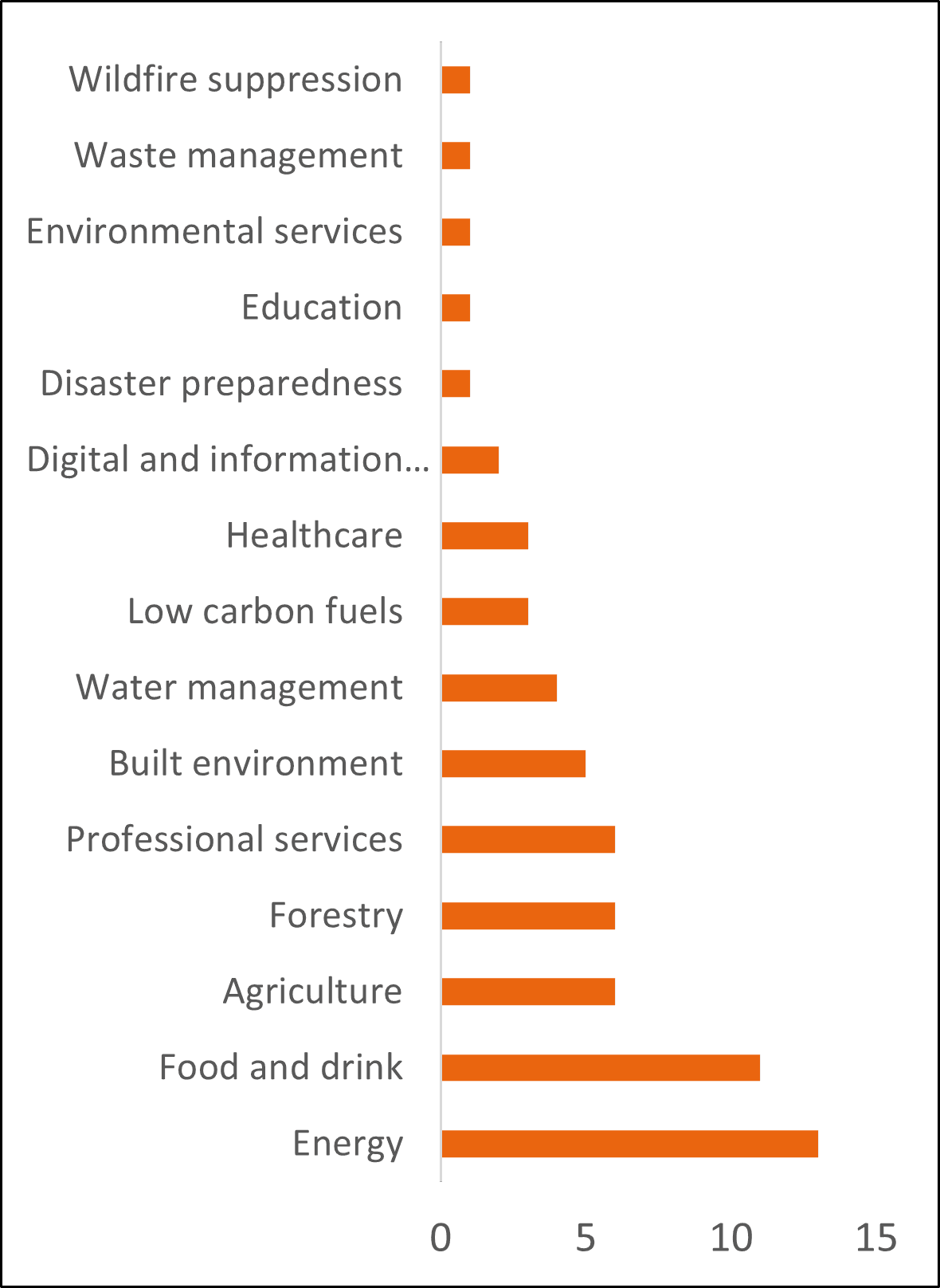
Figure 5: A bar chart displaying the number of mentions of specific economic opportunities from climate change adaptation found as part of our literature review, categorised by economic sector.
Sector | Economic opportunity (services) | Example illustrative quote |
Built | Flood resilience and drainage solutions | “In the last 18 months, we’re not just talking about carbon and climate mitigation anymore. We’re very much talking about adaptation and resilience […] It is a huge source of growth. I couldn’t comment on how much of it could be linked back to climate. However, what we do have is […] our own sustainability strategy, and we have a tool which we apply to every single project.” |
Nature based and hybrid solutions in the built environment | ||
Retrofit for climate resilience | ||
Climate risk data, assessment and advisory services | ||
Food and Agriculture | Climate-resilient crops and agricultural inputs | “Data analytics will be critical in the future, and the ability to interpret and act on insights will transform on-farm operations. The level of attention to detail required will be phenomenal…This shift will likely be accelerated by the need for both adaptive and mitigative actions.” |
Water management and on-farm resilience measures | ||
Digital agri-tech, data, and advisory services | ||
Land-based and landscape-scale adaptation approaches | ||
Finance and Insurance | Climate risk analytics and catastrophe modelling | “Resilience bonds and funds present significant gaps in their current structure, particularly in risk assessment. More work is needed to develop robust frameworks that accurately evaluate and price resilience-related risks.” |
Risk transfer and insurance innovation | ||
Resilience-linked lending and investment | ||
Nature and place-based finance models |
6.1 Areas of opportunity for priority Scottish economic sectors
In the Built Environment, demand is driven by immediate physical risks (particularly flooding, rainfall intensity and overheating), creating activity in retrofit, drainage, climate-informed design, and nature-based solutions. In Food and Agriculture, adaptation is centred on managing volatility in weather and water availability to protect yield stability and business continuity, with opportunities in resilient crops, water management, digital agritech, advisory services, and landscape-scale approaches. In Finance and Insurance, physical climate risks are already material to asset values and insurability, generating demand for analytics, modelling, insurance innovation, and emerging place-based finance models that incentivise resilience.
Across these sectors, several common themes emerge. First, growth is concentrated in services (e.g. data, skills, and coordinated delivery models), rather than in physical goods (e.g. large-scale manufacturing or commodity expansion). Second, markets strengthen when climate risk affects the bottom line, for example through insurance pricing, asset valuation, regulation, or operational disruption. Third, Scotland’s potential competitive advantage lies in leveraging domestic climate pressures as testbeds to develop exportable expertise in analytics, retrofit, water and land management, and resilience-linked finance. Adaptation therefore presents a distributed economic opportunity, spanning the boundaries of traditional sectors and built on knowledge, capability, and systems integration, rather than single technologies.
6.2 Market evolution over time
Our research highlighted both markets that are already moving, as well as markets that are dependent on longer-term system change. In the next five years, growth is most likely in climate risk analytics and disclosure support, flood and water-related services and delivery, and incremental, practice-led adaptation in agriculture. These markets are responding to rising costs, insurance pressures and regulatory expectations. Over the longer term, adaptation markets are likely to become more structural and embedded throughout wider economic systems. This includes resilience-linked pricing in finance and insurance, large-scale retrofit programmes, catchment-scale delivery models and more mature ecosystem service markets. These opportunities depend less on new technology and more on governance, skills, standards and investable project pipelines.
6.3 Implications for economic growth
Taken together, the findings suggest that adaptation-related growth in Scotland is most likely to come from:
- High-value services, including analytics, engineering, advisory and finance structuring
- Skilled trades and SMEs involved in retrofit, drainage, monitoring and land management
- Rural and regional employment linked to landscape-scale management, nature restoration and water stewardship
The limited availability of data meant we were unable to determine sectors or opportunities which might constitute areas of competitive advantage for Scotland, nor were we able to confidently identify export markets. However, based on Scotland’s existing strengths, potential opportunity areas to export internationally would likely be skewed towards skills, professional services, delivery models, and integrated approaches, rather than standardised products or large‑scale manufacturing. However, developing areas of competitive advantage for Scotland on the international stage will depend on whether enabling conditions are put in place, such as action on skills, standards, data, and investment models. Without these, many opportunities will remain fragmented or localised.
6.4 What this means for policy
For policymakers, the central implication of this research is that the pace and scale of adaptation-led economic growth will depend less on new technologies and more on the institutional conditions that enable existing solutions to scale. The most powerful role for government is as a market shaper:
- Providing stable and credible policy signals
- Embedding resilience into standards, procurement and appraisal
- Strengthening access to high-quality, decision-ready climate data
- Investing in skills and accreditation pipelines
- Supporting place-based coordination that aggregates projects into investable programmes.
By aligning public funding rules, planning, insurance, lending and regulatory frameworks so that resilience is visible, valued and rewarded, government can convert climate risk into predictable demand. If these enabling conditions are put in place, adaptation can shift from reactive risk management to a durable source of economic activity, innovation and exportable expertise, positioning Scotland not just to withstand climate change, but to assume a leadership role in shaping resilient economies.
References
AAC Clyde Space, n.d. Scottish built satellites to tackle Scotland’s declining forest health. [Online]
Available at: Https://Www.Aac-Clyde.Space/Case-Studies/Forestsandinnovation#:~:Text=The%20AAC%20Clyde%20Space%20satellite,To%20monitor%20change%20over%20time
ABI, 2025. More action needed to protect properties as adverse weather takes record toll on insurance claims in 2024. [Online]
Available at: https://www.abi.org.uk/news/news-articles/2025/2/more-action-needed-to-protect-properties-as-adverse-weather-takes-record-toll-on-insurance-claims-in-2024/
ABI, 2025. Year-to-date property insurance payouts hit record £4.6 billion. [Online]
Available at: Https://Www.Abi.Org.Uk/News/News-Articles/2025/11/Year-to-Date-Property-Insurance-Payouts-Hit-Record-4.6-Billion/
Anderson, C. C., Renaud, F. G., Hanscomb, S. & Gonzalez-Ollauri, A., 2022. Green, hybrid, or grey disaster risk reduction measures: What shapes public preferences for nature-based solutions?. Journal of Environmental Management, Volume 310.
Bank of England, 2025. PS25/25 – Enhancing banks’ and insurers’ approaches to managing climate-related risks – Update to SS3/19. [Online]
Available at: https://www.bankofengland.co.uk/prudential-regulation/publication/2025/december/enhancing-banks-and-insurers-approaches-to-managing-climate-related-risks-policy-statement
Barclays, 2025. Agritech – sowing the seeds to Britain’s farming success. [Online]
Available at: https://home.barclays/news/press-releases/2025/04/agritech—sowing-the-seeds-to-britain-s-farming-success/
Barclays, 2025. Agritech: supporting the future of farming. [Online]
Available at: https://home.barclays/content/dam/home-barclays/documents/news/Insights/Barclays_Agritech_Report_FINAL.pdf
BBC, 2025. Scottish space sector lands £4.6m investment at Glasgow conference. [Online]
Available at: Https://Www.Bbc.Co.Uk/News/Articles/Cd9zlvvlyyyo
BCG, 2025. The private equity opportunity in climate adaptation and resilience. [Online]
Available at: https://web-assets.bcg.com/b0/07/11ba848b4ae8a55e19ce9955aa92/the-private-equity-opportunity-in-climate-adaptation-and-resilience-may-2025.pdf
Beauchamp, K., 2018. Climate change impacts on Scotland’s forestry supply chain. [Online]
Available at: https://www.climatexchange.org.uk/wp-content/uploads/2023/09/climate-change-impacts-on-scotlands-forestry-supply-chain.pdf
Bennett, D. & Hamilton, I., 2025. Who are the workers who will fire Scotland’s space industry?. [Online]
Available at: Https://Www.Bbc.Co.Uk/News/Articles/C3epzvp3nxzo
Bonaventura, M., 2018. Scoping and sizing the Scottish Adaptation & Resilience (Climate Change) (A&RCC) Economy: An overview of methods.. [Online]
Available at: www.climatexchange.org.uk
Built Environment Forum Scotland, 2023. Facts & figures. [Online]
Available at: https://www.befs.org.uk/scotlands-historic-environment/facts-figures/#:~:text=Traditional%20dwellings%20constructed%20before%201919,Participation%20in%20the%20Historic%20Environment
Climate Change Committee, 2025. Progress in adapting to climate change: 2025 report to Parliament. [Online]
Available at: https://www.theccc.org.uk/publication/progress-in-adapting-to-climate-change-2025/
Climate Financial Risk Forum, 2025. From risk to resilience: integrating adaptation into finance. [Online]
Available at: https://www.fca.org.uk/publication/corporate/from-risk-resilience-integrating-adaptation-finance.pdf
ClimateXChange, 2018. Indicators and trends: Suitability and productivity (forestry). [Online]
Available at: https://www.climatexchange.org.uk/projects/indicators-and-trends-suitability-and-productivity-forestry/
Defra, 2022. UK Climate Change Risk Assessment 2022. [Online]
Available at: https://www.gov.uk/government/publications/uk-climate-change-risk-assessment-2022
El-taibi, B. et al., 2024. Enhancing water management in smart agriculture: a cloud and IoT-based smart irrigation system. Results in Engineering, Volume 22.
England, K., Watkiss, P. & Hunt, A., 2024. An economic assessment of climate risks and opportunities for the Highlands – Regional Report.. [Online]
Available at: https://highlandadapts.scot/wp-content/uploads/2022/02/Regional-Report-HCROA.pdf
EY, 2024. UK businesses lead way with climate transition planning and disclosures. [Online]
Available at: Https://Www.Ey.Com/En_uk/Newsroom/2024/12/Uk-Businesses-Lead-Way-with-Climate-Transition-Planning-Disclosures
Farm Advisory Service, 2026. Business and Policy March 2026. [Online]
Available at: https://www.fas.scot/article/business-and-policy-march-2026-policy/
Financial Conduct Authority, 2025. The Financial Conduct Authority’s Adaptation Report. [Online]
Available at: https://www.fca.org.uk/publication/corporate/fca-adaptation-report-2025.pdf
Flood Re, 2023. Propoerty flood resilience market study. [Online]
Available at: https://www.floodre.co.uk/wp-content/uploads/20759_Flood_Re_PFR-Report_2023.pdf
Flood Re, 2024. Flood Re Limited: Annual report and accounts 2023-24. [Online]
Available at: https://www.floodre.co.uk/ara-2024/transition/
Forestry and Land Scotland, 2021. Forestry and Land Scotland’s Climate Change Plan. [Online]
Available at: https://forestryandland.gov.scot/media/o4hogcia/climate-change-plan.pdf
Forestry Commission, 2023. The UK Forestry Standard. [Online]
Available at: https://www.forestry.gov.scot/sites/default/files/pub-documents/Ukfs-webpage—uk-forestry-standard-5th-edition-%282023%29-%5Bpdf-1%5D.pdf
Foyn, A. & Skinner, R., 2024. Market size and forecast: Climate financial data and analytics 2022-2028. [Online]
Available at: https://www.verdantix.com/venture/report/market-size-and-forecast-climate-financial-data-and-analytics-2022-2028-global
Frontier Economics, 2022. Barriers to financing adaptation actions in the UK: an evidence report, s.l.: s.n.
Garnett, E. R. & Nissen, B., n.d. Trends in sustainable solutions for the build environment: Reflecting on 2024. [Online]
Available at: https://ukgbc.org/trends-in-solutions-2024/
[Accessed January 2026].
GII, 2025. Climate risk advisory market forecasts to 2032 – Global analysis by service type, organisation size, deployment mode, end user and by geography. [Online]
Available at: https://www.giiresearch.com/report/smrc1859825-climate-risk-advisory-market-forecasts-global.html
Global Center on Adapataion & Climate Policy Initiative, 2024. State and trends in climate adaptation finance 2024. [Online]
Available at: https://gca.org/wp-content/uploads/2024/04/State-and-Trends-in-Climate-Adaptation-Finance-2024.pdf
Global Insight Services, 2025. Predictive climate risk analytics market: Size, growth, trends, and forecast. [Online]
Available at: https://www.globalinsightservices.com/reports/predictive-climate-risk-analytics-market/
Gonzalez Pelaez, A., Daniell, J. & Douglas, R., 2025. Insurance and risk management tools for agriculture in the EU. [Online]
Available at: https://www.fi-compass.eu/sites/default/files/publications/EAFRD_AGRI_Insurance_Risk_MA.pdf
Grand View Research, 2025. Earth observation market 2025-2030. [Online]
Available at: https://www.grandviewresearch.com/industry-analysis/earth-observation-market-report
Green Finance Institute, 2021. The finance gap for UK nature. [Online]
Available at: https://legacy.greenfinanceinstitute.com/wp-content/uploads/2021/10/The-Finance-Gap-for-UK-Nature-13102021.pdf
Griffith, R. & Nicholls, M., 2024. Finance for place-based climate action: case studies of Westminster and Cumberland. [Online]
Available at: https://justtransitionfinance.org/wp-content/uploads/2024/09/Finance-for-place-based-climate-action-case-studies-of-Westminster-and-Cumberland-policy-brief-1.pdf
[Accessed February 2026].
Highlands and Islands Enterprise, 2026. Growing in controlled environments. [Online]
Available at: https://www.hie.co.uk/our-region/our-growth-sectors/foodanddrink/growing-in-controlled-environments/
[Accessed February 2026].
Historic Environment Scotland, 2024. Annual Report 2023-24. [Online]
Available at: https://www.historicenvironment.scot/archives-and-research/publications/publication/?publicationId=62917fd9-2ca6-4a66-8343-b20900a6822b
Hunt, A., England, K. & Watkiss, P., 2024. An economic assessment of climate risks and opportunities for the Highland food and drink sector. [Online]
Available at: www.highlandmentalwellbeing.scot.nhs.uk
James Hutton Institute, 2025. Crop breeding. [Online]
Available at: https://www.hutton.ac.uk/wp-content/uploads/2025/07/Crop-breeding_A4.pdf
James Hutton Institute, 2025. The James Hutton Institute’s world class science delivers huge economic impact. [Online]
Available at: https://www.hutton.ac.uk/the-james-hutton-institutes-world-class-science-delivers-huge-economic-impact/
k-Matrix, 2019. The Adaptation Economy of Glasgow City Region. [Online]
Available at: https://static1.squarespace.com/static/5ba0fb199f8770be65438008/t/5c6e82eeee6eb0281c1531b0/1550746384210/11+kMatrix+-+The+Adaptation+Economy+of+Glasgow+City+Region.pdf
LESG, 2025. Sustainable bonds on the London Stock Exchange – a decade of innovation. [Online]
Available at: https://www.lseg.com/en/insights/sustainable-bonds-london-stock-exchange-decade-of-innovation
LETI, 2021. LETI Climate Emergency Retrofit Guide: How existing homes can be adapted to meet UK climate targets. [Online]
Available at: https://www.leti.uk/_files/ugd/252d09_c71428bafc3d42fbac34f9ad0cd6262b.pdf
Littenberg, M., Rotter, M. & Witschi, P., 2024. Climate-related disclosures by U.S.-based and other companies: stats from the new IFRS Foundation Progress Report. [Online]
Available at: https://corpgov.law.harvard.edu/2024/12/20/climate-related-disclosures-by-u-s-based-and-other-companies-stats-from-the-new-ifrs-foundation-progress-report/
Lloyd’s, 2025. How insurance works. [Online]
Available at: https://www.lloyds.com/about-lloyds/our-market/how-insurance-works
[Accessed February 2026].
London School of Economics and Political Science, 2024. What role do catastrophe bonds play in managing the physical risks from climate change?. [Online]
Available at: https://www.lse.ac.uk/granthaminstitute/explainers/what-role-do-catastrophe-bonds-play-in-managing-the-physical-risks-from-climate-change/
[Accessed February 2026].
Lucia , R. L. E., Blanchy, G., Mehmandoostkotlar, A. & Garre, S., 2024. Exploring climate-adaptive drainage in water management: Enhancing soil moisture, crop resilience and groundwater recharge. [Online]
Available at: https://ui.adsabs.harvard.edu/abs/2024EGUGA..26.3837L/abstract
[Accessed February 2026].
Met Office, 2024. Met Office delivers £56 billion of economic value to the UK. [Online]
Available at: https://www.metoffice.gov.uk/about-us/news-and-media/media-centre/corporate-news/2024/met-office-delivers-gbp56-billion-of-economic-value-to-the-uk
Mordor Intelligence, 2025. Climate data analytics market size & share analysis – Growth trends & forecasts (2025-2030). [Online]
Available at: https://www.mordorintelligence.com/industry-reports/climate-data-analytics-market
Morton Fraser Macroberts, 2025. Scotland’s growing role in the UK tech ecosystem. [Online]
Available at: https://www.mfmac.com/insights/manufacturing-media-technology/scotlands-growing-role-in-the-uk-tech-ecosystem/
OECD, 2025. Global Insurance Market Trends 2025. [Online]
Available at: https://www.oecd.org/en/publications/global-insurance-market-trends-2025_0d11ecf4-en/full-report/component-3.html
OECD, 2025. Scaling finance and investment for climate adaptation: Input paper for the G20 Sustainable Finance Working Group. [Online].
O’Gorman, S. et al., 2024. Economic Opportunities in Scotland’s net zero and climate adaptation economy. [Online]
Available at: https://doi.org/10.7488/era/4354
Rackley, S., 2024. What happens after Flood Re?. [Online]
Available at: https://www.cii.co.uk/learning/learning-content-hub/articles/what-happens-after-flood-re/8f85e9e4-9560-415a-bc67-6ce1f057484f
Randall, T., Sedemund, J. & Bartz-Zuccala, W., 2023. Private investment for climate change adaptation – difficult to finance or difficult to see the finance?. Technological Forecasting and Social Change, Volume 185.
Reguis, A. et al., 2023. Energy performance of Scottish public buildings and its impact on the ability to use low-temperature heat. Energy and Buildings, 290(113064).
Reinders, H. J., Shoenmaker, D. & van Dijk, M., 2025. Climate risk stress testing: A critical survey and classification. Journal of Climate Finance, Volume 10.
Retrofit Information, Support & Expertise RISE, 2024. Understanding the fabric first approach: Advice pack. [Online]
Available at: https://riseretrofit.org.uk/storage/uploads/1726218220_20240809_TAF2_AdvicePack_Fabric_First_final.pdf
[Accessed February 2026].
Royal Bank of Scotland, 2022. Agri-tech outlook 2022, part 2: new technology to meet challenges. [Online]
Available at: https://www.rbs.co.uk/business/insights/sector-trends/agriculture/rbs-agri-tech-outlook2022-part-2-new-technology.html
Scottish Affairs Committee, 2025. Scotland’s space sector follow-up: launch. [Online]
Available at: https://publications.parliament.uk/pa/cm5901/cmselect/cmscotaf/671/report.html
Scottish Development International, 2025. From spaceports to satellites; Scotland’s thriving space sector. [Online]
Available at: Https://Www.Sdi.Co.Uk/News-and-Success-Stories/News-Stories/from-Spaceports-to-Satellites-Scotland-s-Thriving-Space-Sector
Scottish Development International, 2025. How Scottish space data companies are transforming insurance. [Online]
Available at: https://www.sdi.co.uk/news-and-success-stories/news-stories/how-scottish-space-data-companies-are-transforming-insurance
Scottish Government, 2019. Place Principle: introduction. [Online]
Available at: https://www.gov.scot/publications/place-principle-introduction/
[Accessed February 2026].
Scottish Government, 2024. Climate Change: Scottish National Adaptation Plan 2024-2029. [Online]
Available at: https://www.gov.scot/publications/scottish-national-adaptation-plan-2024-2029-2/pages/9/
Scottish Government, 2024. National Flood Resilience Strategy. [Online]
Available at: https://www.gov.scot/binaries/content/documents/govscot/publications/strategy-plan/2024/12/national-flood-resilience-strategy-3/documents/national-flood-resilience-strategy/national-flood-resilience-strategy/govscot:document/national-flood-resilience-stra
Scottish Government, 2025. Future Farming Investment Scheme. [Online]
Available at: https://www.ruralpayments.org/topics/all-schemes/ffis/#:~:text=The%20Future%20Farming%20Investment%20Scheme,the%20effect%20of%20climate%20change
Sharma, R., 2025. Climate risk analytics market research report 2033. [Online]
Available at: https://marketintelo.com/report/climate-risk-analytics-market
Strategic Revenue Insights, 2026. Space service market size, future growth and forecast 2033. [Online]
Available at: https://www.strategicrevenueinsights.com/industry/space-service-market
Sutherland, L.-A., Banks, E., Boyce, A. & Martinat, S., 2023. Establishing an agricultural knowledge and innovation system. [Online]
Available at: https://era.ed.ac.uk/server/api/core/bitstreams/93fe92dd-2411-437f-9d34-eb5b6e93e6f5/content
The Global City, 2026. Financing the global transition. [Online]
Available at: http://theglobalcity.uk/sustainable-finance/opportunities/transition-finance
Trabacchi, C. & Mazza, F., 2015. Emerging solutions to drive private investment in climate resilience, s.l.: s.n.
Trittip, A. et al., 2025. Climate resilience technology: An inflection point for new investment. [Online]
Available at: https://www.mckinsey.com/capabilities/sustainability/our-insights/climate-resilience-technology-an-inflection-point-for-new-investment#/
UK Space Agency, 2025. Scottish space innovation secures UK Space Agency Investment. [Online]
Available at: Https://Www.Gov.Uk/Government/News/Scottish-Space-Innovation-Secures-Uk-Space-Agency-Investment
UKGBC, 2022. The value of urban nature-based solutions. [Online]
Available at: https://ukgbc.org/wp-content/uploads/2022/05/UKGBC_WIP-Report_V09-LR.pdf
UKGBC, 2025. Home Retrofit. [Online]
Available at: https://ukgbc.org/our-work/home-retrofit/
[Accessed January 2026].
UKGBC, 2025. Trends in sustainable solutions for the built environment 2025. [Online]
Available at: https://ukgbc.org/trends-in-sustainable-solutions-2025/
University of Edinburgh, 2026. Artificial Intelligence. [Online]
Available at: Https://Www.Ed.Ac.Uk/Ai
Webber, G., 2025. Key updates from the new SuDS standards for 2025 – Barker Associates. [Online]
Available at: https://www.barker-associates.co.uk/new-suds-standards-for-2025/
Woodall, L., 2026. Europe calculates adaptation shortfall, climate slips down global risk agenda, supply chain tech company closes $20mn raise, and more. [Online]
Available at: https://www.climateproof.news/p/europe-calculates-adaptation-shortfall-climate-slips-down-global-risk-agenda-supply-chain-tech-compa
Woodland Carbon Code, 2025. UK carbon prices. [Online]
Available at: https://www.woodlandcarboncode.org.uk/uk-carbon-prices#para-147-2-0
World Economic Forum, 2025. From Risk to Reward: Unlocking Private Captial for Cliamte and Growth. [Online]
Available at: https://reports.weforum.org/docs/WEF_Risk_to_Reward_2025.pdf
World Economic Forum, 2025. What is parametric insurance and how is it building climate resilience?. [Online]
Available at: https://www.weforum.org/stories/2025/01/what-is-parametric-insurance-and-how-is-it-building-climate-resilience/
[Accessed February 2026].
Appendices
Appendix A Detailed methodology and assumptions
We conducted this study between October 2025 and January 2026. It employed a four-phase, mixed-methods approach designed to identify, prioritise and assess climate adaptation–related economic opportunities in Scotland. The methodology combined a targeted literature review, market data synthesis, stakeholder engagement, and thematic analysis. Each phase is described below.
Appendix A.1 Targeted literature review and opportunity identification
We undertook a targeted rapid review of key Scotland-specific literature on the adaptation economy to establish an initial evidence base. Sources included England et al. (2024), k-Matrix (2019), O’Gorman et al. (2024), Bonaventura (2018) and early insights from the forthcoming UK’s Fourth Climate Risk Assessment carried out by the Grantham Institute LSE (Gannon, 2026). These sources were selected given their relevance to Scotland’s adaptation economy.
Additionally, we conducted a targeted search of academic and grey literature published within the last four years using the search terms “Scotland”, “climate”, “adaptation”, and “economy”. This supplementary search focused particularly on identifying innovation-led adaptation opportunities, emerging technologies, and developing commercial areas relevant to Scotland.
We used the Adaptation Scotland programmes 15 Key Consequences of Climate Change as a biophysical framework to assess the evidence. For each source, references to economic adaptation opportunities were recorded and systematically mapped against the relevant climate consequences. This included opportunities that were explicitly framed as adaptation, as well as activities primarily described as mitigation, environmental management or innovation, but which have clear adaptation relevance when considered through an adaptation lens. We used a data extraction template to support this process of systematically extracting evidence from the literature and to help identify and shortlist significant opportunities and sectors. Further details on this can be found in Appendix B Detail on outputs of literature analysis.
To review the mapped opportunities and sectors, we organised an interim workshop with the steering group. This collaborative session enabled collective sense checking and consensus building on priority sectors and opportunities to be taken forward. We prioritised sectors based on recurrence across sources, relevance to Scotland’s economy, evidence of current or emerging market activity, and potential for scalability or export. The priority sectors for subsequent stages of the research were Built Environment, Food and Agriculture, and Finance and Insurance.
Appendix A.2 Market data synthesis and narrative scenario development
For the prioritised opportunity sectors identified in Phase 1, we extracted available market data from the reviewed literature and initial publication sources. Both quantitative and qualitative data were collated, with a focus on addressing the study’s research questions. Key variables included the nature of the opportunity, indicative market size, short- and long-term growth potential, sources of competitive advantage, and relevance to export markets.
We synthesised the extracted data into concise summaries for each opportunity area. Due to limited and largely outdated quantitative data, structured qualitative assessment was used to contextualise market dynamics and trends. Narrative descriptions were developed to articulate future scenario pathways for each sector. These scenarios were designed to provide background context for the stakeholder interviews conducted in Phase 3.
Appendix A.3 Stakeholder engagement
We conducted semi-structured interviews in November 2025 with 15 stakeholders – five from agriculture, five from built environment, and five from finance and insurance. In the sample, six interviewees were from representative bodies in food and agriculture and the built environment, whereas the rest were from private companies. Participants were recruited to reflect a broad mix of perspectives, including business and industry leaders, economic development agencies, and trade bodies. We also sought stakeholders from innovative or emerging adaptation areas, and to capture cross-sectoral opportunities.
Stakeholder recruitment utilised network-based and snowball sampling approaches to reach organisations that were not already engaged in previous research commissioned by ClimateXChange. Participants were provided with a participant information sheet, consent form, and the interview questions in advance of the interview. All participants gave informed consent. Participants were given the option to be named or to remain anonymous, in any quotations used. All data collected was processed and stored in line with GDPR rules.
We conducted interviews online from 11 November to 5 December 2025 using Microsoft Teams. Interviews were recorded and transcribed via Teams and stored securely in SRUC’s SharePoint server. Each interview lasted around 60 minutes. Interview topic guides were designed to validate findings from the desk-based research, explore market barriers and enablers, and elicit perspectives on market growth and export potential. Questions were also designed to examine adaptation solutions in practice, alongside insights into constraints with scaling, commercialisation, and market uptake. Further details on the interview guide are detailed in Appendix C Interview guide.
Appendix A.4 Thematic synthesis and reporting
We developed a coding framework to support interview coding and thematic analysis of interview transcripts as shown in Appendix D Coding framework and thematic analysis approach. Analysis focused on identifying convergent and divergent themes related to the research questions. The analysis also highlighted cross and sector-specific themes.
Findings were structured primarily by sector to address the themes below:
- Emerging adaptation-related economic opportunities
- Short-term and long-term market potential
- Scotland’s current or potential competitive advantage
- Barriers and enablers
Themes were developed iteratively, integrating findings from interview coding with patterns identified in the literature review to ensure conclusions reflected both evidence streams. Upon agreement from the steering group, a case study on weather and earth observation data solutions was used for a deeper dive on market potential for the sector. The final format and structure of report was agreed in consultation with the steering group during the analysis phase.
Appendix B Detail on outputs of literature analysis
We developed a structured data extraction template to systematically capture evidence from the literature review. Each row in the resulting template represented a single, discrete, adaptation-related economic opportunity identified within a source. Where a publication referenced multiple opportunities, these were recorded as separate rows.
For each opportunity, the template captured:
- Bibliographic metadata (e.g. source title, author, publication year, source type);
- Contextual information (geographic scope, sector and sub‑sector);
- A qualitative description of the adaptation opportunity.
We mapped each opportunity to relevant climate risks and biophysical drivers using the Adaptation Scotland programme’s 15 Key Consequences of Climate Change framework. Additional fields captured temporal characteristics (short‑term versus longer‑term hazards, opportunity type, and strategic relevance to Scotland (direct, indirect, or export‑oriented). Other attributes that were recorded included barriers and enablers, associated risks, and the frequency with which similar opportunities appear across the literature. We applied an initial prioritisation score to shortlist sectors and opportunities. The quality of available market evidence was also assessed for each opportunity (quantitative, qualitative, or no market data).
Due to the content size of the file, it is not feasible to be attached with this report. A summary of findings is displayed in Appendix B.1 below which details examples of opportunities identified in the literature alongside the frequency of mentions and corresponding sub-sector.
Appendix B.1 Summary of data collected from literature review
Sub-sector | Broad sector | Mentions | Examples |
Financial services / insurance | Professional Services | 19 (10) | Disaster resilience insurance, green bonds, adaptation equity funds, environmental markets (PES) |
Climate resilient buildings, retrofitting | Built Environment | 11 | Climate resilient construction materials, retrofitting and energy efficiency, |
Infrastructure Resilience | Built Environment | 11 | Flood defences and drainage systems, grid hardening, climate resilient energy generation technologies, transport and logistics upgrades), Nature based solutions |
Aquaculture | Food and Drink | 9 | New fish stock, Snorkel sea cage technology, salmon breeding and vaccines, spatial planning |
Consulting: engineering, environmental | Professional Services | 6 | Sustainability consultancy, climate risk advisory, compliance with evolving regulations, flood risk assessments engineering and planning |
Sensors, information systems data management | Digital and Information solutions | 6 | Early Warning and Disaster Monitoring Systems, Communications and ICT Infrastructure, predictive modelling, urban analytics, smart buildings |
Crop suitability and changes in growing season | Agriculture | 5 | New crops due to change in climate (Soybeans, wild cabbage, truffle) |
Irrigation and heat resilience | Agriculture | 5 | Heat and drought resilient crops, irrigation technology, soil management |
Water management, storage and irrigation | Water Management | 4 | Water storage, sustainable drainage, leakage control, smart water meters, desalination, wastewater treatment |
Flood resilience | Water Management | 3 | Flood defences, sustainable drainage, stormwater and flood software |
Agri-tech | Agriculture | 3 | Controlled environment agriculture, precision agriculture hardware, precision livestock farming |
Resilient crops | Agriculture | 2 | Crop genetics, seeds, biotechnology – drought and pest resilience |
Nature based solutions – flood management | Built Environment | 2 | Woodland |
Whisky | Food and Drink | 2 | Water use efficiency, water storage |
Health surveillance | Healthcare | 2 | Heatwave preparedness, health surveillance and warning tech, medical consumer products |
Wildfire suppression | Wildfire suppression | 2 | Anti-wildfire chemicals and materials, postfire restoration, wildfire analytics |
Ecosystem restoration | Environmental services | 2 | Peatland restoration afforestation, coastal habitat management |
Tourism growth | Tourism | 2 | Tourism moving north, hospitality accommodation |
Appendix C Interview guide
Our interviews were based around aa core set of overarching questions (see Appendix C. 1). These questions were adapted for each interview to reflect sector-specific contexts and to explore the most relevant adaptation-related opportunities in greater depth.
During interviews, we presented participants with a summary table of adaptation opportunities identified for their specific sector during the desk-based review. This was used to prompt discussion on future growth potential, market dynamics, demand drivers, barriers, and enablers.
To minimise research fatigue and avoid duplication, the project team conducted background research on the participating organisations and reviewed relevant publications and prior outputs where available. This allowed interviews to focus on areas of greatest relevance and insight.
Appendix C.1 Interview Guide
Introduction |
Note to participants- For the purposes of this research, please focus on climate adaptation, meaning products or services that help manage or respond to the physical impacts of climate change (e.g. drought, floods, storms, sea level rise). |
General understanding of adaptation economy |
|
Sector-specific opportunities |
|
Market dynamics and trends |
|
International competitive advantage |
|
Future outlook |
|
Appendix D Coding framework and thematic analysis approach
We developed a coding framework to assess the climate risk, adaptation, strategic responses, and identified economic adaptation opportunities across the financial services, agriculture/food and built environment sectors.
The framework organises interview data across five core themes: sector and regulatory context, climate risks, adaptation strategies, innovation and opportunities, barriers and enablers, market and strategic outlook, and competitive advantage. We created an additional level of sub-theme for each data point to summarise specific insights or findings from interview quotes which allowed quicker identification of common themes for cross-sectoral analysis.
Appendix D.1 Coding framework
Theme | Sub-theme |
Sector context | Climate related levies or tax exemption |
Sector context | Wider conversations and priorities |
Sector context | Policy alignment |
Regulatory environment | Industry wide sustainability goals/commitments |
Regulatory environment | Sanctions |
Regulatory environment | AECS |
Climate risk | Resource risk |
Innovation and opportunities | Opportunity |
Climate risk | Supply chain risk |
Climate risk | Trends |
Climate risk | Credit risk |
Climate risk | Energy risk |
Climate risk | Changing weather and farming conditions |
Climate risk | Drought |
Climate risk | Rising temperatures |
Climate risk | Flooding |
Climate risk | Sea level rise |
Climate risk | Heat, wildfires |
Climate risk | Nature-based vulnerabilities |
Climate risk | Storms |
Climate risk | Infrastructure damage |
Adaptation strategies | Examples |
Adaptation strategies | Changing weather and adapting farming opportunities |
Adaptation strategies | Changing weather and farming conditions |
Adaptation strategies | New crop variants |
Adaptation strategies | Trends |
Barriers and enablers | Enabler |
Adaptation strategies | Drivers |
Adaptation strategies | Forestry |
Innovation and opportunities | Technological innovation |
Innovation and opportunities | Circular economy |
Innovation and opportunities | Digital solutions |
Innovation and opportunities | Frameworks |
Barriers and enablers | Barrier |
Innovation and opportunities | Data tool |
Barriers and enablers | Financial constraints/opportunities for adaptation |
Barriers and enablers | Financial constraints |
Barriers and enablers | Mitigation versus adaptation |
Barriers and enablers | Policy and incentives |
Barriers and enablers | Knowledge gap |
Barriers and enablers | Skills shortage |
Barriers and enablers | Incentives |
Barriers and enablers | Political barriers |
Barriers and enablers | Political barriers/ Financial constraints |
Barriers and enablers | Incentives / Political barrier / Financial constraint |
Barriers and enablers | Enabler/ Barrier |
Barriers and enablers | Policy enabler |
Barriers and enablers | Policy barrier |
Barriers and enablers | Legislation barrier |
Market and strategic outlook | Knowledge gap |
Market and strategic outlook | Export market outlook |
Market and strategic outlook | Scottish-specific |
Market and strategic outlook | Consumer trends |
Market and strategic outlook | Short term |
Market and strategic outlook | Long term |
Market and strategic outlook | Global markets |
Market and strategic outlook | Mitigation and adaptation |
Market and strategic outlook | Disruptor |
Competitive advantage | Existing market leader |
Competitive advantage | Market penetration |
Competitive advantage | Natural Resources |
Competitive advantage | Innovation |
Competitive advantage | Local strength |
Competitive advantage | Engineering |
Competitive advantage | Established market |
Competitive advantage | Competition |
Competitive advantage | Changing weather in other parts |
Competitive advantage | Land use |
Competitive advantage | Institutional |
Competitive advantage | Land ownership |
Competitive advantage | Data tool |
How to cite this publication:
Barthelmess, V., Naidu, T., Vester, S., and Stevens, B. (2026) ‘ Exploring opportunities to build a climate resilient economy ‘, ClimateXChange.
© The University of Edinburgh, 2026. Prepared by SAC Consulting on behalf of ClimateXChange, The University of Edinburgh. All rights reserved.
While every effort is made to ensure the information in this report is accurate as at the date of the report, no legal responsibility is accepted for any errors, omissions or misleading statements. The views expressed represent those of the author(s), and do not necessarily represent those of the host institutions or funders.
This work was supported by the Rural and Environment Science and Analytical Services Division of the Scottish Government (CoE – CXC).
ClimateXChange
Edinburgh Climate Change Institute
High School Yards
Edinburgh EH1 1LZ
+44 (0) 131 651 4783
If you require the report in an alternative format such as a Word document, please contact info@climatexchange.org.uk or 0131 651 4783.
Place-based lending involves financial models that invest adaptation outcomes through nature‑based solutions (e.g. flood mitigation, water stewardship, landscape‑scale resilience, ecosystem services) and link multiple beneficiaries to shared outcomes. ↑
International Sustainability Standards Board and Taskforce for Nature-related Financial Disclosures. ↑
Appendix B.1 includes a table which details the unique opportunities and sub-sectors identified in the literature. It should be noted this does not accurately represent the economic size of the opportunities. Some opportunities are also cross-sectoral. For instance, water management and flood resilience is a significant sector in Scotland but did not emerge with high number of opportunities, however some services were captured within other sectors such as agriculture and built environment.
Grey infrastructure are “hard engineering” solutions such as dams or dikes; Green and blue infrastructure are types of nature-based solutions such as created wetlands, rain gardens, etc.; Hybrid grey-green combine natural and non-natural elements, e.g. sea walls that are designed to provide habitat (Anderson, et al., 2022). ↑
These outcomes are clean water, biodiversity protection/restoration, flood risk reduction, improved bio-resource efficiency, climate mitigation through bio-carbon, enhanced biosecurity, and improved access and engagement with natural environment. ↑
Natural flood management measures include nature restoration that enhance water flow regulation and water retention capacity of soils. ↑
“The fabric first approach to net zero retrofitting involves improving a building’s energy performance primarily through modifications to its physical fabric, rather than solely relying on advanced technologies and renewable energy systems. This approach is built on the principle of minimising energy demand first before any change to building services by enhancing the building envelope and employing passive design strategies” (Retrofit Information, Support & Expertise RISE, 2024). ↑
See for details: Task Force on Climate-related Financial Disclosures. ↑
Climate adaptive drainage (also known as controlled drainage) is the practice of managing the drainage of cultivated fields to raise the water table (to the degree possible, and not to the detriment of crops currently growing) to enhance aquifer recharge and store water in fields for use in drier months (Lucia , et al., 2024). ↑
Statistics published in March 2025 indicated a total of 282,215 units for WCC and 187, 291 units for PC were sold as Pending Issuance Units (i.e. units that are due to be verified by an independent body). The data was calculated using average prices of £26.85 for WCC and £25.04 for PC in 2024. ↑
Controlled environment agriculture includes protected growing under structures such as polytunnels and glasshouses, and often includes smart technologies for monitoring and remote management of glasshouses right through to vertical farming, where fresh produce is grown in stacked layers under LED lighting (Highlands and Islands Enterprise, 2026). ↑
Results from the Scottish Agricultural Census: June 2025 – gov.scot ↑
“Due to the size and complexity of some risks, some insurers take out their own, additional insurance – as added protection for themselves. When insurers insure a risk again, it’s called reinsurance” (Lloyd’s, 2025). ↑
The TCFD has now been integrated into the International Financial Reporting Standards ↑
“Also known as event or index-based insurance, parametric [insurance] products trigger payouts when specific conditions are met, such as certain levels of rainfall or wind speed […] Ultimately, these attributes strengthen the resilience of vulnerable communities. Unlike traditional insurance, which is based on the actual losses sustained, parametric insurance is linked to a specified event. This expands the scope of coverage and addresses gaps that conventional policies often leave unprotected” (World Economic Forum, 2025). ↑
“A catastrophe bond is a financial instrument that transfers financial risk connected with exposure to natural disasters to capital market investors. Catastrophe bonds have their origins in the aftermath of several major natural disasters that struck the United States in the 1990s and caused the insurance and reinsurance industry to reevaluate their methods” (London School of Economics and Political Science, 2024). ↑
Insurance penetration is the total of premiums written for both life and non-life insurance business as a percentage of GDP. It provides a measure of how accessible financial protection is for people and businesses for certain risks for which insurers can provide coverage, or how “insured” a country’s population is (OECD, 2025). ↑
“Transition finance is the financial flows, products and services that facilitate an economy-wide transition to net zero consistent with the Paris Agreement. The need for transition finance will be particularly acute to support the decarbonisation of high-emitting sectors such as heavy industrial sectors, transport, energy, agriculture and the built environment.” (The Global City, 2026). ↑